

Major Events of 1944: Key Historical Moments You Need to Know
Every year brings its own set of pivotal moments that leave a lasting mark on history. From political shifts and technological advancements to cultural breakthroughs, these events shape the world and influence the future. In this comprehensive overview, we'll explore the most significant occurrences from 1944, highlighting key moments that continue to impact our lives today.
Explore by topic:
Born in 1944? Get Your Birth Year Poster!
A beautifully researched, newspaper-style poster of the year.
Step back into 1944. Get yours today!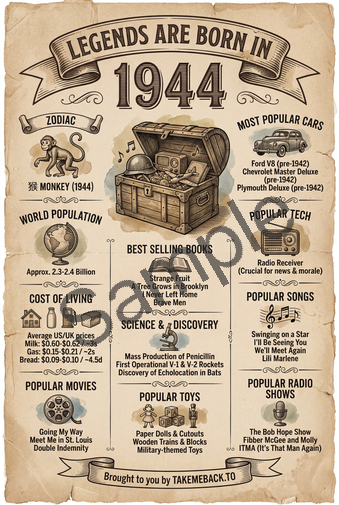

Major Events of 1944 - Historical Moments That Defined the Year | TakeMeBack.to
- 01 Jan US Army Air Force strategic planning in 1944: In early 1944, the US Army Air Force (USAAF) intensified its strategic planning to support Allied operations in Europe. A key component was the Combined Bomber Offensive (CBO), which aimed to weaken German industrial capacity and disrupt transportation networks. The CBO plan, finalized in April 1943, outlined 18 operations per three-month phase targeting 76 specific objectives, with the goal of reducing German war production and hindering troop movements. This strategic bombing campaign was integral to the success of subsequent Allied landings in Normandy. source: nps.gov
- 02 Jan Allied landing at Saidor, Papua New Guinea: On January 2, 1944, Allied forces conducted a landing at Saidor, Papua New Guinea, as part of the New Guinea campaign during World War II. This operation aimed to secure the Huon Peninsula and establish a base for further operations against Japanese forces in the region. The successful landing at Saidor contributed to the Allied strategy of advancing towards the Philippines and Japan. source: en.wikipedia.org
- 03 Jan William Tubman becomes President of Liberia: William Tubman was inaugurated as the 20th President of Liberia on January 3, 1944. His presidency marked significant political and economic changes in Liberia, including efforts to modernize the country and improve relations with the United States. source: britannica.com
- 04 Jan Operation Carpetbagger begins: Operation Carpetbagger commenced on January 4, 1944, as a covert operation by the United States to supply and support resistance movements in occupied Europe during World War II. This operation was crucial for the success of Allied forces. source: britannica.com
- 05 Jan Soviet Capture of Berdychiv: On January 5, 1944, Soviet forces captured the city of Berdychiv in Ukraine during their offensive against German troops. This event was part of the larger Soviet campaign to reclaim territory lost during the early years of World War II. source: britannica.com
- 06 Jan Establishment of US Navy Task Force 58: On January 6, 1944, the United States Navy established Task Force 58, which played a pivotal role in the Pacific Theater during World War II. This task force was instrumental in various naval operations, including the liberation of the Philippines. source: britannica.com
- 09 Jan Birth of Jimmy Page: James Patrick Page, known as Jimmy Page, was born in Heston, Middlesex, England. He later achieved international success as the guitarist and founder of the rock band Led Zeppelin. source: en.wikipedia.org
- 11 Jan Roosevelt's Second Bill of Rights Proposal: On January 11, 1944, President Franklin D. Roosevelt proposed a "Second Bill of Rights" during his State of the Union Address, aiming to guarantee economic rights such as employment, adequate income, and education. source: en.wikipedia.org
- 14 Jan San Juan Earthquake disaster: On January 14, 1944, a devastating earthquake struck San Juan, Puerto Rico, causing significant destruction and loss of life. The quake registered a magnitude of 6.4 and resulted in extensive damage to buildings and infrastructure, leading to a humanitarian crisis. source: usgs.gov
- 15 Jan European powers plan Germany's post-war division: On January 15, 1944, discussions among European powers regarding the post-war division of Germany intensified. This planning was crucial for shaping the geopolitical landscape of Europe after World War II, as nations sought to prevent future conflicts. source: britannica.com
- 17 Jan Battle of Monte Cassino begins: The Battle of Monte Cassino commenced on January 17, 1944, as Allied forces launched an assault against German positions in Italy. The battle aimed to break through the Gustav Line and advance towards Rome. source: britannica.com
- 19 Jan British bombing raid on Berlin during World War II: On January 19, 1944, British bombers conducted their heaviest raid on Berlin, dropping 2,300 tons of bombs in just over half an hour. The raid caused extensive damage to residential areas and resulted in significant civilian casualties. source: en.wikipedia.org
- 20 Jan Soviet breakthrough at Leningrad: On January 18, 1944, Soviet forces broke the Siege of Leningrad by opening a narrow corridor south of Lake Ladoga, effectively ending the 900-day blockade. source: en.wikipedia.org
- 21 Jan Eisenhower approves Operation Overlord plan: On January 21, 1944, General Dwight D. Eisenhower approved the revised Operation Overlord plan, which outlined the strategy for the Allied invasion of Normandy. The plan included landing five divisions along a thirty-mile front from the River Orne to the Cotentin Peninsula. source: en.wikipedia.org
- 22 Jan Operation Shingle: Allied amphibious landing at Anzio: On January 22, 1944, Allied forces executed Operation Shingle, an amphibious landing at Anzio and Nettuno, Italy. The operation aimed to outflank German defenses and establish a beachhead for further operations in Italy. source: en.wikipedia.org
- 23 Jan Allied forces consolidate Anzio beachhead: On January 22, 1944, Allied forces landed at Anzio, Italy, as part of Operation Shingle. By January 23, they had established a beachhead, securing the port of Anzio and the neighboring town of Nettuno. The initial landings were virtually unopposed, but the decision to consolidate the position allowed German forces to reinforce and prepare counterattacks. source: britannica.com
- 24 Jan Battle of the Korsun–Cherkassy Pocket begins: On January 24, 1944, the Battle of the Korsun–Cherkassy Pocket commenced on the Eastern Front. This significant engagement involved Soviet forces attempting to encircle and destroy German troops in the area, marking a pivotal moment in the Soviet offensive during World War II. source: en.wikipedia.org
- 25 Jan Sinking of Japanese destroyer Suzukaze: On January 25, 1944, the Japanese destroyer Suzukaze was sunk during World War II. The ship was part of the Imperial Japanese Navy and participated in various operations before its sinking. source: en.wikipedia.org
- 26 Jan Argentina severs diplomatic ties with Axis powers: On January 26, 1944, Argentina severed diplomatic relations with Germany and Japan, marking a significant shift from its previous neutral stance during World War II. source: chroniclingamerica.loc.gov
- 28 Jan Allied reinforcements at Anzio beachhead: On January 28, 1944, Allied forces landed reinforcements at the Anzio beachhead in Italy, aiming to break the stalemate on the Italian front. This operation was part of a larger strategy to outflank German defenses and advance towards Rome. source: britannica.com
- 29 Jan USS Missouri launched: The USS Missouri, a battleship of the United States Navy, was launched on January 29, 1944. This ship would later become famous for being the site of the Japanese surrender, effectively ending World War II in the Pacific. source: britannica.com
- 30 Jan US invasion of Majuro, Marshall Islands: On January 30, 1944, U.S. forces launched an invasion of Majuro in the Marshall Islands as part of their strategy to capture key locations in the Pacific during World War II. This operation was crucial for establishing bases for further assaults against Japanese-held territories. source: archives.gov
- 31 Jan US forces land in Marshall Islands during World War II: On January 31, 1944, U.S. forces successfully landed in the Marshall Islands, marking a significant step in the Pacific campaign of World War II. This operation aimed to capture the islands from Japanese control and establish strategic military bases. source: archives.gov
- 01 Feb Military intelligence support in Marshall Islands: On February 1, 1944, military intelligence operations were intensified in the Marshall Islands to support U.S. forces during their campaign in the Pacific. This intelligence was crucial for planning subsequent operations against Japanese forces. source: archives.gov
- 02 Feb Allied troops land on Japanese territory during World War II: On February 2, 1944, Allied forces continued their Pacific campaign by landing on Japanese-controlled islands in the Marshall Islands. This operation aimed to establish beachheads and secure strategic positions for further advances against Japan. source: historyofwar.org
- 03 Feb U.S. forces capture Kwajalein Atoll in World War II Pacific campaign: On February 3, 1944, U.S. forces secured Kwajalein Atoll in the Marshall Islands. This victory was a significant milestone in the Pacific campaign, providing a strategic base for further operations against Japan. source: historyofwar.org
- 04 Feb US military victory in Pacific Theater during World War II: On February 4, 1944, U.S. forces achieved a significant victory in the Pacific Theater by securing key positions in the Marshall Islands. This success was part of the broader strategy to advance towards Japan and end the war. source: historyofwar.org
- 07 Feb German counter-offensive at Anzio: On February 7, 1944, German forces launched a counter-offensive against the Allied beachhead at Anzio, Italy, aiming to drive back the invading forces. The battle resulted in significant casualties on both sides and was part of the larger Italian Campaign during World War II. source: britannica.com
- 08 Feb Death of Clem Wilson, Cricket Player: Clem Wilson, a cricket player who played two Tests for England in 1896 and was the brother of Rockley Wilson, passed away.
- 09 Feb German submarine losses off Irish coast during World War II: On February 9, 1944, several German submarines were lost off the Irish coast due to Allied naval operations. This event marked a significant point in the Battle of the Atlantic, impacting German U-boat operations. source: bbc.co.uk
- 10 Feb Allied victory at Saidor landing: On February 10, 1944, Allied forces achieved a significant victory at the Saidor landing in New Guinea. This operation was crucial for securing the region and disrupting Japanese supply lines. source: britannica.com
- 11 Feb German capture of 'The Factory' at Anzio: On February 11, 1944, German troops captured a strategic position known as 'The Factory' at Anzio, Italy. This was a significant event in the ongoing battles of the Italian campaign. source: bbc.co.uk
- 12 Feb Wendell Willkie enters 1944 presidential race: On February 12, 1944, Wendell Willkie, the Republican candidate in the 1940 U.S. presidential election, announced his candidacy for the 1944 election. He had previously withdrawn from the race after losing the Wisconsin primary. source: britannica.com
- 13 Feb Establishment of SHAEF Headquarters: The Supreme Headquarters Allied Expeditionary Force (SHAEF) was established on February 13, 1944, in London, England, under the command of General Dwight D. Eisenhower, to coordinate Allied military operations in Europe during World War II. source: archives.gov
- 14 Feb Birth of Watergate Investigative Journalist Carl Bernstein: Carl Bernstein, the American investigative journalist renowned for his role in uncovering the Watergate scandal, was born on February 14, 1944, in Washington, D.C. source: en.wikipedia.org
- 16 Feb Operation Hailstone: Major US Naval Victory in World War II: On February 16, 1944, the U.S. Navy initiated Operation Hailstone, a large-scale air and surface attack on Truk Lagoon, Japan's main base in the South Pacific. The operation resulted in the destruction of numerous Japanese warships and aircraft, significantly weakening Japan's defensive capabilities in the region. source: en.wikipedia.org
- 17 Feb Battle of Eniwetok Commences: On February 17, 1944, American forces began the invasion of Eniwetok Atoll, a strategic location in the Marshall Islands. The operation, known as Operation Catchpole, aimed to secure the atoll for future operations in the Pacific Theater. source: history.navy.mil
- 18 Feb Operation Jericho: RAF Raids Amiens Prison: On February 18, 1944, the Royal Air Force (RAF) conducted Operation Jericho, a bombing raid on Amiens Prison in France. The mission aimed to free French Resistance fighters imprisoned by the Germans, resulting in the escape of numerous prisoners. source: en.wikipedia.org
- 19 Feb German submarine U-264 sunk off Irish coast: On February 19, 1944, German submarine U-264 was sunk by British warships southwest of Ireland. The entire crew of 52 officers and men survived and were taken prisoner. source: en.wikipedia.org
- 20 Feb Operation Argument ('Big Week') aerial campaign: Operation Argument, also known as 'Big Week', was a significant aerial campaign during World War II aimed at crippling German aircraft production. It involved extensive bombing raids by Allied forces over Germany, particularly targeting aircraft factories and airfields. source: britannica.com
- 21 Feb Churchill mediates Polish-Soviet diplomatic tensions: On February 21, 1944, British Prime Minister Winston Churchill intervened in the diplomatic tensions between Poland and the Soviet Union. His mediation efforts were aimed at resolving disputes over Polish sovereignty and the post-war order in Eastern Europe. source: bbc.com
- 22 Feb Soviet Red Army recaptures Krivoi Rog: On February 22, 1944, the Soviet Red Army successfully recaptured the city of Krivoi Rog from German forces. This victory was part of the larger Soviet offensive aimed at pushing back the Axis powers on the Eastern Front. source: britannica.com
- 23 Feb Soviet forced deportation of Chechen and Ingush peoples: On February 23, 1944, the Soviet government initiated Operation Lentil, forcibly deporting the entire Chechen and Ingush populations from the North Caucasus to Central Asia and Siberia, accusing them of collaborating with Nazi Germany. This operation resulted in the death of tens of thousands due to harsh conditions during transit and resettlement. source: bbc.co.uk
- 24 Feb Big Week: Strategic Allied air campaign against German industry: Between February 20 and 25, 1944, the Allies launched 'Big Week,' a strategic air campaign aimed at crippling German aircraft production. The operation involved heavy bombing raids by the US 8th and 15th Air Forces, targeting key industrial sites in Germany, and marked a significant escalation in the Allied bombing campaign over Europe. source: en.wikipedia.org
- 25 Feb Allied forces advance in Italy during World War II: On February 25, 1944, Allied forces continued their advance in Italy during World War II, engaging in operations aimed at breaking through German defensive lines. This period marked a significant phase in the Italian Campaign, with the Allies making gradual progress despite strong German resistance. source: en.wikipedia.org
- 26 Feb Nazi propaganda film production in Theresienstadt: On February 26, 1944, the Nazis began filming 'Theresienstadt: A Documentary Film from the Jewish Settlement Area' in the Theresienstadt concentration camp, directed by Kurt Gerron under SS supervision, to portray the camp as a model settlement. source: en.wikipedia.org
- 29 Feb Operation Brewer - Admiralty Islands Invasion: Operation Brewer was a series of battles in the New Guinea campaign of World War II, focusing on capturing the Japanese-held Admiralty Islands. The operation began on February 29, 1944, with U.S. forces landing on Los Negros Island, aiming to secure airfields and eliminate the Japanese garrison. source: en.wikipedia.org
- 01 Mar Kingisepp–Gdov Offensive concludes with Soviet victory: The Soviet Kingisepp–Gdov Offensive, aimed at capturing the eastern shore of Lake Peipus and the western bank of the Narva River, ended on March 1, 1944, with Soviet forces achieving victory. source: en.wikipedia.org
- 02 Mar U.S. 5th Cavalry Regiment lands in Admiralty Islands: On March 2, 1944, during World War II, the U.S. 5th Cavalry Regiment landed in the Admiralty Islands, part of the Bismarck Archipelago in the Pacific Ocean. This operation aimed to secure the islands and establish a base for further Allied advances in the region. source: en.wikipedia.org
- 03 Mar Operation Shingle begins: Operation Shingle commenced on March 3, 1944, during World War II. This Allied amphibious assault aimed to land troops at Anzio, Italy, to outflank German forces and relieve pressure on the Allied forces advancing from the south. source: en.wikipedia.org
- 04 Mar US launches daylight bombing campaign on Berlin: On March 4, 1944, the United States Army Air Forces (USAAF) initiated its first major daylight bombing raid on Berlin, targeting the Kleinmachnow suburb. This marked a significant escalation in the Allied strategic bombing campaign against Nazi Germany. source: armyaircorpsmuseum.org
- 05 Mar Red Army launches Uman-Botosani Offensive: On March 5, 1944, the Soviet Red Army initiated the Uman-Botosani Offensive, aiming to advance through Ukraine and Romania, and to disrupt German supply lines in the region. source: en.wikipedia.org
- 06 Mar First full-scale daylight raid on Berlin: On March 6, 1944, the Allies conducted their first full-scale daylight bombing raid on Berlin, targeting key military and industrial sites. This operation marked a significant escalation in the air war over Germany, aiming to weaken the Nazi war effort. The raid was met with heavy German resistance but demonstrated the Allies' growing air power. source: britannica.com
- 07 Mar Tito consolidates Yugoslav government: On March 7, 1944, Josip Broz Tito took significant steps to consolidate the Yugoslav government in exile. This move was aimed at unifying various resistance factions against Axis powers. Tito's leadership was pivotal in establishing a coordinated effort among Yugoslav partisans during World War II. source: britannica.com
- 08 Mar US Resumes Bombing of Berlin: On March 8, 1944, the U.S. Eighth Air Force conducted a daylight bombing raid on Berlin, marking the first major American attack on the German capital during World War II. source: en.wikipedia.org
- 10 Mar Establishment of Greek Political Committee of National Liberation: On March 10, 1944, the National Liberation Front (EAM) established the Political Committee of National Liberation (PEEA), also known as the "Mountain Government," in Greece. This government aimed to oppose both the collaborationist German-controlled government in Athens and the royal government-in-exile in Cairo. The PEEA was led by Evripidis Bakirtzis, a former leader of National and Social Liberation (EKKA). source: en.wikipedia.org
- 11 Mar Japanese Launch Operation Ichi-Go: On March 11, 1944, the Japanese Imperial Army launched Operation Ichi-Go, a major offensive in China during World War II. The operation aimed to secure vital transportation routes and resources in the region. source: en.wikipedia.org
- 12 Mar Battle of Monte Cassino: Allied bombing of monastery: On March 12, 1944, Allied forces bombed the Monte Cassino monastery in Italy, believing it to be a German stronghold. This controversial action aimed to weaken German defenses but resulted in significant cultural loss and civilian casualties. source: bbc.com
- 13 Mar Soviet 28th Army captures Kherson: On March 13, 1944, the Soviet 28th Army captured the city of Kherson in Ukraine from German forces. This victory was part of the broader Soviet offensive to reclaim territory during World War II. source: bbc.co.uk
- 14 Mar US Mars Task Force arrives in China: The US Mars Task Force, a unit formed to support operations in China, arrived on March 14, 1944. This deployment was part of the Allied strategy to bolster Chinese forces against Japanese occupation. source: britannica.com
- 15 Mar First US heavy bomber raid on Berlin: On March 15, 1944, the United States conducted its first heavy bomber raid on Berlin, targeting key military and industrial sites. This marked a significant escalation in the air war over Germany. source: britannica.com
- 16 Mar US Air Transport Command strategic airlift in Burma: On March 16, 1944, the US Air Transport Command conducted a strategic airlift operation in Burma, crucial for supplying Allied forces in the region. This operation was part of the larger efforts to support military operations in Southeast Asia during World War II. source: britannica.com
- 17 Mar Polish troops capture Monte Cassino: On March 17, 1944, Polish troops played a crucial role in the capture of Monte Cassino, a strategic point in Italy during World War II. This victory was part of the larger Italian Campaign and was significant for the Allied forces. source: britannica.com
- 18 Mar Allied Destroyers Attack Japanese Base in New Guinea: On March 18, 1944, Allied destroyers launched an attack on a Japanese base in New Guinea as part of the ongoing Pacific campaign. source: en.wikipedia.org
- 19 Mar Nazi forces occupy Hungary: On March 19, 1944, German forces initiated Operation Margarethe, occupying Hungary to prevent the government from negotiating a separate peace with the Allies. This occupation led to the deportation of Hungarian Jews to Auschwitz, resulting in the deaths of over 434,000 individuals between May and July 1944. source: encyclopedia.ushmm.org
- 20 Mar The Great Escape from Stalag Luft III: On March 20, 1944, the Great Escape from Stalag Luft III took place, where Allied prisoners of war attempted to escape from a German camp. This event became famous for the daring nature of the escape and was later depicted in films and literature. source: bbc.co.uk
- 21 Mar First Japanese piloted bombs used in naval warfare: On March 21, 1944, Japan deployed its first piloted bombs in naval warfare, marking a new phase in their military tactics during World War II. This tactic aimed to inflict significant damage on Allied naval forces. source: history.com
- 22 Mar US 8th Air Force conducts major bombing raid on Berlin: On March 22, 1944, the US 8th Air Force launched a significant daylight bombing raid on Berlin, targeting various industrial sites. This mission was part of a series of attacks aimed at crippling German industry and supporting the Soviet advance on the Eastern Front. source: nationalww2museum.org
- 24 Mar Ardeatine Massacre in Rome: On March 24, 1944, German occupation troops executed 335 Italian civilians and political prisoners in Rome's Ardeatine Caves as a reprisal for a partisan attack that killed 33 German soldiers the previous day. source: en.wikipedia.org
- 26 Mar Multiple significant World War II developments: March 26, 1944, saw various significant developments in World War II, including military strategies and territorial changes. The ongoing conflict involved numerous fronts, with both Axis and Allied forces making critical moves that would shape the war's outcome. source: britannica.com
- 27 Mar Mass murder in Kaunas, Lithuania: On March 27, 1944, Nazi forces executed mass murders in Kaunas, Lithuania, targeting Jewish populations and other groups. This event was part of the broader Holocaust atrocities occurring across Europe during World War II. source: britannica.com
- 28 Mar Holocaust victim: Rabbi Chayyim Most: Rabbi Chayyim Most was identified as a Holocaust victim on March 28, 1944. His story reflects the tragic loss of life and culture during the Holocaust, as many religious leaders were targeted by the Nazi regime. source: britannica.com
- 30 Mar Allied bombing of Sofia, Bulgaria: On March 30, 1944, Allied forces conducted a severe bombing raid on Sofia, Bulgaria, targeting the city center. Approximately 370 American heavy bombers dropped over 3,000 high-explosive and 30,000 incendiary bombs, resulting in the destruction of 3,575 buildings. Casualties were relatively low due to prior evacuations, with 139 people killed. This raid was among the most destructive during World War II. source: en.wikipedia.org
- 31 Mar Hungarian Jews required to wear yellow stars: On March 31, 1944, the Hungarian government issued a decree mandating that all Jews aged six and older wear a clearly visible yellow six-pointed star on their clothing. This measure was part of a series of anti-Semitic laws aimed at segregating and persecuting the Jewish population during World War II. source: yellowstarhouses.org
- 02 Apr Soviet Army Enters Romania: On April 2, 1944, Soviet forces crossed the Prut River into Romania, initiating the Battle of Romania. This marked the beginning of a series of Soviet offensives aimed at liberating Romanian territory from Axis control. source: en.wikipedia.org
- 03 Apr Supreme Court Strikes Down White Primaries: On April 3, 1944, the U.S. Supreme Court ruled in Smith v. Allwright that white primaries were unconstitutional, affirming the right of African Americans to participate in primary elections. source: en.wikipedia.org
- 04 Apr Charles De Gaulle Forms French Resistance Government: On April 4, 1944, Charles de Gaulle established the French National Committee of Liberation, a provisional government representing the French Resistance during World War II. This move aimed to unify various resistance groups and assert French sovereignty in the face of German occupation. source: en.wikipedia.org
- 05 Apr Escape from Auschwitz-Birkenhau: On April 5, 1944, a group of prisoners escaped from the Auschwitz-Birkenau concentration camp. This escape was part of the broader resistance efforts within the camp during World War II. source: en.wikipedia.org
- 06 Apr Nazi raid on Jewish nursery in Izieu: On April 6, 1944, the Gestapo, led by Klaus Barbie, raided a Jewish children's home in Izieu, France, arresting 44 children and seven adults. Most were deported to Auschwitz-Birkenau, where they were killed. source: memorializieu.eu
- 07 Apr Hitler suspends Berlin laws: On April 7, 1944, Adolf Hitler suspended certain laws in Berlin, likely in response to the increasing Allied air raids on the city. source: en.wikipedia.org
- 08 Apr Sinking of German Submarine U-962: On April 8, 1944, the German submarine U-962 was sunk by depth charges from the British sloops HMS Crane and HMS Cygnet in the Atlantic Ocean, northwest of Cape Finisterre, Spain. All 50 crew members perished in the attack. source: en.wikipedia.org
- 09 Apr German submarine U-515 sunk: The German submarine U-515 was sunk by Allied forces on April 9, 1944, during World War II. This event marked a significant loss for the German Navy in the Atlantic theater. The submarine was attacked by aircraft from the U.S. Navy, leading to its destruction. source: history.navy.mil
- 10 Apr Escape from Birkenau death camp: On April 10, 1944, a group of prisoners managed to escape from the Birkenau death camp, part of the Auschwitz concentration camp complex. This escape highlighted the desperate conditions and the courage of those who sought freedom from the horrors of the Holocaust. The event is remembered as a significant act of resistance. source: ushmm.org
- 11 Apr Soviet liberation of Crimean cities: On April 11, 1944, Soviet forces liberated several cities in Crimea from German occupation during World War II. This operation was part of the larger campaign to reclaim Soviet territory and was marked by intense fighting. The liberation was a significant step in the Soviet advance towards Eastern Europe. source: britannica.com
- 12 Apr German withdrawal from Crimea: On April 12, 1944, German forces began their withdrawal from Crimea as Soviet troops advanced. This marked a significant turning point in the Eastern Front, leading to the eventual liberation of Crimea by Soviet forces. source: history.com
- 13 Apr Japanese destroyer sunk during World War II: On April 13, 1944, the Japanese destroyer Asashio was sunk by American forces in the Pacific Theater. This event was part of the larger naval engagements during World War II, which saw significant losses on both sides. source: britannica.com
- 14 Apr Eisenhower appointed Allied air fleet commander: On April 14, 1944, General Dwight D. Eisenhower was appointed as the commander of the Allied air fleet in Europe. This role was crucial in coordinating air operations during World War II. source: britannica.com
- 15 Apr Soviet forces capture Tarnopol after intense street fighting: On April 15, 1944, Soviet troops of the First Ukrainian Front captured Tarnopol, a significant railway junction and stronghold in the Lvov direction, after three weeks of heavy street fighting. The victory was announced by Premier Josef Stalin, who commended the troops for their valor. The city suffered extensive destruction during the battle, with 85% of its living quarters destroyed. source: revolutionarydemocracy.org
- 16 Apr USS Joyce and USS Peterson sink German U-550 in North Atlantic: On April 16, 1944, the U.S. Navy destroyer escorts USS Joyce (DE-317) and USS Peterson (DE-152), along with USS Gandy (DE-764), engaged and sank the German submarine U-550 in the North Atlantic, east of New York. The U-550 had previously torpedoed and sunk the U.S. merchant tanker SS Pan Pennsylvania. The destroyer escorts rescued survivors from both the U-550 and the tanker. source: history.navy.mil
- 17 Apr Soviet forces launch Uman–Botoșani Offensive in Ukraine: On April 17, 1944, Soviet troops initiated the Uman–Botoșani Offensive, advancing over 300 kilometers in southwestern Ukraine. This offensive expelled German forces from the region, creating conditions for further Soviet advances into Bessarabia and Romania. The operation effectively split the German military's Army Group South in two, hindering their ability to mount an effective challenge to Soviet offensives on the Eastern front. source: wsws.org
- 18 Apr USS Gudgeon sunk by Japanese aircraft: On April 18, 1944, the U.S. submarine USS Gudgeon (SS-211) was reported missing and presumed sunk off the Maug Islands, Mariana Islands. The submarine was last heard from on April 7, 1944, and was officially declared overdue and presumed lost on June 7, 1944. source: history.navy.mil
- 19 Apr Operation Ichi-Go begins in Second Sino-Japanese War: Operation Ichi-Go was a major offensive launched by the Imperial Japanese Army against Chinese Nationalist forces during the Second Sino-Japanese War. The operation aimed to secure key transportation routes and consolidate Japanese control over occupied territories in China. source: britannica.com
- 20 Apr RAF conducts massive bombing raid: On April 20, 1944, the Royal Air Force (RAF) executed a significant bombing raid targeting German industrial sites. This operation was part of the broader Allied strategy to weaken German war production capabilities during World War II. source: britannica.com
- 21 Apr US Navy Pacific Campaign Operation: On April 21, 1944, the US Navy conducted preparatory airstrikes against Japanese airfields at Hollandia, Wakde Island, and Sawar in the Netherlands East Indies. These attacks aimed to neutralize enemy air capabilities ahead of the upcoming amphibious landings at Hollandia and Aitape. The strikes resulted in the destruction of numerous Japanese aircraft and facilities, setting the stage for the subsequent operations. source: ibiblio.org
- 22 Apr Western New Guinea Campaign Commences: On April 22, 1944, Allied forces initiated the Western New Guinea campaign with simultaneous amphibious landings at Hollandia and Aitape. These operations aimed to secure strategic positions and airfields, bypassing heavily fortified Japanese bases at Wewak and Hansa Bay. The landings were part of a broader strategy to advance towards the Philippines. source: en.wikipedia.org
- 23 Apr Anzio Breakout and Strategic Disagreement: On April 23, 1944, the Allied forces at Anzio, Italy, initiated a breakout from their beachhead. This maneuver aimed to advance inland and relieve pressure on the forces fighting in the Italian peninsula. However, strategic disagreements arose regarding the timing and execution of the breakout, leading to debates among Allied commanders. source: en.wikipedia.org
- 24 Apr First B-29 arrives in China: On April 24, 1944, the first Boeing B-29 Superfortress aircraft arrived in China. This marked a significant expansion of the United States' strategic bombing capabilities in the Pacific Theater during World War II, allowing for more effective operations against Japanese targets.
- 26 Apr Allied Naval Action off Brittany Coast: On April 25–26, 1944, during Operation Tunnel, Allied destroyers engaged German torpedo boats off the coast of Brittany. The action resulted in the sinking of the German torpedo boat T29 and damage to others, contributing to the Allied naval efforts in preparation for Operation Overlord. source: en.wikipedia.org
- 28 Apr Detailed Account of Exercise Tiger: Exercise Tiger was a large-scale rehearsal for the D-Day invasion of Normandy, conducted in April 1944 on Slapton Sands in Devon. The exercise faced significant challenges, including friendly fire incidents and an attack by German E-boats, resulting in the deaths of at least 749 American servicemen. source: en.wikipedia.org
- 29 Apr USS Bon Homme Richard Launched: The USS Bon Homme Richard (CV-31), an Essex-class aircraft carrier of the United States Navy, was launched on April 29, 1944. It played a significant role in the Pacific Theater during World War II. source: en.wikipedia.org
- 30 Apr U.S. Navy bombards Satawan Island in the Caroline Islands: On April 30, 1944, U.S. Navy cruisers and destroyers conducted a bombardment of Satawan Island in the Caroline Islands. The operation aimed to neutralize Japanese positions and prevent the development of an air base on the island. The bombardment was part of a series of attacks in the Pacific Theater during World War II. source: ibiblio.org
- 01 May Nazi executions in Kaisariani, Athens: On May 1, 1944, German forces executed 200 Greek civilians in Kaisariani, Athens, in retaliation for resistance activities. This mass execution was part of a series of reprisals by the Nazis during their occupation of Greece. source: en.wikipedia.org
- 02 May First Hungarian Jewish transports arrive at Auschwitz: On May 2, 1944, the first transports of Hungarian Jews arrived at the Auschwitz concentration camp. This marked the beginning of the mass deportation of Hungarian Jews to Auschwitz during the Holocaust. source: en.wikipedia.org
- 03 May RAF tragically sinks ships with concentration camp survivors: On May 3, 1944, a tragic incident occurred when the Royal Air Force mistakenly sank ships carrying concentration camp survivors. This event highlighted the chaos and confusion of wartime operations, leading to significant loss of life. source: bbc.com
- 04 May German submarine U-846 destroyed: On May 4, 1944, the German submarine U-846 was destroyed during World War II. This event was part of the larger naval conflict in the Atlantic, contributing to the decline of German naval power. source: britannica.com
- 05 May Soviet offensive at Sevastopol: On May 5, 1944, Soviet forces launched a significant assault on Sevastopol, a key naval base in Crimea, as part of the Crimean Offensive during World War II. This operation aimed to liberate the city from German occupation. The offensive continued until May 9, culminating in the capture of Sevastopol. source: prlib.ru
- 06 May USS Gurnard naval engagement: The USS Gurnard (SS-254), a Gato-class submarine of the United States Navy, engaged enemy forces during World War II. Specific details of the engagement on this date are not readily available. source: en.wikipedia.org
- 09 May First Eye Bank Established: On May 9, 1944, Dr. R. Townley Paton founded the Eye-Bank for Sight Restoration in New York City, marking the establishment of the world's first eye bank. This organization was the first tissue bank of any kind and laid the foundation for modern eye banking practices. source: iraneyebank.org
- 11 May Operation Diadem in Italy: Operation Diadem was a major Allied offensive in Italy aimed at breaking the German defensive line. It commenced on May 11, 1944, and involved significant fighting in the Liri Valley. The operation was crucial for the Allies to advance towards Rome. source: britannica.com
- 12 May Soviet Liberation of Crimea Completed: The Soviet Union completed the liberation of Crimea from German forces on May 12, 1944. This marked a significant victory for the Red Army and was part of a larger campaign to reclaim Soviet territory during World War II. The operation was crucial for the Allies' Eastern Front strategy. source: bbc.com
- 13 May US Carrier Task Force raids Kyushu: On May 13, 1944, a U.S. Carrier Task Force launched air strikes against Japanese airfields on Kyushu, Japan. These raids aimed to neutralize Japanese aircraft threatening Allied forces in the Pacific Theater. The operation was part of a broader strategy to weaken Japanese defenses and support the Allied advance. source: ibiblio.org
- 15 May Russian Orthodox Church leadership change: On May 15, 1944, the Russian Orthodox Church saw a significant leadership change with the election of Metropolitan Alexy as the new Patriarch of Moscow. This event marked a pivotal moment in the church's history, influencing its role in Soviet society during and after World War II. source: bbc.com
- 16 May Holocaust: Mass deportation of Hungarian Jews to Auschwitz: On May 16, 1944, the mass deportation of Hungarian Jews to Auschwitz intensified, marking a tragic phase in the Holocaust. This operation was part of the Nazi regime's systematic extermination efforts, leading to the deaths of hundreds of thousands of Jews. source: ushmm.org
- 17 May D-Day invasion planning finalized: On May 17, 1944, the final plans for the D-Day invasion were completed, setting the stage for the Allied forces' assault on Normandy. This operation was crucial in the liberation of Western Europe from Nazi occupation. source: history.com
- 18 May Battle of Monte Cassino Concludes: The Battle of Monte Cassino concluded on May 18, 1944, with the capture of the Monte Cassino monastery by the Polish 2nd Army Corps. This battle was part of the Italian Campaign during World War II and was one of the most intense and costly engagements for the Allies. The successful capture of Monte Cassino allowed Allied forces to advance towards Rome. source: en.wikipedia.org
- 20 May Birth of Joe Cocker: Joe Cocker, the renowned English singer known for his soulful voice and unique interpretations of popular songs, was born on May 20, 1944. source: biography.com
- 21 May West Loch Disaster at Pearl Harbor: On May 21, 1944, a catastrophic explosion occurred at Pearl Harbor's West Loch, resulting in the deaths of 163 sailors and the sinking of six Landing Ship Tanks (LSTs). The incident was initially classified and remained largely unknown until 1962. source: history.navy.mil
- 23 May Operation Buffalo: Allied Breakout from Anzio Beachhead: On May 23, 1944, the U.S. VI Corps at Anzio launched an attack against German positions, aiming to break out of the beachhead and advance toward Rome. source: en.wikipedia.org
- 24 May Allied Forces Capture Terracina, Italy: On May 24, 1944, Allied forces captured Terracina, Italy, a strategic coastal town south of Rome, as part of their advance toward the city. source: onwar.com
- 25 May Partisan leader Tito escapes German encirclement in Bosnia: On May 25, 1944, during Operation Rösselsprung, German forces attempted to capture Yugoslav Partisan leader Josip Broz Tito in Drvar, Bosnia. Despite the assault, Tito and his staff successfully escaped. source: en.wikipedia.org
- 26 May Soviet troops enter Romania: On May 26, 1944, Soviet troops entered Romania, marking a significant advancement of Soviet forces in Eastern Europe during World War II. source: en.wikipedia.org
- 27 May Jean-Paul Sartre's 'Huis Clos' premieres in Paris: Jean-Paul Sartre's play 'Huis Clos' (No Exit) premiered in Paris on May 27, 1944. This existentialist work is significant in Sartre's literary career and has been widely studied. source: britannica.com
- 30 May Nazi Deportation of French Jews: On May 30, 1944, the Nazi regime continued its systematic deportation of Jews from France to concentration camps. This tragic event was part of the broader Holocaust, which saw millions of Jews and other minorities persecuted and murdered. source: britannica.com
- 31 May Allied Breakthrough in Italy: On May 31, 1944, Allied forces achieved a significant breakthrough in Italy, following the earlier advances by the U.S. Fifth Army and British Eighth Army. This breakthrough was crucial for the liberation of Rome and the defeat of Axis forces in Italy. source: britannica.com
- 01 Jun Allied commanders strategic meeting in Portsmouth: On June 1, 1944, Allied commanders met in Portsmouth to discuss strategies for the upcoming D-Day invasion. This meeting was crucial for coordinating the efforts of the Allied forces in the European theater. source: britannica.com
- 02 Jun Provisional French government established: On June 2, 1944, the Provisional Government of the French Republic was established in Algiers. This government aimed to restore French authority and coordinate efforts against the Axis powers. source: britannica.com
- 03 Jun Nazis evacuate Rome during World War II: On June 3, 1944, German forces began their evacuation of Rome as Allied troops advanced into the city. This marked a significant moment in the liberation of Italy during World War II, as the Allies took control shortly thereafter. source: bbc.com
- 04 Jun Allied forces capture Rome in World War II: On June 4, 1944, Allied forces successfully captured Rome, marking a significant victory in World War II. This event was pivotal in the Italian Campaign and symbolized the weakening of Axis powers in Europe. source: bbc.com
- 05 Jun D-Day invasion decision: The decision to launch the D-Day invasion was finalized on June 5, 1944, as weather conditions improved. Allied leaders, including General Eisenhower, confirmed the operation to land troops in Normandy, marking a pivotal moment in World War II. source: britannica.com
- 06 Jun D-Day: Allied invasion of Normandy: On June 6, 1944, Allied forces launched the largest amphibious invasion in history, landing on the beaches of Normandy, France. This operation marked a significant turning point in World War II, leading to the liberation of Western Europe from Nazi control. source: britannica.com
- 07 Jun SS Massacre of Canadian Prisoners in Normandy: On June 7, 1944, during the Battle of Normandy, members of the 12th SS Panzer Division (Hitlerjugend) executed 11 Canadian prisoners of war from the North Nova Scotia Highlanders and the 27th Armoured Regiment (The Sherbrooke Fusilier Regiment) at the Abbaye d'Ardenne in Saint-Germain-la-Blanche-Herbe, France. This act was part of a series of killings resulting in the deaths of up to 156 Canadian soldiers during the Normandy Invasion. source: britannica.com
- 08 Jun Allied Forces Establish Critical Normandy Corridor: On June 8, 1944, Allied forces established a critical corridor in Normandy, France, connecting the Utah and Omaha beachheads. This corridor facilitated the movement of troops, equipment, and supplies, significantly enhancing the effectiveness of the Allied advance inland. source: dday-overlord.com
- 09 Jun Soviet Vyborg–Petrozavodsk Offensive Against Finland: On June 9, 1944, the Soviet Union initiated the Vyborg–Petrozavodsk Offensive during the Continuation War against Finland. This strategic operation aimed to drive Finnish forces out of the Karelian Isthmus and East Karelia, ultimately leading to the recapture of East Karelia and the city of Vyborg. The offensive continued until August 9, 1944, culminating in the Moscow Armistice. source: en.wikipedia.org
- 11 Jun US forces capture key Normandy locations: On June 11, 1944, US forces successfully captured several strategic locations in Normandy, France, as part of the D-Day operations. This advance was crucial for establishing a foothold in Europe and pushing back German forces. source: archives.gov
- 12 Jun Allied forces establish solid battlefront in Normandy: On June 12, 1944, Allied forces began to establish a solid battlefront in Normandy, consolidating their positions after the initial D-Day landings. This strategic move was essential for the success of the campaign in Western Europe. source: archives.gov
- 13 Jun First V1 Flying Bomb Attack on England: On June 13, 1944, Germany launched the first V1 flying bombs, known as "doodlebugs," targeting London. The initial attack resulted in six fatalities and 26 injuries, with significant damage to infrastructure. Over the following months, thousands more V1s were launched, causing widespread destruction and terror. source: ww2civildefence.co.uk
- 14 Jun First B-29 Raid on Japan: On June 14, 1944, the United States conducted its first B-29 Superfortress bombing raid over Japan. The mission targeted industrial sites in the Japanese city of Yawata, marking a significant escalation in the Pacific theater of World War II. source: en.wikipedia.org
- 15 Jun Battle of Saipan begins: On June 15, 1944, U.S. Marines landed on the island of Saipan in the Mariana Islands, marking the beginning of the Battle of Saipan. This operation aimed to capture the island from Japanese forces, providing a strategic base for future operations in the Pacific Theater during World War II. source: en.wikipedia.org
- 16 Jun Record V-1 Rocket Attack on London: During the Battle of Normandy, a record 244 V-1 rockets were launched against London, representing the largest single-day bombardment of the city by these German terror weapons.
- 17 Jun US amphibious assault on Saipan: On June 17, 1944, American forces launched an amphibious assault on Saipan during World War II. This operation was part of the larger Mariana and Palau Islands campaign, aimed at capturing strategic islands from Japanese control. source: britannica.com
- 18 Jun US Marines advance on Saipan: On June 18, 1944, U.S. Marines continued their advance on Saipan, engaging in fierce combat with Japanese defenders. This operation was part of the broader campaign to secure the Mariana Islands. source: britannica.com
- 19 Jun Battle of the Philippine Sea: Major naval engagement: The Battle of the Philippine Sea, fought from June 19 to 20, 1944, was a decisive naval battle during World War II. It resulted in a significant defeat for the Japanese navy, marking a turning point in the Pacific Theater. source: britannica.com
- 20 Jun Nazi mass extermination at Auschwitz: On June 20, 1944, the Nazi regime continued its mass extermination efforts at Auschwitz, one of the most notorious concentration camps during the Holocaust. This event is a grim reminder of the atrocities committed during World War II. source: britannica.com
- 21 Jun American Invasion of Biak Island: The American invasion of Biak Island began on June 21, 1944, as part of the campaign to secure the western Pacific during World War II. This strategic location was crucial for the Allies in their efforts against Japanese forces. source: britannica.com
- 22 Jun Operation Bagration: Soviet Massive Offensive Against German Army Group Centre: Operation Bagration, launched on June 22, 1944, was a major Soviet offensive aimed at destroying German Army Group Centre. This operation significantly weakened German forces on the Eastern Front during World War II. source: britannica.com
- 23 Jun Thomas Mann becomes US citizen: On June 23, 1944, German author Thomas Mann was naturalized as a United States citizen. source: britannica.com
- 24 Jun Jeff Beck birth: Jeff Beck, English guitarist known for his work with The Yardbirds and his solo career, was born on June 24, 1944. source: en.wikipedia.org
- 25 Jun Assault on Fortress Cherbourg: Following the naval bombardment on June 25, 1944, Allied forces initiated an assault on the German-held fortress of Cherbourg, France. The operation aimed to capture the port, which was vital for the Allies to establish a secure supply line following the D-Day landings. source: en.wikipedia.org
- 26 Jun RAF mistakenly bombs neutral San Marino: On June 26, 1944, the Royal Air Force conducted a bombing raid on San Marino, mistakenly targeting the neutral nation under the belief that German forces were using its railway for military transport. The attack resulted in extensive damage to the city and civilian casualties. source: en.wikipedia.org
- 27 Jun German garrison surrenders at Cherbourg: On June 27, 1944, the German garrison in Cherbourg surrendered to Allied forces after a prolonged siege. This marked a significant strategic victory for the Allies in the Normandy campaign during World War II. source: britannica.com
- 28 Jun Liberation of Cherbourg by Allied forces: Cherbourg was liberated by Allied forces on June 28, 1944, following the surrender of German troops. This liberation was crucial for securing a major port for the Allies in Normandy. source: britannica.com
- 29 Jun Deportation of Hungarian Jews during the Holocaust: On June 29, 1944, the Hungarian government began deporting Jews to Auschwitz concentration camp, marking a significant escalation in the Holocaust. This operation led to the mass murder of approximately 437,000 Jews over a period of eight weeks. source: ushmm.org
- 30 Jun Operation Neptune concludes: Operation Neptune, the naval component of the Allied invasion of Normandy, concluded on June 30, 1944. This operation involved the landing of over 156,000 troops and the establishment of beachheads in Normandy, marking a pivotal moment in World War II. source: reuters.com
- 01 Jul Bretton Woods Conference begins: The Bretton Woods Conference commenced on July 1, 1944, in Bretton Woods, New Hampshire. Representatives from 44 Allied nations met to establish a new international monetary and financial order, leading to the creation of the International Monetary Fund (IMF) and the World Bank. source: imf.org
- 02 Jul German military leadership change on Eastern Front: On this date, significant changes occurred in the German military command structure on the Eastern Front, impacting their strategic operations during World War II. This shift was part of the broader context of the war as the Allies gained momentum. source: britannica.com
- 03 Jul Jackie Robinson's army bus incident: Jackie Robinson, while serving in the U.S. Army, faced racial discrimination when he was arrested for refusing to move to the back of a bus. This incident highlighted the racial tensions of the time and foreshadowed Robinson's later impact on civil rights and sports. source: britannica.com
- 04 Jul US artillery fires salute in Normandy on Independence Day: On July 4, 1944, U.S. artillery units in Normandy fired a salute to honor American Independence Day. This event was captured in a photograph showing Lt. Gen. Omar Nelson Bradley, commander of the U.S. 1st Army, firing a 155mm Long Tom cannon in France. source: ww2incolor.com
- 06 Jul Patton lands in France: General George S. Patton's Third Army crossed the Seine River at Mantes-Gassicourt, establishing the first Allied bridgehead across the Seine. This maneuver facilitated the liberation of Paris and marked a significant advancement in the Allied campaign in Western Europe. source: en.wikipedia.org
- 07 Jul Massive Banzai Attack at Saipan: On July 7, 1944, Japanese forces launched a large-scale banzai charge against American positions on Saipan Island in the Pacific Theater. This desperate assault resulted in heavy casualties for the Japanese and marked a significant turning point in the Battle of Saipan. source: en.wikipedia.org
- 08 Jul Massive Aerial Bombardment of Caen: On July 7, 1944, preceding Operation Charnwood, Allied forces conducted a massive aerial bombardment of Caen, dropping nearly 6,000 tons of bombs on the northern part of the city. This attack resulted in extensive destruction, with approximately 80% of the northern half of Caen being destroyed. The bombing led to significant civilian casualties, with estimates ranging from 300 to 400 French civilians killed. The operation aimed to weaken German defenses and facilitate the Allied advance into the city. source: dday-overlord.com
- 09 Jul U.S. Captures Saipan, Triggering Political Shift in Japan: On July 9, 1944, U.S. forces declared the island of Saipan secure after a month-long battle. The capture of Saipan was a significant strategic victory, providing the U.S. with a base for operations in the Pacific and bringing the Japanese home islands within range of American bombers. This event marked a turning point in the Pacific Theater, leading to a shift in Japanese political and military strategy. source: en.wikipedia.org
- 10 Jul Liberation of Northern Caen: On July 10, 1944, British and Canadian forces liberated the northern part of Caen, France, after a month-long battle. The operation, part of the larger Battle of Normandy, aimed to secure the city and its strategic positions. Despite heavy bombardment and intense fighting, the Allies faced strong German resistance, leading to significant destruction and civilian casualties. source: cheminsdememoire.gouv.fr
- 11 Jul Franklin D. Roosevelt Announces Fourth Presidential Campaign: On July 11, 1944, U.S. President Franklin D. Roosevelt announced his candidacy for a fourth term in the upcoming presidential election. This decision was unprecedented, as no previous president had sought more than two terms. Roosevelt's announcement underscored his leadership during World War II and his commitment to the Allied cause. source: archives.gov
- 12 Jul Soviet summer offensive against German Army Group North: On July 12, 1944, the Soviet Union launched a major summer offensive against German Army Group North, aiming to liberate the Baltic states. This offensive was part of a broader strategy to weaken German forces on the Eastern Front and regain territory lost during earlier phases of the war. source: britannica.com
- 13 Jul Liberation of Vilnius: On July 13, 1944, Soviet forces liberated Vilnius, the capital of Lithuania, from German occupation. This event marked a significant moment in the Eastern Front, as it symbolized the Soviet advance into the Baltic region and the weakening of German control. source: britannica.com
- 14 Jul US military assault on Coutances: On July 14, 1944, American forces launched an assault on Coutances, a strategic location in Normandy, France. This operation was part of the broader campaign to secure the region following the D-Day landings and aimed to push German forces back further into France. source: britannica.com
- 15 Jul Birth of Millie Jackson: Millie Jackson, an American singer known for her soulful and bluesy style, was born on July 15, 1944. source: biography.com
- 16 Jul Japanese Launch Operation Ichi-Go in China: Operation Ichi-Go, initiated by Japan in April 1944, was a major offensive aimed at capturing strategic areas in China, including the Beijing-Hankou and Guangzhou-Hankou railways, and neutralizing Allied airbases. The operation led to significant battles, such as the Battle of Changsha, resulting in heavy casualties on both sides. Despite initial successes, the operation did not achieve its strategic objectives, and Chinese forces continued to resist Japanese advances. source: en.wikipedia.org
- 17 Jul Rommel Injured in Normandy: Field Marshal Erwin Rommel, a prominent German commander during World War II, was injured on July 17, 1944, in Normandy, France. The circumstances of his injury remain a subject of historical debate, with some accounts suggesting it was due to a strafing attack by Allied aircraft. Rommel's injury occurred during the period of the Allied invasion of Normandy, known as D-Day, which began on June 6, 1944. source: en.wikipedia.org
- 18 Jul American Forces capture St. Lo: On July 18, 1944, American forces captured the strategic French town of St. Lo during World War II. This victory was crucial for the Allied advance following the D-Day landings, as St. Lo served as a key logistical hub for German defenses in Normandy. source: britannica.com
- 19 Jul Wallenberg meets Eichmann: On July 19, 1944, Swedish diplomat Raoul Wallenberg met with Adolf Eichmann in Budapest. Wallenberg was attempting to negotiate the safety of Hungarian Jews during the Holocaust, while Eichmann was a key figure in the implementation of Nazi policies regarding the Jewish population. source: britannica.com
- 20 Jul Roosevelt nominated for fourth presidential term: On July 20, 1944, President Franklin D. Roosevelt was nominated for an unprecedented fourth term by the Democratic National Convention. This nomination reflected the party's confidence in his leadership during World War II, despite concerns about his health. source: archives.gov
- 21 Jul Execution of Stauffenberg and conspirators: On July 21, 1944, Claus von Stauffenberg and several other conspirators involved in the July 20 assassination attempt on Hitler were executed. This marked a significant moment in the internal resistance against the Nazi regime. source: britannica.com
- 22 Jul Polish Committee of National Liberation manifesto: On July 22, 1944, the Polish Committee of National Liberation issued a manifesto declaring its authority over Poland. This was a significant step in the establishment of a communist government in Poland following World War II. source: britannica.com
- 23 Jul Liberation of Majdanek concentration camp: On July 23, 1944, Soviet forces liberated the Majdanek concentration camp in Poland. This camp was one of the first to be discovered by Allied forces, revealing the extent of Nazi atrocities. The liberation marked a significant moment in the Holocaust narrative and the broader context of World War II. source: britannica.com
- 24 Jul Liberation of Majdanek Concentration Camp: On July 24, 1944, Soviet troops liberated the Majdanek concentration camp in Poland. This camp was one of the first to be discovered by Allied forces, revealing the extent of Nazi atrocities. The liberation led to the documentation of the horrors faced by prisoners, contributing to post-war trials and historical understanding. source: ushmm.org
- 25 Jul Operation Cobra begins: Massive Allied air assault: On July 25, 1944, Operation Cobra commenced, marking a significant Allied air assault during World War II. This operation aimed to break through German defenses in Normandy and was crucial for the success of the Allied advance in France. The air campaign supported ground troops and facilitated further advances. source: britannica.com
- 26 Jul Soviet liberation of Lviv: On July 26, 1944, Soviet forces liberated the city of Lviv from German occupation during World War II. This liberation was part of a larger offensive to reclaim territory in Eastern Europe and was significant for the Soviet Union's military strategy. The event marked a turning point in the war in this region. source: britannica.com
- 27 Jul Operation Cobra: Critical Allied Breakthrough in Normandy: Operation Cobra, launched on July 25, 1944, led to a critical Allied breakthrough in Normandy, France, by July 27. source: en.wikipedia.org
- 28 Jul US 8th Army Corps captures Coutances: On July 28, 1944, during Operation Cobra, the U.S. 8th Army Corps captured the strategic town of Coutances in Normandy, France. This advance was part of a broader offensive aimed at breaking out from the Normandy beachhead. The 4th Armored Division led the assault, encountering minimal resistance as German forces retreated. The capture of Coutances facilitated further Allied advances in the region. source: dday-overlord.com
- 29 Jul Allied Air Forces launch extensive bombing campaign against Germany: On July 29, 1944, Allied Air Forces conducted extensive bombing raids over Germany. The U.S. 8th Air Force, for instance, launched a mission targeting synthetic oil facilities at Merseburg, Germany. These operations aimed to disrupt German war production and supply lines. source: ww2db.com
- 30 Jul Battle of Normandy: Intense combat at Tessy-sur-Vire and Villebaudon: On July 30, 1944, during the Battle of Normandy, intense combat occurred at Tessy-sur-Vire and Villebaudon. These engagements were part of the broader Allied offensive to liberate Normandy from German occupation. source: historyofwar.org
- 31 Jul Final deportation from Mechelen: On July 31, 1944, the last deportation of Jews from Mechelen, Belgium, took place during the Holocaust. This marked a tragic culmination of the systematic removal of Jewish populations from occupied territories. source: bbc.com
- 01 Aug Warsaw uprising against Nazi occupation: The Warsaw Uprising began on August 1, 1944, as Polish resistance fighters sought to liberate the city from German control. This marked one of the largest resistance efforts in occupied Europe during World War II. source: bbc.com
- 02 Aug Auschwitz-Birkenau Gypsy Family Camp massacre: On August 2, 1944, the Nazis conducted a massacre at the Gypsy Family Camp in Auschwitz-Birkenau, exterminating a large number of Romani people. This event was part of the broader genocide against the Romani population during the Holocaust. source: ushmm.org
- 03 Aug Mass murder of Roma at Auschwitz-Birkenau: On August 3, 1944, the Nazis executed a mass murder of Romani people at Auschwitz-Birkenau, part of the systematic genocide during the Holocaust. This atrocity targeted the Romani population, resulting in the deaths of thousands. source: ushmm.org
- 04 Aug Mannerheim elected president of Finland: On August 4, 1944, Carl Gustav Emil Mannerheim was elected as the President of Finland. His leadership was pivotal during World War II, particularly in navigating Finland's complex relationship with Nazi Germany and the Soviet Union. source: britannica.com
- 05 Aug Nazi massacre in Wola, Poland: On August 5, 1944, during the Warsaw Uprising, Nazi forces executed thousands of civilians in the Wola district of Warsaw. This brutal massacre was part of a larger campaign to suppress the uprising and resulted in significant loss of life. source: bbc.com
- 06 Aug Deportation of Jews from Lodz to Auschwitz: On August 6, 1944, the deportation of Jews from Lodz to Auschwitz intensified as part of the Nazi's final solution. This operation led to the suffering and deaths of thousands of individuals. source: ushmm.org
- 07 Aug July 20th Plot trial begins in Berlin: The trial for the July 20th Plot conspirators, who attempted to assassinate Adolf Hitler, began on August 7, 1944. This event marked a significant moment in the resistance against the Nazi regime. source: britannica.com
- 08 Aug Critical strategic moment in Battle of Normandy: August 8, 1944, marked a pivotal point in the Battle of Normandy as Allied forces intensified their efforts to break through German defenses. This period was crucial for the eventual liberation of France. source: britannica.com
- 09 Aug Operation Totalize: Allied offensive in Normandy: On August 9, 1944, Operation Totalize commenced, marking a significant Allied offensive aimed at breaking through German lines in Normandy. This operation involved extensive air support and armored units. source: britannica.com
- 10 Aug Battle of Guam concludes: The Battle of Guam concluded on August 10, 1944, marking a significant victory for American forces during World War II. This battle was part of the Pacific campaign, where U.S. troops aimed to reclaim the island from Japanese occupation. The successful capture of Guam allowed the U.S. to establish a strategic base for further operations in the Pacific. source: britannica.com
- 11 Aug Battle of Normandy: Closing the Falaise Pocket: On August 11, 1944, Allied forces closed the Falaise Pocket in Normandy, effectively encircling German troops. This maneuver was crucial in the liberation of France and marked a significant turning point in World War II. The successful encirclement led to the capture of thousands of German soldiers and weakened their position in the region. source: britannica.com
- 12 Aug Wola massacre by Nazi German troops: Between August 5 and 12, 1944, German forces systematically killed between 40,000 and 50,000 Polish civilians in the Wola district of Warsaw. This mass execution was part of the German strategy to suppress the Warsaw Uprising, with civilians being executed in their homes, hospitals, and other locations. The Wola massacre is one of the largest single mass killings in Warsaw during World War II. source: en.wikipedia.org
- 13 Aug British 8th Army captures Florence: On August 13, 1944, the British 8th Army captured Florence, Italy, marking a significant Allied victory in the Italian Campaign during World War II. The capture of Florence was a strategic move to advance Allied forces northward and to secure the city, which held cultural and historical significance. source: en.wikipedia.org
- 14 Aug Falaise Pocket Closure Ordered: On August 14, 1944, the First Canadian Army launched Operation Tractable, aiming to capture Falaise and close the Falaise Gap, thereby encircling German forces in Normandy. The operation began with a heavy bombing campaign, followed by a daylight assault supported by artillery smoke screens. Despite initial challenges, including friendly fire incidents due to misidentified smoke signals, the operation progressed, leading to the eventual capture of Falaise by August 16. source: en.wikipedia.org
- 15 Aug Operation Anvil/Dragoon: Allied Invasion of Southern France: On August 15, 1944, Allied forces launched Operation Anvil/Dragoon, a major amphibious invasion of southern France. This operation aimed to secure the French Riviera and provide a second front against German forces, complementing the ongoing Normandy campaign. The invasion involved American, British, and French troops landing on the beaches of Provence, leading to the rapid liberation of southern France. source: en.wikipedia.org
- 16 Aug Hitler acknowledges defeat in Normandy: On August 16, 1944, Adolf Hitler officially recognized the defeat of German forces in Normandy. This acknowledgment came after the significant losses suffered during the Allied invasion, which began in June 1944. The defeat marked a turning point in the war, leading to further Allied advances in Europe. source: bbc.com
- 17 Aug Multiple Allied advances and German retreats: On August 17, 1944, Allied forces made significant advances in France, leading to further German retreats. This momentum was part of the ongoing efforts to liberate occupied territories following the D-Day landings. The situation for German troops became increasingly precarious as they faced coordinated attacks. source: bbc.com
- 18 Aug Allied forces close Falaise Gap: On August 18, 1944, Allied forces, including Canadian and Polish troops, advanced towards Falaise, aiming to encircle German forces. The 2nd Canadian Division captured Falaise, and the 1st Polish Armoured Division advanced towards Chambois, effectively closing the gap. This maneuver trapped approximately 50,000 German soldiers in the Falaise Pocket. source: lermuseum.org
- 19 Aug Operation Bagration concludes: Operation Bagration, the Soviet offensive on the Eastern Front, concluded on August 19, 1944. The operation resulted in the liberation of Belarus and significant losses for the German Army, marking a turning point in the Eastern Front of World War II. source: en.wikipedia.org
- 20 Aug Destruction of German 7th Army: On August 20, 1944, the German 7th Army was effectively destroyed during the Soviet offensive in Romania. This significant loss for the Axis powers marked a turning point in the Eastern Front, contributing to the eventual Soviet advance into Central Europe. source: britannica.com
- 21 Aug Dumbarton Oaks Conference begins: The Dumbarton Oaks Conference commenced on August 21, 1944, where representatives from the United States, the United Kingdom, the Soviet Union, and China discussed the establishment of the United Nations. This conference was crucial in shaping post-war international relations. source: britannica.com
- 22 Aug Royal Navy's Operation Goodwood: The Royal Navy initiated Operation Goodwood, a series of carrier raids targeting the German battleship Tirpitz, which was anchored in northern Norway. This operation was part of the strategic efforts to neutralize significant German naval assets.
- 23 Aug Romania Switches Sides in World War II: On August 23, 1944, Romania, under King Michael I, staged a coup against the pro-Axis government, arresting dictator Ion Antonescu. Romania then declared war on Germany, switching sides to the Allies. source: britannica.com
- 24 Aug Liberation of Paris begins: The liberation of Paris officially began on August 24, 1944, when French and Allied forces launched an offensive to free the city from German occupation. This pivotal moment was celebrated by Parisians and marked the beginning of the end of Nazi control in France. source: britannica.com
- 25 Aug German commander surrenders Paris: On August 25, 1944, the German commander in Paris surrendered the city to the Allied forces, marking a significant victory in the liberation of France. This surrender was a pivotal moment in World War II, leading to the eventual defeat of Nazi Germany. source: britannica.com
- 26 Aug Romania declares war on Germany: On August 26, 1944, Romania officially declared war on Germany, following a coup d'état led by King Michael I on August 23 that ousted the pro-German government. source: en.wikipedia.org
- 28 Aug German surrender in Marseille: On August 28, 1944, German forces surrendered in Marseille, France, marking a significant event in the liberation of France during World War II. This surrender facilitated the Allied advance into southern France and contributed to the overall collapse of German defenses in the region. source: britannica.com
- 29 Aug American troops liberate Paris: On August 29, 1944, American troops officially liberated Paris from German occupation, marking a pivotal moment in World War II. This event symbolized the end of Nazi control in the French capital and was celebrated worldwide. source: britannica.com
- 30 Aug Soviet troops enter Bucharest, Romania: On August 30, 1944, Soviet troops entered Bucharest, marking the liberation of the Romanian capital from Axis occupation. This event was pivotal in the Eastern Front of World War II, leading to Romania's switch to the Allied side. source: britannica.com
- 31 Aug French Provisional Government relocates to Paris: On August 31, 1944, the French Provisional Government officially relocated to Paris following the liberation of the city. This marked a significant step in restoring French governance after years of occupation. source: britannica.com
- 01 Sep Montgomery promoted to Field Marshal: On September 1, 1944, British General Bernard Montgomery was promoted to the rank of Field Marshal, the highest in the British Army, following his leadership in the Normandy campaign. source: britannica.com
- 03 Sep Liberation of Brussels by British forces: On September 3, 1944, Brussels was liberated by British forces during World War II. This liberation was part of the broader Allied campaign to free occupied territories in Europe. source: britannica.com
- 04 Sep Liberation of Antwerp by British forces: On September 4, 1944, Antwerp was liberated by British forces during World War II. This liberation was crucial for the Allies as Antwerp was a key port for supply routes. source: britannica.com
- 05 Sep Liberation of Brussels: On September 5, 1944, Brussels was liberated by Allied forces during World War II. This marked a significant step in the liberation of Belgium from Nazi occupation, contributing to the overall Allied advance in Western Europe. source: britannica.com
- 06 Sep Soviet capture of Tartu during World War II: On September 6, 1944, Soviet forces captured Tartu, Estonia, during World War II. This event was part of the larger Soviet offensive to reclaim Baltic territories from German occupation. source: britannica.com
- 07 Sep SS Shin'yō Maru Tragedy: On September 7, 1944, the Japanese transport ship SS Shin'yō Maru, carrying 750 Allied prisoners of war, was torpedoed by the U.S. submarine USS Paddle off the coast of the Philippines. The attack resulted in the deaths of 668 POWs, with only 82 survivors rescued. source: en.wikipedia.org
- 09 Sep Fatherland Front Seizes Power in Bulgaria: On September 9, 1944, the Fatherland Front, a coalition of communists, left-wing agrarians, and other opposition groups, launched a coup d'état in Sofia. Supported by Soviet military presence, they swiftly overthrew the government of Konstantin Muraviev, arrested its members, and installed Kimon Georgiev as the new Prime Minister, marking a significant shift in Bulgaria's political landscape. source: bta.bg
- 10 Sep Operation Market Garden Strategic Discussion: On September 10, 1944, Allied military leaders convened to discuss Operation Market Garden, a bold plan aimed at securing key bridges in the Netherlands to facilitate an advance into Germany. The operation was intended to shorten the war by establishing a direct route into the heart of German territory. source: history.com
- 11 Sep 2nd Quebec Conference: Allied leaders strategy meeting: The 2nd Quebec Conference took place from September 11 to 16, 1944, where Allied leaders, including Churchill and Roosevelt, strategized on military operations and post-war plans. This meeting was crucial for coordinating efforts against Axis powers and shaping the future of Europe. source: britannica.com
- 12 Sep US Army enters Germany: On September 12, 1944, the US Army crossed into Germany, marking a significant milestone in the Allied campaign in Europe. This incursion was part of the broader strategy to defeat Nazi Germany and liberate occupied territories. source: britannica.com
- 13 Sep Last transport from Camp Westerbork: On September 13, 1944, the last transport from Camp Westerbork, a transit camp in the Netherlands, departed for Auschwitz. This event marked a tragic moment in the Holocaust, as many of the camp's remaining Jewish inhabitants were sent to their deaths. source: britannica.com
- 14 Sep Battle of Păuliș commences: The Battle of Păuliș began in Arad County, Romania, as Romanian and Soviet forces engaged Hungarian troops. The Romanian 'Păuliș' Detachment, consisting of 1,800 men, faced approximately 20,000 Hungarian soldiers. The battle lasted until September 21, 1944, resulting in a Romanian–Soviet victory. source: en.wikipedia.org
- 15 Sep Quebec Conference (Octagon): The Quebec Conference, codenamed "Octagon," was a pivotal meeting during World War II held from September 12 to 16, 1944, in Quebec City, Canada. British Prime Minister Winston Churchill and U.S. President Franklin D. Roosevelt met to discuss military strategy and post-war plans. Key outcomes included agreements on the invasion of France (Operation Overlord), coordination of Allied forces, and the establishment of the United Nations. The conference solidified the partnership between the U.S. and the UK, shaping the final phase of the war. source: en.wikipedia.org
- 17 Sep Operation Market Garden: Major Allied Airborne Invasion: On September 17, 1944, Allied forces launched Operation Market Garden, a significant airborne operation during World War II. Paratroopers from the British 1st Airborne Division, U.S. 82nd and 101st Airborne Divisions, and the Polish 1st Independent Parachute Brigade landed in the Netherlands to capture key bridges and facilitate an advance into Germany. Despite initial successes, the operation faced strong German resistance, leading to its ultimate failure. source: britannica.com
- 19 Sep Operation Market Garden: Allied Coordination: On September 19, 1944, during Operation Market Garden, Allied forces coordinated efforts to secure key bridges in the Netherlands. Despite initial successes, the operation faced strong German resistance, leading to its ultimate failure. source: army.mod.uk
- 21 Sep British paratroopers surrender at Arnhem: On September 21, 1944, British paratroopers at Arnhem surrendered after fierce fighting during Operation Market Garden. The operation aimed to secure key bridges in the Netherlands but faced significant German resistance. source: bbc.com
- 22 Sep Operation Market Garden: Polish paratroopers land at Driel: On September 22, 1944, Polish paratroopers landed at Driel as part of Operation Market Garden. Their mission was to support the British forces at Arnhem, which were under siege by German troops. source: bbc.com
- 23 Sep Soviet forces reach Baltic Sea in Estonia: On September 23, 1944, Soviet forces reached the Baltic Sea in Estonia, completing a significant phase of their offensive against German troops in the region. This advance was crucial for securing the Baltic states. source: bbc.com
- 24 Sep U.S. Army captures Epinal during World War II: On September 24, 1944, the U.S. Army successfully captured the town of Épinal in France during World War II. This strategic victory was part of the larger campaign to liberate France from German occupation. source: britannica.com
- 25 Sep Battle of Arnhem: British withdrawal: The Battle of Arnhem, part of Operation Market Garden, saw British forces begin their withdrawal on September 25, 1944. The operation aimed to secure key bridges in the Netherlands but ultimately resulted in heavy losses for the Allies. source: britannica.com
- 26 Sep Battle of Arnhem concludes in Allied defeat: The Battle of Arnhem concluded on September 26, 1944, with the Allies suffering a significant defeat. This battle was part of Operation Market Garden and marked a turning point in the campaign in the Netherlands. source: britannica.com
- 27 Sep Operation Market Garden concludes in Allied defeat: Operation Market Garden, initiated on September 17, 1944, aimed to secure key bridges in the Netherlands to facilitate an advance into Germany. However, the operation faced significant challenges, particularly at Arnhem, where British airborne forces were unable to hold the bridge over the Lower Rhine. By September 27, the Allies had to abandon the operation, marking a significant setback in their campaign. source: britannica.com
- 28 Sep Battle of Arnhem concludes: The Battle of Arnhem, part of Operation Market Garden, concluded on September 28, 1944. British airborne forces, who had been attempting to secure the Arnhem bridge over the Lower Rhine, were withdrawn after facing overwhelming German resistance, leading to a significant Allied defeat. source: britannica.com
- 29 Sep Marzabotto massacre by Nazi forces: Between September 29 and October 5, 1944, Nazi troops systematically killed hundreds of civilians in Marzabotto, Italy, in reprisal for local support to partisans. Estimates of the death toll vary, with some sources reporting up to 1,830 victims, while others estimate 770. This remains the largest massacre of civilians committed by the Waffen SS in Western Europe during World War II. source: euronews.com
- 01 Oct Operation Undergo concludes: Operation Undergo, the Canadian assault on the German garrison in Calais, France, concluded on October 1, 1944. The operation, which began on September 22, resulted in the capture of Calais and the silencing of heavy German artillery at Cap Gris Nez. The Canadian 3rd Infantry Division, commanded by Major General Daniel Spry, faced German forces under Oberstleutnant Ludwig Schroeder. The operation ended with the unconditional surrender of German troops in Calais, marking a significant Allied victory. source: en.wikipedia.org
- 02 Oct Nazi forces suppress Warsaw Uprising: On October 2, 1944, after two months of intense fighting, Nazi German forces suppressed the Warsaw Uprising. The uprising, initiated by the Polish resistance Home Army, aimed to liberate Warsaw from German occupation before the advancing Soviet forces could arrive. Despite initial successes, the resistance faced overwhelming German counterattacks, leading to the eventual surrender of the insurgents. The suppression resulted in widespread destruction of the city and significant loss of life. source: en.wikipedia.org
- 03 Oct Warsaw Uprising destruction: The Warsaw Uprising, which began on August 1, 1944, faced severe destruction by German forces. By October 3, the city was largely devastated, with significant loss of life and infrastructure. The uprising was a major act of resistance against Nazi occupation during World War II. source: britannica.com
- 04 Oct Allied air raids and diplomatic maneuvers: On October 4, 1944, Allied forces conducted air raids against German positions while engaging in diplomatic efforts to strengthen alliances. This period was marked by strategic military operations aimed at weakening Axis powers in Europe. source: britannica.com
- 05 Oct Battle of Opheusden: The Battle of Opheusden took place on October 5, 1944, as part of the larger campaign in the Netherlands. Allied forces aimed to secure the area against German defenses, contributing to the liberation of the region during World War II. source: britannica.com
- 07 Oct Rommel recalled to Berlin: Field Marshal Erwin Rommel was recalled to Berlin on October 7, 1944, amid growing concerns about his loyalty and the situation on the Western Front. His return marked a significant moment in the internal conflicts of the Nazi leadership as they faced increasing military setbacks. source: britannica.com
- 08 Oct Death of Wendell Willkie: Wendell Willkie, an American lawyer and politician who ran for president in 1940, died on October 8, 1944. His death marked the end of a significant political career and he was known for his advocacy of international cooperation during World War II. source: britannica.com
- 09 Oct Moscow Conference: Strategic Allied Discussions: The Moscow Conference on October 9, 1944, involved key Allied leaders discussing military strategies and post-war plans. This meeting was crucial for coordinating efforts against Axis powers and shaping the future of Europe after the war. source: britannica.com
- 10 Oct US military advances in Pacific Theater: On October 10, 1944, US military forces made significant advances in the Pacific Theater, continuing their campaign against Japanese forces. This period marked crucial developments in the liberation of occupied territories and the eventual defeat of Japan in World War II. source: britannica.com
- 11 Oct Release of film noir 'Laura': On October 11, 1944, the film noir 'Laura' was released, directed by Otto Preminger. The film became a classic of the genre, known for its innovative storytelling and strong performances, particularly by Gene Tierney and Dana Andrews. source: britannica.com
- 12 Oct First B-29 Superfortress arrives in Mariana Islands: On October 12, 1944, the first B-29 Superfortress landed on Saipan in the Mariana Islands, marking the beginning of the Twentieth Air Force's strategic bombing campaign against Japan. This deployment brought all of Japan within range of U.S. Army Air Forces bombers. source: en.wikipedia.org
- 13 Oct Soviet Riga Offensive captures Riga: The Soviet Riga Offensive, part of the larger Baltic Offensive, resulted in the capture of Riga, Latvia, on October 13, 1944. This operation was a significant step in the Soviet Union's efforts to push German forces out of the Baltic region during World War II. source: Wikipedia (day-month pages)
- 14 Oct Liberation of Athens: On October 14, 1944, Allied forces liberated Athens from German occupation during World War II. This event marked a significant turning point for Greece, as it restored sovereignty and led to the re-establishment of the Greek government. The liberation was celebrated by the local population, ending years of occupation. source: britannica.com
- 15 Oct Hungary attempts armistice with Soviet Union: On October 15, 1944, Hungarian Regent Miklós Horthy announced a ceasefire with the Soviet Union, signaling Hungary's intent to exit World War II. This move was part of a broader strategy to negotiate an armistice and preserve Hungary's autonomy as Soviet forces advanced into the country. However, the announcement led to immediate German intervention, culminating in Operation Panzerfaust, which resulted in Horthy's abduction and the installation of the pro-German Arrow Cross Party in power. source: history.com
- 17 Oct American invasion of Leyte, Philippines: On October 17, 1944, American forces launched the invasion of Leyte in the Philippines, marking a significant step in the liberation of the Philippines from Japanese occupation. This operation was part of a larger strategy to regain control of the Pacific and was crucial for the subsequent battles in the region. source: britannica.com
- 18 Oct Soviet Union begins liberation of Czechoslovakia: On October 18, 1944, the Soviet Union initiated operations to liberate Czechoslovakia from German occupation. This marked a significant advance in the Eastern Front of World War II, contributing to the eventual defeat of Nazi Germany. source: britannica.com
- 19 Oct US forces land in Philippines: On October 19, 1944, U.S. forces landed on the island of Leyte in the Philippines, marking a pivotal moment in the campaign to liberate the Philippines from Japanese control. This operation was part of a broader strategy to regain territory in the Pacific. source: britannica.com
- 20 Oct MacArthur returns to the Philippines: On October 20, 1944, General Douglas MacArthur returned to the Philippines, fulfilling his famous promise, "I shall return." This marked a pivotal moment in the Pacific Theater of World War II, as Allied forces began the liberation of the Philippines from Japanese occupation. source: archives.gov
- 21 Oct Aachen falls to Allied forces: On October 21, 1944, Aachen became the first German city to fall to Allied forces during World War II. The capture marked a significant strategic victory for the Allies as they advanced into Germany. The battle for Aachen was intense, with heavy fighting and significant casualties on both sides. source: britannica.com
- 22 Oct Fall of Aachen to American forces: On October 22, 1944, American forces officially captured Aachen, solidifying their foothold in Germany. The fall of the city was a crucial moment in the European theater of World War II, showcasing the effectiveness of Allied strategies. The battle resulted in significant destruction and loss of life. source: britannica.com
- 23 Oct Anne Frank deported to Bergen-Belsen: On October 23, 1944, Anne Frank and her sister Margot were deported from Auschwitz to Bergen-Belsen concentration camp. This marked a tragic turn in their lives, as conditions in Bergen-Belsen were dire. Anne's diary, which documented her experiences, later became a symbol of the Holocaust. source: britannica.com
- 24 Oct Battle of Leyte Gulf: Japanese forces repulsed: On October 24, 1944, during the Battle of Leyte Gulf, Japanese naval forces were repulsed by the U.S. Navy. This battle was a significant turning point in the Pacific Theater of World War II, marking the decline of Japanese naval power. source: britannica.com
- 25 Oct Battle of Leyte Gulf: Largest naval battle in World War II: The Battle of Leyte Gulf, fought from October 23 to 26, 1944, is considered the largest naval battle in World War II. It involved massive fleets and was pivotal in establishing U.S. naval dominance in the Pacific. source: britannica.com
- 26 Oct Battle of Leyte Gulf concludes in decisive American victory: On October 26, 1944, the Battle of Leyte Gulf, the largest naval battle in history, ended with a decisive victory for the United States over Japan. The battle, fought from October 23 to 26, resulted in the destruction of a significant portion of the Japanese fleet, marking a turning point in the Pacific Theater of World War II. source: britannica.com
- 28 Oct First B-29 Superfortress mission in Pacific Theater: On October 28, 1944, the first B-29 Superfortress mission was conducted in the Pacific Theater, marking a significant advancement in aerial warfare. This mission was part of the broader strategy to gain air superiority over Japan during World War II. source: archives.gov
- 29 Oct Battle of Budapest commences: The Battle of Budapest began on October 29, 1944, as Soviet forces launched an offensive to capture the city from German and Hungarian troops. This battle was part of the larger Eastern Front operations during World War II. source: britannica.com
- 30 Oct Anne and Margot Frank deportation to Bergen-Belsen: On October 30, 1944, Anne Frank and her sister Margot were deported to the Bergen-Belsen concentration camp. This event marked a tragic turn in their lives during the Holocaust. source: annefrank.org
- 31 Oct Capture of serial killer Marcel Petiot in Paris: On October 31, 1944, Marcel Petiot, a notorious serial killer, was captured in Paris. He was responsible for the deaths of numerous victims during the German occupation of France, and his arrest marked a significant moment in the post-war efforts to bring criminals to justice. source: britannica.com
- 01 Nov First US reconnaissance flight over Tokyo since Doolittle raid: On November 1, 1944, the United States conducted its first reconnaissance flight over Tokyo since the Doolittle Raid in 1942. This mission aimed to gather intelligence on Japanese defenses and military installations as the war in the Pacific continued to escalate. source: britannica.com
- 02 Nov Mass murder at Auschwitz concentration camp: In November 1944, the mass extermination of Jews in the gas chambers at Auschwitz-Birkenau ceased. The majority of Jewish prisoners assigned to labor in the crematorium and gas chamber crews were liquidated in September, October, and November as eyewitnesses to extermination. More than 400 Jews died during a mutiny by a crematorium crew (Sonderkommando) on October 7, 1944. Several score Sonderkommando members were kept alive until the final liquidation of the camp. source: auschwitz.org
- 03 Nov Japanese Fu-Go fire balloon campaign begins: The Japanese military initiated the Fu-Go fire balloon campaign, launching balloons intended to cause destruction in the United States. This campaign aimed to exploit the jet stream to carry incendiary devices across the Pacific. Although it caused limited damage, it marked a unique aspect of World War II aerial warfare. source: archives.gov
- 04 Nov Operation Pheasant concludes successfully: Operation Pheasant, a military operation conducted by Allied forces, concluded on November 4, 1944, with successful outcomes. The operation aimed to secure strategic positions in the Netherlands and involved coordinated attacks by ground and air forces. Its success contributed to the overall Allied advance in the region. source: britannica.com
- 05 Nov US Task Force 38 strikes Japanese targets: On November 5, 1944, US Task Force 38 launched airstrikes against Japanese targets in the Pacific theater. This operation aimed to weaken Japanese naval capabilities and support ongoing ground operations. The strikes were part of a larger strategy to gain air superiority in the region. source: britannica.com
- 06 Nov France abolishes anti-Semitic laws: On November 6, 1944, the French Provisional Government abolished the anti-Semitic laws that had been enacted during the Vichy regime. These laws had discriminated against Jewish citizens, and their repeal was a significant step towards restoring civil rights and equality in post-war France. source: en.wikipedia.org
- 07 Nov U.S. Presidential Election of 1944: The U.S. Presidential Election was held on November 7, 1944, where Franklin D. Roosevelt was re-elected for a fourth term. This election was significant as it occurred during World War II, reflecting the public's support for Roosevelt's leadership during the conflict. source: archives.gov
- 08 Nov Hungarian Jews Forced into Labor: On November 8, 1944, reports emerged of Hungarian Jews being forced into labor by Nazi authorities. This was part of the broader persecution and deportation of Jews during the Holocaust, reflecting the dire situation in Hungary at the time. source: bbc.com
- 09 Nov Walcheren Island Liberated from Nazi Occupation: On November 9, 1944, Walcheren Island was liberated from Nazi occupation by Allied forces. This liberation was a crucial step in the campaign to free the Netherlands from German control. source: britannica.com
- 10 Nov USS Mount Hood ammunition ship explosion: On November 10, 1944, the USS Mount Hood (AE-11), an ammunition ship, exploded in Seeadler Harbor, Manus Island, Papua New Guinea. The explosion obliterated the ship and resulted in the deaths of over 300 crew members. Nearby ships, including the repair ship Mindanao (ARG-3), suffered significant damage and casualties. The exact cause of the explosion remains undetermined. source: history.navy.mil
- 12 Nov Sinking of the German battleship Tirpitz: The German battleship Tirpitz was sunk by British bombers in a raid on November 12, 1944. This event marked a significant loss for the German Navy, as Tirpitz was one of their largest battleships. The sinking contributed to the weakening of German naval power during World War II. source: britannica.com
- 13 Nov U.S. Navy destroys Japanese naval assets in Manila: On November 13, 1944, the U.S. Navy conducted operations that resulted in the destruction of Japanese naval assets in Manila. This action was part of the broader campaign to reclaim the Philippines from Japanese occupation during World War II. The successful operation marked a turning point in the naval battles in the region. source: britannica.com
- 14 Nov Death of British Air Chief Marshal Sir Trafford Leigh-Mallory: Sir Trafford Leigh-Mallory, a prominent British Air Chief Marshal during World War II, died in a plane crash on November 14, 1944. He was known for his leadership in the air operations during the Battle of Britain and the Normandy landings. source: britannica.com
- 15 Nov USS Queenfish sinks Japanese depot ship: On November 15, 1944, the USS Queenfish, a United States Navy submarine, successfully sank a Japanese depot ship in the Pacific Theater. This action contributed to the naval blockade against Japan during World War II. source: britannica.com
- 16 Nov Operation Queen launched against German Siegfried Line: Operation Queen commenced on November 16, 1944, as a combined Allied air-ground offensive targeting the German Siegfried Line. The operation aimed to advance to the Roer River and establish bridgeheads for a subsequent thrust into Germany. Despite heavy bombardment, the Allied advance was slow due to strong German resistance. source: en.wikipedia.org
- 17 Nov Tom Seaver Birth: Birth of Tom Seaver, a legendary baseball pitcher who would later become a New York Mets icon. Seaver would go on to win three Cy Young Awards (in 1969, 1973, and 1975) and achieve the prestigious milestone of 300 career wins.
- 18 Nov US Third Army enters Metz, France: On November 18, 1944, during World War II, the U.S. Third Army's XX Corps entered the city of Metz, France, marking a significant advance in the Lorraine Campaign. The city had been under German control since 1940, and its liberation was a strategic victory for the Allies. The battle for Metz was intense, with U.S. forces facing strong German resistance, but the entry into the city signified a turning point in the campaign. source: en.wikipedia.org
- 19 Nov Roosevelt launches 6th War Loan Drive: On November 19, 1944, U.S. President Franklin D. Roosevelt announced the launch of the 6th War Loan Drive, a campaign aimed at raising funds to support the ongoing efforts in World War II. This initiative encouraged citizens to purchase war bonds, thereby financing military operations and demonstrating national unity and support for the troops. The drive was part of a series of campaigns to ensure adequate funding for the war effort. source: en.wikipedia.org
- 20 Nov Hitler leaves Wolfsschanze: On November 20, 1944, Adolf Hitler departed from his Eastern Front headquarters, the Wolfsschanze (Wolf's Lair), located near Rastenburg in East Prussia. This move was part of a broader strategic retreat as German forces faced increasing pressure from the advancing Soviet Army. The departure marked a significant shift in the dynamics of the Eastern Front during World War II. source: worldwar-2.net
- 21 Nov USS submarine action in Formosa Strait: On November 21, 1944, U.S. submarines engaged in significant actions in the Formosa Strait, targeting Japanese shipping. This operation was part of the broader strategy to disrupt Japanese supply lines during World War II. source: britannica.com
- 22 Nov Canadian Parliament debates conscription: On November 22, 1944, the Canadian Parliament convened to discuss the conscription crisis. Prime Minister William Lyon Mackenzie King addressed the issue, emphasizing the potential national unity risks and arguing against mandatory overseas service for drafted troops. source: en.wikipedia.org
- 23 Nov De Gaulle takes command of Free French Forces: On November 23, 1944, General Charles de Gaulle assumed command of the Free French Forces, leading them in the liberation of France from German occupation during World War II. source: en.wikipedia.org
- 24 Nov First US bombing raid on Tokyo from Northern Mariana Islands: On November 24, 1944, the first B-29 Superfortress raid on Tokyo was conducted by 111 planes, marking a significant escalation in the Pacific Theater of World War II. source: onwar.com
- 25 Nov Death of Baseball Commissioner Kenesaw Landis: Kenesaw Mountain Landis, the first Commissioner of Major League Baseball, died on November 25, 1944, in Chicago, Illinois, at the age of 78. He had served as commissioner since 1920 and was instrumental in restoring public confidence in baseball following the Black Sox Scandal. source: en.wikipedia.org
- 26 Nov Himmler orders destruction of Auschwitz crematoriums: Heinrich Himmler ordered the destruction of the crematoriums at Auschwitz to eliminate evidence of the atrocities committed there. This order was part of a broader effort to cover up the Holocaust as Allied forces advanced into German-occupied territories. source: ushmm.org
- 27 Nov Major Allied air strikes support ground offensives: Allied forces conducted major air strikes to support ground offensives in Europe. These operations were crucial in weakening German defenses and facilitating the advance of Allied troops. source: history.com
- 28 Nov Allies operational at Antwerp port: Allied forces became operational at the port of Antwerp, which was vital for logistics and supply lines. Securing this port was a significant strategic advantage in the European theater of World War II. source: britannica.com
- 29 Nov USS Archer-Fish sinks Japanese aircraft carrier Shinano: On November 29, 1944, the U.S. Navy submarine USS Archerfish (SS-311), commanded by Joseph F. Enright, sank the Japanese aircraft carrier Shinano. Shinano, the largest warship ever built at the time, was struck by four torpedoes from Archerfish, leading to its sinking. This event marked a significant achievement in submarine warfare during World War II. source: history.navy.mil
- 30 Nov V-2 rocket attack on London: On November 30, 1944, Nazi Germany launched a V-2 rocket attack on London, marking one of the last V-2 strikes against the city during World War II. The V-2 rockets, developed by Nazi Germany, were the world's first long-range guided ballistic missiles and were used to target Allied cities, causing significant destruction and civilian casualties. source: en.wikipedia.org
- 01 Dec Thiaroye Massacre in Senegal: On December 1, 1944, French forces opened fire on African soldiers in Thiaroye, Senegal, who had been demanding unpaid wages. Official reports claimed 35 deaths, but historians estimate the toll to be much higher, with some speaking of almost 400 soldiers killed. source: euronews.com
- 02 Dec German troops seize Betuwse dikes on December 2, 1944: On December 2, 1944, German troops seized control of the Betuwse dikes in the Netherlands. This action was part of the broader military operations during World War II, impacting the local population and the war's progression in the region. source: history.com
- 03 Dec Dekemvriana Clashes in Athens: On December 3, 1944, a large demonstration by the National Liberation Front (EAM) in Athens turned violent when Greek police opened fire on the crowd, resulting in at least 28 deaths and 148 injuries. This incident marked the beginning of the Dekemvriana clashes, a series of confrontations between EAM and British-backed government forces, leading to the Greek Civil War. source: britannica.com
- 05 Dec Allied forces capture Ravenna: On December 5, 1944, Canadian troops of the 1st Corps captured Ravenna in northeastern Italy as part of the British 8th Army's offensive. source: onwar.com
- 07 Dec Chicago Convention on International Civil Aviation: The Chicago Convention, signed on December 7, 1944, established the International Civil Aviation Organization (ICAO) and set the framework for international air travel regulations. This landmark agreement was crucial for the development of global aviation standards. source: icao.int
- 08 Dec Birth of Neil Innes, musician and comedian: Neil Innes, known for his work with The Bonzo Dog Doo-Dah Band and as a member of Monty Python, was born on December 8, 1944. He became a notable figure in British comedy and music, contributing to various influential projects throughout his career. source: bbc.com
- 09 Dec US submarines damage Japanese carrier Junyo: On December 9, 1944, US submarines successfully attacked the Japanese aircraft carrier Junyo, inflicting significant damage. This event was part of the broader naval engagements in the Pacific Theater during World War II. source: britannica.com
- 10 Dec France and Soviet Union mutual assistance pact: On December 10, 1944, France and the Soviet Union signed a mutual assistance pact, strengthening their alliance during World War II. This agreement aimed to bolster military cooperation against the Axis powers. source: britannica.com
- 11 Dec Prisoner rescue operation: On December 11, 1944, a significant prisoner rescue operation took place, aimed at liberating Allied soldiers held captive by enemy forces. This operation was part of the broader efforts to secure the release of POWs during World War II. source: britannica.com
- 12 Dec Harold Alexander promoted to Field Marshal: On December 12, 1944, General Sir Harold Alexander was promoted to Field Marshal. He served as the Commander-in-Chief of the Allied Armies in Italy during World War II. source: en.wikipedia.org
- 13 Dec Kamikaze attack on USS Nashville: On December 13, 1944, the USS Nashville (CL-43) was attacked by a Japanese kamikaze aircraft during World War II. The attack resulted in significant damage to the ship. source: en.wikipedia.org
- 14 Dec US Congress establishes five-star general rank: On December 14, 1944, the U.S. Congress passed legislation creating the five-star ranks of Fleet Admiral and General of the Army. This move aimed to place American military leaders on equal footing with their Allied counterparts. The rank was initially temporary, becoming permanent in 1946. source: en.wikipedia.org
- 15 Dec Eisenhower receives fifth star: On December 15, 1944, General Dwight D. Eisenhower was promoted to the rank of five-star general, a significant recognition of his leadership during World War II. This promotion placed him among a select group of military leaders in U.S. history. source: britannica.com
- 16 Dec Operation Autumn Mist: German surprise offensive in the Ardennes: On December 16, 1944, the German military launched Operation Autumn Mist, a surprise offensive in the Ardennes region. This operation aimed to split the Allied forces and capture the port of Antwerp, marking a significant moment in the Battle of the Bulge. source: britannica.com
- 17 Dec Japanese-Americans released from detention camps: On December 17, 1944, the U.S. government began releasing Japanese-Americans from detention camps, a significant step towards rectifying wartime injustices. This marked a gradual shift in policy regarding the treatment of Japanese-Americans during World War II. source: britannica.com
- 18 Dec Korematsu v. United States Supreme Court decision: On December 18, 1944, the Supreme Court upheld the internment of Japanese Americans during World War II in the case of Korematsu v. United States. This decision has been widely criticized for its implications on civil liberties. source: archives.gov
- 19 Dec Battle of Schnee Eifel: U.S. forces surrender to German troops: On December 19, 1944, during World War II, the U.S. 106th Infantry Division's 422nd and 423rd Infantry Regiments, stationed in the Schnee Eifel region of Belgium, faced intense German artillery bombardment. With mounting casualties and dwindling ammunition, the regiments were compelled to surrender, marking a significant defeat for American forces in the European Theater. source: army.mil
- 20 Dec Battle of Bastogne: Critical World War II engagement: On December 20, 1944, during the Battle of the Bulge, American forces in Bastogne, Belgium, continued to hold their positions against German attacks. The 101st Airborne Division, along with other units, faced encirclement but maintained their defense, playing a pivotal role in the Allied counteroffensive. source: armytimes.com
- 21 Dec American victory in Battle of Ormoc Bay: The Battle of Ormoc Bay concluded with a decisive American victory, marking a significant step in the liberation of the Philippines during World War II. This battle was part of the larger campaign to secure the island of Leyte from Japanese forces. source: britannica.com
- 22 Dec Battle of the Bulge - Bastogne surrender demand: During the Battle of the Bulge, German forces demanded the surrender of American troops in Bastogne. The American commander, General Anthony McAuliffe, famously replied 'Nuts!', leading to a pivotal moment in the battle. source: britannica.com
- 23 Dec Harsh winter of 1944: The winter of 1944 was particularly harsh, impacting military operations during World War II, especially in Europe. Soldiers faced extreme cold and difficult conditions, which affected troop morale and logistics. source: britannica.com
- 24 Dec Leopoldville troopship tragedy: On December 24, 1944, the troopship Leopoldville was torpedoed by a German U-boat, resulting in the loss of over 800 American soldiers. This incident highlighted the dangers faced by troops during World War II and the challenges of maritime transport in wartime. source: britannica.com
- 25 Dec US Sixth Army captures Palompon, Leyte: On December 25, 1944, the US Sixth Army successfully captured Palompon in Leyte, Philippines. This victory was part of the larger campaign to liberate the Philippines from Japanese occupation during World War II. source: britannica.com
- 26 Dec Patton breaks Bastogne encirclement: On December 26, 1944, General George S. Patton's Third Army successfully broke the German encirclement of Bastogne during the Battle of the Bulge. This maneuver was pivotal in turning the tide of the battle in favor of the Allies. source: britannica.com
- 27 Dec Battle of Bastogne Concludes: The siege of Bastogne, a critical engagement during the Battle of the Bulge, concluded on December 27, 1944, when American forces successfully relieved the town, ending the German encirclement. source: en.wikipedia.org
- 28 Dec Battle of the Bulge: Critical Turning Point: On December 28, 1944, the Battle of the Bulge reached a critical turning point as Allied forces began to repel German advances, marking the beginning of the end for the German offensive in the Ardennes. source: en.wikipedia.org
- 29 Dec Siege of Budapest Begins: On December 29, 1944, Soviet and Romanian forces began the Siege of Budapest, encircling the city and initiating a 50-day battle that resulted in significant casualties and destruction. source: en.wikipedia.org
- 30 Dec Battle of Leyte: Major Allied Victory in the Philippines: On December 30, 1944, the Battle of Leyte concluded with a major Allied victory in the Philippines, marking a significant step in the Pacific campaign during World War II. source: en.wikipedia.org
- 31 Dec Hungary declares war on Germany: On December 31, 1944, Hungary's Provisional National Assembly officially declared war on Germany, ending its previous cooperation with the Axis powers. This declaration marked a significant shift in Hungary's wartime stance. source: history.com
What happened in 1944?
Discover what the world looked like in 1944: