

Major Events of 1948: Key Historical Moments You Need to Know
Every year brings its own set of pivotal moments that leave a lasting mark on history. From political shifts and technological advancements to cultural breakthroughs, these events shape the world and influence the future. In this comprehensive overview, we'll explore the most significant occurrences from 1948, highlighting key moments that continue to impact our lives today.
Explore by topic:
Born in 1948? Get Your Birth Year Poster!
A beautifully researched, newspaper-style poster of the year.
Step back into 1948. Get yours today!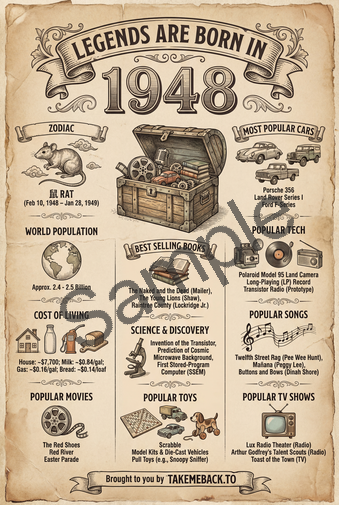

Major Events of 1948 - Historical Moments That Defined the Year | TakeMeBack.to
- 01 Jan General Agreement on Tariffs and Trade (GATT) Takes Effect: The General Agreement on Tariffs and Trade (GATT) was applied on a provisional basis starting January 1, 1948, following its signing by 23 nations in Geneva on October 30, 1947. source: en.wikipedia.org
- 02 Jan WNDT television channel launches in New York: WNDT, the first non-commercial television station in the United States, launched in New York on January 2, 1948. This station played a crucial role in the development of educational television programming. source: nytimes.com
- 03 Jan TNT shipment seized in New York bound for Palestine: On January 3, 1948, New York police discovered a shipment of 65,000 pounds of TNT intended for Tel Aviv, Palestine. The explosives were concealed in crates labeled as 'used machinery' and were intercepted during loading onto the freighter Executor. The shipment was impounded, and an investigation was initiated. source: jta.org
- 04 Jan Burma gains independence from United Kingdom: On January 4, 1948, Burma (now Myanmar) gained independence from the United Kingdom. This marked the end of British colonial rule in Burma, leading to the establishment of the Union of Burma as a sovereign nation.
- 05 Jan Kinsey Report on human sexuality published: The Kinsey Report, officially titled 'Sexual Behavior in the Human Male,' was published on January 5, 1948. This groundbreaking work by Alfred Kinsey provided extensive research on human sexual behavior, challenging societal norms and sparking widespread discussion. source: britannica.com
- 06 Jan Birth of Dayle Hadlee, New Zealand cricketer: Dayle Hadlee, a notable New Zealand cricketer, was born on January 6, 1948. He is recognized for his contributions to New Zealand cricket, particularly as a fast bowler and all-rounder. source: britannica.com
- 07 Jan Truman raises taxes for Marshall Plan: On January 7, 1948, President Harry S. Truman announced a tax increase to fund the Marshall Plan, aimed at aiding European recovery post-World War II. This decision was part of a broader strategy to stabilize Europe and prevent the spread of communism. source: archives.gov
- 08 Jan Death of Richard Tauber, renowned operatic tenor: Richard Tauber, a celebrated operatic tenor, passed away on January 8, 1948. His contributions to opera and classical music left a lasting legacy, influencing generations of singers and musicians. source: britannica.com
- 10 Jan US State Department restricts radar equipment export: On January 10, 1948, the US State Department announced restrictions on the export of radar equipment. This decision was part of broader efforts to control sensitive technologies during the early Cold War period. source: archives.gov
- 11 Jan Breakthrough in cholera treatment at American University of Beirut: On January 11, 1948, researchers at the American University of Beirut announced a significant breakthrough in the treatment of cholera. This advancement was crucial in addressing public health challenges in the region. source: ncbi.nlm.nih.gov
- 12 Jan Truman presents peacetime budget to Congress: On January 12, 1948, President Harry S. Truman presented his peacetime budget to Congress. This budget was significant as it reflected the economic priorities of the post-World War II era. source: archives.gov
- 13 Jan Gandhi begins final fast for communal harmony: On January 13, 1948, Mahatma Gandhi commenced his last fast in New Delhi, aiming to restore communal peace amid rising Hindu-Muslim tensions. source: tribuneindia.com
- 14 Jan Marshall Plan and US Foreign Policy Stance with Yugoslavia: On January 14, 1948, the United States, under the Marshall Plan, maintained its foreign policy stance towards Yugoslavia, focusing on economic aid and political alignment. source: en.wikipedia.org
- 15 Jan Arab League warns of military intervention in Palestine: On January 15, 1948, the Arab League issued a warning regarding potential military intervention in Palestine amidst rising tensions and violence. This statement was part of the broader context of the Arab-Israeli conflict that was escalating at the time. source: britannica.com
- 16 Jan Haganah ambush in Gush Etzyon: On January 16, 1948, the Haganah conducted an ambush in Gush Etzyon, a significant event during the conflict in Mandatory Palestine. This operation was part of the broader struggle between Jewish and Arab forces in the region. source: britannica.com
- 17 Jan US Communist Party trial begins: The trial of members of the US Communist Party began on January 17, 1948, as part of the broader Red Scare and anti-communist sentiment in the United States during this period. This trial was significant in the context of American political history. source: britannica.com
- 19 Jan Steamship Cautin tragedy: On January 19, 1948, the steamship Cautin sank off the coast of Chile, resulting in significant loss of life. The tragedy highlighted the dangers of maritime travel during that period and led to discussions on improving safety regulations. source: britannica.com
- 20 Jan UN Security Council addresses Kashmir dispute: On January 20, 1948, the UN Security Council held discussions regarding the ongoing Kashmir dispute between India and Pakistan. This marked an early international effort to mediate the conflict that continues to this day. source: un.org
- 21 Jan Anti-lynching bill blocked: On January 21, 1948, an anti-lynching bill was blocked in the U.S. Congress, reflecting the ongoing struggle for civil rights and racial justice in America. This event highlighted the challenges faced by advocates of anti-lynching legislation. source: congress.gov
- 23 Jan Donald Bradman's remarkable cricket performance: On January 23, 1948, during the fourth Test match against India in Adelaide, Australia, Sir Donald Bradman scored 201 runs, marking his 12th and final double century in first-class cricket. This innings contributed to Australia's victory by an innings and 16 runs. source: sports.ndtv.com
- 26 Jan Executive Order 9981: Desegregation of US Armed Forces: On January 26, 1948, President Harry S. Truman signed Executive Order 9981, mandating the desegregation of the U.S. Armed Forces. This order marked a significant step toward racial integration in the military. source: en.wikipedia.org
- 28 Jan Birth of Mikhail Baryshnikov: Mikhail Baryshnikov, a renowned Latvian-American dancer, choreographer, and actor, was born on January 27, 1948, in Riga, Latvia. source: britannica.com
- 29 Jan Tragic plane crash at Los Gatos Creek: On January 29, 1948, a plane crash occurred at Los Gatos Creek, resulting in significant loss of life. The incident is often associated with the broader context of aviation safety issues during that era. source: nytimes.com
- 30 Jan Assassination of Mahatma Gandhi: Mahatma Gandhi was assassinated on January 30, 1948, by Nathuram Godse, a Hindu nationalist. This event marked a significant moment in Indian history, leading to widespread mourning and political upheaval. source: britannica.com
- 31 Jan Formation of Federation of Malaya: On January 31, 1948, the Federation of Malaya was formed, marking a significant step towards independence from British colonial rule. This event laid the groundwork for the eventual establishment of Malaysia. source: britannica.com
- 01 Feb Soviet Voice of America jamming: On February 1, 1948, the Soviet Union began jamming broadcasts from the Voice of America, aiming to suppress Western influence in Eastern Europe. This action was part of the broader Cold War tensions between the East and West. source: britannica.com
- 02 Feb Truman's landmark civil rights message to Congress: On February 2, 1948, President Harry S. Truman delivered a significant civil rights message to Congress, advocating for anti-lynching laws and desegregation. This marked a pivotal moment in the civil rights movement in the United States. source: archives.gov
- 05 Feb Gretchen Fraser wins Olympic slalom gold: Gretchen Fraser became the first American woman to win an Olympic gold medal in alpine skiing by securing the gold in the slalom event at the 1948 Winter Olympics in St. Moritz, Switzerland. source: olympic.org
- 07 Feb Oswald Mosley Launches Union Movement: On February 7, 1948, Oswald Mosley launched the Union Movement, a far-right political party in the United Kingdom, aiming to promote European nationalism. source: en.wikipedia.org
- 08 Feb Costa Rican Election Controversy: The 1948 Costa Rican presidential election, held on February 8, was marked by significant controversy. Opposition candidate Otilio Ulate was declared the winner, but the ruling party alleged electoral fraud and annulled the results. This led to the Costa Rican Civil War, which lasted from March 12 to April 24, 1948, resulting in approximately 2,000 deaths and significant political changes in the country. source: en.wikipedia.org
- 09 Feb WLWT Television Channel 5 Launches in Cincinnati: On February 9, 1948, WLWT began commercial broadcasting in Cincinnati, Ohio, as the city's first television station. Initially operating on VHF channel 4, WLWT later moved to channel 5 in 1952. source: wlwt.com
- 11 Feb John Costello becomes Taoiseach of Ireland: John Costello was appointed as the Taoiseach of Ireland on February 11, 1948, marking the beginning of his second term in office. He led the first inter-party government in Ireland, which ended the long-standing dominance of the Fianna Fáil party. His government focused on economic recovery and social reform during a challenging post-war period. source: historyireland.com
- 12 Feb Gandhi's final farewell: ashes scattered in Ganges: Mahatma Gandhi's ashes were scattered in the Ganges River on February 12, 1948, following his assassination on January 30, 1948. This event marked a poignant moment in Indian history, symbolizing the nation's mourning for its leader and the commitment to his principles of non-violence and peace. The ceremony was attended by thousands, reflecting Gandhi's profound impact on India and the world. source: bbc.com
- 13 Feb London policeman killed in line of duty: On February 13, 1948, a London policeman was tragically killed while on duty, highlighting the dangers faced by law enforcement officers. This incident sparked discussions about police safety and the challenges of maintaining public order in post-war London. The event served as a reminder of the sacrifices made by those in the line of duty. source: theguardian.com
- 14 Feb US and Britain allow German aluminum production: The United States and Britain agreed to permit German manufacturers to produce virgin aluminum, which had been previously prohibited under the Potsdam Agreement. source: justapedia.org
- 15 Feb Mao Zedong's army occupies Yenan: Mao Zedong's People's Liberation Army occupied Yenan, a significant base for the Chinese Communist Party during the Chinese Civil War. source: justapedia.org
- 16 Feb Ray Kurzweil born: Ray Kurzweil, a renowned futurist, inventor, and author known for his groundbreaking work in artificial intelligence and technological prediction, was born in Queens, New York, on February 16, 1948. source: 440int.com
- 18 Feb Éamon de Valera resigns as Taoiseach of Ireland: On February 18, 1948, Éamon de Valera resigned as Taoiseach (Prime Minister) of Ireland. His resignation marked a significant shift in Irish politics, leading to the formation of a new government under John A. Costello. source: historyireland.com
- 19 Feb Nuremberg Hostages Trial concludes: On February 19, 1948, the Nuremberg Hostages Trial concluded. This trial was part of the series of Nuremberg Trials held after World War II to prosecute prominent leaders of Nazi Germany for war crimes. source: ushmm.org
- 20 Feb Czechoslovakia's political transition begins: On February 20, 1948, Czechoslovakia's political transition began when twelve non-Communist ministers resigned in protest against the Communist Party's increasing control over the government. This event set the stage for the Communist Party's eventual takeover later that month. source: britannica.com
- 22 Feb Communist takeover of Czechoslovakia: On February 22, 1948, the Communist Party of Czechoslovakia consolidated power, leading to a significant shift in the country's political landscape. This event marked the beginning of a communist regime that would last for over four decades. source: britannica.com
- 23 Feb Communist coup in Czechoslovakia: The coup d'état on February 23, 1948, saw the Communist Party take control of the Czechoslovak government, effectively ending the democratic system. This event was characterized by the resignation of non-communist ministers and the establishment of a one-party state. source: britannica.com
- 24 Feb Communist takeover of Czechoslovakia: On February 24, 1948, the Communist Party solidified its control over Czechoslovakia, following the resignation of key government officials. This event marked a critical point in the establishment of a communist regime in the country. source: britannica.com
- 25 Feb Communist coup in Czechoslovakia: The events of February 25, 1948, culminated in the complete takeover of the Czechoslovak government by the Communist Party. This day is often marked as the definitive end of democratic governance in the nation. source: britannica.com
- 26 Feb Argentina rejects British negotiations on Falkland Islands: On February 26, 1948, Argentina formally rejected British proposals for negotiations regarding the sovereignty of the Falkland Islands. This decision was part of Argentina's long-standing claim over the islands, which it refers to as the Malvinas, and has been a point of contention between the two nations for decades. source: britannica.com
- 27 Feb Communist takeover in Czechoslovakia: On February 27, 1948, a coup in Czechoslovakia led to a complete takeover by the Communist Party, effectively ending the democratic government. This event marked a significant moment in the Cold War, as Czechoslovakia became a Soviet satellite state, influencing the political landscape of Eastern Europe. source: britannica.com
- 28 Feb Accra riots spark Gold Coast independence movement: On February 28, 1948, riots broke out in Accra, Gold Coast (now Ghana), igniting a movement for independence from British colonial rule. The unrest was fueled by economic grievances and political repression, leading to increased demands for self-governance and ultimately contributing to Ghana's independence in 1957. source: britannica.com
- 04 Mar King Michael of Romania repudiates abdication in exile: King Michael I of Romania, who was forced to abdicate in December 1947, issued a statement in London on March 4, 1948, declaring that his abdication had been imposed upon him by force and that he did not consider himself bound by it. source: royalmusingsblogspotcom.blogspot.com
- 06 Mar USS Newport News launched as first fully air-conditioned surface ship: The USS Newport News (CA-148), a Des Moines-class heavy cruiser, was launched on March 6, 1948, by the Newport News Shipbuilding and Dry Dock Company. It was the first fully air-conditioned surface ship in the United States Navy. source: en.wikipedia.org
- 08 Mar Supreme Court rules against religious instruction in public schools: On March 8, 1948, the U.S. Supreme Court ruled 8-1 in McCollum v. Board of Education that using public school facilities for religious instruction violated the Establishment Clause of the First Amendment. source: politico.com
- 10 Mar Death of Jan Masaryk: Jan Masaryk, Czechoslovakia's Foreign Minister, was found dead under suspicious circumstances on March 10, 1948. Officially ruled a suicide, many believe he was murdered, possibly due to his opposition to the Communist government. source: britannica.com
- 11 Mar Zhoucun–Zhangdian Campaign Begins: The Zhoucun–Zhangdian Campaign commenced on March 11, 1948, during the Chinese Civil War, as part of the larger Huaihai Campaign. source: en.wikipedia.org
- 12 Mar James Taylor's birth: James Taylor, the renowned American singer-songwriter, was born on March 12, 1948. He is known for his soft rock music and has won multiple Grammy Awards throughout his career. source: biography.com
- 13 Mar Southern governors oppose Truman's re-election: On March 13, 1948, a group of Southern governors publicly opposed President Harry S. Truman's re-election. This opposition was rooted in Truman's civil rights policies, which were controversial in the South at the time. source: history.com
- 14 Mar Freedom Train arrives in San Francisco: The Freedom Train, a special train promoting civil rights and American democracy, arrived in San Francisco on March 14, 1948. It showcased important documents and symbols of freedom. source: archives.gov
- 15 Mar Economic Cooperation Convention draft: On March 15, 1948, the draft for the Economic Cooperation Convention was discussed, laying the groundwork for the Marshall Plan. This plan aimed to aid European recovery post-World War II. source: archives.gov
- 17 Mar Treaty of Brussels signed: The Treaty of Brussels was signed on March 17, 1948, establishing a mutual defense alliance among Belgium, France, Luxembourg, the Netherlands, and the United Kingdom. This treaty laid the groundwork for future European defense cooperation. source: nato.int
- 18 Mar Marshall Plan signed by President Truman: On March 18, 1948, President Truman signed the Marshall Plan, officially known as the European Recovery Program. This initiative aimed to provide economic assistance to European nations to help rebuild after World War II. source: archives.gov
- 19 Mar Federal Rules of Civil Procedure amendment: On March 19, 1948, amendments to the Federal Rules of Civil Procedure were adopted, which aimed to streamline the judicial process in federal courts. These changes were significant in shaping modern civil litigation in the United States. source: uscourts.gov
- 20 Mar 20th Academy Awards Ceremony: The 20th Academy Awards Ceremony was held on March 20, 1948, honoring films released in 1947. source: en.wikipedia.org
- 21 Mar Communist forces win Zhoucun–Zhangdian Campaign: The Zhoucun–Zhangdian Campaign, fought between March 11 and March 21, 1948, resulted in a Communist victory. The Nationalists lost over 38,000 troops, and the important Qingdao–Jinan railway transportation and communication line was severed. Additionally, fourteen cities and towns fell into Communist hands, allowing the Communists to combine their two separate bases in central Shandong and the coastal region into a single larger one. source: en.wikipedia.org
- 25 Mar World Premiere of Mr. Blandings Builds His Dream House: The film 'Mr. Blandings Builds His Dream House' premiered on March 25, 1948. It stars Cary Grant and Myrna Loy as a couple who face numerous challenges while building their dream home in Connecticut. source: britannica.com
- 29 Mar Yankees and Red Sox tie in 17-inning spring training game: On March 29, 1948, the New York Yankees and Boston Red Sox played a 17-inning, four-hour and two-minute spring training game, ending in a 2-2 tie. The Red Sox scored first in the top of the ninth inning, and the Yankees equalized in the bottom half. source: mlb.com
- 31 Mar Marshall Plan Aid Act Passed: On March 31, 1948, the U.S. House of Representatives passed the Economic Cooperation Act, commonly known as the Marshall Plan, by a vote of 333 to 78. This legislation authorized over $12 billion in economic aid to Western European countries to assist in their post-World War II recovery. source: archives.gov
- 02 Apr Truman's tax bill veto overturned by Congress: On April 2, 1948, Congress successfully overturned President Harry S. Truman's veto of a tax bill. This marked a significant moment in U.S. legislative history, showcasing the power of Congress in fiscal matters. source: congress.gov
- 03 Apr Marshall Plan signed into law by President Truman: On April 3, 1948, President Harry S. Truman signed the Economic Assistance Act, commonly known as the Marshall Plan, which authorized over $5 billion in aid to 16 European countries to help them recover and rebuild after World War II. source: archives.gov
- 04 Apr Battle of Mishmar HaEmek during Israeli War of Independence: The Battle of Mishmar HaEmek occurred on April 4, 1948, during the Israeli War of Independence. This battle was significant in the struggle for control over the region and had lasting implications for the conflict. source: bbc.com
- 05 Apr World Health Organization established: The World Health Organization (WHO) was established on April 5, 1948, as a specialized agency of the United Nations responsible for international public health. Its mission is to promote health and well-being worldwide. source: en.wikipedia.org
- 06 Apr Finland-Soviet military pact signed: On April 6, 1948, Finland and the Soviet Union signed the Agreement of Friendship, Cooperation, and Mutual Assistance, a military pact aimed at ensuring mutual defense and cooperation between the two nations. source: en.wikipedia.org
- 07 Apr World Health Organization founded: On April 7, 1948, the World Health Organization (WHO) was established as a specialized agency of the United Nations to coordinate international health efforts and promote global health. source: who.int
- 09 Apr Deir Yassin massacre occurs during Arab-Israeli conflict: On April 9, 1948, the Deir Yassin massacre took place, where over 100 Palestinian Arabs were killed by Jewish paramilitary groups. This event significantly escalated tensions in the region and contributed to the broader Arab-Israeli conflict. source: britannica.com
- 10 Apr Burma joins the United Nations, Italy's application vetoed: On April 10, 1948, Burma was admitted to the United Nations as a member state. On the same day, Italy's application for UN membership was vetoed, reflecting the geopolitical tensions of the post-World War II era. source: un.org
- 11 Apr Claude Harmon wins 12th Masters Golf Championship: On April 11, 1948, Claude Harmon won the 12th Masters Golf Championship held at Augusta National Golf Club. This victory marked a significant achievement in Harmon’s golfing career. source: britannica.com
- 12 Apr Raphick Jumadeen born in Trinidad: Raphick Rasif Jumadeen, a Trinidadian cricketer, was born on April 12, 1948, in Harmony Hall, Gasparillo, Trinidad and Tobago. He played 12 Test matches for the West Indies between 1972 and 1979, taking 29 wickets. source: espncricinfo.com
- 14 Apr US nuclear testing at Enwetak: On April 14, 1948, the United States conducted nuclear tests at Enwetak Atoll in the Marshall Islands. This marked one of the early series of tests in the Pacific as part of the U.S. nuclear weapons program following World War II. source: archives.gov
- 15 Apr Pan Am Flight 1-10 tragic crash: On April 15, 1948, Pan Am Flight 1-10 crashed in the Pacific Ocean, resulting in the loss of all 32 passengers and crew on board. The incident raised significant concerns regarding aviation safety and led to changes in regulations. source: ntsb.gov
- 16 Apr Formation of the Organization for European Economic Cooperation (OEEC): On April 16, 1948, the Organization for European Economic Cooperation (OEEC) was formed to help administer the Marshall Plan for the reconstruction of Europe after World War II. This organization played a crucial role in European economic integration. source: britannica.com
- 17 Apr Elpidio Quirino becomes President of the Philippines: On April 17, 1948, Elpidio Quirino was inaugurated as the sixth President of the Philippines, following the death of President Manuel Roxas. source: en.wikipedia.org
- 18 Apr Italy's first democratic general election with universal suffrage: On April 18, 1948, Italy held its first general election under universal suffrage, marking a significant milestone in its post-fascist democratic development. The Christian Democracy party, led by Alcide De Gasperi, secured a decisive victory with 48.5% of the vote, obtaining 305 seats in the Chamber of Deputies and 131 in the Senate, thus achieving an absolute majority in both chambers. source: en.wikipedia.org
- 19 Apr ABC-TV network launch: On April 19, 1948, the American Broadcasting Company (ABC) launched its television network, marking a new era in American broadcasting. The network's first primary affiliate was WFIL-TV in Philadelphia, which later became WPVI-TV. The inaugural broadcast featured the program "On the Corner" with host Henry Morgan. source: en.wikipedia.org
- 20 Apr Walter P. Reuther survives assassination attempt: On April 20, 1948, Walter P. Reuther, president of the United Automobile Workers, survived an assassination attempt when a double-barrel shotgun blast shattered his kitchen window, injuring his right arm and back. The assailant fled in a red four-door Ford sedan. Reuther's brother, Victor, was also targeted in a similar attack 13 months later. source: en.wikipedia.org
- 21 Apr UN Security Council adopts Resolution 47 on Kashmir: On April 21, 1948, the United Nations Security Council adopted Resolution 47, calling for a ceasefire and plebiscite in the Kashmir region to determine its future status. source: un.org
- 22 Apr Capture of Haifa during Arab-Israeli War: On April 22, 1948, during the Arab-Israeli War, Israeli forces captured the city of Haifa, a significant port and industrial center. source: en.wikipedia.org
- 23 Apr Devastating tornado in Iowa: On April 23, 1948, a powerful tornado struck Iowa, causing significant destruction and loss of life. The tornado was part of a larger outbreak that affected several states in the Midwest. It resulted in extensive damage to homes and infrastructure, highlighting the need for improved weather forecasting. source: weather.gov
- 24 Apr Costa Rican Civil War concludes: The Costa Rican Civil War, which began in 1948, concluded on April 24 of the same year. The conflict arose from political disputes and resulted in significant changes in the country's governance. The end of the war led to the establishment of a new political order in Costa Rica. source: britannica.com
- 25 Apr Assassination attempt on Egyptian Prime Minister Mostafa El-Nahas: On April 25, 1948, Egyptian Prime Minister Mostafa El-Nahas survived an assassination attempt when three men dressed in police uniforms detonated a car bomb at his residence and escaped in a second vehicle. source: fooddeserts.org
- 28 Apr Jerusalem truce negotiation: On April 28, 1948, negotiations for a truce in Jerusalem took place amid escalating violence during the Arab-Israeli conflict. The discussions aimed to establish a ceasefire and address the humanitarian situation in the city. However, the negotiations faced significant challenges due to ongoing hostilities. source: britannica.com
- 29 Apr Nazi Gauleiter Albert Forster sentenced to death: On April 29, 1948, Albert Forster, the Nazi Gauleiter of Danzig, was sentenced to death for war crimes committed during World War II. His trial was part of the broader effort to hold Nazi officials accountable for their actions during the Holocaust and the war. Forster's execution marked a significant moment in post-war justice. source: britannica.com
- 30 Apr Organization of American States established: The Organization of American States (OAS) was established on April 30, 1948, in Bogotá, Colombia. It aimed to promote democracy, human rights, and economic cooperation among member states in the Americas. source: britannica.com
- 01 May Establishment of North Korean state: The Democratic People's Republic of Korea (North Korea) was officially established on May 1, 1948. This marked the beginning of a separate government in the northern part of the Korean Peninsula, following the end of Japanese rule after World War II. source: britannica.com
- 02 May Eisenhower's military retirement: General Dwight D. Eisenhower officially retired from the U.S. Army on May 2, 1948. His retirement marked the end of a distinguished military career, including his role as Supreme Commander of Allied Forces in Europe during World War II. source: archives.gov
- 03 May Landmark Supreme Court decision on housing discrimination: On May 3, 1948, the U.S. Supreme Court ruled in Shelley v. Kraemer that racially restrictive covenants in housing were unenforceable in court. This decision was a significant step towards ending racial discrimination in housing. source: archives.gov
- 04 May War criminal sentenced at The Hague: On May 4, 1948, a war criminal was sentenced at The Hague, marking one of the early instances of international justice post-World War II. This case set a precedent for future war crimes tribunals. source: icc-cpi.int
- 07 May Hague Congress: Vision for United Europe: From May 7 to 11, 1948, the Hague Congress convened in the Netherlands, bringing together approximately 800 delegates from 26 countries. The congress aimed to promote European unity and peace, leading to the establishment of the Council of Europe in 1949. Key outcomes included the call for a European Assembly and the drafting of a Human Rights Charter. source: book.coe.int
- 09 May Haganah launches Operation Barak in pre-Israel conflict: On May 9, 1948, the Haganah, the military organization of the Jewish community in Palestine, initiated Operation Barak. This operation aimed to secure key areas in anticipation of the impending declaration of the State of Israel. source: britannica.com
- 10 May Haganah captures Safed: On May 10, 1948, the Haganah captured the city of Safed during the ongoing conflict in Palestine. This event was part of a broader military campaign leading up to the establishment of Israel. source: britannica.com
- 11 May Kfar Etzion massacre: On May 11, 1948, the Kfar Etzion massacre occurred, where Jewish defenders were killed by Arab forces. This tragic event highlighted the intense violence during the period leading up to the establishment of Israel. source: britannica.com
- 12 May Hebei–Rehe–Chahar Campaign begins: The Hebei–Rehe–Chahar Campaign commenced on May 12, 1948, as part of the Chinese Civil War. The campaign involved battles between nationalist and communist forces in Northern China, resulting in a communist victory. source: en.wikipedia.org
- 13 May Detailed account of Kfar Etzion Massacre: A detailed account of the Kfar Etzion massacre, which took place on May 13, 1948, during the Arab-Israeli War, where 127 Jewish defenders were killed by Arab forces after the surrender of the settlement. source: en.wikipedia.org
- 14 May US recognition of Israel: On May 14, 1948, the United States officially recognized the State of Israel, shortly after its declaration of independence. This recognition marked a significant moment in US-Israel relations and the broader geopolitical landscape of the Middle East. source: history.state.gov
- 15 May Israel declares independence: On May 15, 1948, Israel declared its independence, leading to the establishment of the State of Israel. This declaration was met with immediate military action from neighboring Arab states, marking the beginning of the Arab-Israeli conflict. source: britannica.com
- 16 May George Polk murder mystery unfolds: On May 16, 1948, the murder of American journalist George Polk in Lebanon became a significant event, raising questions about press freedom and political tensions in the region. His death remains a topic of investigation and controversy. source: nytimes.com
- 17 May Soviet Union recognizes Israel: On May 17, 1948, the Soviet Union officially recognized the State of Israel, marking a significant moment in international relations during the Cold War. This recognition was crucial for Israel's legitimacy on the world stage. source: britannica.com
- 18 May Saudi Arabia enters Israeli-Arab conflict: On May 18, 1948, Saudi Arabia officially entered the conflict between Israel and Arab nations following the declaration of the State of Israel. This marked a significant escalation in the Arab-Israeli War, as Saudi forces aimed to support Palestinian Arabs against Israeli forces. source: britannica.com
- 19 May Mundt-Nixon Bill passes House of Representatives: On May 19, 1948, the Mundt-Nixon Bill, aimed at regulating the activities of the Communist Party in the United States, passed the House of Representatives. This legislation was part of the broader Red Scare and anti-communist sentiment of the era. source: congress.gov
- 20 May Israeli Air Force's first war victory: On May 20, 1948, the Israeli Air Force achieved its first significant victory during the Arab-Israeli War. This event marked a turning point in the conflict, showcasing the capabilities of the newly formed Israeli military. source: britannica.com
- 21 May Birth of Leo Sayer, pop singer: Leo Sayer, born Gerard Hugh Sayer on May 21, 1948, in Shoreham-by-Sea, Sussex, England, is a British and Australian singer and songwriter known for hits like 'You Make Me Feel Like Dancing' and 'When I Need You.' source: en.wikipedia.org
- 22 May Finnish Interior Minister dismissed for Soviet collaboration: On May 22, 1948, Finnish Interior Minister Aarne Laitinen was dismissed from his position due to allegations of collaboration with the Soviet Union during World War II. This decision was part of a broader political shift in Finland as the country sought to distance itself from Soviet influence in the post-war period. source: britannica.com
- 23 May Assassination of US Consul-General in Jerusalem: On May 23, 1948, US Consul-General in Jerusalem, John M. McDonald, was assassinated amid rising tensions in the region. This event highlighted the volatile political climate during the early stages of the Arab-Israeli conflict. source: history.com
- 24 May Battles of Latrun: The Battles of Latrun, occurring on May 24, 1948, were significant confrontations during the Arab-Israeli War. Israeli forces attempted to capture the strategic Latrun area from Arab forces, resulting in heavy casualties and impacting the course of the conflict. source: britannica.com
- 25 May General Motors wage increase agreement: On May 25, 1948, General Motors reached a wage increase agreement with its workers, reflecting the post-war economic conditions and labor negotiations in the United States. This agreement was part of broader labor movements during the era. source: nytimes.com
- 26 May South Africa elects Nationalist government: On May 26, 1948, South Africa held elections that resulted in the Nationalist Party coming to power. This marked the beginning of the apartheid era, which enforced racial segregation and discrimination in the country. source: britannica.com
- 27 May Destruction of Hurvat Rabbi Yehudah he-Hasid Synagogue: On May 27, 1948, during the 1948 Arab-Israeli War, the Hurvat Rabbi Yehudah he-Hasid Synagogue in Jerusalem was destroyed. The synagogue, originally built in the 18th century and rebuilt in 1864, was a significant Ashkenazi house of worship in the Old City. source: en.wikipedia.org
- 28 May Daniel François Malan becomes Prime Minister of South Africa: On May 28, 1948, Daniel François Malan was elected as the Prime Minister of South Africa. He led the country during a period of significant political change, including the implementation of apartheid policies. source: en.wikipedia.org
- 29 May UN Truce Supervision Organization established: On May 29, 1948, the United Nations Truce Supervision Organization (UNTSO) was established to monitor ceasefires and supervise armistice agreements in the Middle East, particularly in areas affected by the 1948 Arab-Israeli War. source: en.wikipedia.org
- 30 May Israeli Battalion Engagement near Isdud: On May 30, 1948, during the 1948 Arab-Israeli War, Israeli forces engaged Egyptian troops near the village of Isdud. The operation aimed to halt the Egyptian advance northward. Israeli forces faced challenges due to limited manpower and resources, leading to a retreat after initial engagements. source: en.wikipedia.org
- 01 Jun First Israeli Air Strike on Arab Capital: On the night of May 31 to June 1, 1948, during the 1948 Arab–Israeli War, Israeli aircraft conducted their first raid on an Arab capital by bombing Amman, Jordan. The attack targeted the King's Palace and an adjacent British airfield, resulting in approximately 12 fatalities and 30 injuries. source: en.wikipedia.org
- 03 Jun Hale Telescope dedicated at Palomar Observatory: The 200-inch Hale Telescope was dedicated at Palomar Observatory in California, named in honor of astronomer George Ellery Hale. The ceremony was attended by nearly 1,000 guests, including Hale's widow, Evelina Hale. The telescope became operational in 1949, with astronomer Edwin Hubble capturing the first image on January 26, 1949. source: jpl.nasa.gov
- 04 Jun Daniel François Malan becomes Prime Minister of South Africa, institutionalizing apartheid: Daniel François Malan was elected Prime Minister of South Africa, leading the National Party. His government implemented the policy of apartheid, a system of institutionalized racial segregation and discrimination against non-white South Africans. source: sahistory.org.za
- 05 Jun Richie Ashburn sets National League rookie hitting streak record: Philadelphia Phillies outfielder Richie Ashburn set a National League rookie record by hitting safely in 19 consecutive games, showcasing his exceptional batting skills during his first season. source: baseball-reference.com
- 07 Jun Communist takeover of Czechoslovakia: On June 7, 1948, the Communist Party of Czechoslovakia solidified its control over the government, leading to a one-party state. This event marked a significant shift in the political landscape of Czechoslovakia during the early Cold War period. source: britannica.com
- 08 Jun Establishment of the National Health Service (NHS): The National Health Service (NHS) was established in the United Kingdom on June 8, 1948, providing healthcare to all citizens free at the point of use. This landmark initiative aimed to ensure comprehensive health services for the population. source: britannica.com
- 09 Jun Truman's Washington State tour: On June 9, 1948, President Harry S. Truman embarked on a tour of Washington State, promoting his policies and seeking support for his administration. This tour was part of his efforts to connect with the American public. source: trumanlibrary.gov
- 12 Jun Truman's foreign policy speech: On June 12, 1948, President Harry S. Truman delivered a significant speech outlining his foreign policy, emphasizing the importance of containing communism and supporting free peoples. This speech was pivotal in shaping U.S. foreign relations during the Cold War. source: trumanlibrary.gov
- 13 Jun Soviet blockade of Berlin begins: The Soviet blockade of Berlin commenced on June 13, 1948, as the USSR sought to cut off access to West Berlin in response to the introduction of a new currency in West Germany. This event escalated tensions during the early Cold War and led to the Berlin Airlift. source: britannica.com
- 14 Jun Klement Gottwald becomes Czechoslovak president: On June 14, 1948, Klement Gottwald was inaugurated as the president of Czechoslovakia. His presidency marked a significant shift towards a communist regime in the country, aligning it more closely with Soviet policies during the Cold War. source: britannica.com
- 15 Jun WTNH TV Channel 8 Begins Broadcasting: WTNH TV channel 8 in New Haven, Connecticut, launched its first broadcast as an ABC affiliate, further expanding television coverage in the New England region.
- 16 Jun Malayan Communist Party escalates conflict: On June 16, 1948, the Malayan Communist Party (MCP) initiated the Malayan Emergency by killing three European plantation managers in Perak state, leading the British authorities to declare a state of emergency. source: britannica.com
- 17 Jun Joe Cronin's doubleheader home run achievement: On June 17, 1943, Joe Cronin, then player-manager of the Boston Red Sox, hit a home run in both games of a doubleheader against the Philadelphia Athletics. This feat was notable as Cronin was 35 years old at the time, demonstrating his enduring power and skill. source: en.wikipedia.org
- 18 Jun Deutsche Mark introduction and Berlin tensions: On June 18, 1948, the Western Allies announced the introduction of the Deutsche Mark in their occupation zones of Germany, effective June 21. The Soviets opposed this move, leading to heightened tensions and the eventual Berlin Blockade. source: en.wikipedia.org
- 19 Jun Battle of Shangcai ends in Communist victory: The Battle of Shangcai, fought between the Chinese Communist forces and the Nationalist army, concluded on June 19, 1948, with a victory for the Communists. This battle was part of the larger Chinese Civil War, which ultimately led to the establishment of the People's Republic of China. source: en.wikipedia.org
- 20 Jun First stored-program computer execution: On June 20, 1948, the Manchester Small-Scale Experimental Machine (SSEM), also known as the Manchester Baby, executed its first program. This event marked a pivotal moment in computing history, demonstrating the feasibility of stored-program architecture. source: bbc.co.uk
- 21 Jun Manchester Baby computer: first stored-program computer: The Manchester Baby, also known as the SSEM, was the first computer to successfully run a stored program on June 21, 1948. This achievement laid the groundwork for modern computing systems. source: bbc.co.uk
- 22 Jun First stored-program computer execution: On June 22, 1948, the Manchester Baby executed its first program, marking a significant milestone in computing history. This event demonstrated the practical application of stored-program architecture. source: bbc.co.uk
- 23 Jun First World Health Assembly Convenes: The first World Health Assembly convened on June 23, 1948, marking a significant step in the establishment of the World Health Organization (WHO). This assembly aimed to address global health issues and set the agenda for the newly formed organization. source: who.int
- 24 Jun Berlin Blockade Begins: On June 24, 1948, the Soviet Union initiated the Berlin Blockade by cutting off all land and water routes to West Berlin, aiming to force the Western Allies to abandon the city. This action marked a significant escalation in Cold War tensions. source: britannica.com
- 25 Jun Berlin Airlift begins: On June 25, 1948, the Soviet Union initiated the Berlin Blockade by cutting off all land and water routes to West Berlin. In response, the Western Allies launched the Berlin Airlift, a massive operation to supply West Berlin with food and fuel by air.
- 26 Jun Breakthrough in electronics: Transistor patent filed: On June 26, 1948, John Bardeen, Walter Brattain, and William Shockley filed a patent for the transistor, a pivotal invention in electronics. This innovation laid the groundwork for modern computing and telecommunications. source: britannica.com
- 27 Jun Berlin Blockade and Airlift begins: The Berlin Blockade, initiated by the Soviet Union on June 27, 1948, aimed to cut off access to West Berlin. In response, the Western Allies launched the Berlin Airlift to supply the city, marking a significant event in the early Cold War. source: britannica.com
- 28 Jun Berlin Airlift begins: The Berlin Airlift officially began on June 28, 1948, as Allied forces commenced airlifting supplies to West Berlin in response to the Soviet blockade. This operation lasted until May 1949 and was crucial in sustaining the city's population. source: britannica.com
- 29 Jun Birth of Ian Paice, Deep Purple drummer: Ian Paice, the drummer for the rock band Deep Purple, was born on June 29, 1948. He is known for his innovative drumming style and has been a key member of the band since its formation in 1968. source: britannica.com
- 30 Jun Transistor technology breakthrough: On June 30, 1948, a significant breakthrough in transistor technology was announced, paving the way for modern electronics. This innovation was crucial for the development of various electronic devices and systems. source: britannica.com
- 01 Jul Don Bradman's cricket performance against Surrey: On July 1, 1948, Australian cricketer Don Bradman played a notable match against Surrey at The Oval, scoring 187 runs. This performance was part of his final first-class match series before retirement. Bradman's exceptional skills and contributions to cricket are still celebrated today. source: britannica.com
- 02 Jul 62nd Wimbledon men's singles final: The 62nd Wimbledon men's singles final took place on July 2, 1948, where American player Jack Kramer defeated the British player, Frank Parker. This match was significant as it marked a post-war resurgence of tennis at Wimbledon. Kramer showcased his powerful serve and volley game to secure the title. source: britannica.com
- 03 Jul Caryl Chessman sentencing: On July 3, 1948, Caryl Chessman was sentenced to death in California for kidnapping and robbery, a case that garnered significant media attention. Chessman's trial and subsequent appeals raised questions about the death penalty and criminal justice in the United States. His case became a focal point for anti-death penalty activists. source: nytimes.com
- 04 Jul Tommy Körberg birth: Tommy Körberg, a renowned Swedish singer and actor, was born on July 4, 1948. He is best known for his powerful voice and performances in musical theatre, particularly in productions like 'Chess.' Körberg has had a significant impact on Swedish music and culture over the decades. source: britannica.com
- 06 Jul Brad Park born in Toronto, Ontario, Canada: Brad Park, a Canadian former professional ice hockey player, was born on July 6, 1948, in Toronto, Ontario. He played as a defenceman in the National Hockey League (NHL) for the New York Rangers, Boston Bruins, and Detroit Red Wings. Park was inducted into the Hockey Hall of Fame in 1988. source: en.wikipedia.org
- 07 Jul Women sworn into regular US Navy: On July 7, 1948, the Women's Armed Services Integration Act was signed into law, allowing women to serve as permanent, regular members of the U.S. Armed Forces, including the Navy. This legislation enabled women to serve in the Navy as regular members, not just in the reserve. source: en.wikipedia.org
- 08 Jul US Air Force accepts first female recruits: On July 8, 1948, the Women's Armed Services Integration Act was signed into law, allowing women to serve as permanent, regular members of the U.S. Armed Forces, including the Air Force. This legislation enabled women to serve in the Air Force as regular members, not just in the reserve. source: en.wikipedia.org
- 09 Jul Operation Dani in 1948 Arab-Israeli War: Operation Dani was an Israeli military offensive launched on July 9, 1948, during the 1948 Arab-Israeli War. The operation aimed to capture territory east of Tel Aviv and relieve the Jewish population and forces in Jerusalem. It resulted in the capture of Ramle, Lydda, and surrounding villages. source: en.wikipedia.org
- 11 Jul First air bombing of Jerusalem during 1948 Arab-Israeli War: On July 11, 1948, during the 1948 Arab-Israeli War, the first air bombing of Jerusalem occurred. Israeli forces conducted the attack, marking a significant escalation in the conflict. This event intensified hostilities and had lasting impacts on the city's history. source: jstor.org
- 12 Jul Expulsion of Palestinians from Lod and Ramla during 1948 Arab-Israeli War: On July 12, 1948, during the 1948 Arab-Israeli War, Israeli forces expelled Palestinian residents from the towns of Lod and Ramla. This action was part of a broader strategy to secure areas for the newly established state of Israel, leading to significant displacement of Palestinian civilians. source: jstor.org
- 13 Jul Attempted assassination of Palmiro Togliatti: On July 13, 1948, Palmiro Togliatti, the leader of the Italian Communist Party, was shot and seriously wounded in Rome. This event sparked widespread protests and political unrest in Italy. source: britannica.com
- 14 Jul Assassination attempt on Palmiro Togliatti: Following the initial assassination attempt on July 13, Togliatti was again targeted on July 14, 1948. The political ramifications of these events were significant, leading to increased tensions in Italy. source: britannica.com
- 15 Jul Truman seeks re-election: On July 15, 1948, President Harry S. Truman announced his intention to seek re-election. This decision came during a tumultuous political climate in the United States, leading to a historic election. source: britannica.com
- 16 Jul First commercial aircraft hijacking: The first commercial aircraft hijacking occurred on July 16, 1948, when a plane was seized by a group of armed individuals. This incident marked a significant moment in aviation security history, leading to increased measures in the industry. source: nytimes.com
- 17 Jul Proclamation of the Constitution of South Korea: On July 17, 1948, the Constitution of the Republic of Korea was proclaimed, establishing the framework for the government and legal system of South Korea. This event was pivotal in the country's transition to a democratic state. source: britannica.com
- 18 Jul Hartmut Michel - Nobel Prize-Winning German Chemist: Hartmut Michel, a German biochemist, was born on July 18, 1948, in Ludwigsburg, Germany. He was awarded the Nobel Prize in Chemistry in 1988 for determining the structure of proteins essential for photosynthesis. source: britannica.com
- 19 Jul US-Yugoslavia assets dispute resolved: On July 19, 1948, the United States and Yugoslavia signed agreements in Washington to settle claims related to American property nationalized in Yugoslavia and other financial disputes. The U.S. Treasury also unfroze Yugoslav assets in the U.S. as part of these agreements. source: history.state.gov
- 20 Jul First peacetime military draft in US history: On July 20, 1948, President Harry S. Truman announced the reinstatement of the military draft, requiring nearly 10 million men to register for service within two months. This decision was made amid escalating Cold War tensions with the Soviet Union. source: history.com
- 21 Jul Death of David Wark Griffith, pioneering film director: On July 21, 1948, David Wark Griffith, a pioneering American film director known for his work in the early 20th century, passed away. He is often regarded as one of the most influential figures in the history of cinema. source: en.wikipedia.org
- 22 Jul Newfoundland votes for confederation with Canada: On July 22, 1948, Newfoundland held a referendum in which 52.3% of voters chose confederation with Canada over responsible government, leading to Newfoundland joining Canada on March 31, 1949. source: thecanadianencyclopedia.ca
- 24 Jul Marvin the Martian debuts: Marvin the Martian, a character from the Looney Tunes series, made his first appearance in the animated short film 'Haredevil Hare' on July 24, 1948. source: chuckjones.com
- 27 Jul Otto Skorzeny escapes detention: On July 27, 1948, Otto Skorzeny, a former SS officer, escaped from an internment camp in Darmstadt, Germany. He was aided by three individuals dressed in U.S. Military Police uniforms who claimed to be transferring him to Nuremberg for a legal hearing. Skorzeny later alleged that American authorities had assisted in his escape by providing the uniforms. source: en.wikipedia.org
- 30 Jul Emil Zátopek wins Olympic 10,000m gold: Czechoslovakian runner Emil Zátopek secured the gold medal in the men's 10,000 meters at the 1948 London Olympics, setting an Olympic record with a time of 29:59.6. source: en.wikipedia.org
- 31 Jul Lee Beom-seok becomes first Prime Minister of South Korea: On July 31, 1948, Lee Beom-seok was appointed as the first Prime Minister of South Korea, serving under President Syngman Rhee. He held this position until April 20, 1950. source: en.wikipedia.org
- 01 Aug Air France Latécoère 631 disappearance: On August 1, 1948, Air France flight Latécoère 631, a Lockheed Constellation aircraft, disappeared over the Atlantic Ocean during a flight from Paris to New York. The aircraft was carrying 52 people, and despite extensive search efforts, no wreckage was ever found, leading to one of aviation's enduring mysteries. source: en.wikipedia.org
- 02 Aug Stalin discusses Berlin Blockade with Western envoys in Moscow: On August 2, 1948, Joseph Stalin met with Western envoys in Moscow, discussing the Berlin Blockade. He acknowledged the blockade as a retaliation against Western plans for a Western German regime and agreed to lift it under certain conditions. source: time.com
- 05 Aug Alger Hiss testifies before House Un-American Activities Committee: On August 5, 1948, Alger Hiss, a former State Department official, appeared before the House Un-American Activities Committee (HUAC) to address allegations of communist affiliations. He categorically denied the charges made by Whittaker Chambers, a former Communist Party member who had accused Hiss of espionage. Hiss's testimony was part of a broader investigation into alleged communist infiltration within the U.S. government during the early years of the Cold War. source: visitthecapitol.gov
- 06 Aug Dov Yosef appointed Jerusalem's military governor: On August 6, 1948, Dov Yosef was appointed as the military governor of Jerusalem. His appointment was part of the Israeli government's efforts to establish control and administration over Jerusalem during the 1948 Arab-Israeli War. source: en.wikipedia.org
- 07 Aug Devastating Min River Flood in Fujian: On August 7, 1948, torrential flooding of the Min River in Fujian province, China, resulted in approximately 1,000 fatalities and displaced around 1 million people. The disaster intensified the ongoing civil war, with the Nationalists blaming the Communists for destroying dikes, while the Communists argued that repairing the dikes was impossible due to Nationalist attacks. source: en.wikipedia.org
- 08 Aug Nazi Saboteurs Pardoned by President Truman: On August 8, 1948, President Harry S. Truman pardoned eight German saboteurs who had been convicted of espionage and sabotage during World War II. The decision was controversial and sparked debates about justice and reconciliation. source: en.wikipedia.org
- 10 Aug WABC TV Channel 7 begins broadcasting: On August 10, 1948, WABC TV Channel 7 in New York City began broadcasting. The station became a significant part of the city's media landscape, offering a variety of programming to its viewers. source: en.wikipedia.org
- 12 Aug Mizengo Pinda's birth: On August 12, 1948, Mizengo Pinda, a Tanzanian politician and former Prime Minister of Tanzania, was born. He served as Prime Minister from 2008 to 2015 and held various other governmental positions during his career. source: en.wikipedia.org
- 14 Aug 1948 Summer Olympics conclude in London: The 1948 Summer Olympics, held in London, concluded successfully after a 12-year hiatus due to World War II. The Games featured athletes from 59 nations and were notable for their spirit of recovery and unity. The event marked the first Olympics since 1936. source: bbc.com
- 15 Aug Establishment of the Republic of Korea: The Republic of Korea was officially established on August 15, 1948, following the end of Japanese colonial rule. This marked a significant moment in Korean history, leading to the division of Korea into North and South. The establishment was recognized internationally and led to the formation of a new government. source: bbc.com
- 16 Aug Truman's anti-inflation legislation: On August 16, 1948, President Harry S. Truman signed anti-inflation legislation aimed at controlling rising prices in the post-war economy. This legislation was part of Truman's broader efforts to stabilize the economy and address concerns about inflation affecting American families. source: archives.gov
- 17 Aug Alger Hiss denies communist espionage allegations: Alger Hiss, a former U.S. State Department official, publicly denied allegations of espionage and being a communist. This event was part of a larger controversy that would lead to his trial and conviction for perjury in 1950. source: britannica.com
- 18 Aug Soviet Union blocks Ceylon's UN membership: The Soviet Union vetoed Ceylon's application for membership in the United Nations, reflecting the geopolitical tensions of the Cold War era. This event was part of broader Soviet strategies in international relations during this period. source: un.org
- 21 Aug Axis Sally Transported to Face War Crimes Charges: On August 21, 1948, Mildred Gillars, known as "Axis Sally," was transported from Berlin to the United States to face charges of treason for her role in broadcasting Nazi propaganda during World War II. source: en.wikipedia.org
- 24 Aug US-South Korea Security Agreement: On August 24, 1948, South Korean President Syngman Rhee and U.S. military governor John R. Hodge signed an agreement providing for American assistance in equipping and training South Korean security forces. source: en.wikipedia.org
- 31 Aug Berlin Airlift reaches new supply record: On August 31, 1948, the Berlin Airlift achieved a new daily record by delivering 4,836 tons of supplies to Berlin. This operation involved 694 British and American planes, underscoring the Allies' commitment to sustaining West Berlin during the Soviet blockade. source: en.wikipedia.org
- 02 Sep Andrei Zhdanov funeral held in Leningrad: Andrei Zhdanov, a prominent Soviet politician and cultural figure, passed away on August 31, 1948. His funeral took place on September 2, 1948, in Leningrad, attended by many high-ranking officials and citizens, reflecting his significant role in Soviet cultural and political life. source: britannica.com
- 03 Sep Death of Edvard Beneš, former Czechoslovak president: Edvard Beneš, the former president of Czechoslovakia, died on September 3, 1948. He was a significant figure in Czechoslovak history, known for his role in the country's independence and his efforts during World War II. source: britannica.com
- 04 Sep Queen Wilhelmina's royal abdication: Queen Wilhelmina of the Netherlands abdicated the throne on September 4, 1948, after a reign of 50 years. Her abdication marked a significant moment in Dutch history, leading to the ascension of her daughter, Juliana. source: britannica.com
- 05 Sep A. J. Cronin's novel tops New York Times fiction list: On September 5, 1948, A. J. Cronin's novel reached the top of the New York Times fiction bestsellers list. Cronin was a Scottish author known for his impactful storytelling and exploration of human experiences. source: nytimes.com
- 06 Sep 'The Red Shoes' film premiere: The film 'The Red Shoes,' directed by Michael Powell and Emeric Pressburger, premiered on September 6, 1948. It is renowned for its stunning visuals and compelling narrative about a ballerina's struggle between art and life. source: britannica.com
- 09 Sep Establishment of North Korea: On September 9, 1948, the Democratic People's Republic of Korea (North Korea) was established, with Kim Il-sung as Premier. source: en.wikipedia.org
- 11 Sep Death of Muhammad Ali Jinnah, founder of Pakistan: Muhammad Ali Jinnah, the founder of Pakistan and its first Governor-General, passed away on September 11, 1948. His leadership was pivotal in the creation of Pakistan as a separate nation for Muslims in the Indian subcontinent. source: britannica.com
- 12 Sep Liaoshen Campaign launched by Communist forces: The Liaoshen Campaign, initiated on September 12, 1948, was a significant military operation during the Chinese Civil War. It aimed to capture the northeastern region of China from the Nationalist forces. source: britannica.com
- 13 Sep Margaret Chase Smith elected to U.S. Senate: Margaret Chase Smith was elected to the U.S. Senate on September 13, 1948, becoming the first woman to serve in both houses of the U.S. Congress. Her election marked a significant milestone in American politics. source: britannica.com
- 14 Sep Milton Berle launches television career: Milton Berle, known as "Mr. Television," began his television career with the premiere of "Texaco Star Theater" on NBC. His highly visual style, characterized by vaudeville slapstick and outlandish costumes, proved ideal for the new medium. Berle's show dominated Tuesday night television for several years, reaching the number one slot in the Nielsen ratings with as much as a 97% share of the viewing audience. source: britannica.com
- 16 Sep Battle of Jinan in Chinese Civil War: The Battle of Jinan began on September 16, 1948, during the Chinese Civil War. This significant military engagement involved intense fighting between the Chinese Nationalist forces and the Communist forces, marking a pivotal moment in the conflict. source: en.wikipedia.org
- 17 Sep Assassination of UN Mediator Count Bernadotte: Count Folke Bernadotte, the United Nations Mediator in Palestine, was assassinated in Jerusalem on September 17, 1948. He was killed by Jewish assailants while en route from Government House to the YMCA. source: un.org
- 18 Sep Operation Polo concludes: Indian Army accepts Hyderabad's surrender: On September 18, 1948, the Indian Army accepted the surrender of Hyderabad's forces, marking the end of Operation Polo. This led to the formal integration of Hyderabad into the Indian Union. source: en.wikipedia.org
- 20 Sep Mexican Baseball League Dissolution: The Mexican Baseball League disbanded on September 20, 1948. This event marked the end of the league's operations. source: brainyhistory.com
- 21 Sep H. V. Evatt Elected UN General Assembly President: H. V. Evatt was elected President of the United Nations General Assembly on September 21, 1948. His election was a notable event in international diplomacy.
- 22 Sep Irgun dissolves, hands over arms to Israeli government: On September 22, 1948, the Irgun, a Jewish paramilitary organization, formally disbanded and surrendered its weapons to the Israeli government. This decision followed the assassination of UN mediator Folke Bernadotte by Lehi, another underground group, prompting the Israeli government to demand the dissolution of all such organizations. The remaining Irgun fighters integrated into the Israel Defense Forces (IDF). source: en.wikipedia.org
- 23 Sep Boston Braves clinch National League pennant: On September 23, 1948, the Boston Braves secured the National League pennant by defeating the New York Giants 3-2. This victory marked the Braves' first NL pennant since 1914, ending a 34-year championship drought. The decisive moment was a three-run home run by Bob Elliott in the first inning, which proved to be the game's only scoring. The Braves finished the season six and a half games ahead of the second-place Brooklyn Dodgers. source: baseball-reference.com
- 26 Sep Olivia Newton-John's Birth: Olivia Newton-John, the British and Australian singer and actress, was born on September 26, 1948, in Cambridge, England. She gained fame for her roles in films like "Grease" and "Xanadu," and achieved success in the music industry with hits such as "Physical" and "I Honestly Love You." Newton-John passed away on August 8, 2022, in Santa Ynez, California. source: en.wikipedia.org
- 28 Sep Western European Defense Alliance formation: On September 28, 1948, the Western European Defense Alliance was formed, marking a significant step in post-World War II military cooperation among Western European nations. This alliance aimed to enhance collective security against potential threats, particularly from the Soviet Union. source: britannica.com
- 29 Sep UN diplomatic tension: Western powers accuse USSR of charter violation: On September 29, 1948, diplomatic tensions escalated at the United Nations as Western powers accused the USSR of violating the UN Charter. This incident highlighted the growing rift between Eastern and Western blocs during the early Cold War period. source: un.org
- 30 Sep Death of Edith Roosevelt: Edith Kermit Carow Roosevelt, the second wife of President Theodore Roosevelt and First Lady from 1901 to 1909, passed away at the age of 87 on September 30, 1948, at her home in Oyster Bay, New York. source: nps.gov
- 03 Oct Montgomery appointed as permanent Military Chairman of Western Union Defense Organization: On October 3, 1948, Field Marshal Bernard Montgomery resigned as Chief of the Imperial General Staff to become the permanent Military Chairman of the Western Union Defense Organization, a position he officially assumed on October 4, 1948. source: history.state.gov
- 04 Oct Montgomery appointed as permanent Military Chairman of Western Union Defense Organization: On October 4, 1948, Field Marshal Bernard Montgomery officially assumed the role of permanent Military Chairman of the Western Union Defense Organization, overseeing defense coordination among Western European nations. source: history.state.gov
- 05 Oct UN Security Council Berlin Blockade Vote: On October 5, 1948, the United Nations Security Council held a vote regarding the Berlin Blockade, a significant event during the Cold War. The blockade was a Soviet attempt to limit the ability of France, Great Britain, and the United States to travel to their sectors of Berlin. The vote underscored the international tensions of the era. source: un.org
- 06 Oct Devastating Ashgabat Earthquake: On October 6, 1948, a powerful earthquake struck Ashgabat, Turkmenistan, causing catastrophic damage and a high death toll. The earthquake is often cited as one of the most destructive in history, with estimates of casualties ranging from tens of thousands to over 100,000. The event had lasting impacts on the region's infrastructure and population. source: britannica.com
- 07 Oct Battle of Jinzhou in Chinese Civil War: The Battle of Jinzhou was a significant military engagement during the Chinese Civil War, occurring on October 7, 1948. It involved the People's Liberation Army and the Nationalist forces, marking a crucial point in the conflict as the PLA aimed to capture key territories. source: britannica.com
- 08 Oct Cuba, Egypt, and Norway Elected to UN Security Council: On October 8, 1948, Cuba, Egypt, and Norway were elected as non-permanent members of the United Nations Security Council. This election was part of the UN's efforts to ensure diverse representation in its decision-making bodies. source: un.org
- 09 Oct Notable Births on October 9, 1948: October 9, 1948, saw the birth of several notable figures, contributing to various fields such as music, sports, and politics. This day is marked by the emergence of individuals who would later achieve significant recognition. source: britannica.com
- 11 Oct 1948 Commonwealth Prime Ministers' Conference: The 1948 Commonwealth Prime Ministers' Conference commenced in London, marking the first attendance of prime ministers from newly independent Asian states: Ceylon, India, and Pakistan. The conference addressed issues such as the independence of these nations and the future of the Commonwealth. source: en.wikipedia.org
- 14 Oct World Premiere of 'Johnny Belinda': The film 'Johnny Belinda' premiered on October 14, 1948, at the Warner Hollywood Theatre in Los Angeles, California. source: m.imdb.com
- 15 Oct Israeli Forces launch Operation Yoav: Operation Yoav was a military campaign conducted by the Israel Defense Forces during the 1948 Arab-Israeli War. The operation aimed to secure the Negev region and facilitate the connection between the southern and central parts of Israel. It was a significant step in the establishment of the state of Israel. source: britannica.com
- 16 Oct Red Mill musical opens in NYC: The musical 'Red Mill' opened on October 16, 1948, in New York City. This production was a revival of the original 1906 musical, featuring a mix of comedy and romance set in a Dutch-themed cabaret. source: ibdb.com
- 18 Oct Operation 10 Plagues: On October 18, 1948, Israel launched Operation 10 Plagues, a military offensive during the 1948 Arab-Israeli War. The operation aimed to break the Egyptian siege of the Negev Desert and was part of a series of Israeli military actions to secure the region. source: en.wikipedia.org
- 19 Oct Communist forces capture Changchun during Chinese Civil War: On October 19, 1948, the People's Liberation Army (PLA) captured Changchun, the largest city in Manchuria, after a prolonged siege that began on May 23, 1948. The Nationalist garrison, led by General Zheng Dongguo, surrendered following defections and intense pressure. The siege resulted in significant civilian casualties due to starvation, with estimates ranging from 150,000 to 330,000 deaths. source: britannica.com
- 21 Oct Liberation of Beersheba: On October 21, 1948, Israeli forces captured Beersheba during Operation Yoav, severing the Egyptian supply route and strengthening Israel's claim to the Negev desert. The operation began at 4:00 AM and concluded by 9:15 AM with the surrender of Egyptian forces. source: en.wikipedia.org
- 22 Oct UN-Brokered Ceasefire in Arab-Israeli War: On October 22, 1948, a ceasefire was brokered by the United Nations to halt hostilities in the Arab-Israeli War, following significant military actions and territorial changes. source: en.wikipedia.org
- 24 Oct First United Nations Day observed: On October 24, 1948, the first United Nations Day was observed, marking the anniversary of the entry into force of the UN Charter in 1945. The day is celebrated annually to highlight the aims and achievements of the United Nations. source: un.org
- 25 Oct Dan Issel born: Dan Issel, an American former professional basketball player and coach, was born on October 25, 1948. He is known for his time with the Denver Nuggets in the ABA and NBA, and he was inducted into the Naismith Memorial Basketball Hall of Fame. source: nba.com
- 26 Oct Toby Harrah born: Colbert Dale "Toby" Harrah, American former professional baseball shortstop and third baseman, was born on October 26, 1948, in Sissonville, West Virginia. source: en.wikipedia.org
- 27 Oct Donora Smog Disaster: The Donora Smog Disaster began on October 27, 1948, in Donora, Pennsylvania, when a thick, toxic smog enveloped the town, leading to 20 deaths and thousands of illnesses over five days. source: en.wikipedia.org
- 28 Oct Donora smog disaster: The Donora smog disaster occurred in late October 1948 in Donora, Pennsylvania, resulting in severe air pollution that caused numerous health issues and several deaths. This event highlighted the dangers of air pollution and led to increased awareness and regulation. source: epa.gov
- 29 Oct Safsaf massacre during Israeli-Palestinian conflict: On October 29, 1948, Israeli forces captured the Palestinian village of Safsaf in the Galilee region. Following the capture, between 50 and 70 villagers were killed by the Israel Defense Forces (IDF). source: en.wikipedia.org
- 30 Oct Operation Hiram: Israeli control of Galilee: Between October 29 and 31, 1948, Israeli forces conducted Operation Hiram, capturing the Upper Galilee region from the Arab Liberation Army and Syrian forces. The operation resulted in Israeli control over the area and the expulsion of over 50,000 Palestinian refugees. source: en.wikipedia.org
- 01 Nov Foley Square trial begins: The Foley Square trial, involving the prosecution of several Communist Party leaders, began on November 1, 1948. This trial was significant in the context of the Red Scare and the government's efforts to suppress communist influence in the United States. source: archives.gov
- 02 Nov Liaoshen campaign concludes: The Liaoshen Campaign, a major military operation during the Chinese Civil War, concluded on November 2, 1948. This campaign was pivotal in securing Manchuria for the Communist forces, significantly impacting the course of the war. source: britannica.com
- 03 Nov 2nd NHL All-Star Game: The 2nd National Hockey League All-Star Game took place at Chicago Stadium on November 3, 1948. The NHL All-Stars defeated the Toronto Maple Leafs 3–1, with Woody Dumart of the Boston Bruins scoring the winning goal. source: en.wikipedia.org
- 05 Nov William Daniel Phillips born: William Daniel Phillips, an American physicist renowned for his work in laser cooling and trapping of atoms, was born on November 5, 1948, in Wilkes-Barre, Pennsylvania. source: britannica.com
- 09 Nov Operation Shmone: Israeli forces capture Egyptian police fort: On November 9, 1948, during the 1948 Arab-Israeli War, Israeli forces successfully captured the Egyptian-held police fort of Iraq Suwaydan in Operation Shmone, leading to the Egyptian evacuation of nearby positions. source: en.wikipedia.org
- 12 Nov Tokyo War Crimes Tribunal sentences Japanese leaders to death: On November 12, 1948, the International Military Tribunal for the Far East sentenced former Japanese premier Hideki Tojo and six other World War II Japanese leaders to death by hanging for war crimes. source: history.com
- 13 Nov 'As the Girls Go' Broadway musical premieres: The musical 'As the Girls Go' premiered on Broadway at the Winter Garden Theatre on November 13, 1948, featuring music by Jimmy McHugh and lyrics by Harold Adamson. source: en.wikipedia.org
- 14 Nov Prince Charles born as Prince of Wales: Prince Charles was born on November 14, 1948, at Buckingham Palace, London, as the first child of Princess Elizabeth and Prince Philip. He was christened Charles Philip Arthur George on December 15, 1948, in the Music Room of Buckingham Palace. source: bbc.com
- 15 Nov Operation Magic Carpet begins: Operation Magic Carpet commenced on November 15, 1948, facilitating the mass emigration of Yemenite Jews to Israel. This operation was the first of a series aimed at aiding Jewish emigration from Muslim lands. source: en.wikipedia.org
- 16 Nov Operation Magic Carpet: Jewish Migration from Yemen to Israel: Operation Magic Carpet continued on November 16, 1948, facilitating the mass emigration of Yemenite Jews to Israel. This operation was the first of a series aimed at aiding Jewish emigration from Muslim lands. source: en.wikipedia.org
- 17 Nov South Korean President Syngman Rhee declares martial law to suppress the Jeju uprising: On November 17, 1948, South Korean President Syngman Rhee declared martial law in response to the Jeju uprising, an armed rebellion that began in April 1948, aiming to suppress the insurgency. source: en.wikipedia.org
- 18 Nov US Economic Cooperation Administration announces emergency food assistance for China: On November 18, 1948, Paul G. Hoffman, head of the US Economic Cooperation Administration, announced emergency measures to provide food assistance for 11 million Chinese, addressing the post-war crisis. source: en.wikipedia.org
- 20 Nov Birth of John R. Bolton: John R. Bolton, an American attorney and diplomat, was born on November 20, 1948. He has served in various significant roles, including as the U.S. National Security Advisor. source: britannica.com
- 22 Nov Birth of Saroj Khan, Bollywood choreography legend: Saroj Khan, a renowned Bollywood choreographer, was born on November 22, 1948. She is celebrated for her innovative dance sequences and has worked on numerous iconic films, influencing the dance style in Indian cinema. source: bbc.com
- 23 Nov Israeli Operation Lot: Operation Lot was a military operation conducted by Israel on November 23, 1948, during the Arab-Israeli War. The operation aimed to secure areas in the Negev and was part of the broader conflict following the establishment of Israel. source: britannica.com
- 24 Nov Venezuelan presidential coup: A coup occurred in Venezuela on November 24, 1948, leading to the overthrow of President Rómulo Gallegos. This event marked a significant shift in the country's political landscape. source: bbc.com
- 25 Nov Lou Boudreau Wins AL MVP Award: Lou Boudreau, a prominent baseball player, was awarded the American League Most Valuable Player (MVP) award on November 25, 1948. His performance during the season was instrumental in his team's success. source: britannica.com
- 26 Nov Krešimir Ćosić birth: Krešimir Ćosić, a Croatian professional basketball player and coach, was born in Zagreb, PR Croatia, Yugoslavia. source: en.wikipedia.org
- 27 Nov 36th CFL Grey Cup Championship: The 36th Grey Cup, the Canadian Football League's championship game, was played on November 27, 1948, in Toronto, where the Calgary Stampeders defeated the Ottawa Rough Riders 12–7. source: en.wikipedia.org
- 28 Nov First Polaroid instant camera sold: The first Polaroid instant camera, the Model 95, was sold on November 26, 1948, at Jordan Marsh department store in Boston for $89.75. source: history.com
- 29 Nov Israel applies for UN membership: On November 29, 1948, Israel submitted its application for membership in the United Nations, seeking international recognition and legitimacy as a sovereign state. This application was a significant step in Israel's efforts to integrate into the international community following its declaration of independence earlier that year.
- 30 Nov Dissolution of Negro National League in Baseball: The Negro National League, a professional baseball league for African American players, was dissolved on November 30, 1948. This marked a significant moment in sports history as it reflected the changing landscape of baseball and the eventual integration of the sport. source: baseballhall.org
- 01 Dec Costa Rica abolishes its military: On December 1, 1948, Costa Rica officially abolished its military, becoming the first country in the world to do so. This decision was part of a broader effort to promote peace and democracy in the region following a civil war. source: britannica.com
- 02 Dec Berlin Airlift: Western Allies respond to Soviet blockade: The Berlin Airlift began on December 2, 1948, as Western Allies responded to the Soviet blockade of West Berlin. This operation was a significant event during the Cold War, demonstrating the commitment of the Allies to support West Berlin's residents. source: britannica.com
- 03 Dec Kiangya refugee ship disaster: On December 3, 1948, the Kiangya, a refugee ship, sank in the Huangpu River near Shanghai, resulting in a significant loss of life. The disaster occurred during the Chinese Civil War, as many refugees were fleeing the conflict. source: britannica.com
- 04 Dec HUAC espionage revelation: On December 4, 1948, the House Un-American Activities Committee (HUAC) revealed allegations of espionage involving several individuals, including Alger Hiss. This event intensified the Red Scare and heightened fears of communist infiltration in the U.S. source: archives.gov
- 05 Dec Argentina Constitutional Assembly elections: On December 5, 1948, Argentina held elections for a constitutional assembly. This assembly was tasked with drafting a new constitution, reflecting the political changes in the country following World War II. source: britannica.com
- 08 Dec Jordan annexes West Bank territory: On December 8, 1948, Jordan officially annexed the West Bank territory, a significant event in the context of the Arab-Israeli conflict. This annexation was part of Jordan's territorial expansion following the 1948 Arab-Israeli War. source: britannica.com
- 09 Dec UN adopts Genocide Convention: On December 9, 1948, the United Nations General Assembly unanimously adopted the Convention on the Prevention and Punishment of the Crime of Genocide, marking a significant step in international human rights law. source: un.org
- 10 Dec Universal Declaration of Human Rights adopted: The United Nations General Assembly adopted the Universal Declaration of Human Rights on December 10, 1948. This landmark document outlines fundamental human rights to be universally protected, marking a significant milestone in international human rights law. source: un.org
- 11 Dec UN Resolution 194 on Palestine Conciliation: On December 11, 1948, the United Nations General Assembly adopted Resolution 194, addressing the situation in Palestine and calling for the establishment of a Conciliation Commission. source: un.org
- 15 Dec France's first atomic reactor Zoé begins operation: On December 15, 1948, France's first atomic reactor, Zoé (EL-1), began experimental operation at Fort de Châtillon in Fontenay-aux-Roses, a suburb of Paris. Designed by Frédéric Joliot-Curie and Lew Kowarski, Zoé was a heavy-water reactor that produced a modest 150 kW of power by 1953. It marked a significant step in France's nuclear research and energy development. source: en.wikipedia.org
- 17 Dec Establishment of Finnish Security Police: On December 17, 1948, Finland established the Finnish Security Police (Suojelupoliisi, Supo) to replace the State Police (Valtiollinen poliisi, Valpo). This reorganization aimed to address concerns over communist influence within the previous agency's leadership. source: en.wikipedia.org
- 19 Dec Dutch launch Operation Kraai against Indonesian Republic: On December 19, 1948, the Dutch initiated Operation Kraai, a military offensive targeting the Indonesian Republic. The operation began with an airborne assault on Yogyakarta, the temporary capital, leading to the capture of President Sukarno, Vice-President Hatta, and other leaders, who were subsequently exiled to Sumatra. This action intensified the Indonesian National Revolution and drew international condemnation. source: cambridge.org
- 20 Dec Dutch capture Yogyakarta during Indonesian National Revolution: On December 20, 1948, Dutch forces captured Yogyakarta, the temporary capital of the Indonesian Republic, during Operation Kraai. This strategic move led to the arrest and exile of key Republican leaders, including President Sukarno and Vice-President Hatta, to Sumatra. source: cambridge.org
- 21 Dec Ireland becomes a republic: On December 21, 1948, President Seán T. O'Kelly signed the Republic of Ireland Act, declaring Ireland as a republic and ending the British monarchy's statutory role in the country. The Act came into force on April 18, 1949. source: en.wikipedia.org
- 23 Dec Battle of Hill 86 concludes with Egyptian victory: The Battle of Hill 86, part of Operation Horev during the 1948 Arab–Israeli War, concluded on December 23, 1948. The Israeli Defense Forces (IDF) initiated the battle by capturing Hill 86, but Egyptian forces counterattacked, leading to Israeli casualties and a retreat. Despite the loss, the operation's strategic goal was achieved, diverting Egyptian attention from other fronts. source: en.wikipedia.org
- 25 Dec Soviet withdrawal from North Korea: The Soviet Union announced the completion of its withdrawal from North Korea on December 25, 1948. This marked the end of Soviet military presence in the region, following the establishment of separate Korean states in the North and South. source: history.state.gov
- 26 Dec Cardinal József Mindszenty's arrest: On December 26, 1948, Cardinal József Mindszenty, a prominent Hungarian Catholic leader and outspoken critic of the Communist regime, was arrested on charges including plotting against the government, espionage, treason, and black market activities. source: en.wikipedia.org
- 27 Dec United States of Indonesia established: On December 27, 1948, the United States of Indonesia was established as a federal state comprising the Republic of Indonesia and several other states. This formation aimed to unify the archipelago under a federal system. source: en.wikipedia.org
- 28 Dec Assassination of Egyptian Prime Minister Mahmoud El Nokrashy Pasha: On December 28, 1948, Egyptian Prime Minister Mahmoud El Nokrashy Pasha was assassinated by Abdel Meguid Ahmed Hassan, a member of the Muslim Brotherhood, at the Ministry of the Interior in Cairo. Hassan, disguised in a police uniform, shot Nokrashy multiple times, leading to his death. This act was in response to Nokrashy's decision to dissolve the Muslim Brotherhood earlier that month. source: en.wikipedia.org
- 31 Dec Kinsey Report on Human Sexual Behavior Published: In 1948, the Kinsey Report, titled "Sexual Behavior in the Human Male," was published, providing comprehensive statistical data on male sexual behavior in the United States. source: en.wikipedia.org
What happened in 1948?
Discover what the world looked like in 1948: