

Major Events of 1950: Key Historical Moments You Need to Know
Every year brings its own set of pivotal moments that leave a lasting mark on history. From political shifts and technological advancements to cultural breakthroughs, these events shape the world and influence the future. In this comprehensive overview, we'll explore the most significant occurrences from 1950, highlighting key moments that continue to impact our lives today.
Explore by topic:
Born in 1950? Get Your Birth Year Poster!
A beautifully researched, newspaper-style poster of the year.
Step back into 1950. Get yours today!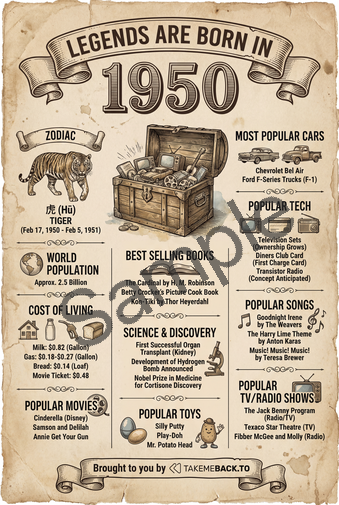

Major Events of 1950 - Historical Moments That Defined the Year | TakeMeBack.to
- 01 Jan Ho Chi Minh launches offensive against French colonial forces: On January 1, 1950, Ho Chi Minh initiated a military offensive against French colonial forces in Vietnam. This marked a significant escalation in the First Indochina War, as the Viet Minh sought to gain independence from French rule. source: britannica.com
- 05 Jan U.S. Senate initiates investigation into organized crime: On January 5, 1950, Senator Estes Kefauver introduced a resolution authorizing the Senate Committee on the Judiciary to investigate interstate racketeering activities and the use of interstate commerce for organized crime. This led to the formation of a special committee to examine organized crime's influence on interstate commerce. source: archives.gov
- 07 Jan Mercy Hospital Fire Tragedy: On January 7, 1950, a fire erupted at St. Elizabeth's Mental Health Facility within Mercy Hospital in Davenport, Iowa, resulting in the deaths of 41 individuals, including 40 patients and one nurse. The building's design, featuring locked doors and barred windows, hindered rescue efforts. The fire was believed to have been started by a patient who ignited curtains in her room, leading to rapid spread due to the building's combustible materials. source: usdeadlyevents.com
- 08 Jan Kwame Nkrumah's 'Positive Action' Campaign Begins: On January 8, 1950, Kwame Nkrumah initiated the 'Positive Action' campaign, a non-violent movement aimed at achieving self-governance for the Gold Coast (now Ghana). source: en.wikipedia.org
- 09 Jan Truman submits federal budget for fiscal year 1951: On January 9, 1950, President Harry S. Truman submitted his budget recommendations for the fiscal year ending June 30, 1951, estimating expenditures at $42.4 billion, approximately $860 million below the previous year's estimated expenditures. source: presidency.ucsb.edu
- 12 Jan Soviet Union reinstates death penalty: On January 12, 1950, the Soviet Union reinstated the death penalty, which had been abolished in 1947. This decision was part of a broader campaign to strengthen state security and suppress dissent during the early Cold War period. source: britannica.com
- 13 Jan British submarine tragedy in Thames Estuary: On January 13, 1950, another tragedy struck the British submarine service when HMS Truculent sank in the Thames Estuary. This incident followed the earlier sinking and highlighted ongoing safety issues within the Royal Navy. source: bbc.com
- 14 Jan U.S. recalls consular officials from China: On January 14, 1950, the United States recalled its consular officials from China amid rising tensions and diplomatic strains. This move was part of the broader context of the Cold War and the Chinese Civil War. source: state.gov
- 15 Jan National Emergency Civil Rights Conference: The National Emergency Civil Rights Conference took place on January 15, 1950, focusing on civil rights issues in the United States. This conference aimed to address racial discrimination and promote equality. source: archives.gov
- 18 Jan Bob Feller's voluntary salary reduction: On January 18, 1950, baseball pitcher Bob Feller announced a voluntary salary reduction to support his team during a challenging financial period. This decision was seen as a gesture of solidarity with his teammates and the organization. source: nytimes.com
- 19 Jan U.S. economic aid to South Korea stalled: On January 19, 1950, reports indicated that U.S. economic aid to South Korea was facing significant delays. This stalling was attributed to bureaucratic hurdles and concerns over the effectiveness of the aid. source: archives.gov
- 20 Jan Suriname's autonomy within Dutch Kingdom: On January 20, 1950, Suriname was granted autonomy within the Dutch Kingdom, marking a significant step towards self-governance. This change was part of a broader movement towards decolonization in the region. source: britannica.com
- 21 Jan Alger Hiss convicted of perjury: Alger Hiss, a former U.S. State Department official, was convicted of perjury on January 21, 1950. The case was significant during the Red Scare, as Hiss was accused of being a Soviet spy, which fueled anti-communist sentiments in the United States. source: archives.gov
- 22 Jan Preston Tucker acquitted of mail fraud: Automobile entrepreneur Preston Tucker was acquitted of mail fraud charges on January 22, 1950. His innovative car design and business practices had drawn scrutiny, but the acquittal allowed him to continue his work in the automotive industry. source: nytimes.com
- 23 Jan Israel declares Jerusalem as capital: On January 23, 1950, Israel officially declared Jerusalem as its capital. This decision has had lasting implications for the region and remains a contentious issue in international politics. source: bbc.com
- 24 Jan Cold War espionage: Klaus Fuchs Soviet spy confession: On January 24, 1950, Klaus Fuchs, a German-born physicist, confessed to espionage for the Soviet Union. His revelations about atomic secrets significantly impacted Cold War dynamics and U.S.-Soviet relations. source: britannica.com
- 25 Jan Significant minimum wage increase in the United States: On January 25, 1950, the U.S. government announced a significant increase in the federal minimum wage, raising it to 75 cents per hour. This change aimed to address inflation and improve worker compensation. source: dol.gov
- 26 Jan India becomes a republic: On January 26, 1950, India adopted its Constitution, transitioning from a British dominion to a republic. Dr. Rajendra Prasad was sworn in as the first President, replacing the British monarch as head of state. The new constitution replaced the Government of India Act 1935, marking a significant step in India's post-independence journey. source: news.bbc.co.uk
- 27 Jan 2nd Emmy Awards Ceremony: The 2nd Emmy Awards Ceremony was held on January 27, 1950, honoring outstanding achievements in the television industry for the year 1949. The event recognized excellence in various categories, including drama, comedy, and news programming. source: emmys.com
- 28 Jan Establishment of the Supreme Court of India: On January 28, 1950, the Supreme Court of India was inaugurated in the Chamber of Princes in the Parliament building, two days after India became a republic. The first Chief Justice was Sir Harilal Jekisundas Kania. source: sci.gov.in
- 30 Jan Soviet support for North Korean invasion plan: On January 30, 1950, Soviet leader Joseph Stalin informed North Korean Chairman Kim Il Sung through Soviet envoy Terenti Shtykov that the Soviet Union would support Kim's plan to invade South Korea. This decision was made after Stalin's meeting with Chinese leader Mao Zedong in Moscow. source: en.wikipedia.org
- 31 Jan Truman orders hydrogen bomb development: On January 31, 1950, U.S. President Harry S. Truman announced that he had directed the Atomic Energy Commission to continue its work on all forms of atomic weapons, including the hydrogen bomb. This decision was made in response to the Soviet Union's successful detonation of an atomic bomb in 1949. source: trumanlibrary.gov
- 01 Feb Truman establishes 'Top Secret' classification: On February 1, 1950, President Harry S. Truman issued a directive establishing the 'Top Secret' classification level for sensitive government information. This measure aimed to enhance national security by restricting access to critical information. source: archives.gov
- 02 Feb Arms and the Girl Broadway musical premiere: 'Arms and the Girl' is a 1950 Broadway musical with a book by Herbert Fields, Dorothy Fields, and Rouben Mamoulian, music by Morton Gould, and lyrics by Dorothy Fields. The show is based on the play 'The Pursuit of Happiness' by Lawrence Langner and Armina Marshall. It opened at the 46th Street Theatre on February 2, 1950, and closed on May 27 after 134 performances. source: en.wikipedia.org
- 03 Feb Klaus Fuchs arrested for passing atomic secrets to Soviets: Klaus Fuchs, a German-born British physicist who worked on the Manhattan Project, was arrested in Great Britain on February 3, 1950, for passing top-secret information about the atomic bomb to the Soviet Union. His arrest led to further investigations and the eventual conviction of Julius and Ethel Rosenberg in the United States. source: britannica.com
- 05 Feb Birth of Ann Sexton, American poet and vocalist: Ann Sexton was born on February 5, 1950, in Newton, Massachusetts. She became a prominent American poet known for her confessional style and exploration of personal and societal issues. Sexton's work earned her a Pulitzer Prize in 1967, and she remains a significant figure in American literature. source: britannica.com
- 06 Feb Testimony on Soviet nuclear development: On February 6, 1950, testimony was given regarding the advancements in Soviet nuclear capabilities. This was part of the broader context of Cold War tensions and concerns over nuclear proliferation. The testimony highlighted the urgency of U.S. responses to Soviet developments. source: archives.gov
- 07 Feb US diplomatic recognition of French-supported governments in Indochina: On February 7, 1950, the United States formally recognized the French-supported governments in Indochina. This recognition was part of the U.S. strategy to counter communist influence in Southeast Asia during the Cold War. source: history.state.gov
- 08 Feb Establishment of the Stasi in East Germany: The Stasi, or Ministry for State Security, was established in East Germany on February 8, 1950. It became one of the most effective and repressive intelligence and secret police agencies in the world, playing a crucial role in the surveillance of East German citizens. source: britannica.com
- 09 Feb McCarthy's 'Enemies Within' speech: On February 9, 1950, Senator Joseph McCarthy delivered his famous 'Enemies Within' speech in Wheeling, West Virginia, where he claimed that communists had infiltrated the U.S. government. This speech marked the beginning of McCarthyism and heightened fears of communist subversion in America. source: archives.gov
- 10 Feb Norwegian–British–Swedish Antarctic Expedition Establishes Maudheim Station: On February 11, 1950, the Norwegian–British–Swedish Antarctic Expedition established the Maudheim wintering base on the Quar Ice Shelf at 71°02.6' S 10°55.5' W in Queen Maud Land, Norway's claimed territory in Antarctica. This base served as the home for the expedition's scientific research. source: munin.uit.no
- 14 Feb USSR and China Peace Treaty: On February 14, 1950, the USSR and China signed a peace treaty, marking a significant alliance during the Cold War. This treaty solidified their mutual interests against Western powers and laid the groundwork for future cooperation. source: britannica.com
- 15 Feb Soviet-China Mutual Defense Treaty Signed: On February 15, 1950, the Soviet Union and China signed a mutual defense treaty, strengthening their military alliance during the Cold War. This agreement was pivotal in shaping the geopolitical landscape of the time. source: britannica.com
- 16 Feb Peter Hain Born: Peter Hain, a prominent British politician and anti-apartheid activist, was born on February 16, 1950. He has played a significant role in British politics and social justice movements throughout his career. source: britannica.com
- 17 Feb Deadly Long Island Railroad Train Collision: On February 17, 1950, a tragic collision occurred on the Long Island Railroad, resulting in multiple fatalities. The incident raised concerns about railway safety and led to investigations into operational protocols. source: nytimes.com
- 18 Feb John Hughes born in Lansing, Michigan: John Wilden Hughes Jr., an American filmmaker and producer, was born on February 18, 1950, in Lansing, Michigan. He is best known for directing and producing films such as 'Sixteen Candles,' 'The Breakfast Club,' and 'Ferris Bueller's Day Off.' source: en.wikipedia.org
- 19 Feb US breaks diplomatic relations with Bulgaria: On February 19, 1950, the United States severed diplomatic ties with Bulgaria after the Bulgarian government refused to withdraw espionage charges against American diplomat Donald R. Heath. This led to the withdrawal of American diplomats from Sofia. source: history.state.gov
- 20 Feb Tony Wilson's Birth: Tony Wilson, an influential figure in the British music scene, was born on February 20, 1950. He is best known for founding Factory Records and promoting the Manchester music scene. source: theguardian.com
- 21 Feb RMS Aquitania reaches end of historic maritime career: The RMS Aquitania, a British ocean liner, was retired from service on February 21, 1950, after a distinguished career spanning nearly four decades. It was known for its luxurious accommodations and significant role in transatlantic travel. source: britannica.com
- 22 Feb Walt Disney's Cinderella premieres in major US cities: Walt Disney's animated film 'Cinderella' premiered in major U.S. cities on February 22, 1950. The film became a classic and is credited with revitalizing Disney's animation studio. source: disney.com
- 23 Feb Kurt Vonnegut's First Published Work: Kurt Vonnegut's first published work appeared on February 23, 1950. This marked the beginning of his prolific writing career, which would later include many acclaimed novels. source: nytimes.com
- 25 Feb George Minot, Nobel Prize-winning physician dies: George Minot, an American physician who won the Nobel Prize in Physiology or Medicine in 1934 for his work on liver disease, passed away on February 25, 1950. His research significantly advanced the understanding of pernicious anemia and its treatment. source: britannica.com
- 27 Feb 22nd Amendment ratified: The 22nd Amendment to the United States Constitution, which limits presidents to two terms in office, was ratified on February 27, 1950. This amendment was a response to Franklin D. Roosevelt's four-term presidency. source: archives.gov
- 28 Feb B-36 bomber nuclear weapon crash: On February 28, 1950, a B-36 bomber carrying a nuclear weapon crashed in the vicinity of the Canadian Arctic. The incident raised concerns about nuclear safety and military operations during the Cold War. source: britannica.com
- 01 Mar Klaus Fuchs convicted of atomic espionage: Klaus Fuchs, a German-born physicist, was convicted in the United Kingdom for passing atomic secrets to the Soviet Union, significantly impacting Cold War dynamics. source: en.wikipedia.org
- 02 Mar Karen Carpenter born in New Haven, Connecticut: Karen Anne Carpenter, the American singer and drummer known for her work with the Carpenters, was born on March 2, 1950, in New Haven, Connecticut. source: en.wikipedia.org
- 03 Mar U.S. House Votes in Favor of Alaska Statehood: On March 3, 1950, the U.S. House of Representatives voted in favor of a bill for Alaska's statehood. This was a significant step towards Alaska becoming the 49th state of the United States. source: congress.gov
- 04 Mar Walt Disney's Cinderella premieres in the United States: Walt Disney's animated film 'Cinderella' premiered in the United States on February 15, 1950. The film was a significant success, marking Disney's return to feature-length animation after World War II. source: en.wikipedia.org
- 06 Mar Comedian Lew Lehr Dies: Comedian Lew Lehr passed away on March 6, 1950. He was known for his unique style of humor and contributions to the entertainment industry during his career. source: nytimes.com
- 07 Mar U.S. House approves Hawaii statehood bill: On March 7, 1950, the U.S. House of Representatives passed a statehood bill for Hawaii by a vote of 262-110, marking a significant step toward Hawaii's admission as the 50th state. source: perspectivaestadista.blogspot.com
- 11 Mar Death of Charles Windolph: Charles A. Windolph, a U.S. Army soldier who survived the Battle of the Little Bighorn and was awarded the Medal of Honor, died on March 11, 1950. source: en.wikipedia.org
- 13 Mar Soviet Labor Camp Wage System Introduced: On March 13, 1950, the Soviet government adopted a resolution to introduce wages for prisoners at all correctional-labor camps and colonies, except special camps housing 'especially dangerous' criminals. This policy aimed to integrate prisoners into the workforce by compensating them similarly to free workers, with earnings up to 1,800 rubles, though only a portion was paid directly to the prisoners. source: uh.edu
- 15 Mar Consul Play at Barrymore Theater: The play 'Consul' premiered at the Barrymore Theater in New York City on March 15, 1950. It was notable for its innovative use of music and themes related to the human condition. source: nytimes.com
- 16 Mar First National Book Awards ceremony: The inaugural National Book Awards ceremony took place on March 16, 1950, celebrating outstanding literary achievements in the United States. This event has since become a prestigious annual recognition in the literary community. source: nytimes.com
- 17 Mar Belgian government resignation: On March 17, 1950, the Belgian government resigned amid political turmoil and public discontent. This event marked a significant moment in Belgian politics during the post-war period. source: bbc.com
- 18 Mar Belgian government collapses amid political crisis: On March 18, 1950, Belgian Prime Minister Gaston Eyskens and his cabinet resigned, leading to the collapse of the government after ministers failed to agree on holding a joint session of Parliament to decide on King Leopold III's return from exile. source: en.wikipedia.org
- 19 Mar Walter Haworth, Nobel Prize-winning chemist, passes away: On March 19, 1950, Walter Haworth, a British chemist who won the Nobel Prize in Chemistry in 1929 for his work on carbohydrates and vitamin C, died. source: en.wikipedia.org
- 20 Mar Polish government confiscates Catholic Church property: On March 20, 1950, the Polish government initiated a campaign to confiscate property belonging to the Catholic Church. This move was part of a broader effort to assert state control over religious institutions during a period of increasing communist influence. source: bbc.com
- 21 Mar Great Fire of New Orleans: The Great Fire of New Orleans occurred on March 21, 1950, devastating a significant portion of the city. The fire, which started in a warehouse, spread rapidly, destroying numerous buildings and leading to extensive damage. source: archives.gov
- 22 Mar Egypt demands British troop withdrawal from Suez Canal: On March 22, 1950, Egypt formally demanded the withdrawal of British troops from the Suez Canal. This demand was part of the growing nationalist movement in Egypt and reflected tensions between Egypt and colonial powers. source: bbc.com
- 23 Mar World Meteorological Organization established: The World Meteorological Organization (WMO) was established on March 23, 1950, as a specialized agency of the United Nations. Its mission is to promote international cooperation in meteorology, climatology, hydrology, and related fields to enhance the safety and well-being of society. source: public.wmo.int
- 24 Mar Mass defection from Communist Czechoslovakia: On March 24, 1950, a significant mass defection occurred in Czechoslovakia, where a group of individuals fled the communist regime. This event highlighted the growing discontent and resistance against communist rule in Eastern Europe during the Cold War. source: bbc.com
- 26 Mar Yugoslav Communist Parliamentary Elections: Parliamentary elections were held in Yugoslavia on March 26, 1950. The Communist Party of Yugoslavia, led by Josip Broz Tito, won the elections, with the People's Front, dominated by the Communist Party, being the only organization to contest the election. source: en.wikipedia.org
- 27 Mar WHAS TV Channel 11 Launches in Louisville: WHAS-TV, Louisville's second television station, began broadcasting on March 27, 1950. Originally on VHF channel 9, it was founded by the Bingham family, publishers of The Courier-Journal and The Louisville Times. source: en.wikipedia.org
- 28 Mar CCNY Beavers win NCAA basketball championship: On March 28, 1950, the City College of New York (CCNY) Beavers secured their first NCAA men's basketball championship by defeating the Bradley Braves 71–68 at Madison Square Garden in New York City. This victory marked the only instance of a team winning both the National Invitation Tournament (NIT) and NCAA tournaments in the same season. Irwin Dambrot of CCNY was named the tournament's Most Outstanding Player. source: en.wikipedia.org
- 29 Mar RCA demonstrates color television system: On March 29, 1950, the Radio Corporation of America (RCA) conducted the first public demonstration of its all-electronic color television system in Washington, D.C. This system utilized a single tube, differing from RCA's earlier three-tube design, and was compatible with existing black-and-white television sets. David Sarnoff, RCA's president, announced that the new system would bring color television to American homes in a matter of months rather than years. source: chroniclingamerica.loc.gov
- 31 Mar Jordan's Prime Minister resigns: On March 31, 1950, Jordan's Prime Minister, Tawfiq Abu al-Huda, resigned from his position. His resignation was part of a broader political shift in the region during a time of significant change and instability. source: britannica.com
- 01 Apr Death of Charles R. Drew, blood bank pioneer: Charles R. Drew, an African American surgeon and medical researcher known for his pioneering work in blood transfusion and blood banking, died on April 1, 1950. His contributions significantly advanced medical practices related to blood donation and storage. source: ncbi.nlm.nih.gov
- 02 Apr Historic India-Pakistan summit meeting: On April 2, 1950, a significant summit meeting took place between leaders of India and Pakistan. This meeting aimed to address ongoing tensions and foster dialogue between the two nations in the aftermath of partition. source: bbc.com
- 03 Apr Death of Carter G. Woodson, Pioneer of African American Historical Studies: Carter G. Woodson, an American historian and founder of the Association for the Study of African American Life and History, died on April 3, 1950, in Washington, D.C. source: en.wikipedia.org
- 08 Apr Cold War incident: Soviet shootdown of U.S. Navy plane: On April 8, 1950, a Soviet fighter jet shot down a U.S. Navy plane over the Baltic Sea, escalating tensions during the Cold War. This incident highlighted the growing hostilities between the United States and the Soviet Union, contributing to the climate of fear and suspicion that characterized the era. source: archives.gov
- 09 Apr Bob Hope's first television appearance: Bob Hope made his first television appearance on April 9, 1950, marking a significant moment in entertainment history. This appearance helped to establish Hope as a major television personality and contributed to the popularity of variety shows in the early days of television. source: bobhope.com
- 10 Apr Dag Hammarskjöld becomes UN Secretary-General: On April 10, 1950, Dag Hammarskjöld was appointed as the second Secretary-General of the United Nations. His leadership was marked by efforts to strengthen the UN's role in international diplomacy and peacekeeping during a tumultuous period in global politics. source: un.org
- 11 Apr Jordan's First Inclusive Elections: On April 11, 1950, Jordan held its first general elections, allowing West Bank Palestinians to vote for the first time. The 40-member Parliament was equally divided between representatives from the East and West Banks, with all candidates running as independents due to the ban on political parties. source: en.wikipedia.org
- 13 Apr Arab League Collective Security Treaty: On April 13, 1950, the Arab League members signed the Joint Defence and Economic Co-operation Treaty in Cairo, Egypt. This treaty established mutual defense and economic cooperation among the member states, aiming to strengthen regional security and unity. source: jewishvirtuallibrary.org
- 15 Apr Red River of the North Floods Manitoba: The 1950 Red River flood was a devastating event that took place along the Red River in North Dakota, United States, and Manitoba, Canada, from April 15 to June 12, 1950. Damage was particularly severe in the city of Winnipeg and its environs, which were inundated on May 5, also known as Black Friday to some residents. An estimated 70,000–100,000 residents had to be evacuated, and four of eleven bridges were destroyed. In that year, the Red River reached its highest level since 1861 and flooded most of the Red River Valley, more than 550 square miles. One man died, and property losses due to the flood were estimated at more than $600 million to one billion. source: en.wikipedia.org
- 20 Apr Aleksandr Lebed born: Russian politician and military leader Aleksandr Lebed was born on April 20, 1950. He gained prominence in the 1990s and served as a general in the Russian army, later becoming a governor and a political figure. source: britannica.com
- 21 Apr Nainital wedding massacre: The Nainital wedding massacre occurred on April 21, 1950, when a group of armed men attacked a wedding party in Nainital, India. The incident resulted in multiple casualties and highlighted issues of lawlessness in the region during that period. source: indiatoday.in
- 22 Apr Communist forces capture Hainan Island: On April 22, 1950, Communist forces captured Hainan Island during the Chinese Civil War. This event marked a significant step in the consolidation of Communist control over China, following the end of the civil war. source: britannica.com
- 23 Apr Nationalist China evacuates Hainan Island: On April 23, 1950, Nationalist Chinese forces evacuated Hainan Island as the People's Liberation Army advanced. This marked a significant moment in the Chinese Civil War, leading to the consolidation of Communist control over the region. source: britannica.com
- 24 Apr South Africa passes Group Areas Act: On April 24, 1950, the South African Parliament passed the Group Areas Act, which enforced racial segregation in urban areas. This legislation was a key component of the apartheid system that institutionalized racial discrimination in South Africa. source: britannica.com
- 25 Apr UN forces halt Chinese advance in Korean War: On April 25, 1950, United Nations forces successfully halted the advance of Chinese troops during the Korean War. This marked a crucial turning point in the conflict, as UN forces regrouped and fortified their positions. source: britannica.com
- 26 Apr University of Miami tennis team achieves milestone: On April 26, 1950, the University of Miami's tennis team reached a significant milestone by winning its first conference championship. This achievement highlighted the growing prominence of the university's athletic programs. source: miami.edu
- 27 Apr 4 Saints in 3 Acts closes on Broadway: On April 27, 1950, the groundbreaking opera '4 Saints in 3 Acts' closed on Broadway after a successful run. This production was notable for its avant-garde style and incorporation of African American culture. source: britannica.com
- 01 May Gwendolyn Brooks wins Pulitzer Prize for Poetry: On May 1, 1950, Gwendolyn Brooks was awarded the Pulitzer Prize for Poetry for her book 'Annie Allen,' making her the first African American to receive this honor. source: latimes.com
- 02 May Lou Gramm: Rock Musician Born: Louis Andrew Grammatico, known professionally as Lou Gramm, was born on May 2, 1950, in Rochester, New York. source: en.wikipedia.org
- 03 May Mary Hopkin born in Pontardawe, Wales: Mary Hopkin, Welsh singer known for her 1968 hit "Those Were the Days," was born in Pontardawe, Wales. source: en.wikipedia.org
- 05 May Coronation of King Bhumibol Adulyadej: King Bhumibol Adulyadej was crowned as the ninth monarch of Thailand on May 5, 1950, in Bangkok. This ceremony marked the first coronation of a Thai sovereign under the constitutional monarchy system. source: britannica.com
- 07 May Canonization of Saint Anthony Mary Claret: On May 7, 1950, Saint Anthony Mary Claret, founder of the Claretian Missionaries, was canonized by Pope Pius XII in a ceremony at St. Peter's Basilica in Rome. Claret was recognized for his dedication to missionary work and his contributions to the Catholic Church. source: claret.org
- 09 May Schuman Declaration: European integration begins: On May 9, 1950, French Foreign Minister Robert Schuman proposed the creation of a European Coal and Steel Community, marking the beginning of European integration. source: robert-schuman.eu
- 11 May Eugene Dennis begins jail sentence for contempt of Congress: Eugene Dennis, General Secretary of the Communist Party USA, began serving a five-year prison sentence on May 11, 1950, after being convicted of contempt of Congress for refusing to testify before the House Un-American Activities Committee. source: en.wikipedia.org
- 12 May Darius Milhaud's opera Bolivar premieres in Paris: Darius Milhaud's opera 'Bolivar' premiered at the Théâtre de l'Opéra-Comique in Paris on May 12, 1950. The opera is based on the life of Simón Bolívar, the South American liberator. Milhaud's work is noted for its innovative use of orchestration and blending of musical styles. source: britannica.com
- 13 May Kim Il Sung's strategic Beijing meeting: On May 13, 1950, Kim Il Sung met with Chinese leaders in Beijing to discuss military strategies and support for North Korea. This meeting was pivotal in solidifying the alliance between North Korea and China, which would later influence the Korean War. The discussions focused on the potential for conflict on the Korean Peninsula. source: bbc.com
- 14 May Turkey's first free democratic election: On May 14, 1950, Turkey held its first free and democratic general elections, marking a significant milestone in its political history. The Democrat Party (DP), led by Celâl Bayar, secured a decisive victory, winning 416 out of 487 seats in the Grand National Assembly with 55% of the popular vote. This election ended the Republican People's Party's (CHP) 27-year rule, initiating a new era of multiparty democracy in Turkey. source: aa.com.tr
- 17 May Celâl Bayar becomes President of Turkey: On May 17, 1950, following the Democrat Party's victory in the May 14 elections, Celâl Bayar was elected as the third President of Turkey. He was elected by the Grand National Assembly on May 22, 1950, and served as president until 1960. source: britannica.com
- 19 May Egypt closes Suez Canal to Israeli shipping: On May 19, 1950, Egypt officially closed the Suez Canal to Israeli shipping, a significant move in the context of regional tensions. This decision was part of broader Arab opposition to the establishment of Israel and aimed to restrict Israeli access to international trade routes. source: britannica.com
- 20 May 76th Preakness Stakes won by Eddie Arcaro: On May 20, 1950, Eddie Arcaro rode Hill Prince to victory in the 76th Preakness Stakes, marking a notable achievement in horse racing history. This win contributed to Arcaro's reputation as one of the greatest jockeys of his time. source: britannica.com
- 21 May First aerial hydrogen bomb test at Bikini Atoll: On May 21, 1950, the United States conducted its first aerial hydrogen bomb test at Bikini Atoll, known as Operation Greenhouse. This test was part of a series of nuclear tests that significantly advanced the U.S. nuclear arsenal during the Cold War. source: britannica.com
- 22 May Celal Bayar elected President of Turkey: Celal Bayar was elected as the third President of Turkey on May 22, 1950, succeeding Ismet İnönü. source: en.wikipedia.org
- 24 May U.S. Maritime Administration established: The U.S. Maritime Administration was established to oversee the nation's merchant marine and ensure the availability of shipping services during emergencies. source: maritime.dot.gov
- 25 May Brooklyn-Battery Tunnel opens in New York City: The Brooklyn-Battery Tunnel, connecting Red Hook in Brooklyn to the Battery in Manhattan, opened to traffic, becoming the longest continuous underwater vehicular tunnel in North America at that time. source: mta.info
- 26 May Kefauver Committee hearings on organized crime begin: The Kefauver Committee, led by Senator Estes Kefauver, began hearings investigating organized crime in the United States, bringing national attention to the issue. source: archives.gov
- 27 May Gasoline rationing ends in the United Kingdom: The United Kingdom lifted gasoline rationing, which had been in place since World War II, allowing motorists to purchase fuel without restrictions. source: gov.uk
- 28 May Death of Stanisław Kętrzyński: Stanisław Kętrzyński, a Polish historian and diplomat, passed away on May 28, 1950, in Warsaw, Poland. He was known for his contributions to Polish history and his role as a diplomat. source: en.wikipedia.org
- 30 May South Korean National Assembly Election: On May 30, 1950, South Korea held its legislative elections, resulting in a tie between the Democratic Nationalist Party and the Korea Nationalist Party, each securing 24 seats. Voter turnout was 91.9%. source: en.wikipedia.org
- 01 Jun Declaration of Conscience Speech: On June 1, 1950, U.S. Senator Margaret Chase Smith delivered the "Declaration of Conscience" speech on the Senate floor, criticizing the tactics of Senator Joseph McCarthy and advocating for the protection of individual rights and freedoms. source: senate.gov
- 02 Jun US and Canada Join OEEC: On June 2, 1950, the United States and Canada joined the Organisation for European Economic Co-operation (OEEC), an organization established to coordinate European economic recovery after World War II. source: en.wikipedia.org
- 03 Jun First ascent of Annapurna: A mountaineering milestone: On June 3, 1950, Maurice Herzog and Louis Lachenal of the French Annapurna expedition reached the summit of Annapurna I, marking the first ascent of an 8,000-meter peak. source: en.wikipedia.org
- 06 Jun Red Purge in Japan initiated by General MacArthur: On June 6, 1950, General Douglas MacArthur ordered Japanese Prime Minister Yoshida Shigeru to purge 24 members of the Japanese Communist Party's Central Committee from public office, marking the beginning of the Red Purge in Japan. source: ndl.go.jp
- 12 Jun Mindoro Province Split: On June 12, 1950, the Philippine Congress enacted Republic Act No. 505, dividing the island province of Mindoro into two separate provinces: Occidental Mindoro and Oriental Mindoro. This legislation provided each province with its own representation in Congress, effective from the second half of the 2nd Congress. source: en.wikipedia.org
- 13 Jun South African Parliament Passes Group Areas Act: On June 13, 1950, the South African Parliament passed the Group Areas Act, which enforced the segregation of different races into specific areas within urban locales. This act restricted ownership and occupation of land to designated racial groups, leading to the forced removal of non-Whites from areas classified for White occupation. source: britannica.com
- 15 Jun Asteroid discovery by Itzigsohn: On June 15, 1950, astronomer Hugo Itzigsohn discovered an asteroid, contributing to the field of astronomy. This discovery added to the catalog of known asteroids and enhanced understanding of celestial bodies. source: nasa.gov
- 16 Jun Truman amends Displaced Persons Act: On June 16, 1950, President Harry S. Truman signed an amendment to the Displaced Persons Act, allowing for the admission of more refugees into the United States. This amendment aimed to address the humanitarian crisis following World War II. source: archives.gov
- 17 Jun Julius Rosenberg arrested for espionage: Julius Rosenberg was arrested on June 17, 1950, on charges of espionage for allegedly passing atomic secrets to the Soviet Union. His trial and subsequent execution became a significant event during the Cold War era. source: archives.gov
- 18 Jun Arab League Joint Defence Treaty signed: On June 18, 1950, the Arab League signed a Joint Defence Treaty aimed at mutual defense among member states. This treaty was a significant step in regional cooperation during the Cold War era. source: brookings.edu
- 19 Jun Rosenbergs executed for espionage: On June 19, 1950, Julius and Ethel Rosenberg were executed in the United States for espionage, accused of passing atomic secrets to the Soviet Union. Their trial and execution sparked significant controversy and debate. source: archives.gov
- 20 Jun Dutch Air Force base transferred to Indonesia: On June 20, 1950, the Dutch government officially transferred control of a military air base to Indonesia, marking a significant step in the decolonization process following Indonesia's independence. source: britannica.com
- 24 Jun Apartheid: Group Areas Act passed in South Africa: The Group Areas Act was enacted on June 24, 1950, as part of the apartheid legislation in South Africa. This law designated specific areas for different racial groups, leading to forced removals and significant social and economic impacts on non-white populations. source: britannica.com
- 25 Jun Korean War begins: The Korean War officially began on June 25, 1950, when North Korean forces invaded South Korea. This conflict marked a significant escalation in Cold War tensions and led to a prolonged military engagement involving multiple nations. source: britannica.com
- 26 Jun Suppression of Communism Act Passed in South Africa: On June 26, 1950, the South African Parliament passed the Suppression of Communism Act, which declared the Communist Party of South Africa an unlawful organization and granted the government authority to ban other organizations promoting communistic activities. source: britannica.com
- 27 Jun North Korean Invasion of South Korea Begins: On June 27, 1950, North Korean forces launched a full-scale invasion of South Korea, marking the beginning of the Korean War. source: en.wikipedia.org
- 28 Jun Fall of Seoul: On June 28, 1950, North Korean forces captured Seoul, the capital of South Korea, during the early stages of the Korean War. source: en.wikipedia.org
- 29 Jun United States defeats England in World Cup soccer: On June 29, 1950, the United States soccer team achieved a stunning 1-0 victory over England in the FIFA World Cup, considered one of the biggest upsets in World Cup history. source: en.wikipedia.org
- 30 Jun US intervention in Korean War begins: On June 30, 1950, President Harry S. Truman announced the deployment of U.S. forces to Korea in response to North Korea's invasion of South Korea. This marked the beginning of direct U.S. military involvement in the Korean War, aimed at containing the spread of communism in Asia. source: archives.gov
- 01 Jul First US ground troops deployed in Korean War: On July 1, 1950, the first U.S. ground troops were deployed to Korea as part of the United Nations response to North Korea's invasion. This marked a significant escalation in the conflict, with American forces engaging directly in combat operations. source: archives.gov
- 02 Jul Naval Battle of Chumonchin Chan during Korean War: The Naval Battle of Chumonchin Chan occurred on July 2, 1950, as U.S. naval forces engaged North Korean vessels. This battle was part of the broader conflict of the Korean War, highlighting the naval component of the military operations. source: britannica.com
- 03 Jul First Major US-North Korean Military Engagement in Korean War: On July 3, 1950, U.S. Navy aircraft from the USS Valley Forge launched the first carrier air strikes of the Korean War, targeting North Korean airfields and other strategic sites. This marked the first combat employment of the F9F Panther and A-1 Skyraider aircraft. source: history.navy.mil
- 04 Jul Radio Free Europe Inaugural Broadcast: On July 4, 1950, Radio Free Europe began its inaugural broadcast, aiming to provide news and information to Eastern Europe during the Cold War. source: en.wikipedia.org
- 05 Jul Israel's Law of Return enacted: On July 5, 1950, the Knesset passed the Law of Return, granting Jews worldwide the right to immigrate to Israel and obtain citizenship. source: en.wikipedia.org
- 07 Jul Death of Jazz Trumpet Legend Fats Navarro: Fats Navarro, a pioneering American jazz trumpeter known for his contributions to the bebop style, died on July 7, 1950, in New York City at the age of 26. source: en.wikipedia.org
- 08 Jul Louise Brough Wins Wimbledon Women's Tennis: On July 8, 1950, Louise Brough won the Wimbledon Women's Singles title, defeating Margaret duPont in the final. source: en.wikipedia.org
- 09 Jul Record rainfall in York, Nebraska: On July 9, 1950, York, Nebraska, experienced record rainfall, leading to significant flooding in the area. This weather event was part of a larger pattern of severe weather affecting the Midwest during that summer. source: weather.gov
- 10 Jul UK ends soap rationing post-World War II: On July 10, 1950, the United Kingdom officially ended soap rationing, a measure that had been in place since World War II. This marked a significant step towards normalcy in post-war Britain. source: bbc.co.uk
- 11 Jul 17th MLB All-Star Game at Comiskey Park: The 17th Major League Baseball All-Star Game was held on July 11, 1950, at Comiskey Park in Chicago. The National League defeated the American League 4–3 in 14 innings, marking the first extra-inning All-Star Game. Ted Williams of the Boston Red Sox sustained an elbow injury during the game after colliding with the unpadded outfield wall. source: en.wikipedia.org
- 13 Jul General Walton H. Walker assumes command of U.S. ground forces in Korea: On July 13, 1950, General Walton H. Walker, commander of the Eighth U.S. Army, assumed command of all U.S. ground forces in Korea. This move was part of the United Nations' effort to unify command under U.S. leadership during the Korean War. source: history.army.mil
- 14 Jul Battle of Taejon begins during Korean War: On July 14, 1950, the Battle of Taejon commenced as North Korean forces advanced southward, leading to significant engagements between U.S. and North Korean troops. This battle was part of the larger conflict during the Korean War. source: history.army.mil
- 16 Jul Uruguay defeats Brazil in dramatic World Cup final: In the 1950 FIFA World Cup final, Uruguay overcame Brazil 2-1 at Rio de Janeiro's Maracanã Stadium. Brazil led with a goal from Friaça in the 48th minute, but Uruguay's Juan Alberto Schiaffino equalized in the 66th minute, and Alcides Ghiggia scored the decisive goal in the 79th minute, securing Uruguay's second World Cup title. source: bbc.com
- 19 Jul Papal Encyclical Publication: Pope Pius XII issued the encyclical 'Summi Maeroris' on July 19, 1950, calling for public prayers for peace during the Holy Year. source: vatican.va
- 20 Jul Soviet espionage: Harry Gold pleads guilty: On July 20, 1950, Harry Gold, an American citizen, pleaded guilty to charges of espionage for passing atomic secrets to the Soviet Union. His case was part of a larger investigation into Soviet espionage activities in the United States during the Cold War. source: archives.gov
- 22 Jul Death of William Lyon Mackenzie King: William Lyon Mackenzie King, the 10th Prime Minister of Canada, passed away on July 22, 1950. His long tenure and policies significantly shaped Canadian politics and society in the 20th century. source: thecanadianencyclopedia.ca
- 24 Jul First rocket launch at Cape Canaveral: On July 24, 1950, the first successful rocket launch took place at Cape Canaveral, marking a significant milestone in the United States' space exploration efforts. This event laid the groundwork for future advancements in rocketry and space travel. source: nasa.gov
- 25 Jul Puerto Rican Federal Relations Act enacted: The Puerto Rican Federal Relations Act was enacted on July 25, 1950, establishing a new political relationship between Puerto Rico and the United States. This act allowed Puerto Rico to create its own constitution and provided for a degree of self-governance while maintaining U.S. sovereignty. source: congress.gov
- 26 Jul Dissolution and reorganization of KNIL: On July 26, 1950, the Royal Netherlands East Indies Army (KNIL) was officially dissolved and reorganized as part of the transition to Indonesian independence. This marked a significant change in the military structure in the region. source: britannica.com
- 27 Jul Truman's commitment to Taiwan's defense: On July 27, 1950, President Harry S. Truman announced a commitment to defend Taiwan against potential aggression from the People's Republic of China. This decision was part of the broader U.S. strategy in Asia during the Cold War. source: archives.gov
- 28 Jul Manuel Odría becomes President of Peru: Manuel A. Odría assumed the presidency of Peru after a military coup. His government was marked by authoritarian rule and significant economic development, particularly in infrastructure and industry. source: britannica.com
- 29 Jul No Gun Ri massacre during Korean War: The No Gun Ri massacre occurred from July 26 to July 29, 1950, when U.S. troops killed a large number of South Korean refugees. This event has been a significant point of discussion regarding military conduct during the war. source: nytimes.com
- 31 Jul Belgian workers' mass protest at Royal Palace: On July 31, 1950, thousands of Belgian workers protested at the Royal Palace in Brussels against the government's policies and the return of King Leopold III. This event highlighted the social tensions in post-war Belgium. source: bbc.com
- 01 Aug Belgian royal succession: On August 1, 1950, King Baudouin succeeded his father, King Leopold III, following a controversial reign. This transition marked a significant moment in Belgian history, impacting the monarchy's role in society. source: britannica.com
- 04 Aug Mao Zedong prepares for Korean War intervention: On August 4, 1950, during a Chinese Communist Party Politburo meeting, Chairman Mao Zedong advocated for preparations to assist North Korea in the Korean War, expressing concerns over potential U.S. imperialist threats if they were to win. source: archives.gov
- 06 Aug Chinese generals prevent hasty Korean invasion: On August 6, 1950, Chinese military leaders made strategic decisions to prevent a rapid invasion of Korea. This move was crucial in shaping the dynamics of the Korean War, as it aimed to stabilize the region amidst escalating tensions. source: britannica.com
- 07 Aug UN Security Council rejects China's UN membership: On August 7, 1950, the United Nations Security Council voted against admitting the People's Republic of China as a member. This decision reflected the geopolitical tensions of the time, particularly in relation to the ongoing Korean War. source: un.org
- 08 Aug Truman's Internal Security Message to Congress: On August 8, 1950, President Harry S. Truman delivered a message to Congress emphasizing the need for internal security measures during the Cold War. He highlighted the threat of communism and the importance of safeguarding national security. source: archives.gov
- 09 Aug Stalin orders advanced anti-aircraft defense system: On August 9, 1950, Joseph Stalin ordered the implementation of an advanced anti-aircraft defense system in the Soviet Union. This move was part of a broader strategy to enhance military capabilities amid rising tensions during the Cold War. source: bbc.com
- 10 Aug Battle of the Notch during Korean War: The Battle of the Notch occurred on August 10, 1950, during the Korean War, marking a significant conflict between North and South Korean forces. This battle was part of the early stages of the war, highlighting the intense military engagements of the period. source: archives.gov
- 11 Aug Belgian legislative approval of royal transition: On August 11, 1950, Crown Prince Baudouin of Belgium was administered the oath to become Prince Royal, exercising all of the powers of his father, King Leopold III, who retained the title of King of Belgium. The Senate and Chamber of Deputies approved Leopold's decision to relinquish power, with a vote of 349–0 and eight abstentions. source: en.wikipedia.org
- 13 Aug Soviet steamer Mayakovsky sinks in Riga: On August 13, 1950, the Soviet paddle steamer Mayakovsky sank in the Daugava River in Riga, Latvia, due to overloading. The vessel, with a capacity of 150, was carrying 421 people at the time of the disaster, resulting in 147 deaths, including 48 children. This remains the deadliest peacetime disaster in Soviet Latvian history. source: en.wikipedia.org
- 15 Aug Battle of Battle Mountain begins: The Battle of Battle Mountain commenced on August 15, 1950, as part of the Korean War. United Nations Command forces, including the U.S. 25th Infantry Division, engaged North Korean troops in the Sobuk-san mountain area of South Korea. The battle aimed to prevent the North Korean People's Army from advancing beyond the Pusan Perimeter. The engagement lasted until September 19, 1950, resulting in a United Nations victory. source: en.wikipedia.org
- 17 Aug Indonesia becomes a unitary state: On August 17, 1950, Indonesia dissolved the United States of Indonesia and re-established itself as a unitary state, the Republic of Indonesia, under a new provisional constitution. source: en.wikipedia.org
- 18 Aug Assassination of Belgian Communist Party leader Julien Lahaut: Julien Lahaut, chairman of the Communist Party of Belgium, was assassinated in his home in Seraing, Belgium, on August 18, 1950. source: en.wikipedia.org
- 19 Aug Acrobat Ranch children's television series debuts on ABC: Acrobat Ranch, a children's television series featuring circus acts and audience participation games, premiered on ABC on August 19, 1950. It was one of ABC's first Saturday morning children's shows. source: en.wikipedia.org
- 21 Aug Althea Gibson becomes first African American to compete in U.S. National Tennis Championships: On August 21, 1950, Althea Gibson was accepted into the U.S. National Lawn Tennis Association's championship at Forest Hills, New York, becoming the first African American to compete in a U.S. national tennis competition. source: history.com
- 22 Aug Althea Gibson breaks racial barrier in tennis: In 1950, amid widespread segregation, Althea Gibson made history by becoming the first Black person to compete in the U.S. National Championships, now known as the U.S. Open. source: history.com
- 23 Aug Paul Robeson's passport dispute escalates: Paul Robeson, the renowned African American singer and civil rights activist, faced a significant dispute regarding his passport, which was revoked due to his political beliefs. This incident highlighted the tensions surrounding civil rights and freedom of expression during the era. source: britannica.com
- 24 Aug First African American UN delegate appointed: The United Nations appointed its first African American delegate, marking a significant milestone in representation and civil rights within international organizations. This appointment was a step forward for diversity in global diplomacy. source: un.org
- 25 Aug Truman orders army to seize control of railroads: On August 25, 1950, President Harry S. Truman issued an executive order placing the nation's railroads under the control of the U.S. Army, effective August 27, 1950, at 4:00 pm. This action was taken in anticipation of a nationwide strike by railroad workers, which was scheduled to begin on August 28, 1950. Truman stated that the seizure was imperative for the protection of American citizens and essential to national defense and security. source: trumanlibrary.gov
- 29 Aug British Commonwealth Forces arrive in Korea: On August 29, 1950, British Commonwealth forces, including troops from the United Kingdom, Canada, Australia, and New Zealand, arrived in Korea to support South Korean forces during the Korean War. source: history.com
- 01 Sep North Korean invasion of UN lines in Korean War: On September 1, 1950, North Korean forces advanced beyond the 38th parallel, breaching UN lines during the Korean War. This marked a significant escalation in the conflict, leading to increased international military involvement. source: britannica.com
- 02 Sep Mikhail Fradkov's birth: Mikhail Fradkov, a notable Russian politician and former Prime Minister, was born on September 2, 1950. He played a significant role in Russian politics during the early 2000s. source: britannica.com
- 03 Sep First Formula One World Champion: Giuseppe 'Nino' Farina secured the inaugural Formula One World Championship by winning the 1950 Italian Grand Prix at Monza on September 3, 1950. This victory clinched the championship title for Farina, who had previously won the British Grand Prix earlier that year. source: formula1.com
- 05 Sep Syria adopts first constitution: On September 5, 1950, Syria adopted its first constitution, known as the "Constitution of Independence." This document aimed to limit presidential powers and enhance parliamentary authority, marking a significant step in Syria's political development. source: en.wikipedia.org
- 07 Sep Knockshinnoch Coal Mine Disaster in Scotland: On September 7, 1950, the Knockshinnoch Castle Colliery in New Cumnock, Ayrshire, Scotland, experienced a catastrophic inrush of liquid peat and water, trapping 129 miners underground. Despite extensive rescue efforts, 13 miners lost their lives. source: en.wikipedia.org
- 08 Sep Defense Production Act enacted: The Defense Production Act was enacted on September 8, 1950, in response to the Korean War. It aimed to ensure the availability of resources and materials necessary for national defense and allowed the government to prioritize contracts for defense-related production. source: congress.gov
- 09 Sep California celebrates 100 years of statehood: On September 9, 1950, California celebrated the centennial of its admission to the United States. This event marked a significant milestone in California's history, highlighting its growth and development over the past century. source: britannica.com
- 10 Sep U.S. napalm attack on Wolmido Island: On September 10, 1950, during the Korean War, U.S. forces conducted a napalm attack on Wolmido Island. This operation was part of the broader military strategy to secure the area against North Korean forces. source: archives.gov
- 11 Sep Bolling v. Sharpe civil rights case initiated: The Bolling v. Sharpe case was initiated on September 11, 1950, challenging school segregation in Washington, D.C. This case would later be significant in the fight for civil rights in the United States. source: archives.gov
- 12 Sep UN forces triumph in Battle of Kyongju during Korean War: The Battle of Kyongju, part of the Battle of Pusan Perimeter, concluded on September 12, 1950, with United Nations forces achieving victory over North Korean troops. The engagement, which began on August 27, 1950, involved intense fighting as UN forces repelled a strong North Korean attack in the Kyongju region of South Korea. source: en.wikipedia.org
- 15 Sep Korean War: Inchon Landing: On September 15, 1950, during the Korean War, U.S. Marines initiated an amphibious assault at Inchon, South Korea, marking a significant turning point in the conflict. source: history.com
- 16 Sep Cleveland Rams' First NFL Game: On September 16, 1950, the Cleveland Rams played their first game in the National Football League (NFL) after the league's expansion to include teams from the All-America Football Conference (AAFC). source: pro-football-reference.com
- 17 Sep UN Forces Capture Kimpo Airfield in Korean War: On September 17, 1950, during the Korean War, United Nations forces captured Kimpo Airfield, a strategic location near Seoul, South Korea. source: history.navy.mil
- 19 Sep Great Powers Recognize Bonn Government: On September 19, 1950, the foreign ministers of the United States, United Kingdom, and France recognized the federal government in Bonn as the only "free and legally constituted" government in Germany. source: en.wikipedia.org
- 20 Sep Internal Security Act of 1950 enacted: The Internal Security Act of 1950 was enacted to address perceived threats of communism in the United States. It allowed for the detention of individuals deemed subversive and required Communist organizations to register with the government. source: congress.gov
- 21 Sep George Marshall becomes Secretary of Defense: George C. Marshall was appointed as the Secretary of Defense on September 21, 1950. His leadership during World War II and his role in the Marshall Plan were pivotal in shaping U.S. military and foreign policy during the Cold War. source: defense.gov
- 22 Sep Truman vetoes Internal Security Act: President Harry S. Truman vetoed the Internal Security Act on September 22, 1950, citing concerns over civil liberties. Despite his veto, Congress overrode it, leading to the law's enactment. source: presidency.ucsb.edu
- 23 Sep Patty Berg wins LPGA Golf Tournament: Patty Berg won the LPGA Golf Tournament on September 23, 1950, marking a significant achievement in women's professional golf. She was one of the founding members of the LPGA and a prominent figure in the sport. source: lpga.com
- 24 Sep Operation Magic Carpet: Mass Jewish migration to Israel: On September 24, 1950, Operation Magic Carpet continued, facilitating the mass migration of Jews from Yemen to Israel. This operation was crucial in establishing a Jewish presence in the newly formed state of Israel. source: jewishvirtuallibrary.org
- 25 Sep First transcontinental microwave television transmission: On September 25, 1950, the first successful transcontinental microwave television transmission took place, marking a significant advancement in broadcasting technology. This event paved the way for modern television broadcasting. source: britannica.com
- 26 Sep UN forces recapture Seoul during Korean War: On September 26, 1950, United Nations forces recaptured Seoul, the capital of South Korea, from North Korean control. This marked a significant turning point in the Korean War. source: history.com
- 27 Sep Dr. Ralph Bunche receives Nobel Peace Prize: On September 27, 1950, Dr. Ralph Bunche was awarded the Nobel Peace Prize for his mediation efforts in Palestine. source: en.wikipedia.org
- 28 Sep Indonesia joins the United Nations as 60th member: On September 28, 1950, Indonesia was admitted as the 60th member state of the United Nations, following the adoption of General Assembly Resolution 491 (V). This occurred less than a year after Indonesia's independence from the Netherlands. source: indonesia.un.org
- 29 Sep Tin Pan Alley TV show concludes: The popular television show 'Tin Pan Alley' concluded on September 29, 1950. The show was known for featuring various musical acts and played a significant role in promoting popular music during its run. source: tvguide.com
- 30 Sep WSM TV Channel 4 Nashville launches: WSM TV Channel 4 in Nashville officially launched on September 30, 1950. It became a significant broadcasting station, known for its country music programming and connection to the Grand Ole Opry. source: nashville.gov
- 02 Oct China's potential Korea intervention: On October 2, 1950, China began mobilizing troops in response to the Korean War, indicating a potential intervention. This move was part of a broader strategy to support North Korea against UN forces led by the United States. source: britannica.com
- 03 Oct China's warning to United States: On October 3, 1950, China issued a warning to the United States regarding its military actions in Korea. This warning was part of escalating tensions as Chinese forces prepared to intervene in the Korean War. source: britannica.com
- 04 Oct Peng Dehuai selected to command Chinese forces in Korean War: On October 4, 1950, Peng Dehuai was appointed to command Chinese forces in the Korean War. His leadership played a crucial role in the Chinese military strategy during the conflict. source: britannica.com
- 05 Oct Chinese invasion of Tibet begins: The Chinese invasion of Tibet commenced on October 5, 1950, when the People's Liberation Army entered Tibet, leading to the eventual incorporation of Tibet into the People's Republic of China. This event marked a significant moment in Tibetan history and has had lasting implications for Tibetan culture and autonomy. source: bbc.com
- 06 Oct UN establishes commission for Korean rehabilitation: On October 6, 1950, the United Nations established a commission aimed at the rehabilitation of Korea following the outbreak of the Korean War. This commission was tasked with addressing humanitarian needs and rebuilding efforts in the war-torn region. source: un.org
- 07 Oct US forces cross 38th parallel in Korean War: On October 7, 1950, United States forces crossed the 38th parallel into North Korea during the Korean War. This action was part of a broader military strategy to push back North Korean forces and secure the peninsula. source: britannica.com
- 08 Oct Cold War incident: On October 8, 1950, various incidents related to the Cold War occurred, reflecting the tensions between the United States and the Soviet Union. These events contributed to the ongoing geopolitical struggles of the era. source: britannica.com
- 11 Oct Communist election held in East Germany: On October 11, 1950, East Germany held elections that were heavily influenced by the ruling Socialist Unity Party. The elections were characterized by a lack of genuine democratic processes, as opposition parties were suppressed. This event was part of the broader context of Cold War politics in Eastern Europe. source: britannica.com
- 12 Oct CIA report on potential Chinese intervention in Korean War: On October 12, 1950, the CIA released a report assessing the likelihood of Chinese intervention in the Korean War. The report highlighted concerns about the growing tensions and the potential for a broader conflict involving China. This analysis was crucial for U.S. military strategy during the war. source: cia.gov
- 13 Oct Chinese Communist Party decides on Korean War intervention: On October 13, 1950, the Chinese Communist Party made a pivotal decision to intervene in the Korean War. This decision was influenced by the advancing UN forces and the perceived threat to China's border security. The intervention would significantly alter the course of the conflict. source: britannica.com
- 14 Oct Renmin University of China established: Renmin University of China was officially established on October 3, 1950, following the merger of North China University and China University of Political Science and Law. It was the first modern university founded by the People's Republic of China. source: en.wikipedia.org
- 17 Oct Empire Zinc Strike: A Landmark Labor Rights Protest: On October 17, 1950, workers at the Empire Zinc mine in Hanover, New Mexico, initiated a 15-month strike against the Empire Zinc Company. The miners, predominantly Mexican-American, demanded equal pay, paid holidays, and improved housing conditions, protesting against discriminatory practices by the company. The strike drew national attention and was later depicted in the 1954 film "Salt of the Earth." source: en.wikipedia.org
- 18 Oct Connie Mack Retires from Philadelphia Athletics: On October 18, 1950, Connie Mack, the 87-year-old manager of the Philadelphia Athletics, announced his retirement after 50 years at the helm. Mack, known as "The Tall Tactician," had led the team to nine American League pennants and five World Series titles. He was succeeded by Jimmy Dykes as manager. source: philadelphiaathletics.org
- 19 Oct Iran accepts US technical assistance: On October 19, 1950, Iran accepted technical assistance from the United States, marking a significant moment in U.S.-Iran relations during the early Cold War period. This assistance was aimed at developing Iran's oil industry. source: britannica.com
- 21 Oct Battle of Yongyu during Korean War: A significant engagement between United Nations forces and the Korean People's Army in Yongyu, North Korea, resulting in a United Nations victory. source: en.wikipedia.org
- 24 Oct Annexation of Tibet by China: On October 24, 1950, the People's Liberation Army of China ceased all military operations in Tibet, effectively annexing the region and ending the Battle of Chamdo. source: en.wikipedia.org
- 25 Oct Chinese Volunteers Enter Korean Conflict: On October 25, 1950, Chinese volunteers, known as the People's Volunteer Army, crossed the Yalu River into North Korea, marking China's entry into the Korean War. source: en.wikipedia.org
- 26 Oct South Korean troops approach Chinese border: On October 26, 1950, South Korean troops advanced towards the Chinese border during the Korean War. This movement raised concerns about potential Chinese intervention in the conflict, which would occur shortly thereafter. source: britannica.com
- 27 Oct UN authorizes Korean Peninsula intervention: On October 27, 1950, the United Nations Security Council authorized military intervention in the Korean Peninsula to repel North Korean forces. This decision marked a significant escalation in the Korean War. source: un.org
- 28 Oct Jack Benny Show premieres: The Jack Benny Show, a popular American radio and television program, premiered on October 28, 1950. The show featured comedian Jack Benny and became a staple of American entertainment for many years. source: en.wikipedia.org
- 29 Oct UN Forces advance in Korean War: On October 29, 1950, United Nations forces advanced in the Korean War, making significant progress against North Korean troops. This marked a pivotal moment in the conflict. source: en.wikipedia.org
- 30 Oct Jayuya Uprising begins in Puerto Rico: The Jayuya Uprising started on October 30, 1950, as a revolt against U.S. colonial rule in Puerto Rico. It was led by the Puerto Rican Nationalist Party and aimed to achieve independence for the island. source: loc.gov
- 31 Oct Attempted assassination of President Truman: On October 31, 1950, an assassination attempt was made on President Harry S. Truman by Puerto Rican nationalists. The attack occurred at Blair House, where Truman was staying during White House renovations. source: archives.gov
- 01 Nov Puerto Rican Nationalist assassination attempt on President Truman: On November 1, 1950, a second assassination attempt on President Truman was made by Puerto Rican nationalists. This event followed the earlier attempt on October 31, highlighting tensions surrounding Puerto Rican independence. source: archives.gov
- 02 Nov Death of George Bernard Shaw: George Bernard Shaw, the Irish playwright and Nobel laureate, died on November 2, 1950, at the age of 94 in Ayot St Lawrence, Hertfordshire, England. source: findagrave.com
- 03 Nov Air India Flight 245 Tragedy: On November 3, 1950, Air India Flight 245, a Lockheed L-749A Constellation named 'Malabar Princess,' crashed into Mont Blanc, France, during its descent to Geneva. All 48 people on board, including 40 passengers and 8 crew members, were killed. The crash was attributed to a navigational error and severe weather conditions. source: britannica.com
- 04 Nov Indonesian Military Operation in Ambon: On November 4, 1950, Indonesian forces launched a military operation in Ambon, part of the Maluku Islands, to assert control over the region during the Indonesian National Revolution. This operation was part of a broader conflict involving various factions in Indonesia. source: britannica.com
- 05 Nov Battle of Pakchon during Korean War: The Battle of Pakchon occurred on November 5, 1950, during the Korean War. This battle was part of the UN forces' advance into North Korea, facing resistance from the North Korean army. source: britannica.com
- 06 Nov UN confirms Chinese involvement in Korean War: On November 6, 1950, the United Nations confirmed the involvement of Chinese troops in the Korean War, marking a pivotal moment in the conflict. This revelation shifted international perceptions and strategies regarding the war. source: un.org
- 07 Nov Secret meeting on nuclear weapons in Korean War: On November 7, 1950, a secret meeting took place regarding the potential use of nuclear weapons in the Korean War. This meeting highlighted the escalating tensions and the strategic considerations of the U.S. and its allies. source: bbc.com
- 08 Nov Chinese intervention in Korean War: On November 8, 1950, Chinese forces began to intervene in the Korean War, significantly altering the conflict's dynamics. This intervention was prompted by the advancing United Nations forces towards the Yalu River, which China viewed as a direct threat. source: britannica.com
- 09 Nov Attempted assassination of President Harry S. Truman: On November 9, 1950, an assassination attempt was made on President Harry S. Truman by two Puerto Rican nationalists. The assailants were apprehended before they could carry out their plan, highlighting the political tensions of the era. source: britannica.com
- 10 Nov U.S. Air Force nuclear incident over Quebec: On November 10, 1950, a U.S. Air Force Boeing B-50 Superfortress aircraft released a nuclear weapon near Rivière-du-Loup, Quebec, Canada, due to engine troubles. The bomb was destroyed in a non-nuclear detonation before it hit the ground. source: en.wikipedia.org
- 12 Nov NFL rushing record set by Gene Roberts: Gene Roberts of the New York Giants set an NFL and team single-game rushing record with 218 yards against the Chicago Cardinals on November 12, 1950. This record stood until 1956 for the NFL and until 2005 for the Giants. source: gomocs.com
- 17 Nov Enthronement of the 14th Dalai Lama: On November 17, 1950, at the age of 15, the 14th Dalai Lama assumed full temporal (political) power as the ruler of Tibet, following China's invasion of Tibet in 1949. This marked a significant moment in Tibetan history, as the Dalai Lama took on both spiritual and political leadership roles. source: en.wikipedia.org
- 19 Nov Eisenhower appointed NATO Supreme Commander: On November 19, 1950, General Dwight D. Eisenhower was appointed as the Supreme Commander of NATO. This role was pivotal in shaping the military strategies of the alliance during the Cold War, emphasizing collective defense against potential Soviet aggression. source: nato.int
- 20 Nov Attempted assassination of President Truman: On November 20, 1950, an assassination attempt was made on President Harry S. Truman by two Puerto Rican nationalists. They fired shots at the Blair House, where Truman was staying, but he was unharmed. source: archives.gov
- 21 Nov US 7th Infantry Division reaches Yalu River: On November 21, 1950, the US 7th Infantry Division reached the Yalu River during the Korean War. This advance marked a significant moment in the conflict, as it brought American forces closer to the Chinese border. source: archives.gov
- 22 Nov Richmond Hill Train Crash: On November 22, 1950, a collision occurred between two Long Island Rail Road trains in Kew Gardens, Queens, New York City, resulting in 78 fatalities and 363 injuries. The crash remains the worst in LIRR history. source: en.wikipedia.org
- 24 Nov Truman assassination attempt: On November 24, 1950, an assassination attempt was made on President Harry S. Truman by two Puerto Rican nationalists. They were apprehended before they could carry out their plan, which involved an armed attack on the Blair House, where Truman was staying at the time. source: archives.gov
- 25 Nov Storm of the Century devastates northeastern US: On November 25, 1950, a severe winter storm, later dubbed the 'Storm of the Century,' struck the northeastern United States. The storm brought heavy snowfall and strong winds, causing widespread disruption and significant damage across the region. source: weather.gov
- 26 Nov Chinese Communist forces launch major Korean War counterattack: On November 26, 1950, Chinese Communist forces launched a significant counteroffensive against United Nations troops in North Korea during the Korean War. This marked a turning point in the conflict, leading to a prolonged stalemate. source: britannica.com
- 27 Nov Assassination attempt on President Truman: On November 27, 1950, an assassination attempt was made on President Harry S. Truman by two Puerto Rican nationalists. The attack occurred at Blair House, where Truman was staying while the White House was undergoing renovations. source: archives.gov
- 28 Nov Attempted assassination of President Truman: On November 28, 1950, an assassination attempt was made on President Harry S. Truman by two Puerto Rican nationalists. They were apprehended before they could carry out their plan, which involved an armed attack on the Blair House where Truman was staying. This incident highlighted the tensions surrounding national security during the early Cold War period. source: archives.gov
- 29 Nov Korean War: UN forces retreat from North Korea: On November 29, 1950, United Nations forces began a strategic retreat from North Korea due to overwhelming Chinese military intervention. This marked a significant turning point in the Korean War, as UN forces had initially advanced deep into North Korean territory. The retreat was a response to the changing dynamics of the conflict and the need to regroup. source: britannica.com
- 30 Nov Truman's press conference on Korean crisis: On November 30, 1950, President Harry S. Truman held a press conference addressing the Korean conflict. He stated that the United States would take "whatever steps are necessary" to meet the military situation, including the potential use of atomic weapons. Truman emphasized that while the atomic bomb was a terrible weapon, it should not be used on innocent civilians. source: politico.com
- 05 Dec Sikkim becomes Indian protectorate: On December 5, 1950, Sikkim, a small kingdom in the eastern Himalayas, signed an agreement with India, making it a protectorate. This arrangement allowed India to control Sikkim's foreign affairs, defense, and communications, while Sikkim retained internal autonomy. The agreement paved the way for Sikkim's eventual integration into India as a state in 1975. source: britannica.com
- 06 Dec Dr. Ralph Bunche receives Nobel Peace Prize: On December 6, 1950, Dr. Ralph Bunche, an American diplomat and United Nations mediator, was awarded the Nobel Peace Prize for his efforts in negotiating a ceasefire between Israelis and Arabs during the 1948 conflict. He became the first African American and the first person of color to receive the Nobel Peace Prize. source: un.org
- 09 Dec Joan Armatrading born in Basseterre, Saint Kitts: Joan Anita Barbara Armatrading, a British singer-songwriter and guitarist, was born on December 9, 1950, in Basseterre, Saint Kitts. She later moved to Birmingham, England, where she began her musical career. source: en.wikipedia.org
- 10 Dec Ralph J. Bunche awarded Nobel Peace Prize: On December 10, 1950, Ralph J. Bunche, an American diplomat and scholar, was awarded the Nobel Peace Prize for his mediation efforts in Palestine. source: nobelprize.org
- 11 Dec Bertrand Russell's Nobel Lecture: Bertrand Russell delivered his Nobel Lecture on December 11, 1950, in Stockholm, Sweden. He discussed the importance of philosophy and its role in human understanding and progress. This lecture was part of the Nobel Prize ceremony where he was awarded the Nobel Prize in Literature in 1950. source: britannica.com
- 12 Dec First Woman Performing Rabbinical Functions in the US: On December 12, 1950, the first woman to perform rabbinical functions in the United States was ordained. This milestone marked a significant step towards gender equality in religious leadership within Judaism. The event was celebrated by many as a progressive change in the traditionally male-dominated field. source: jta.org
- 13 Dec Battle of Chosin Reservoir concludes: The Battle of Chosin Reservoir, a significant engagement during the Korean War, concluded on December 13, 1950. United Nations Command forces, including the U.S. 1st Marine Division, faced a surprise attack by approximately 120,000 Chinese troops. Despite being encircled, UN forces managed a fighting withdrawal to the port of Hungnam, marking a pivotal moment in the conflict. source: britannica.com
- 14 Dec UN establishes High Commissioner for Refugees: The United Nations established the Office of the High Commissioner for Refugees (UNHCR) on December 14, 1950, to lead and coordinate international efforts to protect refugees worldwide. This agency succeeded the earlier United Nations Relief and Rehabilitation Administration and has since been instrumental in safeguarding the rights and well-being of refugees globally. source: en.wikipedia.org
- 15 Dec Ezzard Charles retains heavyweight boxing title: On December 15, 1950, Ezzard Charles successfully defended his World Heavyweight Boxing Championship title by defeating challenger Jersey Joe Walcott in a 15-round unanimous decision. source: en.wikipedia.org
- 16 Dec Establishment of Defense Mobilization Office: On December 16, 1950, President Harry S. Truman established the Office of Defense Mobilization (ODM) through Executive Order 10193. The ODM was tasked with directing and coordinating all mobilization activities of the Executive Branch, including production, procurement, manpower, stabilization, and transport operations. source: presidency.ucsb.edu
- 19 Dec Eisenhower appointed NATO commander: On December 19, 1950, General Dwight D. Eisenhower was appointed as the Supreme Commander of NATO. This appointment marked a significant step in the establishment of NATO as a military alliance during the Cold War, aimed at countering Soviet influence in Europe. source: nato.int
- 20 Dec Harvey film premiere in New York: The film 'Harvey,' based on the play by Mary Chase, premiered in New York City on December 20, 1950. The film starred James Stewart as Elwood P. Dowd, a man who claims to have an invisible friend, a rabbit named Harvey. source: nytimes.com
- 21 Dec MacArthur's Korean War media censorship: On December 21, 1950, General Douglas MacArthur implemented media censorship during the Korean War. This decision aimed to control the flow of information regarding military operations and maintain morale on the home front. source: archives.gov
- 22 Dec Long Island Railroad collision tragedy: On December 22, 1950, a tragic collision occurred involving two Long Island Railroad trains, resulting in multiple fatalities and injuries. This incident highlighted safety concerns in rail transportation during that era. source: nytimes.com
- 23 Dec Chou En-lai's statement on Korean cease-fire proposal: On December 23, 1950, Chinese Premier Chou En-lai made a statement regarding a cease-fire proposal in the Korean War. His remarks were significant in the context of ongoing negotiations and international relations during the conflict. source: britannica.com
- 24 Dec U.S. Navy demolition operation in North Korea: On December 24, 1950, the U.S. Navy conducted a demolition operation in North Korea as part of military actions during the Korean War. This operation aimed to disrupt enemy supply lines and infrastructure. source: britannica.com
- 25 Dec Disney's first TV special: One Hour in Wonderland: On December 25, 1950, Walt Disney Productions aired 'One Hour in Wonderland,' its first television special, on NBC. Hosted by Walt Disney, the program featured appearances by Bobby Driscoll, Kathryn Beaumont, Edgar Bergen, and Charlie McCarthy, along with other Disney collaborators. The special served as a promotional program for Disney's upcoming theatrical feature, 'Alice in Wonderland,' with Beaumont, who voiced Alice, dressed as the character. source: en.wikipedia.org
- 26 Dec Ralph Bunche wins Nobel Peace Prize: On December 26, 1950, Ralph Bunche was awarded the Nobel Peace Prize for his mediation efforts in Palestine, making him the first African American to receive the honor. source: nobelprize.org
- 28 Dec Chinese troops enter Korean War: On December 28, 1950, Chinese troops officially entered the Korean War, supporting North Korea against South Korean and United Nations forces. This intervention significantly altered the dynamics of the conflict, leading to a protracted stalemate. source: britannica.com
- 29 Dec Yugoslav Emergency Relief Assistance Act of 1950: On December 29, 1950, the Yugoslav Emergency Relief Assistance Act was enacted, providing aid to Yugoslavia amidst its economic difficulties. This act was part of the U.S. strategy to support non-Soviet aligned countries during the Cold War. source: congress.gov
- 30 Dec Independence of Indochina states in French Union: On December 30, 1950, the Indochina states of Vietnam, Laos, and Cambodia were granted independence within the French Union. This marked a significant step towards full sovereignty for these nations, although French influence remained. source: britannica.com
- 31 Dec New Year's Eve global celebrations: On December 31, 1950, various global celebrations took place to welcome the New Year. These festivities included fireworks, parties, and cultural events, marking the end of the year and the beginning of 1951 in different parts of the world. source: britannica.com
What happened in 1950?
Discover what the world looked like in 1950: