

Major Events of 1951: Key Historical Moments You Need to Know
Every year brings its own set of pivotal moments that leave a lasting mark on history. From political shifts and technological advancements to cultural breakthroughs, these events shape the world and influence the future. In this comprehensive overview, we'll explore the most significant occurrences from 1951, highlighting key moments that continue to impact our lives today.
Explore by topic:
Born in 1951? Get Your Birth Year Poster!
A beautifully researched, newspaper-style poster of the year.
Step back into 1951. Get yours today!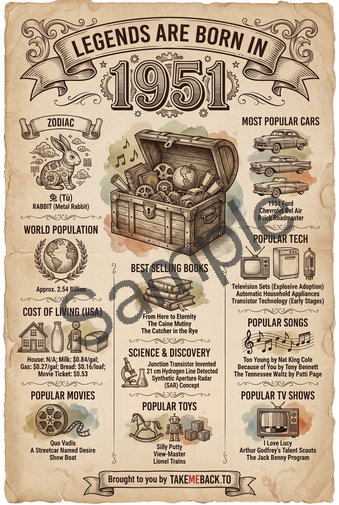

Major Events of 1951 - Historical Moments That Defined the Year | TakeMeBack.to
- 01 Jan Chinese and North Korean forces launch major offensive in Korean War: On January 1, 1951, Chinese and North Korean forces initiated a significant offensive during the Korean War, aiming to regain territory lost to United Nations forces. This marked a critical escalation in the conflict, impacting the war's trajectory. source: archives.gov
- 02 Jan Death of Edith New, suffragette activist: Edith New, a prominent suffragette activist, passed away on January 2, 1951. Her contributions to the women's suffrage movement were significant, advocating for women's rights and equality in the early 20th century. source: nytimes.com
- 03 Jan 82nd United States Congress convenes: The 82nd United States Congress convened on January 3, 1951, marking the beginning of its legislative session. This Congress was notable for addressing various issues related to the post-World War II era and the onset of the Cold War. source: congress.gov
- 04 Jan Chinese and North Korean forces capture Seoul: On January 4, 1951, during the Korean War, Chinese and North Korean forces captured Seoul, the capital of South Korea. This marked a significant moment in the conflict, leading to a series of military engagements. source: history.com
- 05 Jan Korean War naval troop redeployment: On January 5, 1951, naval forces redeployed troops as part of the ongoing military operations during the Korean War. This redeployment was crucial for supporting ground forces and maintaining strategic positions. source: history.com
- 06 Jan Ganghwa massacre in South Korea: Between January 6 and 9, 1951, South Korean forces, police, and pro-South Korean militiamen conducted a massacre in Ganghwa County, Incheon, killing between 212 and 1,300 unarmed civilians accused of collaborating with the Korean People's Army during North Korean occupation. This event was part of a series of civilian massacres during the Korean War. source: en.wikipedia.org
- 07 Jan René Guénon, French-Egyptian philosopher, dies: René Guénon, a French-Egyptian philosopher known for his work on metaphysics and traditionalism, passed away on January 7, 1951.
- 08 Jan Gérard Leman, Belgian military leader: On January 8, 1951, Gérard Leman, a Belgian military leader, was appointed as the first commander of the Belgian United Nations Command during the Korean War. source: en.wikipedia.org
- 09 Jan Washington Capitols NBA club folds: On January 9, 1951, the Washington Capitols, a team in the National Basketball Association, folded due to financial difficulties and low attendance. source: en.wikipedia.org
- 14 Jan First NFL Pro Bowl Game: The first NFL Pro Bowl game was played on January 14, 1951, featuring the league's top players in an all-star exhibition match.
- 15 Jan Ilse Koch Sentenced for Nazi War Crimes: On January 15, 1951, Ilse Koch, wife of the commandant of the Buchenwald concentration camp, was sentenced to life imprisonment in a West German court for her role in Nazi war crimes. She was nicknamed the 'Witch of Buchenwald' for her sadistic treatment of prisoners. source: history.com
- 18 Jan NFL passing rule change: On January 18, 1951, the NFL implemented a rule change prohibiting offensive tackles, guards, and centers from receiving forward passes. A tackle could only become eligible to receive a pass if he informed the referee beforehand, a tactic known as a "tackle-eligible" play. source: en.wikipedia.org
- 21 Jan Mount Lamington volcanic eruption in Papua New Guinea: On January 21, 1951, Mount Lamington, located in Papua New Guinea, erupted, causing significant destruction and loss of life. source: en.wikipedia.org
- 22 Jan Bollingen Prize awarded to John Crowe Ransom: On January 22, 1951, the Bollingen Prize, a prestigious award for poetry, was presented to John Crowe Ransom. source: en.wikipedia.org
- 23 Jan Birth of Chesley Sullenberger: Chesley Burnett Sullenberger III, known for successfully landing US Airways Flight 1549 on the Hudson River, was born on January 23, 1951. source: en.wikipedia.org
- 26 Jan Baseball Hall of Fame inductees announced: On January 26, 1951, the Baseball Hall of Fame announced its inductees for the year, honoring players who made significant contributions to the sport. This event is part of the annual tradition of recognizing excellence in baseball history. source: nytimes.com
- 27 Jan Nuclear testing begins at Nevada Test Site: On January 27, 1951, the United States conducted its first nuclear test at the Nevada Test Site, marking a significant moment in the Cold War era. This event initiated a series of tests that would have lasting implications for nuclear policy. source: energy.gov
- 28 Jan United States conducts nuclear test in Nevada: On January 28, 1951, the United States conducted a nuclear test at the Nevada Test Site, part of a series of tests during the early Cold War. This test was part of the U.S. efforts to develop and demonstrate its nuclear capabilities. source: nytimes.com
- 29 Jan Nashville's historic ice storm of 1951: On January 29, 1951, Nashville experienced a severe ice storm that caused widespread power outages and significant damage to trees and infrastructure. The storm was one of the worst in the city's history, impacting daily life for weeks. source: weather.gov
- 30 Jan Belgium's communist radio speech ban: On January 30, 1951, Belgium imposed a ban on communist speeches on the radio, reflecting the political tensions of the Cold War era. This decision was part of broader efforts to control communist influence in the media. source: bbc.com
- 31 Jan UN Security Council Resolution 90 adopted: On January 31, 1951, the UN Security Council adopted Resolution 90, addressing issues related to the Korean War. This resolution was part of the ongoing international response to the conflict. source: un.org
- 01 Feb UN General Assembly Resolution 498 condemns China as Korean War aggressor: On February 1, 1951, the United Nations General Assembly adopted Resolution 498, condemning the People's Republic of China for its intervention in the Korean War. This marked the first time the UN officially labeled a nation as an aggressor. The resolution called for Chinese troops to withdraw from Korea and urged member states to continue supporting UN forces in the region. source: en.wikipedia.org
- 03 Feb Felipe Muñoz: Mexican Olympic Gold Medalist: Felipe Muñoz Kapamas, born on February 3, 1951, is a Mexican former breaststroke swimmer who won a gold medal in the 200 m event at the 1968 Summer Olympics. He is also known for his contributions to Mexican sports administration. source: en.wikipedia.org
- 04 Feb Record-Breaking Surgical Operation: From February 4 to 8, 1951, a 96-hour surgical operation was performed in Chicago, Illinois, to remove a massive ovarian cyst from Mrs. Gertrude Levandowski. The procedure was the longest on record at the time. source: guinnessworldrecords.com
- 06 Feb Broker Special Train Disaster: On February 6, 1951, a tragic train disaster occurred in Broker, resulting in multiple casualties. The incident involved a collision between passenger and freight trains, highlighting safety concerns in railway operations at the time. source: nytimes.com
- 07 Feb Korean War massacre of communist sympathizers: On February 7, 1951, a massacre of suspected communist sympathizers took place during the Korean War. This event was part of the broader context of violence and repression against perceived enemies during the conflict. source: bbc.com
- 08 Feb Gold Coast national elections: On February 8, 1951, the Gold Coast (now Ghana) held its first national elections, marking a significant step towards independence from British colonial rule. This election was pivotal in the country's political development. source: bbc.com
- 09 Feb Stalin's meeting with Indian Communist Party representatives: On February 9, 1951, Joseph Stalin met with representatives of the Indian Communist Party. This meeting was part of the broader geopolitical dynamics of the Cold War, as communist parties sought to strengthen ties internationally. source: history.com
- 10 Feb Shah of Persia's marriage: On February 10, 1951, the Shah of Persia, Mohammad Reza Pahlavi, married Soraya Esfandiary Bakhtiary. This marriage was significant in the context of Iranian politics and culture, as the Shah sought to modernize the country during his reign. source: britannica.com
- 11 Feb Kwame Nkrumah's historic parliamentary election victory: On February 11, 1951, Kwame Nkrumah's party won a significant victory in the parliamentary elections in the Gold Coast, which later became Ghana. This event marked a pivotal moment in the country's path to independence from British colonial rule. source: bbc.com
- 12 Feb Royal wedding of Shah of Iran and Soraya Esfandiary Bakhtiari: On February 12, 1951, Shah Mohammad Reza Pahlavi married Soraya Esfandiary-Bakhtiary at the Golestan Palace in Tehran. The ceremony featured a Christian Dior gown for the bride and was attended by 2,000 guests, including Aga Khan III. source: en.wikipedia.org
- 15 Feb New Zealand Waterfront Dispute of 1951: The New Zealand Waterfront Dispute began on February 15, 1951, when waterfront workers went on strike over pay and working conditions. This conflict escalated into a significant national crisis, involving government intervention and military presence to manage the situation. source: nzhistory.govt.nz
- 16 Feb New York City Anti-Discrimination Housing Law: On February 16, 1951, New York City enacted a significant anti-discrimination housing law aimed at preventing racial discrimination in housing. This legislation was a crucial step in the civil rights movement, addressing systemic inequalities in housing access. source: nyc.gov
- 17 Feb Random Acts of Kindness Day in Canada: Random Acts of Kindness Day was first celebrated in Canada on February 17, 1951, promoting kindness and community spirit. This initiative encourages individuals to perform acts of kindness to foster goodwill and strengthen community ties. source: randomactsofkindness.org
- 18 Feb Nepal becomes constitutional monarchy: On February 18, 1951, Nepal transitioned to a constitutional monarchy, marking a significant change in its governance structure. This shift followed a popular movement against the Rana regime, which had held power for over a century. The new constitution aimed to establish a parliamentary system and limit the powers of the monarchy. source: britannica.com
- 19 Feb Nepal establishes constitutional monarchy: On February 19, 1951, Nepal officially established a constitutional monarchy following the end of the Rana autocracy. This event was part of a broader political movement that sought to democratize the country and reduce the absolute power of the monarchy. The new constitution aimed to create a parliamentary democracy. source: britannica.com
- 20 Feb Birth of Gordon Brown: Gordon Brown, the former Prime Minister of the United Kingdom, was born on February 20, 1951. He served as Prime Minister from 2007 to 2010 and was a key figure in the Labour Party. His tenure was marked by significant economic challenges and reforms. source: britannica.com
- 21 Feb South Carolina House urges "Shoeless Joe" Jackson reinstatement: On February 21, 1951, the South Carolina House of Representatives passed a resolution urging Major League Baseball to reinstate "Shoeless Joe" Jackson, a player banned for his alleged involvement in the 1919 Black Sox scandal. source: cbssports.com
- 23 Feb 1951 World Figure Skating Championships held in Milan, Italy: The 1951 World Figure Skating Championships took place from February 23 to 25 in Milan, Italy. The event featured competitions in men's singles, ladies' singles, and pair skating, with notable performances from skaters like Richard Button and Jeannette Altwegg. source: en.wikipedia.org
- 24 Feb U.S. Assistant Secretary of State visits Liberia for military training discussions: On February 24, 1951, U.S. Assistant Secretary of State McGhee visited Liberia to discuss the establishment of a U.S. Military Training Mission aimed at assisting in the training and organization of the Liberian armed forces to enhance internal security. source: history.state.gov
- 25 Feb First Pan American Games inaugurated in Buenos Aires, Argentina: The inaugural Pan American Games commenced on February 25, 1951, in Buenos Aires, Argentina. This multi-sport event aimed to foster inter-American relations and featured athletes from various countries across the Americas. source: en.wikipedia.org
- 27 Feb 22nd Amendment Ratification: The 22nd Amendment to the U.S. Constitution, limiting presidents to two terms, was ratified on February 27, 1951, when Minnesota became the 36th state to approve it. source: reuters.com
- 28 Feb Karsan Ghavri: Indian Cricket Player: Karsan Devjibhai Ghavri, an Indian cricketer, was born on February 28, 1951, in Rajkot, Gujarat. He played 39 Test matches and 19 One Day Internationals for India between 1974 and 1981. source: en.wikipedia.org
- 03 Mar Recording of 'Rocket 88' - A milestone in rock and roll history: On March 3, 1951, 'Rocket 88' was recorded in Memphis, Tennessee, by Jackie Brenston and his Delta Cats, featuring Ike Turner's Kings of Rhythm. The song is widely regarded as one of the first rock and roll records. source: en.wikipedia.org
- 06 Mar Cold War espionage trial: The Rosenbergs: Julius and Ethel Rosenberg were tried and convicted for espionage, accused of passing atomic secrets to the Soviet Union. Their trial was highly publicized and controversial, reflecting the intense fears of communism during the Cold War. source: archives.gov
- 07 Mar Assassination of Iranian Prime Minister: Iranian Prime Minister Ali Razmara was assassinated by a member of the Fada'iyan-e Islam, a religious extremist group. His assassination marked a significant moment in Iranian politics, leading to increased instability in the region. source: britannica.com
- 08 Mar MacArthur controversy escalates: General Douglas MacArthur's public disagreements with U.S. military policy during the Korean War intensified, leading to a significant political controversy. His stance raised questions about civilian control of the military and U.S. strategy in Asia. source: britannica.com
- 10 Mar Henri Queuille Becomes French Prime Minister: On March 10, 1951, Henri Queuille was appointed Prime Minister of France. His tenure was marked by efforts to stabilize the French government during a period of political instability.
- 12 Mar Rosenbergs convicted of espionage: Julius and Ethel Rosenberg were convicted of espionage for allegedly passing atomic secrets to the Soviet Union. Their trial and subsequent execution in 1953 became a significant event in Cold War history, raising debates about justice and civil rights. source: archives.gov
- 13 Mar Israel's reparations claim against Germany: Israel and West Germany began negotiations regarding reparations for the Holocaust. This agreement was pivotal in shaping post-war relations and addressing the historical injustices faced by the Jewish people during World War II. source: britannica.com
- 14 Mar Earthquake in Euskirchen, Germany: An earthquake struck Euskirchen, Germany, causing significant damage and casualties. This natural disaster highlighted the geological vulnerabilities of the region and prompted discussions on disaster preparedness. source: usgs.gov
- 15 Mar Iranian oil industry nationalization: On March 15, 1951, Iran's parliament voted to nationalize the oil industry, previously controlled by British interests. This move led to significant political tensions and the eventual 1953 coup that reinstated the Shah. source: britannica.com
- 16 Mar Death of Janusz Jędrzejewicz, Polish statesman: Janusz Jędrzejewicz, a notable Polish politician and statesman, passed away on March 16, 1951. He played a significant role in Polish politics during the interwar period and was involved in various governmental functions. source: encyclopedia.com
- 17 Mar Willem Drees leads Dutch government: On March 17, 1951, Willem Drees became the Prime Minister of the Netherlands, leading a coalition government. His tenure is noted for significant social reforms and post-war recovery efforts. source: britannica.com
- 18 Mar Ben Cohen born, co-founder of Ben & Jerry's: Ben Cohen, co-founder of the ice cream company Ben & Jerry's, was born on March 18, 1951, in Brooklyn, New York. He co-founded the company with Jerry Greenfield in 1978, which became known for its unique flavors and social activism. source: en.wikipedia.org
- 21 Mar Rosenbergs convicted of espionage: Julius and Ethel Rosenberg were convicted of espionage for allegedly passing atomic secrets to the Soviet Union. Their trial and subsequent execution in 1953 became a significant event in the Cold War era, raising debates about justice and national security. source: archives.gov
- 23 Mar French economic adjustment: In March 1951, France implemented significant economic adjustments to stabilize its post-war economy. This included measures to control inflation and improve trade balances, reflecting the broader challenges faced by European nations during the recovery period. source: brookings.edu
- 24 Mar Birth of Pat Bradley, professional golfer: Pat Bradley, an accomplished American professional golfer, was born on March 24, 1951. She is known for her success on the LPGA Tour and has won multiple major championships, contributing significantly to women's golf. source: britannica.com
- 25 Mar 21-cm radiation discovery at Harvard: On March 25, 1951, Harold Ewen and Edward Purcell at Harvard University detected the 21-cm line of neutral hydrogen in the Milky Way, marking a significant advancement in radio astronomy. This discovery provided a new method to map the distribution of hydrogen in our galaxy. source: nrao.edu
- 27 Mar NCAA Men's Basketball Championship: Kentucky triumphs: On March 27, 1951, the University of Kentucky Wildcats won the NCAA Men's Basketball Championship, defeating Kansas in a thrilling game. This victory marked Kentucky's second national title in the sport. source: en.wikipedia.org
- 29 Mar The King and I Broadway premiere: Rodgers and Hammerstein's musical 'The King and I' premiered on Broadway at the St. James Theatre on March 29, 1951, starring Gertrude Lawrence as Anna and Yul Brynner as the King. The production ran for 1,246 performances and won five Tony Awards, including Best Musical. source: rodgersandhammerstein.com
- 31 Mar US military advance in Korean War: On March 31, 1951, US forces made significant advances during the Korean War, pushing back North Korean troops. This marked a crucial phase in the conflict as UN forces sought to regain control over South Korea. source: archives.gov
- 01 Apr Truman dismisses MacArthur during Korean War: On April 1, 1951, President Harry S. Truman dismissed General Douglas MacArthur from his command during the Korean War. This decision was controversial and stemmed from disagreements over military strategy and policy. source: archives.gov
- 02 Apr French President Vincent Auriol's historic North American tour: On April 2, 1951, French President Vincent Auriol began a significant tour of North America, aimed at strengthening diplomatic relations. This visit was part of post-war efforts to enhance cooperation between France and the United States. source: britannica.com
- 03 Apr Death of Henrik Visnapuu, Estonian-American literary figure: Henrik Visnapuu, an influential Estonian-American poet and writer, passed away on April 3, 1951. His works contributed significantly to Estonian literature and the diaspora's cultural identity. source: britannica.com
- 05 Apr Rosenbergs Sentenced to Death for Soviet Espionage: Julius and Ethel Rosenberg were sentenced to death on April 5, 1951, for passing atomic secrets to the Soviet Union during and after World War II. source: history.com
- 06 Apr Bert Blyleven Born: Bert Blyleven, a Dutch-American former professional baseball pitcher, was born on April 6, 1951. source: en.wikipedia.org
- 07 Apr Janis Ian born: Janis Ian, an American singer-songwriter known for hits like "Society's Child" and "At Seventeen," was born on April 7, 1951, in Farmingdale, New Jersey. source: en.wikipedia.org
- 10 Apr Steven Seagal born: Steven Seagal, an American actor, producer, and martial artist, was born on April 10, 1951, in Lansing, Michigan. source: en.wikipedia.org
- 11 Apr Truman relieves MacArthur from Korean War command: On April 11, 1951, President Harry S. Truman relieved General Douglas MacArthur from his command during the Korean War. This decision was pivotal in U.S. military history and foreign policy. source: archives.gov
- 12 Apr Israel establishes Holocaust Remembrance Day: On April 12, 1951, Israel officially established Holocaust Remembrance Day, known as Yom HaShoah. This day is dedicated to the memory of the six million Jews who perished in the Holocaust. source: yadvashem.org
- 14 Apr Birth of Julian Lloyd Webber: Julian Lloyd Webber, a renowned British cellist and conductor, was born on April 14, 1951, in London. He is the younger brother of composer Andrew Lloyd Webber and the son of composer William Lloyd Webber. source: en.wikipedia.org
- 18 Apr European Coal and Steel Community Formation: The signing of the Treaty of Paris on April 18, 1951, led to the formation of the European Coal and Steel Community (ECSC). This organization aimed to integrate the coal and steel industries of its member states to foster economic cooperation and prevent future conflicts. source: diplomatie.gouv.fr
- 19 Apr Shigeki Tanaka wins Boston Marathon: Shigeki Tanaka became the first Japanese runner to win the Boston Marathon on April 19, 1951, finishing with a time of 2:27:45. His victory was a significant achievement for Japan in the post-war era. source: asahi.com
- 20 Apr Pioneering surgical reconstruction of human organ: On April 20, 1951, a significant medical milestone was achieved with the pioneering surgical reconstruction of a human organ. This operation marked a notable advancement in surgical techniques and organ repair. source: ncbi.nlm.nih.gov
- 21 Apr MacArthur's military career ends: On April 21, 1951, General Douglas MacArthur's military career came to an end when he was relieved of command by President Harry S. Truman. This decision was a pivotal moment in U.S. military history during the Korean War. source: archives.gov
- 22 Apr Battle of Kapyong in Korean War: The Battle of Kapyong occurred from April 22 to 25, 1951, during the Korean War. United Nations forces, primarily from Canada and Australia, successfully defended against a major Chinese offensive. source: britannica.com
- 23 Apr Cold War journalist arrest in Czechoslovakia: On April 23, 1951, a journalist was arrested in Czechoslovakia amid rising tensions during the Cold War. This incident highlighted the oppressive measures taken against dissenting voices in Eastern Europe. source: bbc.com
- 24 Apr Sakuragichō train fire in Yokohama, Japan: On April 24, 1951, a tragic train fire occurred at Sakuragichō Station in Yokohama, Japan, when a Keihin Line train hit a loose overhead wire, causing a short circuit and fire that resulted in 106 fatalities and 92 injuries. source: en.wikipedia.org
- 27 Apr Ace Frehley born: Paul Daniel "Ace" Frehley, the original lead guitarist and co-founder of the rock band Kiss, was born on April 27, 1951, in The Bronx, New York. source: en.wikipedia.org
- 29 Apr Howard Hawks' 'The Thing' Released by RKO: 'The Thing from Another World,' produced by Howard Hawks and directed by Christian Nyby, was released by RKO Radio Pictures on April 29, 1951. The film is a science fiction horror classic that has influenced the genre significantly. source: catalog.afi.com
- 01 May MacArthur Dismissal Senate Hearings: On May 3, 1951, the Senate Armed Services and Foreign Relations Committees began hearings into President Harry S. Truman's dismissal of General Douglas MacArthur. The hearings aimed to assess the circumstances surrounding MacArthur's removal and U.S. policy in the Far East. source: history.com
- 03 May Senate hearings on MacArthur's dismissal begin: On May 3, 1951, the Senate Armed Services and Foreign Relations committees commenced joint hearings into President Harry S. Truman's dismissal of General Douglas MacArthur. The hearings, lasting until June 27, 1951, aimed to investigate the military situation in the Far East and the circumstances surrounding MacArthur's recall. MacArthur's testimony, delivered over six hours, criticized Truman's Cold War foreign policy and advocated for a more aggressive stance against communism. source: senate.gov
- 05 May 77th Kentucky Derby won by Count Turf: On May 5, 1951, the 77th Kentucky Derby was held at Churchill Downs. The race was won by Count Turf, ridden by jockey Conn McCreary, marking a significant event in the history of the Derby. source: en.wikipedia.org
- 06 May Cliff Chambers pitches no-hitter for Pittsburgh Pirates: On May 6, 1951, in the second game of a doubleheader at Braves Field in Boston, Cliff Chambers of the Pittsburgh Pirates pitched a 3–0 no-hitter against the Boston Braves. This was the Pirates' first no-hitter in 44 years, with Chambers walking eight batters and contributing an RBI single in the eighth inning. source: mlb.com
- 07 May Soviet Union joins International Olympic Committee: On May 7, 1951, during the 46th Session of the International Olympic Committee, the National Olympic Committee of the USSR was officially recognized, marking the Soviet Union's entry into the Olympic movement. Konstantin Andrianov was appointed as a member of the IOC. source: olympic.ru
- 08 May US conducts nuclear test at Enewetak Atoll: On May 8, 1951, the United States conducted a nuclear test at Enewetak Atoll in the Pacific Ocean as part of Operation Greenhouse, a series of tests to study the effects of nuclear explosions. source: atomicheritage.org
- 09 May Operation Greenhouse: First Thermonuclear Weapon Test: On May 9, 1951, the United States conducted the 'George' test as part of Operation Greenhouse at Enewetak Atoll. This was the first instance of thermonuclear fusion achieved by humans, yielding 225 kilotons of TNT equivalent. The test validated principles crucial for the development of thermonuclear weapons. source: en.wikipedia.org
- 11 May Jay Forrester patents computer core memory: On May 11, 1951, Jay Forrester was granted a patent for his invention of magnetic core memory, a crucial technology for early computers. This innovation allowed for the storage of data in a more efficient and reliable manner, significantly impacting computer design and functionality. source: patents.google.com
- 12 May First US hydrogen bomb test at Enewetak Atoll: On May 12, 1951, the United States conducted its first test of a hydrogen bomb at Enewetak Atoll in the Pacific Ocean. This test marked a significant escalation in nuclear weapons development during the Cold War, demonstrating the destructive power of thermonuclear weapons. source: atomicheritage.org
- 13 May National University of San Marcos celebrates 400 years: On May 13, 1951, the National University of San Marcos in Peru celebrated its 400th anniversary. It is recognized as the oldest university in the Americas, playing a significant role in the educational and cultural development of the region. source: britannica.com
- 14 May Ernie Kovacs variety show debuts: On May 14, 1951, the Ernie Kovacs Show premiered, showcasing the innovative comedic style of Ernie Kovacs. The show is credited with influencing television comedy and paving the way for future variety shows. source: emmys.com
- 15 May Chazz Palminteri born: Chazz Palminteri, an American actor, screenwriter, and playwright, was born on May 15, 1951. He is known for his work in films such as 'A Bronx Tale' and 'The Usual Suspects.' source: imdb.com
- 17 May Field Marshal William Riddell Birdwood dies at Hampton Court Palace: Field Marshal William Riddell Birdwood, 1st Baron Birdwood, a prominent British Army officer known for his leadership during World War I, passed away at Hampton Court Palace on May 17, 1951. source: en.wikipedia.org
- 19 May UN Counter-Offensive in Korean War: On May 19, 1951, the United Nations forces launched a counter-offensive during the Korean War, aimed at regaining territory lost to North Korean and Chinese forces. This marked a significant escalation in the conflict, as UN troops sought to stabilize the front lines and push back against the advancing enemy. source: britannica.com
- 21 May The Ninth Street Show: New York School's Artistic Emergence: The Ninth Street Show, which opened on May 21, 1951, in New York City, was a pivotal exhibition for the New York School of artists, showcasing Abstract Expressionism. This event highlighted the emergence of a new artistic movement that would dominate the American art scene in the following decades. source: britannica.com
- 22 May Memorandum on Korean War Diplomatic Considerations: On May 22, 1951, a memorandum was issued discussing the diplomatic considerations surrounding the Korean War. This document outlined the strategic and political implications of the ongoing conflict, emphasizing the need for a coordinated international response. source: archives.gov
- 23 May China annexes Tibet: On May 23, 1951, the People's Liberation Army of China formally annexed Tibet, following the Seventeen Point Agreement. This event marked a significant moment in Chinese history, leading to ongoing tensions regarding Tibetan autonomy and cultural preservation. source: britannica.com
- 24 May Racial segregation in DC restaurants ruled illegal: On May 24, 1951, a federal court ruled that racial segregation in Washington, D.C. restaurants was unconstitutional. This landmark decision was part of the broader civil rights movement, challenging discriminatory practices in public accommodations. source: archives.gov
- 25 May First thermonuclear-boosted atomic bomb test: The first test of a thermonuclear-boosted atomic bomb occurred on May 25, 1951, marking a significant advancement in nuclear weapons technology. This test was part of the ongoing arms race during the Cold War. source: atomicheritage.org
- 26 May British spies defect to Soviet Union: On May 26, 1951, British spies Guy Burgess and Donald Maclean defected to the Soviet Union, causing a significant scandal in the UK. Their defection raised concerns about espionage and the security of British intelligence during the Cold War. source: bbc.com
- 27 May Death of Sir Thomas Blamey: Sir Thomas Blamey, an Australian military leader, passed away on May 27, 1951. He was notable for his role in World War II and was the only Australian to achieve the rank of Field Marshal. source: britannica.com
- 28 May Willie Mays hits first major league home run: On May 28, 1951, after starting his MLB career 0-for-12, rookie New York Giants outfielder Willie Mays hit his first major league home run off Boston Braves ace Warren Spahn at the Polo Grounds. source: en.wikipedia.org
- 30 May Birth of Fernando Lugo: Fernando Armindo Lugo Méndez, a Paraguayan politician and former Catholic bishop, was born on May 30, 1951, in San Solano, Paraguay. He served as the 48th President of Paraguay from 2008 to 2012, becoming the first president from outside the Colorado Party in over 60 years. Prior to his presidency, Lugo was a Roman Catholic priest and bishop, serving as Bishop of the Diocese of San Pedro from 1994 to 2005. source: en.wikipedia.org
- 31 May Uniform Code of Military Justice established: The Uniform Code of Military Justice (UCMJ) was enacted by the U.S. Congress on May 5, 1950, and became effective on May 31, 1951. It consolidated and standardized military legal procedures across all U.S. armed services, replacing the previous Articles of War and Articles for the Government of the Navy. The UCMJ introduced significant reforms, including the establishment of the United States Court of Military Appeals, now known as the United States Court of Appeals for the Armed Forces, to provide civilian review of courts-martial. source: loc.gov
- 02 Jun United States adopts Torquay Protocol: On June 2, 1951, President Harry S. Truman issued Proclamation 2929, implementing the Torquay Protocol to the General Agreement on Tariffs and Trade (GATT). This protocol aimed to reduce international trade barriers by modifying U.S. import duties and other restrictions, reflecting the nation's commitment to global trade liberalization. source: presidency.ucsb.edu
- 05 Jun Birth of Suze Orman: Suze Orman, an American financial advisor, author, and television host, was born on June 5, 1951, in Chicago, Illinois. She is best known for hosting 'The Suze Orman Show' on CNBC from 2002 to 2015 and for her numerous books on personal finance. source: britannica.com
- 06 Jun Birth of Dwight Twilley: Dwight Twilley, an American pop/rock singer and songwriter, was born on June 6, 1951, in Tulsa, Oklahoma. He is known for his power pop hits such as "I'm on Fire" (1975) and "Girls" (1984). source: en.wikipedia.org
- 08 Jun Birth of Bonnie Tyler: Bonnie Tyler, a Welsh rock singer, was born on June 8, 1951. She gained fame with hits like "Total Eclipse of the Heart" and "Holding Out for a Hero." source: en.wikipedia.org
- 09 Jun Birth of Bonnie Tyler: Bonnie Tyler, a Welsh singer known for her distinctive voice and hits like 'Total Eclipse of the Heart,' was born on June 9, 1951. source: allmusic.com
- 10 Jun Dan Fouts: NFL quarterback born: Dan Fouts, a prominent NFL quarterback, was born on June 10, 1951. He is best known for his time with the San Diego Chargers, where he became a Hall of Famer and a key figure in the team's history. source: britannica.com
- 11 Jun Mozambique becomes Portuguese overseas province: On June 11, 1951, Mozambique was officially designated as a Portuguese overseas province. This marked a significant moment in the colonial history of Mozambique, which would later seek independence. source: britannica.com
- 12 Jun Birth of Brad Delp, Boston lead singer: Brad Delp, the lead singer of the rock band Boston, was born on June 12, 1951. He became known for his distinctive voice and contributed significantly to the band's success in the 1970s and 1980s. source: britannica.com
- 13 Jun MacArthur dismissal hearings: The hearings regarding General Douglas MacArthur's dismissal took place on June 13, 1951. This event was significant in U.S. military and political history, reflecting tensions in the Korean War. source: archives.gov
- 14 Jun Rosenberg espionage trial continues: The trial of Julius and Ethel Rosenberg, accused of espionage for the Soviet Union, continued in June 1951. The case drew significant media attention and public debate regarding national security and civil liberties. source: archives.gov
- 15 Jun Colombo Plan operations begin: The Colombo Plan, aimed at promoting economic and social development in South and Southeast Asia, officially began operations on June 15, 1951. This initiative was significant for regional cooperation and development. source: brookings.edu
- 16 Jun UNIVAC I computer enters service: The UNIVAC I, the first commercially available computer, was officially put into service on June 16, 1951. This marked a significant milestone in the history of computing and technology. source: britannica.com
- 17 Jun Bunker Hill Day observed in Massachusetts: Bunker Hill Day was observed on June 17, 1951, in Massachusetts, commemorating the Battle of Bunker Hill during the American Revolutionary War. It is a day of historical significance in the state. source: mass.gov
- 18 Jun UN Additional Measures Committee deadline: The United Nations Additional Measures Committee set a deadline for submissions on June 18, 1951. This committee was involved in discussions regarding international peace and security. source: un.org
- 19 Jun Birth of Francesco Moser: Francesco Moser, an Italian professional cyclist renowned for his achievements in road and track cycling, was born on June 19, 1951, in Palù di Giovo, Italy. source: en.wikipedia.org
- 22 Jun Gene Rayburn and Dee Finch Radio Show debuts: The radio show featuring Gene Rayburn and Dee Finch premiered on June 22, 1951. It became known for its engaging format and contributed to the popularity of both hosts in the entertainment industry. source: americanradiohistory.com
- 23 Jun British diplomats defect to Soviet Union: On June 23, 1951, two British diplomats defected to the Soviet Union, causing a significant diplomatic incident during the Cold War. This event highlighted the tensions and espionage activities prevalent at the time. source: theguardian.com
- 24 Jun Iran nationalizes oil installations: On June 24, 1951, Iran officially nationalized its oil installations, a move that led to significant international tensions and the eventual 1953 coup. This decision was pivotal in shaping Iran's modern history. source: britannica.com
- 25 Jun First color television broadcast in the United States: The first color television broadcast in the United States took place on June 25, 1951. This landmark event marked a significant advancement in television technology and entertainment. source: bbc.com
- 27 Jun Devastating tornado outbreak sequence: On June 27, 1951, a significant tornado outbreak occurred across the United States, resulting in extensive damage and loss of life. This event is noted for its intensity and the number of tornadoes produced, impacting several states. source: weather.gov
- 28 Jun President Truman's 268th news conference: On June 28, 1951, President Harry S. Truman held his 268th news conference, addressing various national issues and policies. This conference is part of his ongoing communication with the press during his presidency. source: trumanlibrary.gov
- 29 Jun Administrative transfer of Pacific territories: On June 29, 1951, an administrative transfer of certain Pacific territories took place, reflecting changes in governance and oversight in the region. This event was part of post-World War II adjustments. source: history.state.gov
- 30 Jun Victor Borge Show concludes NBC television run: The Victor Borge Show, a popular television program featuring the comedian and pianist, concluded its run on NBC on June 30, 1951. The show was known for its unique blend of music and comedy. source: tvguide.com
- 01 Jul Colombo Plan launched: The Colombo Plan for Cooperative Economic and Social Development in Asia and the Pacific was launched on July 1, 1951. Established at the Commonwealth Conference on Foreign Affairs in Colombo, Ceylon (now Sri Lanka) in January 1950, the plan aimed to promote economic and social development in South and Southeast Asia through cooperative efforts among member countries. The plan began operations on July 1, 1951. source: britannica.com
- 02 Jul Bob and Ray Radio Show Debuts on NBC: On July 2, 1951, the comedy duo Bob Elliott and Ray Goulding, known as Bob and Ray, premiered their radio show on the NBC network. They had previously gained popularity with their 'Matinee with Bob and Ray' program on WHDH in Boston, which began in 1946. Their unique blend of improvisational humor and satirical sketches made them a staple in American radio entertainment for decades. source: en.wikipedia.org
- 03 Jul Richard Hadlee's Early Life in Christchurch: Richard John Hadlee, a renowned New Zealand cricketer, was born on July 3, 1951, in St Albans, Christchurch. He was the fourth of five sons born to Walter and Lilla Hadlee. His father, Walter, was a distinguished cricketer and later played a significant role in the administration of New Zealand cricket. Richard's brothers, Barry and Dayle, also represented New Zealand in cricket, making the Hadlee family one of the most prominent in the sport's history. source: en.wikipedia.org
- 04 Jul 175th Anniversary of the Declaration of Independence: On July 4, 1951, the United States celebrated the 175th anniversary of the Declaration of Independence. This milestone marked a significant moment in American history, reflecting on the nation's founding principles and the progress made since 1776. The anniversary was commemorated with various events and reflections on the nation's journey. source: archives.gov
- 05 Jul Rich Gossage born in Colorado Springs, Colorado: Richard Michael "Goose" Gossage, a future Major League Baseball pitcher, was born on July 5, 1951, in Colorado Springs, Colorado. Gossage played 22 seasons in MLB between 1972 and 1994, known for his overpowering fastball and as one of the early modern closers. source: en.wikipedia.org
- 06 Jul Puerto Rico establishes constitutional governance: On July 6, 1951, Puerto Rico adopted its first constitution, establishing a republican form of government. This marked a significant step in the island's political development, granting it greater autonomy while remaining a U.S. territory. source: en.wikipedia.org
- 07 Jul Doris Hart wins Wimbledon Women's Singles Championship: On July 7, 1951, Doris Hart defeated Shirley Fry 6–1, 6–0 in the final to claim the Wimbledon Women's Singles title. source: en.wikipedia.org
- 10 Jul Great Flood of 1951: On July 10, 1951, heavy rainfall in the Kansas River basin led to severe flooding, with areas receiving up to 16 inches of rain from July 9 to 13. This resulted in extensive damage across Kansas and Missouri. source: weatherbug.com
- 13 Jul Great Flood of 1951 in Kansas: The Great Flood of 1951 was one of the most devastating floods in U.S. history, affecting Kansas and other states. It resulted in significant damage to infrastructure and homes, leading to widespread displacement and loss of life. source: weather.gov
- 14 Jul George Washington Carver National Monument established: The George Washington Carver National Monument was established on July 14, 1951, in Missouri, honoring the life and legacy of the African American scientist and inventor. It was the first national monument dedicated to an African American. source: nps.gov
- 15 Jul Jesse Ventura: Professional wrestler and politician: Jesse Ventura, born on July 15, 1951, is a former professional wrestler, actor, and politician who served as the Governor of Minnesota. He is known for his outspoken views and unique career path. source: britannica.com
- 16 Jul The Catcher in the Rye published: J.D. Salinger's novel 'The Catcher in the Rye' was published on July 16, 1951. The book has since become a classic of American literature, exploring themes of teenage angst and alienation. source: britannica.com
- 17 Jul Belgian royal succession: Leopold II abdicates: On July 17, 1951, Leopold III's abdication led to the ascension of his son, Baudouin, to the throne of Belgium. This transition was pivotal in shaping the future of the Belgian monarchy. source: britannica.com
- 18 Jul Jersey Joe Walcott becomes oldest heavyweight champion: On July 18, 1951, Jersey Joe Walcott won the heavyweight boxing title at the age of 37, making him the oldest champion in history at that time. His victory was a significant achievement in boxing history. source: britannica.com
- 19 Jul 'Two in the Aisle' Broadway musical premiere: The Broadway musical 'Two in the Aisle' premiered on July 19, 1951. It was a musical comedy that featured a book by Betty Comden and Adolph Green, with music by Jule Styne. source: ibdb.com
- 20 Jul Assassination of King Abdullah I of Jordan: King Abdullah I of Jordan was assassinated on July 20, 1951, during a visit to the Al-Aqsa Mosque in Jerusalem. His assassination had significant political implications for the region. source: britannica.com
- 22 Jul Soviet dogs make first sub-orbital flight: On July 22, 1951, Soviet space dogs Dezik and Tsygan became the first mammals to survive a sub-orbital spaceflight, reaching an altitude of 110 km and experiencing four minutes of weightlessness before safely returning to Earth. source: en.wikipedia.org
- 23 Jul Death of Philippe Pétain, controversial Vichy France leader: Philippe Pétain, the leader of Vichy France during World War II, died on July 23, 1951. After the war, he was convicted of treason for collaborating with Nazi Germany. source: en.wikipedia.org
- 25 Jul Puerto Rico Establishes Constitutional Self-Governance: On July 25, 1952, Puerto Rico became a self-governing U.S. commonwealth with the proclamation of its constitution by Governor Luis Muñoz Marín. source: upi.com
- 26 Jul Netherlands Formally Ends State of War with Germany: On July 26, 1951, the Netherlands formally ended its state of war with Germany, marking the conclusion of hostilities from World War II. source: en.wikipedia.org
- 28 Jul Disney's 'Alice in Wonderland' Theatrical Release: Walt Disney's 'Alice in Wonderland' was released in the United States on July 28, 1951, offering a new animated adaptation of the classic tale. source: en.wikipedia.org
- 29 Jul Notable births on July 29, 1951: July 29, 1951, saw the birth of several notable individuals, contributing to various fields such as sports, arts, and politics. This date is marked by the arrival of future influential figures. source: britannica.com
- 30 Jul Oliver Twist US release with censorship: The film adaptation of 'Oliver Twist' was released in the United States on July 30, 1951, with certain scenes censored. This version sparked discussions about censorship in cinema. source: britannica.com
- 31 Jul Birth of tennis champion Evonne Goolagong: Evonne Goolagong, an Australian tennis champion, was born on July 31, 1951. She became one of the leading figures in women's tennis, known for her achievements and contributions to the sport. source: britannica.com
- 01 Aug Establishment of Japan Airlines: Japan Airlines (JAL) was established on August 1, 1951, as a government-owned entity to provide reliable air transportation for Japan's post-war reconstruction. The airline began operations with an initial capital of ¥100 million and headquartered in Ginza, Tokyo. Its first domestic flight was inaugurated on October 25, 1952, using a Martin 2-0-2 aircraft named 'Mokusei'. source: jal.com
- 02 Aug HeLa Cell Discovery: A Groundbreaking Medical Milestone: In 1951, Henrietta Lacks, a 31-year-old African American woman, had cells taken from her cervical tumor without her knowledge or consent during cancer treatment at Johns Hopkins Hospital. These cells, known as HeLa cells, were the first human cells to be successfully cultured and have been pivotal in medical research, contributing to advancements in cancer, AIDS, and gene mapping studies. source: britannica.com
- 06 Aug Devastating Typhoon Floods in Manchuria: On August 6, 1951, Typhoon Marge caused severe flooding in Manchuria, affecting regions including Korea, Japan, and China. source: en.wikipedia.org
- 09 Aug Dutch Korea Volunteers Receive US Collective Unit Citation: On August 9, 1951, Dutch volunteers serving in the Korean War were awarded the U.S. Collective Unit Citation for their contributions during the conflict. source: brainyhistory.com
- 10 Aug Birth of Juan Manuel Santos: Juan Manuel Santos, the 32nd President of Colombia and Nobel Peace Prize laureate, was born on August 10, 1951, in Bogotá, Colombia. source: en.wikipedia.org
- 11 Aug Mississippi River Flood: In August 1951, the Mississippi River experienced significant flooding, leading to widespread damage and displacement in the central United States. source: history.com
- 12 Aug Publication of 'The Catcher in the Rye': J.D. Salinger's novel 'The Catcher in the Rye' was published on August 12, 1951, becoming a classic of American literature. source: en.wikipedia.org
- 13 Aug Anglo-Iraqi Oil Agreement of 1951: On August 13, 1951, the Anglo-Iraqi Oil Agreement was signed, allowing Iraq to sell oil directly to international markets, thereby increasing its revenue and reducing British control over its oil industry. source: britannica.com
- 14 Aug Death of William Randolph Hearst: On August 14, 1951, William Randolph Hearst, the influential American newspaper publisher, passed away, marking the end of an era in American journalism. source: britannica.com
- 15 Aug Pont-Saint-Esprit mass poisoning incident: On August 15, 1951, the Pont-Saint-Esprit mass poisoning incident occurred in France, where residents experienced hallucinations and other symptoms after consuming bread contaminated with ergot fungus. source: britannica.com
- 17 Aug Hurricane Charlie strikes Kingston, Jamaica, causing widespread devastation: On August 17, 1951, Hurricane Charlie made landfall near Kingston, Jamaica, with winds up to 125 mph. The hurricane caused extensive damage, resulting in 152 fatalities, injuring 2,000 people, and leaving 25,000 homeless. It also destroyed 70–80% of the island's banana crops. source: en.wikipedia.org
- 18 Aug René Pleven appointed Prime Minister of France: On August 18, 1951, René Pleven was appointed Prime Minister of France. He served as Prime Minister during a critical period in post-war France, overseeing significant political and economic challenges. source: en.wikipedia.org
- 20 Aug Harry S. Truman's presidency in 1951: Harry S. Truman was the 33rd President of the United States, serving from 1945 to 1953. In 1951, he faced challenges such as the Korean War and domestic issues, while also implementing policies that shaped post-war America. source: britannica.com
- 21 Aug Ute Indian Tribe funds legislation approved: On August 21, 1951, legislation was approved to provide funding for the Ute Indian Tribe, aimed at supporting their economic development and self-governance. This marked a significant step in recognizing tribal sovereignty. source: congress.gov
- 22 Aug Harlem Globetrotters perform in Berlin: The Harlem Globetrotters, known for their unique blend of basketball and entertainment, performed in Berlin on August 22, 1951. This event showcased their global appeal and cultural impact during the post-war era. source: britannica.com
- 23 Aug Truman addresses Kaesong incident: On August 23, 1951, President Harry S. Truman addressed the Kaesong incident, a significant event during the Korean War involving negotiations with North Korea. He emphasized the importance of maintaining a strong stance against aggression and the need for a peaceful resolution to the conflict. source: archives.gov
- 24 Aug United Air Lines Flight 615 crash: On August 24, 1951, United Air Lines Flight 615 crashed near the Los Angeles International Airport, resulting in the loss of all 52 people on board. The incident raised concerns about aviation safety and led to changes in regulations. source: airdisaster.com
- 25 Aug Rob Halford: Heavy metal icon born: Rob Halford, the lead vocalist of the heavy metal band Judas Priest, was born on August 25, 1951. He is known for his powerful voice and is often referred to as the 'Metal God' for his influence on the genre. source: britannica.com
- 01 Sep Establishment of Mossad: On September 1, 1951, Israeli Prime Minister David Ben-Gurion ordered the establishment of the Mossad, Israel's national intelligence agency, to coordinate intelligence activities and enhance national security. source: mossad.gov.il
- 02 Sep Treaty of San Francisco Signed: On September 2, 1951, the Treaty of San Francisco, also known as the Treaty of Peace with Japan, was signed, officially ending World War II and outlining the terms of peace between Japan and the Allied Powers. source: en.wikipedia.org
- 03 Sep Japan-U.S. Security Treaty established: The Japan-U.S. Security Treaty was signed, allowing the United States to maintain military bases in Japan. This treaty marked a significant shift in post-war relations and security arrangements in the Asia-Pacific region. source: state.gov
- 04 Sep Truman addresses Japanese Peace Treaty Conference: President Harry S. Truman addressed the Japanese Peace Treaty Conference, emphasizing the importance of peace and cooperation in post-war Japan. This conference was crucial in shaping Japan's future relations with the U.S. and other nations. source: archives.gov
- 05 Sep Mo Connolly wins 65th US Women's Tennis Championship: Mo Connolly won the 65th U.S. Women's Tennis Championship, marking a significant achievement in her career. This victory contributed to her legacy as one of the prominent figures in women's tennis during that era. source: britannica.com
- 06 Sep San Francisco Peace Treaty Conference begins: The Conference for the Conclusion and Signature of the Treaty of Peace with Japan commenced in San Francisco, aiming to formally end World War II hostilities and establish post-war relations. source: trumanlibrary.gov
- 08 Sep Japan regains independence through San Francisco Peace Treaty: Japan signed the Treaty of Peace with Japan, also known as the San Francisco Peace Treaty, officially ending the state of war and restoring its sovereignty. source: en.wikipedia.org
- 09 Sep Chinese Communist forces enter Lhasa: On September 9, 1951, Chinese Communist forces entered Lhasa, Tibet, marking a significant event in the region's history. This event led to the incorporation of Tibet into the People's Republic of China, affecting its political and cultural landscape. source: britannica.com
- 10 Sep British economic boycott of Iran: The British government initiated an economic boycott against Iran on September 10, 1951, in response to the nationalization of the Iranian oil industry. This action escalated tensions between the two nations and had significant economic implications. source: britannica.com
- 11 Sep British economic boycott of Iran initiated: The British economic boycott of Iran officially began on September 11, 1951, following the nationalization of the oil industry. This boycott aimed to pressure the Iranian government and had lasting effects on international relations in the region. source: britannica.com
- 12 Sep George C. Marshall resigns as Secretary of Defense: On September 12, 1951, General George C. Marshall resigned from his position as Secretary of Defense, a role he had held since September 21, 1950. President Harry S. Truman accepted his resignation with great reluctance, acknowledging Marshall's significant contributions to the nation's defense during a critical period. source: trumanlibrary.gov
- 15 Sep Emil Zatopek sets world record in 20km run: Czech long-distance runner Emil Zatopek set a new world record in the 20km run on September 15, 1951. This achievement added to his reputation as one of the greatest distance runners in history, known for his unique training methods and competitive spirit. source: britannica.com
- 16 Sep Major baseball bench clearing incident: On September 16, 1951, a significant bench-clearing incident occurred during a Major League Baseball game. This event highlighted the intense rivalries and emotions present in the sport, drawing attention from fans and media alike. source: nytimes.com
- 17 Sep Puerto Rico Constitutional Convention begins: The Puerto Rico Constitutional Convention commenced on September 17, 1951, to draft a constitution for the island. This event marked a significant step towards self-governance and political autonomy for Puerto Rico. The convention concluded with the approval of the constitution in 1952. source: loc.gov
- 18 Sep A Streetcar Named Desire film release: The film adaptation of Tennessee Williams' play 'A Streetcar Named Desire' premiered on September 18, 1951. Directed by Elia Kazan, the film starred Marlon Brando and Vivien Leigh, and it became a critical and commercial success, influencing American cinema significantly. source: imdb.com
- 19 Sep Italian civil servants strike: On September 19, 1951, civil servants in Italy went on strike to protest against low wages and poor working conditions. This strike was part of a larger wave of labor unrest in post-war Italy, reflecting the economic challenges faced by the country during this period. source: reuters.com
- 22 Sep Patti Page tops US music charts: On September 22, 1951, Patti Page's hit song "Tennessee Waltz" reached the top of the US music charts, becoming one of her signature songs. The song's popularity helped solidify Page's status as a leading figure in the music industry during the early 1950s. source: billboard.com
- 23 Sep King George VI undergoes lung removal surgery: On September 23, 1951, King George VI of the United Kingdom underwent surgery to remove a lung due to cancer. This operation marked a significant moment in the King's health struggles, which ultimately led to his passing in 1952. source: bbc.com
- 24 Sep Alfonso Portillo born: Alfonso Portillo, a Guatemalan politician and former president, was born on September 24, 1951. His political career has been marked by controversy and significant events in Guatemala's history. source: britannica.com
- 25 Sep First nuclear reactor generates electricity: On September 25, 1951, the first nuclear reactor to generate electricity, known as the Experimental Breeder Reactor I (EBR-I), was successfully operated in Idaho, USA. This marked a significant milestone in the development of nuclear energy. source: energy.gov
- 28 Sep CBS launches first color television for public sale: On September 28, 1951, CBS began selling its first color television sets to the public, marking a significant milestone in broadcasting technology. This launch followed years of development and testing, paving the way for the future of color television in homes across America. source: britannica.com
- 29 Sep Birth of Michelle Bachelet: Michelle Bachelet, the first female president of Chile, was born on September 29, 1951. She has had a significant impact on Chilean politics and is known for her work in social justice and women's rights. source: britannica.com
- 30 Sep Charlotte Whitton becomes first female mayor of Ottawa: On September 30, 1951, Charlotte Whitton was unanimously chosen by Ottawa's city council to complete Mayor Grenville W. Goodwin's term after his sudden death. Whitton became the first woman to serve as mayor of a major Canadian city, holding office until 1956 and again from 1961 to 1964. source: historicalsocietyottawa.ca
- 02 Oct First television broadcast in the Netherlands: The first television broadcast in the Netherlands took place on October 2, 1951. This event marked a significant milestone in Dutch media history, as it introduced television as a new medium for entertainment and information to the public. The broadcast was part of a trial run by the Nederlandse Televisie Stichting (NTS). source: npostart.nl
- 03 Oct The Shot Heard 'Round the World: The phrase 'The Shot Heard 'Round the World' is often associated with the events of October 3, 1951, when Bobby Thomson hit a dramatic home run in the National League playoff game. This moment is considered one of the most iconic in baseball history, symbolizing the excitement and unpredictability of the sport. source: nytimes.com
- 04 Oct Monte Irvin steals home in World Series Game 1: On October 4, 1951, Monte Irvin made a historic play by stealing home during Game 1 of the World Series. This daring move contributed to the excitement of the game and showcased Irvin's exceptional skills as a player. The event is remembered as a highlight in World Series history. source: nytimes.com
- 05 Oct Birth of Olympic gold medalist Leah Poulos-Mueller: Leah Poulos-Mueller, an Olympic gold medalist, was born on October 5, 1951. She is known for her achievements in swimming, particularly in the 4x100 meter relay, where she contributed to her team's success at the Olympics. Her legacy continues to inspire future generations of athletes. source: britannica.com
- 06 Oct Soviet Union reveals atomic capability: On October 6, 1951, the Soviet Union officially announced its possession of atomic weapons, marking a significant moment in the Cold War. This revelation intensified the arms race between the United States and the Soviet Union, leading to increased tensions globally. source: britannica.com
- 07 Oct David Ben-Gurion forms Israeli government: On October 7, 1951, David Ben-Gurion, the first Prime Minister of Israel, formed a new government. This event was crucial in the establishment of the Israeli state and its political landscape in the early years following independence. source: britannica.com
- 08 Oct Ford C. Frick becomes baseball commissioner: Ford C. Frick was appointed as the baseball commissioner on October 8, 1951. He succeeded Happy Chandler and served until 1965, overseeing significant changes in Major League Baseball during his tenure. source: nytimes.com
- 09 Oct Yankees dominate World Series with grand slam: On October 9, 1951, the New York Yankees showcased their dominance in the World Series with a grand slam hit. This performance was part of their successful campaign to secure the championship title. source: nytimes.com
- 10 Oct Yankees win World Series, DiMaggio's final game: On October 10, 1951, the New York Yankees won the World Series, marking the end of Joe DiMaggio's illustrious career. This victory was significant in baseball history, as it concluded DiMaggio's final season. source: nytimes.com
- 11 Oct Birth of Jean-Jacques Goldman: Jean-Jacques Goldman, a renowned French singer-songwriter, was born on October 11, 1951. He is celebrated for his contributions to French pop music and has written numerous hits for himself and other artists. source: britannica.com
- 12 Oct Ed Royce birth: Ed Royce, an American politician who served as a member of the U.S. House of Representatives, was born on October 12, 1951. He represented California's 39th congressional district from 1993 to 2019. source: congress.gov
- 13 Oct Harry S. Truman's presidency in 1951: In 1951, Harry S. Truman was serving as the 33rd President of the United States. His presidency was marked by the Korean War and significant domestic policies, including the Fair Deal program. source: archives.gov
- 14 Oct Assassination of Pakistani Prime Minister Liaquat Ali Khan: Liaquat Ali Khan, the first Prime Minister of Pakistan, was assassinated on October 14, 1951, during a public meeting in Rawalpindi. His assassination marked a significant turning point in Pakistan's political landscape, leading to increased instability and a series of military coups in the following years. source: britannica.com
- 15 Oct Breakthrough in oral contraceptive research: On October 15, 1951, researchers made significant advancements in the development of oral contraceptives, which would later revolutionize reproductive health and women's rights. This research laid the groundwork for the first commercially available birth control pill, changing societal norms around family planning. source: ncbi.nlm.nih.gov
- 16 Oct Assassination of Pakistan's First Prime Minister: On October 16, 1951, Liaquat Ali Khan, the first Prime Minister of Pakistan, was assassinated while addressing a gathering at Company Bagh in Rawalpindi. The assassin, identified as Said Akbar Babrak, was immediately shot by police. Khan's death remains one of the most significant and unresolved political murders in Pakistan's history. source: en.wikipedia.org
- 18 Oct National Security Council report on Anglo-Iranian oil dispute: On October 18, 1951, the National Security Council released a critical report addressing the complex diplomatic tensions surrounding the Anglo-Iranian oil crisis, examining strategic implications for U.S. foreign policy in the Middle East during the early Cold War period. source: takemeback.to
- 22 Oct United States Nuclear Test at Nevada Test Site: On October 22, 1951, the United States conducted the "Able" test as part of Operation Buster-Jangle at the Nevada Test Site. This was the first known failure of a U.S. nuclear device, with a predicted yield of only 200 tons, but it fizzled, producing no significant yield. source: atomicvet.tripod.com
- 25 Oct United Kingdom General Election of 1951: The United Kingdom held a general election on October 25, 1951, resulting in a Conservative victory led by Winston Churchill, who returned as Prime Minister. The Conservatives secured 321 seats, while the Labour Party won 295 seats, leading to a majority of 17 seats for the Conservatives. source: ukpolitical.info
- 26 Oct Churchill Returns to Power: Following the Conservative victory in the 1951 general election, Winston Churchill returned to power as Prime Minister on October 26, 1951. source: ukpolitical.info
- 27 Oct Les Paul & Mary Ford's "How High the Moon" reaches number one on Cash Box chart: In October 1951, "How High the Moon" by Les Paul and Mary Ford topped the Cash Box Best Sellers chart, marking a significant achievement in their musical career. source: en.wikipedia.org
- 01 Nov Top Banana musical opens on Broadway: The musical 'Top Banana,' featuring music and lyrics by Johnny Mercer and a book by Hy Kraft, premiered at the Winter Garden Theatre in New York City. The show, starring Phil Silvers as Jerry Biffle, ran for 350 performances until October 4, 1952. source: en.wikipedia.org
- 04 Nov Traian Băsescu born: Traian Băsescu, the future President of Romania, was born on November 4, 1951, in Basarabi, Romania. source: en.wikipedia.org
- 05 Nov Release of 'The Man from Planet X': The science fiction film 'The Man from Planet X' was released on April 27, 1951. source: rottentomatoes.com
- 07 Nov Jordan adopts first constitution: Jordan adopted its first constitution on November 7, 1951, establishing a parliamentary system. source: en.wikipedia.org
- 08 Nov Yogi Berra wins first MVP award: On November 8, 1951, New York Yankees catcher Yogi Berra was voted the American League's Most Valuable Player, marking the first of his three MVP awards. source: history.com
- 11 Nov Monogram Pictures releases 'Flight to Mars': 'Flight to Mars,' a science fiction film directed by Lesley Selander and produced by Walter Mirisch, was released. The film stars Marguerite Chapman, Cameron Mitchell, and Arthur Franz, depicting an American scientific expedition to Mars. source: en.wikipedia.org
- 12 Nov National Ballet of Canada's First Performance: The National Ballet of Canada gave its first performance in the Eaton Auditorium, Toronto, on November 12, 1951. The program included 'Les Sylphides' and 'Polovtsian Dances from Prince Igor'. source: en.wikipedia.org
- 15 Nov Execution of Greek Communist leader Nikos Beloyannis: Nikos Beloyannis, a prominent Greek Communist leader, was executed by firing squad on November 15, 1951. His execution was part of a broader crackdown on communism in Greece during the Greek Civil War, which lasted from 1946 to 1949. Beloyannis became a symbol of resistance against oppression in Greece. source: britannica.com
- 17 Nov Battle of Landing Zone Albany - devastating ambush in Vietnam War: The Battle of Landing Zone Albany occurred on November 17, 1951, during the Vietnam War, where U.S. forces faced a surprise attack from North Vietnamese troops. This ambush resulted in significant casualties and highlighted the challenges faced by American forces in the region. It is remembered as a critical moment in the early stages of U.S. involvement in Vietnam. source: britannica.com
- 18 Nov British troops occupy Ismailiya, Egypt: On November 18, 1951, British troops occupied Ismailiya, Egypt, as part of their military presence in the Suez Canal region. This occupation was a response to rising tensions and nationalist movements in Egypt, which ultimately led to significant political changes in the country. The event is a notable moment in the history of British-Egyptian relations. source: britannica.com
- 19 Nov Charlie Falconer born: Charlie Falconer, a British lawyer and politician, was born on November 19, 1951. He served as a member of the House of Lords and held various positions in the UK government. source: theguardian.com
- 20 Nov Po River flood in Northern Italy: On November 20, 1951, the Po River in Northern Italy experienced significant flooding, causing widespread damage and displacement. This event was part of a series of floods that affected the region, leading to increased awareness and improvements in flood management. source: bbc.com
- 21 Nov Birth of Thomas Roth, prominent German television news anchor: Thomas Roth, a well-known German television news anchor, was born on November 21, 1951. He gained prominence for his work in journalism and has been a significant figure in German media. source: britannica.com
- 23 Nov Olympic gold medalist Jörg Landvoigt born: Jörg Landvoigt, an Olympic gold medalist, was born on November 23, 1951. He is recognized for his achievements in sports, particularly in the field of athletics. source: olympic.org
- 24 Nov Gigi Broadway premiere with Audrey Hepburn: Audrey Hepburn made her Broadway debut in the play 'Gigi' at the Fulton Theatre in New York City on November 24, 1951. The play, adapted from Colette's novella by Anita Loos, ran for 219 performances, closing on May 31, 1952. Hepburn's performance received critical acclaim, earning her the Theatre World Award in 1952. source: christies.com
- 26 Nov Birth of Sulejman Tihić: Bosnian Political Leader: Sulejman Tihić, a Bosnian politician who served as the 4th Bosniak member of the Presidency of Bosnia and Herzegovina from 2002 to 2006, was born in Bosanski Šamac, Bosnia and Herzegovina. source: en.wikipedia.org
- 28 Nov Syrian military coup by Colonel Adib el-Shishakli: On November 28, 1951, Colonel Adib el-Shishakli led a military coup in Syria, overthrowing the government. This event marked a significant shift in Syrian politics, leading to a period of military rule. source: britannica.com
- 29 Nov Winston Churchill re-elected as British Prime Minister: Winston Churchill was re-elected as Prime Minister of the United Kingdom on November 29, 1951, after leading the Conservative Party to victory in the general elections. His return marked a significant moment in British politics during the post-war era. source: britannica.com
- 30 Nov De Havilland Comet's maiden flight: The De Havilland Comet, the world's first commercial jet airliner, made its maiden flight on November 30, 1951. This event marked a significant milestone in aviation history, paving the way for the future of air travel. source: britannica.com
- 01 Dec United Nations Headquarters officially opens in New York City: The United Nations Headquarters officially opened in New York City on December 1, 1951. This marked a significant milestone in the establishment of the UN's permanent headquarters, which had been under construction since 1949. source: un.org
- 02 Dec Philadelphia Eagles set NFL rushing record: On December 2, 1951, the Philadelphia Eagles set an NFL rushing record by gaining 408 yards on the ground in a single game against the Pittsburgh Steelers. source: pro-football-reference.com
- 03 Dec Establishment of Lebanese University: The Lebanese University, the only state-funded public university in Lebanon, was established on December 3, 1951. source: en.wikipedia.org
- 05 Dec Dragnet television series premiere: The television series 'Dragnet' premiered on December 5, 1951.
- 06 Dec State of Emergency in Egypt: In response to escalating violence and unrest, Egypt declared a state of emergency, granting the government and police extended powers, including the suspension of constitutional rights and the establishment of special courts. source: en.wikipedia.org
- 11 Dec Joe DiMaggio retires from Major League Baseball: On December 11, 1951, Joe DiMaggio, the legendary New York Yankees center fielder, announced his retirement from baseball at age 37, citing physical decline and injuries. source: pbs.org
- 16 Dec World Meteorological Organization Joins United Nations: On December 20, 1951, the United Nations General Assembly adopted Resolution 531(VI), recognizing the World Meteorological Organization (WMO) as a specialized agency of the UN system. source: public.wmo.int
- 17 Dec The American Civil Rights Congress delivers "We Charge Genocide" to the United Nations: On December 17, 1951, the American Civil Rights Congress delivered the "We Charge Genocide" petition to the United Nations, alleging human rights violations against African Americans in the United States. source: en.wikipedia.org
- 18 Dec Birth of Andrew S.W. Thomas, Australian-American astronaut: Andrew Sydney Withiel Thomas, known as Andy Thomas, was born on December 18, 1951, in Adelaide, South Australia. He became the first Australian-born professional astronaut to enter space, flying on four Space Shuttle missions between 1996 and 2005. source: nasa.gov
- 22 Dec Founding of Selangor Labour Party: The Selangor Labour Party was established in Selangor, Malaya, on December 22, 1951. The party cooperated with the Malayan Trades Union Council and played a role in building the Mill Workers Union of Selangor and the Shop Workers Union of Selangor. It also had links with labour parties in Penang, Malacca, Perak, and Singapore. In 1952, these parties formed the Pan-Malayan Labour Party, with the Selangor Labour Party becoming an affiliate. source: en.wikipedia.org
- 23 Dec First Coast-to-Coast Televised NFL Championship Game: On December 23, 1951, the NFL Championship Game between the Los Angeles Rams and the Cleveland Browns was broadcast live across the United States for the first time. The DuMont Television Network purchased the rights to broadcast the game for $75,000. The Rams defeated the Browns 24–17 in the game. source: en.wikipedia.org
- 25 Dec Bloody Christmas Incident in Los Angeles: On December 25, 1951, a violent confrontation occurred between police and a group of Mexican-American youths in Los Angeles, resulting in multiple injuries and arrests. This incident highlighted racial tensions and issues of police brutality in the area during that time. source: latimes.com
- 26 Dec The African Queen Film Premiere: The film 'The African Queen,' directed by John Huston and starring Humphrey Bogart and Katharine Hepburn, premiered on December 26, 1951. The film received critical acclaim and went on to win several Academy Awards, solidifying its place in cinematic history. source: britannica.com
- 27 Dec Birth of Ernesto Zedillo: Ernesto Zedillo, the former President of Mexico, was born on December 27, 1951. He served as president from 1994 to 2000 and is known for his economic reforms and efforts to stabilize the Mexican economy during a challenging period. source: britannica.com
- 28 Dec Australia retains Davis Cup in thrilling final against United States: On December 28, 1951, Australia successfully retained the Davis Cup title after a thrilling final against the United States. The match was marked by intense competition and showcased the talents of both teams. source: daviscup.com
- 31 Dec Marshall Plan Concludes: On December 31, 1951, the Marshall Plan, officially known as the European Recovery Program, concluded after distributing over $13.3 billion in aid to Western European nations. Initiated in 1948, the plan aimed to rebuild war-torn economies, prevent the spread of communism, and promote political stability in Europe. source: loc.gov
What happened in 1951?
Discover what the world looked like in 1951: