

Major Events of 1952: Key Historical Moments You Need to Know
Every year brings its own set of pivotal moments that leave a lasting mark on history. From political shifts and technological advancements to cultural breakthroughs, these events shape the world and influence the future. In this comprehensive overview, we'll explore the most significant occurrences from 1952, highlighting key moments that continue to impact our lives today.
Explore by topic:
Born in 1952? Get Your Birth Year Poster!
A beautifully researched, newspaper-style poster of the year.
Step back into 1952. Get yours today!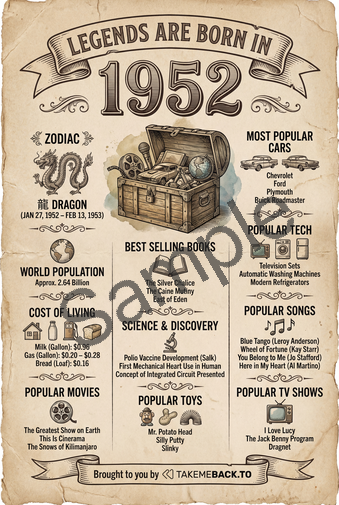

Major Events of 1952 - Historical Moments That Defined the Year | TakeMeBack.to
- 02 Jan Birth of Soviet gymnast Elvira Saadi: Elvira Saadi, a Soviet gymnast, was born on January 2, 1952, in Tashkent, Uzbek SSR, Soviet Union. She became a prominent member of the Soviet Union's women's gymnastics team, winning team gold medals at the 1972 and 1976 Olympics. source: en.wikipedia.org
- 03 Jan 'Dragnet' television series debuts in the United States: The television series 'Dragnet' premiered on January 3, 1952, in the United States, becoming a significant influence on police procedurals. source: en.wikipedia.org
- 05 Jan Nawab of Pataudi: Legendary Cricket Player Passes Away: Iftikhar Ali Khan Pataudi, the 8th Nawab of Pataudi and a renowned cricketer, died of a heart attack while playing polo in New Delhi on January 5, 1952. His son, Mansoor Ali Khan Pataudi, succeeded him as the 9th Nawab and later became the captain of the Indian cricket team. source: en.wikipedia.org
- 08 Jan Jordan adopts new constitution: On January 8, 1952, Jordan's new constitution came into effect, establishing a parliamentary monarchy with a hereditary king and a bicameral legislature. This constitution replaced the previous 1947 version, granting the House of Representatives the authority to modify internal finances, ratify foreign treaties, dissolve the cabinet via no-confidence votes, and override royal vetoes. source: wipo.int
- 10 Jan The Greatest Show on Earth film premiere: The film 'The Greatest Show on Earth,' directed by Cecil B. DeMille, premiered on January 10, 1952, at Radio City Music Hall in New York City. The film won two Academy Awards for Best Picture and Best Story. source: en.wikipedia.org
- 11 Jan Bollingen Prize awarded to Marianne Moore: On January 11, 1952, poet Marianne Moore was awarded the Bollingen Prize for Poetry, recognizing her significant contributions to American literature.
- 14 Jan NBC's Today Show launches: NBC's 'Today' show premiered on January 14, 1952, revolutionizing morning television by blending news, interviews, and entertainment. source: en.wikipedia.org
- 18 Jan Truman-Churchill White House meeting: On January 18, 1952, U.S. President Harry S. Truman met with British Prime Minister Winston Churchill at the White House. The meeting focused on various international issues, including the Korean War and NATO's role in global security. source: trumanlibrary.gov
- 19 Jan PGA desegregation milestone: On January 19, 1952, the Professional Golfers' Association (PGA) voted to allow non-white players to compete in its tournaments, marking a significant step towards desegregation in professional golf. This decision was influenced by the growing civil rights movement in the United States. source: pga.com
- 20 Jan British Army occupies Ismailiya: On January 20, 1952, British troops occupied Ismailiya, Egypt, amid rising tensions and unrest in the region. This military action was part of the broader context of the Suez Crisis and the struggle for control over the Suez Canal. source: bbc.com
- 21 Jan Indian General Election of 1952 begins: The first general election in India commenced on January 21, 1952, marking a significant milestone in the country's democratic process. This election was crucial for establishing a parliamentary system in the newly independent nation. It involved millions of voters across the country. source: britannica.com
- 22 Jan Devastating winter storm hits South Dakota: On January 22, 1952, South Dakota experienced a severe winter storm that caused significant disruptions. The storm brought heavy snowfall and strong winds, leading to road closures and power outages across the state. This event highlighted the challenges of winter weather in the region. source: weather.gov
- 23 Jan Robin Zander born: Robin Zander, the lead vocalist and rhythm guitarist of the rock band Cheap Trick, was born on January 23, 1952. He is known for his distinctive voice and energetic performances, contributing to the band's success in the late 1970s and beyond. Zander remains an influential figure in rock music. source: britannica.com
- 24 Jan Dallas Texans Join NFL: On January 24, 1952, the NFL awarded a franchise to a Dallas-based group, leading to the formation of the Dallas Texans. The team played one season in 1952, finishing with a 1–11 record, and was subsequently dissolved. source: en.wikipedia.org
- 26 Jan Black Saturday in Egypt: On January 26, 1952, Cairo experienced widespread riots known as Black Saturday. Triggered by the British attack on an Egyptian police station in Ismailia, the riots led to the burning and looting of approximately 750 buildings in downtown Cairo, including shops, cafes, cinemas, and the city's Opera House. source: en.wikipedia.org
- 27 Jan Black Saturday Riots in Cairo: Following the Battle of Ismailia on January 25, 1952, which resulted in the deaths of 50 Egyptian auxiliary policemen, Cairo erupted in riots on January 26. The unrest led to the destruction of numerous buildings in the city center, marking a significant moment in Egypt's struggle for independence. source: en.wikipedia.org
- 30 Jan Korean War truce negotiations stall: On January 30, 1952, truce talks aimed at ending the Korean War remained deadlocked after more than 50 meetings in Panmunjom. Disagreements over the repatriation of prisoners of war and the composition of neutral nation observer teams were significant obstacles. source: macaudailytimes.com.mo
- 01 Feb Sun Records founded in Memphis: Sun Records, an influential American independent record label, was founded by producer Sam Phillips on February 1, 1952, in Memphis, Tennessee. The label is renowned for launching the careers of artists such as Elvis Presley, Johnny Cash, and Jerry Lee Lewis. source: en.wikipedia.org
- 03 Feb First Recorded Tropical Storm in South Florida: On February 3, 1952, South Florida experienced its first recorded tropical storm, which brought significant rainfall and wind. This event marked a notable point in the region's meteorological history, highlighting the area's vulnerability to tropical weather systems. source: nhc.noaa.gov
- 04 Feb First African American Television Executive Appointed: On February 4, 1952, the first African American television executive was appointed, marking a significant milestone in the media industry. This appointment represented a step forward in diversifying the leadership within television networks during a time of racial segregation in the United States. source: bbc.com
- 05 Feb Death of Reginald Allen, Cricket Player: Reginald Allen, a notable cricket player, passed away on February 5, 1952. His contributions to the sport were recognized during his lifetime, and his death marked a loss for the cricket community. source: britannica.com
- 06 Feb Elizabeth II Becomes Queen of the United Kingdom: On February 6, 1952, Elizabeth II officially became queen of the United Kingdom following the death of her father, King George VI. Her reign would go on to become the longest in British history, significantly shaping the monarchy's role in modern society. source: britannica.com
- 07 Feb Elizabeth II Ascends to the Throne: Elizabeth II was officially proclaimed queen on February 7, 1952, following the death of her father, King George VI. This event marked the beginning of her long reign over the United Kingdom and other Commonwealth realms. source: britannica.com
- 10 Feb Birth of Lee Hsien Loong: Lee Hsien Loong, the current Prime Minister of Singapore, was born on February 10, 1952. He has played a significant role in Singapore's political landscape since becoming Prime Minister in 2004. source: britannica.com
- 11 Feb Death of Matija Murko, prominent Yugoslav scholar: Matija Murko, a notable Yugoslav scholar known for his contributions to linguistics and literature, passed away on February 11, 1952. His work significantly influenced the study of Slavic languages and culture. source: britannica.com
- 12 Feb Birth of Simon MacCorkindale: Simon MacCorkindale, a British actor and director, was born on February 12, 1952. He is best known for his roles in television and film, particularly in the series 'Falcon Crest.' source: britannica.com
- 13 Feb Rocky Marciano triumphs in boxing match: On February 13, 1952, Rocky Marciano achieved a significant victory in his boxing career, further solidifying his reputation as a heavyweight champion. His relentless fighting style and determination were key to his success. source: britannica.com
- 14 Feb King George VI's death mourned during Winter Olympics: The death of King George VI on February 14, 1952, was mourned during the Winter Olympics held in Oslo, Norway. His passing marked a significant moment in British history, impacting the nation and the Olympic events. source: bbc.com
- 15 Feb Funeral of King George VI: King George VI died on February 6, 1952, and his state funeral was held on February 15 at St George's Chapel, Windsor Castle. His coffin lay in state at Westminster Hall from February 11 to 14, with over 300,000 people paying their respects. source: en.wikipedia.org
- 18 Feb First African American baseball umpire: On February 18, 1952, Emmett Ashford became the first African American umpire in professional baseball, officiating in the Pacific Coast League. His appointment marked a significant milestone in the integration of baseball, paving the way for future diversity in the sport. source: baseballhall.org
- 19 Feb Birth of Rodolfo Neri Vela, Mexican astronaut: Rodolfo Neri Vela was born on February 19, 1952, in Mexico City. He became the first Mexican astronaut to fly in space, participating in the STS-61-B mission in 1985, which was a significant achievement for Mexico in the field of space exploration. source: nasa.gov
- 20 Feb The African Queen film release: The film 'The African Queen', directed by John Huston and starring Humphrey Bogart and Katharine Hepburn, premiered in New York City. It is based on the 1935 novel by C.S. Forester and became a classic of American cinema, winning multiple Academy Awards. source: britannica.com
- 21 Feb Language Martyrs' Day in East Pakistan: Language Martyrs' Day, observed on February 21, commemorates the students who protested for the recognition of Bengali as one of the official languages of Pakistan in 1952. The day is now recognized as International Mother Language Day by UNESCO, celebrating linguistic and cultural diversity. source: bbc.com
- 22 Feb Bill Frist enters political scene: Bill Frist, a prominent American politician and physician, officially entered the political arena on February 22, 1952. He later became a U.S. Senator from Tennessee and served as Senate Majority Leader, influencing healthcare and education policies. source: senate.gov
- 24 Feb LPGA Orlando mixed golf tournament won by Betty MacKinnon and Sam Snead: On February 24, 1952, the LPGA Orlando mixed golf tournament concluded with Betty MacKinnon and Sam Snead emerging as the winners. This event was notable for its mixed-gender format, showcasing the growing popularity of golf among both men and women. source: britannica.com
- 25 Feb Parícutin volcano eruption ends: The eruption of Parícutin volcano in Mexico concluded in 1952, after nearly a decade of activity. The volcano reached a final height of 424 meters and has remained dormant since. source: dlab.epfl.ch
- 28 Feb Birth of William Finn, Notable American Musical Theater Composer: William Finn, an acclaimed American composer and lyricist known for musicals like 'Falsettos' and 'A New Brain,' was born on February 28, 1952, in Boston, Massachusetts. source: en.wikipedia.org
- 01 Mar Bob Costas born: Bob Costas, an American sportscaster and television personality, was born on March 1, 1952. He is known for his work with NBC Sports and has covered numerous Olympic Games and major sporting events throughout his career. source: biography.com
- 02 Mar Marlene Hagge wins LPGA Sarasota Golf Open: Marlene Hagge won the LPGA Sarasota Golf Open on March 2, 1952. This victory added to her reputation as one of the leading female golfers of her time, contributing to the growth of women's golf in the United States. source: britannica.com
- 03 Mar Puerto Rico approves first self-written constitution: On March 3, 1952, Puerto Rico approved its first self-written constitution, establishing a framework for its government and affirming its status as a commonwealth of the United States. This was a pivotal moment in Puerto Rican history. source: loc.gov
- 04 Mar Hemingway completes 'The Old Man and the Sea': Ernest Hemingway completed his novella 'The Old Man and the Sea' on March 4, 1952. This work would go on to win the Pulitzer Prize for Fiction in 1953 and is considered one of his most famous works. source: biography.com
- 05 Mar Assassination attempt on Nobel laureate Sir Charles Sherrington: On March 5, 1952, an assassination attempt was made on Sir Charles Sherrington, a Nobel Prize-winning physiologist. The attempt was unsuccessful, and he continued his work in the field of neuroscience. source: britannica.com
- 06 Mar Execution of Jürgen Stroop, Nazi SS war criminal: Jürgen Stroop, a Nazi SS officer known for his role in the Warsaw Ghetto Uprising, was executed on March 6, 1952. His actions during World War II led to significant loss of life and suffering. source: britannica.com
- 07 Mar Paramahansa Yogananda passes away: Paramahansa Yogananda, a prominent spiritual teacher and author of 'Autobiography of a Yogi,' passed away on March 7, 1952. He is credited with bringing yoga and meditation to the Western world. source: britannica.com
- 10 Mar Establishment of military dictatorship in Cuba: On March 10, 1952, Fulgencio Batista established a military dictatorship in Cuba after leading a coup against the elected government. This regime was characterized by repression and corruption, leading to widespread opposition. source: britannica.com
- 11 Mar Batista's military coup in Cuba: On March 11, 1952, Fulgencio Batista's military coup was solidified as he took control of the Cuban government. This coup led to significant political changes and set the stage for the Cuban Revolution. source: britannica.com
- 12 Mar Death of Hugh Herbert, comedic actor: Hugh Herbert, a well-known comedic actor, passed away on March 12, 1952. He was recognized for his roles in various films and his contributions to the entertainment industry during the early 20th century. source: britannica.com
- 14 Mar Birth of David Byrne: David Byrne, the influential musician and founding member of the band Talking Heads, was born on March 14, 1952. He is known for his innovative contributions to music and art. source: britannica.com
- 16 Mar Kwame Nkrumah's Political Rise: In 1952, Kwame Nkrumah, leader of the Convention People's Party (CPP), was appointed as the Leader of Government Business in the Legislative Assembly of the Gold Coast, marking a significant step in his political career. source: en.wikipedia.org
- 20 Mar Final executions in the Netherlands: The last executions in the Netherlands took place on March 20, 1952, marking the end of capital punishment in the country. This event was significant in the context of Dutch legal history and human rights developments. source: nrc.nl
- 21 Mar Devastating tornado outbreak in South-Central United States: On March 21, 1952, a significant tornado outbreak struck the South-Central United States, causing extensive damage and loss of life. The outbreak included multiple tornadoes that affected several states, leading to widespread destruction. source: weather.gov
- 22 Mar Devastating Southern United States tornado outbreak: On March 22, 1952, another severe tornado outbreak occurred in the Southern United States, resulting in significant destruction and casualties. This event followed closely after the March 21 outbreak, compounding the devastation in affected areas. source: weather.gov
- 23 Mar NHL record: Bill Mosienko's fastest hat trick: On March 23, 1952, Bill Mosienko of the Chicago Blackhawks set an NHL record by scoring three goals in just 21 seconds during a game against the New York Rangers. This remarkable feat remains one of the fastest hat tricks in NHL history. source: nhl.com
- 25 Mar Western Powers Reject Soviet Peace Treaty Proposal: On March 25, 1952, the United States, United Kingdom, and France responded to the Soviet Union's proposal for a German peace treaty by emphasizing the need for free elections and a unified German government before any treaty discussions. source: germanhistorydocs.org
- 26 Mar Kansas Jayhawks win 1952 NCAA Men's Basketball Championship: On March 26, 1952, the Kansas Jayhawks defeated St. John's University 80-63 to claim their first NCAA Men's Basketball Championship. The game was held at Hec Edmundson Pavilion in Seattle, Washington, with Clyde Lovellette of Kansas being named the tournament's Most Outstanding Player. source: ncaa.com
- 29 Mar Tragic West Ice seal hunter disaster: The West Ice seal hunter disaster occurred on March 29, 1952, resulting in the loss of several lives during a hunting expedition. This event highlighted the dangers faced by hunters in extreme conditions and raised awareness about safety in such activities. source: nytimes.com
- 30 Mar 6th Tony Awards honors Broadway excellence: The 6th Tony Awards took place on March 30, 1952, celebrating outstanding achievements in Broadway theater. This event has since become a prestigious annual ceremony recognizing theatrical excellence. source: tonyawards.com
- 31 Mar Death of Senator Wallace H. White Jr.: Senator Wallace H. White Jr. passed away on March 31, 1952. He was a prominent Republican senator from Maine who served in the Senate during significant periods of American history, including World War II. source: congress.gov
- 01 Apr US nuclear test at Nevada site: On April 1, 1952, the United States conducted a nuclear test at the Nevada Test Site. This test was part of a series of nuclear detonations during the early Cold War period, aimed at developing and demonstrating nuclear capabilities. The tests had significant implications for international relations and military strategy. source: osti.gov
- 03 Apr Dutch Queen Juliana addresses United States Congress: On April 3, 1952, Queen Juliana of the Netherlands addressed a joint session of the United States Congress. This event marked a significant diplomatic moment, highlighting the strong ties between the Netherlands and the United States during the post-World War II era. The address focused on themes of cooperation and mutual support. source: congress.gov
- 04 Apr North Atlantic Treaty Organization (NATO) officially established: NATO was officially established on April 4, 1952, as a military alliance among North American and European countries. The organization was created to provide collective defense against aggression, particularly in the context of the Cold War. Its formation marked a significant shift in international relations and military strategy. source: nato.int
- 06 Apr Sam Snead wins 16th Golf Masters Championship: Sam Snead won the 1952 Masters Tournament, held April 3–6 at Augusta National Golf Club in Augusta, Georgia. In strong winds and cool temperatures on the final two days, Snead held on to the lead and won the second of his three Masters titles, four strokes ahead of runner-up Jack Burke Jr. It was the sixth of Snead's seven major titles. source: en.wikipedia.org
- 08 Apr Truman seizes steel mills to prevent national strike: On April 8, 1952, President Truman took the unprecedented step of seizing the steel mills to avert a national strike that threatened to impact the war effort in Korea. This decision sparked significant legal and political debates. source: archives.gov
- 09 Apr Bolivian National Revolution begins: The Bolivian National Revolution commenced on April 9, 1952, leading to significant social and political changes in Bolivia. This revolution aimed to address issues of inequality and land reform, resulting in the nationalization of key industries. source: britannica.com
- 10 Apr I Love Lucy sets television viewership record: On April 10, 1952, the television show 'I Love Lucy' set a record for viewership, becoming one of the most popular shows of its time. This milestone highlighted the growing influence of television in American culture. source: britannica.com
- 11 Apr Battle of Nanri Island: A conflict between the Republic of China Army and the People's Liberation Army over Nanri Island, resulting in a Nationalist victory. source: en.wikipedia.org
- 15 Apr Bolivia's National Revolution begins: The National Revolution in Bolivia commenced on April 15, 1952, leading to significant social and political changes in the country. This revolution aimed to address issues of inequality and land reform, ultimately resulting in the nationalization of key industries and the establishment of a more inclusive government. source: britannica.com
- 16 Apr Notable births: Bill Belichick and David Hann: On April 16, 1952, notable figures Bill Belichick, an acclaimed NFL coach, and David Hann, a prominent figure in the arts, were born. Their contributions to their respective fields have made significant impacts in sports and culture. source: nfl.com
- 17 Apr An uneventful day in global history: April 17, 1952, is often noted as an uneventful day in global history, with no significant events recorded. This day serves as a reminder that not all days are marked by historical milestones, highlighting the quieter moments in time. source: onthisday.com
- 18 Apr Bolivia's National Revolution: Democratic and Social Transformation: On April 18, 1952, the Bolivian National Revolution led by the Revolutionary Nationalist Movement (MNR) achieved significant milestones, including the establishment of universal suffrage, nationalization of mines, and agrarian reform. These reforms aimed to dismantle the existing oligarchy and implement a new socioeconomic model in Bolivia. source: en.wikipedia.org
- 21 Apr First Secretaries' Day celebration: The first National Secretaries' Day was celebrated on April 21, 1952, to recognize the contributions of secretaries and administrative professionals. This day has since evolved into Administrative Professionals Day, celebrated annually in many countries. source: history.com
- 22 Apr US nuclear testing at Nevada Test Site: On April 22, 1952, the United States conducted nuclear tests at the Nevada Test Site, part of a series of tests during the Cold War. These tests were significant in the development of nuclear weapons and had lasting impacts on military strategy and international relations. source: nv.doe.gov
- 23 Apr Kirkuk-Banias oil pipeline completed: The Kirkuk-Banias oil pipeline, which connects oil fields in Iraq to the Mediterranean Sea in Syria, was completed on April 23, 1952. This pipeline significantly enhanced the transportation of oil from the Middle East to Europe, impacting global oil markets. source: britannica.com
- 24 Apr US policy statement on Arab states and Israel: On April 24, 1952, the United States issued a policy statement addressing its stance on Arab states and Israel, emphasizing the importance of peace and stability in the region. This statement was part of the broader context of US foreign policy in the Middle East during the early Cold War. source: state.gov
- 25 Apr Formation of Baden-Württemberg: On April 25, 1952, the state of Baden-Württemberg was officially formed in Germany, merging the states of Baden, Württemberg-Baden, and Württemberg-Hohenzollern. This formation was a significant step in the post-war restructuring of Germany. source: britannica.com
- 26 Apr US Navy tragedy: Hobson and Wasp collision: On April 26, 1952, the USS Hobson collided with the USS Wasp during a training exercise off the coast of Virginia. The incident resulted in the sinking of the Hobson and the loss of 176 crew members, marking one of the worst peacetime naval disasters in U.S. history. source: nytimes.com
- 27 Apr Death of Manuel Portela Valladares: Manuel Portela Valladares, a prominent figure in the Dominican Republic's political landscape, passed away on April 27, 1952. He was known for his role in the country's governance and his influence in shaping its political history. source: britannica.com
- 28 Apr Treaty of San Francisco takes effect: The Treaty of San Francisco, officially ending the state of war between Japan and the Allied Powers, came into effect on April 28, 1952. This treaty marked Japan's re-entry into the international community and established the framework for its post-war relations. source: archives.gov
- 29 Apr Lever House opens in New York City: Lever House, a landmark skyscraper in New York City, officially opened on April 29, 1952. It was one of the first modernist glass buildings in the city and is considered an architectural icon. source: nytimes.com
- 30 Apr Mr. Potato Head first TV toy advertisement: On April 30, 1952, the first television advertisement for Mr. Potato Head aired, marking a significant moment in toy marketing history. This innovative advertising approach helped popularize the toy and set a precedent for future toy commercials. source: toyhalloffame.org
- 01 May Mr. Potato Head Toy Debut: In 1952, the Mr. Potato Head toy was introduced, becoming one of the first toys to feature a television commercial.
- 02 May First jet airliner maiden voyage: The de Havilland Comet, the world's first jet airliner, made its maiden flight on May 2, 1952. This marked a significant advancement in aviation technology, paving the way for future commercial jet travel. source: britannica.com
- 03 May First aircraft landing at geographic North Pole: On May 3, 1952, a U.S. Air Force aircraft successfully landed at the geographic North Pole for the first time. This event was a significant milestone in polar exploration and aviation history. source: britannica.com
- 04 May Babe Didrikson-Zaharias triumphs at LPGA Fresno Golf Open: Babe Didrikson-Zaharias won the LPGA Fresno Golf Open on May 4, 1952, showcasing her exceptional talent in women's golf. This victory added to her legacy as one of the greatest female athletes of all time. source: britannica.com
- 05 May Pulitzer Prize awarded to Herman Wouk: Herman Wouk was awarded the Pulitzer Prize for Fiction on May 5, 1952, for his novel 'The Caine Mutiny.' This recognition highlighted his significant contributions to American literature. source: britannica.com
- 06 May First aircraft landing at the geographic North Pole: On May 6, 1952, a U.S. Air Force aircraft successfully landed at the geographic North Pole. This event marked a significant achievement in aviation and exploration. source: nasa.gov
- 07 May Integrated circuit concept proposed: On May 7, 1952, the concept of the integrated circuit was proposed by Jack Kilby. This innovation laid the groundwork for modern electronics and computing. source: britannica.com
- 08 May Mad Magazine launches: Mad Magazine, a satirical publication known for its humor and social commentary, was launched on May 8, 1952. It quickly became a cultural icon, influencing generations with its unique style and approach to satire. source: britannica.com
- 09 May Uneventful day in 1952: May 9, 1952, is noted as an uneventful day in historical records, with no significant events reported. This day is often referenced in discussions about mundane historical timelines. source: onthisday.com
- 10 May Notable births: Roland Kaiser and Manuel Mora Morales: On May 10, 1952, notable figures Roland Kaiser, a German pop singer, and Manuel Mora Morales, a Mexican politician, were born. Both have made significant contributions to their respective fields. source: britannica.com
- 11 May Warren Littlefield born: Warren Littlefield, an American television executive known for developing popular shows like 'Cheers' and 'Seinfeld', was born on May 11, 1952, in Montclair, New Jersey. source: en.wikipedia.org
- 13 May Sew Shivnarine: cricket player: Sew Shivnarine, a notable cricket player, was active in the early 1950s, contributing to the sport's development in his region. His performances were significant in the context of cricket history during that era. source: espncricinfo.com
- 14 May David Byrne born in Dumbarton, Scotland: David Byrne, the Scottish-born musician and lead singer of Talking Heads, was born on May 14, 1952, in Dumbarton, Dunbartonshire, Scotland. source: britannica.com
- 15 May Israel and Japan establish diplomatic relations: On May 15, 1952, Israel and Japan established diplomatic relations, marking a significant step in bilateral ties between the two nations. source: mofa.go.jp
- 16 May 'New Faces of 1952' Broadway musical premieres: On May 16, 1952, the Broadway musical revue 'New Faces of 1952' premiered, featuring a cast of young performers and showcasing new musical talents. source: ibdb.com
- 17 May United States Armed Forces Day celebration: The United States Armed Forces Day was celebrated on May 17, 1952, honoring the men and women of the military. This day is part of a week-long observance of National Military Appreciation Month. source: defense.gov
- 18 May Volga-Don Canal navigation opens: The Volga-Don Canal, connecting the Volga River and the Don River, officially opened for navigation on May 18, 1952. This canal significantly improved trade and transportation in the region. source: britannica.com
- 19 May George Strait born: George Strait, an influential American country music singer, songwriter, and actor, was born on May 19, 1952, in Poteet, Texas. He is known as the 'King of Country' and has numerous hits and awards to his name, significantly shaping the genre. source: biography.com
- 20 May Birth of Roger Milla, Cameroonian football legend: Roger Milla, a renowned Cameroonian footballer, was born on May 20, 1952. He is celebrated for his remarkable performances in the FIFA World Cup, particularly in 1990 and 1994, and is considered one of Africa's greatest footballers. source: bbc.com
- 21 May Death of John Garfield: John Garfield, an American film and stage actor, passed away on May 21, 1952. He was known for his roles in films such as 'The Postman Always Rings Twice' and 'Gentleman's Agreement.' source: biography.com
- 22 May President Truman's 305th news conference: On May 22, 1952, President Harry S. Truman held his 305th news conference, addressing various national issues. This conference was part of his ongoing efforts to communicate directly with the public and the press during his presidency. source: trumanlibrary.gov
- 23 May Birth of Marvelous Marvin Hagler: Marvelous Marvin Hagler was born on May 23, 1952, in Newark, New Jersey. He became a legendary middleweight boxing champion, known for his toughness and skill in the ring. source: boxingnews24.com
- 24 May Birth of Sybil Danning: Sybil Danning was born on May 24, 1952, in Wels, Austria. She is known for her roles in various films and television series, becoming a prominent figure in the entertainment industry. source: britannica.com
- 27 May Formation of the European Defense Community (EDC): The European Defense Community (EDC) was established on May 27, 1952, aiming to create a unified military force among Western European nations. This initiative was part of the broader efforts to ensure collective security in post-World War II Europe. source: britannica.com
- 28 May Women's suffrage in Greece: On May 28, 1952, Greek women were granted the right to vote and stand for election in parliamentary elections, marking a significant milestone in the country's history. source: greekreporter.com
- 31 May Harry S. Truman serves as U.S. President: On May 31, 1952, Harry S. Truman was serving as the President of the United States during a critical period of the Cold War and post-World War II reconstruction. source: takemeback.to
- 01 Jun Volga-Don Canal opens for navigation: On June 1, 1952, the Volga-Don Canal in the Soviet Union was opened for navigation, connecting the Volga River to the Don River and facilitating inland waterway transport. source: en.wikipedia.org
- 02 Jun Supreme Court limits presidential power: On June 2, 1952, the U.S. Supreme Court issued a ruling that limited the scope of presidential power, marking a significant decision in the balance of powers between branches of government. source: en.wikipedia.org
- 06 Jun Birth of Marsha Blackburn: Marsha Blackburn, an American politician and businesswoman, was born on June 6, 1952, in Laurel, Mississippi. She has served as the senior United States senator from Tennessee since 2019. source: en.wikipedia.org
- 07 Jun 3 Wishes Broadway musical closes: The Broadway musical '3 Wishes' closed on June 7, 1952, after a brief run. This event marked the end of a production that had garnered attention during its time on stage. source: ibdb.com
- 10 Jun Truman's steel industry nationalization proposal: On June 10, 1952, President Harry S. Truman proposed the nationalization of the steel industry in response to a labor strike that threatened national security. This controversial move was later challenged in the Supreme Court, which ruled against Truman's actions. The proposal highlighted tensions between labor rights and government authority during the post-war era. source: archives.gov
- 11 Jun Top US Song: Vanessa by Hugo Winterhalter: On June 11, 1952, the song "Vanessa" by Hugo Winterhalter reached the top of the US charts. This instrumental piece was notable for its lush orchestration and became a popular hit during the early 1950s. source: billboard.com
- 12 Jun Anne Frank's Diary Published in English: On June 12, 1952, Anne Frank's diary was published in English, titled "The Diary of a Young Girl." This publication brought her poignant reflections on life during the Holocaust to a wider audience. source: annefrank.org
- 13 Jun Extended Catalina Affair Details: On June 13, 1952, further details emerged regarding the Catalina Affair, a significant incident involving espionage and military operations during the Cold War. This event highlighted the tensions between the US and Soviet Union. source: britannica.com
- 14 Jun USS Nautilus Keel Laying: On June 14, 1952, the keel of the USS Nautilus, the world's first nuclear-powered submarine, was laid. This marked a significant advancement in naval technology and military capabilities. source: history.com
- 17 Jun Guatemala's Land Redistribution Decree: On June 17, 1952, Guatemala enacted a significant land redistribution decree aimed at addressing land inequality. This policy was part of a broader agrarian reform movement that sought to improve the living conditions of rural peasants. The decree faced opposition from landowners and foreign interests, particularly the United Fruit Company. source: britannica.com
- 18 Jun Birth of Idriss Déby Itno: Idriss Déby Itno, the former President of Chad, was born on June 18, 1952. He served as president from 1990 until his death in 2021, playing a significant role in Chadian politics and military affairs. Déby's leadership was marked by both support and criticism, particularly regarding human rights issues. source: bbc.com
- 19 Jun United States Army Special Forces established: The United States Army Special Forces, also known as the Green Berets, were officially established on June 19, 1952. This elite unit was created to conduct unconventional warfare and special operations, playing a crucial role in various military engagements since its inception. source: defense.gov
- 20 Jun Notable births: John Goodman and Vikram Seth: On June 20, 1952, actor John Goodman and poet Vikram Seth were born. Goodman is known for his roles in film and television, while Seth is celebrated for his literary contributions, including the acclaimed novel 'A Suitable Boy.' source: biography.com
- 21 Jun US Air Force bombs Yalu River installations: On June 21, 1952, the United States Air Force conducted bombing raids on installations along the Yalu River during the Korean War. This operation aimed to disrupt supply lines and military operations of North Korean forces. source: archives.gov
- 23 Jun Birth of Peter Whiteside: Peter Whiteside, a British modern pentathlete, was born on June 23, 1952, in Marton, Middlesbrough, England. He competed in the 1980 Summer Olympics and was the British Modern Pentathlon champion in 1985. source: en.wikipedia.org
- 24 Jun Birth of Sir George Pearce, Australian Statesman: Sir George Pearce, an Australian statesman, was born on June 24, 1952. He served as a member of the Australian Senate and held various ministerial positions.
- 25 Jun Truman vetoes McCarran-Walter Immigration Bill: On June 25, 1952, President Harry S. Truman vetoed the McCarran-Walter Immigration and Nationality Act, citing its continuation of national origins quotas and other provisions he deemed discriminatory. Congress overrode the veto, and the act became law on June 27, 1952. source: history.com
- 27 Jun Congressional Override of McCarran-Walter Act Veto: On June 27, 1952, Congress overrode President Truman's veto of the McCarran-Walter Immigration and Nationality Act, enacting the legislation into law. source: history.com
- 30 Jun Hussein Sirri Pasha forms Egyptian government: On June 30, 1952, Hussein Sirri Pasha was appointed as the Prime Minister of Egypt, leading a government during a time of significant political change. This event occurred shortly before the Egyptian Revolution, which aimed to end monarchy and establish a republic. source: britannica.com
- 02 Jul Marriage of Mangosuthu Buthelezi: On July 2, 1952, Mangosuthu Buthelezi, a prominent South African politician and leader of the Inkatha Freedom Party, married his wife, who would later become a significant figure in his political life. This event is part of his personal history amidst a backdrop of political activism. source: britannica.com
- 03 Jul Puerto Rico constitution approved: On July 3, 1952, the Constitution of Puerto Rico was approved, establishing the island as a self-governing commonwealth of the United States. This marked a significant step in Puerto Rico's political evolution and its relationship with the U.S. source: loc.gov
- 04 Jul Álvaro Uribe Vélez born: Álvaro Uribe Vélez, former President of Colombia, was born on July 4, 1952, in Medellín, Colombia. source: en.wikipedia.org
- 05 Jul Maureen Connolly wins Wimbledon Women's Singles: On July 5, 1952, American tennis player Maureen Connolly defeated Shirley Fry in the Wimbledon Women's Singles final, securing her third consecutive title. source: en.wikipedia.org
- 11 Jul Dwight D. Eisenhower secures Republican presidential nomination: At the 1952 Republican National Convention in Chicago, Dwight D. Eisenhower was nominated for president on the first ballot, defeating Senator Robert A. Taft. Eisenhower's running mate was Senator Richard M. Nixon. source: britannica.com
- 12 Jul Formation of East German Army approved: The Soviet Union approved the formation of the National People's Army (Nationale Volksarmee) in East Germany, marking a significant step in the militarization of the German Democratic Republic. source: en.wikipedia.org
- 13 Jul Formation of East Germany's National People's Army: The establishment of the National People's Army (Nationale Volksarmee) in East Germany was officially announced, solidifying the GDR's military capabilities under Soviet influence. source: en.wikipedia.org
- 14 Jul Iraq Republic Day celebrated on July 14, 1952: Iraq Republic Day marks the anniversary of the 1958 revolution that led to the establishment of the Republic of Iraq. The day is celebrated with various events and ceremonies across the country, reflecting on Iraq's history and national identity. source: britannica.com
- 15 Jul First transatlantic helicopter flight on July 15, 1952: On July 15, 1952, the first successful transatlantic helicopter flight was completed, marking a significant milestone in aviation history. This achievement demonstrated the capabilities of helicopters for long-distance travel and opened new possibilities for air transport. source: britannica.com
- 16 Jul Birth of Stewart Copeland on July 16, 1952: Stewart Copeland, the renowned drummer of the band The Police, was born on July 16, 1952. His contributions to music have made a significant impact on rock and pop genres, earning him recognition and accolades throughout his career. source: britannica.com
- 17 Jul David Hasselhoff born in Baltimore, Maryland: David Hasselhoff, the American actor and singer, was born on July 17, 1952, in Baltimore, Maryland. source: en.wikipedia.org
- 19 Jul Washington D.C. UFO Incident: On July 19, 1952, a series of unidentified flying objects were reported over Washington D.C., leading to a significant public and governmental response. The incident involved multiple radar sightings and visual confirmations by military personnel, sparking widespread media coverage and speculation about extraterrestrial life. source: history.com
- 20 Jul Emil Zatopek sets Olympic record in 10,000 meters: On July 20, 1952, Emil Zatopek of Czechoslovakia set a new Olympic record in the 10,000 meters at the Helsinki Olympics. His performance was remarkable, showcasing his endurance and speed, and he went on to win three gold medals in the same Olympics. source: britannica.com
- 21 Jul European Coal and Steel Community established: On July 21, 1952, the European Coal and Steel Community (ECSC) was established, marking a significant step towards European integration. This treaty aimed to regulate the coal and steel industries of its member states to promote economic cooperation and prevent future conflicts. source: europa.eu
- 22 Jul Poland adopts Communist constitution: On July 22, 1952, Poland adopted a new constitution that solidified the Communist Party's control over the state. This constitution established the People's Republic of Poland and marked a significant step in the consolidation of Communist power in Eastern Europe. source: britannica.com
- 23 Jul Founding of the European Coal and Steel Community: On July 23, 1952, the European Coal and Steel Community (ECSC) was established, marking a significant step towards European integration. This organization aimed to regulate the coal and steel industries of its member states, fostering economic cooperation and preventing future conflicts. source: britannica.com
- 24 Jul Georgia records extreme heat: On July 24, 1952, Georgia experienced a record high temperature, contributing to a severe heat wave affecting the southeastern United States. This event highlighted the impact of extreme weather conditions on public health and agriculture during that period. source: weather.gov
- 25 Jul Puerto Rico becomes a commonwealth: On July 25, 1952, Puerto Rico officially became a Commonwealth of the United States, establishing a new political status that allowed for greater self-governance. This change was significant in the relationship between Puerto Rico and the U.S. source: loc.gov
- 26 Jul Death of Eva Perón: Eva Perón, the influential First Lady of Argentina and a key political figure, passed away on July 26, 1952. Her death marked a significant moment in Argentine history, as she was beloved by many for her work in social welfare and women's rights. source: britannica.com
- 27 Jul Emil Zatopek's Olympic Marathon Record: On July 27, 1952, Emil Zatopek set a new Olympic record in the marathon during the Helsinki Games. His remarkable performance solidified his status as one of the greatest long-distance runners in history. source: britannica.com
- 28 Jul Birth of King Vajiralongkorn of Thailand: King Vajiralongkorn, also known as King Rama X, was born on July 28, 1952, in Bangkok, Thailand. He ascended to the throne in 2016, following the death of his father, King Bhumibol Adulyadej. source: britannica.com
- 29 Jul First nonstop transpacific jet flight: The first nonstop transpacific jet flight occurred on July 29, 1952, marking a significant advancement in aviation. This flight demonstrated the capabilities of jet technology and transformed international travel. source: britannica.com
- 30 Jul MLB Commissioner Ford Frick implements waiver rule: On July 30, 1952, Major League Baseball Commissioner Ford Frick established a waiver rule to prevent inter-league trades until all clubs had the opportunity to bid, with the lowest-ranked team in each league receiving the first pick. The set price for these transactions was $10,000, and all other deals were prohibited after July 31. source: bleedcubbieblue.com
- 03 Aug Birth of Osvaldo Ardiles, Argentine football legend: Osvaldo César Ardiles, an Argentine football manager and former player, was born in Córdoba, Argentina. He is renowned for his midfield skills and was part of the Argentina national team that won the 1978 FIFA World Cup. source: en.wikipedia.org
- 04 Aug Gábor Demszky, Hungarian Politician: Gábor Demszky, a notable Hungarian politician who would later become a significant figure in Budapest's political landscape, particularly during the post-communist era.
- 06 Aug Satchel Paige makes baseball history: On August 6, 1952, Satchel Paige became the first African American pitcher to play in the American League, making his debut with the Cleveland Indians. This historic moment marked a significant step in the integration of Major League Baseball, following the earlier entry of Jackie Robinson into the National League in 1947. source: baseballhall.org
- 07 Aug Birth of Alexei Sayle, pioneering British comedian: Alexei Sayle, a prominent British comedian and actor, was born on August 7, 1952. He is known for his unique style of humor and contributions to British comedy, particularly during the 1980s and 1990s, including his role in the BBC series 'The Young Ones.' source: bbc.co.uk
- 08 Aug Syngman Rhee re-elected as South Korean president: On August 8, 1952, Syngman Rhee was re-elected as the President of South Korea. His presidency was marked by strong anti-communist policies and significant U.S. support during the Korean War, although his administration faced criticism for authoritarian practices. source: britannica.com
- 09 Aug Belgian general strike against overtime conscription: On August 9, 1952, a general strike occurred in Belgium in response to the government's decision to impose overtime conscription. This strike was part of a broader labor movement against government policies perceived as oppressive and sparked significant social unrest. source: bbc.com
- 13 Aug Japan joins the International Monetary Fund: Japan officially became a member of the International Monetary Fund (IMF) on August 13, 1952. This membership marked a significant step in Japan's post-war economic recovery and integration into the global financial system. source: brookings.edu
- 15 Aug Lynmouth flood disaster: The Lynmouth flood disaster occurred on August 15, 1952, when heavy rainfall caused the River Lyn to overflow, resulting in devastating floods in Lynmouth, England. The disaster led to significant loss of life and property damage, prompting changes in flood management policies. source: bbc.com
- 16 Aug Lynmouth flood disaster aftermath: Following the Lynmouth flood disaster on August 15, 1952, recovery efforts began on August 16, focusing on rescue operations and assessing damage. The event led to significant changes in local infrastructure and flood prevention measures. source: bbc.com
- 17 Aug Nelson Piquet birth: Nelson Piquet, the Brazilian racing driver and three-time Formula One World Champion, was born on August 17, 1952. He is known for his significant contributions to motorsport and his successful career in Formula One. source: britannica.com
- 22 Aug 1952 Kern County Earthquake Aftershock: An aftershock of the 1952 Kern County earthquake occurred, causing additional damage and concern in the region. The main earthquake had already resulted in significant destruction, and this aftershock added to the challenges faced by residents and emergency services. source: usgs.gov
- 23 Aug Arab League established: The Arab League was officially established in Cairo, Egypt, with the aim of promoting political, economic, cultural, and social cooperation among Arab states. This organization has played a significant role in regional politics and diplomacy since its inception. source: britannica.com
- 24 Aug Birth of Linton Kwesi Johnson, pioneering dub poet: Linton Kwesi Johnson, a significant figure in the dub poetry movement, was born on this day. His work has influenced both music and literature, addressing social and political issues through his unique style and voice. source: bbc.com
- 25 Aug Virgil Trucks' Second No-Hitter of 1952: On August 25, 1952, Detroit Tigers pitcher Virgil Trucks threw his second no-hitter of the season, defeating the New York Yankees 1-0 at Yankee Stadium. This made him the third pitcher to achieve two no-hitters in a single season. source: sabr.org
- 27 Aug Emil Zatopek wins Olympic marathon: Czech long-distance runner Emil Zatopek won the Olympic marathon on August 27, 1952, during the Helsinki Olympics. This victory added to his earlier wins in the 5,000 and 10,000 meters, making him the first athlete to win all three events in a single Olympics. source: britannica.com
- 28 Aug Germany-Israel reparations negotiations conclude: On August 28, 1952, negotiations between Germany and Israel regarding reparations for Holocaust survivors concluded. This agreement marked a significant step in post-war relations and reparations for the Jewish community. source: britannica.com
- 29 Aug Premiere of John Cage's 4'33": John Cage's groundbreaking composition 4'33" premiered on August 29, 1952. The piece, known for its silence, challenges traditional notions of music and has had a lasting impact on contemporary art and music. source: britannica.com
- 30 Aug Finnish war reparations concluded: On August 30, 1952, Finland completed its war reparations to the Soviet Union, fulfilling a $570 million debt incurred after World War II. This marked the end of a significant chapter in Finland's post-war recovery. source: time.com
- 31 Aug Grenzlandring racetrack closure: On August 31, 1952, the Grenzlandring racetrack in Wegberg, Germany, was closed following a tragic accident where a driver crashed, resulting in 13 fatalities and 42 injuries. This incident led to the cessation of racing activities at the track. source: en.wikipedia.org
- 01 Sep Discovery of Asteroid Juno: German astronomer Karl Ludwig Harding discovered Juno, one of the largest asteroids in the Main Asteroid Belt, contributing significantly to astronomical knowledge.
- 02 Sep Jimmy Connors: Tennis legend: Jimmy Connors, an iconic American tennis player, was born on September 2, 1952. He is known for his aggressive playing style and has won numerous Grand Slam titles throughout his career, making him one of the sport's all-time greats. source: britannica.com
- 03 Sep First successful open-heart surgery in medical history: On September 3, 1952, Dr. John Gibbon performed the first successful open-heart surgery using a heart-lung machine. This groundbreaking procedure marked a significant advancement in cardiac surgery and paved the way for future innovations in the field. source: ncbi.nlm.nih.gov
- 04 Sep Birth of Rishi Kapoor, legendary Bollywood actor: Rishi Kapoor, a prominent figure in Indian cinema, was born on September 4, 1952. He gained fame for his roles in numerous Bollywood films and was known for his versatility as an actor, contributing significantly to the film industry. source: britannica.com
- 05 Sep Puerto Rican Marine Fernando Luis García killed in Korean War: On September 5, 1952, Puerto Rican Marine Fernando Luis García was killed in action during the Korean War. His sacrifice is remembered as part of the contributions of Puerto Rican soldiers in the conflict. source: history.com
- 06 Sep A prototype aircraft crashes at the Farnborough Airshow: On September 6, 1952, a prototype aircraft crashed at the Farnborough Airshow, killing 29 spectators and the two crew members. This incident highlighted the need for improved safety measures at air shows. source: bbc.com
- 07 Sep Egyptian Revolution: General Naguib forms government: On September 7, 1952, following the resignation of Prime Minister Aly Maher Pasha, General Mohamed Naguib assumed the role of Prime Minister and Commander-in-Chief of Egypt. He formed a new civilian government, marking a significant consolidation of power by the military after the July 1952 revolution. source: news.bbc.co.uk
- 09 Sep Dave Stewart: Eurythmics musician born: Dave Stewart, a prominent musician and songwriter, known for his work with the Eurythmics, was born on September 9, 1952. He gained fame in the 1980s with hits like "Sweet Dreams (Are Made of This)" and has had a significant impact on the music industry. source: britannica.com
- 10 Sep European Parliamentary Assembly established: The European Parliamentary Assembly was established on September 10, 1952, marking a significant step in European integration. It aimed to foster cooperation among European nations and laid the groundwork for the modern European Parliament. source: europarl.europa.eu
- 11 Sep West German reparations agreement for Holocaust victims: On September 11, 1952, West Germany signed a reparations agreement with Israel to compensate Holocaust survivors. This agreement was a significant step in acknowledging the atrocities of the Holocaust and providing restitution to victims. source: jewishvirtuallibrary.org
- 12 Sep The Flatwoods Monster Incident: On September 12, 1952, in Flatwoods, West Virginia, a group of boys and a local farmer reported seeing a strange creature and a bright light in the sky. This incident became a notable part of UFO lore and has been the subject of various investigations and theories over the years. source: britannica.com
- 13 Sep Adolfo Ruiz Cortinez elected President of Mexico: Adolfo Ruiz Cortinez was elected President of Mexico on September 13, 1952, serving until 1958. His presidency is noted for significant social and economic reforms, including land redistribution and educational improvements. source: britannica.com
- 15 Sep Formation of the European Parliamentary Assembly: The European Parliamentary Assembly was formed on September 15, 1952, as part of the European integration process. It aimed to provide a platform for dialogue among European nations and to promote cooperation in various sectors. source: europarl.europa.eu
- 17 Sep Establishment of Citizenship Day in the United States: Citizenship Day was established in the United States on September 17, 1952, to recognize and celebrate the rights and responsibilities of citizenship. It serves as a reminder of the importance of civic engagement and participation. source: archives.gov
- 18 Sep Korean War Ceasefire Negotiations Stall: On September 18, 1952, ceasefire negotiations during the Korean War faced significant setbacks. The discussions aimed at ending hostilities were complicated by differing political agendas and military strategies. source: britannica.com
- 19 Sep Charlie Chaplin barred from returning to the United States: Charlie Chaplin, the famous British actor and filmmaker, was denied re-entry into the United States on September 19, 1952, due to his political beliefs and associations. This decision was influenced by the growing anti-communist sentiment during the McCarthy era. Chaplin had been traveling to promote his film 'Limelight' when he learned of the U.S. government's decision. source: britannica.com
- 20 Sep KPTV Channel 12 launches in Portland: KPTV Channel 12, the first television station in Portland, Oregon, officially began broadcasting on September 20, 1952. This marked a significant development in local media, providing residents with access to television programming. The station has since become a key player in the Portland broadcasting landscape. source: kptv.com
- 21 Sep Robinson Risner becomes Korean War jet ace: On September 21, 1952, U.S. Air Force pilot Robinson Risner achieved ace status during the Korean War by shooting down his fifth enemy aircraft. This accomplishment highlighted his skill and bravery in aerial combat, contributing to the air war efforts in Korea. Risner later became a prisoner of war and was recognized for his heroism. source: nytimes.com
- 22 Sep Mossadeq's ultimatum to Britain: On September 22, 1952, Iranian Prime Minister Mohammad Mossadeq issued an ultimatum to Britain regarding the nationalization of the Iranian oil industry. This move escalated tensions between Iran and the UK, leading to significant geopolitical ramifications and contributing to the eventual coup against Mossadeq in 1953. source: britannica.com
- 23 Sep Nixon's pivotal 'Checkers' speech: On September 23, 1952, then-Senator Richard Nixon delivered his famous 'Checkers' speech, addressing accusations of corruption. The speech was pivotal in saving his place on the Republican ticket for the vice presidency, as he connected emotionally with the American public. source: archives.gov
- 24 Sep Dutch minister sentences war criminal to death: On September 24, 1952, a Dutch minister sentenced a war criminal to death, reflecting the post-World War II efforts to bring justice to those responsible for war crimes. This event was part of a broader movement in Europe to address wartime atrocities. source: bbc.com
- 25 Sep Bell Hooks born: influential author and activist: On September 25, 1952, Bell Hooks, an influential author, feminist theorist, and social activist, was born. Her work focused on the intersectionality of race, gender, and class, and she became a prominent voice in contemporary feminist discourse. source: theguardian.com
- 28 Sep Stan Musial's unique pitching performance: On September 28, 1952, during the final game of the season, St. Louis Cardinals' outfielder Stan Musial made his only major league pitching appearance. Manager Eddie Stanky moved Musial from the outfield to pitch to Chicago Cubs' outfielder Frank Baumholtz, who was second in the National League batting race behind Musial. Musial's first pitch resulted in a hard grounder to third baseman Solly Hemus, which was ruled an error. Musial returned to the outfield after the brief appearance. source: stltoday.com
- 29 Sep 'Lights Out' final NBC television broadcast: 'Lights Out' was an American television anthology series that aired on NBC from July 12, 1949, to September 29, 1952. The series featured dramas of thrills and suspense and was the first TV dramatic program to use a split-screen display. The final episode aired on September 29, 1952. source: en.wikipedia.org
- 30 Sep Supreme Court limits presidential power in steel mill seizure case: In 1952, during the Korean War, President Harry S. Truman ordered the seizure of steel mills to prevent a strike that could disrupt steel production vital for the war effort. The Supreme Court, in a landmark decision, ruled that the President did not have the authority to seize private property without congressional authorization, thereby limiting presidential power. source: archives.gov
- 01 Oct Liberal Party wins Japanese elections: In the Japanese general election held on October 1, 1952, the Liberal Party secured a majority, winning 240 of the 466 seats in the House of Representatives, with a voter turnout of 76.43%. source: en.wikipedia.org
- 03 Oct First British Atomic Bomb Test: On October 3, 1952, the United Kingdom conducted its first atomic bomb test, codenamed Operation Hurricane, at the Monte Bello Islands off the northwest coast of Australia. The test involved detonating a 25-kiloton plutonium implosion device inside the hull of the frigate HMS Plym, marking Britain as the world's third nuclear power after the United States and the Soviet Union. source: history.co.uk
- 05 Oct 6th NHL All-Star Game ends in tie: The 6th National Hockey League All-Star Game took place at Detroit Olympia on October 5, 1952, between the First and Second All-Star teams. The game concluded with a 1–1 tie, marking the second consecutive year the All-Star Game ended in a draw. This outcome led the NHL to revert to the previous format, where the Stanley Cup champion faced an All-Star team. source: en.wikipedia.org
- 06 Oct New York Yankees win 1952 World Series: The New York Yankees clinched the 1952 World Series by defeating the Brooklyn Dodgers in Game 7 on October 6, 1952. This victory marked the Yankees' fourth consecutive World Series title and their 16th overall. source: mlb.com
- 07 Oct Yankees win 15th World Series title: On October 7, 1952, the New York Yankees secured their 15th World Series title by defeating the Brooklyn Dodgers in Game 7. This victory continued the Yankees' dominance in Major League Baseball during the early 1950s. source: mlb.com
- 08 Oct Germany-Israel Reparations Agreement: On October 8, 1952, West Germany and Israel signed a reparations agreement in Luxembourg, under which Germany agreed to pay Israel $822 million over a 12-year period. This agreement aimed to compensate Israel for the costs of resettling Jewish refugees and to address claims from Holocaust survivors. source: jta.org
- 09 Oct Britain Develops Atomic Weapons: On October 9, 1952, the United Kingdom conducted its first successful atomic bomb test, becoming the third country to develop nuclear weapons after the United States and the Soviet Union. source: en.wikipedia.org
- 12 Oct Louis Armstrong's diplomatic jazz performance in Germany: On October 12, 1952, jazz legend Louis Armstrong performed at the Titania Palast in Berlin, Germany. This concert was part of his European tour and was broadcast on RIAS (Radio in the American Sector). The performance featured Armstrong's All Stars, including Trummy Young on trombone, Bob McCracken on clarinet, Marty Napoleon on piano, Arvell Shaw on bass, and Cozy Cole on drums. source: jazzmessengers.com
- 16 Oct Charlie Chaplin's 'Limelight' London Premiere and US Re-entry Permit Revocation: On October 16, 1952, Charlie Chaplin premiered his film 'Limelight' in London. During his voyage to the UK, U.S. Attorney General James P. McGranery revoked Chaplin's re-entry permit, requiring him to submit to an interview about his political views and moral behavior to return to the U.S. source: theguardian.com
- 17 Oct Youngest George Cross Recipient: On October 17, 1952, John 'Jack' Bamford, aged 15, was announced as the youngest recipient of the George Cross for rescuing his two younger brothers from a house fire in Newthorpe, Nottinghamshire. source: telegraph.co.uk
- 18 Oct Chuck Lorre's birth: Chuck Lorre, born Charles Michael Levine, is an American television producer, writer, director, and composer. He is known for creating and producing several successful sitcoms, including 'Two and a Half Men' and 'The Big Bang Theory'. source: en.wikipedia.org
- 20 Oct State of emergency in Kenya during Mau Mau Uprising: On October 20, 1952, Governor Evelyn Baring declared a state of emergency in Kenya and began arresting hundreds of suspected leaders of the Mau Mau Uprising, including Jomo Kenyatta, the future first President of Kenya. source: calendarz.com
- 21 Oct Birth of Patti Davis: Patti Davis, the daughter of U.S. President Ronald Reagan and actress Jane Wyman, was born on October 21, 1952. She is known for her work as an author and actress, as well as her political activism. source: reaganlibrary.gov
- 23 Oct Eisenhower campaign rally in New York: On October 23, 1952, Dwight D. Eisenhower held a significant campaign rally in New York City as part of his presidential campaign. The rally was attended by thousands and marked a pivotal moment in his bid for the presidency. source: nytimes.com
- 24 Oct Arab Liberation Movement establishes single-party rule in Syria: On October 24, 1952, the Arab Liberation Movement declared a single-party rule in Syria, marking a significant shift in the country's political landscape. This move was part of broader regional trends towards nationalism and authoritarian governance. source: britannica.com
- 25 Oct Eisenhower's Korea campaign promise: On October 25, 1952, Dwight D. Eisenhower made a campaign promise regarding Korea, pledging to seek an end to the Korean War. This promise resonated with voters and was a key part of his presidential campaign platform. source: archives.gov
- 26 Oct Death of tennis player Myrtle McAteer: American tennis player Myrtle McAteer, who won the U.S. National Championships singles title in 1900, passed away on October 26, 1952. source: sewiki.info
- 27 Oct Birth of political scientist Francis Fukuyama: Francis Fukuyama, an American political scientist and author, was born on October 27, 1952.
- 28 Oct Death of former Australian Prime Minister Billy Hughes: Billy Hughes, who served as the seventh Prime Minister of Australia from 1915 to 1923, died on October 28, 1952.
- 31 Oct Bolivia nationalizes major tin mining companies: On October 31, 1952, Bolivia's government, led by President Víctor Paz Estenssoro, nationalized the properties of the three largest tin mining companies—Aramayo, Hochschild, and Patiño. This action transferred control of the mining industry to the state-owned Mining Corporation of Bolivia (COMIBOL), marking a significant shift in the nation's economic structure. source: countrystudies.us
- 01 Nov First thermonuclear device detonated in Operation Ivy Mike: On November 1, 1952, the United States conducted the first successful detonation of a thermonuclear device, known as a hydrogen bomb, during Operation Ivy Mike at the Enewetak Atoll in the Pacific Ocean. This test marked a significant advancement in nuclear weapons technology. source: en.wikipedia.org
- 03 Nov Egypt protests German reparations to Israel: On November 3, 1952, Egypt protested against the reparations agreement between Germany and Israel, which was seen as a betrayal of Arab interests. The Egyptian government expressed strong opposition, emphasizing the historical grievances related to the Holocaust and the Arab-Israeli conflict. source: britannica.com
- 04 Nov 1952 United States Presidential Election: The United States presidential election took place on November 4, 1952, resulting in Dwight D. Eisenhower's victory over Adlai Stevenson. This election marked a significant shift in American politics, with Eisenhower's campaign focusing on ending the Korean War and addressing domestic issues. source: archives.gov
- 05 Nov Birth of Bill Walton, NBA basketball legend: Bill Walton, a prominent NBA player known for his time with the Portland Trail Blazers and Boston Celtics, was born on November 5, 1952. Walton is celebrated for his exceptional skills and contributions to basketball, including winning two NBA championships and being named the league's Most Valuable Player. source: britannica.com
- 06 Nov US Presidential Election Day: November 6, 1952, marked the official Election Day for the United States presidential election, where voters cast their ballots for the candidates. This day is significant in American history as it solidified Dwight D. Eisenhower's presidency and shaped the political landscape for years to come. source: archives.gov
- 07 Nov ANC leaders protest racial segregation in Kimberley: On November 7, 1952, leaders of the African National Congress (ANC) organized a protest in Kimberley, South Africa, against racial segregation policies. This event was part of a broader campaign against apartheid, highlighting the ANC's commitment to fighting for equal rights and justice for all South Africans. source: britannica.com
- 08 Nov Mayibuye uprising against apartheid: The Mayibuye uprising occurred on November 8, 1952, as part of the Defiance Campaign against apartheid in South Africa. This uprising was marked by protests and civil disobedience aimed at challenging the oppressive laws of the apartheid regime. source: britannica.com
- 09 Nov Birth of Senator Sherrod Brown: Sherrod Brown, an American politician and member of the Democratic Party, was born on November 9, 1952. He has served as a U.S. Senator from Ohio since 2007 and is known for his advocacy on economic and social issues. source: senate.gov
- 10 Nov Trygve Lie resigns as first UN Secretary-General: On November 10, 1952, Trygve Lie, the first Secretary-General of the United Nations, announced his resignation during a General Assembly session. His decision was influenced by the Soviet Union's opposition to his support for UN military intervention in the Korean War and the challenges posed by the U.S. investigations into alleged communist activities within the UN. Lie served from 1946 until his resignation in 1952. source: britannica.com
- 12 Nov Bobby Shantz wins American League MVP Award: On November 12, 1952, Philadelphia Athletics pitcher Bobby Shantz was named the American League Most Valuable Player by the Baseball Writers' Association of America. Shantz achieved a 24-7 record with 152 strikeouts and a 2.48 ERA during the regular season, also earning The Sporting News American League Pitcher of the Year honor. source: mlb.com
- 13 Nov KLBK TV Channel 13 launches in Lubbock, Texas: On November 13, 1952, KLBK TV Channel 13 began broadcasting in Lubbock, Texas. As the city's first television station, it provided local news, entertainment, and educational programming to the community. source: klbk.com
- 14 Nov First UK Singles Chart Published: On November 14, 1952, the New Musical Express (NME) published the first official UK Singles Chart, marking a significant milestone in the music industry. The inaugural number one was "Here in My Heart" by Al Martino, which held the top position for nine consecutive weeks. This chart was compiled by contacting 20 record shops across the UK to gather sales data. source: officialcharts.com
- 18 Nov Jomo Kenyatta's arrest during Mau Mau Uprising: Jomo Kenyatta, a key figure in the struggle for Kenyan independence, was arrested on November 18, 1952, during the Mau Mau Uprising. His arrest marked a significant escalation in the conflict between British colonial authorities and the Kenyan nationalist movement. source: britannica.com
- 19 Nov Alexander Papagos becomes Greek Prime Minister: Alexander Papagos was appointed Prime Minister of Greece on November 19, 1952. His leadership was marked by efforts to stabilize the country post-Civil War and to strengthen ties with Western powers during the Cold War. source: britannica.com
- 20 Nov Pioneering sex reassignment surgery performed: On November 20, 1952, Dr. Christine Jorgensen became the first American to undergo sex reassignment surgery in Denmark. This landmark event brought significant attention to transgender issues and the possibilities of gender-affirming medical procedures. source: ncbi.nlm.nih.gov
- 21 Nov Jomo Kenyatta arrested by British colonial authorities: On November 21, 1952, Jomo Kenyatta, a prominent leader in the struggle for Kenyan independence, was arrested by British colonial authorities. His arrest was part of a broader crackdown on the Mau Mau movement, which sought to end colonial rule in Kenya. source: britannica.com
- 22 Nov Eisenhower wins 1952 US presidential election: On November 22, 1952, Dwight D. Eisenhower was declared the winner of the 1952 United States presidential election. His victory marked a significant shift in American politics and set the stage for his presidency during the Cold War era. source: archives.gov
- 25 Nov Battle of Triangle Hill Concludes: The Battle of Triangle Hill, also known as Operation Showdown or the Shangganling Campaign, concluded on November 25, 1952, after 42 days of intense fighting. Despite superior artillery and air support, United Nations forces failed to capture the strategic position, resulting in a Chinese victory. source: en.wikipedia.org
- 27 Nov KTBC TV Channel 7 launches in Austin: On November 27, 1952, KTBC TV Channel 7 began broadcasting in Austin, Texas, becoming the first television station in the area. Initially owned by the Texas Broadcasting Company, the station was later acquired by Lyndon B. Johnson and his wife, Lady Bird Johnson. It primarily served as a CBS affiliate, carrying approximately 65% of CBS's programming, with NBC and ABC splitting the remaining coverage. source: en.wikipedia.org
- 01 Dec First television broadcast in Hawaii: On December 1, 1952, KGMB-TV Channel 9 began regular daily television broadcasts in Honolulu, marking the first television broadcast in Hawaii. The station's inaugural programming included popular shows of the time. source: www2.hawaii.edu
- 02 Dec Marcos Pérez Jiménez becomes Venezuelan president: On December 2, 1952, General Marcos Pérez Jiménez was declared provisional president of Venezuela by the military junta, following the cancellation of the 1952 elections when early results indicated an opposition victory. Pérez Jiménez's appointment was confirmed by the constituent assembly in April 1953, and he ruled until January 1958. source: britannica.com
- 03 Dec Birth of Mel Smith: Mel Smith, a British actor and comedian, was born on December 3, 1952. He was known for his work on television and in film, including the sketch comedy show 'Not the Nine O'Clock News' and the film 'The Tall Guy.' source: imdb.com
- 05 Dec The Great Smog of London: A severe air pollution event occurred in London from December 5 to December 9, 1952, known as the Great Smog. It was caused by a combination of industrial pollution and high-pressure weather conditions, leading to thousands of deaths and prompting the passage of the Clean Air Act in 1956. source: britannica.com
- 06 Dec Birth of Craig Newmark: Craig Newmark, the founder of Craigslist, was born on December 6, 1952. He is known for his contributions to online classifieds and community engagement through technology. source: biography.com
- 07 Dec Birth of Susan Collins: Susan Collins, a prominent American politician and U.S. Senator from Maine, was born on December 7, 1952. She has served in the Senate since 1997 and is known for her bipartisan approach. source: senate.gov
- 08 Dec Casablanca Demonstration Massacre: The Casablanca Demonstration Massacre occurred on December 8, 1952, when Moroccan protesters were killed by French police during a demonstration. This event highlighted tensions in colonial Morocco. source: britannica.com
- 09 Dec The Great Smog of London ends: The Great Smog of London, which began in early December 1952, ended on December 9, 1952. This severe air pollution event led to thousands of deaths and prompted significant changes in environmental policy in the UK. source: bbc.com
- 10 Dec Yitzhak Ben-Zvi elected president of Israel: Yitzhak Ben-Zvi was elected as the second president of Israel on December 10, 1952. His presidency lasted until 1963, during which he played a significant role in the development of the state. source: britannica.com
- 12 Dec Ajit De Silva: Sri Lankan Cricket Player: Ajit de Silva, a former Sri Lankan international cricketer, was born on December 12, 1952, in Ambalangoda, Sri Lanka. He played four Test matches and six One Day Internationals for Sri Lanka between 1975 and 1982. source: wisden.com
- 14 Dec First successful surgical separation of Siamese twins: On December 14, 1952, Dr. Alfred Blalock and his team successfully separated conjoined twins, Patricia and Phyllis, in a groundbreaking surgery at Johns Hopkins Hospital. This operation marked a significant advancement in surgical techniques and pediatric medicine, showcasing the potential for complex surgical interventions. source: ncbi.nlm.nih.gov
- 15 Dec Christine Jorgensen undergoes pioneering sex reassignment surgery: On December 15, 1952, Christine Jorgensen became the first American to undergo sex reassignment surgery, a significant event in the history of transgender rights. Her surgery in Denmark brought attention to transgender issues and sparked discussions about gender identity in the United States. source: nytimes.com
- 16 Dec Birth of Joel Garner, West Indian cricket legend: Joel Garner, a renowned West Indian cricketer known for his exceptional bowling skills, was born on December 16, 1952. Garner became famous for his height and ability to bowl fast, contributing significantly to the West Indies cricket team's success during the 1970s and 1980s. source: bbc.com
- 18 Dec Passing of paleontologist Ernst Stromer: Ernst Stromer, a German paleontologist renowned for his discovery of Spinosaurus fossils in Egypt, passed away on December 18, 1952, in Erlangen, West Germany. source: en.wikipedia.org
- 21 Dec WSBT TV Channel 22 begins broadcasting in South Bend, Indiana: On December 21, 1952, WSBT TV Channel 22 commenced operations in South Bend, Indiana, as a CBS affiliate. This marked a significant development in the region's television broadcasting history. source: onthisday.com
- 22 Dec French government of Antoine Pinay resigns: On December 22, 1952, the French government led by Prime Minister Antoine Pinay resigned following a vote of no confidence, leading to a period of political instability in France. source: independent.co.uk
- 25 Dec Wilhelm List pardoned after war crimes trial: On December 25, 1952, Nazi Field Marshal Wilhelm List, convicted of war crimes for mass killings of civilians in Yugoslavia, was released from life imprisonment on medical parole. He had been serving his sentence since 1948. source: jta.org
- 26 Dec Biological Warfare during Mau Mau Uprising: During the Mau Mau Uprising in Kenya, reports emerged on December 26, 1952, alleging the use of biological warfare tactics by colonial forces, including the distribution of infected clothing to suppress the rebellion. source: theguardian.com
- 28 Dec NFL Championship Game: Detroit Lions triumph: On December 28, 1952, the Detroit Lions defeated the Cleveland Browns 17-7 in the NFL Championship Game. This victory marked the Lions' third championship title in six years, solidifying their dominance in the early 1950s NFL landscape. source: pro-football-reference.com
- 29 Dec First transistorized hearing aid launched: On December 29, 1952, Sonotone introduced the Model 1010, the first commercial hearing aid to use transistors, marking a significant advancement in hearing aid technology. source: en.wikipedia.org
- 30 Dec Historic milestone: No lynchings in the United States: On December 30, 1952, it was reported that there were no recorded lynchings in the United States for the first time in a year. This milestone was seen as a significant step forward in the civil rights movement and efforts to combat racial violence. source: nytimes.com
- 31 Dec NFL Championship Game: On December 31, 1952, the NFL Championship Game took place, where the Detroit Lions faced the Cleveland Browns. This game was pivotal in determining the league champion for the season, with the Lions emerging victorious. source: pro-football-reference.com
What happened in 1952?
Discover what the world looked like in 1952: