

Major Events of 1956: Key Historical Moments You Need to Know
Every year brings its own set of pivotal moments that leave a lasting mark on history. From political shifts and technological advancements to cultural breakthroughs, these events shape the world and influence the future. In this comprehensive overview, we'll explore the most significant occurrences from 1956, highlighting key moments that continue to impact our lives today.
Explore by topic:
Born in 1956? Get Your Birth Year Poster!
A beautifully researched, newspaper-style poster of the year.
Step back into 1956. Get yours today!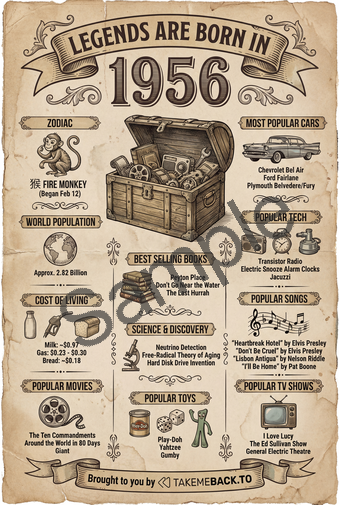

Major Events of 1956 - Historical Moments That Defined the Year | TakeMeBack.to
- 01 Jan Sudan gains independence from Britain: On January 1, 1956, Sudan officially gained independence from British-Egyptian rule. This marked a significant milestone in the country's history, leading to the establishment of a sovereign state. source: britannica.com
- 02 Jan French legislative election of 1956: The French legislative election held on January 2, 1956, was crucial in shaping the political landscape of France. It resulted in significant changes in the composition of the National Assembly. source: britannica.com
- 03 Jan Mel Gibson's Birth: Mel Gibson, the American actor and filmmaker, was born on January 3, 1956, in Peekskill, New York. source: britannica.com
- 05 Jan Piasecki YH-16A helicopter prototype crash: On January 5, 1956, a Piasecki YH-16A Turbo Transporter helicopter prototype (serial number 50-1270) crashed near Swedesboro, New Jersey, during a test flight. The crash was caused by a failure of the aft slip ring, leading to a rotor shaft malfunction. Test pilots Harold Peterson and George Callaghan were killed, and the YH-16 program was subsequently canceled. source: takemeback.to
- 06 Jan Sudan gains independence: First Prime Minister takes office: On January 6, 1956, Ismail al-Azhari took office as the first Prime Minister of an independent Sudan. source: takemeback.to
- 07 Jan Record-breaking cricket partnership by Vinoo Mankad and Roy: Vinoo Mankad and his partner set a record for the highest partnership in Test cricket during a match against New Zealand. Their performance was pivotal in establishing a strong position for India in the game. source: espncricinfo.com
- 08 Jan Elvis Presley's record-breaking single: Elvis Presley achieved a significant milestone with his single, which broke sales records and topped charts. This event marked a pivotal moment in the history of rock and roll music. source: billboard.com
- 09 Jan Political change in Jordan: On January 9, 1956, Jordan experienced significant political changes, including shifts in leadership and policy. This period marked a crucial time in Jordan's history, influencing its political landscape for years to come. source: bbc.com
- 10 Jan Elvis Presley records iconic song 'Heartbreak Hotel': On January 10, 1956, Elvis Presley recorded 'Heartbreak Hotel,' which would become one of his most famous songs. The track marked a significant moment in rock and roll history, showcasing Presley's unique style and vocal talent. source: rollingstone.com
- 12 Jan Significant earthquake strikes Budapest: A significant earthquake struck Budapest on January 12, 1956, causing considerable damage and prompting emergency responses. This event highlighted the seismic risks in the region and led to discussions on building safety and preparedness. source: usgs.gov
- 13 Jan Severe ice storm concludes on Mount Washington: On January 13, 1956, a severe ice storm that had impacted Mount Washington came to an end. The storm caused hazardous conditions and significant disruptions, emphasizing the challenges of winter weather in mountainous regions. source: weather.gov
- 14 Jan Jordan declines Baghdad Pact membership: On January 14, 1956, Jordan officially declined to join the Baghdad Pact, a mutual defense agreement aimed at countering Soviet influence in the Middle East. This decision was influenced by regional dynamics and Jordan's own political considerations. source: britannica.com
- 15 Jan Shostakovich honored by Academia Santa Cecilia: On January 15, 1956, composer Dmitri Shostakovich was honored by Academia Santa Cecilia in Rome. This recognition highlighted his contributions to music and his influence on 20th-century classical compositions. source: britannica.com
- 16 Jan Nasser's Palestine Reconquest Pledge: On January 16, 1956, Egyptian President Gamal Abdel Nasser pledged to reconquer Palestine, signaling Egypt's commitment to the Palestinian cause and its opposition to Israel. source: sahistory.org.za
- 17 Jan Nasser's Vow to Reconquer Palestine: On January 17, 1956, Egyptian President Gamal Abdel Nasser reiterated his commitment to reconquer Palestine, emphasizing Egypt's dedication to the Palestinian cause and its opposition to Israel. source: sahistory.org.za
- 18 Jan East Germany Establishes National People's Army: On January 18, 1956, East Germany established the National People's Army (Nationale Volksarmee), marking a significant development in the country's military history during the Cold War.
- 19 Jan General Motors Motorama Showcases 1956 Corvette: On January 19, 1956, General Motors' Motorama event showcased the 1956 Corvette, highlighting the car's new features and design, and solidifying its status as an American automotive icon.
- 22 Jan Canadian Football Council established: On January 22, 1956, representatives from the Interprovincial Rugby Football Union (IRFU) and the Western Interprovincial Football Union (WIFU) formed the Canadian Football Council (CFC) in Winnipeg. G. Sydney Halter, QC, was appointed as the commissioner. The CFC introduced a national negotiation list and increased the touchdown point value from five to six. Television rights for Canadian football games were sold for $101,000. source: britannica.com
- 23 Jan Death of Sir Alexander Korda: Sir Alexander Korda, a prominent film producer and director known for his work in British cinema, passed away on January 23, 1956. He was influential in the development of the British film industry and produced several notable films during his career. source: britannica.com
- 24 Jan Record-breaking precipitation in Hawaii: On January 24, 1956, Hawaii experienced record-breaking precipitation, leading to significant flooding and disruption. This event highlighted the region's vulnerability to extreme weather conditions. source: weather.gov
- 25 Jan Birth of Andy Cox, rock guitarist: Andy Cox, a well-known rock guitarist, was born on January 25, 1956. He is recognized for his work with the band Fine Young Cannibals and has made significant contributions to the music industry. source: britannica.com
- 26 Jan Soviet Union returns Porkkala to Finland: On January 26, 1956, the Soviet Union officially returned the Porkkala naval base to Finland, a significant event in post-war relations between the two countries. This marked a step towards improved diplomatic ties. source: bbc.com
- 27 Jan Colombian presidential administrative reform: On January 27, 1956, Colombia implemented significant administrative reforms under President Alberto Lleras Camacho. These reforms aimed to modernize the government and improve efficiency in public administration. source: britannica.com
- 28 Jan Elvis Presley's first national television appearance: On January 28, 1956, Elvis Presley made his first national television appearance on the Dorsey Brothers' Stage Show. This performance marked a pivotal moment in his career and the rise of rock and roll music in America. source: britannica.com
- 29 Jan 1956 World Sportscar Championship begins: The 1956 World Sportscar Championship commenced with the 1000 km Buenos Aires race on January 29, 1956. The event was won by Stirling Moss and Carlos Menditéguy, driving a Maserati 300S. source: en.wikipedia.org
- 31 Jan Juscelino Kubitschek Becomes President of Brazil: Juscelino Kubitschek was inaugurated as the President of Brazil on January 31, 1956. His administration is noted for ambitious development projects and the construction of Brasília, the new capital. source: britannica.com
- 01 Feb War Crimes Revelation in The Hague: On February 1, 1956, significant revelations regarding war crimes were made in The Hague, highlighting the ongoing efforts to address war crimes from World War II. This marked a pivotal moment in international law and justice. source: icc-cpi.int
- 02 Feb World Première of Eugene O'Neill's 'Long Day's Journey into Night': Eugene O'Neill's play 'Long Day's Journey into Night' premiered on February 2, 1956, at the Royal Dramatic Theatre in Stockholm, Sweden. The production was directed by Bengt Ekerot and featured a cast including Lars Hanson as James Tyrone and Inga Tidblad as Mary Tyrone. The play received universal praise from critics. source: en.wikipedia.org
- 03 Feb Autherine Lucy Breaks Racial Barrier at University of Alabama: On February 3, 1956, Autherine Lucy became the first African American woman to attend the University of Alabama, breaking the racial barrier at the institution. source: en.wikipedia.org
- 04 Feb American League tests automatic intentional walk: On February 4, 1956, the American League announced it would test the automatic intentional walk during spring training. This experiment aimed to expedite the game by allowing managers to signal for an intentional walk without the pitcher throwing four balls. The rule was not adopted in the majors until 2017. source: baseballhall.org
- 06 Feb Autherine Lucy suspended from University of Alabama amid campus riots: On February 6, 1956, Autherine Lucy, the first African American student at the University of Alabama, was suspended after violent protests erupted on campus. The university cited her safety as the reason for the suspension. source: uscourts.gov
- 07 Feb Autherine Lucy expelled from University of Alabama: On February 7, 1956, Autherine Lucy was expelled from the University of Alabama after her suspension, following violent protests against her enrollment as the first African American student. source: uscourts.gov
- 08 Feb Treaty of London establishes independent Federation of Malaya: On February 8, 1956, the Treaty of London was signed, leading to the establishment of the independent Federation of Malaya, which achieved independence on August 31, 1957. source: en.wikipedia.org
- 09 Feb US military expansion in South Vietnam: On February 9, 1956, the United States authorized a temporary mission of 350 additional military personnel to South Vietnam. This mission aimed to salvage approximately $1 billion in military equipment left behind by the French military, which had recently withdrawn from the region. source: en.wikipedia.org
- 11 Feb British spies Guy Burgess and Donald Maclean resurface in Soviet Union: On February 11, 1956, British spies Guy Burgess and Donald Maclean appeared in the Soviet Union, five years after vanishing from the UK. They issued a statement denying espionage activities and expressing their desire to contribute to mutual understanding between East and West. source: irishtimes.com
- 12 Feb Fay Crocker wins LPGA Miami Beach Golf Open: On February 12, 1956, Fay Crocker secured victory at the LPGA Miami Beach Golf Open, marking a significant achievement in her professional golf career.
- 14 Feb Khrushchev's Secret Speech at 20th Communist Party Congress: On February 14, 1956, Nikita Khrushchev delivered a secret speech denouncing Stalin's policies at the 20th Congress of the Communist Party of the Soviet Union. This speech marked a significant shift in Soviet politics and ideology. source: britannica.com
- 15 Feb Urho Kekkonen Becomes President of Finland: On February 15, 1956, Urho Kekkonen was elected as the President of Finland, a position he would hold for over two decades. His presidency was marked by significant political and economic developments in Finland. source: britannica.com
- 16 Feb Rodgers and Hammerstein's 'Carousel' Film Release: On February 16, 1956, the film adaptation of Rodgers and Hammerstein's musical 'Carousel' was released. The film is notable for its music and themes, contributing to the legacy of American musical theater. source: imdb.com
- 17 Feb Carol Heiss Wins Ladies Figure Skating Championship: At the 1956 World Figure Skating Championships, Carol Heiss secured the gold medal in the ladies' singles event. She delivered a near-flawless performance, earning high praise from judges and spectators alike. source: skateguardblog.com
- 18 Feb Scottish Airlines Malta Air Disaster: On February 18, 1956, an Avro York aircraft operated by Scottish Airlines crashed shortly after takeoff from Luqa Airport in Malta, en route to London Stansted Airport. The crash resulted in the deaths of all 50 people on board, including 45 Royal Air Force personnel and five crew members. The accident was attributed to engine failure and pilot error. source: en.wikipedia.org
- 20 Feb United States Merchant Marine Academy gains permanent status: On February 20, 1956, the United States Merchant Marine Academy was granted permanent status as a federal service academy, solidifying its role in training officers for the U.S. Merchant Marine and other branches of the armed forces. source: isitaholidaytoday.com
- 21 Feb First mapping of the Gibson Desert: In February 1956, Australian explorer and geographer Cecil Madigan led an expedition that resulted in the first comprehensive mapping of the Gibson Desert, a vast arid region in central Australia. source: en.wikipedia.org
- 22 Feb Montgomery Bus Boycott mass arrest: On February 22, 1956, during the Montgomery Bus Boycott, a mass arrest occurred as African American leaders, including Martin Luther King Jr., were charged with conspiracy and violating segregation laws. source: en.wikipedia.org
- 23 Feb Khrushchev denounces Stalin: On February 23, 1956, Soviet Premier Nikita Khrushchev delivered a secret speech at the 20th Congress of the Communist Party of the Soviet Union, denouncing Joseph Stalin's policies and initiating a period of de-Stalinization. source: en.wikipedia.org
- 24 Feb Formation of the General Union of Algerian Workers: The General Union of Algerian Workers (UGTA) was formed in Algeria on February 24, 1956. The UGTA played a significant role in the country's labor movement and its struggle for independence. source: en.wikipedia.org
- 25 Feb Khrushchev's historic denunciation of Stalin: On February 25, 1956, during a closed session of the 20th Congress of the Communist Party of the Soviet Union, Nikita Khrushchev delivered a speech titled "On the Cult of Personality and Its Consequences," denouncing the personality cult and dictatorship of Joseph Stalin. source: en.wikipedia.org
- 26 Feb Betsy Rawls wins LPGA Sarasota Golf Open: On February 26, 1956, Betsy Rawls won the LPGA Sarasota Golf Open. Rawls was a prominent American professional golfer, known for her consistent performance on the LPGA Tour. source: en.wikipedia.org
- 27 Feb Death of Günther Ramin: Günther Ramin, a renowned German organist, conductor, composer, and pedagogue, passed away on February 27, 1956, in Leipzig, East Germany. He was notably the Thomaskantor in Leipzig from 1940 to 1955 and was influential in the music community. source: en.wikipedia.org
- 29 Feb Eisenhower announces second presidential campaign: On February 29, 1956, President Dwight D. Eisenhower announced his candidacy for a second term in the 1956 presidential election. source: en.wikipedia.org
- 01 Mar IATA radiotelephony spelling alphabet draft: On March 1, 1956, the International Air Transport Association (IATA) introduced a draft for a radiotelephony spelling alphabet. This was aimed at improving communication clarity in aviation, particularly in radio transmissions. source: icao.int
- 02 Mar Morocco gains independence from France: On March 2, 1956, Morocco officially gained independence from French colonial rule. This marked a significant moment in the decolonization process in Africa, as Morocco became a sovereign nation after years of foreign control. source: britannica.com
- 03 Mar Indonesian government transition: On March 3, 1956, Indonesia underwent a significant government transition, marking a shift in political power. This event was part of the broader struggle for stability and governance in the post-colonial era of Indonesia. source: britannica.com
- 04 Mar Georgian protests against de-Stalinization: On March 4, 1956, protests erupted in Tbilisi, Georgia, in response to Nikita Khrushchev's de-Stalinization policy. Demonstrators, primarily students, defended Joseph Stalin's legacy and Georgian national identity, leading to a violent crackdown by Soviet authorities. source: britannica.com
- 05 Mar King Kong first television broadcast: On March 5, 1956, the 1933 film 'King Kong' was broadcast on television for the first time, bringing the iconic monster movie to a new audience and marking a significant moment in the history of television programming. source: britannica.com
- 06 Mar Peter Roebuck born in Oxfordshire, England: Peter Michael Roebuck, an English cricketer and journalist, was born in Oddington, Oxfordshire, England. He later became a prominent figure in cricket journalism and commentary. source: en.wikipedia.org
- 09 Mar Deadly pro-Stalin protests in Tbilisi: On March 9, 1956, protests erupted in Tbilisi, Georgia, against the Soviet regime, leading to violent clashes. The demonstrations were sparked by the Soviet government's decision to rehabilitate Joseph Stalin's image, which angered many Georgians. The protests resulted in numerous casualties and highlighted the growing discontent within the Soviet Union. source: bbc.com
- 10 Mar World air speed record set by Peter Twiss: On March 10, 1956, British pilot Peter Twiss set a new world air speed record flying the de Havilland Venom jet. He achieved a speed of 1,132.1 km/h (703.6 mph), breaking previous records and showcasing advancements in aviation technology. This achievement was significant in the context of the Cold War and the race for technological superiority. source: bbc.com
- 11 Mar Laurence Olivier's Richard III U.S. premiere: On March 11, 1956, Laurence Olivier's film adaptation of Shakespeare's 'Richard III' premiered in the United States. The film was notable for its innovative cinematography and Olivier's acclaimed performance. This premiere contributed to the popularity of Shakespearean adaptations in cinema during the mid-20th century. source: bbc.com
- 12 Mar Southern Manifesto signed - resistance to civil rights: The Southern Manifesto was signed on March 12, 1956, by 101 Southern politicians in opposition to the Supreme Court's decision in Brown v. Board of Education, which mandated the desegregation of public schools. This document articulated the South's resistance to civil rights advancements and was a pivotal moment in the civil rights movement. source: archives.gov
- 13 Mar Southern Manifesto signed against racial integration: On March 13, 1956, the Southern Manifesto was signed by additional Southern leaders, reinforcing opposition to racial integration in public schools. This document was a response to the Supreme Court's ruling in Brown v. Board of Education and highlighted the deep-seated resistance to civil rights in the South. source: archives.gov
- 14 Mar Memorial to Karl Marx unveiled at Highgate Cemetery: On March 14, 1956, a monument to Karl Marx was unveiled in Highgate Cemetery, London. Designed by Laurence Bradshaw and funded by the Communist Party of Great Britain, the monument features a bronze bust of Marx atop a granite plinth. The unveiling ceremony was led by Harry Pollitt, General Secretary of the Communist Party of Great Britain. source: theguardian.com
- 15 Mar Wrestling championship change: On March 15, 1956, significant changes were made to the wrestling championship formats, impacting how competitions were structured. This was part of an ongoing evolution in the sport to enhance viewer engagement and athlete performance. source: britannica.com
- 16 Mar Devastating earthquakes strike Lebanon: On March 16, 1956, Lebanon experienced a series of earthquakes along the Dead Sea Transform fault system. The first shock, with a magnitude of 5.3, occurred at 9:32 PM local time, followed by a 5.5 magnitude aftershock 11 minutes later. The epicenter was located in the Chouf District, resulting in 136 fatalities, the destruction of approximately 6,000 homes, and damage to an additional 17,000 structures. source: en.wikipedia.org
- 17 Mar Death of Irène Joliot-Curie, renowned French physicist: Irène Joliot-Curie, the esteemed French physicist and Nobel laureate, died on March 17, 1956, at the age of 58. She succumbed to leukemia, leaving a profound impact on the field of chemistry and physics. source: en.wikipedia.org
- 18 Mar Severe nor'easter impacts Mid-Atlantic and New England: A severe nor'easter struck the Mid-Atlantic and New England regions on March 18, 1956, causing significant disruptions and damage. The storm brought heavy snowfall and strong winds, affecting transportation and daily life. source: weather.gov
- 20 Mar Tunisia gains independence from France: On March 20, 1956, Tunisia officially gained independence from French colonial rule after a long struggle for liberation. This marked a significant moment in the decolonization movement across Africa and the Arab world. source: britannica.com
- 21 Mar 28th Academy Awards ceremony: The 28th Academy Awards took place on March 21, 1956, honoring the best films of 1955. The ceremony was notable for its presentation of awards in various categories, celebrating achievements in the film industry. source: britannica.com
- 22 Mar Douglas D-558-II Skyrocket emergency: On March 22, 1956, a Douglas D-558-II Skyrocket experienced a critical emergency during a test flight. The incident highlighted the challenges and risks associated with experimental aircraft testing during the era. source: britannica.com
- 23 Mar Sudan gains independence: On March 23, 1956, Sudan officially gained independence from joint British-Egyptian rule. This event marked the beginning of a new era for Sudan, allowing it to establish its own government and national identity. source: britannica.com
- 24 Mar Steve Ballmer born: Steve Ballmer, the former CEO of Microsoft, was born on March 24, 1956. He played a crucial role in the company's growth and development during his tenure, becoming one of the most recognized figures in the tech industry. source: biography.com
- 25 Mar Pakistan adopts first constitution as Islamic republic: On March 25, 1956, Pakistan adopted its first constitution as an Islamic republic, solidifying its commitment to Islamic governance. This constitution laid the groundwork for the country's legal and political framework. source: britannica.com
- 28 Mar Asoka de Silva: Sri Lankan cricket leg spinner: Asoka de Silva, a Sri Lankan cricketer known for his leg-spin bowling, was born on March 28, 1956, in Kalutara, Sri Lanka. He played in 10 Test matches and 28 One Day Internationals for Sri Lanka between 1985 and 1992. source: espncricinfo.com
- 31 Mar Typhoon Sarah near-miss in the Philippines: Typhoon Sarah formed on March 21, 1956, and approached the Philippine islands on March 31, 1956. It slowed and reversed direction, dissipating on April 4, 1956, without making landfall. source: agora.ex.nii.ac.jp
- 01 Apr KPIC TV Channel 4 launches in Roseburg, Oregon: On April 1, 1956, KPIC TV Channel 4 officially launched in Roseburg, Oregon, becoming a key source of local news and entertainment. This marked an important development in regional broadcasting. source: britannica.com
- 02 Apr Northwest Orient Airlines Flight 2 emergency landing: On April 2, 1956, Northwest Orient Airlines Flight 2 made an emergency landing in Seattle due to engine failure. The incident highlighted the importance of aviation safety and led to changes in airline protocols. source: history.com
- 03 Apr Elvis Presley's television breakthrough: On April 3, 1956, Elvis Presley made a significant television appearance that contributed to his rise in popularity. This performance marked a turning point in his career, bringing him into the national spotlight. source: rollingstone.com
- 04 Apr Strom Thurmond resigns from the U.S. Senate: On April 4, 1956, Senator Strom Thurmond resigned from the U.S. Senate to fulfill a campaign pledge made during his 1954 election. He had promised to resign before the 1956 primary to allow South Carolina voters to select a candidate for the remainder of his term. Thurmond was re-elected unopposed in the special election held later that year. source: senate.gov
- 05 Apr Mao Zedong's diplomatic conversation: On April 5, 1956, Mao Zedong engaged in a significant diplomatic conversation that influenced China's foreign relations. This event was part of the broader context of Cold War politics. source: bbc.com
- 06 Apr Polish Communist Leader Gomulka Released from Prison: Władysław Gomułka, a prominent Polish Communist leader, was released from prison on April 6, 1956, after spending nearly four years in confinement. His imprisonment was part of a broader political purge initiated by Bolesław Bierut, the then leader of Poland, who accused Gomułka of 'right-nationalist deviation.' Gomułka's release occurred during a period of de-Stalinization in Poland, following the death of Joseph Stalin and the subsequent political thaw. This event marked a significant turning point in Polish politics, leading to Gomułka's eventual return to power later that year. source: britannica.com
- 07 Apr Birth of Charles Carreon: Charles Carreon, an American attorney and author, was born on April 7, 1956. He is known for his work in intellectual property law and his involvement in various legal controversies. source: britannica.com
- 08 Apr Ceylon Election: People's Front Victory: In the 1956 Ceylonese parliamentary elections, the Mahajana Eksath Peramuna (People's United Front), led by S.W.R.D. Bandaranaike, secured a majority with 51 seats, ending the United National Party's (UNP) eight-year rule. The UNP, under John Kotelawala, won only 8 seats. This marked a significant shift in Ceylon's political landscape, with the MEP advocating for a neutralist foreign policy and strong nationalist policies at home. source: en.wikipedia.org
- 09 Apr Habib Bourguiba Elected Prime Minister of Tunisia: On April 9, 1956, Habib Bourguiba was elected Prime Minister of Tunisia. He played a pivotal role in Tunisia's struggle for independence from French colonial rule and became the country's first president in 1957.
- 10 Apr Racist Attack Interrupts Nat King Cole Concert: On April 10, 1956, during a concert in Birmingham, Alabama, African American singer Nat King Cole was attacked by a white man who threw a knife at him. The incident was part of a series of racist attacks against Cole during his tour of the segregated South.
- 11 Apr Racial violence against Nat King Cole: On April 11, 1956, Nat King Cole faced racial violence during a concert in Birmingham, Alabama, where he was attacked by a group of white men. This incident highlighted the racial tensions and challenges faced by African American artists during the civil rights era. source: npr.org
- 12 Apr Death of José Moscardó Ituarte: José Moscardó Ituarte, a Spanish military officer known for his role during the Spanish Civil War, died on April 12, 1956. He was a controversial figure, remembered for his staunch support of Franco's regime. source: britannica.com
- 13 Apr Alison Wheeler, British activist: Alison Wheeler, a notable British activist, was born on April 13, 1956. She is recognized for her contributions to various social justice movements in the UK. source: theguardian.com
- 14 Apr First commercial videotape recorder demonstrated: On April 14, 1956, Ampex Corporation unveiled the VR-1000, the first commercial videotape recorder, at the National Association of Radio and Television Broadcasters Convention in Chicago. source: history.co.uk
- 15 Apr Habib Bourguiba becomes Prime Minister of Tunisia: On April 15, 1956, Habib Bourguiba was appointed as the first Prime Minister of Tunisia following the country's independence from France. source: en.wikipedia.org
- 16 Apr Council of Europe establishes Resettlement Fund for refugees: On April 16, 1956, the Council of Europe established the Resettlement Fund for National Refugees and Overpopulation in Europe to aid the integration of refugees and migrants. This initiative was part of the Council's efforts to address the challenges posed by displaced populations in post-war Europe. source: coe.int
- 17 Apr Premium Savings Bonds launch: The U.S. Treasury launched Premium Savings Bonds on April 17, 1956, offering a new savings option for Americans. These bonds were designed to encourage saving and provide a secure investment opportunity. source: treasurydirect.gov
- 18 Apr British diver Lionel Crabb disappears during covert mission: On April 18, 1956, British diver Lionel Crabb went missing during a covert operation in Portsmouth Harbour. His disappearance raised suspicions and led to various conspiracy theories regarding his fate, particularly in relation to Cold War espionage. source: bbc.com
- 19 Apr Earthquake in southern Spain: On April 19, 1956, a significant earthquake struck southern Spain, causing widespread damage and panic among residents. The quake was felt across several regions, leading to emergency responses and assessments of the damage. source: usgs.gov
- 21 Apr Margaret Truman marries Clifton Daniel: On April 21, 1956, Margaret Truman, daughter of former U.S. President Harry S. Truman, married journalist Clifton Daniel at Trinity Episcopal Church in Independence, Missouri. source: trumanlibrary.gov
- 23 Apr Supreme Court ruling against bus segregation in South Carolina: On April 23, 1956, the U.S. Supreme Court declined to review a federal appellate court ruling that struck down segregated seating on buses in Columbia, South Carolina. This decision was seen as declaring all intrastate bus segregation unconstitutional, further challenging segregation laws in the South. source: kinginstitute.stanford.edu
- 27 Apr Rocky Marciano retires undefeated: On April 27, 1956, world heavyweight champion Rocky Marciano announced his retirement from boxing at age 32, ending his career with a perfect record of 49 wins and 43 knockouts. source: history.com
- 28 Apr WLUC TV Channel 6 launches in Marquette, Michigan: On April 28, 1956, WLUC-TV, originally known as WDMJ-TV, began broadcasting as the Upper Peninsula's first television station. It was owned by the Daily Mining Journal and primarily affiliated with CBS. source: en.wikipedia.org
- 29 Apr WWBT TV Channel 12 begins broadcasting in Richmond, Virginia: WWBT TV Channel 12 commenced broadcasting on April 29, 1956, becoming one of the first television stations in Richmond, Virginia. This marked a significant development in local media and entertainment. source: richmond.com
- 30 Apr Death of Senator Alben Barkley during speech: On April 30, 1956, former Vice President and U.S. Senator Alben W. Barkley collapsed and died of a heart attack while delivering a speech at Washington and Lee University in Lexington, Virginia. source: govinfo.gov
- 01 May Official discovery of Minamata disease in Japan: On May 1, 1956, a hospital in Minamata reported an influx of patients exhibiting symptoms of an unknown neurological disorder. This marked the first official recognition of Minamata disease, a condition caused by mercury poisoning from industrial wastewater discharged into the sea by Chisso Corporation. source: asahi.com
- 02 May End of Indonesia-Netherlands constitutional union: The constitutional union between Indonesia and the Netherlands officially ended on May 2, 1956, following years of political tension. This marked a significant moment in Indonesia's path to full sovereignty. source: britannica.com
- 03 May Most Happy Fella Broadway premiere: The musical 'Most Happy Fella' premiered on Broadway on May 3, 1956. It was composed by Frank Loesser and is notable for its blend of operatic and musical theater styles. The show received critical acclaim and contributed to the evolution of American musical theater. source: britannica.com
- 04 May US nuclear test at Enwetak Atoll: On May 4, 1956, the United States conducted a nuclear test at Enwetak Atoll as part of its ongoing series of nuclear tests in the Pacific. This test was part of Operation Redwing, which aimed to develop and test new nuclear weapons. The tests raised significant concerns regarding environmental and health impacts. source: osti.gov
- 05 May Jim Bailey sets mile record: On May 5, 1956, Jim Bailey set a new world record in the mile run, achieving a time that would stand for years. This accomplishment highlighted Bailey's exceptional athletic ability and contributed to the history of track and field. His record-setting performance was celebrated in the sports community. source: britannica.com
- 06 May 54th Copa del Generalísimo football competition begins: The 54th edition of the Copa del Generalísimo, a prestigious football tournament in Spain, began on May 6, 1956. This competition features top teams from across the country vying for the championship title. source: rsssf.org
- 07 May Battle of Oran, Algeria: The Battle of Oran occurred on May 7, 1956, during the Algerian War of Independence. This conflict was part of the larger struggle for Algeria's independence from French colonial rule. source: britannica.com
- 08 May Look Back in Anger premieres in London: The play 'Look Back in Anger' by John Osborne premiered at the Royal Court Theatre in London. It is considered a landmark in British theatre, marking the rise of the 'Angry Young Men' movement. The play's themes of disillusionment and class struggle resonated with post-war audiences. source: britannica.com
- 09 May First ascent of Manaslu mountain: On May 9, 1956, a Japanese expedition led by Toshio Imanishi and Gyalzen Norbu achieved the first successful ascent of Manaslu, the eighth highest mountain in the world. This ascent marked a significant milestone in the history of mountaineering. source: britannica.com
- 10 May French military deployment to Algeria: On May 10, 1956, France increased its military presence in Algeria amid rising tensions and violence during the Algerian War of Independence. This deployment was part of France's efforts to maintain control over its colony as nationalist movements gained momentum. source: britannica.com
- 11 May Passing of astronomer Walter Sydney Adams: Walter Sydney Adams, an American astronomer known for his work on stellar spectroscopy and the study of variable stars, passed away on May 11, 1956. source: en.wikipedia.org
- 12 May Death of actor Louis Calhern: American actor Louis Calhern, known for his roles in films such as "The Asphalt Jungle" and "The Magnificent Yankee," died unexpectedly of a heart attack on May 12, 1956, in Nara, Japan. source: en.wikipedia.org
- 13 May Birth of Sri Sri Ravi Shankar: Sri Sri Ravi Shankar, an Indian spiritual leader and founder of the Art of Living Foundation, was born on May 13, 1956, in Papanasam, Tamil Nadu, India. He is also known as Gurudev or Guruji. source: en.wikipedia.org
- 16 May Egypt recognizes People's Republic of China: On May 16, 1956, Egypt officially recognized the People's Republic of China, marking a significant diplomatic shift during the Cold War. This recognition was part of Egypt's broader strategy to strengthen ties with non-Western nations and assert its independence from Western influence. source: britannica.com
- 17 May Birth of Sugar Ray Leonard: Sugar Ray Leonard, an iconic American professional boxer, was born on May 17, 1956. He became a prominent figure in boxing, known for his speed, skill, and charisma, and went on to win world titles in multiple weight classes. source: biography.com
- 18 May Swiss mountaineers conquer Lhotse: On May 18, 1956, Swiss climbers successfully reached the summit of Lhotse, the fourth highest mountain in the world. This achievement was a significant milestone in the history of mountaineering, showcasing the skills and determination of the climbers involved. source: britannica.com
- 19 May James Gosling: Pioneer of Java programming language: James Gosling, known as the father of the Java programming language, was born on May 19, 1956. His contributions to computer science and software development have had a lasting impact on programming and technology. source: oracle.com
- 20 May Jordan government resignation: On May 20, 1956, the government of Jordan resigned amid political tensions and public unrest. This event marked a significant moment in Jordan's political history, reflecting the challenges faced by the monarchy during that period. source: bbc.com
- 21 May Nuclear testing at Bikini Atoll: On May 21, 1956, the United States conducted a nuclear test at Bikini Atoll as part of Operation Redwing. This series of tests aimed to evaluate the effects of nuclear weapons on military equipment and personnel. The tests had significant environmental and health impacts on the local population and the surrounding ecosystem. source: archives.gov
- 22 May Intense French-Algerian conflict escalates: On May 22, 1956, the conflict between France and Algerian nationalists intensified, marking a significant escalation in the Algerian War of Independence. This period saw increased violence and military operations as Algerian groups sought independence from French colonial rule. The conflict would continue for several years, leading to Algeria's eventual independence in 1962. source: britannica.com
- 23 May French political resignation over Algeria: On May 23, 1956, French Prime Minister Guy Mollet resigned due to the political crisis surrounding the Algerian War. His resignation marked a significant moment in French politics as the conflict in Algeria escalated, leading to widespread debate and division within France. source: britannica.com
- 24 May Sixth Buddhist Council conclusion: The Sixth Buddhist Council concluded on May 24, 1956, in Rangoon, Burma (now Myanmar). This council was significant for the Theravada Buddhist community, as it aimed to preserve and promote the teachings of Buddhism, resulting in the publication of the Pali Canon. source: buddhanet.net
- 25 May Elvis Presley's Detroit performance: On May 25, 1956, Elvis Presley performed in Detroit, Michigan, marking one of his early major concerts. This performance contributed to his rising fame and solidified his status as a leading figure in rock and roll music during the 1950s. source: elvis.com.au
- 26 May USS Bennington disaster: The USS Bennington disaster occurred on May 26, 1956, when a boiler explosion on the aircraft carrier resulted in the deaths of 103 crew members. This tragic incident raised concerns about naval safety and led to investigations and reforms in the U.S. Navy. source: nytimes.com
- 27 May US nuclear test at Enewetak Atoll: On May 27, 1956, the United States conducted a nuclear test at Enewetak Atoll as part of its ongoing series of nuclear tests in the Pacific. This test was part of the Cold War arms race and contributed to the development of nuclear weapons technology. source: ctbto.org
- 28 May Life Magazine's May 28, 1956 issue features 'The King and I': The May 28, 1956 issue of Life Magazine featured a cover story on the film 'The King and I,' starring Deborah Kerr and Yul Brynner. The magazine also included articles on various topics, such as the Studebaker-Packard company's financial troubles and a boxing match where Sugar Ray Robinson defeated Bobo Olson. source: oldlifemagazine.com
- 30 May US nuclear test at Enewetak Atoll: On May 30, 1956, the United States conducted a nuclear test named "Erie" as part of Operation Redwing at Enewetak Atoll in the Pacific Ocean. This test was one of several atmospheric nuclear tests conducted during the operation. source: en.wikipedia.org
- 01 Jun Molotov resigns as Soviet foreign minister: On June 1, 1956, Vyacheslav Molotov resigned from his position as the Soviet Union's foreign minister. His resignation was part of a broader shift in Soviet leadership and foreign policy during a time of significant political change. source: britannica.com
- 02 Jun Tito's diplomatic visit to Moscow: On June 2, 1956, Yugoslav leader Josip Broz Tito made a diplomatic visit to Moscow. This visit was significant in the context of Cold War politics, as it marked a thaw in relations between Yugoslavia and the Soviet Union after years of tension. source: britannica.com
- 03 Jun HMS Telemachus temporary disappearance: On June 3, 1956, the British submarine HMS Telemachus was reported temporarily missing during exercises. The incident raised concerns about naval safety and operational protocols during the Cold War era. source: britannica.com
- 04 Jun Khrushchev's secret speech denouncing Stalin becomes public: On June 4, 1956, Nikita Khrushchev's secret speech denouncing Joseph Stalin was made public. This speech, delivered earlier that year, criticized Stalin's policies and actions, leading to significant political repercussions within the Soviet Union. source: en.wikipedia.org
- 05 Jun Montgomery bus segregation ruled unconstitutional: On June 5, 1956, a federal court ruled that segregation on Montgomery, Alabama's public buses was unconstitutional. This decision was a significant victory for the Civil Rights Movement, following the Montgomery Bus Boycott led by Rosa Parks and others. source: en.wikipedia.org
- 06 Jun Birth of Björn Borg: Björn Borg, the renowned Swedish tennis player, was born on June 6, 1956. He is celebrated for his achievements in tennis, including winning 11 Grand Slam singles titles. source: britannica.com
- 07 Jun Elvis Presley's controversial TV performance: On June 7, 1956, Elvis Presley performed on television, which sparked controversy due to his provocative dance moves. This performance played a significant role in shaping his career and the perception of rock and roll music. source: bbc.com
- 08 Jun Lim Yew Hock forms Singapore government: On June 8, 1956, Lim Yew Hock was appointed as Singapore's second Chief Minister, succeeding David Marshall, following Marshall's resignation. source: en.wikipedia.org
- 09 Jun Birth of Patricia Cornwell: Patricia Cornwell, the American crime novelist, was born on June 9, 1956, in Miami, Florida. source: en.wikipedia.org
- 11 Jun Gal Oya Riots in Sri Lanka: The Gal Oya Riots occurred on June 11, 1956, in Sri Lanka, resulting from ethnic tensions between Sinhalese and Tamils. The riots led to significant violence and loss of life, highlighting the growing ethnic divisions in the country. source: bbc.com
- 12 Jun Political leadership change in Burma: On June 12, 1956, a significant political leadership change occurred in Burma, leading to shifts in governance and policy. This change was part of the broader political landscape in Southeast Asia during the post-colonial period. source: bbc.com
- 13 Jun INTERPOL establishment: INTERPOL, the International Criminal Police Organization, was established on June 13, 1956, to facilitate international police cooperation. It has since become a vital organization in combating transnational crime. source: interpol.int
- 14 Jun United States Army flag dedication ceremony: On June 14, 1956, a dedication ceremony for the United States Army flag took place, symbolizing the pride and history of the Army. This event is part of the broader tradition of honoring military service and heritage in the United States. source: army.mil
- 15 Jun First meeting of John Lennon and Paul McCartney: On June 15, 1956, John Lennon and Paul McCartney met for the first time at a church fete in Liverpool, marking the beginning of one of the most influential musical partnerships in history. This meeting would eventually lead to the formation of The Beatles, transforming popular music worldwide. source: bbc.com
- 16 Jun 88th Belmont Stakes Horse Race: The 88th Belmont Stakes took place on June 16, 1956, at Belmont Park in Elmont, New York. The race was won by the horse, Needles, who became the first horse to win the Triple Crown since Citation in 1948. source: britannica.com
- 17 Jun Israeli Cabinet Ministerial Change: Golda Meir Becomes Foreign Minister: On June 17, 1956, Golda Meir was appointed as Israel's Foreign Minister, becoming one of the first women to hold such a position in the world. Her tenure was marked by significant diplomatic efforts during a tumultuous period in Israeli history. source: britannica.com
- 18 Jun British Withdrawal from Suez Canal Zone: The British withdrawal from the Suez Canal Zone was completed on June 18, 1956, following the Suez Crisis. This marked a significant shift in British imperial policy and the end of colonial control in the region. source: britannica.com
- 19 Jun Death of Thomas J. Watson, IBM Founder: Thomas J. Watson, the founder of IBM, passed away on June 19, 1956. He was instrumental in shaping the modern computing industry and is remembered for his leadership and vision in technology. source: britannica.com
- 20 Jun Quebec General Election: The 1956 Quebec general election was held on June 20, 1956, to elect members of the Legislative Assembly of Quebec, Canada. The incumbent Union Nationale, led by Maurice Duplessis, won re-election, defeating the Quebec Liberal Party, led by Georges-Émile Lapalme. source: en.wikipedia.org
- 21 Jun Astrological Significance: June 21, 1956 fell under the zodiac sign of Cancer in Western astrology and the sign of Monkey in Chinese zodiac, representing different cultural perspectives of celestial interpretation.
- 23 Jun UK Death Penalty Abolition Progress: On June 23, 1956, the United Kingdom made significant strides toward abolishing the death penalty. The House of Commons voted to suspend capital punishment for a five-year period, marking a pivotal moment in the nation's legal history. source: theguardian.com
- 24 Jun Marlene Hagge Wins 2nd LPGA Championship: On June 24, 1956, Marlene Hagge secured her second LPGA Championship title. At 22, she triumphed over Patty Berg in a sudden-death playoff, marking a significant achievement in women's golf. source: en.wikipedia.org
- 28 Jun Poznań June Uprising of 1956: In June 1956, workers in Poznań, Poland, initiated protests demanding better working conditions and living standards. The demonstrations escalated into violent riots, leading to a military crackdown that resulted in numerous casualties. This uprising marked a significant challenge to the communist regime and influenced subsequent political changes in Poland. source: britannica.com
- 29 Jun Infrastructure Revolution: Interstate Highway System Established: On June 29, 1956, President Dwight D. Eisenhower signed the Federal-Aid Highway Act into law, initiating the construction of the Interstate Highway System. This legislation authorized the creation of a 41,000-mile network of highways, marking the largest public works project in U.S. history at that time. source: history.com
- 30 Jun Dunmore King wins Greyhound Derby: Dunmore King won the prestigious Greyhound Derby held at White City Stadium in London. This victory marked a significant achievement in the world of greyhound racing, showcasing the dog's speed and skill. source: bbc.com
- 01 Jul Elvis Presley's television breakthrough: Elvis Presley made a significant television appearance on the Ed Sullivan Show, which helped catapult him to national fame. This performance is often credited with introducing his music to a wider audience. source: rollingstone.com
- 02 Jul Sylvania Electric Products Laboratory explosion: An explosion occurred at the Sylvania Electric Products Laboratory, resulting in significant damage and injuries. The incident raised concerns about safety protocols in industrial settings. source: nytimes.com
- 03 Jul Birth of Montel Williams: Television personality Montel Williams was born on this date. He later became known for his talk show, which addressed various social issues and featured celebrity guests. source: biography.com
- 04 Jul U-2 spy plane conducts first reconnaissance mission over Soviet Union: On July 4, 1956, a U-2 spy plane, piloted by Hervey Stockman, completed the first overflight of the Soviet Union, capturing detailed photographs of airfields, factories, and shipyards. This mission provided critical intelligence on Soviet military capabilities and marked a significant advancement in Cold War surveillance. source: nps.gov
- 06 Jul Lew Hoad defeats Ken Rosewall in 70th Wimbledon Men's Singles Final: Australian tennis player Lew Hoad defeated compatriot Ken Rosewall in the men's singles final at the 70th Wimbledon Championships, held at the All England Lawn Tennis and Croquet Club in London. source: en.wikipedia.org
- 07 Jul First ascent of Gasherbrum II: On July 7, 1956, an Austrian expedition led by Fritz Moravec, along with Josef Larch and Hans Willenpart, achieved the first ascent of Gasherbrum II, the 13th highest mountain in the world, located on the Pakistan-China border. source: guinnessworldrecords.com
- 08 Jul Joyce Ziske wins LPGA Syracuse Golf Open: On July 8, 1956, Joyce Ziske secured victory at the Syracuse Open, a golf tournament held at Drumlins Country Club in Syracuse, New York. This event was part of the LPGA Tour and marked Ziske's first win in the tournament. source: en.wikipedia.org
- 10 Jul US nuclear test at Bikini Island: On July 10, 1956, the United States conducted a nuclear test at Bikini Atoll as part of Operation Redwing. This series of tests aimed to evaluate the effects of nuclear weapons on various targets and was part of the ongoing Cold War nuclear arms race. source: archives.gov
- 11 Jul Birth of Sela Ward: Sela Ward, an American actress and producer, was born on July 11, 1956. She is known for her roles in television series such as 'Sisters' and 'Once and Again', as well as in films like 'The Day After Tomorrow'. source: imdb.com
- 13 Jul Dartmouth Workshop: Birth of Artificial Intelligence: The Dartmouth Summer Research Project on Artificial Intelligence, held from June 18 to August 17, 1956, at Dartmouth College in Hanover, New Hampshire, is widely considered the founding event of artificial intelligence as a field. Organized by John McCarthy, Marvin Minsky, Nathaniel Rochester, and Claude Shannon, the workshop brought together leading scientists to explore the potential of machines to simulate human intelligence. source: en.wikipedia.org
- 14 Jul Juan Manuel Fangio wins 1956 British Grand Prix: On July 14, 1956, Argentine driver Juan Manuel Fangio secured victory at the British Grand Prix held at Silverstone Circuit. Driving for Ferrari, Fangio completed the 101-lap race in 2 hours, 59 minutes, and 47 seconds, finishing ahead of teammates Alfonso de Portago and Peter Collins. source: formula1.com
- 16 Jul Detroit Tigers Baseball Team and Stadium Sale: The Detroit Tigers baseball team and Briggs Stadium were sold for a record-breaking $5.5 million, marking a significant transaction in sports business history.
- 17 Jul Gold Coast Legislative Elections: On July 17, 1956, general elections were held in the Gold Coast (now Ghana). The Convention People's Party (CPP), led by Kwame Nkrumah, secured 71 of the 104 seats in the Legislative Assembly, maintaining their majority. This election was a significant step towards the country's independence, which was achieved on March 6, 1957. source: en.wikipedia.org
- 18 Jul Leadership change in Hungarian Communist Party: Under pressure from the Soviet Union, Mátyás Rákosi resigned as General Secretary of the Hungarian Workers' Party. He was succeeded by Ernő Gerő, who was also unpopular among the Hungarian populace. source: britannica.com
- 20 Jul Taiwan Government Relocates Provincial Administration: On July 20, 1956, the Fujian Provincial Government of the Republic of China relocated its administrative functions to Sindian District (now part of New Taipei City) in Taiwan. This move was part of a broader strategy to streamline governance and address the challenges posed by the ongoing conflict with the People's Republic of China. source: taipeitimes.com
- 21 Jul Devastating Anjar Earthquake in Gujarat, India: On July 21, 1956, a powerful earthquake struck Anjar, Gujarat, causing widespread destruction and loss of life. The earthquake registered a magnitude of 6.5 and resulted in significant damage to infrastructure and homes in the region. source: britannica.com
- 22 Jul Michael Spinks - Olympic Gold Medalist Boxer: On July 22, 1956, Michael Spinks, an American boxer, won the Olympic gold medal in boxing. His victory was a significant achievement in his career, leading to a successful professional boxing journey. source: olympic.org
- 23 Jul Bell X-2 Sets World Speed Record: On July 23, 1956, the Bell X-2 rocket plane set a new world speed record, reaching speeds of over 3,000 miles per hour. This achievement marked a significant milestone in aerospace engineering and research. source: nasa.gov
- 24 Jul Dean Martin and Jerry Lewis perform final comedy show at Copacabana: On July 24, 1956, Dean Martin and Jerry Lewis performed their final comedy show together at New York City's Copacabana nightclub. This marked the end of their ten-year partnership as a comedy duo. source: longislandpress.com
- 26 Jul Nationalization of the Suez Canal: On July 26, 1956, Egyptian President Gamal Abdel Nasser announced the nationalization of the Suez Canal, previously controlled by British and French interests. This move aimed to fund the construction of the Aswan High Dam and was met with international condemnation, leading to the Suez Crisis. source: britannica.com
- 28 Jul United Kingdom freezes Egyptian financial assets: On July 28, 1956, the United Kingdom froze Egyptian financial assets in response to Egypt's nationalization of the Suez Canal. This action was part of a broader strategy to exert pressure on Egypt and was a significant escalation in the tensions surrounding the Suez Crisis. source: britannica.com
- 29 Jul Tragic McKee Refinery fire claims 19 firefighters: On July 29, 1956, a devastating fire at the McKee Refinery in the United States resulted in the deaths of 19 firefighters. This incident raised concerns about safety regulations in industrial facilities and the risks faced by emergency responders. source: nytimes.com
- 30 Jul U.S. National Motto 'In God We Trust' officially authorized: On July 30, 1956, the U.S. Congress officially adopted 'In God We Trust' as the national motto. This decision was part of a broader movement during the Cold War to emphasize the United States' religious values in contrast to atheistic communism. source: congress.gov
- 31 Jul Jim Laker's record-breaking cricket performance: On July 31, 1956, English cricketer Jim Laker achieved a remarkable feat by taking 19 wickets in a single match against Australia at Old Trafford. This performance remains one of the greatest in cricket history. source: bbc.com
- 01 Aug Diplomatic meeting on Suez Crisis: On August 1, 1956, a diplomatic meeting took place regarding the Suez Crisis, which was escalating due to Egypt's nationalization of the Suez Canal. This meeting involved key international players aiming to resolve the tensions surrounding the canal's control. source: britannica.com
- 02 Aug Hugh Gaitskell comments on Suez Canal nationalization: On August 2, 1956, British politician Hugh Gaitskell made remarks regarding the nationalization of the Suez Canal by Egypt. His comments reflected the growing tensions and the international implications of the crisis. source: bbc.com
- 03 Aug Willie Williams sets 100m world record: On August 3, 1956, Willie Williams set a new world record in the 100 meters, showcasing his exceptional speed and athleticism. This achievement contributed to his legacy in track and field history. source: bbc.com
- 04 Aug Elvis Presley releases 'Hound Dog': Elvis Presley released his version of 'Hound Dog' on July 13, 1956. The song topped the Billboard charts for 11 weeks, becoming one of his most iconic hits. source: cbsnews.com
- 05 Aug Juan Manuel Fangio wins 1956 German Grand Prix: Juan Manuel Fangio secured victory at the 1956 German Grand Prix, further solidifying his reputation as a leading Formula One driver.
- 06 Aug Eisenhower-Bulganin disarmament correspondence: On August 6, 1956, President Dwight D. Eisenhower sent a letter to Soviet Premier Nikolai Bulganin regarding disarmament proposals. In the letter, Eisenhower expressed concerns about the Soviet Union's stance on aerial inspection and exchange of military information, emphasizing the need for mutual trust and transparency to achieve effective disarmament. source: presidency.ucsb.edu
- 08 Aug Marcinelle Mining Disaster: On August 8, 1956, a fire broke out in the Bois du Cazier coal mine in Marcinelle, Belgium, resulting in the deaths of 262 miners, including 136 Italians. The disaster occurred when a hoist mechanism was started before a coal wagon was fully loaded, causing electric cables to rupture and ignite an underground fire. source: en.wikipedia.org
- 09 Aug This Is Tomorrow exhibition opens: The 'This Is Tomorrow' exhibition opened on August 9, 1956, at the Whitechapel Art Gallery in London. It featured twelve collaborative installations by artists, architects, and designers, marking a significant moment in the development of British Pop Art. source: en.wikipedia.org
- 12 Aug Hurricane Betsy strikes Puerto Rico: Hurricane Betsy, known as Hurricane Santa Clara in Puerto Rico, made landfall on August 12, 1956, as a Category 1 hurricane. It caused significant damage, destroying 15,023 houses and resulting in 16 fatalities. The hurricane also led to severe crop damage, including a complete loss of the corn crop in Camuy. Betsy was the first hurricane to be observed from the San Juan radar and prompted the first hurricane warning on the island to be released on television. source: en.wikipedia.org
- 13 Aug 1956 Democratic National Convention nominates Stevenson and Kefauver: The 1956 Democratic National Convention, held in Chicago, nominated Adlai Stevenson for president and Estes Kefauver for vice president. Stevenson, the former governor of Illinois, was seeking his second term, while Kefauver, a senator from Tennessee, was known for his work on organized crime investigations. source: en.wikipedia.org
- 14 Aug Dutch coaster Hondsrug sinks off Danish coast: On August 14, 1956, the Dutch coaster Hondsrug sank off the Danish coast. The vessel was en route from Rotterdam to Copenhagen when it encountered severe weather conditions, leading to its sinking. The incident resulted in the loss of several crew members. source: en.wikipedia.org
- 16 Aug Democratic Presidential Nomination of Adlai Stevenson: On August 16, 1956, during the Democratic National Convention in Chicago, Adlai Stevenson was nominated for president. He accepted the nomination on August 17, 1956. source: en.wikipedia.org
- 17 Aug West German Constitutional Court Bans Communist Party: On August 17, 1956, the Federal Constitutional Court of Germany banned the Communist Party of Germany (KPD), declaring it unconstitutional. source: en.wikipedia.org
- 19 Aug Fay Crocker wins LPGA St. Louis Golf Open: Fay Crocker secured victory at the LPGA St. Louis Golf Open, marking a significant achievement in her golfing career. This event showcased her skills and contributed to her reputation in women's golf during the 1950s. source: britannica.com
- 20 Aug First commercial nuclear power station begins operation: The world's first commercial nuclear power station, Calder Hall in the UK, began operations, marking a significant milestone in energy production. This event represented a major advancement in the use of nuclear technology for electricity generation. source: britannica.com
- 21 Aug WTVW TV Channel 7 begins broadcasting in Evansville: WTVW TV Channel 7 commenced broadcasting in Evansville, Indiana, becoming a key local television station. This event contributed to the expansion of television media in the region during the mid-20th century. source: britannica.com
- 22 Aug US Navy aircraft shot down over Taiwan Strait: A US Navy aircraft was shot down over the Taiwan Strait, escalating tensions in the region during the Cold War. This incident highlighted the ongoing military confrontations and geopolitical issues of the time. source: britannica.com
- 25 Aug 1956 Republican National Convention Nominates Eisenhower: The 1956 Republican National Convention was held from August 20 to August 23, 1956, at the Cow Palace in San Francisco, California. President Dwight D. Eisenhower was unanimously re-nominated for re-election, with Vice President Richard M. Nixon as his running mate. source: en.wikipedia.org
- 26 Aug CS Dinamo București makes European Cup history: On August 26, 1956, CS Dinamo București became the first Romanian team to compete in the European Cup, marking a significant milestone in the club's history. This event highlighted the growing importance of European football competitions during the post-war era. source: bbc.com
- 27 Aug World's first commercial nuclear power station goes online: On August 27, 1956, the world's first commercial nuclear power station, Calder Hall, began operations in the United Kingdom. This landmark event marked the beginning of the nuclear power era, providing a new source of energy and influencing global energy policies. source: bbc.com
- 29 Aug French troop deployment to Cyprus during Suez Crisis: On August 29, 1956, French troops were deployed to Cyprus as part of the broader geopolitical tensions surrounding the Suez Crisis. This military action was part of France's response to the nationalization of the Suez Canal by Egypt, reflecting the complexities of Cold War politics. source: britannica.com
- 30 Aug Racial segregation resistance in Mansfield, Texas: On August 30, 1956, a significant event in the civil rights movement occurred in Mansfield, Texas, where local residents resisted racial segregation in schools. This resistance was part of a larger struggle for civil rights across the United States during the 1950s. source: history.com
- 31 Aug States Reorganisation Act Receives Presidential Assent: On August 31, 1956, the President of India assented to the States Reorganisation Act, which reorganized the states and union territories of India based on linguistic lines. This act came into effect on November 1, 1956, leading to the creation of new states and the reorganization of existing ones. source: mapsofindia.com
- 01 Sep Tripura Becomes a Union Territory of India: On September 1, 1956, Tripura was designated as a Union Territory of India following the enactment of the States Reorganisation Act. Prior to this, Tripura was a Part C state under the Indian Constitution. source: en.wikipedia.org
- 03 Sep Racial tensions in Clinton, Tennessee: On September 3, 1956, Clinton, Tennessee, was embroiled in racial tensions as the town began the process of desegregating its public schools. The 'Clinton 12,' a group of African American students, were enrolled in the previously all-white Clinton High School, leading to protests and resistance from segregationists. The situation escalated, resulting in the deployment of state police and the National Guard to enforce the desegregation order. source: time.com
- 05 Sep Tragic train crash in New Mexico: On September 5, 1956, a tragic train crash occurred in New Mexico, resulting in multiple fatalities and injuries. The incident involved a collision between a passenger train and a freight train, highlighting safety concerns in rail transport at the time. source: nytimes.com
- 06 Sep Death of Michael Ventris, Linear B decipherer: Michael Ventris, the British architect and linguist known for deciphering Linear B, passed away on September 6, 1956. His work significantly advanced the understanding of Mycenaean Greek and ancient scripts. source: britannica.com
- 07 Sep Bell X-2 aircraft sets altitude record: On September 7, 1956, U.S. Air Force Captain Iven C. Kincheloe piloted the Bell X-2 rocket-powered aircraft to an altitude of 126,200 feet, setting a new world record for manned flight. This achievement marked the first time a human exceeded 100,000 feet in altitude. source: nasa.gov
- 08 Sep Harry Belafonte's 'Calypso' tops charts: Harry Belafonte's album 'Calypso' reached the number one position on the Billboard charts on September 8, 1956. The album, featuring songs like 'Day-O (Banana Boat Song),' became the first to sell over a million copies in the U.S. source: number1albums.com
- 09 Sep Elvis Presley makes first appearance on 'The Ed Sullivan Show': On September 9, 1956, Elvis Presley made his first appearance on 'The Ed Sullivan Show,' performing songs like 'Don't Be Cruel' and 'Love Me Tender.' The broadcast attracted approximately 60 million viewers, marking it as the most-watched television broadcast of the decade. source: history.com
- 12 Sep Racial segregation in Kentucky elementary school: On September 12, 1956, a significant event regarding racial segregation occurred in a Kentucky elementary school, highlighting the ongoing struggles for civil rights in the United States. This incident was part of a broader movement against segregation in schools across the nation. source: archives.gov
- 13 Sep IBM introduces first commercial hard drive: On September 13, 1956, IBM announced the IBM 305 RAMAC, the first commercial hard drive, revolutionizing data storage technology. This innovation paved the way for modern computing and data management practices. source: ibm.com
- 14 Sep First prefrontal lobotomy in Washington, D.C.: The first prefrontal lobotomy in Washington, D.C. was performed on September 14, 1956, as part of a controversial psychiatric treatment method. This procedure was part of a broader trend in mental health treatment during the mid-20th century. source: ncbi.nlm.nih.gov
- 15 Sep First Soviet Commercial Jet Airliner Takes Flight: On September 15, 1956, the Tupolev Tu-104, the Soviet Union's first commercial jet airliner, began revenue service with Aeroflot on the Moscow-Omsk-Irkutsk route, significantly reducing flight times and enhancing passenger comfort. source: en.wikipedia.org
- 16 Sep First Australian Television Station Launches: On September 16, 1956, TCN-9 Sydney became Australia's first television station to commence regular transmission, marking the nation's entry into the television era. source: nfsa.gov.au
- 17 Sep First Television Broadcast in Australia: On September 17, 1956, TCN-9 Sydney began regular television transmissions, marking the first official television broadcast in Australia. source: nfsa.gov.au
- 18 Sep Mickey Mantle Hits 50 Home Runs in a Season: On September 18, 1956, Mickey Mantle became the eighth player in Major League Baseball history to hit 50 home runs in a single season, achieving this milestone with a game-winning home run in the 11th inning against the Chicago White Sox. source: baseballhall.org
- 20 Sep Tom Gastall's fatal plane crash: On September 20, 1956, Tom Gastall, a 24-year-old catcher for the Baltimore Orioles, died when the ERCO Ercoupe aircraft he was piloting crashed into the Chesapeake Bay. He had taken off from Easton, Maryland, and radioed the control tower reporting engine trouble before the crash. His body was found five days later off Riviera Beach, Maryland. source: en.wikipedia.org
- 23 Sep Hurricane Flossy strikes Florida: Hurricane Flossy formed over the Yucatán Peninsula on September 21, 1956, and intensified into a Category 1 hurricane by September 23. It made landfall near Venice, Louisiana, on September 24, and later struck Florida near Miramar Beach on September 25. The hurricane caused significant rainfall and flooding, leading to 15 fatalities and approximately $24.8 million in damages. source: weather.gov
- 24 Sep First transatlantic telephone cable becomes operational: The first transatlantic telephone cable, known as TAT-1, became operational on September 24, 1956. This cable significantly improved transatlantic communication by providing a direct telephone link between North America and Europe. source: en.wikipedia.org
- 25 Sep TAT-1 transatlantic telephone cable inaugurated: The TAT-1 transatlantic telephone cable was inaugurated on September 25, 1956. This cable provided the first direct telephone link between North America and Europe, revolutionizing international communication. source: en.wikipedia.org
- 26 Sep Elvis Presley's Homecoming Concert in Tupelo: On September 26, 1956, Elvis Presley returned to his hometown of Tupelo, Mississippi, to perform at the Mississippi-Alabama Fair and Dairy Show. This marked his first public performance in Tupelo since he was 10 years old. The concert was a significant event, with Presley receiving a symbolic guitar-shaped key to the city from Tupelo’s mayor, James Ballard. source: elvisdaily.com
- 27 Sep Captain Milburn G. Apt's Fatal Mach 3 Flight: On September 27, 1956, Captain Milburn G. Apt, a test pilot for the U.S. Air Force, tragically lost his life during a Mach 3 flight. He was known for his contributions to high-speed flight research. source: history.com
- 28 Sep Elvis Presley achieves record sales milestone: On September 28, 1956, Elvis Presley reached a significant milestone in his music career, achieving record sales that solidified his status as a leading figure in rock and roll. His single 'Heartbreak Hotel' was among the top sellers, contributing to his rapid rise in popularity. source: rollingstone.com
- 29 Sep Australian Rules Football to be Olympic demonstration sport: On September 29, 1956, it was announced that Australian Rules Football would be featured as a demonstration sport at the Melbourne Olympics. This marked a significant recognition of the sport on an international stage, showcasing its unique style and rules. source: olympic.org
- 30 Sep Algerian War: terrorist bombings in Algiers: On September 30, 1956, a series of terrorist bombings occurred in Algiers during the Algerian War, marking a significant escalation in the conflict. These attacks targeted civilian areas and highlighted the growing violence associated with the struggle for Algerian independence from French colonial rule. source: bbc.com
- 03 Oct 1956 World Series Opening Game: Dodgers Triumph Over Yankees: In the opening game of the 1956 World Series on October 3, 1956, the Brooklyn Dodgers defeated the New York Yankees 6-3 at Ebbets Field. Dodgers pitcher Sal 'The Barber' Maglie outpitched Yankees ace Whitey Ford, allowing three runs in a complete game. The Dodgers' offense was led by Gil Hodges, who hit a three-run homer in the third inning, and Jackie Robinson, who also homered in the game. source: mlb.com
- 07 Oct Tico Torres born: Tico Torres, the drummer for the rock band Bon Jovi, was born on October 7, 1956. He has been a key member of the band since its formation in the 1980s, contributing to their success and numerous hit albums. source: biography.com
- 08 Oct Don Larsen's perfect World Series game: On October 8, 1956, Don Larsen pitched a perfect game in the World Series, a historic achievement in baseball. This remains the only perfect game in World Series history, showcasing Larsen's exceptional skill and composure under pressure. source: nytimes.com
- 09 Oct 10th NHL All-Star Game in Montreal: The 10th National Hockey League All-Star Game was held at the Montreal Forum on October 9, 1956. The Montreal Canadiens, fresh off their Stanley Cup victory, faced a team of All-Stars, resulting in a 1–1 tie. The game was attended by 13,095 spectators. source: en.wikipedia.org
- 10 Oct Lockheed L-1649 Starliner's Maiden Flight: The Lockheed L-1649 Starliner, a long-range airliner, completed its maiden flight on October 10, 1956. This aircraft was designed to offer improved performance and comfort for transatlantic flights. source: en.wikipedia.org
- 11 Oct First Test Cricket Match between Pakistan and Australia: On October 11, 1956, Pakistan and Australia played their inaugural Test cricket match in Karachi. Pakistan achieved a historic victory, with Fazal Mahmood taking 13 wickets for 114 runs, leading to a decisive win. source: espncricinfo.com
- 12 Oct Death of Don Lorenzo Perosi, Italian Composer: Italian composer Don Lorenzo Perosi, known for his contributions to sacred music, passed away on October 12, 1956. His works have been influential in the development of modern sacred music. source: en.wikipedia.org
- 14 Oct Patty Berg wins LPGA Arkansas Golf Open: Patty Berg secured victory at the Arkansas Open, a one-time LPGA Tour event held at the Country Club of Hot Springs in Hot Springs, Arkansas. She finished with a score of 287, earning $880 in prize money. source: en.wikipedia.org
- 15 Oct First FORTRAN Reference Manual Released: On October 15, 1956, IBM released the first FORTRAN (Formula Translation) reference manual, marking a significant milestone in computer programming. Developed by John Backus and his team, FORTRAN was designed to simplify programming for scientific and engineering applications. The manual provided guidelines for using the language, which would become one of the most widely used programming languages in history. source: britannica.com
- 17 Oct First Commercial Nuclear Power Station Opens in UK: Calder Hall, the world's first commercial nuclear power station, was officially opened by Queen Elizabeth II on October 17, 1956. Located at Windscale in Cumbria, England, Calder Hall had four Magnox reactors capable of generating 60 MWe each. Initially, the plant primarily produced weapons-grade plutonium, with electricity generation as a secondary purpose. source: en.wikipedia.org
- 19 Oct Soviet-Japanese Joint Declaration ends World War II hostilities: On October 19, 1956, Japan and the Soviet Union signed a Joint Declaration ending the state of war between them and restoring diplomatic relations. The declaration also agreed to continue negotiations for a peace treaty and addressed territorial issues concerning the Habomai Islands and Shikotan Island. source: en.wikipedia.org
- 22 Oct Suez Crisis Secret Meeting: On October 22, 1956, representatives from Israel, France, and the United Kingdom held a secret meeting in Sèvres, France, to plan military action against Egypt in response to President Nasser's nationalization of the Suez Canal. source: britannica.com
- 23 Oct Hungarian Revolution Begins in Budapest: On October 23, 1956, the Hungarian Revolution began in Budapest, with protesters demanding political reforms and the withdrawal of Soviet troops. source: en.wikipedia.org
- 24 Oct Nicaragua earthquake of 1956: On October 24, 1956, a devastating earthquake struck Nicaragua, causing significant destruction and loss of life. The earthquake registered a magnitude of 6.2 and affected the capital city of Managua, leading to widespread damage to infrastructure and homes. This natural disaster prompted international aid and relief efforts to assist the affected population. source: usgs.gov
- 25 Oct Hungarian Revolution: Crowd meets Russian tank crews: On October 25, 1956, during the Hungarian Revolution, a crowd confronted Russian tank crews in Budapest. This encounter symbolized the resistance of the Hungarian people against Soviet oppression. The event highlighted the intense struggle for freedom and the desire for political reform in Hungary during this tumultuous period. source: britannica.com
- 26 Oct Hungarian Revolution: Civilian Massacre: On October 26, 1956, during the Hungarian Revolution, a massacre of civilians occurred as Soviet forces suppressed the uprising. This event marked a significant moment in the conflict, highlighting the brutal response to the demands for reform and independence from Soviet control. source: britannica.com
- 27 Oct Hungarian Revolution: Formation of New Government: On October 27, 1956, a new government was formed in Hungary as part of the revolutionary changes taking place. This government sought to implement reforms and distance itself from Soviet control, reflecting the aspirations of the Hungarian people during the uprising. source: britannica.com
- 28 Oct Hungarian Revolution: Ceasefire and Soviet Withdrawal: On October 28, 1956, Hungarian Prime Minister Imre Nagy announced a ceasefire and unconditional amnesty, signaling the end of the five-day uprising. Soviet forces withdrew from Budapest, and Nagy declared Hungary's withdrawal from the Warsaw Pact, aiming to establish a neutral, multi-party system. source: enrs.eu
- 29 Oct Suez Crisis Begins: Israeli Invasion of Sinai Peninsula: On October 29, 1956, Israeli forces launched Operation Kadesh, invading the Sinai Peninsula and advancing toward the Suez Canal. This military action aimed to open the Straits of Tiran and halt fedayeen incursions into Israel, marking the beginning of the Suez Crisis. source: history.com
- 30 Oct Political tensions in Rome: In late October 1956, political tensions escalated in Rome as Italy grappled with the implications of the Hungarian Revolution and the Suez Crisis. The Italian government faced internal pressures regarding its foreign policy and the growing influence of communism in Eastern Europe. source: britannica.com
- 31 Oct Hungarian Revolution of 1956: The Hungarian Revolution began on October 23, 1956, and escalated on October 31, when Soviet forces launched a counter-offensive against the insurgents. This uprising was a nationwide revolt against the Soviet-imposed policies of the People's Republic of Hungary. source: britannica.com
- 01 Nov Hungarian Revolution escalates: On November 1, 1956, the Hungarian Revolution escalated as Soviet troops began to withdraw, leading to a brief period of hope for the revolutionaries. However, this was soon followed by a renewed Soviet offensive, which crushed the uprising. source: britannica.com
- 02 Nov Hungary seeks UN intervention against Soviet invasion: On November 2, 1956, amid the Hungarian Revolution, the Hungarian government appealed to the United Nations for intervention against the Soviet invasion. The revolution was a nationwide revolt against Soviet-imposed policies. source: en.wikipedia.org
- 03 Nov Hungarian Revolution: Political transformation: On November 3, 1956, the Hungarian Revolution led to significant political transformations, including the formation of a new government and the withdrawal of Soviet troops from Budapest. However, the revolution was eventually suppressed by Soviet forces. source: en.wikipedia.org
- 04 Nov Detailed account of Soviet invasion of Hungary: A comprehensive account of the Soviet invasion of Hungary on November 4, 1956, detailing the military strategies employed, the resistance faced, and the aftermath of the operation that led to the suppression of the Hungarian Revolution. source: history.com
- 05 Nov British and French military intervention in Egypt during Suez Crisis: On November 5, 1956, British and French forces began bombing Egyptian positions and launched a seaborne invasion at Port Said, aiming to seize control of the Suez Canal during the Suez Crisis. source: history.com
- 06 Nov 1956 United States presidential election: The 1956 United States presidential election was held on November 6, 1956. Incumbent President Dwight D. Eisenhower was re-elected, defeating Democratic candidate Adlai Stevenson in a significant victory. source: archives.gov
- 07 Nov UN resolution on Suez Crisis: On November 7, 1956, the United Nations General Assembly adopted a resolution calling for an immediate ceasefire and withdrawal of foreign troops from Egypt during the Suez Crisis. This marked a significant moment in international diplomacy. source: un.org
- 08 Nov UN demands Soviet withdrawal from Hungary: On November 8, 1956, the United Nations General Assembly passed a resolution demanding the withdrawal of Soviet troops from Hungary. This demand underscored the international community's response to the Soviet intervention during the Hungarian Revolution. source: un.org
- 09 Nov X-15 altitude record flight: On November 9, 1956, the X-15 rocket plane achieved a significant altitude record, reaching 67,000 meters (220,000 feet). This flight was part of a series of missions aimed at exploring the boundaries of space and high-speed flight. The X-15 program contributed valuable data for future space exploration. source: nasa.gov
- 11 Nov Hungarian Revolution of 1956: Soviet suppression: On November 11, 1956, the Soviet Union intensified its military response to the Hungarian Revolution, which had begun in October. The revolution aimed for political reform and independence from Soviet control, but it was met with brutal suppression. This event marked a significant moment in Cold War history. source: britannica.com
- 12 Nov Three African nations join the United Nations: On November 12, 1956, three African nations were admitted to the United Nations, marking a significant step in the decolonization process. This event highlighted the growing recognition of African nations on the global stage. source: un.org
- 13 Nov US-Soviet state visit agreement: On November 13, 1956, the United States and the Soviet Union reached an agreement on state visits, aimed at improving diplomatic relations during the Cold War. This agreement was part of broader efforts to ease tensions between the two superpowers. source: archives.gov
- 14 Nov Soviet suppression of Hungarian Revolution: On November 14, 1956, Soviet forces intensified their military intervention in Hungary, suppressing the revolution that had begun earlier that month. This crackdown resulted in significant casualties and the re-establishment of a pro-Soviet government. source: britannica.com
- 15 Nov Elvis Presley's film debut: Elvis Presley made his film debut on November 15, 1956, in the movie 'Love Me Tender.' This marked the beginning of his successful career in Hollywood, complementing his already burgeoning music career. source: britannica.com
- 17 Nov Soviet atmospheric nuclear test: On November 17, 1956, the Soviet Union conducted an atmospheric nuclear test, part of its ongoing nuclear weapons program during the Cold War. This test contributed to the escalating arms race between the superpowers. source: britannica.com
- 18 Nov Khrushchev's provocative 'We Will Bury You' speech: On November 18, 1956, Soviet Premier Nikita Khrushchev addressed Western ambassadors at the Polish embassy in Moscow, declaring, "We will bury you!" This remark was interpreted as a threat of military aggression, but some modern translators suggest it was a misinterpretation or mistranslation. source: en.wikipedia.org
- 21 Nov Don Newcombe wins historic baseball awards: On November 21, 1956, Brooklyn Dodgers pitcher Don Newcombe was named the National League Most Valuable Player, becoming the first pitcher to win both the MVP and the inaugural Cy Young Award in the same season. He achieved a 27–7 record with a 3.06 ERA and 139 strikeouts. source: mlb.com
- 22 Nov XVI Olympic Games in Melbourne: The XVI Olympic Games were held in Melbourne, Australia, from November 22 to December 8, 1956. This was the first time the Olympics were held in the Southern Hemisphere, featuring 4,738 athletes from 67 nations competing in 151 events across 17 sports. source: en.wikipedia.org
- 23 Nov Suez Crisis triggers British petrol rationing: In response to the Suez Crisis, the British government implemented petrol rationing on November 23, 1956, to conserve fuel and manage the economic impact of the conflict. source: en.wikipedia.org
- 26 Nov The Price Is Right television debut: The American television game show 'The Price Is Right' premiered on November 26, 1956, marking the beginning of its long-running presence in American television history. source: en.wikipedia.org
- 28 Nov And God Created Woman film release: On November 28, 1956, the French film 'And God Created Woman' (Et Dieu... créa la femme) was released, starring Brigitte Bardot. The film was a major success, making Bardot an international sex symbol. source: en.wikipedia.org
- 29 Nov Suez Crisis: Israeli invasion of Sinai Peninsula: On November 29, 1956, Israel launched an invasion of the Sinai Peninsula during the Suez Crisis, aiming to regain Western control of the Suez Canal and remove Egyptian President Gamal Abdel Nasser. This military action was part of a tripartite aggression involving the UK and France, leading to significant geopolitical tensions in the region. source: britannica.com
- 30 Nov Castro's Granma landing in Cuba: On November 30, 1956, Fidel Castro and a group of revolutionaries landed in Cuba aboard the Granma yacht, marking the beginning of the Cuban Revolution. This event was pivotal in the fight against the Batista regime and ultimately led to the establishment of a communist government in Cuba. source: britannica.com
- 01 Dec Montgomery bus boycott ends: The Montgomery Bus Boycott, a pivotal event in the American civil rights movement, officially ended on December 1, 1956, following a Supreme Court ruling that declared segregation on public buses unconstitutional. This boycott was led by figures such as Martin Luther King Jr. and marked a significant victory for civil rights activists. source: britannica.com
- 02 Dec First self-sustaining nuclear chain reaction achieved: On December 2, 1956, the first self-sustaining nuclear chain reaction was achieved. This milestone was a significant advancement in nuclear physics, demonstrating the potential for controlled nuclear reactions. source: en.wikipedia.org
- 03 Dec Anglo-French forces withdraw from Egypt after Suez Crisis: On December 3, 1956, following international pressure and a ceasefire agreement, British and French forces withdrew from Egypt. This marked the end of the Suez Crisis, a conflict that had begun in late October 1956 over control of the Suez Canal. source: en.wikipedia.org
- 04 Dec Pat McCormick's Olympic Diving Triumph: On December 4, 1956, American diver Pat McCormick won the gold medal in the women's 3-meter springboard event at the Melbourne Olympics. This victory marked her second consecutive Olympic gold in this event, as she had also won in 1952. source: en.wikipedia.org
- 05 Dec Rose Heilbron Becomes First Female Judge in Britain: On December 5, 1956, Rose Heilbron was appointed as the first female judge in Britain. She was a pioneering figure in the British legal system, known for her work in criminal law and her advocacy for women's rights. source: theguardian.com
- 06 Dec Nelson Mandela and 156 others arrested for treason in South Africa: On December 5, 1956, Nelson Mandela and 155 other members of the African National Congress (ANC) were arrested and charged with high treason. The arrests were part of the government's attempt to suppress the anti-apartheid movement. The trial, known as the Treason Trial, lasted until 1961, when all the accused were acquitted due to lack of evidence. source: sahistory.org.za
- 07 Dec Larry Bird born in West Baden Springs, Indiana: Larry Bird, an American professional basketball player, was born on December 7, 1956, in West Baden Springs, Indiana. He is widely regarded as one of the greatest basketball players in history, known for his time with the Boston Celtics in the NBA. source: en.wikipedia.org
- 08 Dec First Vanguard satellite test firing: The first test firing of the Vanguard satellite took place, marking a significant milestone in the early space race. This event was part of the United States' efforts to develop satellite technology during the Cold War. The Vanguard program aimed to launch the first American satellite into orbit. source: nasa.gov
- 09 Dec Trans-Canada Air Lines Flight 810 tragic crash: Trans-Canada Air Lines Flight 810 crashed near Mount Seymour, resulting in the loss of all 62 passengers and crew on board. This tragic incident highlighted the need for improved safety measures in aviation. Investigations followed to determine the cause of the crash. source: britannica.com
- 10 Dec Establishment of MPLA in Angola: The Popular Movement for the Liberation of Angola (MPLA) was officially established, marking a significant step in Angola's struggle for independence from colonial rule. The MPLA played a crucial role in the Angolan Civil War and the country's eventual independence. This event is pivotal in understanding Angola's political history. source: britannica.com
- 11 Dec Anti-Russian demonstrations in Polish cities: Widespread anti-Russian demonstrations erupted in various Polish cities, reflecting public discontent with Soviet influence in Poland. These protests were part of a broader wave of unrest in Eastern Europe during the 1956 period. The demonstrations highlighted the growing desire for political reform and independence from Soviet control. source: britannica.com
- 12 Dec Japan joins the United Nations: Japan was admitted to the United Nations on December 12, 1956, after a long period of post-war reconstruction. This marked a significant step in Japan's reintegration into the international community following World War II. source: un.org
- 13 Dec Jackie Robinson traded and retires from Major League Baseball: On December 13, 1956, Jackie Robinson was traded from the Brooklyn Dodgers to the New York Giants, but he chose to retire instead. Robinson was a pivotal figure in breaking the color barrier in Major League Baseball. source: nytimes.com
- 14 Dec Paul-Henri Spaak becomes NATO Secretary-General: On December 14, 1956, Paul-Henri Spaak was appointed as the Secretary-General of NATO. His leadership played a crucial role in shaping NATO's policies during the Cold War era. source: nato.int
- 15 Dec KGW TV Channel 8 launches in Portland: KGW-TV Channel 8 commenced operations in Portland, Oregon, on December 15, 1956. Initially an ABC affiliate, it was the fourth television station in Portland and began broadcasting live local programming in color. source: en.wikipedia.org
- 17 Dec NFL Championship Game: Bears triumph over Giants: On December 17, 1956, the Chicago Bears defeated the New York Giants in the NFL Championship Game, securing their eighth title. The game was notable for its competitive play and significant attendance, marking a high point in the NFL's popularity during that era. source: pro-football-reference.com
- 18 Dec Japan joins the United Nations: On December 18, 1956, Japan was admitted to the United Nations after a long post-war period of rebuilding and international diplomacy. This marked a significant step in Japan's reintegration into the global community. source: un.org
- 19 Dec John Bodkin Adams murder investigation: On December 19, 1956, the investigation into the alleged murders by Dr. John Bodkin Adams gained significant media attention. Adams was accused of killing several patients for their inheritance, leading to a high-profile trial. source: bbc.com
- 20 Dec Montgomery Bus Boycott concludes: The Montgomery Bus Boycott, initiated on December 5, 1955, concluded on December 20, 1956, after the U.S. Supreme Court upheld the desegregation of Montgomery's buses, marking a significant victory in the Civil Rights Movement. source: nps.gov
- 21 Dec Death of Lewis M. Terman: Lewis M. Terman, an influential American psychologist known for his work in intelligence testing, died on December 21, 1956. source: en.wikipedia.org
- 22 Dec Colo: First captive-born gorilla: Colo, the first gorilla born in captivity, was born at the Columbus Zoo on December 22, 1956. Her birth marked a significant milestone in zoo history and conservation efforts for the species. source: columbuszoo.org
- 23 Dec British and French troops withdraw from Suez Canal: On December 23, 1956, British and French forces completed their withdrawal from the Suez Canal, marking the end of the Suez Crisis. This event had significant implications for international relations and colonialism. source: britannica.com
- 24 Dec Ferdinand de Lesseps statue destroyed in Port Said: On December 24, 1956, a statue of Ferdinand de Lesseps was destroyed in Port Said, Egypt, during the Suez Crisis. This act symbolized the rising nationalism and anti-colonial sentiment in the region. source: britannica.com
- 25 Dec KKK bombing of Reverend Fred Shuttlesworth's home: On December 25, 1956, the home of civil rights leader Reverend Fred Shuttlesworth in Birmingham, Alabama, was bombed by the Ku Klux Klan. This act of violence was part of a broader campaign of intimidation against civil rights activists in the South during this period. source: birminghamal.gov
- 26 Dec Civil rights protest against bus segregation in Birmingham: On December 26, 1956, a significant civil rights protest took place in Birmingham, Alabama, aimed at ending bus segregation. This event was part of a larger movement advocating for racial equality and justice in public transportation. source: archives.gov
- 27 Dec Bill Sharman's historic NBA free throw streak ends: On December 27, 1956, NBA player Bill Sharman's remarkable free throw streak came to an end. His achievement was notable in the history of basketball, highlighting his skill and consistency as a player. source: nba.com
- 28 Dec Baling talks: Malayan Emergency negotiations: On December 28, 1956, negotiations known as the Baling talks took place regarding the Malayan Emergency. These discussions aimed to address the conflict and seek a resolution to the ongoing insurgency in Malaya. source: bbc.co.uk
- 29 Dec Death of Martin Albertz, German Theologian: Martin Albertz, a German clergyman, resistance fighter, and teacher, passed away on December 29, 1956, in Berlin. He was known for his opposition to the Nazis and his role within the Confessing Church. source: en.wikipedia.org
- 30 Dec NFL Championship: New York Giants Triumph Over Chicago Bears: On December 30, 1956, the New York Giants defeated the Chicago Bears in the NFL Championship game, securing the league title for that season. source: en.wikipedia.org
- 31 Dec Asian Flu Pandemic Origin: The Asian Flu pandemic, caused by the H2N2 influenza A virus, originated in East Asia in 1956 and spread globally, leading to significant health impacts. source: en.wikipedia.org
What happened in 1956?
Discover what the world looked like in 1956: