

Major Events of 1958: Key Historical Moments You Need to Know
Every year brings its own set of pivotal moments that leave a lasting mark on history. From political shifts and technological advancements to cultural breakthroughs, these events shape the world and influence the future. In this comprehensive overview, we'll explore the most significant occurrences from 1958, highlighting key moments that continue to impact our lives today.
Explore by topic:
Born in 1958? Get Your Birth Year Poster!
A beautifully researched, newspaper-style poster of the year.
Step back into 1958. Get yours today!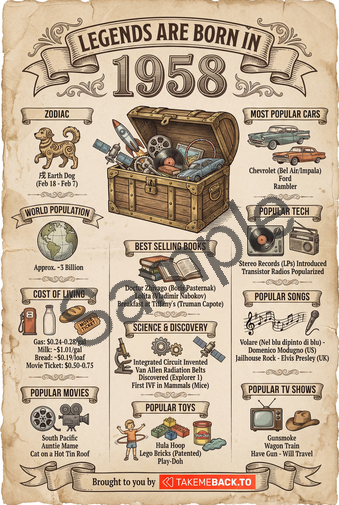

Major Events of 1958 - Historical Moments That Defined the Year | TakeMeBack.to
- 01 Jan European Economic Community established: On January 1, 1958, the European Economic Community (EEC) was officially established, marking a significant step towards European integration. The EEC aimed to foster economic cooperation among its member states, laying the groundwork for the European Union. source: europarl.europa.eu
- 02 Jan 'At The Hop' tops US music charts: The song 'At The Hop' by Danny and the Juniors reached the top of the US music charts on January 2, 1958. This hit became emblematic of the rock and roll era of the late 1950s. source: billboard.com
- 03 Jan West Indies Federation formation: The West Indies Federation was established on January 3, 1958, as a political union of several Caribbean territories. It aimed to promote economic cooperation and political unity among its member states, although it faced challenges and was dissolved in 1962. source: britannica.com
- 04 Jan Sputnik 1 re-entry and destruction: Sputnik 1, the first artificial satellite, re-entered Earth's atmosphere on January 4, 1958, after nearly three months in orbit. Its re-entry marked the end of a significant milestone in the Space Race between the United States and the Soviet Union. source: nasa.gov
- 05 Jan Edmund Hillary's Commonwealth Trans-Antarctic Expedition reaches South Pole: The Commonwealth Trans-Antarctic Expedition, led by Sir Edmund Hillary, successfully reached the South Pole on January 5, 1958. This expedition was notable for its scientific contributions and the spirit of international cooperation in polar exploration. source: britannica.com
- 06 Jan E.E. Cummings receives Bollingen Prize: On January 6, 1958, poet E.E. Cummings was awarded the Bollingen Prize for Poetry, recognizing his significant contributions to American literature. The Bollingen Prize, established in 1948, honors poets for their lifetime achievements. Cummings, known for his unconventional style and innovative use of language, was among the early recipients of this prestigious award. source: bollingen.yale.edu
- 07 Jan Soviet Union reduces military personnel: In January 1958, the Soviet Union announced a planned reduction of 300,000 military personnel, bringing the total reduction since 1955 to over 2.1 million. This decision aimed to decrease the size of the Soviet armed forces, reflecting a shift in military strategy during the Cold War era. source: cia.gov
- 08 Jan Lumbee Indians confront Ku Klux Klan: On January 8, 1958, the Lumbee Indians confronted a Ku Klux Klan rally in North Carolina, resulting in a violent clash. The Lumbee, defending their community, successfully dispersed the Klan members, marking a significant moment in civil rights history. source: ncbi.nlm.nih.gov
- 09 Jan European Economic Community established: The European Economic Community (EEC) was established on January 9, 1958, through the Treaty of Rome, which aimed to create a common market among its member states. This marked a significant step towards European integration and economic cooperation. source: europa.eu
- 10 Jan Jerry Lee Lewis tops music charts: On January 10, 1958, Jerry Lee Lewis's hit song "Great Balls of Fire" reached the top of the music charts, solidifying his status as a leading figure in rock and roll. The song became one of his signature tracks and remains iconic in music history. source: billboard.com
- 12 Jan NCAA introduces two-point conversion in football: The NCAA rules committee made the first change in football scoring rules since 1912 by adding the two-point conversion. source: nhregister.com
- 13 Jan Global scientists petition for nuclear test ban: On January 13, 1958, a group of scientists from around the world signed a petition advocating for a ban on nuclear testing. This initiative was part of a broader movement during the Cold War aimed at reducing nuclear proliferation and promoting peace. The petition highlighted the dangers of nuclear weapons and the need for international cooperation to prevent their use. source: britannica.com
- 14 Jan King Philip V of Spain abdicates the throne: On January 14, 1958, King Philip V of Spain abdicated the throne, marking a significant moment in Spanish history. His abdication was part of a broader political shift in Spain, leading to changes in governance and the monarchy's role in the country. This event was pivotal in shaping modern Spain's political landscape. source: britannica.com
- 15 Jan Birth of Boris Tadić: Boris Tadić, a Serbian politician and former president of Serbia, was born on January 15, 1958. He served as the president from 2004 to 2012 and was a significant figure in Serbian politics during a transformative period in the country's history. His leadership was marked by efforts toward European integration and democratic reforms. source: britannica.com
- 16 Jan "At The Hop" Tops US Music Charts: "At The Hop" by Danny & the Juniors reached number one on the US charts in January 1958, becoming one of the top-selling singles of the year. The song also topped the R&B Best Sellers list and achieved significant success internationally. source: en.wikipedia.org
- 18 Jan Willie O'Ree Breaks NHL Color Barrier: On January 18, 1958, Willie O'Ree became the first Black player to compete in the National Hockey League (NHL) when he debuted for the Boston Bruins against the Montreal Canadiens. His participation marked a significant milestone in the integration of professional sports in North America. source: en.wikipedia.org
- 19 Jan Inconclusive Presidential Elections in Guatemala: On January 19, 1958, Guatemala held general elections after the annulment of the 1957 elections due to allegations of electoral fraud. No candidate secured over 50% of the vote, leading Congress to elect Miguel Ydígoras Fuentes as President on February 12, 1958. source: en.wikipedia.org
- 20 Jan Japan-Indonesia Peace Treaty Signed: On January 20, 1958, Japan and Indonesia signed a peace treaty in Jakarta, officially ending the state of war between the two nations and establishing a framework for future cooperation. source: voi.id
- 21 Jan Starkweather-Fugate Murder Spree Begins: On January 21, 1958, Charles Starkweather and his 14-year-old companion, Caril Ann Fugate, embarked on a killing spree in Nebraska and Wyoming, resulting in multiple murders over several weeks. source: en.wikipedia.org
- 23 Jan Venezuelan Coup d'État Overthrows Marcos Pérez Jiménez: On January 23, 1958, Venezuelan dictator Marcos Pérez Jiménez was overthrown in a coup d'état, leading to the establishment of a provisional government and the restoration of democracy in Venezuela. source: washingtonpost.com
- 24 Jan Japanese Soldier Found Decades After War: Sergeant Shoichi Yokoi is discovered hiding in a Guam jungle, having remained in isolation since the end of World War II, representing an extraordinary tale of survival and dedication.
- 26 Jan Nankai Maru ferry disaster: On January 26, 1958, the Nankai Maru ferry sank off the coast of Japan, resulting in significant loss of life. The incident highlighted safety issues in maritime transport. source: britannica.com
- 27 Jan Soviet-American Cultural Exchange Agreement: On January 27, 1958, the Lacy-Zarubin Agreement was signed in Washington, D.C., facilitating cultural, technical, and educational exchanges between the United States and the Soviet Union. source: en.wikipedia.org
- 28 Jan LEGO Brick Patent: On January 28, 1958, the LEGO Group filed a patent in Denmark for the stud-and-tube coupling system, enhancing the stability and versatility of their building bricks. source: en.wikipedia.org
- 29 Jan Paul Newman and Joanne Woodward Wedding: On January 29, 1958, actor Paul Newman married actress Joanne Woodward in Las Vegas. The couple remained married for 50 years until Newman's death in 2008. source: en.wikipedia.org
- 31 Jan Discovery of Van Allen Radiation Belt: On January 31, 1958, the United States launched Explorer 1, the first American satellite, which led to the discovery of the Van Allen radiation belts. source: nasa.gov
- 01 Feb Explorer I Satellite Launch: On February 1, 1958, the United States launched Explorer 1, the first American satellite, which led to the discovery of the Van Allen radiation belts. source: nasa.gov
- 02 Feb Gamal Abdel Nasser becomes first UAR president: On February 2, 1958, Egypt and Syria declared the formation of the United Arab Republic (UAR), with Egyptian President Gamal Abdel Nasser as its first president. This union aimed to promote Arab unity and was a significant political development in the Middle East. source: en.wikipedia.org
- 03 Feb Founding of Benelux Economic Union: On February 3, 1958, the Benelux Economic Union was established, comprising Belgium, the Netherlands, and Luxembourg. This union aimed to promote economic cooperation and integration among the three countries. source: en.wikipedia.org
- 05 Feb Nasser nominated as UAR president: On February 5, 1958, Gamal Abdel Nasser was nominated as the first president of the United Arab Republic (UAR), a political union between Egypt and Syria. This event marked a significant moment in Arab nationalism and the political landscape of the Middle East. Nasser's leadership was characterized by his efforts to promote pan-Arabism. source: britannica.com
- 06 Feb Munich air disaster - Manchester United tragedy: The Munich air disaster occurred on February 6, 1958, when a British European Airways flight carrying the Manchester United football team crashed while attempting to take off from Munich-Riem Airport. The tragedy resulted in the deaths of 23 people, including eight players, and had a profound impact on the club and its supporters. source: bbc.com
- 07 Feb Brooklyn Dodgers relocate to Los Angeles: On February 7, 1958, the Brooklyn Dodgers announced their move to Los Angeles, marking a significant shift in Major League Baseball. This relocation was part of a broader trend of teams moving to larger markets, which transformed the landscape of American sports. source: nytimes.com
- 08 Feb French bombing of Sakiet, Tunisia: On February 8, 1958, French forces bombed the town of Sakiet in Tunisia, an act that escalated tensions during the Algerian War. The bombing aimed to target rebel bases but resulted in significant civilian casualties, drawing international condemnation. source: bbc.com
- 09 Feb Single-candidate election in Paraguay: On February 9, 1958, Paraguay held a single-candidate election where Alfredo Stroessner was elected president. This election was part of a broader context of political repression and consolidation of power in the country. Stroessner's regime would last for over three decades, marked by authoritarian rule. source: britannica.com
- 10 Feb Major solar geomagnetic storm disrupts global communications: On February 10, 1958, a major solar geomagnetic storm disrupted global communications, affecting radio and radar systems. This storm was part of a larger solar cycle and highlighted the vulnerabilities of technology to solar activity. The event raised awareness about the need for monitoring space weather. source: nasa.gov
- 11 Feb Egypt and Syria form United Arab Republic: On February 11, 1958, Egypt and Syria officially united to form the United Arab Republic, a political union aimed at promoting Arab nationalism. This union was short-lived but significant in the context of Middle Eastern politics during the Cold War. It represented a moment of unity among Arab states against colonial influences. source: britannica.com
- 12 Feb Early warning about global warming: On February 12, 1958, scientists presented early warnings about the potential impacts of global warming, emphasizing the need for awareness and action. This marked a significant moment in environmental science, laying the groundwork for future climate research and policy discussions. source: nasa.gov
- 13 Feb Death of Cristabel Pankhurst: Cristabel Pankhurst, a prominent British suffragette and activist, passed away on February 13, 1958. She was a key figure in the women's suffrage movement, advocating for women's rights and social reforms throughout her life. source: britannica.com
- 14 Feb Formation of the Arab Federation of Iraq and Jordan: On February 14, 1958, King Faisal II of Iraq and King Hussein of Jordan established the Arab Federation, uniting their Hashemite kingdoms in response to the formation of the United Arab Republic between Egypt and Syria. The federation lasted until August 2, 1958, when it was dissolved following a military coup in Iraq. source: en.wikipedia.org
- 15 Feb Formation of United Arab Republic: On February 15, 1958, Egypt and Syria proclaimed their political union as the United Arab Republic, with Egyptian President Gamal Abdel Nasser becoming president upon formation of the new state on 22 February. source: omniatlas.com
- 16 Feb Birth of Ice-T: Tracy Lauren Marrow, known professionally as Ice-T, was born on February 16, 1958, in Newark, New Jersey. He is an American rapper and actor, recognized for his contributions to hip hop and heavy metal music. source: en.wikipedia.org
- 17 Feb Comic strip 'B.C.' debuts: The American comic strip 'B.C.', created by cartoonist Johnny Hart, made its newspaper debut on February 17, 1958. The strip is set in prehistoric times and features a group of cavemen and anthropomorphic animals. source: en.wikipedia.org
- 20 Feb Pauling and Teller nuclear weapons debate: On February 20, 1958, Linus Pauling and Edward Teller engaged in a televised debate on KQED-TV in San Francisco, discussing the dangers of nuclear weapons testing and advocating for disarmament. Pauling argued that radiation from nuclear tests caused widespread health issues, while Teller supported the continuation of testing for national security. source: paulingblog.wordpress.com
- 21 Feb Jake Steinfeld born in New York City: Jake Steinfeld, an American actor, fitness personality, and entrepreneur known for his 'Body by Jake' brand, was born on February 21, 1958, in New York City. source: en.wikipedia.org
- 22 Feb Formation of United Arab Republic: On February 22, 1958, Egypt and Syria officially united to form the United Arab Republic. This political union aimed to promote Arab nationalism and unity in the region. source: britannica.com
- 23 Feb Egypt and Syria form United Arab Republic: On February 23, 1958, Egypt and Syria officially announced the formation of the United Arab Republic. This union was intended to strengthen Arab unity and was a significant event in Middle Eastern politics. source: britannica.com
- 24 Feb Radio Rebelde begins broadcasting in Cuba: Radio Rebelde, a significant radio station in Cuba, began broadcasting on February 24, 1958. It played a crucial role in the Cuban Revolution by disseminating information and propaganda supporting Fidel Castro's movement. source: cubanow.net
- 25 Feb Campaign for Nuclear Disarmament launched: The Campaign for Nuclear Disarmament (CND) was launched on February 25, 1958, in the United Kingdom. It aimed to promote nuclear disarmament and raise public awareness about the dangers of nuclear weapons. source: cnduk.org
- 27 Feb Soviet nuclear test at Novaya Zemlya: On February 27, 1958, the Soviet Union conducted a nuclear test at Novaya Zemlya, part of its extensive nuclear weapons program during the Cold War. This test was part of a series of tests that raised international concerns about nuclear proliferation. source: armscontrol.org
- 28 Feb Tragic Floyd County school bus accident: On February 28, 1958, a tragic school bus accident occurred in Floyd County, Kentucky, resulting in the deaths of 26 children. This incident remains one of the deadliest school bus accidents in U.S. history, prompting discussions on school transportation safety. source: nytimes.com
- 01 Mar Gary Sobers' record-breaking cricket performance: On March 1, 1958, Gary Sobers achieved a remarkable feat in cricket by scoring 365 not out against Pakistan, setting a world record for the highest individual score in Test cricket at that time. This performance solidified his legacy as one of the greatest cricketers. source: bbc.com
- 02 Mar First surface crossing of Antarctica: On March 2, 1958, the first successful surface crossing of Antarctica was completed by a team led by Sir Vivian Fuchs and supported by the Commonwealth Trans-Antarctic Expedition. This historic journey spanned over 3,000 kilometers and was a significant achievement in polar exploration. source: britannica.com
- 03 Mar KTVU television channel 2 launches in Oakland-San Francisco: KTVU, a television station in Oakland-San Francisco, officially launched on March 3, 1958. It has since become a prominent news source in the Bay Area, known for its local news coverage and programming. source: ktvu.com
- 07 Mar B-47 accidentally drops unarmed nuclear bomb on South Carolina home: On March 7, 1958, a B-47 bomber accidentally dropped an unarmed nuclear bomb on a home in South Carolina. Fortunately, the bomb did not detonate, but the incident raised serious concerns about the safety protocols surrounding nuclear weapons during the Cold War. source: nytimes.com
- 08 Mar USS Wisconsin decommissioned: The USS Wisconsin (BB-64), a battleship of the United States Navy, was decommissioned on March 8, 1958. This marked the end of its active service, having participated in significant naval operations during its time. source: britannica.com
- 09 Mar George Yardley becomes first NBA player to score 2,000 points in a season: On March 9, 1958, Detroit Pistons forward George Yardley became the first NBA player to score over 2,000 points in a single season, finishing with 2,001 points. Despite his achievement, the Pistons lost to the Syracuse Nationals 111-98. Yardley averaged 27.8 points per game during the 72-game season. source: si.com
- 11 Mar B-47 bomber accidentally drops nuclear weapon on Mars Bluff, SC: On March 11, 1958, a U.S. B-47 bomber accidentally dropped an unarmed Mk-6 atomic bomb on a farm in Mars Bluff, South Carolina. The conventional explosives within the bomb detonated upon impact, injuring six people and causing significant property damage. source: en.wikipedia.org
- 12 Mar Renaming of British Empire Day to Commonwealth Day: On March 12, 1958, British Empire Day was officially renamed Commonwealth Day, reflecting the evolving nature of the British Commonwealth and its member nations. source: en.wikipedia.org
- 13 Mar Government Troops Land in Sumatra: On March 13, 1958, Indonesian government troops landed in Sumatra to suppress a rebellion by the Revolutionary Government of the Republic of Indonesia (PRRI), aiming to restore central government control over the region. source: en.wikipedia.org
- 14 Mar Soviet Atmospheric Nuclear Test: On March 14, 1958, the Soviet Union conducted an atmospheric nuclear test, part of its ongoing nuclear weapons program during the Cold War. This test was part of a series of tests that heightened tensions between the superpowers and raised concerns about nuclear proliferation. source: armscontrol.org
- 15 Mar USSR Nuclear Test in Kazakhstan: On March 15, 1958, the Soviet Union conducted a nuclear test in Kazakhstan, part of its extensive nuclear testing program. This test was significant in the context of the Cold War, as it demonstrated the USSR's growing nuclear capabilities. source: armscontrol.org
- 19 Mar Britain's first planetarium opens in London: On March 19, 1958, the London Planetarium opened its doors to the public, offering shows related to space and astronomy. Located on Marylebone Road, it seated around 330 people beneath a horizontal dome approximately 18.29 meters in diameter. The planetarium was opened by Prince Philip, Duke of Edinburgh, with public presentations commencing on March 20. source: en.wikipedia.org
- 21 Mar Cyril M. Kornbluth dies at age 34: Cyril M. Kornbluth, an American science fiction author and member of the Futurians, died on March 21, 1958, in Levittown, New York, at the age of 34. He had been suffering from essential malignant hypertension, which led to a fatal heart attack on the day he was scheduled to meet for an editorial position. source: en.wikipedia.org
- 22 Mar University of Kentucky wins NCAA Basketball Championship: On March 22, 1958, the University of Kentucky Wildcats secured their fourth NCAA basketball championship by defeating the Seattle Chieftains 84-72 at Freedom Hall in Louisville, Kentucky. Senior Vernon Hatton led the team with 30 points, overcoming a 25-point performance by Seattle's Elgin Baylor. source: kentucky.com
- 24 Mar Birth of Roland Koch: Roland Koch, a German jurist and politician, was born on March 24, 1958, in Frankfurt am Main, West Germany. He served as the Minister-President of Hesse from 1999 to 2010 and was a prominent member of the Christian Democratic Union (CDU). source: en.wikipedia.org
- 25 Mar María Caridad: Olympic Javelin Thrower: María Caridad, a Cuban javelin thrower, won a gold medal at the 1980 Olympics, representing Cuba's athletic excellence.
- 26 Mar African Regroupment Party launched: On March 26, 1958, the African Regroupment Party (PRA) was formed in Paris, uniting various African nationalist groups from French colonies. The PRA aimed to create an independent federation of French African colonies. source: en.wikipedia.org
- 27 Mar Bart Conner born: Bart Conner, an American gymnast and Olympic gold medalist, was born on March 27, 1958, in Chicago, Illinois. source: en.wikipedia.org
- 28 Mar Death of W.C. Handy - Father of the Blues: William Christopher Handy, known as the 'Father of the Blues,' passed away on March 28, 1958. He was a pivotal figure in popularizing blues music and transforming it from a regional folk tradition to a recognized musical genre. source: en.wikipedia.org
- 31 Mar Canadian Federal Election Landslide: In a historic federal election, John Diefenbaker's Progressive Conservatives achieve an unprecedented victory, securing 208 out of 265 seats—the largest percentage of seats in Canadian electoral history, signaling a major political realignment. source: calendarz.com
- 01 Apr KVIQ TV Channel 6 begins broadcasting in Eureka, California: KVIQ TV Channel 6 commenced operations in Eureka, California, on April 1, 1958. The station, originally affiliated with NBC, was co-owned with KVIP-TV in Redding, California. Over the years, KVIQ has undergone several changes, including shifts in affiliations and ownership. source: en.wikipedia.org
- 03 Apr Medical breakthrough in cancer treatment: In 1958, a significant advancement in cancer treatment was reported, focusing on the use of chemotherapy. This breakthrough laid the groundwork for future cancer therapies and improved patient outcomes. source: cancer.gov
- 04 Apr First anti-nuclear weapons march in UK: On April 4, 1958, the first major anti-nuclear weapons march took place in London, organized by the Campaign for Nuclear Disarmament. This event marked a pivotal moment in the UK's peace movement. source: theguardian.com
- 05 Apr Destruction of Ripple Rock in Seymour Narrows: On April 5, 1958, Ripple Rock, a dangerous underwater rock formation in Seymour Narrows, British Columbia, was destroyed using explosives. This engineering feat improved navigation and safety in the area. source: thecanadianencyclopedia.ca
- 06 Apr Van Cliburn's historic Moscow competition win: On April 6, 1958, American pianist Van Cliburn won the International Tchaikovsky Competition in Moscow, becoming the first American to achieve this honor. His victory symbolized a cultural thaw during the Cold War. source: bbc.com
- 08 Apr U.S. Air Force KC-135 Stratotanker sets unprecedented long-distance flight record: On April 8, 1958, the U.S. Air Force's KC-135 Stratotanker achieved a significant long-distance flight record, demonstrating its capabilities in aerial refueling operations. source: af.mil
- 09 Apr "Tequila" tops US music charts: The instrumental track "Tequila" by The Champs reached the number one position on the Billboard Hot 100 chart on April 9, 1958. source: billboard.com
- 11 Apr France Develops Nuclear Weapons Capability: On April 11, 1958, French Prime Minister Félix Gaillard signed a directive ordering the construction of a nuclear device to be tested in 1960. This decision marked a significant step in France's pursuit of an independent nuclear deterrent, culminating in the first French nuclear test, Gerboise Bleue, on February 13, 1960. source: en.wikipedia.org
- 12 Apr St. Louis Hawks Clinch 1958 NBA Championship: The St. Louis Hawks secured the 1958 NBA Championship by defeating the Boston Celtics in a best-of-seven series. This victory marked the Hawks' first and only NBA title during their time in St. Louis. source: en.wikipedia.org
- 13 Apr Sputnik 2 Disintegration: On April 13, 1958, the Soviet Union's Sputnik 2 satellite re-entered Earth's atmosphere and disintegrated. Launched on November 3, 1957, Sputnik 2 was the second artificial Earth satellite and carried the first living creature into orbit, the dog Laika. source: en.wikipedia.org
- 14 Apr Sputnik 2 re-entry and Laika's historic mission: On April 14, 1958, Sputnik 2 re-entered Earth's atmosphere, marking the end of its mission that included the first living creature, Laika, in space. Laika's journey provided valuable data on the effects of space travel on living organisms. source: nasa.gov
- 15 Apr US launches Explorer 1 satellite: On April 15, 1958, the United States successfully launched Explorer 1, its first satellite, into orbit. This mission was significant for its role in the discovery of the Van Allen radiation belts, enhancing understanding of Earth's magnetosphere. source: nasa.gov
- 16 Apr Philip Bainbridge: British cricketer: Philip Bainbridge, a notable British cricketer, was born on April 16, 1958. He made significant contributions to the sport during his career, representing England in various international matches. source: britannica.com
- 18 Apr Indonesian government military action: On April 18, 1958, Indonesian government forces launched a military operation to suppress the Revolutionary Government of the Republic of Indonesia (PRRI) in West Sumatra. The operation, known as Operation 17 Agustus, aimed to recapture key cities including Padang, Solok, Payakumbuh, and Bukittinggi. The offensive involved coordinated efforts from the Indonesian Army, Navy, and Air Force, leading to the eventual surrender of approximately 500 PRRI soldiers by May 24, 1958. source: en.wikipedia.org
- 19 Apr 62nd Boston Marathon: The 62nd Boston Marathon took place on April 19, 1958, with Franjo Mihalić winning the men's race in 2:25:54. source: de.wikipedia.org
- 20 Apr Montreal Canadiens win Stanley Cup: The Montreal Canadiens won the Stanley Cup on April 20, 1958, defeating the Boston Bruins in the finals. source: nhl.com
- 21 Apr Arturo Frondizi becomes Argentine President: Arturo Frondizi was elected President of Argentina on February 23, 1958, and assumed office on May 1, 1958. His presidency was marked by developmentalist policies aimed at industrializing the nation. source: en.wikipedia.org
- 23 Apr Dodgers' Gil Hodges hits 300th home run and Pee Wee Reese plays 2,000th game: On April 23, 1958, at the Los Angeles Memorial Coliseum, Dodgers' first baseman Gil Hodges hit his 300th career home run, and shortstop Pee Wee Reese played his 2,000th game. Despite these milestones, the Dodgers lost 7-6 to the Chicago Cubs. source: bleedcubbieblue.com
- 24 Apr Dion and the Belmonts release debut single: On April 24, 1958, the American rock and roll group Dion and the Belmonts released their debut single, marking the beginning of their successful music career. source: en.wikipedia.org
- 26 Apr Baltimore and Ohio Railroad's Royal Blue final run: The Royal Blue, a famous passenger train service operated by the Baltimore and Ohio Railroad, made its final run on April 26, 1958. This marked the end of an era for one of the most iconic train routes in American history. source: nytimes.com
- 27 Apr Nixon's Latin American diplomatic tour: On April 27, 1958, U.S. Vice President Richard Nixon began a diplomatic tour of Latin America. This tour aimed to strengthen U.S. relations with Latin American countries during a time of political tension in the region. source: archives.gov
- 28 Apr Nixon's Latin American goodwill tour: On April 28, 1958, Vice President Nixon continued his goodwill tour in Latin America, focusing on fostering diplomatic ties and addressing regional concerns. This tour was part of a broader strategy to improve U.S. influence in the area. source: archives.gov
- 30 Apr Ted Williams reaches 1,000 extra-base hits milestone: On April 30, 1958, Ted Williams of the Boston Red Sox became the tenth Major League Baseball player to achieve 1,000 extra-base hits. He reached this milestone by hitting a home run off pitcher Ned Garver in the ninth inning of a game against the Kansas City Athletics at Fenway Park. source: thisdayinbaseball.com
- 01 May Arturo Frondizi becomes President of Argentina: On May 1, 1958, Arturo Frondizi was inaugurated as the 57th President of Argentina. His presidency marked a shift towards economic development and industrialization, as well as a more independent foreign policy. source: en.wikipedia.org
- 02 May Colombian Military Junta Kidnapping Incident: On May 2, 1958, members of the Colombian Military Junta were kidnapped by insurgents during a period of political instability in Colombia. This event highlighted the challenges faced by the government in maintaining control over the country. source: colombianhistory.info
- 03 May Bolton Wanderers triumphs in emotional FA Cup final: On May 3, 1958, Bolton Wanderers secured a 2-0 victory over Manchester United in the FA Cup final at Wembley Stadium. Nat Lofthouse scored both goals for Bolton, leading the team to their fourth FA Cup title. The match was particularly poignant for Manchester United, who had been devastated by the Munich air disaster three months earlier, resulting in the loss of several key players. Despite the tragedy, United's team showed resilience, but Bolton's performance clinched the win. source: en.wikipedia.org
- 05 May US conducts atmospheric nuclear test at Enwetak Atoll: On May 5, 1958, the United States performed an atmospheric nuclear test at Enwetak Atoll as part of Operation Hardtack I. This test, known as 'Cactus,' was one of several conducted during the operation to evaluate the effects of nuclear explosions in various environments. source: forthnews.com
- 06 May Operation Alert 1958: US Civil Defense Drill: On May 6, 1958, the United States conducted Operation Alert 1958, a nationwide civil defense drill designed to test the country's preparedness for a nuclear attack. The exercise involved simulated evacuations and the activation of emergency response systems. source: en.wikipedia.org
- 08 May Release of Hammer Horror Film 'Dracula': The classic Hammer Horror film 'Dracula' was released on May 8, 1958, marking a significant entry in the genre. source: imdb.com
- 09 May Paul Robeson's Carnegie Hall Recital: On May 9, 1958, Paul Robeson performed a celebrated recital at Carnegie Hall, marking his return to the U.S. stage after a decade-long hiatus. source: setlist.fm
- 11 May US nuclear test at Bikini Atoll: On May 11, 1958, the United States conducted a nuclear test named 'Fir' at Bikini Atoll in the Pacific Ocean. This test was part of Operation Hardtack I, which aimed to evaluate the effects of nuclear explosions on various military equipment and structures. source: forthnews.com
- 12 May French Algerian political crisis: On May 12, 1958, a political crisis unfolded in France during the Algerian War of Independence. The crisis began with a military uprising in Algiers, leading to the formation of a Committee of Public Safety and the eventual return of Charles de Gaulle to power, marking the end of the Fourth Republic and the establishment of the Fifth Republic. source: en.wikipedia.org
- 13 May May 1958 Algerian Crisis: On May 13, 1958, an army junta led by General Jacques Massu seized control of Algiers, forming a Committee of Public Safety and demanding the return of General Charles de Gaulle to power to prevent the "abandonment of Algeria." This event marked a significant turning point in the Algerian War and led to the establishment of the Fifth Republic in France. source: britannica.com
- 14 May Pierre Pflimlin Forms French Government: On May 14, 1958, Pierre Pflimlin was appointed Prime Minister of France, leading a government that aimed to address the Algerian crisis and the instability of the Fourth Republic. source: theconversation.com
- 15 May Soviet Union Launches Sputnik 3: On May 15, 1958, the Soviet Union launched Sputnik 3, the third artificial Earth satellite, which carried scientific instruments to study cosmic rays, solar wind, and the Earth's magnetic field. source: nasa.gov
- 16 May French government declares state of emergency in Algeria amid crisis: On May 16, 1958, the French government declared a state of emergency in Algeria following escalating tensions and unrest. This measure aimed to restore order and address the challenges posed by the crisis. source: time.com
- 17 May Algerian crisis intensifies with mass demonstrations and military involvement: On May 17, 1958, Algeria witnessed mass demonstrations and increased military involvement as the crisis deepened. The situation prompted significant political and social upheaval. source: marxists.org
- 18 May F-104 Starfighter sets unprecedented speed record: On May 18, 1958, the Lockheed F-104 Starfighter achieved a world speed record of 1,404.19 km/h (870.12 mph) at Edwards Air Force Base in California. This record showcased the aircraft's advanced design and capabilities during the Cold War era. source: lockheedmartin.com
- 19 May Arab Federation cabinet formation: On May 19, 1958, the Arab Federation, which included Egypt and Syria, formed its cabinet. This political union aimed to strengthen ties between the two nations amidst regional tensions and aspirations for Arab unity. source: britannica.com
- 20 May Cuban counteroffensive against Castro: On May 20, 1958, Cuban forces launched a counteroffensive against Fidel Castro's rebels during the Cuban Revolution. This marked a significant escalation in the conflict as government troops sought to regain control over territories held by insurgents. source: britannica.com
- 21 May US nuclear testing at Bikini Atoll: The United States conducted nuclear tests at Bikini Atoll as part of its ongoing series of nuclear detonations in the Pacific. source: en.wikipedia.org
- 22 May 1958 Ceylon Riots: Riots erupted in Ceylon (now Sri Lanka) due to ethnic tensions, leading to significant unrest and casualties. source: en.wikipedia.org
- 23 May Great Leap Forward Launched in China: On May 23, 1958, the Chinese Communist Party, led by Mao Zedong, officially launched the Great Leap Forward. This campaign aimed to rapidly transform China from an agrarian society into an industrialized nation through the establishment of large-scale rural communes and mass mobilization of labor. source: britannica.com
- 24 May Batista launches Operation Verano against Castro's forces: On May 24, 1958, Cuban President Fulgencio Batista initiated Operation Verano, a major military offensive aimed at eliminating Fidel Castro's guerrilla forces in the Sierra Maestra mountains. Despite numerical superiority, the Cuban army faced significant challenges due to the rebels' superior knowledge of guerrilla warfare and the difficult terrain. source: britannica.com
- 27 May Vanguard SLV-1 launch attempt: The Vanguard SLV-1, an early American satellite launch vehicle, had its launch attempt on May 27, 1958. This event was part of the United States' efforts to compete in the space race during the Cold War, although the launch was ultimately unsuccessful. source: nasa.gov
- 28 May Political turmoil in France: On May 28, 1958, France experienced significant political turmoil, leading to the establishment of the Fifth Republic. This period was marked by instability and the eventual rise of Charles de Gaulle as a key political figure, reshaping French governance. source: britannica.com
- 29 May Arab League diplomatic tensions: On May 29, 1958, diplomatic tensions arose within the Arab League, particularly concerning the political situation in Iraq. The tensions highlighted the complexities of inter-Arab relations and the challenges of achieving consensus on regional issues. source: en.wikipedia.org
- 30 May Charles de Gaulle Returns to Political Power in France: On May 30, 1958, Charles de Gaulle was appointed Prime Minister of France, marking his return to political power after a period of retirement. This event was pivotal in the establishment of the Fifth Republic. source: en.wikipedia.org
- 31 May Mervyn Rose wins French Tennis Championship: Australian tennis player Mervyn Rose secured the men's singles title at the 1958 French Championships, defeating Chilean Luis Ayala 6–3, 6–4, 6–4 in the final. source: en.wikipedia.org
- 01 Jun Charles De Gaulle returns to power in France: Charles De Gaulle returned to power in France in 1958, leading to the establishment of the Fifth Republic. source: en.wikipedia.org
- 02 Jun Hearst Castle opens to public tours: On June 2, 1958, Hearst Castle, located in San Simeon, California, was opened to the public for the first time. The estate, previously a private residence of William Randolph Hearst, was donated to the state of California in 1957 and has since operated as the Hearst San Simeon State Historical Monument, attracting approximately 750,000 visitors annually. source: parks.ca.gov
- 04 Jun De Gaulle's Historic Algeria Speech: On June 4, 1958, Charles de Gaulle delivered a pivotal speech in Algiers, declaring "Je vous ai compris" ("I have understood you"), signaling his commitment to addressing the concerns of both French settlers and Algerian Muslims. This speech marked a significant moment in the Algerian War, as de Gaulle proposed reforms aimed at reconciling the divided population and ending the conflict. source: cheminsdememoire.gouv.fr
- 06 Jun Ozzie Virgil breaks color barrier for Detroit Tigers: Ozzie Virgil became the first Dominican player to play for the Detroit Tigers, breaking the color barrier in the team. His debut marked a significant moment in Major League Baseball history, contributing to the integration of the sport. source: baseball-reference.com
- 07 Jun Prince Rogers Nelson born: Prince Rogers Nelson, known simply as Prince, was born on June 7, 1958, in Minneapolis, Minnesota. He would go on to become a legendary musician and cultural icon, influencing various genres of music. source: biography.com
- 08 Jun Keenen Ivory Wayans born: Keenen Ivory Wayans, an influential comedian, actor, and director, was born on June 8, 1958. He is best known for creating and starring in the groundbreaking sketch comedy show 'In Living Color.' source: biography.com
- 09 Jun Queen Elizabeth II opens London Gatwick Airport: On June 9, 1958, Queen Elizabeth II officially opened the expanded London Gatwick Airport, marking its transformation into a major international hub with direct rail connections. source: news.bbc.co.uk
- 11 Jun UN Security Council Resolution 128 establishes UNOGIL in Lebanon: On June 11, 1958, the United Nations Security Council adopted Resolution 128, establishing the United Nations Observation Group in Lebanon (UNOGIL). The mission aimed to monitor and prevent illegal infiltration of personnel, arms, or other material across Lebanon's borders, following Lebanon's complaint about interference by the United Arab Republic in its internal affairs. source: un.org
- 12 Jun 'Make Me Laugh' TV game show debuts: On June 12, 1958, the television game show 'Make Me Laugh' premiered, offering a platform for comedians to showcase their talents and entertain audiences. source: imdb.com
- 14 Jun Nelson Mandela marries Winnie Madikizela: On June 14, 1958, Nelson Mandela married Winnie Madikizela in a ceremony that marked a significant personal milestone for the anti-apartheid leader. Their marriage would become a focal point in Mandela's life, intertwining personal and political struggles during a tumultuous period in South Africa's history. source: britannica.com
- 15 Jun US condemns execution of Imre Nagy: On June 15, 1958, the United States condemned the execution of Imre Nagy, the former Prime Minister of Hungary, who was executed for his role in the 1956 Hungarian Revolution. This condemnation reflected the US's stance against Soviet influence in Eastern Europe during the Cold War. source: bbc.com
- 16 Jun Nuclear criticality accident at Y-12: On June 16, 1958, a nuclear criticality accident occurred at the Y-12 National Security Complex in Oak Ridge, Tennessee. The incident involved the accidental assembly of a critical mass of uranium, leading to a brief but intense release of radiation. Fortunately, there were no fatalities, but it raised significant safety concerns. source: nrc.gov
- 17 Jun Execution of Imre Nagy by Soviet authorities: Imre Nagy, the Hungarian revolutionary leader, was executed by Soviet authorities on June 17, 1958. His execution was a significant event in the context of the Cold War, as Nagy had previously led a revolt against Soviet control in Hungary in 1956. His death symbolized the harsh repression of dissent in Eastern Europe. source: britannica.com
- 18 Jun Soviet Union initiates agricultural policy reforms to boost production: On June 18, 1958, the Soviet government abolished the compulsory sales system of collective farms to the state, transitioning to a purchase system for agricultural products. This reform aimed to increase the purchase price of agricultural products and relax production management, allowing farms greater autonomy. Additionally, the state began selling tractors and other agricultural machinery to collective farms and reorganized machine tractor stations into machine repair stations. source: icecreamtutor.com
- 21 Jun Notable birthdays on June 21, 1958: On June 21, 1958, several notable individuals were born, including actor Bruce Campbell, best known for his role in the 'Evil Dead' series. source: famousbirthdays.com
- 22 Jun Bruce Campbell's birth: Bruce Campbell, an American actor and filmmaker, was born on June 22, 1958, in Royal Oak, Michigan. source: famousbirthdays.com
- 26 Jun Gaston Eyskens becomes Premier of Belgium: On June 26, 1958, Gaston Eyskens was appointed as the Prime Minister of Belgium, leading the government during a period of economic growth and modernization. source: britannica.com
- 27 Jun Peronist Party legalization in Argentina: On June 27, 1958, the Peronist Party was legalized in Argentina, three years after being outlawed by Decree Law 4161/56. source: en.wikipedia.org
- 29 Jun Brazil's first FIFA World Cup victory: Brazil won its first FIFA World Cup by defeating Sweden 5-2 in the final held in Stockholm. This victory marked Brazil's emergence as a football powerhouse and set the stage for future successes in the tournament. source: britannica.com
- 30 Jun End of the Ifni War: The Ifni War, a conflict between Spain and Morocco, officially ended on June 30, 1958. The war was marked by territorial disputes over the Ifni region, and its conclusion led to the establishment of a ceasefire and negotiations for future relations. source: britannica.com
- 01 Jul Saint Lawrence Seaway flooding commences: Flooding along the Saint Lawrence Seaway began on July 1, 1958, due to heavy rainfall and snowmelt. This event raised concerns about navigation and environmental impacts in the region, prompting discussions on flood management strategies. source: nytimes.com
- 02 Jul Destruction of the Lost Villages for Saint Lawrence Seaway: On July 2, 1958, the Canadian government began the destruction of the Lost Villages to make way for the Saint Lawrence Seaway. The Lost Villages were a group of communities along the St. Lawrence River that were submerged due to the construction of the seaway, leading to the relocation of residents. source: en.wikipedia.org
- 03 Jul Anti-nuclear protest yacht intercepted at Enewetak: On July 3, 1958, an anti-nuclear protest yacht was intercepted at Enewetak Atoll in the Pacific Ocean. The yacht, carrying activists opposed to nuclear testing, was detained by U.S. authorities, highlighting the growing public concern over nuclear weapons testing during that period. source: en.wikipedia.org
- 04 Jul First television transmission from aircraft: On July 4, 1958, KTLA in Los Angeles conducted the first television transmission from an aircraft, using a helicopter equipped with a television camera. This marked a significant advancement in mobile broadcasting techniques. source: brainyhistory.com
- 05 Jul First IHOP restaurant opens: On July 5, 1958, the first International House of Pancakes (IHOP) restaurant opened in Los Angeles, California, introducing a new dining experience focused on breakfast foods. source: ihop.com
- 06 Jul Alaska Becomes 49th U.S. State: On July 6, 1958, President Dwight D. Eisenhower signed the Alaska Statehood Act, admitting Alaska as the 49th state of the United States. source: archives.gov
- 08 Jul Execution of Romanian anti-communist rebel: On July 8, 1958, Romanian authorities executed anti-communist rebel Gheorghe Arsenescu. His execution was part of a broader crackdown on dissent during the communist regime in Romania, which sought to eliminate opposition and consolidate power. source: britannica.com
- 09 Jul 1958 Lituya Bay megatsunami: On July 9, 1958, a megatsunami struck Lituya Bay, Alaska, following a massive landslide. The wave reached a height of 1,720 feet, making it the tallest tsunami ever recorded. The event caused significant destruction and loss of life in the area. source: usgs.gov
- 10 Jul Record-breaking tsunami in Lituya Bay, Alaska: On July 10, 1958, a record-breaking tsunami occurred in Lituya Bay, Alaska, following a landslide. The tsunami reached unprecedented heights, causing extensive damage to the surrounding area and highlighting the geological risks in the region. source: usgs.gov
- 13 Jul Peter Thomson wins 87th British Golf Open: Peter Thomson secured his fourth Open Championship title in five years by defeating Dave Thomas in a 36-hole playoff at the Royal Lytham & St Annes Golf Club in Lytham St Annes, England. Both players finished with a score of 278, setting a new tournament record. source: en.wikipedia.org
- 14 Jul 14 July Revolution in Iraq: The 14 July Revolution, also known as the 1958 Iraqi military coup, was a bloody military coup that took place on 14 July 1958 in Iraq, resulting in the toppling of King Faisal II and the overthrow of the Hashemite-led Kingdom of Iraq. The Iraqi Republic established in its wake ended the Hashemite Arab Federation between Iraq and Jordan that had been established just six months earlier. source: en.wikipedia.org
- 16 Jul Michael Flatley born in Chicago, Illinois: Michael Ryan Flatley, renowned for his contributions to Irish dance, was born on July 16, 1958, in Chicago, Illinois. source: en.wikipedia.org
- 19 Jul Failed U.S. ICBM Test: On July 19, 1958, the United States conducted its first test of a three-engine intercontinental ballistic missile (ICBM). The test failed due to a malfunction in the rate gyroscope of the SM-65 Atlas rocket. source: nytimes.com
- 20 Jul Jordan cuts diplomatic ties with United Arab Republic: On July 20, 1958, Jordan severed diplomatic relations with the United Arab Republic, a political union between Egypt and Syria, following the UAR's intervention in Jordanian affairs. source: en.wikipedia.org
- 22 Jul US nuclear test at Bikini Atoll: On July 22, 1958, the United States conducted a nuclear test at Bikini Atoll as part of Operation Hardtack I, a series of nuclear tests in the Pacific Ocean. source: en.wikipedia.org
- 23 Jul Divorce (Insanity and Desertion) Act Implemented: The Divorce (Insanity and Desertion) Act 1958 received Royal Assent on July 23, 1958, amending UK divorce law to broaden the definition of insanity and address issues related to desertion. It allowed for divorce on grounds of desertion even if a separation agreement was in place before desertion became a legal ground for divorce. source: en.wikipedia.org
- 26 Jul U.S. Army launches Explorer IV satellite: The U.S. Army launched the Explorer IV satellite on July 26, 1958, to study the Van Allen radiation belts. source: en.wikipedia.org
- 28 Jul NASA established by presidential act: The National Aeronautics and Space Administration (NASA) was established on July 29, 1958, by the National Aeronautics and Space Act, signed by President Dwight D. Eisenhower. This marked a significant step in the United States' space exploration efforts during the Cold War era. source: nasa.gov
- 29 Jul NASA established by U.S. Congress: On July 29, 1958, the U.S. Congress passed the National Aeronautics and Space Act, which formally established NASA. This legislation was crucial for organizing the United States' efforts in space exploration and research. source: nasa.gov
- 30 Jul Kate Bush born in Bexleyheath, England: Catherine Bush, known professionally as Kate Bush, was born on July 30, 1958, in Bexleyheath, Kent, England. She is an English singer, songwriter, dancer, and record producer, renowned for her eclectic musical style and innovative performances. source: britannica.com
- 31 Jul First gold record certification: The first gold record certification was awarded on July 31, 1958, by the Recording Industry Association of America (RIAA). This milestone recognized the sales achievements of music records and set a standard for future certifications in the music industry. source: riaa.com
- 01 Aug US First-Class Postage Rate Increases: On August 1, 1958, the United States Postal Service increased the first-class postage rate from 3 cents to 4 cents per ounce. This marked the first rate change in 26 years, reflecting the rising costs of mail delivery. source: about.usps.com
- 02 Aug Death of Michele Navarra: Michele Navarra, an Italian Mafia boss from Corleone, Sicily, was assassinated on August 2, 1958. He was killed alongside Dr. Giovanni Russo, an innocent bystander, when their car was ambushed and riddled with bullets. source: en.wikipedia.org
- 03 Aug USS Nautilus Crosses North Pole Underwater: On August 3, 1958, the USS Nautilus, a U.S. Navy nuclear-powered submarine, became the first vessel to reach the North Pole underwater. This historic voyage demonstrated the capabilities of nuclear propulsion and marked a significant achievement in naval exploration. source: en.wikipedia.org
- 04 Aug Billboard Hot 100 music chart established: The Billboard Hot 100 music chart was established on August 4, 1958, marking a significant milestone in the music industry. It became the standard for measuring the popularity of songs in the United States, combining sales, radio play, and jukebox play data. source: britannica.com
- 05 Aug Keeling begins landmark CO2 measurements: On August 5, 1958, Charles David Keeling began his groundbreaking measurements of atmospheric carbon dioxide at the Mauna Loa Observatory in Hawaii. This data collection has been crucial in understanding climate change and the increase of greenhouse gases in the atmosphere. source: noaa.gov
- 06 Aug US nuclear test at Johnston Island: On August 6, 1958, the United States conducted a nuclear test at Johnston Island as part of its ongoing nuclear weapons testing program. This test was part of a series of atmospheric tests during the Cold War era. source: britannica.com
- 07 Aug Bruce Dickinson born in Worksop, England: Paul Bruce Dickinson, the lead vocalist of the heavy metal band Iron Maiden, was born on August 7, 1958, in Worksop, Nottinghamshire, England. He is known for his wide-ranging operatic vocal style and energetic stage presence. source: en.wikipedia.org
- 09 Aug Central African Airways Flight 890 Crash: On August 9, 1958, Central African Airways Flight 890, a Vickers Viscount 748D, crashed near Benina International Airport in Libya, resulting in 36 fatalities out of 54 people on board. The crash occurred during a nighttime approach to runway 33R, with the pilot descending below a safe altitude, causing the aircraft to crash into high ground. source: en.wikipedia.org
- 13 Aug KLM Superconstellation tragedy: On August 13, 1958, a KLM Superconstellation aircraft crashed during a flight from Amsterdam to New York, resulting in the loss of all 99 people on board. The incident was attributed to a combination of pilot error and adverse weather conditions. This tragedy highlighted the need for improved safety measures in aviation. source: britannica.com
- 14 Aug KLM Flight 607-E tragic crash: On August 14, 1958, KLM Flight 607-E crashed into the Atlantic Ocean shortly after takeoff from Shannon Airport, Ireland, killing all 34 passengers and crew members. The crash was attributed to a combination of technical failures and adverse weather conditions. This incident raised concerns about flight safety protocols. source: britannica.com
- 15 Aug Buddy Holly's wedding: Buddy Holly, the iconic rock and roll musician, married Maria Elena Santiago on August 15, 1958. Their marriage was a significant event in Holly's life, marking a personal milestone amidst his rising fame. The couple's relationship was often highlighted in discussions about Holly's legacy. source: britannica.com
- 17 Aug Lolita published in the United States: Vladimir Nabokov's controversial novel 'Lolita' was published in the United States on August 17, 1958. The book sparked significant debate and discussion regarding its themes and content, becoming a classic of modern literature. source: nytimes.com
- 18 Aug Vladimir Nabokov's controversial novel 'Lolita' published in the U.S.: On August 18, 1958, Vladimir Nabokov's novel 'Lolita' was published in the United States. The book, which had been previously published in Paris in 1955, tells the story of Humbert Humbert, a middle-aged man who becomes obsessed with a 12-year-old girl named Dolores Haze, whom he nicknames 'Lolita'. The novel's provocative subject matter led to widespread controversy and discussions about its moral implications. source: thenation.com
- 24 Aug Steve Guttenberg's birth: Steve Guttenberg, an American actor, author, businessman, producer, and director, was born on August 24, 1958, in Brooklyn, New York. source: en.wikipedia.org
- 25 Aug Birth of Tim Burton: Tim Burton, an American filmmaker known for his unique style in movies such as 'Beetlejuice' and 'Edward Scissorhands,' was born on August 25, 1958. source: en.wikipedia.org
- 26 Aug Alaska becomes 49th U.S. state: On August 26, 1958, Alaska was admitted as the 49th state of the United States, following the passage of the Alaska Statehood Act. source: en.wikipedia.org
- 27 Aug Death of Dr. Ernest O. Lawrence, cyclotron inventor: Dr. Ernest O. Lawrence, an American physicist known for inventing the cyclotron, passed away on August 27, 1958. His work significantly advanced nuclear physics and medical applications of radiation. Lawrence was awarded the Nobel Prize in Physics in 1939 for his contributions to the field. source: britannica.com
- 28 Aug Deadly coal mine explosion in Poland: A tragic coal mine explosion occurred in Poland on August 28, 1958, resulting in numerous fatalities. The incident highlighted ongoing safety issues within the mining industry and prompted discussions about regulations and worker protections. Such disasters were not uncommon during this period, raising concerns about mining practices. source: bbc.com
- 29 Aug Michael Jackson's birth: Michael Jackson, the iconic pop singer and entertainer, was born on August 29, 1958, in Gary, Indiana. He would go on to become one of the most famous and influential musicians in history, known for his groundbreaking contributions to music and dance. His early life and career began with the Jackson 5 before launching a solo career. source: britannica.com
- 30 Aug Notting Hill Race Riots: Between August 30 and September 5, 1958, a series of racially motivated riots occurred in Notting Hill, London. The unrest was triggered by tensions between white youths and the Caribbean community, leading to significant violence and arrests. source: en.wikipedia.org
- 31 Aug Edwin Moses born: Edwin Moses, an American track and field athlete renowned for his achievements in the 400-meter hurdles, was born on August 31, 1958. source: en.wikipedia.org
- 01 Sep First Cod War begins between Iceland and United Kingdom: The First Cod War commenced on September 1, 1958, when Iceland expanded its territorial waters to 12 nautical miles, leading to confrontations with the United Kingdom over fishing rights. source: en.wikipedia.org
- 02 Sep National Defense Education Act signed: The National Defense Education Act was signed into law on September 2, 1958, aiming to strengthen the U.S. education system in response to national security needs. source: presidency.ucsb.edu
- 03 Sep Greek police target Teddy Boy subculture: On September 3, 1958, Greek police began targeting the Teddy Boy subculture, which was characterized by its distinctive fashion and rebellious attitude. This crackdown was part of broader social tensions in post-war Greece. source: theguardian.com
- 04 Sep First Cod War begins between UK and Iceland: The First Cod War began on September 4, 1958, as Iceland extended its fishing limits, leading to confrontations with British trawlers. This conflict highlighted the tensions over fishing rights in the North Atlantic. source: bbc.com
- 05 Sep Doctor Zhivago published in the United States: On September 5, 1958, Boris Pasternak's novel 'Doctor Zhivago' was published in the United States, despite being banned in the Soviet Union. The book gained international acclaim and became a symbol of artistic freedom. source: nytimes.com
- 06 Sep Food Additives Amendment of 1958 Signed into Law: On September 6, 1958, President Dwight D. Eisenhower signed the Food Additives Amendment into law, amending the Federal Food, Drug, and Cosmetic Act. This legislation required manufacturers to establish the safety of new food additives before they could be used in food products. source: fda.gov
- 07 Sep US Navy Escorts Taiwanese Convoy During Taiwan Strait Crisis: On September 7, 1958, during the Taiwan Strait Crisis, the U.S. Navy provided protection to Taiwanese convoys, ensuring their safe passage amid heightened tensions between China and Taiwan. This action was part of the United States' commitment to defend Taiwan against potential aggression. source: britannica.com
- 08 Sep Mickey Wright Wins LPGA Dallas Golf Open: Mickey Wright won the LPGA Dallas Golf Open on September 8, 1958, with a score of 284. source: en.wikipedia.org
- 09 Sep Roberto Clemente's triple record: On September 9, 1958, Roberto Clemente achieved a remarkable triple record in baseball, highlighting his exceptional talent. source: en.wikipedia.org
- 10 Sep Dan Castellaneta Born: Dan Castellaneta, the American actor best known for voicing Homer Simpson on 'The Simpsons,' was born on September 10, 1958.
- 12 Sep First working integrated circuit demonstrated: On September 12, 1958, Jack Kilby of Texas Instruments demonstrated the first working integrated circuit. This invention was pivotal in the development of modern electronics, leading to the miniaturization of circuits and the advancement of technology. source: britannica.com
- 13 Sep Deadly oil tanker collision in Gulf of Oman: On September 13, 1958, a catastrophic collision between two oil tankers in the Gulf of Oman resulted in significant loss of life and environmental damage. This incident raised concerns about maritime safety and regulations in the region. source: reuters.com
- 14 Sep Ernst Mohr's post-war rocket achievement: On September 14, 1958, German engineer Ernst Mohr successfully launched two post-war rockets designed to reach the upper atmosphere. These rockets, developed in Wuppertal, Germany, were single-stage solid-fuel vehicles measuring 1.7 meters in length and weighing 150 kg. They achieved altitudes of up to 50 kilometers, marking a significant milestone in Germany's post-war rocket development. source: en.wikipedia.org
- 16 Sep Charles Malik elected President of the UN General Assembly: On September 16, 1958, Dr. Charles Malik, Lebanon's Minister for Foreign Affairs, was elected President of the United Nations General Assembly's 13th session. He secured 45 votes, defeating Sudan's candidate, Mohammed Ahmed Mahgoub, who received 31 votes. source: media.un.org
- 20 Sep Algerian Government in Exile Established: On September 20, 1958, the Algerian government in exile was officially established in Tunis, Tunisia. This government aimed to represent the Algerian people in their struggle for independence from French colonial rule. The establishment marked a significant step in the Algerian War of Independence, which would continue until 1962. source: britannica.com
- 21 Sep Nuclear Test at Nevada Test Site: On September 21, 1958, the United States conducted a nuclear test at the Nevada Test Site as part of its ongoing nuclear weapons program. This test was part of a series of atmospheric tests that aimed to develop and refine nuclear capabilities during the Cold War. The test raised concerns about nuclear proliferation and environmental impacts. source: osti.gov
- 22 Sep National Defense Education Act Signed: On September 22, 1958, President Dwight D. Eisenhower signed the National Defense Education Act into law. This legislation aimed to provide funding for education in science, mathematics, and foreign languages, reflecting the Cold War emphasis on technological advancement. The act significantly impacted American education and workforce development. source: ed.gov
- 23 Sep Fouad Chehab becomes President of Lebanon: Fouad Chehab was elected as the third President of Lebanon on September 23, 1958, succeeding Camille Chamoun. Chehab, a former army commander, assumed office during a period of political instability and worked towards national unity and stability. source: presidency.gov.lb
- 26 Sep Communist China expands maritime territory: On September 26, 1958, Communist China announced the expansion of its maritime territory, which was a significant move in the context of international relations and territorial disputes in the region. source: britannica.com
- 27 Sep Devastating Typhoon Ida strikes Honshū, Japan: On September 27, 1958, Typhoon Ida struck Honshū, Japan, causing widespread destruction and loss of life. The typhoon was one of the deadliest natural disasters in Japan's history. source: bbc.com
- 28 Sep Establishment of the French Fifth Republic: On September 28, 1958, French voters overwhelmingly approved a new constitution, leading to the establishment of the Fifth Republic. The referendum received 82.6% approval, with 79.3% in metropolitan France and 84.9% voter turnout. The new constitution, crafted by Charles de Gaulle, significantly strengthened executive powers, replacing the parliamentary system of the Fourth Republic. source: britannica.com
- 29 Sep Studio One TV Series Concludes: The American anthology drama television series 'Studio One' concluded its run on September 29, 1958, after 10 seasons and 467 episodes. The series, which began in 1948, was adapted from a radio series and was known for its live performances and adaptations of classic literature. source: en.wikipedia.org
- 01 Oct NASA established, replacing NACA: NASA was established on October 1, 1958, as a response to the Soviet Union's advancements in space technology. It replaced the National Advisory Committee for Aeronautics (NACA) and marked a significant shift in U.S. space policy and exploration efforts. source: nasa.gov
- 02 Oct Guinea's independence from France: On October 2, 1958, Guinea became the first French African colony to gain independence from France. This event marked a significant moment in the decolonization movement across Africa, inspiring other nations to seek self-determination. source: bbc.com
- 03 Oct NASA establishment period: The establishment period of NASA began on October 3, 1958, following its official formation. This period was crucial for setting the agency's goals and objectives in space exploration and research, laying the groundwork for future missions. source: nasa.gov
- 04 Oct Adoption of the French Constitution: On October 4, 1958, the French Constitution was adopted, establishing the Fifth Republic. This new constitution was a response to political instability and aimed to strengthen the executive branch of government. source: britannica.com
- 05 Oct André Kuipers birth: André Kuipers, a Dutch astronaut, was born on October 5, 1958. He is known for his missions to the International Space Station and contributions to space exploration. source: nasa.gov
- 06 Oct USS Seawolf sets underwater endurance record: On October 6, 1958, the USS Seawolf, a nuclear submarine, set a record for underwater endurance by remaining submerged for an extended period. This achievement demonstrated advancements in submarine technology and capabilities during the Cold War era. source: history.navy.mil
- 07 Oct Pakistan suspends constitution and imposes martial law: On October 7, 1958, President Iskander Mirza suspended the constitution of Pakistan and declared martial law, marking a significant shift in the country's governance. This move was supported by the military and led to the appointment of General Muhammad Ayub Khan as the Chief Martial Law Administrator. source: bbc.com
- 08 Oct First transatlantic passenger jet service: On October 8, 1958, the first transatlantic passenger jet service was inaugurated by Pan American World Airways. This marked a significant advancement in commercial aviation, allowing for faster and more efficient travel between the United States and Europe. source: panam.com
- 09 Oct Death of Pope Pius XII: Pope Pius XII passed away on October 9, 1958, after serving as the head of the Catholic Church since 1939. His papacy was marked by significant events during World War II and the early Cold War period. source: britannica.com
- 10 Oct Pioneer 1: First US lunar space probe launch: Pioneer 1 was launched on October 10, 1958, marking the United States' first attempt to reach the Moon. Although it did not achieve its intended orbit, it provided valuable data about cosmic rays and the Earth's radiation belts. source: nasa.gov
- 11 Oct NASA's Pioneer 1 space probe launch: On October 11, 1958, NASA launched Pioneer 1, the first spacecraft intended to reach the Moon. Although it failed to achieve its goal, it provided important scientific data and marked a significant step in space exploration. source: nasa.gov
- 12 Oct Temple bombing in Atlanta: On October 12, 1958, a bombing occurred at the Hebrew Benevolent Congregation in Atlanta, Georgia. This act of violence was part of a series of attacks against Jewish institutions during a period of heightened racial tensions in the United States. source: history.com
- 13 Oct Burial of Pope Pius XII: Pope Pius XII was buried on October 13, 1958, following his death on October 9. His papacy was marked by significant events during World War II and the early Cold War, and his burial was attended by numerous dignitaries and clergy. source: vaticannews.va
- 14 Oct Malagasy Republic Gains Autonomy: On October 14, 1958, Madagascar was proclaimed an autonomous state within the French Community, becoming the Malagasy Republic. This followed a referendum on September 28, 1958, where 77.64% of voters approved the new constitution, leading to the country's autonomy. source: britannica.com
- 17 Oct Aeroflot Tupolev Tu-104 crash in Moscow: On October 17, 1958, an Aeroflot Tupolev Tu-104 crashed during a flight in Moscow, resulting in significant casualties. This incident highlighted the safety concerns surrounding early jet aviation. source: aviation-safety.net
- 18 Oct First interactive computer game: Tennis for Two: On October 18, 1958, 'Tennis for Two' was created by physicist William Higinbotham, marking one of the earliest examples of an interactive computer game. It was designed to entertain visitors at the Brookhaven National Laboratory. source: brookhavenlab.gov
- 19 Oct Mike Hawthorn wins 1958 Formula One World Championship: On October 19, 1958, British driver Mike Hawthorn secured the Formula One World Championship, becoming the first British driver to win the title. His victory was a significant milestone in motorsport history. source: bbc.com
- 20 Oct Sarit Thanarat, influential Thai military leader, born: Sarit Thanarat, a prominent Thai military leader and politician, was born on October 20, 1958. He played a crucial role in Thailand's political landscape during the mid-20th century. source: britannica.com
- 21 Oct Women Admitted to British House of Lords: On October 21, 1958, the first women were admitted to the British House of Lords as life peers under the Life Peerages Act 1958. Among them were Barbara Wootton and Stella Isaacs, who took their seats on that day. source: parliament.uk
- 23 Oct Springhill Mining Disaster: On October 23, 1958, the Springhill mining disaster occurred in Nova Scotia, Canada, resulting in the deaths of 75 miners due to a gas explosion. source: en.wikipedia.org
- 24 Oct USSR provides financial support for Aswan Dam construction: On October 24, 1958, the Soviet Union announced its financial backing for the construction of the Aswan Dam in Egypt. This support was part of a broader strategy to strengthen ties with Arab nations during the Cold War. source: britannica.com
- 25 Oct Youth march for integrated schools in Washington, D.C.: On October 25, 1958, thousands of youth marched in Washington, D.C., advocating for integrated schools. This event highlighted the ongoing civil rights movement and the demand for desegregation in education across the United States. source: history.com
- 26 Oct First transatlantic jet passenger flight: On October 26, 1958, the first transatlantic jet passenger flight took place, marking a significant milestone in aviation history. The flight was operated by BOAC, using the de Havilland Comet, and connected London to New York. source: britannica.com
- 27 Oct Boris Pasternak awarded Nobel Prize: On October 27, 1958, Boris Pasternak was awarded the Nobel Prize in Literature for his novel 'Doctor Zhivago.' The award was controversial in the Soviet Union, leading to significant political repercussions for Pasternak. source: britannica.com
- 28 Oct Election of Pope John XXIII: Pope John XXIII was elected on October 28, 1958, succeeding Pope Pius XII. His papacy is noted for initiating the Second Vatican Council, which brought significant changes to the Catholic Church. source: britannica.com
- 29 Oct Pasternak refuses Nobel Prize: On October 29, 1958, Russian author Boris Pasternak declined the Nobel Prize in Literature, which he had been awarded for his novel 'Doctor Zhivago.' His refusal was influenced by political pressure from the Soviet government, which opposed the recognition of his work. source: britannica.com
- 31 Oct Billboard Hot 100 Number One Hit: 'It's All In The Game': On October 31, 1958, Tommy Edwards' song 'It's All In The Game' topped the Billboard Hot 100 chart. This song is notable for being the first to reach number one on the chart that was composed by a U.S. president, Calvin Coolidge. source: billboard.com
- 01 Nov UNESCO World Heritage Centre Inauguration: The UNESCO World Heritage Centre was inaugurated on November 1, 1958, in Paris, France. This center was established to promote the preservation of cultural and natural heritage around the world. source: whc.unesco.org
- 02 Nov Dutch-Indonesian Sovereignty Transfer: On November 2, 1958, the sovereignty of Indonesia was officially transferred from the Netherlands, marking the end of colonial rule. This event was a significant milestone in Indonesia's history as an independent nation. source: britannica.com
- 03 Nov Cuban presidential election: The Cuban presidential election took place on November 3, 1958, amidst political turmoil. This election was significant as it occurred during the Cuban Revolution, which ultimately led to the overthrow of the Batista regime. source: britannica.com
- 04 Nov 1958 U.S. congressional election: The 1958 U.S. congressional elections were held on November 4, 1958. This election resulted in significant gains for the Democratic Party, reflecting public discontent with the Republican administration. source: archives.gov
- 10 Nov Hope Diamond Donated to Smithsonian: On November 10, 1958, the Hope Diamond was donated to the Smithsonian Institution by jeweler Harry Winston, where it remains on display today. source: si.edu
- 12 Nov Bob Turley wins Cy Young Award: On November 12, 1958, New York Yankees pitcher Bob Turley was awarded the Cy Young Award, recognizing him as the best pitcher in Major League Baseball. Turley achieved a 21–7 record with a 2.97 ERA and led the American League with 19 complete games. He narrowly edged out Warren Spahn of the Milwaukee Braves, who had a 22–11 record and a 3.07 ERA. source: baseball-reference.com
- 15 Nov Ghana political crackdown: In November 1958, Ghana experienced a political crackdown under President Kwame Nkrumah, targeting opposition and dissent. This period marked increased repression against political rivals and civil liberties, reflecting the tensions in the newly independent nation. source: bbc.com
- 16 Nov Hungarian parliamentary referendum: On November 16, 1958, Hungary held a parliamentary referendum to approve the new constitution, which solidified the communist regime's power. The referendum was characterized by a lack of genuine democratic processes, reflecting the political climate of the time. source: bbc.com
- 17 Nov Argentina imposes state of siege: On November 17, 1958, Argentina declared a state of siege in response to growing political unrest and violence. This measure allowed the government to suspend civil liberties and increase military control, reflecting the turbulent political landscape of the time. source: reuters.com
- 18 Nov SS Carl D. Bradley sinks on Lake Michigan: On November 18, 1958, the SS Carl D. Bradley, a 639-foot self-unloading bulk freighter, sank in a storm on Lake Michigan. The vessel was en route to Rogers City, Michigan, when it encountered severe weather conditions, leading to its rapid sinking. Of the 35 crew members aboard, 33 perished, making it one of the deadliest shipwrecks in Great Lakes history. source: en.wikipedia.org
- 19 Nov Aer Lingus receives first F-27 Fokker Friendship aircraft: On November 19, 1958, Aer Lingus, the national airline of Ireland, took delivery of its first F-27 Fokker Friendship aircraft. This turboprop airliner was introduced to enhance the airline's regional services, offering improved efficiency and passenger comfort. The F-27 marked a significant advancement in Aer Lingus's fleet during the late 1950s. source: en.wikipedia.org
- 20 Nov Founding of The Jim Henson Company: The Jim Henson Company was founded by puppeteer Jim Henson in New York City. Initially known for its innovative puppetry and television productions, the company became famous for creating iconic characters like Kermit the Frog and the Muppets. source: britannica.com
- 21 Nov Death of Baseball Legend Mel Ott: Mel Ott, a Hall of Fame baseball player known for his time with the New York Giants, passed away on November 21, 1958. He was celebrated for his powerful hitting and was one of the first players to hit over 500 home runs in Major League Baseball. source: britannica.com
- 22 Nov Australian Federal Election of 1958: The Australian Federal Election was held on November 22, 1958, resulting in a victory for the Liberal-Country Party coalition led by Prime Minister Robert Menzies. This election was significant in shaping the political landscape of Australia during the late 1950s. source: britannica.com
- 23 Nov "Have Gun - Will Travel" Radio Drama Premiere: The radio drama "Have Gun - Will Travel" premiered on November 23, 1958. The show became popular for its unique storytelling and character development, later transitioning to a successful television series. source: britannica.com
- 24 Nov Death of Robert Cecil, Nobel Peace Prize Laureate: Robert Cecil, a prominent British statesman and Nobel Peace Prize laureate, passed away on November 24, 1958. He was known for his efforts in promoting international cooperation and disarmament, significantly contributing to the League of Nations and later the United Nations. source: britannica.com
- 25 Nov Senegal gains autonomy from France: On November 25, 1958, Senegal achieved autonomy from France, marking a significant step towards independence. This event was part of a broader movement across Africa during the decolonization period, where many nations sought self-governance and independence from colonial powers. source: britannica.com
- 27 Nov Soviet ultimatum on Berlin: On November 27, 1958, the Soviet Union issued an ultimatum regarding the status of Berlin, demanding that Western powers withdraw their forces from the city. This event heightened tensions during the Cold War and was a precursor to further conflicts over Berlin. source: britannica.com
- 28 Nov Chad becomes autonomous republic: On November 28, 1958, Chad was declared an autonomous republic within the French Community. This marked a significant step towards independence from French colonial rule, which was fully achieved in 1960. source: britannica.com
- 29 Nov Argentine government suppresses railway workers' strike: On November 29, 1958, the Argentine government took measures to suppress a strike by railway workers, reflecting ongoing labor tensions in the country. This event highlighted the challenges faced by the government in managing labor relations during this period. source: bbc.com
- 30 Nov Our Lady of the Angels School fire: The Our Lady of the Angels School fire occurred on November 30, 1958, in Chicago, resulting in the tragic deaths of 92 students and three nuns. This devastating incident led to significant changes in fire safety regulations in schools across the United States. source: chicagotribune.com
- 01 Dec Central African Republic gains independence: The Central African Republic achieved full independence from France on December 1, 1958. This event marked the culmination of a gradual process of decolonization in Africa during the mid-20th century. source: britannica.com
- 02 Dec Benelux Treaty signing: The Benelux Treaty was signed on December 2, 1958, establishing a customs union between Belgium, the Netherlands, and Luxembourg. This agreement aimed to promote economic cooperation and integration among the three countries. source: benelux.int
- 05 Dec Preston By-pass: UK's first motorway opens: The Preston By-pass, which opened on December 5, 1958, was the first motorway in the United Kingdom. It marked a significant development in the UK's road infrastructure, facilitating faster travel and improving connectivity. The motorway was part of the M6 and set the stage for future motorway construction across the country. source: bbc.com
- 06 Dec US Pioneer 3 lunar probe launch attempt: The US attempted to launch the Pioneer 3 lunar probe on December 6, 1958. Although the mission did not achieve its intended goal of reaching the Moon, it provided valuable data about the Earth's radiation belts. This was part of the early efforts in space exploration during the Cold War era. source: nasa.gov
- 07 Dec Rómulo Betancourt elected president of Venezuela: On December 7, 1958, Rómulo Betancourt was elected president of Venezuela, marking the first free elections after the overthrow of Marcos Pérez Jiménez. source: britannica.com
- 10 Dec First domestic jet passenger flight in the United States: On December 10, 1958, National Airlines became the first airline to operate jet service for flights within the United States, as a Boeing 707 plane began flying between Miami and New York City. This marked a significant advancement in domestic air travel. source: en.wikipedia.org
- 11 Dec Decolonization of French West African Territories: On December 11, 1958, several French West African territories, including Upper Volta (now Burkina Faso), gained self-governance within the French Community, marking a significant step towards their eventual independence. source: en.wikipedia.org
- 12 Dec Guinea Joins the United Nations: On December 12, 1958, Guinea was admitted as the 82nd member of the United Nations, following its declaration of independence from France on October 2, 1958. source: digitallibrary.un.org
- 14 Dec Soviet Antarctic Expedition reaches Pole of Inaccessibility: On December 14, 1958, the 3rd Soviet Antarctic Expedition, led by Yevgeny Tolstikov, established a temporary research station at the Southern Pole of Inaccessibility, the point in Antarctica furthest from any ocean. The station performed meteorological observations from December 14 to 26, 1958. source: en.wikipedia.org
- 17 Dec NASA announces human spaceflight program: On December 17, 1958, NASA officially announced its human spaceflight program, marking a significant step in the United States' efforts in space exploration. This program aimed to develop the technology and capabilities necessary for human space travel, ultimately leading to missions such as Mercury and Apollo. source: nasa.gov
- 18 Dec Project SCORE: world's first communications satellite launch: On December 18, 1958, Project SCORE (Signal Communications by Orbiting Relay Equipment) was launched, becoming the world's first communications satellite. This event was crucial in the development of satellite communications technology. source: nasa.gov
- 19 Dec First radio broadcast from space: On December 19, 1958, the first radio broadcast from space was made by the Explorer 1 satellite. This event showcased the capabilities of space technology and its potential for communication. source: nasa.gov
- 21 Dec French presidential election of 1958: On December 21, 1958, Charles de Gaulle was elected as the first President of the French Fifth Republic. He received 78.5% of the vote, defeating Georges Marrane of the French Communist Party and Albert Châtelet of the Union of Democratic Forces. source: en.wikipedia.org
- 22 Dec Second Dutch Beel Government forms: On December 22, 1958, the Second Beel cabinet was established in the Netherlands. This caretaker government, led by Prime Minister Louis Beel, was formed by the Catholic People's Party (KVP), Anti-Revolutionary Party (ARP), and Christian Historical Union (CHU) following the collapse of the Third Drees cabinet. The cabinet's primary objective was to prepare for the 1959 general elections. source: en.wikipedia.org
- 25 Dec First color television broadcast of Tchaikovsky's The Nutcracker: On December 25, 1958, the first color television broadcast of Tchaikovsky's The Nutcracker was aired in the United States. This landmark event showcased the ballet in vibrant color, marking a significant moment in television history. source: npr.org
- 26 Dec Jackie Wilson dominates R&B charts: On December 26, 1958, Jackie Wilson was a leading figure on the R&B charts, showcasing his influence in the music industry during this period. His hits contributed significantly to the genre's popularity. source: billboard.com
- 27 Dec The Chipmunks top US charts: On December 27, 1958, The Chipmunks achieved a significant milestone by topping the US charts. Their unique sound and appeal made them a favorite among audiences, especially during the holiday season. source: billboard.com
- 28 Dec NFL Championship: Greatest Game Ever Played: The Baltimore Colts defeated the New York Giants 23–17 in overtime at Yankee Stadium, marking the first NFL game decided by sudden death overtime. This game is widely regarded as 'The Greatest Game Ever Played' and significantly boosted the NFL's popularity. source: history.com
- 29 Dec NFL Championship Game: Baltimore Colts Triumph: The Baltimore Colts secured their first NFL Championship by defeating the New York Giants 23–17 in overtime at Yankee Stadium. This game is widely regarded as 'The Greatest Game Ever Played' and significantly boosted the NFL's popularity. source: history.com
- 31 Dec Cold War Diplomatic Tension: Berlin Crisis: The Berlin Crisis of 1958 marked a significant period of tension during the Cold War, primarily involving the United States and the Soviet Union. It was characterized by disputes over the status of Berlin and culminated in increased military presence and diplomatic negotiations. source: britannica.com
What happened in 1958?
Discover what the world looked like in 1958: