

Major Events of 1959: Key Historical Moments You Need to Know
Every year brings its own set of pivotal moments that leave a lasting mark on history. From political shifts and technological advancements to cultural breakthroughs, these events shape the world and influence the future. In this comprehensive overview, we'll explore the most significant occurrences from 1959, highlighting key moments that continue to impact our lives today.
Explore by topic:
Born in 1959? Get Your Birth Year Poster!
A beautifully researched, newspaper-style poster of the year.
Step back into 1959. Get yours today!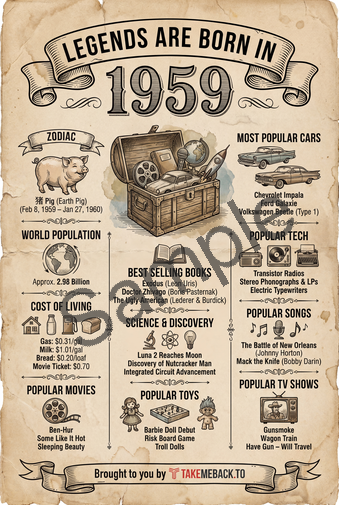

Major Events of 1959 - Historical Moments That Defined the Year | TakeMeBack.to
- 01 Jan Cuban Revolution Overthrows Batista: The Cuban Revolution culminated on January 1, 1959, when Fidel Castro's forces successfully overthrew the Batista government. This event marked a significant shift in Cuba's political landscape and had lasting implications for U.S.-Cuba relations. source: britannica.com
- 02 Jan Luna 1: First Spacecraft to Escape Earth's Gravity: On January 2, 1959, the Soviet Union launched Luna 1, the first spacecraft to escape Earth's gravity, marking a significant milestone in space exploration. source: en.wikipedia.org
- 03 Jan Alaska becomes 49th U.S. state: On January 3, 1959, President Dwight D. Eisenhower signed a proclamation admitting Alaska as the 49th state of the United States. This followed the passage of the Alaska Statehood Act in 1958, which facilitated Alaska's transition from a U.S. territory to a state. source: eisenhowerlibrary.gov
- 04 Jan Luna 1 spacecraft reaches Moon's vicinity: On January 4, 1959, the Soviet Union's Luna 1 spacecraft became the first human-made object to reach the vicinity of the Moon. It passed within 5,995 kilometers (3,725 miles) of the lunar surface, marking a significant milestone in space exploration. source: en.wikipedia.org
- 06 Jan Loving v. Virginia: Landmark civil rights case: Loving v. Virginia was a significant Supreme Court case that invalidated laws prohibiting interracial marriage. The case was decided on June 12, 1967, but the events leading to it began in 1959 when Richard and Mildred Loving were arrested for their marriage. This case is a cornerstone of civil rights law in the United States. source: oyez.org
- 07 Jan United States recognizes Castro's Cuban government: On January 7, 1959, the United States officially recognized Fidel Castro's government in Cuba following the Cuban Revolution. This recognition marked a significant shift in U.S.-Cuba relations and set the stage for future diplomatic and political developments in the region. Castro's rise to power was a pivotal moment in Cold War history. source: britannica.com
- 08 Jan Charles de Gaulle inaugurated as President of French Fifth Republic: On January 8, 1959, Charles de Gaulle was inaugurated as the first President of the French Fifth Republic. His presidency marked a significant shift in French politics and governance, establishing a new constitution and strengthening the executive branch. De Gaulle's leadership had a lasting impact on France and its role in global affairs. source: britannica.com
- 09 Jan NWA Championship Wrestling match held: On January 9, 1959, a notable NWA Championship Wrestling match took place, showcasing the popularity of professional wrestling during this era. The event featured prominent wrestlers of the time and contributed to the growth of wrestling as a mainstream entertainment form. source: britannica.com
- 11 Jan Theodore Roethke wins Bollingen Prize: Theodore Roethke, an influential American poet, was awarded the Bollingen Prize on January 11, 1959. This prestigious award recognized his significant contributions to American poetry and literature. source: britannica.com
- 12 Jan Discovery of the Caves of Nerja: On January 12, 1959, five young boys from Maro, Spain, discovered the Caves of Nerja while searching for bats. They entered through a narrow opening known as "La Mina" and found a vast cave system, leading to significant archaeological and tourist interest. source: en.wikipedia.org
- 13 Jan Tanker Mirador explosion tragedy: On January 13, 1959, the tanker Mirador exploded in the harbor of Havana, resulting in significant loss of life and damage. This tragic event highlighted the dangers associated with maritime transport and industrial accidents. source: britannica.com
- 14 Jan Paul Terry born in Osnabrück, Germany: Vivian Paul Terry, an English cricketer, was born on January 14, 1959, in Osnabrück, Germany. He played two Test matches for England in 1984. source: en.wikipedia.org
- 16 Jan Sade Adu born in Ibadan, Nigeria: Helen Folasade Adu, known professionally as Sade, was born on January 16, 1959, in Ibadan, Nigeria. She is a Nigerian-born British singer and songwriter, best known as the lead vocalist of the band Sade. source: en.wikipedia.org
- 17 Jan Tragic cricket accident occurs: On January 17, 1959, a tragic accident occurred during a cricket match in which several players were injured. This incident raised concerns about safety in sports and led to discussions on improving regulations. source: britannica.com
- 18 Jan 1960 Democratic National Convention location decided: On January 18, 1959, the location for the 1960 Democratic National Convention was officially decided. This convention was crucial for the Democratic Party as it prepared for the upcoming presidential election. source: nytimes.com
- 19 Jan General strike disrupts Argentina during presidential diplomatic mission: A general strike occurred in Argentina on January 19, 1959, disrupting activities during a presidential diplomatic mission. This strike highlighted the political tensions and labor issues in the country at the time. source: bbc.com
- 20 Jan Soviet Foreign Minister Anastas Mikoyan concludes controversial US tour: Anastas Mikoyan, the Soviet Foreign Minister, returned to Moscow on January 20, 1959, after a 17-day tour of the United States that attracted significant attention and controversy. source: en.wikipedia.org
- 21 Jan European Court of Human Rights established: The European Court of Human Rights was established on January 21, 1959, to oversee the enforcement of the European Convention on Human Rights among member states. source: en.wikipedia.org
- 22 Jan Knox Mine Disaster in Pennsylvania: On January 22, 1959, the Knox Mine Disaster occurred in Port Griffith, Pennsylvania, when water breached the River Slope Mine, resulting in the deaths of twelve coal miners. source: en.wikipedia.org
- 24 Jan Broadway musical concludes short run: A Broadway musical concluded its short run on January 24, 1959, reflecting the competitive nature of theater productions during this period. The show garnered attention but ultimately did not achieve long-term success. source: britannica.com
- 26 Jan Union City, California, incorporated: On January 26, 1959, the communities of Alvarado and Decoto in Alameda County, California, merged to form the city of Union City. This consolidation aimed to strengthen the region's position against neighboring cities seeking annexation. source: en.wikipedia.org
- 27 Jan 21st Congress of the Communist Party of the Soviet Union: The 21st Congress of the Communist Party of the Soviet Union commenced on January 27, 1959. This congress was a significant event in Soviet political history, focusing on various aspects of the nation's governance and policies. source: en.wikipedia.org
- 28 Jan Dyatlov Pass incident occurred: On January 28, 1959, nine experienced hikers led by Igor Dyatlov died mysteriously in the Ural Mountains of Russia. Their tent was found ripped open from the inside, and their bodies exhibited unexplained injuries, leading to various theories about the cause of their deaths. source: en.wikipedia.org
- 29 Jan Sleeping Beauty film premiere: Disney's animated film 'Sleeping Beauty' premiered on January 29, 1959. The film, based on Charles Perrault's fairy tale, follows Princess Aurora, cursed by the evil fairy Maleficent to die from pricking her finger on a spinning wheel, only to be saved by true love's kiss. source: en.wikipedia.org
- 30 Jan End of Jebel Akhdar War in Oman: On January 30, 1959, forces of the Sultanate of Muscat captured the last strongholds of the Imamate of Oman, Saiq and Shuraijah, effectively ending the five-year Jebel Akhdar War. This victory solidified the Sultanate's control over Oman. source: isitaholidaytoday.com
- 31 Jan Domenico Modugno wins Sanremo Music Festival: Domenico Modugno, along with Johnny Dorelli, won the 1959 Sanremo Music Festival with the song "Piove (Ciao, ciao bambina)". This victory marked their second consecutive win at the festival, following their previous success in 1958 with "Nel blu, dipinto di blu". The 1959 festival was held at the Sanremo Casino and was broadcast by Radiotelevisione italiana (RAI). source: en.wikipedia.org
- 01 Feb U.S. Female Figure Skating Championship: Carol Heiss wins the U.S. Female Figure Skating championship, highlighting women's achievements in winter sports.
- 02 Feb The Day the Music Died marks the deaths of rock and roll stars: On February 2, 1959, rock and roll stars Buddy Holly, Ritchie Valens, and J.P. 'The Big Bopper' Richardson died in a plane crash in Iowa. This tragic event is often referred to as 'The Day the Music Died' and had a profound impact on the music industry and fans worldwide. source: britannica.com
- 03 Feb The Day the Music Died: plane crash claims three rock stars: On February 3, 1959, the plane crash that killed Buddy Holly, Ritchie Valens, and J.P. 'The Big Bopper' Richardson is often referred to as 'The Day the Music Died.' This event marked a significant moment in music history, leading to widespread mourning and tributes. source: britannica.com
- 04 Feb Lawrence Taylor born in Williamsburg, Virginia: Lawrence Julius Taylor, widely regarded as one of the greatest linebackers in NFL history, was born on February 4, 1959, in Williamsburg, Virginia. He played his entire 13-season professional career with the New York Giants, earning two Super Bowl championships and being inducted into the Pro Football Hall of Fame in 1999. source: britannica.com
- 06 Feb First successful Titan ICBM test: On February 6, 1959, the United States successfully test-fired the Titan I intercontinental ballistic missile (ICBM) from Cape Canaveral, Florida. This marked a significant advancement in U.S. military capabilities during the Cold War. source: wired.com
- 07 Feb Castro proclaims new Cuban constitution: On February 7, 1959, Fidel Castro's government in Cuba enacted the 'Fundamental Law of the Republic,' effectively suspending the 1940 Constitution and establishing a new legal framework for the country. source: havanatimes.org
- 09 Feb Photochemical formation of organic compounds: On this date, researchers published findings on the photochemical processes that lead to the formation of organic compounds. This research contributed to the understanding of chemical reactions driven by light, which has implications in various scientific fields, including environmental science and organic chemistry. source: britannica.com
- 10 Feb Devastating tornado strikes Saint Louis: A powerful tornado struck Saint Louis, causing significant destruction and loss of life. The tornado was part of a larger weather system that affected several states, highlighting the need for improved weather forecasting and emergency response systems. source: weather.gov
- 11 Feb Formation of Federation of Arab Emirates of the South: The Federation of Arab Emirates of the South was formed, uniting several emirates in the southern region of the Arabian Peninsula. This political development was significant in the context of regional stability and the eventual formation of the United Arab Emirates. source: britannica.com
- 13 Feb TAT-2 transatlantic telephone cable launched: The TAT-2, the first transatlantic telephone cable, was officially launched on February 13, 1959. This cable significantly improved communication between North America and Europe, allowing for more efficient telephone service. source: britannica.com
- 14 Feb Major heroin seizure in New York City: On February 14, 1959, law enforcement in New York City seized a significant quantity of heroin, marking a notable event in the ongoing battle against drug trafficking in the United States. This seizure highlighted the growing drug problem during that era. source: nytimes.com
- 15 Feb First weather satellite launched: The first weather satellite, Vanguard 2, was launched on February 15, 1959. This satellite provided crucial data for meteorology and paved the way for future advancements in weather forecasting technology. source: nasa.gov
- 16 Feb Fidel Castro becomes Premier of Cuba: Fidel Castro officially assumed the role of Premier of Cuba following the Cuban Revolution. His leadership marked the beginning of significant political and social changes in the country, aligning it with socialist ideologies. source: britannica.com
- 17 Feb First Navy-NASA Mercury Project meeting: The inaugural meeting of the Navy-NASA Mercury Project took place, focusing on the development of the first human spaceflight program in the United States. This collaboration aimed to send astronauts into orbit. source: nasa.gov
- 18 Feb First democratic elections in Nepal: On February 18, 1959, Nepal held its first democratic elections, leading to the election of Dwarika Devi Thakurani as the first female member of the House of Representatives. source: en.wikipedia.org
- 19 Feb Slovenia's National Assembly Building Opening: The National Assembly Building of Slovenia, also known as the Palace of the People's Assembly, was inaugurated on February 19, 1959. Designed by architect Vinko Glanz, the building is located at Republic Square in Ljubljana and serves as the seat of Slovenia's legislature. It was constructed between 1954 and 1959, utilizing domestic materials such as marble, stone, and wood. source: en.wikipedia.org
- 20 Feb Tragic dam collapse in Rhodesia: On February 20, 1959, a dam in Rhodesia (now Zimbabwe) collapsed, resulting in significant loss of life and property. The disaster highlighted the need for improved infrastructure and safety regulations in the region. source: britannica.com
- 22 Feb First Daytona 500 auto race: The inaugural Daytona 500 auto race took place on February 22, 1959, marking a significant event in NASCAR history. This race has since become one of the most prestigious events in the sport. source: nascar.com
- 23 Feb KVIE TV Channel 6 launches in Sacramento-Stockton: On February 23, 1959, KVIE Channel 6 began broadcasting in the Sacramento-Stockton area, providing educational television programming. The station was established by Central California Educational Television (CCET) and was affiliated with the National Educational Television (NET) network. source: kvie.org
- 27 Feb Bob Cousy Sets NBA Record with 28 Assists in a Game: On February 27, 1959, Boston Celtics guard Bob Cousy set an NBA record by recording 28 assists in a game against the Minneapolis Lakers, leading the Celtics to a 173-139 victory. This record stood for 19 years and remains among the highest single-game assist totals in NBA history. source: espn.com
- 28 Feb Goldilocks Musical Closes on Broadway: The musical 'Goldilocks' concluded its run at the Lunt Fontanne Theater in New York City after 161 performances, marking the end of a Broadway production during the late 1950s theatrical season.
- 01 Mar Archbishop Makarios III returns from exile to Cyprus: On March 1, 1959, Archbishop Makarios III returned to Cyprus after being exiled in 1956. His return was met with an unprecedented reception in Nicosia, where nearly two-thirds of the adult Greek Cypriot population turned out to welcome him. source: britannica.com
- 03 Mar Pioneer 4 launched into solar orbit: On March 3, 1959, NASA launched Pioneer 4, the second of two early attempts to send a spacecraft to the Moon. The mission was designed primarily to photograph the Moon up close, but due to a trajectory error, the spacecraft passed at a much farther distance than planned, and the camera sensor failed to trigger. However, Pioneer 4 provided valuable data on radiation and the tracking of space objects. source: jpl.nasa.gov
- 04 Mar Pioneer 4 passes within 37,000 miles of the Moon: On March 4, 1959, Pioneer 4, launched on March 3, passed within 37,000 miles of the Moon's surface. Although it did not achieve its primary objective of photographing the Moon, the spacecraft provided valuable data on radiation and the tracking of space objects. source: jpl.nasa.gov
- 05 Mar Iran-US Economic and Military Cooperation Treaty signed: On March 5, 1959, Iran and the United States signed an Economic and Military Cooperation Treaty. This agreement aimed to strengthen bilateral relations and provided for U.S. military assistance to Iran, marking a significant development in Cold War geopolitics. source: en.wikipedia.org
- 06 Mar Castro government reduces Cuban rents: In March 1959, Fidel Castro's government implemented measures to reduce rents for urban dwellings, halving rents for those paying less than $100 per month. This initiative aimed to increase the purchasing power of the Cuban populace. However, the policy led to decreased productivity and drained the country's financial reserves within two years. source: en.wikipedia.org
- 08 Mar Failed Pro-Egyptian Coup in Mosul: On March 8, 1959, Colonel Abd al-Wahab al-Shawaf led an attempted coup in Mosul, Iraq, aiming to depose Prime Minister Abd al-Karim Qasim and join the United Arab Republic. The coup failed, leading to violent street battles and the eventual death of Shawaf. source: en.wikipedia.org
- 09 Mar Barbie Doll Makes Historic Debut: On March 9, 1959, the first Barbie doll was introduced at the American International Toy Fair in New York City, marking a significant moment in toy history. source: en.wikipedia.org
- 10 Mar 1959 Tibetan uprising begins in Lhasa: On March 10, 1959, thousands of Tibetans in Lhasa surrounded the Dalai Lama's palace, fearing a Chinese plan to arrest him. This marked the start of the 1959 Tibetan uprising, which led to the Dalai Lama's escape to India and significant casualties among Tibetans. source: history.com
- 11 Mar Eurovision Song Contest 1959: The fourth edition of the Eurovision Song Contest was held on March 11, 1959, at the Palais des Festivals et des Congrès in Cannes, France. The Netherlands won with the song "Een beetje" performed by Teddy Scholten. source: en.wikipedia.org
- 12 Mar Hawaii Statehood approved by US Congress: On March 12, 1959, the United States Congress approved the admission of Hawaii as the 50th state. This decision marked a significant milestone in the history of the United States, expanding its territory into the Pacific. Hawaii officially became a state on August 21, 1959. source: archives.gov
- 13 Mar UN votes to end trusteeship of French Cameroons: On March 13, 1959, the United Nations General Assembly voted to end the trusteeship of French Cameroons, allowing it to gain independence. This decision was part of a broader movement towards decolonization in Africa during the late 1950s. The territory later became the Republic of Cameroon. source: un.org
- 14 Mar J.R.D.A.C.I. founded in Côte d'Ivoire: The J.R.D.A.C.I. (Jeunesse Républicaine Démocratique d'Afrique Centrale et de l'Indépendance) was founded in Côte d'Ivoire on March 14, 1959. This organization aimed to promote democratic values and independence in the region during a time of significant political change in Africa. source: britannica.com
- 15 Mar Louise Suggs wins LPGA Titleholders Golf Championship: On March 15, 1959, Louise Suggs secured her fourth Titleholders Championship victory at Augusta Country Club, finishing with a score of 297 (+9). She edged out Betsy Rawls, who finished one stroke behind. source: en.wikipedia.org
- 16 Mar Birth of Jens Stoltenberg: Jens Stoltenberg, the former Prime Minister of Norway and Secretary General of NATO, was born on March 16, 1959.
- 18 Mar Hawaii Statehood Act Signed: On March 18, 1959, President Dwight D. Eisenhower signed the Hawaii Admission Act, paving the way for Hawaii's admission as the 50th U.S. state. The act was signed into law on this date, but Hawaii's statehood became effective on August 21, 1959. source: archives.gov
- 19 Mar Tibetan Uprising Against Chinese Troops: On March 19, 1959, following a Chinese government order for the Dalai Lama to report without his bodyguards, fighting erupted in Lhasa, Tibet, as Tibetans clashed with Chinese troops. The Chinese government reported that thousands of rebels attacked Lhasa and were defeated after a two-day battle. source: en.wikipedia.org
- 20 Mar Attempted vandalism at Lenin's Mausoleum: On March 20, 1959, an individual attempted to break the glass covering Lenin's sarcophagus with a hammer but failed. This incident was part of a series of attempts to desecrate Lenin's body, including a similar attempt in November 1957. source: rbth.com
- 22 Mar Mike Brey born: Mike Brey, an American college basketball coach, was born on March 22, 1959. He is known for his long tenure as the head coach of the Notre Dame Fighting Irish men's basketball team. source: nd.edu
- 23 Mar Lee Harvey Oswald obtains GED: On March 23, 1959, Lee Harvey Oswald, who would later become infamous for the assassination of President John F. Kennedy, obtained his General Educational Development (GED) certificate. This marked a significant step in his education after dropping out of high school. source: archives.gov
- 24 Mar Iraq withdraws from Baghdad Pact: On March 24, 1959, Iraq announced its withdrawal from the Baghdad Pact, a mutual defense agreement aimed at containing Soviet influence in the Middle East. This decision marked a significant shift in Iraq's foreign policy during the Cold War. source: britannica.com
- 25 Mar Mao Zedong's Shanghai Meeting: On March 25, 1959, Mao Zedong convened a secret meeting at the Jinjiang Hotel in Shanghai. During this meeting, he ordered the party to procure up to one-third of all grain, emphasizing that distributing resources evenly would ruin the Great Leap Forward. Mao stated, "To distribute resources evenly will only ruin the Great Leap Forward. When there is not enough to eat, people starve to death. It is better to let half of the people die so that the other half can eat their fill." source: en.wikipedia.org
- 26 Mar Death of Raymond Chandler: Raymond Chandler, the American novelist and screenwriter, died on March 26, 1959, in La Jolla, California. He was best known for his hard-boiled detective fiction, particularly the Philip Marlowe series. source: en.wikipedia.org
- 28 Mar China dissolves Tibetan government: On March 28, 1959, the Chinese government officially dissolved the Tibetan government, following a period of unrest and the Tibetan uprising. This event marked a significant shift in Tibet's political landscape, leading to increased Chinese control over the region. source: bbc.com
- 29 Mar Assassination of Barthélemy Boganda: Barthélemy Boganda, a prominent Central African political leader, was assassinated on March 29, 1959. His death had significant implications for the political landscape of the Central African Republic. source: bbc.com
- 30 Mar Dalai Lama escapes Tibet: On March 30, 1959, the 14th Dalai Lama fled Tibet amid fears for his safety during a Chinese military crackdown. He eventually sought asylum in India, where he has since lived and advocated for Tibetan autonomy. source: bbc.com
- 31 Mar Birth of rock guitarist Angus Young: Angus Young, the co-founder and lead guitarist of the rock band AC/DC, was born on March 31, 1959, in Glasgow, Scotland. He is known for his energetic performances and distinctive guitar riffs. source: biography.com
- 01 Apr Iakovos becomes Greek Orthodox Archbishop of America: On April 1, 1959, Iakovos was enthroned as the Greek Orthodox Archbishop of America. He played a crucial role in promoting interfaith dialogue and civil rights during his tenure. source: nytimes.com
- 02 Apr Ken Macleay: Australian cricket player: Ken Macleay, an Australian cricketer, was born on April 2, 1959. He is known for his contributions to Australian cricket during the late 20th century. source: britannica.com
- 04 Apr Formation of the Mali Federation: The Mali Federation was formed on April 4, 1959, uniting the French Sudan and Senegal. This political union aimed to strengthen the independence movements in West Africa and was a significant step towards self-governance. source: britannica.com
- 05 Apr Controversial racial repatriation meeting: A controversial meeting regarding racial repatriation took place on April 5, 1959, sparking debates about race relations and policies in the United States. The discussions highlighted the tensions surrounding civil rights at the time. source: nytimes.com
- 06 Apr Gigi, Susan Hayward, and David Niven win at 31st Academy Awards: At the 31st Academy Awards on April 6, 1959, 'Gigi' won the Oscar for Best Picture. Susan Hayward won Best Actress, and David Niven took home the award for Best Actor, marking significant achievements in the film industry. source: oscars.org
- 07 Apr NASA Space Task Group conducts abort test: On April 7, 1959, NASA's Space Task Group conducted an abort test, which was crucial for ensuring the safety of future manned space missions. This test was part of the early stages of the U.S. space program. source: nasa.gov
- 08 Apr COBOL programming language initial meeting: The first meeting to discuss the development of COBOL (Common Business-Oriented Language) took place on April 8, 1959. This meeting was crucial in establishing a standardized programming language for business applications. source: en.wikipedia.org
- 09 Apr NASA announces Mercury Seven astronauts: On April 9, 1959, NASA announced the selection of the Mercury Seven astronauts, the first group of astronauts for the United States' Project Mercury program. This marked a significant milestone in the U.S. space program. source: nasa.gov
- 10 Apr Imperial wedding of Crown Prince Akihito and Michiko Shoda: On April 10, 1959, Crown Prince Akihito married Michiko Shoda in a traditional Shinto ceremony at the Imperial Palace in Tokyo. This marked the first time a commoner married into the Japanese Imperial Family, breaking over 2,600 years of tradition. The wedding procession was followed by over 500,000 people in the streets of Tokyo, and parts of the ceremony were televised, drawing about 15 million viewers. source: mofa.go.jp
- 11 Apr America's lunar mission plans announced: On April 11, 1959, the United States announced plans for its lunar mission, marking a significant step in the space race. This announcement set the stage for future lunar exploration efforts by NASA. source: nasa.gov
- 12 Apr NASA conducts second full-scale beach abort test at Wallops Island: On April 12, 1959, NASA's Space Task Group performed the second full-scale beach abort test at Wallops Island. The test involved a deliberate thrust misalignment of 1 inch in the escape combination, resulting in a clean liftoff and a slow pitch during the escape rocket motor's burn. source: american-spacecraft.org
- 13 Apr Vanguard SLV-5 launch failure: On April 13, 1959, the Vanguard SLV-5 rocket failed to achieve orbit. A momentary delay in first-stage separation caused the second-stage engine to ignite while still attached to the first stage, leading to loss of attitude control and the subsequent failure of the mission. source: nextspaceflight.com
- 15 Apr John Foster Dulles resignation: John Foster Dulles, the U.S. Secretary of State, resigned on April 15, 1959, due to health issues. His resignation marked the end of a significant era in U.S. foreign policy during the Cold War. source: nytimes.com
- 16 Apr Malaysian political leadership change: On April 16, 1959, Malaysia experienced a significant political leadership change, impacting the country's governance and political landscape. This transition was part of the broader context of post-colonial governance in Southeast Asia. source: britannica.com
- 18 Apr Montreal Canadiens win fourth consecutive Stanley Cup: On April 18, 1959, the Montreal Canadiens defeated the Toronto Maple Leafs 5-3 in Game 5 of the Stanley Cup Final, clinching their fourth consecutive championship. source: nhl.com
- 21 Apr Fidel Castro speaks in New York: Fidel Castro delivered a speech at the United Nations in New York, marking a significant moment in U.S.-Cuba relations. His visit was notable for its political implications during the Cold War era. source: nytimes.com
- 22 Apr Miles Davis records Kind of Blue: Miles Davis began recording his iconic album 'Kind of Blue' on April 22, 1959. This album would go on to become one of the best-selling jazz albums of all time. source: rollingstone.com
- 23 Apr Britain's first heliport opens in London: On April 23, 1959, London's first heliport, known as Battersea Heliport, was officially opened. Located on the south bank of the River Thames in Battersea, the facility was constructed by W. & C. French and provided services for helicopter operations in the city. source: en.wikipedia.org
- 25 Apr St. Lawrence Seaway opens for navigation: The St. Lawrence Seaway officially opened on April 25, 1959, allowing ships to travel from the Atlantic Ocean to the Great Lakes. This monumental engineering project significantly enhanced trade and transportation in North America. source: britannica.com
- 26 Apr Wiffi Smith wins LPGA golf tournament: Wiffi Smith claimed victory at the LPGA golf tournament held on April 26, 1959. This win marked a significant achievement in her professional golfing career, contributing to her recognition in the sport. source: britannica.com
- 27 Apr Liu Shaoqi elected as Chairman of the People's Republic of China: On April 27, 1959, Liu Shaoqi was elected as the Chairman of the People's Republic of China during the first session of the Second National People's Congress. He succeeded Mao Zedong in this role. source: britannica.com
- 28 Apr KLOE TV Channel 10 launches in Goodland, Kansas: KLOE TV Channel 10 began broadcasting in Goodland, Kansas, on April 28, 1959. It was affiliated with CBS and served the Colby/Goodland area. source: en.wikipedia.org
- 01 May W.E.B. Du Bois receives Lenin Peace Prize: On May 1, 1959, W.E.B. Du Bois was awarded the Lenin Peace Prize for his efforts in promoting peace among nations. The Soviet Peace Committee praised his contributions to improving U.S.-Soviet relations and wished him good health and vigor. source: credo.library.umass.edu
- 02 May 85th Kentucky Derby won by Tomy Lee: On May 2, 1959, Tomy Lee won the 85th Kentucky Derby, securing victory in the prestigious horse racing event.
- 03 May Ben Elton born: Ben Elton, a prominent British comedian, playwright, and author, was born on May 3, 1959. He is known for his work in television and theater, contributing significantly to British comedy and literature. source: britannica.com
- 04 May First Grammy Awards ceremony: The first Grammy Awards ceremony took place on May 4, 1959, celebrating the best in the music industry. This inaugural event set the stage for future ceremonies, becoming a prestigious occasion for artists and musicians. source: grammy.com
- 05 May US-West Germany Nuclear Cooperation Agreement: On May 5, 1959, the United States and West Germany signed an agreement to share classified information about American nuclear weapons and to train German personnel in their operation. source: presidency.ucsb.edu
- 08 May French New Wave cinema milestone: The French New Wave, a revolutionary film movement, reached a significant milestone in 1959 with the release of several influential films. This movement challenged traditional filmmaking conventions and introduced new narrative techniques and styles. source: britannica.com
- 09 May Eritrea votes to join Ethiopia: On May 9, 1959, Eritrea held a referendum in which the population voted to join Ethiopia. This decision had significant political implications for the region and contributed to future conflicts. source: bbc.com
- 16 May 85th Preakness Stakes Horse Race: The 85th Preakness Stakes, a major horse racing event, took place on May 16, 1959, at Pimlico Race Course in Baltimore, Maryland. The race is the second leg of the American Triple Crown. source: en.wikipedia.org
- 17 May Paris Summit Collapse During Cold War: The Paris Summit, a Cold War diplomatic meeting between the United States, the Soviet Union, the United Kingdom, and France, collapsed on May 17, 1959, due to disagreements over the status of Berlin. source: en.wikipedia.org
- 18 May National Liberation Committee of Côte d'Ivoire launched: The National Liberation Committee of Côte d'Ivoire was established on May 18, 1959, as a political movement aimed at promoting independence and self-governance in Côte d'Ivoire. This event marked a significant step in the country's path towards sovereignty. source: britannica.com
- 19 May Establishment of Group 559 and Ho Chi Minh Trail: On May 19, 1959, Group 559 was established to facilitate the transport of supplies and troops along the Ho Chi Minh Trail during the Vietnam War. This strategic route became crucial for North Vietnamese forces in their efforts against South Vietnam and the United States. source: britannica.com
- 20 May Ford introduces the Falcon automobile: On May 20, 1959, Ford Motor Company unveiled the Falcon, a compact car that aimed to capture the growing market for smaller vehicles in America. The Falcon became popular for its affordability and efficiency, influencing future car designs. source: ford.com
- 22 May Benjamin O. Davis Jr. becomes first Black Major General in USAF: On May 22, 1959, Benjamin O. Davis Jr. was promoted to Major General in the United States Air Force, becoming the first African American to achieve this rank. source: en.wikipedia.org
- 23 May Presbyterian Church advances gender equality: On May 23, 1959, the Presbyterian Church made significant strides towards gender equality within its ranks. This move was part of a broader trend in various religious organizations to address gender disparities and promote inclusivity. source: presbyterianmission.org
- 24 May British Empire Day renamed Commonwealth Day: On May 24, 1959, British Empire Day was officially renamed Commonwealth Day. This change was part of a broader effort to reflect the evolving nature of the Commonwealth and its member nations, promoting unity and cooperation. source: commonwealth.int
- 26 May Death of Ed Walsh, Baseball Pitcher: Ed Walsh, a Hall of Fame pitcher known for his 1.82 career ERA, died at age 78 in Pompano Beach, Florida. source: en.wikipedia.org
- 27 May Khrushchev's Berlin Ultimatum Expires: Soviet Premier Nikita Khrushchev's six-month ultimatum for Western powers to withdraw from Berlin expired, leading to heightened Cold War tensions. source: cia.gov
- 30 May Auckland Harbour Bridge Opening: The Auckland Harbour Bridge, a 1.2 km steel truss cantilever bridge, was officially opened on May 30, 1959, connecting Auckland city with the North Shore. The opening ceremony was attended by Governor-General Lord Cobham, and the first car to cross was driven by project supervisor W. Cardno. source: archives.govt.nz
- 01 Jun Miss Able: Space Monkey Tragedy: On May 28, 1959, rhesus macaque Miss Able and squirrel monkey Miss Baker successfully flew aboard the JUPITER AM-18 mission, reaching over 100 miles in altitude and withstanding 38g forces. However, Miss Able died on June 1, 1959, during surgery to remove an infected medical electrode, due to a reaction to the anesthesia. Miss Baker survived and lived until 1984. source: en.wikipedia.org
- 03 Jun Singapore becomes self-governing crown colony: On June 3, 1959, Singapore was declared a self-governing crown colony, marking a significant step towards its independence. This change allowed for greater local governance and political autonomy under British rule, setting the stage for future developments in Singapore's political landscape. source: britannica.com
- 04 Jun Death of Miss Able: Early space exploration casualty: On June 4, 1959, Miss Able, a rhesus monkey, died shortly after returning from a suborbital flight as part of the U.S. space program. This event highlighted the risks associated with early space exploration and the use of animals in testing space travel conditions. source: nasa.gov
- 05 Jun Singapore gains self-governance: On June 5, 1959, Singapore officially gained self-governance, allowing for a locally elected government. This pivotal moment in Singapore's history paved the way for its eventual full independence from British colonial rule. source: britannica.com
- 06 Jun First satellite communication via lunar relay: On June 6, 1959, the first successful satellite communication via a lunar relay was achieved. This marked a significant advancement in space communication technology, demonstrating the potential for using the Moon as a relay point for signals. source: nasa.gov
- 07 Jun Landmark Supreme Court decision on birth control rights: On June 7, 1959, the U.S. Supreme Court ruled in a significant case regarding the right to use contraceptives. This decision laid the groundwork for future rulings on reproductive rights and privacy. source: supremecourt.gov
- 08 Jun X-15 first unpowered flight: The X-15 rocket plane conducted its first unpowered flight on June 8, 1959. This flight was a significant milestone in the development of experimental aircraft and contributed to the understanding of hypersonic flight. source: nasa.gov
- 09 Jun US spy planes intercept Soviet missile telemetry: On June 9, 1959, U.S. spy planes successfully intercepted telemetry signals from Soviet missile tests. This intelligence-gathering operation was crucial during the Cold War, providing insights into Soviet military capabilities. source: cia.gov
- 12 Jun Mike McCormick throws rain-shortened no-hitter against Phillies: On June 12, 1959, San Francisco Giants pitcher Mike McCormick pitched a five-inning no-hitter against the Philadelphia Phillies. The game was halted due to rain in the sixth inning, and the official score reverted to the end of the fifth inning, resulting in a 3-0 victory for the Giants. source: sabr.org
- 14 Jun Dominican exiles attempt to overthrow Trujillo: Dominican exiles, led by Enrique Jiménez Moya, land in the Dominican Republic to overthrow dictator Rafael Trujillo. source: history.state.gov
- 15 Jun Galápagos Islands established as Ecuador's first national park: Ecuador establishes the Galápagos Islands as its first national park, aiming to protect its unique biodiversity. source: ecuador.travel
- 16 Jun Philco introduces innovative portable television: Philco introduces a portable television, marking a significant advancement in consumer electronics. source: americanradiohistory.com
- 17 Jun Birth of Ulrike Richter: Ulrike Richter, a German former swimmer, was born on June 17, 1959, in Görlitz, East Germany. She gained prominence in the 1970s, winning three gold medals at the 1976 Olympic Games in Montreal and setting 14 world records during her career. source: en.wikipedia.org
- 18 Jun Queen Elizabeth II's Canadian Tour: Queen Elizabeth II and Prince Philip began a 45-day tour of Canada on June 18, 1959, visiting all 10 provinces and 2 territories. The tour included the inauguration of the St. Lawrence Seaway on June 26, 1959. source: canada.ca
- 20 Jun Soviet Union Denies Nuclear Technology to China: On June 20, 1959, the Soviet Union unilaterally abrogated the 1957 agreements on weapons development with China, refusing to provide technical data and a sample atomic bomb. This decision led China to initiate its own nuclear weapons program, known as Project 596. source: cambridge.org
- 23 Jun Klaus Fuchs Released from Prison: Klaus Fuchs, a German-born physicist convicted of espionage for passing atomic secrets to the Soviet Union, was released from Wakefield Prison in England on June 23, 1959, after serving nine years and four months of his 14-year sentence. source: en.wikipedia.org
- 26 Jun Saint Lawrence Seaway officially opened: The official opening of the Saint Lawrence Seaway took place on June 26, 1959, with a ceremony attended by dignitaries from both the United States and Canada. This event symbolized the collaboration between the two nations in enhancing trade and transportation. source: britannica.com
- 27 Jun Hawaii votes for statehood: On June 27, 1959, Hawaii voted in favor of statehood, a pivotal moment in its history. This vote led to Hawaii becoming the 50th state of the United States on August 21, 1959, marking a significant expansion of the nation. source: archives.gov
- 28 Jun Ethiopian Orthodox Church gains independence: On June 28, 1959, the Ethiopian Orthodox Church was granted independence from the Coptic Orthodox Church of Alexandria. This marked a significant moment in the church's history, allowing it to establish its own hierarchy and governance. The move was part of a broader trend of national churches seeking autonomy during the mid-20th century. source: britannica.com
- 29 Jun Pope John XXIII's first encyclical: Ad Petri Cathedram: On June 29, 1959, Pope John XXIII issued his first encyclical titled 'Ad Petri Cathedram.' This document addressed the role of the papacy and emphasized the importance of unity within the Church. It was a significant moment in his papacy, reflecting his vision for the Catholic Church's future. source: vatican.va
- 30 Jun F-100 Super Sabre crash in Okinawa: On June 30, 1959, an F-100 Super Sabre crashed during a training exercise in Okinawa. The incident raised questions about the safety of military aircraft and the training protocols in place. Investigations followed to determine the cause of the crash and to improve safety measures. source: airforcemag.com
- 01 Jul World Refugee Year Commences: On July 1, 1959, the United Nations launched World Refugee Year, a global initiative running until June 30, 1960, aimed at addressing the needs of approximately 15 million refugees worldwide. The campaign focused on increasing awareness, financial contributions, and developing permanent solutions for refugees through repatriation, resettlement, or integration. source: un.org
- 03 Jul Gary Player wins British Golf Open: Gary Player won the British Open on July 3, 1959, marking a significant achievement in his golfing career. This victory contributed to his reputation as one of the greatest golfers of all time. source: britannica.com
- 04 Jul 49-star American flag debuts: The 49-star American flag was officially adopted on July 4, 1959, following the admission of Alaska as the 49th state. This flag design was used until Hawaii became the 50th state in 1960. source: archives.gov
- 05 Jul Indonesia restores constitution and introduces guided democracy: On July 5, 1959, Indonesia restored its 1945 constitution and introduced a system of guided democracy. This political shift aimed to stabilize the country following years of political turmoil. source: britannica.com
- 06 Jul Saarland fully integrated into West Germany: On July 6, 1959, Saarland completed its economic integration into West Germany, marking the end of a 14-year period of separation. This event, known as "Day X," followed the political integration of Saarland on January 1, 1957. source: historisches-museum.org
- 07 Jul Black Sea Fishing Convention: The Convention Concerning Fishing in the Black Sea was signed on July 7, 1959, by the Soviet Union, Bulgaria, and Romania. This treaty aimed to promote rational fishing practices, improve fishing techniques, and conduct research to maintain and increase fish stocks in the Black Sea. source: fao.org
- 09 Jul Kevin Nash Born: Kevin Nash, an American professional wrestler and actor, was born on July 9, 1959, in Detroit, Michigan. source: en.wikipedia.org
- 13 Jul Paul Anka's 'Lonely Boy' tops Billboard charts: On July 13, 1959, Paul Anka's song 'Lonely Boy' reached number one on the Billboard Hot 100 chart, marking his first chart-topping single. source: en.wikipedia.org
- 14 Jul USS Long Beach: First nuclear-powered cruiser launched: On July 14, 1959, the USS Long Beach, the world's first nuclear-powered cruiser, was launched, marking a significant advancement in naval technology. source: en.wikipedia.org
- 15 Jul 1959 United States Steel Strike: The United States Steel Strike began on July 15, 1959, as steelworkers sought better wages and working conditions. The strike lasted for 116 days, significantly impacting the steel industry and the economy. source: britannica.com
- 16 Jul Major Solar Flare Event: A significant solar flare occurred on July 16, 1959, impacting radio communications and satellite operations. This event was part of the solar cycle and demonstrated the sun's influence on Earth. source: nasa.gov
- 17 Jul Tibet abolishes serfdom: On July 17, 1959, the Tibetan government announced the abolition of serfdom, a significant social reform. This change was part of broader political shifts in Tibet during this period. source: bbc.com
- 20 Jul Mercury Tracking Network negotiations begin: On July 20, 1959, NASA initiated negotiations with the Western Electric Company and its subcontractors—Bendix Aviation, IBM, Bell Telephone Laboratories, and Burns and Roe—for the construction of the Mercury tracking network, a critical component for Project Mercury's space missions. source: en.wikipedia.org
- 22 Jul Benjamin Britten's 'Missa Brevis' Premiere: On July 22, 1959, composer Benjamin Britten's 'Missa Brevis in D, Op. 63' was first performed at Westminster Cathedral in London. The piece, written for three-part treble choir and organ, was dedicated to George Malcolm and the Westminster Cathedral Choir, marking Malcolm's retirement as organist and choirmaster. source: en.wikipedia.org
- 24 Jul Kitchen Debate between Nixon and Khrushchev: On July 24, 1959, U.S. Vice President Richard Nixon and Soviet Premier Nikita Khrushchev engaged in the 'Kitchen Debate' during the opening of the American National Exhibition in Moscow. The impromptu exchange, conducted through interpreters, centered on the merits of capitalism versus communism, particularly in relation to household appliances and women's roles. source: en.wikipedia.org
- 25 Jul SR-N1 Hovercraft Crosses the English Channel: On July 25, 1959, the SR-N1 hovercraft, developed by the British Hovercraft Corporation, successfully crossed the English Channel. This achievement demonstrated the viability of hovercraft technology for passenger and vehicle transport over water. source: en.wikipedia.org
- 26 Jul Santa Susana Field Laboratory nuclear incident: On July 26, 1959, a nuclear incident occurred at the Santa Susana Field Laboratory in California. This event involved a partial meltdown of a reactor, raising concerns about safety and environmental impact. The incident has been the subject of ongoing investigations and discussions regarding nuclear safety regulations. source: epa.gov
- 27 Jul Continental League announced as third major baseball league: On July 27, 1959, the Continental League was announced as a proposed third major baseball league in the United States. This announcement aimed to challenge the existing Major League Baseball structure and was part of a broader movement to expand professional baseball. The league ultimately did not materialize, but it influenced future expansion efforts. source: baseballhall.org
- 28 Jul Hawaii's first U.S. congressional elections: On July 28, 1959, Hawaii held its first U.S. congressional elections following its admission as the 50th state. Republican Hiram Fong and Democrat Oren Long were elected as the state's first U.S. senators. source: senate.gov
- 30 Jul Death of Heinie Conklin: Heinie Conklin, an American actor and comedian known for his roles in silent films and as one of the original Keystone Kops, died in Hollywood, California. source: en.wikipedia.org
- 31 Jul Bongos Exhibit Opens at Cleveland Metroparks Zoo: The Cleveland Metroparks Zoo opened its first exhibit featuring bongos, a species of antelope native to West Africa. source: brainyhistory.com
- 01 Aug WAAY TV Channel 31 Launches in Huntsville, Alabama: WAAY TV Channel 31 began broadcasting in Huntsville, Alabama, on August 1, 1959. This station became a significant source of news and entertainment for the local community. source: en.wikipedia.org
- 02 Aug Willie McCovey hits first major league home run: On August 2, 1959, Willie McCovey hit his first major league home run off pitcher Ron Kline, contributing to the San Francisco Giants' 5-3 victory over the Pittsburgh Pirates. McCovey's debut season was marked by a .354 batting average and 13 home runs in 52 games. source: thisdayinbaseball.com
- 03 Aug 27th MLB All-Star Game: The 27th Major League Baseball All-Star Game was held on August 3, 1959. This annual exhibition game showcased the league's top talent from both the American and National Leagues. source: en.wikipedia.org
- 04 Aug Billy Barnes Revue Opens in NYC: The Billy Barnes Revue, a musical comedy, opened in New York City on August 4, 1959. The show received critical acclaim for its performances and production. source: en.wikipedia.org
- 06 Aug Final military operation of B-17 Flying Fortress: The B-17 Flying Fortress, a World War II bomber, conducted its final military operation on August 6, 1959. This marked the end of an era for the aircraft, which had played a significant role in the war and subsequent military operations. source: airforcemag.com
- 07 Aug First Earth television photo from space: On August 7, 1959, the first television photo of Earth from space was transmitted by the Explorer 6 satellite. This groundbreaking achievement provided a new perspective on the planet and was a significant step in space exploration. source: nasa.gov
- 08 Aug Devastating Typhoon Ellen floods Taiwan: Typhoon Ellen struck Taiwan on August 8, 1959, causing severe flooding and destruction. The typhoon resulted in significant loss of life and damage to infrastructure, highlighting the vulnerability of the region to natural disasters. source: ncdc.noaa.gov
- 09 Aug SM-65 Atlas ICBM becomes operational: The SM-65 Atlas Intercontinental Ballistic Missile (ICBM) was declared operational on August 9, 1959. This marked a significant advancement in the United States' nuclear deterrent capabilities during the Cold War. source: britannica.com
- 10 Aug The Platters band members arrested in Cincinnati: On August 10, 1959, members of The Platters were arrested in Cincinnati, Ohio, due to a dispute involving a hotel incident. This event highlighted the challenges faced by popular music groups during that era. source: rollingstone.com
- 11 Aug Sheremetyevo International Airport inauguration: Sheremetyevo International Airport, located in Moscow, was inaugurated on August 11, 1959. It has since become one of the major airports serving the Russian capital and international flights. source: britannica.com
- 12 Aug First Polaris Missile Ship-Firing Test: The first successful ship-firing test of the Polaris missile took place on August 12, 1959. This event marked a significant advancement in naval missile technology, enhancing the United States' strategic capabilities during the Cold War. source: history.navy.mil
- 13 Aug Discoverer 5 Military Satellite Launch: Discoverer 5, part of the Corona reconnaissance satellite program, was launched on August 13, 1959. This satellite was significant for its role in gathering intelligence during the Cold War, marking a key development in space-based surveillance. source: nasa.gov
- 14 Aug First Earth Orbital Image: On August 14, 1959, the first image of Earth from orbit was captured by the Explorer 6 satellite. This milestone in space exploration provided valuable data and imagery of the planet, contributing to scientific research. source: nasa.gov
- 15 Aug Cyprus gains independence from United Kingdom: On August 15, 1959, Cyprus gained independence from British colonial rule after a long struggle for self-determination. The agreement established the Republic of Cyprus, marking a significant moment in the island's history. source: bbc.com
- 16 Aug USSR introduces installment buying: On August 16, 1959, the Soviet Union announced the introduction of installment buying, allowing citizens to purchase goods on credit. This marked a significant shift in consumer policy within the USSR, aimed at increasing consumer access to goods. source: britannica.com
- 17 Aug 1959 Hebgen Lake earthquake: The Hebgen Lake earthquake struck near West Yellowstone, Montana, on August 17, 1959. It registered a magnitude of 7.5 and caused significant damage, including landslides and the formation of a new lake. The disaster resulted in 28 fatalities and is one of the most powerful earthquakes in U.S. history. source: usgs.gov
- 18 Aug Inter-American Commission on Human Rights established: The Inter-American Commission on Human Rights was established on August 18, 1959, as part of the Organization of American States (OAS). Its purpose is to promote and protect human rights in the Americas through monitoring, reporting, and advising member states on human rights issues. source: humanrights.gov
- 19 Aug Central Treaty Organization (CENTO) Establishment: On August 19, 1959, the Middle East Treaty Organization (METO) was renamed the Central Treaty Organization (CENTO) following Iraq's withdrawal from the alliance. source: britannica.com
- 21 Aug Hawaii Becomes the 50th U.S. State: On August 21, 1959, Hawaii was admitted as the 50th state of the United States. source: Wikipedia (day-month pages)
- 22 Aug Founding of the American Football League: On August 22, 1959, representatives from Los Angeles, Dallas, Houston, New York, Minneapolis, and Denver signed articles of association to establish the American Football League (AFL). This league was formed as a rival to the National Football League (NFL), with the inaugural season set to begin in 1960. source: casemine.com
- 25 Aug First border clash between India and China: The first significant military clash between India and China occurred on August 25, 1959, in the disputed region of Aksai Chin. This confrontation marked the beginning of a series of border tensions that would escalate into the Sino-Indian War in 1962. source: bbc.com
- 26 Aug Launch of the original Mini by British Motor Corporation: The original Mini, designed by Sir Alec Issigonis, was launched by the British Motor Corporation on August 26, 1959. This compact car became an iconic symbol of the 1960s and is celebrated for its innovative design and efficiency. source: bbc.com
- 27 Aug Birth of Gerhard Berger: Austrian former Formula One driver Gerhard Berger was born on August 27, 1959. He competed in Formula One from 1984 to 1997 and is known for his time with teams like Ferrari and Benetton. source: bbc.com
- 28 Aug Indonesia's currency redenomination: On August 28, 1959, Indonesia announced a currency redenomination, changing the currency from the gulden to the rupiah. This move was part of broader economic reforms during a period of political change in the country. source: reuters.com
- 29 Aug Timothy Shriver: Special Olympics founder and disability rights advocate: Timothy Shriver, born on August 29, 1959, is an American activist and educator known for his work in promoting inclusion and equality for individuals with intellectual disabilities. He is the son of Sargent Shriver and Eunice Kennedy Shriver, the founder of the Special Olympics. Timothy has served as the chairman of the Special Olympics and has been involved in various initiatives to advance the rights and opportunities of people with disabilities. source: specialolympics.org
- 30 Aug South Vietnamese legislative election controversy: On August 30, 1959, South Vietnam held parliamentary elections resulting in an overwhelming victory for President Ngô Đình Diệm and the government. The regime won all but two of the 123 seats in the National Assembly, taken by five pro-government political parties and pro-government independent candidates. Despite considerable efforts to prevent opposition candidates from standing, two independent candidates from the opposition were elected. However, during the first inaugural session of the National Assembly, these candidates were not permitted to attend and were arrested and charged with electoral fraud. The election was described by a 1966 CIA report as the "dirtiest and most openly rigged" of all South Vietnamese elections. source: en.wikipedia.org
- 31 Aug Australia wins Davis Cup: On August 31, 1959, Australia won the Davis Cup, the premier international team event in men's tennis. The Australian team secured the victory by defeating the United States in the final, marking a significant achievement in the country's tennis history. source: en.wikipedia.org
- 02 Sep Eisenhower's diplomatic visit to Paris: President Dwight D. Eisenhower visited Paris in early September 1959 to meet with French President Charles de Gaulle, discussing Cold War tensions and European security. source: pbs.org
- 03 Sep Singapore raises national flag, marking path to independence: On September 3, 1959, Singapore raised its national flag, signifying its transition to self-governance and a step toward full independence from British colonial rule. source: history.com
- 04 Sep Singapore raises national flag, marking transition from British rule: On September 4, 1959, Singapore raised its national flag, marking its transition from British colonial rule to self-governance. source: history.com
- 05 Sep First television station in South Australia begins broadcasting: NWS-9, the first television station in Adelaide, commenced full-time transmission on September 5, 1959. The station was owned by Rupert Murdoch's News Limited through Southern Television Corporation Limited, which also owned the local newspaper, The News. The inaugural broadcast featured a variety of programs, including cartoons, short films, and a Western starring Roy Rogers. source: televisionau.com
- 08 Sep Wild Horse Protection Act signed into law: On September 8, 1959, President Dwight D. Eisenhower signed the Wild Horse Protection Act, also known as the "Wild Horse Annie Act," into law. This legislation prohibited the use of motorized vehicles and aircraft to hunt wild horses and burros on public lands, as well as the pollution of watering holes to harm these animals. source: blm.gov
- 11 Sep Food Stamps Authorization Bill passed: On September 11, 1959, the U.S. Congress passed the Food Stamps Authorization Bill, which aimed to provide nutritional assistance to low-income families. This legislation marked a significant step in the development of the U.S. food assistance program. source: fns.usda.gov
- 12 Sep Luna 2: First spacecraft to impact the Moon: On September 12, 1959, the Soviet spacecraft Luna 2 became the first human-made object to reach the Moon, impacting its surface. This achievement marked a significant milestone in the space race and lunar exploration. source: nasa.gov
- 13 Sep Birth of Jean Smart: Jean Smart, an acclaimed American actress known for her roles in television and film, was born on September 13, 1959. She has received multiple awards for her performances, including Emmy Awards. source: biography.com
- 14 Sep Landrum–Griffin Act signed into law: The Landrum–Griffin Act was signed into law on September 14, 1959, aimed at regulating labor unions and ensuring transparency in their operations. This legislation was a response to concerns about corruption within labor organizations. source: dol.gov
- 15 Sep Luna 2: First lunar impact: On September 15, 1959, the Soviet Luna 2 spacecraft successfully impacted the Moon, marking the first time a human-made object reached the lunar surface. This event was a pivotal moment in the history of space exploration. source: nasa.gov
- 16 Sep De Gaulle's Algerian self-determination declaration: On September 16, 1959, French President Charles de Gaulle announced a policy of self-determination for Algeria, a significant step in the Algerian War of Independence. This declaration aimed to address the growing demands for independence from French colonial rule. source: britannica.com
- 17 Sep Devastating typhoon strikes Japan and Korea: On September 17, 1959, Typhoon Vera struck Japan and Korea, causing widespread destruction and loss of life. It was one of the most powerful typhoons to hit the region, leading to significant humanitarian and economic impacts. source: britannica.com
- 18 Sep Memphis State University desegregates: On September 18, 1959, eight African American students, known as the 'Memphis State Eight,' integrated Memphis State University, becoming the first Black students admitted to the institution. source: memphis.edu
- 20 Sep Iraqi officers executed after Mosul uprising: On September 20, 1959, General Nadhim Tabaqchali and 12 other Iraqi officers were executed by firing squad for their involvement in the March 1959 Mosul Uprising. source: en.wikipedia.org
- 21 Sep Birth of Dave Coulier: Dave Coulier, an American actor and comedian best known for his role as Joey Gladstone on the sitcom 'Full House,' was born on September 21, 1959, in Detroit, Michigan. source: en.wikipedia.org
- 22 Sep Chicago White Sox clinch the American League pennant: On September 22, 1959, the Chicago White Sox secured the American League pennant, marking their first division title since 1919. source: baseball-reference.com
- 23 Sep Khrushchev visits Iowa farm during U.S. tour: On September 23, 1959, Soviet Premier Nikita Khrushchev visited an Iowa farm as part of his tour of the United States. This visit was significant in showcasing American agriculture and fostering dialogue between the two superpowers during the Cold War. source: nytimes.com
- 24 Sep Wild Horse Protection Act signed into law: The Wild Horse Protection Act was signed into law on September 24, 1959, aimed at protecting wild horses and burros on public lands in the United States. This legislation marked a significant step in wildlife conservation efforts. source: congress.gov
- 25 Sep Khrushchev and Eisenhower meet for talks at Camp David: On September 25, 1959, Soviet Premier Nikita Khrushchev and U.S. President Dwight D. Eisenhower began two days of discussions at Camp David, Maryland, focusing on Cold War tensions and potential areas of cooperation. source: history.com
- 27 Sep Khrushchev's U.S. diplomatic visit concludes: On September 27, 1959, Soviet Premier Nikita Khrushchev concluded his 13-day diplomatic visit to the United States, having met with President Eisenhower and toured various American cities. source: history.com
- 28 Sep Rochester College inaugural classes: Rochester College began its inaugural classes on September 28, 1959, marking the establishment of the institution in Rochester Hills, Michigan. The college aimed to provide a Christian-based education and has since grown in enrollment and academic offerings. source: rochester.edu
- 29 Sep Hurricane Gracie strikes South Carolina: Hurricane Gracie made landfall in South Carolina on September 29, 1959, causing severe flooding and damage along the coast. The hurricane was one of the most impactful storms of the season, leading to evacuations and significant property loss. source: nhc.noaa.gov
- 30 Sep Soviet-Chinese leadership summit in Beijing: On September 30, 1959, Soviet Premier Nikita Khrushchev and Chinese Premier Zhou Enlai held a leadership summit in Beijing to discuss bilateral relations and regional issues. source: en.wikipedia.org
- 01 Oct 10th anniversary of the People's Republic of China: October 1, 1959, marked the 10th anniversary of the founding of the People's Republic of China, celebrated with various national events and reflections on the decade since its establishment. source: en.wikipedia.org
- 02 Oct The Twilight Zone television premiere: The iconic anthology series 'The Twilight Zone' premiered on October 2, 1959, on CBS. Created by Rod Serling, the show became known for its unique storytelling and twist endings, influencing the science fiction and horror genres significantly. source: tvguide.com
- 03 Oct USS Theodore Roosevelt submarine launch: The USS Theodore Roosevelt (SSBN-600), a fleet ballistic missile submarine, was launched on October 3, 1959. This submarine was notable for being one of the first of its class, contributing to the United States' strategic deterrent capabilities during the Cold War. source: navy.mil
- 04 Oct Soviet Lunik 3 lunar mission: The Soviet Union's Lunik 3 mission successfully launched on October 4, 1959, and became the first spacecraft to send back images of the far side of the Moon. This achievement marked a significant milestone in space exploration and the space race between the U.S. and the USSR. source: nasa.gov
- 05 Oct IBM 1401: A revolutionary business computer: On October 5, 1959, IBM announced the IBM 1401, a groundbreaking business computer that revolutionized data processing. It became one of the most popular computers of its time, widely used in various industries for its versatility and efficiency. source: ibm.com
- 06 Oct Soviet Luna 3 Spacecraft Photographs Moon: On October 6, 1959, the Soviet Luna 3 spacecraft captured the first photographs of the Moon's far side, revealing a terrain starkly different from the near side, with fewer maria and more craters. source: nasa.gov
- 07 Oct Luna 3 captures first images of Moon's far side: On October 7, 1959, the Soviet Union's Luna 3 spacecraft transmitted the first photographs of the Moon's far side, revealing previously unseen lunar terrain. source: esa.int
- 08 Oct British General Election of 1959: The British General Election of 1959 was held on October 8, 1959. The Conservative Party, led by Harold Macmillan, won a significant majority, securing 365 seats in the House of Commons. This election is notable for the Conservatives' successful campaign and the Labour Party's defeat. source: bbc.com
- 09 Oct CIA agent Russell Langelle arrested in Moscow: On October 9, 1959, CIA agent Russell Langelle was arrested in Moscow. His arrest was part of the ongoing tensions during the Cold War, highlighting the risks faced by intelligence operatives in hostile environments. Langelle's case drew significant media attention at the time. source: cia.gov
- 10 Oct Founding of Fatah: Fatah, a major Palestinian political party, was founded on October 10, 1959. The organization played a significant role in the Palestinian national movement and has been influential in the politics of the region. Fatah's establishment marked a pivotal moment in Palestinian history. source: britannica.com
- 13 Oct United States Launches Explorer 7 Satellite: On October 13, 1959, the United States launched the Explorer 7 satellite into orbit. The satellite was designed to study solar X-ray and Lyman-alpha flux, trapped energetic particles, and heavy primary cosmic rays. It provided significant geophysical information on radiation and magnetic storms. source: en.wikipedia.org
- 15 Oct Assassination of Stepan Bandera: Stepan Bandera, a prominent Ukrainian nationalist leader, was assassinated in Munich, Germany, by a KGB agent. His death marked a significant moment in the history of Ukrainian nationalism and Soviet relations. Bandera was a controversial figure, revered by some and reviled by others. source: britannica.com
- 16 Oct George Marshall dies: George C. Marshall, the U.S. Army Chief of Staff during World War II and later Secretary of State, passed away. He is best known for the Marshall Plan, which aided in the reconstruction of Europe post-war. His contributions to military and foreign policy have had a lasting impact on American history. source: britannica.com
- 17 Oct Belgian colonial tensions in Rwanda: On this date, tensions escalated in Rwanda, a Belgian colony, as ethnic divisions between Hutu and Tutsi populations became increasingly pronounced. This period set the stage for future conflicts in the region, including the Rwandan Genocide decades later. Colonial policies significantly influenced these tensions. source: britannica.com
- 19 Oct Florence Henderson joins Today Show panel: In 1959, Florence Henderson began substituting for Dave Garroway on NBC's morning show, The Today Show, performing weather and light news segments. She also appeared in Oldsmobile commercials from 1958 through 1961 on The Patti Page Show. source: en.wikipedia.org
- 20 Oct German actor Werner Krauss dies in Vienna: Werner Krauss, a renowned German actor known for his role in "The Cabinet of Dr. Caligari," died on October 20, 1959, in Vienna, Austria, at the age of 75. source: imdb.com
- 22 Oct "Take Me Along" Broadway Musical Premiere: "Take Me Along," a Broadway musical, premiered on October 22, 1959, at the Shubert Theatre. source: ibdb.com
- 26 Oct Castro's mass demonstration in Havana: On October 26, 1959, Fidel Castro addressed a mass rally in front of the Presidential Palace in Havana. The rally was organized by government-affiliated labor unions to express support for Castro's decision to arrest Commander Huber Matos, who had resigned his military post and was charged with treason and attempting to conspire against the revolutionary government. source: collections.library.yale.edu
- 27 Oct Devastating Pacific hurricane in western Mexico: On October 27, 1959, Hurricane Fifteen, also known as the 1959 Mexico hurricane, made landfall near Manzanillo, Colima, Mexico, as a Category 4 storm. It was the deadliest Pacific hurricane on record at the time, causing at least 1,800 fatalities and extensive damage in Colima and Jalisco states. source: en.wikipedia.org
- 30 Oct Colonial violence in Belgian Congo: On October 30, 1959, violent uprisings occurred in the Belgian Congo as tensions escalated between colonial authorities and the local population. This unrest was part of a broader movement towards independence in the region. source: britannica.com
- 31 Oct USSR and Egypt sign Aswan Dam construction contracts: On October 31, 1959, the USSR and Egypt signed contracts for the construction of the Aswan Dam, a significant project aimed at controlling the Nile River's flooding and generating hydroelectric power. This agreement marked a key moment in Soviet-Egyptian relations during the Cold War. source: britannica.com
- 01 Nov Patrice Lumumba's arrest: On November 1, 1959, Patrice Lumumba, leader of the Congolese National Movement (MNC), was arrested in Stanleyville after two days of rioting that resulted in over 70 deaths. He was charged with inciting violence and briefly imprisoned. source: theguardian.com
- 02 Nov Charles Van Doren quiz show scandal confession: On November 2, 1959, Charles Van Doren, a contestant on the popular television quiz show "Twenty-One," confessed to having been given answers in advance, leading to a major scandal that exposed the show's rigging. source: history.com
- 03 Nov Israeli parliamentary elections of 1959: On November 3, 1959, Israel held elections for the fourth Knesset. The Mapai party, led by David Ben-Gurion, secured 47 seats, maintaining its position as the largest party. source: en.wikipedia.org
- 05 Nov Mercury astronauts fitted with pressure suits: On November 5, 1959, NASA's Project Mercury astronauts underwent fittings for their pressure suits, essential for their upcoming space missions. These suits, developed by the B.F. Goodrich Company, were based on the U.S. Navy's Mark IV pressure suit and were designed to provide life support and protection during flights. The suits underwent various tests to ensure their functionality and comfort for the astronauts. source: nasa.gov
- 07 Nov The Kitchen Debate: Nixon and Khrushchev's iconic Cold War confrontation: On November 7, 1959, U.S. Vice President Richard Nixon and Soviet Premier Nikita Khrushchev engaged in a heated exchange at the American National Exhibition in Moscow. The debate, known as the "Kitchen Debate," centered around the merits of capitalism and communism, symbolizing the ideological struggle of the Cold War era. source: en.wikipedia.org
- 09 Nov Birth of Thomas Quasthoff, renowned German bass-baritone: Thomas Quasthoff, a distinguished German bass-baritone, was born on November 9, 1959, in Hildesheim, West Germany. Despite severe birth defects caused by thalidomide, he pursued a successful career in classical music, earning multiple Grammy Awards. source: en.wikipedia.org
- 10 Nov Corinne Rottschaeffer crowned Miss World: Corinne Rottschaeffer, representing the Netherlands, was crowned Miss World on November 10, 1959, in London. This event marked a significant moment in beauty pageant history, showcasing contestants from various countries. source: britannica.com
- 11 Nov Demolition of Seals Stadium in San Francisco: Seals Stadium, the former home of the San Francisco Seals and briefly the San Francisco Giants, was demolished in November 1959 to make way for Candlestick Park. The demolition began on October 6, 1959, and continued through November. Many of the stadium's seats and light towers were repurposed at Cheney Stadium in Tacoma, Washington. source: sfchronicle.com
- 14 Nov Kīlauea Iki eruption begins in Hawaii: On November 14, 1959, the Kīlauea Iki crater in Hawaii erupted, producing spectacular lava fountains up to 1,900 feet high and creating a lava lake within the crater. The eruption lasted until December 20, 1959, providing valuable data on Kīlauea's magma reservoir system. source: usgs.gov
- 15 Nov Clutter family murders in Kansas: On November 15, 1959, four members of the Clutter family—Herbert, Bonnie, and their teenage children Nancy and Kenyon—were murdered in their home in Holcomb, Kansas. The crime was committed by ex-convicts Perry Smith and Richard Hickock, who were later convicted and executed for the murders. source: en.wikipedia.org
- 17 Nov Jacques Plante introduces face mask in NHL: On November 17, 1959, Jacques Plante became the first goaltender in the NHL to wear a face mask during a game. This innovation was prompted by a facial injury he sustained earlier in the season. Plante's use of the mask revolutionized goaltending and set a new standard for player safety in hockey. source: nhl.com
- 18 Nov Ben-Hur film premiere in New York City: The film 'Ben-Hur' premiered in New York City on November 18, 1959. Directed by William Wyler, this epic historical drama became one of the most celebrated films of its time, winning 11 Academy Awards. Its grand scale and innovative production techniques set new standards in filmmaking. source: imdb.com
- 19 Nov Ford discontinues the Edsel: On November 19, 1959, Ford Motor Company announced the discontinuation of the Edsel, a car model that had failed to meet sales expectations. Launched with much fanfare, the Edsel became infamous for its marketing missteps and design flaws, leading to its short-lived production. source: ford.com
- 20 Nov UN Declaration of the Rights of the Child: The United Nations General Assembly adopted the Declaration of the Rights of the Child on November 20, 1959, outlining ten principles to promote the welfare and rights of children worldwide. source: en.wikipedia.org
- 21 Nov Alan Freed fired from WABC Radio in payola scandal: Alan Freed, a prominent radio DJ known for popularizing rock and roll, was dismissed from WABC Radio amid allegations of payola, a practice where radio stations were paid to play certain songs. This scandal significantly impacted his career and the music industry at large, highlighting issues of ethics in broadcasting. source: nytimes.com
- 22 Nov Boston Patriots join the American Football League: The Boston Patriots officially became a member of the American Football League (AFL) on November 22, 1959. This marked a significant moment in professional football, as the AFL was established to compete with the National Football League (NFL) for fans and players. source: boston.com
- 23 Nov De Gaulle's vision of a united Europe: On November 23, 1959, French President Charles de Gaulle articulated his vision for a united Europe, emphasizing the need for European nations to collaborate politically and economically. This vision aimed to strengthen Europe against external threats and promote unity among member states. source: theguardian.com
- 24 Nov Death of Dr. Lyman Bryson, prominent educator: Dr. Lyman Bryson, a notable educator and author, passed away on November 24, 1959. He was known for his contributions to education and his work in promoting progressive teaching methods, leaving a lasting impact on the field. source: nytimes.com
- 25 Nov First Bilateral Investment Treaty Signed: On November 25, 1959, the world's first Bilateral Investment Treaty (BIT) was signed between Pakistan and Germany. BITs are agreements between two countries that establish the terms and conditions for private investment across borders, aiming to protect and promote foreign investments. source: en.wikipedia.org
- 28 Nov Minamata Disease Sit-In Protest: On November 28, 1959, a protest occurred in Minamata, Japan, against the mercury poisoning caused by industrial waste from Chisso Corporation. This event marked a significant moment in the fight for environmental justice and raised awareness about the health impacts of pollution. source: ncbi.nlm.nih.gov
- 29 Nov Martin Luther King Jr.'s Farewell Sermon at Dexter Avenue Baptist Church: On November 29, 1959, Martin Luther King Jr. delivered his farewell sermon at Dexter Avenue Baptist Church in Montgomery, Alabama, before moving to Atlanta. This sermon reflected on his experiences and the civil rights movement's future direction. source: britannica.com
- 30 Nov Joe Foss Becomes First AFL Commissioner: On November 30, 1959, Joe Foss was appointed as the first commissioner of the American Football League (AFL). His leadership helped shape the league's early years and contributed to its eventual merger with the NFL. source: nytimes.com
- 01 Dec First Color Photograph of Earth from Space: On December 1, 1959, the first color photograph of Earth from space was taken by the Explorer 6 satellite. This milestone in space exploration provided a new perspective of our planet and contributed to advancements in satellite technology. source: nasa.gov
- 02 Dec Malpasset Dam disaster in France: The Malpasset Dam in France collapsed, resulting in a catastrophic flood that killed over 400 people. The disaster raised significant concerns about dam safety and engineering practices in France. source: britannica.com
- 03 Dec Eisenhower's diplomatic goodwill mission: President Dwight D. Eisenhower embarked on a diplomatic goodwill mission to strengthen international relations. This mission aimed to promote peace and cooperation during the Cold War era. source: archives.gov
- 04 Dec First monkey space recovery mission: The United States successfully recovered a monkey named Able after a suborbital flight, marking a significant milestone in space exploration. This mission contributed to understanding the effects of space travel on living organisms. source: nasa.gov
- 05 Dec Death of K.S. Duleepsinhji, notable English cricketer: K.S. Duleepsinhji, a prominent English cricketer, passed away on December 5, 1959. He was renowned for his elegant batting style and significant contributions to English cricket during the early 20th century. source: britannica.com
- 06 Dec Stadio San Paolo opens in Naples: The Stadio San Paolo, a significant sports venue in Naples, Italy, was inaugurated on December 6, 1959. It has since hosted numerous football matches and other sporting events. source: stadioturistico.it
- 08 Dec Colombian airliner vanishes: On December 8, 1959, a Colombian airliner disappeared while en route from Bogotá to the United States. The incident raised concerns about aviation safety and led to investigations into the circumstances surrounding the disappearance. source: nytimes.com
- 11 Dec CIA memo targeting Fidel Castro: On December 11, 1959, Colonel J.C. King, head of the CIA's Western Hemisphere Division, sent a confidential memorandum to CIA Director Allen W. Dulles, recommending actions against the newly established Cuban government led by Fidel Castro. The memo highlighted concerns over the 'far-left' dictatorship in Cuba and suggested measures to prevent similar movements in other Latin American countries. This document marked the initiation of covert operations aimed at undermining Castro's regime. source: en.wikipedia.org
- 12 Dec Birth of cricket player Krishnamachari Srikkanth: Krishnamachari Srikkanth, a prominent Indian cricketer, was born on December 12, 1959. He is known for his aggressive batting style and has made significant contributions to Indian cricket. source: britannica.com
- 13 Dec Archbishop Makarios III elected first President of Cyprus: On December 13, 1959, Archbishop Makarios III was elected as the first President of Cyprus, receiving 66.82% of the vote in the presidential election. This marked a significant milestone in Cyprus's journey to independence from British colonial rule. source: britannica.com
- 14 Dec Xerox 914 commercial copier introduced: On December 14, 1959, the Xerox 914, the first commercial plain paper copier, was introduced. This innovation revolutionized office document reproduction. source: en.wikipedia.org
- 15 Dec Major Joseph W. Rogers sets world speed record: On December 15, 1959, Major Joseph W. Rogers of the U.S. Air Force flew a Convair F-106A Delta Dart at Edwards Air Force Base, California, achieving an average speed of 1,525.95 mph (2,455.736 km/h) over a 15-kilometer course, setting a new world speed record. source: thisdayinaviation.com
- 16 Dec Second City Comedy Troupe founded: On December 16, 1959, the improvisational comedy troupe Second City was founded at 1842 N. Wells Street in Chicago, Illinois. source: en.wikipedia.org
- 17 Dec On the Beach global film premiere: The film 'On the Beach' premiered simultaneously in 18 cities worldwide on December 17, 1959, including New York City, London, Paris, and Moscow. This marked the first time an American film had a premiere in the Soviet Union, with Gregory Peck and his wife attending the Moscow screening alongside 1,200 Soviet dignitaries. source: britannica.com
- 18 Dec Iraqi territorial claim against Iran: On December 18, 1959, Iraq made a territorial claim against Iran, asserting rights over the Shatt al-Arab waterway, a strategic and economically significant area. source: britannica.com
- 19 Dec First Liberty Bowl game: Penn State defeats Alabama: On December 19, 1959, the first Liberty Bowl game was played, with Penn State defeating Alabama. source: libertybowl.org
- 20 Dec Fatal bus-truck collision near Tucson, Arizona: On December 20, 1959, a Greyhound Scenicruiser bus collided with a cattle truck near Tucson, Arizona, resulting in nine fatalities and 32 injuries. The impact was severe, with calves thrown into the bus, and the accident was described as the bloodiest in the region at that time. source: newspaperarchive.com
- 21 Dec Significant NYC snowfall: On December 21, 1959, New York City experienced a significant snowfall, disrupting transportation and daily activities. The storm was notable for its intensity and impact on the city. source: nytimes.com
- 23 Dec Chuck Berry arrested under Mann Act: On December 23, 1959, rock and roll pioneer Chuck Berry was arrested for violating the Mann Act, which prohibits transporting minors across state lines for immoral purposes. Berry had taken a 14-year-old girl from Mexico to his St. Louis nightclub, where she was employed. After being fired, she reported Berry to authorities, leading to his arrest. source: chuckberry.us
- 25 Dec Ringo Starr receives first drum set for Christmas: On December 25, 1959, Richard Starkey, later known as Ringo Starr, received his first real drum set for Christmas, marking the beginning of his musical journey. source: beatlesdaily.com
- 26 Dec First landing on Heritage Range, Antarctica: On December 26, 1959, a team from Byrd Station, including Edward C. Thiel, J.C. Craddock, and E.S. Robinson, landed on a glacier at Pipe Peak in the Heritage Range, marking the first landing in the southern part of the range. source: en.wikipedia.org
- 27 Dec NFL Championship: Baltimore Colts defeat New York Giants: On December 27, 1959, the Baltimore Colts defeated the New York Giants in the NFL Championship game.
- 29 Dec US nuclear testing moratorium ends: On December 29, 1959, the United States ended its moratorium on nuclear testing, resuming atmospheric tests. This decision was part of the Cold War dynamics and raised concerns about nuclear proliferation. source: armscontrol.org
- 30 Dec First US ballistic missile submarine commissioned: The USS George Washington, the first ballistic missile submarine in the United States Navy, was commissioned on December 30, 1959. This marked a significant advancement in naval warfare and nuclear deterrence. source: history.navy.mil
- 31 Dec Breakthrough in plastic manufacturing technology: On December 31, 1959, significant advancements in plastic manufacturing technology were reported, leading to the development of new materials and applications. This innovation played a crucial role in various industries. source: plasticsindustry.org
What happened in 1959?
Discover what the world looked like in 1959: