

Major Events of 1960: Key Historical Moments You Need to Know
Every year brings its own set of pivotal moments that leave a lasting mark on history. From political shifts and technological advancements to cultural breakthroughs, these events shape the world and influence the future. In this comprehensive overview, we'll explore the most significant occurrences from 1960, highlighting key moments that continue to impact our lives today.
Explore by topic:
Born in 1960? Get Your Birth Year Poster!
A beautifully researched, newspaper-style poster of the year.
Step back into 1960. Get yours today!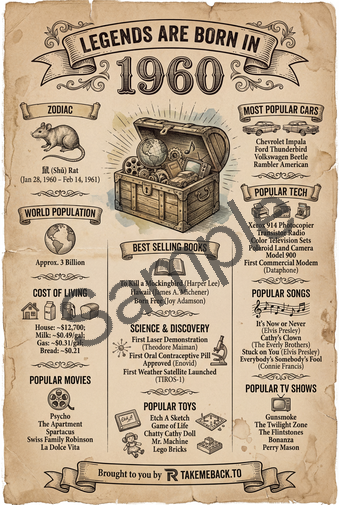

Major Events of 1960 - Historical Moments That Defined the Year | TakeMeBack.to
- 01 Jan Cameroon achieves independence: On January 1, 1960, Cameroon gained independence from France, marking a significant milestone in the decolonization of Africa. This event led to the establishment of the Republic of Cameroon, with Ahmadou Ahidjo as its first president. source: britannica.com
- 02 Jan Solar system age determination: In 1960, scientists determined the age of the solar system to be approximately 4.6 billion years using radiometric dating techniques on meteorites. This finding has been crucial in understanding the formation and evolution of the solar system. source: nasa.gov
- 03 Jan Australia's highest temperature record: On January 3, 1960, Oodnadatta, South Australia, recorded a temperature of 50.3°C (122.5°F), marking the highest temperature ever recorded in Australia at that time. source: en.wikipedia.org
- 04 Jan European Free Trade Association established: The European Free Trade Association (EFTA) was established on January 4, 1960, as an intergovernmental organization to promote free trade and economic integration between European countries. source: en.wikipedia.org
- 05 Jan Continental League Baseball Proposal Gains Congressional Support: On January 5, 1960, the Continental League, a proposed third major league in North American professional baseball, received an assurance of Congressional support from U.S. Senator Kenneth Keating, a New York Republican, who offered to serve as "an informal mediator, day or night" on behalf of the start-up circuit. source: en.wikipedia.org
- 07 Jan First Successful Polaris Missile Test Launch: On January 7, 1960, the U.S. Navy successfully launched the first Polaris missile from the submerged submarine USS George Washington, marking a significant advancement in the development of submarine-launched ballistic missiles. source: en.wikipedia.org
- 08 Jan Lee Harvey Oswald's Soviet defection: On January 8, 1960, Lee Harvey Oswald, who would later become infamous for the assassination of President John F. Kennedy, officially defected to the Soviet Union. His move was significant in the context of Cold War tensions and raised questions about his motivations and future actions. source: archives.gov
- 09 Jan Aswan High Dam construction begins: The construction of the Aswan High Dam in Egypt officially began on January 9, 1960. This monumental project aimed to control the Nile River's flooding, provide hydroelectric power, and improve irrigation. It was a significant development in Egypt's modernization efforts. source: britannica.com
- 10 Jan Macmillan's Wind of Change speech: On January 10, 1960, British Prime Minister Harold Macmillan delivered his famous 'Wind of Change' speech in Cape Town, South Africa. The speech addressed the decolonization of Africa and the changing political landscape, emphasizing the need for a new relationship between Britain and its former colonies. source: bbc.com
- 11 Jan Henry Lee Lucas kills his mother in Michigan: On January 11, 1960, in Tecumseh, Michigan, Henry Lee Lucas killed his mother, Nellie, during an argument. He claimed she struck him with a broom, leading him to stab her in the neck. The official cause of death was ruled as a heart attack precipitated by the assault. Lucas was arrested and later convicted of second-degree murder. source: henryleelucas.com
- 13 Jan White House initiates covert plans against Cuba: On January 13, 1960, the White House approved a covert action program against Cuba, aiming to overthrow Fidel Castro's regime through intelligence, political, paramilitary, and psychological operations. source: archives.gov
- 14 Jan Establishment of Reserve Bank of Australia: On January 14, 1960, the Reserve Bank of Australia was established, taking over the role of central bank from the Commonwealth Bank of Australia. source: rba.gov.au
- 15 Jan Khrushchev proposes troop reduction in Eastern Europe: On January 15, 1960, Soviet Premier Nikita Khrushchev proposed a reduction of Soviet military forces in Eastern Europe, signaling a potential shift in Soviet foreign policy. source: archives.gov
- 16 Jan Cameroon gains independence from France: On January 16, 1960, Cameroon declared its independence from France, marking a significant milestone in the country's history. This event led to the establishment of the Republic of Cameroon. source: britannica.com
- 17 Jan Construction begins on Aswan High Dam in Egypt: On January 17, 1960, construction began on the Aswan High Dam in Egypt. This monumental project aimed to control the Nile's flooding, provide increased water storage for irrigation, and generate hydroelectric power. source: britannica.com
- 18 Jan US-Japan Mutual Defense Treaty Signed: On January 18, 1960, the United States and Japan signed the Treaty of Mutual Cooperation and Security, allowing U.S. military bases on Japanese soil and committing both nations to mutual defense. source: defense.gov
- 19 Jan US-Japan Security Treaty Signed: On January 19, 1960, the United States and Japan signed the Treaty of Mutual Cooperation and Security, allowing U.S. military bases on Japanese soil and committing both nations to mutual defense. source: defense.gov
- 21 Jan Mercury Spacecraft Little Joe 1B Launch: On January 21, 1960, NASA launched the Little Joe 1B mission from Wallops Island, Virginia. The mission tested the Mercury spacecraft's launch escape system and carried a rhesus monkey named Miss Sam. The flight reached an altitude of 9.3 miles and lasted 8 minutes and 35 seconds. source: en.wikipedia.org
- 22 Jan Birth of Michael Hutchence: Michael Kelland John Hutchence, Australian singer and lead vocalist of INXS, was born in Sydney, Australia. source: en.wikipedia.org
- 23 Jan Record-Breaking Deep Sea Dive in Mariana Trench: On January 23, 1960, the bathyscaphe Trieste, piloted by Jacques Piccard and Don Walsh, reached the bottom of the Mariana Trench, setting a depth record. source: en.wikipedia.org
- 24 Jan Barricades Week in Algiers: In January 1960, Algiers experienced a week of barricades as French settlers protested against the French government's plans to grant independence to Algeria. source: en.wikipedia.org
- 25 Jan First Mercury Spacecraft Production Delivery: On January 25, 1960, the first production model of the Mercury spacecraft was delivered to the United States Air Force, marking a significant milestone in the U.S. space program. source: en.wikipedia.org
- 26 Jan Pete Rozelle becomes NFL commissioner: On January 26, 1960, Pete Rozelle was appointed as the NFL Commissioner. His leadership transformed the league into a major professional sports entity, overseeing significant expansions and the establishment of the Super Bowl. source: nfl.com
- 28 Jan First lunar photograph transmission: On January 28, 1960, the first photographs of the Moon were transmitted back to Earth. This event marked a significant milestone in space exploration and lunar studies, paving the way for future missions. source: nasa.gov
- 29 Jan Establishment of the Reserve Bank of Australia: The Reserve Bank of Australia was established on January 29, 1960, as the country's central bank. It plays a crucial role in monetary policy and financial stability in Australia. source: rba.gov.au
- 30 Jan CIA authorizes U-2 aircraft production: On January 30, 1960, the CIA officially authorized the production of the U-2 reconnaissance aircraft. This decision was pivotal for Cold War intelligence-gathering efforts, allowing for high-altitude surveillance of the Soviet Union and other regions. source: cia.gov
- 01 Feb Greensboro sit-ins: a pivotal civil rights moment: The Greensboro sit-ins began on February 1, 1960, when four African American college students sat at a segregated lunch counter in Greensboro, North Carolina. This act of nonviolent protest became a significant event in the American civil rights movement. source: archives.gov
- 03 Feb Harold Macmillan's Wind of Change Speech: On February 3, 1960, British Prime Minister Harold Macmillan delivered his 'Wind of Change' speech to the South African Parliament in Cape Town, signaling a shift in British policy towards decolonization in Africa. source: en.wikipedia.org
- 04 Feb De Gaulle dismisses Jacques Soustelle: On February 4, 1960, French President Charles de Gaulle dismissed Jacques Soustelle, the Minister of the Sahara, due to differing views on Algerian policy. Soustelle, a prominent Gaullist since 1940, was informed abruptly of his dismissal, leading to a bitter exchange. source: time.com
- 05 Feb Louis Stricker, South African Cricket Player, Dies: Louis Stricker, a notable South African cricket player who served as an opening batsman in 13 Test matches between 1909-1912, passed away.
- 08 Feb Royal Family name change: On February 8, 1960, Queen Elizabeth II announced that the royal family would adopt the name 'Windsor' as their official surname. This decision was made to reflect the family's British heritage and to distance themselves from their German roots during World War I. source: bbc.com
- 09 Feb First star on Hollywood Walk of Fame: The first star on the Hollywood Walk of Fame was awarded to actress Joanne Woodward on February 9, 1960. This event marked the beginning of a tradition that honors the contributions of artists in the entertainment industry. source: britannica.com
- 10 Feb Khrushchev's diplomatic tour of South Asia: Soviet Premier Nikita Khrushchev embarked on a diplomatic tour of South Asia, visiting India, Afghanistan, and other nations. This tour aimed to strengthen ties with these countries during the Cold War era and promote Soviet influence in the region. source: britannica.com
- 11 Feb Classified military information disclosure: On this date, a significant disclosure of classified military information occurred, raising concerns about national security. The details surrounding the disclosure were closely monitored by government officials and the media. source: archives.gov
- 12 Feb Death of Bobby Clark, legendary circus clown: Bobby Clark, a renowned circus clown known for his comedic performances, passed away on this date. His contributions to the circus arts left a lasting impact on the entertainment industry. source: nytimes.com
- 13 Feb France becomes fourth nuclear power: On February 13, 1960, France conducted its first successful nuclear test in the Sahara Desert, officially becoming the fourth nation to possess nuclear weapons. This event marked a significant development in the Cold War dynamics. source: britannica.com
- 14 Feb France conducts second nuclear test: On February 14, 1960, France conducted its second nuclear test, further solidifying its status as a nuclear power. This test followed the first one just a day prior and was part of France's efforts to establish itself in global military politics. source: britannica.com
- 15 Feb Near conflict between Egypt and Israel in 1960: On February 15, 1960, tensions escalated between Egypt and Israel, leading to a near conflict. This period was marked by rising hostilities in the region, influenced by broader geopolitical dynamics during the Cold War. source: britannica.com
- 16 Feb USS Triton's historic underwater circumnavigation: The USS Triton completed its historic underwater circumnavigation of the globe on February 16, 1960. This mission marked a significant achievement in naval history, showcasing advancements in submarine technology. source: britannica.com
- 18 Feb VIII Olympic Winter Games in Squaw Valley: The VIII Olympic Winter Games were held in Squaw Valley, California, from February 18 to March 8, 1960. This event featured various winter sports and was notable for its organization and the participation of athletes from around the world. source: britannica.com
- 19 Feb China launches first sounding rocket: On February 19, 1960, China successfully launched its first sounding rocket, marking a significant milestone in its space exploration efforts. This event demonstrated China's growing capabilities in rocketry and aeronautics. source: scmp.com
- 20 Feb CERN particle accelerator inauguration: On February 20, 1960, CERN inaugurated its first particle accelerator, marking a significant advancement in the field of particle physics. This facility has since played a crucial role in numerous scientific discoveries. source: home.cern
- 21 Feb Cuban nationalization of businesses: On February 21, 1960, the Cuban government began the nationalization of foreign-owned businesses, a key step in the country's shift towards socialism. This move was part of a broader strategy to consolidate power and reduce foreign influence in Cuba. source: britannica.com
- 23 Feb Ebbets Field demolition begins: The demolition of Ebbets Field, the former home of the Brooklyn Dodgers, began on February 23, 1960. This marked the end of an era for baseball fans and the community that cherished the historic ballpark. source: nytimes.com
- 24 Feb Segni Government Collapses in Italy: On February 24, 1960, the minority government of Prime Minister Antonio Segni resigned. President Giovanni Gronchi tasked Fernando Tambroni with forming a new government. Tambroni's cabinet, relying on support from the neo-Fascist Movimento Sociale Italiano, faced internal opposition and eventually led to further political instability. source: history.state.gov
- 26 Feb Alitalia Flight 618 crashes in Ireland: On February 26, 1960, Alitalia Flight 618, a Douglas DC-7C en route from Rome to New York, crashed shortly after takeoff from Shannon Airport in Ireland, killing 34 of the 52 people on board. source: en.wikipedia.org
- 28 Feb VIII Winter Olympics conclude at Squaw Valley: The VIII Winter Olympic Games officially ended in Squaw Valley, California, after a series of winter sports competitions from February 18 to 28, 1960. source: britannica.com
- 29 Feb Devastating Agadir Earthquake: A catastrophic earthquake struck Agadir, Morocco, on February 29, 1960, resulting in significant loss of life and widespread destruction. source: en.wikipedia.org
- 02 Mar Lufthansa launches first Boeing 707 jet service: On March 2, 1960, Lufthansa inaugurated its first Boeing 707 jet service, marking a significant advancement in commercial aviation. This service allowed for faster and more efficient travel, revolutionizing air travel in Europe and beyond. The introduction of the 707 was a pivotal moment for the airline industry. source: lufthansa.com
- 03 Mar Pope John XXIII expands College of Cardinals with historic appointments: On March 3, 1960, Pope John XXIII made significant appointments to the College of Cardinals, expanding its membership. This move was seen as a way to modernize the Church and included the first appointments of cardinals from countries outside Europe. This event was pivotal in the Church's efforts to engage with a global audience. source: britannica.com
- 04 Mar La Coubre explosion in Havana: On March 4, 1960, the French freighter La Coubre exploded in Havana Harbor, Cuba, while unloading 76 tons of Belgian munitions. The blast resulted in 75 to 100 deaths and over 200 injuries. Fidel Castro alleged U.S. involvement, but the U.S. government denied any responsibility. source: en.wikipedia.org
- 05 Mar World Ice Pairs Figure Skating Championship: Barbara Wagner and Robert Paul from Canada win the World Ice Pairs Figure Skating Championship held in Vancouver, British Columbia.
- 07 Mar Ivan Lendl's birth in Czechoslovakia: Ivan Lendl, a prominent tennis player, was born on March 7, 1960, in Ostrava, Czechoslovakia. He became one of the leading players in the sport during the 1980s and early 1990s, winning eight Grand Slam singles titles. source: britannica.com
- 08 Mar Iconic Che Guevara photograph: On March 8, 1960, the famous photograph of Che Guevara, taken by Alberto Korda, was captured. This image became a symbol of revolutionary movements worldwide and is one of the most reproduced photographs in history. source: britannica.com
- 09 Mar First permanent hemodialysis shunt implanted: On March 9, 1960, the first permanent hemodialysis shunt was implanted, marking a significant advancement in medical technology for treating kidney failure. This innovation improved the quality of life for patients requiring dialysis. source: ncbi.nlm.nih.gov
- 11 Mar Pioneer 5 launched into solar orbit between Earth and Venus: On March 11, 1960, NASA launched Pioneer 5, the first space probe designed to study interplanetary space between Earth and Venus. The mission aimed to map the interplanetary magnetic field and test long-range communications. The spacecraft successfully entered a heliocentric orbit and transmitted data until June 26, 1960. source: science.nasa.gov
- 13 Mar Maurizio Pollini wins the International Chopin Piano Competition: Italian pianist Maurizio Pollini won the prestigious International Chopin Piano Competition in Warsaw, Poland, on March 13, 1960. His victory marked a significant milestone in his career, establishing him as a leading interpreter of Chopin's works. source: britannica.com
- 14 Mar Historic meeting between West German Chancellor and Israeli Prime Minister: On March 14, 1960, West German Chancellor Konrad Adenauer met with Israeli Prime Minister David Ben-Gurion in a landmark meeting. This meeting was significant in the context of post-World War II relations and the establishment of diplomatic ties between Germany and Israel. source: britannica.com
- 15 Mar First underwater park established in Key Largo: On March 15, 1960, the first underwater park in the United States was established in Key Largo, Florida. This park aimed to protect marine life and promote underwater recreation, becoming a model for future marine conservation efforts. source: nps.gov
- 17 Mar WSLA (now WAKA) TV channel 8 in Selma, AL (CBS) begins broadcasting: WSLA, now known as WAKA, began broadcasting on March 17, 1960, as a CBS affiliate in Selma, Alabama. This station played a significant role in local news and entertainment, contributing to the media landscape in the region. source: al.com
- 19 Mar Ceylon's Parliamentary Election Complexity: On March 19, 1960, Ceylon (now Sri Lanka) held parliamentary elections that were marked by significant political complexities. The elections were pivotal in shaping the country's political landscape, leading to the rise of the United National Party and the eventual appointment of Sirimavo Bandaranaike as the world's first female prime minister. source: bbc.com
- 21 Mar Sharpeville Massacre: A Turning Point in South African History: On March 21, 1960, police opened fire on a crowd of approximately 5,000 unarmed Black protesters in Sharpeville, South Africa, resulting in at least 91 deaths and over 180 injuries. The demonstration was organized by the Pan-Africanist Congress against the apartheid pass laws, which restricted the movement of Black South Africans. This tragic event galvanized international opposition to apartheid and led to the declaration of a state of emergency in South Africa. source: britannica.com
- 27 Mar Wiffi Smith wins LPGA Royal Crown Golf Open: On March 27, 1960, Wiffi Smith secured victory at the Royal Crown Open in Georgia, a tournament on the LPGA Tour. source: en.wikipedia.org
- 28 Mar Worst Peacetime Firefighting Loss in British History: The Cheapside Street whisky bond fire on March 28, 1960, remains Britain's worst peacetime fire service disaster, with 19 fatalities. source: fbu.org.uk
- 29 Mar 1960 United States Census: The 1960 United States Census was conducted to collect demographic data across the nation. source: en.wikipedia.org
- 01 Apr First television picture from space: On April 1, 1960, the first television picture from space was transmitted by the TIROS-1 satellite. This marked a significant milestone in space exploration and satellite technology, allowing for real-time weather monitoring and data collection from the atmosphere. source: nasa.gov
- 02 Apr Racial tensions in South Africa: On April 2, 1960, racial tensions escalated in South Africa, particularly in response to the Sharpeville Massacre that occurred earlier. The event highlighted the growing resistance against apartheid and the struggle for civil rights in the country. source: bbc.com
- 03 Apr Origin of the Charismatic Movement: On April 3, 1960, Dennis J. Bennett, rector of St. Mark's Episcopal Church in Van Nuys, California, announced to his congregation that he had received the baptism of the Holy Spirit and spoken in tongues. This event is considered the beginning of the Charismatic Movement in mainline Protestant denominations. source: en.wikipedia.org
- 04 Apr Mali Federation independence: On April 4, 1960, the Mali Federation, comprising Senegal and French Sudan, declared its independence from France. This led to the formation of the independent nations of Mali and Senegal. source: en.wikipedia.org
- 05 Apr Wisconsin Democratic Primary of 1960: On April 5, 1960, the Wisconsin Democratic Primary was held, with John F. Kennedy winning the primary. This victory was significant in his campaign for the Democratic nomination for the 1960 presidential election. source: en.wikipedia.org
- 08 Apr US Civil Rights Bill signed by President Eisenhower: On April 8, 1960, President Dwight D. Eisenhower signed the Civil Rights Act of 1960 into law. This legislation aimed to improve voting rights for African Americans and established penalties for voter intimidation. source: archives.gov
- 09 Apr NASA's first astronaut presentation: On April 9, 1960, NASA held its first public presentation of the Mercury astronauts, marking a significant moment in the U.S. space program. This event showcased the seven astronauts selected for the Mercury program, which aimed to send humans into space. source: nasa.gov
- 10 Apr US Senate passes Civil Rights Bill: On April 10, 1960, the U.S. Senate passed the Civil Rights Act of 1960, which aimed to enhance voting rights protections for African Americans. This legislation was a crucial step in the civil rights movement. source: archives.gov
- 12 Apr Éric Peugeot kidnapped in Paris: On April 12, 1960, four-year-old Éric Peugeot, son of Roland Peugeot, was abducted from the Saint-Cloud Golf Club in Paris. The kidnappers demanded a ransom of 50 million francs. Éric was released two days later, unharmed, after the ransom was paid. The kidnappers were arrested in March 1961 and sentenced to 20 years in prison. source: lemonde.fr
- 13 Apr Sultan Hisamuddin Alam Shah becomes Malaysian Head of State: Sultan Hisamuddin Alam Shah of Selangor was elected as the second Yang di-Pertuan Agong (King) of the Federation of Malaya, serving from April 14 to September 1, 1960. source: archontology.org
- 14 Apr Pat Symcox birth: Patrick Leonard Symcox, a former South African international cricketer, was born on April 14, 1960, in Kimberley, Northern Cape Province, South Africa. He played 20 Test matches and 80 One Day Internationals in the 1990s. source: en.wikipedia.org
- 18 Apr European Convention on Extradition Takes Effect: The European Convention on Extradition, a multilateral treaty governing extradition between member states of the Council of Europe, entered into force on April 18, 1960. This treaty established obligations among member states to surrender fugitives for certain offenses committed in another state. source: ojp.gov
- 19 Apr 64th Boston Marathon: The 64th Boston Marathon took place on April 19, 1960. The race was won by Paavo Kotila, who completed the marathon in 2 hours, 20 minutes, and 54 seconds. source: de.wikipedia.org
- 20 Apr Manned Space Stations Symposium: From April 20 to 22, 1960, the Institute of the Aeronautical Sciences, NASA, and the RAND Corporation co-hosted the Manned Space Stations Symposium in Los Angeles. This event gathered leading aeronautical and aerospace scientists and engineers to discuss the feasibility, design, and operational aspects of manned space stations. The proceedings were later published as "Proceedings of the Manned Space Stations Symposium." source: hq.nasa.gov
- 21 Apr Inauguration of Brasília as Brazil's New Capital: On April 21, 1960, Brasília was officially inaugurated as the new capital of Brazil. Designed by architect Oscar Niemeyer and urban planner Lúcio Costa, the city was built to promote development in the interior of the country and to symbolize a new era of progress. Its unique modernist architecture and urban planning have since made it a UNESCO World Heritage site.
- 24 Apr Civil Rights Confrontation in Biloxi: On April 24, 1960, a significant civil rights confrontation occurred in Biloxi, Mississippi, when African American students from the University of Southern Mississippi attempted to integrate the city's segregated public beaches. This act of peaceful protest led to arrests and highlighted the ongoing struggle for civil rights in the South.
- 25 Apr Death of Afghan Monarch Amanullah Khan: Amanullah Khan, the former King of Afghanistan, passed away on April 25, 1960, in Zürich, Switzerland. He was known for leading Afghanistan to independence from British influence and for his attempts to modernize the country. source: britannica.com
- 27 Apr Togo gains independence from France: On April 27, 1960, Togo officially gained independence from French colonial rule. This marked a significant moment in the decolonization of Africa, as Togo became one of the first countries in West Africa to achieve independence. source: britannica.com
- 28 Apr Shea Stadium construction approved: On April 28, 1960, the construction of Shea Stadium was officially approved. This stadium would later become the home of the New York Mets and host numerous significant events, including concerts and other sports. source: nytimes.com
- 01 May U-2 spy plane incident: On May 1, 1960, the U-2 spy plane incident occurred when an American U-2 aircraft was shot down over Soviet airspace. This event heightened tensions during the Cold War and had significant diplomatic repercussions. source: britannica.com
- 03 May The Fantasticks opens Off-Broadway: The musical "The Fantasticks" premiered Off-Broadway on May 3, 1960. It became one of the longest-running musicals in American theater history, known for its romantic themes and unique storytelling style. source: nytimes.com
- 04 May US-India grain agreement signed: On May 4, 1960, the United States and India signed a grain agreement to facilitate food aid and agricultural cooperation. This agreement was part of broader efforts to strengthen bilateral relations during the Cold War. source: state.gov
- 05 May Wilburton, Oklahoma tornado disaster: On May 5, 1960, a devastating tornado struck Wilburton, Oklahoma, causing significant destruction and loss of life. The disaster prompted emergency responses and raised awareness about tornado preparedness. source: weather.gov
- 06 May Civil Rights Act of 1960 signed into law by President Eisenhower: On May 6, 1960, President Dwight D. Eisenhower signed the Civil Rights Act of 1960 into law. This legislation established federal inspection of local voter registration polls and introduced penalties for anyone who obstructed someone's attempt to register to vote. The Act aimed to strengthen voting rights protections for African Americans. source: en.wikipedia.org
- 07 May U-2 spy plane incident escalates Cold War tensions: On May 7, 1960, tensions escalated during the Cold War when a U-2 spy plane was shot down over Soviet airspace. This incident heightened hostilities between the United States and the Soviet Union, leading to significant diplomatic fallout. source: archives.gov
- 08 May USSR and Cuba diplomatic relations resumed: On May 8, 1960, the Soviet Union and Cuba resumed diplomatic relations, strengthening their alliance during the Cold War. This move was significant in the geopolitical landscape of the time, as it solidified Cuba's position as a key ally of the USSR. source: bbc.com
- 09 May Nigeria joins British Commonwealth: On May 9, 1960, Nigeria officially joined the British Commonwealth, marking a significant step in its post-colonial development. This event symbolized Nigeria's commitment to maintaining ties with the Commonwealth nations after gaining independence. source: commonwealth.int
- 10 May USS Triton completes first submerged circumnavigation: On May 10, 1960, the USS Triton, a U.S. Navy nuclear-powered submarine, completed the first submerged circumnavigation of the Earth. Departing on February 15, 1960, the Triton traveled 26,723 nautical miles over 60 days and 21 hours, demonstrating the endurance and capabilities of nuclear-powered submarines. source: wired.com
- 12 May Defense Communications Agency established: On May 12, 1960, the U.S. Department of Defense established the Defense Communications Agency to manage the Defense Communications System, centralizing military communications. source: army.mil
- 13 May First Delta Satellite Launch Failure: On May 13, 1960, the inaugural launch of the Thor-Delta rocket, carrying the Echo 1 communications satellite, failed due to an attitude control system malfunction in the Delta stage, resulting in the destruction of the payload. source: upi.com
- 14 May USSR Launches First Unmanned Space Capsule: On May 14, 1960, the Soviet Union launched the Korabl'-Sputnik 1, an uncrewed spacecraft, marking a significant milestone in the Soviet space program. source: spacelaunchschedule.com
- 15 May Sputnik 4 Space Mission: On May 15, 1960, the Soviet Union launched Sputnik 4, a mission that carried a biological payload to study the effects of space travel on living organisms, contributing to the preparation for human spaceflight. source: spacelaunchschedule.com
- 16 May First Optical Laser Invented: Physicist Theodore Maiman demonstrated the first working optical laser at Hughes Research Laboratories in Malibu, California, using a synthetic ruby crystal. source: wired.com
- 17 May Paris Summit Conference Cancelled Due to U-2 Incident: The Paris Summit, scheduled to discuss nuclear disarmament and other issues, was canceled following the U-2 spy plane incident, leading to a significant diplomatic setback. source: archives.gov
- 18 May Jean Genet's Le Balcon premieres: Jean Genet's play Le Balcon premiered on May 18, 1960, in Paris. The play explores themes of power, sexuality, and the nature of reality, and it has been influential in the realm of avant-garde theater. Genet's work is known for its provocative content and complex characters. source: theguardian.com
- 19 May X-15 altitude record flight: On May 19, 1960, the X-15 rocket plane achieved a new altitude record during a test flight. This program was crucial in advancing aerospace technology and contributed to the development of future space missions. The X-15 program provided valuable data on high-speed and high-altitude flight. source: nasa.gov
- 20 May Japanese Security Treaty ratified amid protests: On May 20, 1960, Japan's House of Representatives ratified the Treaty of Mutual Cooperation and Security between Japan and the United States, despite significant opposition and protests. The treaty, signed on January 19, 1960, committed both nations to mutual defense and permitted the presence of U.S. military bases on Japanese soil. The ratification process was marked by intense public demonstrations and political turmoil. source: foreignaffairs.com
- 22 May The Great Chilean Earthquake of 1960: On May 22, 1960, the Great Chilean Earthquake struck, registering a magnitude of 9.5, making it the most powerful earthquake ever recorded. The quake caused widespread devastation in Chile and triggered tsunamis that affected coastal areas across the Pacific Ocean. source: usgs.gov
- 23 May Hawaii Tsunami Disaster: On May 23, 1960, a tsunami struck Hawaii, triggered by the Great Chilean Earthquake. The disaster caused significant damage and loss of life, highlighting the far-reaching effects of seismic activity. source: usgs.gov
- 24 May Valdivia Earthquake and Cordon Caulle Eruption: On May 24, 1960, the aftermath of the Valdivia Earthquake continued to unfold, with volcanic activity from the Cordon Caulle. This eruption added to the challenges faced by the affected communities in Chile. source: britannica.com
- 25 May U-2 Spy Plane Incident During Cold War: On May 25, 1960, tensions escalated during the Cold War following the U-2 spy plane incident. This event had significant implications for U.S.-Soviet relations. source: history.com
- 26 May Soviet Union presents Great Seal replica with hidden listening device to U.S. Ambassador: On May 26, 1960, U.S. Ambassador to the United Nations Henry Cabot Lodge Jr. displayed a hand-carved replica of the Great Seal of the United States at the UN. This replica, presented by the Soviet Union in 1946, contained a concealed listening device, known as "The Thing," which had been used by Soviet agents to eavesdrop on confidential conversations in the U.S. Embassy in Moscow. source: en.wikipedia.org
- 27 May Turkish military coup ousts President and Prime Minister: On May 27, 1960, the Turkish military, led by General Cemal Gürsel, staged a coup d'état, arresting President Celal Bayar and Prime Minister Adnan Menderes. General Gürsel assumed both presidential and prime ministerial roles, replacing the legislature with 37 officers who formed the Milli Birlik Komitesi (Committee of National Unity). Menderes, Foreign Minister Fatin Rustu Zorlu, and Finance Minister Hasan Polatkan were later executed, while Bayar was released after three years in prison. source: en.wikipedia.org
- 28 May 'Greenwillow' musical closes at Alvin Theater in NYC after 95 performances: On May 28, 1960, the musical 'Greenwillow' closed at the Alvin Theater in New York City after 95 performances. The show, featuring music and lyrics by Frank Loesser, had opened on March 11, 1960, and received mixed reviews during its run. source: en.wikipedia.org
- 30 May Turkey's 24th Government formed by Cemal Gürsel: On May 30, 1960, following a military coup, Cemal Gürsel was appointed as the head of Turkey's 24th government. This marked a significant political shift in the country's governance. source: en.wikipedia.org
- 01 Jun Launch of 'Little School' program in Texas: On June 1, 1960, the 'Little School' program was launched in Texas, aimed at improving early childhood education. This initiative was part of broader educational reforms during the 1960s. source: texas.gov
- 02 Jun Broadway theaters close for a day: On June 2, 1960, Broadway theaters closed for a day in solidarity with the actors' strike. This event highlighted the ongoing labor disputes in the theater industry during that period. source: nytimes.com
- 03 Jun Gideon v. Wainwright Supreme Court decision: On June 3, 1960, the U.S. Supreme Court delivered its decision in Gideon v. Wainwright, ruling that the Sixth Amendment guarantees the right to counsel for defendants in state courts. This landmark case expanded legal rights for individuals unable to afford an attorney. source: uscourts.gov
- 04 Jun French Constitution amendment on colonial independence: On June 4, 1960, the French Constitution was amended to allow for the independence of several African colonies. This amendment marked a significant shift in France's colonial policy, paving the way for the decolonization process in Africa during the 1960s. source: britannica.com
- 05 Jun Lake Bodom murders in Finland: On June 5, 1960, the Lake Bodom murders occurred in Finland, where three teenagers were brutally killed while camping. This unsolved case remains one of Finland's most infamous criminal mysteries. source: bbc.com
- 06 Jun Pondo Massacre in South Africa: On June 6, 1960, during a peaceful gathering at Ngquza Hill in Pondoland, South Africa, police opened fire on unarmed Pondo tribesmen, resulting in the deaths of 11 individuals. The meeting aimed to protest the imposition of the Bantu Authorities Act and other apartheid policies. The incident intensified resistance against apartheid in the region. source: justice.gov.za
- 07 Jun John F. Kennedy wins California Democratic Primary: On June 7, 1960, Senator John F. Kennedy secured victory in the California Democratic primary, a significant win in his campaign for the 1960 presidential election. This victory bolstered his momentum leading up to the Democratic National Convention. source: en.wikipedia.org
- 09 Jun Deadly Typhoon Mary strikes China: Typhoon Mary made landfall in China, causing significant destruction and loss of life. The storm was one of the deadliest typhoons of the year, impacting various regions and leading to extensive flooding and damage. source: britannica.com
- 10 Jun Typhoon Mary devastates Hong Kong and China: Following its initial landfall, Typhoon Mary continued to wreak havoc in Hong Kong and parts of China, leading to severe flooding and infrastructure damage. The storm's impact was felt across multiple regions, exacerbating the humanitarian crisis. source: britannica.com
- 11 Jun Benjamin Britten's 'A Midsummer Night's Dream' Opera Premiere: On June 11, 1960, Benjamin Britten's opera 'A Midsummer Night's Dream' premiered at the Aldeburgh Festival in England. The opera, adapted from Shakespeare's play, was conducted by Britten himself and featured a cast including countertenor Alfred Deller as Oberon and soprano Jennifer Vyvyan as Tytania. source: en.wikipedia.org
- 12 Jun Angel Cordero Jr. rides first race at El Comandante Racetrack: On June 12, 1960, Angel Cordero Jr. rode his first race at El Comandante Racetrack in San Juan, Puerto Rico. source: ntra.com
- 15 Jun Anpo Protests in Japan: On June 15, 1960, during the Anpo protests against the U.S.-Japan Security Treaty, hundreds of thousands of protesters marched on the National Diet in Tokyo. Radical student activists breached the Diet compound, leading to violent clashes with police. In the confrontation, Tokyo University student Michiko Kanba was killed, intensifying public outrage and contributing to the resignation of Prime Minister Nobusuke Kishi. source: en.wikipedia.org
- 16 Jun Portuguese Colonial Massacre in Mozambique: On June 16, 1960, Portuguese colonial forces opened fire on a crowd of Mozambican nationalists in Mueda, resulting in numerous deaths. This event is considered a pivotal moment in Mozambique's struggle for independence. source: en.wikipedia.org
- 20 Jun Mali Federation gains independence from France: On June 20, 1960, the Mali Federation, comprising Senegal and French Sudan, declared independence from France. This event marked a significant step in the decolonization of Africa and the emergence of new nations. source: britannica.com
- 21 Jun Armin Hary sets 100m world record: German sprinter Armin Hary set a new world record in the 100 meters with a time of 10.2 seconds on June 21, 1960. This achievement solidified his status as one of the top sprinters of his time. source: britannica.com
- 22 Jun Disappearance of civil rights activists: On June 22, 1960, civil rights activists in the United States faced increasing threats and violence, leading to the disappearance of several key figures. This event highlighted the dangers faced by those fighting for civil rights during this turbulent period. source: britannica.com
- 23 Jun FDA approves first oral contraceptive pill: On June 23, 1960, the U.S. Food and Drug Administration approved the first oral contraceptive pill, Enovid. This marked a significant milestone in reproductive health, providing women with greater control over their fertility and contributing to social changes in the following decades. source: fda.gov
- 24 Jun First president of independent Congo: On June 24, 1960, Joseph Kasavubu was inaugurated as the first president of the newly independent Republic of the Congo. This event marked a significant moment in African history as the Congo transitioned from colonial rule to independence. source: britannica.com
- 25 Jun Somaliland gains independence from Britain: On June 25, 1960, Somaliland declared independence from British colonial rule, becoming the State of Somaliland. This event was a crucial step in the region's quest for self-determination and set the stage for future political developments in the Horn of Africa. source: britannica.com
- 26 Jun Madagascar Independence from France: On June 26, 1960, Madagascar gained independence from France, becoming the Malagasy Republic. This event marked the end of French colonial rule in the region. source: en.wikipedia.org
- 27 Jun Chlorophyll 'A' synthesized at MIT: On June 27, 1960, researchers at MIT successfully synthesized chlorophyll 'A', a significant achievement in biochemistry. This breakthrough contributed to the understanding of photosynthesis and plant biology. source: mit.edu
- 28 Jun Cuban oil refineries nationalized: On June 28, 1960, the Cuban government nationalized all oil refineries in the country, a pivotal moment in the Cuban Revolution. This action led to significant tensions between Cuba and the United States. source: bbc.com
- 29 Jun Cuba nationalizes Texaco oil refinery: On June 29, 1960, the Cuban government nationalized the Texaco oil refinery, a significant move in the context of U.S.-Cuba relations. This action was part of a broader strategy by Fidel Castro to assert control over foreign businesses in Cuba, particularly in the oil sector. source: britannica.com
- 30 Jun Belgian Congo gains independence: The Belgian Congo gained independence on June 30, 1960, becoming the Democratic Republic of the Congo. This event was pivotal in the decolonization movement in Africa, leading to significant political changes and challenges in the newly independent nation. source: britannica.com
- 01 Jul Ghana becomes a republic: On July 1, 1960, Ghana officially became a republic, marking a significant milestone in its post-colonial history. This transition was part of a broader movement across Africa towards independence and self-governance following colonial rule. source: britannica.com
- 02 Jul Truman criticizes Kennedy's presidential candidacy: On July 2, 1960, former President Harry S. Truman publicly criticized Senator John F. Kennedy's candidacy for the presidency. Truman's remarks highlighted the political tensions within the Democratic Party during the election season. source: nytimes.com
- 03 Jul Tragic lightning strike on Mount Bisalta: On July 3, 1960, a tragic lightning strike occurred on Mount Bisalta, resulting in multiple fatalities. This incident raised awareness about the dangers of outdoor activities during thunderstorms. source: bbc.com
- 05 Jul Congo Crisis erupts: On July 5, 1960, soldiers of the Force Publique in the Republic of the Congo mutinied against their Belgian officers, leading to widespread instability and marking the beginning of the Congo Crisis. source: en.wikipedia.org
- 09 Jul Kel Nagle wins 1960 British Open Golf Championship: Kel Nagle won the 1960 British Open Golf Championship held at St. Andrews, Scotland. This victory marked a significant achievement in Nagle's career, as he became the first Australian to win the prestigious tournament. source: britannica.com
- 10 Jul Belgium intervenes in Congo: On July 10, 1960, Belgium intervened in the Congo amid rising tensions and violence following the country's independence. This intervention was controversial and marked a significant moment in post-colonial African history. source: britannica.com
- 11 Jul French colonial independence: On July 11, 1960, several French colonies in Africa gained independence, marking a significant shift in colonial power dynamics. This wave of independence movements was part of a broader decolonization trend across the continent. source: britannica.com
- 12 Jul Launch of the first passive communication satellite: On July 12, 1960, the first passive communication satellite, Echo 1, was launched by the United States. This satellite reflected radio signals and marked a significant advancement in satellite technology and communication. source: nasa.gov
- 13 Jul John F. Kennedy nominated for presidential candidacy: On July 13, 1960, John F. Kennedy was officially nominated as the Democratic candidate for President of the United States at the Democratic National Convention in Los Angeles. His nomination marked a pivotal moment in American political history. source: britannica.com
- 14 Jul Jane Goodall Begins Groundbreaking Chimpanzee Research: On July 14, 1960, Jane Goodall arrived at Gombe Stream National Park in Tanzania to begin her pioneering study of wild chimpanzees. This research led to significant discoveries about chimpanzee behavior and social structures. source: guinnessworldrecords.com
- 15 Jul Kennedy accepts Democratic presidential nomination: On July 15, 1960, John F. Kennedy was officially nominated as the Democratic candidate for President of the United States at the Democratic National Convention in Los Angeles. His acceptance speech emphasized a vision for a new frontier in American politics and society. source: archives.gov
- 16 Jul Sino-Soviet split escalates: The Sino-Soviet split intensified on July 16, 1960, as tensions between China and the Soviet Union grew over ideological differences and national interests. This event had lasting implications for global communism and international relations. source: britannica.com
- 17 Jul Gastone Nencini wins 47th Tour de France: On July 17, 1960, Italian cyclist Gastone Nencini won the 47th edition of the Tour de France. His victory was marked by a strong performance throughout the race, solidifying his place in cycling history. source: britannica.com
- 18 Jul Nobusuke Kishi resigns as Japanese Prime Minister: On July 18, 1960, Nobusuke Kishi resigned as Prime Minister of Japan following widespread protests against the U.S.-Japan Security Treaty. source: en.wikipedia.org
- 19 Jul Juan Marichal's MLB debut with one-hitter: On July 19, 1960, Juan Marichal made his Major League Baseball debut for the San Francisco Giants, pitching a one-hit shutout against the Philadelphia Phillies. source: en.wikipedia.org
- 20 Jul Cold War tensions in Congo Crisis: On July 20, 1960, the United Nations deployed 3,500 troops to the Congo to assist the newly independent nation in quelling mutinies and secessionist movements, marking a significant Cold War confrontation as the U.S. and Soviet Union supported opposing factions. source: britannica.com
- 21 Jul Francis Chichester's record Atlantic crossing: On July 21, 1960, British sailor Francis Chichester completed a solo circumnavigation of the globe, setting a new record for the fastest solo voyage. source: britannica.com
- 22 Jul Cuba nationalizes US sugar factories: On July 22, 1960, Cuba announced the nationalization of all U.S. sugar factories, escalating tensions between the U.S. and Cuba. This move was part of a broader strategy by Fidel Castro's government to assert control over the economy and reduce foreign influence. The nationalization led to significant economic repercussions and contributed to the deterioration of U.S.-Cuba relations. source: britannica.com
- 24 Jul Tragic mountain bus accident in Japan: On July 24, 1960, a devastating bus accident occurred in the mountains of Japan, resulting in numerous fatalities. The incident highlighted the dangers of mountainous travel and led to discussions about road safety regulations in the country. It remains one of the deadliest bus accidents in Japanese history. source: britannica.com
- 25 Jul Nixon's Republican nomination: On July 25, 1960, Richard Nixon was officially nominated as the Republican candidate for President at the party's convention. This nomination set the stage for the upcoming election against John F. Kennedy. Nixon's campaign focused on his experience and foreign policy credentials. source: archives.gov
- 26 Jul Nixon nominated for presidential candidacy: Richard Nixon was nominated as the Republican candidate for President of the United States at the Republican National Convention held in Chicago. This marked a significant moment in his political career as he aimed to succeed Dwight D. Eisenhower. source: archives.gov
- 27 Jul Nixon nominated for president at Republican convention: Richard Nixon was officially nominated for President by the Republican Party at their convention in Chicago. This nomination was a pivotal moment in the 1960 election campaign against John F. Kennedy. source: archives.gov
- 28 Jul Richard Nixon selected as Republican presidential candidate: On July 28, 1960, Richard Nixon was officially nominated as the Republican candidate for President of the United States at the Republican National Convention in Chicago. This marked his second consecutive run for the presidency after losing to John F. Kennedy in 1960. source: archives.gov
- 29 Jul Asteroid discovery: 2000 Herschel: On July 29, 1960, astronomers discovered asteroid 2000 Herschel, named after the astronomer William Herschel. This discovery contributed to the growing catalog of asteroids in the solar system, enhancing our understanding of celestial bodies. source: jpl.nasa.gov
- 30 Jul First AFL preseason game: Boston Patriots vs Buffalo Bills: The first preseason game of the American Football League (AFL) took place on July 30, 1960, featuring the Boston Patriots against the Buffalo Bills. This marked a significant moment in professional football history as the AFL sought to establish itself as a competitor to the NFL. source: britannica.com
- 31 Jul Nation of Islam leader calls for separate Black state: On July 31, 1960, Nation of Islam leader Elijah Muhammad called for the establishment of a separate Black state in the United States. This statement was part of a broader movement advocating for Black nationalism and self-determination during the civil rights era. source: britannica.com
- 01 Aug Dahomey (Benin) independence and political suppression: On August 1, 1960, Dahomey (now Benin) gained independence from France. However, the new government faced significant political challenges and suppression of dissent in the following years. source: britannica.com
- 02 Aug Benin gains independence from France: On August 2, 1960, Benin, formerly known as Dahomey, gained independence from French colonial rule. This marked a significant moment in the decolonization of Africa, as many nations sought self-governance during this period. source: britannica.com
- 03 Aug Niger gains independence from France: Niger achieved independence from France on August 3, 1960. This event was part of a broader wave of decolonization across Africa, as many nations sought to establish their sovereignty and self-determination. source: britannica.com
- 04 Aug US Air Force research aircraft speed record: On August 4, 1960, a US Air Force research aircraft set a new speed record, showcasing advancements in military aviation technology. This achievement contributed to the ongoing development of high-speed aircraft during the Cold War era. source: nasa.gov
- 05 Aug Upper Volta gains independence from France: On August 5, 1960, Upper Volta, now known as Burkina Faso, achieved full independence from French colonial rule. Maurice Yaméogo became the nation's first president, leading the Voltaic Democratic Union (UDV). The country was renamed Burkina Faso in 1984. source: history.state.gov
- 06 Aug Cuba nationalizes foreign properties: On August 6, 1960, the Cuban government, led by Fidel Castro, announced the nationalization of all foreign-owned properties in Cuba. This move was part of a broader effort to consolidate power and implement socialist reforms. source: en.wikipedia.org
- 07 Aug Côte d'Ivoire gains independence from France: On August 7, 1960, Côte d'Ivoire officially gained independence from France, marking a significant moment in the decolonization of Africa. This event was celebrated as a step towards self-determination and sovereignty for the Ivorian people. source: britannica.com
- 08 Aug Sharpeville massacre legal developments: On August 8, 1960, legal developments regarding the Sharpeville massacre were reported, following the tragic events of March 21, 1960, in South Africa. This incident highlighted the brutal response of the apartheid regime to peaceful protests against racial segregation. source: bbc.com
- 09 Aug Laotian government overthrown in military coup: On August 9, 1960, a military coup in Laos resulted in the overthrow of the government. This coup was part of the ongoing political instability in Laos during the Cold War, influenced by both internal and external factors. source: britannica.com
- 10 Aug Discoverer 13 space recovery mission: On August 10, 1960, the Discoverer 13 mission successfully recovered a satellite, marking a significant achievement in the early days of the U.S. space program. This mission contributed to the development of reconnaissance satellites during the Cold War. source: nasa.gov
- 11 Aug Chad gains independence from France: On August 11, 1960, Chad formally achieved its independence from France, becoming a sovereign nation after years of colonial rule. source: dw.com
- 12 Aug NASA launches Echo 1A communications satellite: On August 12, 1960, NASA successfully launched Echo 1A, the first passive communications satellite, which reflected radio signals to demonstrate satellite-based communication. source: nasa.gov
- 13 Aug Central African Republic and Chad gain independence from France: On August 13, 1960, both the Central African Republic and Chad formally achieved independence from France, marking a significant moment in African decolonization. source: dw.com
- 14 Aug UN Peacekeeping Mission in Congo: On August 14, 1960, the United Nations initiated the United Nations Operation in the Congo (ONUC) to assist the newly independent Republic of the Congo in maintaining law and order, following the country's independence from Belgium on July 30, 1960. source: peacekeeping.un.org
- 15 Aug Cyprus gains independence from Britain: On August 15, 1960, Cyprus achieved independence from British colonial rule, becoming a sovereign nation. The country's first president was Archbishop Makarios III. source: en.wikipedia.org
- 16 Aug Cyprus independence details: On August 16, 1960, Cyprus officially gained independence from British rule, marking a significant moment in its history. The new Republic of Cyprus was established, with a constitution that aimed to balance power between the Greek and Turkish communities on the island. This independence was the result of negotiations and conflicts that had spanned several years. source: britannica.com
- 17 Aug Francis Gary Powers U-2 spy trial begins in Moscow: The trial of Francis Gary Powers, a U.S. pilot shot down while flying a U-2 spy plane over the Soviet Union, began on August 17, 1960. Powers was charged with espionage, and his capture heightened Cold War tensions. The trial was a significant event in the context of U.S.-Soviet relations during the Cold War. source: britannica.com
- 18 Aug First Spy Satellite Photograph: On August 18, 1960, the United States launched the Discoverer 14 satellite, the first optical-imaging spy satellite. It successfully captured photographs of Soviet military installations, including the Mys Shmidta airfield, marking a significant advancement in reconnaissance technology. source: guinnessworldrecords.com
- 20 Aug USS Seadragon surfaces at North Pole: On August 20, 1960, the USS Seadragon (SSN-584) surfaced at the North Pole, becoming the third submarine to do so. The crew conducted scientific experiments and played a softball game on the ice. source: en.wikipedia.org
- 24 Aug Record Low Temperature in Antarctica: On August 24, 1960, a record low temperature of -88.3°C (-126.9°F) was recorded at Vostok Station in Antarctica. source: weatherbug.com
- 28 Aug Declaration of San José condemns international intervention: The Seventh Meeting of Consultation of Ministers of Foreign Affairs, held in San José, Costa Rica, adopted the Declaration of San José. The declaration condemned intervention by extra-continental powers in the affairs of American republics and reaffirmed the principle of nonintervention among American states. source: avalon.law.yale.edu
- 29 Aug Assassination of Jordanian Prime Minister: Jordanian Prime Minister Hazza' al-Majali was assassinated in Amman, Jordan. His assassination was part of a series of political upheavals in the region during that period. source: en.wikipedia.org
- 30 Aug East Germany imposes partial blockade on West Berlin: On August 30, 1960, East Germany implemented a partial blockade on West Berlin, escalating tensions during the Cold War. This action was part of a series of measures aimed at restricting access to the western sectors of the city. source: britannica.com
- 31 Aug South Africa lifts state of emergency: On August 31, 1960, South Africa officially lifted the state of emergency that had been in place since the Sharpeville Massacre earlier that year. This decision marked a significant moment in the country's political landscape during apartheid. source: bbc.com
- 01 Sep Pennsylvania Railroad workers strike: On September 1, 1960, Pennsylvania Railroad workers initiated a strike over wage disputes and working conditions. This labor action significantly impacted rail transport and drew national attention to labor rights issues in the United States. source: nytimes.com
- 02 Sep Political crisis in Congo: On September 2, 1960, the political situation in the Republic of the Congo escalated as Prime Minister Patrice Lumumba was dismissed by President Joseph Kasavubu. This event marked a significant turning point in the Congo's post-independence turmoil. source: britannica.com
- 03 Sep US women's swimming team sets world record: On September 3, 1960, the US women's swimming team set a new world record in the 4x100 meter relay at the Rome Olympics. This achievement highlighted the dominance of American swimmers in the sport during this era. source: britannica.com
- 04 Sep Real Madrid defeats Peñarol 5-1 in Intercontinental Cup final: On September 4, 1960, Real Madrid secured their first Intercontinental Cup title by defeating Peñarol 5-1 in the second leg of the final at Santiago Bernabéu Stadium in Madrid. The match was notable for Real Madrid's dominant performance, with goals from Ferenc Puskás (2), Alfredo Di Stéfano, Jesús Herrera, and Paco Gento. The first leg, played in Montevideo, had ended in a 0-0 draw. source: realmadrid.com
- 06 Sep Manifesto of the 121 published: The Manifesto of the 121 was published on September 6, 1960, by a group of French intellectuals opposing the Algerian War. This document called for a ceasefire and highlighted the moral implications of the conflict, influencing public opinion in France. source: britannica.com
- 07 Sep Crown Prince Constantine II wins Olympic gold in sailing: On September 7, 1960, Crown Prince Constantine II of Greece won a gold medal in sailing at the Rome Olympics. His victory was celebrated in Greece and highlighted the country's strong maritime tradition. source: bbc.com
- 08 Sep Formation of OPEC: On September 8, 1960, the Organization of the Petroleum Exporting Countries (OPEC) was founded in Baghdad, Iraq. This organization aimed to coordinate and unify petroleum policies among member countries to secure fair and stable prices for petroleum producers. source: britannica.com
- 09 Sep First American Football League game: The first game of the American Football League (AFL) was played on September 9, 1960, marking the beginning of a new professional football league that would eventually merge with the NFL. This game featured the Dallas Texans against the New York Titans. source: profootballhof.com
- 10 Sep Abebe Bikila's historic Olympic marathon victory: On September 10, 1960, Abebe Bikila of Ethiopia won the Olympic marathon in Rome, becoming the first African to win a gold medal in the event. He famously ran the race barefoot, setting a new world record. source: britannica.com
- 11 Sep Lee Harvey Oswald's military discharge status changed: On September 11, 1960, Lee Harvey Oswald's military discharge status was officially changed from 'undesirable' to 'honorable.' This change was significant in his later life and public perception. source: archives.gov
- 12 Sep Kennedy's historic speech on religious tolerance: On September 12, 1960, John F. Kennedy delivered a significant speech in Houston, Texas, addressing concerns about his Catholic faith and advocating for religious tolerance. This speech was pivotal in his presidential campaign. source: britannica.com
- 13 Sep Dutch 1st Chamber condemns soccer-law: On September 13, 1960, the Dutch 1st Chamber of Parliament condemned a proposed law regarding soccer regulations. This decision reflected ongoing debates about sports governance in the Netherlands during that period. source: parlement.com
- 14 Sep Congo military coup: On September 14, 1960, a military coup occurred in the Republic of the Congo, leading to significant political upheaval. This event marked a critical moment in the country's struggle for independence and stability. source: britannica.com
- 15 Sep Cuba nationalizes tobacco industry: On September 15, 1960, the Cuban government announced the nationalization of the tobacco industry, a significant move in the context of the country's broader economic reforms following the revolution. source: bbc.com
- 16 Sep Amos Alonzo Stagg Retires at 98: On September 16, 1960, Amos Alonzo Stagg, a pioneering figure in American football coaching, retired at the age of 98. His career spanned over seven decades, during which he made significant contributions to the sport.
- 17 Sep Cuba Nationalizes American Banks: On September 17, 1960, the Cuban government announced the nationalization of all American-owned banks operating in the country. This move was part of a series of actions that led to the deterioration of U.S.-Cuba relations.
- 18 Sep Fidel Castro arrives in New York for UN General Assembly: On September 18, 1960, Cuban Prime Minister Fidel Castro arrived in New York City to attend the United Nations General Assembly. His visit drew significant attention, especially after he chose to stay at the Hotel Theresa in Harlem, where he met with African American leaders and delivered a notable speech to the UN on September 26. source: history.com
- 19 Sep Indus Waters Treaty signed by India and Pakistan: On September 19, 1960, India and Pakistan signed the Indus Waters Treaty, a landmark agreement brokered by the World Bank to resolve disputes over the Indus River system. source: worldbank.org
- 20 Sep Dr. Ernest Goodpasture passes away: Dr. Ernest William Goodpasture, an American pathologist renowned for his work on infectious diseases and the development of vaccines, died suddenly from a heart attack in Nashville, Tennessee. source: en.wikipedia.org
- 22 Sep Mali's Independence from France: On September 22, 1960, the Sudanese Republic, later known as Mali, declared its independence from France, becoming a sovereign nation. source: en.wikipedia.org
- 24 Sep USS Enterprise nuclear aircraft carrier launch: The USS Enterprise (CVN-65), the world's first nuclear-powered aircraft carrier, was launched on September 24, 1960. This significant event marked a milestone in naval engineering and military capability, showcasing advancements in nuclear technology for naval vessels. source: britannica.com
- 25 Sep Yankees clinch AL pennant: On September 25, 1960, the New York Yankees clinched the American League pennant, securing their place in the World Series. This victory marked another successful season for the Yankees, who were a dominant force in Major League Baseball during this era. source: nytimes.com
- 26 Sep Castro's record-breaking UN speech: On September 26, 1960, Cuban leader Fidel Castro delivered a lengthy speech at the United Nations, which became one of the longest in UN history. His address criticized U.S. foreign policy and called for global solidarity among developing nations. source: un.org
- 28 Sep Mali and Senegal join the United Nations: Mali and Senegal were admitted as member states of the United Nations on September 28, 1960. This marked a significant step in their international recognition following their independence from colonial rule earlier that year. source: un.org
- 29 Sep Khrushchev's UN disruption: On September 29, 1960, Soviet Premier Nikita Khrushchev disrupted a United Nations meeting by banging his shoe on the podium. This incident became one of the most famous moments in UN history, symbolizing Cold War tensions. source: britannica.com
- 30 Sep The Flintstones TV premiere: The official premiere of 'The Flintstones' aired on September 30, 1960, following its initial preview. The show quickly gained popularity and became a significant part of American pop culture. source: britannica.com
- 01 Oct Nigeria's independence leadership: The leadership during Nigeria's transition to independence in 1960 was pivotal in shaping the nation's future. Key figures included Nnamdi Azikiwe, who became the first Governor-General, and Tafawa Balewa, the first Prime Minister. Their roles were crucial in navigating the complexities of post-colonial governance. source: britannica.com
- 02 Oct Discovery of MRSA antibiotic resistance: On October 2, 1960, the first reports of Methicillin-resistant Staphylococcus aureus (MRSA) emerged, highlighting a significant challenge in antibiotic treatment. This discovery has had lasting implications for public health and the treatment of bacterial infections. source: ncbi.nlm.nih.gov
- 03 Oct Jânio Quadros elected President of Brazil: On October 3, 1960, Jânio Quadros was elected President of Brazil, defeating Marshal Henrique Teixeira Lott. Quadros received approximately 5.6 million votes (48%), marking the highest vote ever obtained in Brazil at that time. His inauguration took place on January 31, 1961. source: en.wikipedia.org
- 05 Oct South African Republic referendum: On October 5, 1960, a referendum was held in South Africa to decide whether the country should become a republic. The majority voted in favor, leading to the establishment of the Republic of South Africa on May 31, 1961. This referendum was significant in the context of South Africa's political landscape during apartheid. source: britannica.com
- 06 Oct Typhoon Kit devastates Philippines: On October 6, 1960, Typhoon Kit struck the Philippines, causing widespread destruction and loss of life. The typhoon brought heavy rains and strong winds, leading to flooding and landslides. The disaster prompted a significant humanitarian response to assist affected communities. source: bbc.com
- 07 Oct Kennedy-Nixon presidential debate on foreign policy: The second presidential debate between John F. Kennedy and Richard Nixon took place on October 7, 1960, focusing on foreign policy issues. This debate further shaped the candidates' public images and highlighted their differing approaches to international relations during the Cold War. source: britannica.com
- 08 Oct UN General Assembly rejects China's membership: On October 8, 1960, the United Nations General Assembly voted against admitting the People's Republic of China as a member, maintaining the status quo of recognizing the Republic of China (Taiwan) as the legitimate representative of China. source: un.org
- 09 Oct Tragic death of Howard Glenn: Howard Glenn, a prominent figure, tragically died in a car accident on October 9, 1960. His death shocked the community and led to discussions about road safety and regulations. source: nytimes.com
- 10 Oct Deadly Gulf of Bengal cyclone: A powerful cyclone struck the Gulf of Bengal on October 10, 1960, causing widespread destruction and loss of life. The storm highlighted the need for improved weather forecasting and disaster preparedness in the region. source: bbc.com
- 11 Oct Devastating hurricane in East Pakistan: A severe hurricane struck East Pakistan on October 11, 1960, leading to significant casualties and damage. The event underscored the vulnerability of coastal regions to natural disasters. source: bbc.com
- 12 Oct Khrushchev's shoe-pounding incident at UN: On October 12, 1960, Soviet Premier Nikita Khrushchev famously pounded his shoe on a desk during a speech at the United Nations. This incident became a symbol of Cold War tensions and Khrushchev's confrontational style. source: bbc.com
- 13 Oct Third Kennedy-Nixon presidential debate: The third presidential debate between John F. Kennedy and Richard Nixon took place on October 13, 1960. This debate was pivotal in shaping public perception of the candidates during the closely contested election. source: debates.org
- 14 Oct Cuban Missile Crisis begins: The Cuban Missile Crisis began on October 14, 1960, when U.S. reconnaissance flights revealed Soviet missile installations in Cuba. This event escalated Cold War tensions and brought the world to the brink of nuclear war. source: archives.gov
- 15 Oct Assassination of Félix-Roland Moumié: On October 15, 1960, Félix-Roland Moumié, a prominent Cameroonian anti-colonialist leader, was poisoned in Geneva, Switzerland. He died on November 3, 1960, from thallium poisoning, which was believed to have been administered by agents of the French secret service. source: cameroononline.org
- 16 Oct Birth of Canadian Musician Guy LeBlanc: Guy LeBlanc, a Canadian keyboardist and composer, was born on October 16, 1960, in Moncton, New Brunswick. He was known for his work with the progressive rock band Nathan Mahl and as a member of the British progressive band Camel from 2000 to 2015. source: en.wikipedia.org
- 17 Oct Tenderloin Broadway Musical Premiere: The musical 'Tenderloin' premiered on October 17, 1960, at the 46th Street Theatre in New York City. Directed by George Abbott, the production ran for 216 performances and featured Maurice Evans as Reverend Brock. The score included the song 'Artificial Flowers,' which became a popular hit when recorded by Bobby Darrin. source: ibdb.com
- 19 Oct Martin Luther King Jr. arrested in Atlanta sit-in: On October 19, 1960, Martin Luther King Jr. was arrested during a sit-in protest at an Atlanta lunch counter. This event was part of the broader civil rights movement, advocating for the desegregation of public spaces. King's arrest drew national attention to the struggle for civil rights in the United States. source: history.com
- 20 Oct Gold market volatility: On October 20, 1960, the gold market experienced significant volatility, influenced by various economic factors including inflation and currency fluctuations. This period marked a time of uncertainty in global financial markets, impacting gold prices and investor confidence. The fluctuations were closely monitored by economists and investors alike. source: reuters.com
- 21 Oct 1st British nuclear sub Dreadnought launched: On October 21, 1960, the British Royal Navy launched its first nuclear submarine, HMS Dreadnought. This marked a significant advancement in naval technology and military capability for the United Kingdom during the Cold War. source: bbc.com
- 22 Oct Mali gains independence from France: On October 22, 1960, Mali officially gained independence from France, marking a significant moment in the decolonization of Africa. This event was celebrated as a step towards self-determination for the Malian people. source: britannica.com
- 24 Oct Baikonur Cosmodrome rocket explosion kills at least 90 people: On October 24, 1960, a catastrophic explosion occurred at the Baikonur Cosmodrome in Kazakhstan during preparations for a test launch of the R-16 intercontinental ballistic missile. The explosion resulted in the deaths of at least 90 individuals, including Chief Marshal Mitrofan Nedelin, head of the Soviet Union's Strategic Rocket Forces. The incident, known as the Nedelin catastrophe, was initially kept secret by Soviet authorities. source: britannica.com
- 25 Oct Cuba nationalizes US businesses: On October 25, 1960, the Cuban government, led by Fidel Castro, announced the nationalization of all U.S.-owned businesses in Cuba. This move was part of a series of actions taken by the Cuban government to assert its sovereignty and reduce foreign influence on the island. source: britannica.com
- 26 Oct Robert F. Kennedy helps Martin Luther King Jr.'s wife: On October 26, 1960, Robert F. Kennedy met with Coretta Scott King to offer support following the arrest of her husband, Martin Luther King Jr. This meeting highlighted the growing involvement of political figures in the civil rights movement during this era. source: history.com
- 27 Oct U.S. covert operation in Congo: On October 27, 1960, the United States initiated a covert operation in the Congo, aimed at influencing the political landscape during a period of instability. This operation was part of broader Cold War strategies in Africa. source: bbc.com
- 28 Oct Kennedy proposes Peace Corps: On October 28, 1960, John F. Kennedy proposed the establishment of the Peace Corps during a campaign speech. The initiative aimed to send American volunteers to assist in development projects in countries around the world, promoting peace and friendship. This proposal was a significant part of Kennedy's vision for international service and diplomacy. source: peacecorps.gov
- 29 Oct Muhammad Ali's first professional fight: Muhammad Ali, then known as Cassius Clay, had his first professional boxing match on October 29, 1960, against Tunney Hunsaker. Ali won the fight by unanimous decision, marking the beginning of his illustrious boxing career. This event was pivotal in establishing Ali as a prominent figure in sports and culture. source: boxingnews24.com
- 30 Oct First successful kidney transplant in the United Kingdom: On October 30, 1960, the first successful kidney transplant in the United Kingdom was performed at Guy's Hospital in London. This groundbreaking surgery marked a significant advancement in medical science and organ transplantation, paving the way for future developments in the field. source: ncbi.nlm.nih.gov
- 31 Oct Luis Fortuño, Puerto Rican Political Figure: Luis Fortuño, born on October 31, 1960, in San Juan, Puerto Rico, is a prominent Puerto Rican politician who served as the Governor of Puerto Rico from 2009 to 2013. He has also held positions as the Resident Commissioner of Puerto Rico and as a member of the U.S. House of Representatives. Fortuño is a member of the New Progressive Party and the Republican Party. source: en.wikipedia.org
- 01 Nov Benelux Economic Treaty Activated: The Benelux Economic Union, comprising Belgium, the Netherlands, and Luxembourg, was established to promote economic integration among the three countries. The treaty was activated on November 1, 1960, aiming to create a common market and customs union to enhance economic cooperation. source: en.wikipedia.org
- 02 Nov Lady Chatterley's Lover obscenity trial verdict delivered: On November 2, 1960, the trial concerning the publication of D.H. Lawrence's 'Lady Chatterley's Lover' concluded with a verdict that deemed the book not obscene. This landmark case significantly impacted literary censorship laws in the UK. source: bbc.com
- 03 Nov Panama gains independence from Colombia: On November 3, 1960, Panama celebrated its independence from Colombia, a significant event in its national history. This day is marked by various celebrations and is a reminder of Panama's sovereignty. source: britannica.com
- 04 Nov Filming concludes on 'The Misfits': On November 4, 1960, filming wrapped on 'The Misfits,' a film starring Marilyn Monroe and Clark Gable. This film is notable for being Monroe's last completed film before her death. source: britannica.com
- 08 Nov John F. Kennedy elected as 35th U.S. President over Richard Nixon: On November 8, 1960, Democratic Senator John F. Kennedy defeated Republican Vice President Richard Nixon in the U.S. presidential election, becoming the youngest man elected to the office. source: en.wikipedia.org
- 09 Nov Nixon concedes presidential election to Kennedy: On November 9, 1960, Richard Nixon conceded defeat to John F. Kennedy in the presidential election, acknowledging Kennedy's victory after a closely contested race. source: en.wikipedia.org
- 10 Nov Birth of Neil Gaiman: Neil Gaiman, the acclaimed British author known for his works in fantasy and graphic novels, was born on November 10, 1960, in Portchester, Hampshire, England. source: en.wikipedia.org
- 11 Nov Military coup attempt against Ngo Dinh Diem: On November 11, 1960, a military coup attempt was made against South Vietnamese President Ngo Dinh Diem. The coup was unsuccessful, but it highlighted the growing discontent within the military and the political instability in South Vietnam during this period. source: britannica.com
- 12 Nov Failed coup attempt in South Vietnam: On November 12, 1960, another coup attempt against the Diem government was made, which also failed. This series of events underscored the instability and challenges faced by the South Vietnamese government during this tumultuous period. source: britannica.com
- 13 Nov Landmark interracial marriage: On November 13, 1960, a landmark interracial marriage took place, challenging social norms and legal restrictions of the time. This event was significant in the context of the civil rights movement and the fight against racial discrimination in the United States. source: britannica.com
- 14 Nov Civil Rights Milestone: School Integration in New Orleans: On November 14, 1960, four Black children—Ruby Bridges, Tessie Prevost Williams, Leona Tate, and Gail Etienne—integrated New Orleans public schools, facing significant opposition and requiring federal marshals for protection. This event was a pivotal moment in the Civil Rights Movement, challenging segregation in education. source: apnews.com
- 15 Nov USS George Washington Nuclear Submarine Launched: On November 15, 1960, the USS George Washington (SSBN-598), the first nuclear-powered ballistic missile submarine, was launched by the United States Navy. This submarine significantly enhanced the U.S. Navy's strategic deterrence capabilities during the Cold War. source: en.wikipedia.org
- 16 Nov Dick Groat wins National League MVP: On November 16, 1960, Dick Groat, shortstop for the Pittsburgh Pirates, was named the National League Most Valuable Player. Groat led the league with a .325 batting average and contributed significantly to the Pirates' success that season. source: baseball-reference.com
- 17 Nov Jonathan Ross born: Jonathan Ross, a British television presenter, film critic, and comedian, was born on November 17, 1960. He is known for hosting 'Friday Night with Jonathan Ross' and 'The Jonathan Ross Show' in the UK. source: en.wikipedia.org
- 20 Nov Japanese parliamentary elections of 1960: The Japanese parliamentary elections were held on November 20, 1960, resulting in a significant victory for the ruling Liberal Democratic Party. This election was marked by widespread protests against the U.S.-Japan Security Treaty, which influenced the political landscape in Japan. source: britannica.com
- 21 Nov Mercury-Redstone 1 launch attempt: The Mercury-Redstone 1 launch attempt took place on November 21, 1960, as part of NASA's early human spaceflight program. The mission aimed to test the Redstone rocket but was ultimately unsuccessful due to a technical failure before liftoff. source: nasa.gov
- 22 Nov UN supports Congo's leadership: On November 22, 1960, the United Nations expressed support for the leadership of the newly independent Republic of the Congo. This support was crucial during a time of political instability and conflict in the region. source: un.org
- 23 Nov Tiros 2 weather satellite launch: The Tiros 2 weather satellite was successfully launched on November 23, 1960, marking a significant advancement in meteorological technology. This satellite provided crucial data for weather forecasting and paved the way for future satellite missions. source: nasa.gov
- 24 Nov Wilt Chamberlain's record-breaking rebound performance: On November 24, 1960, Wilt Chamberlain achieved a record-breaking 55 rebounds in a single game against the Boston Celtics. This performance remains one of the most iconic moments in NBA history, showcasing Chamberlain's dominance on the court. source: nytimes.com
- 25 Nov First atomic research reactor opens in Richland: The first atomic research reactor in Richland, Washington, was opened on November 25, 1960. This facility played a crucial role in advancing nuclear research and education in the United States. source: energy.gov
- 26 Nov New Zealand National Party Wins Parliamentary Majority: The National Party of New Zealand won a decisive victory in the parliamentary elections, securing a majority. This victory led to the formation of a new government under Prime Minister Keith Holyoake. The election results were significant in shaping New Zealand's political landscape during the 1960s. source: parliament.nz
- 27 Nov Patrice Lumumba flees Leopoldville, Congo: On November 27, 1960, Patrice Lumumba, the first Prime Minister of the Democratic Republic of the Congo, fled Leopoldville amid political turmoil. His departure was part of a larger crisis involving regional secession and foreign intervention. source: britannica.com
- 28 Nov Patrice Lumumba arrested: On November 28, 1960, Patrice Lumumba was arrested by political opponents in the Congo, escalating the ongoing political crisis. His arrest was a pivotal moment that would lead to further instability in the region. source: britannica.com
- 29 Nov Minnesota Gophers claim Big Ten football championship: On November 29, 1960, the University of Minnesota Gophers were declared the Big Ten football champions. This victory was a highlight in the college football season, showcasing the team's strong performance throughout the year. source: britannica.com
- 30 Nov DeSoto automobile brand discontinued: Chrysler Corporation announced the discontinuation of the DeSoto brand on November 18, 1960, with production ceasing on November 30, 1960. This decision was influenced by declining sales and internal market competition. The last DeSoto vehicle produced was a turquoise and white two-door hardtop. source: autonews.com
- 03 Dec Camelot musical Broadway premiere: 'Camelot' opened on Broadway at the Majestic Theatre on December 3, 1960, starring Richard Burton, Julie Andrews, and Robert Goulet. The production received four Tony Awards and ran for 873 performances. source: en.wikipedia.org
- 04 Dec Boynton v. Virginia Supreme Court decision: On December 5, 1960, the U.S. Supreme Court issued its decision in Boynton v. Virginia, ruling that racial segregation in public transportation was illegal under the Interstate Commerce Act of 1887. source: en.wikipedia.org
- 06 Dec Establishment of Izembek National Wildlife Range: On December 6, 1960, the Izembek National Wildlife Range was established in Alaska. This area is known for its diverse wildlife and critical habitats, particularly for migratory birds. source: fws.gov
- 07 Dec UN Security Council session on Lumumba: On December 7, 1960, the UN Security Council held a session to discuss the situation surrounding Patrice Lumumba, the first Prime Minister of the Democratic Republic of the Congo. This session was crucial in addressing the political turmoil in the region. source: un.org
- 08 Dec Los Angeles Angels Lease Dodger Stadium: The Los Angeles Angels baseball team signed a four-year lease to use Dodger Stadium, marking an important moment in the team's early history and stadium arrangements.
- 09 Dec Coronation Street Debuts on British Television: 'Coronation Street,' a British television soap opera, premiered on ITV on December 9, 1960. Created by Tony Warren, the series introduced viewers to the fictional town of Weatherfield, featuring characters like Elsie Tanner and Ken Barlow, and has since become one of the longest-running television programs in the UK. source: en.wikipedia.org
- 11 Dec French Forces Suppress Algerian Protests: On December 11, 1960, thousands of Algerians participated in peaceful demonstrations across major cities, demanding self-determination and opposing French colonial policies. The protests were sparked by French President Charles de Gaulle's visit to Algeria and his proposed 'Algerian Algeria' plan. In response, French authorities deployed tanks, machine guns, and tear gas, leading to mass arrests and violent clashes. The demonstrations lasted until December 16, 1960. source: al24news.dz
- 12 Dec US Supreme Court Strikes Down Louisiana Segregation Laws: On December 12, 1960, the U.S. Supreme Court issued a landmark decision in the case of 'Green v. New Kent County,' ruling that the 'freedom-of-choice' plans used to maintain racial segregation in public schools were unconstitutional. This decision mandated that public schools must take affirmative action to eliminate segregation, marking a significant step forward in the Civil Rights Movement. source: en.wikipedia.org
- 13 Dec Political coup in Laos: On December 13, 1960, a political coup occurred in Laos, leading to significant changes in the country's government and political landscape. source: archives.gov
- 14 Dec OECD formation: On December 14, 1960, the Convention on the Organisation for Economic Co-operation and Development (OECD) was signed in Paris, transforming the Organisation for European Economic Co-operation (OEEC) into the OECD. source: oecd.org
- 15 Dec Nepal's Democratic Setback: On December 15, 1960, King Mahendra of Nepal dismissed Prime Minister B.P. Koirala's cabinet and dissolved the House of Representatives, effectively ending the country's brief experiment with parliamentary democracy. source: en.wikipedia.org
- 16 Dec 1960 New York Air Disaster: On December 16, 1960, United Air Lines Flight 826 collided with Trans World Airlines Flight 266 over New York City, resulting in 134 fatalities, including 128 passengers and crew, and six people on the ground. source: en.wikipedia.org
- 17 Dec Ethiopian Coup Attempt Crushed: On December 17, 1960, Ethiopian Prime Minister Abebe Aregai was killed by machine-gun fire as the army stormed the Genetta Leul palace, where he was being held hostage by rebels. source: en.wikipedia.org
- 18 Dec United Nations condemns apartheid: On December 18, 1960, the United Nations General Assembly passed a resolution condemning apartheid, marking a significant step in the international community's opposition to South Africa's system of racial segregation. source: history.com
- 19 Dec Mercury-Redstone 1A Test Flight: On December 19, 1960, NASA successfully launched the Mercury-Redstone 1A (MR-1A) mission from Cape Canaveral, Florida. This uncrewed suborbital flight tested the Mercury spacecraft's systems, including instrumentation, posigrade rockets, retrorockets, and recovery system, achieving an altitude of 210.3 km and a flight duration of 15 minutes and 45 seconds. source: nasa.gov
- 22 Dec Louis Leakey's Groundbreaking Homo Erectus Discovery: In December 1960, Louis S. B. Leakey and his team discovered a fossilized skull cap of an early hominin, known as the Chellean Man (OH 9), in Olduvai Gorge, Tanzania. This specimen, dating to approximately 1.4 million years ago, is significant for its large cranial capacity and features characteristic of Homo erectus. source: en.wikipedia.org
- 24 Dec Pope John XXIII's papacy: Pope John XXIII, born Angelo Giuseppe Roncalli, served as the head of the Catholic Church from October 28, 1958, until his death on June 3, 1963. His papacy was notable for initiating the Second Vatican Council, aiming to address relations between the Church and the modern world. source: en.wikipedia.org
- 27 Dec France's third nuclear test in Algeria: On December 27, 1960, France conducted its third nuclear test, codenamed "Gerboise Bleue," in the Algerian desert. This test was part of France's efforts to develop its own nuclear weapons program. source: en.wikipedia.org
- 28 Dec Assassination of Ethiopian Prime Minister Abebe Aregai: Ethiopian Prime Minister Abebe Aregai was assassinated on December 28, 1960, during a coup attempt. His death marked a significant turning point in Ethiopian politics, leading to increased instability in the region. source: britannica.com
- 29 Dec Cliff Richard Tops UK Music Charts: On December 29, 1960, Cliff Richard achieved a significant milestone by topping the UK music charts. His success marked the beginning of a long and influential career in the music industry. source: bbc.com
- 31 Dec Population of Asia in 1960: In 1960, Asia's population was approximately 1.7 billion people, making it the most populous continent at that time. source: en.wikipedia.org
What happened in 1960?
Discover what the world looked like in 1960: