

Major Events of 1961: Key Historical Moments You Need to Know
Every year brings its own set of pivotal moments that leave a lasting mark on history. From political shifts and technological advancements to cultural breakthroughs, these events shape the world and influence the future. In this comprehensive overview, we'll explore the most significant occurrences from 1961, highlighting key moments that continue to impact our lives today.
Explore by topic:
Born in 1961? Get Your Birth Year Poster!
A beautifully researched, newspaper-style poster of the year.
Step back into 1961. Get yours today!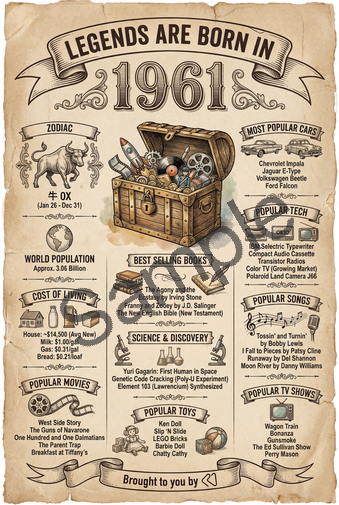

Major Events of 1961 - Historical Moments That Defined the Year | TakeMeBack.to
- 01 Jan First AFL Championship Game: The inaugural American Football League Championship Game was held on January 1, 1961, at Jeppesen Stadium in Houston, Texas. The Houston Oilers defeated the Los Angeles Chargers 24–16, with quarterback George Blanda leading the Oilers by throwing three touchdown passes and adding a field goal and three extra points. source: profootballhof.com
- 02 Jan 47th Rose Bowl: The 47th Rose Bowl took place on January 2, 1961, in Pasadena, California. The Washington Huskies defeated the Minnesota Golden Gophers 17–7, with Washington quarterback Bob Schloredt being named the game's Most Valuable Player. source: sports-reference.com
- 03 Jan US Marines Lower Flag at Cuban Embassy: On January 3, 1961, U.S. Marines lowered the American flag at the U.S. Embassy in Havana, Cuba, following the severance of diplomatic relations between the United States and Cuba. source: en.wikipedia.org
- 04 Jan Death of Erwin Schrödinger, Quantum Physics Pioneer: Erwin Schrödinger, the Austrian physicist renowned for his contributions to quantum mechanics, died of tuberculosis in Vienna at the age of 73. source: britannica.com
- 06 Jan University of Georgia desegregation milestone: On January 6, 1961, federal judge William Bootle ruled that Hamilton Holmes and Charlayne Hunter were qualified for immediate admission to the University of Georgia, marking a significant step in the desegregation of higher education in the South. source: news.uga.edu
- 08 Jan French referendum on Algerian policy: On January 8, 1961, a referendum was held in France regarding the self-determination of Algeria. This vote was crucial in determining the future of Algeria amidst the ongoing Algerian War of Independence. The outcome favored the government's proposal, leading to negotiations for Algerian independence. source: britannica.com
- 09 Jan Assassination of Patrice Lumumba: Patrice Lumumba, the first Prime Minister of the Democratic Republic of the Congo, was assassinated on January 9, 1961. His assassination was a pivotal moment in the Congo Crisis and had significant implications for the country's political landscape and Cold War dynamics. source: britannica.com
- 10 Jan Deaths of notable writers reported: On January 10, 1961, several notable writers were reported to have passed away, marking a significant loss in the literary community. This event highlighted the impact of these individuals on literature and culture. source: nytimes.com
- 11 Jan Racial tensions at University of Georgia: On January 11, 1961, following the enrollment of Hamilton E. Holmes and Charlayne Hunter, a riot erupted outside Hunter's dormitory, involving approximately 1,000 people, including members of the Ku Klux Klan, protesting the university's desegregation. source: en.wikipedia.org
- 12 Jan United Nations Genocide Convention Takes Effect: The United Nations Genocide Convention, adopted on December 9, 1948, entered into force on January 12, 1951, after 20 countries ratified it. This convention codified genocide as an international crime and obligated signatory nations to prevent and punish such acts. source: un.org
- 13 Jan Kent Hull born in Mississippi: Kent Hull, an American football center known for his time with the Buffalo Bills, was born on January 13, 1961, in Mississippi. He became a key player in the NFL and was recognized for his contributions to the sport. source: pro-football-reference.com
- 15 Jan Offshore Radar Tower Tragedy: On January 15, 1961, Texas Tower 4, a U.S. Air Force radar station located 63 miles off the coast of Long Island, collapsed during a severe nor'easter. The tower had previously suffered structural damage from Hurricane Donna in September 1960. Despite evacuation orders, the tower collapsed into the sea, resulting in the loss of all 28 crew members aboard. source: en.wikipedia.org
- 17 Jan Lumumba Assassination: Patrice Lumumba, the first Prime Minister of the Democratic Republic of the Congo, was executed by a firing squad on January 17, 1961, near Élisabethville (now Lubumbashi). His assassination was a significant event in Congo's post-independence history. source: britannica.com
- 19 Jan First episode of The Dick Van Dyke Show filmed: On January 19, 1961, the cast and crew of "The Dick Van Dyke Show" filmed the first episode of the sitcom, which would premiere on October 3, 1961. The show starred Dick Van Dyke and Mary Tyler Moore, and became a classic in television history. source: history.com
- 20 Jan John F. Kennedy Presidential Inauguration: On January 20, 1961, John F. Kennedy was inaugurated as the 35th President of the United States. The ceremony took place on the steps of the U.S. Capitol in Washington, D.C. source: archives.gov
- 21 Jan Poulenc's 'Gloria' premieres in Boston: On January 21, 1961, Francis Poulenc's 'Gloria' was premiered at Boston's Symphony Hall. The performance featured soprano Adele Addison, the Chorus Pro Musica, and the Boston Symphony Orchestra, conducted by Charles Munch. The concert was initially scheduled for January 20 but was postponed due to a blizzard. Poulenc, who attended the premiere, expressed satisfaction with the performance, noting it as 'very good, very fine, a success.' source: bso.org
- 22 Jan Portuguese rebels hijack Santa Maria cruise ship: On January 22, 1961, Portuguese and Spanish political rebels, led by Henrique Galvão, seized control of the Portuguese passenger ship Santa Maria. The hijacking aimed to draw international attention to the Estado Novo regime in Portugal. The ship, carrying approximately 600 passengers and 300 crew members, was diverted towards West Africa. After being surrounded by U.S. and British naval forces, the ship arrived in Recife, Brazil, on February 2, where the rebels were granted political asylum. source: en.wikipedia.org
- 23 Jan Goldsboro nuclear near-disaster: On January 23, 1961, a B-52 bomber carrying two nuclear bombs broke up in mid-air over Goldsboro, North Carolina. One of the bombs was accidentally activated, but fortunately, it did not detonate. This incident raised significant concerns about the safety of nuclear weapons and the protocols surrounding their transport. source: nytimes.com
- 24 Jan Goldsboro B-52 nuclear incident: On January 24, 1961, a B-52 bomber carrying nuclear weapons experienced a catastrophic failure, leading to the accidental release of one of its bombs. The incident highlighted the risks associated with nuclear weapons and the importance of stringent safety measures in military operations. source: nytimes.com
- 25 Jan Military coup in El Salvador: On January 25, 1961, a military coup took place in El Salvador, resulting in the overthrow of the existing government. This coup was part of a broader pattern of military interventions in Latin America during the Cold War, reflecting the geopolitical tensions of the era. source: britannica.com
- 27 Jan 'Sing Along with Mitch' TV show premiered: The musical variety show 'Sing Along with Mitch,' hosted by Mitch Miller, premiered on NBC on January 27, 1961. source: en.wikipedia.org
- 29 Jan Bob Dylan meets Woody Guthrie at Greystone Park Psychiatric Hospital: On January 29, 1961, Bob Dylan met his idol, Woody Guthrie, at Greystone Park Psychiatric Hospital in Morris Plains, New Jersey. Dylan performed his original song 'Song to Woody' for Guthrie, who was battling Huntington's disease. Guthrie approved of the song, which later appeared on Dylan's 1962 debut album. source: thecurrent.org
- 30 Jan Ranjit Madurasinghe Cricket Profile: Ranjit Madurasinghe, a Sri Lankan cricket player who represented his national team in three Test matches between 1988 and 1992.
- 31 Jan First Primate in Space: On January 31, 1961, a chimpanzee named Ham became the first primate in space aboard the Mercury-Redstone 2 mission. The suborbital flight lasted 16 minutes and 39 seconds, reaching an altitude of 253 kilometers. Ham's successful mission demonstrated that primates could survive space travel, paving the way for human space exploration. source: nasa.gov
- 02 Feb Barack Obama's parents get married in Hawaii: Barack Obama Sr. and Ann Dunham were married in Honolulu, Hawaii, on February 2, 1961. This marriage would later lead to the birth of Barack Obama, the 44th President of the United States. source: nbcnews.com
- 03 Feb NYC's 6th largest snowfall: On February 3, 1961, New York City experienced its sixth largest snowfall, with over 20 inches accumulating in some areas. This event caused significant disruptions in transportation and daily life. source: nytimes.com
- 04 Feb Sputnik 7 space mission: The Soviet Union launched Sputnik 7 on February 4, 1961, as part of its ongoing space exploration efforts. This mission contributed to the early stages of space research and satellite technology. source: nasa.gov
- 06 Feb KOAP-TV Channel 10 launches in Portland, Oregon: On February 6, 1961, KOAP-TV Channel 10 began broadcasting in Portland, Oregon, as a satellite station of KOAC-TV in Corvallis. The station, now known as KOPB-TV, was part of the Oregon Educational and Public Broadcasting Service and served as the flagship of Oregon Public Broadcasting. source: en.wikipedia.org
- 07 Feb Jane Fonda's Acting Debut: On February 7, 1961, Jane Fonda made her acting debut in the NBC drama 'A String of Beads' as Gloria Winters. source: brainyhistory.com
- 09 Feb The Beatles' first performance at the Cavern Club: The Beatles performed at the Cavern Club in Liverpool for the first time on February 9, 1961. This performance marked a significant moment in their early career, helping to establish their popularity in the UK music scene. source: bbc.com
- 10 Feb Niagara Falls hydroelectric project begins: The Niagara Falls hydroelectric project began operations on February 10, 1961, significantly contributing to the region's energy supply. This project utilized the natural power of the falls to generate electricity. source: energy.gov
- 11 Feb Assassination of Patrice Lumumba: Patrice Lumumba, the first Prime Minister of the Democratic Republic of the Congo, was assassinated on February 11, 1961. His death marked a pivotal moment in the country's tumultuous history and had lasting implications for its political landscape. source: bbc.com
- 12 Feb Mickey Wright wins LPGA Saint Petersburg Golf Open: On February 12, 1961, American professional golfer Mickey Wright secured victory at the LPGA Saint Petersburg Golf Open, further solidifying her reputation as one of the leading female golfers of her time.
- 13 Feb Frank Sinatra launches Reprise Records: On February 13, 1961, Frank Sinatra founded Reprise Records to gain greater artistic control over his music. The label's first release was Sinatra's own single, "The Second Time Around," recorded in December 1960. source: udiscovermusic.com
- 15 Feb Sabena Flight 548 crashes near Brussels Airport: On February 15, 1961, Sabena Flight 548, a Boeing 707 en route from New York City to Brussels, crashed on approach to Brussels Airport, killing all 72 people on board, including the entire U.S. figure skating team traveling to the World Figure Skating Championships in Prague. The crash remains the deadliest in Belgian history and the first involving a Boeing 707 in regular passenger service. source: britannica.com
- 16 Feb NASA Explorer 9 mission launched: On February 16, 1961, NASA launched Explorer 9, a satellite designed to study cosmic rays and solar wind. The mission aimed to enhance understanding of the Earth's magnetosphere and cosmic radiation. source: nasa.gov
- 17 Feb Lütfi Kırdar, Turkish statesman, passes away: On February 17, 1961, Lütfi Kırdar, a prominent Turkish statesman and former mayor of Istanbul, passed away. He was known for his contributions to urban development and modernization in Turkey. source: en.wikipedia.org
- 18 Feb Henk van der Grift becomes world champion skater: On February 18, 1961, Dutch speed skater Henk van der Grift won the World Allround Speed Skating Championships in Gothenburg, Sweden. He secured the title by winning the 1,500-meter race and narrowly defeating Soviet skater Viktor Kosichkin in the 10,000-meter event, becoming the first Dutch World Champion since 1905. source: olympics.com
- 19 Feb Netherlands Speed Skating Champion: On February 19, 1961, Dutch speed skater Henk van der Grift clinched the World Allround Speed Skating Championship in Gothenburg, Sweden. He achieved this by winning the 1,500-meter race and narrowly defeating Soviet skater Viktor Kosichkin in the 10,000-meter event, becoming the first Dutch World Champion since 1905. source: olympics.com
- 21 Feb Mercury-Atlas 2 test flight: On February 21, 1961, NASA conducted the Mercury-Atlas 2 (MA-2) test flight, an uncrewed mission aimed at evaluating the Mercury spacecraft's reentry capabilities under critical abort conditions. The flight successfully launched from Cape Canaveral, Florida, and lasted approximately 17 minutes and 56 seconds. source: nasa.gov
- 24 Feb Explorer (10) fails to reach Earth orbit: On February 24, 1961, the Explorer 10 satellite was launched but failed to achieve Earth orbit due to a malfunction. This event marked a setback in the early U.S. space program as it aimed to gather data on cosmic rays and solar radiation. source: nasa.gov
- 25 Feb End of Sydney's tramway era: On February 25, 1961, the last tram service in Sydney, Australia, was officially discontinued, marking the end of an era for public transport in the city. This decision was part of a broader shift towards bus and car transportation. source: sydney.com
- 26 Feb Hassan II ascends to Moroccan throne: On February 26, 1961, Hassan II officially ascended to the throne of Morocco following the death of his father, King Mohammed V. His reign would last until 1999, during which he implemented significant political and economic reforms. source: britannica.com
- 27 Feb Henry Kissinger appointed as National Security Council consultant: On February 27, 1961, President John F. Kennedy appointed Henry Kissinger as a part-time consultant to the National Security Council, tasking him with providing insights on specific national security issues as requested by the White House. source: jfklibrary.org
- 01 Mar Establishment of the Peace Corps: On March 1, 1961, President John F. Kennedy signed Executive Order 10924, establishing the Peace Corps as a new agency within the Department of State. The initiative aimed to send trained American volunteers abroad to assist in development efforts. source: history.com
- 03 Mar Cyprus Joins the Commonwealth: Cyprus became the first small country to join the Commonwealth of Nations, marking a significant milestone in its post-colonial political development.
- 06 Mar London introduces minicabs: On March 6, 1961, London witnessed the introduction of minicabs, a new form of private hire vehicle. Carline Cabs, based in Wimbledon, launched a fleet of 12 Ford Anglia 105Es, exploiting a loophole in the 1869 Carriage Act by operating vehicles that responded to telephone bookings rather than plying for hire on the streets. In their first week, these minicabs transported 500 passengers, offering fares two-thirds lower than traditional black cabs and providing better service to London's outer suburbs. source: telegraph.co.uk
- 08 Mar Max Conrad sets world record in global flight: On March 8, 1961, American aviator Max Conrad set a world record by completing a solo, non-stop flight around the world. Departing from and returning to the United States, Conrad's journey demonstrated the advancements in long-distance aviation capabilities. source: historynet.com
- 09 Mar Soviet Sputnik 9 space mission prepares for human spaceflight: On March 9, 1961, the Soviet Union prepared for the Sputnik 9 space mission, which was intended to carry a living organism into space as a precursor to human spaceflight. This mission was part of the Soviet space program's efforts to test the effects of space travel on living beings. source: russianspaceweb.com
- 11 Mar CIA presents invasion plans for Cuba: On March 11, 1961, CIA official Richard M. Bissell, Jr. presented 'Operation Trinidad,' a plan for an amphibious assault on Cuba, to President John F. Kennedy. The plan was rejected as 'too spectacular,' leading to the development of alternative strategies. source: en.wikipedia.org
- 13 Mar UK £5 black and white notes cease to be legal tender: On March 13, 1961, the Bank of England withdrew the old black and white £5 notes from circulation, rendering them no longer legal tender. These notes had been in use for many years and were replaced by new designs featuring the Queen's portrait. source: britishmuseum.org
- 14 Mar USAF B-52 nuclear weapons crash near Yuba City: On March 14, 1961, a B-52 bomber carrying nuclear weapons crashed near Yuba City, California. The incident raised significant concerns about nuclear safety and the handling of nuclear materials by the military. source: nytimes.com
- 15 Mar South Africa's Commonwealth withdrawal: On March 15, 1961, South Africa announced its withdrawal from the Commonwealth of Nations. This decision was largely influenced by the country's increasing isolation due to its apartheid policies. source: britannica.com
- 16 Mar Todd McFarlane born: Comic book artist and creator Todd McFarlane was born on March 16, 1961. He is best known for his work on Spider-Man and for creating the Spawn comic series. source: nytimes.com
- 17 Mar South Africa withdraws from the Commonwealth: On March 17, 1961, South African Prime Minister H.F. Verwoerd withdrew the country's application to remain within the British Commonwealth after facing opposition due to apartheid policies. source: sahistory.org.za
- 18 Mar Eurovision Song Contest 1961 held in Cannes: The Eurovision Song Contest 1961 took place on March 18, 1961, in Cannes, France, with Luxembourg's Jean-Claude Pascal winning with the song "Nous les amoureux." source: en.wikipedia.org
- 21 Mar Birth of Shawn Lane: Shawn Lane, an influential American guitarist known for his virtuosic playing style, was born on March 21, 1961. He gained recognition in the music industry for his technical skills and contributions to rock music. source: guitarworld.com
- 23 Mar Kennedy addresses Laos situation in press conference: On March 23, 1961, President John F. Kennedy held a press conference in Washington, D.C., where he discussed the escalating situation in Laos. He emphasized the United States' strong support for a neutral and independent Laos, free from external domination, and condemned the externally supported Communist attacks threatening this neutrality. Kennedy stated that if these attacks did not cease, the U.S. and its allies would consider their response. He also advocated for constructive negotiations and supported the British proposal for a cease-fire and an international conference on Laos. source: presidency.ucsb.edu
- 24 Mar Establishment of Quebec Board of the French Language: On March 24, 1961, the Quebec government established the Office québécois de la langue française (OQLF), also known as the Quebec Board of the French Language. This public organization was tasked with promoting the French language in Quebec, ensuring its correct usage, and protecting it from the influence of other languages, particularly English. The OQLF's mission included aligning with international French standards, promoting Canadian French expressions, and combating Anglicisms. source: en.wikipedia.org
- 25 Mar Explorer 10 Space Mission: Explorer 10, also known as Explorer X or P-14, was a NASA satellite launched on March 25, 1961, to investigate Earth's magnetic field and nearby plasma. It was the first satellite to measure the "shock wave" generated by a solar flare. source: en.wikipedia.org
- 26 Mar Louise Suggs wins LPGA Golden Circle of Golf Festival: On March 26, 1961, Louise Suggs won the Golden Circle of Golf Festival, a golf tournament on the LPGA Tour, played only in 1961 at the DeSota Lakes Golf & Country Club in Sarasota, Florida. source: en.wikipedia.org
- 29 Mar Twenty-third Amendment ratification: The Twenty-third Amendment to the United States Constitution was ratified, allowing residents of Washington, D.C. to vote in presidential elections. This amendment was significant in expanding democratic participation in the U.S. source: archives.gov
- 30 Mar NASA X-15 high-altitude flight record: On March 30, 1961, the NASA X-15 rocket plane achieved a new high-altitude flight record, reaching 67.6 miles above the Earth. This flight was part of a series of missions that contributed to the understanding of aeronautics and space travel. source: nasa.gov
- 31 Mar Mercury spacecraft prepared for orbital test: On March 31, 1961, NASA prepared the Mercury spacecraft for its upcoming orbital test flight. This mission was crucial in the early stages of the U.S. space program, paving the way for future manned space missions. source: nasa.gov
- 01 Apr Susan Boyle's birth: Susan Boyle, the Scottish singer who gained fame on 'Britain's Got Talent,' was born on April 1, 1961. She became an international sensation after her audition in 2009, showcasing her powerful singing voice. source: britannica.com
- 02 Apr First simulated Project Mercury orbital mission: The first simulated orbital mission of Project Mercury took place on April 2, 1961. This mission was crucial for testing the systems and procedures that would be used in actual spaceflights. source: nasa.gov
- 03 Apr Eddie Murphy born: Eddie Murphy, the acclaimed American actor and comedian, was born on April 3, 1961. He gained fame in the 1980s and has since become one of the most successful comedians in film history. source: britannica.com
- 04 Apr Carlos Marcello FBI arrest: On April 4, 1961, mob boss Carlos Marcello was arrested by the FBI in New Orleans. His arrest was part of a larger investigation into organized crime and its connections to political figures. source: nytimes.com
- 05 Apr Barbra Streisand appears on Jack Paar show: On April 5, 1961, Barbra Streisand made her television debut on The Jack Paar Show. This appearance helped launch her career and introduced her powerful singing voice to a national audience. source: rollingstone.com
- 06 Apr First human space flight: Yuri Gagarin orbits Earth: On April 6, 1961, Yuri Gagarin became the first human to orbit the Earth aboard Vostok 1. This historic flight marked a significant achievement in the Space Race between the United States and the Soviet Union. source: nasa.gov
- 07 Apr Argentina-Uruguay River Uruguay Boundary Treaty: On April 7, 1961, Argentina and Uruguay signed the Treaty concerning the boundary constituted by the River Uruguay in Montevideo, aiming to resolve the dispute over the river's waters and islands. source: dipublico.org
- 10 Apr Gary Player wins Masters Tournament: On April 10, 1961, South African golfer Gary Player became the first international champion at the Masters Tournament, defeating defending champion Arnold Palmer and amateur Charles Coe by one stroke. source: history.com
- 12 Apr D.D. Verni born in New Jersey: Carlo "D.D." Verni, an American musician best known as a founding member, bassist, and songwriter of the thrash metal band Overkill, was born in New Jersey on April 12, 1961. source: en.wikipedia.org
- 16 Apr Fidel Castro declares himself a Marxist-Leninist: On April 16, 1961, Fidel Castro publicly declared his commitment to Marxism-Leninism during a speech in Havana, Cuba. This announcement marked a significant shift in Cuba's political landscape and solidified its alignment with the Soviet Union during the Cold War. source: britannica.com
- 17 Apr 33rd Academy Awards: The 33rd Academy Awards were held on April 17, 1961, honoring the best films of 1960. This prestigious event recognized outstanding achievements in the film industry, including Best Picture and Best Director awards. source: britannica.com
- 18 Apr Vienna Convention on Diplomatic Relations adopted: The Vienna Convention on Diplomatic Relations was adopted on April 18, 1961, establishing the framework for diplomatic relations between independent countries. This treaty is a cornerstone of international law regarding diplomatic immunity and the conduct of diplomatic missions. source: un.org
- 19 Apr Bay of Pigs invasion detailed account: The Bay of Pigs invasion, which occurred in April 1961, was a failed military invasion of Cuba by a CIA-sponsored paramilitary group. The event is significant in Cold War history and has been extensively documented and analyzed. source: cia.gov
- 20 Apr Bay of Pigs Invasion Failure: On April 20, 1961, the U.S.-backed Cuban exile force, Brigade 2506, surrendered to Cuban forces after a failed invasion at the Bay of Pigs. The operation aimed to overthrow Fidel Castro's government but resulted in a significant defeat for the invaders. source: britannica.com
- 21 Apr Judy Garland's Historic Carnegie Hall Concert: On April 23, 1961, Judy Garland performed a legendary comeback concert at Carnegie Hall in New York City, receiving a standing ovation as she arrived on stage, and five minutes of cheering. source: en.wikipedia.org
- 23 Apr Algiers Putsch by French Generals: On April 23, 1961, retired French generals Maurice Challe, André Zeller, and Raoul Salan initiated the Algiers Putsch, a failed coup d'état against President Charles de Gaulle's government. source: en.wikipedia.org
- 25 Apr French nuclear test in Algeria: On April 25, 1961, France conducted a nuclear test in Algeria, part of its series of tests during the Algerian War. This test was controversial and raised international concerns regarding nuclear proliferation and the environmental impact of such tests. It was part of France's efforts to establish itself as a nuclear power. source: bbc.com
- 26 Apr French paratroopers' revolt in Algeria: On April 26, 1961, a revolt by French paratroopers occurred in Algeria, opposing the French government's negotiations to end the Algerian War. This uprising was part of a larger conflict involving military factions that were against the peace process. The revolt highlighted the tensions within France regarding its colonial policies. source: aljazeera.com
- 27 Apr Sierra Leone gains independence: On April 27, 1961, Sierra Leone gained independence from British colonial rule. This significant event marked the beginning of self-governance for the nation and was celebrated by its citizens. The independence movement was part of a broader wave of decolonization across Africa during the 20th century. source: bbc.com
- 28 Apr Soviet high-altitude flight record: On April 28, 1961, the Soviet Union set a new high-altitude flight record, demonstrating advancements in aviation technology during the Cold War era. This achievement was part of the ongoing competition in aerospace capabilities between the U.S. and the USSR. source: nasa.gov
- 30 Apr Soviet nuclear submarine K-19 commissioned: The Soviet Union commissioned the K-19, its first nuclear-powered ballistic missile submarine, on April 30, 1961. This vessel was part of the Project 658 class, also known as the Hotel class, and was equipped with nuclear ballistic missiles. The K-19 was constructed rapidly in response to the United States' advancements in nuclear submarines during the Cold War arms race. source: en.wikipedia.org
- 01 May UK Legalizes Betting Shops: The Betting and Gaming Act 1960 legalized betting shops in the UK, allowing them to open from May 1, 1961. This legislation permitted betting shops to operate legally, marking a significant change in the UK's gambling landscape. source: en.wikipedia.org
- 03 May British Diplomat George Blake Sentenced for Espionage: On May 3, 1961, British diplomat George Blake was sentenced to 42 years in prison for espionage after admitting to passing classified information to the Soviet Union. His actions led to the exposure of numerous British agents. source: britannica.com
- 05 May First American in space: Alan Shepard's historic flight: On May 5, 1961, Alan Shepard became the first American to travel into space aboard the Freedom 7 spacecraft. This suborbital flight lasted about 15 minutes and marked a significant milestone in the U.S. space program during the Cold War. Shepard's mission paved the way for future manned space exploration. source: nasa.gov
- 06 May Tottenham Hotspur's historic double: On May 6, 1961, Tottenham Hotspur secured the FA Cup, completing a historic double by also winning the league title that season. This achievement marked the first time a club had won both the league and FA Cup in the same season since the war, solidifying Spurs' place in football history. source: bbc.com
- 07 May Mount Pelée catastrophic eruption: On May 7, 1961, Mount Pelée erupted catastrophically, causing significant destruction and loss of life. This volcanic event was one of the most devastating in the region's history, impacting the local population and environment. The eruption highlighted the dangers posed by active volcanoes. source: usgs.gov
- 09 May Jim Gentile hits two grand slams in consecutive innings: On May 9, 1961, Baltimore Orioles first baseman Jim Gentile became the first player in Major League Baseball history to hit two grand slams in consecutive innings. In a game against the Minnesota Twins, Gentile's grand slams in the first and second innings contributed to the Orioles' 13-5 victory. He finished the game with nine RBIs. source: sabr.org
- 12 May Botvinnik wins World Chess Championship rematch against Tal: On May 12, 1961, Mikhail Botvinnik defeated Mikhail Tal 13–8 in a World Chess Championship rematch in Moscow, regaining the title he had lost to Tal the previous year. source: en.wikipedia.org
- 15 May Breakthrough in Genetic Code Understanding: On May 15, 1961, significant advancements were made in understanding the genetic code, which laid the groundwork for molecular biology. This breakthrough was pivotal in the study of genetics and the development of biotechnology. source: nature.com
- 16 May South Korean Military Coup: On May 16, 1961, a military coup in South Korea led by General Park Chung-hee overthrew the government of President Yun Bo-seon. This event marked the beginning of a military regime that would last for several years, significantly impacting South Korean politics. source: bbc.com
- 17 May President Kennedy's address to Canadian Parliament: On May 17, 1961, President John F. Kennedy delivered an address to the Canadian Parliament in Ottawa, emphasizing the strong relationship between the United States and Canada. He stated, "Geography has made us neighbours. History has made us friends. Economics has made us partners. And necessity has made us allies." source: jfklibrary.org
- 19 May Venera 1: First spacecraft to fly by another planet: Venera 1, launched by the Soviet Union on February 12, 1961, was the first spacecraft to perform an interplanetary flight and the first to fly past Venus. However, radio contact was lost before the flyby, resulting in no data being returned. source: nasa.gov
- 21 May Martial law declared in Montgomery during civil rights unrest: On May 21, 1961, a white mob surrounded the First Baptist Church in Montgomery, Alabama, where over 1,000 Black residents and civil rights leaders, including Dr. Martin Luther King Jr., were attending a service supporting the Freedom Riders. The mob vandalized parked cars and threatened violence. In response, Alabama Governor John Patterson declared martial law, deploying National Guard troops to restore order. Authorities arrested 17 white rioters, and by midnight, the streets were calm enough for those in the church to leave. source: calendar.eji.org
- 22 May 5.5 magnitude earthquake strikes New South Wales, Australia: On May 22, 1961, a 5.5 magnitude earthquake, known as the Robertson earthquake, struck New South Wales, Australia. The epicenter was near Robertson, and the tremors were felt across a wide area, including Sydney, Dubbo, and Narrandera. The earthquake caused significant structural damage in towns like Robertson, Bowral, and Moss Vale, with rockfalls blocking the Illawarra Highway at Macquarie Pass. Sydney experienced minimal damage but felt the tremors sharply, leading to power disruptions. source: en.wikipedia.org
- 24 May Cyprus joins the Council of Europe: On May 24, 1961, Cyprus officially became a member of the Council of Europe, enhancing its international presence and commitment to democratic values. This membership marked a significant step in Cyprus's post-independence journey, aligning it with European political and legal standards. source: coe.int
- 25 May Kennedy's moon landing challenge: On May 25, 1961, President John F. Kennedy delivered a speech before Congress, challenging the nation to land a man on the Moon before the end of the decade. This ambitious goal galvanized the U.S. space program and set the stage for the Apollo missions. source: nasa.gov
- 26 May Freedom Ride Coordinating Committee established: On May 26, 1961, the Freedom Ride Coordinating Committee was established to organize and support the Freedom Rides, which aimed to challenge segregation in interstate bus travel. This initiative was a pivotal moment in the Civil Rights Movement, promoting racial equality and justice. source: archives.gov
- 27 May Kennedy's Moon Landing Commitment: On May 27, 1961, President John F. Kennedy committed the United States to landing a man on the Moon before the end of the decade, setting the goal of achieving this feat by 1970. source: archives.gov
- 29 May Melissa Etheridge born in Leavenworth, Kansas: Melissa Lou Etheridge, an American singer-songwriter and guitarist, was born on May 29, 1961, in Leavenworth, Kansas. She is known for her raspy-voiced rock-and-roll singing and has been an outspoken advocate for women's causes. source: britannica.com
- 31 May Republic of South Africa Established: South Africa officially became a republic, ending its status as a British dominion. The last Governor-General, Charles R. Swart, was sworn in as the first State President. source: sahistory.org.za
- 02 Jun George S. Kaufman, Pulitzer Prize-Winning Playwright, Dies: George S. Kaufman, an American playwright, theater director, and producer, died in New York City at the age of 71. He was renowned for his comedies and political satires, winning the Pulitzer Prize for Drama in 1932 and 1937. source: en.wikipedia.org
- 04 Jun Kennedy-Khrushchev Vienna Summit: On June 4, 1961, U.S. President John F. Kennedy and Soviet Premier Nikita Khrushchev met in Vienna, Austria, to discuss Cold War issues, including the Berlin Crisis and the situation in Laos. The summit aimed to ease tensions but ended without significant agreements, leading to increased Cold War confrontations. source: jfk.org
- 05 Jun Vienna Summit Between Kennedy and Khrushchev: The Vienna Summit continued on June 5, 1961, with President Kennedy and Premier Khrushchev engaging in further discussions. The focus remained on the Berlin Crisis, with Khrushchev reiterating his plans to sign a peace treaty with East Germany, which could undermine Western access rights to West Berlin. Kennedy emphasized the importance of maintaining these rights, underscoring the potential for conflict if they were violated. The summit concluded without a concrete agreement, reflecting the deepening Cold War tensions. source: historycentral.com
- 06 Jun Death of Carl Gustav Jung: Carl Gustav Jung, the Swiss psychiatrist and psychoanalyst who founded analytical psychology, passed away on June 6, 1961. Jung's work, including concepts like the collective unconscious and archetypes, has had a profound impact on psychology, psychiatry, and psychotherapy. His theories continue to influence various fields, including literature, religion, and art. source: en.wikipedia.org
- 07 Jun California Launches Japanese Beetle Prevention Campaign: On June 7, 1961, California initiated a campaign to prevent the spread of the Japanese beetle, an invasive species known to damage a wide range of plants. The campaign included measures such as quarantines, inspections, and public education to protect the state's agriculture and natural resources from the beetle's destructive impact. source: en.wikipedia.org
- 08 Jun First public jet pack demonstration: On June 8, 1961, Bell Laboratories test pilot Harold Graham made the first public demonstration of a jet pack, flying the Bell Rocket Belt at Fort Eustis, Virginia, before a crowd of several hundred military officers and their guests. source: en.wikipedia.org
- 10 Jun Establishment of KCIA: On June 10, 1961, the Korean Central Intelligence Agency (KCIA) was established in South Korea. The agency was created to oversee intelligence operations and national security matters.
- 11 Jun 1961 24 Hours of Le Mans winner: The 1961 24 Hours of Le Mans, held on June 11, 1961, was won by the Ferrari team. The race was part of the World Sportscar Championship and featured various manufacturers competing for the title.
- 12 Jun KLM Flight 823 crashes near Cairo International Airport: On June 12, 1961, KLM Flight 823, a Lockheed L-188 Electra, crashed on approach to Cairo International Airport, Egypt, after departing from Rome, Italy. The crash resulted in the deaths of 20 out of 36 people on board, including 17 passengers and 3 crew members. The accident was attributed to pilot error, specifically the pilot-in-command's insufficient attention to instruments during the approach. source: en.wikipedia.org
- 15 Jun The Supremes signed to Motown Records: On June 15, 1961, The Supremes, an American female singing group, signed with Motown Records, marking a significant milestone in their career. source: motownmuseum.org
- 16 Jun Dave Garroway leaves Today Show: Dave Garroway, the original host of NBC's 'Today' show, departed on June 16, 1961, after a decade-long tenure, citing personal reasons and a desire to spend more time with his children. source: en.wikipedia.org
- 17 Jun Gene Littler wins U.S. Open: Gene Littler clinched the 1961 U.S. Open at Oakland Hills Country Club in Birmingham, Michigan, with a final score of 281 (+1). He secured his only major title by one stroke over runners-up Bob Goalby and Doug Sanders. source: en.wikipedia.org
- 19 Jun US Supreme Court decision in Torcaso v. Watkins: On June 19, 1961, the US Supreme Court ruled in Torcaso v. Watkins that state governments cannot require a religious test for public officeholders, reaffirming the prohibition of religious tests under the Constitution. source: en.wikipedia.org
- 22 Jun The Beatles record in Hamburg: On June 22, 1961, The Beatles recorded at the Star-Club in Hamburg, Germany. This session was pivotal in their early development as a band, capturing their energetic performances and raw sound. source: bbc.com
- 23 Jun Antarctic Treaty System comes into force: The Antarctic Treaty System came into force on June 23, 1961, establishing Antarctica as a zone of peace and scientific cooperation. This treaty was signed by multiple nations, promoting international collaboration in scientific research. source: state.gov
- 24 Jun Kennedy directs space program unification: On June 24, 1961, President John F. Kennedy directed the unification of the U.S. space program, emphasizing the need for a coordinated effort in space exploration. This marked a significant step in the U.S. response to the space race. source: nasa.gov
- 25 Jun Kuwait requests British military assistance: Following Iraq's claim over Kuwait on June 25, 1961, the Emir of Kuwait declared a state of emergency and sought British military aid. British forces were deployed to Kuwait on July 1, 1961, to defend its sovereignty. source: hansard.parliament.uk
- 26 Jun Death of Carl Jung: Swiss psychiatrist Carl Jung, known for founding analytical psychology, died on June 26, 1961. His work on the collective unconscious and archetypes significantly influenced psychology and psychotherapy. source: en.wikipedia.org
- 29 Jun Transit 4a satellite launch with nuclear power supply: The Transit 4a satellite was launched on June 29, 1961, as part of the U.S. Navy's navigation satellite program. It was notable for being the first satellite to carry a nuclear power source, which allowed it to operate for an extended period. This launch marked a significant advancement in satellite technology and military navigation systems. source: nasa.gov
- 30 Jun Explorer 12 satellite launch failure: Explorer 12 was intended to study cosmic rays and was launched on June 30, 1961. Unfortunately, the satellite failed to reach orbit due to a launch vehicle malfunction. This incident highlighted the challenges faced in early space exploration efforts. source: nasa.gov
- 01 Jul Establishment of Haleakala National Park: Haleakala National Park was established on July 1, 1961, in Hawaii, protecting the unique ecosystems and landscapes of the Haleakala volcano. The park is known for its diverse flora and fauna, as well as its stunning sunrises and sunsets, attracting visitors from around the world. source: nps.gov
- 05 Jul Israel's first rocket launch: On July 5, 1961, Israel launched the Shavit 2 rocket, its first domestically developed sounding rocket, designed for meteorological research. The launch took place from a secret site on the Mediterranean coast, marking Israel as the third country to fire and track a sounding rocket. source: digital.bentley.umich.edu
- 07 Jul James R. Hoffa re-elected as Teamsters president: On July 7, 1961, James R. Hoffa was re-elected by acclamation to a new five-year term as president of the International Brotherhood of Teamsters during the union's convention in Miami Beach. This re-election solidified Hoffa's control over the largest labor union in the United States. source: realtime1960s.com
- 10 Jul First Human Spaceflight: Vostok 1 Mission: On July 10, 1961, the Soviet Union successfully launched Vostok 1, marking the first human spaceflight. Yuri Gagarin became the first human to orbit the Earth, completing one full orbit in approximately 108 minutes. source: nasa.gov
- 11 Jul Kennedy State Dinner for Pakistani President: On July 11, 1961, President John F. Kennedy hosted a state dinner for President Ayub Khan of Pakistan at the White House. The event aimed to strengthen U.S.-Pakistan relations during a time of geopolitical tension. source: washingtonpost.com
- 12 Jul Pune Dam Disaster: The Pune Dam disaster occurred on July 12, 1961, when heavy rains caused a dam to overflow, leading to flooding in nearby areas. The event highlighted the need for better infrastructure and disaster management in India. source: thehindu.com
- 13 Jul Death of Arnold Schoenberg, Pioneering Composer: Arnold Schoenberg, an Austrian-American composer and music theorist, passed away on July 13, 1951, in Los Angeles, California. He was a pivotal figure in 20th-century music, known for developing the twelve-tone technique, which profoundly influenced modern composition. Schoenberg's works include 'Verklärte Nacht' and 'Suite for Piano, Op. 25.' source: britannica.com
- 14 Jul Pope John XXIII Publishes Encyclical Mater et Magistra: On July 14, 1961, Pope John XXIII published the encyclical 'Mater et Magistra' ('Mother and Teacher'), addressing the Church's role in social issues and advocating for social justice and economic development. The document emphasized the need for solidarity among nations and the importance of addressing poverty and inequality. source: vatican.va
- 15 Jul Birth of Lolita Davidovich: Lolita Davidovich, a Canadian actress known for her roles in films such as "Blaze" and "Leap of Faith," was born on July 15, 1961, in London, Ontario, Canada. source: en.wikipedia.org
- 16 Jul US Long Jump Record Set by Ralph Boston: On July 16, 1961, during the USA–USSR Track and Field Dual Meet in Moscow, Ralph Boston set a world record in the long jump with a leap of 8.28 meters (27 feet 2 inches). source: en.wikipedia.org
- 19 Jul Tunisia-France conflict at Bizerte: On July 19, 1961, tensions escalated between Tunisia and France over the Bizerte naval base. Tunisia sought full sovereignty over the base, leading to confrontations with French forces stationed there. This conflict was part of Tunisia's broader efforts to assert independence and control over its territory. source: britannica.com
- 20 Jul French military breaks Tunisian siege of Bizerte: On July 20, 1961, French military forces successfully broke the Tunisian siege of the Bizerte naval base. The operation aimed to restore French control over the base, which had been under siege by Tunisian forces seeking full sovereignty. The intervention led to significant casualties and further strained relations between Tunisia and France. source: britannica.com
- 21 Jul Mercury-Redstone 4 mission: Gus Grissom's suborbital spaceflight: On July 21, 1961, astronaut Virgil "Gus" Grissom piloted the Mercury-Redstone 4 mission, also known as Liberty Bell 7. The suborbital flight lasted 15 minutes and 37 seconds, reaching an altitude of 118 miles and a range of 303 miles. The mission concluded with a premature hatch blowout during recovery, causing the spacecraft to sink, but Grissom was safely rescued. source: nasa.gov
- 22 Jul British and Saudi troops arrive in Kuwait: On July 22, 1961, British and Saudi troops were deployed to Kuwait in response to regional tensions and the threat of Iraqi aggression. This military presence was part of a broader strategy to stabilize the region and protect Kuwait's sovereignty during a period of uncertainty in the Middle East. source: bbc.com
- 23 Jul Sandinista National Liberation Front founding: The Sandinista National Liberation Front (FSLN) was founded on July 23, 1961, in Nicaragua. This revolutionary group aimed to overthrow the Somoza dictatorship and promote social justice in the country. The FSLN would later play a significant role in Nicaraguan politics and the Sandinista Revolution. source: britannica.com
- 24 Jul Tsar Bomba nuclear test conducted by the Soviet Union: On July 24, 1961, the Soviet Union conducted the Tsar Bomba test, the most powerful nuclear weapon ever detonated. This test was a significant demonstration of military capability during the Cold War. source: britannica.com
- 25 Jul President Kennedy delivers Berlin Crisis speech: On July 25, 1961, President John F. Kennedy delivered a pivotal speech in Berlin, addressing the tensions of the Cold War and reaffirming U.S. support for West Berlin. His speech was a significant moment in U.S.-German relations. source: archives.gov
- 29 Jul Philadelphia Phillies begin historic losing streak: On July 29, 1961, the Philadelphia Phillies lost to the San Francisco Giants 4-3, marking the start of a 23-game losing streak that lasted until August 20, 1961. This remains the longest losing streak in Major League Baseball history since 1900. source: inquirer.com
- 31 Jul MLB All-Star Game Ends in Rare Tie Due to Rain: On July 31, 1961, the second Major League Baseball All-Star Game was played at Fenway Park in Boston. The game ended in a 1–1 tie after nine innings due to heavy rain, marking the first tie in All-Star history. source: mlb.com
- 01 Aug San Francisco Hall of Justice Opens: The new San Francisco Hall of Justice is inaugurated, providing a modern facility for law enforcement and judicial operations in the city.
- 02 Aug The Beatles perform at Liverpool's Cavern Club: On August 2, 1961, The Beatles performed two shows at Liverpool's Cavern Club, marking their 27th appearance at the venue. They were the headliners for the evening show, supported by Karl Terry and the Cruisers, and Dale Roberts and the Jaywalkers. source: beatlesbible.com
- 03 Aug Suicide Act 1961 decriminalizes suicide in the UK: On August 3, 1961, the Suicide Act 1961 received Royal Assent in the United Kingdom, decriminalizing suicide and the act of assisting suicide. source: legislation.gov.uk
- 04 Aug Clarence Earl Gideon convicted without counsel in Florida: On August 4, 1961, Clarence Earl Gideon was convicted in Florida for breaking and entering with intent to commit petty larceny. He was denied legal counsel during his trial, leading to the landmark Supreme Court case Gideon v. Wainwright, which established the right to appointed counsel for indigent defendants in state felony cases. source: britannica.com
- 05 Aug Six Flags Over Texas opens in Arlington, Texas: Six Flags Over Texas, the first amusement park in the Six Flags chain, opened on August 5, 1961, in Arlington, Texas. The park featured six themed areas representing the flags that have governed Texas: Spain, France, Mexico, the Republic of Texas, the United States, and the Confederate States of America. source: en.wikipedia.org
- 06 Aug First documented case of space motion sickness by Gherman Titov: On August 6, 1961, Soviet cosmonaut Gherman Titov became the first person to experience space motion sickness during his Vostok 2 mission. Shortly after achieving orbit, Titov reported nausea and vomiting, marking the first recorded instance of space sickness. This condition, similar to motion sickness on Earth, is caused by the changes in gravity experienced during spaceflight. source: guinnessworldrecords.com
- 07 Aug Milgram Experiment begins at Yale University: On August 7, 1961, psychologist Stanley Milgram began his series of experiments at Yale University to study obedience to authority figures. The experiments involved participants being instructed to administer increasingly severe electric shocks to a person (who was actually an actor) to assess the extent to which individuals would follow orders, even when they conflicted with personal ethics. The results revealed the powerful influence of authority on human behavior. source: en.wikipedia.org
- 08 Aug Marvel Comics introduces the Fantastic Four: On August 8, 1961, Marvel Comics published 'Fantastic Four' #1, marking the debut of the superhero team consisting of Reed Richards, Sue Storm, Johnny Storm, and Ben Grimm. This comic, written by Stan Lee and illustrated by Jack Kirby, is considered the beginning of the Marvel Age of Comics. source: marvel.com
- 09 Aug First African American Federal District Court Judge Appointed: On August 9, 1961, President John F. Kennedy appointed Thurgood Marshall as the first African American federal district court judge. Marshall was a prominent civil rights lawyer and later became the first African American Supreme Court Justice in 1967. source: archives.gov
- 10 Aug United Kingdom's First EEC Membership Application: On August 10, 1961, the United Kingdom submitted its first application to join the European Economic Community (EEC), marking the beginning of its journey towards European integration. This application was later withdrawn in 1963, but the UK would reapply and eventually join the EEC in 1973. source: gov.uk
- 11 Aug Warren Spahn achieves 300-win milestone: On August 11, 1961, Warren Spahn of the Milwaukee Braves secured his 300th career victory by defeating the Chicago Cubs 2-1 at County Stadium. Spahn pitched a complete game, allowing one run on six hits, and also contributed offensively with a sacrifice fly that drove in the game's first run. source: baseballhall.org
- 13 Aug Construction of the Berlin Wall begins: The construction of the Berlin Wall started on August 13, 1961, as East Germany sought to stop the mass emigration of its citizens to the West. This event marked a significant escalation in Cold War tensions and symbolized the division of East and West Berlin. source: britannica.com
- 14 Aug Jomo Kenyatta released from prison: Jomo Kenyatta was released from prison on August 14, 1961, after being detained for several years. His release marked a pivotal moment in Kenya's struggle for independence from British colonial rule. source: britannica.com
- 15 Aug First Saturn rocket arrives at Kennedy Space Center: The first Saturn rocket arrived at Kennedy Space Center on August 15, 1961, marking a significant milestone in the U.S. space program. This rocket would play a crucial role in future Apollo missions to the Moon. source: nasa.gov
- 16 Aug Dissolution of United Arab Republic agreement: The United Arab Republic, a political union between Egypt and Syria, effectively dissolved on August 16, 1961. This dissolution marked the end of a brief experiment in Arab unity, with Syria re-establishing its independence. source: britannica.com
- 17 Aug Kennedy administration launches Alliance for Progress: On August 17, 1961, President John F. Kennedy announced the Alliance for Progress, aimed at establishing economic cooperation between the United States and Latin America. This initiative sought to counteract the influence of communism in the region. source: britannica.com
- 19 Aug Lyndon B. Johnson visits West Berlin during Cold War tensions: On August 19, 1961, U.S. President Lyndon B. Johnson visited West Berlin to express solidarity with the citizens of West Berlin amid rising tensions due to the construction of the Berlin Wall. His visit was a significant show of support for the West during the Cold War. source: nytimes.com
- 20 Aug Death of Percy Williams Bridgman: Percy Williams Bridgman, an American physicist and Nobel laureate, passed away on August 20, 1961. He was known for his work in high-pressure physics and made significant contributions to the field. source: britannica.com
- 21 Aug Jomo Kenyatta released from detention: On August 21, 1961, Jomo Kenyatta, leader of the Kenyan independence movement, was released by British colonial authorities after nearly nine years of imprisonment and detention. His release paved the way for Kenya's independence in 1963, with Kenyatta becoming the country's first prime minister. source: britannica.com
- 30 Aug Charles Coburn dies: American actor Charles Coburn, known for his roles in films like "The More the Merrier," died of a heart attack in New York City on August 30, 1961. source: britannica.com
- 31 Aug Soviet Union resumes nuclear testing: On August 31, 1961, Soviet Premier Nikita Khrushchev announced the Soviet Union's decision to resume nuclear weapons testing, ending a three-year moratorium. The following day, September 1, the Soviet Union conducted an atmospheric nuclear test, marking the beginning of a new series of tests. source: nuclearweaponarchive.org
- 01 Sep Eritrean War of Independence begins: The Eritrean War of Independence commenced on September 1, 1961, when the Eritrean Liberation Front (ELF) initiated armed resistance against Ethiopian forces. The conflict aimed to achieve self-determination and independence for Eritrea from Ethiopian rule. source: en.wikipedia.org
- 02 Sep Eric Dickerson birth: Eric Demetric Dickerson, a former professional football player, was born on September 2, 1960, in Sealy, Texas. He played as a running back for 11 seasons in the NFL, primarily with the Los Angeles Rams, and is widely regarded as one of the greatest running backs of all time. source: en.wikipedia.org
- 04 Sep Carol Burnette-Richard Hayes Show premieres on CBS radio: The 'Carol Burnette-Richard Hayes Show,' a 20-minute musical variety program, premiered on CBS Radio on September 4, 1961. The show featured Carol Burnett, known for her role on 'The Garry Moore Show,' and singer Richard Hayes, who had been a regular on Arthur Godfrey's daily radio show. source: mediaconfidential.blogspot.com
- 06 Sep Soviet Union conducts high-altitude nuclear test at Kapustin Yar: On September 6, 1961, the Soviet Union conducted a high-altitude nuclear test, known as Test No. 88, at Kapustin Yar, a military test range in Astrakhan. The test involved launching a nuclear warhead atop a R-5M rocket, which detonated at an altitude of 22.7 kilometers, releasing an estimated yield of 10.5 kilotons. This test was part of the Soviet Union's efforts to develop anti-ballistic missile systems and study the effects of nuclear explosions at high altitudes. source: futurescience.com
- 09 Sep Maria Beale Fletcher wins Miss America 1962: On September 9, 1961, Maria Beale Fletcher of Asheville, North Carolina, was crowned Miss America 1962 at the Boardwalk Hall in Atlantic City, New Jersey. She became the first contestant representing North Carolina to win the title. source: dncr.nc.gov
- 10 Sep Deadly Formula One crash at Monza: On September 10, 1961, during the Italian Grand Prix at Monza, German driver Wolfgang von Trips collided with Jim Clark's Lotus. His Ferrari became airborne, crashed into a side barrier, and killed both von Trips and 15 spectators. source: en.wikipedia.org
- 11 Sep Hurricane Carla devastates Texas coast: On September 11, 1961, Hurricane Carla made landfall on the Texas coast, causing widespread damage and resulting in at least 34 fatalities. source: en.wikipedia.org
- 12 Sep African and Malagasy Union Established: On September 12, 1961, the African and Malagasy Union (AMU) was founded in Antananarivo, Madagascar. This intergovernmental organization aimed to promote cooperation among newly independent Francophone African states. The AMU's objectives included adopting common stances on international issues, fostering economic and cultural cooperation, and maintaining a common defense organization. However, the organization faced challenges due to its dependence on France and the diverse post-colonial issues of its member countries. source: en.wikipedia.org
- 13 Sep Mercury-Atlas 4 Orbital Mission: On September 13, 1961, NASA successfully launched Mercury-Atlas 4 (MA-4), the first uncrewed orbital flight of the Mercury program. The mission demonstrated the Atlas rocket's capability to place the Mercury capsule into orbit and validated the capsule's autonomous systems. The flight lasted 1 hour, 49 minutes, and 20 seconds, completing one orbit before safely splashing down in the Atlantic Ocean. source: en.wikipedia.org
- 14 Sep Dmitri Shostakovich joins Communist Party of the Soviet Union: In September 1961, renowned composer Dmitri Shostakovich became a member of the Communist Party of the Soviet Union. This decision was influenced by his appointment as Chairman of the RSFSR Union of Composers, a position that required Party membership. Shostakovich's son recalled that the event reduced him to tears, and he later told his wife Irina that he had been blackmailed. source: en.wikipedia.org
- 15 Sep United States resumes underground nuclear testing: On September 15, 1961, the United States resumed underground nuclear testing. This marked a significant development in the Cold War era, as the U.S. continued to advance its nuclear capabilities. source: history.com
- 16 Sep USSR conducts nuclear test: On September 16, 1961, the Soviet Union conducted a nuclear test at the Novaya Zemlya test site. This test was part of a series of nuclear detonations during the Cold War, contributing to the arms race between the USSR and the United States. source: armscontrol.org
- 17 Sep Northwest Orient Airlines Flight 706 crash: On September 17, 1961, Northwest Orient Airlines Flight 706 crashed near the Minneapolis-St. Paul International Airport, resulting in the loss of all 48 people on board. The incident raised concerns about aviation safety and regulations. source: ntsb.gov
- 18 Sep UN Secretary-General Dag Hammarskjöld dies in plane crash: On September 18, 1961, United Nations Secretary-General Dag Hammarskjöld died in a plane crash near Ndola, Northern Rhodesia (now Zambia), while on a peace mission to the Congo. All 16 people aboard, including Hammarskjöld, were killed. The cause of the crash remains a subject of investigation and debate. source: un.org
- 21 Sep Disney's television transition to color and NBC: On September 21, 1961, Disney's television shows began broadcasting in color, marking a significant transition in television history. This change was part of a broader trend in the industry as networks like NBC adopted color programming to enhance viewer experience. source: nbcnews.com
- 22 Sep Peace Corps Act signed into law: On September 22, 1961, President John F. Kennedy signed the Peace Corps Act into law, establishing the Peace Corps as a volunteer program aimed at promoting world peace and friendship. This initiative has since sent thousands of American volunteers to work in developing countries. source: peacecorps.gov
- 23 Sep Mickey Mantle's 54th Home Run of the Season: On September 23, 1961, Mickey Mantle hit his 54th home run of the season, contributing to the New York Yankees' 8-3 victory over the Boston Red Sox. This home run marked his career-high for a single season. source: seattletimes.com
- 24 Sep Mickey Wright wins LPGA Sacramento Valley Golf Open: Mickey Wright secured victory at the Sacramento Valley Open, a professional golf tournament on the LPGA Tour, held in California in 1961. source: en.wikipedia.org
- 25 Sep President Kennedy addresses UN General Assembly on nuclear disarmament: On September 25, 1961, President John F. Kennedy delivered a speech to the United Nations General Assembly, proposing steps toward nuclear disarmament and emphasizing the need for international cooperation to prevent the spread of nuclear weapons. source: jfklibrary.org
- 27 Sep Sierra Leone joins the United Nations: On September 27, 1961, Sierra Leone was officially admitted as a member of the United Nations. This marked a significant step in the country's post-colonial development and its engagement in international affairs. source: un.org
- 28 Sep End of United Arab Republic: On September 28, 1961, the United Arab Republic, a political union between Egypt and Syria, was officially dissolved. This marked a significant shift in Middle Eastern politics and the relationship between the two nations. source: britannica.com
- 29 Sep Castro bans casino gambling in Havana: In September 1961, Fidel Castro's government closed all casinos in Havana, effectively ending the gambling industry that had been a significant part of the city's economy and culture. This move was part of broader efforts to eliminate capitalist influences following the Cuban Revolution. source: flexpub.com
- 30 Sep OECD formation: On September 30, 1961, the Organisation for Economic Co-operation and Development (OECD) was established. The OECD aimed to promote policies that improve the economic and social well-being of people around the world. source: en.wikipedia.org
- 01 Oct Mr. Ed television series debuts: The American television sitcom 'Mister Ed' premiered on October 1, 1961, on CBS. The show featured a talking horse named Mister Ed, who conversed exclusively with his owner, Wilbur Post. The series gained popularity for its unique premise and ran for six seasons, becoming a notable part of 1960s television. source: en.wikipedia.org
- 02 Oct Soviet Nuclear Test at Novaya Zemlya: On October 2, 1961, the Soviet Union conducted a nuclear test at Novaya Zemlya, part of a series of tests during the Cold War. This test was part of the Soviet nuclear weapons program and contributed to international tensions. source: armscontrol.org
- 03 Oct The Dick Van Dyke Show Premieres: 'The Dick Van Dyke Show' premiered on October 3, 1961. The sitcom starred Dick Van Dyke and Mary Tyler Moore and became a classic, known for its humor and innovative storytelling. It received critical acclaim and numerous awards. source: britannica.com
- 05 Oct Mercury-Atlas 5 mission preparation: The Mercury-Atlas 5 mission, which launched on November 29, 1961, was a significant step in the U.S. space program. Preparations on this date included final checks and readiness assessments for the spacecraft and its systems. source: nasa.gov
- 06 Oct Kennedy's civil defense warning: President John F. Kennedy issued a civil defense warning on this date, urging Americans to prepare for potential nuclear threats. This warning reflected the heightened tensions of the Cold War and the need for public readiness. source: britannica.com
- 07 Oct 15th NHL All-Star Game: The 15th NHL All-Star Game took place on this date, showcasing the league's top talent in a competitive exhibition match. This annual event has been a tradition in professional hockey since its inception. source: britannica.com
- 08 Oct 1961 Formula One Season Concludes: The 1961 Formula One season concluded with the United States Grand Prix at Watkins Glen, New York, on October 8, 1961. Innes Ireland won the race, marking his only Formula One victory. Phil Hill secured the Drivers' Championship, becoming the first American-born champion, and Ferrari clinched the Constructors' Championship. source: en.wikipedia.org
- 09 Oct Communist Party Registration Mandate: On October 9, 1961, the U.S. government mandated the registration of the Communist Party, reflecting Cold War tensions. This move aimed to monitor and control communist activities within the country. source: archives.gov
- 10 Oct Michigan Supreme Court Appointment: On October 10, 1961, an appointment was made to the Michigan Supreme Court, impacting the state's judicial landscape. This appointment was part of ongoing changes in the state's legal system during that period. source: michigan.gov
- 11 Oct First Summit of the Non-Aligned Movement in Belgrade: The first summit of the Non-Aligned Movement took place in Belgrade from October 11-12, 1961. This gathering aimed to establish a coalition of states not aligned with major power blocs during the Cold War. source: un.org
- 13 Oct Anti-Apartheid protest held in Johannesburg: On October 13, 1961, a significant anti-apartheid protest took place in Johannesburg, South Africa. This event was part of the broader struggle against racial segregation and discrimination in the country, which would continue for decades until the end of apartheid. source: bbc.com
- 14 Oct NORAD Operation Sky Shield II conducted: NORAD Operation Sky Shield II was conducted on October 14, 1961, as a large-scale air defense exercise. This operation was designed to test the readiness of North American air defenses during the Cold War, simulating a potential Soviet attack. source: norad.mil
- 15 Oct Turkey holds democratic elections following 1960 military coup: On October 15, 1961, Turkey held general elections, marking the return to civilian governance after the 1960 military coup. The Republican People's Party (CHP) emerged as the largest party, securing 173 of the 450 seats in the National Assembly. The Justice Party (AP) followed with 158 seats, and the New Turkey Party (YTP) gained 65 seats. İsmet İnönü formed the first coalition government in Turkey's history, leading the CHP. source: en.wikipedia.org
- 16 Oct Birth of Chris Doleman, NFL Hall of Fame linebacker: Chris Doleman, an American football player who became a Hall of Fame linebacker in the NFL, was born on October 16, 1961. He played for several teams during his career and was known for his exceptional pass-rushing abilities. source: en.wikipedia.org
- 17 Oct Paris Massacre of Algerian protesters: On October 17, 1961, during the Algerian War of Independence, French police in Paris conducted a violent crackdown on Algerian protesters, resulting in the deaths of numerous individuals. The exact number of casualties remains disputed, but the event is a significant chapter in the history of French-Algerian relations. source: en.wikipedia.org
- 18 Oct West Side Story film premiere: The film adaptation of the Broadway musical 'West Side Story' premiered on October 18, 1961. Directed by Robert Wise and Jerome Robbins, the movie stars Natalie Wood and Richard Beymer. It received critical acclaim, winning 10 Academy Awards, including Best Picture, and became the highest-grossing film of 1961. source: en.wikipedia.org
- 23 Oct Norwegian Parliamentary Leadership Changes: Leadership transitions occurred in Norway's Lagting and Odelsting, with Nils Hønsvald becoming President of the Lagting and Per Borten becoming President of the Odelsting.
- 24 Oct Yves Montand's Broadway performance opens: French singer and actor Yves Montand's concert, 'An Evening With Yves Montand,' opened at the John Golden Theatre in New York City on October 24, 1961. This marked his return to Broadway after a successful engagement in 1959. source: ibdb.com
- 25 Oct First publication of Private Eye magazine: Private Eye, a British satirical and current affairs magazine, was first published on October 25, 1961. It has since become known for its investigative journalism and humorous take on politics and society. source: private-eye.co.uk
- 26 Oct Cemal Gürsel becomes President of Turkey: On October 26, 1961, Cemal Gürsel was elected as the fourth President of Turkey by the Turkish Grand National Assembly, following the 1960 military coup. source: en.wikipedia.org
- 27 Oct Confrontation at Checkpoint Charlie: On October 27, 1961, American and Soviet tanks faced off at Checkpoint Charlie in Berlin, marking a significant escalation in Cold War tensions. The standoff lasted for over 24 hours before both sides withdrew. source: army.mil
- 28 Oct Groundbreaking for Shea Stadium: On October 28, 1961, the groundbreaking ceremony for Shea Stadium took place in New York City. This stadium would later become the home of the New York Mets and host numerous significant events until its closure in 2008. source: nytimes.com
- 29 Oct Syria exits the United Arab Republic: On October 29, 1961, Syria officially declared its exit from the United Arab Republic, a political union with Egypt that had been established in 1958. This separation marked a significant shift in the political dynamics of the region. source: britannica.com
- 30 Oct U Thant elected UN Acting Secretary-General: On October 30, 1961, U Thant of Burma was elected as the Acting Secretary-General of the United Nations, following the death of Dag Hammarskjöld.
- 31 Oct Stalin's Body Removed from Lenin's Mausoleum: On October 31, 1961, Joseph Stalin's embalmed body was quietly removed from Lenin's Mausoleum in Moscow's Red Square and reburied near the Kremlin Wall. This action was part of the Soviet Union's de-Stalinization efforts under Nikita Khrushchev, aiming to distance the state from Stalin's oppressive legacy. source: history.com
- 01 Nov Women Strike for Peace inaugural protest: On November 1, 1961, approximately 50,000 women in 60 U.S. cities participated in a one-day strike to protest nuclear weapons testing, marking the inception of the Women Strike for Peace organization. source: britannica.com
- 03 Nov U Thant appointed Acting Secretary-General of the United Nations: On November 3, 1961, the United Nations General Assembly unanimously appointed U Thant of Burma as Acting Secretary-General for a term extending until April 10, 1963. This decision followed the recommendation of the Security Council, which had adopted Resolution 168 on the same day, endorsing U Thant's appointment. source: un.org
- 04 Nov Konstantinos Karamanlis becomes Prime Minister of Greece: On November 4, 1961, Konstantinos Karamanlis was appointed Prime Minister of Greece, succeeding Konstantinos Dovas. Karamanlis, leader of the National Radical Union (ERE), had previously served as Prime Minister from 1955 to 1958 and from 1958 to 1961. source: mlahanas.de
- 06 Nov Heinz Felfe arrested for espionage in West Germany: On November 6, 1961, Heinz Felfe, a former West German intelligence officer, was arrested on charges of espionage for the Soviet Union. Felfe had been passing classified documents to Soviet handlers, compromising national security. His arrest was a significant blow to West German intelligence operations. source: en.wikipedia.org
- 07 Nov Political upheaval in Ecuador: Velasco Ibarra resigns: On November 7, 1961, Ecuadorian President José María Velasco Ibarra resigned amid political turmoil and protests. His resignation marked a significant moment in Ecuador's political history, leading to a period of instability. source: britannica.com
- 08 Nov Imperial Airlines Flight 201/8 crash: On November 8, 1961, Imperial Airlines Flight 201/8, a chartered Lockheed Constellation L-049 aircraft, crashed near Byrd Field in Richmond, Virginia, resulting in 77 fatalities. source: en.wikipedia.org
- 09 Nov USAF Major Robert M White X-15 high altitude flight: On November 9, 1961, USAF Major Robert M. White piloted the X-15 rocket plane to a record altitude of 314,750 feet. This flight contributed significantly to the understanding of high-altitude flight and space travel. source: nasa.gov
- 10 Nov Publication of Catch-22: Joseph Heller's novel 'Catch-22' was published on November 10, 1961. The book, which satirizes the absurdities of war and bureaucracy, has since become a classic of American literature. Its unique narrative style and dark humor have influenced countless writers and remains relevant in discussions about military and governmental practices. source: britannica.com
- 11 Nov Tragic UN peacekeeping massacre in Congo: On November 11, 1961, a tragic incident occurred involving UN peacekeepers in the Congo, where several soldiers were killed during a mission. This event highlighted the challenges faced by UN forces in conflict zones and raised questions about the effectiveness of peacekeeping operations. The Congo crisis was marked by significant violence and political instability. source: un.org
- 12 Nov Birth of Nadia Comaneci, legendary gymnast: Nadia Comaneci, the renowned Romanian gymnast, was born on November 12, 1961. She gained international fame for her perfect 10 scores at the 1976 Montreal Olympics, revolutionizing the sport of gymnastics. Comaneci's achievements have inspired generations of athletes and contributed to the popularity of gymnastics worldwide. source: britannica.com
- 13 Nov KGB leadership change: On November 13, 1961, a significant change in the leadership of the KGB was reported, reflecting shifts in Soviet intelligence operations during the Cold War. This change was part of broader political dynamics within the Soviet Union. source: cia.gov
- 15 Nov United Nations nuclear arms ban: On November 15, 1961, discussions at the United Nations focused on a proposed nuclear arms ban, reflecting global concerns about nuclear proliferation. This was a pivotal moment in international relations during the Cold War. source: un.org
- 16 Nov Kennedy's Foreign Policy Address at University of Washington: On November 16, 1961, President John F. Kennedy delivered a significant foreign policy speech at the University of Washington's 100th anniversary program in Seattle. In his address, Kennedy discussed the creation of educational institutions through the Morrill Acts of 1862 and 1890, and emphasized the challenges of defending freedom and maintaining peace as a world power. source: jfklibrary.org
- 17 Nov Mysterious Disappearance of Michael Rockefeller in New Guinea: On November 17, 1961, Michael Rockefeller, son of New York Governor Nelson Rockefeller, disappeared in New Guinea while collecting art for the Museum of Primitive Art. Despite extensive searches, his fate remains unknown, leading to various theories about his disappearance. source: history.com
- 18 Nov US Military Advisors Deployed to South Vietnam: On November 18, 1961, the United States increased its military presence in South Vietnam by deploying additional military advisors. This move marked a significant escalation in U.S. involvement in the Vietnam War, aiming to support the South Vietnamese government against the growing communist insurgency. source: history.com
- 19 Nov Meg Ryan born: Meg Ryan, an American actress known for her roles in romantic comedies, was born as Margaret Mary Emily Anne Hyra on November 19, 1961, in Fairfield, Connecticut. She gained fame in the late 1980s and 1990s with films like "When Harry Met Sally..." and "Sleepless in Seattle." source: britannica.com
- 22 Nov James Bond marketing campaign launch: The marketing campaign for the James Bond film 'Dr. No' was launched, marking the beginning of a significant cultural phenomenon. This campaign set the stage for the franchise's future success and popularity in cinema. source: bbc.com
- 24 Nov Arundhati Roy born: Arundhati Roy, an acclaimed Indian author and activist, was born on this date. She gained international fame for her novel 'The God of Small Things,' which won the Booker Prize in 1997 and has since been a prominent voice in social and environmental issues. source: britannica.com
- 25 Nov Konrad Adenauer re-elected as West German Chancellor: On November 25, 1961, Konrad Adenauer was re-elected as Chancellor of West Germany, securing his fourth term in office. He received 258 votes in the Bundestag, just eight more than the required majority, indicating a narrow margin of support. source: digital.bentley.umich.edu
- 27 Nov Gordie Howe reaches NHL milestone: On November 27, 1961, Gordie Howe achieved a significant milestone in his NHL career, further solidifying his reputation as one of the greatest hockey players of all time. This accomplishment was celebrated by fans and analysts alike, highlighting his enduring skill and impact on the sport. source: nhl.com
- 28 Nov Death of Bahraini Emir: On November 28, 1961, the Emir of Bahrain, Sheikh Salman bin Hamad Al Khalifa, passed away. His death marked a significant transition in the leadership of Bahrain during a time of regional change. source: bbc.com
- 29 Nov Mercury-Atlas 5 mission with chimpanzee Enos: On November 29, 1961, NASA launched the Mercury-Atlas 5 mission, carrying Enos, a chimpanzee, into orbit. Enos completed two orbits around Earth before the mission was concluded due to technical issues. This flight marked the first time a primate orbited Earth. source: en.wikipedia.org
- 02 Dec Fidel Castro declares Cuba's Communist path: On December 2, 1961, Fidel Castro declared himself a Marxist-Leninist and announced Cuba's commitment to socialism, stating, "I am a Marxist-Leninist and I will be a Marxist-Leninist until the last day of my life." He emphasized the formation of a single political party, "The United Party of Cuba's Socialist Revolution," and indicated that communism would not be established for at least thirty years. source: marxists.org
- 03 Dec George Blanda's 55-yard field goal sets AFL record: On December 3, 1961, George Blanda of the Houston Oilers kicked a 55-yard field goal against the San Diego Chargers, setting an AFL record at the time. source: profootballhof.com
- 04 Dec Tanganyika joins United Nations: Tanganyika was admitted to the United Nations on December 4, 1961, following its independence from British colonial rule. This marked a significant step in the country's journey towards self-governance and international recognition. source: un.org
- 05 Dec Tanganyika gains independence: On December 5, 1961, Tanganyika officially gained independence from British colonial rule. This event was a pivotal moment in the history of the region, leading to the eventual formation of the United Republic of Tanzania in 1964. source: britannica.com
- 06 Dec Antarctic Treaty signed: The Antarctic Treaty was signed on December 6, 1961, establishing Antarctica as a zone of peace and scientific cooperation. It prohibits military activity and supports international collaboration in scientific research. source: state.gov
- 08 Dec NBA scoring record set: On December 8, 1961, an NBA scoring record was established, highlighting the competitive nature of the league during that period. This record has since been a significant part of NBA history. source: nba.com
- 09 Dec Tanganyika gains independence from British colonial rule: On December 9, 1961, Tanganyika achieved independence from British colonial rule, with Julius Nyerere becoming the country's first Prime Minister. The ceremony took place at the National Stadium in Dar es Salaam, marking the end of British administration and the beginning of Tanganyika's sovereignty. source: jp.tzembassy.go.tz
- 10 Dec US conducts underground nuclear test: On December 10, 1961, the United States conducted an underground nuclear test as part of its nuclear weapons testing program. source: ctbto.org
- 11 Dec Melvin Calvin awarded Nobel Prize in Chemistry: On December 11, 1961, Melvin Calvin was awarded the Nobel Prize in Chemistry for his research on the carbon dioxide assimilation in plants, known as the Calvin cycle. source: nobelprize.org
- 13 Dec Eichmann Trial Prosecution Demands Death Penalty: On December 13, 1961, during the trial of Adolf Eichmann in Jerusalem, the prosecution demanded the death penalty for Eichmann, who was charged with crimes against humanity for his role in orchestrating the Holocaust. The trial concluded on August 14, 1961, with Eichmann being found guilty on all counts. The death sentence was issued on December 15, 1961. source: en.wikipedia.org
- 14 Dec Tanzania Joins the United Nations: On December 14, 1961, Tanzania was admitted as the 99th member of the United Nations, following its independence from Britain on December 9, 1961. The country's admission marked a significant step in its post-independence international relations. source: en.wikipedia.org
- 15 Dec Adolf Eichmann sentenced to death for Holocaust crimes: Adolf Eichmann, a key organizer of the Holocaust, was sentenced to death by hanging in Israel for his role in the genocide of millions of Jews during World War II. His trial was significant in bringing attention to the atrocities of the Holocaust and the importance of justice for war crimes. source: bbc.com
- 16 Dec Battle of the Bulge begins: The Battle of the Bulge, the last major German offensive campaign on the Western Front during World War II, began on December 16, 1944. The surprise attack aimed to split the Allied forces and capture the vital port of Antwerp, leading to significant fighting in the Ardennes region. source: britannica.com
- 17 Dec Niterói Circus fire tragedy: The Niterói Circus fire occurred on December 17, 1961, in Brazil, resulting in the deaths of over 500 people. The tragedy was caused by a fire that broke out during a performance, leading to one of the deadliest incidents in Brazilian history. source: bbc.com
- 18 Dec Indonesia invades Netherlands New Guinea: On December 18, 1961, Indonesia launched an invasion of Netherlands New Guinea, also known as West Irian. This military action was part of Indonesia's efforts to assert control over the territory, leading to international tensions and conflict with the Netherlands. The invasion marked a significant moment in Indonesian history. source: britannica.com
- 19 Dec India annexes Goa, Daman, and Diu: On December 19, 1961, India officially annexed the territories of Goa, Daman, and Diu after a military operation against Portuguese colonial rule. This event marked the end of Portuguese colonial presence in India and was a significant moment in India's post-independence history. source: britannica.com
- 20 Dec Death of Moss Hart, Renowned American Playwright: Moss Hart, an acclaimed American playwright, librettist, and theater director, died of a heart attack at his winter home in Palm Springs, California, at the age of 57. source: en.wikipedia.org
- 21 Dec UK Music Chart Topper: 'Poetry In Motion' by Johnny Tillotson was the number one song in the United Kingdom, reflecting the popular music trends of the early 1960s.
- 22 Dec United States nuclear test at Nevada Test Site: On December 22, 1961, the United States conducted a nuclear test at the Nevada Test Site, part of its ongoing nuclear weapons development program. This test was part of a series of atmospheric and underground tests conducted during the Cold War era. source: osti.gov
- 23 Dec Castro releases Bay of Pigs prisoners: On December 23, 1961, Fidel Castro announced the release of prisoners captured during the Bay of Pigs invasion. This decision was part of a broader effort to improve relations with the United States following the failed invasion. source: history.com
- 24 Dec Houston Oilers win AFL Championship: On December 24, 1961, the Houston Oilers won the American Football League (AFL) Championship, marking a significant achievement in the team's history. This victory contributed to the Oilers' legacy in professional football. source: pro-football-reference.com
- 25 Dec Otto Loewi, Nobel laureate, dies at 88: Otto Loewi, a German-born pharmacologist renowned for discovering acetylcholine as a neurotransmitter, passed away in New York City on December 25, 1961, at the age of 88. source: en.wikipedia.org
- 30 Dec Conflict in South Kasai, Congo: On December 30, 1961, after a four-month military campaign, Congolese government troops re-conquered South Kasai and arrested its leader, Albert Kalonji, effectively ending the secession. source: military-history.fandom.com
- 31 Dec Failed coup attempt in Lebanon by Syrian Social Nationalist Party: On December 31, 1961, members of the Syrian Social Nationalist Party (SSNP) attempted a coup against the Lebanese government. The Lebanese Army and security forces swiftly suppressed the insurrection. source: en.wikipedia.org
What happened in 1961?
Discover what the world looked like in 1961: