

Major Events of 1962: Key Historical Moments You Need to Know
Every year brings its own set of pivotal moments that leave a lasting mark on history. From political shifts and technological advancements to cultural breakthroughs, these events shape the world and influence the future. In this comprehensive overview, we'll explore the most significant occurrences from 1962, highlighting key moments that continue to impact our lives today.
Explore by topic:
Born in 1962? Get Your Birth Year Poster!
A beautifully researched, newspaper-style poster of the year.
Step back into 1962. Get yours today!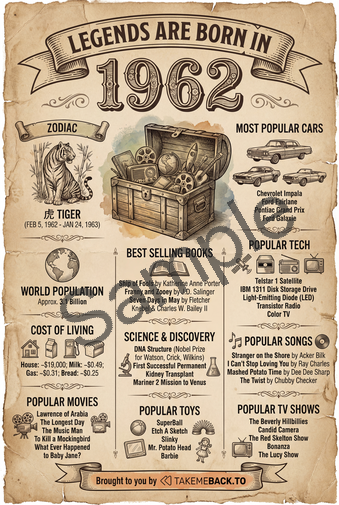

Major Events of 1962 - Historical Moments That Defined the Year | TakeMeBack.to
- 01 Jan United States Navy SEALs established: On January 1, 1962, the United States Navy SEALs were officially established as a special operations force, combining the capabilities of the Navy's Underwater Demolition Teams and other specialized units to conduct unconventional warfare and special reconnaissance missions. source: history.com
- 05 Jan Clarence Gideon's Supreme Court petition filed: On January 5, 1962, Clarence Gideon filed a petition to the U.S. Supreme Court, challenging his conviction for breaking and entering. His case would lead to the landmark decision in Gideon v. Wainwright, which established the right to counsel for defendants in criminal cases. This case significantly impacted the American legal system. source: oyez.org
- 06 Jan Birth of Kim Weon-Kee, South Korean Olympic wrestler: Kim Weon-Kee, a notable South Korean Olympic wrestler, was born on January 6, 1962. He would go on to represent South Korea in various international competitions, contributing to the country's reputation in the sport. His achievements in wrestling have made him a prominent figure in South Korean sports history. source: sports-reference.com
- 07 Jan Bomb explosion at Jean-Paul Sartre's apartment: On January 7, 1962, a bomb exploded at the apartment of French philosopher Jean-Paul Sartre in Paris. The incident was linked to political tensions of the time, particularly regarding the Algerian War. Sartre, a prominent intellectual, was known for his anti-colonial stance, which made him a target for such attacks. source: theguardian.com
- 09 Jan Phil Lewis Birth: Phil Lewis, future rock vocalist for the band LA Guns, was born in London, England.
- 10 Jan NASA announces Saturn V moon rocket development: On January 10, 1962, NASA officially announced the development of the Saturn V rocket, which would later play a crucial role in the Apollo missions to the Moon. The Saturn V was designed to be a powerful launch vehicle capable of carrying astronauts and equipment beyond Earth's orbit. source: nasa.gov
- 11 Jan Huascarán volcano disaster in Peru: On January 11, 1962, the Huascarán volcano in Peru erupted, leading to devastating consequences for nearby communities. The eruption caused significant geological changes and resulted in loss of life and property, highlighting the dangers of volcanic activity in the region. source: usgs.gov
- 12 Jan First American combat mission in Vietnam War: On January 12, 1962, the United States conducted its first combat mission in Vietnam, marking a pivotal moment in the Vietnam War. This mission involved the deployment of U.S. military advisors and aircraft in support of South Vietnamese forces. source: britannica.com
- 13 Jan Jackie Kennedy's White House television tour: On January 13, 1962, First Lady Jacqueline Kennedy conducted a televised tour of the White House, showcasing its history and renovations. This event was significant in promoting the arts and culture, as well as enhancing the public's connection to the presidency. source: britannica.com
- 14 Jan NFL Pro Bowl: West Triumphs in Close Match: The 1962 NFL Pro Bowl, held on January 14, 1962, at the Los Angeles Memorial Coliseum, featured a thrilling game between the Western and Eastern Conference All-Stars. The Western Conference, coached by Norm Van Brocklin of the Minnesota Vikings, edged out the Eastern Conference, coached by Allie Sherman of the New York Giants, with a final score of 31-30. The game was marked by a dramatic last-second touchdown pass from Johnny Unitas to Jon Arnett, securing the victory for the West. Cleveland Browns fullback Jim Brown was named the game's outstanding back, and Henry Jordan of the Green Bay Packers was honored as the lineman of the game. source: en.wikipedia.org
- 15 Jan Netherlands New Guinea Naval Conflict: On January 15, 1962, the Battle of Arafura Sea occurred in the Vlakke Hoek Bay of the Arafura Sea, involving Dutch and Indonesian naval forces. The Indonesian Navy attempted to land 150 soldiers in Dutch New Guinea for sabotage operations. Dutch forces, including the destroyers HNLMS Evertsen and HNLMS Kortenaer, intercepted and defeated the Indonesian fleet, resulting in the sinking of the Indonesian torpedo boat RI Matjan Tutul and the death of Commodore Yos Sudarso. This engagement was part of the broader West New Guinea dispute between Indonesia and the Netherlands. source: en.wikipedia.org
- 16 Jan Joaquín Balaguer resigns as President of the Dominican Republic: On January 16, 1962, President Joaquín Balaguer resigned following intense protests and a military coup led by General Pedro Rafael Rodríguez Echavarría. This event marked a significant political shift in the Dominican Republic. source: cia.gov
- 18 Jan US nuclear test at Nevada Test Site: On January 18, 1962, the United States conducted a nuclear test at the Nevada Test Site, part of a series of tests during the Cold War. This test was part of the larger Operation Nougat, which aimed to develop and assess nuclear weapons capabilities. source: osti.gov
- 19 Jan Dominican Republic counter-coup of 1962: On January 19, 1962, a counter-coup occurred in the Dominican Republic, aimed at restoring the government of Juan Bosch after his ousting. The event was marked by political turmoil and intervention from the United States, reflecting Cold War tensions in the region. source: loc.gov
- 20 Jan J. Spencer Love, textile industry titan, passes away: J. Spencer Love, a prominent figure in the American textile industry and founder of the Love Company, passed away on January 20, 1962. His contributions significantly shaped the textile manufacturing landscape in the United States. source: nytimes.com
- 21 Jan OAS ministers of foreign affairs meeting in Uruguay: On January 21, 1962, the Organization of American States (OAS) held a meeting of foreign ministers in Uruguay. The meeting focused on regional cooperation and responses to political developments in Latin America during the Cold War. source: loc.gov
- 24 Jan US Satellite Launch Attempt Fails: The United States experienced a setback in its space exploration efforts when an attempt to launch five satellites simultaneously failed due to a malfunction in the final stage of a Thor rocket. This incident underscored the technical challenges of early space missions.
- 26 Jan US Ranger 3 Moon Mission Failure: On January 26, 1962, NASA launched Ranger 3, its first attempt to land a spacecraft on the Moon. Due to guidance system malfunctions, the spacecraft missed the Moon by approximately 36,800 kilometers and entered a heliocentric orbit. source: jpl.nasa.gov
- 29 Jan Geneva Nuclear Test Ban Conference Fails: The Geneva Conference on nuclear test ban negotiations concluded on January 29, 1962, without reaching an agreement. The Soviet Union's proposal for an immediate treaty banning space, atmospheric, and underwater tests, along with a moratorium on underground tests pending a control system agreement, was rejected by the U.S. and U.K. due to the absence of a specific control system. source: ldeo.columbia.edu
- 30 Jan Tanganyika Laughter Epidemic: A bizarre and unprecedented mass psychological event begins at a girls' mission school in Kashasha, Tanganyika (now Tanzania), where an unexplained laughter epidemic spreads, affecting over 1,000 people and becoming a fascinating case study in mass hysteria.
- 31 Jan Samuel Gravely assumes command of destroyer escort USS Falgout: On January 31, 1962, Samuel Lee Gravely Jr. became the commanding officer of the USS Falgout (DE-324), a destroyer escort. This appointment marked a significant milestone in his naval career, as he was the first African American to command a U.S. Navy ship. Gravely's leadership aboard the USS Falgout paved the way for future African American officers in the Navy. source: georgeoberle.org
- 01 Feb Takashi Murakami born: Takashi Murakami, a Japanese contemporary artist known for his work in fine arts and commercial media, was born in Tokyo, Japan. source: britannica.com
- 02 Feb Rare planetary alignment: Neptune and Pluto: On February 2, 1962, a rare planetary alignment occurred involving Neptune and Pluto. Such alignments are of interest in astronomy and can have various interpretations in astrological contexts. source: nasa.gov
- 03 Feb US trade embargo against Cuba: On February 3, 1962, the United States officially imposed a trade embargo against Cuba, which has had lasting implications for US-Cuba relations and international trade policies. source: state.gov
- 04 Feb Rare planetary grand conjunction: A rare planetary grand conjunction took place on February 4, 1962, involving multiple planets aligning in the sky. Such events are notable in both astronomy and astrology. source: nasa.gov
- 05 Feb De Gaulle calls for Algerian independence: On February 5, 1962, French President Charles de Gaulle publicly declared his support for Algeria's independence, signaling a shift in French policy during the Algerian War. source: en.wikipedia.org
- 06 Feb U.S. Trade Embargo Against Cuba Established: On February 6, 1962, President John F. Kennedy announced a trade embargo against Cuba, prohibiting all trade except for food and medicine. This action was part of a broader strategy to isolate the Cuban government following the Cuban Revolution and the establishment of a communist regime under Fidel Castro. source: history.state.gov
- 07 Feb Kennedy Initiates Cuban Blockade: On February 7, 1962, President Kennedy initiated a blockade against Cuba, which was part of the broader trade embargo. This action was aimed at preventing the shipment of military supplies to Cuba, escalating tensions during the Cold War. source: history.state.gov
- 08 Feb Charonne Massacre in Paris: The Charonne massacre occurred on February 8, 1962, when French police violently suppressed a peaceful demonstration by Algerian immigrants in Paris, resulting in numerous deaths. This event highlighted the tensions surrounding the Algerian War and the treatment of immigrants in France. source: britannica.com
- 10 Feb Cold War Spy Exchange at Glienicke Bridge: On February 10, 1962, the first major Cold War spy exchange took place on the Glienicke Bridge between East and West Berlin. American U-2 pilot Francis Gary Powers, captured by the Soviet Union in 1960, was exchanged for Soviet KGB Colonel Rudolf Abel, arrested in the U.S. in 1957. This event marked a significant moment in Cold War diplomacy. source: history.com
- 15 Feb United States nuclear test in Nevada: On February 15, 1962, the United States conducted a nuclear test at the Nevada Test Site, known as 'Operation Fishbowl.' This test was part of a series of high-altitude nuclear tests aimed at studying the effects of nuclear explosions in the atmosphere. source: osti.gov
- 16 Feb Devastating floods in West Germany: On February 16, 1962, West Germany experienced severe flooding due to heavy rainfall and melting snow. The floods caused significant damage to infrastructure and homes, leading to emergency responses across affected regions. source: britannica.com
- 17 Feb North Sea flood of 1962: The North Sea flood of 1962 occurred on February 17, causing extensive damage in northern Europe, particularly in Germany and the Netherlands. High tides and storm surges led to significant flooding, resulting in loss of life and property. source: bbc.com
- 20 Feb John Glenn becomes first American to orbit Earth: On February 20, 1962, astronaut John Glenn became the first American to orbit the Earth aboard the Friendship 7 spacecraft. The mission lasted approximately 4 hours and 55 minutes, during which Glenn completed three orbits before safely splashing down in the Atlantic Ocean. source: nasa.gov
- 21 Feb Fonteyn and Nureyev's historic ballet performance: On February 21, 1962, Margot Fonteyn and Rudolf Nureyev performed together in 'Giselle' with the Royal Ballet. This performance marked the beginning of what is considered one of the greatest ballet partnerships of all time. source: en.wikipedia.org
- 22 Feb Birth of Steve Irwin: Steve Irwin, known as "The Crocodile Hunter," was born on February 22, 1962, in Upper Ferntree Gully, Victoria, Australia. He gained international fame as a zookeeper, conservationist, and television personality, co-hosting the wildlife documentary series "The Crocodile Hunter" with his wife, Terri. source: en.wikipedia.org
- 24 Feb Broadway musical 'Sail Away' closes after 167 performances: Noël Coward's musical 'Sail Away' concluded its Broadway run at the Broadhurst Theatre in New York City on February 24, 1962, after 167 performances. The production, which opened on October 3, 1961, starred Elaine Stritch as Mimi Paragon and featured songs like 'Why Do the Wrong People Travel?' and 'The Customer's Always Right.' source: ibdb.com
- 27 Feb Failed assassination attempt on President Ngô Đình Diệm: On February 27, 1962, two dissident Republic of Vietnam Air Force pilots, Nguyễn Văn Cử and Phạm Phú Quốc, bombed the Independence Palace in Saigon, targeting President Ngô Đình Diệm in an attempt to assassinate him. source: en.wikipedia.org
- 01 Mar Historic ticker-tape parade for Mercury astronauts: On March 1, 1962, New York City held a ticker-tape parade to honor astronaut John Glenn, who had recently orbited the Earth aboard Friendship 7. The event drew an estimated four million spectators, making it one of the largest in the city's history. source: dc.lib.jjay.cuny.edu
- 02 Mar Wilt Chamberlain scores 100 points in NBA game: On March 2, 1962, Wilt Chamberlain of the Philadelphia Warriors scored 100 points in a single NBA game against the New York Knicks, setting a record that remains unbroken. source: nba.com
- 03 Mar Birth of Jackie Joyner-Kersee: On March 3, 1962, Jackie Joyner-Kersee, an American track and field athlete widely regarded as one of the greatest female athletes of all time, was born in East St. Louis, Illinois. source: olympic.org
- 06 Mar Remington Nylon 66 Rifle Patent Granted: On March 6, 1962, Remington Arms was granted a patent for the Nylon 66 rifle, a semi-automatic .22 caliber rifle featuring a synthetic stock and receiver made from DuPont's Zytel 101 nylon resin. This innovative design aimed to reduce manufacturing costs and improve durability. The rifle was introduced in 1959 and became one of Remington's most successful models, with over a million units sold by 1989. source: americanrifleman.org
- 08 Mar Brigantine Hotel Storm Damage: On March 6–8, 1962, the Ash Wednesday Storm, a powerful nor'easter, struck the mid-Atlantic coast, causing significant damage in Brigantine, New Jersey. The Brigantine Hotel, serving as the Navy's Combat Information Center, suffered extensive damage, including broken windows and flooding in various areas. The storm's impact was part of a broader disaster that resulted in 40 fatalities and over $200 million in property damage across six states. source: brigantinenow.com
- 09 Mar Tragic Hospital Incident: On March 9, 1962, three infants at Binghamton General Hospital in New York died suddenly of heart failure, with three more dying the following day. The deaths were traced to a nurse's mistaken placement of salt into a sugar container used for making baby formula, leading to abnormally high sodium levels in the infants. The incident was ruled accidental. source: fws.gov
- 10 Mar Eighteen Nation Disarmament Conference begins: The Eighteen Nation Disarmament Conference commenced on March 10, 1962, in Geneva, Switzerland. This conference aimed to address nuclear disarmament and arms control during the Cold War. It brought together representatives from various nations to discuss strategies for reducing the threat of nuclear weapons. source: un.org
- 11 Mar Kennedy announces nuclear testing resumption: On March 11, 1962, President John F. Kennedy announced the resumption of nuclear testing by the United States. This decision was made in the context of escalating Cold War tensions and aimed to strengthen the U.S. nuclear arsenal. The announcement raised concerns about the implications for global security and arms control. source: archives.gov
- 12 Mar Dutch Premier De Quay announces secret talks with Indonesia: On March 12, 1962, Dutch Prime Minister Jan de Quay announced that the Netherlands and Indonesia had agreed to undertake secret preliminary talks to decide the future of the disputed New Guinea territory. These discussions were to be mediated by the United States, with a neutral observer present. source: digital.bentley.umich.edu
- 13 Mar Yugoslavia grants 1,000 prisoners amnesty: On March 13, 1962, Yugoslavia granted amnesty to approximately 1,000 prisoners. This move was part of a broader effort to address prison conditions and the rehabilitation of inmates. source: brainyhistory.com
- 15 Mar Évian Accords end Algerian War: The Évian Accords, signed on March 18, 1962, officially ended the Algerian War, leading to Algeria's independence from France. source: en.wikipedia.org
- 16 Mar First Titan 2 rocket launch: The first Titan II rocket was launched on March 16, 1962, marking a significant advancement in U.S. intercontinental ballistic missile technology. source: en.wikipedia.org
- 18 Mar Algerian War concludes: The Algerian War concluded on March 18, 1962, following the signing of the Évian Accords, leading to Algeria's independence from France. source: en.wikipedia.org
- 20 Mar Eighteen Nation Disarmament Conference opens in Geneva: The Eighteen Nation Disarmament Conference commenced in Geneva, aiming to address nuclear disarmament and arms control. This significant meeting involved representatives from various nations discussing strategies to reduce the threat of nuclear weapons. source: un.org
- 21 Mar Catholic bishop supports birth control: On March 21, 1962, a Catholic bishop publicly expressed support for the use of birth control, marking a significant moment in the Church's stance on family planning. This statement sparked discussions within the Church and among its followers. source: nytimes.com
- 22 Mar I Can Get It For You Wholesale opens at Shubert NYC for 300 performances: The musical 'I Can Get It For You Wholesale' opened at the Shubert Theatre in New York City on March 22, 1962. It ran for 300 performances and was significant for its role in introducing Barbra Streisand to a wider audience. source: nytimes.com
- 23 Mar World Trade Center construction legislation signed: On March 23, 1962, legislation was signed to facilitate the construction of the World Trade Center in New York City. This marked a pivotal moment in urban development and international trade infrastructure. source: nytimes.com
- 24 Mar Tragic boxing incident: On March 24, 1962, a tragic incident occurred in the boxing world, leading to significant discussions about safety regulations in the sport. This event highlighted the risks associated with professional boxing. source: bbc.com
- 26 Mar Baker v. Carr Supreme Court decision: On March 26, 1962, the U.S. Supreme Court ruled in Baker v. Carr that federal courts have jurisdiction over cases involving legislative apportionment, establishing the principle of "one person, one vote." source: britannica.com
- 27 Mar Archbishop Rummel desegregates Catholic schools in New Orleans: On March 27, 1962, Archbishop Joseph Rummel announced the desegregation of Catholic schools in New Orleans, marking the first integrated school year in the archdiocese. source: en.wikipedia.org
- 28 Mar Birth of Ged Grimes, musician: Ged Grimes, a Scottish musician known for his work with Simple Minds, was born on March 28, 1962. source: en.wikipedia.org
- 29 Mar Military coup overthrows Argentine President Arturo Frondizi: On March 29, 1962, a military coup in Argentina led to the ousting of President Arturo Frondizi. The coup was precipitated by the electoral success of Peronist candidates, which the military opposed. Frondizi was arrested and held at Isla Martín García, while José María Guido, the president of the Senate, assumed the presidency. source: digital.bentley.umich.edu
- 31 Mar 116th Grand National Horse Race: The 116th Grand National took place at Aintree Racecourse near Liverpool, England, on March 31, 1962. The race was won by Kilmore, a 28/1 outsider, ridden by jockey Fred Winter. The 12-year-old horse was trained by Ryan Price. source: en.wikipedia.org
- 02 Apr First Panda Crossing in London: On April 2, 1962, the first panda crossing was introduced outside Waterloo Station in London. The crossing featured triangular road markings and a sequence of flashing and pulsating lights to control pedestrian and vehicle movements. However, the system was met with confusion and was eventually abandoned in 1967. source: en.wikipedia.org
- 03 Apr Tragic Death of Boxer Benny 'Kid' Paret: Cuban welterweight boxer Benny 'Kid' Paret died on April 3, 1962, from injuries sustained during a bout with Emile Griffith on March 24, 1962. Paret collapsed in the ring after a barrage of punches and never regained consciousness, passing away ten days later at Roosevelt Hospital in New York City. source: en.wikipedia.org
- 04 Apr James Hanratty executed for A6 murder: James Hanratty, convicted of the 1961 A6 murder in Bedfordshire, was executed by hanging at Bedford Prison on April 4, 1962. His execution was one of the last before capital punishment was abolished in the UK. source: en.wikipedia.org
- 06 Apr Leonard Bernstein's Controversial Concert Remarks: On April 6, 1962, conductor Leonard Bernstein introduced pianist Glenn Gould's performance of Brahms' First Piano Concerto with remarks disassociating himself from Gould's unorthodox interpretation, leading to significant controversy. source: openculture.com
- 09 Apr 34th Academy Awards Highlights: The 34th Academy Awards took place on April 9, 1962, celebrating the best films of 1961. Highlights included the presentation of the Best Picture award to "West Side Story." This ceremony is notable for its recognition of musical films during a transformative period in Hollywood. source: oscars.org
- 10 Apr Mickey Mantle's 375th Home Run: On April 10, 1962, New York Yankees star Mickey Mantle hit his 375th career home run during a game against the Chicago White Sox. This milestone further solidified Mantle's status as one of baseball's all-time greats and a key figure in the Yankees' history. source: nytimes.com
- 12 Apr San Mateo County withdraws from BART district: On April 12, 1962, San Mateo County withdrew from the Bay Area Rapid Transit (BART) district, a decision that significantly impacted the development of the BART system in the San Francisco Bay Area. source: brainyhistory.com
- 13 Apr Stan Musial sets National League record for runs scored: On April 13, 1962, at Wrigley Field, Stan Musial scored his 1,869th run, setting a new National League record as the St. Louis Cardinals defeated the Chicago Cubs 8–5 in 15 innings. source: thisdayinbaseball.com
- 14 Apr Georges Pompidou becomes Prime Minister of France: Georges Pompidou was appointed Prime Minister of France on April 14, 1962, succeeding Michel Debré. He served in this role until July 1968. source: elysee.fr
- 15 Apr Death of Clara Blandick: Clara Blandick, an American actress known for her role as Aunt Em in "The Wizard of Oz," passed away on April 15, 1962.
- 16 Apr Walter Cronkite becomes CBS Evening News anchor: On April 16, 1962, Walter Cronkite succeeded Douglas Edwards as the anchor of the CBS Evening News. Cronkite's tenure marked a significant period in American broadcast journalism, as he became a trusted figure for millions of viewers. source: cbsnews.com
- 17 Apr Bay of Pigs Invasion begins: On April 17, 1962, the Bay of Pigs Invasion commenced as a CIA-backed force of Cuban exiles landed in Cuba, aiming to overthrow Fidel Castro's government. The operation ended in failure, leading to significant political repercussions. source: history.com
- 18 Apr Boston Celtics win 16th NBA Championship: The Boston Celtics secured their 16th NBA Championship by defeating the Los Angeles Lakers in the finals. This victory solidified their dominance in the league during the early 1960s, marking a significant achievement in sports history. source: nba.com
- 19 Apr NASA X-15 high-altitude flight: NASA's X-15 rocket plane achieved a high-altitude flight, reaching significant milestones in aeronautics and space exploration. This flight contributed to the understanding of hypersonic flight and paved the way for future space missions. source: nasa.gov
- 20 Apr Arrest of OAS leader in Algeria: The leader of the Organisation de l'Armée Secrète (OAS) was arrested in Algeria, marking a significant event in the context of the Algerian War of Independence. This event highlighted the ongoing conflict and political tensions in the region. source: bbc.com
- 21 Apr NASA's second astronaut group selection begins: NASA began selecting its second group of astronauts, known as the 'New Nine,' on April 21, 1962. This group included future astronauts who would play pivotal roles in the U.S. space program. source: nasa.gov
- 22 Apr 1962 Stanley Cup Finals: Maple Leafs Triumph: The Toronto Maple Leafs won the 1962 Stanley Cup Finals on April 22, 1962, defeating the Chicago Black Hawks to claim the championship. source: en.wikipedia.org
- 23 Apr New York Mets' first victory: On April 23, 1962, the New York Mets secured their first-ever victory, defeating the Pittsburgh Pirates 9-1 at Forbes Field. Pitcher Jay Hook delivered a complete-game performance, allowing only one run on five hits. source: mlb.com
- 24 Apr Sandy Koufax's remarkable pitching performance: On April 24, 1962, Sandy Koufax of the Los Angeles Dodgers tied a Major League Baseball record by striking out 18 batters in a complete game against the Chicago Cubs at Wrigley Field. source: dodgerblue.com
- 25 Apr First synthetic thunderstorm in space: On April 25, 1962, scientists created the first synthetic thunderstorm in space as part of experiments to understand atmospheric phenomena. This groundbreaking work contributed to meteorological science. source: nasa.gov
- 26 Apr Ariel 1: First British satellite launch: On April 26, 1962, Ariel 1 was launched, marking the first British satellite to be placed in orbit. This mission was a significant milestone in the UK's space exploration efforts. source: britannica.com
- 27 Apr US nuclear test at Christmas Island: On April 27, 1962, the United States conducted the 'Aztec' nuclear test as part of Operation Dominic I. This test involved a B-52 airdrop of a 410 kiloton warhead over Christmas Island in the Pacific Ocean. The explosion produced a mushroom cloud that rose to approximately 60,000 feet. source: nuclearweaponarchive.org
- 29 Apr 16th Tony Awards honors Broadway excellence: On April 29, 1962, the 16th annual Tony Awards ceremony took place, recognizing outstanding achievements in Broadway theater. The event celebrated performances from the 1961–1962 season, honoring excellence in various categories. source: en.wikipedia.org
- 30 Apr NASA X-15 high-altitude flight: On April 30, 1962, NASA's X-15 rocket plane, piloted by Robert White, conducted a high-altitude flight reaching an altitude of 85,000 feet. This flight was part of a series of test flights aimed at exploring the boundaries of human flight. source: en.wikipedia.org
- 01 May JFK authorizes Area Redevelopment Act: On May 1, 1962, President John F. Kennedy authorized the Area Redevelopment Act, aiming to alleviate chronic unemployment in economically distressed regions of the United States. The Act provided federal assistance to communities facing high unemployment rates, marking a significant step in federal economic intervention. source: presidency.ucsb.edu
- 02 May European Cup Final: Benfica triumphs: On May 2, 1962, Benfica defeated Real Madrid 5-3 in the European Cup Final, securing their second consecutive European Cup title. source: uefa.com
- 03 May Mikawashima Train Disaster: The Mikawashima Train Disaster occurred in Japan when a passenger train collided with a freight train, resulting in significant casualties. This tragic event highlighted the need for improved safety measures in railway operations. The disaster remains one of the deadliest train accidents in Japanese history. source: japantimes.co.jp
- 04 May Diplomatic tension between US and Canada: On May 4, 1962, diplomatic tensions arose between the United States and Canada over issues related to trade and defense policies. This period marked a significant moment in North American relations, as both countries navigated their respective national interests. The tensions were eventually resolved through diplomatic channels. source: thecanadianencyclopedia.ca
- 05 May East German tunnel escape from Berlin Wall: On May 5, 1962, a group of East German citizens successfully escaped to West Berlin by digging a tunnel from a house in East Berlin to a shed in West Berlin. The tunnel was constructed over a period of sixteen days, with the escapees working clandestinely to avoid detection by border patrols. The operation was discovered five days later by the East German People's Police. source: germanhistorydocs.org
- 06 May First nuclear warhead launched from Polaris submarine: On May 6, 1962, the U.S. Navy conducted the 'Frigate Bird' test as part of Operation Dominic, marking the first live launch of a nuclear-armed Polaris A-2 missile from a submerged submarine. The USS Ethan Allen (SSBN-608) launched the missile, which successfully detonated at an altitude of 11,000 feet over the South Pacific Ocean. source: en.wikipedia.org
- 07 May CIA-Mafia collaboration revelation: In May 1962, it was revealed that the CIA had engaged the Mafia in assassination plots against Cuban leader Fidel Castro. This collaboration was disclosed during a briefing to Attorney General Robert F. Kennedy, highlighting the CIA's covert operations involving organized crime figures. source: deseret.com
- 08 May Schindlers honored in Jerusalem: On May 8, 1962, Oskar Schindler, who saved approximately 1,200 Jews during the Holocaust, was honored in Jerusalem. He was invited by Yad Vashem to plant a tree on the Avenue of the Righteous, a memorial to those who saved Jews during World War II. source: en.wikipedia.org
- 09 May Beatles sign with EMI Parlophone: On May 9, 1962, The Beatles signed their first contract with EMI's Parlophone label, marking a significant milestone in their music career. source: brainyhistory.com
- 11 May US deploys troops to Thailand: On May 11, 1962, the United States deployed troops to Thailand as part of its military assistance program during the Cold War. source: en.wikipedia.org
- 12 May Douglas MacArthur's Farewell Speech: On May 12, 1962, General Douglas MacArthur delivered his famous "Duty, Honor, Country" farewell address at the United States Military Academy at West Point. source: realclearhistory.com
- 14 May Royal wedding of Juan Carlos and Sophia: The royal wedding of Juan Carlos I of Spain and Sofia of Greece took place on May 14, 1962. This event marked a significant moment in Spanish history, as Juan Carlos would later become the king who transitioned Spain to democracy after Franco's regime. source: britannica.com
- 15 May US atmospheric nuclear test at Christmas Island: On May 15, 1962, the United States conducted an atmospheric nuclear test at Christmas Island, part of its nuclear testing program. This test was significant in the context of Cold War tensions and nuclear arms development. source: britannica.com
- 16 May US Marines deployment and Gemini project advancement: On May 16, 1962, the U.S. Marines were deployed to support various operations, coinciding with advancements in NASA's Gemini project, which aimed to develop human spaceflight capabilities. This period marked significant progress in both military and space exploration efforts during the Cold War. source: nasa.gov
- 17 May Martin Luther King Jr.'s White House draft submission: On May 17, 1962, Martin Luther King Jr. submitted a draft to the White House, advocating for civil rights and social justice. This submission was part of his ongoing efforts to influence national policy and promote equality for African Americans. source: archives.gov
- 18 May First Kmart store opens: On May 18, 1962, the first Kmart store opened in Garden City, Michigan. This marked the beginning of a major retail chain that would grow to become a significant player in the discount retail market in the United States. source: kmart.com
- 19 May Ho Chi Minh Trail Organization Begins: On May 19, 1959, North Vietnam established Group 559, tasked with creating a supply route to South Vietnam, leading to the construction of the Ho Chi Minh Trail. This network of roads and paths was crucial for transporting troops and supplies during the Vietnam War. source: washingtonpost.com
- 20 May Patty Berg Wins LPGA Muskogee Civitan Golf Open: On May 20, 1962, professional golfer Patty Berg won the LPGA Muskogee Civitan Golf Open. This victory added to her illustrious career, which included multiple major championship titles. source: lpga.com
- 21 May Nasser Unveils Arab Socialist Union National Charter: On May 21, 1962, Egyptian President Gamal Abdel Nasser unveiled the national charter of the Arab Socialist Union. This political organization aimed to unify Arab nations under a socialist framework. source: britannica.com
- 22 May Raoul Salan sentenced to life imprisonment: On May 22, 1962, General Raoul Salan, leader of the Secret Army Organization (OAS) in Algeria, was sentenced to life imprisonment for treason after leading a failed coup attempt against French President Charles de Gaulle. source: content.time.com
- 23 May First successful human limb reattachment performed by Dr. Ronald A. Malt at Massachusetts General Hospital: On May 23, 1962, Dr. Ronald A. Malt led a surgical team at Massachusetts General Hospital in Boston to successfully reattach the severed right arm of 12-year-old Everett Knowles, who had been injured by a freight train. This pioneering procedure marked the first successful replantation of a completely severed limb. source: en.wikipedia.org
- 24 May Scott Carpenter's Aurora 7 space mission: On May 24, 1962, astronaut Scott Carpenter piloted the Aurora 7 spacecraft on the Mercury-Atlas 7 mission, completing three orbits around Earth in 4 hours and 56 minutes. The mission aimed to demonstrate human capabilities in space and included scientific experiments and observations. source: nasa.gov
- 25 May AFL-CIO Labor Campaign: On May 25, 1962, the AFL-CIO launched a significant labor campaign aimed at improving workers' rights and conditions. This campaign was part of a broader movement to strengthen labor unions and advocate for fair labor practices. source: nytimes.com
- 26 May Death of Wilfrid Wilson: Wilfrid Wilson, a notable British poet and writer, passed away on May 26, 1962. His contributions to literature were significant, particularly in the realm of poetry. His works continue to be studied and appreciated in literary circles. source: britannica.com
- 27 May Centralia Mine Fire Ignition: The Centralia mine fire ignited on May 27, 1962, in Centralia, Pennsylvania. This underground fire has been burning for decades, leading to the abandonment of the town and raising concerns about environmental safety and public health. source: epa.gov
- 28 May Major US Stock Market Crash: A significant stock market crash occurred in the United States on May 28, 1962, leading to widespread financial turmoil. This event was part of a series of market fluctuations that affected investors and the economy at large. source: bbc.com
- 30 May 1962 FIFA World Cup begins in Chile: The 1962 FIFA World Cup commenced in Chile on May 30, 1962. This tournament marked the first World Cup held in South America since 1950, featuring 16 teams competing across four cities: Santiago, Viña del Mar, Rancagua, and Arica. Brazil successfully defended their title, defeating Czechoslovakia 3–1 in the final. source: en.wikipedia.org
- 31 May Execution of Adolf Eichmann: Adolf Eichmann, a key figure in organizing the Holocaust, was executed by hanging in Israel on May 31, 1962. His trial and execution were significant events in post-war history. source: history.com
- 01 Jun Adolf Eichmann executed in Israel: Adolf Eichmann, a key Nazi official responsible for organizing the logistics of the Holocaust, was executed by hanging in Israel on June 1, 1962, after being convicted of war crimes and crimes against humanity. source: en.wikipedia.org
- 02 Jun Battle of Santiago during 1962 FIFA World Cup: On June 2, 1962, during the 1962 FIFA World Cup, Chile faced Italy in a match that became known as the "Battle of Santiago" due to its high level of violence, including multiple player expulsions and police intervention. source: en.wikipedia.org
- 03 Jun Air France Flight 007 tragedy at Paris Orly Airport: On June 3, 1962, Air France Flight 007 crashed during its approach to Paris Orly Airport, resulting in the loss of all 130 passengers and crew on board. The tragedy was attributed to a combination of pilot error and adverse weather conditions. This incident remains one of the deadliest aviation disasters in history. source: britannica.com
- 04 Jun Project Gemini space mission simulation: On June 4, 1962, NASA conducted a simulation for the Project Gemini space mission. This program was crucial for the United States' efforts to land a man on the Moon. The simulations tested various aspects of space travel and were essential for mission planning. source: nasa.gov
- 05 Jun Ray Charles' 'I Can't Stop Loving You' tops Billboard charts: Ray Charles' iconic song 'I Can't Stop Loving You' reached the top of the Billboard charts on June 5, 1962. This track became one of his signature songs and is celebrated for its emotional depth and musicality. source: billboard.com
- 06 Jun Alcatraz prison break: On June 6, 1962, a significant prison break occurred at Alcatraz, involving inmates who attempted to escape the notorious facility. This event is one of the most famous escape attempts in American history, highlighting the challenges of prison security. source: nps.gov
- 07 Jun NASA X-15 high-altitude flight: On June 7, 1962, NASA's X-15 rocket plane conducted a high-altitude flight, contributing to the understanding of aerodynamics and space travel. This program was crucial for the development of future space missions. source: nasa.gov
- 08 Jun Pakistan's new constitution takes effect: On June 8, 1962, Pakistan's new constitution came into effect, marking a significant development in the country's political history. source: pakistan.gov.pk
- 09 Jun Franco suspends constitutional rights: On June 9, 1962, Spanish dictator Francisco Franco suspended constitutional rights, consolidating his authoritarian rule. source: britannica.com
- 12 Jun Alcatraz Prison Break: On the night of June 11, 1962, inmates Frank Morris and brothers John and Clarence Anglin escaped from Alcatraz Federal Penitentiary. They meticulously planned their escape by creating dummy heads to deceive night guards, then navigated through utility corridors and reached the roof, where they launched an improvised raft made from raincoats into the cold waters of San Francisco Bay. Despite an extensive search, their fate remains unknown. source: britannica.com
- 13 Jun The Bob Newhart Show concludes on NBC: The Bob Newhart Show, an American comedy variety series starring Bob Newhart, concluded its run on NBC on June 13, 1962. The show aired from October 1961 to June 1962, featuring a mix of comedy and musical guests. Despite its critical acclaim, including winning the Primetime Emmy Award for Outstanding Program Achievement in the Field of Humor in 1962, the series was canceled after one season due to low ratings. source: en.wikipedia.org
- 14 Jun European Space Research Organisation established: On June 14, 1962, ten European nations signed the Convention creating the European Space Research Organisation (ESRO) in Paris. The founding members were Belgium, Denmark, France, Germany, Italy, the Netherlands, Spain, Sweden, Switzerland, and the United Kingdom. ESRO aimed to jointly pursue scientific research in space. source: esa.int
- 15 Jun Brazil wins 1962 FIFA World Cup: On June 15, 1962, Brazil secured their second FIFA World Cup title by defeating the Czechoslovak national team 3-1 in the final held in Santiago, Chile. The victory was marked by outstanding performances from players like Garrincha and Vavá. source: en.wikipedia.org
- 16 Jun The New Yorker publishes Silent Spring excerpt: On June 16, 1962, The New Yorker published an excerpt from Rachel Carson's influential book 'Silent Spring.' This publication played a crucial role in raising public awareness about environmental issues and the dangers of pesticides, particularly DDT. source: nytimes.com
- 17 Jun Brazil wins 1962 FIFA World Cup in Chile: On June 17, 1962, Brazil secured its second consecutive FIFA World Cup title by defeating Czechoslovakia 3-1 in the final held in Santiago, Chile. This victory solidified Brazil's status as a football powerhouse. source: bbc.com
- 18 Jun Discovery of Scorpius X-1: First cosmic X-ray source: On June 18, 1962, Scorpius X-1 was identified as the first cosmic X-ray source. This discovery marked a significant advancement in astrophysics and our understanding of the universe. source: nasa.gov
- 19 Jun Passing of Character Actor Will Wright: American actor Will Wright, known for his roles in Westerns and as a curmudgeonly old man, died of cancer at Cedars of Lebanon Hospital in Los Angeles on June 19, 1962, at the age of 68. source: en.wikipedia.org
- 22 Jun Supreme Court bans mandatory school prayers: On June 22, 1962, the U.S. Supreme Court ruled in Engel v. Vitale that mandatory school prayers violated the Establishment Clause of the First Amendment. This landmark decision emphasized the separation of church and state in public education. source: archives.gov
- 23 Jun Larry Doby's career transition: On June 23, 1962, Larry Doby, the first African American to play in the American League, transitioned from player to coach. His contributions to baseball and civil rights have been widely recognized. source: nytimes.com
- 24 Jun Record-breaking Yankees vs Tigers baseball game: On June 24, 1962, the New York Yankees faced the Detroit Tigers in a record-breaking baseball game that ended with a score of 9-7. This game was notable for its high attendance and competitive play. source: nytimes.com
- 25 Jun Formation of FRELIMO in Mozambique: On June 25, 1962, the Mozambique Liberation Front (FRELIMO) was established in Dar es Salaam, Tanzania, through the merger of three nationalist groups: the Mozambique African National Union (MANU), the National Democratic Union of Mozambique (UDENAMO), and the National African Union of Independent Mozambique (UNAMI). This unification, led by Eduardo Mondlane, marked a significant step in Mozambique's struggle for independence from Portuguese colonial rule. source: en.wikipedia.org
- 26 Jun Ruanda-Urundi split into two nations: On June 26, 1962, the Belgian Congo gained independence, leading to the division of the former Belgian colony of Ruanda-Urundi into two separate nations: Rwanda and Burundi. source: britannica.com
- 27 Jun X-15 high-altitude speed record: On June 27, 1962, pilot Joseph A. Walker achieved a speed of 4,104 mph (Mach 5.92) at an altitude of 23.4 miles (37.7 km) during an X-15 flight. source: nasa.gov
- 29 Jun First flight of Vickers VC-10 airliner: The Vickers VC-10, a British four-engine jet airliner, made its maiden flight from Brooklands, Surrey, piloted by G.R. 'Jock' Bryce. The prototype, G-ARTA, flew to Wisley for further testing. source: en.wikipedia.org
- 01 Jul Algeria gains independence from France: On July 1, 1962, a referendum in French Algeria resulted in 99.72% of voters supporting independence. France recognized Algeria's independence on July 3, 1962, and the country celebrated its national independence on July 5, 1962. source: britannica.com
- 02 Jul First Walmart store opens in Rogers, Arkansas: On July 2, 1962, Sam Walton opened the first Wal-Mart Discount City store at 719 W. Walnut Street in Rogers, Arkansas. This store marked the beginning of what would become a global retail chain. source: en.wikipedia.org
- 03 Jul 1962 World Artistic Gymnastics Championships held in Prague: The 15th Artistic Gymnastics World Championships took place from July 3 to 8, 1962, in Prague, Czechoslovakia. This event marked the third time Prague hosted the championships. source: en.wikipedia.org
- 04 Jul Houston celebrates Mercury astronauts: On July 4, 1962, Houston held a celebration honoring the Mercury astronauts, who were pivotal in the early years of the U.S. space program. This event highlighted the achievements of these astronauts and their contributions to space exploration. source: nasa.gov
- 05 Jul Oran Massacre: The Oran Massacre occurred on July 5, 1962, in Algeria, where violent clashes erupted between French settlers and Algerian nationalists. This event marked a significant moment in Algeria's struggle for independence from French colonial rule. source: britannica.com
- 06 Jul William Faulkner's death: William Faulkner, the renowned American author known for his complex narratives and innovative writing style, passed away on July 6, 1962. His works, including 'The Sound and the Fury' and 'As I Lay Dying', have had a profound impact on American literature. source: britannica.com
- 07 Jul Alitalia Flight 771 crash in Maharashtra: On July 7, 1962, Alitalia Flight 771 crashed in Maharashtra, India, resulting in the loss of all passengers and crew on board. The incident raised concerns about aviation safety and led to investigations into the causes of the crash. source: britannica.com
- 08 Jul Ne Win destroys Rangoon University Student Union building: On July 8, 1962, General Ne Win ordered the destruction of the Rangoon University Student Union building in Burma (Myanmar) as part of a crackdown on student protests. This event marked a significant moment in the military's control over the country and the suppression of dissent. source: bbc.com
- 09 Jul Starfish Prime nuclear test in space: On July 9, 1962, the United States conducted the Starfish Prime nuclear test, detonating a 1.4 megaton bomb in space above the Pacific Ocean. This test was part of a series of high-altitude nuclear tests and had significant implications for both military strategy and the understanding of electromagnetic pulse effects. source: britannica.com
- 10 Jul Telstar: First Commercial Communications Satellite Launch: On July 10, 1962, the Telstar 1 satellite was launched, marking the first commercial communications satellite. This event revolutionized global communications by enabling live television broadcasts and telephone calls across the Atlantic Ocean. source: nasa.gov
- 11 Jul First Transatlantic Television Transmission via Satellite: On July 11, 1962, the Telstar 1 satellite facilitated the first live transatlantic television transmission, broadcasting images from the United States to Europe and vice versa, marking a significant milestone in global communications. source: nasa.gov
- 12 Jul Rolling Stones' first performance at Marquee Club: On July 12, 1962, The Rolling Stones, then known as 'The Rollin' Stones,' played their first gig at London's Marquee Club. The lineup included Mick Jagger, Keith Richards, Brian Jones, Ian Stewart, Dick Taylor, and Tony Chapman. They performed a set of blues and R&B covers, marking the beginning of their illustrious career. source: setlist.fm
- 18 Jul Minnesota Twins historic offensive performance: On July 18, 1962, the Minnesota Twins achieved a remarkable feat by hitting two grand slam home runs in the same inning against the Cleveland Indians. In the first inning, Bob Allison hit a grand slam off pitcher Barry Latman, and Harmon Killebrew followed with another grand slam off Jim Perry, leading the Twins to a 14-3 victory. source: baseball-reference.com
- 21 Jul Civil Rights Demonstration and Mass Arrest in Albany, Georgia: On July 21, 1962, civil rights activists, including Dr. Martin Luther King Jr., were arrested during a demonstration in Albany, Georgia, as part of the Albany Movement aimed at desegregating the city. source: en.wikipedia.org
- 22 Jul Nelson Mandela's Arrest: On July 22, 1962, Nelson Mandela was arrested by South African police for leaving the country without a passport and inciting workers to strike, leading to his imprisonment. source: en.wikipedia.org
- 23 Jul Telstar relays first trans-Atlantic television broadcast: On July 23, 1962, the Telstar 1 communications satellite relayed the first publicly available live trans-Atlantic television signal. The broadcast featured images of the Statue of Liberty in New York and the Eiffel Tower in Paris. source: wired.com
- 25 Jul US Army establishes first attack helicopter company: On July 25, 1962, the U.S. Army activated its first armed helicopter company, the Utility Tactical Transport Helicopter Company (UTT), in Okinawa. This unit was equipped with UH-1B Huey helicopters and played a significant role in the development of Army aviation during the Vietnam War. source: armyaviationmagazine.com
- 27 Jul Martin Luther King Jr. arrested in Albany civil rights protest: On July 27, 1962, Martin Luther King Jr. and nine others were arrested in Albany, Georgia, after holding a prayer vigil in front of City Hall to demand a meeting with the City Commission regarding racial integration. Police Chief Laurie Pritchett invited them into his office, but upon their refusal, ordered their arrest. King documented this event in his jail diary, expressing his commitment to remain incarcerated until the city addressed segregation issues. source: kinginstitute.stanford.edu
- 30 Jul 33rd Major League Baseball All-Star Game: The 33rd Major League Baseball All-Star Game took place on July 30, 1962, at the Memorial Stadium in Baltimore, Maryland. The game featured star players from both the American and National Leagues, culminating in a competitive match that highlighted the best talents of the era. source: baseball-reference.com
- 31 Jul Formation of the Federation of Malaysia: The Federation of Malaysia was officially formed on July 31, 1962, uniting Malaya, Singapore, Sarawak, and North Borneo. This significant political event marked a new chapter in Southeast Asian history, aimed at fostering economic and political stability in the region. source: britannica.com
- 01 Aug Failed assassination attempt on President Nkrumah of Ghana: On August 1, 1962, there was a failed assassination attempt on President Kwame Nkrumah of Ghana. This incident highlighted the political tensions in the country during that period, as Nkrumah faced opposition from various factions. source: britannica.com
- 04 Aug Nelson Mandela's arrest by South African police: On August 4, 1962, Nelson Mandela was arrested by South African police while traveling in a car. This event marked a significant moment in the anti-apartheid movement, leading to Mandela's imprisonment and his eventual rise as a global symbol of resistance against oppression. source: britannica.com
- 05 Aug Death of Marilyn Monroe: Marilyn Monroe, the iconic American actress, was found dead in her home on August 5, 1962. Her death was ruled a probable suicide, and it shocked the world, leading to widespread media coverage and speculation about her life and struggles. source: britannica.com
- 06 Aug Jamaica's independence from Britain: On August 6, 1962, Jamaica gained independence from British colonial rule, becoming a sovereign nation. This event marked a significant milestone in the Caribbean's decolonization process and was celebrated with various festivities across the island. source: britannica.com
- 07 Aug Ahmed Ben Bella takes power in Algeria: On August 7, 1962, Ahmed Ben Bella became the first President of Algeria following the country's independence from France. Ben Bella, a leader of the National Liberation Front (FLN), played a pivotal role in Algeria's struggle for independence and was elected as the nation's first president after its liberation.
- 08 Aug Elizabeth Ann Duncan executed in California's gas chamber: Elizabeth Ann Duncan, 58, was executed in California's gas chamber on August 8, 1962, for orchestrating the murder of her daughter-in-law, Olga Duncan, in 1958. She was the last woman executed in California before the U.S. Supreme Court suspended the death penalty under Furman v. Georgia. source: cdcr.ca.gov
- 09 Aug Ellen Fairclough appointed Postmaster General of Canada: Ellen Fairclough was appointed Postmaster General of Canada on August 9, 1962, following a cabinet reshuffle by Prime Minister John Diefenbaker. source: en.wikipedia.org
- 10 Aug CIA reports Soviet missile buildup in Cuba: On August 10, 1962, the CIA reported a significant Soviet missile buildup in Cuba, marking a critical point in the Cuban Missile Crisis. source: archives.gov
- 11 Aug Vostok 3 space mission: First microgravity experience: On August 11, 1962, the Soviet Union launched Vostok 3, carrying cosmonaut Andriyan Nikolayev. During the mission, Nikolayev became the first person to float freely in microgravity, marking a significant milestone in human space exploration. source: britannica.com
- 12 Aug First multi-person space mission: On August 12, 1962, the Soviet Union launched Vostok 4, carrying cosmonaut Pavel Popovich. This mission, launched a day after Vostok 3, marked the first simultaneous flight of two crewed spacecraft, demonstrating the Soviet Union's capability for coordinated space operations. source: britannica.com
- 13 Aug First complete ascent of Matterhorn's west face: On August 13, 1962, climbers Renato Daguin and Giovanni Ottin achieved the first complete ascent of the Matterhorn's west face, a significant milestone in mountaineering history. source: en.wikipedia.org
- 15 Aug US soldier defects to North Korea: On August 15, 1962, U.S. Private First Class James Joseph Dresnok defected to North Korea by crossing the Demilitarized Zone from South Korea. Facing a court martial for forging documents, he sought asylum in the North, where he later appeared in propaganda films and taught English. source: washingtonpost.com
- 19 Aug Lorenzo Bandini wins inaugural Mediterranean Grand Prix: On August 19, 1962, Italian driver Lorenzo Bandini secured victory in the first Mediterranean Grand Prix at the Autodromo di Pergusa in Sicily, driving a Ferrari 156. source: en.wikipedia.org
- 20 Aug NS Savannah's maiden voyage begins: The NS Savannah, the world's first nuclear-powered cargo-passenger ship, commenced its maiden voyage on August 20, 1962, from Yorktown, Virginia. This voyage was part of President Eisenhower's "Atoms for Peace" initiative to demonstrate the peaceful use of nuclear energy. The ship was named after the SS Savannah, the first steam-powered ship to cross the Atlantic in 1819. source: wired.com
- 24 Aug Cuban exile attack on Havana hotel: On August 24, 1962, a group of Cuban exiles launched an attack on the Havana Riviera Hotel, which was known to be frequented by government officials. This incident was part of ongoing tensions and conflicts following the Cuban Revolution. source: nytimes.com
- 25 Aug Soviet nuclear test conducted at Novaya Zemlya: On August 25, 1962, the Soviet Union conducted a nuclear test at Novaya Zemlya, part of its ongoing nuclear weapons program. This test was significant in the context of Cold War tensions and arms race dynamics. source: armscontrol.org
- 26 Aug Final Negro American League All-Star Game: The last All-Star Game of the Negro American League took place on August 26, 1962. This event marked the end of an era for the league, which had been a significant part of baseball history, showcasing talented African American players before the integration of Major League Baseball. source: nytimes.com
- 27 Aug Mariner 2: First Successful Venus Flyby: On August 27, 1962, Mariner 2 became the first spacecraft to successfully fly by Venus, providing valuable data about the planet's atmosphere and surface. This mission marked a significant milestone in space exploration and paved the way for future missions to Venus and other planets. source: nasa.gov
- 28 Aug Horrific Domestic Violence Incident: On August 28, 1962, a tragic domestic violence incident occurred, drawing attention to the issue of domestic abuse in society. This event highlighted the need for increased awareness and support for victims of domestic violence. source: nytimes.com
- 29 Aug Kuwait constitutional suspension: On August 29, 1962, the Emir of Kuwait suspended the constitution, which had been in effect since 1962. This action was taken amid political tensions and unrest in the country, leading to significant changes in governance. source: britannica.com
- 30 Aug Japan's first post-war commercial aircraft test: On August 30, 1962, Japan conducted its first test flight of a post-war commercial aircraft, the YS-11. This marked a significant milestone in Japan's aviation industry, showcasing its recovery and technological advancements after World War II. source: japantimes.co.jp
- 31 Aug Trinidad and Tobago independence: On August 31, 1962, Trinidad and Tobago gained independence from the United Kingdom. This marked a significant moment in the Caribbean's decolonization process, allowing the nation to establish its own governance and identity. source: britannica.com
- 01 Sep Global population milestone: 3 billion humans: On September 1, 1962, the global population reached an estimated 3 billion people. This milestone highlighted the rapid growth of the world's population post-World War II, driven by advancements in medicine and agriculture. source: un.org
- 02 Sep The Soviet Union agrees to send arms to Cuba: On September 2, 1962, the Soviet Union officially agreed to send military arms to Cuba, escalating tensions during the Cold War. This decision was a pivotal moment leading up to the Cuban Missile Crisis. source: history.com
- 03 Sep Devastating earthquake in Iran: On September 3, 1962, another significant earthquake struck Iran, compounding the devastation from the earlier quake. The dual events raised awareness about the need for improved infrastructure and emergency response in the region. source: usgs.gov
- 04 Sep Soviet Union offers military aid to Cuba: On September 4, 1962, the Soviet Union extended military aid to Cuba, marking a significant escalation in Cold War tensions. This aid included weapons and military equipment, contributing to the Cuban Missile Crisis that would unfold later that year. source: britannica.com
- 05 Sep Ken Hubbs sets MLB defensive record: On September 5, 1962, Ken Hubbs of the Chicago Cubs set a Major League Baseball record for consecutive errorless games by a second baseman. This achievement underscored his defensive prowess and contributed to his reputation in the sport. source: baseball-reference.com
- 06 Sep Archaeological discovery of Blackfriars ships: On September 6, 1962, archaeologist Peter Marsden discovered the first of the Blackfriars ships, dating back to the 2nd century AD, along the River Thames in London. source: en.wikipedia.org
- 10 Sep Rod Laver achieves tennis Grand Slam: On September 10, 1962, Australian tennis player Rod Laver won the U.S. National Championships, completing the Grand Slam by securing victories at the Australian Open, French Open, Wimbledon, and U.S. Open in the same year. He defeated fellow Australian Roy Emerson in the final with a score of 6–2, 6–4, 5–7, 6–4. source: en.wikipedia.org
- 12 Sep Kennedy's Moon Landing Commitment: On September 12, 1962, President John F. Kennedy delivered his "We choose to go to the Moon" speech at Rice University in Houston, Texas. He reaffirmed the United States' commitment to landing a man on the Moon before the end of the decade, stating, "We choose to go to the Moon... not because they are easy, but because they are hard." source: nasa.gov
- 15 Sep USSR conducts nuclear test at Novaya Zemlya: On September 15, 1962, the Soviet Union conducted a nuclear test at the Novaya Zemlya test site in the Arctic Ocean. This test was part of a series of 78 nuclear tests conducted by the Soviet Union in 1962. source: en.wikipedia.org
- 16 Sep Brian Kilby wins European Athletics Championships marathon: On September 16, 1962, British marathon runner Brian Kilby won the men's marathon at the European Athletics Championships in Belgrade, Yugoslavia, with a time of 2:23:18.8. source: en.wikipedia.org
- 18 Sep United Nations admits four new member states: On September 18, 1962, the United Nations General Assembly admitted four new member states: Rwanda, Burundi, Jamaica, and Trinidad and Tobago. This expansion brought the total number of UN member nations to 108, reflecting the organization's growth and the increasing participation of newly independent countries in global affairs. source: media.un.org
- 20 Sep James Meredith barred from University of Mississippi: On September 20, 1962, James Meredith, an African American student, was physically blocked by Mississippi Governor Ross Barnett from entering the University of Mississippi, despite a federal court order mandating his admission. source: history.com
- 23 Sep Lincoln Center opens in New York City: Lincoln Center for the Performing Arts officially opened in New York City, becoming a major cultural hub. It houses several renowned institutions, including the New York Philharmonic and the Metropolitan Opera. The center has since played a significant role in the arts and culture of the city. source: nytimes.com
- 24 Sep James Meredith university integration ruling: A federal court ruled that James Meredith, an African American, had the right to enroll at the University of Mississippi, a significant event in the civil rights movement. This ruling was pivotal in challenging segregation in higher education and led to increased tensions and protests. Meredith's enrollment was a landmark moment in the fight for civil rights. source: archives.gov
- 25 Sep Cuban Missile Crisis begins: The Cuban Missile Crisis began when the United States discovered Soviet nuclear missiles in Cuba, leading to a 13-day confrontation. This event marked a critical moment in the Cold War, heightening tensions between the U.S. and the Soviet Union. The crisis ultimately ended with a negotiated settlement, averting potential nuclear conflict. source: archives.gov
- 26 Sep Silent Spring publication launches environmental movement: On September 26, 1962, Rachel Carson's book Silent Spring was published, raising awareness about the dangers of pesticides and environmental degradation. The book is credited with sparking the modern environmental movement and led to significant changes in policies regarding chemical use. source: epa.gov
- 27 Sep Silent Spring Publication: Rachel Carson's influential book 'Silent Spring' was published on September 27, 1962, documenting the environmental harm caused by pesticides and sparking the modern environmental movement. source: history.com
- 29 Sep Ben Bella forms Algerian government: On September 29, 1962, Ahmed Ben Bella was appointed as the first Prime Minister of Algeria following the country's independence from France. This event marked the establishment of a new government in Algeria, reflecting the end of colonial rule. source: britannica.com
- 30 Sep James Meredith integrates University of Mississippi: On September 30, 1962, James Meredith became the first African American student to enroll at the University of Mississippi. His enrollment was met with significant resistance, leading to a federal intervention to ensure his safety. source: archives.gov
- 01 Oct James Meredith desegregates University of Mississippi: On October 1, 1962, James Meredith became the first African American student to enroll at the University of Mississippi, a significant event in the American civil rights movement. His enrollment was met with violent protests, leading to federal intervention to ensure his safety and uphold desegregation laws. source: archives.gov
- 02 Oct Johnny Carson debuts on The Tonight Show: On October 2, 1962, Johnny Carson made his debut as the host of The Tonight Show, a late-night television program that would become a staple of American entertainment. Carson's wit and charm helped to define the format of late-night talk shows for decades to come. source: biography.com
- 03 Oct Mercury-Atlas 8 mission with Wally Schirra: On October 3, 1962, astronaut Walter M. "Wally" Schirra piloted the Mercury-Atlas 8 mission, also known as Sigma 7. The mission lasted 9 hours and 13 minutes, during which Schirra orbited Earth six times, conducting engineering tests and experiments. The spacecraft splashed down approximately 275 miles northeast of Midway Island, near the recovery ship, the USS Kearsarge. source: nasa.gov
- 05 Oct Dr. No: First James Bond Film Debuts: The first James Bond film, 'Dr. No,' premiered at the London Pavilion on October 5, 1962. Directed by Terence Young and starring Sean Connery as Agent 007, the film marked the beginning of the iconic spy series. It was released in the United States on May 8, 1963. source: en.wikipedia.org
- 06 Oct US Atmospheric Nuclear Test at Johnston Island: On October 6, 1962, the United States conducted an atmospheric nuclear test at Johnston Island in the Pacific Ocean. This test was part of the U.S. nuclear weapons testing program during the Cold War era. source: en.wikipedia.org
- 07 Oct U-2 Reconnaissance Flights Hindered by Caribbean Weather: On October 7, 1962, U-2 reconnaissance flights over the Caribbean were hindered by adverse weather conditions. These flights were part of the United States' intelligence-gathering efforts during the Cold War. source: en.wikipedia.org
- 08 Oct Spiegel Scandal exposes West German military weaknesses: On October 8, 1962, the German news magazine Der Spiegel published an article detailing the deficiencies of West Germany's defense forces, including a NATO assessment that found them only 'partially ready' to defend the country. This led to a government crackdown, with Defense Minister Franz Josef Strauss resigning due to the controversy. source: britannica.com
- 09 Oct Uganda's independence from United Kingdom: On October 9, 1962, Uganda gained independence from the United Kingdom, becoming a sovereign nation. This event marked the end of British colonial rule and the beginning of Uganda's journey as an independent state.
- 10 Oct Sino-Indian War begins: The Sino-Indian War commenced on October 10, 1962, following escalating border disputes between China and India. The conflict lasted until November 21, 1962, resulting in significant casualties and territorial changes. source: britannica.com
- 11 Oct Second Vatican Council convenes: Pope John XXIII opened the Second Vatican Council on October 11, 1962, at St. Peter's Basilica. This ecumenical council aimed to address relations between the Catholic Church and the modern world, marking a significant event in church history. source: britannica.com
- 12 Oct Columbus Day Storm devastates Pacific Northwest: On October 12, 1962, the Columbus Day Storm struck the Pacific Northwest, causing widespread damage and power outages. It remains one of the most powerful windstorms in U.S. history. source: weather.gov
- 13 Oct Devastating Pacific Northwest cyclone: On October 13, 1962, a powerful cyclone struck the Pacific Northwest, causing significant damage and loss of life. The storm was one of the most severe weather events in the region's history, leading to widespread flooding and destruction. source: weather.gov
- 14 Oct Cuban Missile Crisis begins: U-2 reconnaissance reveals Soviet nuclear missiles in Cuba: On October 14, 1962, U-2 reconnaissance flights revealed the presence of Soviet nuclear missiles in Cuba, marking the beginning of the Cuban Missile Crisis. This discovery heightened tensions between the United States and the Soviet Union, leading to a 13-day standoff. source: archives.gov
- 15 Oct Cuban Missile Crisis discovery: On October 15, 1962, U.S. reconnaissance flights over Cuba revealed the presence of Soviet missile installations, marking the discovery that initiated the Cuban Missile Crisis. This event escalated tensions between the United States and the Soviet Union, leading to a 13-day standoff that brought the world to the brink of nuclear war. source: archives.gov
- 16 Oct Cuban Missile Crisis begins: The Cuban Missile Crisis officially began on October 16, 1962, when President John F. Kennedy was informed of the U.S. reconnaissance findings regarding Soviet missiles in Cuba. This pivotal moment led to intense negotiations and military readiness as the U.S. sought to address the perceived threat. source: archives.gov
- 17 Oct Cuban Missile Crisis: Critical National Security Council meeting: On October 17, 1962, a critical National Security Council meeting was held to discuss the escalating Cuban Missile Crisis. This meeting was pivotal in shaping U.S. policy and response to the Soviet missile threat in Cuba, influencing the course of the crisis. source: archives.gov
- 18 Oct Nobel Prize in Medicine for DNA Structure Discovery: On October 18, 1962, James D. Watson, Francis Crick, and Maurice Wilkins were awarded the Nobel Prize in Physiology or Medicine for their discovery of the double-helix structure of DNA. source: apnews.com
- 19 Oct Cuban Missile Crisis: Critical White House Meeting: On October 19, 1962, a critical meeting was held at the White House to discuss the Cuban Missile Crisis. The meeting involved President Kennedy and his advisors, focusing on the Soviet missile installations in Cuba and potential U.S. responses. source: avalon.law.yale.edu
- 20 Oct US conducts atmospheric nuclear test 'Checkmate' at Johnston Atoll: On October 20, 1962, the United States conducted an atmospheric nuclear test named 'Checkmate' at Johnston Atoll in the Pacific Ocean. The test had a yield of 7 kilotons and was part of the Operation Dominic series, which aimed to investigate the effects of nuclear explosions in the atmosphere. The test was conducted during the Cuban Missile Crisis, a period of heightened Cold War tensions. source: ctbto.org
- 21 Oct Kennedy's Fourth Speech Draft Completed: On October 21, 1962, President John F. Kennedy completed the fourth draft of his speech addressing the Cuban Missile Crisis. This speech was intended to inform the American public about the developments in Cuba and the U.S. response to the Soviet missile deployment. source: jfklibrary.org
- 22 Oct Cuban Missile Crisis Presidential Address: On October 22, 1962, President John F. Kennedy delivered a televised address to the nation regarding the Cuban Missile Crisis. In this speech, he informed the public about the discovery of Soviet nuclear missiles in Cuba and announced a naval quarantine to prevent further Soviet shipments of military equipment to Cuba. source: jfklibrary.org
- 23 Oct Adlai Stevenson's UN Address on Cuban Missile Crisis: On October 23, 1962, U.S. Ambassador Adlai Stevenson addressed the United Nations Security Council, presenting photographic evidence of Soviet nuclear missiles in Cuba and demanding their removal. This pivotal moment intensified the Cuban Missile Crisis, bringing the world closer to nuclear conflict. source: pacificaradioarchives.org
- 24 Oct US Navy implements blockade during Cuban Missile Crisis: On October 24, 1962, the United States Navy began implementing a naval blockade, referred to as a 'quarantine,' around Cuba during the Cuban Missile Crisis. This action aimed to prevent further Soviet shipments of military equipment to Cuba, escalating tensions between the US and the Soviet Union. source: ctbto.org
- 25 Oct John Steinbeck awarded Nobel Prize in Literature: On October 25, 1962, the Swedish Academy announced that American author John Steinbeck had been awarded the Nobel Prize in Literature for his "realistic and imaginative writings, combining as they do sympathetic humour and keen social perception." source: nobelprize.org
- 26 Oct French presidential election reform approved: On October 26, 1962, a constitutional reform was approved in France, allowing the direct election of the President by popular vote. This change was significant in shaping the French political landscape, enhancing the democratic process in the country. source: britannica.com
- 27 Oct Vasily Arkhipov prevents nuclear war: On October 27, 1962, Soviet Navy officer Vasily Arkhipov prevented a potential nuclear conflict during the Cuban Missile Crisis by refusing to authorize the launch of a nuclear torpedo from the submarine B-59, despite pressure from his captain. source: en.wikipedia.org
- 28 Oct Cuban Missile Crisis resolution: On October 28, 1962, Soviet Premier Nikita Khrushchev announced the removal of Soviet missiles from Cuba, effectively resolving the Cuban Missile Crisis. source: rferl.org
- 31 Oct Soviet missile withdrawal from Cuba begins: On October 31, 1962, the Soviet Union began the withdrawal of its nuclear missiles from Cuba, following the resolution of the Cuban Missile Crisis. source: rferl.org
- 01 Nov Soviet Union launches Mars 1 spacecraft: The Soviet Union launched Mars 1, the first spacecraft in its Mars program, intended to fly by Mars and transmit data back to Earth. source: en.wikipedia.org
- 03 Nov Cuban Missile Crisis NSC Executive Committee Meeting: On November 3, 1962, the National Security Council's Executive Committee convened to discuss the ongoing Cuban Missile Crisis. The meeting focused on the U.S. response to the presence of Soviet missiles in Cuba and the implications for U.S. national security. source: archives.gov
- 04 Nov Cuban Missile Crisis Resolution: On November 4, 1962, the resolution of the Cuban Missile Crisis was underway as negotiations between the U.S. and the Soviet Union progressed. The U.S. agreed to remove its missiles from Turkey in exchange for the withdrawal of Soviet missiles from Cuba, marking a pivotal moment in Cold War diplomacy. source: archives.gov
- 05 Nov Cuban Missile Crisis resolution: The Cuban Missile Crisis, a 13-day confrontation between the United States and the Soviet Union, reached a resolution on November 5, 1962. The crisis was marked by the U.S. naval blockade of Cuba and negotiations that led to the withdrawal of Soviet missiles. source: britannica.com
- 06 Nov UN condemns South African apartheid: On November 6, 1962, the United Nations General Assembly adopted a resolution condemning apartheid in South Africa. This marked a significant moment in international efforts to address racial discrimination and human rights violations in the country. source: un.org
- 07 Nov Cuban Missile Crisis Resolution: On November 7, 1962, the U.S. authorized the Defense Department to announce that Soviet ships carrying missiles were leaving Cuba, signaling progress in the resolution of the Cuban Missile Crisis. source: avalon.law.yale.edu
- 08 Nov Dutch Catharina Lodders crowned Miss World 1962: On November 8, 1962, Catharina Lodders from the Netherlands was crowned Miss World at the Lyceum Ballroom in London. She became the second Dutch woman to win the title, following Corine Rottschafer in 1959. Prior to this, Lodders had been crowned Miss Holland in May 1962. source: en.wikipedia.org
- 09 Nov X-15 Spaceplane Crash Injures Test Pilot: On November 9, 1962, NASA research pilot Jack McKay was injured during an emergency landing of the X-15 #2 aircraft at Mud Lake, Nevada. The aircraft's rocket engine malfunctioned, producing only 30% of its maximum thrust, necessitating a high-speed landing without flaps. The left skid collapsed upon touchdown, causing the aircraft to flip onto its back. McKay sustained back injuries but later resumed X-15 pilot duties, making 22 more flights. The aircraft was subsequently rebuilt into the X-15A-2. source: nasa.gov
- 10 Nov Funeral of Eleanor Roosevelt: Eleanor Roosevelt, former First Lady of the United States, passed away on November 7, 1962. Her funeral was held on November 10, 1962, in New York City, attended by dignitaries and citizens alike, honoring her contributions to human rights and social justice. source: archives.gov
- 11 Nov Kuwait ratifies national constitution: On November 11, 1962, Kuwait officially ratified its national constitution, establishing a parliamentary system and outlining the rights of citizens. This significant event marked a pivotal moment in Kuwait's political development and governance. source: britannica.com
- 15 Nov Cuba threatens U.S. reconnaissance flights: On November 15, 1962, Cuba issued a warning against U.S. reconnaissance flights over its territory, escalating tensions during the Cold War. This threat came amid the Cuban Missile Crisis, highlighting the fraught relationship between the U.S. and Cuba. source: archives.gov
- 16 Nov Kuwait adopts first constitution: On November 16, 1962, Kuwait adopted its first constitution, which laid the foundation for a parliamentary democracy. This constitution was a significant step in the country's political evolution and governance. source: britannica.com
- 17 Nov Dulles International Airport dedication: President John F. Kennedy dedicated Washington Dulles International Airport on November 17, 1962, marking a significant expansion in the United States' air travel infrastructure. source: retronewser.com
- 19 Nov Cuban Missile Crisis Resolution: Soviet Weapons Removal: On November 19, 1962, the resolution of the Cuban Missile Crisis was marked by the agreement for the removal of Soviet nuclear weapons from Cuba. This event was pivotal in easing Cold War tensions between the United States and the Soviet Union. source: archives.gov
- 20 Nov Cuban Missile Crisis resolution: The resolution of the Cuban Missile Crisis was officially recognized on November 20, 1962, following the agreement between the U.S. and the Soviet Union. This event marked a crucial moment in Cold War history, leading to improved communication between the two superpowers. source: archives.gov
- 21 Nov Cuban Missile Crisis resolution: On November 21, 1962, the Cuban Missile Crisis was officially resolved when the United States and the Soviet Union reached an agreement to withdraw missiles from Cuba and Turkey. This marked a significant de-escalation in Cold War tensions. source: archives.gov
- 23 Nov Spiegel scandal resolution: On November 23, 1962, the Spiegel scandal, which involved the German magazine 'Der Spiegel' and its criticism of the government, was resolved when the German government dropped charges against the magazine's editors. This event highlighted issues of press freedom in Germany. source: britannica.com
- 24 Nov Cold War political reorganization in Berlin: On November 24, 1962, significant political changes occurred in Berlin as part of the ongoing Cold War tensions. These changes were influenced by the division of the city and the broader geopolitical landscape. source: britannica.com
- 25 Nov French legislative election - second round: The second round of the French legislative elections took place on November 25, 1962. This election was crucial in shaping the political landscape of France during the early 1960s. source: britannica.com
- 26 Nov Kennedy inspects HAWK missile sites: On November 26, 1962, President John F. Kennedy visited HAWK missile sites in the United States. This inspection was part of the ongoing Cold War efforts to bolster U.S. missile defense capabilities against potential threats. source: jfklibrary.org
- 27 Nov Boeing 727 first test flight: The Boeing 727 had its first test flight on November 27, 1962. This aircraft would go on to become one of the most popular commercial jets in aviation history. source: boeing.com
- 28 Nov Jon Stewart born: Jon Stewart, the American comedian, writer, and television host, was born on November 28, 1962. He is best known for hosting 'The Daily Show' from 1999 to 2015. source: biography.com
- 29 Nov Anglo-French Concorde Development Agreement: On November 29, 1962, the United Kingdom and France signed an agreement to jointly develop and produce a supersonic airliner, known as Concorde. The project aimed to create a slender-wing airliner with a cruising speed of about Mach 2.2, capable of reducing transatlantic flight times from 7.5 hours to approximately 3 hours. The development was a collaboration between British Aircraft Corporation and Sud Aviation, with the first flight expected in 1966 and service entry by 1970. source: api.parliament.uk
- 01 Dec Fog-Interrupted Grey Cup Thriller: The 50th Grey Cup, also known as the 'Fog Bowl,' was played on December 1, 1962, between the Winnipeg Blue Bombers and the Hamilton Tiger-Cats at Exhibition Stadium in Toronto. The game was suspended due to dense fog and resumed on December 2, with the Blue Bombers winning 28–27. source: en.wikipedia.org
- 02 Dec 50th Canadian Football League Grey Cup: The 50th Grey Cup, also known as the 'Fog Bowl,' was played on December 1, 1962, between the Winnipeg Blue Bombers and the Hamilton Tiger-Cats at Exhibition Stadium in Toronto. The game was suspended due to dense fog and resumed on December 2, with the Blue Bombers winning 28–27. source: en.wikipedia.org
- 03 Dec First African American female judge sworn in: On December 3, 1962, Marjorie McKenzie Lawson was appointed by President John F. Kennedy as an associate judge for the Juvenile Court of the District of Columbia, becoming the first African American woman to serve as a judge in the District. source: en.wikipedia.org
- 04 Dec US performs nuclear test at Nevada Test Site: On December 4, 1962, the United States conducted a nuclear test at the Nevada Test Site, continuing its series of atmospheric nuclear tests during that period.
- 06 Dec Robena Coal Mine Disaster: On December 6, 1962, an explosion at the Robena No. 3 Mine in Carmichaels, Pennsylvania, resulted in the deaths of 37 miners. The explosion was caused by the ignition of methane gas and coal dust, leading to significant safety reforms in the mining industry. source: umwa.org
- 07 Dec Bill Wyman Joins The Rolling Stones: Bill Wyman is hired as the bass player for The Rolling Stones, a pivotal moment in the formation of one of the most iconic rock bands in music history.
- 08 Dec Queen Wilhelmina's Funeral: Queen Wilhelmina of the Netherlands, who reigned from 1890 to 1948, passed away on November 28, 1962. Her funeral took place on December 8, 1962, at the Nieuwe Kerk in Delft, Netherlands. The ceremony was notable for being entirely in white, reflecting her belief that earthly death was the beginning of eternal life. source: en.wikipedia.org
- 09 Dec Tanganyika Becomes a Republic: On December 9, 1962, Tanganyika, a former British colony in East Africa, became a republic, gaining independence from British rule. This marked a significant step in the decolonization process in Africa during the early 1960s. source: en.wikipedia.org
- 10 Dec Lawrence of Arabia film premiere: David Lean's epic film 'Lawrence of Arabia' premiered at the Odeon Leicester Square in London, attended by Queen Elizabeth II and Prince Philip. source: bfi.org.uk
- 12 Dec United States nuclear test in Nevada: On December 12, 1962, the United States conducted a nuclear test at the Nevada Test Site. This test was part of a series of atmospheric tests that were conducted during the Cold War, aimed at developing and demonstrating nuclear capabilities. source: osti.gov
- 13 Dec Relay 1 communication satellite launch: On December 13, 1962, the United States launched Relay 1, the first active communications satellite. This satellite marked a significant advancement in satellite technology, enabling live television broadcasts and improved communication capabilities. source: nasa.gov
- 14 Dec Mariner 2 spacecraft launches to Venus: On December 14, 1962, NASA launched Mariner 2, the first successful spacecraft to fly by Venus. This mission provided valuable data about the planet's atmosphere and surface, marking a milestone in space exploration. source: nasa.gov
- 15 Dec North Sea radio station silenced: On December 15, 1962, the North Sea Radio Station, known for its pirate broadcasts, was silenced by British authorities. This marked a significant moment in the history of offshore radio broadcasting in the UK. source: bbc.com
- 16 Dec First confirmed Alcatraz escape: On December 16, 1962, the first confirmed escape from Alcatraz occurred when three inmates successfully fled the prison. Their escape became a significant part of Alcatraz's notorious history. source: nps.gov
- 17 Dec Monaco adopts new constitution: On December 17, 1962, Monaco adopted a new constitution that established a parliamentary system and increased the powers of the elected assembly. This was a significant step in the principality's governance. source: loc.gov
- 18 Dec WAIQ TV channel 26 in Montgomery, AL (PBS) begins broadcasting: On December 18, 1962, WAIQ TV channel 26, a PBS affiliate, began broadcasting in Montgomery, Alabama. This marked an important development in local media and educational programming. source: pbs.org
- 19 Dec First operational navigation satellite launched: On December 19, 1962, the United States launched the first operational navigation satellite, Transit 1B, marking a significant advancement in satellite-based navigation systems. source: history.navy.mil
- 21 Dec Britain purchases Polaris missiles: On December 21, 1962, the United Kingdom announced the purchase of Polaris missiles from the United States, enhancing its nuclear deterrent capabilities during the Cold War. source: theguardian.com
- 23 Dec Cuba returns Bay of Pigs invasion prisoners: On December 23, 1962, Cuba returned 1,113 prisoners captured during the Bay of Pigs invasion to the United States. This event marked a significant moment in U.S.-Cuba relations following the failed invasion in April 1961. The exchange was part of a deal that included the U.S. providing humanitarian aid to Cuba. source: archives.gov
- 24 Dec Publication of 'Sex and the Single Girl': On December 24, 1962, Helen Gurley Brown's book 'Sex and the Single Girl' was published, challenging traditional views on women's roles and sexuality. The book became a bestseller and significantly influenced the feminist movement and women's liberation in the 1960s and beyond. source: nytimes.com
- 25 Dec Soviet Union's final above-ground nuclear test: On December 25, 1962, the Soviet Union conducted its last above-ground nuclear test, marking a significant moment in the Cold War nuclear arms race. This test was part of a series of tests that raised international concerns about nuclear proliferation and led to subsequent arms control agreements. source: britannica.com
- 27 Dec Indonesian independence recognition: On December 27, 1962, the United Nations General Assembly recognized Indonesia's independence, affirming its sovereignty after years of colonial rule. This recognition was a pivotal moment in Indonesia's post-colonial history, solidifying its status as an independent nation. source: un.org
- 28 Dec UN intervention in Katanga: On December 28, 1962, the United Nations intervened in Katanga, a region in the Democratic Republic of the Congo, to address ongoing conflicts and humanitarian issues. This intervention was part of a broader UN peacekeeping mission aimed at stabilizing the region. source: un.org
- 29 Dec Graham Hill wins South African Grand Prix and F1 World Championship: Graham Hill secured his first Formula One World Championship by winning the 1962 South African Grand Prix at East London. He finished ahead of Bruce McLaren and Tony Maggs, clinching the title after Jim Clark's retirement due to an oil leak. source: en.wikipedia.org
- 30 Dec NFL Championship: Green Bay Packers triumph over New York Giants: The Green Bay Packers defeated the New York Giants in the NFL Championship game, securing their first NFL title. The Packers' victory was marked by a strong performance from quarterback Bart Starr.
- 31 Dec Green Bay Packers NFL Championship victory: The Green Bay Packers secured their first NFL Championship title by defeating the New York Giants. The game was notable for quarterback Bart Starr's exceptional performance.
What happened in 1962?
Discover what the world looked like in 1962: