

Major Events of 1963: Key Historical Moments You Need to Know
Every year brings its own set of pivotal moments that leave a lasting mark on history. From political shifts and technological advancements to cultural breakthroughs, these events shape the world and influence the future. In this comprehensive overview, we'll explore the most significant occurrences from 1963, highlighting key moments that continue to impact our lives today.
Explore by topic:
Born in 1963? Get Your Birth Year Poster!
A beautifully researched, newspaper-style poster of the year.
Step back into 1963. Get yours today!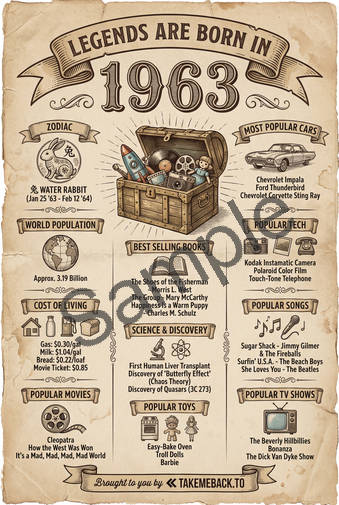

Major Events of 1963 - Historical Moments That Defined the Year | TakeMeBack.to
- 01 Jan Bogle-Chandler Mystery Death Case: On January 1, 1963, the bodies of Dr. Gilbert Bogle and Mrs. Margaret Chandler were found near the Lane Cove River in Sydney, Australia. Both were scientists, and their deaths remain unsolved, with theories ranging from poisoning to accidental hydrogen sulfide exposure. source: en.wikipedia.org
- 02 Jan Viet Cong's First Major Victory at the Battle of Ap Bac: On January 2, 1963, the Viet Cong secured their first major victory at the Battle of Ap Bac in South Vietnam, inflicting significant casualties on the South Vietnamese Army and boosting their morale. source: en.wikipedia.org
- 05 Jan Camelot concludes Broadway run: The musical 'Camelot' closed its Broadway run at the Majestic Theatre on January 5, 1963, after 873 performances. Directed by Moss Hart, the production starred Richard Burton as King Arthur and Julie Andrews as Guenevere. The show received four Tony Awards in 1961. source: americanhistory.si.edu
- 07 Jan 1st class postage raised from 4 cents to 5 cents: On January 7, 1963, the United States Postal Service increased the price of first-class postage from 4 cents to 5 cents. This change was part of a broader adjustment in postal rates to address rising operational costs. source: archives.gov
- 08 Jan Flying Scotsman's final scheduled run: The Flying Scotsman, a famous steam locomotive, made its final scheduled run on January 8, 1963. This event marked the end of an era for steam locomotives in Britain, as the country transitioned to diesel and electric trains. source: bbc.com
- 09 Jan Mao Tse-tung composes poetic work: On January 9, 1963, Mao Tse-tung, the leader of the People's Republic of China, composed a poetic work that reflected his political ideology and vision for China. This event highlighted Mao's engagement with literature and culture as part of his leadership. source: britannica.com
- 11 Jan The Beatles release breakthrough single: On January 11, 1963, The Beatles released their single 'Please Please Me,' which marked a significant turning point in their career and the British music scene. This song helped propel them to national fame in the UK. source: bbc.com
- 12 Jan Bobby Simpson's cricket performance against England: On January 12, 1963, Australian cricketer Bobby Simpson delivered a remarkable performance against England, contributing significantly to his team's success. His skills on the field were widely recognized and celebrated. source: espncricinfo.com
- 13 Jan Assassination of President Sylvanus Olympio in Togo: On January 13, 1963, President Sylvanus Olympio of Togo was assassinated during a military coup, leading to significant political upheaval in the country. source: en.wikipedia.org
- 14 Jan George Wallace's Infamous Segregationist Inaugural Address: On January 14, 1963, George Wallace, Governor of Alabama, delivered his inaugural address, famously declaring "segregation now, segregation tomorrow, segregation forever," signaling his commitment to maintaining racial segregation. source: en.wikipedia.org
- 18 Jan Death of Hugh Gaitskell, British Labour Party leader: Hugh Gaitskell, the leader of the British Labour Party since 1955, died on January 18, 1963, at the age of 56. He had been ill with flu in mid-December 1962 and later contracted another virus, leading to complications from lupus, an autoimmune disease. source: en.wikipedia.org
- 20 Jan Indonesia declares konfrontasi against proposed Malaysian federation: On January 20, 1963, Indonesia officially declared a policy of konfrontasi, opposing the formation of the Malaysian Federation. This policy was part of Indonesia's broader strategy to assert its influence in Southeast Asia and challenge Western colonialism. The declaration marked a significant escalation in regional tensions during the Cold War era. source: britannica.com
- 21 Jan Chicago North Shore and Milwaukee Railroad ceases operations: The Chicago North Shore and Milwaukee Railroad officially ceased operations on January 21, 1963. This marked the end of a significant chapter in regional transportation history, as the railroad had been a key link between Chicago and Milwaukee since its inception. The closure was attributed to financial difficulties and declining ridership. source: chicagotribune.com
- 22 Jan Élysée Treaty of friendship between France and West Germany: The Élysée Treaty, signed on January 22, 1963, established a framework for cooperation between France and West Germany. This treaty was a significant step in post-World War II reconciliation and aimed to strengthen ties between the two nations. It laid the groundwork for future European integration efforts. source: britannica.com
- 23 Jan Guinea-Bissau War of Independence begins: On January 23, 1963, the African Party for the Independence of Guinea and Cape Verde (PAIGC) initiated the Guinea-Bissau War of Independence by attacking the Portuguese army in Tite, marking the start of a protracted guerrilla conflict that lasted until 1974. source: britannica.com
- 24 Jan Wrestling Championship Split in Toronto: On January 24, 1963, a dispute over the NWA World Heavyweight Championship match between Lou Thesz and Buddy Rogers in Toronto led to the formation of the World Wide Wrestling Federation (WWWF), with Rogers recognized as its first world champion. source: en.wikipedia.org
- 26 Jan Iranian women granted the right to vote: On January 26, 1963, a referendum in Iran granted women the right to vote, marking a significant milestone in the country's history. This reform was part of the Shah's White Revolution, which aimed to modernize Iran. source: en.wikipedia.org
- 28 Jan Kentucky extreme cold temperature record: On January 28, 1963, Kentucky recorded its lowest temperature at -40°F in the town of Shelbyville. This extreme cold snap was part of a larger Arctic outbreak affecting much of the United States during that winter. source: weather.gov
- 29 Jan De Gaulle blocks UK's EEC entry: On January 29, 1963, French President Charles de Gaulle vetoed the United Kingdom's application to join the European Economic Community (EEC). This decision was rooted in concerns over the UK's economic policies and its relationship with the United States. source: bbc.com
- 30 Jan Francis Poulenc's passing: Francis Poulenc, the influential French composer, passed away on January 30, 1963. His works are celebrated for their melodic richness and emotional depth, contributing significantly to 20th-century music. source: britannica.com
- 31 Jan Release of Dr. Strangelove: A Cold War satire: Stanley Kubrick's satirical film 'Dr. Strangelove or: How I Learned to Stop Worrying and Love the Bomb' was released on January 31, 1963. The film critiques Cold War politics and the absurdity of nuclear warfare, becoming a significant cultural touchstone of the era. source: britannica.com
- 01 Feb Nyasaland gains self-governance: On February 1, 1963, Nyasaland, now known as Malawi, achieved self-governance from British colonial rule. This marked a significant step towards full independence, which was attained in 1964, and was part of a broader movement for decolonization in Africa. source: britannica.com
- 02 Feb Leadership change in Soviet military intelligence: On February 2, 1963, a significant leadership change occurred in the Soviet military intelligence agency, known as the GRU. This shift was part of broader reforms within the Soviet military establishment during the Cold War period. source: britannica.com
- 06 Feb McNamara confirms removal of Soviet missiles from Cuba: On February 6, 1963, U.S. Secretary of Defense Robert McNamara confirmed that Soviet missiles had been removed from Cuba, marking a significant moment in Cold War tensions. This announcement followed the Cuban Missile Crisis of 1962. source: archives.gov
- 07 Feb Leadership change in Soviet military intelligence: On February 7, 1963, a significant leadership change occurred within the Soviet military intelligence agency, known as the GRU. This shift was part of broader changes in Soviet military and intelligence operations during the Cold War. source: cia.gov
- 08 Feb Ba'ath Party overthrows Iraqi regime: On February 8, 1963, the Iraqi branch of the Ba'ath Party, led by Ahmed Hassan al-Bakr, overthrew Prime Minister Abd al-Karim Qasim in a military coup known as the Ramadan Revolution. The coup resulted in Qasim's execution and the establishment of a Ba'athist government. The fighting during the coup led to significant casualties, with estimates of civilian deaths ranging from 1,500 to 5,000. source: en.wikipedia.org
- 09 Feb Boeing 727 first flight: On February 9, 1963, the Boeing 727, a mid-sized, narrow-body, three-engine jet airliner, made its first flight. The 727 became one of the most successful commercial aircraft in history, known for its versatility and efficiency, and was widely used by airlines around the world. source: en.wikipedia.org
- 10 Feb Formation of Kitakyūshū City: Kitakyūshū City was officially formed on February 10, 1963, through the merger of several municipalities. This event marked a significant administrative change in Japan, contributing to the region's development and urbanization. source: city.kitakyushu.lg.jp
- 11 Feb The Beatles record debut album 'Please Please Me': On February 11, 1963, The Beatles recorded their debut album 'Please Please Me' at Abbey Road Studios. This album would go on to become a landmark in music history, establishing the band's global influence. source: thebeatles.com
- 12 Feb Construction of Gateway Arch begins: On February 12, 1963, construction officially began on the Gateway Arch in St. Louis, Missouri. This iconic monument was designed to commemorate the westward expansion of the United States and has since become a symbol of the city. source: nps.gov
- 13 Feb Taiwan coastal earthquake: A significant earthquake struck the coastal region of Taiwan on February 13, 1963. The quake caused considerable damage and loss of life, highlighting the region's vulnerability to seismic activity. source: earthquake.usgs.gov
- 14 Feb Syncom 1 communications satellite launch: On February 14, 1963, the United States launched Syncom 1, the first geostationary communications satellite. This marked a significant advancement in satellite technology and communications. source: nasa.gov
- 15 Feb First Lennon-McCartney song recorded by another artist: On February 15, 1963, the song 'Please Please Me' written by John Lennon and Paul McCartney was recorded by the British group The Beatles. This marked the beginning of their rise to fame. source: britannica.com
- 16 Feb The Beatles top British charts: On February 16, 1963, The Beatles achieved their first number one hit in the UK with 'Please Please Me.' This event marked a pivotal moment in the British music scene. source: bbc.com
- 19 Feb Seal's Birth: Seal Henry Olusegun Olumide Adeola Samuel, known professionally as Seal, was born on February 19, 1963, in Paddington, London, England. source: en.wikipedia.org
- 21 Feb Telstar satellite ceases communication due to radiation damage: The Telstar communications satellite, launched in July 1962, ceased to communicate in February 1963 after suffering radiation damage from an American nuclear-weapons test conducted in the atmosphere the day before its launch. This incident highlighted the vulnerability of early satellites to space radiation. source: britannica.com
- 27 Feb Dominican Republic's first democratically elected president inaugurated: On February 27, 1963, Juan Bosch was sworn in as the Dominican Republic's first democratically elected president since the fall of Rafael Trujillo's dictatorship in 1961. Bosch's inauguration marked a new era of democracy and freedom for the nation. source: en.wikipedia.org
- 01 Mar French miners' strike begins demanding wage increases: On March 1, 1963, French coal miners initiated a strike demanding an 11% wage increase and a $40 bonus. The strike, which lasted several weeks, led to a government-imposed settlement granting a 6.5% wage increase and a $4 bonus. source: thecrimson.com
- 02 Mar The Beatles release 'Please Please Me' album: On March 2, 1963, The Beatles released their debut studio album, 'Please Please Me', which included hits like 'Love Me Do' and 'I Saw Her Standing There'. The album marked a significant milestone in the band's rise to fame. source: en.wikipedia.org
- 03 Mar Mississippi John Hurt rediscovered by musicologist: On March 3, 1963, musicologist Dick Spottswood rediscovered blues musician Mississippi John Hurt, leading to a revival of his career and the release of new recordings. source: en.wikipedia.org
- 04 Mar Assassination attempt on French President Charles de Gaulle: On March 4, 1963, an assassination attempt was made on French President Charles de Gaulle. The plot was foiled, and de Gaulle remained unharmed. source: en.wikipedia.org
- 05 Mar Hula-Hoop patent granted in the United States: On March 5, 1963, the U.S. Patent and Trademark Office granted a patent for the Hula-Hoop, a popular toy that became a cultural phenomenon in the 1950s and 1960s. source: en.wikipedia.org
- 08 Mar Ba'ath Party Seizes Power in Syria: On March 8, 1963, the Ba'ath Party, led by military officers including Muhammad Umran, Salah Jadid, and Hafez al-Assad, executed a coup d'état in Syria. They established the National Council for the Revolutionary Command (NCRC), marking the beginning of Ba'athist rule in Syria. This event is often referred to as the March 8 Revolution. source: en.wikipedia.org
- 10 Mar Mohammad Yusuf appointed Prime Minister of Afghanistan: On March 10, 1963, Mohammad Yusuf was appointed as the Prime Minister of Afghanistan, succeeding Mohammed Daoud Khan. Yusuf, a technocrat and former Minister of Mines and Industries, was the first Afghan prime minister not from the royal family. His tenure lasted until November 2, 1965. source: en.wikipedia.org
- 12 Mar Beatles perform as a trio due to John Lennon's illness: On March 12, 1963, The Beatles performed as a trio at the Royal Albert Hall due to John Lennon suffering from a cold. This performance was part of their early rise to fame in the UK music scene. source: bbc.com
- 13 Mar Birth of Fito Páez: Fito Páez, an influential Argentine musician and composer, was born on March 13, 1963. He is known for his contributions to Latin American rock and pop music. source: biography.com
- 14 Mar Ridge v Baldwin: Landmark Judicial Review Case: On March 14, 1963, the House of Lords delivered its judgment in Ridge v Baldwin, a landmark UK labour law case. The decision extended the doctrine of natural justice into administrative decision-making, allowing judicial review of executive actions. The case involved the dismissal of Chief Constable Charles Ridge without a fair hearing. source: en.wikipedia.org
- 17 Mar Mount Agung volcanic eruption in Bali: On March 17, 1963, Mount Agung erupted explosively, sending debris 8 to 10 kilometers into the air and generating massive pyroclastic flows. These flows devastated numerous villages, resulting in an estimated 1,100–1,500 fatalities. Heavy rainfall following the eruption caused additional lahars, leading to approximately 200 more deaths. source: en.wikipedia.org
- 18 Mar Miranda Rights Supreme Court decision: On March 18, 1963, the U.S. Supreme Court issued its landmark decision in Miranda v. Arizona, establishing the requirement for law enforcement to inform suspects of their rights to remain silent and to an attorney during interrogations. source: en.wikipedia.org
- 21 Mar Closure of Alcatraz Federal Penitentiary: On March 21, 1963, the U.S. federal prison on Alcatraz Island in San Francisco Bay closed after 29 years of operation. The decision was made due to high operational costs and deteriorating infrastructure. The last group of inmates was transferred, marking the end of an era for the notorious prison.
- 22 Mar The Beatles release debut album 'Please Please Me': On March 22, 1963, The Beatles released their debut album, 'Please Please Me', which included hits like 'Love Me Do' and 'I Saw Her Standing There'. The album marked a significant milestone in the band's career and the British Invasion of the U.S. music scene. source: britannica.com
- 25 Mar Isser Harel resigns as Mossad director: Isser Harel, who had served as the head of Israel's Mossad since 1952, resigned on March 25, 1963, following disagreements with Prime Minister David Ben-Gurion over intelligence operations. Harel's departure marked a significant shift in Israeli intelligence leadership. source: en.wikipedia.org
- 26 Mar Birth of Kyogoku Natsuhiko: Kyogoku Natsuhiko, a renowned Japanese mystery writer, was born on March 26, 1963, in Otaru, Hokkaido. He is known for his works that often explore Japanese folklore and the supernatural. source: en.wikipedia.org
- 28 Mar New York Titans renamed New York Jets: On March 28, 1963, the New York Titans, a professional American football team, officially changed their name to the New York Jets. This rebranding was part of a broader effort to establish a new identity for the team in the competitive landscape of the NFL. source: nfl.com
- 29 Mar Final episode of soap opera Young Doctor Malone: The final episode of the soap opera 'Young Doctor Malone' aired on March 29, 1963. This show was notable for its portrayal of medical professionals and their personal lives, contributing to the genre's popularity during its run. source: soapoperadigest.com
- 30 Mar French nuclear test in Algeria: On March 30, 1963, France conducted its first nuclear test in Algeria, known as 'Gerboise Bleue.' This test marked a significant step in France's nuclear program, which had been developed in the context of decolonization and Cold War tensions. The test raised concerns about nuclear proliferation and its environmental impact. source: britannica.com
- 31 Mar New York City newspaper strike concludes: The New York City newspaper strike, which began earlier in March 1963, concluded on March 31, 1963. The strike involved several major newspapers and was primarily over labor disputes, including pay and working conditions. Its resolution marked a significant moment in labor relations within the media industry. source: nytimes.com
- 01 Apr Duke Snider traded to New York Mets: On April 1, 1963, baseball player Duke Snider was traded from the Los Angeles Dodgers to the New York Mets. This trade was notable as Snider was a prominent player and a key figure in Dodgers history. His move to the Mets marked a significant moment in his career and in the history of both franchises. source: nytimes.com
- 02 Apr Martin Luther King Jr.'s Birmingham demonstrations: On April 2, 1963, Martin Luther King Jr. led demonstrations in Birmingham, Alabama, as part of the civil rights movement. These protests aimed to combat racial segregation and injustice, drawing national attention to the civil rights struggle. The events were pivotal in the fight for civil rights in the United States. source: archives.gov
- 03 Apr Birmingham campaign against racial segregation: On April 3, 1963, the Birmingham campaign intensified as civil rights activists, including Martin Luther King Jr., organized protests against racial segregation in Birmingham, Alabama. This campaign was crucial in raising awareness and mobilizing support for civil rights reforms across the United States. source: archives.gov
- 04 Apr Long-distance call rates reduced: On April 4, 1963, the Federal Communications Commission announced a reduction in long-distance call rates in the United States. This change aimed to make communication more affordable for consumers. source: fcc.gov
- 05 Apr USSR launches Luna 4 spacecraft: On April 5, 1963, the USSR launched the Luna 4 spacecraft, which was the first spacecraft to reach the vicinity of the Moon. This mission was part of the Soviet Union's efforts in the space race. source: nasa.gov
- 06 Apr Moscow-Washington Hotline established: On April 6, 1963, the Moscow-Washington Hotline, also known as the Red Phone, was established to enable direct communication between the leaders of the United States and the Soviet Union, aiming to prevent nuclear war by providing a quick and direct line of communication. source: en.wikipedia.org
- 08 Apr Birth of Julian Lennon: Julian Lennon, the son of John Lennon and Cynthia Lennon, was born on April 8, 1963. He is a musician and photographer, known for his work in the music industry and his philanthropic efforts. source: britannica.com
- 09 Apr Winston Churchill becomes first honorary US citizen: On April 9, 1963, Winston Churchill was granted honorary US citizenship by President John F. Kennedy. This honor recognized Churchill's significant contributions to the Allied victory in World War II and his enduring legacy in US-UK relations. source: archives.gov
- 10 Apr USS Thresher Submarine Disaster: The USS Thresher, a nuclear submarine, sank during deep-diving tests on April 10, 1963, resulting in the loss of all 129 crew members. This tragedy led to significant changes in submarine safety protocols and the U.S. Navy's operational procedures. source: britannica.com
- 11 Apr Soviet Union Launches Luna 4 Lunar Mission: On April 11, 1963, the Soviet Union launched Luna 4, which became the first spacecraft to reach the vicinity of the Moon. This mission was part of the Soviet lunar program and aimed to gather data about the Moon's surface and environment. source: nasa.gov
- 12 Apr Martin Luther King Jr. arrested during Birmingham civil rights protests: On April 12, 1963, Dr. Martin Luther King Jr. and at least 55 others were arrested in Birmingham, Alabama, for 'parading without a permit' during a march against segregation. The arrests were ordered by Commissioner Eugene 'Bull' Connor, a notorious segregationist. While in jail, King wrote his famous 'Letter from Birmingham Jail' in response to local clergymen who criticized the protests. source: calendar.eji.org
- 15 Apr Manoj Prabhakar's Birth: Manoj Prabhakar, former Indian cricketer and coach, was born on April 15, 1963, in Ghaziabad, Uttar Pradesh, India. He was a right-arm medium-pace bowler and a lower-order batsman, known for his contributions to Indian cricket during the 1980s and 1990s. source: en.wikipedia.org
- 16 Apr Jimmy Osmond born: James Arthur Osmond, known as Jimmy Osmond, was born on April 16, 1963, in Canoga Park, California. He is the youngest member of the musical group The Osmonds and has achieved success as a solo artist with multiple gold and platinum records. source: en.wikipedia.org
- 18 Apr Toronto Maple Leafs win Stanley Cup: On April 18, 1963, the Toronto Maple Leafs secured their second consecutive Stanley Cup by defeating the Detroit Red Wings 3-1 in Game 5 of the Final. The decisive goal was scored by Eddie Shack at 13:28 of the third period. source: nhl.com
- 19 Apr 67th Boston Marathon held: The 67th Boston Marathon took place on April 19, 1963. The event is a historic annual marathon race held in Boston, Massachusetts. source: en.wikipedia.org
- 20 Apr Soviet Luna 4 Moon mission launched: On April 20, 1963, the Soviet Union launched Luna 4, an uncrewed spacecraft intended to be the first to reach the Moon. However, it missed the Moon and entered a heliocentric orbit. source: en.wikipedia.org
- 21 Apr First election of the Universal House of Justice: On April 21, 1963, the Universal House of Justice, the supreme governing institution of the Bahá'í Faith, was first elected during the International Bahá'í Convention in Haifa, Israel. This event marked a significant milestone in the development of the Bahá'í community, coinciding with the centenary of Bahá'u'lláh's public declaration of His mission. source: universalhouseofjustice.bahai.org
- 23 Apr Ludwig Erhard succeeds Konrad Adenauer as West German Chancellor: On April 23, 1963, Ludwig Erhard was elected as the new Chancellor of West Germany, succeeding Konrad Adenauer. Erhard, known for his role in the post-war economic recovery, faced challenges in maintaining stability and addressing social issues. His leadership marked a significant transition in West German politics. source: britannica.com
- 24 Apr Boston Celtics win NBA Championship: The Boston Celtics clinched the NBA Championship on April 24, 1963, defeating the Los Angeles Lakers. This victory marked the Celtics' fifth consecutive championship, solidifying their dominance in the league during that era. The game was a significant moment in NBA history, showcasing the Celtics' talent and teamwork. source: nba.com
- 25 Apr Soviet Union launches Luna 4 lunar mission: On April 25, 1963, the Soviet Union launched Luna 4, a spacecraft aimed at exploring the Moon. This mission was part of the Soviet lunar program and followed the earlier successes of Luna 1, 2, and 3. Luna 4 was significant in the ongoing space race between the United States and the Soviet Union. source: nasa.gov
- 27 Apr Soviet Union launches Luna 4 lunar mission: On April 27, 1963, the Soviet Union successfully launched Luna 4, a spacecraft aimed at the Moon. This mission marked a significant step in the space race, as it was the first spacecraft to reach the vicinity of the Moon, although it did not achieve a soft landing. The mission provided valuable data about the lunar environment. source: nasa.gov
- 28 Apr Italian general election: The Italian general election held on April 28, 1963, was significant as it resulted in a coalition government led by the Christian Democracy party. This election was marked by a notable increase in support for the Italian Socialist Party, reflecting the changing political landscape in Italy during the early 1960s. source: britannica.com
- 29 Apr Soviet Luna 4 moon mission: On April 29, 1963, the Soviet Union's Luna 4 spacecraft became the first to reach the vicinity of the Moon, although it did not achieve a soft landing. This mission was part of the Soviet lunar program and aimed to gather data about the Moon's surface and environment. source: nasa.gov
- 01 May Birmingham Children's Crusade Protest: On May 1, 1963, thousands of children participated in the Birmingham Children's Crusade, a pivotal event in the American civil rights movement. They marched to protest segregation and discrimination in Birmingham, Alabama, facing violent opposition from law enforcement. This event drew national attention to the civil rights struggle. source: archives.gov
- 02 May Birmingham Children's Crusade: Civil Rights Protest: On May 2, 1963, the Birmingham Children's Crusade continued as children marched for civil rights, facing police brutality. This event was crucial in highlighting the struggle against racial segregation in the South. The images of children being attacked by police dogs and fire hoses shocked the nation. source: archives.gov
- 03 May Birmingham campaign police violence: On May 3, 1963, police violence erupted during the Birmingham campaign, a series of protests against racial segregation. The brutal response from law enforcement was widely publicized, drawing national outrage and support for the civil rights movement. This event was pivotal in changing public opinion on civil rights issues. source: archives.gov
- 04 May Chateaugay wins 89th Kentucky Derby: On May 4, 1963, Chateaugay won the 89th Kentucky Derby, securing victory in the prestigious horse racing event.
- 05 May Jacobus JP Old, De Stijl architect, dies: Jacobus Johannes Pieter Old, a prominent architect associated with the De Stijl movement, passed away on May 5, 1963. His work significantly influenced modern architecture, emphasizing geometric forms and primary colors. Old's contributions to the movement are celebrated in architectural history. source: britannica.com
- 06 May Dick Gregory arrested during Birmingham civil rights campaign: Civil rights activist Dick Gregory was arrested on May 6, 1963, during protests in Birmingham, Alabama. His arrest highlighted the ongoing struggle for civil rights and drew national attention to the movement. Gregory's activism played a crucial role in advocating for racial equality. source: history.com
- 07 May Telstar 2 satellite launch: The Telstar 2 satellite was launched on May 7, 1963, marking a significant advancement in communications technology. This satellite facilitated the first live television broadcasts across the Atlantic and improved global communications. Its launch was a milestone in the space race. source: nasa.gov
- 08 May Buddhist Crisis erupts in South Vietnam: On May 8, 1963, nine unarmed Buddhist civilians were killed in Huế, South Vietnam, when government forces opened fire on protesters opposing a ban on the Buddhist flag during Vesak celebrations. This incident marked the beginning of the Buddhist Crisis, a period of political and religious tension in South Vietnam. source: en.wikipedia.org
- 09 May Birmingham desegregation breakthrough: On May 9, 1963, a significant breakthrough in desegregation occurred in Birmingham, Alabama, when local authorities agreed to desegregate public facilities, including schools and public accommodations, following intense protests and negotiations. source: history.com
- 10 May Birmingham Campaign settlement: On May 10, 1963, leaders of the Birmingham Campaign, including Martin Luther King Jr. and Fred Shuttlesworth, reached an agreement with Birmingham city officials to desegregate public facilities and improve employment opportunities for African Americans. The agreement also called for the release of jailed protesters and the formation of a biracial committee to monitor the implementation of the agreement. source: kinginstitute.stanford.edu
- 11 May Death of Herbert Spencer Gasser: Herbert Spencer Gasser, an American physiologist and Nobel laureate, passed away on May 11, 1963, in New York City at the age of 74. He was renowned for his work on nerve fibers and action potentials. source: en.wikipedia.org
- 12 May Bob Dylan walks out on The Ed Sullivan Show: On May 12, 1963, Bob Dylan was scheduled to perform on The Ed Sullivan Show but walked off after CBS executives censored his song "Talkin' John Birch Paranoid Blues," a satirical critique of the John Birch Society. Dylan refused to perform another song, leading to his departure from the show. source: history.com
- 14 May Kuwait joins the United Nations: On May 14, 1963, Kuwait became the 111th member of the United Nations, marking a significant step in its international recognition and diplomatic relations. source: un.org
- 16 May Birth of Rosie Perez: Rosie Perez, an American actress, dancer, and choreographer, was born on May 16, 1963, in Brooklyn, New York. She gained fame for her roles in films such as 'Do the Right Thing' and 'White Men Can't Jump.' Perez is also known for her work in television and as a political activist. source: biography.com
- 17 May United States nuclear test in Nevada: On May 17, 1963, the United States conducted a nuclear test at the Nevada Test Site. This test was part of a series of atmospheric nuclear tests conducted during the Cold War, aimed at advancing nuclear weapons technology. source: osti.gov
- 18 May Birth of Ernie Davis: Ernie Davis, the first African American to win the Heisman Trophy, was born on May 18, 1963. He played college football at Syracuse University and is remembered for his significant contributions to the sport and his impact on civil rights. source: biography.com
- 21 May Birth of Richard Appel, television writer and producer: Richard Appel, an American television writer and producer known for his work on 'The Simpsons' and 'Family Guy', was born on May 21, 1963, in New York City. source: en.wikipedia.org
- 22 May Assassination of Grigoris Lambrakis: Grigoris Lambrakis, a Greek politician and anti-war activist, was assassinated on May 22, 1963, in Thessaloniki, Greece, after being struck by a police motorcycle during a peace rally. source: en.wikipedia.org
- 23 May Castro's Soviet Union diplomatic visit: On May 23, 1963, Cuban leader Fidel Castro visited the Soviet Union for diplomatic talks, strengthening the ties between the two nations during the Cold War. source: en.wikipedia.org
- 24 May Barbra Streisand performs at White House Press Correspondents' Dinner: On May 24, 1963, Barbra Streisand performed at the White House Press Correspondents' Dinner, where she sang "Happy Days Are Here Again" for President John F. Kennedy. source: barbra-archives.info
- 26 May Formation of the Organisation of African Unity: On May 26, 1963, the Organisation of African Unity (OAU) was established in Addis Ababa, Ethiopia. The OAU aimed to promote unity and cooperation among African nations and to address issues affecting the continent. source: au.int
- 27 May Assassination of Greek politician Grigoris Lambrakis: Grigoris Lambrakis, a prominent Greek politician and peace activist, was assassinated on May 27, 1963. His death sparked widespread protests and was a pivotal moment in Greek political history. source: bbc.com
- 31 May Edith Hamilton's death: Edith Hamilton, an American educator and author renowned for popularizing classical literature, died on May 31, 1963, in Washington, D.C. source: britannica.com
- 04 Jun Kennedy signs silver currency law: On June 4, 1963, President John F. Kennedy signed Public Law 88-36, repealing the Silver Purchase Act of 1934 and related laws. This legislation authorized the Federal Reserve to issue one- and two-dollar bills and eliminated the tax on silver transfers. Additionally, Kennedy signed Executive Order 11110 on the same day, delegating to the Secretary of the Treasury the authority to issue silver certificates during the transition period. source: en.wikipedia.org
- 05 Jun Kennedy announces supersonic transport development: On June 5, 1963, President John F. Kennedy announced during his speech at the U.S. Air Force Academy that the United States would collaborate with private industry to develop a commercially successful supersonic transport aircraft superior to those being built in other countries. source: presidency.ucsb.edu
- 06 Jun Gasunie Establishment: Gasunie, a Dutch natural gas infrastructure and transportation company, was established in 1963 as a public-private partnership between the Dutch state, Royal Dutch Shell, and ExxonMobil. source: en.wikipedia.org
- 08 Jun American Heart Association launches anti-smoking campaign: On June 8, 1963, the American Heart Association initiated a campaign aimed at reducing smoking rates in the United States. This campaign was part of a broader public health effort to address the rising concerns about the health impacts of tobacco use. source: ncbi.nlm.nih.gov
- 09 Jun Equal Pay Act signed into law: The Equal Pay Act was signed into law on June 9, 1963, by President John F. Kennedy. This legislation aimed to abolish wage disparity based on sex, ensuring that men and women receive equal pay for equal work. source: eeoc.gov
- 10 Jun George Wallace's Stand Against Integration: On June 10, 1963, Alabama Governor George Wallace attempted to block the enrollment of African American students Vivian Malone and James Hood at the University of Alabama. He stood in the doorway of Foster Auditorium, defying a federal court order mandating desegregation. This act, known as the "Stand in the Schoolhouse Door," was a significant moment in the Civil Rights Movement. source: ua.edu
- 11 Jun Thich Quang Duc's Self-Immolation: On June 11, 1963, Vietnamese Buddhist monk Thich Quang Duc self-immolated in Saigon to protest the persecution of Buddhists by the South Vietnamese government. His act drew international attention to the religious discrimination in Vietnam and became a symbol of resistance. source: history.com
- 12 Jun Assassination of Medgar Evers: On June 12, 1963, civil rights leader Medgar Evers was assassinated in Jackson, Mississippi. Evers was the field secretary for the NAACP and had been instrumental in efforts to desegregate the University of Mississippi and promote voting rights for African Americans. source: history.com
- 15 Jun Juan Marichal pitches no-hitter against Houston: On June 15, 1963, San Francisco Giants pitcher Juan Marichal threw a no-hitter against the Houston Colt .45s at Candlestick Park, winning 1-0. Marichal retired the first 14 batters and struck out five, with Chuck Hiller's eighth-inning double providing the game's only run. source: sfchronicle.com
- 16 Jun Valentina Tereshkova becomes first woman in space: On June 16, 1963, Soviet cosmonaut Valentina Tereshkova became the first woman to travel into space aboard Vostok 6, orbiting Earth 48 times and spending almost three days in space. source: nasa.gov
- 17 Jun US Supreme Court bans school prayer: On June 17, 1963, the US Supreme Court ruled in Abington School District v. Schempp that mandatory school-sponsored Bible reading and prayer were unconstitutional, violating the Establishment Clause of the First Amendment. This landmark decision reinforced the separation of church and state in public education. source: archives.gov
- 18 Jun 3,000 blacks boycott Boston public school: On June 18, 1963, approximately 3,000 African American students boycotted Boston public schools to protest against racial segregation and inequality in education. This event was part of a larger civil rights movement aimed at achieving equal educational opportunities. source: boston.com
- 19 Jun New Greek government formed: On June 19, 1963, a new government was formed in Greece following the assassination of Prime Minister Gregoris Lambrakis. This event marked a significant political shift in the country during a turbulent period of its history. source: bbc.com
- 20 Jun US-Soviet Direct Communications Link Established: On June 20, 1963, during the Cold War, the United States and the Soviet Union signed a memorandum of understanding to establish a direct communications link, known as the "hotline," to reduce the risk of accidental nuclear war. This agreement provided for a two-way telegraphic link between Washington and Moscow, with terminals in London, Copenhagen, Stockholm, and Helsinki, and a standby radio communication system between Washington and Moscow. source: avalon.law.yale.edu
- 21 Jun Cardinal Giovanni Battista Montini Elected Pope Paul VI: On June 21, 1963, Cardinal Giovanni Battista Montini was elected as the 262nd pope of the Roman Catholic Church, taking the name Paul VI. His papacy, which lasted until his death in 1978, was marked by significant events, including the conclusion of the Second Vatican Council and efforts to modernize the Church. source: en.wikipedia.org
- 22 Jun Election of Pope Paul VI: On June 22, 1963, Cardinal Giovanni Battista Montini was elected as the 262nd pope of the Roman Catholic Church, taking the name Paul VI. His papacy, which lasted until his death in 1978, was marked by significant events, including the conclusion of the Second Vatican Council and efforts to modernize the Church. source: en.wikipedia.org
- 23 Jun Detroit Walk to Freedom: On June 23, 1963, an estimated 125,000 people marched down Woodward Avenue in Detroit, Michigan, in what was considered the largest civil rights demonstration in the nation's history up to that point. The march was organized to address racial discrimination and to commemorate the 20th anniversary of the 1943 Detroit race riots. Dr. Martin Luther King Jr. delivered a precursor to his "I Have a Dream" speech at Cobo Hall during the event. source: en.wikipedia.org
- 25 Jun Arrest of Curnick Ndlovu: Curnick Ndlovu, a prominent anti-apartheid activist, was arrested on June 25, 1963, in South Africa. His arrest was part of a broader crackdown on political dissent during the apartheid era. source: theguardian.com
- 26 Jun Kennedy's Berlin Wall speech: On June 26, 1963, President John F. Kennedy delivered his famous "Ich bin ein Berliner" speech in West Berlin. This speech was a strong statement of U.S. support for West Germany and a condemnation of communism. source: jfklibrary.org
- 27 Jun X-15 high altitude flight: On June 27, 1963, the X-15 rocket plane achieved a significant milestone in high-altitude flight, reaching altitudes that contributed to the understanding of aerodynamics and space travel. This program was crucial for future space exploration. source: nasa.gov
- 30 Jun Cardinal Montini Elected Pope Paul VI: On June 30, 1963, Cardinal Giovanni Montini was elected as Pope Paul VI, following the death of Pope John XXIII on June 3, 1963. His coronation took place on June 30, 1963, in St. Peter's Square, marking the last papal coronation to date. source: en.wikipedia.org
- 01 Jul Introduction of ZIP Codes in the United States: On July 1, 1963, the United States Postal Service introduced the Zone Improvement Plan (ZIP) Codes to enhance mail sorting efficiency. This system assigned five-digit codes to addresses, streamlining the delivery process and reducing handling times. The initiative aimed to address the doubling of annual mail volume from 33 billion to 66.5 billion pieces between 1943 and 1962. source: postalmuseum.si.edu
- 02 Jul Epic Pitching Duel: Marichal vs. Spahn: On July 2, 1963, San Francisco Giants pitcher Juan Marichal faced off against Milwaukee Braves pitcher Warren Spahn in a legendary 16-inning game. Marichal pitched a complete game, allowing eight hits and striking out ten, while Spahn pitched 15.1 innings, allowing nine hits and one walk. The game ended with a 1-0 victory for the Giants when Willie Mays hit a home run off Spahn in the 16th inning. source: newstimes.com
- 04 Jul Clyde Kennard dies of cancer: Clyde Kennard, a civil rights activist and Korean War veteran, died of cancer in Chicago on July 4, 1963. He had been released from Mississippi's Parchman Penitentiary earlier that year after serving time on a wrongful conviction related to his attempts to desegregate Mississippi Southern College. His death occurred on the anniversary of the Declaration of Independence, highlighting the contrast between the nation's ideals and the injustices he faced. source: mississippitoday.org
- 05 Jul Introduction of ZIP Codes in the United States: On July 5, 1963, the United States Postal Service introduced the five-digit ZIP code system to improve mail delivery efficiency. This system assigned unique codes to specific geographic areas, streamlining the sorting and delivery process. The implementation of ZIP codes marked a significant advancement in the modernization of the U.S. postal system. source: usps.com
- 06 Jul 70th Wimbledon Women's Tennis Championship: The 70th Wimbledon Women's Tennis Championship took place in 1963, featuring top female tennis players competing on the grass courts of the All England Club. The tournament was part of the prestigious Grand Slam series, attracting international attention and showcasing the athletic prowess of women in the sport. source: wimbledon.com
- 07 Jul Buddhist Crisis: Attack on American Journalists in South Vietnam: On July 7, 1963, during Buddhist protests marking the ninth anniversary of President Ngô Đình Diệm's rise to power, the secret police of Ngô Đình Nhu, Diệm's brother, attacked a group of American journalists in Saigon. Peter Arnett of the Associated Press was punched in the nose, and the altercation ended when David Halberstam of The New York Times counterattacked, causing the police to retreat. Arnett and his colleague Malcolm Browne were later detained and questioned on suspicion of attacking police officers. source: en.wikipedia.org
- 08 Jul Fred Basset comic strip debut: The 'Fred Basset' comic strip, created by Scottish cartoonist Alex Graham, debuted in the Daily Mail on July 8, 1963. The strip features the humorous daily life of a basset hound named Fred and has been syndicated worldwide. source: en.wikipedia.org
- 09 Jul Formation of the Federation of Malaysia: On July 9, 1963, the Federation of Malaysia was officially formed, uniting Malaya, Singapore, Sarawak, and North Borneo. This significant political event aimed to strengthen economic and political ties in the region. The formation was part of a broader decolonization process in Southeast Asia. source: britannica.com
- 11 Jul ANC leaders arrested in South Africa: On July 11, 1963, several leaders of the African National Congress (ANC) were arrested in South Africa. This event was part of the government's crackdown on anti-apartheid activities. The arrests highlighted the ongoing struggle against apartheid and the resistance efforts of the ANC. source: britannica.com
- 12 Jul First Gambit Military Reconnaissance Satellite Launch: On July 12, 1963, the United States launched the first GAMBIT-1 high-resolution photoreconnaissance satellite, designed to capture detailed photographs of targets such as aircraft, missiles, and naval vessels. This mission marked a significant advancement in intelligence-gathering capabilities, providing imagery with a ground resolution of approximately 2 to 3 feet. source: airandspace.si.edu
- 14 Jul Harriman arrives in Moscow for nuclear test ban treaty negotiations: On July 14, 1963, U.S. Under Secretary of State for Political Affairs W. Averell Harriman arrived in Moscow to participate in negotiations for a treaty banning nuclear weapons tests in the atmosphere, outer space, and underwater. These discussions aimed to reduce international tensions and were a significant step toward the Partial Test Ban Treaty. source: presidency.ucsb.edu
- 16 Jul Amazon River water flow measurement: In July 1963, a joint project between the University of Brazil, the Brazilian Navy, and the U.S. Geological Survey conducted the first measurements of the Amazon River's flow. The discharge at Obidos was recorded at 7,640,000 cubic feet per second, significantly higher than the Mississippi River's maximum discharge. source: pubs.usgs.gov
- 17 Jul Birth of Matti Nykänen, Finnish ski jumping legend: Matti Nykänen, a renowned Finnish ski jumper, was born on July 17, 1963. He became one of the most successful ski jumpers in history, winning multiple Olympic and World Championship medals. source: britannica.com
- 18 Jul Martín Torrijos Espino, President of Panama: Martín Torrijos Espino became the President of Panama on July 18, 1963, following a military coup that ousted the previous government. His presidency marked a significant period in Panama's political history, characterized by military rule. source: britannica.com
- 19 Jul First recognized human spaceflight by X-15: On July 19, 1963, the X-15 rocket plane achieved its first recognized human spaceflight, reaching the edge of space. This milestone was crucial in the development of future manned space missions and contributed to our understanding of high-altitude flight. source: nasa.gov
- 20 Jul Total Solar Eclipse of 1963: A total solar eclipse occurred on July 20, 1963, visible in regions including Hokkaido in Japan, the Kuril Islands in the Soviet Union, Alaska, Maine in the United States, and parts of Canada. The eclipse had a magnitude of 1.0224, with totality lasting up to 4 minutes and 3 seconds in some areas. The path of totality was detailed by NASA. source: eclipse.gsfc.nasa.gov
- 21 Jul Introduction of ZIP Codes in the United States: On July 1, 1963, the United States Postal Service introduced the Zone Improvement Plan (ZIP) codes to improve mail delivery efficiency. The system became effective nationwide on July 1, 1963. source: timeanddate.com
- 22 Jul Sarawak gains self-governance from British rule: On July 22, 1963, Sarawak was granted self-governance by the British government, marking a significant step towards its eventual independence. This milestone was celebrated annually as Sarawak Day, a public holiday established in 2016 to honor the state's autonomy. source: en.wikipedia.org
- 26 Jul Syncom 2 Satellite Launch: On July 26, 1963, NASA launched Syncom 2, the first geosynchronous communications satellite, from Cape Canaveral, Florida. Syncom 2 demonstrated the feasibility of geosynchronous satellite communications, paving the way for future advancements in global communication. source: britannica.com
- 27 Jul Puijo Observation Tower opens in Finland: The Puijo Observation Tower, a 75-meter-tall structure with a revolving restaurant, opened in Kuopio, Finland, on July 27, 1963. Designed by architect Seppo Ruotsalainen, it was the first tower with a revolving restaurant in the Nordic countries. The tower offers panoramic views of the surrounding Finnish landscape and has become a popular tourist attraction. source: puijopeak.fi
- 28 Jul Fernando Belaúnde Terry becomes President of Peru: Fernando Belaúnde Terry was inaugurated as the 35th President of Peru on July 28, 1963. His presidency marked a return to democratic governance after a period of military rule, and he focused on national development and infrastructure projects during his term. source: en.wikipedia.org
- 30 Jul Kim Philby defects to Soviet Union: On July 30, 1963, British intelligence officer Kim Philby defected to the Soviet Union. Philby had been a member of the Cambridge Five, a group of British spies who passed information to the Soviet Union during and after World War II, and his defection was a significant event in Cold War espionage. source: en.wikipedia.org
- 31 Jul Arturo Illia elected President of Argentina: On July 31, 1963, Arturo Umberto Illia was elected as the 34th President of Argentina. Representing the People's Radical Civic Union, Illia secured 168 electoral votes, surpassing the required majority. He assumed office on October 12, 1963, and served until his overthrow in 1966. source: en.wikipedia.org
- 01 Aug WQAD TV Channel launches in Moline: WQAD-TV, an ABC affiliate, began broadcasting in Moline, Illinois, serving the Quad Cities area. The station was owned by the Moline Television Corporation, a group of 24 local investors, and aired ABC programming in color from its inception. source: en.wikipedia.org
- 02 Aug 30th NFL Chicago All-Star Game: The 30th NFL Chicago All-Star Game took place on August 2, 1963, featuring a matchup between the NFL champions and a team of All-Stars. This event is part of the history of American football and showcases the sport's popularity during that era. source: pro-football-reference.com
- 03 Aug Syncom 2 geosynchronous orbit achievement: On August 3, 1963, Syncom 2 became the first satellite to achieve geosynchronous orbit, marking a significant milestone in space exploration and telecommunications. This achievement paved the way for future satellite technology. source: nasa.gov
- 04 Aug African Development Bank Establishment: On August 4, 1963, the Agreement establishing the African Development Bank was signed in Khartoum by the Finance Ministers of 23 independent African countries. The agreement came into force on September 10, 1964. source: britannica.com
- 05 Aug Partial Nuclear Test Ban Treaty Signed: The Partial Nuclear Test Ban Treaty, also known as the Limited Test Ban Treaty, was signed on August 5, 1963, by the United States, the United Kingdom, and the Soviet Union. The treaty prohibited nuclear tests in the atmosphere, in outer space, and under water. source: archives.gov
- 06 Aug Great Train Robbery of 1963: On August 6, 1963, a group of 15 criminals in the United Kingdom executed a meticulously planned robbery of a Royal Mail train, making off with £2.6 million (equivalent to about £53 million today). The heist was notable for its planning and execution, leading to the capture and conviction of most of the perpetrators. source: britannica.com
- 07 Aug Jacqueline Kennedy Gives Birth: On August 7, 1963, First Lady Jacqueline Kennedy gave birth to Patrick Bouvier Kennedy via emergency caesarean section at Otis Air Force Base Hospital in Bourne, Massachusetts. The infant, born five and a half weeks prematurely, died two days later from respiratory complications. source: upi.com
- 09 Aug Lee Harvey Oswald arrested in New Orleans: On August 9, 1963, Lee Harvey Oswald was arrested in New Orleans for distributing leaflets for the Fair Play for Cuba Committee. He was released after spending the night in jail. source: en.wikipedia.org
- 12 Aug Beatles Record Duet for BBC: George Harrison and Paul McCartney collaborated on a recording of the Goffin-King song 'Don't Ever Change', preparing a duet for future broadcast on BBC radio, showcasing the band's creative musical interactions.
- 15 Aug Overthrow of President Fulbert Youlou in Congo: On August 15, 1963, President Fulbert Youlou of the Republic of the Congo was overthrown in a coup. This political upheaval was marked by widespread protests and dissatisfaction with his government, leading to a significant change in the country's leadership. source: britannica.com
- 16 Aug Perez Jimenez jailed: Former Venezuelan dictator Marcos Pérez Jiménez was jailed on August 16, 1963, after being extradited from the United States. His imprisonment marked a significant moment in Venezuela's political history following years of dictatorship. source: britannica.com
- 17 Aug Tragic ferry sinking in Okinawa: On August 17, 1963, a ferry sank off the coast of Okinawa, resulting in significant loss of life. The incident raised concerns about maritime safety and led to changes in regulations for passenger vessels in the region. source: bbc.com
- 22 Aug X-15 reaches highest altitude in program history: On August 22, 1963, NASA pilot Joseph A. Walker flew the X-15 aircraft to an altitude of 354,200 feet (67 miles), the highest achieved during the X-15 program. source: nasa.gov
- 24 Aug John Pennel becomes first to pole vault over 17 feet: On August 24, 1963, American pole vaulter John Pennel cleared 5.20 meters (17 feet, 0.75 inches) at the University of Miami in Coral Gables, Florida, becoming the first athlete to surpass the 17-foot mark in the pole vault. source: discover.sportsengineplay.com
- 26 Aug Birth of Liu Huan, Chinese singer: Liu Huan, a renowned Chinese singer and songwriter, was born on August 26, 1963, in Tianjin, China. He is known for his contributions to modern Chinese pop music and his role as a teacher of Western music history. source: en.wikipedia.org
- 27 Aug W. E. B. Du Bois Death: W. E. B. Du Bois, a prominent American sociologist, historian, and civil rights activist, died on August 27, 1963, in Accra, Ghana, at the age of 95. He was a leading figure in the Pan-African movement and co-founder of the National Association for the Advancement of Colored People (NAACP). source: umass.edu
- 28 Aug Martin Luther King Jr.'s 'I Have a Dream' Speech: On August 28, 1963, during the March on Washington for Jobs and Freedom, Martin Luther King Jr. delivered his iconic 'I Have a Dream' speech, envisioning a future where all individuals are judged by their character rather than the color of their skin. source: archives.gov
- 29 Aug US Nuclear War Strategy Amendment: On August 29, 1963, the United States amended its nuclear war strategy, shifting from a policy of massive retaliation to a strategy of flexible response, allowing for a range of military options in the event of a nuclear conflict. source: archives.gov
- 30 Aug Establishment of the US-Soviet Hotline: The Moscow-Washington Hotline, also known as the 'red telephone,' was established on August 30, 1963, to facilitate direct communication between the United States and the Soviet Union. This was a response to the Cuban Missile Crisis, aiming to prevent accidental nuclear war by providing a direct and immediate communication link between the two superpowers. source: en.wikipedia.org
- 31 Aug Moscow-Washington Hotline Established: The Moscow-Washington Hotline, also known as the 'red telephone,' was established on August 30, 1963, to facilitate direct communication between the United States and the Soviet Union. This was a response to the Cuban Missile Crisis, aiming to prevent accidental nuclear war by providing a direct and immediate communication link between the two superpowers. source: en.wikipedia.org
- 03 Sep US Federal minimum wage increase: On September 3, 1963, the United States increased the federal minimum wage to $1.25 per hour. This change aimed to improve the living standards of workers and was part of broader economic reforms during the Kennedy administration. source: dol.gov
- 04 Sep Swissair Flight 306 tragic crash: Swissair Flight 306 crashed on September 4, 1963, shortly after takeoff from Zurich, resulting in the deaths of all 80 passengers and crew on board. The incident raised significant concerns about aviation safety and regulations. source: britannica.com
- 05 Sep Christine Keeler perjury arrest and conviction: On September 5, 1963, Christine Keeler was arrested and later convicted of perjury related to the Profumo affair, a political scandal in the UK. Her testimony had significant implications for British politics and society at the time. source: bbc.com
- 06 Sep 100,000th Major League Baseball game: The 100,000th Major League Baseball game was played on September 6, 1963. This milestone highlighted the popularity and growth of baseball in the United States, marking a significant moment in sports history. source: baseball-almanac.com
- 07 Sep Pro Football Hall of Fame inaugurated: The Pro Football Hall of Fame was inaugurated on September 7, 1963, in Canton, Ohio. It serves as the sport's hall of fame, enshrining exceptional figures in professional football, including players, coaches, officials, and franchise owners. source: en.wikipedia.org
- 08 Sep Gemini astronaut candidate training begins: On September 8, 1963, NASA initiated the training program for the Gemini astronaut candidates. This program was crucial for preparing astronauts for the upcoming Gemini missions, which aimed to develop space travel techniques and conduct scientific experiments in low Earth orbit. source: nasa.gov
- 09 Sep Vaiont Dam disaster in Italy: On September 9, 1963, the Vaiont Dam in Italy experienced a catastrophic landslide, leading to a massive flood that resulted in the deaths of thousands. This disaster raised significant concerns about dam safety and engineering practices. source: britannica.com
- 10 Sep Integration of Alabama public schools: On September 10, 1963, Alabama public schools officially began the process of integration following federal mandates. This event was a crucial step in the Civil Rights Movement, aiming to dismantle segregation in education. source: archives.gov
- 13 Sep Kennedy's upcoming Dallas trip confirmed: On September 13, 1963, President John F. Kennedy's trip to Dallas was officially confirmed. This visit was part of a larger tour of Texas aimed at garnering support for the Democratic Party and addressing issues in the state. source: jfklibrary.org
- 14 Sep Tokyo Convention on Aircraft Offenses signed: On September 14, 1963, the Tokyo Convention on Offenses and Certain Other Acts Committed on Board Aircraft was signed. This international treaty aimed to enhance aviation security and address crimes occurring on aircraft. source: icao.int
- 15 Sep Ben Bella becomes first president of Algeria: Ahmed Ben Bella was inaugurated as the first president of Algeria on September 15, 1963, following the country's independence from France. His presidency marked a significant shift in Algeria's political landscape as he aimed to implement socialist reforms and strengthen national identity. source: britannica.com
- 16 Sep Formation of Malaysia: Malaysia was officially formed on September 16, 1963, uniting Malaya, Singapore, Sarawak, and North Borneo. This federation aimed to strengthen economic and political ties in the region, although it faced challenges, including Singapore's eventual separation in 1965. source: britannica.com
- 17 Sep Swissair Flight 306 tragic crash: On September 17, 1963, Swissair Flight 306 crashed into Lake Zurich, resulting in the deaths of all 80 passengers and crew on board. The accident raised concerns about aviation safety and led to investigations into the causes of the crash. source: britannica.com
- 18 Sep British Embassy burned in Jakarta: On September 18, 1963, a mob of approximately 10,000 rioters attacked and set fire to the British Embassy in Jakarta, Indonesia. The unrest was in response to the formation of Malaysia, which Indonesia opposed. The embassy staff evacuated safely, though some employees sustained injuries during the rioting. Indonesian authorities did not intervene to extinguish the fire. source: oregonnews.uoregon.edu
- 21 Sep Hurricane Cindy Formation: Hurricane Cindy formed approximately 200 miles east-northeast of Brownsville, Texas, marking the beginning of a potential tropical weather system in the Gulf of Mexico.
- 23 Sep Nuclear Test Ban Treaty Ratification: The Nuclear Test Ban Treaty was opened for signature on August 5, 1963, and ratified by the United States on September 23, 1963. This treaty aimed to prohibit all nuclear tests in the atmosphere, underwater, and in space, marking a significant step in nuclear disarmament efforts during the Cold War. source: state.gov
- 24 Sep U.S. Senate Ratifies Partial Nuclear Test Ban Treaty: On September 24, 1963, the U.S. Senate ratified the Partial Nuclear Test Ban Treaty, which aimed to limit nuclear testing. This treaty was a crucial element in the Cold War strategy to curb the arms race and promote international peace. source: state.gov
- 25 Sep US Senate Ratifies Partial Nuclear Test Ban Treaty: On September 25, 1963, the U.S. Senate ratified the Partial Nuclear Test Ban Treaty, which aimed to prohibit nuclear tests in the atmosphere, underwater, and in space. This ratification was a pivotal moment in the Cold War, promoting disarmament efforts. source: state.gov
- 26 Sep Lee Harvey Oswald's Mexico trip: In late September 1963, Lee Harvey Oswald traveled to Mexico City, where he visited the Soviet and Cuban embassies. His purpose was to obtain visas to travel to Cuba and the Soviet Union, raising questions about his potential connections to foreign governments prior to the assassination of President John F. Kennedy. source: en.wikipedia.org
- 27 Sep Lee Harvey Oswald's controversial consulate visit: On September 27, 1963, Lee Harvey Oswald visited the Soviet consulate in Mexico City, where he sought assistance in traveling to Cuba. This visit raised questions about his intentions and connections to foreign governments, especially in light of his later actions. The event has been a subject of extensive investigation and speculation regarding Oswald's motives. source: archives.gov
- 28 Sep Whiskeytown Dam inauguration: The Whiskeytown Dam was inaugurated on September 28, 1963, as part of a project to provide water and hydroelectric power to Northern California. The dam is located in the Whiskeytown National Recreation Area and plays a crucial role in regional water management and flood control. source: usbr.gov
- 29 Sep Second Vatican Council continues: The Second Vatican Council, which began in 1962, continued its sessions on September 29, 1963. This ecumenical council aimed to address relations between the Catholic Church and the modern world, leading to significant reforms in church practices and policies. The council was pivotal in shaping contemporary Catholicism. source: britannica.com
- 30 Sep 'She Loves You' leads UK music charts: On September 30, 1963, The Beatles' single 'She Loves You' topped the UK Singles Chart. Released on August 23, 1963, the song became the band's best-selling single in the UK, holding the number one position for several weeks. source: officialcharts.com
- 01 Oct Nigeria becomes a republic: On October 1, 1963, Nigeria officially became a republic, marking a significant transition from a dominion within the British Commonwealth. This change was part of Nigeria's broader journey towards self-governance and independence, which had been achieved in 1960. source: britannica.com
- 02 Oct Kennedy receives McNamara-Taylor Vietnam report: On October 2, 1963, President John F. Kennedy received the McNamara-Taylor report on Vietnam, which assessed the situation in the country and recommended a shift in U.S. policy. This report played a crucial role in shaping U.S. involvement in Vietnam during the early 1960s. source: archives.gov
- 03 Oct A violent coup in Honduras begins two decades of military rule: On October 3, 1963, a military coup in Honduras led to the overthrow of President Ramón Villeda Morales. This event initiated a prolonged period of military governance in the country, significantly impacting its political landscape. source: britannica.com
- 04 Oct Hurricane Flora devastates Caribbean: Hurricane Flora struck the Caribbean on October 4, 1963, causing widespread destruction, particularly in Cuba and Haiti. The storm resulted in significant loss of life and property, making it one of the deadliest hurricanes of the 20th century. source: nhc.noaa.gov
- 05 Oct US suspends commercial import program in Vietnam: On October 5, 1963, the United States suspended its commercial import program in Vietnam, a move that reflected the changing political and military landscape in the region. This decision was part of a broader strategy during the Vietnam War. source: archives.gov
- 06 Oct Barbra Streisand on Judy Garland Show: On October 6, 1963, Barbra Streisand appeared on "The Judy Garland Show," performing a duet with Judy Garland of "Get Happy" and "Happy Days Are Here Again." The episode was taped on October 4, 1963, and was so successful that it was rushed through post-production to air on October 6. source: judygarlandnews.com
- 07 Oct Nuclear Test Ban Treaty Ratification: On October 7, 1963, the United States, the United Kingdom, and the Soviet Union signed the Partial Nuclear Test Ban Treaty, prohibiting nuclear tests in the atmosphere, underwater, and in space. source: archives.gov
- 08 Oct Sam Cooke Confronts Racial Discrimination: On October 8, 1963, singer Sam Cooke was denied entry to a hotel in Shreveport, Louisiana, due to racial discrimination, an incident that led him to write the song "A Change Is Gonna Come." source: biography.com
- 09 Oct Nuclear Test Ban Treaty takes effect: On October 9, 1963, the Partial Nuclear Test Ban Treaty, which prohibited nuclear tests in the atmosphere, underwater, and in space, entered into force, marking a significant step in nuclear arms control. source: en.wikipedia.org
- 10 Oct Partial Nuclear Test Ban Treaty takes effect: The Partial Nuclear Test Ban Treaty, which prohibits nuclear tests in the atmosphere, outer space, and underwater, officially took effect on October 10, 1963. This treaty marked a significant step towards nuclear disarmament during the Cold War. source: state.gov
- 11 Oct Death of Édith Piaf, legendary French chanteuse: Édith Piaf, one of France's most iconic singers, passed away on October 11, 1963. Known for her powerful voice and emotive performances, she left a lasting legacy in the world of music, particularly with her famous song 'La Vie en Rose.' source: britannica.com
- 12 Oct Final event at historic Polo Grounds: The Polo Grounds, a historic sports venue in New York City, hosted its final event on October 12, 1963. This marked the end of an era for the stadium, which had been home to various sports teams, including the New York Giants and the New York Mets. source: nytimes.com
- 13 Oct The Beatles Spark Beatlemania at London Palladium: On October 13, 1963, The Beatles performed at the London Palladium, igniting a cultural phenomenon known as Beatlemania. This event marked a pivotal moment in music history, showcasing the band's immense popularity. source: bbc.com
- 14 Oct Beatlemania Term Coined: The term 'Beatlemania' was officially coined on October 14, 1963, to describe the intense fan frenzy surrounding The Beatles. This phenomenon reflected the band's unprecedented impact on popular culture. source: bbc.com
- 15 Oct Tunisia gains independence: Evacuation Day: On October 15, 1963, Tunisia commemorated Evacuation Day, marking the final withdrawal of French military forces from the country. This event signified the culmination of Tunisia's struggle for complete sovereignty, as French troops had maintained a presence in the strategic city of Bizerte even after Tunisia's independence in 1956. The departure of the last French soldier on this day ended over eight decades of colonial military presence. source: calendarz.com
- 17 Oct 'Jennie' opens at Majestic Theater NYC for 82 performances: On October 17, 1963, the musical 'Jennie' premiered at the Majestic Theater in New York City. The production ran for 82 performances before closing on December 28, 1963. Directed by Vincent J. Donehue and choreographed by Matt Mattox, the cast included George D. and others. source: en.wikipedia.org
- 18 Oct Mexico City selected as 1968 Olympic host: On October 18, 1963, Mexico City was officially selected to host the 1968 Summer Olympics. This decision marked the first time the Games would be held in Latin America, highlighting Mexico's growing international stature and commitment to sports. source: olympics.com
- 19 Oct The Beatles record 'I Want to Hold Your Hand': On October 19, 1963, The Beatles recorded 'I Want to Hold Your Hand' at EMI Studios in London. This session marked the band's first use of four-track recording technology. The song was released on November 29, 1963, and became their first U.S. number-one hit, entering the Billboard Hot 100 on January 18, 1964. source: grammy.com
- 20 Oct Nelson Mandela treason trial begins: The treason trial of Nelson Mandela and other leaders of the African National Congress (ANC) began on October 20, 1963. This trial was a pivotal moment in the struggle against apartheid in South Africa, drawing international attention to the anti-apartheid movement. source: britannica.com
- 21 Oct Birth of Gordon Korman: Gordon Korman, a Canadian author known for his children's and young adult literature, was born on October 21, 1963. He gained fame for his humorous and engaging writing style, appealing to a wide range of young readers. source: britannica.com
- 22 Oct Chicago Public Schools boycott: On October 22, 1963, over 200,000 students in Chicago participated in a mass boycott and demonstration against the segregationist policies of the Chicago Public Schools (CPS). The protest, known as Freedom Day, aimed to address issues such as overcrowded classrooms, inadequate resources, and the use of mobile classrooms referred to as "Willis Wagons." The boycott led to increased awareness and discussions about educational inequality in Chicago. source: history.com
- 24 Oct Sandy Koufax wins unanimous Cy Young Award: On October 24, 1963, Los Angeles Dodgers pitcher Sandy Koufax was unanimously awarded the Cy Young Award, recognizing him as the best pitcher in Major League Baseball for that season. Koufax's exceptional performance included a 25-5 win-loss record, a 1.88 earned run average, and 306 strikeouts, leading the league in all three categories. source: baseball-reference.com
- 25 Oct The Beatles begin first foreign tour in Sweden: On October 25, 1963, The Beatles embarked on their first foreign tour, performing in Sweden. The tour marked a significant milestone in the band's international popularity and was part of their rapid rise to global fame during the early 1960s. source: beatlesbible.com
- 26 Oct Global nuclear missile capability milestone: On October 26, 1963, a significant milestone in global nuclear missile capability was reached, reflecting advancements in missile technology and international military strategy. This event underscored the escalating arms race during the Cold War. source: britannica.com
- 27 Oct Ludwig Erhard becomes West German Chancellor: On October 27, 1963, Ludwig Erhard was officially appointed as Chancellor of West Germany, succeeding Konrad Adenauer. Erhard, known for his role in the post-war economic recovery, faced various challenges during his leadership. source: britannica.com
- 30 Oct Morocco and Algeria ceasefire in Sand War: A ceasefire was declared on October 30, 1963, between Morocco and Algeria, ending the Sand War, which had erupted over territorial disputes. The conflict lasted for about two weeks and was marked by skirmishes along the border. The ceasefire was facilitated by the Organization of African Unity, aiming to promote peace in the region. source: britannica.com
- 31 Oct J. Edgar Hoover's final meeting with President Kennedy: On October 31, 1963, J. Edgar Hoover, the then-director of the FBI, had his final meeting with President John F. Kennedy. The meeting focused on various national security issues and the ongoing civil rights movement. Hoover's tenure as FBI director would end shortly after Kennedy's assassination in 1963. source: britannica.com
- 01 Nov South Vietnamese political uprising against Diem regime: On November 1, 1963, a political uprising occurred in South Vietnam, leading to the overthrow of President Ngo Dinh Diem. This event was marked by widespread protests and military actions against the government, which faced increasing opposition from various factions. The uprising ultimately resulted in Diem's assassination shortly thereafter. source: britannica.com
- 02 Nov Assassination of South Vietnamese President Ngo Dinh Diem: On November 2, 1963, South Vietnamese President Ngo Dinh Diem was assassinated during a military coup. His death marked a significant turning point in the Vietnam War, leading to increased instability in South Vietnam and a shift in U.S. policy. The coup was supported by the U.S. government, which had grown disillusioned with Diem's leadership. source: britannica.com
- 03 Nov Arrest of ticket fraud suspect Barry E. Steiner: On November 3, 1963, Barry E. Steiner was arrested in connection with a ticket fraud scheme. The case drew attention due to the scale of the fraud and its impact on the ticketing industry. Steiner's arrest highlighted issues of consumer protection and fraud in the entertainment sector. source: nytimes.com
- 06 Nov South Vietnamese Government Leadership Change: On November 6, 1963, General Dương Văn Minh assumed leadership of South Vietnam following the coup that deposed President Ngô Đình Diệm. Minh led a military junta that suspended the 1956 constitution and established a provisional government. source: en.wikipedia.org
- 07 Nov Wunder von Lengede: Miraculous Mine Rescue in Germany: On November 7, 1963, the 'Wunder von Lengede' occurred in Germany, where 11 miners were rescued after being trapped underground for 14 days following a mine collapse. The rescue was hailed as a miracle. source: en.wikipedia.org
- 09 Nov Miike Coal Mine Disaster in Japan: On November 9, 1963, an explosion at the Miike coal mine in Japan resulted in 458 fatalities and 555 injuries. The disaster occurred when a coal dust explosion ignited, causing roof collapses and releasing carbon monoxide throughout the mine. The lack of safety measures and delayed rescue operations contributed to the high death toll. source: jstage.jst.go.jp
- 11 Nov Beatles secure Ed Sullivan Show appearances: On November 11, 1963, Beatles' manager Brian Epstein met with Ed Sullivan at the Delmonico Hotel in New York City, finalizing a deal for the band to appear on "The Ed Sullivan Show". This agreement led to three performances: two live and one taped, marking a significant milestone in the Beatles' American debut. source: edsullivan.com
- 15 Nov Valium approved by FDA: On November 15, 1963, the U.S. Food and Drug Administration approved Valium (diazepam) for medical use. This medication became widely prescribed for anxiety, muscle spasms, and seizures, significantly impacting the pharmaceutical landscape. source: fda.gov
- 16 Nov JFK assassination: On November 16, 1963, the assassination of President John F. Kennedy occurred in Dallas, Texas, on November 22, 1963. This event had profound implications for the United States and the world, leading to significant political and social changes. source: archives.gov
- 17 Nov Kathy Whitworth wins LPGA tournament: Kathy Whitworth won the LPGA tournament on November 17, 1963, marking a significant achievement in women's golf. She became one of the most successful female golfers in history, with numerous tournament victories throughout her career. source: britannica.com
- 19 Nov Montreal Aircraft Disaster: On November 19, 1963, a tragic aircraft disaster occurred in Montreal, Canada, when a plane crashed shortly after takeoff, resulting in numerous fatalities. The incident raised concerns about aviation safety and led to investigations into the causes of the crash. source: thecanadianencyclopedia.ca
- 20 Nov Birth of Ming-Na Wen: Ming-Na Wen, an American actress known for her roles in 'Mulan' and 'Agents of S.H.I.E.L.D.,' was born on November 20, 1963. She has made significant contributions to film and television, becoming a prominent figure in the entertainment industry. source: biography.com
- 21 Nov JFK flies to Texas: On November 21, 1963, President John F. Kennedy departed for Texas on a political trip aimed at easing tensions within the Democratic Party. This trip would be his last, as he was assassinated the following day in Dallas. source: history.com
- 22 Nov Lyndon B. Johnson becomes President: Following the assassination of President John F. Kennedy on November 22, 1963, Vice President Lyndon B. Johnson was sworn in as the 36th President of the United States aboard Air Force One at Dallas Love Field. source: whitehouse.gov
- 23 Nov Lee Harvey Oswald charged with Kennedy's murder: On November 23, 1963, Lee Harvey Oswald was formally charged with the assassination of President John F. Kennedy, following his arrest on November 22. source: history.com
- 24 Nov Lee Harvey Oswald killed by Jack Ruby on live television: On November 24, 1963, Lee Harvey Oswald was fatally shot by Dallas nightclub owner Jack Ruby while being transferred from the Dallas City Jail to the county jail, an event broadcast live on television. source: history.com
- 25 Nov State funeral of President John F. Kennedy held in Washington, D.C.: President John F. Kennedy's state funeral took place on November 25, 1963, following his assassination. The funeral was attended by numerous dignitaries and was marked by a procession through the streets of Washington, D.C. source: archives.gov
- 26 Nov Roger Staubach wins Heisman Trophy: Roger Staubach won the Heisman Trophy on November 26, 1963, while playing for the United States Naval Academy. His performance during the season was instrumental in earning him this prestigious award, recognizing him as the best player in college football. source: britannica.com
- 27 Nov Secret Service reenacts Kennedy assassination for investigation: On November 27, 1963, the Secret Service conducted a reenactment of the assassination of President John F. Kennedy as part of their investigation into the events surrounding his death. This was aimed at understanding the circumstances and improving security measures. source: archives.gov
- 28 Nov The Beatles' 'She Loves You' tops UK charts: On November 28, 1963, The Beatles' single 'She Loves You' reached the top of the UK charts, becoming one of their most iconic songs. This marked a significant moment in the British music scene during the 1960s. source: officialcharts.com
- 29 Nov Warren Commission established: The Warren Commission was established on November 29, 1963, to investigate the assassination of President John F. Kennedy. This commission played a crucial role in shaping the narrative surrounding the events of that day. source: archives.gov
- 30 Nov 51st CFL Grey Cup: Hamilton Tiger-Cats defeat BC Lions: On November 30, 1963, the Hamilton Tiger-Cats defeated the BC Lions 21–10 in the 51st Grey Cup at Empire Stadium in Vancouver, British Columbia. source: en.wikipedia.org
- 01 Dec Malcolm X's controversial Kennedy assassination statement: On December 1, 1963, Malcolm X commented on President John F. Kennedy's assassination, stating it was a case of "chickens coming home to roost." He added that such events "never did make me sad; they've always made me glad." These remarks led to public outcry and a 90-day suspension from public speaking imposed by the Nation of Islam. source: en.wikipedia.org
- 02 Dec Venezuelan Presidential Election: Raúl Leoni of the Democratic Action party secured victory in the Venezuelan presidential election, defeating Rafael Caldera and five other challengers in a competitive political contest.
- 04 Dec Pope Paul VI closes Second Vatican Council session: On December 4, 1963, Pope Paul VI concluded the second session of the Second Vatican Council, during which the Constitution on the Sacred Liturgy and the Decree on the Modern Means of Social Communication were promulgated. source: vaticaniiat50.wordpress.com
- 05 Dec Birth of Eddie 'the Eagle' Edwards: Michael David Edwards, known as Eddie 'the Eagle' Edwards, was born in Cheltenham, Gloucestershire, England. He became the first British ski jumper to compete in the Winter Olympics in 1988. source: en.wikipedia.org
- 06 Dec Presidential Medal of Freedom Ceremony: On December 6, 1963, President Lyndon B. Johnson awarded the Presidential Medal of Freedom to 31 individuals, including Marian Anderson, Pablo Casals, and posthumously to President John F. Kennedy. source: presidency.ucsb.edu
- 08 Dec LPGA Golf Tournament: Mickey Wright and Dave Ragan Jr. won the Haig and Haig Scotch Mixed Golf tournament, highlighting the competitive golf scene of the early 1960s.
- 09 Dec Birth of Empress Masako of Japan: Empress Masako of Japan was born in Tokyo, later becoming a significant figure in the Japanese imperial family.
- 10 Dec Zanzibar gains independence from United Kingdom: On December 10, 1963, Zanzibar was granted independence from the United Kingdom, becoming a constitutional monarchy under Sultan Jamshid bin Abdullah. This followed a general election in July 1963, where the Zanzibar Nationalist Party and Zanzibar and Pemba People's Party alliance secured 18 seats, leading to the formation of a new government. The Sultanate's independence was short-lived, as it was overthrown in the Zanzibar Revolution on January 12, 1964. source: en.wikipedia.org
- 12 Dec Kenya gains independence: On December 12, 1963, Kenya achieved independence from the United Kingdom, becoming a sovereign nation. Jomo Kenyatta, a prominent leader in the independence movement, became the country's first Prime Minister. source: en.wikipedia.org
- 13 Dec Capitol Records signs The Beatles: On December 13, 1963, Capitol Records secured a right of first refusal agreement with The Beatles, a pivotal moment in the band's early international music distribution and marketing strategy. This agreement would help launch the band's global popularity and music distribution. source: takemeback.to
- 15 Dec Lyndon B. Johnson is inaugurated as the 36th President of the United States: On December 15, 1963, Lyndon B. Johnson was officially inaugurated as the 36th President of the United States following the assassination of John F. Kennedy. His presidency focused on civil rights and social reforms. source: archives.gov
- 17 Dec Robert McNamara briefs NATO on nuclear policy: On December 17, 1963, U.S. Secretary of Defense Robert McNamara provided a briefing to NATO allies regarding U.S. nuclear policy. This briefing was part of ongoing discussions about defense strategies during the Cold War. source: defense.gov
- 18 Dec The Pink Panther Film Premiere: The Pink Panther, a comedy film directed by Blake Edwards and starring David Niven and Peter Sellers, premiered in Italy on December 18, 1963. source: en.wikipedia.org
- 19 Dec Zanzibar Gains Independence from United Kingdom: Zanzibar gained independence from the United Kingdom on December 19, 1963, becoming a sovereign state.
- 21 Dec TIROS-8 weather satellite launch: The TIROS-8 weather satellite was launched on December 21, 1963, as part of the TIROS program aimed at improving weather forecasting. This satellite provided valuable data on atmospheric conditions and contributed to advancements in meteorology. The TIROS series was instrumental in the development of satellite-based weather observation. source: nasa.gov
- 22 Dec Lakonia cruise ship disaster: The Lakonia cruise ship disaster occurred on December 22, 1963, when a fire broke out on the ship, leading to the loss of many lives. The incident raised significant concerns about maritime safety and regulations. Investigations followed to determine the causes and prevent future tragedies. source: bbc.com
- 25 Dec President Johnson's Christmas Day communication: On Christmas Day 1963, President Lyndon B. Johnson delivered a message to the nation, reflecting on the year and promoting peace and goodwill. This communication was part of his efforts to connect with the American public during the holiday season. source: presidency.ucsb.edu
- 26 Dec The Beatles release breakthrough single: On December 26, 1963, The Beatles released their single 'I Want to Hold Your Hand,' which became a major hit and marked the beginning of Beatlemania in the United States. This song played a crucial role in the band's rise to international fame. source: rollingstone.com
- 27 Dec Beatles UK chart success: On December 27, 1963, "I Want to Hold Your Hand" by The Beatles was the number one song in the United Kingdom. source: mybirthdayhits.com
- 28 Dec Death of Paul Hindemith: Paul Hindemith, a renowned German composer, died on December 28, 1963. source: britannica.com
- 29 Dec Chicago Bears win NFL Championship: The Chicago Bears defeated the New York Giants 14-10 in the 1963 NFL Championship Game at Wrigley Field in Chicago. The game was played on December 29, 1963. source: en.wikipedia.org
- 31 Dec Central African Federation dissolved: On December 31, 1963, the Federation of Rhodesia and Nyasaland was formally dissolved, leading to the independence of Northern Rhodesia as Zambia and Nyasaland as Malawi in 1964. source: en.wikipedia.org
What happened in 1963?
Discover what the world looked like in 1963: