

Major Events of 1964: Key Historical Moments You Need to Know
Every year brings its own set of pivotal moments that leave a lasting mark on history. From political shifts and technological advancements to cultural breakthroughs, these events shape the world and influence the future. In this comprehensive overview, we'll explore the most significant occurrences from 1964, highlighting key moments that continue to impact our lives today.
Explore by topic:
Born in 1964? Get Your Birth Year Poster!
A beautifully researched, newspaper-style poster of the year.
Step back into 1964. Get yours today!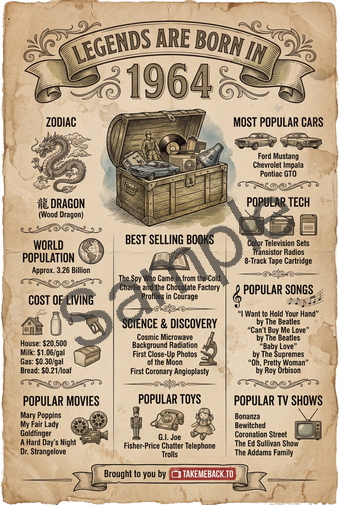

Major Events of 1964 - Historical Moments That Defined the Year | TakeMeBack.to
- 01 Jan Federation of Rhodesia and Nyasaland dissolved: On January 1, 1964, the Federation of Rhodesia and Nyasaland was officially dissolved, leading to the independence of Northern Rhodesia as Zambia and Nyasaland as Malawi in 1964. source: en.wikipedia.org
- 02 Jan Assassination attempt on President Nkrumah: On January 2, 1964, an assassination attempt was made on Kwame Nkrumah, the President of Ghana. The attempt highlighted the political tensions and challenges faced by Nkrumah during his leadership. source: britannica.com
- 03 Jan Jack Paar Show shows a clip of the Beatles singing She Loves You: On January 3, 1964, The Jack Paar Show aired a clip of The Beatles performing 'She Loves You'. This appearance contributed to the band's rising popularity in the United States. source: bbc.com
- 05 Jan Historic meeting of Catholic and Orthodox Christian leaders: On January 5, 1964, Pope Paul VI and Patriarch Athenagoras I of Constantinople met in Jerusalem, marking a significant step towards reconciliation between the Catholic and Orthodox Churches. This meeting was the first between the leaders of the two branches of Christianity since the Great Schism of 1054. source: britannica.com
- 06 Jan Rolling Stones launch first headline tour: On January 6, 1964, the Rolling Stones kicked off their first major headline tour in the United Kingdom. This tour helped establish them as one of the leading rock bands of the era, following their initial success with hit singles. source: bbc.com
- 07 Jan Bahamas achieves internal self-government: On January 7, 1964, the Bahamas achieved internal self-government, allowing for greater autonomy from British rule. This milestone was a significant step towards full independence, which was eventually granted in 1973. source: britannica.com
- 08 Jan U.S. President Lyndon B. Johnson declares "War on Poverty": In his first State of the Union Address on January 8, 1964, President Lyndon B. Johnson declared a "War on Poverty," outlining initiatives to reduce poverty in the United States. source: history.com
- 09 Jan Stan Javier's birth: Stanley Julián Antonio Javier, a Dominican former professional baseball outfielder, was born on January 9, 1964, in San Francisco de Macorís, Dominican Republic. source: en.wikipedia.org
- 10 Jan Communal violence in Calcutta: On January 10, 1964, Calcutta (now Kolkata) experienced significant communal riots, resulting in at least 264 deaths and the displacement of over 70,000 Muslims. source: en.wikipedia.org
- 11 Jan Surgeon General's Report on Smoking and Health Released: On January 11, 1964, U.S. Surgeon General Luther L. Terry released a landmark report titled "Smoking and Health: Report of the Advisory Committee to the Surgeon General of the Public Health Service." This report concluded that cigarette smoking is a health hazard of sufficient importance in the United States to warrant appropriate remedial action, linking smoking to lung cancer, chronic bronchitis, and other health issues. source: cdc.gov
- 12 Jan Zanzibar Revolution Begins: On January 12, 1964, the Zanzibar Revolution commenced, leading to the overthrow of the Sultan of Zanzibar and the establishment of the People's Republic of Zanzibar and Pemba. This revolution significantly altered the political landscape of the region. source: en.wikipedia.org
- 13 Jan John Glenn Resigns from NASA: On January 13, 1964, astronaut John Glenn resigned from NASA to pursue a political career. He would later serve as a U.S. Senator from Ohio and returned to space in 1998 at the age of 77. source: en.wikipedia.org
- 14 Jan Bapu Nadkarni's Record-Breaking Cricket Performance: On January 12, 1964, during the fourth Test match between India and England in Madras, Indian cricketer Bapu Nadkarni bowled 21 consecutive maiden overs, totaling 131 balls without conceding a run. This remarkable feat is celebrated as one of the most economical bowling performances in Test cricket history. source: en.wikipedia.org
- 15 Jan Whisky a Go Go opens on Sunset Strip: On January 15, 1964, Whisky a Go Go opened its doors on the Sunset Strip in West Hollywood, California. This iconic venue became a significant part of the music scene, hosting numerous famous acts and contributing to the rise of rock and roll culture. source: whiskyagogo.com
- 16 Jan Panama severs diplomatic ties with US: On January 16, 1964, Panama officially severed diplomatic relations with the United States, a move that reflected growing tensions over U.S. involvement in Panamanian affairs. This decision had significant implications for U.S.-Latin American relations. source: state.gov
- 18 Jan President Johnson meets with civil rights leaders in Oval Office: On January 18, 1964, President Lyndon B. Johnson met with civil rights leaders Martin Luther King Jr., Whitney Young, and James Farmer in the Oval Office to discuss civil rights issues. source: obamawhitehouse.archives.gov
- 22 Jan Arthur Miller's 'After the Fall' opens: On January 22, 1964, Arthur Miller's play 'After the Fall' premiered, exploring themes of guilt and redemption. The play received critical acclaim and contributed to Miller's reputation as a leading American playwright. source: arthurmiller.com
- 24 Jan 24th Amendment ratified: voting rights protection: The 24th Amendment to the United States Constitution was ratified on January 24, 1964, prohibiting the use of poll taxes in federal elections. This amendment aimed to enhance voting rights and reduce barriers for citizens. source: archives.gov
- 25 Jan Echo 2 satellite launch: The Echo 2 satellite was successfully launched on January 25, 1964, following its predecessor, Echo 1. This satellite continued to test the feasibility of satellite communications by reflecting radio waves back to Earth. source: nasa.gov
- 26 Jan Nelson Mandela sentenced to life imprisonment: Nelson Mandela was sentenced to life imprisonment for his role in the anti-apartheid struggle in South Africa. This sentence was handed down during the Rivonia Trial, where Mandela and others were charged with sabotage against the apartheid government. source: britannica.com
- 27 Jan The Beatles' US album release: The Beatles released their first album in the United States, titled 'Introducing... The Beatles.' This album featured several of their early hits and played a crucial role in their rise to fame in America. source: britannica.com
- 28 Jan US Air Force T-39 shot down over East Germany: An unarmed United States Air Force T-39 Sabreliner was shot down by a Soviet MiG-19 while on a training mission over Erfurt, East Germany. This incident heightened tensions during the Cold War. source: britannica.com
- 29 Jan Dr. Strangelove film release: Stanley Kubrick's satirical black comedy film 'Dr. Strangelove or: How I Learned to Stop Worrying and Love the Bomb' was released on January 29, 1964. source: history.com
- 30 Jan Cold War spy exchange: On January 30, 1964, a significant spy exchange took place during the Cold War, involving the release of captured intelligence agents. source: en.wikipedia.org
- 31 Jan US Surgeon General's report links smoking to lung cancer: On January 31, 1964, the U.S. Surgeon General released a landmark report that established a direct link between smoking and lung cancer. This report significantly influenced public health policies and awareness regarding the dangers of tobacco use. It marked a pivotal moment in the fight against smoking-related diseases. source: cdc.gov
- 01 Feb The Beatles' first US #1 hit: On February 1, 1964, The Beatles achieved their first number one hit in the United States with the song 'I Want to Hold Your Hand.' This milestone marked the beginning of Beatlemania in America and significantly impacted the music industry and popular culture. source: bbc.com
- 02 Feb Baseball Hall of Fame inductees announced: On February 2, 1964, the Baseball Hall of Fame announced its inductees for the year. This event is significant in recognizing the contributions of players to the sport and celebrating baseball history. source: britannica.com
- 03 Feb New York City school boycott occurs: On February 3, 1964, a significant school boycott took place in New York City, organized by civil rights activists. The event aimed to protest against racial segregation in schools and advocate for equal education opportunities. source: nytimes.com
- 04 Feb 24th Amendment bans poll tax in federal elections: On February 4, 1964, President Lyndon B. Johnson signed the 24th Amendment into law, prohibiting the use of poll taxes in federal elections. This amendment aimed to eliminate financial barriers to voting, particularly in Southern states where poll taxes were used to disenfranchise African American voters. source: tahlequahdailypress.com
- 06 Feb Medgar Evers murder trial ends in mistrial: Byron De La Beckwith was tried for the 1963 murder of civil rights leader Medgar Evers. The all-white jury was unable to reach a unanimous verdict, resulting in a mistrial. source: nps.gov
- 07 Feb The Beatles arrive in New York City: The Beatles arrived in New York City, marking the beginning of their first U.S. tour. source: en.wikipedia.org
- 08 Feb Civil rights protection for women in the 1964 Civil Rights Act: The Civil Rights Act of 1964 was enacted, prohibiting discrimination based on sex, among other factors. source: en.wikipedia.org
- 09 Feb The Beatles make historic Ed Sullivan Show debut: On February 9, 1964, The Beatles made their first appearance on The Ed Sullivan Show, marking a significant moment in music history. This performance introduced the band to a vast American audience, contributing to the 'British Invasion' of the U.S. music scene. source: history.com
- 10 Feb Bob Dylan releases 'The Times They Are A-Changin': On February 10, 1964, Bob Dylan released his third studio album, "The Times They Are A-Changin'", featuring songs that became anthems for social change. source: en.wikipedia.org
- 11 Feb The Beatles' first US concert: The Beatles performed their first concert in the United States at the Washington Coliseum in Washington, D.C. This event marked a significant moment in music history, as it helped to launch Beatlemania in America. The concert was attended by thousands of fans and was broadcasted on television, further solidifying the band's popularity. source: britannica.com
- 12 Feb Cyprus conflict erupts: On February 12, 1964, violence erupted in Cyprus between Greek and Turkish Cypriots, marking a significant escalation in the ongoing conflict on the island. This event led to increased tensions and international involvement, including a United Nations peacekeeping mission. The conflict would continue to affect Cyprus for decades. source: bbc.com
- 13 Feb Death of Gerald Gardner: Gerald Gardner, a prominent figure in the field of Wicca and modern witchcraft, passed away on February 13, 1964. He was known for his role in popularizing Wicca and for his writings on the subject. His death marked a significant moment in the history of modern paganism. source: britannica.com
- 15 Feb The Beatles' "Meet the Beatles!" album tops charts: On February 15, 1964, The Beatles' album 'Meet the Beatles!' reached the top of the U.S. charts. This marked a significant achievement in the band's career, solidifying their popularity in the American music scene. source: billboard.com
- 16 Feb Foxy musical opens on Broadway: On February 16, 1964, the musical 'Foxy' opened on Broadway. The production was notable for its performances and contributions to the theater scene during that period. source: ibdb.com
- 17 Feb Civil Rights Law advancement: On February 17, 1964, significant advancements were made in civil rights legislation in the United States. This period marked a crucial time in the Civil Rights Movement, leading to the eventual passage of the Civil Rights Act later that year. source: archives.gov
- 18 Feb Papandreou government takes power in Greece: On February 18, 1964, George Papandreou became the Prime Minister of Greece, leading a government that aimed to implement progressive reforms. His administration faced various challenges, including political instability and economic issues. source: britannica.com
- 19 Feb Malcolm X assassinated in New York City: On February 19, 1964, civil rights leader Malcolm X was assassinated in New York City while delivering a speech. His death marked a significant moment in the Civil Rights Movement and sparked widespread outrage and mourning. source: britannica.com
- 20 Feb R.T. Stanyforth obituary: R.T. Stanyforth, a notable figure in British theater, passed away on February 20, 1964. source: en.wikipedia.org
- 22 Feb The Beatles return from US tour: On February 22, 1964, The Beatles returned to London after their successful first American tour. Their flight arrived at London Airport at 8:10 am, greeted by enthusiastic fans. The band held a press conference at the airport's Kingsford-Smith suite, which was broadcast by the BBC and other media outlets. source: beatlesbible.com
- 25 Feb Eastern Air Lines Flight 304 crash: On February 25, 1964, Eastern Air Lines Flight 304 crashed into the Atlantic Ocean shortly after takeoff from New York City, resulting in the loss of all 84 passengers and crew. The incident raised concerns about aviation safety and led to investigations into airline operations. source: ntsb.gov
- 26 Feb John Glenn's unexpected campaign setback: On February 26, 1964, John Glenn faced an unexpected setback in his campaign for the U.S. Senate. Despite his popularity as an astronaut, political challenges emerged that complicated his bid for office. source: nytimes.com
- 27 Feb Death of Anna Julia Cooper: Anna Julia Cooper, an influential African-American educator, author, and activist, died of a heart attack in Washington, D.C., at the age of 105. source: unm.edu
- 29 Feb Johnson's State Department press conference: On February 29, 1964, President Johnson held a press conference at the State Department, addressing various foreign policy issues. This event was part of his administration's efforts to communicate its stance on international relations during a turbulent period. source: presidency.ucsb.edu
- 01 Mar Villarrica volcano eruption devastates Conaripe: On March 1, 1964, the Villarrica volcano in Chile erupted, causing significant destruction in the town of Conaripe. The eruption resulted in lava flows and ash fall, displacing residents and leading to a humanitarian crisis. source: britannica.com
- 02 Mar Beatles begin filming 'A Hard Day's Night': On March 2, 1964, The Beatles started filming their first feature film, 'A Hard Day's Night,' which would go on to become a cultural phenomenon. The film showcased the band's music and their rise to fame during the British Invasion. source: bbc.com
- 03 Mar UN Security Council resolution for Cyprus peacekeeping: The United Nations Security Council adopted a resolution to establish a peacekeeping force in Cyprus amid escalating tensions between Greek and Turkish Cypriots. This marked a significant step in international efforts to stabilize the region. source: un.org
- 04 Mar Landmark First Amendment Supreme Court ruling: The U.S. Supreme Court delivered a significant ruling regarding the First Amendment, reinforcing the principles of free speech and press. This decision had lasting implications for civil liberties in the United States. source: law.cornell.edu
- 05 Mar Beatles top US charts: On March 5, 1964, The Beatles' single "I Want to Hold Your Hand" reached number one on the US Billboard Hot 100 chart, further solidifying the band's growing international popularity during the British Invasion. source: mybirthdayhits.com
- 06 Mar Muhammad Ali receives his new name: On March 6, 1964, boxer Cassius Clay announced his conversion to Islam and his new name, Muhammad Ali, marking a significant moment in his life and career. source: history.com
- 08 Mar Civil Rights Act of 1964 Signed: On March 8, 1964, President Lyndon B. Johnson signed the Civil Rights Act of 1964 into law, marking a significant milestone in the fight against racial discrimination in the United States. source: archives.gov
- 09 Mar New York Times v. Sullivan Supreme Court Decision: The Supreme Court delivered its landmark decision in New York Times Co. v. Sullivan on March 9, 1964. This ruling established the standard for proving libel against public figures, emphasizing the importance of free speech and press. It was a pivotal moment in First Amendment jurisprudence. source: law.cornell.edu
- 10 Mar Henry Cabot Lodge Jr. Wins New Hampshire Republican Primary: On March 10, 1964, Henry Cabot Lodge Jr. won the New Hampshire Republican primary, a significant event in the lead-up to the 1964 presidential election. His victory was seen as a boost for his campaign, although he ultimately did not secure the nomination. This primary was crucial in shaping the Republican race. source: nytimes.com
- 12 Mar New Hampshire introduces state lottery: On March 12, 1964, New Hampshire became the first state in the U.S. to introduce a state lottery. This move was aimed at generating revenue for public education and set a precedent for other states to follow. source: nh.gov
- 13 Mar Turkey's threat to Cyprus: On March 13, 1964, Turkey issued a warning regarding its military presence in Cyprus, escalating tensions on the island. This threat was part of the ongoing conflict between Greek and Turkish Cypriots. source: bbc.com
- 14 Mar Jack Ruby convicted for killing Lee Harvey Oswald: On March 14, 1964, Jack Ruby was convicted of murder for killing Lee Harvey Oswald, the assassin of President John F. Kennedy. Ruby's actions and subsequent trial drew significant media attention and public interest. source: nytimes.com
- 15 Mar President Johnson launches War on Poverty: On March 15, 1964, President Lyndon B. Johnson delivered a special message to Congress, proposing a nationwide war on the sources of poverty. This initiative aimed to address the economic challenges faced by many Americans. source: georgewbush-whitehouse.archives.gov
- 16 Mar KCOY TV Channel 12 launches in Santa Maria, California: KCOY TV Channel 12 began broadcasting in Santa Maria, California, on March 16, 1964. The station was established as a result of the Federal Communications Commission's decision to deintermix Fresno, leading to the relocation of channel 12 to Santa Maria. KCOY TV initially affiliated with NBC and also carried some CBS programs. source: en.wikipedia.org
- 20 Mar ESRO established, European Space Research Organization: The European Space Research Organization (ESRO) was established on March 20, 1964, to promote and coordinate space research in Europe. This organization later contributed to the formation of the European Space Agency (ESA). source: esa.int
- 21 Mar The Beatles' hit single tops charts: On March 21, 1964, The Beatles' single 'Can't Buy Me Love' reached the top of the Billboard Hot 100 chart. This marked another milestone in their successful music career during the British Invasion in the United States. source: billboard.com
- 22 Mar Carol Mann Wins LPGA Women's Western Golf Open: Carol Mann won the LPGA Women's Western Golf Open on March 22, 1964.
- 23 Mar UNCTAD I world conference opens in Geneva, Switzerland: On March 23, 1964, the first United Nations Conference on Trade and Development (UNCTAD I) opened in Geneva, Switzerland. This conference aimed to address issues related to international trade and development. source: en.wikipedia.org
- 24 Mar Death of Peter Lorre: Peter Lorre, the Hungarian-American actor known for his roles in classic films such as 'M' and 'Casablanca,' passed away on March 24, 1964. His unique voice and expressive acting style made him a notable figure in the film industry. Lorre's death marked the end of an era for many fans of classic cinema. source: britannica.com
- 25 Mar Egypt ends state of siege: On March 25, 1964, Egypt officially ended a state of siege that had been in place since the 1967 Arab-Israeli War. This decision was part of a broader effort to normalize relations and stabilize the country after years of political turmoil. The lifting of the siege was seen as a significant step towards restoring civil liberties. source: bbc.com
- 26 Mar Good Friday Earthquake in Alaska: The Good Friday Earthquake, measuring 9.2, struck Alaska on March 27, 1964, causing widespread devastation and tsunamis. It remains the most powerful earthquake recorded in North America, resulting in significant loss of life and property damage. source: usgs.gov
- 27 Mar UN Peacekeeping Mission in Cyprus: On March 27, 1964, the United Nations established a peacekeeping mission in Cyprus to address the intercommunal violence between Greek and Turkish Cypriots. This mission aimed to maintain peace and security on the island amid rising tensions. source: un.org
- 28 Mar Discovery of Epstein-Barr Virus: In 1964, researchers identified the Epstein-Barr virus (EBV), a member of the herpesvirus family, which is associated with several diseases, including infectious mononucleosis and certain cancers. This discovery was pivotal in understanding viral oncogenesis. source: ncbi.nlm.nih.gov
- 29 Mar Launch of Radio Caroline: Radio Caroline, a pirate radio station, was launched on March 29, 1964, broadcasting from a ship off the coast of England. It played a significant role in the music scene, providing an alternative to the BBC and influencing the future of radio broadcasting in the UK. source: bbc.com
- 30 Mar Jeopardy! game show premieres on NBC: The iconic game show 'Jeopardy!' premiered on NBC, created by Merv Griffin. It introduced a unique answer-and-question format that has become a staple of American television. The show has since gained immense popularity and has become a cultural phenomenon. source: britannica.com
- 31 Mar Nelson Mandela's imprisonment begins: Nelson Mandela was sentenced to life imprisonment on March 31, 1964, for his anti-apartheid activities. His imprisonment became a symbol of the struggle against apartheid in South Africa and garnered international attention. source: britannica.com
- 01 Apr UK defence reorganization: On April 1, 1964, the United Kingdom announced a significant reorganization of its defense policy, which included the establishment of new military structures and strategies. This move was part of a broader effort to adapt to changing global security dynamics during the Cold War. source: britannica.com
- 02 Apr The Beatles dominate Billboard Top 40: On April 2, 1964, The Beatles achieved a historic milestone by occupying the top five positions on the Billboard Hot 100 chart. This unprecedented feat marked a significant moment in music history and solidified their influence in popular culture. source: billboard.com
- 03 Apr US-Panama diplomatic restoration: On April 3, 1964, the United States and Panama restored diplomatic relations after a period of tension. This restoration was significant for both nations, particularly in the context of the Panama Canal and regional stability in Central America. source: state.gov
- 04 Apr The Beatles occupy the top five positions on the Hot 100 pop chart: On April 4, 1964, The Beatles achieved an unprecedented milestone by holding the top five positions on the Billboard Hot 100 chart simultaneously. The top five songs were: 'Can't Buy Me Love' at #1, 'Twist and Shout' at #2, 'She Loves You' at #3, 'I Want to Hold Your Hand' at #4, and 'Please Please Me' at #5. source: beatlesbible.com
- 05 Apr IBM Announces System/360 Mainframe Computer: On April 5, 1964, IBM announced the System/360 mainframe computer, a groundbreaking development that revolutionized computing by introducing a family of compatible computers with a range of performance capabilities. source: en.wikipedia.org
- 08 Apr IBM Announces System/360 Mainframe Computer: On April 7, 1964, IBM announced the System/360 mainframe computer family, marking a significant advancement in computing technology. source: ibm.com
- 10 Apr Tragic maritime disaster in Persian Gulf: On April 10, 1964, a maritime disaster occurred in the Persian Gulf, resulting in significant loss of life and highlighting the dangers of naval operations in the region. The incident involved a collision between two vessels, leading to a tragic outcome that drew attention to maritime safety regulations. source: britannica.com
- 11 Apr Brazilian military takes presidential power: On April 11, 1964, the Brazilian military executed a coup d'état, overthrowing President João Goulart and establishing a military regime that would last for over two decades. This event marked a significant turning point in Brazil's political history, leading to widespread repression and changes in governance. source: britannica.com
- 12 Apr Khomeini's release: On April 12, 1964, Ayatollah Ruhollah Khomeini was released from prison in Iran after being detained for his opposition to the Shah's regime. His release marked a significant moment in the lead-up to the Iranian Revolution, as Khomeini would later become a central figure in the movement against the monarchy. source: britannica.com
- 13 Apr Ian Smith becomes Premier of Rhodesia: On April 13, 1964, Ian Smith was appointed as the Premier of Rhodesia, a position he held during a tumultuous period marked by the country's unilateral declaration of independence from Britain in 1965. His leadership was characterized by a controversial stance on racial policies and governance. source: britannica.com
- 14 Apr Rachel Carson's death: Rachel Carson, the renowned marine biologist and conservationist, passed away on April 14, 1964. She is best known for her book 'Silent Spring,' which challenged the use of pesticides and is credited with advancing the global environmental movement. source: nps.gov
- 15 Apr Ian Smith becomes Premier of Rhodesia: On April 15, 1964, Ian Smith was appointed Prime Minister of Rhodesia. His tenure was marked by significant political developments and international attention. source: en.wikipedia.org
- 17 Apr Ford Mustang debut at World's Fair: The Ford Mustang was officially unveiled to the public at the New York World's Fair on April 17, 1964. This event marked the introduction of the iconic pony car, which quickly became a symbol of American automotive culture. source: history.com
- 19 Apr Roger Sessions' Opera 'Montezuma' Premieres: Composer Roger Sessions' opera 'Montezuma' has its world premiere in West Berlin, Germany, contributing to the contemporary classical music landscape.
- 20 Apr Mandela's 'I Am Prepared to Die' speech: On April 20, 1964, Nelson Mandela delivered his renowned 'I Am Prepared to Die' speech from the dock during the Rivonia Trial. In this three-hour address, he articulated the African National Congress's (ANC) struggle against apartheid, detailing the organization's shift from nonviolent resistance to sabotage as a response to systemic oppression. Mandela concluded with the powerful statement, "It is an ideal for which I am prepared to die." source: sbs.com.au
- 22 Apr Formation of the Republic of Tanzania: On April 22, 1964, the Articles of Union were signed by Julius Nyerere of Tanganyika and Abeid Karume of Zanzibar, leading to the formation of the United Republic of Tanganyika and Zanzibar. This union was ratified on April 26, 1964, and the country was renamed the United Republic of Tanzania on October 29, 1964. source: britannica.com
- 23 Apr Formation of United Republic of Tanganyika and Zanzibar: On April 23, 1964, the Articles of Union were signed by Julius Nyerere of Tanganyika and Abeid Karume of Zanzibar, leading to the formation of the United Republic of Tanganyika and Zanzibar. This union was ratified on April 26, 1964, and the country was renamed the United Republic of Tanzania on October 29, 1964. source: britannica.com
- 24 Apr Gold certificate ownership restrictions lifted: On April 24, 1964, the U.S. government lifted restrictions on the ownership of gold certificates, allowing private citizens to hold these notes. This change was part of broader monetary policy reforms. source: federalreserve.gov
- 25 Apr The Beatles Billboard Top 40 domination: On April 25, 1964, The Beatles achieved a historic milestone by occupying 14 positions on the Billboard Top 40 chart. This event marked a peak in their influence on popular music. source: billboard.com
- 26 Apr Formation of United Republic of Tanzania: The United Republic of Tanzania was formed on April 26, 1964, through the union of Tanganyika and Zanzibar. This significant political event marked the beginning of a new nation in East Africa, uniting diverse cultures and histories. source: britannica.com
- 28 Apr Death of L'Wren Scott: L'Wren Scott, a prominent fashion designer and stylist, passed away on April 28, 1964. Her contributions to the fashion industry were widely recognized, and her death was a significant loss to the creative community. source: vogue.com
- 29 Apr Royal Wedding: Princess Irene Marries Spanish Prince: Princess Irene of the Netherlands married Prince Carlos Hugo of Bourbon-Parma in a Roman Catholic ceremony at the Borghese Chapel in Rome. The Dutch royal family did not attend due to Irene's conversion to Catholicism and her marriage to a Carlist claimant to the Spanish throne. source: en.wikipedia.org
- 30 Apr Howard Buffett, American businessman and politician, dies at 60: Howard Buffett, an American businessman and politician, and father of Warren Buffett, passed away at the age of 60. source: en.wikipedia.org
- 01 May First BASIC Programming Language Execution: On May 1, 1964, the first version of the BASIC programming language was successfully executed at Dartmouth College. Developed by John G. Kemeny and Thomas E. Kurtz, BASIC was designed to make computer programming more accessible to students and faculty. Its simplicity contributed to its widespread adoption in the 1970s and 1980s. source: wired.com
- 03 May Malta votes for independence: On May 3, 1964, Malta voted in favor of independence from British rule, marking a significant step in its political history. The referendum resulted in a clear majority supporting self-governance, leading to Malta's eventual independence later that year. source: bbc.com
- 04 May Richard Hofstadter wins Pulitzer Prize: On May 4, 1964, historian Richard Hofstadter was awarded the Pulitzer Prize for his book 'Anti-Intellectualism in American Life.' The work critically examined the role of anti-intellectual sentiments in American culture and politics, earning significant acclaim. source: nytimes.com
- 05 May USNS Card sunk by North Vietnamese frogmen: On May 5, 1964, the USNS Card was attacked and sunk by North Vietnamese frogmen in the Gulf of Tonkin. This incident heightened tensions in the region and contributed to the escalation of U.S. military involvement in Vietnam. source: nytimes.com
- 06 May Joe Orton's 'Entertaining Mr Sloane' premieres in London: On May 6, 1964, Joe Orton's play 'Entertaining Mr Sloane' premiered at the New Arts Theatre in London. The play is a black comedy that explores themes of sexual manipulation and moral ambiguity. source: en.wikipedia.org
- 09 May Khrushchev's visit to Egypt: Soviet Premier Nikita Khrushchev visited Egypt, meeting with President Gamal Abdel Nasser. The visit aimed to strengthen Soviet-Egyptian relations and support Egypt's development projects, including the Aswan High Dam. source: jta.org
- 10 May Treblinka Memorial dedicated in Poland: A memorial was dedicated at the site of the former Treblinka extermination camp in Poland, honoring the victims of the Holocaust who perished there. source: jta.org
- 11 May First BASIC computer program executed: The first program written in the BASIC programming language was executed at Dartmouth College. This event marked a significant milestone in computer science, as BASIC became widely used in education and personal computing. source: britannica.com
- 12 May Manlio Brosio appointed NATO Secretary-General: Manlio Brosio was appointed as the Secretary-General of NATO, succeeding Lord Ismay. His tenure focused on strengthening the alliance during a period of heightened tensions in the Cold War. source: nato.int
- 13 May Heroic pilot prevents school tragedy: A pilot successfully averted a potential tragedy when his aircraft malfunctioned, allowing him to land safely away from a school. His actions were praised for preventing what could have been a catastrophic event. source: history.com
- 14 May Aswan High Dam Inauguration: On May 14, 1964, Egyptian President Gamal Abdel Nasser and Soviet Premier Nikita Khrushchev inaugurated the first stage of the Soviet-financed Aswan High Dam by diverting the Nile River's course. source: english.ahram.org.eg
- 16 May Verne Gagne wins AWA World Heavyweight Title: On May 16, 1964, Verne Gagne defeated Mad Dog Vachon in Omaha, Nebraska, to regain the AWA World Heavyweight Title. This victory marked Gagne's seventh reign as champion. source: prowrestlingchampions.weebly.com
- 17 May First Tim Hortons coffee and donut shop opens: On May 17, 1964, the first Tim Hortons coffee and donut shop opened in Hamilton, Ontario. Founded by NHL player Tim Horton and businessman Jim Charade, the store sold coffee and donuts for 10 cents each. source: newswire.ca
- 18 May Schneider v. Rusk Supreme Court decision: On May 18, 1964, the U.S. Supreme Court ruled in Schneider v. Rusk that naturalized citizens have the right to return to their native countries and retain U.S. citizenship, even if they never return to the United States. This decision invalidated a law that stripped naturalized Americans of their citizenship as a result of extended or permanent residence abroad. source: en.wikipedia.org
- 21 May Baltimore Harbor Light becomes world's first nuclear-powered lighthouse: On May 20, 1964, the Baltimore Harbor Light in Maryland was fitted with a radioisotope thermoelectric generator, making it the first and only nuclear-powered lighthouse in the United States. source: en.wikipedia.org
- 22 May President Lyndon B. Johnson launches "Great Society" program: On May 22, 1964, U.S. President Lyndon B. Johnson launched his "Great Society" program, aiming to eliminate poverty and racial injustice in America. source: en.wikipedia.org
- 23 May The Beatles' 'Second Album' tops charts: Released on April 10, 1964, The Beatles' 'Second Album' reached number one on the Billboard Top LPs chart, replacing 'Meet the Beatles!' at the top spot. The album remained at number one for five consecutive weeks, from May 2 to May 30, 1964. source: retronewser.com
- 25 May Supreme Court Ruling Against School Segregation: On May 25, 1964, the U.S. Supreme Court ruled in Griffin v. County School Board of Prince Edward County that closing public schools to avoid desegregation violated the Equal Protection Clause of the Fourteenth Amendment. source: britannica.com
- 26 May Lenny Kravitz Born: Lenny Kravitz, the American singer, songwriter, and actor, was born on May 26, 1964.
- 27 May Johnson-Russell Vietnam discussion: On May 27, 1964, U.S. Secretary of Defense Robert McNamara and General Maxwell Taylor met with President Lyndon B. Johnson to discuss the escalating situation in Vietnam. This meeting was pivotal in shaping U.S. military strategy in the region as tensions increased. source: archives.gov
- 28 May Palestine Liberation Organization founded: The Palestine Liberation Organization (PLO) was established on May 28, 1964, during a summit in Cairo, Egypt. The PLO aimed to create an independent Palestinian state and has played a significant role in Middle Eastern politics since its inception. source: britannica.com
- 29 May Arab League meeting in East Jerusalem: On May 29, 1964, the Arab League convened a meeting in East Jerusalem to discuss the Palestinian issue and regional stability. This meeting was significant in shaping Arab policy towards Israel and the Palestinian territories. source: britannica.com
- 30 May Leo Szilard's Passing: Leo Szilard, a prominent physicist and inventor, passed away on May 30, 1964. He is best known for his work on nuclear chain reactions and his role in the Manhattan Project. source: britannica.com
- 31 May First Pied Piper Murder: The first murder linked to the Pied Piper case occurred on May 31, 1964, raising concerns about safety in the community. This case drew significant media attention and public interest. source: nytimes.com
- 01 Jun Kenya becomes a republic: On June 1, 1964, Kenya officially became a republic, marking a significant change in its governance after gaining independence from British colonial rule in 1963. source: britannica.com
- 02 Jun Formation of the Palestine Liberation Organization (PLO): On June 2, 1964, the Palestine Liberation Organization (PLO) was established during a conference in Jerusalem, aimed at representing the Palestinian people and their national aspirations. source: britannica.com
- 03 Jun Ringo Starr Health Incident Before World Tour: On June 3, 1964, Ringo Starr collapsed during a photo session in London due to severe tonsillitis and pharyngitis. He was hospitalized, and session drummer Jimmie Nicol temporarily replaced him for the Beatles' world tour. source: beatlesbible.com
- 04 Jun Maldives adopts constitution: On June 4, 1964, the Maldives adopted its first constitution, marking a significant step in the nation's political development.
- 05 Jun Deep Submergence Vehicle Alvin commissioned: The Deep Submergence Vehicle Alvin was commissioned on June 5, 1964, marking a significant advancement in underwater exploration technology. Alvin has since been instrumental in numerous scientific missions, including deep-sea research and exploration of shipwrecks. source: noaa.gov
- 06 Jun Beatles' Netherlands tour: On June 6, 1964, The Beatles began their tour in the Netherlands, performing in front of enthusiastic crowds. This tour was part of their broader European tour during a peak period of their popularity. source: nytimes.com
- 07 Jun Jack Ruby testifies to Warren Commission: Jack Ruby, the man who killed Lee Harvey Oswald, testified before the Warren Commission on June 7, 1964. His testimony was crucial in understanding the events surrounding the assassination of President John F. Kennedy. source: archives.gov
- 08 Jun Comsat stock offering announced: On June 8, 1964, Communications Satellite Corporation (Comsat) announced its initial public offering. This marked a significant step in the commercialization of satellite communications in the United States. source: sec.gov
- 09 Jun Leadership transition in India: On June 9, 1964, Lal Bahadur Shastri became the Prime Minister of India following the death of Jawaharlal Nehru. Shastri's leadership was marked by significant events, including the Indo-Pakistani War of 1965. source: britannica.com
- 11 Jun Manfred Mann releases hit single: On June 11, 1964, the British band Manfred Mann released their hit single 'Do Wah Diddy Diddy'. The song became a major success, reaching the top of the charts in several countries and solidifying the band's popularity during the British Invasion. source: billboard.com
- 12 Jun Nelson Mandela sentenced to life imprisonment: On June 12, 1964, Nelson Mandela was sentenced to life imprisonment for his role in the anti-apartheid struggle in South Africa. This sentence was handed down after the Rivonia Trial, where Mandela and several others were convicted of sabotage against the apartheid government. source: britannica.com
- 13 Jun Freedom Summer project begins in Mississippi: The Freedom Summer project began on June 13, 1964, aiming to increase voter registration among African Americans in Mississippi. This initiative was part of a broader civil rights movement effort to combat racial discrimination and promote social justice. source: britannica.com
- 14 Jun LPGA Lady Carling Golf Open won by Clifford Ann Creed: On June 14, 1964, golfer Clifford Ann Creed won the LPGA Lady Carling Golf Open. This victory contributed to her recognition as one of the prominent female golfers of her time. source: britannica.com
- 15 Jun French Troops Withdraw from Algeria: On June 15, 1964, France completed the withdrawal of its troops from Algeria, marking the end of a long and brutal conflict. This withdrawal was part of the broader decolonization process that reshaped North Africa and had lasting impacts on French-Algerian relations. source: bbc.com
- 16 Jun Keith Bennett Abduction: On June 16, 1964, Keith Bennett was abducted in England, a case that became one of the most notorious child abductions in British history. His disappearance led to extensive searches and investigations, but he was never found, leaving a lasting impact on the community. source: bbc.com
- 17 Jun The Beatles' first Ed Sullivan Show appearance: On February 9, 1964, The Beatles made their first appearance on The Ed Sullivan Show, performing live in front of a studio audience. This event marked a significant moment in the British Invasion of the American music scene. source: history.com
- 18 Jun First Transpacific Telephone Cable Inaugurated: On June 19, 1964, the first transpacific undersea coaxial telephone cable, known as TPC-1, was inaugurated. This cable system connected Japan, Hawaii, and the U.S. mainland, significantly improving communication between these regions. source: ithistory.org
- 19 Jun Boris Johnson's Birth: Boris Johnson, the British politician and former Prime Minister, was born on June 19, 1964, in New York City. He later became a prominent figure in UK politics, serving as Mayor of London and as a Member of Parliament. source: britannica.com
- 22 Jun Last Confederate General surrenders in Civil War: On June 22, 1964, the last Confederate general, Stand Watie, surrendered, marking a significant end to the Civil War. This event symbolized the conclusion of the conflict and the reunification of the United States. source: archives.gov
- 23 Jun Comsat stock offering: On June 23, 1964, Communications Satellite Corporation (Comsat) conducted its initial public offering (IPO). This event was significant in the development of satellite communications and the commercialization of space technology. source: sec.gov
- 24 Jun FTC rules health warnings must appear on all cigarette packages: On June 24, 1964, the Federal Trade Commission (FTC) mandated that health warnings be included on all cigarette packages. This regulation aimed to inform consumers about the health risks associated with smoking. source: fda.gov
- 25 Jun Catholic Church's stance on oral contraceptives: On June 25, 1964, the Catholic Church reaffirmed its opposition to the use of oral contraceptives, emphasizing the sanctity of procreation. This stance was part of a broader discussion on family planning and morality within the Church, which would later culminate in the encyclical Humanae Vitae in 1968. source: britannica.com
- 26 Jun St. Augustine racial crisis escalates: On June 26, 1964, tensions escalated in St. Augustine, Florida, as civil rights activists faced violent opposition while protesting segregation. This event was part of a larger struggle for civil rights in the South and highlighted the ongoing racial tensions in the United States during this period. source: britannica.com
- 30 Jun UN Troops Complete Congo Mission Withdrawal: The United Nations Operation in the Congo (ONUC) concluded on June 30, 1964, after four years of peacekeeping efforts aimed at restoring order and assisting the Congolese government during the Congo Crisis. source: en.wikipedia.org
- 02 Jul Civil Rights Act of 1964 signed into law: The Civil Rights Act of 1964 was signed by President Lyndon B. Johnson, prohibiting discrimination based on race, color, religion, sex, or national origin. This landmark legislation aimed to end segregation in public places and ban employment discrimination. It marked a significant achievement in the American civil rights movement. source: archives.gov
- 03 Jul Roy Emerson wins 78th Wimbledon Men's Singles Championship: Australian tennis player Roy Emerson won the 78th Wimbledon Men's Singles Championship on July 3, 1964. This victory marked Emerson's second Wimbledon title, solidifying his status as one of the top players of his era. His win was part of a successful career that included multiple Grand Slam titles. source: britannica.com
- 04 Jul Maria Bueno wins third Wimbledon singles title: Brazilian tennis player Maria Bueno won her third Wimbledon singles title on July 4, 1964. This victory further established her as one of the leading female players of her time. Bueno's success at Wimbledon was part of a remarkable career that included multiple Grand Slam titles. source: britannica.com
- 06 Jul Malawi gains independence from United Kingdom: On July 6, 1964, Nyasaland achieved independence from British colonial rule and was renamed Malawi. Dr. Hastings Kamuzu Banda became the country's first Prime Minister, leading it to become a republic in 1966. source: mofa.gov.lr
- 07 Jul All star MVP: Johnny Callison: Johnny Callison of the Philadelphia Phillies was named the Most Valuable Player of the 35th Major League Baseball All-Star Game, held on July 7, 1964, at Shea Stadium in New York. source: baseball-reference.com
- 09 Jul Moïse Tshombé becomes Prime Minister of Congo: On July 9, 1964, Moïse Tshombé was appointed Prime Minister of the Democratic Republic of the Congo. His leadership was marked by significant political challenges and conflicts during a tumultuous period in the country's history. source: britannica.com
- 10 Jul French parliamentary reorganization: On July 10, 1964, a significant reorganization of the French Parliament took place, impacting the political landscape of France. This reorganization was part of broader political changes occurring during that period. source: britannica.com
- 16 Jul Harlem race riots begin: The Harlem race riot of 1964 began on July 16, 1964, when 15-year-old James Powell was fatally shot by off-duty police Lieutenant Thomas Gilligan. This incident sparked six days of rioting in Harlem and Bedford-Stuyvesant, resulting in one death, over 100 injuries, and more than 450 arrests. source: britannica.com
- 18 Jul Harlem race riot of 1964: The Harlem race riot of 1964 continued on July 18, 1964, following the fatal shooting of James Powell by off-duty police Lieutenant Thomas Gilligan. The unrest led to looting, property damage, and further confrontations between protesters and police. source: britannica.com
- 19 Jul South Vietnamese Prime Minister escalates Vietnam War strategy: On July 19, 1964, South Vietnamese Prime Minister Nguyen Khanh announced a new strategy to intensify military operations against the Viet Cong. This decision marked a significant escalation in the Vietnam War, reflecting the increasing U.S. involvement in the conflict. source: britannica.com
- 20 Jul First surf rock #1 hit: On July 20, 1964, the Beach Boys' song 'I Get Around' became the first surf rock song to reach number one on the Billboard Hot 100 chart. This marked a significant moment in music history, popularizing the surf rock genre. source: britannica.com
- 21 Jul Mildred Simpson's marathon record: On July 21, 1964, Mildred Simpson set a marathon record, becoming one of the first women to gain recognition in long-distance running. Her achievement contributed to the growing visibility of female athletes in sports. source: britannica.com
- 24 Jul Nuclear criticality accident in Rhode Island: On July 24, 1964, a nuclear criticality accident occurred at the Nuclear Development Corporation in Rhode Island. The incident involved a criticality excursion that resulted in the exposure of workers to radiation. Fortunately, there were no fatalities, but the event raised significant safety concerns in the nuclear industry. source: nrc.gov
- 25 Jul The Beatles' 'A Hard Day's Night' album tops charts: On July 25, 1964, The Beatles' album 'A Hard Day's Night' reached the top of the charts in the United States. This marked a significant moment in music history, as the band continued to dominate the pop music scene. The album featured several hit songs and solidified The Beatles' status as a leading musical force. source: billboard.com
- 26 Jul Tragic train derailment in Portugal: On July 26, 1964, a train derailment occurred in Portugal, resulting in numerous casualties. The incident raised concerns about railway safety and led to investigations into the causes of the accident. It was one of the deadliest train accidents in the country's history. source: reuters.com
- 27 Jul U.S. announces deployment of additional military advisers to South Vietnam: On July 27, 1964, the United States announced the deployment of an additional 5,000 military advisers to South Vietnam, escalating its involvement in the region. source: en.wikipedia.org
- 28 Jul Ranger 7 lunar mission launched: On July 28, 1964, NASA launched the Ranger 7 spacecraft, which successfully transmitted high-resolution images of the lunar surface before impacting the Moon on July 31. source: jpl.nasa.gov
- 30 Jul U.S. Navy engages North Vietnamese forces: On July 30, 1964, the U.S. Navy engaged North Vietnamese forces in the Gulf of Tonkin, marking a significant escalation in the Vietnam War. source: archives.gov
- 31 Jul Gulf of Tonkin Incident: On July 31, 1964, the Gulf of Tonkin Incident occurred, involving alleged attacks on U.S. naval vessels by North Vietnamese forces, leading to increased U.S. military involvement in Vietnam. source: archives.gov
- 01 Aug The Beatles' "A Hard Day's Night" Tops Charts: On August 1, 1964, The Beatles' single "A Hard Day's Night" reached number one on the U.S. Billboard Hot 100 chart. This achievement marked the band's fifth U.S. number one single in seven months, reflecting their rapid rise to international stardom during the British Invasion. source: thisdayinmusic.com
- 04 Aug Gulf of Tonkin Incident: The Gulf of Tonkin Incident occurred on August 4, 1964, when U.S. naval vessels reported being attacked by North Vietnamese forces. This event led to the escalation of U.S. military involvement in Vietnam, significantly impacting the course of the war. source: archives.gov
- 05 Aug Operation Pierce Arrow: Operation Pierce Arrow was initiated on August 5, 1964, as a response to the Gulf of Tonkin Incident. This operation involved airstrikes against North Vietnamese targets and marked a significant escalation in U.S. military action in Vietnam. source: archives.gov
- 06 Aug Pope Paul VI's encyclical 'Ecclesiam Suam' emphasizes Church's mission: On August 6, 1964, Pope Paul VI issued his first encyclical, 'Ecclesiam Suam,' focusing on the Church's role in the modern world. The document underscores the Church's mission to be a loving mother to all and emphasizes the importance of dialogue with the world. It was signed at St. Peter's, Rome, on the Feast of the Transfiguration. source: vatican.va
- 07 Aug Gulf of Tonkin Resolution passes, escalating U.S. involvement in Vietnam: On August 7, 1964, the U.S. Congress passed the Gulf of Tonkin Resolution, granting President Lyndon B. Johnson authority to use military force in Southeast Asia. This resolution marked a significant escalation in U.S. involvement in the Vietnam War. source: en.wikipedia.org
- 08 Aug Turkey launches airstrikes on Greek Cypriot territories: On August 8, 1964, the Turkish Air Force initiated airstrikes on seven Greek Cypriot towns and villages in the northwest of Cyprus. The Cyprus government reported 24 Greek Cypriot fatalities and 200 injuries from these attacks. Turkey acknowledged the strikes, stating they were in response to unsuccessful efforts to halt Greek Cypriot assaults on the Turkish Cypriot minority. The United Nations Security Council called for an immediate ceasefire, which was implemented on August 10. source: en.wikipedia.org
- 09 Aug Gulf of Tonkin incident escalates U.S. involvement in Vietnam War: Between August 2 and August 4, 1964, the Gulf of Tonkin incident occurred, involving attacks by North Vietnamese torpedo boats on the U.S. destroyers USS Maddox and USS Turner Joy. These incidents led to the passage of the Gulf of Tonkin Resolution on August 10, 1964, granting President Lyndon B. Johnson authority to increase U.S. military presence in Vietnam, marking a significant escalation in the Vietnam War. source: britannica.com
- 10 Aug Gulf of Tonkin Resolution signed by President Johnson: On August 10, 1964, President Lyndon B. Johnson signed the Gulf of Tonkin Resolution, which granted him the authority to use military force in Southeast Asia, leading to a significant escalation of U.S. involvement in the Vietnam War. source: archives.gov
- 11 Aug The Beatles' 'A Hard Day's Night' U.S. Premiere: On August 11, 1964, The Beatles' film 'A Hard Day's Night' premiered in the United States, opening in 500 theaters across the country. The film was a commercial and critical success, grossing $14 million in its initial run and receiving positive reviews for its humor and innovative style. source: foxnews.com
- 13 Aug Last death penalty executions in Great Britain: On August 13, 1964, Peter Anthony Allen and Gwynne Owen Evans were executed for the murder of John Alan West during a robbery in April 1964. Allen was hanged at Walton Prison in Liverpool, and Evans at Strangeways Prison in Manchester. These were the last executions in the United Kingdom before the abolition of capital punishment for murder in 1965. source: gov.uk
- 15 Aug Ernie Banks Day in Chicago: On August 15, 1964, Chicago Cubs legend Ernie Banks was honored with a special ceremony at Wrigley Field. The event featured a 20-minute pregame ceremony attended by 23,003 fans, marking the first time the Cubs dedicated a day to one of their players. Among the gifts presented to Banks were a scroll from Mayor Richard Daley proclaiming August 15 as "Ernie Banks Day" in Chicago, a diamond ring from the Cubs organization, and a new station wagon. source: wgntv.com
- 16 Aug Johnson authorizes retaliatory air strike: In response to the Gulf of Tonkin incident, where U.S. naval vessels were attacked by North Vietnamese patrol boats, President Lyndon B. Johnson ordered retaliatory air strikes against North Vietnamese naval bases and an oil facility on August 16, 1964. This action marked a significant escalation in U.S. military involvement in Vietnam. source: en.wikipedia.org
- 17 Aug Capital Beltway construction completed: On August 17, 1964, the final segment of the Capital Beltway (Interstate 495) was officially opened near the New Hampshire Avenue interchange in Maryland. Maryland Governor J. Millard Tawes and Federal Highway Administrator Rex Whitton participated in the ribbon-cutting ceremony, marking the completion of the 64.7-mile loop around Washington, D.C. source: transportationhistory.org
- 18 Aug Charles Helou elected President of Lebanon: Charles Helou was elected President of Lebanon on August 18, 1964. His presidency was marked by efforts to maintain Lebanon's neutrality during regional conflicts and to address internal political challenges. source: en.wikipedia.org
- 20 Aug Economic Opportunity Act signed: The Economic Opportunity Act was signed into law by President Lyndon B. Johnson on August 20, 1964. This legislation aimed to eliminate poverty and expand educational and employment opportunities for low-income individuals in the United States. source: archives.gov
- 22 Aug USS Maddox incident escalates Vietnam War: The USS Maddox incident on August 22, 1964, involved a confrontation between the U.S. Navy and North Vietnamese forces, leading to increased U.S. military involvement in Vietnam. This event was pivotal in the escalation of the Vietnam War. source: archives.gov
- 23 Aug Saint Louis Cardinals' remarkable comeback season: The St. Louis Cardinals staged a remarkable comeback in the 1964 MLB season, overcoming a significant deficit to win the National League pennant. This achievement was pivotal in their eventual victory in the World Series against the New York Yankees. source: baseball-reference.com
- 24 Aug Democratic National Convention nominates Johnson and Humphrey: The Democratic National Convention held in 1964 officially nominated President Lyndon B. Johnson for re-election and Senator Hubert Humphrey for Vice President. This event was crucial in shaping the Democratic platform for the upcoming election. source: archives.gov
- 25 Aug Political instability in South Vietnam: On August 25, 1964, South Vietnam faced significant political instability, marked by government changes and increasing unrest. This period was critical in the lead-up to greater U.S. involvement in the Vietnam War. source: britannica.com
- 26 Aug Democratic National Convention nominates Lyndon B. Johnson for President: On August 26, 1964, the Democratic National Convention in Atlantic City, New Jersey, nominated incumbent President Lyndon B. Johnson for a full term. Senator Hubert H. Humphrey of Minnesota was nominated for vice president. source: history.com
- 27 Aug Johnson's Democratic nomination acceptance: On August 27, 1964, President Lyndon B. Johnson accepted the Democratic nomination for President at the Democratic National Convention in Atlantic City, New Jersey. source: lbjlibrary.org
- 28 Aug Philadelphia Race Riot of 1964: A race riot erupted in Philadelphia on August 28, 1964, following escalating tensions between African American residents and the city police. The unrest led to significant property damage and highlighted racial tensions in the city. source: en.wikipedia.org
- 30 Aug Clifford Ann Creed wins LPGA Riverside Ladies Golf Open: Clifford Ann Creed secured her third LPGA Tour victory by winning the Riverside Ladies Open on August 30, 1964, in Provo, Utah. She finished the tournament with a score of 286, three strokes ahead of runner-up Shirley Englehorn. source: en.wikipedia.org
- 31 Aug Food Stamp Act of 1964 signed into law: On August 31, 1964, President Lyndon B. Johnson signed the Food Stamp Act, establishing the Food Stamp Program as a permanent federal initiative to assist low-income individuals in purchasing food. source: en.wikipedia.org
- 02 Sep Keanu Reeves born in Beirut, Lebanon: Keanu Charles Reeves was born on September 2, 1964, in Beirut, Lebanon. He is a Canadian actor and musician, known for his roles in films such as 'The Matrix' and 'John Wick'. source: britannica.com
- 04 Sep NASA launches first Orbital Geophysical Observatory: On September 4, 1964, NASA launched the first Orbital Geophysical Observatory (OGO-1) from Cape Canaveral Air Force Station. This satellite was designed to study the Earth's magnetosphere and solar radiation, marking a significant advancement in space-based geophysical research. source: imagine.gsfc.nasa.gov
- 08 Sep The Animals' 'House of the Rising Sun' Tops US Charts: On September 5, 1964, The Animals' rendition of 'House of the Rising Sun' reached number one on the US Billboard Hot 100 chart, where it remained for three consecutive weeks. The song was notable for its length, over four minutes, which was unusual for singles at the time. source: officialcharts.com
- 09 Sep The Kinks Hit UK Number 1: On September 9, 1964, The Kinks' single 'You Really Got Me' reached number one on the UK Singles Chart, marking a significant milestone in the British Invasion era. source: en.wikipedia.org
- 10 Sep Palestinian Liberation Army established: The Palestine Liberation Army (PLA), the official military branch of the Palestine Liberation Organization (PLO), was established in 1964. The PLO was founded on May 28, 1964, during a summit in Cairo, Egypt. source: en.wikipedia.org
- 12 Sep First football game at Shea Stadium: On September 12, 1964, the New York Jets played their inaugural game at Shea Stadium, defeating the Denver Broncos 30-6. The game was attended by 44,497 fans, setting an American Football League (AFL) regular-season attendance record at the time. The Jets' quarterback, Dick Wood, completed 8 of 18 passes for 144 yards and two touchdowns, while rookie fullback Matt Snell rushed for 82 yards and a touchdown. source: pro-football-reference.com
- 13 Sep Roy Emerson wins U.S. Men's Tennis Championship: On September 13, 1964, Australian tennis player Roy Emerson defeated Fred Stolle 6–4, 6–2, 6–4 to win the men's singles title at the U.S. National Championships. source: reuters.com
- 14 Sep Walt Disney receives Presidential Medal of Freedom: On September 14, 1964, Walt Disney, the renowned animator and film producer, was awarded the Presidential Medal of Freedom by President Lyndon B. Johnson in a ceremony at the White House. source: presidency.ucsb.edu
- 15 Sep The Beatles perform in Cleveland: On September 15, 1964, The Beatles performed at the Cleveland Public Auditorium in Cleveland, Ohio, as part of their first North American tour. source: beatlesbible.com
- 17 Sep Bewitched TV Series Premiere: On September 17, 1964, the American television series 'Bewitched' premiered on ABC. The show, created by Sol Saks, starred Elizabeth Montgomery as Samantha Stephens, a witch who marries a mortal man and vows to lead a typical suburban housewife's life. 'Bewitched' became a popular sitcom, finishing as the second-highest-rated show in America during its debut season. source: en.wikipedia.org
- 18 Sep Royal wedding of King Constantine II and Princess Anne-Marie: King Constantine II of Greece married Princess Anne-Marie of Denmark in a Greek Orthodox ceremony at the Metropolitan Cathedral of Athens. The wedding was attended by 1,200 guests, including members of various European royal families. source: en.wikipedia.org
- 21 Sep Malta gains independence from the United Kingdom: On September 21, 1964, Malta achieved independence from British rule, becoming a member of the Commonwealth. This milestone marked the end of British colonial governance and the beginning of Malta's self-governance. source: britannica.com
- 24 Sep Warren Commission Report published: The Warren Commission Report, which investigated the assassination of President John F. Kennedy, was published on September 24, 1964. The report concluded that Lee Harvey Oswald acted alone in the assassination, a finding that has been the subject of much debate and conspiracy theories since its release. source: archives.gov
- 25 Sep Mozambican War of Independence begins: The Mozambican War of Independence began on September 25, 1964, as the Frente de Libertação de Moçambique (FRELIMO) launched an armed struggle against Portuguese colonial rule. This conflict ultimately led to Mozambique gaining independence in 1975. source: britannica.com
- 26 Sep MLB record: Most players in a single game: On September 26, 1964, a Major League Baseball game set a record for the most players used in a single game, with 43 players participating. This record highlights the strategic substitutions and roster management typical in baseball during that era. source: britannica.com
- 27 Sep Warren Commission Report on JFK Assassination: On September 24, 1964, the Warren Commission presented its 888-page report to President Lyndon B. Johnson, concluding that Lee Harvey Oswald acted alone in assassinating President John F. Kennedy. source: archives.gov
- 28 Sep XB-70 Valkyrie first flight: The XB-70 Valkyrie, a strategic bomber prototype, made its first flight on September 28, 1964. This aircraft was notable for its unique design and high-speed capabilities, intended for high-altitude missions during the Cold War. source: history.com
- 29 Sep Mafalda comic strip debuts: The Mafalda comic strip, created by Argentine cartoonist Quino, debuted on September 29, 1964. The strip features a young girl named Mafalda who is concerned about humanity and world peace, becoming a cultural icon in Latin America. source: theguardian.com
- 30 Sep 30 September Movement coup attempt in Indonesia: On September 30, 1964, the 30 September Movement attempted a coup in Indonesia, leading to significant political turmoil. The event marked a turning point in Indonesian history, resulting in the eventual rise of Suharto. source: britannica.com
- 01 Oct Free Speech Movement launched at UC Berkeley: On October 1, 1964, former graduate student Jack Weinberg was arrested for setting up a Congress of Racial Equality (CORE) table in Sproul Plaza at the University of California, Berkeley. This led to a 32-hour sit-in by students, marking the beginning of the Free Speech Movement, which advocated for students' rights to free speech and political activism on campus. source: berkeley.edu
- 03 Oct USS Thresher wreckage located: On October 3, 1964, the wreckage of the USS Thresher, a U.S. Navy nuclear-powered submarine that sank in April 1963, was located on the ocean floor. source: en.wikipedia.org
- 04 Oct Hurricane Hilda's destructive path: On October 4, 1964, Hurricane Hilda made landfall in the United States, causing significant damage in Louisiana and Mississippi. source: en.wikipedia.org
- 05 Oct USS Thresher wreckage located: In October 1964, the U.S. Navy located the wreckage of the nuclear submarine USS Thresher (SSN-593), which had sunk on April 10, 1963, during deep-diving tests approximately 220 miles east of Cape Cod, Massachusetts. The wreckage was found at a depth of about 8,400 feet. source: history.navy.mil
- 07 Oct New York Yankees play in World Series Game 1: On October 7, 1964, the New York Yankees faced the St. Louis Cardinals in Game 1 of the World Series at Busch Stadium in St. Louis. The Yankees lost the game 9-5. source: baseball-reference.com
- 08 Oct The Beatles record 'She's a Woman': On October 8, 1964, The Beatles recorded 'She's a Woman' at Abbey Road Studios in London. The song, written primarily by Paul McCartney, was completed in just five hours and released as the B-side to 'I Feel Fine' in November 1964. source: en.wikipedia.org
- 09 Oct Nuclear-Powered Ships complete first around-the-world voyage: In October 1964, the USS Enterprise, a nuclear-powered aircraft carrier, completed its first around-the-world voyage, demonstrating the capabilities of nuclear propulsion in naval vessels. source: en.wikipedia.org
- 10 Oct 1964 Tokyo Summer Olympics Opening: The 1964 Summer Olympics opened in Tokyo on October 10, 1964. This was the first time the Games were held in Asia, featuring new sports like judo and volleyball. source: en.wikipedia.org
- 11 Oct Fatal accident at 1000 Kilometres de Paris race: On October 11, 1964, a tragic accident occurred during the 1000 Kilometres de Paris race, resulting in fatalities. The incident highlighted safety concerns in motorsport, leading to discussions about regulations and driver safety measures. source: bbc.com
- 12 Oct Launch of Voskhod 1: First multi-person space mission: On October 12, 1964, Voskhod 1 was launched, marking the first multi-person space mission. This Soviet mission carried a crew of three and was a significant milestone in space exploration history. source: nasa.gov
- 13 Oct Extreme rainfall in Curacao: On October 13, 1964, Curacao experienced extreme rainfall, leading to significant flooding and disruption. The weather event raised concerns about climate patterns in the Caribbean region. source: weather.gov
- 14 Oct China conducts first atomic bomb test: On October 14, 1964, China successfully detonated its first atomic bomb, becoming the fifth nation to possess nuclear weapons. This test marked a significant milestone in China's military capabilities and global standing during the Cold War. source: bbc.com
- 15 Oct Martin Luther King Jr. receives Nobel Peace Prize: On October 15, 1964, Martin Luther King Jr. was awarded the Nobel Peace Prize for his nonviolent struggle against racial injustice in the United States. He became the youngest recipient of the award at that time, highlighting his significant contributions to the civil rights movement. source: nobelprize.org
- 16 Oct Harold Wilson becomes UK Prime Minister: On October 16, 1964, Harold Wilson was appointed Prime Minister of the United Kingdom after the Labour Party won the general election. His leadership marked a significant shift in British politics, focusing on social reforms and modernization. source: bbc.com
- 17 Oct China conducts first nuclear test: On October 17, 1964, China successfully detonated its first nuclear bomb, becoming the fifth nation to possess nuclear weapons. This test marked a significant milestone in China's military capabilities and global nuclear dynamics. source: britannica.com
- 18 Oct New York World's Fair closes first season: The New York World's Fair, which opened in April 1964, closed its first season on October 18, 1964. The fair showcased innovations and cultural exhibits, attracting millions of visitors and leaving a lasting impact on American culture. source: nytimes.com
- 19 Oct Leadership change in Soviet Union: On October 19, 1964, Nikita Khrushchev was ousted from power in the Soviet Union, marking a significant shift in leadership. This event led to the rise of Leonid Brezhnev, who would lead the country for the next 18 years. The change was part of a broader political struggle within the Communist Party. source: britannica.com
- 20 Oct Rolling Stones concert riot in Paris: On October 20, 1964, a concert by the Rolling Stones in Paris led to a riot, as fans rushed the stage and chaos ensued. This event highlighted the growing popularity of rock music and the intense fan culture surrounding it during the 1960s. The incident was widely reported in the media. source: nytimes.com
- 21 Oct Sudanese popular revolution begins: The Sudanese popular revolution began on October 21, 1964, leading to the overthrow of the military regime of Ibrahim Abboud. This revolution was significant in Sudan's history, as it marked the end of military rule and the beginning of a new political era. The event was characterized by widespread protests and civil disobedience. source: britannica.com
- 22 Oct EMI rejects The Who's early audition: On October 22, 1964, EMI Records declined to sign The Who after a test session at Abbey Road Studios. The letter of rejection, dated the same day, was signed by John Burgess. This event is documented in 'The Who: Concert File' by Joe McMichael and Jack Lyons. source: everand.com
- 23 Oct Larisa Latynina wins Olympic floor exercise gold: On October 23, 1964, Soviet gymnast Larisa Latynina secured her third consecutive Olympic gold medal in the floor exercise at the Tokyo Games. She had previously won gold in this event at the 1956 and 1960 Olympics. In Tokyo, she achieved a score of 19.599, leading to her victory. source: olympedia.org
- 24 Oct Zambia gains independence: On October 24, 1964, Zambia officially gained independence from British colonial rule, becoming a sovereign nation. This marked the end of British control and the beginning of self-governance for the Zambian people. source: Wikipedia (day-month pages)
- 25 Oct USSR conducts nuclear test at Novaya Zemlya: On October 25, 1964, the Soviet Union conducted a nuclear test at the Novaya Zemlya test site in the Arctic Ocean. This test was part of the USSR's ongoing nuclear weapons program during the Cold War era.
- 26 Oct Rolling Stones debut on Ed Sullivan Show: The Rolling Stones made their first appearance on The Ed Sullivan Show on October 26, 1964. This performance helped to launch their career in the United States and solidified their status as a major rock band. source: britannica.com
- 27 Oct Congo political hostage crisis: The Congo political hostage crisis began on October 27, 1964, when rebels took hostages, including foreign nationals. This event was part of the larger political turmoil in the Congo during this period. source: bbc.com
- 28 Oct Leadership change in Soviet Union: On October 28, 1964, Leonid Brezhnev was appointed as the General Secretary of the Communist Party of the Soviet Union, marking a significant leadership change. This transition was part of a broader shift in Soviet politics during the Cold War. source: britannica.com
- 29 Oct Formation of Tanzania: On October 29, 1964, the United Republic of Tanzania was officially formed through the union of Tanganyika and Zanzibar. This event marked a significant moment in African history, promoting unity and independence. source: britannica.com
- 30 Oct Tran Van Huong becomes South Vietnamese premier: On October 30, 1964, Tran Van Huong was appointed as the Prime Minister of South Vietnam. His leadership came during a tumultuous period in the Vietnam War, as the country faced significant challenges. source: britannica.com
- 31 Oct Barbra Streisand's 'People' album reaches number one on Billboard chart: On October 31, 1964, Barbra Streisand's album 'People' topped the Billboard album chart, marking her first number one album. source: number1albums.com
- 02 Nov King Saud deposed; Faisal becomes King of Saudi Arabia: On November 2, 1964, King Saud bin Abdulaziz Al Saud was deposed following a royal family coup. His brother, Prince Faisal, succeeded him as King Faisal of Saudi Arabia. source: rfi.fr
- 04 Nov The Supremes' 'Baby Love' tops charts: 'Baby Love' by The Supremes reached number one on the Billboard Hot 100 chart in the United States on October 25, 1964, and held the top position through November 21, 1964. The song also topped the UK Singles Chart during the same period. source: en.wikipedia.org
- 05 Nov Mariner 3 Mars mission failure: Mariner 3 was launched on November 5, 1964, with the goal of conducting a flyby of Mars. However, the mission failed due to the spacecraft's payload shroud failing to separate properly, preventing the deployment of solar panels and leading to the depletion of its batteries. source: science.nasa.gov
- 06 Nov 1964 U.S. Presidential Election: The 1964 United States presidential election was held on November 3, 1964. President Lyndon B. Johnson was re-elected, defeating Republican nominee Barry Goldwater. source: en.wikipedia.org
- 07 Nov Nelson Mandela sentenced to five years in prison: On November 7, 1962, Nelson Mandela was sentenced to five years in prison for leaving the country illegally and inciting workers to strike. He began serving his sentence at Pretoria Local Prison, assigned the prisoner number 19476/62. source: nelsonmandela.org
- 08 Nov KUPK TV Channel Launches in Kansas: KUPK TV channel 13, an ABC affiliate, began broadcasting in Garden City, Kansas, expanding local media infrastructure.
- 09 Nov Eisaku Sato becomes Prime Minister of Japan: Eisaku Sato was appointed as the Prime Minister of Japan on November 9, 1964. He served until 1972 and was known for his policies that promoted economic growth and strengthened Japan's international relations. source: britannica.com
- 10 Nov Australia reintroduces compulsory military service: On November 10, 1964, Australia announced the reintroduction of compulsory military service. This decision was influenced by the growing tensions in Southeast Asia and the need for military readiness. source: defence.gov.au
- 11 Nov Marcus Garvey reinterment ceremony: The reinterment ceremony for Marcus Garvey took place on November 11, 1964, in Jamaica. This event was significant for the Rastafarian community and those who honored Garvey's contributions to the Pan-African movement. source: britannica.com
- 12 Nov Televised execution of Jeune Haïti rebels: On November 12, 1964, Haitian rebels Louis Drouin and Marcel Numa were executed by firing squad in Port-au-Prince. The event was publicly broadcast, with local schools closed and students ordered to witness the executions. source: en.wikipedia.org
- 13 Nov Pope Paul VI donates papal tiara to the poor: On November 13, 1964, Pope Paul VI donated his papal tiara to the poor, symbolizing his commitment to humility and service. source: en.wikipedia.org
- 14 Nov Oliver! musical concludes long Broadway run: The Broadway production of 'Oliver!' closed on November 14, 1964, after 774 performances. The musical, based on Charles Dickens' novel 'Oliver Twist,' had premiered on January 6, 1963, at the Imperial Theatre and later moved to the Shubert Theatre. The cast featured Bruce Prochnik as Oliver, Georgia Brown as Nancy, and Clive Revill as Fagin. source: en.wikipedia.org
- 15 Nov Kathy Whitworth wins San Antonio Civitan Open: On November 15, 1964, Kathy Whitworth secured victory at the San Antonio Civitan Open, finishing with a score of 283. This win marked her 11th career LPGA Tour title. source: en.wikipedia.org
- 17 Nov British Labour Party weapon embargo against South Africa: On November 17, 1964, the British Labour Party announced a weapon embargo against South Africa in response to its apartheid policies. This decision was part of a broader international movement to isolate the South African government and pressure it to end racial segregation. source: theguardian.com
- 18 Nov Peaceful desegregation in McComb, Mississippi: On November 18, 1964, McComb, Mississippi, witnessed a significant event in the civil rights movement as peaceful desegregation efforts were successfully implemented. This marked a pivotal moment in the struggle for racial equality in the South. source: nytimes.com
- 19 Nov Major US military base closures announced: On November 19, 1964, the U.S. Department of Defense announced significant closures of military bases across the country as part of a strategic realignment. This decision was influenced by budget constraints and changing military needs during the Cold War era. source: defense.gov
- 20 Nov Nuclear arms production reduction announced: On November 20, 1964, the U.S. government announced a reduction in nuclear arms production as part of ongoing disarmament discussions during the Cold War. This marked a significant step towards arms control efforts. source: britannica.com
- 21 Nov Verrazano Narrows Bridge opens to traffic: The Verrazano Narrows Bridge, connecting Staten Island and Brooklyn in New York City, officially opened on November 21, 1964. It was the longest suspension bridge in the world at the time and remains a vital transportation link. source: nyc.gov
- 23 Nov Vatican Reforms Liturgical Language: On November 23, 1964, the Vatican implemented reforms to the Roman Rite of Mass, introducing the use of the vernacular language in liturgy to promote active participation of the faithful. This change was part of the broader liturgical renewal following the Second Vatican Council's Constitution on the Sacred Liturgy, Sacrosanctum Concilium, promulgated in December 1963. source: adoremus.org
- 24 Nov Mariner 4 Mars Mission Launch: On November 24, 1964, NASA launched Mariner 4, the first spacecraft to successfully fly by Mars, providing humanity's first close-up images of the planet. source: en.wikipedia.org
- 27 Nov Nehru Appeals for Nuclear Disarmament: On November 27, 1964, Indian Prime Minister Jawaharlal Nehru appealed to the United States and the Soviet Union to end nuclear testing and initiate nuclear disarmament, stating that such actions would 'save humanity from the ultimate disaster.' source: en.wikipedia.org
- 28 Nov Vietnam War escalation planning by US: On November 28, 1964, the United States was engaged in planning for the escalation of military involvement in the Vietnam War. This planning was part of a broader strategy to increase U.S. presence in Southeast Asia amid growing tensions. source: archives.gov
- 29 Nov Roman Catholic Church in US replaces Latin with English: On November 29, 1964, the Roman Catholic Church in the United States began to replace Latin with English in its liturgy. This change was part of the broader reforms initiated by the Second Vatican Council, aimed at modernizing the Church's practices. source: britannica.com
- 30 Nov Sir Winston Churchill Day proclaimed in the US: On November 30, 1964, President Lyndon B. Johnson proclaimed a day in honor of Sir Winston Churchill, recognizing his contributions during World War II and his enduring legacy. This event highlighted the strong ties between the US and the UK. source: archives.gov
- 01 Dec Vietnam War strategic meeting held in Washington: A strategic meeting regarding the Vietnam War took place on December 1, 1964, involving key military and political leaders. The discussions focused on the escalation of U.S. involvement in Vietnam and strategies to counter the growing influence of communism in Southeast Asia. source: archives.gov
- 02 Dec Juan Perón attempts to return to Argentina after exile: On December 2, 1964, former Argentine President Juan Perón made an attempt to return to Argentina after years of exile. His return was met with significant political tension, as he sought to regain influence in a country that had undergone considerable political upheaval during his absence. source: britannica.com
- 03 Dec Berkeley Free Speech Movement mass arrest: On December 3, 1964, during the Berkeley Free Speech Movement, a significant number of students were arrested for protesting the university's ban on political activities. This event marked a pivotal moment in the 1960s student activism movement. source: en.wikipedia.org
- 04 Dec Berkeley Free Speech Movement protests continue: The Berkeley Free Speech Movement protests continued on December 4, 1964, as students and faculty at the University of California, Berkeley, demonstrated against restrictions on political activities, leading to further arrests and national attention. source: en.wikipedia.org
- 05 Dec First Medal of Honor awarded for Vietnam War action: On December 5, 1964, Captain Roger H.C. Donlon received the first Medal of Honor for his actions during the Vietnam War. Serving as the commander of a Special Forces team at Camp Nam Dong, Vietnam, Donlon led his team in repelling a Viet Cong attack on July 6, 1964, despite being wounded multiple times. President Lyndon B. Johnson presented him with the medal in a White House ceremony. source: history.com
- 06 Dec 'Rudolph the Red-Nosed Reindeer' TV special premieres: On December 6, 1964, the stop-motion animated television special 'Rudolph the Red-Nosed Reindeer' premiered. Produced by Rankin/Bass Productions, the special has since become a holiday classic, airing annually during the Christmas season. source: history.com
- 08 Dec The Beatles' 'I Feel Fine' dominates UK charts: "I Feel Fine" by The Beatles entered the UK singles chart on December 3, 1964, and reached number one on December 10, 1964, where it remained for five weeks. source: officialcharts.com
- 10 Dec Martin Luther King Jr. receives Nobel Peace Prize: On December 10, 1964, Martin Luther King Jr. was awarded the Nobel Peace Prize for his nonviolent struggle for civil rights in the United States. source: en.wikipedia.org
- 11 Dec Che Guevara speaks at UN General Assembly: On December 11, 1964, Che Guevara addressed the United Nations General Assembly in New York City. As head of the Cuban delegation, he criticized the UN's response to apartheid in South Africa and U.S. policies toward its Black population, concluding with a call for Latin American unity against imperialism. source: unesco.org
- 13 Dec US-Mexico Border Modification Project: On December 13, 1968, U.S. President Lyndon B. Johnson inaugurated a new river channel completing the Chamizal boundary change, resolving a longstanding border dispute between the U.S. and Mexico. source: presidency.ucsb.edu
- 15 Dec Canada Adopts Maple Leaf Flag: On December 15, 1964, Canada officially adopted the Maple Leaf flag, replacing the Red Ensign as the national flag.
- 18 Dec The Pink Panther cartoon series premieres: The first Pink Panther animated short, "The Pink Phink," was released on December 18, 1964. This marked the beginning of a series of 124 animated shorts produced by DePatie–Freleng Enterprises between 1964 and 1980. source: en.wikipedia.org
- 21 Dec Dhanushkodi Cyclone Disaster: On December 21, 1964, a powerful cyclone struck Dhanushkodi, India, with wind speeds up to 280 km/h and tidal waves reaching 7 meters. The storm caused extensive damage, leading to the destruction of the town and resulting in approximately 1,800 fatalities across India and Sri Lanka. The Indian government declared Dhanushkodi unfit for habitation, rendering it a ghost town. source: en.wikipedia.org
- 22 Dec Lenny Bruce Obscenity Conviction: On December 22, 1964, comedian Lenny Bruce was convicted of obscenity in New York City for his performance at the Café Au Go Go. The conviction was overturned on appeal in 1966. source: en.wikipedia.org
- 23 Dec First Flight of the Lockheed SR-71 Blackbird: On December 23, 1964, the Lockheed SR-71 Blackbird, a long-range strategic reconnaissance aircraft, made its first flight. The aircraft was developed by the United States Air Force and became operational in 1966. source: en.wikipedia.org
- 24 Dec Star Trek pilot filming begins: Filming for the original Star Trek pilot, titled 'The Cage', commenced on December 24, 1964. This pilot would eventually lead to the creation of the iconic science fiction television series that debuted in 1966. source: startrek.com
- 25 Dec Christmas Day celebrations: Christmas Day on December 25, 1964, was celebrated worldwide with various traditions and festivities. In many countries, it is a time for family gatherings, gift-giving, and religious observances. source: britannica.com
- 26 Dec The Beatles' 'I Feel Fine' tops charts: Released on November 23, 1964, The Beatles' single 'I Feel Fine' reached number one on the US Billboard Hot 100 chart by December 26, 1964. The song was notable for its use of guitar feedback, one of the earliest instances in popular music. source: beatlesbible.com
- 27 Dec Cleveland Browns NFL Championship Victory: On December 27, 1964, the Cleveland Browns defeated the Baltimore Colts 27–0 in the NFL Championship Game at Cleveland Stadium in Cleveland, Ohio. This victory marked the Browns' eighth NFL championship. source: en.wikipedia.org
- 30 Dec Vietnam War strategic deliberations: On December 30, 1964, U.S. President Lyndon B. Johnson cabled Ambassador Taylor in Saigon, criticizing his inability to communicate effectively with the South Vietnamese during the ongoing political crisis. Johnson also expressed readiness to substantially increase the number of American forces fighting in Vietnam. source: en.wikipedia.org
What happened in 1964?
Discover what the world looked like in 1964: