

Major Events of 1965: Key Historical Moments You Need to Know
Every year brings its own set of pivotal moments that leave a lasting mark on history. From political shifts and technological advancements to cultural breakthroughs, these events shape the world and influence the future. In this comprehensive overview, we'll explore the most significant occurrences from 1965, highlighting key moments that continue to impact our lives today.
Explore by topic:
Born in 1965? Get Your Birth Year Poster!
A beautifully researched, newspaper-style poster of the year.
Step back into 1965. Get yours today!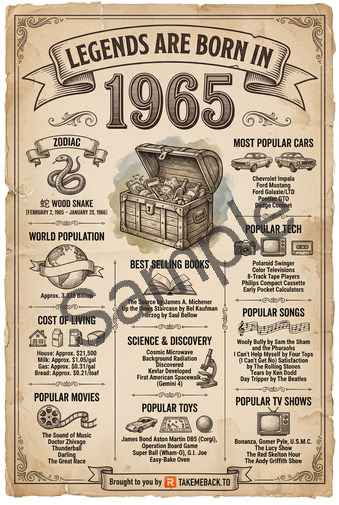

Major Events of 1965 - Historical Moments That Defined the Year | TakeMeBack.to
- 01 Jan International Cooperation Year begins: The United Nations declared 1965 as the International Cooperation Year to promote global collaboration and development. This initiative aimed to enhance international partnerships and address global challenges through cooperative efforts. source: un.org
- 02 Jan Martin Luther King Jr. voting rights campaign: On January 2, 1965, Martin Luther King Jr. launched a campaign aimed at securing voting rights for African Americans in the South. This initiative was part of a broader civil rights movement seeking to eliminate racial discrimination in voting. source: history.com
- 03 Jan Robert F. Kennedy begins Senate term: Robert F. Kennedy was sworn in as the junior senator from New York on January 3, 1965, after defeating incumbent Republican Senator Kenneth Keating in the 1964 election. source: en.wikipedia.org
- 06 Jan Muhammad al-Ahari, American Muslim Scholar: Muhammad Abdullah al-Ahari, born Ray Allen Rudder on January 6, 1965, is an American essayist, historian, and writer specializing in topics such as American Islam, Black Nationalist groups, and modern occultism. He has taught at the Islamic Foundation School in Villa Park, Illinois. source: en.wikipedia.org
- 08 Jan Star of India gem returns to museum: The Star of India, a famous 563-carat star sapphire, was returned to the American Museum of Natural History in New York after being stolen in 1964. The gem is one of the largest and most famous sapphires in the world, known for its unique star-shaped pattern. Its return was celebrated by gem enthusiasts and museum visitors alike. source: nytimes.com
- 09 Jan Beatles' '65 album tops charts: The Beatles' album 'Beatles '65' reached the top of the charts on January 9, 1965. This album features several hit songs and showcases the band's evolving musical style during the early years of their career. Its success contributed to the Beatles' dominance in the music industry during the 1960s. source: rollingstone.com
- 10 Jan Horace Gregory wins Bollingen Prize: Poet Horace Gregory was awarded the Bollingen Prize on January 10, 1965, recognizing his significant contributions to American poetry. The Bollingen Prize is one of the most prestigious awards in the literary world, celebrating excellence in poetry and literature. Gregory's work has had a lasting impact on the literary community. source: poetryfoundation.org
- 12 Jan Wanda Beach murders occur: The Wanda Beach murders took place on January 12, 1965, when two teenage girls were found murdered at Wanda Beach in New South Wales, Australia. This case remains one of Australia's most infamous unsolved crimes, capturing national attention and leading to extensive investigations. source: abc.net.au
- 13 Jan Formation of Fatah's military wing: On January 13, 1965, Fatah announced the formation of its military wing, marking a strategic shift in its approach to the Palestinian liberation movement. This development aimed to enhance its capabilities in armed struggle against Israeli forces. source: aljazeera.com
- 14 Jan Historic Meeting Between Northern Ireland and Republic of Ireland Leaders: On January 14, 1965, Taoiseach Seán Lemass of the Republic of Ireland met with Prime Minister Terence O'Neill of Northern Ireland at Stormont Castle in Belfast. This marked the first meeting between the leaders of the two regions since Ireland's partition in 1922, signaling a thaw in relations and discussions on cooperation in areas such as tourism, agriculture, and health services. source: irishcentral.com
- 15 Jan Soviet Underground Nuclear Test Creates Atomic Lake: On January 15, 1965, the Soviet Union conducted an underground nuclear test, resulting in the creation of an 'atomic lake' due to the collapse of the test site. This event was part of the Soviet Union's extensive nuclear testing program during the Cold War. source: en.wikipedia.org
- 16 Jan The Outer Limits final episode airs: The final episode of the original 'The Outer Limits' television series, titled 'The Probe,' airs on January 16, 1965. This episode, which is the 17th of the second season, features a plot where four plane crash survivors find themselves trapped in an alien space probe. source: en.wikipedia.org
- 19 Jan Gemini 2 launched on suborbital test: On January 19, 1965, the unmanned Gemini 2 spacecraft is launched on a suborbital test to evaluate various spacecraft systems. This mission is part of NASA's Gemini program, which aims to develop the techniques and technology necessary for long-duration missions to the Moon. source: en.wikipedia.org
- 20 Jan Lyndon B. Johnson's Second Presidential Inauguration: Lyndon B. Johnson was inaugurated for his second term as President of the United States on January 20, 1965. This inauguration took place following his election victory in 1964, emphasizing his Great Society agenda. source: archives.gov
- 21 Jan Martin Luther King Jr. speaks at Penn State University: On January 21, 1965, Martin Luther King Jr. delivered a speech at Penn State University, discussing civil rights and social justice. His visit was part of a broader effort to engage young people in the civil rights movement. source: pennlive.com
- 22 Jan DJ Jazzy Jeff's birth: DJ Jazzy Jeff, born Jeffrey Townes on January 22, 1965, is an influential American DJ and record producer. He gained fame as part of the duo DJ Jazzy Jeff & The Fresh Prince, alongside Will Smith. source: biography.com
- 23 Jan King Family Show Premieres on ABC TV: The King Family Show, a musical variety series featuring The King Sisters and their extended family, premiered on ABC on January 23, 1965, replacing The Outer Limits. source: en.wikipedia.org
- 24 Jan Joe Tex's 'Hold What You've Got' dominates R&B charts: Joe Tex's hit single 'Hold What You've Got' reached the top of the R&B charts in January 1965, showcasing his unique blend of soul and rhythm and blues. The song's success marked a significant moment in Tex's career and contributed to the evolution of the genre during the 1960s. source: billboard.com
- 26 Jan Iranian Prime Minister assassinated: On January 26, 1965, Iranian Prime Minister Hassan Ali Mansur was assassinated in Tehran. His assassination marked a significant event in Iranian politics, contributing to the instability that would lead to future upheavals in the country. source: britannica.com
- 27 Jan US Strategic Intervention in Vietnam War: On January 27, 1965, the United States escalated its military involvement in the Vietnam War by deploying combat troops. This marked a significant shift in U.S. policy, moving from advisory roles to active combat operations against North Vietnamese forces. source: archives.gov
- 28 Jan Cricket legend Tich Freeman passes away: Tich Freeman, a renowned English cricketer known for his exceptional leg-spin bowling, passed away on January 28, 1965. He was celebrated for his record-breaking performances in county cricket. source: britannica.com
- 29 Jan Birth of Dominik Hasek, legendary hockey goaltender: Dominik Hasek, a celebrated Czech ice hockey goaltender, was born on January 29, 1965. He is known for his outstanding career in the NHL and is regarded as one of the greatest goaltenders in hockey history. source: britannica.com
- 30 Jan Death of Vic Jackson, cricket player: Vic Jackson, an English cricketer known for his contributions to the sport, passed away on January 30, 1965. He played a significant role in various county teams during his career. source: britannica.com
- 01 Feb Peter Jennings becomes ABC News anchor: On February 1, 1965, Peter Jennings, at 26, became the youngest-ever American network news anchor, leading ABC's 15-minute nightly newscast, "Peter Jennings with the News." This move aimed to attract younger viewers to the network. source: britannica.com
- 03 Feb Orbiting Solar Observatory 2 launched into Earth orbit: The United States launched the Orbiting Solar Observatory 2 (OSO 2) on February 3, 1965, from Cape Canaveral, Florida. OSO 2 was designed to observe solar flares and other solar phenomena in ultraviolet, X-ray, and gamma-ray wavelengths. It operated successfully for nearly nine months before being placed in reserve on November 6, 1965. source: en.wikipedia.org
- 04 Feb US conducts nuclear test at Nevada Test Site: On February 4, 1965, the United States conducted a nuclear test at the Nevada Test Site. The Nevada Test Site, established in 1951, was a primary location for U.S. nuclear detonations, including both atmospheric and underground tests, until 1992. source: en.wikipedia.org
- 05 Feb Zhou Enlai hosts Soviet leader Kosygin in Beijing: On February 5, 1965, Chinese Premier Zhou Enlai hosted Soviet Premier Alexei Kosygin in Beijing. This meeting was part of the ongoing diplomatic efforts between China and the Soviet Union during the 1960s. source: en.wikipedia.org
- 06 Feb Sir Stanley Matthews' final First Division game: On February 6, 1965, Sir Stanley Matthews played his final First Division game for Stoke City against Fulham. Matthews, known as the 'Wizard of the Dribble,' was a legendary English footballer who had a career spanning over 30 years. source: en.wikipedia.org
- 07 Feb US escalates Vietnam War with bombing campaign: On February 7, 1965, the United States initiated Operation Rolling Thunder, a sustained bombing campaign against North Vietnam, marking a significant escalation in the Vietnam War. source: en.wikipedia.org
- 08 Feb US combat troops deployed to Vietnam: On February 8, 1965, the United States deployed combat troops to South Vietnam, marking a significant escalation in its military involvement in the region. source: en.wikipedia.org
- 12 Feb Formation of the African and Malagasy Common Organization: On February 12, 1965, the African and Malagasy Common Organization (OCAM) was established in Nouakchott, Mauritania. This intergovernmental organization aimed to promote economic, social, technical, and cultural cooperation among its member states. The founding members included Cameroon, Central African Republic, Chad, Congo (Brazzaville), Dahomey, Gabon, Ivory Coast, Madagascar, Mauritania, Niger, Senegal, Togo, and Upper Volta. Rwanda later joined the organization. source: cambridge.org
- 14 Feb Malcolm X speaks in Detroit after house firebombing: On February 14, 1965, Malcolm X delivered a speech in Detroit, Michigan, addressing the recent firebombing of his home in New York City. He discussed the bombing, his experiences in Africa, and the importance of Black American organization. The speech was recorded and is available through the Atlanta University Center Robert W. Woodruff Library. source: dlg.usg.edu
- 15 Feb Canada adopts the Maple Leaf flag: On February 15, 1965, Canada officially adopted the Maple Leaf flag, replacing the Red Ensign. The new flag features a stylized red maple leaf at its center, symbolizing unity and the country's natural heritage. source: en.wikipedia.org
- 16 Feb Pegasus 1 satellite launch: The Pegasus 1 satellite was launched on February 16, 1965, marking a significant milestone in satellite technology. It was part of the U.S. Navy's program to develop satellite communications capabilities. source: nasa.gov
- 17 Feb Ranger 8 moon mission launch: The Ranger 8 spacecraft was launched on February 17, 1965, to conduct a mission to the Moon. It successfully transmitted thousands of images of the lunar surface before impacting the Moon. source: nasa.gov
- 18 Feb Ranger 8 Lunar Mission concludes: The Ranger 8 mission, which successfully transmitted images of the Moon's surface, concluded on February 18, 1965. This mission was significant for providing detailed photographs that aided in lunar exploration efforts. source: nasa.gov
- 19 Feb Deadly coal mine explosion in Mexico: On February 19, 1965, a catastrophic explosion occurred in a coal mine in Mexico, resulting in numerous fatalities. The incident raised concerns about mine safety regulations and practices in the country. source: bbc.com
- 21 Feb Malcolm X assassinated in New York City: Malcolm X, the prominent African American civil rights leader, was assassinated on February 21, 1965, in New York City. His death marked a significant moment in the civil rights movement. source: history.com
- 22 Feb Royal Australian Mint established in Canberra: The Royal Australian Mint was established in Canberra on February 22, 1965, to produce Australia's coinage. It marked a significant development in the nation's numismatic history. source: history.com
- 23 Feb Constance Baker Motley: Historic Borough President Election: On February 23, 1965, Constance Baker Motley became the first African American woman elected as a borough president in New York City. Her election marked a significant milestone in the civil rights movement and women's representation in politics. source: nytimes.com
- 24 Feb The Beatles begin filming 'Help' in the Bahamas: On February 24, 1965, The Beatles started filming their second feature film, 'Help!', in the Bahamas. The film showcased the band's growing popularity and included several of their hit songs. source: bbc.com
- 25 Feb First human spacewalk: On February 25, 1965, Soviet cosmonaut Alexei Leonov conducted the first-ever spacewalk during the Voskhod 2 mission. This historic event marked a significant achievement in human space exploration. source: nasa.gov
- 26 Feb Dutch government of Marijnen collapses: On February 26, 1965, the Dutch government led by Prime Minister Marijnen collapsed due to a political crisis. This event led to significant changes in the Dutch political landscape. source: reuters.com
- 27 Feb French nuclear test in Algeria: On February 27, 1965, France conducted a nuclear test in Algeria, which was part of its nuclear program. This event raised international concerns regarding nuclear proliferation. source: bbc.com
- 28 Feb Adolf Schärf, Austrian President, passes away: Adolf Schärf, the President of Austria since 1957, died in office on February 28, 1965. He had been re-elected in 1963 and served until his death. source: archontology.org
- 02 Mar Operation Rolling Thunder begins in Vietnam War: Operation Rolling Thunder, a sustained U.S. bombing campaign against North Vietnam, commenced on March 2, 1965. The operation aimed to disrupt North Vietnamese supply lines and support for insurgents in South Vietnam. source: history.com
- 04 Mar David Attenborough becomes BBC2 Controller: On March 4, 1965, David Attenborough was appointed as the new Controller of BBC2, succeeding Michael Peacock. He held this position until 1968, overseeing significant developments in the channel's programming. source: bbc.co.uk
- 06 Mar First nonstop helicopter crossing of North America: On March 6, 1965, a team of pilots completed the first nonstop helicopter crossing of North America. The journey showcased advancements in aviation technology and demonstrated the capabilities of helicopters for long-distance travel. source: nytimes.com
- 07 Mar Bloody Sunday: Civil rights activists brutally attacked in Selma: On March 7, 1965, civil rights activists were violently confronted by law enforcement during a march from Selma to Montgomery, Alabama. This event, known as Bloody Sunday, became a pivotal moment in the American civil rights movement, highlighting the struggle for voting rights. source: history.com
- 08 Mar US Marines first combat troops in Vietnam: On March 8, 1965, the first U.S. combat troops were deployed to Vietnam, marking a significant escalation in American involvement in the Vietnam War. This deployment was a response to the increasing conflict and instability in the region. source: archives.gov
- 11 Mar Civil Rights Activist James J. Reeb Dies After Brutal Attack: James J. Reeb, a Unitarian Universalist minister and civil rights activist, was fatally attacked by white segregationists in Selma, Alabama, on March 9, 1965. He succumbed to his injuries on March 11, 1965, in a Birmingham hospital. His death galvanized national support for the Voting Rights Act of 1965. source: selmatimesjournal.com
- 15 Mar Johnson proposes Voting Rights Act: On March 15, 1965, President Lyndon B. Johnson addressed a joint session of Congress, urging the passage of the Voting Rights Act to eliminate racial discrimination in voting. He emphasized the need for federal legislation to protect the voting rights of African Americans, stating, "Their cause must be our cause too." source: voanews.com
- 17 Mar Civil rights demonstration in Montgomery, Alabama: On March 17, 1965, a significant civil rights demonstration took place in Montgomery, Alabama, as activists continued to advocate for voting rights and racial equality. The marchers faced opposition from local authorities, but their efforts contributed to the growing momentum for the Voting Rights Act. source: whitehousehistory.org
- 18 Mar First human spacewalk conducted by Alexei Leonov: On March 18, 1965, Soviet cosmonaut Alexei Leonov performed the first-ever spacewalk, or extravehicular activity (EVA), during the Voskhod 2 mission. He spent approximately 12 minutes outside the spacecraft, tethered by a cable, marking a significant milestone in human space exploration. source: history.com
- 19 Mar SS Georgiana Wreck Discovered: On March 19, 1965, underwater archaeologist E. Lee Spence discovered the wreckage of the Confederate blockade runner SS Georgiana in Charleston's harbor. source: en.wikipedia.org
- 20 Mar Federal intervention in Selma civil rights march: On March 20, 1965, President Lyndon B. Johnson federalized the Alabama National Guard to protect a civil rights march from Selma to Montgomery. This decision followed violent attacks on protesters during the initial march on March 7, known as "Bloody Sunday." The federal intervention ensured the safety of the demonstrators, leading to the successful completion of the march on March 25, 1965. source: history.com
- 21 Mar Selma to Montgomery civil rights march begins: On March 21, 1965, the Selma to Montgomery civil rights march began, with approximately 50,000 marchers led by Dr. Martin Luther King Jr. The march, protected by federal troops, covered 54 miles to the Alabama Capitol, advocating for voting rights for African Americans. source: history.com
- 22 Mar Nicolae Ceaușescu becomes First Secretary of Romanian Communist Party: On March 22, 1965, Nicolae Ceaușescu was elected First Secretary of the Romanian Communist Party, succeeding Gheorghe Gheorghiu-Dej. source: britannica.com
- 23 Mar Gemini 3: First US Two-Man Space Flight: On March 23, 1965, Gemini 3 became the first U.S. two-man space flight, piloted by Gus Grissom and John Young. source: nasa.gov
- 24 Mar NASA Ranger 9 Moon Impact Mission: On March 24, 1965, NASA's Ranger 9 spacecraft impacted the Moon, transmitting high-resolution images before its collision. source: nasa.gov
- 25 Mar Selma to Montgomery Civil Rights March Completed: On March 25, 1965, approximately 25,000 civil rights activists, led by Martin Luther King Jr., completed the five-day march from Selma to Montgomery, Alabama. The marchers gathered at the Alabama State Capitol, where King delivered his "How Long, Not Long" speech, advocating for African American voting rights. This event was pivotal in the Civil Rights Movement and contributed to the passage of the Voting Rights Act of 1965. source: history.com
- 26 Mar Arrests in Viola Liuzzo Murder Announced by President Johnson: On March 26, 1965, President Lyndon B. Johnson announced the arrests of several individuals in connection with the murder of Viola Liuzzo, a white civil rights activist killed by Ku Klux Klan members. The arrests were a significant development in the investigation and underscored the federal government's commitment to prosecuting those responsible for violence against civil rights activists. source: history.com
- 28 Mar 1965 La Ligua earthquake and dam failure in Chile: On March 28, 1965, a magnitude 7.5 earthquake struck near La Ligua, Chile, causing widespread damage and triggering dam failures. The El Cobre mining area was particularly affected, with mineral waste spilling onto the community, resulting in the deaths of 400–500 people. source: en.wikipedia.org
- 29 Mar The Supremes' 'Stop! In The Name Of Love' reaches number one on Billboard charts: On March 29, 1965, The Supremes' single 'Stop! In The Name Of Love' topped the Billboard Hot 100 chart, marking a significant achievement in the Motown era. source: en.wikipedia.org
- 01 Apr Peter O'Toole - Irish Musician: Peter O'Toole, an Irish pop bassist, was known for his work with the band Hothouse Flowers, contributing to notable albums such as 'People', 'Home', and 'Don't Go'.
- 02 Apr Birth of Rodney King: Rodney King, an American construction worker whose 1991 police beating and the subsequent trial of the officers involved sparked widespread riots, was born on April 2, 1965, in Sacramento, California. source: en.wikipedia.org
- 03 Apr U.S. Marines engagement in Vietnam: On April 3, 1965, U.S. Marines engaged in combat operations in South Vietnam, marking a significant escalation in American military involvement. This engagement was part of a broader strategy to support South Vietnamese forces against the Viet Cong and North Vietnamese Army. source: history.com
- 04 Apr Mickey Wright wins LPGA Baton Rouge Invitational: On April 4, 1965, Mickey Wright secured victory at the LPGA Baton Rouge Invitational in Louisiana, marking one of her 82 LPGA Tour titles. source: brainyhistory.com
- 05 Apr 37th Academy Awards ceremony held: On April 5, 1965, the 37th Academy Awards ceremony took place, honoring films released in 1964. The event recognized achievements in the film industry. source: en.wikipedia.org
- 06 Apr First commercial geosynchronous communications satellite launched: On April 6, 1965, Intelsat I, also known as Early Bird, became the first commercial communications satellite placed in geosynchronous orbit. Built by Hughes Aircraft for the Communications Satellite Corporation (COMSAT), it provided direct and nearly instantaneous contact between Europe and North America, handling television, telephone, and fax transmissions. source: intelsat.com
- 08 Apr U.S. Marines' mission change in Vietnam: On April 1, 1965, President Lyndon B. Johnson authorized a change in the U.S. Marines' mission in South Vietnam. Previously, Marines had been deployed to protect installations at Da Nang. The new directive expanded their role to include engaging North Vietnamese and Viet Cong forces in combat operations beyond the base perimeter. source: en.wikipedia.org
- 09 Apr Voting Rights Act of 1965 signed: On April 9, 1965, President Lyndon B. Johnson signed the Voting Rights Act of 1965 into law, a landmark legislation aimed at eliminating racial discrimination in voting. source: en.wikipedia.org
- 10 Apr Devastating thunderstorms and hail impact in Clark County: On April 10, 1965, Clark County experienced severe thunderstorms accompanied by hail, causing significant damage. The storms were part of a larger weather system affecting multiple states, leading to widespread destruction and disruption. source: weather.gov
- 11 Apr 1965 Palm Sunday tornado outbreak: The Palm Sunday tornado outbreak on April 11, 1965, produced a series of devastating tornadoes across several states, resulting in significant loss of life and property. This event is one of the deadliest tornado outbreaks in U.S. history, with numerous injuries and fatalities reported. source: weather.gov
- 12 Apr First MLB game at Houston's Astrodome: On April 12, 1965, the Houston Astros played their first Major League Baseball game at the Astrodome, marking a significant milestone in sports history. The Astrodome was the first indoor stadium in the world, revolutionizing how baseball was played. source: houstontx.gov
- 13 Apr First African American Senate Page appointed: On April 13, 1965, Senator Jacob Javits of New York appointed Lawrence W. Bradford, Jr., a 16-year-old African American, as a Senate page. This appointment was celebrated as a significant step toward racial integration in congressional staff positions. source: senate.gov
- 14 Apr Operation Fact Sheet: Psychological Warfare in North Vietnam: On April 14, 1965, the United States and South Vietnam initiated "Operation Fact Sheet," a psychological warfare mission involving the aerial distribution of over two million leaflets in North Vietnamese cities with military facilities. The leaflets, written in Vietnamese, contained messages urging civilians to avoid areas designated for bombing, suggesting that civilian opposition to their government could end the bombings, and promoting the benefits of relocating to South Vietnam. Despite the extensive leaflet drops, the operation had minimal impact on North Vietnamese strategy, though it did result in some civilians moving away from military sites. source: historydiaries.blog
- 15 Apr James Baldwin's 'The Amen Corner' Broadway Premiere: James Baldwin's play 'The Amen Corner' premiered on Broadway at the Ethel Barrymore Theatre in New York City on April 15, 1965. The production, directed by Frank Silvera, featured a cast including Beah Richards as Sister Margaret Alexander and Silvera himself as David. The play explores themes of faith, family, and community within an African-American church setting. Richards received a Tony Award nomination for Best Actress in a Play for her performance. source: nytimes.com
- 16 Apr Saturn S-1C Rocket Test Flight: On April 16, 1965, NASA conducted the first test firing of the Saturn V rocket's first stage, known as the S-1C. The test took place at the Marshall Space Flight Center in Alabama, where all five F-1 engines were fired simultaneously for 6.5 seconds, producing a combined thrust of 7.5 million pounds. This successful test was a significant milestone in the development of the Saturn V rocket, which would later be used for the Apollo missions to the Moon. source: nasa.gov
- 19 Apr WINS becomes first all-news radio station in the U.S.: On April 19, 1965, New York City's WINS (AM) switched from a Top 40 music format to an all-news format, becoming the first all-news radio station in the United States. This marked a significant shift in radio broadcasting, emphasizing continuous news coverage. source: en.wikipedia.org
- 21 Apr New York World's Fair second season opens: The New York World's Fair, which began in 1964, opened its second season on April 21, 1965. The fair showcased innovations and cultural exhibits from around the world, attracting millions of visitors during its run. source: nytimes.com
- 23 Apr Dominican Republic political uprising: On April 23, 1965, a political uprising began in the Dominican Republic, leading to a civil war. The conflict arose from tensions over the return of former president Juan Bosch, who had been ousted in a coup. source: britannica.com
- 24 Apr Dominican Republic civil war erupts: The Dominican Republic civil war erupted on April 24, 1965, following the political uprising that began the previous day. The conflict involved various factions and led to U.S. military intervention. source: britannica.com
- 25 Apr U.S. military intervention in Dominican Republic: On April 25, 1965, the U.S. began evacuating American citizens from the Dominican Republic amid escalating civil unrest. This operation evolved into a larger military intervention to support the government and prevent a communist takeover. source: history.com
- 26 Apr Manchester United clinches 1964–65 First Division title: On April 26, 1965, Manchester United secured their sixth First Division title by defeating Arsenal 3–1 at Old Trafford. This victory effectively sealed the championship, as Leeds United, their closest rivals, drew 3–3 against already relegated Birmingham City in their final match. source: manutd.com
- 27 Apr Edward R. Murrow passes away: Edward R. Murrow, the renowned American broadcast journalist and war correspondent, died on April 27, 1965, at his home in Pawling, New York. He was 56 years old and had been battling cancer. source: en.wikipedia.org
- 28 Apr US military intervention in Dominican Republic: On April 28, 1965, the United States initiated "Operation Power Pack," deploying Marines to the Dominican Republic to protect American citizens and prevent a potential communist takeover. This intervention marked the end of the "Good Neighbor" policy in the Western Hemisphere. source: presidency.ucsb.edu
- 29 Apr Australia commits combat troops to Vietnam War: On April 29, 1965, Australian Prime Minister Robert Menzies announced the deployment of an infantry battalion to South Vietnam, marking Australia's formal military commitment to the Vietnam War. source: nma.gov.au
- 30 Apr US Marines intervention in Dominican Republic: On April 30, 1965, the United States expanded its military presence in the Dominican Republic, deploying additional Marines to secure key locations and assist in evacuation operations during the ongoing civil unrest. source: army.mil
- 01 May Soviet Luna 5 moon mission: The Soviet Luna 5 mission, launched on May 1, 1965, was the first spacecraft to impact the Moon. It was part of the Soviet Union's efforts to explore the Moon and gather data about its surface. The mission successfully impacted the Moon on May 12, 1965, marking a significant achievement in space exploration. source: nasa.gov
- 02 May Early Bird satellite begins commercial service: On May 2, 1965, the Early Bird satellite, also known as Intelsat I, began commercial service, marking a significant milestone in satellite communications. This satellite was the first to provide commercial transatlantic telephone service, revolutionizing global communications. It paved the way for future advancements in satellite technology. source: britannica.com
- 03 May First satellite TV broadcast: On May 3, 1965, the first satellite television broadcast took place, marking a significant milestone in communication technology. The event was facilitated by the use of the Early Bird satellite, which allowed live television transmission across the Atlantic Ocean. source: britannica.com
- 04 May Willie Mays breaks National League home run record: On May 4, 1965, Willie Mays hit his 512th home run, breaking the National League record previously held by Babe Ruth. This achievement solidified Mays' status as one of baseball's all-time greats. source: britannica.com
- 05 May US Army ground units deployment to Vietnam: On May 5, 1965, the United States began deploying ground combat units to Vietnam, marking a significant escalation in U.S. involvement in the Vietnam War. This decision was part of a broader strategy to combat the spread of communism in Southeast Asia. source: archives.gov
- 06 May Devastating Minnesota Tornado Outbreak: On May 6, 1965, a series of tornadoes struck Minnesota, causing significant destruction and loss of life. This outbreak was one of the most severe in the state's history, leading to extensive damage and emergency responses. source: weather.gov
- 07 May Rhodesian Front Maintains Political Control: On May 7, 1965, the Rhodesian Front, a political party in Rhodesia, maintained its grip on power amid growing tensions and international scrutiny. This period marked significant political developments in the region. source: britannica.com
- 08 May Randy Matson sets first 70-foot shot put: On May 8, 1965, at the Southwest Conference Meet in College Station, Texas, Randy Matson became the first athlete to throw the shot put over 70 feet, achieving a distance of 70 feet 7¼ inches (21.52 meters). This groundbreaking performance marked a significant milestone in track and field history. source: convention.ustfccca.org
- 09 May The Beatles attend Bob Dylan's concert at Royal Albert Hall: On May 9, 1965, The Beatles attended Bob Dylan's performance at London's Royal Albert Hall. After the show, they visited Dylan at his suite at the Savoy Hotel, accompanied by singer Alma Cogan and poet Allen Ginsberg. The atmosphere was initially tense until Ginsberg fell into John Lennon's lap, breaking the ice. The group spent the rest of the evening nightclubbing in London. source: beatlesbible.com
- 10 May Warren Buffett acquires controlling interest in Berkshire Hathaway: On May 10, 1965, Warren Buffett gained control of Berkshire Hathaway, a struggling New England textile company, by purchasing a 40% ownership stake. This acquisition marked the beginning of Buffett's transformation of the company into a diversified conglomerate. source: reuters.com
- 12 May Israel-West Germany Diplomatic Relations Established: On May 12, 1965, Israel and West Germany officially established diplomatic relations, marking a significant step in post-World War II reconciliation. This followed the 1952 Reparations Agreement and a 1960 meeting between leaders Konrad Adenauer and David Ben-Gurion. source: auswaertiges-amt.de
- 14 May West Germany and Israel establish diplomatic relations: On May 14, 1965, West Germany and Israel officially established diplomatic relations, a significant step in post-World War II reconciliation efforts. This move aimed to foster cooperation and address historical issues between the two nations. source: nytimes.com
- 15 May Zugspitze Avalanche Incident: On May 15, 1965, an avalanche struck the Hotel Schneefernerhaus near Garmisch-Partenkirchen, Germany, located on the Zugspitze mountain. The disaster resulted in eight fatalities, with 40 individuals feared buried under the snow. source: reuters.screenocean.com
- 17 May Birth of Trent Reznor: Trent Reznor, the American singer, songwriter, and composer, was born on May 17, 1965, in New Castle, Pennsylvania. He is best known as the founder and primary member of the industrial rock band Nine Inch Nails. source: en.wikipedia.org
- 18 May Execution of Israeli Spy Eli Cohen in Syria: Eliyahu Ben-Shaul Cohen, an Israeli spy known as Eli Cohen, was executed by hanging in Damascus, Syria, on May 18, 1965. He had infiltrated Syria's political and military hierarchy, providing intelligence that significantly aided Israel during the 1967 Six-Day War. source: en.wikipedia.org
- 20 May First Indian to summit Mount Everest: On May 20, 1965, Lt Col Avatar Singh Cheema became the first Indian to climb Mount Everest, leading a successful expedition. source: indiatoday.in
- 21 May Berkeley Teach-In: On May 21–23, 1965, the University of California, Berkeley, hosted a 36-hour anti-Vietnam War teach-in organized by the Vietnam Day Committee. The event attracted approximately 30,000 attendees and featured debates, lectures, and musical performances. An empty chair labeled 'Reserved for the State Department' was placed on stage after the State Department declined the invitation to send a representative. source: en.wikipedia.org
- 22 May First Skateboard Championship and Vietnam War Protests: On May 22, 1965, the first National Skateboard Championships were held in Anaheim, California, featuring events like downhill and flatland slalom, trick performances, and a figure-eight skating event. The two-day event attracted contestants from various regions and was televised on ABC's Wide World of Sports. Additionally, several hundred Vietnam War protesters in Berkeley marched to the Draft Board, burning 19 more draft cards and hanging an effigy of President Lyndon Johnson. source: en.wikipedia.org
- 23 May Deadly ferry disaster in Malawi: On May 23, 1965, a ferry capsized on the Shire River near Liwonde in southern Malawi, resulting in the drowning of approximately 150 people, including many women and children. source: maravipost.com
- 24 May US Supreme Court declares federal law allowing post office to intercept communist propaganda unconstitutional: On May 24, 1965, the U.S. Supreme Court ruled in Lamont v. Postmaster General that a federal statute requiring the Postmaster General to detain and deliver only upon the addressee's request unsealed foreign mailings of 'communist political propaganda' was unconstitutional, as it imposed an unconstitutional limitation on First Amendment rights. source: supreme.justia.com
- 25 May Simon Fowler Birth: Simon Fowler, who would later become the lead singer of the British rock band Ocean Colour Scene, was born.
- 26 May United States Senate passes Voting Rights Act of 1965: On May 26, 1965, the U.S. Senate passed the Voting Rights Act of 1965, a landmark legislation aimed at eliminating racial discrimination in voting, particularly in the Southern states.
- 29 May Samotlor Oil Field discovery in Russia: The Samotlor Oil Field, one of the largest oil fields in Russia, was discovered on May 29, 1965. This discovery significantly contributed to the Soviet Union's oil production capabilities and has been a major source of oil for the region. source: reuters.com
- 30 May Viet Cong offensive at Da Nang: On May 30, 1965, the Viet Cong launched an offensive in Da Nang, escalating the conflict in Vietnam. This event was part of a larger strategy during the Vietnam War, impacting military and civilian lives. source: britannica.com
- 31 May Florida International University established: Florida International University (FIU) was established on May 31, 1965, in Miami, Florida. This institution has grown to become one of the largest universities in the United States, serving a diverse student body. source: fiu.edu
- 01 Jun Cosmic Microwave Background Radiation discovery: On June 1, 1965, researchers Arno Penzias and Robert Wilson discovered the Cosmic Microwave Background Radiation, providing significant evidence for the Big Bang theory. This discovery earned them the Nobel Prize in Physics in 1978. source: nasa.gov
- 02 Jun NASA's Apollo program progress update: On June 2, 1965, NASA provided a progress update on the Apollo program, detailing advancements in technology and mission planning aimed at landing humans on the Moon. This program was pivotal in the space race during the 1960s. source: nasa.gov
- 03 Jun First American spacewalk by Edward H. White: On June 3, 1965, during the Gemini 4 mission, astronaut Edward H. White II became the first American to perform an extravehicular activity (EVA), or spacewalk. He spent approximately 23 minutes outside the spacecraft, tethered by a 25-foot umbilical line and a 23-foot tether line, using a Hand-Held Self-Maneuvering Unit to maneuver in space. source: nasa.gov
- 06 Jun Cam Neely born: Cam Neely, a Canadian professional ice hockey executive and former player, was born on June 6, 1965, in Comox, British Columbia, Canada. source: en.wikipedia.org
- 07 Jun Landmark Supreme Court decision on contraception: On June 7, 1965, the U.S. Supreme Court issued a 7–2 decision in Griswold v. Connecticut, striking down a Connecticut law that prohibited the use of contraceptives by married couples. The Court held that the law violated the right to marital privacy, establishing a constitutional right to privacy in matters of contraception. This landmark ruling laid the foundation for future decisions related to reproductive rights. source: britannica.com
- 08 Jun US troops ordered to offensive combat in Vietnam: On June 8, 1965, President Lyndon B. Johnson authorized the first major offensive combat operations by U.S. troops in Vietnam. This decision marked a significant escalation in the U.S. military involvement in the Vietnam War, transitioning from advisory and support roles to active combat operations against North Vietnamese forces. source: archives.gov
- 09 Jun Battle of Đồng Xoài during Vietnam War: On June 9, 1965, the Battle of Đồng Xoài occurred in South Vietnam. This was one of the first major ground engagements between U.S. forces and the Viet Cong, resulting in significant casualties on both sides and highlighting the intensifying conflict in the region. source: history.com
- 10 Jun Battle of Dong Xoai during Vietnam War: The Battle of Dong Xoai occurred in South Vietnam, involving intense fighting between Viet Cong forces and South Vietnamese troops. source: en.wikipedia.org
- 11 Jun Joey Santiago born: Joey Santiago, guitarist for the American alternative rock band Pixies, was born on this date. source: en.wikipedia.org
- 12 Jun The Beatles awarded MBE by Queen Elizabeth II: On June 12, 1965, The Beatles were awarded the Member of the Order of the British Empire (MBE) by Queen Elizabeth II. This honor recognized their significant contributions to music and culture during the 1960s. source: bbc.com
- 13 Jun Battle of Dong Xoai ends in Viet Cong victory: The Battle of Dong Xoai concluded on June 13, 1965, with a significant victory for the Viet Cong against South Vietnamese forces. This battle was part of the larger conflict in Vietnam and highlighted the ongoing struggle during the war. source: bbc.com
- 14 Jun The Beatles release 'Beatles VI' in the United States: On June 14, 1965, Capitol Records released 'Beatles VI,' the seventh studio album by The Beatles in the U.S. and Canada. The album included tracks from the UK release 'Beatles for Sale,' as well as two songs recorded specifically for the North American market: 'Bad Boy' and 'Dizzy Miss Lizzy.' source: beatlesbible.com
- 16 Jun U.S. Troop Deployment to Vietnam: On June 16, 1965, U.S. Secretary of Defense Robert S. McNamara announced the deployment of 22,000 additional American troops to South Vietnam, increasing the total number of U.S. personnel there to 72,000. source: en.wikipedia.org
- 17 Jun First B-52 Bombing in Vietnam War: On June 17, 1965, the United States conducted its first B-52 bombing raid in the Vietnam War, targeting National Liberation Front guerrilla fighters in South Vietnam. source: en.wikipedia.org
- 18 Jun U.S. Uses B-52 Bombers in Vietnam War: On June 18, 1965, the United States used B-52 bombers to attack National Liberation Front guerrilla fighters in South Vietnam, marking a significant escalation in the conflict. source: en.wikipedia.org
- 19 Jun Military Leadership Change in South Vietnam: On June 19, 1965, Air Vice-Marshal Nguyễn Cao Kỳ became Prime Minister of South Vietnam, leading a military junta, while General Nguyễn Văn Thiệu assumed the role of Chief of State. source: history.com
- 20 Jun Bernard Baruch, Influential American Financier, Dies: Bernard Baruch, a prominent American financier and statesman, passed away on June 20, 1965. source: britannica.com
- 21 Jun The Byrds release groundbreaking folk rock album: On June 21, 1965, American rock band The Byrds released their debut studio album, 'Mr. Tambourine Man,' which featured a blend of folk and rock elements. The album's title track, a cover of Bob Dylan's song, became a hit and is considered a seminal moment in the folk rock genre. source: en.wikipedia.org
- 22 Jun Outer Space Treaty signed: On June 22, 1965, the Outer Space Treaty was signed, establishing the framework for international space law. The treaty outlines principles for the peaceful use and exploration of outer space, including the prohibition of nuclear weapons in space and the use of celestial bodies for military purposes. source: en.wikipedia.org
- 24 Jun Voting Rights Act of 1965 Signed: The Voting Rights Act of 1965 was signed into law by President Lyndon B. Johnson on August 6, 1965, prohibiting racial discrimination in voting. source: archives.gov
- 25 Jun Commonwealth Secretariat Established: The Commonwealth Secretariat was established in 1965 to serve as the main intergovernmental agency of the Commonwealth of Nations.
- 26 Jun NASA selects six scientist-astronauts: On June 26, 1965, NASA announced the selection of six scientist-astronauts, marking a significant step in the agency's efforts to include scientists in space missions. This selection aimed to enhance the scientific capabilities of future space explorations. source: nasa.gov
- 27 Jun Carol Mann wins LPGA Carling Golf Open: On June 27, 1965, Carol Mann won the LPGA Carling Golf Open, marking a significant achievement in her professional golf career. This victory contributed to her reputation as one of the leading female golfers of her time. source: lpga.com
- 28 Jun First major US offensive in Vietnam War: On June 28, 1965, the United States launched its first major offensive in the Vietnam War, marking a significant escalation in military involvement. This operation aimed to combat the growing influence of North Vietnamese forces in the region. source: archives.gov
- 29 Jun Australian Troops Arrive in Vietnam: On June 29, 1965, the first Australian combat troops arrived in South Vietnam, marking Australia's commitment to support the United States in the Vietnam War. The deployment included infantry and artillery units, and it was part of Australia's broader involvement in the conflict. source: en.wikipedia.org
- 30 Jun India-Pakistan Rann of Kutch Ceasefire: On June 30, 1965, India and Pakistan signed an agreement that ended the fighting in the Rann of Kutch. The agreement, facilitated by the United Kingdom, was signed separately in Karachi and New Delhi. The ceasefire became effective on July 1, 1965, with both nations agreeing to demarcate the border through international arbitration. source: history.state.gov
- 01 Jul Australia begins Vietnam War draft: On July 1, 1965, Australia officially initiated a conscription program for the Vietnam War, marking a significant escalation in its military involvement. This decision was met with considerable public debate and protest in the following years. source: awm.gov.au
- 02 Jul Roy Emerson wins Wimbledon men's singles title: On July 2, 1965, Australian tennis player Roy Emerson claimed the men's singles title at Wimbledon. This victory marked his fourth Wimbledon title and solidified his status as one of the greats in tennis history. source: wimbledon.com
- 03 Jul USSR and Persia economic cooperation pact: On July 3, 1965, the Soviet Union and Iran signed an agreement to build a dam and provide economic aid. This pact aimed to enhance bilateral relations and foster economic development between the two nations. source: brainyhistory.com
- 07 Jul Saudi Arabia and Kuwait partition Neutral Zone: On July 7, 1965, Saudi Arabia and Kuwait signed an agreement to partition the Neutral Zone, a 5,770 km² area between their borders. This agreement, effective from July 25, 1966, divided the zone into two equal parts, each administered by one of the countries. The partition was formalized in subsequent agreements, with the final ratification in 1970. source: un-ilibrary.org
- 09 Jul United States Senate approves Medicare Act: On July 9, 1965, the United States Senate passed the Medicare Act, which established a health insurance program for Americans aged 65 and older. This landmark legislation aimed to provide essential medical services to the elderly population, significantly impacting healthcare in the U.S. source: cms.gov
- 10 Jul Immigration and Nationality Act of 1965: On July 10, 1965, the Immigration and Nationality Act was signed into law, abolishing the national origins quota system. This act significantly changed U.S. immigration policy, allowing for a more diverse influx of immigrants. source: uscis.gov
- 11 Jul Kathy Whitworth wins LPGA Lady Carling Midwest Golf Open: On July 11, 1965, Kathy Whitworth secured victory at the LPGA Lady Carling Midwest Golf Open in Ohio, marking her 15th win of the 1965 LPGA Tour season. This triumph contributed to her leading the money list with earnings of $28,658 that year. source: en.wikipedia.org
- 13 Jul Mariner 4 Mars flyby: On July 13, 1965, NASA's Mariner 4 spacecraft conducted the first successful flyby of Mars, sending back the first images of the planet's surface. This mission marked a significant milestone in space exploration, providing valuable data about Mars' atmosphere and geology. source: nasa.gov
- 14 Jul Mariner 4 first Mars close-up photos: On July 14, 1965, Mariner 4 transmitted the first close-up photographs of Mars, revealing a cratered surface and providing insights into the planet's geological history. This event was pivotal in shaping our understanding of Mars. source: nasa.gov
- 15 Jul Mariner IV captures first Mars images: On July 15, 1965, NASA's Mariner IV spacecraft transmitted the first close-up photographs of Mars, revealing a barren, cratered landscape and dispelling previous notions of a lush, inhabited planet. source: jpl.nasa.gov
- 16 Jul Mont Blanc Tunnel inauguration: The Mont Blanc Tunnel, connecting France and Italy beneath the Alps, was inaugurated on July 16, 1965, marking a significant engineering achievement in transportation infrastructure. source: en.wikipedia.org
- 18 Jul Kathy Whitworth wins LPGA Yankee Golf Open: Kathy Whitworth secured her victory at the LPGA Yankee Golf Open, marking a significant achievement in her golfing career. This win contributed to her reputation as one of the most successful female golfers in history. source: nytimes.com
- 19 Jul Star Trek second pilot filming begins: Filming for the second pilot of Star Trek commenced on July 19, 1965, which would eventually lead to the iconic series' debut. This pilot was crucial in shaping the future of science fiction television. source: startrek.com
- 20 Jul Civil rights tragedy in Alabama: On July 20, 1965, a tragic event occurred in Alabama related to the civil rights movement, highlighting the ongoing struggles for racial equality. This incident drew national attention to the civil rights issues of the time. source: history.com
- 21 Jul National Security Council meeting with President Johnson: On July 21, 1965, President Lyndon B. Johnson convened a meeting of the 15-member National Security Council at the White House to discuss the direction of the Vietnam War. During the session, Under Secretary of State George Ball strongly opposed Defense Secretary Robert S. McNamara's recommendation to increase U.S. troop levels in South Vietnam, advocating instead for a reduction in U.S. involvement. source: en.wikipedia.org
- 22 Jul Edward Heath becomes Conservative Party leader: On July 22, 1965, Edward Heath was elected leader of the Conservative Party in the United Kingdom, succeeding Sir Alec Douglas-Home. Heath's leadership marked a significant shift in the party's direction, leading to his tenure as Prime Minister from 1970 to 1974. source: en.wikipedia.org
- 23 Jul Beatles release 'Help!' album: On July 23, 1965, The Beatles released their album 'Help!', which served as the soundtrack for their second feature film of the same name. The album showcased the band's evolving musical style and included hits like 'Ticket to Ride' and the title track 'Help!'. source: en.wikipedia.org
- 24 Jul First surface-to-air missile attack on US aircraft in Vietnam War: On July 24, 1965, the first surface-to-air missile attack on U.S. aircraft occurred during the Vietnam War. This event marked a significant escalation in the conflict and highlighted the increasing sophistication of North Vietnamese military capabilities. source: archives.gov
- 25 Jul Kathy Whitworth wins LPGA Buckeye Savings Golf Tournament: Kathy Whitworth won the LPGA Buckeye Savings Golf Tournament on July 25, 1965. This victory added to her impressive career, making her one of the most successful female golfers in history. source: lpga.com
- 26 Jul Maldives independence from British rule: The Maldives gained independence from British colonial rule on July 26, 1965. This marked a significant moment in the nation's history, allowing it to establish its own governance and sovereignty. source: britannica.com
- 27 Jul US cigarette health warning legislation: On July 27, 1965, the United States enacted legislation requiring health warnings on cigarette packages. This was a pivotal step in public health policy aimed at reducing smoking-related illnesses. source: cdc.gov
- 28 Jul US troop escalation in Vietnam War: On July 28, 1965, President Lyndon B. Johnson announced a significant escalation of US troop involvement in the Vietnam War. This decision marked a turning point in American military engagement in the conflict. source: archives.gov
- 29 Jul Gemini 5 Space Mission Completion: The Gemini 5 space mission, launched on August 21, 1965, concluded its successful 8-day mission on August 29, 1965. The mission set a new American spaceflight duration record and was a significant step toward the Apollo program. source: en.wikipedia.org
- 30 Jul Medicare and Medicaid Established: On July 30, 1965, President Lyndon B. Johnson signed the Social Security Amendments of 1965 into law, establishing Medicare and Medicaid. These programs provided health insurance to Americans aged 65 and older and to low-income individuals, respectively. source: en.wikipedia.org
- 31 Jul Birth of J.K. Rowling: Joanne Rowling, better known as J.K. Rowling, was born in Yate, Gloucestershire, England. She would later become the author of the Harry Potter series, one of the best-selling book series in history. source: en.wikipedia.org
- 01 Aug Dune novel publication: Frank Herbert's science fiction novel 'Dune' was published by Chilton Books on August 1, 1965. Initially serialized in 'Analog' magazine from 1963 to 1965, the novel is set on the desert planet Arrakis and follows the journey of Paul Atreides. Despite initial poor sales, 'Dune' eventually became one of the best-selling science fiction novels, winning the Hugo and Nebula Awards. source: britannica.com
- 05 Aug Viet Cong destroy fuel storage tanks near Da Nang: On August 5, 1965, Viet Cong guerrillas attacked the Esso fuel storage complex near Da Nang, Vietnam, destroying two of nine storage tanks and damaging two others. Approximately 1.8 million gallons of aviation fuel were lost, potentially impacting U.S. air operations. The attack also resulted in the overrun of a government outpost protecting the facility, causing heavy casualties during a 45-minute assault that began with a mortar barrage at 1 a.m. source: digital.bentley.umich.edu
- 06 Aug Voting Rights Act signed into law: On August 6, 1965, President Lyndon B. Johnson signed the Voting Rights Act into law. This landmark legislation aimed to eliminate racial discrimination in voting, particularly in the Southern United States, by prohibiting literacy tests and other discriminatory practices. source: archives.gov
- 07 Aug Singapore's separation from Malaysia: On August 7, 1965, Singapore officially separated from Malaysia, marking a significant moment in Southeast Asian history. This separation was a result of political and economic tensions that had developed between the two entities since their merger in 1963. source: bbc.com
- 08 Aug Voting Rights Act signed into law: On August 8, 1965, President Lyndon B. Johnson signed the Voting Rights Act into law, a landmark piece of legislation aimed at eliminating racial discrimination in voting. This act was a significant achievement of the Civil Rights Movement, ensuring that all citizens had the right to vote without barriers. source: archives.gov
- 09 Aug Singapore's involuntary independence: On August 9, 1965, Singapore declared its independence from Malaysia, following a tumultuous relationship that led to its separation. This event marked the beginning of Singapore's journey as a sovereign nation. source: bbc.com
- 10 Aug Jordan and Saudi Arabia border agreement: On August 10, 1965, Jordan and Saudi Arabia signed a border agreement aimed at resolving territorial disputes between the two nations. This agreement was significant in promoting stability in the region during a time of heightened tensions in the Middle East. It marked a step towards diplomatic relations and cooperation between the two countries. source: jordantimes.com
- 11 Aug Watts riots: a pivotal moment in civil rights history: The Watts riots began on August 11, 1965, in Los Angeles, California, sparked by racial tensions and police brutality. The unrest lasted for six days, resulting in significant property damage and highlighting the struggles faced by African Americans. This event became a catalyst for the civil rights movement in the United States. source: nytimes.com
- 12 Aug First female British Supreme Court justice: On August 12, 1965, the first female justice was appointed to the British Supreme Court, marking a significant milestone in gender equality within the judiciary. This appointment paved the way for increased female representation in legal positions. source: bbc.com
- 13 Aug Resignation of Japanese Prime Minister Ikeda Hayato: On August 13, 1965, Japanese Prime Minister Ikeda Hayato announced his resignation, citing health issues and political pressures. His departure marked a significant moment in Japanese politics during a time of economic growth and social change. source: bbc.com
- 14 Aug The Beatles' final live appearance on The Ed Sullivan Show: On August 14, 1965, The Beatles taped their fourth and final live performance for The Ed Sullivan Show at CBS Studio 50 in New York City. The setlist included 'I Feel Fine,' 'I'm Down,' 'Act Naturally,' 'Ticket to Ride,' 'Yesterday,' and 'Help!'. The broadcast aired on September 12, 1965, attracting a 60% share of the nighttime audience. source: edsullivan.com
- 15 Aug The Beatles perform at Shea Stadium: On August 15, 1965, The Beatles held a historic concert at Shea Stadium in New York City, marking the opening of their 1965 North American tour. The event set a record attendance of 55,600, showcasing the peak of 'Beatlemania' in the United States. source: en.wikipedia.org
- 17 Aug Watts Riots conclude in Los Angeles: The Watts Riots, a series of violent protests in Los Angeles, concluded on August 17, 1965. The riots were sparked by racial tensions and police brutality, resulting in significant property damage and loss of life. The events highlighted the deep-seated issues of race relations in America during the 1960s. source: britannica.com
- 18 Aug Operation Starlite in Vietnam War: Operation Starlite, the first major ground offensive by U.S. forces during the Vietnam War, began on August 18, 1965. The operation aimed to eliminate Viet Cong forces in the Quang Ngai Province and marked a significant escalation in U.S. military involvement in Vietnam. It involved thousands of troops and was characterized by intense combat. source: britannica.com
- 19 Aug Auschwitz trials conclude in Frankfurt: The Auschwitz trials, held in Frankfurt, Germany, concluded on August 19, 1965. These trials were significant in bringing Nazi war criminals to justice and highlighted the atrocities committed during the Holocaust. The proceedings were a pivotal moment in post-war Germany's reckoning with its past. source: britannica.com
- 20 Aug Civil Rights martyr: Jonathan Myrick Daniels: Jonathan Myrick Daniels, a civil rights activist, was killed on August 20, 1965, in Alabama while working to register African American voters. His death highlighted the violent resistance to civil rights efforts in the South and he is remembered as a martyr for the cause. source: history.com
- 21 Aug Romania proclaims socialist republic: On August 21, 1965, Romania officially proclaimed itself a socialist republic, marking a significant shift in its political landscape. This change was part of a broader trend in Eastern Europe during the Cold War, as countries aligned more closely with the Soviet Union. source: britannica.com
- 24 Aug Economic Opportunity Act signed into law: On August 24, 1965, President Lyndon B. Johnson signed the Economic Opportunity Act into law, aiming to combat poverty in the United States. This legislation established programs such as Job Corps, Head Start, and Volunteers in Service to America (VISTA), marking a significant step in the War on Poverty. source: presidency.ucsb.edu
- 27 Aug WTVI PBS Channel launched in Charlotte: On August 27, 1965, WTVI, a PBS member television station, began broadcasting in Charlotte, North Carolina. The station was originally owned by the Charlotte-Mecklenburg Board of Education and is now owned by Central Piedmont Community College. source: en.wikipedia.org
- 28 Aug First Subway Restaurant Established: The first Subway restaurant was established on August 28, 1965, in Bridgeport, Connecticut, by 17-year-old Fred DeLuca and his family friend Dr. Peter Buck. The initial investment was $1,000, and the restaurant was originally named "Pete's Super Submarines." source: subway.com
- 30 Aug Bob Dylan releases "Highway 61 Revisited": On August 30, 1965, Bob Dylan released his sixth studio album, "Highway 61 Revisited," featuring the iconic track "Like a Rolling Stone." The album marked a significant shift in Dylan's musical style, incorporating electric instruments and a more rock-oriented sound. source: en.wikipedia.org
- 31 Aug Establishment of the U.S. Department of Housing and Urban Development: On August 31, 1965, President Lyndon B. Johnson signed the Housing and Urban Development Act, leading to the creation of the Department of Housing and Urban Development (HUD). The department was established to address the nation's housing needs and improve urban development. source: en.wikipedia.org
- 01 Sep San Francisco Mint resumes coin production: On September 1, 1965, the San Francisco Mint resumed coin production after a hiatus. The mint had been closed for several years due to the construction of a new facility, and its reopening marked a significant event in the history of U.S. coinage. source: en.wikipedia.org
- 02 Sep Indo-Pakistani War of 1965 begins: On September 2, 1965, the Indo-Pakistani War of 1965 commenced, following escalating tensions and skirmishes between India and Pakistan over the Kashmir region.
- 03 Sep Papal Encyclical on Eucharistic Mystery: On September 3, 1965, Pope Paul VI issued the encyclical 'Mysterium Fidei' ('The Mystery of Faith'), addressing the doctrine and worship of the Holy Eucharist. This document aimed to counter certain theological movements within the Roman Catholic Church and emphasized the importance of the Eucharist in the liturgy. source: vatican.va
- 04 Sep The Beatles' 'Help!' tops music charts: On September 4, 1965, The Beatles' song 'Help!' reached the top of the music charts, marking a significant achievement in the band's career during the height of Beatlemania. source: billboard.com
- 05 Sep Founding of Mujahedin-e Khalq Organization (MEK): On September 5, 1965, the Mujahedin-e Khalq Organization (MEK) was founded in Iran, aiming to overthrow the Shah's regime and establish an Islamic government. source: britannica.com
- 06 Sep Indo-Pakistani War escalates: The Indo-Pakistani War of 1965 escalated on September 6, 1965, as both nations engaged in significant military actions. This conflict was primarily over the Kashmir region and marked a critical point in Indo-Pakistani relations. source: britannica.com
- 07 Sep Operation Piranha in Vietnam War: Operation Piranha was launched on September 7, 1965, during the Vietnam War. This operation involved significant military actions aimed at disrupting enemy supply lines and was part of the broader U.S. military strategy in Vietnam. source: britannica.com
- 08 Sep Hurricane Betsy devastates Gulf Coast: Hurricane Betsy made landfall on the Gulf Coast, causing extensive damage, particularly in Louisiana and Florida. It was one of the first hurricanes to be given a name and resulted in significant flooding and destruction, leading to numerous fatalities and displacements. source: nhc.noaa.gov
- 09 Sep US-Soviet direct telephone link established: A direct telephone link between the United States and the Soviet Union was established on September 9, 1965. This communication line was intended to reduce the risk of misunderstandings during the Cold War and facilitate direct dialogue between the two superpowers. source: archives.gov
- 10 Sep Typhoon Shirley strikes Japan, causing significant damage: Typhoon Shirley, a Category 4 super typhoon, made landfall in southern Japan on September 10, 1965. The storm caused moderate damage and heavy rain, resulting in floods and landslides that killed 67 people and left 6 missing. source: en.wikipedia.org
- 11 Sep US 1st Cavalry Division arrives in Vietnam: On September 11, 1965, the United States 1st Cavalry Division arrived in Vietnam, marking a significant escalation in the U.S. military presence during the Vietnam War. source: en.wikipedia.org
- 12 Sep Hurricane Betsy devastates Gulf Coast: Hurricane Betsy struck the Gulf Coast on September 12, 1965, causing widespread damage and loss of life, particularly in Louisiana. source: en.wikipedia.org
- 13 Sep The Beatles release 'Yesterday': On September 13, 1965, The Beatles released 'Yesterday,' a song that became one of their most iconic and covered tracks. source: en.wikipedia.org
- 14 Sep Fourth session of the Second Vatican Council opens: The fourth and final session of the Second Vatican Council began on September 14, 1965. Pope Paul VI opened the session with an address extolling the council as a significant event in the life of the Church and announced the establishment of a Synod of Bishops to continue collaboration between the Pope and bishops. source: en.wikipedia.org
- 16 Sep Sobibor trial begins in West Germany: On September 6, 1965, the West German court in Hagen initiated proceedings against twelve former SS members accused of crimes against humanity related to their roles at the Sobibor extermination camp. The trial continued until December 20, 1966. source: en.wikipedia.org
- 17 Sep Battle of Chawinda during Indo-Pakistani War: The Battle of Chawinda was a significant engagement during the 1965 Indo-Pakistani War, taking place from September 14 to 19, 1965, near the town of Chawinda in Pakistan. It was one of the largest tank battles since World War II. source: en.wikipedia.org
- 18 Sep Mickey Mantle Day at Yankee Stadium: On September 18, 1965, Yankee Stadium celebrated Mickey Mantle Day in honor of the legendary baseball player. The event included ceremonies and tributes to Mantle's contributions to the team and the sport. source: nytimes.com
- 19 Sep West German parliamentary election: The West German parliamentary election took place on September 19, 1965. This election was significant as it resulted in a coalition government led by the Christian Democratic Union (CDU). source: britannica.com
- 20 Sep Chinese Air Force shoots down American F-104 Starfighter: On September 20, 1965, the Chinese Air Force shot down an American F-104 Starfighter over the Taiwan Strait. This incident heightened tensions during the Cold War era. source: history.com
- 22 Sep Indo-Pakistani War of 1965 Ends: On September 22, 1965, the United Nations Security Council unanimously passed Resolution 211, demanding an immediate ceasefire between India and Pakistan, effectively ending the conflict. source: en.wikipedia.org
- 23 Sep Indo-Pakistani War of 1965 Concludes with UN Ceasefire: The Indo-Pakistani War of 1965 concluded on September 23, 1965, following the United Nations Security Council's adoption of Resolution 211, which called for an immediate ceasefire. source: en.wikipedia.org
- 24 Sep US Agrees to Panama Canal Transfer: On September 24, 1965, the United States agreed to transfer control of the Panama Canal to Panama, marking a significant shift in U.S. foreign policy. source: en.wikipedia.org
- 25 Sep Do I Hear a Waltz? concludes Broadway run: The musical 'Do I Hear a Waltz?', featuring music by Richard Rodgers and lyrics by Stephen Sondheim, concluded its Broadway run on September 25, 1965, after 220 performances. source: ibdb.com
- 27 Sep Peter MacKay's birth: Peter MacKay, a Canadian lawyer and politician, was born in New Glasgow, Nova Scotia, Canada. source: en.wikipedia.org
- 28 Sep Thunderbirds Television Series Debuts: The iconic British science fiction television series 'Thunderbirds' premiered on ITV, introducing audiences to the innovative Gerry Anderson puppet animation style and futuristic rescue scenarios.
- 29 Sep Ralph Boston sets long jump record: On September 29, 1965, American track and field athlete Ralph Boston set a world record in the long jump event. source: olympic.org
- 30 Sep Indonesian Army generals assassinated: On September 30, 1965, six Indonesian Army generals were assassinated during a failed coup attempt. source: britannica.com
- 01 Oct 30 September Movement Coup Attempt: On October 1, 1965, the 30 September Movement, a group of Indonesian military personnel, captured and killed six generals in an abortive coup aimed at preventing a purported right-wing plot against President Sukarno. The movement declared control over Jakarta, but by the end of the day, General Suharto had regained control, leading to the movement's failure. source: britannica.com
- 03 Oct Immigration Act of 1965 signed: The Immigration and Nationality Act of 1965 was signed into law on October 3, 1965, abolishing the national origins quota system. This act significantly changed the demographic makeup of the United States by allowing more immigrants from non-European countries. source: uscis.gov
- 04 Oct Pope Paul VI's historic first papal visit to the Americas: Pope Paul VI made his first papal visit to the Americas on October 4, 1965, arriving in New York City. This visit marked a significant moment in the history of the Catholic Church and its relationship with the Americas. source: archives.gov
- 05 Oct Johnson-Eisenhower strategic consultation: On October 5, 1965, President Lyndon B. Johnson held a strategic consultation with former President Dwight D. Eisenhower. This meeting focused on national security and foreign policy issues during a critical time in the Cold War. source: archives.gov
- 06 Oct William Goodhart's 'Generation' Premieres in NYC: On October 6, 1965, the Broadway play 'Generation' by William Goodhart premiered at the Morosco Theatre in New York City. The play, directed by Gene Saks and produced by Frederick Brisson and Victor Samrock, ran for 300 performances and was nominated for a Tony Award in 1966. source: en.wikipedia.org
- 07 Oct Indonesian Communist purge begins: Following the September 30th Movement, which resulted in the deaths of six Indonesian generals, the Indonesian Army initiated a large-scale anti-communist purge in early October 1965. The purge targeted members and alleged sympathizers of the Communist Party of Indonesia (PKI), leading to widespread arrests and executions. The violence escalated throughout October, with mass killings reported across the country. source: en.wikipedia.org
- 08 Oct Soviet nuclear test at Semipalatinsk: On October 8, 1965, the Soviet Union conducted a nuclear test at the Semipalatinsk Test Site in Kazakhstan. This test was part of the Soviet Union's ongoing nuclear weapons program during the Cold War era. source: en.wikipedia.org
- 09 Oct The Beatles' "Yesterday" tops charts: On October 9, 1965, "Yesterday" by The Beatles reached the top of the charts, becoming one of the band's most iconic songs. source: billboard.com
- 10 Oct Vinland Map introduced by Yale University: On October 10, 1965, Yale University unveiled the Vinland Map, a purported 15th-century map depicting a portion of North America labeled "Vinland," suggesting pre-Columbian European exploration. source: pbs.org
- 12 Oct UN General Assembly condemns Rhodesian unilateral independence declaration: On October 12, 1965, the UN General Assembly adopted Resolution 2022, condemning any attempt by Rhodesian authorities to declare unilateral independence, viewing it as an act of rebellion and incompatible with the principle of equal rights and self-determination of peoples. source: refworld.org
- 13 Oct President Kasavubu dismisses Prime Minister Tshombe in Congo: On October 13, 1965, President Joseph Kasa-Vubu dismissed Prime Minister Moïse Tshombe, replacing him with Évariste Kimba, amid escalating political tensions and rivalry between the two leaders. source: reuters.screenocean.com
- 14 Oct Immigration and Nationality Act of 1965 signed into law: On October 14, 1965, President Lyndon B. Johnson signed the Immigration and Nationality Act of 1965, also known as the Hart-Celler Act, which abolished the National Origins Formula and established a new immigration policy based on reuniting immigrant families and attracting skilled labor to the United States. source: archives.gov
- 15 Oct Moors Murders: Lesley Ann Downey case: Lesley Ann Downey was one of the victims of the Moors Murders, a series of killings in England by Ian Brady and Myra Hindley. Downey was abducted on December 12, 1964, and her body was discovered in 1965. The case drew significant media attention and remains one of the most notorious in British criminal history. source: bbc.com
- 16 Oct Global anti-war protests: On October 16, 1965, significant anti-war protests occurred globally, particularly against the Vietnam War. These protests were part of a larger movement that gained momentum throughout the 1960s, reflecting widespread public dissent against military involvement in Vietnam. source: bbc.com
- 17 Oct New York World's Fair concludes: The New York World's Fair, which opened in 1964, concluded on October 17, 1965. The fair showcased innovations and cultural exhibits from around the world, leaving a lasting impact on the city and its visitors. source: nytimes.com
- 18 Oct Indonesian Communist Party banned by government: On October 18, 1965, the Indonesian government officially banned the Indonesian Communist Party (PKI) following a failed coup attempt. This action led to widespread violence and the persecution of communists and suspected sympathizers across the country. The ban marked a significant shift in Indonesia's political landscape. source: bbc.com
- 19 Oct Siege of Plei Me during Vietnam War: The Siege of Plei Me began on October 19, 1965, as North Vietnamese forces attacked the Plei Me camp in South Vietnam. This event was part of the larger conflict in the region and underscored the escalating military engagement of the U.S. and its allies in Vietnam. source: britannica.com
- 20 Oct Motor Vehicle Air Pollution Control Act enacted: On October 20, 1965, the Motor Vehicle Air Pollution Control Act was signed into law in the United States. This legislation aimed to regulate air pollution from motor vehicles and marked a significant step towards environmental protection and public health. source: epa.gov
- 21 Oct Comet Ikeya-Seki approaches perihelion: Comet Ikeya-Seki, a bright comet visible to the naked eye, approached its perihelion (closest point to the Sun) on October 21, 1965. It was one of the brightest comets of the 20th century and was observed by astronomers worldwide. source: en.wikipedia.org
- 22 Oct African nations pressure UK over Rhodesian independence: On October 22, 1965, African nations intensified their pressure on the United Kingdom to grant independence to Rhodesia (now Zimbabwe). The push for independence was part of a broader movement across Africa during the 1960s. source: en.wikipedia.org
- 23 Oct Muhammad Ali defeats Floyd Patterson: On October 23, 1965, Muhammad Ali (then known as Cassius Clay) defeated Floyd Patterson by technical knockout in the 12th round, becoming the youngest heavyweight champion at that time. source: ringtv.com
- 24 Oct Joe Tex's "I Want To (Do Everything for You)" tops R&B charts: Joe Tex's single "I Want To (Do Everything for You)" reached number one on the Billboard Hot Rhythm and Blues Singles chart during the week of October 9–29, 1965, marking a significant achievement in his career. source: rebeatmag.com
- 25 Oct Vatican's historic statement on Jewish responsibility: On October 25, 1965, the Second Vatican Council issued a significant declaration addressing the relationship between the Catholic Church and the Jewish people. This document called for Catholics to re-evaluate their attitudes toward Jews, emphasizing the need for a fraternal encounter and acknowledging the injustices inflicted upon Jews by Christians in the past. It marked a pivotal moment in Catholic-Jewish relations, promoting harmony and mutual respect. source: usccb.org
- 26 Oct Aaron Kwok born in Hong Kong: Aaron Kwok, a prominent Hong Kong singer and actor, was born on October 26, 1965. He is known for his contributions to the Cantopop music scene and his roles in various films. Kwok has received numerous awards for his work in entertainment. source: britannica.com
- 27 Oct British European Airways Flight 706 tragedy: On October 27, 1965, British European Airways Flight 706 crashed while attempting to land at the airport in Brussels, Belgium. The incident resulted in the loss of 62 lives and raised concerns about aviation safety. Investigations followed to determine the cause of the crash. source: bbc.com
- 28 Oct Nostra Aetate: Historic Vatican declaration on religious tolerance: On October 28, 1965, the Vatican II Council promulgated Nostra Aetate, a declaration promoting interfaith dialogue and religious tolerance. This document marked a significant shift in the Catholic Church's approach to other religions, emphasizing respect and understanding. source: bbc.com
- 29 Oct The Who release iconic single 'My Generation': On October 29, 1965, British rock band The Who released their iconic single "My Generation," which became a defining anthem of the 1960s counterculture. source: en.wikipedia.org
- 31 Oct The Beatles' 'Yesterday' tops US charts: On October 31, 1965, 'Yesterday' by The Beatles reached number one on the US Billboard Hot 100 chart, where it remained for four consecutive weeks starting October 9, 1965. source: beatlesbible.com
- 01 Nov Norman Morrison's protest suicide: On November 1, 1965, Norman Morrison, a Quaker, committed self-immolation in front of the Pentagon to protest the Vietnam War. source: en.wikipedia.org
- 02 Nov Norman Morrison's self-immolation protest at the Pentagon: On November 2, 1965, Norman Morrison, a 31-year-old Quaker and father of three, set himself on fire outside the Pentagon to protest U.S. involvement in the Vietnam War. Holding his one-year-old daughter, Emily, he doused himself with kerosene and ignited the flames, resulting in his death from severe burns. His daughter was unharmed. This act was inspired by Buddhist monks' self-immolations in Vietnam and aimed to draw attention to the war's impact on civilians. source: washingtonpost.com
- 04 Nov Birth of Wayne Static: Wayne Richard Wells, known professionally as Wayne Static, was born on November 4, 1965, in Muskegon, Michigan. He gained fame as the lead vocalist, rhythm guitarist, keyboardist, and primary lyricist for the industrial metal band Static-X. Static was also recognized for his distinctive vertical hairstyle and signature 'chintail' beard. source: en.wikipedia.org
- 06 Nov Vietnam War protest: Roger Allen LaPorte's self-immolation: On November 6, 1965, Roger Allen LaPorte self-immolated in New York City as a protest against the Vietnam War. His act was intended to draw attention to the suffering caused by the war and to advocate for peace. LaPorte's self-sacrifice became a significant moment in the anti-war movement. source: nytimes.com
- 07 Nov Rhodesian unilateral declaration of independence: On November 7, 1965, Rhodesia (now Zimbabwe) unilaterally declared independence from the United Kingdom. This declaration was made by the white-minority government led by Ian Smith, leading to international condemnation and a prolonged period of conflict. The move was a significant moment in the decolonization process in Africa. source: bbc.com
- 08 Nov United Kingdom abolishes death penalty: On November 8, 1965, the United Kingdom officially abolished the death penalty for murder, a landmark decision in its legal history. This followed years of debate and public discourse on the morality and effectiveness of capital punishment. The abolition was part of a broader movement towards human rights and justice reform. source: bbc.com
- 09 Nov Northeast Blackout of 1965: On November 9, 1965, a massive power outage, known as the Northeast Blackout, affected parts of the northeastern United States and Canada. The blackout lasted up to 13 hours, impacting approximately 30 million people across eight U.S. states and parts of Canada. source: en.wikipedia.org
- 10 Nov First American Spacewalk: On November 10, 1965, astronaut Ed White conducted the first American spacewalk during the Gemini 4 mission. He spent approximately 23 minutes outside the spacecraft, marking a significant milestone in human space exploration. source: en.wikipedia.org
- 11 Nov Rhodesian unilateral declaration of independence: On November 11, 1965, Rhodesia (now Zimbabwe) unilaterally declared independence from the United Kingdom. This declaration was not recognized by the UK or the international community, leading to significant political and military conflict in the region. source: britannica.com
- 12 Nov Ferdinand Marcos elected president of Philippines: On November 12, 1965, Ferdinand Marcos was elected as the President of the Philippines. His presidency would later be marked by martial law and significant political controversy, impacting the country's history for decades. source: britannica.com
- 14 Nov US military escalates presence in Vietnam during Battle of Ia Drang: On November 14, 1965, the Battle of Ia Drang began in the Central Highlands of Vietnam, marking the first major engagement between U.S. and North Vietnamese forces. The battle lasted until November 20, resulting in 305 American soldiers and approximately 3,561 North Vietnamese Army soldiers killed. This engagement was significant as it set the precedent for the conduct of the war in Vietnam. source: en.wikipedia.org
- 15 Nov Walt Disney announces plans for Disney World: On November 15, 1965, Walt Disney announced plans for a new entertainment complex, later known as Walt Disney World, to be built in Florida. The announcement marked a significant expansion of Disney's theme park ventures. source: en.wikipedia.org
- 16 Nov Soviet Union launches Venera 3 mission to Venus: On November 16, 1965, the Soviet Union launched Venera 3, the first spacecraft intended to land on Venus. The mission aimed to gather data about the planet's atmosphere and surface conditions. source: en.wikipedia.org
- 17 Nov UN General Assembly refuses China's admission: On November 17, 1965, the United Nations General Assembly voted against admitting the People's Republic of China as a member. This decision was influenced by the ongoing Cold War dynamics and the recognition of the Republic of China (Taiwan) as the legitimate representative of China at the UN. source: un.org
- 18 Nov Zoilo Versalles wins American League MVP: On November 18, 1965, Zoilo Versalles was awarded the American League Most Valuable Player (MVP) award. He played a crucial role for the Minnesota Twins, showcasing exceptional performance throughout the season. source: baseball-reference.com
- 19 Nov British Guiana gains independence: On November 19, 1965, British Guiana, now known as Guyana, gained independence from British colonial rule. This marked a significant step in the decolonization process in the Caribbean region. source: britannica.com
- 21 Nov UNDP established: The United Nations Development Programme (UNDP) was established on November 21, 1965, to promote sustainable development and reduce poverty globally. It focuses on various areas including governance, health, and education, working in over 170 countries. source: undp.org
- 22 Nov Muhammad Ali defeats Floyd Patterson: On November 22, 1965, Muhammad Ali defeated Floyd Patterson in a boxing match held in New York City. This victory solidified Ali's status as a leading heavyweight champion during the 1960s. source: boxingnews24.com
- 23 Nov TIROS-2 satellite launch: The TIROS-2 satellite was launched on November 23, 1965, as part of the United States' efforts to improve weather forecasting capabilities. This satellite provided valuable data on atmospheric conditions and contributed to advancements in meteorology. source: nasa.gov
- 24 Nov Afghanistan Prime Minister appointment: On November 24, 1965, Afghanistan appointed a new Prime Minister, marking a shift in the country's political landscape. This change was part of ongoing efforts to address internal and external challenges faced by the Afghan government during this period. source: britannica.com
- 25 Nov Congo military coup: Mobutu seizes power: On November 25, 1965, Joseph Mobutu led a military coup in the Democratic Republic of the Congo, overthrowing the government of President Joseph Kasavubu. This event marked the beginning of Mobutu's long dictatorship, which lasted for over three decades. source: britannica.com
- 26 Nov France launches first satellite Astérix: On November 26, 1965, France successfully launched its first satellite, Astérix, into orbit. This marked a significant milestone in France's space program, establishing it as a key player in the global space race during the Cold War era. source: britannica.com
- 27 Nov France enters space race with first satellite launch: On November 27, 1965, France successfully launched its first satellite, Asterix, marking its entry into the space race. This event demonstrated France's growing capabilities in space technology and its commitment to developing an independent space program. source: nasa.gov
- 28 Nov Philippines commits troops to Vietnam War: On November 28, 1965, the Philippines announced its decision to send troops to support U.S. forces in the Vietnam War. This commitment was part of the broader Southeast Asian response to the conflict, aligning with U.S. military efforts in the region. source: bbc.com
- 29 Nov Canadian Space Agency launches Alouette 2 satellite: On November 29, 1965, Canada launched Alouette 2, its second ionospheric research satellite, from Vandenberg Air Force Base in California. The satellite was designed to study the ionosphere and operated until August 1, 1975. source: asc-csa.gc.ca
- 30 Nov Northeast Blackout of 1965: On November 30, 1965, a massive power outage, known as the Northeast Blackout, affected parts of the northeastern United States and Canada, leaving approximately 30 million people without electricity for up to 13 hours. source: en.wikipedia.org
- 01 Dec The Beatles release 'Rubber Soul': On December 1, 1965, The Beatles released their album 'Rubber Soul,' marking a significant evolution in their musical style and contributing to the development of the 1960s counterculture. source: en.wikipedia.org
- 02 Dec NASA Deputy Administrator Hugh Dryden passes away: Hugh Latimer Dryden, an American aeronautical scientist and civil servant, served as NASA's Deputy Administrator from August 19, 1958, until his death from cancer on December 2, 1965. He played a critical role in the development of the U.S. space program. source: en.wikipedia.org
- 03 Dec The Beatles' final UK concert tour begins: On December 3, 1965, The Beatles commenced their final UK tour with two performances at the Odeon Cinema in Glasgow. This 10-day tour included 18 shows across nine venues in England, Scotland, and Wales, featuring a setlist of 11 songs. The tour coincided with the release of their album 'Rubber Soul' and the double A-side single 'Day Tripper'/'We Can Work It Out'. source: en.wikipedia.org
- 04 Dec Gemini 7 space mission launch: On December 4, 1965, NASA launched Gemini 7, a significant space mission that set a new record for human spaceflight duration at the time. The mission was part of the Gemini program, which aimed to develop space travel techniques in support of the Apollo program. source: Wikipedia (day-month pages)
- 05 Dec First civil rights protest in Soviet Union: On December 5, 1965, the first civil rights protest in the Soviet Union took place in Moscow. Activists gathered to demand the release of political prisoners and to advocate for human rights, marking a significant moment in the history of dissent in the USSR. source: bbc.com
- 06 Dec Tragic truck crash in Sotouboua, Togo: On December 6, 1965, a tragic truck crash occurred in Sotouboua, Togo, resulting in numerous fatalities. The incident highlighted issues related to road safety and transportation regulations in the region. source: reuters.com
- 07 Dec Catholic–Orthodox Joint Declaration of 1965: On December 7, 1965, Pope Paul VI and Ecumenical Patriarch Athenagoras I simultaneously lifted the mutual excommunications that had divided the Eastern Orthodox and Catholic Churches for over nine centuries. This historic gesture aimed to heal the Great Schism of 1054 and foster reconciliation between the two churches. source: vatican.va
- 08 Dec Second Vatican Council Concludes: The Second Vatican Council, initiated by Pope John XXIII in 1962, concluded on December 8, 1965. This ecumenical council brought significant changes to the Catholic Church, including reforms in liturgy and improved relations with other Christian denominations. source: vatican.va
- 09 Dec First Space Rendezvous: On December 9, 1965, the Soviet Union achieved the first space rendezvous when the spacecraft Venera 3 was launched towards Venus. Although it failed to reach Venus, it marked a significant milestone in space exploration. source: en.wikipedia.org
- 11 Dec Broadway production 'Anya' closes after 16 performances: The musical 'Anya' closed at the Ziegfeld Theatre in New York City on December 11, 1965, after 16 performances. Directed by George Abbott and choreographed by Hanya Holm, the production starred Constance Towers as Anya and Lillian Gish as the Dowager Empress. The show was based on the life of Grand Duchess Anastasia Nikolaevna Romanova. source: ibdb.com
- 12 Dec Vivian Beaumont Theater opens at Lincoln Center: The Vivian Beaumont Theater, located in the Lincoln Center complex in Manhattan, opened on October 21, 1965. It was the first Broadway theater outside the traditional Theater District, designed by architect Eero Saarinen. The theater has since hosted numerous notable productions. source: en.wikipedia.org
- 13 Dec Tragic plane crash near Evansville: On December 13, 1965, a plane crash occurred near Evansville, Indiana, resulting in significant loss of life. The incident involved a chartered aircraft that was carrying a group of individuals, leading to widespread mourning in the community. source: nytimes.com
- 14 Dec Vienna Convention on Diplomatic Relations takes effect: The Vienna Convention on Diplomatic Relations officially came into effect on December 14, 1965. This landmark treaty established the framework for diplomatic relations between independent countries, promoting international cooperation and understanding. source: un.org
- 15 Dec Devastating cyclone in Bangladesh: On December 15, 1965, a devastating cyclone struck Bangladesh, causing widespread destruction and loss of life. The natural disaster highlighted the region's vulnerability to severe weather events and prompted international humanitarian responses. source: bbc.com
- 16 Dec Vietnam War: troop expansion request: On December 16, 1965, President Lyndon B. Johnson requested an increase in U.S. troop levels in Vietnam, marking a significant escalation in the conflict. This request was part of a broader strategy to combat the growing influence of communism in Southeast Asia. source: archives.gov
- 17 Dec British oil embargo against Rhodesia ends: On December 17, 1965, the British oil embargo against Rhodesia, which had been imposed in response to the Unilateral Declaration of Independence, was lifted. This decision was part of the changing political landscape in Southern Africa during this period. source: bbc.com
- 18 Dec Kenneth LeBel sets barrel jumping record on ice skates: On December 18, 1965, American speed skater Ken LeBel set a world record by jumping over 17 barrels while wearing ice skates. source: omny.fm
- 20 Dec World Food Programme becomes permanent UN agency: On December 20, 1965, the World Food Programme (WFP) was established as a permanent agency of the United Nations. Its mission is to combat hunger and promote food security worldwide, providing assistance to those in need. source: un.org
- 21 Dec UN adopts International Convention Against Racial Discrimination: On December 21, 1965, the United Nations General Assembly adopted the International Convention on the Elimination of All Forms of Racial Discrimination. This treaty aims to eliminate racial discrimination and promote equality among all races. source: un.org
- 22 Dec United Kingdom introduces national speed limit: On December 22, 1965, the United Kingdom implemented a national speed limit of 70 miles per hour on motorways. This measure was introduced to improve road safety and reduce accidents. source: britannica.com
- 25 Dec Founding of Yemeni Nasserist Unionist People's Organisation: The Nasserist Unionist People's Organisation (NUPO) was established in Taiz, Yemen, on December 25, 1965. The party is a Nasserist political entity that has been active in Yemen's political landscape since its inception. source: en.wikipedia.org
- 27 Dec U.S. military resumes bombing in North Vietnam: On December 27, 1965, U.S. military command announced the resumption of bombing operations over North Vietnam, which had been suspended since October 1965. This decision aimed to pressure North Vietnam by targeting its lines of communication and supply routes, marking a significant escalation in the conflict. source: history.state.gov
- 28 Dec Westminster Abbey's 900th anniversary celebrated: On December 28, 1965, Westminster Abbey celebrated its 900th anniversary, marking the consecration of the Abbey on December 28, 1065. The Guinness family presented sixteen lead crystal chandeliers to adorn the nave and transepts, and the entire Abbey underwent extensive cleaning in preparation for the celebrations. source: westminster-abbey.org
- 29 Dec The Beatles top UK charts with 'I Feel Fine': On December 29, 1965, The Beatles achieved a significant milestone by topping the UK charts with their hit single 'I Feel Fine'. This song marked another success in their illustrious career, showcasing their influence on the music industry during the 1960s. source: bbc.co.uk
- 30 Dec Luise Rainer, pioneering actress, dies: Luise Rainer, the first actress to win two Academy Awards, passed away on December 30, 1965. Known for her roles in 'The Good Earth' and 'The Great Ziegfeld', Rainer's contributions to cinema were significant during the early 20th century. source: nytimes.com
- 31 Dec Bokassa initiates coup in Central African Republic: On December 31, 1965, Jean-Bédel Bokassa led a coup d'état in the Central African Republic, overthrowing President David Dacko. This event marked the beginning of Bokassa's controversial rule, which would last for over a decade. source: britannica.com
What happened in 1965?
Discover what the world looked like in 1965: