

Major Events of 1966: Key Historical Moments You Need to Know
Every year brings its own set of pivotal moments that leave a lasting mark on history. From political shifts and technological advancements to cultural breakthroughs, these events shape the world and influence the future. In this comprehensive overview, we'll explore the most significant occurrences from 1966, highlighting key moments that continue to impact our lives today.
Explore by topic:
Born in 1966? Get Your Birth Year Poster!
A beautifully researched, newspaper-style poster of the year.
Step back into 1966. Get yours today!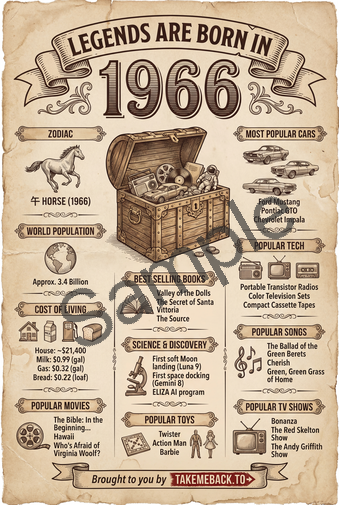

Major Events of 1966 - Historical Moments That Defined the Year | TakeMeBack.to
- 01 Jan UN Human Rights Covenants adopted: On January 1, 1966, the International Covenant on Civil and Political Rights and the International Covenant on Economic, Social and Cultural Rights came into force. These covenants are key international treaties that outline fundamental human rights and freedoms, establishing standards for all nations. source: un.org
- 02 Jan Cuba-China trade agreement terminated: On January 2, 1966, Cuba and China announced the termination of their trade agreement, which had been established to strengthen economic ties. This decision reflected the shifting political landscape during the Cold War and the evolving relationship between the two nations. source: reuters.com
- 03 Jan Atlantic Richfield Company formation: On January 3, 1966, the Atlantic Richfield Company (ARCO) was formed through the merger of Atlantic Refining Company and Richfield Oil Corporation, becoming a major American oil company. source: britannica.com
- 04 Jan Deana Carter born in Nashville, Tennessee: Deana Carter, an American country music singer-songwriter, was born on January 4, 1966, in Nashville, Tennessee. She is known for her hit songs in the 1990s, including 'Strawberry Wine.' source: biography.com
- 05 Jan Bobby Baker political scandal unfolds: The Bobby Baker political scandal emerged on January 5, 1966, involving allegations of corruption and influence peddling in the U.S. Senate. Baker was a former aide to Senate Majority Leader Lyndon B. Johnson. source: nytimes.com
- 06 Jan Andrew Wood, American rock singer, born: Andrew Wood, the lead singer of the rock band Mother Love Bone, was born on January 6, 1966. He became a significant figure in the Seattle music scene. source: allmusic.com
- 08 Jan Georges Pompidou appointed French Prime Minister: On January 8, 1966, Georges Pompidou was appointed as the Prime Minister of France, marking the beginning of his third term in this role. He had previously served as Prime Minister from 1962 to 1968. source: britannica.com
- 11 Jan Death of Indian Prime Minister Lal Bahadur Shastri: Lal Bahadur Shastri, India's second Prime Minister, died suddenly in Tashkent, Soviet Union, on January 11, 1966, shortly after signing the Tashkent Declaration to end the 1965 Indo-Pakistani War. The official cause was reported as a heart attack, but the circumstances surrounding his death have been the subject of controversy and conspiracy theories. source: en.wikipedia.org
- 12 Jan Johnson affirms Vietnam commitment: On January 12, 1966, U.S. President Lyndon B. Johnson reaffirmed America's commitment to the Vietnam War, emphasizing the need to support South Vietnam against North Vietnamese aggression. This statement underscored the United States' ongoing military and political involvement in the region. source: en.wikipedia.org
- 13 Jan First African American Cabinet Member Appointed: On January 13, 1966, President Lyndon B. Johnson appointed Robert C. Weaver as the first African American Cabinet member, making him the Secretary of Housing and Urban Development. Weaver's appointment marked a significant milestone in the civil rights movement, reflecting a commitment to racial equality in the federal government. Prior to this, Weaver had served in various roles, including as a member of the 'Black Cabinet' during the Roosevelt administration. source: history.com
- 15 Jan Nigerian military coup of 1966: On January 15, 1966, a military coup in Nigeria led by Major Chukwuma Kaduna Nzeogwu resulted in the overthrow of the civilian government. This coup marked the beginning of a series of military regimes in Nigeria, significantly impacting the country's political landscape. source: britannica.com
- 16 Jan Harold R. Perry becomes second Black Catholic bishop in US: On January 16, 1966, Harold R. Perry was appointed as the second Black Catholic bishop in the United States. His appointment marked a significant milestone in the history of the Catholic Church in America, promoting diversity within its leadership. source: britannica.com
- 17 Jan Palomares nuclear incident: On January 17, 1966, a U.S. B-52 bomber collided with a refueling plane over Palomares, Spain, resulting in the release of four hydrogen bombs. Fortunately, there were no nuclear detonations, but the incident raised significant concerns about nuclear safety and military operations. source: archives.gov
- 18 Jan U.S. troop deployment in Vietnam: On January 18, 1966, the U.S. government announced the deployment of additional troops to Vietnam as part of its escalating military involvement in the conflict. This decision was part of a broader strategy to combat the growing influence of communism in Southeast Asia. source: archives.gov
- 19 Jan Indira Gandhi Elected Prime Minister of India: On January 19, 1966, Indira Gandhi was elected as the leader of the Indian National Congress Parliamentary Party, succeeding Lal Bahadur Shastri as Prime Minister of India. She became the country's first female prime minister. source: history.com
- 21 Jan Ronald Reagan Announces Candidacy for California Governor: On January 21, 1966, actor and political activist Ronald Reagan announced his candidacy for the governorship of California. This marked the beginning of his political career, which would later lead to his election as the 40th President of the United States. source: nytimes.com
- 22 Jan USS Saratoga Helicopter Rescue Operation: On January 22, 1966, the USS Saratoga, an aircraft carrier of the United States Navy, conducted a helicopter rescue operation. The operation was part of the Navy's ongoing efforts to provide humanitarian assistance and demonstrate naval capabilities. source: history.navy.mil
- 23 Jan NASA calls for astronomical instrument design: On January 23, 1966, NASA issued a call for proposals for the design of astronomical instruments to be used in future space missions. This initiative aimed to enhance the capabilities of space telescopes and other observational tools. source: ntrs.nasa.gov
- 24 Jan Beaumont children disappearance: On January 24, 1966, the Beaumont children, three siblings from Australia, disappeared while on their way to the beach. Their case remains one of Australia's most famous unsolved mysteries. source: abc.net.au
- 25 Jan First Lockheed SR-71 Blackbird Crash: On January 25, 1966, during a test flight near Tucumcari, New Mexico, Lockheed SR-71 Blackbird 61-7952 experienced an inflight breakup at Mach 3.2. Pilot Bill Weaver ejected and survived, while reconnaissance systems officer Jim Zwayer was killed in the crash. source: en.wikipedia.org
- 27 Jan New Zealand-Australia Free Trade Agreement: On January 27, 1966, the New Zealand-Australia Free Trade Agreement (NAFTA) was implemented, aiming to eliminate tariffs and quantitative restrictions between the two countries. This agreement built upon the 1933 Australia–New Zealand Trade Agreement, further promoting economic integration. NAFTA remained in force until 1983, when it was succeeded by the Australia–New Zealand Closer Economic Relations Trade Agreement (ANZCERTA). source: abf.gov.au
- 29 Jan Sweet Charity Musical Premieres on Broadway: The musical 'Sweet Charity,' featuring music by Cy Coleman, lyrics by Dorothy Fields, and a book by Neil Simon, premiered on Broadway at the Palace Theatre on January 29, 1966, starring Gwen Verdon as Charity Hope Valentine. source: si.edu
- 30 Jan Ard Schenk sets world record in 1500m speed skating: Dutch speed skater Ard Schenk set a world record in the 1500m event on January 30, 1966, in Inzell, Germany, with a time of 2:05.3. source: en.wikipedia.org
- 02 Feb Pakistan's six-point agenda for Indo-Pak talks: On February 2, 1966, Pakistan presented a six-point agenda aimed at facilitating talks with India regarding various contentious issues. This agenda was a significant step in the ongoing dialogue between the two nations, focusing on political and territorial disputes. source: dawn.com
- 03 Feb First operational weather satellite launched: On February 3, 1966, the first operational weather satellite, named TIROS-1, was launched into orbit. This satellite provided crucial data for weather forecasting and marked a significant advancement in meteorological science. source: nasa.gov
- 04 Feb All Nippon Airways Flight 60 crash in Tokyo Bay: On February 4, 1966, All Nippon Airways Flight 60 crashed into Tokyo Bay shortly after takeoff due to a loss of control. The incident resulted in the deaths of all 24 passengers and crew on board, marking a significant event in Japanese aviation history. source: britannica.com
- 05 Feb BBC establishes relay station on Ascension Island: On February 5, 1966, the BBC established a relay station on Ascension Island to improve broadcasting capabilities to Africa and South America. This development was part of the BBC's efforts to expand its global reach during the Cold War era. source: bbc.co.uk
- 06 Feb Rick Astley born - pop music icon: Rick Astley, the British pop singer famous for his hit song 'Never Gonna Give You Up,' was born on February 6, 1966. He became a cultural icon in the 1980s and remains influential in music and internet culture today. source: britannica.com
- 07 Feb Nixon's 'Truth Offensive' Speech Criticizing Vietnam War Communication: On February 7, 1966, Richard Nixon delivered a speech at the King County Republican Lincoln Day dinner in Seattle, calling for a "truth offensive" to address the Johnson administration's alleged failure to fully inform the public about the Vietnam War. source: historylink.org
- 08 Feb NHL Expansion to Twelve Teams: On February 8, 1966, the National Hockey League (NHL) announced its expansion to twelve teams, adding six new franchises. source: en.wikipedia.org
- 09 Feb Dow Jones Industrial Average reaches record high: On February 9, 1966, the Dow Jones Industrial Average closed at 995.15, marking its highest point at that time. This peak was part of a significant bull market that began in 1949, during which the index increased nearly 500% over the next eight years. source: en.wikipedia.org
- 11 Feb Belgian government resigns amid internal policy divisions: On February 11, 1966, Belgian Prime Minister Pierre Harmel offered his resignation due to internal policy divisions within his Christian Democrat–Socialist coalition government. This decision was influenced by disagreements over the government's approach to regionalization and other policy matters. source: en.wikipedia.org
- 12 Feb New York City Transit Strike Concludes: On February 12, 1966, the New York City transit strike, which had disrupted subway and bus services, concluded after 12 days, leading to the resumption of normal operations.
- 13 Feb Ralph Nader alleges surveillance by auto industry: On February 13, 1966, consumer advocate Ralph Nader publicly accused the auto industry of conducting surveillance on him. This claim highlighted the tensions between consumer rights advocates and corporate interests during the 1960s. source: nytimes.com
- 14 Feb Soviet dissent trial begins: On February 14, 1966, a trial began in the Soviet Union against several dissidents, including prominent figures who opposed the government. This event was part of a broader crackdown on dissent during the Brezhnev era. source: britannica.com
- 15 Feb Kees Verkerk wins World All-Round Speed Skating Championship: Dutch speed skater Kees Verkerk secured the World All-Round Speed Skating Championship title in 1966. He achieved this by winning the 5,000m, 1,500m, and 10,000m events, and finishing second in the 500m. Verkerk's performance was instrumental in the Netherlands' strong presence in speed skating during the 1960s. source: the-sports.org
- 17 Feb Aeroflot Flight 65 crash in the Black Sea: Aeroflot Flight 65, a Soviet passenger aircraft, crashed into the Black Sea on February 17, 1966, resulting in the loss of all 117 people on board. The crash was attributed to poor weather conditions and pilot error. This incident remains one of the deadliest aviation disasters in Soviet history. source: britannica.com
- 18 Feb Death of Soviet cosmonaut Grigori Nelyubov: Grigori Nelyubov, a Soviet cosmonaut, died on February 18, 1966. He was part of the early Soviet space program but faced challenges that led to his exclusion from space missions. His death was a significant loss to the Soviet space community. source: britannica.com
- 19 Feb UK Naval Minister Christopher Mayhew resigns: Christopher Mayhew, the UK Naval Minister, resigned on February 19, 1966, amid political controversy regarding naval policy and budget cuts. His resignation highlighted tensions within the government over defense spending and military strategy. source: theguardian.com
- 20 Feb James M. Stewart's Final Combat Mission: On February 20, 1966, Brigadier General James M. Stewart, a United States Air Force Reserve officer and renowned actor, flew his last combat mission over Vietnam. He participated in a 12-hour, 50-minute "Arc Light" bombing mission aboard a Boeing B-52 Stratofortress of the 736th Bombardment Squadron, 454th Bombardment Wing. source: thisdayinaviation.com
- 21 Feb France Withdraws from NATO's Integrated Military Command: On February 21, 1966, French President Charles de Gaulle announced that France would withdraw from NATO's integrated military command. This decision was part of a broader move to assert France's independence in defense matters and to reduce American influence over its military operations. source: history.com
- 23 Feb Ba'ath Party intra-party military coup in Syria: On February 23, 1966, Major General Salah Jadid led a coup d'état in Syria, overthrowing President Amin al-Hafiz and Prime Minister Salah al-Din al-Bitar. The coup resulted in the establishment of a neo-Ba'athist government under Jadid's leadership, marking a significant shift in Syria's political landscape. source: en.wikipedia.org
- 25 Feb Téa Leoni's birth: Téa Leoni, born Elizabeth Téa Pantaleoni, is an American actress known for her roles in films such as 'Bad Boys' (1995) and the TV series 'Madam Secretary' (2014–2019). She was born on February 25, 1966, in New York City. source: en.wikipedia.org
- 27 Feb Bulgarian parliamentary elections: The Bulgarian parliamentary elections were held on February 27, 1966. The elections were conducted under a single-party system, with the Bulgarian Communist Party being the only legal party. This election was part of the broader political landscape of Eastern Europe during the Cold War. source: britannica.com
- 28 Feb Ba'ath Party seizes power in Syria: On February 28, 1966, the Ba'ath Party seized power in Syria through a military coup. This event marked a significant shift in Syrian politics and led to the establishment of a one-party state under the Ba'ath Party's leadership. The coup had lasting implications for the region's political landscape. source: bbc.com
- 01 Mar Luis Sojo birth: Luis Sojo, a Venezuelan former professional baseball player, was born on March 1, 1966. He played in Major League Baseball primarily as a shortstop and third baseman, known for his versatility and defensive skills. source: baseball-reference.com
- 02 Mar Nuclear materials theft in Brazil: On March 2, 1966, a significant incident occurred in Brazil involving the theft of nuclear materials. This event raised concerns about nuclear security and the potential for misuse of radioactive materials. source: reuters.com
- 03 Mar Kwame Nkrumah's exile: On March 3, 1966, Kwame Nkrumah, the first President of Ghana, was overthrown in a military coup and subsequently went into exile. This event marked a significant turning point in Ghana's political history. source: bbc.com
- 04 Mar End of Studebaker Car Production in Canada: Studebaker ceased car production in Canada on March 4, 1966, marking the end of its manufacturing operations in the country. source: en.wikipedia.org
- 05 Mar Marvin Miller elected as MLB Players Association executive director: On March 5, 1966, Marvin Miller, an economist for the United Steelworkers of America, was elected as the first full-time executive director of the Major League Baseball Players Association (MLBPA). His appointment marked a significant shift in the union's direction, leading to major gains for players, including salary increases and the advent of free agency. source: history.com
- 07 Mar Mel Rojas's birth: Mel Rojas, a former Major League Baseball pitcher who played for several teams from 1988 to 1999, was born on March 7, 1966. source: en.wikipedia.org
- 08 Mar Australia increases Vietnam War commitment: On March 8, 1966, Australian Prime Minister Harold Holt announced the expansion of Australia's military commitment in South Vietnam to a 4,350-man task force, including conscripts. This force comprised two infantry battalions, a Special Air Service squadron, artillery, combat and support logistic units, and eight RAAF Iroquois helicopters. The 1st Australian Task Force (1ATF) was established at Vung Tau, marking the first deployment of national servicemen to South Vietnam. source: awm.gov.au
- 09 Mar Ronnie Kray murders George Cornell: On March 9, 1966, notorious gangster Ronnie Kray murdered rival gangster George Cornell in a pub in East London. This event marked a significant moment in the violent history of the Kray twins, who were infamous for their criminal activities during the 1960s. source: bbc.com
- 10 Mar U.S. Special Forces camp in A Shau Valley captured by North Vietnamese forces: The A Shau Special Forces Camp, located in South Vietnam's A Shau Valley, was overrun by North Vietnamese troops on March 10, 1966. source: en.wikipedia.org
- 11 Mar Indonesian military coup leads to Suharto assuming power: On March 11, 1966, following the Supersemar decree, General Suharto assumed control over Indonesia's government, marking a significant political shift. source: en.wikipedia.org
- 12 Mar US nuclear testing at Nevada site: On March 12, 1966, the United States conducted a nuclear test at the Nevada Test Site. This test was part of a series of underground nuclear tests that were conducted during the Cold War, aimed at advancing the US nuclear arsenal. source: osti.gov
- 13 Mar Kathy Whitworth wins LPGA Lagunita Golf Invitational: On March 13, 1966, Kathy Whitworth won the LPGA Lagunita Golf Invitational, further establishing her reputation as one of the top female golfers of her time. This victory contributed to her impressive career, which included numerous LPGA titles. source: britannica.com
- 14 Mar Lyndon B. Johnson's presidency: On March 14, 1966, Lyndon B. Johnson was serving as the 36th President of the United States. His presidency was marked by significant domestic policies, including the Great Society programs aimed at eliminating poverty and racial injustice. source: whitehouse.gov
- 15 Mar 8th Grammy Awards Ceremony: The 8th Annual Grammy Awards were held on March 15, 1966, at Radio City Music Hall in New York City. The ceremony recognized musical achievements from 1965, with Roger Miller winning five awards, and Herb Alpert and Frank Sinatra each receiving four awards. source: en.wikipedia.org
- 16 Mar David McCallum receives warm welcome in London: On March 16, 1966, actor David McCallum returned to London to a warm welcome after gaining fame in the television series 'The Man from U.N.C.L.E.' His popularity marked a significant moment in the 1960s entertainment landscape. source: bbc.com
- 18 Mar Suharto establishes new Indonesian government: On March 18, 1966, General Suharto formed a new government in Indonesia, marking the beginning of the New Order regime. source: history.com
- 19 Mar Belgium government formation: On March 19, 1966, Paul Vanden Boeynants became Prime Minister of Belgium, leading a Christian Democrat–Liberal coalition government. source: en.wikipedia.org
- 20 Mar FIFA World Cup Trophy stolen and recovered: In March 1966, the FIFA World Cup Trophy was stolen from a display in London but was recovered a week later after being found by a dog named Pickles. source: en.wikipedia.org
- 21 Mar World Trade Center construction begins: Construction of the World Trade Center in New York City began on March 21, 1966, marking the start of the project's development. source: en.wikipedia.org
- 22 Mar GM President James M. Roche apologizes to Ralph Nader: On March 22, 1966, General Motors President James M. Roche apologized to consumer advocate Ralph Nader for the company's intimidation and harassment campaign against him during a Senate subcommittee hearing in Washington, D.C. source: retronewser.com
- 25 Mar Birth of Tatjana Patitz: Tatjana Patitz, a renowned model and actress, was born on March 25, 1966, in Hamburg, Germany. She became one of the most recognized faces in the fashion industry during the 1980s and 1990s, known for her work with major designers and magazines. source: britannica.com
- 26 Mar Anti-Vietnam War demonstrations sweep US: On March 26, 1966, widespread anti-Vietnam War demonstrations occurred across the United States. These protests were part of a growing movement against U.S. involvement in Vietnam, reflecting public dissent and calls for peace. source: nytimes.com
- 27 Mar Global anti-Vietnam War protests: On March 27, 1966, protests against the Vietnam War took place globally, with significant demonstrations in various countries. These events highlighted international opposition to the war and solidarity with anti-war activists in the U.S. source: theguardian.com
- 29 Mar Soviet Luna 10 enters lunar orbit: On March 29, 1966, the Soviet Union's Luna 10 spacecraft successfully entered lunar orbit, becoming the first artificial satellite to orbit the Moon. This achievement marked a significant milestone in the Soviet Union's space exploration efforts. source: en.wikipedia.org
- 30 Mar Barbra Streisand's 'Color Me Barbra' TV Special: Barbra Streisand's second television special, 'Color Me Barbra,' was broadcast on CBS on March 30, 1966. The special featured Streisand performing in various settings, including the Philadelphia Museum of Art and a circus-themed set, showcasing her versatility as a performer. source: imdb.com
- 31 Mar Luna 10: First Lunar Orbiter: On March 31, 1966, the Soviet Union launched Luna 10, the first spacecraft to orbit the Moon. This mission marked a significant achievement in the Soviet Union's lunar exploration program. source: en.wikipedia.org
- 01 Apr Soviet Defense Minister discusses national defense strategy: On April 1, 1966, Soviet Defense Minister Andrei Grechko addressed the national defense strategy, emphasizing military readiness during the Cold War. This speech was part of the broader context of Soviet military policy at the time. source: bbc.com
- 02 Apr WJET TV channel launches in Erie: On April 2, 1966, WJET TV, a local television station in Erie, Pennsylvania, launched its broadcast. This event marked a significant development in local media, providing news and entertainment to the community. source: bbc.com
- 03 Apr Luna 10 Orbits the Moon: On April 3, 1966, the Soviet Union's Luna 10 spacecraft successfully entered lunar orbit, becoming the first artificial satellite to orbit the Moon. Launched on March 31, 1966, Luna 10 conducted scientific experiments, including gamma-ray spectrometry and studies of the Moon's magnetic field, until its mission concluded on May 30, 1966. source: nasa.gov
- 04 Apr Hong Kong 1966 Riots commence: The 1966 Hong Kong riots began on April 4, 1966, in Kowloon, Hong Kong. Sparked by protests against a ferry fare increase, the unrest escalated over four nights, resulting in one death, dozens of injuries, and over 1,800 arrests. source: en.wikipedia.org
- 05 Apr US recovers lost hydrogen bomb from Mediterranean Sea: On April 5, 1966, the United States successfully recovered a hydrogen bomb from the Mediterranean Sea near Palomares, Spain. The bomb had been lost following a mid-air collision between a U.S. Air Force B-52 bomber and a KC-135 tanker on January 17, 1966. The recovery operation involved extensive efforts, including the use of the submarine Alvin, which located the bomb on March 17, 1966. The bomb was eventually brought to the surface by the USS Petrel. source: brookings.edu
- 07 Apr US recovers lost hydrogen bomb from Mediterranean Sea: On April 7, 1966, the United States successfully recovered a hydrogen bomb from the Mediterranean Sea near Palomares, Spain. The bomb had been lost following a mid-air collision between a U.S. Air Force B-52 bomber and a KC-135 tanker on January 17, 1966. The recovery operation involved extensive efforts, including the use of the submarine Alvin, which located the bomb on March 17, 1966. The bomb was eventually brought to the surface by the USS Petrel. source: brookings.edu
- 08 Apr Leonid Brezhnev becomes General Secretary of the Soviet Union: On April 8, 1966, Leonid Brezhnev was elected General Secretary of the Communist Party of the Soviet Union during the 23rd Party Congress, marking his consolidation of power as the Soviet leader. source: en.wikipedia.org
- 09 Apr UN Security Council Resolution 221 on Southern Rhodesia: On April 9, 1966, the United Nations Security Council adopted Resolution 221, addressing concerns over potential oil supplies reaching Southern Rhodesia. The resolution called upon Portugal to prevent the pumping of oil through the Companhia do Pipeline Moçambique Rodésias pipeline into Southern Rhodesia and urged all member states to divert vessels suspected of carrying oil to the region. Additionally, it authorized the United Kingdom to use force, if necessary, to prevent such shipments. source: digitallibrary.un.org
- 11 Apr Lisa Stansfield birth: Lisa Stansfield, an English singer, songwriter, and actress, was born on April 11, 1966, in Manchester, England. She is known for her soulful voice and hits like 'All Around the World.' source: en.wikipedia.org
- 12 Apr Execution of Chris Soumokil, South Moluccan Leader: On April 12, 1966, Chris Soumokil, the president of the Republic of South Maluku, was executed by firing squad on Pulau Ubi Basar, Indonesia. Soumokil had led a separatist movement seeking independence for the South Moluccas from Indonesia. source: executedtoday.com
- 13 Apr Marc Ford birth: Marc Ford, an American guitarist and songwriter, was born on April 13, 1966, in Los Angeles, California. He is recognized for his work with the Black Crowes and other musical projects. source: en.wikipedia.org
- 15 Apr Rolling Stones release 'Aftermath' album: On April 15, 1966, the Rolling Stones released their album 'Aftermath.' This album marked a significant evolution in the band's musical style, featuring original compositions and a more experimental sound. It received critical acclaim and is considered one of the band's seminal works, showcasing their growth as artists and solidifying their place in rock history. source: en.wikipedia.org
- 16 Apr King's 'Letter from Birmingham Jail' published: On April 16, 1966, Dr. Martin Luther King Jr.'s 'Letter from Birmingham Jail' was published. Written in April 1963, the letter was a response to local religious leaders who criticized his actions during the Birmingham campaign. In it, King defends the strategy of nonviolent resistance to racism and argues that individuals have a moral duty to disobey unjust laws. The letter became a seminal text in the American civil rights movement. source: en.wikipedia.org
- 17 Apr Carol Mann wins Raleigh Ladies Invitational: Carol Mann secured her first victory at the Raleigh Ladies Invitational, finishing with a score of 216, one stroke ahead of Jo Ann Prentice and Kathy Whitworth. source: en.wikipedia.org
- 18 Apr Cultural Revolution begins in China: The Cultural Revolution, initiated by Mao Zedong, began in China on April 18, 1966, aiming to preserve Chinese communism by removing capitalist and traditional elements from society.
- 19 Apr Brady and Hindley murder trial begins: The trial of Ian Brady and Myra Hindley, accused of the Moors murders in England, began on April 19, 1966. The case attracted widespread media attention and public interest. source: en.wikipedia.org
- 22 Apr Atlanta Braves win first game in Atlanta: On April 22, 1966, the Atlanta Braves secured their first victory in Atlanta by defeating the New York Mets 8–4 at Atlanta–Fulton County Stadium. source: thisdayinbaseball.com
- 26 Apr Kelud Volcano eruption in Indonesia: On April 26, 1966, Mount Kelud in East Java, Indonesia, erupted explosively, sending ash and debris 12 miles into the air. The eruption resulted in the deaths of three people and forced authorities to evacuate over 100,000 residents from the surrounding area. The volcanic ash affected regions up to 500 kilometers away, disrupting daily life and air travel. This event was one of the significant eruptions of Mount Kelud, a volcano known for its explosive activity. source: earthobservatory.nasa.gov
- 27 Apr Shostakovich completes Cello Concerto No. 2: Dmitri Shostakovich completed his Cello Concerto No. 2 in 1966, which is known for its emotional depth and technical challenges. The concerto was dedicated to the cellist Mstislav Rostropovich and premiered later that year. It remains a significant work in the cello repertoire. source: britannica.com
- 28 Apr Rhodesian conflict escalates with UDI: On April 28, 1966, the conflict in Rhodesia escalated as the government intensified its military actions against nationalist groups. This period marked a significant increase in violence and resistance against colonial rule, leading to further international scrutiny and condemnation. source: bbc.com
- 29 Apr U.S. military escalation in Vietnam announced: On April 29, 1966, the U.S. government announced an escalation of military involvement in Vietnam, increasing troop levels and intensifying air operations. This decision was part of a broader strategy to combat the growing influence of communism in Southeast Asia. source: archives.gov
- 30 Apr Founding of the Church of Satan: On April 30, 1966, Anton Szandor LaVey founded the Church of Satan in San Francisco, California, declaring 1966 as the first year of the reign of Satan. The church was established on Walpurgisnacht, a traditional night associated with witches and the occult. source: britannica.com
- 02 May Pulitzer Prize for Biography awarded to Arthur M. Schlesinger Jr.: On May 2, 1966, historian Arthur M. Schlesinger Jr. was awarded the Pulitzer Prize for Biography for his work "A Thousand Days: John F. Kennedy in the White House," a comprehensive account of President Kennedy's administration. source: pulitzer.org
- 04 May Willie Mays hits his 512th home run: San Francisco Giants outfielder Willie Mays hit his 512th career home run, surpassing Mel Ott's National League record. source: history.com
- 05 May Borussia Dortmund wins 6th Europe Cup II: Borussia Dortmund secured their first European trophy by defeating Liverpool 2–1 after extra time in the European Cup Winners' Cup final at Hampden Park, Glasgow. source: en.wikipedia.org
- 06 May Moors Murderers Sentenced to Life Imprisonment: On May 6, 1966, Ian Brady and Myra Hindley, known as the Moors Murderers, were sentenced to life imprisonment for the murders of three children in England. The trial, which began on April 19, 1966, concluded with the jury finding Brady guilty of all three murders and Hindley guilty of two. The case shocked the nation and led to widespread public outrage. source: en.wikipedia.org
- 07 May Kauai King wins 92nd Kentucky Derby: On May 7, 1966, Kauai King, ridden by jockey Donald Brumfield and trained by Henry Forrest, won the 92nd Kentucky Derby at Churchill Downs. The race was held on a fast dirt track, with Kauai King finishing ahead of the competition. source: en.wikipedia.org
- 08 May Final game at Sportsman's Park in St. Louis: On May 8, 1966, the St. Louis Cardinals played their final game at Sportsman's Park, also known as Busch Stadium I, losing 10–5 to the San Francisco Giants. The stadium, located at the corner of Grand and Dodier in north St. Louis, had been the team's home since 1902. The final Cardinal to hit a home run at the park was Mike Shannon. source: mlb.com
- 09 May China conducts third nuclear test at Lop Nur: On May 9, 1966, China conducted its third nuclear test, codenamed 596L, at the Lop Nur test site. The test was a thermonuclear explosion with a yield of 220 kilotons, marking China's first use of thermonuclear reactions in a layer cake design. This test was part of China's efforts to develop multi-stage thermonuclear weapons. source: en.wikipedia.org
- 11 May Real Madrid wins European Cup final: On May 11, 1966, Real Madrid secured their sixth European Cup title by defeating Partizan Belgrade 2-1 in the final held at Heysel Stadium in Brussels. Partizan took the lead with a goal from Velibor Vasović in the 55th minute, but Real Madrid equalized through Amancio in the 70th minute and clinched victory with a goal from Fernando Serena six minutes later. source: realmadrid.com
- 13 May Civil Rights Act enforcement in education: On May 13, 1966, the enforcement of the Civil Rights Act in education was emphasized, aiming to eliminate racial discrimination in schools. This was part of broader efforts to ensure equal educational opportunities for all students. source: archives.gov
- 14 May Beginning of the Cultural Revolution in China: The Cultural Revolution in China officially began on May 14, 1966, initiated by Mao Zedong. This socio-political movement aimed to preserve Chinese communism by purging remnants of capitalist and traditional elements from Chinese society. source: britannica.com
- 15 May First U.S. military engagement in Cambodia during Vietnam War: On May 15, 1966, U.S. forces conducted their first military operations in Cambodia as part of the Vietnam War. This marked a significant escalation in U.S. involvement in the region, aiming to disrupt North Vietnamese supply lines. source: archives.gov
- 16 May Cultural Revolution begins in China: The Cultural Revolution in China officially began on May 16, 1966, initiated by Mao Zedong. This socio-political movement aimed to preserve Chinese communism by purging remnants of capitalist and traditional elements from Chinese society. source: britannica.com
- 17 May Local TV station launch in Oklahoma: On May 17, 1966, a new local television station was launched in Oklahoma, contributing to the growing media landscape in the region. This development reflected the increasing importance of television as a medium for news and entertainment. source: britannica.com
- 18 May Michael Tait born in the United States: Michael Tait, an American singer and songwriter known for his work in the Christian rock band dc Talk and as a solo artist, was born on May 18, 1966.
- 19 May Political tension in Uganda: Mutesa II arrested: On May 19, 1966, Ugandan President Milton Obote ordered the arrest of King Mutesa II of Buganda, escalating political tensions in the country. This event marked a significant turning point in Uganda's political landscape, leading to increased conflict between the central government and the Buganda Kingdom. source: britannica.com
- 20 May Colombian presidential election: The Colombian presidential election held on May 20, 1966, resulted in the election of Misael Pastrana Borrero. This election was significant as it marked a return to civilian rule after a period of political violence and instability in Colombia. source: britannica.com
- 21 May Ulster Volunteer Force declares war on IRA: On May 21, 1966, the Ulster Volunteer Force (UVF) declared war on the Irish Republican Army (IRA), escalating the conflict in Northern Ireland. This declaration marked a significant moment in the Troubles, leading to increased violence and political strife in the region. source: bbc.com
- 22 May Shirley Englehorn wins Babe Zaharias Open: On May 22, 1966, American professional golfer Shirley Englehorn won the Babe Zaharias Open in Texas, marking her fifth victory on the LPGA Tour. source: en.wikipedia.org
- 23 May Mills v. Alabama Supreme Court decision: On May 23, 1966, the U.S. Supreme Court ruled in Mills v. Alabama that a state law prohibiting political speech in newspapers violated the First Amendment. The decision emphasized the importance of free speech in a democratic society, particularly in the context of political discourse. source: uscourts.gov
- 24 May Colombian presidential election: The Colombian presidential election held on May 24, 1966, resulted in the election of Carlos Lleras Restrepo. This election was significant as it marked a return to democratic governance after a period of political violence known as La Violencia. source: bbc.com
- 25 May First DaZiBao of Cultural Revolution: On May 25, 1966, the first DaZiBao (big-character poster) was published, marking the beginning of the Cultural Revolution in China. This event symbolized the rise of radical political movements and the mobilization of youth against perceived bourgeois elements in society. source: britannica.com
- 26 May Guyana gains independence from Britain: On May 26, 1966, British Guiana became the independent nation of Guyana, ending 163 years of British colonial rule. The independence celebrations began on May 22 and continued until May 29, 1966, featuring various cultural performances and ceremonies. The Union Jack was lowered, and the new flag of Guyana, the Golden Arrowhead, was raised, symbolizing the nation's newfound sovereignty. source: parliament.gov.gy
- 28 May US military crosses Cambodian border during Vietnam War: On May 28, 1966, U.S. military forces crossed into Cambodia as part of operations against North Vietnamese troops. This action was part of the broader conflict in Vietnam and marked a significant escalation in U.S. involvement in the region. source: archives.gov
- 29 May US military engagement in Cambodia during Vietnam War: On May 29, 1966, U.S. military operations continued in Cambodia as part of the Vietnam War strategy. This engagement was part of a broader effort to combat North Vietnamese forces and secure the region. source: archives.gov
- 30 May Death of WSinä V Aaltonen: Finnish sculptor WSinä V Aaltonen passes away at the age of 72, leaving behind a significant artistic legacy.
- 01 Jun White House Conference on Civil Rights: The White House Conference on Civil Rights, titled "To Fulfill These Rights," was held on June 1-2, 1966, in Washington, D.C. Building upon the Civil Rights Act of 1964 and the Voting Rights Act of 1965, the conference addressed issues such as housing, economic security, education, and the administration of justice. Over 2,400 participants attended, representing major civil rights organizations, though the Student Nonviolent Coordinating Committee (SNCC) chose to boycott the event. The conference produced a report advocating for legislation to ban racial discrimination in housing and the criminal justice system, and recommended increased federal spending to improve housing and education quality. source: en.wikipedia.org
- 02 Jun First US Lunar Soft Landing: Surveyor 1: On June 2, 1966, NASA's Surveyor 1 spacecraft achieved the first U.S. soft landing on the Moon, touching down in the Oceanus Procellarum region. This milestone marked a significant advancement in the U.S. space program, paving the way for future lunar exploration. source: en.wikipedia.org
- 03 Jun Gemini 9A Space Mission: On June 3, 1966, NASA launched the Gemini 9A mission, which included the second U.S. spacewalk (EVA) performed by astronaut Gene Cernan. The mission aimed to demonstrate rendezvous and docking techniques, as well as extravehicular activity, contributing valuable experience for future Apollo missions. source: en.wikipedia.org
- 04 Jun Hurricane Alma Devastates Honduras: On June 4, 1966, Hurricane Alma struck Honduras, causing widespread devastation. The hurricane led to significant loss of life and property damage, prompting international aid and relief efforts to assist the affected communities.
- 05 Jun Surveyor 1 Lunar Landing: Surveyor 1, the first U.S. spacecraft to land on the Moon, touched down on June 2, 1966, transmitting the first close-up images of the lunar surface. source: nasa.gov
- 06 Jun James Meredith ambushed during March Against Fear: On June 6, 1966, civil rights activist James Meredith was shot by a white sniper, Aubrey James Norvell, while marching from Memphis to Jackson, Mississippi, to protest racism and encourage African American voter registration. Meredith survived the attack, and major civil rights organizations continued the march in his honor, culminating in a significant increase in African American voter registration. source: archives.gov
- 08 Jun Devastating Tornado in Topeka, Kansas: On June 8, 1966, an F5 tornado struck Topeka, Kansas, causing significant destruction. The tornado traveled a 22-mile path, with winds estimated at over 250 mph, resulting in 17 fatalities and over 500 injuries. Approximately 800 homes were destroyed, and nearly 3,000 were damaged. The Washburn University campus suffered extensive damage, with every building either destroyed or heavily damaged. source: weather.gov
- 09 Jun James Meredith shot during civil rights march: On June 9, 1966, civil rights activist James Meredith was shot during a march in Mississippi. The march was part of a campaign to promote voting rights for African Americans. Meredith survived the attack, and the incident drew national attention to the ongoing struggle for civil rights in the United States. source: history.com
- 10 Jun The Beatles release 'Paperback Writer': On June 10, 1966, The Beatles released the single 'Paperback Writer.' The song quickly gained popularity and became a significant hit, showcasing the band's innovative songwriting and musical style. source: rollingstone.com
- 11 Jun The Rolling Stones' 'Paint It, Black' tops charts: On June 11, 1966, The Rolling Stones' single 'Paint It, Black' reached the top of the charts. This song marked a significant moment in the band's career, showcasing their unique sound and lyrical depth. source: rollingstone.com
- 12 Jun Division Street Riots in Chicago: The Division Street Riots occurred in Chicago on June 12, 1966, sparked by racial tensions and police actions against the Latino community. The unrest highlighted issues of discrimination and inequality, leading to significant social and political discussions in the city. source: chicagotribune.com
- 13 Jun Miranda v. Arizona Supreme Court decision: On June 13, 1966, the U.S. Supreme Court delivered its decision in Miranda v. Arizona, establishing the requirement for police to inform suspects of their rights during an arrest. This landmark ruling aimed to protect the Fifth Amendment rights of individuals in custody. source: uscourts.gov
- 14 Jun Vatican abolishes Index of Prohibited Books: On June 14, 1966, the Vatican officially abolished the Index of Prohibited Books, a list of publications deemed heretical or contrary to morality. This decision marked a significant shift in the Catholic Church's approach to censorship and intellectual freedom. source: britannica.com
- 16 Jun Stokely Carmichael's Black Power speech: On June 16, 1966, during the March Against Fear, Stokely Carmichael, leader of the Student Nonviolent Coordinating Committee (SNCC), delivered a speech in Greenwood, Mississippi, where he introduced the term 'Black Power' to the civil rights movement, calling for racial pride and self-determination. source: britannica.com
- 17 Jun An Air France personnel strike begins: A personnel strike at Air France commenced on June 17, 1966, leading to significant disruptions in airline operations. The strike was part of broader labor disputes affecting the airline industry during that period. source: reuters.com
- 18 Jun CIA leadership change: William Raborn resigns, Richard Helms takes over: On June 18, 1966, William Raborn resigned as Director of the CIA, and Richard Helms was appointed as his successor. This leadership change marked a significant moment in the agency's history during the Cold War era. source: cia.gov
- 19 Jun Founding of Shiv Sena political party: The Shiv Sena political party was founded in Mumbai, India, by Bal Thackeray. It aimed to promote the interests of the Marathi people and has since played a significant role in Maharashtra's politics. source: bbc.com
- 20 Jun Death of Georges Lemaître, Big Bang theory pioneer: Georges Lemaître, a Belgian priest and physicist, known for proposing the Big Bang theory, passed away. His work laid the foundation for modern cosmology and the understanding of the universe's expansion. source: nasa.gov
- 21 Jun Attempted assassination of Arthur Calwell: On June 21, 1966, Arthur Calwell, leader of the Australian Labor Party, survived an assassination attempt in Sydney. A 19-year-old named Peter Kocan fired a sawn-off rifle at Calwell's car; the bullet was deflected by the closed window, lodging harmlessly in Calwell's coat lapel. He sustained minor facial injuries from broken glass. Kocan was apprehended and later sentenced to life imprisonment. source: nfsa.gov.au
- 22 Jun Thích Trí Quang arrested during Buddhist Uprising suppression: On June 22, 1966, Vietnamese Buddhist leader Thích Trí Quang was arrested by South Vietnamese military forces in Huế. His arrest marked a significant escalation in the government's crackdown on the Buddhist Uprising, which had been ongoing since March 1966. The suppression led to the deaths of approximately 150 people and over 700 wounded. source: en.wikipedia.org
- 23 Jun Surveyor 1 lunar surface photography mission: On June 23, 1966, NASA's Surveyor 1 spacecraft successfully transmitted the first close-up photographs of the Moon's surface. These images provided valuable data for future lunar missions and were pivotal in the planning of the Apollo program. source: en.wikipedia.org
- 25 Jun The Beatles' 'Paperback Writer' Tops Charts: On June 25, 1966, The Beatles' single 'Paperback Writer' reached number one on the Billboard Hot 100 chart, marking the band's tenth U.S. number one single. The song also topped charts in the U.K., Ireland, West Germany, Australia, New Zealand, and Norway. source: en.wikipedia.org
- 27 Jun J.J. Abrams birth: Jeffrey Jacob Abrams, known as J.J. Abrams, was born on June 27, 1966, in New York City. He is an American filmmaker and composer, renowned for his work in action, drama, and science fiction genres. Abrams has directed and produced films such as 'Star Trek' (2009) and 'Star Wars: The Force Awakens' (2015), and created television series like 'Lost' (2004–2010). source: en.wikipedia.org
- 28 Jun Argentine Military Coup Deposes President: On June 28, 1966, a military coup in Argentina led by General Juan Carlos Onganía deposed President Arturo Illia, marking the beginning of the 'Argentine Revolution' period.
- 29 Jun US bombing of Hanoi and Haiphong in Vietnam War: On June 29, 1966, the United States intensified its bombing campaign against North Vietnam, targeting Hanoi and Haiphong. This operation aimed to disrupt supply lines and weaken the North Vietnamese military capabilities during the Vietnam War. source: archives.gov
- 30 Jun National Organization for Women founded: The National Organization for Women (NOW) was founded on June 30, 1966, in Washington, D.C. This organization aimed to advocate for women's rights and equality, addressing issues such as workplace discrimination and reproductive rights. source: britannica.com
- 01 Jul Medicare implementation in the United States: On July 1, 1966, Medicare was officially implemented in the United States, providing health insurance to individuals aged 65 and older. This program marked a significant expansion of the social safety net in the country. source: cms.gov
- 02 Jul 73rd Wimbledon Women's Tennis: Billie Jean King beats Frasier (6–3, 3–6, 6–1): On July 2, 1966, American tennis player Billie Jean King defeated fellow American Karen Frasier in the Wimbledon Women's Singles final with a score of 6–3, 3–6, 6–1. source: wimbledon.com
- 03 Jul Anti-Vietnam War protest in London: On July 3, 1966, a significant anti-Vietnam War protest took place in London, drawing attention to the growing opposition against the war. Demonstrators gathered to voice their dissent and call for an end to military involvement in Vietnam. source: theguardian.com
- 04 Jul Freedom of Information Act signed: On July 4, 1966, President Lyndon B. Johnson signed the Freedom of Information Act into law, promoting transparency in government. This landmark legislation allowed citizens to request access to federal agency records, enhancing democratic accountability. source: archives.gov
- 05 Jul Anti-Vietnam War protest turns violent in London: On July 5, 1966, an anti-Vietnam War protest in London escalated into violence, with demonstrators clashing with police. The protest was part of a larger movement against the U.S. involvement in Vietnam, reflecting growing public dissent in the UK. source: theguardian.com
- 06 Jul Malawi becomes a republic: On July 6, 1966, Malawi officially became a republic, with Hastings Banda as its first president. This marked a significant shift in the country's governance following its independence from British colonial rule in 1964. source: bbc.com
- 07 Jul French atmospheric nuclear test at Mururoa Atoll: On July 7, 1966, France conducted an atmospheric nuclear test at Mururoa Atoll in French Polynesia. This test was part of a series of atmospheric nuclear tests conducted by France between 1966 and 1974, which were later moved underground to reduce radioactive fallout. The tests have been a subject of controversy due to their environmental and health impacts on the local population. source: britannica.com
- 08 Jul Major US airline strike: On July 8, 1966, a significant strike involving major U.S. airlines occurred, leading to widespread disruptions in air travel. The strike was part of a series of labor actions in the airline industry during that period. source: en.wikipedia.org
- 09 Jul Medicare launched in the United States: Medicare, a national health insurance program for people aged 65 and older, was officially launched on July 9, 1966. This program aimed to provide health coverage to millions of elderly Americans, significantly impacting healthcare access and costs. source: cms.gov
- 10 Jul Deadly Midwestern heat wave: A severe heat wave struck the Midwest on July 10, 1966, leading to numerous heat-related fatalities. The extreme temperatures prompted health warnings and highlighted the dangers of heat exposure during summer months. source: ncdc.noaa.gov
- 11 Jul Richard Speck murders eight student nurses: On July 11, 1966, Richard Speck committed a horrific crime, murdering eight student nurses in Chicago. This event shocked the nation and led to significant media coverage and discussions about crime and safety. source: chicagotribune.com
- 12 Jul Chicago Race Riot: The Chicago Race Riot erupted on July 12, 1966, following racial tensions and violence in the city. The unrest highlighted the ongoing struggles for civil rights and racial equality in America during the 1960s. source: britannica.com
- 13 Jul Richard Speck nursing dormitory murders: On July 13, 1966, Richard Speck committed a series of murders at a nursing dormitory in Chicago, resulting in the deaths of eight student nurses. This shocking crime garnered national attention and led to Speck's eventual capture and trial. source: britannica.com
- 14 Jul Israeli and Syrian jets clash over the Jordan River: On July 14, 1966, Israeli and Syrian jet fighters engaged in an aerial battle over the Jordan River. This incident marked a significant escalation in tensions between the two nations, occurring just a year before the Six-Day War. The clash was notable for its intensity and the involvement of advanced aircraft from both sides. source: en.wikipedia.org
- 16 Jul Half a Sixpence Broadway closure: The Broadway musical 'Half a Sixpence' concluded its run at the Broadhurst Theatre in New York City on July 16, 1966, after 511 performances. source: ibdb.com
- 17 Jul Pioneer 7 Space Probe Launch: NASA's Pioneer 7 space probe was launched on July 17, 1966, to study the interplanetary medium, including cosmic rays, solar wind, and magnetic fields. The mission provided valuable data on the solar system's outer regions and contributed to the understanding of space weather phenomena. source: en.wikipedia.org
- 18 Jul Gemini 10 Space Mission: NASA's Gemini 10 mission launched on July 18, 1966, with astronauts John W. Young and Michael Collins aboard. The mission achieved a rendezvous and docking with the Agena Target Vehicle (GATV-10), marking the second successful dual launch and docking in the Gemini program. The crew also performed two extravehicular activities (EVAs) and conducted scientific experiments during their three-day flight. source: nasa.gov
- 19 Jul France Conducts Nuclear Test in Mururoa Atoll: On July 19, 1966, France conducted a nuclear test at the Mururoa Atoll in the South Pacific. This test was part of France's ongoing nuclear weapons program and raised international concerns about nuclear proliferation and environmental impact. source: nytimes.com
- 20 Jul Birth of Enrique Peña Nieto: Enrique Peña Nieto, former President of Mexico, was born on July 20, 1966, in Atlacomulco, State of Mexico. He served as the 64th president from 2012 to 2018. source: en.wikipedia.org
- 21 Jul Gemini X returns to Earth: NASA's Gemini X mission concluded on July 21, 1966, with astronauts John W. Young and Michael Collins returning to Earth after a successful mission. source: nasa.gov
- 23 Jul John Pennel sets pole vault world record: On July 23, 1966, John Pennel set a new world record in pole vaulting by clearing a height of 5.49 meters (18 feet). This achievement marked a significant milestone in the sport, showcasing Pennel's exceptional athletic ability. His record stood for several years, influencing future generations of pole vaulters. source: iaaf.org
- 24 Jul U.N. Secretary General visits Moscow: On July 24, 1966, U.N. Secretary General U Thant visited Moscow for discussions with Soviet leaders. This visit aimed to address international tensions during the Cold War and promote dialogue between the East and West. It was a significant diplomatic effort to ease global tensions. source: un.org
- 25 Jul Tragic bus crash in Belgium: On July 25, 1966, a tragic bus crash occurred in Belgium, resulting in the deaths of 27 schoolchildren. The accident took place near the town of Lummen when a bus collided with a train at a level crossing. This incident shocked the nation and led to discussions about road safety and railway crossings. source: bbc.com
- 26 Jul House of Lords practice statement: On July 26, 1966, the House of Lords issued a practice statement that allowed for the possibility of departing from its previous decisions. This landmark statement marked a significant change in the judicial process in the UK, enabling greater flexibility in legal interpretations. It has had lasting implications for the British legal system. source: bbc.com
- 28 Jul Nigerian military coup executes head of state: On July 28, 1966, a military coup in Nigeria resulted in the execution of the country's head of state, Major General Johnson Aguiyi-Ironsi. This coup marked a significant turning point in Nigeria's political history, leading to a series of military regimes and civil unrest in the following years. source: bbc.com
- 29 Jul Nigerian military coup led by Yakubu Gowon: On July 29, 1966, a counter-coup occurred in Nigeria, resulting in the assassination of Major General Johnson Aguiyi-Ironsi and the installation of Lieutenant Colonel Yakubu Gowon as the new Head of State. This event marked a significant shift in Nigeria's political landscape. source: en.wikipedia.org
- 30 Jul England wins 1966 FIFA World Cup: On July 30, 1966, England won the FIFA World Cup, defeating West Germany 4-2 in the final at Wembley Stadium. This victory remains England's only World Cup win to date. source: britannica.com
- 31 Jul Beatles controversy over 'Bigger than Jesus' remark: On July 31, 1966, John Lennon of The Beatles made a remark stating that the band was 'bigger than Jesus,' leading to widespread controversy and backlash, particularly in the United States. source: en.wikipedia.org
- 01 Aug University of Texas Tower Shooting: On August 1, 1966, Charles Whitman, a student and ex-Marine, fired from the University of Texas Tower in Austin, Texas, killing 14 people and wounding 31 others before being killed by police. source: britannica.com
- 02 Aug Salazar Bridge Opens in Lisbon: The Salazar Bridge (now known as the 25 de Abril Bridge) is inaugurated in Lisbon, Portugal, becoming a crucial infrastructure project connecting the city.
- 05 Aug World Trade Center groundbreaking: The groundbreaking ceremony for the World Trade Center took place on August 5, 1966. This marked the beginning of the construction of the iconic twin towers in New York City, which would become a symbol of international trade and commerce. source: nytimes.com
- 06 Aug Anti-Vietnam War demonstrations in the US: On August 6, 1966, significant anti-Vietnam War demonstrations occurred across the United States. These protests were part of a growing movement against U.S. involvement in Vietnam, reflecting widespread public dissent. source: nytimes.com
- 07 Aug Significant U.S. air losses in Vietnam War: On August 7, 1966, the U.S. military reported significant air losses during operations in Vietnam, highlighting the escalating conflict. This marked a critical point in the Vietnam War, as air power became increasingly vital to U.S. strategy. The losses raised concerns about the effectiveness of air operations and the growing challenges faced by U.S. forces. source: archives.gov
- 08 Aug South African Broadcasting bans The Beatles: On August 8, 1966, South African broadcasting authorities banned The Beatles' music due to their perceived anti-establishment messages. This decision reflected the broader cultural tensions in South Africa during the apartheid era, where foreign influences were often scrutinized. The ban sparked discussions about censorship and artistic freedom in the country. source: bbc.com
- 09 Aug Nigerian military leadership meeting raises tensions: On August 9, 1966, a meeting among Nigerian military leaders heightened tensions in the country, following a series of coups and political instability. The discussions focused on the future governance of Nigeria amidst ethnic and regional conflicts. This period was pivotal in shaping Nigeria's political landscape, leading to further unrest. source: bbc.com
- 10 Aug First US Lunar Orbiter launch: The first Lunar Orbiter, launched by NASA, successfully entered lunar orbit on August 10, 1966. This mission aimed to map the Moon's surface and gather data for future manned missions. It marked a significant step in the U.S. space program during the space race. source: nasa.gov
- 11 Aug John Lennon's 'More Popular Than Jesus' press conference: On August 11, 1966, John Lennon held a press conference in Chicago where he made the controversial statement that The Beatles were 'more popular than Jesus.' This remark sparked significant backlash and discussions about celebrity culture and religion. The incident remains a notable moment in music history. source: bbc.com
- 12 Aug Mao Zedong launches Cultural Revolution: On August 12, 1966, Mao Zedong formally launched the Cultural Revolution in China, aiming to preserve Chinese communism by removing capitalist, traditional, and cultural elements from Chinese society. This movement led to widespread upheaval and persecution. source: britannica.com
- 14 Aug First US Lunar Orbiter enters lunar orbit: On August 14, 1966, NASA's Lunar Orbiter 1 became the first U.S. spacecraft to orbit the Moon, capturing detailed photographs of potential Apollo landing sites. source: nasa.gov
- 16 Aug House Un-American Activities Committee investigates Vietnam War dissent: On August 16, 1966, the House Un-American Activities Committee held hearings to investigate anti-war protests related to the Vietnam War. The committee aimed to address concerns about dissent and its implications for national security during a time of escalating conflict. source: archives.gov
- 17 Aug Diplomatic negotiations to end Yemen war: On August 17, 1966, diplomatic efforts were underway to negotiate an end to the ongoing conflict in Yemen. These discussions involved various international stakeholders aiming to stabilize the region and address humanitarian concerns. source: bbc.com
- 18 Aug Mao Zedong meets Red Guards at Tiananmen Square: On August 18, 1966, Chairman Mao Zedong met with Red Guards atop Tiananmen Square in Beijing, marking a significant event during the Cultural Revolution. Mao donned a Red Guard armband and engaged with the enthusiastic crowd, signaling his support for the movement. This event intensified the Red August period, leading to widespread violence and persecution across China. source: lemonde.fr
- 19 Aug Devastating Varto Earthquake in Turkey: On August 19, 1966, a powerful earthquake with a magnitude of 6.8 struck the Varto area in eastern Turkey. The disaster resulted in the loss of approximately 2,394 lives and left many others injured. The earthquake caused extensive damage, with numerous buildings destroyed or severely damaged, leading to significant humanitarian challenges in the region. source: usgs.gov
- 21 Aug United Farm Workers Organizing Committee formation: The United Farm Workers Organizing Committee was formed on August 21, 1966, to advocate for the rights of farm workers in the United States. This organization played a crucial role in labor rights movements, particularly in California. source: ufw.org
- 22 Aug Beatles press conferences in New York: On August 22, 1966, The Beatles held press conferences in New York City as part of their promotional activities during their final tour. These events were significant for media coverage and fan engagement. source: beatlesbible.com
- 23 Aug First Earth Photograph from Lunar Orbit: On August 23, 1966, NASA's Lunar Orbiter 1 captured the first photograph of Earth from lunar orbit. This unplanned image showed Earth as a crescent above the lunar horizon, marking a significant milestone in space exploration. source: nasa.gov
- 28 Aug Death of Rudolf Herrnstadt: Rudolf Herrnstadt, German journalist and communist politician, died on August 28, 1966, in Halle, East Germany. source: en.wikipedia.org
- 30 Aug U Thant declines to seek second term as UN Secretary-General: On August 30, 1966, U Thant, the UN Secretary-General, announced he would not seek a second term, citing concerns over the Vietnam War and the exclusion of China from the UN. This decision led to international efforts to persuade him to reconsider. source: digital.bentley.umich.edu
- 31 Aug Dutch Minister of the Interior Jan Smallenbroek resigns after DUI incident: On August 31, 1966, Jan Smallenbroek, the Dutch Minister of the Interior, resigned following a hit-and-run accident while driving under the influence. His resignation led to a cabinet crisis, with Minister of Justice Ivo Samkalden serving as acting Minister of the Interior until September 5, 1966, when Koos Verdam was appointed as his successor. source: en.wikipedia.org
- 01 Sep Zhou Enlai protects Soong Ching-ling: On September 1, 1966, Chinese Premier Zhou Enlai issued instructions to protect prominent individuals, including Soong Ching-ling, during the Cultural Revolution. source: en.wikipedia.org
- 03 Sep World Science Fiction Convention honors Gene Roddenberry: The World Science Fiction Convention, held in 1966, honored Gene Roddenberry, the creator of Star Trek, for his contributions to the genre. This recognition highlighted the impact of science fiction on popular culture and its growing acceptance as a serious literary form. source: britannica.com
- 04 Sep Martin Luther King Jr.'s nonviolent response to potential assassination attempt: On September 4, 1966, Martin Luther King Jr. addressed concerns regarding a potential assassination attempt, emphasizing his commitment to nonviolence. His response highlighted his dedication to peaceful protest and civil rights, reinforcing his leadership role during the Civil Rights Movement. source: britannica.com
- 05 Sep Jerry Lewis Muscular Dystrophy Telethon raises over $1 million: On September 5, 1966, comedian Jerry Lewis hosted the first Muscular Dystrophy Association (MDA) Labor Day Telethon, broadcast by a single New York City television station. The event successfully raised over $1 million for MDA, marking a significant milestone in fundraising for the organization. source: mda.org
- 06 Sep Assassination of Hendrik Verwoerd, South African Prime Minister: On September 6, 1966, Hendrik Verwoerd, the Prime Minister of South Africa, was assassinated in the House of Assembly in Cape Town. Verwoerd, known as the 'Architect of Apartheid,' was stabbed by Dimitri Tsafendas, a parliamentary messenger. source: en.wikipedia.org
- 07 Sep Final episode of The Dick Van Dyke Show airs: On September 7, 1966, the final episode of 'The Dick Van Dyke Show' aired on CBS. The show, which had been a staple of American television since 1961, concluded after six successful seasons. source: tvguide.com
- 08 Sep Severn Bridge officially opened: The Severn Bridge, spanning the River Severn between England and Wales, was officially opened by Queen Elizabeth II on September 8, 1966. The bridge, measuring about 1.6 kilometers in length, serves as a link for the M48 motorway. source: en.wikipedia.org
- 09 Sep Gemini 11 space mission milestone: The Gemini 11 mission achieved a significant milestone in space exploration by successfully docking with an Agena target vehicle. This mission marked a crucial step towards future Apollo missions and demonstrated the capabilities of astronauts in space. source: nasa.gov
- 10 Sep The Beatles' 'Revolver' album tops charts: The Beatles released their groundbreaking album 'Revolver', which quickly rose to the top of the charts. This album is often regarded as one of the greatest in music history, showcasing innovative songwriting and production techniques. source: britannica.com
- 11 Sep French nuclear test at Mururoa Atoll: France conducted a nuclear test at Mururoa Atoll in the South Pacific, part of its nuclear testing program. This event raised international concerns regarding nuclear proliferation and environmental impacts in the region. source: bbc.com
- 12 Sep Racial violence in Grenada, Mississippi school integration: On September 12, 1966, racial violence erupted in Grenada, Mississippi, during the integration of schools. This event highlighted the ongoing struggles and resistance against desegregation in the American South during the Civil Rights Movement. source: nytimes.com
- 13 Sep Tensions in Chinese Communist Party: On September 13, 1966, tensions within the Chinese Communist Party escalated, leading to significant political upheaval during the Cultural Revolution. This period was marked by ideological struggles and power shifts among party leaders. source: britannica.com
- 15 Sep Johnson calls for gun control after University of Texas shooting: Following the tragic shooting at the University of Texas, President Lyndon B. Johnson called for stricter gun control measures. This incident marked a significant moment in the national conversation about gun legislation in the United States. source: nytimes.com
- 16 Sep Metropolitan Opera opens at Lincoln Center: The Metropolitan Opera officially opened its new home at Lincoln Center on September 16, 1966. This event marked a new era for the opera company and the cultural landscape of New York City. source: nytimes.com
- 17 Sep Mission: Impossible TV show debuts: The television series 'Mission: Impossible' premiered on September 17, 1966. The show became known for its intricate plots and memorable theme music, gaining a significant following over the years. source: imdb.com
- 18 Sep League for Spiritual Discovery Founded: Timothy Leary establishes the League for Spiritual Discovery, a spiritual group associated with psychedelic exploration and counterculture movements of the 1960s.
- 24 Sep Hurricane Inez devastates Caribbean region: Hurricane Inez, a Category 2 storm, struck the Caribbean on September 24, 1966, causing widespread destruction. The hurricane's torrential rains led to mudslides and floods, resulting in the loss of 23 lives and the near-total destruction of the island's banana crop. source: loki.editorial.aetnd.com
- 28 Sep André Breton, Surrealist Movement Founder, Dies: André Breton, a French poet and co-founder of the Surrealist movement, died on September 28, 1966, in Paris. source: britannica.com
- 29 Sep Botswana Gains Independence: Botswana gained independence from British colonial rule on September 29, 1966.
- 01 Oct West Coast Airlines Flight 956 Crash: West Coast Airlines Flight 956, a scheduled commercial flight, crashed on October 1, 1966, approximately 5.5 miles south of Wemme, Oregon, resulting in the deaths of all 18 occupants. The probable cause was the aircraft descending below its clearance limit, but the exact cause of the descent was undetermined. source: en.wikipedia.org
- 02 Oct Peanuts comic strip first published: The beloved comic strip 'Peanuts' by Charles M. Schulz was first published on October 2, 1966. This iconic strip introduced characters like Charlie Brown and Snoopy, becoming a significant part of American culture. source: scholastic.com
- 03 Oct Arturo da Costa e Silva elected president of Brazil: On October 3, 1966, Arturo da Costa e Silva was elected as the President of Brazil. His presidency was marked by a period of military rule and significant political changes in the country. source: britannica.com
- 04 Oct Lesotho gains independence from Britain: On October 4, 1966, Lesotho officially gained independence from British colonial rule. This event marked the beginning of a new era for the nation as it sought to establish its identity and governance. source: britannica.com
- 07 Oct Baltimore Orioles Win First World Series: The Baltimore Orioles won their first World Series on October 7, 1966, defeating the Los Angeles Dodgers in a four-game sweep. The Orioles' pitching staff, led by Jim Palmer, was instrumental in the victory. source: en.wikipedia.org
- 08 Oct University of Wyoming Cowboys' Record Field Goal Performance: On October 8, 1966, the University of Wyoming Cowboys set a record for the longest field goal in college football history at that time, with a 63-yard kick by placekicker Jim McMillen. source: en.wikipedia.org
- 09 Oct Binh Tai Massacre during Vietnam War: On October 9, 1966, the Binh Tai Massacre occurred in Vietnam, where U.S. forces killed a significant number of Vietnamese civilians. This event is part of the broader context of the Vietnam War and highlights the tragic consequences of military operations on civilian populations. source: archives.gov
- 10 Oct Lyndon B. Johnson's presidency: On October 10, 1966, President Lyndon B. Johnson was in office, focusing on domestic policies and the Vietnam War. His presidency was marked by significant social reforms and escalating military involvement in Vietnam. source: whitehouse.gov
- 11 Oct France-Soviet Union Nuclear Research Treaty: On October 11, 1966, France and the Soviet Union signed a treaty for cooperation in nuclear research. source: en.wikipedia.org
- 13 Oct US military operations in Vietnam escalate: On October 13, 1966, the U.S. military increased its operations in Vietnam, marking a significant escalation in the conflict. This period saw a rise in troop deployments and combat engagements as the U.S. aimed to counter the Viet Cong and North Vietnamese forces. source: archives.gov
- 14 Oct U.S. Department of Transportation established: The U.S. Department of Transportation was established on October 14, 1966, to oversee national transportation policy and infrastructure. This agency was created to address the growing complexities of transportation systems in the United States. source: transportation.gov
- 15 Oct Founding of the Black Panther Party: The Black Panther Party was founded on October 15, 1966, in Oakland, California, by Huey P. Newton and Bobby Seale. The organization aimed to address issues of racial injustice and police brutality in African American communities. source: britannica.com
- 16 Oct George O'Hara, American actor dies: George O'Hara, born George Bolger on February 22, 1899, in New York City, was an American actor and screenwriter active during the silent film era. He began his career under contract with director Mack Sennett and appeared in films such as "Love, Honor, and Behave" (1920). O'Hara transitioned to screenwriting in the 1920s, collaborating with directors like Frank Capra and Howard Hawks. He passed away on October 16, 1966, in Los Angeles, California. source: en.wikipedia.org
- 17 Oct AFL-NFL Merger Approved: On October 17, 1966, the American Football League (AFL) and the National Football League (NFL) announced their merger, which was approved by the NFL owners, leading to the formation of the modern NFL. source: en.wikipedia.org
- 18 Oct Apple Tree opens at Shubert Theater NYC for 463 performances: The musical 'The Apple Tree' premiered at the Shubert Theater in New York City on October 18, 1966. It featured a unique blend of stories and music, running for a total of 463 performances during its run. source: ibdb.com
- 19 Oct The Yardbirds' first US tour: The Yardbirds, a British rock band, embarked on their first tour of the United States on October 19, 1966. This tour helped to establish their presence in the American music scene and introduced their innovative sound to a wider audience. source: britannica.com
- 20 Oct Nobel Prize in Literature awarded to Jewish writers Agnon and Sachs: On October 20, 1966, the Nobel Prize in Literature was awarded to Shmuel Yosef Agnon and Nelly Sachs, recognizing their significant contributions to literature. This award highlighted the impact of Jewish writers on global literature. source: britannica.com
- 21 Oct Aberfan disaster: Coal tip tragedy in Wales: On October 21, 1966, a massive landslide of coal waste engulfed the Welsh village of Aberfan, destroying Pantglas Junior School and several houses. The disaster resulted in 144 fatalities, including 116 children and 28 adults. The collapse was caused by a combination of heavy rainfall and the instability of the colliery spoil tip, leading to one of the UK's worst mining accidents. source: britannica.com
- 22 Oct Luna 12 Soviet lunar orbital mission: On October 22, 1966, the Soviet Union launched Luna 12, an uncrewed spacecraft designed to orbit the Moon and transmit scientific data back to Earth. The mission was part of the Soviet Union's Luna program, which aimed to explore the Moon and gather information about its composition and surface conditions. source: en.wikipedia.org
- 24 Oct NATO headquarters relocation to Brussels: On October 24, 1966, NATO officially relocated its headquarters from Paris to Brussels, Belgium. This move was significant in the context of the Cold War, as it symbolized a shift in NATO's operational focus and its commitment to collective defense in Europe. source: nato.int
- 25 Oct USS Tang sunk by own torpedo: On October 25, 1966, the USS Tang, a submarine, was sunk by its own torpedo during a training exercise. This tragic incident underscored the risks associated with submarine operations and the importance of safety protocols in naval warfare. source: britannica.com
- 26 Oct First Pacific Communications Satellite Launch: The first Pacific communications satellite, named Early Bird, was launched on October 26, 1966. This satellite marked a significant advancement in telecommunications, enabling direct communication across the Pacific Ocean. source: nasa.gov
- 27 Oct UN deprives South Africa of Namibia: On October 27, 1966, the United Nations General Assembly passed a resolution declaring South Africa's administration of Namibia illegal. This marked a significant step in the international community's efforts to end colonial rule in Africa. source: un.org
- 28 Oct Gaston Roelants sets distance running record: On October 28, 1966, Gaston Roelants set a new world record in distance running, completing the 10,000 meters in a remarkable time. His achievement contributed to the evolution of long-distance running in athletics. source: britannica.com
- 29 Oct National Organization for Women (NOW) founded: The National Organization for Women (NOW) was founded on October 29, 1966, in Washington, D.C. It aimed to advocate for women's rights and equality, addressing issues such as workplace discrimination and reproductive rights. source: britannica.com
- 30 Oct Zodiac Killer's first known murder: The Zodiac Killer's first confirmed murder occurred on December 20, 1968, but the killer's first known attack was on October 30, 1966, when he shot a young couple in Vallejo, California. This event marked the beginning of a series of infamous crimes that would remain unsolved for decades. source: britannica.com
- 01 Nov Sandy Koufax's historic achievement: On November 1, 1966, Sandy Koufax was awarded the Cy Young Award, becoming the first pitcher to win it unanimously. This achievement highlighted his dominance in Major League Baseball during his career. source: britannica.com
- 02 Nov Cuban Adjustment Act Takes Effect: The Cuban Adjustment Act, signed by President Lyndon B. Johnson on November 2, 1966, allows Cuban natives or citizens who have been in the U.S. for at least one year to apply for lawful permanent residency. This legislation aimed to provide a pathway for Cuban refugees to adjust their status. source: britannica.com
- 05 Nov Tragic Loop Fire in California: The Loop Fire in California occurred on November 5, 1966, resulting in significant loss of life and property. It was one of the deadliest wildfires in California's history, claiming the lives of 12 firefighters and injuring many others. The fire highlighted the dangers faced by firefighters and led to changes in fire management practices. source: nytimes.com
- 06 Nov First African American Senator since Reconstruction: On November 6, 1966, Edward Brooke was elected as the first African American U.S. Senator since Reconstruction. Representing Massachusetts, Brooke's election was a significant milestone in American history, symbolizing progress in civil rights and representation. He served in the Senate until 1979. source: senate.gov
- 07 Nov John Lennon meets Yoko Ono: John Lennon met Yoko Ono on November 7, 1966, at an art exhibit in London. This meeting marked the beginning of their influential partnership, both personally and artistically. Their relationship would later have a profound impact on music and culture in the 1960s and beyond. source: bbc.com
- 08 Nov Edward W. Brooke elected to Senate: On November 8, 1966, Edward W. Brooke was elected as a U.S. Senator from Massachusetts. He became the first African American to be elected to the Senate since Reconstruction, marking a significant milestone in U.S. political history. source: senate.gov
- 09 Nov John Lennon meets Yoko Ono: On November 9, 1966, John Lennon met Yoko Ono at an art exhibit in London. This meeting marked the beginning of their influential partnership in both music and activism. source: rollingstone.com
- 10 Nov Lunar Orbiter 2 enters lunar orbit: On November 10, 1966, NASA's Lunar Orbiter 2 spacecraft successfully entered lunar orbit, initiating its mission to photograph potential Apollo landing sites. source: nasa.gov
- 11 Nov NASA Gemini 12 Space Mission: The Gemini 12 mission, the final flight of NASA's Gemini program, launched on November 11, 1966, achieving significant milestones in human spaceflight. source: nasa.gov
- 12 Nov First solar eclipse images captured from space: On November 12, 1966, the first images of a solar eclipse were taken from space by the Lunar Orbiter 1. This marked a significant advancement in space exploration and our understanding of solar phenomena. source: nasa.gov
- 13 Nov Israeli military operation in As-Samu village: On November 13, 1966, the Israeli Defense Forces conducted a military operation in the village of As-Samu in the West Bank. This operation was part of ongoing tensions in the region and resulted in significant casualties and damage. source: britannica.com
- 14 Nov Capture of Harry Maurice Roberts in London: On November 14, 1966, Harry Maurice Roberts, a fugitive wanted for murder, was captured in London. His arrest was significant in the context of crime and law enforcement in the UK during that period. source: theguardian.com
- 16 Nov Roberto Clemente wins NL MVP award: On November 16, 1966, Roberto Clemente of the Pittsburgh Pirates was named the National League's Most Valuable Player. He led the league with a .317 batting average, 29 home runs, and 119 RBIs, finishing ahead of runner-up Sandy Koufax. source: baseballhall.org
- 17 Nov UN establishes Industrial Development Organization: On November 17, 1966, the United Nations General Assembly passed resolution 2152 (XXI), establishing the United Nations Industrial Development Organization (UNIDO) as an autonomous body within the UN. Its mission is to promote and accelerate the industrialization of developing countries. Ibrahim Helmi Abdel-Rahman of Egypt was appointed as UNIDO's first Executive Director. source: unido.org
- 20 Nov 17th Chess Olympiad concludes in Havana: The 17th Chess Olympiad concluded in Havana, Cuba, on November 20, 1966. The event featured numerous international teams competing in chess matches. source: chess.com
- 21 Nov Military coup suppression in Togo: On November 21, 1966, a military coup was suppressed in Togo, leading to significant political changes in the country. This event marked a critical moment in Togo's history. source: bbc.com
- 22 Nov Steve Spurrier wins Heisman Trophy: On November 22, 1966, Steve Spurrier, quarterback for the University of Florida, was awarded the Heisman Trophy, recognizing him as the best player in college football for that year. source: en.wikipedia.org
- 23 Nov Death of Seán T. O'Kelly, Former Irish President: Seán T. O'Kelly, the second President of Ireland, passed away on November 23, 1966. He served as president from 1945 to 1959. source: en.wikipedia.org
- 24 Nov The Beatles begin recording 'Strawberry Fields Forever': On November 24, 1966, The Beatles commenced recording 'Strawberry Fields Forever' at EMI Studios in London. This session marked the beginning of their work on the album 'Sgt. Pepper's Lonely Hearts Club Band'. source: en.wikipedia.org
- 26 Nov First Major Tidal Power Plant in France: On November 26, 1966, France inaugurated the first major tidal power plant at La Rance. This facility harnesses tidal energy to generate electricity, marking a significant advancement in renewable energy technology. It has been a model for future tidal energy projects worldwide. source: britannica.com
- 27 Nov Uruguay adopts new constitution: On November 27, 1966, Uruguay adopted a new constitution, which aimed to strengthen democratic governance and civil rights. This constitution replaced the previous one from 1952 and introduced significant reforms in the political system of the country. source: constituteproject.org
- 28 Nov Soviet Soyuz space program launch: On November 28, 1966, the Soviet Union launched a Soyuz spacecraft as part of its ongoing space program. This launch was significant in the context of the space race, contributing to advancements in human spaceflight and exploration. source: nasa.gov
- 30 Nov West German political transition: On November 30, 1966, West German Chancellor Ludwig Erhard resigned amid economic difficulties, leading to the formation of a grand coalition government. source: britannica.com
- 01 Dec First Super Bowl date announced: On December 1, 1966, the National Football League (NFL) announced the date for the first Super Bowl, scheduled for January 15, 1967. source: nfl.com
- 02 Dec HMS Tiger negotiations: Britain and Rhodesia fail to resolve colonial dispute: On December 2, 1966, British Prime Minister Harold Wilson and Rhodesian Prime Minister Ian Smith met aboard the British warship HMS Tiger in the Mediterranean to negotiate over Rhodesia's unilateral declaration of independence. The talks aimed to address the crisis but ultimately failed to resolve the dispute, leading to continued tensions between Britain and Rhodesia. source: en.wikipedia.org
- 03 Dec Anti-Portuguese riots in Macau: On December 3, 1966, widespread protests erupted in Macau against Portuguese colonial rule, known as the 12-3 Incident. The unrest was sparked by a violent police crackdown on local Chinese protesters, resulting in eight deaths and over 200 injuries. The protests led to significant political changes, including the de facto recognition of Chinese sovereignty over Macau. source: en.wikipedia.org
- 07 Dec Deadly army barracks fire in Erzurum, Turkey: On December 7, 1966, a fire broke out in an army barracks in Erzurum, Turkey, resulting in multiple fatalities. The incident raised concerns about safety protocols in military facilities. Investigations followed to determine the cause and prevent future occurrences. source: bbc.com
- 08 Dec Outer Space Nuclear Weapons Treaty: On December 8, 1966, the Outer Space Nuclear Weapons Treaty was signed, prohibiting the placement of nuclear weapons in outer space. This treaty aimed to prevent the militarization of space and promote peaceful uses of outer space. It was a significant step in international arms control efforts. source: un.org
- 09 Dec Barbados joins the United Nations: On December 9, 1966, Barbados became a member of the United Nations, marking a significant milestone in its journey as an independent nation. This membership allowed Barbados to participate in international discussions and contribute to global governance. It was a key moment in the country's post-colonial development. source: un.org
- 10 Dec Shmuel Yosef Agnon wins Nobel Prize in Literature: Shmuel Yosef Agnon was awarded the Nobel Prize in Literature on December 10, 1966, for his profoundly characteristic narrative art with motifs from the life of the Jewish people. source: nobelprize.org
- 12 Dec Eldridge Cleaver paroled from Folsom State Prison: Eldridge Cleaver, a prominent member of the Black Panther Party, was paroled from Folsom State Prison on December 12, 1966. His release marked a significant moment in the civil rights movement, as he had been imprisoned for assault and was a vocal advocate for racial justice. source: nytimes.com
- 13 Dec First US bombing of Hanoi during Vietnam War: On December 13, 1966, the United States conducted its first bombing raids over Hanoi, North Vietnam, during the Vietnam War. This marked a significant escalation in the conflict and drew widespread criticism both domestically and internationally. source: nytimes.com
- 15 Dec UN adopts international human rights covenants: On December 15, 1966, the United Nations General Assembly adopted two key international human rights covenants: the International Covenant on Civil and Political Rights and the International Covenant on Economic, Social and Cultural Rights. These covenants aimed to promote and protect human rights globally, establishing a framework for accountability and enforcement. source: un.org
- 16 Dec First successful human heart transplant: On December 16, 1966, Dr. Adrian Kantrowitz performed the first successful human heart transplant on a 15-day-old infant at Maimonides Medical Center in Brooklyn, New York. This groundbreaking surgery marked a significant milestone in medical science and paved the way for future advancements in organ transplantation. source: ncbi.nlm.nih.gov
- 19 Dec UN Outer Space Treaty adoption: The United Nations General Assembly adopted the Treaty on Principles Governing the Activities of States in the Exploration and Use of Outer Space, including the Moon and Other Celestial Bodies, on December 19, 1966. The treaty was opened for signature on January 27, 1967, and entered into force on October 10, 1967. source: britannica.com
- 20 Dec Seattle Supersonics franchise awarded: The Seattle SuperSonics, an NBA basketball team, were awarded a franchise on December 20, 1966. source: en.wikipedia.org
- 23 Dec End of 'Ready Steady Go' music television show: The British music television show 'Ready Steady Go!' aired its final episode on December 23, 1966. The show was influential in promoting popular music and youth culture during the 1960s. source: bbc.co.uk
- 24 Dec Deadly military aircraft crash in Vietnam: On December 24, 1966, a military aircraft crashed in Vietnam, resulting in multiple fatalities. The incident underscored the dangers faced by military personnel during the Vietnam War. source: defense.gov
- 26 Dec Potential origin of HIV in the Americas: On December 26, 1966, research suggested a potential origin of HIV in the Americas, contributing to the understanding of the virus's spread. This research has implications for public health and epidemiology. source: cdc.gov
- 27 Dec Discovery of Cave of Swallows: The Cave of Swallows, a significant natural landmark in Mexico, was discovered on December 27, 1966. It is known for its impressive depth and unique ecosystem, attracting adventurers and researchers alike. source: nationalgeographic.com
- 28 Dec Endangered Species Act signed: The Endangered Species Act was signed into law on December 28, 1966, marking a significant step in wildlife conservation efforts in the United States. This legislation aimed to protect species at risk of extinction. source: fws.gov
- 29 Dec The Beatles begin recording 'Penny Lane': On December 29, 1966, Paul McCartney began recording 'Penny Lane' at EMI Studios in London, laying down six takes of the piano backing track. source: beatlesbible.com
- 31 Dec ATS-1 satellite launch: The ATS-1 satellite was launched on December 31, 1966, by NASA. It was the first in a series of experimental satellites designed to test new technologies for communication and weather observation. source: ntrs.nasa.gov
What happened in 1966?
Discover what the world looked like in 1966: