

Major Events of 1968: Key Historical Moments You Need to Know
Every year brings its own set of pivotal moments that leave a lasting mark on history. From political shifts and technological advancements to cultural breakthroughs, these events shape the world and influence the future. In this comprehensive overview, we'll explore the most significant occurrences from 1968, highlighting key moments that continue to impact our lives today.
Explore by topic:
Born in 1968? Get Your Birth Year Poster!
A beautifully researched, newspaper-style poster of the year.
Step back into 1968. Get yours today!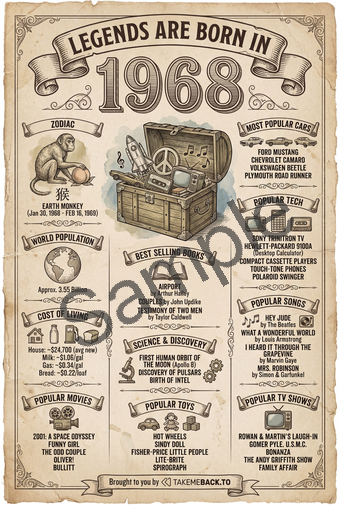

Major Events of 1968 - Historical Moments That Defined the Year | TakeMeBack.to
- 01 Jan Davor Šuker born: Davor Šuker, a Croatian footballer and former president of the Croatian Football Federation, was born on January 1, 1968, in Osijek, Yugoslavia. source: en.wikipedia.org
- 02 Jan Second heart transplant by Dr. Christiaan Barnard: Dr. Christiaan Barnard performed his second heart transplant on January 2, 1968, following his pioneering first transplant in December 1967. source: en.wikipedia.org
- 05 Jan Dr. Benjamin Spock indicted for draft law conspiracy: Dr. Benjamin Spock, a prominent pediatrician and anti-war activist, was indicted on charges related to conspiracy to encourage draft evasion during the Vietnam War. His indictment was part of a broader crackdown on anti-war activists in the United States. source: nytimes.com
- 06 Jan First US adult cardiac transplant operation: The first adult cardiac transplant operation in the United States was performed on January 6, 1968. This groundbreaking surgery marked a significant advancement in medical science and paved the way for future heart transplant procedures. source: ncbi.nlm.nih.gov
- 07 Jan Surveyor 7 Lunar Mission Launch: Surveyor 7, the seventh and final lunar lander of NASA's Surveyor program, was launched on January 7, 1968, from Cape Canaveral, Florida. It successfully landed on the Moon's Tycho crater on January 10, 1968, conducting scientific experiments and returning over 21,000 photographs. source: science.nasa.gov
- 09 Jan US Surveyor 7 lunar landing: The US Surveyor 7 successfully landed on the Moon, marking a significant achievement in lunar exploration. This mission provided valuable data about the lunar surface and helped pave the way for future manned missions. source: nasa.gov
- 10 Jan US Surveyor 7 lunar landing: The US Surveyor 7 mission, which landed on the Moon on January 9, continued to be a topic of interest on January 10, 1968. The mission's findings were crucial for understanding the lunar environment. source: nasa.gov
- 11 Jan Death of Isidor Isaac Rabi, renowned physicist: Isidor Isaac Rabi, a Nobel Prize-winning physicist known for his work in atomic and molecular physics, passed away on January 11, 1968. His contributions to science and education left a lasting legacy. source: nobelprize.org
- 12 Jan Birth of Heather Mills: Heather Mills, a British media personality and activist, was born on January 12, 1968. She is known for her work in charity and her marriage to musician Paul McCartney, which brought her into the public eye. source: britannica.com
- 13 Jan Tet Offensive begins in Vietnam War: The Tet Offensive commenced on January 13, 1968, marking a significant escalation in the Vietnam War. This coordinated series of attacks by North Vietnamese and Viet Cong forces aimed to surprise and overwhelm South Vietnamese and U.S. forces during the Tet holiday. source: archives.gov
- 14 Jan Super Bowl II: Green Bay Packers Triumph: On January 14, 1968, the Green Bay Packers defeated the Oakland Raiders in Super Bowl II, held at the Miami Orange Bowl. The Packers secured their second consecutive championship, winning 33-14, and solidifying their legacy in NFL history. source: nfl.com
- 15 Jan Jeannette Rankin Anti-War March: On January 15, 1968, Jeannette Rankin, the first woman elected to the U.S. Congress, led an anti-war march in San Francisco. The event was part of a larger movement against the Vietnam War, highlighting the growing public dissent during that era. source: history.com
- 16 Jan 21st NHL All-Star Game: The 21st National Hockey League All-Star Game was held at Maple Leaf Gardens in Toronto, where the host Toronto Maple Leafs defeated the NHL All-Stars 4-3. This was the last time Maple Leaf Gardens hosted the event and the final game under the Stanley Cup champions-versus-NHL All-Stars format. source: en.wikipedia.org
- 17 Jan Battle of Khe Sanh Begins: The Battle of Khe Sanh, a significant engagement during the Vietnam War, began on this date. U.S. Marines and North Vietnamese forces clashed near the Khe Sanh Combat Base in Quảng Trị Province, South Vietnam. source: en.wikipedia.org
- 18 Jan Eartha Kitt's White House Luncheon Confrontation Over Vietnam War: On January 18, 1968, singer and actress Eartha Kitt attended a White House luncheon hosted by First Lady Lady Bird Johnson to discuss youth crime. During the event, Kitt openly criticized the Vietnam War, stating, "You send the best of this country off to be shot and maimed. No wonder the kids rebel and take pot." Her remarks reportedly caused Mrs. Johnson to burst into tears and led to a significant backlash against Kitt's career in the United States. source: washingtonpost.com
- 20 Jan Houston ends UCLA's 47-game basketball winning streak: On January 20, 1968, the University of Houston defeated UCLA 71-69 at the Houston Astrodome, ending the Bruins' 47-game winning streak. The game, known as the "Game of the Century," was attended by 52,693 spectators and featured standout performances from Elvin Hayes of Houston and Lew Alcindor of UCLA. source: espn.com
- 21 Jan Battle of Khe Sanh begins: The Battle of Khe Sanh commenced on January 21, 1968, during the Vietnam War. U.S. Marines and Army units defended the Khe Sanh Combat Base against North Vietnamese forces in one of the longest and most intense battles of the war. source: en.wikipedia.org
- 22 Jan Apollo 5 lunar module launch: On January 22, 1968, NASA launched the Apollo 5 mission, which successfully tested the lunar module in Earth orbit. This mission was a critical step in preparing for the Apollo 11 moon landing. source: en.wikipedia.org
- 23 Jan USS Pueblo incident: North Korean seizure of US Navy intelligence ship: On January 23, 1968, the USS Pueblo, a U.S. Navy intelligence ship, was seized by North Korean forces in international waters. The crew was detained, leading to a significant international crisis and diplomatic tensions between the United States and North Korea. source: en.wikipedia.org
- 26 Jan Israeli submarine Dakar tragedy: The Israeli submarine Dakar tragically sank on January 26, 1968, during its voyage from the UK to Israel. All 69 crew members aboard were lost, marking a significant event in Israeli naval history. source: bbc.com
- 27 Jan Broadway Musical 'Darling of the Day' Debuts: 'Darling of the Day,' a musical with music by Jule Styne, lyrics by E.Y. Harburg, and a book by Nunnally Johnson, premiered on Broadway at the George Abbott Theatre on January 27, 1968. The production starred Vincent Price as Priam Farll and Patricia Routledge as Alice Challice. Despite the star-studded cast, the show closed after 31 performances on February 24, 1968. source: julestyne.com
- 28 Jan French Submarine Minerve Disaster: On January 27, 1968, the French submarine Minerve (S647) disappeared in the Mediterranean Sea near Toulon. The submarine was last in contact at 07:55 CET, reporting its position approximately 25 nautical miles from its base. Despite extensive search efforts, the wreckage was not found until 2019. source: en.wikipedia.org
- 30 Jan Tet Offensive begins in Vietnam War: The Tet Offensive, a major turning point in the Vietnam War, commenced on January 30, 1968. This coordinated series of attacks by North Vietnamese forces marked a significant escalation in the conflict. source: archives.gov
- 31 Jan Nauru gains independence: Nauru officially gained independence on January 31, 1968, following its declaration of independence the previous day. This event marked the culmination of its journey to self-governance. source: britannica.com
- 01 Feb UNCTAD 2 Conference in New Delhi: The United Nations Conference on Trade and Development (UNCTAD) 2 convened in New Delhi, focusing on international economic cooperation and development strategies for emerging nations.
- 02 Feb UK Number 1 Song: On February 2, 1968, the UK number one song was "The Mighty Quinn" by Manfred Mann. source: birthdayjams.com
- 03 Feb Sergio Endrigo Wins Sanremo Music Festival: On February 3, 1968, Sergio Endrigo and Roberto Carlos won the Sanremo Music Festival with the song "Canzone per te." source: teche.rai.it
- 04 Feb Martin Luther King Jr.'s 'Drum Major Instinct' Sermon: On February 4, 1968, Martin Luther King Jr. delivered his renowned 'Drum Major Instinct' sermon at Ebenezer Baptist Church in Atlanta, Georgia. In this sermon, King discussed the human desire for recognition and greatness, emphasizing the importance of humility and service to others. The speech is celebrated for its profound insights into human nature and its call for social justice. source: archives.gov
- 05 Feb Battle of Khe Sanh Begins: On January 21, 1968, the Battle of Khe Sanh commenced when North Vietnamese forces initiated a massive artillery bombardment on the U.S. Marine garrison at Khe Sanh, located near the border with Laos. The siege lasted for 77 days, with U.S. Marines and their South Vietnamese allies defending the base against intense attacks. The battle concluded on April 8, 1968, with the relief of the base by U.S. and South Vietnamese forces. source: history.com
- 06 Feb Battle of Lang Vei during Vietnam War: The Battle of Lang Vei began on the evening of February 6, 1968, in Quảng Trị Province, South Vietnam. The People's Army of Vietnam (PAVN) launched an assault on the U.S. Special Forces Camp at Lang Vei, manned by Detachment A-101 of the 5th Special Forces Group and indigenous Civilian Irregular Defense Group (CIDG) forces. Despite artillery and air support, the U.S.-led forces conceded ground, and by the early hours of February 7, the command bunker was the only position still held by Allied forces. source: en.wikipedia.org
- 08 Feb Ron Goetz born, American gridiron football player: Ron Goetz, an American gridiron football linebacker, was born on February 8, 1968. He played in the Canadian Football League (CFL) and the World League of American Football (WLAF). Goetz was named second-team All-WLAF in his first year after making 50 tackles with four interceptions and three fumble recoveries. source: en.wikipedia.org
- 09 Feb Jean-Claude Killy wins Olympic downhill: On February 9, 1968, French skier Jean-Claude Killy won the gold medal in the downhill event at the Winter Olympics held in Grenoble, France. His victory contributed to his status as one of the top skiers of the era. source: britannica.com
- 11 Feb Israeli-Jordanian border tensions: On February 11, 1968, tensions escalated along the Israeli-Jordanian border, leading to military confrontations. This period was marked by ongoing conflicts and skirmishes as both nations navigated complex political and territorial disputes. source: britannica.com
- 12 Feb Phong Nhi and Phong Nhat massacre: On February 12, 1968, during the Vietnam War, the Phong Nhi and Phong Nhat massacre occurred, where South Vietnamese soldiers killed a significant number of unarmed civilians. This tragic event highlighted the brutal realities of the conflict. source: britannica.com
- 13 Feb US military deployment to Vietnam escalates: On February 13, 1968, the United States increased its military presence in Vietnam, marking a significant escalation in the Vietnam War. This deployment was part of a broader strategy to combat the North Vietnamese forces and the Viet Cong, amid growing anti-war sentiment in the U.S. source: archives.gov
- 14 Feb Pennsylvania Railroad merger announced: On February 14, 1968, the merger of the Pennsylvania Railroad with the New York Central Railroad was announced, creating one of the largest railroads in the United States. This merger was part of a trend of consolidation in the railroad industry during the 1960s. source: nytimes.com
- 15 Feb WVUT TV Channel 22 begins broadcasting: On February 15, 1968, WVUT TV Channel 22 in Vincennes, Indiana, began broadcasting as a member station of National Educational Television (NET). source: en.wikipedia.org
- 17 Feb Soviet Union wins Olympic ice hockey gold: On February 17, 1968, the Soviet Union secured their third Olympic gold medal in men's ice hockey at the Winter Olympics in Grenoble, France, defeating Canada 5-0 in the final game. source: en.wikipedia.org
- 19 Feb Mister Rogers' Neighborhood premieres nationally: On February 19, 1968, "Mister Rogers' Neighborhood" made its national debut on National Educational Television (NET), the precursor to PBS. The show, created and hosted by Fred Rogers, aimed to educate and comfort children through its gentle and compassionate approach. source: cbsnews.com
- 21 Feb West Berlin anti-leftist demonstration: On February 21, 1968, a significant anti-leftist demonstration took place in West Berlin, reflecting the political tensions of the time. The protest was part of a broader reaction against leftist movements in West Germany during the late 1960s. source: britannica.com
- 22 Feb Johnny Cash public proposal: On February 22, 1968, Johnny Cash made a public proposal to June Carter during a concert, a moment that became iconic in country music history. Their relationship was a significant part of both their lives and careers, culminating in their marriage later that year. source: rollingstone.com
- 23 Feb Death of Edna Ferber, renowned American author: Edna Ferber, an acclaimed American novelist and playwright, passed away on February 23, 1968. She was known for her works such as 'So Big' and 'Giant', which often explored themes of American life and culture. source: nytimes.com
- 24 Feb First pulsar discovery: On February 24, 1968, astronomers Jocelyn Bell Burnell and Antony Hewish discovered the first pulsar, a type of neutron star that emits beams of radiation. This discovery was pivotal in the field of astrophysics and earned Hewish the Nobel Prize in Physics. source: nasa.gov
- 25 Feb Mass wedding by Unification Church: On February 25, 1968, the Unification Church, founded by Sun Myung Moon, held a mass wedding ceremony in Seoul, South Korea. This event was notable for its large scale and the church's unique approach to marriage. source: washingtonpost.com
- 27 Feb US Billboard Number 1 Song: On February 27, 1968, the US Billboard Hot 100 chart was led by "Love is Blue" by Paul Mauriat. source: birthdayjams.com
- 29 Feb MLB Minimum Salary Increase: Major League Baseball establishes a new minimum player salary of $10,000, reflecting growing professionalization of sports.
- 01 Mar Johnny Cash and June Carter marry in Franklin, Kentucky: On March 1, 1968, country music legends Johnny Cash and June Carter were married in Franklin, Kentucky. The couple had been performing together for years and had one child together, John Carter Cash, born in 1970. They remained married until June's death in May 2003. source: johnnycash.com
- 02 Mar World Men's Figure Skating Championship: The World Men's Figure Skating Championship was held in Geneva, Switzerland, with Emmerich Danzer from Austria emerging as the champion.
- 03 Mar Jean Beliveau reaches NHL milestone: On March 3, 1968, Jean Beliveau scored a goal in a 5-2 loss to the Detroit Red Wings, becoming the second player in NHL history to reach 1,000 career points, joining Gordie Howe. source: thehockeywriters.com
- 04 Mar Nino Benvenuti regains middleweight title: On March 4, 1968, Italian boxer Nino Benvenuti defeated Emile Griffith by unanimous decision in a 15-round bout at Madison Square Garden, reclaiming the WBA, WBC, and The Ring middleweight titles. This victory marked the conclusion of their trilogy, with Benvenuti having previously won and lost to Griffith in 1967. source: britannica.com
- 05 Mar East L.A. Student Walkouts Begin: On March 5, 1968, approximately 2,000 students from Garfield High School in East Los Angeles initiated a walkout to protest educational inequalities, marking the beginning of the East L.A. walkouts. This movement, involving thousands of students across multiple schools, highlighted systemic issues such as overcrowded classrooms, underqualified teachers, and a curriculum that marginalized Mexican-American culture. The protests were a significant catalyst for the Chicano civil rights movement. source: britannica.com
- 07 Mar 1968 Polish Student Protests: In early March 1968, Polish students initiated protests against censorship and political repression. The unrest began at the University of Warsaw, where students rallied for academic freedom and civil liberties. The demonstrations were met with force by the authorities, leading to widespread unrest across Poland. source: en.wikipedia.org
- 08 Mar Polish Political Crisis Erupts: On March 8, 1968, Poland experienced a significant political crisis as student protests against censorship and political repression escalated. The unrest led to confrontations between protesters and security forces, resulting in widespread arrests and heightened tensions. source: en.wikipedia.org
- 10 Mar Battle of Lima Site 85 in Laos: On March 10, 1968, North Vietnamese and Pathet Lao forces initiated an artillery barrage on the U.S. radar facility at Lima Site 85 atop Phou Pha Thi mountain in Laos, leading to the largest single ground combat loss of USAF personnel during the Vietnam War. source: en.wikipedia.org
- 11 Mar Lisa Loeb Birth: Lisa Loeb, an American singer-songwriter known for her hit single 'Stay (I Missed You)', is born in the United States.
- 12 Mar Mauritius gains independence from United Kingdom: On March 12, 1968, Mauritius was granted independence from British rule. The ceremony took place in Port Louis, the capital, where Sir Seewoosagur Ramgoolam became the nation's first Prime Minister. The event marked the culmination of a long struggle involving multiple political parties, notably the Mauritius Labour Party and the Parti Mauricien Social Démocrate. source: en.wikipedia.org
- 14 Mar London Gold Pool suspension and British political upheaval: On March 14, 1968, the United States requested the British government to close the London gold market to address heavy demand for gold. The next day, the UK declared a bank holiday, closing banks and stock exchanges. This led to the dissolution of the London Gold Pool, a consortium of central banks established in 1961 to maintain the gold price at $35 per ounce. The closure marked a significant shift in international monetary policy. source: numismaticnews.net
- 15 Mar My Lai Massacre during Vietnam War: On March 15, 1968, reports emerged about the My Lai Massacre, a tragic incident during the Vietnam War where U.S. soldiers killed hundreds of unarmed South Vietnamese civilians, including women and children. The massacre, which occurred in March 1968, was initially covered up but later became a significant point of controversy and criticism of U.S. military operations in Vietnam. source: brainyhistory.com
- 16 Mar My Lai Massacre: On March 16, 1968, the My Lai Massacre occurred during the Vietnam War, where U.S. soldiers killed between 347 and 504 unarmed South Vietnamese civilians, including women and children. The incident, initially covered up, was later exposed, leading to widespread outrage and a reevaluation of U.S. military conduct in Vietnam. source: brainyhistory.com
- 17 Mar LPGA Golf Tournament Win: Kathie Whitworth wins the LPGA Saint Petersburg Orange Blossom Golf Open, showcasing her skill in professional women's golf.
- 18 Mar U.S. Congress repeals gold reserve requirement: On March 18, 1968, the U.S. Congress repealed the gold reserve requirement, allowing banks to hold reserves in other forms. This marked a significant shift in U.S. monetary policy, reflecting the changing economic landscape of the time. source: congress.gov
- 19 Mar BBC first color television news broadcast: On March 19, 1968, the BBC aired its first color television news broadcast, marking a significant milestone in broadcasting history. This transition to color television represented advancements in technology and media during the late 1960s. source: bbc.co.uk
- 20 Mar Political upheaval in South Yemen: On March 20, 1968, South Yemen experienced significant political upheaval, leading to changes in governance and increased tensions in the region. This event was part of the broader context of decolonization and political change in the Middle East. source: bbc.co.uk
- 21 Mar Battle of Karameh: On March 21, 1968, Israeli forces launched an attack on the town of Karameh in Jordan, targeting the Palestine Liberation Organization (PLO) camps. The battle lasted 15 hours, resulting in casualties on both sides. The Jordanian army and PLO forces repelled the Israeli attack, leading to a perception of victory in the Arab world. source: en.wikipedia.org
- 23 Mar Joni Mitchell's debut album released: Joni Mitchell's debut studio album, 'Song to a Seagull,' was released on March 23, 1968. Produced by David Crosby, the album was recorded at Sunset Sound in Hollywood, California, and released by Reprise Records. source: en.wikipedia.org
- 25 Mar US Nuclear Test at Nevada Test Site: On March 25, 1968, the United States conducted a nuclear test at the Nevada Test Site, part of a series of tests during the Cold War. This test was part of the U.S. government's efforts to develop and maintain its nuclear arsenal amid ongoing tensions with the Soviet Union. source: nytimes.com
- 26 Mar LBJ Declines Presidential Re-election: On March 26, 1968, President Lyndon B. Johnson announced that he would not seek re-election. This decision came amid growing opposition to the Vietnam War and significant domestic challenges, marking a pivotal moment in U.S. political history. source: history.com
- 27 Mar Suharto Becomes President of Indonesia: On March 27, 1968, Suharto was officially inaugurated as the President of Indonesia after a coup that ousted Sukarno. His presidency marked the beginning of a long authoritarian rule characterized by significant political and economic changes in the country. source: britannica.com
- 28 Mar Birth of Nasser Hussain, English cricketer: Nasser Hussain, an English cricketer who captained the England cricket team from 1999 to 2003, was born on March 28, 1968, in Madras, India. He had an international career from 1990 to 2004. source: en.wikipedia.org
- 30 Mar Celine Dion's birth: Celine Dion, the Canadian singer known for her powerful vocals, was born on March 30, 1968, in Charlemagne, Quebec, Canada. She was the youngest of 14 children in a musically inclined family. source: biography.com
- 31 Mar J.R. Reid NBA Player Born: J.R. Reid, future NBA forward who would play for the New York Knicks and Charlotte Hornets, is born.
- 01 Apr Assassination of Martin Luther King Jr.: Martin Luther King Jr., a prominent civil rights leader, was assassinated on April 1, 1968, in Memphis, Tennessee. His death sparked nationwide riots and mourning, significantly impacting the civil rights movement. source: archives.gov
- 02 Apr Robert F. Kennedy's powerful speech in Indianapolis: On April 2, 1968, Robert F. Kennedy delivered a poignant speech in Indianapolis, addressing the assassination of Martin Luther King Jr. His message of unity and peace resonated deeply with the audience during a time of national turmoil. source: britannica.com
- 03 Apr Apollo 6 unmanned test flight: Apollo 6, an unmanned test flight, launched on April 3, 1968, as part of NASA's Apollo program. The mission aimed to test the Saturn V rocket and gather data for future manned missions to the Moon. source: nasa.gov
- 04 Apr Assassination of Martin Luther King Jr.: Martin Luther King Jr. was assassinated on April 4, 1968, in Memphis, Tennessee. His death sparked national outrage and mourning, leading to significant civil rights activism and changes in legislation. source: archives.gov
- 05 Apr Robert F. Kennedy's Cleveland City Club Speech: On April 5, 1968, Senator Robert F. Kennedy delivered a speech titled "On the Mindless Menace of Violence" to the Cleveland City Club, addressing the assassination of Martin Luther King Jr. and the ensuing violence in American cities. source: jfklibrary.org
- 06 Apr Baltimore Riots of 1968: On April 6, 1968, riots erupted in Baltimore, Maryland, following the assassination of Martin Luther King Jr., leading to widespread unrest and property damage. source: baltimoresun.com
- 07 Apr National Day of Mourning for Martin Luther King Jr.: Following the assassination of Dr. Martin Luther King Jr. on April 4, 1968, President Lyndon B. Johnson declared April 7 as a national day of mourning. This day was marked by memorial services and reflections on King's contributions to civil rights. source: history.com
- 08 Apr East Germany's New Socialist Constitution: On April 8, 1968, East Germany adopted a new socialist constitution, reflecting the nation's commitment to Marxist-Leninist principles and its alignment with the Soviet bloc during the Cold War. source: en.wikipedia.org
- 09 Apr Martin Luther King Jr. laid to rest in Atlanta: Martin Luther King Jr., the prominent civil rights leader, was laid to rest on April 9, 1968, in Atlanta, Georgia. His funeral was attended by thousands, including notable figures from various sectors, reflecting his significant impact on the civil rights movement in the United States. source: history.com
- 10 Apr First heart transplant in Europe: The first successful heart transplant in Europe was performed on April 10, 1968, at the Groote Schuur Hospital in Cape Town, South Africa. This groundbreaking surgery was a significant milestone in medical history, showcasing advancements in cardiac surgery. source: ncbi.nlm.nih.gov
- 11 Apr Civil Rights Act of 1968 signed into law: On April 11, 1968, President Lyndon B. Johnson signed the Civil Rights Act of 1968, which included the Fair Housing Act, into law. This legislation prohibited discrimination in housing based on race, color, religion, or national origin, marking a significant advancement in civil rights protections in the United States. source: loc.gov
- 12 Apr Passover Seder in Hebron After Six-Day War: On April 12, 1968, Rabbi Moshe Levinger and a group of Israelis celebrated Passover in Hebron's Park Hotel, marking the first Jewish presence in the city since 1929. This event was a significant step in the renewal of Jewish communities in Judea and Samaria. source: hebron.org.il
- 14 Apr Assassination of Martin Luther King Jr.: On April 4, 1968, Dr. Martin Luther King Jr. was assassinated in Memphis, Tennessee. His death led to widespread mourning and significant social unrest across the United States. source: archives.gov
- 15 Apr Lunar Phase Observation: On April 15, 1968, the moon was in a waning gibbous phase, representing a period when the moon appears more than half illuminated but is gradually decreasing towards the new moon.
- 16 Apr Death of Albert Betz, wind energy pioneer: Albert Betz, a German physicist and pioneer in wind turbine technology, died in Göttingen, Germany, at the age of 82. source: en.wikipedia.org
- 17 Apr Roger Twose born in Torquay, England: Roger Twose, a New Zealand cricketer, was born in Torquay, England, on April 17, 1968. He played 16 Test matches and 87 One Day Internationals for New Zealand between 1995 and 2001. source: en.wikipedia.org
- 18 Apr London Bridge Sold to American Buyer: On April 18, 1968, the City of London sold the 19th-century granite London Bridge to American entrepreneur Robert P. McCulloch for $2.46 million. The bridge was dismantled, shipped to Lake Havasu City, Arizona, and reassembled, where it still stands today. source: londonist.com
- 19 Apr Boston Marathon Victory by Amby Burfoot: On April 19, 1968, Amby Burfoot won the Boston Marathon, becoming the first American male to win the race since 1957. source: runnersworld.com
- 20 Apr Enoch Powell's controversial 'Rivers of Blood' speech: On April 20, 1968, British politician Enoch Powell delivered his 'Rivers of Blood' speech in Birmingham, strongly criticizing mass immigration from Commonwealth countries and opposing the Race Relations Bill. The speech caused a political storm, leading to Powell's dismissal from the Conservative Shadow Cabinet. source: en.wikipedia.org
- 22 Apr Jo Angel - Australian Cricket Fast Bowler: Jo Angel, born on April 22, 1968, is a former Australian cricketer who played in four Test matches and three One Day Internationals between 1993 and 1995. A giant fast bowler standing 6ft 6in tall, Angel took 485 first-class wickets, including 445 in Australian domestic cricket for Western Australia. source: en.wikipedia.org
- 24 Apr Columbia University student protest: On April 24, 1968, students at Columbia University staged a significant protest against the university's involvement in the Vietnam War and its expansion plans. The protests were part of a larger wave of student activism across the United States during this period. source: nytimes.com
- 25 Apr Half a Sixpence opens at Broadhurst Theater NYC for 512 performances: The musical 'Half a Sixpence' premiered at the Broadhurst Theater in New York City on April 25, 1968. It enjoyed a successful run, totaling 512 performances before closing. source: britannica.com
- 26 Apr US underground nuclear test: Operation Crosstie Boxcar: On April 26, 1968, the United States conducted an underground nuclear test known as Operation Crosstie Boxcar. This test was part of a series of nuclear tests conducted during the Cold War. source: nytimes.com
- 27 Apr British abortion law legalization: On April 27, 1968, the British Parliament passed the Abortion Act, legalizing abortion under certain conditions. This was a landmark change in reproductive rights in the UK, reflecting broader social changes of the time. source: bbc.com
- 01 May Broadway play 'Ben Franklin in Paris' concludes run: The Broadway play 'Ben Franklin in Paris' concluded its run on May 1, 1968. The musical, which focused on the life of Benjamin Franklin, was well-received during its time on stage. It showcased the cultural landscape of the era and contributed to the theatrical scene of the late 1960s. source: ibdb.com
- 02 May Journalists murdered in Saigon: On May 2, 1968, two journalists were murdered in Saigon during the Vietnam War. This incident highlighted the dangers faced by reporters covering the conflict and drew international attention to the ongoing violence in the region. The event underscored the risks associated with war reporting. source: nytimes.com
- 03 May Sorbonne student protests begin: The Sorbonne student protests began on May 3, 1968, in Paris, marking a significant moment in the student movement. These protests were part of a larger wave of civil unrest that swept through France and influenced global student activism. The events at the Sorbonne became emblematic of the 1968 protests. source: bbc.com
- 04 May Pittsburgh Pipers win inaugural ABA Championship: On May 4, 1968, the Pittsburgh Pipers defeated the New Orleans Buccaneers 122-113 in Game 7 of the ABA Finals at the Pittsburgh Civic Arena, clinching the first-ever ABA Championship. source: barstoolsports.com
- 06 May Detailed account of Paris student demonstrations: On May 6, 1968, a detailed account of the Paris student demonstrations was published, highlighting the escalating tensions between students and authorities. The report covered the mass arrests at the Sorbonne, the construction of barricades by protesters, and the broader social and political implications of the unrest. This account provided in-depth insights into the motivations and actions of the student protesters. source: britannica.com
- 07 May May 1968 Paris student protests: On May 7, 1968, the Paris student protests continued to escalate. Following the violent confrontations on May 6, students and teachers marched toward the Sorbonne, leading to further clashes with police. The protests were part of a broader movement that included workers' strikes and widespread demonstrations across France. source: britannica.com
- 08 May William Styron wins Pulitzer Prize for 'The Confessions of Nat Turner': In 1968, William Styron's novel 'The Confessions of Nat Turner' was awarded the Pulitzer Prize for Fiction. The novel, published in 1967, presents a first-person narrative by Nat Turner, leader of the 1831 slave rebellion in Virginia. Despite its critical acclaim, the book sparked controversy for its portrayal of Turner and the events of the rebellion. source: nationalbook.org
- 10 May Paris Peace Talks: US and North Vietnam Negotiate Vietnam War Resolution: On May 10, 1968, representatives from the United States and North Vietnam met in Paris to initiate peace negotiations aimed at resolving the Vietnam War. This marked the first direct meeting between the two nations regarding the conflict. source: upi.com
- 11 May Night of the Barricades in Paris: On May 11, 1968, the 'Night of the Barricades' occurred in Paris, where students and workers erected barricades in the Latin Quarter to protest police actions and university closures, leading to violent clashes with authorities. source: abc.net.au
- 12 May March of the Poor Reaches Washington DC: On May 12, 1968, the Poor People's Campaign, led by Martin Luther King Jr.'s associates, culminated in a march to Washington, D.C. This event aimed to address poverty and economic injustice in America, drawing attention to the struggles of marginalized communities. source: britannica.com
- 13 May Mass Protest Against French Government Leadership: On May 13, 1968, mass protests erupted in France against the government of President Charles de Gaulle. This was part of a larger wave of civil unrest that characterized the May 1968 events, driven by student and worker dissatisfaction with the political and social climate. source: britannica.com
- 14 May Prague Spring: Dubček's Liberalization Reforms: On May 14, 1968, Alexander Dubček's government in Czechoslovakia continued its liberalization reforms, known as the Prague Spring. These reforms aimed to create 'socialism with a human face' and led to significant political changes in the region. source: britannica.com
- 15 May First American League game in Milwaukee: On May 15, 1968, the Chicago White Sox played their first American League game in Milwaukee at County Stadium, marking the return of Major League Baseball to the city. source: en.wikipedia.org
- 17 May European Space Research Organization Satellite Launch: The European Space Research Organisation (ESRO) successfully launched its first satellite, ESRO-2B, into orbit on May 17, 1968. The satellite was launched from Vandenberg Air Force Base in California, USA, and became the first mission controlled by teams at the European Space Operations Centre in Darmstadt, Germany. source: esa.int
- 19 May Nigerian military captures Port Harcourt during Biafran War: On May 19, 1968, Nigerian forces captured Port Harcourt, a strategic city in southeastern Nigeria, during the Biafran War. The Nigerian 3rd Marine Commando Division, led by General Benjamin Adekunle, launched an amphibious assault on the city, leading to the retreat of Biafran forces. This victory was significant as it cut off Biafra's access to the sea, impacting their supply lines. source: en.wikipedia.org
- 21 May Soviet Union conducts underground nuclear test: On May 21, 1968, the Soviet Union performed an underground nuclear test at the Semipalatinsk Test Site in Kazakhstan. This test was part of a series of 17 nuclear tests conducted by the Soviet Union in 1968. source: en.wikipedia.org
- 22 May USS Scorpion nuclear submarine lost: On May 22, 1968, the USS Scorpion (SSN-589), a Skipjack-class nuclear-powered submarine, was lost southwest of the Azores. The submarine, returning from a Mediterranean deployment, reported its position on May 21, 1968, but was reported overdue six days later. Despite extensive search efforts, the submarine and its 99-member crew were declared 'presumed lost' on June 5, 1968. The cause of the loss remains a mystery. source: history.navy.mil
- 23 May Beatles open Apple Boutique in London: The Beatles opened their Apple Boutique in London on May 23, 1968. This store was part of their Apple Corps venture, aimed at promoting art and music. It featured a variety of products, including clothing and art, reflecting the counterculture of the time. source: bbc.com
- 24 May French May 1968 political crisis escalates: The political crisis in France intensified on May 24, 1968, as protests and strikes spread across the country. This period marked significant social upheaval, challenging the government and leading to widespread demonstrations. source: bbc.com
- 25 May French political unrest in May 1968: In May 1968, France experienced significant political unrest characterized by widespread protests and strikes. The unrest was driven by student activism and labor movements, leading to a crisis that challenged the government of President Charles de Gaulle. source: britannica.com
- 26 May Iceland's traffic transition to right-hand driving: On May 26, 1968, Iceland officially transitioned from left-hand to right-hand traffic. This significant change aimed to improve road safety and align with most European countries' driving practices. source: bbc.com
- 27 May George W. Bush joins Texas Air National Guard: On May 27, 1968, George W. Bush enlisted in the Texas Air National Guard. This decision was significant in his early life and later political career, as it provided him with military experience during the Vietnam War era. source: nytimes.com
- 28 May Eugene McCarthy wins Oregon Democratic Primary: On May 28, 1968, Eugene McCarthy won the Oregon Democratic Primary, a significant event in his campaign for the 1968 Democratic presidential nomination. His strong performance in Oregon contributed to his momentum in the race. source: en.wikipedia.org
- 29 May US Truth in Lending Act signed: The Truth in Lending Act was signed into law on May 29, 1968, to promote informed use of consumer credit by requiring disclosures about its terms and cost. This legislation aimed to protect consumers from deceptive lending practices and ensure transparency in credit transactions. source: congress.gov
- 30 May Charles de Gaulle turns tide in May 1968 French crisis: On May 30, 1968, French President Charles de Gaulle addressed the nation, asserting his leadership during a period of civil unrest and student protests. His speech aimed to restore order and confidence in the government amid widespread strikes and demonstrations. source: bbc.com
- 31 May Manchester United wins European Cup: On May 31, 1968, Manchester United won the European Cup, becoming the first English club to achieve this feat. The victory was a significant milestone in the club's history and marked a turning point in English football. source: bbc.com
- 01 Jun Helen Keller dies at age 87 in Connecticut: Helen Keller, the renowned author and educator who overcame the challenges of being both blind and deaf, passed away on June 1, 1968, at her home in Easton, Connecticut, at the age of 87. source: britannica.com
- 05 Jun Assassination of Robert F. Kennedy: Robert F. Kennedy, a U.S. Senator and presidential candidate, was assassinated in Los Angeles shortly after delivering a victory speech. He was shot by Sirhan Sirhan and died from his injuries the next day. This event had a profound impact on American politics and society. source: britannica.com
- 06 Jun Don Drysdale's Scoreless Innings Record: On June 6, 1968, Don Drysdale of the Los Angeles Dodgers set a Major League Baseball record by pitching 58 consecutive scoreless innings. This achievement solidified his reputation as one of the great pitchers of his era. source: baseball-reference.com
- 07 Jun Ford Dagenham Equal Pay Strike Begins: The Ford Dagenham Equal Pay Strike began on June 7, 1968, when female workers protested for equal pay for equal work. This strike was a significant event in the fight for gender equality in the workplace in the UK. source: bbc.com
- 08 Jun James Earl Ray arrested for MLK assassination: James Earl Ray was arrested in London for the assassination of Dr. Martin Luther King Jr. This arrest marked a pivotal moment in the investigation of King's murder. source: nytimes.com
- 09 Jun National Day of Mourning for Robert F. Kennedy in the U.S.: Following the assassination of Senator Robert F. Kennedy on June 5, 1968, President Lyndon B. Johnson proclaimed June 9 as a national day of mourning. Flags were flown at half-staff on all federal buildings, and citizens were encouraged to observe the day in memory of Kennedy. source: presidency.ucsb.edu
- 10 Jun General Creighton Abrams takes command in Vietnam: On June 10, 1968, General Creighton Abrams assumed command of U.S. military operations in Vietnam, succeeding General William Westmoreland. Abrams' leadership marked a shift in U.S. military strategy during the Vietnam War. source: en.wikipedia.org
- 11 Jun Atlanta Federal Penitentiary inmate uprising: On June 11, 1968, inmates at the Atlanta Federal Penitentiary staged a significant uprising, protesting conditions and treatment. The event highlighted issues within the prison system and drew national attention to inmate rights. source: nytimes.com
- 12 Jun French government restricts demonstrations: On June 12, 1968, the French government imposed restrictions on public demonstrations amid widespread protests and civil unrest. This move was part of a broader effort to maintain order during a period of significant social upheaval in France. source: bbc.com
- 13 Jun Earl Warren's Supreme Court Resignation Announcement: On June 13, 1968, Chief Justice Earl Warren informed President Lyndon B. Johnson of his intention to retire from the Supreme Court, effective upon the confirmation of his successor. Warren's decision was influenced by concerns over the upcoming presidential election and the possibility of a conservative successor being appointed by Richard Nixon. source: senate.gov
- 14 Jun Off-duty Dutch military permitted to wear regular clothing: On June 14, 1968, the Dutch military announced that off-duty personnel were permitted to wear civilian clothing, marking a significant change in military dress code policy. source: brainyhistory.com
- 15 Jun Broadway musical 'I Do! I Do!' concludes long run: The Broadway musical 'I Do! I Do!' closed on June 15, 1968, after 560 performances at the 46th Street Theatre. The show, which opened on December 5, 1966, starred Mary Martin and Robert Preston in the original cast. source: en.wikipedia.org
- 16 Jun French police clear Sorbonne during student protests: On June 16, 1968, French police evicted student protesters who had occupied the Sorbonne at the University of Paris. Hundreds of students assembled outside the historic building, and riot police used tear gas and concussion grenades to disperse them. The protesters peacefully filed out after being informed they would be searched for arms but not arrested. No firearms were found, but several hundred clubs, gas masks, and leftist pamphlets were collected. source: en.wikipedia.org
- 19 Jun Poor People's Campaign Solidarity Day March: On June 19, 1968, the Poor People's Campaign held a Solidarity Day march in Washington, D.C., drawing between 50,000 and 100,000 participants advocating for economic justice and an end to poverty. source: britannica.com
- 22 Jun Top US Song: This Guy's In Love With You: On June 22, 1968, 'This Guy's In Love With You' by Herb Alpert was the number one song in the United States. source: mybirthdayhits.com
- 24 Jun Sandra Post wins LPGA Championship: Canadian golfer Sandra Post won the LPGA Championship on June 24, 1968, becoming the first Canadian to win a major championship on the LPGA Tour.
- 25 Jun Tony Hancock's tragic end: Tony Hancock, a renowned British comedian, tragically died on June 25, 1968, in Sydney, Australia. His death was ruled a suicide, marking a significant loss in the world of comedy and entertainment. source: bbc.com
- 26 Jun Iwo Jima and Bonin Islands returned to Japan: On June 26, 1968, the United States officially returned the islands of Iwo Jima and the Bonin Islands to Japan. This event marked a significant step in post-war relations between the two nations. source: bbc.com
- 27 Jun Manifest of 2000 Words published in Prague: On June 27, 1968, the 'Manifest of 2000 Words' was published in Prague, calling for political reforms in Czechoslovakia. This document became a symbol of the Prague Spring movement and the push for greater freedoms. source: bbc.com
- 30 Jun French Parliamentary Election: The Gaullist Union pour la défense de la République won an absolute majority in the French National Assembly. source: en.wikipedia.org
- 01 Jul Nuclear Non-Proliferation Treaty signed: The Nuclear Non-Proliferation Treaty (NPT) was signed on July 1, 1968, by the United States, the United Kingdom, the Soviet Union, and 59 other countries. The treaty aims to prevent the spread of nuclear weapons, promote peaceful nuclear energy use, and encourage nuclear disarmament. It entered into force on March 5, 1970. source: britannica.com
- 04 Jul Alec Rose completes solo round-the-world yacht voyage: On July 4, 1968, British yachtsman Alec Rose returned to Portsmouth after a 354-day solo circumnavigation aboard his 36-foot yacht, Lively Lady. Departing on July 16, 1967, Rose sailed approximately 28,500 miles, making stops in Melbourne, Australia, and Bluff Harbour, New Zealand, before completing his journey. His return was celebrated by a crowd of over 250,000 people. source: news.bbc.co.uk
- 06 Jul FBI outlines COINTELPRO practices: On July 6, 1968, the FBI publicly outlined its COINTELPRO practices, which were aimed at surveilling and disrupting domestic political organizations. This revelation raised significant concerns about civil liberties and government overreach in the United States. source: archives.gov
- 07 Jul The Yardbirds disband: On July 7, 1968, the influential British rock band The Yardbirds officially disbanded. Known for their innovative sound and contributions to rock music, the band's breakup marked the end of an era in the music scene of the 1960s. source: britannica.com
- 08 Jul Chrysler Wildcat Strike in Detroit: On July 8, 1968, the Dodge Revolutionary Union Movement (DRUM) led a wildcat strike at Chrysler's Hamtramck assembly plant in Detroit. Approximately 4,000 workers participated, halting production for two and a half days and preventing the production of 3,000 cars. This action highlighted the group's militancy and willingness to challenge the United Auto Workers (UAW) hierarchy. source: socialistworker.org
- 09 Jul Birth of Paolo Di Canio: Paolo Di Canio, an Italian former professional footballer and manager, was born in Rome, Italy. He is renowned for his playing career with clubs like Lazio, Juventus, and West Ham United. source: en.wikipedia.org
- 10 Jul Major League Baseball Restructuring: On July 10, 1968, the National League announced its decision to split into two divisions of six teams each for the 1969 season. This move aimed to enhance competition and fan engagement by creating two distinct pennant races within the league. source: sportshistorynetwork.com
- 11 Jul Earl Weaver Becomes Orioles Manager: On July 11, 1968, the Baltimore Orioles promoted first base coach Earl Weaver to manager, replacing Hank Bauer. Weaver would go on to manage the Orioles for all or parts of 17 seasons, winning four American League pennants and the 1970 World Series. source: en.wikipedia.org
- 13 Jul Sabena cargo plane crash in Lagos: On July 13, 1968, a Sabena cargo plane crashed shortly after takeoff from Lagos, Nigeria, resulting in the loss of all crew members on board. The incident raised concerns about aviation safety in the region and led to investigations into the causes of the crash. source: bbc.com
- 14 Jul Hank Aaron reaches 500 home run milestone: On July 14, 1968, Hank Aaron hit his 500th career home run, becoming the third player in Major League Baseball history to reach this milestone. This achievement solidified Aaron's status as one of the greatest hitters in the sport's history. source: nytimes.com
- 15 Jul First US-USSR Commercial Air Travel: On July 15, 1968, the first commercial air service between the United States and the Soviet Union commenced. An Aeroflot Ilyushin Il-62 from Moscow landed at New York's John F. Kennedy International Airport at 5:27 PM. Later that evening, Pan American World Airways Flight 44, a Boeing 707, departed JFK and arrived in Moscow's Sheremetyevo International Airport after an 11-hour and 19-minute flight. source: en.wikipedia.org
- 18 Jul Intel Corporation Founded: Intel Corporation was founded on July 18, 1968, by semiconductor pioneers Robert Noyce and Gordon Moore, along with investor Arthur Rock. The company was initially named NM Electronics but was renamed Intel, a portmanteau of 'Integrated Electronics'. source: intel.com
- 20 Jul First International Special Olympics Summer Games: The First International Special Olympics Summer Games took place in Chicago, Illinois, from July 20 to July 24, 1968. This event marked a significant milestone in promoting inclusion and sports for individuals with intellectual disabilities. source: specialolympics.org
- 21 Jul Jan Janssen wins Tour de France: Jan Janssen, a Dutch cyclist, won the Tour de France on July 21, 1968. This victory was notable as it was the first time a Dutch cyclist had won the prestigious race, marking a significant moment in cycling history. source: bbc.com
- 23 Jul First Palestinian Liberation Organization Aircraft Hijacking: On July 23, 1968, three members of the Popular Front for the Liberation of Palestine (PFLP) hijacked El Al Flight 426, a Boeing 707 en route from Rome to Tel Aviv. The aircraft was diverted to Algiers, marking the first successful hijacking by a Palestinian group. Negotiations lasted 40 days, resulting in the release of the hostages and the hijackers. This event is considered significant in the advent of modern international air terrorism. source: pbs.org
- 24 Jul Kitchen Debate: On July 24, 1959, U.S. Vice President Richard Nixon and Soviet Premier Nikita Khrushchev engaged in a spirited exchange known as the "kitchen debate" during the opening of the U.S. National Exhibition in Moscow. The debate covered various topics, including communism versus capitalism and national powers. Videotaped and broadcast in both countries, the encounter showcased Nixon's diplomatic skills and calm demeanor, enhancing his international reputation. source: time.com
- 26 Jul Vietnam War: Opposition Leader Sentenced for Peace Advocacy: Trương Đình Dzu, a South Vietnamese politician and peace advocate, was arrested on July 26, 1968, and sentenced to five years of hard labor for illicit currency transactions. His arrest was widely viewed as politically motivated due to his opposition to the Vietnam War and his criticism of the government. International and domestic pressure led to his release after five months. source: en.wikipedia.org
- 27 Jul Pink Floyd Releases 'A Saucerful of Secrets' in USA: Pink Floyd's second studio album, 'A Saucerful of Secrets,' was released in the United States on July 27, 1968. The album marked the first appearance of guitarist David Gilmour, who replaced the departing Syd Barrett. It features tracks like 'Jugband Blues' and 'Set the Controls for the Heart of the Sun.' source: en.wikipedia.org
- 28 Jul Airblue Flight 202 disaster: On July 28, 1968, Airblue Flight 202 crashed during approach to Karachi, Pakistan, resulting in significant loss of life. The incident raised concerns about aviation safety standards in the region. source: bbc.com
- 29 Jul Arenal Volcano catastrophic eruption: On July 29, 1968, Arenal Volcano in Costa Rica erupted catastrophically, leading to significant destruction and loss of life. This eruption marked the beginning of a new phase of activity for the volcano, which had been dormant for centuries. source: usgs.gov
- 30 Jul Thames Television launches in London: On July 30, 1968, Thames Television officially launched as a new television service in London. It became known for its innovative programming and significant contributions to British television history. source: bbc.co.uk
- 31 Jul The Beatles close Apple Boutique: On July 31, 1968, The Beatles closed their Apple Boutique, a retail store in London that sold clothing and other items designed by the band. The store was open for only a few months before being closed due to financial losses. source: beatlesbible.com
- 01 Aug Coronation of Sultan Hassanal Bolkiah of Brunei: On August 1, 1968, Sultan Hassanal Bolkiah was crowned as the 29th Sultan of Brunei in a traditional ceremony at Lapau, Brunei Town. The event was attended by foreign dignitaries, including Singapore's Prime Minister Lee Kuan Yew and Malaysia's Prime Minister Tunku Abdul Rahman. source: en.wikipedia.org
- 02 Aug Casiguran Earthquake in the Philippines: On August 2, 1968, a 7.3-magnitude earthquake struck Casiguran, Aurora, Philippines, causing significant destruction. The quake resulted in the collapse of the six-story Ruby Tower in Manila, leading to at least 270 fatalities and 261 injuries. Extensive landslides and fissures were observed in the mountainous areas near the epicenter, and a small tsunami was recorded as far as Japan. source: phivolcs.dost.gov.ph
- 03 Aug Rod Beck birth: Rod Beck, an American professional baseball pitcher, was born on August 3, 1968. source: baseball-reference.com
- 04 Aug North Central Airlines Flight 261 crash: North Central Airlines Flight 261 crashed on August 4, 1968, near the airport in Minneapolis, Minnesota. The incident resulted in the loss of all 39 passengers and crew on board, marking a significant event in aviation history. source: ntsb.gov
- 05 Aug Republican National Convention nominates Nixon and Agnew: On August 5, 1968, the Republican National Convention officially nominated Richard Nixon for president and Spiro Agnew for vice president. This event was pivotal in shaping the political landscape of the United States during the late 1960s. source: archives.gov
- 08 Aug Richard Nixon nominated at Republican National Convention: On August 8, 1968, former Vice President Richard Nixon was nominated as the Republican candidate for President at the Republican National Convention in Miami Beach, Florida. He secured the nomination on the first ballot, defeating competitors such as New York Governor Nelson Rockefeller and California Governor Ronald Reagan. Nixon's running mate was Maryland Governor Spiro Agnew. source: politico.com
- 10 Aug Shirley Englehorn wins LPGA Concord Open: Shirley Englehorn won the LPGA Concord Open on August 10, 1968, finishing three strokes ahead of Sandra Haynie. source: en.wikipedia.org
- 11 Aug The Beatles Launch Apple Records: On August 11, 1968, The Beatles released their first single under their new label, Apple Records. The single featured "Hey Jude" backed with "Revolution," marking the official launch of the label. source: en.wikipedia.org
- 14 Aug Los Angeles Airways Flight 417 crashes in Compton, California: On August 14, 1968, Los Angeles Airways Flight 417, a Sikorsky S-61L helicopter, crashed in Compton, California, resulting in the deaths of all 21 people on board. The accident was caused by the separation of one of the helicopter's main rotor blades due to a fatigue fracture in the blade spindle. source: en.wikipedia.org
- 18 Aug Tragic bus accident in Japan: On August 18, 1968, two charter buses were caught in a landslide and fell into the Hida River in Gifu Prefecture, Japan, resulting in 104 fatalities. This remains one of Japan's worst bus accidents. source: en.wikipedia.org
- 20 Aug Warsaw Pact invasion of Czechoslovakia: On August 20, 1968, Warsaw Pact troops, led by the Soviet Union, invaded Czechoslovakia to suppress the Prague Spring reforms, marking a significant event in the Cold War. source: en.wikipedia.org
- 21 Aug Romania condemns Soviet invasion: On August 21, 1968, Romania, under Nicolae Ceaușescu, publicly condemned the Soviet-led invasion of Czechoslovakia, marking a rare act of defiance within the Warsaw Pact. source: en.wikipedia.org
- 22 Aug First Papal Visit to Latin America: On August 22, 1968, Pope Paul VI arrived in Bogotá, Colombia, marking the first visit of a pope to Latin America. This historic visit was part of the 39th International Eucharistic Congress and was significant for the Catholic community in the region. source: upi.com
- 23 Aug Detroit Tigers and New York Yankees play 19-inning tie: On August 23, 1968, the Detroit Tigers and New York Yankees played a 19-inning game that ended in a 3–3 tie due to a 1 a.m. curfew at Yankee Stadium. source: baseball-reference.com
- 25 Aug Rocky Colavito pitches and homers for Yankees: On August 25, 1968, during a doubleheader against the Detroit Tigers, outfielder Rocky Colavito pitched 2.2 scoreless innings in relief, earning the win. He also homered in the second game, contributing to the Yankees' 5-4 victory. source: baseball-reference.com
- 26 Aug 1968 Democratic National Convention begins: The 1968 Democratic National Convention commenced on August 26, 1968, in Chicago. The event was marked by significant political turmoil and protests, reflecting the divisions within the Democratic Party over the Vietnam War. source: britannica.com
- 27 Aug Civil rights protest in Derry: On August 27, 1968, a civil rights protest took place in Derry, Northern Ireland. This event was part of a broader movement advocating for the rights of the Catholic minority in a predominantly Protestant region, leading to significant political changes. source: bbc.com
- 28 Aug Democratic National Convention in Chicago disrupted by protests and police violence: On August 28, 1968, during the Democratic National Convention in Chicago, approximately 10,000 anti-war protesters gathered in Grant Park. The Chicago Police Department responded with force, using tear gas and clubs to disperse the crowd. The confrontation, known as the "Battle of Michigan Avenue," was broadcast live, with protesters chanting "The whole world is watching." The violence resulted in numerous injuries and arrests. source: history.com
- 29 Aug 1968 Democratic National Convention concludes amid chaos: The 1968 Democratic National Convention in Chicago concluded on August 29, 1968, amid widespread protests and police violence. The convention, intended to nominate the Democratic candidate for the presidential election, was overshadowed by the unrest outside, leading to a contentious and chaotic conclusion. source: history.com
- 30 Aug The Beatles release "Hey Jude" on Apple Records: On August 30, 1968, The Beatles released "Hey Jude," a song written by Paul McCartney for John Lennon's son, Julian. The single, released on Apple Records, became one of the band's most successful songs, topping charts worldwide. source: beatlesbible.com
- 31 Aug Devastating Iran earthquake: On August 31, 1968, a magnitude 7.4 earthquake struck Iran's Khorasan province, killing over 15,000 people and destroying numerous villages. source: en.wikipedia.org
- 01 Sep Devastating earthquake in Ferdows, Persia: On September 1, 1968, a magnitude 6.4 aftershock struck Ferdows, Iran, destroying the town and causing additional casualties. source: en.wikipedia.org
- 02 Sep Operation OAU in Nigerian Civil War: Operation OAU was a military operation during the Nigerian Civil War, conducted between September 2 and October 15, 1968. The Nigerian 3 Marine Commando Division launched an offensive against Biafran forces in southeastern Nigeria, aiming to capture key cities including Aba and Umuahia. Despite being outnumbered, Biafran forces managed to retain control of Umuahia and eventually recaptured Aba on October 15. source: en.wikipedia.org
- 04 Sep Nigerian Troops Capture Aba During Biafran War: On September 4, 1968, Nigerian troops captured the city of Aba during the Biafran War. This event was part of the larger Operation OAU, where Nigerian forces aimed to secure key Biafran territories. Despite initial successes, Biafran forces later recaptured Aba on October 15. source: en.wikipedia.org
- 05 Sep Nigerian Civil War - Capture of Aba: On September 5, 1968, during the Nigerian Civil War, Nigerian federal troops captured the city of Aba from Biafran forces. This event marked a significant turning point in the conflict, which lasted until 1970. source: bbc.com
- 06 Sep Swaziland Independence Day: On September 6, 1968, Swaziland (now Eswatini) gained independence from British colonial rule. This day is celebrated annually as a national holiday in Eswatini, marking its sovereignty. source: britannica.com
- 07 Sep Miss America Pageant Protest: On September 7, 1968, approximately 400 feminists and civil rights activists, organized by the New York Radical Women, protested the Miss America Pageant in Atlantic City, New Jersey. They criticized the pageant for promoting restrictive beauty standards and objectifying women, symbolically crowning a live sheep as 'Miss America' to draw parallels between the pageant and livestock competitions. The protesters also highlighted the lack of racial diversity, as the pageant had never crowned a Black woman. Despite media reports suggesting the burning of bras, no such act occurred during the protest. source: history.com
- 08 Sep The Beatles' last live TV performance: On September 8, 1968, The Beatles recorded their final live television performance for the BBC's "Top of the Pops" in London. This performance featured the song "Hey Jude" and marked the end of an era for the band, as they would soon transition to studio recordings exclusively. source: beatlesbible.com
- 09 Sep Arthur Ashe's Historic Grand Slam Win: On September 9, 1968, Arthur Ashe won the men's singles title at the U.S. Open, defeating Tom Okker in the final with a score of 14–12, 5–7, 6–3, 3–6, 6–3. This victory made Ashe the first African American man to win a Grand Slam singles title, marking a significant milestone in both tennis history and the civil rights movement. source: en.wikipedia.org
- 10 Sep Sasha Frere-Jones born in New York City: Sasha Frere-Jones, an American musician, writer, and critic, was born on September 10, 1968, in New York City. He is known for his work as a music critic for The New Yorker and as a member of the band We Are Augustines. source: en.wikipedia.org
- 11 Sep Albania's withdrawal from the Warsaw Pact: On September 11, 1968, Albania's withdrawal from the Warsaw Pact was officially recognized, marking a significant shift in the country's foreign policy during the Cold War. source: en.wikipedia.org
- 13 Sep Emma Sjöberg: Swedish model and actress: Emma Sjöberg, later known as Emma Wiklund, was born on September 13, 1968, in Stockholm, Sweden. She became a prominent fashion model in the 1990s, walking the runway for designers such as Thierry Mugler, Christian Lacroix, and Lanvin. She also appeared in George Michael's 1992 music video for "Too Funky" and played police officer Petra in the "Taxi" film series (1998–2007). source: en.wikipedia.org
- 14 Sep USSR's Zond 5 Lunar Mission: On September 14, 1968, the Soviet Union launched Zond 5, the first spacecraft to circle the Moon and return to Earth. The mission carried two tortoises, wine flies, mealworms, plants, seeds, and bacteria, all of which survived the journey. Zond 5's successful flight paved the way for future lunar missions. source: nasa.gov
- 16 Sep Arthur Ashe makes historic U.S. Open victory: Arthur Ashe made history on September 16, 1968, by becoming the first African American man to win the U.S. Open. His victory was a significant milestone in sports and civil rights, inspiring many across the nation. source: usopen.org
- 17 Sep D'Oliveira affair: Cricket tour cancelled due to racial discrimination: The D'Oliveira affair on September 17, 1968, led to the cancellation of a cricket tour due to racial discrimination issues surrounding the selection of players. This incident highlighted the racial tensions in sports during that era. source: bbc.com
- 18 Sep 'Funny Girl' film premieres at Criterion Theatre in New York: The film 'Funny Girl' premiered on September 18, 1968, at the Criterion Theatre in New York City, marking Barbra Streisand's first premiere as a movie star. source: en.wikipedia.org
- 20 Sep Hawaii 5-O television premiere: The iconic police procedural series 'Hawaii 5-O' premiered on CBS, becoming a significant part of American television history. The show focused on an elite police unit in Hawaii and was known for its catchy theme music and memorable catchphrases. source: britannica.com
- 21 Sep Soviet Zond 5 lunar mission returns to Earth: The Soviet spacecraft Zond 5 successfully returned to Earth after completing a mission that included a flyby of the Moon. It was the first spacecraft to carry living organisms around the Moon and return them safely. source: nasa.gov
- 22 Sep Zond 5 space mission completion: The Zond 5 mission was officially completed as the spacecraft returned to Earth, marking a significant achievement in the Soviet space program. It provided valuable data on the effects of space travel on living organisms. source: nasa.gov
- 23 Sep End of Phase III of the Tet Offensive: The Tet Offensive, a major military campaign during the Vietnam War, saw its Phase III conclude on September 23, 1968. This phase involved widespread attacks by North Vietnamese and Viet Cong forces across South Vietnam. The offensive significantly impacted public perception of the war in the United States. source: archives.gov
- 24 Sep Nuclear Testing at Nevada Site: On September 24, 1968, the United States conducted nuclear tests at the Nevada Test Site. This testing was part of a series of underground nuclear tests aimed at developing and maintaining the U.S. nuclear arsenal during the Cold War. The tests raised concerns about environmental and health impacts. source: nrc.gov
- 26 Sep End of theatre censorship in Britain: On September 26, 1968, the British government officially ended theatre censorship, allowing for greater freedom of expression in the arts. This change marked a significant moment in the cultural landscape of the UK. source: theguardian.com
- 27 Sep France blocks UK entry into European Common Market: On September 27, 1968, France vetoed the United Kingdom's application to join the European Common Market. This decision was influenced by concerns over British economic policies and its impact on the community. source: bbc.com
- 28 Sep The Beatles' 'Hey Jude' tops charts: The Beatles' single 'Hey Jude' reached the number one position on the charts on September 28, 1968. source: en.wikipedia.org
- 30 Sep Supremes release 'Love Child': On September 30, 1968, Diana Ross & the Supremes released 'Love Child,' a song addressing the topic of illegitimacy. The track became the group's 11th number-one single in the United States, selling 500,000 copies in its first week and 2 million by year's end. source: en.wikipedia.org
- 02 Oct Tlatelolco Massacre: Student Suppression in Mexico: On October 2, 1968, Mexican military and police forces opened fire on unarmed students and civilians protesting in Mexico City's Plaza de las Tres Culturas, resulting in hundreds of deaths and injuries. The government initially reported 32 deaths, but estimates suggest the actual toll was between 300 and 400. This event is considered a significant moment in Mexico's history, highlighting the government's repressive measures against political dissent. source: apnews.com
- 05 Oct Northern Ireland Civil Rights Association March in Derry: On October 5, 1968, the Northern Ireland Civil Rights Association organized a march in Derry to protest discrimination against the Catholic community. The event marked a significant moment in the civil rights movement in Northern Ireland, leading to increased tensions and violence in the region. source: bbc.com
- 07 Oct Civil Rights Tensions in Northern Ireland: On October 7, 1968, tensions escalated in Northern Ireland as civil rights protests continued. The events of this period highlighted the growing unrest and the demand for equality among the Catholic population, leading to significant political changes. source: bbc.com
- 08 Oct Vietnam War: Operation Sealords launched: Operation Sealords was initiated on October 8, 1968, as a major military operation during the Vietnam War. It aimed to disrupt North Vietnamese supply lines and operations in the Mekong Delta region. The operation involved extensive naval and air support to enhance the effectiveness of ground troops. source: archives.gov
- 09 Oct Marines return to Khe Sanh base: On October 9, 1968, U.S. Marines returned to the Khe Sanh base, which had been a focal point of intense fighting during the Vietnam War. This return was part of a broader strategy to secure the area and maintain a military presence in the region. The base had previously been under siege, making this return significant for U.S. military operations. source: archives.gov
- 10 Oct US 400 meter record set: On October 10, 1968, a new record for the 400 meters was set in the United States, showcasing the athletic prowess during a time of significant sports achievements. This event was part of the broader context of the 1968 Olympic Games, which highlighted various athletic records and performances. The record-setting performance contributed to the legacy of track and field in the U.S. source: britannica.com
- 11 Oct Apollo 7 mission launch: On October 11, 1968, NASA launched Apollo 7, the first crewed mission of the Apollo program. The mission lasted 11 days, during which astronauts Walter M. Schirra Jr., Donn F. Eisele, and Walter Cunningham orbited Earth, testing the Command and Service Modules in preparation for future lunar missions. source: nasa.gov
- 12 Oct Equatorial Guinea gains independence: Equatorial Guinea achieved independence from Spain on October 12, 1968. This marked a significant moment in the country's history, transitioning from colonial rule to self-governance. The event is celebrated annually as the country's National Day. source: britannica.com
- 13 Oct Passing of Bea Benaderet, television actress: Bea Benaderet, a prominent television actress known for her roles in shows like 'Petticoat Junction' and 'The Beverly Hillbillies,' passed away on October 13, 1968. Her contributions to television comedy have left a lasting legacy. source: biography.com
- 14 Oct Jim Hines breaks 10-second barrier in Olympic 100m sprint: On October 14, 1968, Jim Hines became the first sprinter to officially break the 10-second barrier in the Olympic 100m sprint at the Mexico City Olympics. His record time of 9.95 seconds was a significant milestone in track and field history. source: bbc.com
- 15 Oct American League Expansion Draft: During the American League expansion draft, the Kansas City team selected Roger Nelson, while the Pilots picked Don Mincher as part of the league's expansion efforts.
- 16 Oct Black athletes' silent protest at Mexico City Olympics: On October 16, 1968, during the medal ceremony at the Mexico City Olympics, American athletes Tommie Smith and John Carlos raised black-gloved fists in silent protest against racial inequality in the United States. source: en.wikipedia.org
- 17 Oct 'Bullitt' film premieres in New York City: On October 17, 1968, the film 'Bullitt' premiered in New York City, starring Steve McQueen as a San Francisco cop. source: imdb.com
- 18 Oct Bob Beamon's historic long jump world record: On October 18, 1968, Bob Beamon set a world record in the long jump at the Mexico City Olympics, leaping 8.90 meters. This remarkable jump not only shattered the previous record but also marked a significant moment in Olympic history, showcasing Beamon's extraordinary athletic ability. source: britannica.com
- 19 Oct Michael Wendon Olympic swimming record: On October 19, 1968, Australian swimmer Michael Wendon set a world record in the 200-meter freestyle at the Mexico City Olympics. His performance was a highlight of the swimming events, contributing to Australia's strong showing in the sport during the games. source: britannica.com
- 20 Oct Jacqueline Kennedy marries Aristotle Onassis: On October 20, 1968, Jacqueline Kennedy married Greek shipping magnate Aristotle Onassis in a private ceremony on Skorpios Island, Greece. This marriage marked a significant chapter in Kennedy's life following the assassination of her first husband, President John F. Kennedy. source: britannica.com
- 22 Oct Apollo 7 Mission Successful Return: The Apollo 7 mission, which launched on October 11, 1968, successfully returned to Earth on October 22, 1968. This mission marked the first crewed flight of the Apollo program and was crucial for testing the spacecraft's systems in preparation for future lunar missions. source: nasa.gov
- 23 Oct First Indigenous Indian Warship Launched: On October 23, 1968, India launched its first indigenous warship, the INS Ajay, marking a significant milestone in the country's naval capabilities. This event underscored India's efforts to develop its own defense manufacturing capabilities. source: indiannavy.nic.in
- 25 Oct Led Zeppelin's first live performance: Led Zeppelin made their live debut at the University of Surrey in England on October 25, 1968. The band, formed just months earlier, showcased their unique blend of rock and blues, setting the stage for their future success. source: rollingstone.com
- 26 Oct Soviet space rendezvous: Soyuz 3 mission: The Soyuz 3 mission, launched on October 26, 1968, successfully achieved a space rendezvous, marking a significant milestone in Soviet space exploration. The mission was notable for its docking maneuvers and the performance of cosmonaut Georgi Beregovoy. source: nasa.gov
- 27 Oct 19th Olympic Games close in Mexico City: The 19th Olympic Games concluded in Mexico City on October 27, 1968. This event was notable for its high altitude and the introduction of new sports, as well as the famous Black Power salute by American athletes on the podium. source: britannica.com
- 30 Oct Jacqueline Kennedy marries Aristotle Onassis: On October 30, 1968, Jacqueline Kennedy married Greek shipping magnate Aristotle Onassis in a private ceremony on Skorpios Island, Greece. This marriage marked a significant moment in American history, as Jacqueline was the widow of President John F. Kennedy. source: history.com
- 31 Oct US halts bombing of North Vietnam: On October 31, 1968, President Lyndon B. Johnson announced the suspension of bombing operations in North Vietnam. This decision was part of a broader strategy to negotiate peace in the Vietnam War. source: archives.gov
- 01 Nov US halts bombing of North Vietnam: On November 1, 1968, President Lyndon B. Johnson announced a complete cessation of U.S. bombing operations over North Vietnam, effective at 8 a.m. Washington time. This decision aimed to encourage North Vietnam to engage in serious peace negotiations. The halt applied to all air, naval, and artillery bombardments, though reconnaissance missions were permitted. Johnson emphasized that the bombing could resume if North Vietnam violated the terms or failed to participate in meaningful discussions. source: history.state.gov
- 03 Nov Greek political unrest: Papandreou's funeral and mass demonstration: On November 3, 1968, the funeral of former Prime Minister Georgios Papandreou in Athens transformed into a massive anti-junta demonstration. Thousands defied military orders, following the casket to the cemetery, leading to the arrest of 41 individuals. This event marked a significant act of resistance against the military regime. source: en.wikipedia.org
- 04 Nov Northern Ireland political talks: On November 4, 1968, Northern Ireland Prime Minister Terence O'Neill, Home Affairs Minister William Craig, and Commerce Minister Brian Faulkner met with British Prime Minister Harold Wilson and Home Secretary James Callaghan in London. The discussions focused on the escalating civil rights unrest in Northern Ireland, with Wilson stating that no constitutional changes would occur without the consent of the Northern Ireland population. source: cain.ulster.ac.uk
- 05 Nov Nixon elected US President over Humphrey and Wallace: On November 5, 1968, Richard Nixon was elected as the 37th President of the United States, defeating Vice President Hubert Humphrey and former Alabama Governor George C. Wallace in a three-way race. source: en.wikipedia.org
- 06 Nov Richard Nixon elected 37th President of the United States: On November 5, 1968, Richard Nixon was elected as the 37th President of the United States, defeating Democratic nominee Hubert Humphrey. Nixon served as president from 1969 until his resignation in 1974. source: whitehouse.gov
- 09 Nov Loyalist march in Derry: On November 9, 1968, a Loyalist march took place in Derry, Northern Ireland, which was marked by significant tensions and protests. This event is often cited as a catalyst for the escalation of the Troubles in Northern Ireland, highlighting the deep-seated divisions in the community. source: bbc.com
- 10 Nov Mário Soares released from banishment: On November 10, 1968, Mário Soares, a prominent Portuguese politician and future Prime Minister, was released from banishment in the Portuguese colonies. His return marked a significant moment in the struggle against the authoritarian regime in Portugal. source: bbc.com
- 11 Nov Lennon and Ono's controversial album cover: On November 11, 1968, John Lennon and Yoko Ono released their avant-garde album 'Unfinished Music No. 1: Two Virgins,' featuring a nude photograph of the couple on the cover. The album's release was met with public outrage, leading distributors to sell it in plain brown wrappers. source: en.wikipedia.org
- 13 Nov Northrop HL-10 wingless aircraft first rocket-powered flight: The Northrop HL-10, a wingless aircraft, achieved its first rocket-powered flight on November 13, 1968. This experimental vehicle was part of NASA's lifting body program, aimed at developing technology for future space vehicles. source: nasa.gov
- 14 Nov Yale University goes co-educational: On November 14, 1968, Yale University officially became co-educational, admitting women as undergraduate students for the first time. This decision was a significant step towards gender equality in higher education. source: news.yale.edu
- 15 Nov Publication of Ball Four: Jim Bouton's book 'Ball Four' was published, providing an insider's view of Major League Baseball. The book was controversial for its candid portrayal of players and the sport, leading to significant discussions about sports culture. source: nytimes.com
- 16 Nov Polish Communist Party Politburo reshuffles leadership: On November 16, 1968, the Polish Communist Party's Politburo underwent a significant reshuffle, reflecting internal power dynamics and the political climate of the time. This change was part of ongoing efforts to stabilize the party's control. source: britannica.com
- 17 Nov Panagoulis condemned to death: On November 17, 1968, Greek politician Georgios Panagoulis was sentenced to death for his opposition to the military junta. His case drew international attention and highlighted the political repression in Greece during this period. source: britannica.com
- 18 Nov Soviet Zond 6 Lunar Mission Recovery: On November 17, 1968, the Soviet Union's Zond 6 spacecraft, launched on November 10, 1968, completed a circumlunar mission. The spacecraft flew around the Moon on November 14, 1968, at a minimum distance of 2,420 km, capturing photographs of both the near and far sides of the Moon. However, during reentry, a depressurization occurred due to a faulty hatch seal, leading to the loss of the biological payload. Despite this, some film was recovered, including the first color pictures of the Moon. source: en.wikipedia.org
- 19 Nov Mali Military Coup Led by Lieutenant Moussa Traoré: On November 19, 1968, Lieutenant Moussa Traoré led a bloodless military coup in Mali, ousting President Modibo Keïta. Traoré, along with other junior officers, took control of the country, marking a significant shift in Mali's political landscape. source: en.wikipedia.org
- 20 Nov Operation Meade River: Operation Meade River was a U.S. Marine Corps cordon and search operation conducted from November 20 to December 9, 1968, in the Dodge City area of Quảng Nam Province, South Vietnam. The operation aimed to eliminate Viet Cong forces and infrastructure in the region. source: en.wikipedia.org
- 22 Nov The Beatles release White Album: The Beatles released their self-titled double album, commonly known as the White Album, on November 22, 1968. This album features a diverse range of musical styles and is considered one of the band's most influential works. source: britannica.com
- 23 Nov Milwaukee Bucks first NBA trade: On November 23, 1968, the Milwaukee Bucks made their first trade in NBA history, acquiring player Jim McDaniels. This marked a significant moment in the team's early development in the league. source: nba.com
- 24 Nov U.S. military attack on Tham Piu cave: On November 24, 1968, U.S. military forces conducted an attack on the Tham Piu cave in Laos, which was believed to be a hideout for the Pathet Lao. This operation was part of the broader conflict in Southeast Asia during the Vietnam War. source: archives.gov
- 25 Nov Death of Upton Sinclair: Upton Sinclair, the American author and social activist known for his novel 'The Jungle', passed away on November 25, 1968. His works often highlighted social injustices and the plight of the working class, making significant impacts on American literature and politics. source: britannica.com
- 26 Nov The Beatles release White Album: The Beatles released their self-titled double album, commonly known as the 'White Album', on November 26, 1968. This album showcased a diverse range of musical styles and is considered one of the band's most influential works. source: britannica.com
- 27 Nov Penny Ann Early becomes first woman in major men's basketball league: On November 27, 1968, Penny Ann Early made history by becoming the first woman to play in a major professional men's basketball league. She played for the Kentucky Colonels in an ABA game against the Los Angeles Stars, breaking gender barriers in sports. source: npr.org
- 28 Nov Death of Upton Sinclair, influential American author: Upton Sinclair, a prominent American author known for his works on social issues, died on November 28, 1968. His most famous work, 'The Jungle,' exposed the harsh conditions of the meatpacking industry and contributed to significant reforms. source: nytimes.com
- 29 Nov Civil rights tension in Northern Ireland: On November 29, 1968, tensions escalated in Northern Ireland as civil rights protests highlighted discrimination against the Catholic minority. This period marked the beginning of significant unrest that would lead to the Troubles. source: bbc.com
- 30 Nov Birth of Des'ree, British Soul/Pop Singer: Des'ree, born Desirée Annette Weekes on November 30, 1968, in Croydon, London, is a British pop and soul singer-songwriter. She gained prominence in the 1990s with hits like 'Feel So High' and 'You Gotta Be.' source: en.wikipedia.org
- 01 Dec Broadway musical premiere of 'Promises, Promises': The Broadway musical 'Promises, Promises' premiered on December 1, 1968. The show, based on the film 'The Apartment,' featured music by Burt Bacharach and lyrics by Hal David, becoming a significant success in its time. source: broadwayworld.com
- 02 Dec Nixon appoints Kissinger as National Security Advisor: On December 2, 1968, President Richard Nixon appointed Henry Kissinger as his National Security Advisor. This appointment marked a significant shift in U.S. foreign policy during the Cold War era. source: nytimes.com
- 03 Dec Elvis Presley's legendary comeback special: Elvis Presley’s '68 Comeback Special' aired on December 3, 1968, marking his return to live performance after years in Hollywood. The special revitalized his career and showcased his musical talent. source: rollingstone.com
- 04 Dec The Rolling Stones release iconic album *Beggars Banquet*: On December 4, 1968, The Rolling Stones released their album *Beggars Banquet*, which is widely regarded as one of their greatest works. The album features classic tracks such as 'Sympathy for the Devil' and 'Street Fighting Man,' reflecting the social upheaval of the time. Its release marked a significant evolution in the band's musical style. source: rollingstone.com
- 05 Dec Rolling Stones release 'Beggar's Banquet' album: The Rolling Stones released their influential album 'Beggar's Banquet' on December 5, 1968. This album is noted for its raw sound and lyrical depth, featuring songs that addressed contemporary social issues. It is often cited as a turning point in the band's career and in rock music history. source: rollingstone.com
- 06 Dec The Rolling Stones release 'Beggars Banquet': The Rolling Stones released their seventh studio album, 'Beggars Banquet', on December 6, 1968. The album marked a return to their blues roots and included tracks like 'Sympathy for the Devil' and 'Street Fighting Man'. source: en.wikipedia.org
- 07 Dec Orbiting Astronomical Observatory 2 launched: On December 7, 1968, NASA launched the Orbiting Astronomical Observatory 2 (OAO-2), nicknamed 'Stargazer.' This mission marked the first successful space telescope, providing ultraviolet observations of celestial objects and contributing to significant astronomical discoveries. source: guinnessworldrecords.com
- 08 Dec Graham Nash leaves The Hollies to form Crosby, Stills & Nash: On December 8, 1968, Graham Nash departed The Hollies to join David Crosby and Stephen Stills, forming the supergroup Crosby, Stills & Nash. This decision followed Nash's dissatisfaction with The Hollies' musical direction and his desire to pursue more complex songwriting. The trio's first performance together occurred in Joni Mitchell's living room, leading to their successful collaboration. source: rhino.com
- 09 Dec Douglas Engelbart's groundbreaking computer demonstration: On December 9, 1968, Douglas Engelbart presented a pioneering computer demonstration in San Francisco, showcasing the 'oN-Line System' (NLS). This demonstration introduced revolutionary concepts such as the computer mouse, hypertext, and video conferencing, laying the foundation for modern computing. source: en.wikipedia.org
- 10 Dec Death of Thomas Merton: Thomas Merton, an American Trappist monk and author, died on December 10, 1968, in Samut Prakan, Thailand, after attending a monastic conference. He was found in his room with a short-circuited floor fan nearby, leading to speculation that he died from heart failure and an electric shock. His body was returned to the United States and he was buried at the Abbey of Gethsemani. source: en.wikipedia.org
- 11 Dec 'Oliver!' film release in the United States: The film 'Oliver!', based on the 1960 stage musical and Charles Dickens' novel 'Oliver Twist', premiered in the United States on December 11, 1968. Directed by Carol Reed, the film received critical acclaim and won six Academy Awards, including Best Picture. source: en.wikipedia.org
- 12 Dec Rolling Stones film 'Rock and Roll Circus': The Rolling Stones Rock and Roll Circus was a concert film featuring The Rolling Stones, filmed in December 1968. The film was not released until 1996, but it has since been recognized as a significant document of the band's early career. source: en.wikipedia.org
- 13 Dec Brazil's AI-5: Suspension of Civil Liberties: On December 13, 1968, Brazilian President Artur da Costa e Silva issued Institutional Act Number Five (AI-5), granting the government unprecedented powers, including the suspension of habeas corpus and the ability to rule by decree, marking a significant escalation in the military dictatorship's repression. source: en.wikipedia.org
- 14 Dec The Rolling Stones Release 'Beggars Banquet': On December 14, 1968, The Rolling Stones released their album 'Beggars Banquet,' featuring tracks like 'Sympathy for the Devil' and 'Street Fighting Man,' which became iconic in the rock genre. source: en.wikipedia.org
- 16 Dec Vatican Council Rescinds Edict of Expulsion of Jews: On December 16, 1968, the Spanish government formally rescinded the 476-year-old Alhambra Decree, which had expelled Jews from Spain in 1492. This act was part of the Vatican's efforts to reconcile with the Jewish community following the Second Vatican Council. source: jta.org
- 20 Dec Zodiac Killer's first confirmed double murder: On December 20, 1968, the Zodiac Killer committed his first confirmed double murder in Vallejo, California, targeting high school students Betty Lou Jensen and David Faraday. This event marked the beginning of a series of murders attributed to the unidentified serial killer, who would later taunt police and the media with cryptic letters. source: history.com
- 21 Dec Joseph W. Barr becomes US Treasury Secretary: Joseph W. Barr was appointed as the U.S. Treasury Secretary on December 21, 1968, serving under President Lyndon B. Johnson. His tenure was marked by economic challenges, including inflation and the need for fiscal reforms. source: treasurydirect.gov
- 22 Dec Mao's Cultural Revolution directive on intellectual youth: On December 22, 1968, Mao Zedong issued directives during China's Cultural Revolution that targeted intellectual youth, promoting the idea that they should be sent to the countryside for re-education. This policy aimed to align the youth with revolutionary ideals and reduce the influence of intellectualism. source: britannica.com
- 24 Dec Apollo 8: Historic Lunar Mission and Return Trajectory: On December 24, 1968, Apollo 8 became the first crewed spacecraft to orbit the Moon. The mission, launched on December 21, 1968, by astronauts Frank Borman, Jim Lovell, and William Anders, demonstrated a lunar trajectory and was the first manned launch of the Saturn V rocket. source: nasa.gov
- 25 Dec Kilvenmani Massacre: Tragic Violence Against Dalits: On December 25, 1968, in Kizhavenmani village, Tamil Nadu, India, a group of approximately 44 Dalit laborers and their families were killed by a gang allegedly led by their landlords. The attackers surrounded the village, set fire to huts, and shot at the residents, resulting in the deaths of 20 women and 19 children. source: en.wikipedia.org
- 27 Dec Apollo 8 returns to Earth: Apollo 8, the first crewed mission to orbit the Moon, successfully returned to Earth on December 27, 1968. The mission was a significant milestone in the U.S. space program, showcasing human spaceflight capabilities and lunar exploration. source: nasa.gov
- 28 Dec The Beatles' White Album tops charts: On December 28, 1968, The Beatles' self-titled album, commonly known as the White Album, reached the top of the charts. This double album showcased the band's diverse musical styles and solidified their influence in popular music. source: rollingstone.com
- 29 Dec Israeli commando operation in Lebanon: On December 29, 1968, Israeli commandos conducted a raid in Lebanon targeting Palestinian guerrilla bases. This operation was part of ongoing tensions in the region and aimed to disrupt militant activities against Israel. source: bbc.com
- 30 Dec R&B chart dominance: On December 30, 1968, several artists dominated the R&B charts, reflecting the vibrant music scene of the time. Notable tracks included those by prominent artists, showcasing the genre's influence in popular music. source: billboard.com
- 31 Dec First supersonic civilian airliner flight: The first flight of the Concorde, the world's first supersonic civilian airliner, took place on December 31, 1968. This marked a significant milestone in aviation history, paving the way for faster air travel. source: britannica.com
What happened in 1968?
Discover what the world looked like in 1968: