

Major Events of 1969: Key Historical Moments You Need to Know
Every year brings its own set of pivotal moments that leave a lasting mark on history. From political shifts and technological advancements to cultural breakthroughs, these events shape the world and influence the future. In this comprehensive overview, we'll explore the most significant occurrences from 1969, highlighting key moments that continue to impact our lives today.
Explore by topic:
Born in 1969? Get Your Birth Year Poster!
A beautifully researched, newspaper-style poster of the year.
Step back into 1969. Get yours today!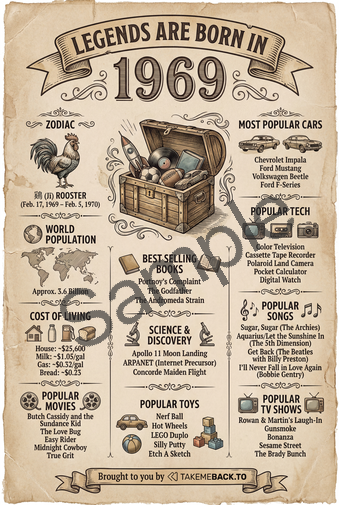

Major Events of 1969 - Historical Moments That Defined the Year | TakeMeBack.to
- 01 Jan POW release from North Vietnam: On January 1, 1969, several American prisoners of war (POWs) were released from North Vietnam. This event was part of the ongoing negotiations to end the Vietnam War and marked a significant moment for the families of the POWs. source: archives.gov
- 02 Jan Rupert Murdoch acquires News of the World: On January 2, 1969, Rupert Murdoch's News Ltd. acquired the News of the World newspaper, marking his first major acquisition in the UK media market. This move established Murdoch's presence in Fleet Street and set the stage for his subsequent expansion in British media. source: britannica.com
- 03 Jan Opening of the 91st United States Congress: The 91st United States Congress convened on January 3, 1969, marking the beginning of its term. This session addressed various legislative matters pertinent to the period. source: congress.gov
- 04 Jan Marvin Gaye's 'I Heard It Through The Grapevine' tops US charts: Marvin Gaye's iconic song 'I Heard It Through The Grapevine' reached number one on the US Billboard Hot 100 chart on January 4, 1969. This track became one of Gaye's signature songs and is considered a classic in the Motown genre. source: billboard.com
- 05 Jan Tensions in Derry, Northern Ireland: On January 5, 1969, tensions escalated in Derry, Northern Ireland, as civil rights protests were met with violent responses from police. This event marked a significant moment in the lead-up to the Troubles, a conflict that would engulf Northern Ireland for decades. source: bbc.com
- 06 Jan Nixon's Electoral College victory certified: On January 6, 1969, the Electoral College's votes for Richard Nixon were officially certified, confirming his election as the 37th President of the United States. This event marked a significant transition in American political leadership. source: archives.gov
- 10 Jan Sweden recognizes North Vietnam: On January 10, 1969, Sweden became the first Western nation to grant formal diplomatic recognition to the Communist republic of North Vietnam. source: en.wikipedia.org
- 11 Jan U.S. Army officer hijacks flight to Cuba: On January 11, 1969, Robert "Red" Helmey, believing himself to be a key operative in a conspiracy involving the FBI and CIA to assassinate Fidel Castro, hijacked United Airlines Flight 459, a Boeing 727 en route from Savannah, Georgia, to Miami, Florida. Armed with a .38-caliber pistol, he ordered the crew to fly to Havana, Cuba. Upon arrival, Cuban authorities imprisoned him in solitary confinement for 109 days before allowing his return to the United States. source: en.wikipedia.org
- 12 Jan Super Bowl III: Historic upset by New York Jets: On January 12, 1969, at the Orange Bowl in Miami, the New York Jets of the American Football League (AFL) defeated the National Football League's (NFL) Baltimore Colts, 16-7, in Super Bowl III. This victory was considered one of the biggest upsets in sports history, as the Jets were 18-point underdogs. Quarterback Joe Namath, who had guaranteed the win, was named the game's Most Valuable Player. source: history.com
- 13 Jan Beatles release Yellow Submarine album: On January 13, 1969, The Beatles released the album "Yellow Submarine." The album, which served as the soundtrack to the animated film of the same name, featured four new Beatles songs and a side of orchestral music composed by George Martin. The release was part of the band's ongoing expansion into various media and artistic expressions. source: en.wikipedia.org
- 14 Jan Soyuz 4 launch: The Soviet Union launched Soyuz 4 on January 14, 1969, carrying cosmonaut Vladimir Shatalov, marking a significant step in the Soviet space program. source: russianspaceweb.com
- 16 Jan Jan Palach's Self-Immolation Protest in Prague: On January 16, 1969, Jan Palach, a 20-year-old student at Charles University in Prague, set himself on fire in Wenceslas Square to protest the Soviet invasion of Czechoslovakia and the suppression of the Prague Spring reforms. He died from his injuries on January 19, 1969. His act became a symbol of resistance against the occupation. source: en.wikipedia.org
- 17 Jan Led Zeppelin's debut album released in the U.S.: Led Zeppelin's self-titled debut album was released in the United States on January 17, 1969. The album, produced by Jimmy Page, showcased the band's unique blend of hard rock and blues influences. It received a positive reception, reaching number 10 on the Billboard chart and earning gold certification by July 1969. source: en.wikipedia.org
- 18 Jan The Saturday Evening Post ceases publication: On January 18, 1969, The Saturday Evening Post, a prominent American magazine, ceased publication after 148 years. The magazine had been a significant cultural and literary publication in the United States, featuring works by notable authors and illustrators. source: en.wikipedia.org
- 19 Jan 19th NFL Pro Bowl: The 19th NFL Pro Bowl was held on January 19, 1969, at the Los Angeles Memorial Coliseum. The Western Conference defeated the Eastern Conference 10-7. Notable performances included quarterback Roman Gabriel and defensive tackle Merlin Olsen, both from the Los Angeles Rams, who were named the game's Most Valuable Players. source: en.wikipedia.org
- 20 Jan Richard Nixon's Presidential Inauguration: Richard Nixon was inaugurated as the 37th President of the United States on January 20, 1969, in Washington, D.C. His inauguration marked the beginning of his first term in office. source: en.wikipedia.org
- 21 Jan Shirley Chisholm enters Congress as first Black woman: On January 21, 1969, Shirley Chisholm was sworn in as the first Black woman elected to the United States Congress. Representing New York's 12th congressional district, she became a trailblazer for women and minorities in politics, advocating for social justice and equality throughout her career. source: congress.gov
- 22 Jan Assassination attempt on Leonid Brezhnev: On January 22, 1969, an assassination attempt was made on Leonid Brezhnev, the General Secretary of the Communist Party of the Soviet Union. The attempt was unsuccessful, and Brezhnev continued to lead the Soviet Union for several more years. source: britannica.com
- 25 Jan Paris Peace Talks on Vietnam War: On January 25, 1969, the Four-Party Conference on Peace in Vietnam officially opened its first plenary session in Paris. The conference included delegations from the Democratic Republic of Vietnam, the National Liberation Front of South Vietnam, the United States, and the Republic of Vietnam. This marked the beginning of extensive negotiations aimed at ending the Vietnam War. source: vietnam.vn
- 27 Jan Chuck Noll becomes Pittsburgh Steelers coach: On January 27, 1969, Chuck Noll was hired as the 14th head coach of the Pittsburgh Steelers, marking a pivotal moment in the franchise's history. source: steelers.com
- 29 Jan Death of Allen Dulles, CIA Director: Allen Dulles, the first civilian Director of the Central Intelligence Agency, died on January 29, 1969, at the age of 75 in Georgetown, Washington, D.C. He had served as CIA Director from 1953 to 1961. source: en.wikipedia.org
- 30 Jan The Beatles' Final Public Performance: On January 30, 1969, The Beatles performed their last public concert on the rooftop of their Apple Corps headquarters at 3 Savile Row, London. The 42-minute set included nine takes of five songs before the Metropolitan Police intervened due to noise complaints. source: beatlesbible.com
- 02 Feb Burdell Mansion Commune fire: On February 2, 1969, a fire broke out at the Burdell Mansion in California, which was being used as a commune. The incident resulted in significant damage and raised concerns about safety regulations in communal living spaces. source: nytimes.com
- 03 Feb Yasser Arafat becomes PLO leader: On February 3, 1969, Yasser Arafat was elected as the leader of the Palestine Liberation Organization (PLO). This marked a significant moment in Palestinian politics and the broader Middle Eastern conflict. source: bbc.com
- 04 Feb Yasser Arafat becomes PLO chairman: On February 4, 1969, Yasser Arafat was officially appointed as the chairman of the Palestine Liberation Organization. His leadership played a crucial role in the Palestinian national movement. source: theguardian.com
- 05 Feb Vince Lombardi joins Washington Redskins leadership: On February 5, 1969, Vince Lombardi, the legendary NFL coach, was appointed executive vice president and head coach of the Washington Redskins. source: en.wikipedia.org
- 06 Feb NFL and AFL announce merger: On February 6, 1969, the National Football League (NFL) and the American Football League (AFL) announced plans to merge, leading to the formation of the modern NFL. source: en.wikipedia.org
- 07 Feb Diane Crump becomes first female jockey at major U.S. racetrack: On February 7, 1969, Diane Crump became the first woman to compete in a professional horse race at a major U.S. racetrack, Hialeah Park in Florida. Despite facing significant hostility, she finished 9th in the 12-horse race. source: washingtonpost.com
- 08 Feb KGTO-TV Channel 36 begins broadcasting in Fayetteville, Arkansas: KGTO-TV, a television station on channel 36 in Fayetteville, Arkansas, began broadcasting on February 8, 1969. Owned by Noark Broadcasting, the station operated from 1969 to 1973, initially affiliating with NBC and later CBS. After ceasing operations in 1973, the license was sold and the station re-emerged in 1977 as KTVP, now known as KHOG-TV. source: en.wikipedia.org
- 09 Feb Boeing 747 prototype's first test flight: On February 9, 1969, the Boeing 747 prototype, named 'City of Everett,' conducted its inaugural test flight from Paine Field in Everett, Washington. Piloted by Jack Waddell, with co-pilot Brien Wygle and flight engineer Jesse Wallick, the flight lasted approximately 1 hour and 15 minutes, reaching altitudes up to 15,500 feet. This marked a significant milestone in aviation history, leading to the 747's entry into commercial service in 1970. source: thisdayinaviation.com
- 12 Feb Kissinger's secret China dialogue plan: On February 12, 1969, Henry Kissinger's plans for secret dialogue with China were revealed, marking a pivotal moment in U.S.-China relations. This initiative eventually led to the normalization of relations between the two countries. source: nytimes.com
- 13 Feb Duke University student protest: On February 13, 1969, students at Duke University organized a protest addressing various social issues, reflecting the broader student activism of the era. This event was part of a larger movement advocating for civil rights and social change in the United States. source: duke.edu
- 14 Feb Death of Mafia Boss Vito Genovese: Vito Genovese, the leader of the Genovese crime family, died of a heart attack in a Springfield, Missouri prison hospital while serving a 15-year sentence for drug trafficking. source: en.wikipedia.org
- 16 Feb Andrei Rublev film screened at Cannes Film Festival: Andrei Tarkovsky's film 'Andrei Rublev' was screened at the 1969 Cannes Film Festival, where it won the FIPRESCI prize. The film, depicting the life of the 15th-century Russian icon painter, faced censorship in the Soviet Union and was not released there until 1971. source: en.wikipedia.org
- 17 Feb Apollo 9 mission launch: Apollo 9 was launched on February 17, 1969, as a part of NASA's Apollo program. It was the first crewed flight to test the Lunar Module in Earth orbit, paving the way for future lunar missions. source: nasa.gov
- 18 Feb Hawthorne Nevada Airlines Flight 708 crashes into Mount Whitney: On February 18, 1969, Hawthorne Nevada Airlines Flight 708 tragically crashed into Mount Whitney, resulting in the loss of all passengers and crew. The incident raised concerns about flight safety in mountainous regions. source: airdisaster.com
- 19 Feb First test flight of Boeing 747 jumbo jet: The Boeing 747, known as the jumbo jet, had its first test flight on February 19, 1969. This aircraft revolutionized air travel with its large capacity and long-range capabilities. source: boeing.com
- 21 Feb Soviet N-1 Rocket Launch Failure: On February 21, 1969, the Soviet Union attempted to launch the N-1 rocket, a heavy-lift vehicle intended to carry cosmonauts to the Moon. The launch ended in failure, marking the third unsuccessful attempt of the N-1 program, which was eventually canceled due to its unreliability. source: russianspaceweb.com
- 22 Feb Beatles Begin Recording 'Abbey Road': On February 22, 1969, The Beatles began recording their iconic album 'Abbey Road' at Abbey Road Studios in London. The album, released later that year, became one of the band's most celebrated works, featuring classics like 'Come Together' and 'Here Comes the Sun.' source: beatlesbible.com
- 23 Feb LeeRoy Yarbrough wins dramatic Daytona 500: On February 23, 1969, LeeRoy Yarbrough won the Daytona 500, marking a significant achievement in his racing career. The race was noted for its intense competition and dramatic moments. source: nascar.com
- 24 Feb Tinker v. Des Moines: Student free speech landmark case: The U.S. Supreme Court ruled in Tinker v. Des Moines Independent Community School District that students do not lose their First Amendment rights at school. This landmark decision affirmed the right of students to express themselves freely, as long as it does not disrupt the educational process. source: archives.gov
- 25 Feb Mariner 6 Mars mission launch: Mariner 6 was launched on February 25, 1969, as part of NASA's Mariner program to explore Mars. The spacecraft successfully transmitted images of the Martian surface back to Earth, contributing to our understanding of the planet. source: mars.nasa.gov
- 27 Feb Syrian military coup led by Hafez al-Assad: On February 27, 1969, Hafez al-Assad led a military coup in Syria, establishing a new regime. This event marked the beginning of Assad's long rule, which significantly shaped Syrian politics and governance. source: britannica.com
- 28 Feb Sirhan Sirhan court appearance: On February 28, 1969, Sirhan Sirhan appeared in court for the first time after being charged with the assassination of Senator Robert F. Kennedy. His trial attracted significant media attention and public interest. source: nytimes.com
- 01 Mar Mickey Mantle retires from baseball: On March 1, 1969, baseball legend Mickey Mantle announced his retirement from the sport. His decision marked the end of an illustrious career and was a significant moment in baseball history. source: nytimes.com
- 02 Mar Sino-Soviet border conflict escalates: On March 2, 1969, tensions between China and the Soviet Union escalated into armed conflict along their border. This incident marked a significant moment in Cold War geopolitics, reflecting the deteriorating relationship between the two communist powers. source: britannica.com
- 03 Mar Apollo 9 space mission launch: On March 3, 1969, NASA launched Apollo 9, a crucial mission in the Apollo program that tested the Lunar Module in Earth orbit. This mission was vital for the success of future lunar landings, demonstrating the capabilities of the spacecraft. source: nasa.gov
- 05 Mar MC Solaar born: Claude Honoré M'Barali, known professionally as MC Solaar, was born in Dakar, Senegal. He is a French rapper of Senegalese and Chadian origin, recognized for his complex lyrics and distinctive flow. source: en.wikipedia.org
- 07 Mar Sam Gash born: Samuel Lee Gash Jr., known as Sam Gash, was born in Hendersonville, North Carolina. He is a former professional American football fullback who played in the NFL for several teams. source: en.wikipedia.org
- 09 Mar Egyptian military leader fatally wounded during Suez Canal conflict: On March 9, 1969, Egyptian General Abdul Munim Riad, Chief of Staff of the Egyptian Armed Forces, was killed by Israeli mortar fire during the War of Attrition along the Suez Canal. He had been overseeing an offensive against Israeli positions when the attack occurred. source: en.wikipedia.org
- 10 Mar James Earl Ray pleads guilty to MLK assassination: On March 10, 1969, James Earl Ray pleaded guilty to the assassination of Dr. Martin Luther King Jr. in Memphis, Tennessee. He was sentenced to 99 years in prison. source: archives.gov
- 11 Mar Soviet-Chinese border conflict on Zhenbao/Damansky Island: On March 11, 1969, a significant military clash occurred between Soviet and Chinese forces over Zhenbao Island, known as Damansky Island in China. This conflict was part of ongoing border tensions between the two nations during the Cold War. source: bbc.com
- 12 Mar Paul McCartney marries Linda Eastman: On March 12, 1969, Paul McCartney married Linda Eastman in a private ceremony. Their marriage became one of the most famous partnerships in music history, influencing McCartney's work with The Beatles and beyond. source: bbc.com
- 13 Mar Soviet-Chinese border conflict at Ussuri River: On March 13, 1969, another clash occurred between Soviet and Chinese forces at the Ussuri River, escalating tensions in the region. This conflict was part of a series of border skirmishes that characterized Sino-Soviet relations during this period. source: bbc.com
- 14 Mar Death of Ben Shahn, influential US painter: On March 14, 1969, Ben Shahn, a prominent American painter and social realist, passed away. He was known for his works that depicted social injustices and his contributions to American art. source: en.wikipedia.org
- 15 Mar Abe Fortas resigns from the Supreme Court: Abe Fortas, an Associate Justice of the Supreme Court, resigned on March 15, 1969, amid controversy over his judicial conduct and potential conflicts of interest. His resignation marked a significant moment in U.S. judicial history, as he was the first sitting justice to resign under such circumstances. source: nytimes.com
- 16 Mar Viasa Flight 742 disaster occurs: On March 16, 1969, Viasa Flight 742 crashed in the Caribbean Sea shortly after takeoff from the Simón Bolívar International Airport in Venezuela. The disaster resulted in the loss of all 84 passengers and crew members on board, marking one of the deadliest aviation accidents of the time. source: nytimes.com
- 17 Mar Golda Meir becomes Prime Minister of Israel: Golda Meir was sworn in as the Prime Minister of Israel on March 17, 1969, becoming the first woman to hold the position. Her leadership during a tumultuous period in Israeli history was marked by significant political and social challenges. source: britannica.com
- 18 Mar Secret US bombing of Cambodia begins: On March 18, 1969, the United States commenced Operation Menu, a covert bombing campaign targeting North Vietnamese sanctuaries in Cambodia during the Vietnam War. The operation was kept secret from the American public and Congress, and its existence was not revealed until 1973. The bombings aimed to disrupt North Vietnamese supply lines and bases but led to significant civilian casualties and increased anti-war sentiment. source: archives.gov
- 19 Mar Chicago 8 indictment: On March 19, 1969, seven individuals were indicted on charges of conspiracy and inciting to riot in connection with anti-Vietnam War protests at the 1968 Democratic National Convention in Chicago. The indictment led to the trial of the Chicago 7, as one defendant, Bobby Seale, was later severed from the case. The trial became a focal point for debates over free speech, civil rights, and the anti-war movement. source: archives.gov
- 20 Mar Nixon's Vietnam War resolution: On March 20, 1969, President Nixon announced a resolution regarding the Vietnam War, emphasizing a strategy for de-escalation and withdrawal of U.S. troops. This marked a significant shift in U.S. foreign policy during the conflict. source: archives.gov
- 21 Mar NASA announces ambitious lunar exploration program: On March 21, 1969, NASA announced plans for an ambitious lunar exploration program, aiming to land humans on the Moon. This initiative was part of the broader Apollo program and marked a significant milestone in space exploration. source: nasa.gov
- 22 Mar Landmark art exhibition opens: On March 22, 1969, a landmark art exhibition opened, showcasing contemporary artists and their works. This exhibition played a crucial role in shaping the art scene and influencing future artistic movements. source: artnews.com
- 23 Mar Charles Manson's ominous encounter at Cielo Drive: On March 23, 1969, Charles Manson had a notable encounter at Cielo Drive, which would later become infamous due to the Tate-LaBianca murders. This event is often cited as a precursor to the violent actions that followed later that year. source: nytimes.com
- 24 Mar Apollo 9 space mission launch: Apollo 9 was launched on March 24, 1969, as a crucial test for the Apollo program. It was the first crewed flight to test the Lunar Module in Earth orbit, paving the way for future lunar missions. source: nasa.gov
- 25 Mar Andes Pact signed in Peru: The Andes Pact, aimed at promoting economic cooperation among Andean countries, was signed on March 25, 1969, in Peru. This agreement sought to enhance regional integration and development. source: britannica.com
- 26 Mar Soviet-Chinese border conflict: The Soviet-Chinese border conflict escalated on March 26, 1969, with military skirmishes occurring along the Ussuri River. This conflict was part of the broader Sino-Soviet tensions during the Cold War. source: britannica.com
- 27 Mar Keith Flint born: Keith Flint, the lead vocalist of the British electronic music group The Prodigy, was born in Redbridge, London. source: en.wikipedia.org
- 28 Mar Pope Paul VI appoints Cardinal Willebrands: Pope Paul VI appointed Cardinal Johannes Willebrands as the President of the Secretariat for Promoting Christian Unity. source: en.wikipedia.org
- 29 Mar Communist New People's Army founded in Philippines: On March 29, 1969, the Communist New People's Army (NPA) was founded in the Philippines. The NPA became the armed wing of the Communist Party of the Philippines, engaging in guerrilla warfare against the Philippine government. source: britannica.com
- 30 Mar Dwight D. Eisenhower lies in state at US Capitol: On March 30, 1969, the body of former U.S. President Dwight D. Eisenhower lay in state at the U.S. Capitol. Eisenhower, who served as the 34th President from 1953 to 1961, passed away on March 28, 1969. source: archives.gov
- 31 Mar Eddy Merckx wins Tour of Flanders: On March 30, 1969, Belgian cyclist Eddy Merckx won the 53rd edition of the Tour of Flanders, a major one-day classic race. source: en.wikipedia.org
- 01 Apr Hawker Siddeley Harrier enters RAF service: On April 1, 1969, the Hawker Siddeley Harrier, a British jet aircraft, entered service with the Royal Air Force. source: Wikipedia (day-month pages)
- 02 Apr LOT Polish Airlines Flight 165 crash: LOT Polish Airlines Flight 165 crashed on April 2, 1969, while attempting to land at New York's JFK Airport. The incident resulted in the loss of all 87 passengers and crew on board, marking it as one of the deadliest aviation disasters of that time. source: britannica.com
- 03 Apr Vietnam War casualties exceed Korean War toll: By April 3, 1969, the number of American casualties in the Vietnam War surpassed those in the Korean War, marking a grim milestone in the conflict. This statistic underscored the escalating violence and prolonged nature of the Vietnam War. source: archives.gov
- 04 Apr ETA political violence in Spain: On April 4, 1969, the Basque separatist group ETA carried out a violent act in Spain, marking a significant moment in the group's history of political violence. This event contributed to the ongoing conflict in the region and highlighted the tensions surrounding Basque nationalism during Franco's regime. source: bbc.com
- 05 Apr Major Vietnam War antiwar protests sweep across United States: On April 5, 1969, significant antiwar protests occurred across the United States, as demonstrators rallied against the Vietnam War. These protests were part of a larger movement that sought to end U.S. involvement in Vietnam and highlighted the growing public dissent against the war. source: nytimes.com
- 06 Apr Notable births on April 6, 1969: April 6, 1969, saw the birth of several notable individuals, including actor and musician Billy Dee Williams and singer-songwriter John McCrea. This date is recognized for its contributions to the arts and entertainment industry through these figures. source: britannica.com
- 07 Apr ARPANET established: On April 7, 1969, ARPANET, the precursor to the modern Internet, was officially established. This network connected four universities and was a pivotal development in computer networking and communication technology. source: britannica.com
- 08 Apr First Major League Baseball game in Canada: The first Major League Baseball game in Canada took place on April 8, 1969, featuring the Montreal Expos. This historic event marked the expansion of Major League Baseball into Canada and was a significant moment in sports history. source: britannica.com
- 09 Apr First Flight of Concorde 002: On April 9, 1969, Concorde 002, the British prototype of the supersonic airliner Concorde, made its first flight from Filton to RAF Fairford in Gloucestershire, England. This marked a significant milestone in the development of supersonic passenger travel. source: en.wikipedia.org
- 12 Apr Wales wins Five Nations Rugby Championship: On April 12, 1969, Wales secured the Five Nations Rugby Championship by defeating England 30-9 at Cardiff Arms Park. This victory marked their 16th outright championship title. source: en.wikipedia.org
- 14 Apr Deadly tornado in East Pakistan: On April 14, 1969, a devastating tornado struck East Pakistan (now Bangladesh), causing significant destruction and loss of life. The tornado was one of the deadliest in the region's history, with hundreds of casualties reported. The event highlighted the vulnerability of the area to severe weather phenomena. source: britannica.com
- 15 Apr British troops deployed in Northern Ireland: On April 15, 1969, British troops were deployed to Northern Ireland in response to escalating violence and civil unrest. This deployment marked a significant moment in the Troubles, a conflict that would last for decades. The presence of troops aimed to restore order amid growing tensions. source: bbc.com
- 16 Apr First successful spacecraft crew transfer in orbit: On April 16, 1969, the first successful crew transfer between spacecraft in orbit was achieved. This milestone demonstrated advancements in space technology and paved the way for future missions. The event was a significant step in human space exploration. source: nasa.gov
- 17 Apr Sirhan Sirhan convicted: On April 17, 1969, Sirhan Sirhan was convicted of first-degree murder for the assassination of Senator Robert F. Kennedy, which occurred on June 5, 1968. Sirhan was subsequently sentenced to death, a sentence that was later commuted to life in prison. source: history.com
- 18 Apr Susan Polgár born: On April 18, 1969, Susan Polgár, a renowned chess player, was born. She is celebrated for her achievements in the game, including being the youngest female ever to earn the title of International Grandmaster. source: en.wikipedia.org
- 19 Apr Derry Riots during Northern Ireland Civil Rights Conflict: On April 19, 1969, riots erupted in Derry, Northern Ireland, as part of the ongoing civil rights conflict, highlighting tensions between Catholic nationalists and Protestant unionists. source: en.wikipedia.org
- 20 Apr The 5th Dimension tops US music charts: On April 20, 1969, The 5th Dimension's single "Aquarius/Let the Sunshine In" reached number one on the US Billboard Hot 100 chart. source: en.wikipedia.org
- 21 Apr Sara Mae Berman wins 1969 Boston Marathon: On April 21, 1969, Sara Mae Berman became the first woman to officially run and complete the Boston Marathon, finishing with a time of 3:05:07. Although women were not officially allowed to enter until 1972, her result was later ratified by the Boston Athletic Association. source: en.wikipedia.org
- 22 Apr Robin Knox-Johnston wins Golden Globe Race: On April 22, 1969, British sailor Sir Robin Knox-Johnston became the first person to sail solo, non-stop around the world, completing the Sunday Times Golden Globe Race in 312 days aboard his ketch, Suhaili. source: yachtingmonthly.com
- 25 Apr Treaty of Tlatelolco signed: On April 25, 1969, the Treaty of Tlatelolco was signed, establishing Latin America and the Caribbean as a nuclear-weapon-free zone.
- 26 Apr US Treasury relaxes gold coin import regulations: On April 26, 1969, the U.S. Treasury Department announced a revision of gold coin import regulations, permitting imports of gold coins minted prior to 1934 without a license. This change aimed to remove inconsistencies between imported pre-1934 gold coins and those regularly traded within the United States. source: scribd.com
- 27 Apr Carol Mann wins LPGA Raleigh Ladies Invitational: On April 27, 1969, Carol Mann secured victory at the LPGA Raleigh Ladies Invitational, held at the Raleigh Country Club in Raleigh, North Carolina. This win was part of her successful 1969 season, where she led the LPGA Tour with eight tournament victories. source: kronishsports.com
- 28 Apr Charles de Gaulle resigns as President of France: On April 28, 1969, Charles de Gaulle announced his resignation as President of France following a failed referendum on regional reform. His departure marked the end of a significant era in French politics, as he had been a dominant figure since the establishment of the Fifth Republic in 1958. source: britannica.com
- 29 Apr Charles de Gaulle resigns from French presidency: On April 29, 1969, Charles de Gaulle officially resigned from the presidency of France, following the announcement made the previous day. His resignation was a pivotal moment in French history, leading to a shift in political power and the eventual election of Georges Pompidou. source: britannica.com
- 30 Apr Bernadette Devlin makes history in British Parliament: On April 30, 1969, Bernadette Devlin became the youngest woman ever elected to the British Parliament at the age of 21. Her election was a significant moment in British political history, representing a shift towards greater representation of women in politics. source: bbc.com
- 01 May Birth of filmmaker Wes Anderson: Wesley Wales Anderson, an American filmmaker known for his distinctive visual and narrative styles, was born on May 1, 1969, in Houston, Texas. source: en.wikipedia.org
- 02 May Maiden voyage of the RMS Queen Elizabeth 2: The RMS Queen Elizabeth 2, a British transatlantic ocean liner, embarked on its maiden voyage on May 2, 1969. source: en.wikipedia.org
- 03 May 95th Kentucky Derby: Bill Hartack on Majestic Prince wins in 2:01.8: Jockey Bill Hartack won his fifth Kentucky Derby aboard Majestic Prince on May 3, 1969, at Churchill Downs. The race was completed in 2 minutes and 1.8 seconds, tying Hartack with Eddie Arcaro's 1952 record for most Derby wins. source: ntra.com
- 04 May Charles Gordone's groundbreaking play premieres: Charles Gordone's play 'No Place to Be Somebody' premiered on May 4, 1969, marking a significant moment in American theater as the first play by an African American to win the Pulitzer Prize for Drama. source: pulitzer.org
- 05 May N. Scott Momaday wins Pulitzer Prize for Literature: N. Scott Momaday was awarded the Pulitzer Prize for Fiction in 1969 for his novel 'House Made of Dawn.' This recognition marked a significant moment in American literature, highlighting Native American voices and experiences. source: britannica.com
- 06 May Gibraltar border closure: On May 6, 1969, the border between Gibraltar and Spain was closed by the Spanish government, leading to significant tensions and impacting the local economy and residents. This closure lasted for over a decade. source: bbc.com
- 07 May Queen Elizabeth 2 arrives in New York: Queen Elizabeth II arrived in New York City on May 7, 1969, marking her first visit to the city since her coronation. The visit was part of a tour celebrating the 350th anniversary of the founding of New York. The Queen was greeted with a grand reception and various ceremonies during her stay. source: nytimes.com
- 08 May Sysco Corporation founded: Sysco Corporation, a global leader in selling, marketing, and distributing food products to restaurants, healthcare, and educational facilities, was founded on May 8, 1969. The company has since grown to become one of the largest foodservice distributors in the world. source: britannica.com
- 09 May Urban guerrilla action against Brazilian military dictatorship: On May 9, 1969, urban guerrilla groups in Brazil intensified their actions against the military dictatorship. This period was marked by significant political unrest and resistance movements aiming to restore democracy in Brazil. source: britannica.com
- 10 May Battle of Hamburger Hill Begins: The Battle of Hamburger Hill commenced on May 10, 1969, during the Vietnam War. U.S. and South Vietnamese forces launched Operation Apache Snow in the A Shau Valley, targeting North Vietnamese positions on Hill 937. The battle lasted until May 20, resulting in significant casualties. source: history.com
- 11 May Battle of Hamburger Hill during Vietnam War: The Battle of Hamburger Hill, part of the Vietnam War, occurred from May 10 to May 20, 1969. It involved intense fighting between U.S. forces and North Vietnamese troops in the A Shau Valley. The battle is noted for its high casualties and the controversial nature of the assault on a heavily fortified position. source: britannica.com
- 12 May Winnie Mandela's political imprisonment: Winnie Mandela, a prominent anti-apartheid activist, was imprisoned for her political activities in South Africa. Her imprisonment on May 12, 1969, was part of the broader crackdown on dissent by the apartheid regime. She became a symbol of resistance against apartheid during her incarceration. source: britannica.com
- 13 May May 13 Incident involving sectarian violence in Kuala Lumpur, Malaysia: The May 13 Incident refers to a series of violent clashes that erupted in Kuala Lumpur, Malaysia, on May 13, 1969. The violence was primarily between ethnic Malays and Chinese, resulting in significant casualties and a national emergency declaration. This event had lasting impacts on Malaysian society and politics. source: britannica.com
- 14 May Canada legalizes abortion and contraception: On May 14, 1969, the House of Commons of Canada approved Bill C-150, a significant overhaul of the Criminal Code, which legalized abortion and contraception, among other reforms. source: en.wikipedia.org
- 16 May Venera 5 mission successfully reaches Venus: On May 16, 1969, the Soviet spacecraft Venera 5 successfully transmitted data from the atmosphere of Venus. This mission marked a significant achievement in space exploration, providing valuable information about the planet's conditions. source: nasa.gov
- 17 May NFL conference realignment announced: On May 17, 1969, the NFL announced a major realignment of its conferences, which included the creation of the American Football Conference (AFC) and the National Football Conference (NFC). This restructuring aimed to enhance competition and fan engagement. source: britannica.com
- 18 May Apollo 10 Mission Launch: Apollo 10, the fourth crewed mission in NASA's Apollo program, was launched on 18 May 1969 at 16:49 UTC from Kennedy Space Center's Launch Complex 39B. The mission served as a 'dress rehearsal' for the first Moon landing, testing all components and procedures except the actual landing. source: nasa.gov
- 21 May Sirhan Sirhan sentenced for RFK murder: On May 21, 1969, Sirhan Sirhan was sentenced to life in prison for the assassination of Senator Robert F. Kennedy. The trial and sentencing were highly publicized, reflecting the political tensions of the era. Sirhan's actions had a profound impact on American politics and society. source: nytimes.com
- 22 May Apollo 10 lunar module test flight: The Apollo 10 mission, which took place in May 1969, included a crucial test flight of the lunar module. This mission served as a rehearsal for the first moon landing, demonstrating the capabilities of the spacecraft. It was a significant step in NASA's Apollo program. source: nasa.gov
- 23 May Jimmy McHugh passes away: Jimmy McHugh, a prominent American songwriter known for his contributions to popular music, passed away on May 23, 1969. His work included many classic songs that have been covered by numerous artists. His legacy continues to influence musicians today. source: britannica.com
- 24 May The Archies release 'Sugar, Sugar': On May 24, 1969, 'Sugar, Sugar' by The Archies was released, becoming a major hit in the late 1960s. source: en.wikipedia.org
- 25 May Andean Pact Establishment: On May 25, 1969, the Andean Pact, also known as the Cartagena Agreement, was established by Bolivia, Colombia, Ecuador, Peru, and Venezuela. This agreement aimed to strengthen the economies of these countries through free trade, tariff elimination, and the creation of a customs union. source: en.wikipedia.org
- 26 May Apollo 10 Returns to Earth: On May 26, 1969, the Apollo 10 mission concluded with a successful splashdown in the Pacific Ocean, approximately 400 miles east of American Samoa. The crew, consisting of Thomas P. Stafford, John W. Young, and Eugene A. Cernan, had completed an eight-day mission that served as a rehearsal for the first Moon landing. source: nssdc.gsfc.nasa.gov
- 27 May Walt Disney World construction begins: Construction for Walt Disney World Resort in Florida commenced on May 27, 1969, marking the start of a major expansion for The Walt Disney Company. source: wdwinfo.com
- 28 May AC Milan wins European Cup: On May 28, 1969, AC Milan secured their second European Cup title by defeating Ajax 4–1 in the final at Santiago Bernabéu Stadium in Madrid. source: acmilan.com
- 30 May Mario Andretti wins Indianapolis 500: Mario Andretti won the Indianapolis 500 on May 30, 1969, marking a significant achievement in his racing career. This victory solidified his status as one of the top drivers in motorsport history. source: indy500.com
- 31 May John Lennon and Yoko Ono record iconic peace anthem: On May 31, 1969, John Lennon and Yoko Ono recorded the peace anthem 'Give Peace a Chance' in Montreal. This song became an anthem for the anti-war movement and is still celebrated today. source: bbc.com
- 01 Jun French Presidential Election First Round: On June 1, 1969, France held the first round of its presidential election following President Charles de Gaulle's resignation. Georges Pompidou, representing the Union of Democrats for the Republic (UDR), secured 43.9% of the vote, while Alain Poher of the Democratic Centre (CD) received 23.4%. The high voter turnout of approximately 78% reflected the nation's engagement in this pivotal political event. source: en.wikipedia.org
- 04 Jun The Beatles release 'The Ballad of John and Yoko' in the US: On June 4, 1969, The Beatles released their second single of the year, 'The Ballad of John and Yoko,' in the United States. The song, written by John Lennon and credited to Lennon-McCartney, was accompanied by the B-side 'Old Brown Shoe.' Despite its UK success, the single faced resistance in the US due to its religious references, leading to some radio stations refusing to play it. source: beatlesbible.com
- 05 Jun Dutch Antilles government resigns amid unrest: On June 5, 1969, following the 1969 Curaçao uprising, Prime Minister Ciro Kroon of the Netherlands Antilles resigned. The uprising, which began on May 30, 1969, was sparked by labor disputes and led to widespread riots and demands for the government's resignation. Kroon's resignation marked a significant political shift in the region. source: en.wikipedia.org
- 07 Jun The Johnny Cash Show premieres on ABC: 'The Johnny Cash Show' debuted on ABC on June 7, 1969, featuring Johnny Cash and special guests Bob Dylan, Doug Kershaw, and Joni Mitchell. The show was recorded at Nashville's Ryman Auditorium and aired until March 31, 1971, with a total of 58 episodes. source: johnnycash.com
- 08 Jun Mickey Mantle's No. 7 retired by New York Yankees: On June 8, 1969, the New York Yankees retired Mickey Mantle's uniform number 7 during a ceremony at Yankee Stadium. Mantle, who had announced his retirement earlier that year, was honored in front of a crowd of approximately 61,000 fans. Fellow Yankee legend Joe DiMaggio presented Mantle with a plaque to be displayed on the center field wall, and Mantle reciprocated by presenting DiMaggio with a similar plaque, humorously noting that DiMaggio's should be placed 'just a little bit higher' than his own. source: foxbangor.com
- 11 Jun Death of influential labor leader John L. Lewis: John L. Lewis, a prominent American labor leader and president of the United Mine Workers of America from 1920 to 1960, passed away on June 11, 1969, in Alexandria, Virginia. source: en.wikipedia.org
- 13 Jun Mick Taylor joins the Rolling Stones: Mick Taylor, formerly of John Mayall & the Bluesbreakers, was introduced as the new guitarist for the Rolling Stones on June 13, 1969, replacing Brian Jones. source: snopes.com
- 14 Jun John Lennon and Yoko Ono appear on The David Frost Show: On June 14, 1969, John Lennon and Yoko Ono pre-recorded an appearance on The David Frost Show at the InterTel studios in Wembley, London. The broadcast, which aired on July 10, 1969, featured the couple discussing their peace activism and promoting their album 'Unfinished Music No. 2: Life with the Lions'. source: beatlesonfilm.com
- 15 Jun Georges Pompidou elected President of France: On June 15, 1969, Georges Pompidou was elected President of France, succeeding Charles de Gaulle. Pompidou served as President from 1969 until his death in 1974. source: en.wikipedia.org
- 16 Jun Supreme Court reinstates Adam Clayton Powell Jr.: On June 16, 1969, the U.S. Supreme Court reinstated Adam Clayton Powell Jr. to his seat in Congress, overturning the House of Representatives' decision to exclude him due to allegations of financial misconduct. source: en.wikipedia.org
- 17 Jun Boris Spassky becomes World Chess Champion: On June 17, 1969, Boris Spassky defeated Tigran Petrosian in Moscow to become the 10th World Chess Champion. Spassky secured the title by achieving 12½ points in a best-of-24-games match. source: en.wikipedia.org
- 20 Jun Georges Pompidou becomes President of France: Georges Pompidou was inaugurated as the President of France on June 20, 1969, after winning the presidential election with 57.58% of the vote. He succeeded Charles de Gaulle, who resigned following a failed constitutional referendum. source: lemonde.fr
- 22 Jun Cuyahoga River Fire sparks environmental reform: On June 22, 1969, the Cuyahoga River in Cleveland, Ohio, caught fire due to industrial pollution. This incident highlighted severe environmental issues and led to significant reforms, including the establishment of the Environmental Protection Agency. source: nps.gov
- 23 Jun Warren E. Burger Becomes Supreme Court Chief Justice: On June 23, 1969, President Richard Nixon nominated Warren E. Burger to serve as Chief Justice of the United States Supreme Court. Burger was confirmed by the Senate and served as Chief Justice from 1969 to 1986, overseeing significant decisions in American jurisprudence. source: archives.gov
- 24 Jun The United Kingdom and Rhodesia Sever Diplomatic Ties: On June 24, 1969, the United Kingdom severed diplomatic ties with Rhodesia, a self-declared independent state in southern Africa. This action was taken in response to Rhodesia's unilateral declaration of independence from Britain in 1965, which was not recognized by the international community. source: britannica.com
- 25 Jun Longest tennis match in Wimbledon history: On June 25, 1969, Pancho Gonzales defeated Charlie Pasarell in a marathon match lasting 5 hours and 20 minutes, comprising 112 games. This match set the record for the longest match at Wimbledon until it was surpassed in 2010. source: en.wikipedia.org
- 27 Jun Stonewall Riots begin in New York City: The Stonewall Riots, a series of spontaneous demonstrations by members of the LGBTQ+ community, began on June 27, 1969, at the Stonewall Inn in Manhattan. This event is widely considered a catalyst for the modern LGBTQ+ rights movement in the United States. source: archives.gov
- 28 Jun The Stonewall riots mark the start of the modern gay rights movement in the U.S.: The Stonewall riots, which began on June 27 and continued into June 28, 1969, are recognized as the catalyst for the modern gay rights movement in the United States. This event galvanized LGBTQ+ activism and awareness across the nation. source: archives.gov
- 29 Jun First Jewish worship service at White House: On June 29, 1969, the first Jewish worship service was held at the White House, marking a significant moment in the recognition of religious diversity in the U.S. This event was attended by various dignitaries and highlighted the growing acceptance of different faiths in American society. source: whitehouse.gov
- 30 Jun Nigeria blocks Red Cross aid to Biafra: On June 30, 1969, Nigeria's government blocked Red Cross aid to the Biafran region, exacerbating the humanitarian crisis during the Nigerian Civil War. This decision drew international criticism and highlighted the dire situation in Biafra. source: bbc.com
- 01 Jul Prince Charles invested as Prince of Wales: On July 1, 1969, Prince Charles was formally invested as the Prince of Wales in a ceremony at Caernarfon Castle, Wales. The event was watched by 500 million people worldwide on television, but it received some opposition from Welsh nationalist organisations. source: en.wikipedia.org
- 02 Jul International Hotel opens in Las Vegas: The International Hotel, later known as the Westgate Las Vegas, opened on July 2, 1969. At the time, it was Nevada's tallest building and largest hotel, featuring international-themed rooms and restaurants. source: en.wikipedia.org
- 03 Jul Death of Brian Jones, Rolling Stones founding member: Brian Jones, a founding member of the Rolling Stones, was found dead at his home in Sussex, England. His death was ruled as a drowning, but the circumstances surrounding it have led to various theories and speculation over the years. source: bbc.com
- 04 Jul Zodiac Killer attack at Blue Rock Springs: On July 4, 1969, the Zodiac Killer attacked a young couple at Blue Rock Springs Park in Vallejo, California. This incident was one of several attributed to the unidentified serial killer, who became infamous for taunting police and the media. source: history.com
- 05 Jul Assassination of Tom Mboya: Tom Mboya, a prominent Kenyan politician and trade unionist, was assassinated on July 5, 1969. His death had significant political repercussions in Kenya and is often seen as a pivotal moment in the country's history. source: bbc.com
- 07 Jul First U.S. troop withdrawals from Vietnam: On July 7, 1969, the United States began withdrawing troops from Vietnam, marking the start of 'Vietnamization,' a policy aimed at transferring combat roles to South Vietnamese forces.
- 08 Jul U.S. begins troop withdrawal from Vietnam: On July 8, 1969, the United States officially commenced the withdrawal of troops from Vietnam, marking a significant shift in U.S. military policy during the Vietnam War. This decision was part of a broader strategy to reduce American involvement in the conflict while transitioning responsibilities to South Vietnamese forces. source: archives.gov
- 09 Jul Moon landing commemorative stamp: On July 9, 1969, the United States Postal Service issued a commemorative stamp celebrating the upcoming Apollo 11 moon landing. This stamp marked a significant moment in space exploration history and public interest in the lunar mission. source: nasa.gov
- 10 Jul First Vietnam War Veterans Parade held in New York City: The first Vietnam War Veterans Parade took place in New York City on July 10, 1969. This event marked a significant moment for veterans returning from the Vietnam War, allowing them to publicly express their experiences and seek recognition. It was a pivotal point in the growing anti-war sentiment and veteran advocacy. source: nytimes.com
- 11 Jul David Bowie's 'Space Oddity' released: David Bowie's iconic song 'Space Oddity' was released on July 11, 1969. The track became a defining moment in Bowie's career and is often associated with the space race, reflecting the cultural zeitgeist of the time. source: bbc.com
- 12 Jul Tony Jacklin wins British Open Golf Championship: On July 12, 1969, Tony Jacklin won the British Open Golf Championship, becoming the first British golfer to win the title in 18 years. His victory was a significant moment in golf history, revitalizing interest in the sport in the UK. source: bbc.com
- 13 Jul Soviet Union launches Luna 15 mission to the Moon: On July 13, 1969, the Soviet Union launched the Luna 15 spacecraft, an unmanned mission aimed at returning lunar soil samples to Earth. The mission was launched from the Baikonur Cosmodrome in Kazakhstan. source: nssdc.gsfc.nasa.gov
- 14 Jul 'Easy Rider' film released in New York City: On July 14, 1969, the film 'Easy Rider' premiered at the Beekman Theatre in New York City. Directed by Dennis Hopper and starring Peter Fonda, the film became a cultural touchstone for the counterculture movement. source: filmretrospect.com
- 16 Jul Apollo 11 mission launch: The Apollo 11 mission was launched from Kennedy Space Center in Florida at 9:32 a.m. EDT on July 16, 1969. Astronauts Neil Armstrong, Buzz Aldrin, and Michael Collins embarked on the historic journey to the Moon aboard the Saturn V rocket. source: nasa.gov
- 18 Jul Edward Kennedy Chappaquiddick Incident: On July 18, 1969, U.S. Senator Edward "Ted" Kennedy drove his car off a bridge on Chappaquiddick Island, Massachusetts, resulting in the drowning of his passenger, Mary Jo Kopechne. Kennedy failed to report the accident for over 10 hours, leading to public outrage and legal consequences, including a guilty plea for leaving the scene of an accident. source: britannica.com
- 19 Jul Apollo 11 enters lunar orbit: On July 19, 1969, NASA's Apollo 11 mission successfully entered lunar orbit, marking a significant milestone in space exploration. This event set the stage for the first human landing on the Moon, which would occur shortly thereafter. source: nasa.gov
- 20 Jul First human moon landing - Apollo 11 mission: On July 20, 1969, Apollo 11 astronauts Neil Armstrong and Buzz Aldrin became the first humans to land on the Moon. This historic event fulfilled President John F. Kennedy's goal of landing a man on the Moon before the end of the 1960s. source: nasa.gov
- 21 Jul First human lunar landing: On July 21, 1969, Apollo 11 astronauts Neil Armstrong and Buzz Aldrin became the first humans to land on the Moon. Armstrong's famous words, "That's one small step for [a] man, one giant leap for mankind," marked a significant achievement in space exploration. source: nasa.gov
- 22 Jul Aretha Franklin arrested in Detroit: On July 22, 1969, legendary singer Aretha Franklin was arrested in Detroit, Michigan, for allegedly disturbing the peace. The incident drew significant media attention, highlighting her status as a cultural icon. source: britannica.com
- 23 Jul Soviet nuclear test in Kazakhstan: On July 23, 1969, the Soviet Union conducted a nuclear test at the Semipalatinsk Test Site in Kazakhstan. This test was part of the USSR's ongoing nuclear weapons program during the Cold War. source: britannica.com
- 24 Jul Apollo 11 Returns to Earth: On July 24, 1969, the Apollo 11 mission concluded with a successful splashdown in the Pacific Ocean, bringing astronauts Neil Armstrong, Buzz Aldrin, and Michael Collins back to Earth after their historic journey to the Moon. source: nasa.gov
- 25 Jul Nixon Doctrine announced: U.S. President Richard Nixon announced the Nixon Doctrine, stating that the U.S. would honor its existing defense commitments but would not undertake all the defense of the free nations of the world. source: en.wikipedia.org
- 26 Jul Devastating Yangjiang earthquake in China: On July 26, 1969, a significant earthquake struck Yangjiang, China, causing widespread destruction and loss of life. The earthquake registered a magnitude of 7.0 and was one of the deadliest natural disasters in the region during that period. source: usgs.gov
- 27 Jul Pioneer 10 space probe launch: Pioneer 10 was launched on July 27, 1969, by NASA, marking a significant milestone in space exploration. It was the first spacecraft to travel through the asteroid belt and make a flyby of Jupiter, providing valuable data about the planet. source: nasa.gov
- 28 Jul Stonewall Inn Uprising: Birth of the Modern LGBTQ+ Rights Movement: The Stonewall Inn uprising occurred in New York City, marking a pivotal moment in the LGBTQ+ rights movement. Patrons of the Stonewall Inn resisted a police raid, leading to several days of protests and clashes. This event is widely regarded as the catalyst for the modern LGBTQ+ rights movement in the United States. source: nps.gov
- 29 Jul Mariner 6 Mars Flyby Transmission: On July 29, 1969, NASA's Mariner 6 spacecraft successfully transmitted images of Mars back to Earth after its flyby. This mission provided valuable data about the Martian surface and atmosphere, contributing to our understanding of the planet. The images captured were among the first detailed views of Mars. source: nasa.gov
- 30 Jul Nixon's Unscheduled Visit to South Vietnam: On July 30, 1969, President Richard Nixon made an unscheduled visit to South Vietnam, meeting with U.S. troops and South Vietnamese leaders. This visit was part of Nixon's strategy to gain support for his Vietnam War policies. It was significant as it highlighted the ongoing U.S. involvement in the conflict. source: archives.gov
- 31 Jul Mariner 6 Mars flyby: On July 31, 1969, Mariner 6 conducted a successful flyby of Mars, capturing over 40 images of the planet. This mission marked a significant milestone in space exploration, enhancing our understanding of Mars' surface features. source: nasa.gov
- 01 Aug Atlantic City Pop Festival: The Atlantic City Pop Festival took place from August 1 to 3, 1969, featuring performances by major artists of the era. It was one of the first large-scale music festivals in the United States, drawing significant crowds and media attention. source: britannica.com
- 02 Aug Nixon's historic Romania visit: President Richard Nixon visited Romania on August 2, 1969, marking the first visit by a U.S. president to a Eastern Bloc country. This visit aimed to strengthen diplomatic relations and was a significant moment in Cold War history. source: archives.gov
- 03 Aug Cincinnati Reds vs Philadelphia Phillies historic high-scoring game: On August 3, 1969, the Cincinnati Reds defeated the Philadelphia Phillies 19-17 in a game that lasted 3 hours and 29 minutes. The match featured a combined 36 runs and 46 hits, making it one of the highest-scoring games in Major League Baseball history. source: sabr.org
- 04 Aug Secret Vietnam War Peace Negotiations Begin in Paris: On August 4, 1969, U.S. National Security Advisor Henry Kissinger initiated secret peace negotiations with North Vietnamese official Xuan Thuy in Paris. These back-channel talks aimed to find a resolution to the Vietnam War, running parallel to the public negotiations. Despite multiple meetings, the secret talks were unproductive, with North Vietnam insisting on the dissolution of the South Vietnamese government and the withdrawal of U.S. forces, terms unacceptable to the United States. source: presidency.ucsb.edu
- 05 Aug Manson Family Murders Sharon Tate: On August 5, 1969, actress Sharon Tate, who was eight months pregnant, and four others were brutally murdered by members of the Manson Family in Los Angeles. This event marked the beginning of a series of murders that shocked the nation and led to the arrest and conviction of Charles Manson and his followers. source: en.wikipedia.org
- 06 Aug Northwoods Tornado Outbreak in Minnesota: On August 6, 1969, a significant tornado outbreak occurred in Minnesota, particularly affecting the Northwoods region. This event resulted in extensive damage and several injuries, highlighting the severe weather risks in the area during summer months. source: weather.gov
- 07 Aug Death of philosopher Theodor W. Adorno: Theodor W. Adorno, a prominent German philosopher and sociologist, passed away on August 7, 1969. He was known for his critical theory and contributions to social philosophy, particularly in the Frankfurt School of thought. source: britannica.com
- 08 Aug The Beatles' Abbey Road album cover photoshoot: On August 8, 1969, The Beatles conducted the iconic photoshoot for the cover of their album 'Abbey Road'. This image has since become one of the most famous album covers in music history, symbolizing the band's legacy. source: bbc.com
- 09 Aug Tate-LaBianca murders occur in Los Angeles: On August 9, 1969, members of the Manson Family murdered actress Sharon Tate and four others at her home in Los Angeles. This event marked a significant moment in American crime history, leading to widespread media coverage and public fear. source: britannica.com
- 10 Aug Manson Family murders the LaBiancas: On August 10, 1969, the Manson Family committed another set of murders, this time targeting Leno and Rosemary LaBianca in Los Angeles. This event followed the Tate murders and further escalated the notoriety of Charles Manson and his followers. source: britannica.com
- 11 Aug Apollo 11 astronauts released from quarantine: On August 11, 1969, the astronauts of Apollo 11, Neil Armstrong, Buzz Aldrin, and Michael Collins, were released from quarantine after their historic moon landing. This marked the end of a precautionary period to ensure they had not brought back any lunar pathogens. source: nasa.gov
- 12 Aug Battle of the Bogside: Sectarian conflict in Northern Ireland: The Battle of the Bogside began on August 12, 1969, in Derry, Northern Ireland, marking a significant escalation in sectarian violence. The conflict arose between the Catholic nationalist community and the predominantly Protestant police force, leading to widespread riots and unrest. This event is often cited as a catalyst for the Troubles in Northern Ireland. source: bbc.com
- 13 Aug Apollo 11 astronauts honored in New York and Los Angeles: On August 13, 1969, the Apollo 11 astronauts were celebrated in ceremonies held in New York City and Los Angeles. These events recognized their monumental achievement of landing on the moon and returning safely to Earth. The astronauts received accolades from various public figures and organizations during these celebrations. source: nasa.gov
- 14 Aug The Troubles: British military deployment in Northern Ireland: On August 14, 1969, British troops were deployed to Northern Ireland in response to escalating violence during the Troubles. This military presence aimed to restore order amid the sectarian conflict that had erupted in Derry and other areas. The deployment marked a significant turning point in the conflict, leading to a prolonged military engagement. source: bbc.com
- 15 Aug Woodstock Music Festival: The Woodstock Music and Art Fair took place from August 15 to 18, 1969, in Bethel, New York, attracting an estimated 400,000 attendees and becoming a defining moment of the 1960s counterculture. source: en.wikipedia.org
- 16 Aug Woodstock Music Festival commences: The Woodstock Music Festival, a pivotal event in music history, began on August 16, 1969, in Bethel, New York. It featured iconic performances from artists like Jimi Hendrix and Janis Joplin, attracting an audience of over 400,000 people. The festival became a symbol of the counterculture movement of the 1960s. source: history.com
- 17 Aug Woodstock Music Festival continues: The Woodstock Music Festival continued on August 17, 1969, featuring performances from numerous artists, including The Who and Joan Baez. The event was marked by a spirit of peace and music, despite challenging weather conditions and logistical issues. It solidified its place in history as a landmark cultural event. source: history.com
- 18 Aug Jimi Hendrix's legendary Woodstock performance: Jimi Hendrix delivered a legendary performance at the Woodstock Music Festival on August 18, 1969, which included his iconic rendition of 'The Star-Spangled Banner.' This performance is often regarded as one of the greatest in rock history, symbolizing the spirit of the 1960s counterculture. Hendrix's set concluded the festival on a high note. source: rollingstone.com
- 20 Aug V.V. Giri Elected President of India: Varahagiri Venkata Giri was elected as the fourth President of India, serving from August 24, 1969, to August 24, 1974. source: presidentofindia.gov.in
- 21 Aug Arson at Al-Aqsa Mosque in Jerusalem: On August 21, 1969, a fire was set at the Al-Aqsa Mosque in Jerusalem, causing significant damage. The incident heightened tensions in the region and was condemned internationally. The arson was attributed to an Australian tourist, who was later arrested and charged. source: bbc.com
- 22 Aug Hurricane Camille devastates U.S. Gulf Coast: Hurricane Camille struck the U.S. Gulf Coast on August 22, 1969, causing catastrophic damage and resulting in over 250 fatalities. It was one of the most powerful hurricanes to hit the region, leading to widespread destruction in Mississippi and Louisiana. The storm's impact prompted significant changes in hurricane preparedness and response. source: nhc.noaa.gov
- 23 Aug First American world cycling champion in decades: On August 23, 1969, American cyclist John Howard became the first U.S. cyclist to win a world championship in over 50 years. His victory marked a significant achievement in American cycling history and helped to inspire a new generation of cyclists in the country. source: cyclingnews.com
- 24 Aug Carol Mann wins LPGA Tournament of Champions: On August 24, 1969, Carol Mann secured victory at the Tournament of Champions in Winnipeg, Manitoba, Canada, defeating Jan Ferraris in a sudden-death playoff. source: en.wikipedia.org
- 27 Aug First 'It's Tough Being a Man' movie released: The Japanese comedy film 'It's Tough Being a Man' (original title: 'Otoko wa Tsurai yo') was released on August 27, 1969. Directed by Yoji Yamada and starring Kiyoshi Atsumi, it is the first entry in the long-running 'Tora-san' series. source: en.wikipedia.org
- 28 Aug Jack Black born: American actor and musician Jack Black was born on August 28, 1969, in Santa Monica, California. He is known for his roles in films such as 'School of Rock' and as the lead vocalist of the band Tenacious D. source: en.wikipedia.org
- 30 Aug Texas International Pop Festival held in Lewisville, Texas: The Texas International Pop Festival took place from August 30 to September 1, 1969, in Lewisville, Texas. It was a significant music festival featuring performances by artists such as Janis Joplin, Sly and the Family Stone, and Led Zeppelin. source: en.wikipedia.org
- 31 Aug Andrew Cunanan born in National City, California: Andrew Cunanan, an American serial killer known for murdering five people, including fashion designer Gianni Versace, was born on August 31, 1969, in National City, California. source: en.wikipedia.org
- 01 Sep Libyan Revolution: Gaddafi seizes power: On September 1, 1969, Muammar Gaddafi led a coup d'état in Libya, overthrowing King Idris I. This marked the beginning of Gaddafi's long rule and significant changes in Libyan governance and society. source: bbc.com
- 02 Sep First ATM installed in the United States: The first automated teller machine (ATM) in the United States was installed in Rockville Centre, New York, on September 2, 1969. This innovation revolutionized banking and access to cash for consumers. source: history.com
- 03 Sep Marine Corps addresses racial discrimination: On September 3, 1969, General Leonard F. Chapman Jr., Commandant of the U.S. Marine Corps, authorized Afro haircuts and the use of the raised fist as a greeting among black Marines, acknowledging past racial discrimination and making concessions to African-American culture. source: en.wikipedia.org
- 06 Sep Cabaret closes on Broadway: The original Broadway production of 'Cabaret' closed on September 6, 1969, after 1,165 performances. The musical, which opened on November 20, 1966, at the Broadhurst Theatre, was directed by Harold Prince and choreographed by Ron Field. source: playbill.com
- 08 Sep SATENA Airlines Flight 742 crashes near Apiay Air Force Base, Colombia: On September 8, 1969, a Douglas C-47 aircraft operating as SATENA Airlines Flight 742 crashed near Apiay Air Force Base, Colombia, resulting in the deaths of all 35 people on board. The flight was en route from Monterrey Airport to Apiay when it encountered a violent storm and crashed on a wooded hillside. source: asn.flightsafety.org
- 09 Sep Canada's Official Languages Act implemented: On September 9, 1969, Canada's Official Languages Act was implemented, recognizing both English and French as official languages of the federal government. This legislation aimed to promote bilingualism and ensure equal rights for both language communities within Canada. source: en.wikipedia.org
- 10 Sep New York Mets overtake Chicago Cubs in pennant race: On September 10, 1969, the New York Mets' doubleheader sweep of the Montreal Expos, combined with the Chicago Cubs' 6–2 loss to the Philadelphia Phillies, moved the Mets into first place in the National League East, marking the first time in franchise history they led the division. source: baseball-reference.com
- 11 Sep Annular solar eclipse visible over South America: On September 11, 1969, an annular solar eclipse was visible across parts of South America, where the moon covered the center of the sun, leaving a ring-like appearance known as the 'ring of fire.' source: eclipse.gsfc.nasa.gov
- 12 Sep Philippine Air Lines Flight 158 crashes in Manila Bay: On September 12, 1969, Philippine Air Lines Flight 158, a DC-6B aircraft, crashed into Manila Bay shortly after takeoff from Manila International Airport, resulting in the deaths of all 24 passengers and crew members on board. source: aviation-safety.net
- 13 Sep Bobby Bonds achieves 30–30 club status: On September 13, 1969, San Francisco Giants outfielder Bobby Bonds became the first player in Major League Baseball history to hit 30 home runs and steal 30 bases in a single season, a milestone now known as the 30–30 club. source: baseball-reference.com
- 16 Sep Meteorite strikes building in Czechoslovakia: On September 16, 1969, a meteorite struck a building in Czechoslovakia, causing damage and drawing significant attention from scientists and the media. This event highlighted the interest in meteorites and their impact on Earth. source: nytimes.com
- 18 Sep Tiny Tim and Miss Vicky get engaged: On September 18, 1969, entertainer Tiny Tim announced his engagement to Miss Vicky, a moment that captured public interest due to Tiny Tim's unique persona and popularity at the time. Their engagement was widely covered in the media. source: nytimes.com
- 19 Sep Death of Rex Ingram, pioneering African American actor and director: Rex Ingram, a pioneering African American actor and director, passed away on September 19, 1969. He was known for his significant contributions to film and theater, breaking barriers for African Americans in the entertainment industry. source: britannica.com
- 20 Sep John Lennon's Private Announcement to Leave The Beatles: On September 20, 1969, during a meeting at Apple's headquarters in London, John Lennon privately informed Paul McCartney and Ringo Starr of his decision to leave The Beatles. This announcement was initially kept confidential as the band was about to sign a new recording contract. source: beatlesbible.com
- 22 Sep Matt Sharp born in Bangkok, Thailand: Matt Sharp, an American musician and songwriter, was born on September 22, 1969, in Bangkok, Thailand. He is best known as the bassist and co-founder of the alternative rock band Weezer, and later formed the band The Rentals. source: en.wikipedia.org
- 23 Sep China's nuclear test: On this date, China conducted its first successful nuclear test, becoming the fifth nation to possess nuclear weapons. This event marked a significant moment in the Cold War and global nuclear proliferation. source: britannica.com
- 24 Sep Trial of Chicago 8 begins: The Trial of the Chicago 8, a significant legal case stemming from the protests at the 1968 Democratic National Convention, began on this date. The trial involved anti-war activists charged with conspiracy and inciting riots. source: britannica.com
- 25 Sep The Beatles release Abbey Road: The Beatles released their iconic album 'Abbey Road' on September 25, 1969. The album features some of the band's most memorable tracks and is considered one of their greatest works. source: en.wikipedia.org
- 26 Sep The Beatles release Abbey Road album: On September 26, 1969, The Beatles released their eleventh studio album, 'Abbey Road', in the United Kingdom. The album, recorded between February and August 1969, features iconic tracks like 'Come Together' and 'Something'. It topped the UK charts for 17 weeks and is considered one of the band's most influential works. source: en.wikipedia.org
- 29 Sep NFL longest punt record set by Steve O'Neal: On September 29, 1969, Steve O'Neal of the New York Jets set the NFL record for the longest punt at 75 yards. This record stood for many years and is a notable achievement in NFL history. source: nfl.com
- 30 Sep China's military on high alert amid Soviet tensions: On September 30, 1969, China's military was reported to be on high alert due to escalating tensions with the Soviet Union. This period marked significant geopolitical strife during the Cold War. source: c-span.org
- 01 Oct Devastating earthquake strikes central Peru: On October 1, 1969, a powerful earthquake struck central Peru, causing significant destruction and loss of life. This natural disaster had a lasting impact on the region. source: usgs.gov
- 02 Oct Project Milrow: Underground Nuclear Test at Amchitka Island: On October 2, 1969, the United States conducted the Milrow underground nuclear test on Amchitka Island, Alaska. This test, part of the Operation Mandrel series, involved detonating a 1.2 megaton device at a depth of 1,220 meters to study the feasibility of larger nuclear explosions. The test produced significant seismic activity, registering a 7.0 magnitude on the Richter scale, and caused the ground to lift approximately 5 meters, creating a subsidence crater. source: osti.gov
- 03 Oct West German Political Shift: Free Democrats Join Social Democrats: On October 3, 1969, the Free Democratic Party (FDP) in West Germany entered into a coalition government with the Social Democratic Party (SPD), marking a significant political shift. This coalition, known as the 'Grand Coalition,' aimed to address various domestic and international issues, including economic policies and the country's position during the Cold War. The partnership was a notable development in West German politics during that period. source: en.wikipedia.org
- 04 Oct UN begins issuing postage stamps: On October 4, 1969, the United Nations issued its first set of postage stamps. This initiative aimed to promote international cooperation and awareness of the UN's work. The stamps featured various designs symbolizing peace and unity among nations. source: un.org
- 05 Oct Monty Python's Flying Circus first episode airs: The first episode of Monty Python's Flying Circus aired on October 5, 1969, on the BBC. This groundbreaking sketch comedy show introduced a unique style of humor and became a cultural phenomenon, influencing comedy for decades to come. source: bbc.co.uk
- 06 Oct Death of Walter Hagen, Golf Legend: Walter Hagen, a pioneering professional golfer who won 11 major championships, passed away at the age of 76 in Traverse City, Michigan. source: michigansportshof.org
- 09 Oct Brazil Selects General Emílio Médici as President: On October 9, 1969, the Brazilian military junta, which had been in power since August 1969, selected General Emílio Garrastazu Médici as the candidate for the presidency. Médici was later elected by the Brazilian Congress on October 25 and inaugurated on October 30, 1969. source: en.wikipedia.org
- 11 Oct Zodiac Killer claims seventh victim: On October 11, 1969, the Zodiac Killer sent a letter to the San Francisco Chronicle claiming responsibility for the murder of a seventh victim. This letter included a cipher and further taunted law enforcement. The Zodiac Killer is known for his unsolved murders in Northern California during the late 1960s. source: fbi.gov
- 12 Oct First five-person space mission: On October 12, 1969, the Soviet Union launched the Soyuz 7 mission, which was notable for being the first space mission to carry five crew members. This milestone marked a significant achievement in human space exploration and demonstrated advancements in spacecraft design and crew capacity. The mission contributed to the ongoing space race and international cooperation in space exploration. source: britannica.com
- 13 Oct Soviet Soyuz 8 space mission: The Soyuz 8 mission was launched on October 13, 1969, as part of the Soviet space program. This mission followed the successful Soyuz 7 and included a crew of two cosmonauts. Soyuz 8 was significant for its role in testing new technologies and procedures for future space missions, contributing to the advancement of human spaceflight. source: britannica.com
- 14 Oct Mets win Game 3 of World Series with 5-0 shutout: On October 14, 1969, the New York Mets defeated the Baltimore Orioles 5-0 in Game 3 of the World Series. Tommie Agee led the offense with a leadoff home run and made two crucial defensive plays, while pitcher Gary Gentry earned the win. The Mets' victory put them ahead 2-1 in the series. source: mlb.com
- 15 Oct Earl Weaver ejected from World Series Game 4: On October 15, 1969, during Game 4 of the World Series, Baltimore Orioles manager Earl Weaver was ejected for arguing balls and strikes with home plate umpire Shag Crawford. This marked the first ejection of a manager from a World Series game since 1935. source: mlb.com
- 16 Oct Willy Brandt Becomes Chancellor of West Germany: On October 16, 1969, Willy Brandt was elected Chancellor of West Germany, marking a significant shift in the country's political landscape. source: en.wikipedia.org
- 17 Oct Wyoming Black Athletes Fired for Protest: On October 17, 1969, the University of Wyoming dismissed 14 African-American football players for planning to wear black armbands during a game against Brigham Young University to protest the LDS Church's racial policies. source: wyominghistoryday.org
- 18 Oct Caravaggio Painting Stolen in Sicily: On October 18, 1969, Caravaggio's 'Nativity with St. Francis and St. Lawrence' was stolen from the Oratory of San Lorenzo in Palermo, Italy. The thieves cut the painting from its frame, and it has remained missing since. The FBI estimates its value at $20 million. source: fbi.gov
- 19 Oct Birth of Trey Parker: Trey Parker, co-creator of the animated television series 'South Park,' was born on October 19, 1969. He is also known for his work in film and theater, including 'The Book of Mormon.' source: biography.com
- 20 Oct American Motors Corporation acquires Kaiser Jeep: On October 20, 1969, American Motors Corporation announced its acquisition of Kaiser Jeep Corporation. This merger aimed to strengthen AMC's position in the automotive market. source: nytimes.com
- 21 Oct Willy Brandt elected Chancellor of West Germany: Willy Brandt was elected Chancellor of West Germany on October 21, 1969. His leadership was notable for its focus on social reforms and improving relations with East Germany. source: britannica.com
- 23 Oct Broadway Musical 'Jimmy' Opens in New York City: The musical 'Jimmy' opened on Broadway at the Winter Garden Theatre on October 23, 1969, and ran until January 3, 1970. It starred Frank Gorshin as Mayor Jimmy Walker and was based on the 1957 film 'Beau James'. source: ibdb.com
- 26 Oct First broadcast of WHMA-TV in Anniston, Alabama: WHMA-TV, later known as WJSU-TV, began its first broadcast on October 26, 1969, in Anniston, Alabama. The station initially operated as a primary CBS and secondary NBC affiliate, serving the Anniston-Gadsden area. source: en.wikipedia.org
- 27 Oct Nobel Prize in Economic Sciences awarded to Jan Tinbergen: On October 27, 1969, Jan Tinbergen was awarded the first Nobel Prize in Economic Sciences for developing and applying dynamic models for the analysis of economic processes. source: nobelprize.org
- 29 Oct ARPANET: First computer-to-computer network link established: On October 29, 1969, ARPANET, the precursor to the modern internet, established its first computer-to-computer network link, marking a significant milestone in the development of computer networking. source: en.wikipedia.org
- 30 Oct Emílio Médici becomes President of Brazil: On October 30, 1969, Emílio Garrastazu Médici was elected President of Brazil by the National Congress, succeeding the military junta that had been in power since the previous year. source: en.wikipedia.org
- 01 Nov Elvis Presley's 'Suspicious Minds' reaches No. 1: Elvis Presley's song 'Suspicious Minds' topped the U.S. Billboard Hot 100 chart on November 1, 1969, marking his first No. 1 hit in seven years. source: thecurrent.org
- 03 Nov Nixon's Vietnam War Address: On November 3, 1969, President Richard Nixon addressed the nation regarding the Vietnam War, outlining his strategy for 'Vietnamization' and seeking public support for the ongoing conflict. source: nixonfoundation.org
- 04 Nov Birth of Sean 'Diddy' Combs: Sean "Diddy" Combs, an American hip hop recording artist and three-time Grammy winner, was born on November 4, 1969, in New York City. source: en.wikipedia.org
- 06 Nov First Baseball Cy Young Award Tie: On November 6, 1969, pitchers Denny McLain of the Detroit Tigers and Mike Cuellar of the Baltimore Orioles were each awarded the American League Cy Young Award, marking the first tie in the award's history. source: thisdayinbaseball.com
- 07 Nov John Lennon and Yoko Ono's 'Wedding Album' Release: On November 7, 1969, John Lennon and Yoko Ono released their avant-garde album 'Wedding Album' in the UK, commemorating their marriage earlier that year. source: beatlesbible.com
- 10 Nov Sesame Street Debuts on PBS: On November 10, 1969, the educational children's television program 'Sesame Street' premiered on PBS, combining live-action, sketch comedy, animation, and puppetry to teach children foundational skills. source: history.com
- 12 Nov Seymour Hersh breaks My Lai Massacre story: On November 12, 1969, investigative journalist Seymour Hersh published a report revealing the My Lai Massacre, detailing the murder of at least 109 Vietnamese civilians by U.S. soldiers in March 1968. This report, based on interviews with veterans and documents, was picked up by over 30 newspapers, bringing the atrocity to public attention. source: history.com
- 13 Nov Agnew criticizes media bias in television news: On November 13, 1969, Vice President Spiro Agnew publicly criticized the media for perceived bias in television news coverage. His remarks sparked discussions about media responsibility and political communication during a tumultuous era. source: nytimes.com
- 14 Nov Color television broadcast begins in UK: On November 14, 1969, the United Kingdom began its first color television broadcasts. This marked a significant advancement in broadcasting technology and changed the viewing experience for audiences across the country. source: bbc.co.uk
- 15 Nov Jackson Five's First Top 100 Hit: The Jackson Five's debut single, "I Want You Back," began its journey up the Billboard Hot 100 chart on November 15, 1969. The song eventually reached number one on January 31, 1970. source: en.wikipedia.org
- 17 Nov First ARPANET link established: The first successful message was sent over the ARPANET, marking a significant milestone in the development of the internet. This event laid the groundwork for future digital communication and networking technologies. source: britannica.com
- 18 Nov Nixon's Vietnam War address: President Richard Nixon delivered a significant address regarding the Vietnam War, outlining his administration's strategy and policies. This speech was part of his efforts to gain public support for the war effort. source: archives.gov
- 19 Nov Apollo 12 Moon Landing: Apollo 12 astronauts Charles "Pete" Conrad and Alan Bean landed the Lunar Module Intrepid in the Oceanus Procellarum region of the Moon on November 19, 1969, becoming the third and fourth humans to walk on the lunar surface. source: nasa.gov
- 21 Nov First permanent ARPANET link established: On November 21, 1969, the first permanent link of the ARPANET was established between UCLA and Stanford Research Institute. This event marked a significant milestone in the development of the internet. source: britannica.com
- 22 Nov First single gene isolation breakthrough: On November 22, 1969, scientists achieved a significant breakthrough in genetics by isolating a single gene for the first time. This discovery paved the way for advancements in genetic research and biotechnology. source: britannica.com
- 24 Nov Apollo 12 mission concludes: The Apollo 12 mission, which was the sixth crewed flight in the Apollo program and the second to land on the Moon, concluded on November 24, 1969. The mission successfully returned to Earth after a successful lunar landing. source: nasa.gov
- 25 Nov John Lennon returns MBE medal in protest: On November 25, 1969, John Lennon returned his Member of the British Empire (MBE) medal to the Queen as a protest against Britain's involvement in the Nigeria-Biafra conflict, support for the U.S. in Vietnam, and the poor chart performance of his song "Cold Turkey." He sent a letter stating his reasons for returning the award. source: beatlesbible.com
- 28 Nov The Rolling Stones release 'Let It Bleed' album: The Rolling Stones released their eighth studio album, 'Let It Bleed', on November 28, 1969, in the United States. The album features tracks like 'Gimme Shelter' and 'You Can't Always Get What You Want', and is notable for being the last to feature Brian Jones and the first to include Mick Taylor. source: en.wikipedia.org
- 30 Nov Soviet nuclear test in Kazakhstan: On November 30, 1969, the Soviet Union conducted a nuclear test at the Semipalatinsk Test Site in Kazakhstan. This test was part of a series of nuclear detonations during the Cold War, contributing to global tensions regarding nuclear proliferation. source: armscontrol.org
- 01 Dec US draft lottery for Vietnam War: The United States held its first draft lottery for the Vietnam War on December 1, 1969. This lottery was designed to select individuals for military service, marking a significant shift in the draft process during the conflict. source: archives.gov
- 02 Dec Boeing 747 first passenger flight: The Boeing 747, known as the 'Jumbo Jet', made its first passenger flight on December 2, 1969. This flight marked a revolutionary moment in aviation history, significantly changing air travel with its large capacity and long-range capabilities. source: boeing.com
- 04 Dec Black Panther Party leaders killed in Chicago police raid: On December 4, 1969, Chicago police raided the apartment of Black Panther Party leaders Fred Hampton and Mark Clark, resulting in their deaths. This event is often cited as a significant moment in the history of civil rights and police violence in the United States. source: history.com
- 05 Dec ARPANET full operation begins: The ARPANET, the precursor to the modern internet, officially began full operation on December 5, 1969. This network connected four universities and marked a significant milestone in the development of computer networking and communication technologies. It laid the groundwork for the internet as we know it today. source: history.com
- 06 Dec Altamont Free Concert: a dark day in rock history: The Altamont Free Concert, held on December 6, 1969, is often remembered as a tragic event in rock history. The concert, featuring The Rolling Stones, was marred by violence and the death of a concertgoer, highlighting the darker side of the 1960s counterculture movement. It remains a significant moment in music history. source: rollingstone.com
- 08 Dec Greek DC-6B crashes in storm at Athens, Greece; 93 killed.: On December 8, 1969, Olympic Airways Flight 954, a Douglas DC-6B, crashed into Mount Paneio near Keratea, Greece, during a storm. All 90 occupants, including 85 passengers and 5 crew members, were killed. The crash was attributed to the crew's deviation from the proper track and descent below the minimum safe altitude during an ILS approach. source: en.wikipedia.org
- 09 Dec Washington D.C. Metrorail Groundbreaking: On December 9, 1969, a groundbreaking ceremony for the Washington D.C. Metrorail system was held at Judiciary Square. Dignitaries including Secretary of Transportation John A. Volpe, District Mayor Walter Washington, and Maryland Governor Marvin Mandel participated in the event, marking the commencement of construction for the Metro system. source: cnn.com
- 10 Dec Carlos Marighella: Brazilian Political Activist: Carlos Marighella, a Brazilian political activist, was born on December 10, 1969. He was known for his involvement in revolutionary activities and his contributions to political thought in Brazil.
- 11 Dec Libya Adopts New Constitution: On December 11, 1969, Libya adopted a new constitution, marking a significant political development in the country's history.
- 12 Dec Piazza Fontana bombing in Milan: The Piazza Fontana bombing occurred in Milan, Italy, resulting in 17 deaths and over 80 injuries. It was one of the first major terrorist attacks in Italy, attributed to far-right extremists. The event marked a significant moment in Italy's political history, leading to widespread unrest and investigations into state involvement. source: britannica.com
- 13 Dec Birth of Raymond A. Spruance: Raymond A. Spruance, a notable U.S. Navy admiral, was born on December 13, 1969. He played a crucial role in World War II, particularly in the Battle of Midway. His leadership and strategic insights significantly impacted naval warfare and U.S. military history. source: britannica.com
- 14 Dec Jackson Five debut on Ed Sullivan Show: The Jackson Five made their first appearance on The Ed Sullivan Show, performing "Stand," "Who's Loving You," and "I Want You Back." Diana Ross was in the audience and took credit for discovering them. source: primetimer.com
- 16 Dec UK Parliament votes to abolish hanging: On December 16, 1969, the UK House of Commons voted 343 to 185 in favor of permanently abolishing the death penalty for murder, ending the suspension initiated by the Murder (Abolition of Death Penalty) Act of 1965. source: news.bbc.co.uk
- 17 Dec SALT I talks commence: The Strategic Arms Limitation Talks (SALT I) began on December 17, 1969, between the United States and the Soviet Union. These negotiations aimed to curtail the arms race and establish a framework for nuclear arms control. source: archives.gov
- 18 Dec US nuclear test in Nevada: On December 18, 1969, the United States conducted a nuclear test at the Nevada Test Site. This test was part of a series of underground nuclear tests aimed at advancing the country's nuclear capabilities during the Cold War. source: nytimes.com
- 20 Dec Peter, Paul and Mary top the charts with 'Leaving on a Jet Plane': On December 20, 1969, the folk group Peter, Paul and Mary reached number one on the Billboard Hot 100 with their rendition of "Leaving on a Jet Plane," written by John Denver. source: theguardian.com
- 21 Dec Gay Activists Alliance established: The Gay Activists Alliance (GAA) was founded in New York City on December 21, 1969, by members of the Gay Liberation Front who sought to focus exclusively on gay and lesbian rights. The organization aimed to secure basic human rights, dignity, and freedom for all gay people. source: nyclgbtsites.org
- 24 Dec Nigerian troops capture Biafran capital Umuahia: On December 24, 1969, Nigerian troops captured Umuahia, the capital of Biafra, marking a significant turning point in the Nigerian Civil War. This event led to the relocation of the Biafran capital to Owerri. source: en.wikipedia.org
- 27 Dec Joan Marie Laurer, known as Chyna, born in Rochester, New York: Joan Marie Laurer, professionally known as Chyna, was born in Rochester, New York. She was a professional wrestler, bodybuilder, and television personality, known for her time in the World Wrestling Federation. source: legacy.com
- 28 Dec Soviet Nuclear Test in Kazakhstan: On December 28, 1969, the Soviet Union conducted a nuclear test at the Semipalatinsk Test Site in Kazakhstan. This test was part of the Soviet Union's ongoing nuclear weapons program during the Cold War era. Specific details about the test, such as yield and purpose, are not specified in the available sources.
- 30 Dec Soviet Nuclear Test in Kazakhstan: On December 30, 1969, the Soviet Union conducted another nuclear test at the Semipalatinsk Test Site in Kazakhstan. This test was part of the Soviet Union's ongoing nuclear weapons program during the Cold War era. Specific details about the test, such as yield and purpose, are not specified in the available sources.
- 31 Dec Congo-Brazzaville becomes the People's Republic: On December 31, 1969, the Republic of the Congo, also known as Congo-Brazzaville, was officially declared a People's Republic. This marked a significant shift in the country's political landscape, aligning it more closely with socialist ideologies. source: britannica.com
What happened in 1969?
Discover what the world looked like in 1969: