

Major Events of 1970: Key Historical Moments You Need to Know
Every year brings its own set of pivotal moments that leave a lasting mark on history. From political shifts and technological advancements to cultural breakthroughs, these events shape the world and influence the future. In this comprehensive overview, we'll explore the most significant occurrences from 1970, highlighting key moments that continue to impact our lives today.
Explore by topic:
Born in 1970? Get Your Birth Year Poster!
A beautifully researched, newspaper-style poster of the year.
Step back into 1970. Get yours today!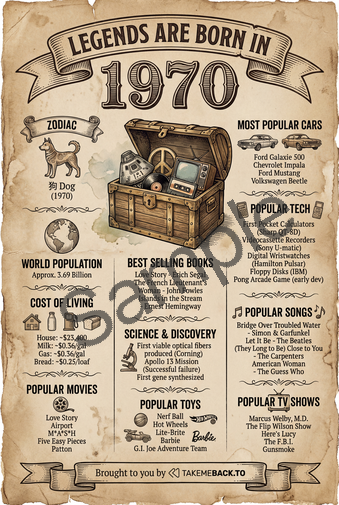

Major Events of 1970 - Historical Moments That Defined the Year | TakeMeBack.to
- 01 Jan National Environmental Policy Act signed into law: The National Environmental Policy Act (NEPA) was signed into law by President Richard Nixon on January 1, 1970. This landmark legislation established a framework for environmental protection and required federal agencies to assess the environmental impacts of their proposed actions before making decisions. source: epa.gov
- 03 Jan Meteorite fall in Oklahoma: On January 3, 1970, a meteorite fell in Oklahoma, causing significant interest among scientists and the public. The event was notable for its size and the impact it had on the local area, contributing to ongoing studies in meteorology and geology. source: nasa.gov
- 04 Jan Devastating Yunnan earthquake strikes: On January 4, 1970, a devastating earthquake struck Yunnan province in China, resulting in significant casualties and damage. The earthquake highlighted the region's vulnerability to seismic activity and prompted discussions on disaster preparedness. source: usgs.gov
- 05 Jan Devastating Tonghai earthquake strikes China: On January 5, 1970, a powerful earthquake struck Tonghai County in Yunnan, China, causing significant destruction and loss of life. The earthquake registered a magnitude of 7.7 and resulted in thousands of casualties and extensive damage to infrastructure. source: earthquake.usgs.gov
- 06 Jan Prince Norodom Sihanouk travels to France for medical treatment: On January 6, 1970, Prince Norodom Sihanouk of Cambodia traveled to France for medical treatment. His health issues and subsequent political developments significantly impacted Cambodia's history during this period. source: britannica.com
- 07 Jan Israeli Air Force Operation Priha: On January 7, 1970, the Israeli Air Force conducted Operation Priha, targeting Palestinian guerrilla bases in response to ongoing attacks. This operation was part of a broader strategy to counteract threats to Israeli security. The operation underscored the ongoing conflict in the region during this period. source: britannica.com
- 08 Jan Dave Eggers author born: Dave Eggers, an American author and publisher, was born on January 8, 1970. He is known for his works such as 'A Heartbreaking Work of Staggering Genius' and for founding the publishing company McSweeney's. Eggers has made significant contributions to contemporary literature and has been involved in various philanthropic efforts. source: britannica.com
- 09 Jan National Environmental Policy Act signed: The National Environmental Policy Act (NEPA) was signed into law on January 9, 1970. This landmark legislation requires federal agencies to assess the environmental effects of their proposed actions before making decisions. NEPA has played a crucial role in environmental protection in the United States. source: epa.gov
- 10 Jan Walt Disney World Preview Center opens in Florida: On January 10, 1970, the Walt Disney World Preview Center opened in Florida, providing visitors with a glimpse of the upcoming Walt Disney World Resort. This center played a crucial role in promoting the resort before its official opening. source: britannica.com
- 11 Jan Sinn Féin political split: On January 11, 1970, Sinn Féin experienced a significant political split, leading to the formation of two factions within the party. This event marked a pivotal moment in Irish politics, influencing the future of the party and its role in the political landscape. source: bbc.com
- 12 Jan Nigerian Civil War ends: The Nigerian Civil War, also known as the Biafran War, officially ended on January 12, 1970. The conflict resulted in significant loss of life and humanitarian crises. The end of the war marked a pivotal moment in Nigeria's history, leading to efforts for national reconciliation. source: bbc.com
- 13 Jan Belfast riots in Ballymurphy: On January 13, 1970, riots broke out in the Ballymurphy area of Belfast, Northern Ireland. The unrest was part of the larger conflict known as The Troubles, characterized by violent clashes between communities. This event highlighted the ongoing tensions in the region. source: bbc.com
- 14 Jan Diana Ross & The Supremes Perform Farewell Concert: On January 14, 1970, Diana Ross & The Supremes performed their farewell concert at the Frontier Hotel in Las Vegas, marking the end of their collaboration. source: en.wikipedia.org
- 15 Jan Nigerian Civil War Ends: Biafran Surrender: On January 15, 1970, Biafran leader Philip Effiong signed the surrender instrument in Lagos, officially ending the Nigerian Civil War. source: en.wikipedia.org
- 16 Jan Curt Flood challenges baseball's reserve clause: On January 16, 1970, Major League Baseball player Curt Flood filed a $1 million lawsuit against Commissioner Bowie Kuhn and Major League Baseball, alleging that the reserve clause violated federal antitrust laws. Flood's action was a significant challenge to the longstanding system that bound players to their teams indefinitely. source: mlb.com
- 18 Jan Vandalism at Karl Marx's Tomb: On January 18, 1970, Karl Marx's tomb in Highgate Cemetery, London, was vandalized. The incident drew attention to the ongoing debates surrounding Marx's legacy and the political ideologies associated with his work. source: theguardian.com
- 19 Jan Nixon nominates G. Harold Carswell to Supreme Court: On January 19, 1970, President Richard Nixon nominated G. Harold Carswell to the Supreme Court. The nomination was met with controversy and debate regarding Carswell's qualifications and judicial philosophy. source: nytimes.com
- 20 Jan First Boeing 747 Commercial Service: The Boeing 747, known as the 'Jumbo Jet', commenced its first commercial service on January 20, 1970. This marked a significant milestone in aviation history, revolutionizing air travel with its large capacity and long-range capabilities. source: boeing.com
- 21 Jan Arrests in Yablonski Murder Case: On January 21, 1970, arrests were made in connection with the murder of United Mine Workers leader Joseph Yablonski. The case drew significant media attention and highlighted issues within labor unions during that period. source: nytimes.com
- 22 Jan Boeing 747 Maiden Commercial Flight: The Boeing 747, the world's first wide-body airliner, completed its maiden commercial flight, revolutionizing air travel with its capacity and range. source: history.com
- 24 Jan Valeri Muratov sets speed skating world record: On January 24, 1970, Soviet speed skater Valeri Muratov set a world record in the men's 500-meter event at the Medeo rink in the Soviet Union. He completed the distance in 38.99 seconds, surpassing the previous record of 39.09 seconds set by himself earlier that month. Muratov's achievement was part of a series of world records he set in January 1970. source: en.wikipedia.org
- 25 Jan M*A*S*H film premiere: The film adaptation of the television series 'M*A*S*H' premiered on January 25, 1970. Directed by Robert Altman, the film is a satirical black comedy set during the Korean War, focusing on the staff of a mobile army surgical hospital. The film received critical acclaim for its sharp wit and ensemble cast, and it later became a successful television series. source: imdb.com
- 26 Jan First Quarter Storm in the Philippines: The First Quarter Storm was a period of political unrest in the Philippines that began on January 26, 1970. It was characterized by mass protests, demonstrations, and confrontations between students, workers, and the government. The unrest was sparked by various social and political issues, including dissatisfaction with the administration of President Ferdinand Marcos. source: en.wikipedia.org
- 27 Jan Erich Heckel: Expressionist Artist: Erich Heckel, a German painter and printmaker, died on January 27, 1970, in Radolfzell, West Germany. He was a founding member of the Expressionist group Die Brücke and is known for his paintings and bold woodcuts of nudes and landscapes. source: britannica.com
- 29 Jan Death of Basil Liddell Hart, renowned military historian: Basil Liddell Hart, a prominent British military historian and strategist, passed away on January 29, 1970. He was known for his influential theories on military strategy and his writings on World War I and II, which shaped modern military thought. source: britannica.com
- 31 Jan Explorer I: First American satellite launch: Explorer I, the first satellite launched by the United States, was successfully placed into orbit on January 31, 1958. This event marked a significant milestone in the space race, contributing to scientific knowledge about cosmic rays and the Earth's atmosphere. source: nasa.gov
- 01 Feb Benavídez rail disaster in Argentina: On February 1, 1970, a tragic train collision occurred near Benavídez, Argentina, resulting in 236 fatalities and over 500 injuries. The accident involved an express train colliding with a stationary local train, making it the deadliest rail disaster in Argentina's history. source: en.wikipedia.org
- 05 Feb Barry Richards scores first Test century: On February 5, 1970, Barry Richards scored his first Test century, making 140 runs off 164 balls against Australia in Durban. He was known for his elegant batting style and was later inducted into the ICC Hall of Fame. source: espncricinfo.com
- 07 Feb Poet Louise Bogan passes away: Louise Bogan, an influential American poet and critic, passed away on February 7, 1970. Known for her lyrical poetry and contributions to literary criticism, Bogan's work has been celebrated for its emotional depth and technical skill. Her legacy continues to influence contemporary poetry. source: nytimes.com
- 08 Feb Nova Scotia oil spill disaster: On February 8, 1970, a significant oil spill occurred off the coast of Nova Scotia, causing extensive environmental damage. The incident raised awareness about the risks associated with offshore drilling and the need for better safety regulations. It prompted discussions on environmental protection measures in Canada. source: nytimes.com
- 09 Feb Tragic explosion on Venezuelan merchant ship Pampatar: On February 9, 1970, the Venezuelan merchant ship Pampatar experienced a tragic explosion, resulting in significant loss of life and damage. The incident highlighted the dangers of maritime transport and led to increased scrutiny of safety protocols in the shipping industry. source: bbc.com
- 10 Feb Record Precipitation on Mount Washington: On February 10, 1970, Mount Washington, New Hampshire, recorded 10.30 inches of precipitation in a 24-hour period, setting a record for the month of February. source: mountwashington.org
- 11 Feb Japan launches first satellite Ōsumi: On February 11, 1970, Japan successfully launched its first satellite, Ōsumi, into orbit. This marked a significant milestone in Japan's space program, making it the fourth country to achieve this feat after the Soviet Union, the United States, and France. source: britannica.com
- 12 Feb Pathet Lao attacks in Laos escalate Vietnam War tensions: On February 12, 1970, the Pathet Lao launched a series of attacks in Laos, intensifying tensions related to the Vietnam War. These actions were part of a broader conflict involving North Vietnamese forces and the U.S.-backed Laotian government. source: britannica.com
- 13 Feb Black Sabbath debut album release: On February 13, 1970, Black Sabbath released their self-titled debut album, which is often credited with pioneering the heavy metal genre. The album featured iconic tracks that would influence countless artists in the years to come. source: britannica.com
- 14 Feb MacDonald family massacre: On February 14, 1970, the MacDonald family was tragically murdered in their home in New York. The case drew significant media attention and remains one of the most infamous unsolved crimes in American history. Investigations into the case have continued for decades. source: nytimes.com
- 15 Feb Nationalist disruption at UN session on Congo: On February 15, 1970, a UN session on the Congo was disrupted by nationalist protests, reflecting the political tensions of the time. The incident underscored the challenges faced by the international community in addressing conflicts in post-colonial Africa. It drew attention to the ongoing struggles for independence and governance in the region. source: un.org
- 16 Feb Joe Frazier wins undisputed heavyweight boxing championship: On February 16, 1970, Joe Frazier defeated Jimmy Ellis to become the undisputed heavyweight boxing champion. The fight took place at Madison Square Garden in New York City, where Frazier won by unanimous decision, solidifying his position as the top contender in the heavyweight division. source: boxingnews24.com
- 17 Feb Death of Nobel Laureate Shmuel Yosef Agnon: On February 17, 1970, Shmuel Yosef Agnon, the Israeli author and Nobel Laureate in Literature, passed away. Agnon was renowned for his works that blend traditional Jewish themes with modernist techniques, and he was awarded the Nobel Prize in 1966 for his contribution to literature. source: nobelprize.org
- 18 Feb Chicago Eight trial verdict delivered: On February 18, 1970, the verdict in the Chicago Eight trial was delivered, where eight defendants were charged with conspiracy and inciting riots during the 1968 Democratic National Convention. The trial was a significant moment in the counterculture movement and highlighted tensions in American society. source: history.com
- 19 Feb USSR launches satellites: On February 19, 1970, the Soviet Union launched several satellites as part of its ongoing space program. This event was part of the Cold War space race, showcasing the USSR's advancements in space technology and exploration. source: nasa.gov
- 21 Feb Jackson 5 Television Debut: The Jackson 5 made their television debut on February 21, 1970, performing on the 'Ed Sullivan Show,' marking a significant milestone in their rise to fame. source: history.com
- 22 Feb Guyana Becomes a Republic: On February 22, 1970, Guyana officially became a republic, severing its ties with the British monarchy and establishing itself as a sovereign nation. source: en.wikipedia.org
- 23 Feb Guyana becomes a republic (National Day): On February 23, 1970, Guyana declared itself a republic, severing its remaining constitutional ties with the British monarchy. This move marked a significant step in the nation's journey toward full sovereignty and self-governance. The first President of the Republic was Arthur Raymond Chung, appointed by the National Assembly. source: parliament.gov.gy
- 24 Feb KVDO TV Channel 3 launches in Salem, Oregon: KVDO TV Channel 3 began broadcasting in Salem, Oregon, as an independent station. The station faced financial challenges and was sold to Liberty Communications in 1972, later becoming part of Oregon Public Broadcasting in 1976. source: en.wikipedia.org
- 25 Feb Death of Mark Rothko: Mark Rothko, a prominent American abstract expressionist painter, died by suicide in his New York studio on February 25, 1970. He was 66 years old at the time of his death. source: biography.com
- 26 Feb Broadway musical 'Georgy' opens at Winter Garden Theatre: The musical 'Georgy' opened at the Winter Garden Theatre in New York City on February 26, 1970. Despite high expectations, the production closed after only four performances. source: ibdb.com
- 28 Feb Birth of Daniel Handler, author known as Lemony Snicket: Daniel Handler, an American author, was born on February 28, 1970, in San Francisco, California. He is best known for his children's book series 'A Series of Unfortunate Events' and 'All the Wrong Questions,' published under the pen name Lemony Snicket. source: en.wikipedia.org
- 01 Mar Austrian parliamentary election: Parliamentary elections were held in Austria on March 1, 1970. The Socialist Party (SPÖ) emerged as the largest party in the National Council, winning 81 of the 165 seats, just two seats short of an absolute majority. SPÖ leader Bruno Kreisky became Chancellor at the head of a minority government, marking the first Socialist-led government since 1920. source: en.wikipedia.org
- 02 Mar Rhodesia declares itself a republic: On March 2, 1970, Rhodesian Prime Minister Ian Smith declared Rhodesia a republic, severing its last ties with the British Crown. This move followed a 1969 referendum in which the electorate approved both the adoption of a republican form of government and a new constitution. The declaration was unrecognized by the United Kingdom and the international community. source: news.bbc.co.uk
- 03 Mar Rick Mirer born: Rick Mirer, a former American football quarterback, was born on March 3, 1970. He played in the NFL for several teams, including the Seattle Seahawks and the Chicago Bears. Mirer was known for his strong arm and leadership on the field. source: pro-football-reference.com
- 04 Mar Black Panthers protest at Queens House of Detention: On March 4, 1970, members of the Black Panther Party protested outside the Queens House of Detention in New York City. The protest was aimed at advocating for the rights of incarcerated individuals and raising awareness about police brutality. This event was part of a broader movement during the civil rights era. source: nytimes.com
- 05 Mar Nuclear Non-Proliferation Treaty takes effect: The Nuclear Non-Proliferation Treaty (NPT) officially took effect on March 5, 1970. This treaty aimed to prevent the spread of nuclear weapons and promote peaceful uses of nuclear energy. It is considered a cornerstone of global nuclear disarmament efforts. source: un.org
- 06 Mar The Beatles release 'Let It Be' in the UK: On March 6, 1970, The Beatles released their final studio album, 'Let It Be,' in the United Kingdom. The album features tracks like 'Across the Universe' and 'Let It Be,' and was accompanied by a film of the same name, documenting the band's recording sessions. source: en.wikipedia.org
- 07 Mar Total solar eclipse visible in parts of the world: On March 7, 1970, a total solar eclipse was visible in parts of the world, including regions of the Pacific Ocean and South America. Total solar eclipses occur when the moon completely covers the sun, casting a shadow on Earth. source: en.wikipedia.org
- 08 Mar Assassination attempt on Cyprus President Makarios III: On March 8, 1970, an assassination attempt was made on President Makarios III of Cyprus. As he departed in a helicopter for Makhaeras Monastery, assailants fired at the helicopter, wounding the pilot but leaving Makarios unharmed. The pilot managed to land safely, and Makarios proceeded to the monastery. The attackers escaped, and investigations implicated former Interior Minister Polycarpos Georkadjis and a right-wing terrorist organization, the National Front. source: history.state.gov
- 10 Mar U.S. Military charges Captain Ernest Medina for My Lai War crimes: On March 10, 1970, Captain Ernest Medina was charged with war crimes related to the My Lai Massacre during the Vietnam War. The charges included murder and assault for his role in the deaths of hundreds of Vietnamese civilians in 1968. This marked a significant development in the U.S. military's efforts to address atrocities committed during the conflict. source: archives.gov
- 11 Mar Iraq recognizes Kurdish nation: On March 11, 1970, Iraq officially recognized the Kurdish nation, granting autonomy to the Kurdish region. This recognition was part of a broader agreement aimed at addressing Kurdish demands for rights and self-governance within Iraq. source: bbc.com
- 12 Mar Finland-Soviet peace agreement: On March 12, 1970, Finland and the Soviet Union signed a peace agreement aimed at strengthening bilateral relations and ensuring mutual security. This agreement was significant in the context of Cold War dynamics in Northern Europe. source: britannica.com
- 13 Mar Digital Equipment Corp introduces PDP-11 minicomputer: On March 13, 1970, Digital Equipment Corporation (DEC) introduced the PDP-11, a 16-bit minicomputer that became one of the most successful product lines in DEC's history. The PDP-11 featured a unique Unibus architecture, allowing all system elements—processor, memory, and peripherals—to interface through a single, bidirectional, asynchronous bus. This design enabled devices to send, receive, or exchange data without intermediate buffering in memory. The PDP-11 was widely used in business, scientific, educational, and timesharing applications, and it played a significant role in the development and popularization of the Unix operating system. source: en.wikipedia.org
- 16 Mar Publication of the New English Bible: The New English Bible was published on March 16, 1970, aiming to provide a modern translation of the scriptures. This translation was notable for its use of contemporary language and was intended for both academic and general audiences. source: britannica.com
- 17 Mar My Lai Massacre: US Army charges officers: On March 17, 1970, the US Army announced charges against several officers involved in the My Lai Massacre, where hundreds of Vietnamese civilians were killed. This event raised significant ethical questions regarding military conduct during the Vietnam War. source: archives.gov
- 18 Mar US Postal Workers Strike: On March 18, 1970, postal workers in New York City initiated a strike demanding better wages and working conditions. The strike quickly spread nationwide, involving approximately 200,000 workers. President Nixon responded by deploying military personnel to deliver mail, and the strike concluded after eight days, leading to the Postal Reorganization Act of 1970. source: en.wikipedia.org
- 20 Mar Nixon signs Public Health Cigarette Smoking Act: On March 20, 1970, President Richard Nixon signed the Public Health Cigarette Smoking Act into law, which banned cigarette advertising on television and radio. This legislation was part of a broader effort to address the health risks associated with smoking and to promote public health awareness. source: ncbi.nlm.nih.gov
- 21 Mar First Earth Day proclamation issued: On March 21, 1970, the first Earth Day proclamation was issued, marking a significant step in the environmental movement. This event aimed to raise awareness about environmental issues and promote sustainability practices. source: earthday.org
- 22 Mar Kathy Whitworth wins Orange Blossom Classic: On March 22, 1970, Kathy Whitworth secured victory at the Orange Blossom Classic in Florida, marking her third consecutive win at this event. She finished with a score of 216 (even par), leading runner-up Carol Mann by one stroke. source: en.wikipedia.org
- 26 Mar Mark Osher Profile: Brief mention of Mark Osher, an Australian writer, with insufficient context provided.
- 28 Mar Tragic loss of French submarine Eurydice: On March 4, 1970, the French submarine Eurydice (S644) was lost in the Mediterranean Sea off Cape Camarat, France, with all 57 crew members aboard. An underwater explosion was detected, and despite extensive search efforts, the wreckage was not found until April 22, 1970. The exact cause of the explosion remains undetermined, though a collision with the Tunisian ship Tabarka has been suggested. source: reuters.com
- 31 Mar Explorer 1 re-enters Earth's atmosphere after 12 years in orbit: Explorer 1, the first U.S. satellite launched in 1958, re-entered Earth's atmosphere on March 31, 1970, after completing over 58,000 orbits. The satellite's primary mission was to detect cosmic rays, leading to the discovery of the Van Allen radiation belts. source: jpl.nasa.gov
- 01 Apr Public Health Cigarette Smoking Act signed: On April 1, 1970, President Richard Nixon signed the Public Health Cigarette Smoking Act into law, which mandated health warnings on cigarette packages and banned cigarette advertising on television and radio, marking a significant step in tobacco regulation. source: en.wikipedia.org
- 04 Apr Gay Trip wins the Grand National: On April 4, 1970, Gay Trip, ridden by jockey Pat Taaffe, won the 124th Grand National steeplechase at Aintree, England, finishing 20 lengths ahead of the second-place horse. source: en.wikipedia.org
- 05 Apr WSNS TV Channel 44 begins broadcasting in Chicago: WSNS TV Channel 44, an independent television station in Chicago, began broadcasting on April 5, 1970. source: americanradiohistory.com
- 06 Apr Launch of BBC Radio 4's 'PM' programme: BBC Radio 4 launched its 'PM' programme on April 6, 1970, providing news and current affairs coverage. source: bbc.co.uk
- 08 Apr Osaka Gas Explosion Disaster: On April 8, 1970, a gas explosion occurred in Osaka, Japan, resulting in significant casualties and damage. The incident highlighted safety issues related to gas infrastructure in urban areas. source: britannica.com
- 09 Apr The Beatles officially disband: On April 9, 1970, Paul McCartney announced that he was leaving The Beatles, effectively marking the official disbandment of the iconic band. This announcement came as a surprise to fans and marked the end of an era in music history. source: bbc.com
- 10 Apr The Beatles break up announcement: On April 10, 1970, Paul McCartney's public announcement of his departure from The Beatles was widely interpreted as the band's official breakup. This announcement was a significant moment in music history, signaling the end of the group's collaboration. source: bbc.com
- 11 Apr Apollo 13 mission launched successfully: The Apollo 13 mission was launched on April 11, 1970, from Kennedy Space Center. It was intended to be the third crewed mission to land on the Moon, but it faced a critical in-flight emergency that would later lead to a dramatic rescue operation. source: nasa.gov
- 12 Apr Yankees honor baseball legends at ceremony: On April 12, 1970, the New York Yankees held a ceremony to honor several baseball legends. This event celebrated the contributions of these players to the sport and highlighted the Yankees' rich history in Major League Baseball. source: nytimes.com
- 13 Apr Mikis Theodorakis released: On April 13, 1970, Greek composer Mikis Theodorakis was released from imprisonment. His release was celebrated by many, as he was a prominent figure in the fight for democracy in Greece during a period of political oppression. source: bbc.com
- 14 Apr Apollo 13 mission crisis: On April 14, 1970, the Apollo 13 mission faced a critical crisis following the oxygen tank explosion. NASA worked tirelessly to ensure the safe return of the astronauts, showcasing remarkable problem-solving and teamwork. source: nasa.gov
- 15 Apr First Earth Day celebrated nationwide: On April 15, 1970, the first Earth Day was celebrated across the United States, marking a significant moment in the environmental movement. This event aimed to raise awareness about environmental issues and promote sustainability. source: earthday.org
- 17 Apr Apollo 13 mission returns safely to Earth: On April 17, 1970, the Apollo 13 command module splashed down in the South Pacific Ocean, four miles from the recovery ship, concluding a mission that faced significant challenges after an oxygen tank explosion en route to the Moon. source: nasa.gov
- 18 Apr Apollo 13 astronauts honored after miraculous space mission: On April 18, 1970, President Nixon awarded the Presidential Medal of Freedom to the Apollo 13 Mission Operations Team in recognition of their efforts during the mission's crisis. source: nasa.gov
- 19 Apr 24th Tony Awards honors Broadway achievements: The 24th Annual Tony Awards ceremony took place on April 19, 1970, at the Mark Hellinger Theatre in New York City. Hosted by Julie Andrews, Shirley MacLaine, and Walter Matthau, the event featured performances from notable musicals such as "Applause," "Coco," and "Purlie." Lauren Bacall won Best Actress in a Musical for her role in "Applause." source: tonyawards.com
- 20 Apr Nixon accelerates Vietnam troop withdrawal: On April 20, 1970, President Richard Nixon announced an acceleration of U.S. troop withdrawals from Vietnam, aiming to reduce American military presence in the region amid ongoing peace negotiations. source: archives.gov
- 21 Apr Apollo 13 mission crisis: On April 21, 1970, the Apollo 13 mission faced a critical crisis when an oxygen tank exploded, jeopardizing the lives of astronauts Jim Lovell, Jack Swigert, and Fred Haise. The explosion led to a life-threatening situation, but through ingenuity and teamwork, NASA's Mission Control and the crew managed to safely return to Earth. source: reuters.com
- 22 Apr First Earth Day celebrated in the United States: On April 22, 1970, the first Earth Day was celebrated in the United States, marking a significant milestone in environmental activism. Initiated by Senator Gaylord Nelson, the event saw millions of Americans participating in rallies, teach-ins, and educational programs to raise awareness about environmental issues. source: history.com
- 24 Apr China launches first satellite Dong Fang Hong I: On April 24, 1970, China successfully launched its first satellite, Dong Fang Hong I, atop a Long March 1 rocket from the Jiuquan Satellite Launch Center. The 173 kg satellite, developed under the direction of Qian Xuesen, carried a radio transmitter that broadcast the song "Dong Fang Hong" for 20 days while in orbit. source: en.wikipedia.org
- 26 Apr World Intellectual Property Organization convention established: The World Intellectual Property Organization (WIPO) was established on April 26, 1970, to promote the protection of intellectual property worldwide. It plays a crucial role in international IP law and policy. source: wipo.int
- 28 Apr Nixon authorizes Cambodia invasion: On April 28, 1970, President Richard Nixon announced the authorization of U.S. troops to invade Cambodia during the Vietnam War. This decision sparked significant protests and controversy across the United States. source: archives.gov
- 29 Apr Chelsea wins FA Cup final replay: On April 29, 1970, Chelsea defeated Leeds United 2-1 after extra time in the FA Cup final replay at Old Trafford, securing their first FA Cup title. source: en.wikipedia.org
- 30 Apr Kent State and Jackson State protests erupt: On April 30, 1970, following President Nixon's announcement of the Cambodia incursion, protests erupted at Kent State University and Jackson State College, leading to violent confrontations with law enforcement. source: history.com
- 01 May Nixon announces Cambodian campaign: On May 1, 1970, President Nixon announced the Cambodian Campaign, a series of military operations conducted by U.S. and South Vietnamese forces in eastern Cambodia. source: en.wikipedia.org
- 02 May 96th Kentucky Derby winner: On May 2, 1970, Dust Commander, ridden by jockey Mike Manganello, won the 96th Kentucky Derby at Churchill Downs. The horse was trained by Don Combs and owned by Robert E. Lehmann. Dust Commander completed the race in 2:03.4, finishing ahead of My Dad George and High Echelon. source: en.wikipedia.org
- 03 May New York Knicks win NBA Championship: On May 3, 1970, the New York Knicks secured their first NBA Championship by defeating the Los Angeles Lakers in Game 7 of the NBA Finals. The Knicks won 113-99, with Willis Reed playing a pivotal role despite an earlier injury. This victory marked a significant achievement in the franchise's history. source: nba.com
- 04 May Kent State shootings: A tragic day in American protest history: On May 4, 1970, during a protest against the Vietnam War at Kent State University in Ohio, the Ohio National Guard opened fire on unarmed students, resulting in four deaths and nine injuries. This incident intensified national division over the war and led to significant student protests, with around 4 million students striking and temporarily closing approximately 900 colleges and universities. source: apnews.com
- 05 May Kyan Douglas birth: Kyan Douglas, born Hugh Edward Douglas Jr., is an American television personality and stylist, best known as the grooming expert on the TV program 'Queer Eye' from 2003 to 2007. source: en.wikipedia.org
- 06 May First ski descent of Mount Everest: On May 6, 1970, Japanese mountaineer Yuichiro Miura became the first person to ski from the South Col of Mount Everest, descending nearly 6,600 vertical feet. source: en.wikipedia.org
- 08 May The Beatles release their final album, 'Let It Be': On May 8, 1970, The Beatles released 'Let It Be,' their twelfth and final studio album. Recorded before their previous album, 'Abbey Road,' 'Let It Be' features classics like the title track, 'Get Back,' 'The Long and Winding Road,' and 'Across The Universe.' The album topped the Billboard Album chart for four weeks. source: digital.abcaudio.com
- 09 May Death of labor leader Walter Reuther: Walter Reuther, a prominent labor leader and president of the United Auto Workers, died in a plane crash on May 9, 1970. His death marked a significant loss for the labor movement in the United States. source: nytimes.com
- 10 May Devastating Lubbock tornado: On May 10, 1970, a powerful tornado struck Lubbock, Texas, causing extensive damage and resulting in fatalities. This event is remembered as one of the most destructive tornadoes in Texas history. source: weather.gov
- 11 May Augusta Civil Rights Uprising of 1970: Beginning on May 11, 1970, Augusta, Georgia, witnessed a significant uprising by Black citizens protesting the death of Charles Oatman, a 16-year-old Black teenager who died under suspicious circumstances in the county jail. The unrest led to property damage and the deaths of six Black men. source: georgiahistory.com
- 12 May Tragic Race Riots in Augusta, Georgia: On May 12, 1970, the unrest in Augusta, Georgia, continued, resulting in further property damage and the deaths of additional Black residents. The riots were a response to systemic racial injustices and the death of Charles Oatman in the county jail. source: georgiahistory.com
- 13 May Franz Stangl war crimes trial begins: The war crimes trial of Franz Stangl, former commandant of the Treblinka and Sobibor extermination camps, began on May 13, 1970. Stangl was charged with the murder of approximately 900,000 Jews during the Holocaust. source: en.wikipedia.org
- 14 May Andreas Baader's prison break: On May 14, 1970, Andreas Baader, a member of the Red Army Faction, was freed from custody in Berlin. The escape was orchestrated by fellow RAF members, including Ulrike Meinhof, who facilitated his release by creating a diversion and allowing him to flee through a window. This event marked a significant moment in the history of the RAF. source: mustardayonnaise.com
- 15 May IOC extends South Africa’s ban from Olympic Games: On May 15, 1970, the International Olympic Committee (IOC) extended South Africa's ban from the Olympic Games, resulting in the country's exclusion from the 1972 Munich Games. This decision was influenced by South Africa's apartheid policies, which led to widespread international condemnation. source: sahistory.org.za
- 17 May Hank Aaron reaches 3,000 hit milestone: On May 17, 1970, Hank Aaron of the Atlanta Braves achieved his 3,000th career hit with a single off Cincinnati Reds pitcher Wayne Simpson at Crosley Field. Aaron became the ninth player in Major League Baseball history to reach this milestone, joining an exclusive club of hitters. source: mlb.com
- 18 May Release of The Beatles' 'Let It Be' album: On May 18, 1970, The Beatles released their final studio album, "Let It Be." The album features the band's last recorded songs and includes the iconic title track, "Let It Be." source: en.wikipedia.org
- 20 May Vietnam War Support March in New York: On May 20, 1970, over 100,000 New Yorkers marched through lower Manhattan to demonstrate support for the Vietnam War and the Nixon administration. The event was organized by the Building and Construction Trades Council of Greater New York, featuring participants such as construction workers and union members. The demonstration was marked by American flags, patriotic tunes, and fervent speeches, with signs denouncing Mayor John Lindsay's anti-war stance. source: janos.nyc
- 23 May Soviet nuclear underground test: On May 23, 1970, the Soviet Union conducted a nuclear underground test, part of its ongoing nuclear weapons program. This test was part of a series of tests during the Cold War, contributing to global tensions and arms control discussions. The event is documented in various nuclear test archives. source: ctbto.org
- 24 May Kola Superdeep Borehole drilling commences: On May 24, 1970, drilling began on the Kola Superdeep Borehole, a scientific drilling project in Russia aimed at exploring the Earth's crust. This project has provided valuable geological insights and remains one of the deepest boreholes in the world. It has contributed significantly to our understanding of geology. source: britannica.com
- 25 May Indiana Pacers win third ABA Championship: On May 25, 1970, the Indiana Pacers secured their third American Basketball Association (ABA) Championship. The Pacers were a dominant team in the ABA during the late 1960s and early 1970s, contributing to the league's growth and popularity. source: en.wikipedia.org
- 27 May Devastating Ancash earthquake in Peru: On May 27, 1970, a catastrophic earthquake struck the Ancash region of Peru, registering a magnitude of 7.9. The disaster resulted in significant loss of life and widespread destruction, particularly in the town of Yungay, which was buried under an avalanche triggered by the quake. Estimates suggest that around 66,000 people died as a result of the earthquake and its aftermath. source: britannica.com
- 28 May Bobby Moore arrested in Colombia: On May 28, 1970, English footballer Bobby Moore was arrested in Colombia for allegedly attempting to steal a bracelet from a shop. The incident occurred just before the 1970 FIFA World Cup, where Moore was the captain of the England national team. He was later released without charges, and the incident became a notable moment in World Cup history. source: bbc.com
- 30 May Jimi Hendrix's penultimate live performance: On May 30, 1970, Jimi Hendrix performed at the Berkeley Community Theatre in California. This concert was part of his 'The Cry of Love Tour' and was recorded for the live album 'Live at Berkeley,' released in 2003. The setlist included classics like 'Hey Joe,' 'Purple Haze,' and 'Voodoo Child (Slight Return),' showcasing Hendrix's enduring influence on rock music. source: en.wikipedia.org
- 31 May Ancash earthquake in Peru: On May 31, 1970, a devastating earthquake struck the Ancash region in Peru. The earthquake, with a magnitude of 7.9, caused widespread destruction and resulted in significant loss of life. It remains one of the most catastrophic natural disasters in Peruvian history. source: en.wikipedia.org
- 01 Jun Soyuz 9 Space Mission Launched: On June 1, 1970, the Soviet Union launched Soyuz 9, a crewed space mission that set a new space endurance record with a nearly 18-day flight. The mission aimed to study the effects of prolonged weightlessness and prepare for future space station missions. source: en.wikipedia.org
- 03 Jun The Kinks' 'Lola' lyric modification: In June 1970, The Kinks' song "Lola" faced a ban from the BBC due to the mention of "Coca-Cola," violating their policy against product placement. To comply, lead singer Ray Davies flew from New York to London on June 3, 1970, to re-record the line, changing "Coca-Cola" to "cherry cola." This effort ensured the song's release and subsequent success. source: ultimateclassicrock.com
- 04 Jun Tonga Gains Independence: On June 4, 1970, Tonga gained independence from British protection, becoming a fully sovereign nation. source: Wikipedia (day-month pages)
- 05 Jun Nixon announces withdrawal of troops from Cambodia: On June 5, 1970, President Richard Nixon announced that American troops would be withdrawn from Cambodia after achieving all major military objectives. He stated that half of the 31,000 U.S. troops in Cambodia had already returned to South Vietnam, with the remainder to follow by the end of the month. source: nixonfoundation.org
- 08 Jun Argentine military coup deposes President Onganía: On June 8, 1970, Argentine President Juan Carlos Onganía was ousted by a military coup led by Army Commander-in-Chief Alejandro Lanusse. The military junta that took control appointed General Roberto Marcelo Levingston as the new president. source: history.state.gov
- 09 Jun Harry A. Blackmun appointed to U.S. Supreme Court: On June 9, 1970, President Richard Nixon nominated Harry A. Blackmun to the U.S. Supreme Court. Blackmun was confirmed and served on the Court until 1994. source: en.wikipedia.org
- 10 Jun Portuguese Counter-Offensive in Mozambique: On June 10, 1970, the Portuguese army launched Operation Gordian Knot (Operação Nó Górdio), a seven-month military campaign targeting permanent insurgent camps and infiltration routes across the Tanzanian border in northern Mozambique. The operation involved approximately 35,000 Portuguese troops, including elite units such as paratroopers, commandos, marines, and naval fusiliers. source: en.wikipedia.org
- 11 Jun First Women Generals in U.S. Army History: On June 11, 1970, the U.S. Army appointed its first female generals, paving the way for greater gender equality in military leadership roles. This milestone marked a significant advancement in the integration of women into higher echelons of the military. source: armytimes.com
- 12 Jun Brazil Wins 1970 FIFA World Cup: On June 12, 1970, Brazil won the FIFA World Cup, defeating Italy 4-1 in the final held in Mexico City. This victory marked Brazil's third World Cup title, making them the first nation to achieve such a feat. source: fifa.com
- 13 Jun The Beatles' final number 1 single: On June 13, 1970, "The Long and Winding Road" became The Beatles' 20th and final number 1 hit on the U.S. Billboard Hot 100 chart. The song, written by Paul McCartney, was part of their final studio album, "Let It Be," released in May 1970. source: en.wikipedia.org
- 15 Jun Soviet plane hijacking attempt: On June 15, 1970, a group of 16 Soviet refuseniks attempted to hijack an Antonov An-2 aircraft in Leningrad, aiming to escape to Israel. The plan, known as "Operation Wedding," was thwarted when the KGB arrested the group at Smolny Airport before they could board the plane. source: en.wikipedia.org
- 17 Jun Brazil triumphs in 1970 FIFA World Cup: On June 17, 1970, Brazil won the FIFA World Cup, defeating Italy 4-1 in the final held in Mexico City. This victory marked Brazil's third World Cup title, solidifying its status as a football powerhouse. source: bbc.com
- 18 Jun Penn Central bankruptcy: On June 18, 1970, the Penn Central Transportation Company filed for bankruptcy, marking one of the largest bankruptcies in U.S. history at the time. This event highlighted the challenges faced by the railroad industry in the 20th century. source: nytimes.com
- 19 Jun British Conservative Party wins election: On June 19, 1970, the British Conservative Party, led by Edward Heath, won the general election, ending 13 years of Labour government. This election marked a significant political shift in the UK. source: bbc.com
- 20 Jun Edward Heath forms British government: Following the Conservative Party's victory in the June 19, 1970 election, Edward Heath was appointed Prime Minister on June 20, 1970. His government focused on various reforms and policies during its tenure. source: bbc.com
- 21 Jun Brazil wins third FIFA World Cup: Brazil secured its third FIFA World Cup title by defeating Italy 4-1 in the final held at the Estadio do Maracanã in Rio de Janeiro. This victory solidified Brazil's status as a football powerhouse, showcasing legendary players like Pelé. The match is remembered for its high skill level and dramatic moments. source: britannica.com
- 22 Jun 26th Amendment signed, lowering voting age: The 26th Amendment to the United States Constitution was signed into law on June 22, 1970, lowering the voting age from 21 to 18. This amendment was a response to the growing movement advocating for younger citizens' rights, particularly in light of the Vietnam War. It marked a significant expansion of democratic participation in the U.S. source: archives.gov
- 23 Jun Charles Rangel defeats Adam Clayton Powell in Democratic primary: On June 23, 1970, Charles Rangel won the Democratic primary against Adam Clayton Powell, marking a significant political shift in Harlem. Rangel's victory was seen as a response to Powell's controversies and a desire for new leadership in the community. source: nytimes.com
- 24 Jun US Senate repeals Gulf of Tonkin Resolution: On June 24, 1970, the U.S. Senate voted to repeal the Gulf of Tonkin Resolution, which had granted President Lyndon B. Johnson broad powers to conduct military operations in Vietnam. This repeal was a significant step in the growing opposition to the Vietnam War. source: congress.gov
- 25 Jun Birth of Erki Nool, Estonian Olympic decathlete: Erki Nool, an Estonian decathlete and Olympic gold medalist, was born on June 25, 1970. He gained international recognition for his athletic achievements, particularly during the 2000 Sydney Olympics where he won the gold medal in decathlon. source: bbc.com
- 26 Jun The Controversial Huston Plan: The Huston Plan was a controversial proposal by the Nixon administration aimed at increasing surveillance of anti-war activists and civil rights groups. It was met with significant backlash and was ultimately never fully implemented, highlighting tensions between national security and civil liberties during the Vietnam War era. source: archives.gov
- 27 Jun Northern Ireland Civil Rights Riots: The Northern Ireland Civil Rights Riots erupted as part of the civil rights movement advocating for equal rights for the Catholic minority in Northern Ireland. The protests were met with violent responses from police, leading to significant unrest and marking a pivotal moment in the conflict known as The Troubles. source: bbc.com
- 28 Jun First Pride March in U.S. History: The first Pride march in U.S. history took place on June 28, 1970, in New York City, commemorating the one-year anniversary of the Stonewall Riots. This event marked a significant moment in the LGBTQ+ rights movement, promoting visibility and advocacy for LGBTQ+ rights across the nation. source: history.com
- 29 Jun US military withdrawal from Cambodia: On June 29, 1970, President Richard Nixon announced the withdrawal of U.S. troops from Cambodia, marking a significant escalation in the Vietnam War. This decision aimed to combat North Vietnamese forces operating in Cambodia, leading to widespread protests and controversy in the United States. source: archives.gov
- 30 Jun FDA organizational change: On June 30, 1970, the U.S. Food and Drug Administration (FDA) underwent significant organizational changes to improve its regulatory processes. This restructuring aimed to enhance the agency's ability to oversee food safety and drug approval, reflecting the growing public concern over health and safety standards. source: fda.gov
- 01 Jul Restoration of provinces in West Pakistan: On July 1, 1970, the government of Pakistan restored the provincial structure in West Pakistan, which had been abolished in 1955. This move aimed to address regional disparities and improve governance in the provinces, leading to significant political changes in the country. source: britannica.com
- 02 Jul Conservative Party Parliamentary Session begins in UK: On July 2, 1970, the Conservative Party Parliamentary Session began in the United Kingdom. This session marked a period of significant political activity, with the Conservative Party, led by Edward Heath, focusing on economic reforms and addressing labor relations during a time of industrial unrest.
- 03 Jul Falls Road Curfew in Belfast: From July 3 to 5, 1970, the British Army imposed a curfew in the Falls district of Belfast, Northern Ireland, to search for weapons. The operation led to riots, gun battles with the IRA, and resulted in four civilian deaths and numerous injuries. source: en.wikipedia.org
- 06 Jul California passes first no-fault divorce law: On July 6, 1970, California enacted the Family Law Act, becoming the first state to allow couples to dissolve their marriages without assigning fault. This law permitted divorces based on "irreconcilable differences," eliminating the need to prove wrongdoing by either spouse. source: cbs8.com
- 12 Jul Janis Joplin's Kentucky Debut: On June 12, 1970, Janis Joplin debuted her new band, Full-Tilt Boogie, at Freedom Hall in Louisville, Kentucky. source: pbs.org
- 14 Jul 41st MLB All-Star Game: The 41st Major League Baseball All-Star Game was played on July 14, 1970, at Riverfront Stadium in Cincinnati, Ohio, resulting in a 5–4 victory for the National League. source: en.wikipedia.org
- 16 Jul 9th British Commonwealth Games begin: The 9th British Commonwealth Games commenced in Edinburgh, Scotland, on July 16, 1970. This event marked the first time the Games were held in Scotland and the first time metric units were used in all events. source: bowls.org.hk
- 18 Jul Soviet plane crash in the Atlantic Ocean: On July 18, 1970, a Soviet Antonov An-22 cargo plane crashed into the Atlantic Ocean between Iceland and Greenland, resulting in the deaths of all 22 people on board. The aircraft was en route to deliver humanitarian aid to Peru following the Ancash earthquake. source: en.wikipedia.org
- 19 Jul Judy Rankin wins LPGA Springfield Jaycee Golf Open: On July 19, 1970, Judy Rankin won the LPGA Springfield Jaycee Golf Open, marking a significant achievement in her professional golf career.
- 20 Jul Bill Singer's No-Hitter Against Philadelphia Phillies: On July 20, 1970, Los Angeles Dodgers pitcher Bill Singer threw a no-hitter against the Philadelphia Phillies at Dodger Stadium, marking the first no-hitter for the Dodgers since Sandy Koufax's perfect game in 1965. source: mlb.com
- 23 Jul Qaboos bin Said al Said becomes Sultan of Oman: On July 23, 1970, Qaboos bin Said overthrew his father, Sultan Said bin Taimur, in a bloodless coup with British support. This event marked the beginning of significant modernization and development in Oman, as Qaboos initiated reforms to end the country's isolation and utilize its oil revenue for progress. source: britannica.com
- 26 Jul Johnny Bench hits three consecutive home runs against Steve Carlton: On July 26, 1970, Johnny Bench of the Cincinnati Reds hit three consecutive home runs off pitcher Steve Carlton of the St. Louis Cardinals, contributing to a 12-5 victory. source: redlegnation.com
- 27 Jul France conducts nuclear test at Mururoa Atoll: On July 27, 1970, France conducted a nuclear test at Mururoa Atoll in the South Pacific, raising international concerns over nuclear proliferation. source: abc.net.au
- 28 Jul NASA Administrator Thomas Paine's resignation accepted by President Nixon: On July 28, 1970, President Richard Nixon accepted the resignation of Dr. Thomas O. Paine as Administrator of NASA, effective September 15, 1970. Paine had led NASA during the Apollo missions and chose to return to private life. source: presidency.ucsb.edu
- 29 Jul Death of conductor George Szell: George Szell, the renowned conductor and music director of the Cleveland Orchestra, died on July 30, 1970, in Cleveland, Ohio, from bone cancer. He was 73 years old. source: britannica.com
- 30 Jul Asteroid Discoveries by Smirnova: Astronomer Smirnova made significant astronomical contributions by discovering three asteroids: 1835 Gajdariya, 2032 Ethel, and 2349 Kurchenko. These discoveries contribute to our understanding of celestial bodies in the solar system.
- 02 Aug Kevin Smith Born: Kevin Patrick Smith, an American filmmaker, was born on August 2, 1970, in Red Bank, New Jersey. He is best known for directing and writing films such as 'Clerks' and 'Chasing Amy'. source: en.wikipedia.org
- 03 Aug Hurricane Celia: Historic Gulf storm: Hurricane Celia formed in the Gulf of Mexico and made landfall in Texas, causing significant damage and flooding. It was one of the most intense hurricanes of the 1970 season, impacting coastal communities and leading to evacuations. source: nhc.noaa.gov
- 04 Aug Jim Morrison arrested for public intoxication: Jim Morrison, the lead singer of The Doors, was arrested in New Haven, Connecticut, for public intoxication and indecent exposure during a concert. This incident became one of the most notorious moments in rock history. source: rollingstone.com
- 05 Aug Huey Newton released after legal battles: Huey Newton, co-founder of the Black Panther Party, was released from prison after a series of legal battles. His release was a significant moment in the civil rights movement and highlighted issues of racial injustice in the United States. source: history.com
- 06 Aug Festival for Peace concert at Shea Stadium: The Festival for Peace concert took place on August 6, 1970, at Shea Stadium in New York City. This event featured various artists and aimed to promote peace during a tumultuous period in American history, particularly in relation to the Vietnam War. source: nytimes.com
- 07 Aug First computer chess tournament: The first computer chess tournament was held on August 7, 1970, marking a significant milestone in artificial intelligence and computer science. This event showcased the capabilities of early computer programs in playing chess against human opponents. source: chess.com
- 08 Aug Capture of Lolita: Orca Whale Taken from Puget Sound: On August 8, 1970, Lolita, a young orca from the Southern Resident community, was captured in Penn Cove, Washington. She was one of seven orcas taken into captivity during this operation, which resulted in the deaths of several others. Lolita was sold to the Miami Seaquarium, where she performed for over five decades before passing away in 2023. source: seattletimes.com
- 10 Aug Jim Morrison's obscenity trial in Miami begins: On August 10, 1970, The Doors' lead singer Jim Morrison's trial for lewd and lascivious behavior commenced in Miami, Florida. The charges stemmed from a March 1, 1969, concert at the Dinner Key Auditorium, where Morrison was accused of indecent exposure and profanity. The trial lasted several weeks, culminating in Morrison's conviction on two counts and sentencing to six months in prison and a $500 fine. source: history.com
- 11 Aug IRA bombing in Northern Ireland: On August 11, 1970, the Provisional Irish Republican Army (IRA) carried out a bombing in Northern Ireland, marking a significant escalation in the conflict known as The Troubles. The attack resulted in multiple casualties and heightened tensions in the region. source: en.wikipedia.org
- 12 Aug United States Postal Service established: On August 12, 1970, the United States Postal Service (USPS) was established as an independent establishment of the executive branch of the U.S. government. The USPS took over the functions of the former Post Office Department, aiming to provide reliable and efficient mail services across the country. source: en.wikipedia.org
- 14 Aug CUNY implements open admissions policy: On August 14, 1970, the City University of New York (CUNY) adopted an open admissions policy, allowing all New York City high school graduates to attend its colleges, regardless of academic qualifications. This decision aimed to provide greater educational opportunities to a broader segment of the population. source: nytimes.com
- 16 Aug Dave Stockton wins 1970 PGA Championship: American golfer Dave Stockton secured his first major victory by winning the 1970 PGA Championship on August 16, 1970, at Southern Hills Country Club in Tulsa, Oklahoma. He finished with a score of 279 (−1), two strokes ahead of runners-up Bob Murphy and Arnold Palmer. source: pgatour.com
- 17 Aug Venera 7 transmits data from Venus surface: On August 17, 1970, the Soviet Union's Venera 7 spacecraft became the first to transmit data from the surface of Venus. This achievement marked a significant milestone in space exploration, providing valuable information about the planet's atmosphere and surface conditions. source: nasa.gov
- 19 Aug Chinese community granted 'White' status in South Africa: On August 19, 1970, the Chinese community in South Africa, previously classified as non-White, was granted official 'White' status for the first time, but only for sport and leisure activities. This change allowed them to participate in facilities and events previously restricted to Whites. However, this status was limited and did not extend to other aspects of life under apartheid. source: sahistory.org.za
- 22 Aug Neil Young releases 'After The Gold Rush' album: Neil Young released his third studio album, 'After The Gold Rush,' on August 22, 1970. The album features a blend of rock, folk, and country influences and includes notable tracks like 'Southern Man' and 'Only Love Can Break Your Heart.' It is considered one of Young's seminal works and has received critical acclaim over the years. source: rollingstone.com
- 23 Aug Salad Bowl strike begins: The Salad Bowl Strike began on August 23, 1970, involving farmworkers in California who demanded better wages and working conditions. This strike was significant in the history of labor movements, highlighting the struggles of agricultural workers. It was part of a larger movement advocating for labor rights in the United States. source: npr.org
- 24 Aug Sterling Hall bombing at University of Wisconsin: The Sterling Hall bombing occurred on August 24, 1970, when a bomb was detonated at the University of Wisconsin-Madison. The attack was carried out by anti-war activists protesting the Vietnam War, resulting in the death of one person and significant damage to the building. This event highlighted the tensions of the era regarding the war and civil rights. source: nytimes.com
- 26 Aug Isle of Wight Festival 1970: largest rock festival of its time: The Isle of Wight Festival 1970, held from August 26 to 30, was one of the largest rock festivals of its time, attracting over 600,000 attendees. The festival featured performances by iconic artists such as Jimi Hendrix and The Who, marking a significant moment in music history. It is remembered for its scale and the cultural impact it had on the music scene. source: bbc.com
- 27 Aug Jimi Hendrix's final studio recording: On August 27, 1970, Jimi Hendrix completed his last studio recording, which would later be released posthumously. This recording is part of his legacy and showcases his unique style and musical innovation. source: rollingstone.com
- 28 Aug The Jackson 5 release 'I'll Be There': On August 28, 1970, The Jackson 5 released their hit single 'I'll Be There.' This song became one of their signature tracks and solidified their place in pop music history. source: billboard.com
- 29 Aug Chicano Moratorium Against Vietnam War: On August 29, 1970, between 20,000 and 30,000 Mexican Americans marched through East Los Angeles to protest the Vietnam War, highlighting the disproportionate number of Latino casualties and advocating for peace. source: history.com
- 30 Aug Isle of Wight Festival 1970: A Legendary Musical Event: From August 28 to 30, 1970, the Isle of Wight Festival in England featured performances by iconic artists like Jimi Hendrix and The Who, drawing large crowds and leaving a lasting impact on music history. source: isleofwightfestival.com
- 31 Aug Birth of Queen Rania of Jordan: Rania Al-Yassin, later known as Queen Rania of Jordan, was born on August 31, 1970, in Kuwait City to Palestinian parents. She later became the queen consort of Jordan upon her marriage to King Abdullah II. source: britannica.com
- 02 Sep First Tennis Tiebreak at Grand Slam: On September 2, 1970, the U.S. Open became the first Grand Slam tournament to implement the tiebreak system, introducing a nine-point sudden-death tiebreaker to decide sets tied at 6–6. This innovation aimed to shorten matches and enhance spectator engagement. The inaugural day saw 26 tiebreaks played, with players like Bob McKinley and Ray Ruffles winning matches in fifth-set tiebreaks. source: insidetennis.com
- 03 Sep Bill Haley & His Comets Decline Australian Tour: Rock and roll pioneers Bill Haley & His Comets reject a lucrative $30,000 offer for a 15-date tour of Australia, highlighting the band's selective approach to performance opportunities.
- 05 Sep Operation Jefferson Glenn initiated during Vietnam War: On September 5, 1970, U.S. forces launched Operation Jefferson Glenn in Thừa Thiên Province, South Vietnam. This operation, involving the 101st Airborne Division and the ARVN 1st Infantry Division, aimed to secure critical installations and was one of the last major operations involving U.S. ground forces during the Vietnam War. source: history.com
- 06 Sep Palestinian terrorist hijackings of 1970: On September 6, 1970, a series of hijackings orchestrated by the Popular Front for the Liberation of Palestine (PFLP) took place, targeting multiple aircraft. This event was part of a broader strategy to draw international attention to the Palestinian cause during the Jordanian Civil Conflict. source: britannica.com
- 07 Sep PLO hijacking incident: On September 7, 1970, the Popular Front for the Liberation of Palestine (PFLP) hijacked three commercial airliners, escalating the crisis that began the previous day. This incident was part of a coordinated effort to gain international attention for the Palestinian cause. source: britannica.com
- 08 Sep Black September: Palestinian Hijacking of Airliners: In September 1970, members of the Popular Front for the Liberation of Palestine (PFLP) hijacked four airliners bound for New York City and one for London. Three aircraft were forced to land at Dawson's Field, a remote desert airstrip near Zarqa, Jordan, formerly Royal Air Force Station Zarqa, which then became PFLP's "Revolutionary Airport". By the end of the incident, one hijacker had been killed and one injury reported. This was the second instance of mass aircraft hijacking, after three aircraft from communist Czechoslovakia were hijacked and taken to Munich, West Germany, in 1950. source: en.wikipedia.org
- 10 Sep Black September airplane hijackings: On September 10, 1970, members of the Popular Front for the Liberation of Palestine (PFLP) hijacked four airliners bound for New York City and one for London. Three aircraft were forced to land at Dawson's Field, a remote desert airstrip near Zarqa, Jordan, which the PFLP renamed 'Revolution Airport'. The hijackers demanded the release of Palestinian prisoners held in Europe and Israel. source: en.wikipedia.org
- 11 Sep Ford Pinto automobile launch: On September 11, 1970, Ford introduced the Pinto, a subcompact car designed to compete in the growing market for smaller vehicles. The Pinto was available in various body styles, including a two-door sedan and station wagon, and featured a rear-wheel-drive layout. Despite initial success, the Pinto became infamous for safety issues related to its fuel tank design. source: en.wikipedia.org
- 12 Sep Concorde's first Heathrow landing: On September 12, 1970, the Concorde supersonic airliner made its first landing at London's Heathrow Airport. This event marked a significant milestone in the development of supersonic passenger travel, showcasing the aircraft's capabilities and paving the way for future commercial operations. source: en.wikipedia.org
- 13 Sep Palestinian guerrilla action in Jordan: On September 13, 1970, Palestinian guerrilla fighters engaged in military actions within Jordanian territory, further escalating the conflict between Palestinian militants and Jordanian forces. source: en.wikipedia.org
- 14 Sep Stevie Wonder marries Syreeta Wright: On September 14, 1970, American singer-songwriter Stevie Wonder married his former Motown labelmate Syreeta Wright. The couple had previously collaborated on several songs, and their marriage was a significant event in the music industry. source: en.wikipedia.org
- 15 Sep Palestinian forces reinforce guerrillas in Jordan: On September 15, 1970, Palestinian forces provided additional support and reinforcements to guerrilla fighters operating within Jordanian territory, intensifying the ongoing conflict between Palestinian militants and Jordanian authorities. source: en.wikipedia.org
- 18 Sep Death of Jimi Hendrix: Jimi Hendrix, the influential American rock guitarist, died on September 18, 1970. source: biography.com
- 19 Sep First Glastonbury Festival: The inaugural Glastonbury Festival took place on September 19, 1970, in Pilton, England. source: bbc.com
- 20 Sep Soviet Luna 16 lands on the Moon and collects samples: On September 20, 1970, the Soviet Union's Luna 16 spacecraft successfully landed on the Moon, marking the first robotic mission to return lunar soil samples to Earth. source: en.wikipedia.org
- 21 Sep Luna 16 departs lunar surface: On September 21, 1970, the Soviet Union's Luna 16 spacecraft lifted off from the Moon's surface, carrying lunar soil samples back to Earth. source: en.wikipedia.org
- 22 Sep Dr. Alice Hamilton, pioneering Harvard professor, dies: Dr. Alice Hamilton, an American physician and toxicologist, passed away on September 22, 1970, at the age of 101. She was a leading expert in occupational health and industrial toxicology, laying the foundation for health and safety protections in the workplace. source: en.wikipedia.org
- 23 Sep Abdul Razak Hussein becomes Malaysian Premier: On September 23, 1970, Tun Abdul Razak Hussein succeeded Tunku Abdul Rahman as Malaysia's Prime Minister, following Rahman's resignation on September 22. source: en.wikipedia.org
- 24 Sep Luna 16: First automated lunar sample return mission: On September 24, 1970, the Soviet Union's Luna 16 spacecraft successfully returned lunar soil samples to Earth, marking the first automated lunar sample return mission. source: en.wikipedia.org
- 25 Sep The Partridge Family Television Debut: On September 25, 1970, "The Partridge Family" television show premiered, featuring a family band embarking on musical adventures.
- 26 Sep Judy Rankin wins LPGA Lincoln-Mercury Open: On September 26, 1970, Judy Rankin secured her fourth LPGA Tour victory at the Lincoln-Mercury Open in California, finishing with a score of 217 (−2). source: en.wikipedia.org
- 28 Sep Words & Music TV Show Debuts: The television show 'Words & Music' premieres on NBC-TV, contributing to the entertainment landscape of the early 1970s.
- 29 Sep Red Army Faction conducts simultaneous bank robberies in West Berlin: On September 29, 1970, the Red Army Faction (RAF) executed coordinated robberies at three banks in West Berlin, collectively known as the "Dreierschlag". The operation resulted in the theft of approximately 217,000 Deutsche Marks. A fourth bank was surveilled but not targeted due to ongoing construction work. source: baader-meinhof.com
- 01 Oct Final game at Connie Mack Stadium: On October 1, 1970, the Philadelphia Phillies played their final game at Connie Mack Stadium, defeating the Montreal Expos 2–1 in 10 innings. The event was marred by fans dismantling parts of the stadium during the game, leading to the cancellation of a planned post-game ceremony. source: sabr.org
- 02 Oct Quebec October Crisis begins: On October 5, 1970, members of the Front de libération du Québec (FLQ) kidnapped British diplomat James Cross from his Montreal residence, marking the start of the October Crisis. A few days later, on October 10, the FLQ kidnapped Quebec's Minister of Labour, Pierre Laporte. source: historymuseum.ca
- 03 Oct Coco musical closes on Broadway: The musical 'Coco,' starring Katharine Hepburn as Coco Chanel, concluded its run at the Mark Hellinger Theatre in New York City after 329 performances. source: ibdb.com
- 04 Oct Jan Stenerud's 55-yard field goal: Kansas City Chiefs kicker Jan Stenerud successfully kicked a 55-yard field goal during a game against the Denver Broncos. source: kansascity.com
- 05 Oct October Crisis begins with James Cross kidnapping: The October Crisis in Canada began when British diplomat James Cross was kidnapped by the Front de libération du Québec (FLQ). This event marked a significant escalation in the FLQ's campaign for Quebec independence, leading to a series of government responses and further kidnappings. source: thecanadianencyclopedia.ca
- 07 Oct Nixon's Vietnam War Peace Proposal: On October 7, 1970, President Richard Nixon announced a five-point proposal for peace in Indochina, including an immediate cease-fire, withdrawal of U.S. forces, and unconditional release of prisoners of war. source: presidency.ucsb.edu
- 08 Oct Solzhenitsyn Wins Nobel Prize in Literature: On October 8, 1970, Russian author and dissident Aleksandr Solzhenitsyn was awarded the Nobel Prize in Literature for his contributions to literature and his courageous stance against Soviet oppression. source: nobelprize.org
- 09 Oct Khmer Republic established in Cambodia: On October 9, 1970, the Khmer Republic was officially established in Cambodia following a coup that ousted Prince Norodom Sihanouk. The new government was led by General Lon Nol and marked a significant shift in the country's political landscape, leading to years of conflict and turmoil. source: britannica.com
- 10 Oct Fiji gains independence: On October 10, 1970, Fiji officially gained independence from British colonial rule. This marked a significant milestone in the country's history, allowing it to establish its own government and constitution. source: britannica.com
- 11 Oct French troops ambushed in Chad: On October 11, 1970, French troops were ambushed in Chad during a military operation aimed at stabilizing the region amidst ongoing conflicts. This incident highlighted the complexities of French military involvement in Africa during this period. source: bbc.com
- 12 Oct US troop withdrawal from Vietnam: On October 12, 1970, the United States continued its troop withdrawal from Vietnam as part of the ongoing process to end American involvement in the Vietnam War. This was a pivotal moment in U.S. military history and foreign policy. source: archives.gov
- 13 Oct Angela Davis arrested in New York City: On October 13, 1970, civil rights activist Angela Davis was arrested in New York City. Her arrest was part of a larger political movement and drew significant media attention, highlighting issues of race and justice in America. source: britannica.com
- 15 Oct Royal 22nd Regiment deployed in Montreal: The Royal 22nd Regiment was deployed to Montreal as part of the government's response to the October Crisis. This deployment aimed to maintain order amid rising tensions and unrest in Quebec. source: thecanadianencyclopedia.ca
- 16 Oct Pierre Laporte murdered during October Crisis: Pierre Laporte, a Quebec minister, was kidnapped and subsequently murdered by the FLQ on October 16, 1970. His death marked a pivotal moment in the October Crisis, intensifying public and governmental response. source: thecanadianencyclopedia.ca
- 17 Oct Pierre Laporte murder during October Crisis: The murder of Pierre Laporte on October 17, 1970, by the FLQ was a significant event during the October Crisis. His death led to widespread outrage and further government action against the separatist group. source: thecanadianencyclopedia.ca
- 18 Oct Nixon orders Christmas bombing of North Vietnam: On October 18, 1970, President Richard Nixon authorized a bombing campaign in North Vietnam, which would later be known as the Christmas Bombing. This decision was part of the broader Vietnam War strategy and aimed to pressure North Vietnam into negotiations. source: archives.gov
- 19 Oct Historic stock market crash: On October 19, 1970, the stock market experienced a significant crash, marking one of the notable downturns in financial history. This event was part of a broader economic instability that affected markets worldwide. source: nytimes.com
- 20 Oct Norman Borlaug receives Nobel Peace Prize: On October 20, 1970, American agronomist Norman Borlaug was awarded the Nobel Peace Prize for his contributions to the 'Green Revolution,' which significantly increased global food production and alleviated hunger. source: nobelprize.org
- 22 Oct Assassination of Chilean Army Commander René Schneider: On October 22, 1970, General René Schneider, the Commander-in-Chief of the Chilean Army, was ambushed in Santiago by coup plotters loyal to Roberto Viaux. Schneider was fatally wounded during the attack and died three days later on October 25. source: en.wikipedia.org
- 23 Oct Blue Flame Land Speed Record: On October 23, 1970, Gary Gabelich drove the rocket-powered Blue Flame vehicle to a world land speed record of 622.407 mph (1,001.667 km/h) for the flying mile and 630.388 mph (1,014.511 km/h) for the flying kilometer at the Bonneville Salt Flats in Utah. source: guinnessworldrecords.com
- 24 Oct Salvador Allende Becomes President of Chile: On October 24, 1970, Salvador Allende was inaugurated as the President of Chile, becoming the first Marxist to be elected president in a liberal democracy. source: en.wikipedia.org
- 25 Oct Nixon's Vietnam War truce proposal: On October 25, 1970, President Nixon proposed a truce in the Vietnam War, aiming to negotiate peace and reduce U.S. troop presence. This proposal was part of ongoing efforts to end the conflict and stabilize the region. source: archives.gov
- 26 Oct Cholera outbreak border closure: On October 26, 1970, a cholera outbreak prompted the closure of borders in affected regions to prevent the spread of the disease. This public health measure aimed to protect populations from the highly contagious illness. source: who.int
- 27 Oct Comprehensive Drug Abuse Prevention and Control Act: On October 27, 1970, the Comprehensive Drug Abuse Prevention and Control Act was enacted in the United States, establishing a framework for regulating controlled substances. This legislation aimed to address drug abuse and trafficking issues. source: dea.gov
- 30 Oct Devastating Vietnam monsoon floods: On October 30, 1970, Vietnam experienced severe monsoon floods that caused widespread destruction and loss of life. The floods were exacerbated by heavy rainfall, leading to significant humanitarian challenges in the affected areas. source: nytimes.com
- 31 Oct Tropical Storm Louise devastates Vietnam: On October 31, 1970, Tropical Storm Louise made landfall in Vietnam, causing severe flooding and destruction. The storm compounded the challenges faced by the region already affected by monsoon floods. source: nytimes.com
- 01 Nov Tragic dance hall fire in France: On November 1, 1970, a tragic fire broke out in a dance hall in France, resulting in numerous casualties. The incident raised concerns about fire safety regulations in public venues. source: bbc.com
- 02 Nov BBC launches first television channel: On November 2, 1970, the BBC launched its first television channel, marking a significant development in broadcasting history. This channel aimed to provide a range of programming, including news, entertainment, and educational content, and it played a crucial role in shaping public media in the UK. source: bbc.co.uk
- 03 Nov Nixon re-elected as US president: On November 3, 1970, Richard Nixon was re-elected as President of the United States, securing a second term in office. His campaign focused on law and order, foreign policy, and economic issues, reflecting the political climate of the time. source: archives.gov
- 04 Nov Salvador Allende's inauguration as Chile's first Marxist president: On November 4, 1970, Salvador Allende was inaugurated as the President of Chile, marking the first time a Marxist leader was democratically elected in Latin America. His presidency initiated significant social and economic reforms aimed at addressing inequality. source: theguardian.com
- 05 Nov US records lowest soldier death toll in Vietnam War: On November 5, 1970, the United States reported the lowest number of soldier fatalities in the Vietnam War up to that point. This marked a significant decrease in casualties, reflecting changes in military operations and strategies during the conflict. source: history.com
- 06 Nov Carl Stokes elected as Cleveland's first Black mayor: On November 6, 1970, Carl Stokes was elected as the first African American mayor of Cleveland, Ohio, marking a significant milestone in the city's history. source: cleveland.com
- 07 Nov Salvador Allende becomes President of Chile: On November 7, 1970, Salvador Allende was inaugurated as the President of Chile, becoming the first Marxist to be elected president in a liberal democracy. source: britannica.com
- 08 Nov Devastating Cyclone Bhola strikes East Pakistan: On November 8, 1970, Cyclone Bhola struck East Pakistan (now Bangladesh), resulting in one of the deadliest natural disasters in recorded history. The cyclone caused widespread devastation, with estimates of casualties ranging from 300,000 to 500,000 people. The disaster had significant political implications, contributing to the eventual independence of Bangladesh. source: bbc.com
- 09 Nov Supreme Court Vietnam War conscientious objection case: On November 9, 1970, the U.S. Supreme Court heard a significant case regarding conscientious objection to the Vietnam War. The ruling addressed the rights of individuals who opposed the war on moral or religious grounds. This case was pivotal in shaping the legal landscape for future conscientious objectors. source: nytimes.com
- 10 Nov Soviet release of U.S. Army generals: On November 10, 1970, the Soviet Union announced the release of several U.S. Army generals who had been detained. This event was part of a broader context of Cold War tensions and negotiations between the U.S. and the Soviet Union. The release was seen as a diplomatic gesture amid ongoing geopolitical struggles. source: washingtonpost.com
- 11 Nov Cyclone Bhola Devastates East Pakistan: On November 11, 1970, Cyclone Bhola struck East Pakistan (now Bangladesh), causing widespread devastation and resulting in significant loss of life. source: en.wikipedia.org
- 12 Nov Hafez al-Assad seizes power in Syria: On November 12, 1970, Hafez al-Assad led a coup d'état in Syria, establishing a new regime that would last for decades. This event marked a significant shift in Syrian politics and the beginning of Assad's long rule. source: britannica.com
- 13 Nov Bhola cyclone: deadliest natural disaster of 20th century: The Bhola cyclone struck East Pakistan (now Bangladesh) on November 12-13, 1970, resulting in the deaths of an estimated 300,000 to 500,000 people. It remains the deadliest tropical cyclone in recorded history. source: britannica.com
- 14 Nov Southern Airways Flight 932 crashes near Huntington, West Virginia, killing 75, including Marshall University football team: On November 14, 1970, Southern Airways Flight 932, a chartered DC-9, crashed into a hillside near Tri-State Airport in Huntington, West Virginia, resulting in the deaths of all 75 people aboard. Among the victims were 37 members of the Marshall University football team, five coaches, seven staff members, 21 boosters, and the flight crew. The team was returning from a game against East Carolina University. source: en.wikipedia.org
- 15 Nov Soviet Union joins International Civil Aviation Organization: On November 15, 1970, the Soviet Union became a member of the International Civil Aviation Organization (ICAO), ending over 25 years of resistance to outside influence on its airspace. source: en.wikipedia.org
- 16 Nov My Lai Massacre Trial Begins: The court-martial of 2nd Lt. William Calley, who led the massacre of Vietnamese civilians at My Lai 4 on March 16, 1968, began on November 16, 1970. Calley was charged with six specifications of premeditated murder for his role in the deaths of 22 civilians. The trial was a significant event in the aftermath of the Vietnam War, highlighting issues of military conduct and accountability. source: history.com
- 17 Nov Soviet Union deploys Lunokhod 1 lunar rover: On November 17, 1970, the Soviet Union's Luna 17 spacecraft successfully landed Lunokhod 1, the first robotic lunar rover, on the Moon's Mare Imbrium. The rover operated for 11 months, traveling over 10 kilometers and transmitting approximately 25,000 photographs back to Earth. source: space.com
- 18 Nov President Nixon requests $155 million aid for Cambodia: On November 18, 1970, President Richard Nixon requested Congress to approve a $155 million appropriation to support the Cambodian government of Premier Lon Nol, aiming to prevent economic collapse and counter communist forces. source: politico.com
- 19 Nov European Economic Community summit held in Munich: On November 19, 1970, the European Economic Community (EEC) held a summit in Munich, Germany. The meeting focused on economic integration and cooperation among member states, aiming to strengthen the EEC's internal market and global economic position. source: europarl.europa.eu
- 20 Nov China admitted to United Nations: On November 20, 1970, the People's Republic of China was admitted to the United Nations, replacing the Republic of China (Taiwan) as the representative of China in the organization. source: un.org
- 21 Nov Death of C.V. Raman, renowned Indian physicist: On November 21, 1970, C.V. Raman, the renowned Indian physicist and Nobel laureate, passed away. Raman was celebrated for his discovery of the Raman effect, which explains the change in the wavelength of light when it is scattered by molecules. source: en.wikipedia.org
- 22 Nov Mercenary attack on Guinea: On November 22, 1970, a group of mercenaries attempted to overthrow the government of Guinea. The attack was part of a broader trend of mercenary activities in Africa during this period, often fueled by Cold War dynamics and local political instability. source: bbc.com
- 23 Nov Simas Kudirka's defection attempt: On November 23, 1970, Simas Kudirka, a Lithuanian sailor, attempted to defect to the United States from a Soviet ship. His dramatic escape attempt was widely publicized and highlighted the tensions of the Cold War era. source: nytimes.com
- 24 Nov Concorde's second test flight: On November 24, 1970, the Concorde supersonic passenger aircraft conducted its second test flight. This flight was part of the development program for the aircraft, which would later revolutionize air travel. source: bbc.com
- 25 Nov Pope Paul VI begins Asian tour: Pope Paul VI embarked on an apostolic pilgrimage to Asia on November 25, 1970, visiting countries including Iran, East Pakistan (now Bangladesh), and the Philippines. His visit aimed to strengthen the Catholic Church's presence and promote peace in the region. source: vatican.va
- 26 Nov Benjamin O. Davis Sr. dies at age 93: Benjamin O. Davis Sr., the first African American general in the U.S. Army, passed away at Great Lakes Naval Hospital in Chicago on November 26, 1970, at the age of 93. source: sova.si.edu
- 27 Nov Assassination attempt on Pope Paul VI: On November 27, 1970, Pope Paul VI survived an assassination attempt when a man fired shots at him during a public audience in St. Peter's Square. source: en.wikipedia.org
- 28 Nov 58th CFL Grey Cup: Montreal Alouettes triumph: On November 28, 1970, the Montreal Alouettes defeated the Calgary Stampeders 23-10 to win the 58th Grey Cup, marking their first championship since 1949. source: en.wikipedia.org
- 29 Nov Mark Pembridge: Welsh football player born: Mark Pembridge, a Welsh footballer known for his midfield play, was born on November 29, 1970, in Cardiff, Wales. source: en.wikipedia.org
- 30 Nov George Harrison Releases 'All Things Must Pass': George Harrison's triple album 'All Things Must Pass' was released in the United Kingdom on November 30, 1970. source: georgeharrison.com
- 01 Dec South Yemen becomes People's Democratic Republic of Yemen: On December 1, 1970, South Yemen was renamed the People's Democratic Republic of Yemen (PDRY). This change followed a period of political upheaval, including the Al-Wadiah War with Saudi Arabia in late 1969. The PDRY was established as a Marxist-Leninist state, with the National Liberation Front (NLF) assuming power and later transforming into the Yemeni Socialist Party in 1978. source: en.wikipedia.org
- 02 Dec EPA establishment: The Environmental Protection Agency (EPA) was established on December 2, 1970, following President Nixon's signing of Reorganization Plan No. 3. This plan consolidated various federal environmental responsibilities into a single agency. William Ruckelshaus was confirmed as the first EPA Administrator on this date. source: epa.gov
- 03 Dec UN supports isolation of South Africa: On December 3, 1970, the United Nations General Assembly passed Resolution 276, calling for the isolation of South Africa due to its apartheid policies. This resolution urged member states to sever diplomatic and economic ties with South Africa to pressure the government into ending apartheid. source: en.wikipedia.org
- 04 Dec US unemployment rate rises to 6.1% in December 1970: In December 1970, the United States experienced an increase in unemployment, with the rate rising to 6.1%. This marked a significant rise from the previous month's rate of 5.9%. source: federalreserve.gov
- 06 Dec Cleveland Cavaliers' first home victory: On December 6, 1970, the Cleveland Cavaliers achieved their first home victory in franchise history, defeating the San Diego Rockets. This milestone was significant for the team's early years in the NBA. source: nba.com
- 07 Dec Toni Morrison's Nobel Prize achievement: On December 7, 1970, Toni Morrison was awarded the Nobel Prize in Literature, becoming the first African American woman to receive this honor. Her works have had a profound impact on American literature and culture. source: britannica.com
- 10 Dec Devastating Peru-Ecuador border earthquake: On December 10, 1970, a powerful earthquake struck the Peru-Ecuador border region, causing significant destruction and loss of life. The quake registered a magnitude of 7.1 and resulted in thousands of casualties and extensive damage to infrastructure. source: usgs.gov
- 11 Dec Norman Borlaug receives Nobel Peace Prize: On December 11, 1970, Norman Borlaug was awarded the Nobel Peace Prize for his contributions to the Green Revolution, which significantly increased food production worldwide. His work in agricultural science helped combat hunger and famine in developing countries. source: britannica.com
- 12 Dec Small Astronomy Satellite Explorer 42 launch: On December 12, 1970, NASA launched the Explorer 42 satellite, designed to study cosmic rays and solar particles. This mission contributed valuable data to the field of space science and our understanding of the Earth's atmosphere. source: nssdc.gsfc.nasa.gov
- 13 Dec First spacecraft landing on Venus: On December 13, 1970, the Soviet spacecraft Venera 7 became the first to successfully land on Venus and transmit data back to Earth. This marked a significant achievement in space exploration and provided valuable information about the planet's atmosphere and surface conditions. source: nasa.gov
- 14 Dec Polish government implements significant price increases: On December 14, 1970, the Polish government announced significant price increases on basic goods, which triggered public outrage and protests. This decision was part of an economic strategy that ultimately led to widespread unrest in the country. source: bbc.com
- 15 Dec Ferry disaster in Korean Strait: On December 15, 1970, a ferry sank in the Korean Strait, resulting in significant loss of life. The incident raised concerns about maritime safety regulations in the region and led to investigations into the causes of the disaster. source: bbc.com
- 16 Dec First successful landing on Venus: On December 16, 1970, the Soviet spacecraft Venera 7 successfully landed on Venus, marking a significant achievement in space exploration. It was the first spacecraft to transmit data from the surface of another planet back to Earth. source: nasa.gov
- 17 Dec USSR nuclear test at Semipalatinsk: On December 17, 1970, the Soviet Union conducted a nuclear test at the Semipalatinsk Test Site in Kazakhstan. This test was part of the USSR's ongoing nuclear weapons program during the Cold War. source: bbc.com
- 18 Dec Rob Van Dam Born: Robert Alexander Szatkowski, known professionally as Rob Van Dam, was born on December 18, 1970, in Battle Creek, Michigan. He is an American professional wrestler and actor, best known for his tenure in Extreme Championship Wrestling (ECW), World Wrestling Entertainment (WWE), and Total Nonstop Action Wrestling (TNA). source: robvandam.com
- 19 Dec Leadership change in South Korea: On December 19, 1970, South Korean President Park Chung-hee dismissed Prime Minister General Chung Il-kwon after over six years in office. This decision was part of a broader cabinet reshuffle ahead of the general elections scheduled for May 1971. Baek Du-jin, who had previously served as Prime Minister during the Korean War, was appointed as the new Prime Minister. source: en.wikipedia.org
- 21 Dec First flight of F-14 Tomcat: On December 21, 1970, the Grumman F-14 Tomcat, a supersonic, twin-engine, two-seat, variable-sweep wing fighter aircraft, made its first flight. The F-14 would later become a prominent aircraft in the U.S. Navy's fleet. source: en.wikipedia.org
- 22 Dec Franz Stangl Sentenced for Nazi War Crimes: On December 22, 1970, Franz Stangl, the former commandant of the Sobibor and Treblinka extermination camps, was sentenced to life imprisonment for his role in Nazi war crimes. Stangl was found guilty by the Schwurgericht Düsseldorf court for his involvement in the mass murder of Jews during World War II. He died in prison on June 28, 1971. source: en.wikipedia.org
- 23 Dec World Trade Center North Tower Topping Out: On December 23, 1970, the North Tower of the World Trade Center in New York City reached its structural completion, a milestone known as "topping out." This event marked the culmination of the building's construction phase, setting the stage for interior work and the eventual opening of the tower. source: architecturaldigest.com
- 24 Dec Disney releases The Aristocats: Disney's animated film 'The Aristocats' premiered in the United States on December 24, 1970. The movie follows a family of aristocratic cats in Paris who are set to inherit their owner's fortune, leading to various adventures. It was the last Disney animated film personally approved by Walt Disney before his death in 1966. source: movies.disney.com
- 25 Dec Barbara Mandrell Born: Barbara Mandrell, a renowned American country music singer-songwriter and actress, was born. She would become a significant figure in the country music scene during the 1970s and 1980s.
- 26 Dec First flight of China's Nanchang J-12 fighter: The Nanchang J-12, a lightweight supersonic fighter developed by the People's Republic of China, made its first flight on December 26, 1970. Designed for short takeoff and landing capabilities, the J-12 aimed to replace the MiG-19 in the People's Liberation Army Air Force. Despite its agility, the aircraft faced performance issues and was eventually discontinued in 1977. source: en.wikipedia.org
- 27 Dec Pierre Laporte kidnappers arrested: The kidnappers of Pierre Laporte, the Quebec Minister of Labour, were arrested on December 27, 1970. Laporte had been abducted by the Front de libération du Québec (FLQ) on October 10, 1970, during the October Crisis in Canada. His kidnapping and subsequent murder led to significant political and social upheaval in Canada.
- 28 Dec Burgos Trial concludes with harsh sentences: The Burgos Trial, a series of military tribunals held in Burgos, Spain, concluded on December 28, 1970. Six members of the Basque separatist organization ETA were sentenced to death, a decision that sparked international outrage. Subsequently, all death sentences were commuted to lengthy prison terms. source: en.wikipedia.org
- 29 Dec Occupational Safety and Health Act signed into law: On December 29, 1970, U.S. President Richard Nixon signed the Occupational Safety and Health Act into law, establishing the Occupational Safety and Health Administration (OSHA) to ensure safe and healthy working conditions for employees. source: osha.gov
- 30 Dec Soviet Union conducts nuclear test in Kazakhstan: On December 30, 1970, the Soviet Union conducted a nuclear test in Kazakhstan, contributing to the ongoing arms race during the Cold War. source: en.wikipedia.org
- 31 Dec Paul McCartney sues to dissolve The Beatles: On December 31, 1970, Paul McCartney filed a lawsuit in the United Kingdom seeking to dissolve The Beatles' legal partnership, marking the beginning of the band's official breakup. source: en.wikipedia.org
What happened in 1970?
Discover what the world looked like in 1970: