

Major Events of 1972: Key Historical Moments You Need to Know
Every year brings its own set of pivotal moments that leave a lasting mark on history. From political shifts and technological advancements to cultural breakthroughs, these events shape the world and influence the future. In this comprehensive overview, we'll explore the most significant occurrences from 1972, highlighting key moments that continue to impact our lives today.
Explore by topic:
Born in 1972? Get Your Birth Year Poster!
A beautifully researched, newspaper-style poster of the year.
Step back into 1972. Get yours today!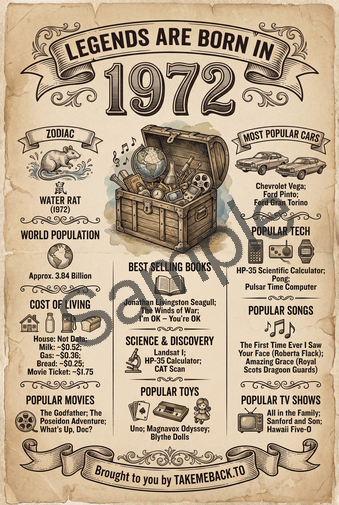

Major Events of 1972 - Historical Moments That Defined the Year | TakeMeBack.to
- 01 Jan Kurt Waldheim becomes UN Secretary-General: Kurt Waldheim, an Austrian diplomat, was appointed as the fourth Secretary-General of the United Nations on January 1, 1972. He served two consecutive five-year terms, from 1972 to 1981. source: un.org
- 02 Jan Mariner 9 Mars mapping mission begins: The Mariner 9 mission, launched by NASA, became the first spacecraft to orbit Mars, providing detailed images of the Martian surface. It was a significant milestone in planetary exploration, revealing features such as volcanoes and canyons. The mission greatly enhanced our understanding of Mars' geology and atmosphere. source: nasa.gov
- 03 Jan Kurt Waldheim becomes UN Secretary-General: Kurt Waldheim was appointed as the Secretary-General of the United Nations on January 3, 1972. His tenure lasted until 1981, during which he focused on various global issues, including peacekeeping and international cooperation. Waldheim's leadership was marked by significant geopolitical events during the Cold War. source: un.org
- 04 Jan First female judge at Old Bailey appointed: On January 4, 1972, the first female judge, Rose Heilbron, was appointed to the Old Bailey in London. This marked a significant milestone in the history of the British judiciary, breaking gender barriers in a traditionally male-dominated field. source: bbc.com
- 05 Jan Sheikh Mujibur Rahman freed from prison: On January 5, 1972, Sheikh Mujibur Rahman, the founding leader of Bangladesh, was released from prison after being detained for nearly a year. His release marked a pivotal moment in the country's post-independence history. source: bbc.com
- 06 Jan US Naval Base in Bahrain: On January 6, 1972, the United States established a naval base in Bahrain, which became a strategic location for U.S. military operations in the Persian Gulf. This base has played a crucial role in U.S. naval presence and operations in the region since its inception. source: bbc.com
- 07 Jan NASA initiates space shuttle research: On January 7, 1972, NASA officially began research and development for the Space Shuttle program. This initiative aimed to create a reusable spacecraft that would revolutionize space travel and exploration. source: nasa.gov
- 08 Jan Sheikh Mujibur Rahman released from prison: On January 8, 1972, Sheikh Mujibur Rahman, the founding leader of Bangladesh, was released from prison after being detained during the Bangladesh Liberation War. His release marked a significant moment in the country's political history as he returned to lead the nation. source: bbc.com
- 09 Jan Powell and Rehnquist sworn in as Supreme Court Justices: On January 9, 1972, William H. Rehnquist was sworn in as an Associate Justice of the U.S. Supreme Court, and Lewis F. Powell Jr. was sworn in as an Associate Justice. Both were nominated by President Richard Nixon and confirmed by the Senate, marking significant appointments to the nation's highest court. source: archives.gov
- 10 Jan Sheikh Mujibur Rahman released from prison: Sheikh Mujibur Rahman, a key figure in Bangladesh's independence movement, was released from prison on January 10, 1972, following the country's liberation from Pakistan. His release marked a significant moment in the establishment of Bangladesh as an independent nation. source: bbc.com
- 11 Jan Bangladesh independence declared: On January 11, 1972, Bangladesh officially declared its independence following a nine-month-long war of liberation against Pakistan. This event marked the establishment of Bangladesh as a sovereign nation, with Sheikh Mujibur Rahman as its first leader. source: bbc.com
- 12 Jan First US asbestos exposure regulations introduced: On January 12, 1972, the United States introduced its first regulations regarding asbestos exposure, aimed at protecting workers from the health risks associated with asbestos. This marked a significant step in occupational health and safety legislation. source: osha.gov
- 13 Jan Military coup in Ghana: On January 13, 1972, a military coup led by Colonel Ignatius Kutu Acheampong overthrew the government of Ghana. source: en.wikipedia.org
- 14 Jan Sanford & Son premieres on NBC: On January 14, 1972, the sitcom 'Sanford & Son' premiered on NBC, starring Redd Foxx and Demond Wilson. source: en.wikipedia.org
- 15 Jan Joe Frazier retains World Heavyweight Championship: On January 15, 1972, Joe Frazier successfully defended his World Heavyweight Championship title against Bob Foster. This match solidified Frazier's status as one of the top boxers of his era. source: britannica.com
- 16 Jan Super Bowl VI: Dallas Cowboys triumph: On January 16, 1972, the Dallas Cowboys won Super Bowl VI, defeating the Miami Dolphins. This victory marked the Cowboys' first Super Bowl title, solidifying their place in NFL history. source: britannica.com
- 17 Jan U.S. Department of Justice files pollution lawsuit against Reserve Mining Company: On January 17, 1972, the U.S. Department of Justice filed a lawsuit against Reserve Mining Company, alleging that the company was discharging asbestos-like fibers into Lake Superior, contaminating the public drinking water of Duluth and other communities. This case became one of the nation's longest and most expensive environmental legal battles, lasting five years. source: mnopedia.org
- 18 Jan 22nd NBA All-Star Game: The 22nd NBA All-Star Game was held on January 18, 1972, at The Forum in Inglewood, California. The Western Conference team defeated the Eastern Conference 112-110, with Jerry West being named the Most Valuable Player. source: en.wikipedia.org
- 21 Jan India grants statehood to Tripura, Manipur, and Meghalaya: On January 21, 1972, India granted full statehood to Tripura, Manipur, and Meghalaya, elevating them from Union Territories to full-fledged states. source: en.wikipedia.org
- 22 Jan European Economic Community expansion: On January 22, 1972, the European Economic Community expanded by signing a Treaty of Accession with the United Kingdom, Ireland, Denmark, and Norway. source: en.wikipedia.org
- 23 Jan U.S. Air Force bombing halts in Vietnam: On January 23, 1972, the U.S. Air Force ceased bombing operations against Viet Cong guerrilla strongholds in South Vietnam after more than nine years of continuous airstrikes. This marked a significant shift in U.S. military strategy during the Vietnam War. source: en.wikipedia.org
- 24 Jan Nixon meets UN Secretary General: On January 24, 1972, U.S. President Richard Nixon met with United Nations Secretary-General U Thant. This meeting was part of Nixon's diplomatic efforts during his visit to China and aimed at discussing international issues, including the Vietnam War. source: history.com
- 25 Jan Nixon's Vietnam War peace plan: On January 25, 1972, President Richard Nixon announced a new peace plan aimed at ending the Vietnam War. This plan included proposals for a ceasefire and negotiations with North Vietnam, marking a significant moment in U.S. foreign policy. source: archives.gov
- 26 Jan Aboriginal Tent Embassy established in Canberra: On January 26, 1972, the Aboriginal Tent Embassy was established in Canberra, Australia, as a protest against the government's treatment of Indigenous Australians. This event became a significant symbol of the Aboriginal rights movement. source: theguardian.com
- 27 Jan Magnavox Odyssey: first home video game console: On January 27, 1972, the Magnavox Odyssey was released as the first home video game console. This marked the beginning of the home gaming industry, paving the way for future developments in video gaming technology. source: bbc.com
- 28 Jan Pakistan leaves the Commonwealth: On January 28, 1972, Pakistan officially left the Commonwealth of Nations. This decision was influenced by political tensions and the aftermath of the Bangladesh Liberation War, which had significant implications for Pakistan's international relations. source: bbc.com
- 29 Jan Supreme Court Justice swearing-in: On January 29, 1972, a new Supreme Court Justice was sworn in, marking a significant event in the U.S. judicial system. This appointment was part of President Nixon's efforts to shape the court's direction during his administration. source: supremecourt.gov
- 30 Jan Bloody Sunday in Derry, Northern Ireland: On January 30, 1972, British soldiers shot 26 unarmed civilians during a protest march in Derry, Northern Ireland. Thirteen men were killed outright, and another died four months later from gunshot injuries. This event, known as Bloody Sunday, is considered one of the most significant incidents of the Troubles, leading to increased hostility towards the British Army and a surge in recruitment to the Provisional Irish Republican Army (IRA). source: britannica.com
- 31 Jan Aretha Franklin performs at Mahalia Jackson's funeral: On January 31, 1972, Aretha Franklin delivered a moving rendition of "Precious Lord, Take My Hand" at Mahalia Jackson's funeral in Chicago. The service, held at the Arie Crown Theater, was attended by thousands, including notable figures like Coretta Scott King and Mayor Richard J. Daley. source: rallypoint.com
- 01 Feb Bloody Sunday Inquiry announced: In early February 1972, the British government announced an inquiry into the events of Bloody Sunday, which occurred on January 30, 1972, when British soldiers killed 13 unarmed civil rights protesters in Derry, Northern Ireland. source: en.wikipedia.org
- 02 Feb British Embassy in Dublin destroyed during Bloody Sunday protest: On February 2, 1972, a large crowd of demonstrators, estimated between 20,000 and 30,000, gathered outside the British Embassy in Dublin to protest the shooting deaths of 13 people in Londonderry on January 30, 1972. The protesters threw petrol bombs, stones, and other missiles, leading to a fire that destroyed the embassy building. Firefighters were delayed in reaching the scene due to the crowd's actions. The Irish government expressed regret and confirmed compensation would be paid for the damage. source: news.bbc.co.uk
- 03 Feb XI Olympic Winter Games held in Sapporo, Japan: The XI Olympic Winter Games were held in Sapporo, Japan, from February 3 to 13, 1972. This marked the first time the Winter Olympics were hosted in Asia, featuring athletes from around the world competing in various winter sports. source: olympics.com
- 04 Feb Strategic Arms Limitation Talks conclude in Vienna: On February 4, 1972, the Strategic Arms Limitation Talks (SALT) concluded in Vienna, Austria. These talks between the United States and the Soviet Union aimed to limit the number of strategic nuclear weapons and reduce the risk of nuclear conflict during the Cold War. source: archives.gov
- 05 Feb Bob Douglas inducted into Basketball Hall of Fame: On February 5, 1972, Robert L. "Bob" Douglas, known as the "Father of Black Professional Basketball," was inducted into the Naismith Memorial Basketball Hall of Fame as a contributor, becoming the first African American enshrined in the Hall. source: washingtonpost.com
- 07 Feb Federal Election Campaign Act signed: The Federal Election Campaign Act was signed into law on February 7, 1972, establishing regulations for campaign financing in federal elections. This act aimed to improve transparency and reduce corruption in political campaigns. source: congress.gov
- 08 Feb UK state of emergency during coal miners' strike: On February 8, 1972, the UK government declared a state of emergency due to a coal miners' strike that severely impacted energy supplies. This strike was part of a larger movement for better wages and working conditions. source: theguardian.com
- 09 Feb Death of Baseball Player Chico Ruiz: Chico Ruiz, a Cuban-American professional baseball player, died on February 9, 1972, in San Diego, California, U.S. He played as an infielder for the Cincinnati Reds and California Angels from 1964 through 1971. source: en.wikipedia.org
- 10 Feb Ras Al Khaimah joins United Arab Emirates: On February 10, 1972, Ras Al Khaimah became the seventh emirate to join the United Arab Emirates, completing the union of the seven emirates. source: thenationalnews.com
- 11 Feb Erhard Keller wins Olympic gold in speed skating: On February 11, 1972, German speed skater Erhard Keller won the gold medal in the men's 500 meters at the Sapporo Winter Olympics, setting an Olympic record with a time of 39.44 seconds. source: olympics-statistics.com
- 13 Feb XI Winter Olympic Games Close in Sapporo: The XI Winter Olympic Games concluded in Sapporo, Japan, on February 13, 1972. This was the first time the Winter Olympics were held in Asia.
- 14 Feb Luna 20 Moon Mission: The Soviet Union launched the Luna 20 mission on February 14, 1972, aiming to return lunar soil samples to Earth. The mission successfully landed on the Moon and returned 55 grams of lunar soil.
- 15 Feb U.S. Copyright Law extends protection to sound recordings: On February 15, 1972, the United States extended federal copyright protection to sound recordings fixed and first published on or after that date. Prior to this, sound recordings were not covered under federal law, leading to inconsistencies in protection. This amendment aimed to provide uniformity and better safeguard the rights of creators in the music industry. source: copyright.gov
- 16 Feb Birth of Taylor Hawkins: Taylor Hawkins, the drummer for the rock band Foo Fighters, was born on February 16, 1972. He became known for his energetic performances and contributions to the band's success. source: bbc.com
- 17 Feb Nixon's historic trip to China: On February 17, 1972, President Richard Nixon embarked on a historic trip to China, marking the first time a sitting U.S. president visited the country. This trip was pivotal in reshaping U.S.-China relations. source: archives.gov
- 18 Feb California Supreme Court abolishes death penalty: On February 18, 1972, the California Supreme Court ruled in People v. Anderson that capital punishment violated the state constitution's prohibition against "cruel or unusual punishment," effectively abolishing the death penalty in California at that time. source: cdcr.ca.gov
- 19 Feb United Red Army hostage crisis at Asama-Sansō lodge: On February 19, 1972, five members of the United Red Army took a woman hostage at the Asama-Sansō lodge near Karuizawa, Nagano Prefecture, Japan. The standoff lasted until February 28, 1972, resulting in the rescue of the hostage and the arrest of the perpetrators. source: en.wikipedia.org
- 20 Feb Maria Goeppert-Mayer, Nobel laureate, dies at 65: Maria Goeppert-Mayer, a German-American theoretical physicist who shared the 1963 Nobel Prize in Physics for her work on nuclear shell structure, passed away in San Diego at the age of 65. source: nobelprize.org
- 21 Feb President Nixon arrives in China for historic talks: U.S. President Richard Nixon arrived in Beijing, marking the first visit by a sitting U.S. president to the People's Republic of China, aiming to end 20 years of frosty relations. source: news.bbc.co.uk
- 22 Feb Nixon and Chou En-lai hold diplomatic meeting in Beijing: On February 22, 1972, U.S. President Richard Nixon and Chinese Premier Chou En-lai engaged in a significant diplomatic meeting in Beijing. This meeting was part of Nixon's historic visit to China, aimed at normalizing relations between the two nations after years of hostility. The discussions focused on various bilateral issues, including the situation in Southeast Asia and the potential for future cooperation. The meeting was a pivotal moment in U.S.-China relations, leading to the eventual establishment of formal diplomatic ties. source: theguardian.com
- 23 Feb Angela Davis released from jail after acquittal: On February 23, 1972, Angela Davis, the American political activist and scholar, was released from jail after being acquitted of all charges related to a 1970 kidnapping and murder case. Davis had been charged with aiding and abetting the kidnapping and murder of a judge, but after a lengthy trial, the jury found her not guilty. Her release was celebrated by supporters who viewed her as a symbol of resistance against racial injustice. source: history.com
- 24 Feb North Vietnamese negotiators exit Paris Peace Talks: On February 24, 1972, North Vietnamese negotiators exited the Paris Peace Talks, a series of negotiations aimed at ending the Vietnam War. Their departure marked a significant setback in the peace process, as both sides had been engaged in discussions for several years. The North Vietnamese delegation's exit led to increased tensions and a continuation of the conflict, delaying the prospects for a peaceful resolution. source: history.com
- 25 Feb Nixon's historic China visit: On February 25, 1972, U.S. President Richard Nixon was in Beijing as part of his historic visit to China, marking the first time a sitting U.S. president visited the People's Republic of China. This visit aimed to open diplomatic relations between the two nations and was a significant step in the normalization of Sino-American relations. source: en.wikipedia.org
- 26 Feb Nixon's historic visit to China: On February 26, 1972, U.S. President Richard Nixon was in Beijing as part of his historic visit to China, marking the first time a sitting U.S. president visited the People's Republic of China. This visit aimed to open diplomatic relations between the two nations and was a significant step in the normalization of Sino-American relations. source: en.wikipedia.org
- 27 Feb US-China Shanghai Communiqué: The US-China Shanghai Communiqué was a pivotal document in US-China relations, marking a significant thaw in diplomatic ties. It was issued during President Nixon's visit to China, outlining the principles guiding future relations between the two nations. source: history.state.gov
- 28 Feb Nixon's Historic China Visit Concludes: President Nixon's visit to China concluded on February 28, 1972, marking a historic moment in US foreign policy. This visit opened diplomatic relations between the two countries and was a significant step in the Cold War context. source: history.state.gov
- 29 Feb ITT Antitrust Controversy Exposed: The ITT antitrust controversy came to light in February 1972, involving allegations of anti-competitive practices. This controversy had significant implications for corporate regulation and antitrust laws in the United States. source: justice.gov
- 01 Mar Club of Rome publishes influential report: On March 2, 1972, the Club of Rome published 'The Limits to Growth,' a report that used computer simulations to predict that if current growth trends continue, the planet's resources would be exhausted within the next 100 years. source: clubofrome.org
- 03 Mar Organisation of Islamic Conference charter signed: The charter of the Organisation of Islamic Conference (OIC) was signed on March 3, 1972, in Rabat, Morocco. This event marked the establishment of a collective organization aimed at promoting Islamic solidarity and cooperation among member states. source: britannica.com
- 04 Mar California lowers voting age: On March 4, 1972, California became the first state to lower the voting age to 18, allowing younger citizens to participate in elections. This change was part of a broader movement across the United States during the early 1970s to expand voting rights. source: nass.org
- 05 Mar Clifford Irving admits Howard Hughes biography fraud: On March 5, 1972, author Clifford Irving publicly admitted that his biography of reclusive billionaire Howard Hughes was a hoax. This revelation shocked the literary world and raised questions about journalistic integrity and ethics. source: nytimes.com
- 06 Mar Supreme Court contraception rights ruling: On March 6, 1972, the US Supreme Court ruled in Eisenstadt v. Baird that the right to privacy extends to unmarried individuals regarding contraception. This landmark decision expanded reproductive rights in the United States. source: law.cornell.edu
- 07 Mar TWA Flight 7 bomb threat averted: On March 7, 1972, a bomb threat against TWA Flight 7 was successfully averted. The incident highlighted the ongoing concerns regarding airline security during this period. source: nytimes.com
- 08 Mar TWA Boeing 707 bombed at Las Vegas airport: On March 8, 1972, a bomb exploded aboard a Trans World Airlines Boeing 707 at McCarran International Airport in Las Vegas. The explosion occurred hours after an anonymous caller threatened TWA with a series of bomb attacks unless $760,000 was paid. The bomb destroyed the cockpit of the aircraft, which was empty at the time, but no injuries were reported. The incident was part of a broader extortion plot targeting TWA, leading to increased security measures across the airline's operations. source: news.bbc.co.uk
- 09 Mar TWA Extortion Plot and Bomb Threat: On March 9, 1972, a bomb threat was made against Trans World Airlines (TWA) as part of an extortion plot. The incident raised significant concerns about airline security and the safety of passengers during a time of heightened tensions in the U.S. source: nytimes.com
- 10 Mar Soviet Nuclear Testing: On March 10, 1972, the Soviet Union conducted a nuclear test at the Semipalatinsk Test Site. This test was part of the ongoing arms race during the Cold War and raised international concerns regarding nuclear proliferation. source: ctbto.org
- 11 Mar North Carolina wins ACC Basketball Tournament: The University of North Carolina Tar Heels won the Atlantic Coast Conference (ACC) Basketball Tournament, defeating the Maryland Terrapins. This victory marked a significant achievement in the college basketball season. source: ncaa.com
- 12 Mar NHL legend Gordie Howe retires from professional hockey: Gordie Howe, one of the most iconic figures in hockey, announced his retirement from professional play. His career spanned several decades, making him a legend in the sport. source: bbc.com
- 14 Mar Sterling Airways Flight 296 crashes near Dubai: On March 14, 1972, Sterling Airways Flight 296, a Sud Aviation Caravelle 10B3, crashed into a mountain ridge near Kalba, United Arab Emirates, during its approach to Dubai. The charter flight, originating from Colombo and en route to Copenhagen with stops in Bombay and Dubai, resulted in the deaths of all 112 passengers and crew members. The accident was attributed to pilot error, with the crew descending below the minimum prescribed altitude due to incorrect information on the outdated flight plan and/or misreading of the weather radar. source: en.wikipedia.org
- 16 Mar Pruitt-Igoe Housing Complex demolition begins: On March 16, 1972, the first building of the Pruitt-Igoe public housing project in St. Louis, Missouri, was demolished by controlled detonation. This marked the start of a phased demolition process that continued until 1976, ultimately leading to the complete removal of the complex. source: en.wikipedia.org
- 17 Mar Ringo Starr releases 'Back Off Boogaloo' single: Ringo Starr released 'Back Off Boogaloo' as a non-album single on March 17, 1972. Produced by George Harrison, the song achieved commercial success, reaching number 2 in the UK and Canada, and number 9 on the US Billboard Hot 100. source: en.wikipedia.org
- 18 Mar China's nuclear test at Lop Nor: On March 18, 1972, China conducted its fourth nuclear test at the Lop Nor test site. This test was part of China's efforts to develop its nuclear arsenal and assert its position in global geopolitics during the Cold War. source: bbc.com
- 19 Mar India-Bangladesh friendship treaty signed: On March 19, 1972, India and Bangladesh signed a friendship treaty, solidifying their diplomatic relations following Bangladesh's independence. This treaty aimed to foster cooperation and mutual support between the two nations. source: bbc.com
- 20 Mar Provisional IRA Belfast car bombing: On March 20, 1972, the Provisional IRA detonated a car bomb in Lower Donegall Street, Belfast, during a busy shopping period. The explosion resulted in seven fatalities, including two members of the Royal Ulster Constabulary (RUC), and injured 148 people. The attack marked one of the first car bombings used by the IRA during the Troubles. source: en.wikipedia.org
- 22 Mar Supreme Court landmark decision on contraceptive rights: On March 22, 1972, the U.S. Supreme Court ruled in Eisenstadt v. Baird that the right to privacy extends to unmarried individuals, allowing them access to contraceptives. This decision was pivotal in expanding reproductive rights and set a precedent for future cases regarding personal privacy and family planning. source: law.cornell.edu
- 23 Mar Tasaday people media event: On March 23, 1972, the Tasaday people, an indigenous group in the Philippines, were introduced to the world through a media event that claimed they lived in isolation from modern society. This event sparked significant interest and controversy regarding their lifestyle and the authenticity of their existence. source: nytimes.com
- 24 Mar Great Britain imposes direct rule over Northern Ireland: On March 24, 1972, British Prime Minister Edward Heath announced the suspension of the Northern Ireland Parliament (Stormont) and the imposition of direct rule from Westminster. This decision was prompted by escalating violence and the refusal of the Northern Ireland government to transfer security responsibilities to London. The Northern Ireland (Temporary Provisions) Act, which formalized this change, received royal assent on March 30, 1972. source: en.wikipedia.org
- 25 Mar UCLA wins 6th consecutive NCAA Basketball Championship: On March 25, 1972, the UCLA Bruins secured their sixth consecutive NCAA men's basketball championship by defeating Florida State 81-76 in the final. The game was held at the Los Angeles Memorial Sports Arena, and UCLA finished the season with an undefeated record of 30-0. source: espn.com
- 26 Mar William Whitelaw appointed first Secretary of State for Northern Ireland: On March 26, 1972, William Whitelaw was appointed as the first Secretary of State for Northern Ireland following the suspension of the Stormont Parliament and the imposition of direct rule from Westminster. This appointment marked a significant shift in the governance of Northern Ireland during a period of political unrest. source: en.wikipedia.org
- 27 Mar Idi Amin expels Israelis from Uganda: On March 27, 1972, Ugandan President Idi Amin ordered the expulsion of all Israeli nationals from Uganda, severing diplomatic ties with Israel. This decision was part of Amin's broader foreign policy shift and had significant implications for Uganda's international relations.
- 28 Mar Three Mile Island nuclear accident: On March 28, 1972, the Three Mile Island nuclear power plant in Pennsylvania experienced a partial meltdown in one of its reactors. This incident raised significant public concern about nuclear safety and had a lasting impact on the nuclear power industry in the United States.
- 31 Mar Beatles fan club officially closes: The official Beatles fan club announced its closure on March 31, 1972, ending an era for fans of the iconic band. The closure was attributed to the band's disbandment and the changing landscape of music fandom. source: bbc.com
- 01 Apr Major League Baseball players first collective strike: On April 1, 1972, Major League Baseball players initiated their first collective strike, primarily over issues related to salary and working conditions. This historic event marked a significant moment in sports labor relations. source: nytimes.com
- 02 Apr Vietnam War: Easter Offensive begins: On April 2, 1972, during the Vietnam War, North Vietnamese forces launched the Easter Offensive, a large-scale military campaign against South Vietnam. The offensive aimed to seize territory and strengthen North Vietnam's position in peace negotiations. source: en.wikipedia.org
- 04 Apr Death of Adam Clayton Powell Jr., pioneering African American congressman: Adam Clayton Powell Jr., a prominent African American congressman from New York, died on April 4, 1972, in Miami, Florida, at the age of 63. He was known for his significant contributions to civil rights and social legislation during his tenure in the U.S. House of Representatives. source: kinginstitute.stanford.edu
- 06 Apr Assassination of Abeid Karume: Abeid Karume, the first President of Zanzibar, was assassinated on April 6, 1972. His death marked a significant turning point in the political landscape of Zanzibar and Tanzania. source: britannica.com
- 07 Apr Biological Weapons Convention signed: The Biological Weapons Convention was signed on April 7, 1972, establishing a framework for the prohibition of biological and toxin weapons. This treaty was a significant step in international disarmament efforts. source: un.org
- 08 Apr Kjell Isaksson sets pole vault world record: On April 8, 1972, Swedish pole vaulter Kjell Isaksson set a new world record by clearing 5.51 meters in Austin, Texas, surpassing the previous record of 5.49 meters held by Christos Papanikolaou. source: en.wikipedia.org
- 10 Apr Biological Weapons Convention signed: The Biological Weapons Convention (BWC) was signed on April 10, 1972, establishing a framework for the prohibition of biological and toxin weapons. This treaty was a significant step in international disarmament efforts, aiming to prevent the development and stockpiling of biological weapons. source: un.org
- 11 Apr 'I'm Sorry I Haven't a Clue' debuts: The British radio comedy show 'I'm Sorry I Haven't a Clue' premiered on April 11, 1972. Created by Graeme Garden and Barry Cryer, the show became known for its humorous take on quiz formats and has remained popular in British culture. source: bbc.co.uk
- 12 Apr First Major League Baseball players' strike resolved: The first Major League Baseball players' strike, which began on April 1, 1972, was resolved on April 12, 1972. The strike was primarily over issues related to player salaries and working conditions, leading to significant changes in labor relations within the sport. source: baseball-almanac.com
- 15 Apr Great Lakes Water Quality Agreement: On April 15, 1972, the United States and Canada signed the Great Lakes Water Quality Agreement, committing to restore and protect the waters of the Great Lakes. source: canada.ca
- 16 Apr Apollo 16 Moon Mission Launch: On April 16, 1972, NASA launched the Apollo 16 mission, the fifth mission to land humans on the Moon, carrying astronauts John Young, Charles Duke, and Ken Mattingly. source: en.wikipedia.org
- 17 Apr First Women's Boston Marathon: On April 17, 1972, Nina Kuscsik became the first woman to officially win the Boston Marathon. Her victory marked a significant milestone in women's sports, as it was the first time a woman was officially recognized as the winner of this prestigious race. source: en.wikipedia.org
- 18 Apr Widgery Report Publication: The Widgery Report, an inquiry into the events of Bloody Sunday in Northern Ireland, was published on April 18, 1972. The report concluded that the British Army acted in self-defense during the incident, a finding that was widely criticized by the nationalist community and led to calls for a more thorough investigation. source: en.wikipedia.org
- 19 Apr Bangladesh Joins British Commonwealth: On April 19, 1972, Bangladesh became the 34th member of the Commonwealth of Nations, following its recognition as an independent country by the United Kingdom on February 4, 1972. This membership marked a significant step in Bangladesh's international relations post-independence. source: thecommonwealth.org
- 21 Apr Apollo 16 Lunar Landing: On April 21, 1972, Apollo 16's Lunar Module Orion, piloted by John W. Young and Charles M. Duke, landed in the Descartes Highlands of the Moon, marking the fifth crewed lunar landing. source: nasa.gov
- 22 Apr Apollo 16 Moon Exploration Mission: On April 22, 1972, Apollo 16 astronauts John W. Young and Charles M. Duke conducted their second extravehicular activity (EVA) on the Moon, exploring the Descartes Highlands region. source: nasa.gov
- 23 Apr Apollo 16 Moon Landing Mission: Apollo 16 was the fifth crewed mission to land on the Moon, occurring on April 23, 1972. The mission focused on exploring the lunar highlands and conducting scientific experiments. Astronauts John Young and Charles Duke spent three days on the lunar surface, collecting samples and conducting research. source: nasa.gov
- 24 Apr Father's Day Officially Recognized in the United States: On April 24, 1972, Father's Day was officially recognized in the United States, establishing a day to honor fathers and father figures. This recognition followed years of advocacy for a dedicated day to celebrate paternal contributions. Father's Day is now celebrated annually on the third Sunday of June. source: britannica.com
- 25 Apr North Vietnamese 320th Division Offensive near Kontum: On April 25, 1972, the North Vietnamese 320th Division launched an offensive near Kontum during the Vietnam War. This military action was part of a larger strategy to gain control over key areas in South Vietnam. The offensive had significant implications for the ongoing conflict. source: britannica.com
- 26 Apr Nixon addresses nation on Vietnam War strategy: On April 26, 1972, President Richard Nixon addressed the nation to outline his strategy for the Vietnam War, emphasizing the need for continued military action and negotiations. source: archives.gov
- 27 Apr Apollo 16 returns to Earth: On April 27, 1972, the Apollo 16 mission concluded with a Pacific Ocean splashdown, marking the successful return of astronauts John W. Young, Charles M. Duke Jr., and Thomas K. Mattingly II after their lunar exploration. source: nasa.gov
- 29 Apr Premiere of 'What's Up, Doc?': 'What's Up, Doc?' is a 1972 American screwball comedy film directed by Peter Bogdanovich. The film stars Barbra Streisand and Ryan O'Neal and was released on April 29, 1972. It received positive reviews for its humor and performances. source: en.wikipedia.org
- 01 May North Vietnamese troops occupy Quang Tri: On May 1, 1972, North Vietnamese forces captured Quang Tri, a strategic city in South Vietnam. This event marked a significant escalation in the Vietnam War, as it demonstrated the North's ability to launch major offensives against South Vietnamese and U.S. forces. source: archives.gov
- 02 May Death of J. Edgar Hoover: J. Edgar Hoover, the first Director of the Federal Bureau of Investigation (FBI), died on May 2, 1972. His tenure was marked by controversial practices and significant influence over U.S. law enforcement and intelligence operations. source: fbi.gov
- 03 May Tragic death of rock guitarist Leslie Harvey: Leslie Harvey, a Scottish rock guitarist known for his work with the band Stone the Crows, died on May 3, 1972, after an accidental electrocution on stage. His death was a significant loss to the music community. source: britannica.com
- 04 May Paris Peace Talks suspended, Operation Linebacker begins: On May 4, 1972, the Paris Peace Talks aimed at ending the Vietnam War were suspended, coinciding with the commencement of Operation Linebacker, a major U.S. bombing campaign against North Vietnam. This marked a pivotal moment in the conflict. source: archives.gov
- 05 May Reverend Gary David: Vocalist Passes Away: Reverend Gary David, a notable vocalist, passed away at the age of 76, marking the end of a significant musical career.
- 06 May Execution of Turkish political activists: On May 6, 1972, several Turkish political activists were executed, marking a significant event in Turkey's political history. This event was part of a broader crackdown on leftist movements during that period. source: bbc.com
- 07 May Italian general elections held: The Italian general elections took place on May 7, 1972, resulting in a significant political shift in the country. These elections were crucial in shaping Italy's political landscape during the early 1970s. source: bbc.com
- 08 May Nixon addresses Southeast Asia policy: On May 8, 1972, President Richard Nixon delivered a significant address regarding U.S. policy in Southeast Asia. This speech was part of his administration's efforts to navigate the complexities of the Vietnam War. source: archives.gov
- 09 May Nixon's historic Moscow summit: On May 9, 1972, President Richard Nixon met with Soviet leader Leonid Brezhnev in Moscow, marking a significant moment in U.S.-Soviet relations. This summit resulted in the signing of several key agreements, including the Strategic Arms Limitation Treaty (SALT I), aimed at curbing the arms race between the two superpowers. It was a pivotal step towards détente during the Cold War. source: archives.gov
- 10 May U.S. air strikes in North Vietnam: On May 10, 1972, the United States conducted air strikes against targets in North Vietnam as part of its military strategy during the Vietnam War. These strikes aimed to weaken North Vietnamese military capabilities and were part of a broader campaign to influence the outcome of the war. The operations faced significant opposition and raised concerns about civilian casualties. source: archives.gov
- 11 May Boston Bruins win Stanley Cup: On May 11, 1972, the Boston Bruins defeated the New York Rangers 3-0 in Game 6 of the Stanley Cup Final at Madison Square Garden, clinching their second championship in three years. source: nhl.com
- 12 May Violent clashes in Northern Ireland: On May 12, 1972, violent clashes erupted in Northern Ireland, marking a significant escalation in The Troubles. The conflict involved various factions, leading to numerous injuries and heightened tensions in the region. source: bbc.com
- 13 May Belfast pub car bombing during The Troubles: On May 13, 1972, a car bomb exploded outside a pub in Belfast, resulting in multiple casualties. This incident was part of the ongoing violence during The Troubles, reflecting the intense sectarian conflict in Northern Ireland. source: bbc.com
- 14 May Tragic killing of young Catholic girl in Belfast: On May 14, 1972, a young Catholic girl was tragically killed in Belfast, an event that further inflamed tensions during The Troubles. This incident highlighted the impact of the conflict on innocent civilians. source: bbc.com
- 15 May George Wallace assassination attempt: On May 15, 1972, during a campaign rally at the Laurel Shopping Center in Laurel, Maryland, Alabama Governor George Wallace was shot four times by Arthur Bremer. The attack left Wallace paralyzed from the waist down and effectively ended his presidential campaign. source: en.wikipedia.org
- 16 May Malta introduces decimal currency: On May 16, 1972, Malta transitioned from the British system of pounds, shillings, and pence to a decimal currency system. The Maltese pound was divided into 100 cents, each cent into 10 mils. The first series of decimal coins included denominations of 50 cent, 10 cent, 5 cent, 2 cent, 1 cent, 5 mils, 3 mils, and 2 mils. source: centralbankmalta.org
- 17 May Germany-Poland Border Treaty ratified: On May 17, 1972, the West German Bundestag ratified the Treaty of Warsaw, confirming the Oder-Neisse line as the border between Germany and Poland. This treaty, signed on December 7, 1970, by Chancellor Willy Brandt and Prime Minister Józef Cyrankiewicz, aimed to resolve post-World War II border disputes. source: en.wikipedia.org
- 18 May Political transition in Madagascar: On May 18, 1972, amid escalating protests and economic challenges, President Philibert Tsiranana dissolved his government and transferred power to the National Army, led by General Gabriel Ramanantsoa, effectively ending the First Republic. source: globalsecurity.org
- 19 May Red Army Faction bombing in Hamburg: On May 19, 1972, the Red Army Faction (RAF) carried out a bombing at the Axel Springer Verlag building in Hamburg, injuring at least 17 people. The attack was part of the RAF's campaign against perceived capitalist institutions. source: dw.com
- 20 May Nixon's Moscow trip begins: President Richard Nixon's historic trip to Moscow begins, marking the first time a sitting U.S. president visited the Soviet Union. This visit aimed to improve U.S.-Soviet relations and culminated in the signing of several important agreements, including the Strategic Arms Limitation Treaty (SALT). source: archives.gov
- 21 May Vandalism of Michelangelo's Pietà: A man attacked Michelangelo's Pietà in St. Peter's Basilica, damaging the sculpture with a hammer. This incident led to increased security measures for the artwork, which is one of the most famous sculptures in the world. The statue was restored and remains a significant cultural treasure. source: britannica.com
- 22 May Watergate scandal begins: The Watergate scandal begins with the break-in at the Democratic National Committee headquarters at the Watergate office complex. This event would lead to a major political scandal involving President Nixon and ultimately his resignation. It marked a significant moment in American political history. source: archives.gov
- 23 May Rangers Win Cup Winners Cup: Glasgow Rangers football club wins the Cup Winners Cup by defeating Dynamo Moscow at Barcelona's Nou Camp stadium. The victory is marred by fan disorder, resulting in the team being banned from defending their title the following season.
- 24 May Apollo-Soyuz Test Project Agreement: The Apollo-Soyuz Test Project Agreement was signed on May 24, 1972, marking a significant collaboration between the United States and the Soviet Union in space exploration. This agreement paved the way for the first international human spaceflight mission, which took place in 1975. source: nasa.gov
- 25 May First Computerized Fly-by-Wire Airplane Flight: On May 25, 1972, the first computerized fly-by-wire airplane, the Airbus A300, made its inaugural flight. This technology revolutionized aviation by allowing for more precise control of aircraft. source: airbus.com
- 26 May Anti-Ballistic Missile (ABM) Treaty signed: The Anti-Ballistic Missile Treaty was signed on May 26, 1972, between the United States and the Soviet Union, limiting the deployment of missile defense systems. source: britannica.com
- 27 May Kings Island Amusement Park Opens: Kings Island, a major amusement park located near Mason, Ohio, officially opened to the public on May 27, 1972, after several preview events starting on April 29. The park would become a significant Midwestern entertainment destination, representing the growing leisure and tourism industry in the United States.
- 29 May Passing of Prithviraj Kapoor: Indian Cinema Legend: Prithviraj Kapoor, a pioneering figure in Indian cinema and founder of Prithvi Theatre, passed away on May 29, 1972, in Mumbai, India. He was renowned for his roles in films like 'Mughal-e-Azam' and 'Sikandar'. source: britannica.com
- 31 May CORONA Spy Satellite Program concludes: The CORONA program, America's first imaging satellite initiative, concluded on May 31, 1972, after 145 missions. It provided extensive photographic coverage of the Earth's surface, significantly enhancing U.S. intelligence capabilities during the Cold War. source: cia.gov
- 01 Jun Iraq nationalizes Iraq Petroleum Company: On June 1, 1972, Iraq announced the nationalization of the Iraq Petroleum Company, a significant move in asserting control over its oil resources and asserting economic independence.
- 02 Jun Andreas Baader captured by West German police: On June 2, 1972, Andreas Baader, a prominent member of the Red Army Faction (RAF), was apprehended by West German authorities. His capture marked a significant event in the efforts to dismantle the RAF, a left-wing extremist group active in West Germany during the 1970s. source: theguardian.com
- 03 Jun Sally Priesand ordained as first female U.S. rabbi: On June 3, 1972, Sally Priesand was ordained by the Hebrew Union College-Jewish Institute of Religion, becoming the first woman to be ordained as a rabbi in the United States. This historic event paved the way for greater gender equality within the Jewish clergy. source: jwa.org
- 04 Jun Angela Davis acquitted of all charges in 1972 trial: On June 4, 1972, activist Angela Davis was acquitted of all charges, including murder, kidnapping, and conspiracy, related to a 1970 courthouse shootout. The trial, which took place in Santa Clara County, California, concluded after 13 hours of deliberation by an all-white jury. Davis's defense team, led by Howard Moore Jr. and Leo Branton Jr., effectively challenged the prosecution's circumstantial evidence, leading to her acquittal. source: nmaahc.si.edu
- 05 Jun UN Conference on the Human Environment in Stockholm: The United Nations Conference on the Human Environment was held in Stockholm, Sweden, from June 5 to 16, 1972. This was the first major UN conference focusing on international environmental issues, leading to the creation of the United Nations Environment Programme (UNEP). source: un.org
- 06 Jun Gold price reaches record high: On June 6, 1972, gold prices reached a record high, with the London afternoon fixing at $61.50 per ounce. source: sdbullion.com
- 09 Jun Elvis Presley's Madison Square Garden Triumph: On June 9, 1972, Elvis Presley performed a historic concert at Madison Square Garden in New York City, marking his first live performance in the city in over a decade. source: elvis.com.au
- 11 Jun LPGA Championship: Kathy Ahern wins the 18th LPGA Championship, marking a notable moment in women's professional golf.
- 12 Jun Deep Throat film debut: The adult film 'Deep Throat' premiered at the World Theater in New York City on June 12, 1972. Directed by Gerard Damiano and starring Linda Lovelace, the film became a cultural phenomenon, grossing over $600 million worldwide. It is considered a landmark in the adult film industry, marking the beginning of the 'Golden Age of Porn'. source: washingtonpost.com
- 14 Jun Hurricane Agnes devastates eastern US: Hurricane Agnes struck the eastern United States on June 14, 1972, causing widespread flooding and significant damage. source: weather.gov
- 15 Jun Ulrike Meinhof captured by West German police: Ulrike Meinhof, a prominent member of the Red Army Faction, was captured by West German police on June 15, 1972. Her arrest marked a significant moment in the fight against leftist terrorism in Germany during the 1970s. source: britannica.com
- 16 Jun Watergate scandal burglary: The Watergate scandal burglary occurred on June 16, 1972, when five men were arrested for breaking into the Democratic National Committee headquarters. This event set off a political scandal that would lead to President Nixon's resignation. source: britannica.com
- 17 Jun Watergate scandal begins: The Watergate scandal began on June 17, 1972, when five men were arrested for breaking into the Democratic National Committee headquarters. This event led to a major political scandal that ultimately resulted in President Nixon's resignation. source: archives.gov
- 18 Jun Staines air disaster: The Staines air disaster occurred on June 18, 1972, when a British Airways Trident crashed shortly after takeoff from London Heathrow. The incident resulted in the loss of 118 lives and raised concerns about aviation safety. source: bbc.com
- 19 Jun Hurricane Agnes devastates eastern United States: Hurricane Agnes made landfall on June 19, 1972, causing widespread destruction across the eastern United States. It resulted in severe flooding and significant damage, leading to numerous fatalities and extensive property loss. source: ncdc.noaa.gov
- 20 Jun Watergate scandal: Mysterious tape gap discovered: On June 20, 1972, it was revealed that a gap existed in the tape recordings related to the Watergate scandal, raising questions about the integrity of the evidence. This discovery intensified the investigation into the scandal that would lead to significant political repercussions. source: archives.gov
- 22 Jun Ping Pong Diplomacy: Breaking Cold War barriers: On June 22, 1972, the U.S. table tennis team visited China, marking a significant thaw in U.S.-China relations during the Cold War. This event, known as 'Ping Pong Diplomacy,' played a crucial role in opening diplomatic channels between the two nations. source: state.gov
- 23 Jun First female umpire in US professional baseball: On June 23, 1972, Bernice Gera became the first female umpire in U.S. professional baseball. She officiated a game in the Appalachian League, marking a significant milestone for women in sports officiating. source: en.wikipedia.org
- 24 Jun Historic Democratic Convention milestone: The 1972 Democratic National Convention marked a significant shift in the party's platform and leadership, reflecting the changing political landscape of the United States. This convention was notable for its inclusion of more diverse voices and the nomination of George McGovern as the presidential candidate. source: archives.gov
- 25 Jun First female professional baseball umpire: On June 25, 1972, Pam Postema became the first woman to officiate a professional baseball game in the United States. Her groundbreaking role paved the way for future female umpires in the sport, challenging gender norms in athletics. source: britannica.com
- 26 Jun IRA resistance in Northern Ireland: On June 26, 1972, the Irish Republican Army (IRA) intensified its activities in Northern Ireland, marking a significant moment in the Troubles. This period was characterized by violent confrontations and political strife as the IRA sought to end British rule in Northern Ireland. source: britannica.com
- 27 Jun Kissinger's diplomatic mission to China: In June 1972, U.S. National Security Advisor Henry Kissinger embarked on a secret diplomatic mission to China, paving the way for President Nixon's historic visit in February 1972. This mission marked a significant shift in U.S.-China relations, leading to the eventual normalization of diplomatic ties. source: archives.gov
- 28 Jun Nixon halts Vietnam War draft: On June 28, 1972, President Richard Nixon announced the suspension of the military draft for the Vietnam War, signaling a significant shift in U.S. military policy during the conflict. source: archives.gov
- 29 Jun Furman v. Georgia: Supreme Court landmark death penalty ruling: On June 29, 1972, the U.S. Supreme Court ruled in Furman v. Georgia that the death penalty, as applied, violated the Eighth and Fourteenth Amendments, leading to a temporary halt in executions in the United States. source: history.com
- 30 Jun Jane Fonda's controversial North Vietnam tour: In June 1972, actress Jane Fonda visited North Vietnam during the Vietnam War, meeting with North Vietnamese officials and making statements critical of U.S. military actions. Her visit was highly controversial and led to widespread criticism in the United States. source: en.wikipedia.org
- 01 Jul Ms. Magazine launches: On July 1, 1972, Ms. Magazine, a feminist publication co-founded by Gloria Steinem, was launched. It became a significant voice in the women's liberation movement, addressing issues such as gender equality and reproductive rights. source: en.wikipedia.org
- 02 Jul Simla Agreement signed between India and Pakistan: On July 2, 1972, following Pakistan's surrender to India in the Indo-Pakistani War of 1971, both nations signed the historic Simla Agreement. This agreement aimed to settle their disputes bilaterally and marked a significant step towards peace in the region. source: en.wikipedia.org
- 04 Jul First Rainbow Gathering held in Colorado: The first Rainbow Gathering, a four-day event organized by youth counterculture groups, took place in Colorado in July 1972. The gathering aimed to promote peace, harmony, and community, and it concluded on July 4, 1972, with attendees migrating to Table Mountain for a noon sighting of a white buffalo. source: en.wikipedia.org
- 05 Jul Susie Maxwell Berning wins US Women's Open Golf Championship: Susie Maxwell Berning secured her second U.S. Women's Open title on July 2, 1972, at Winged Foot Golf Club in Mamaroneck, New York. She overcame a first-round 79 to finish at 299 (+11), edging out Kathy Ahern, Pam Barnett, and Judy Rankin by one stroke. This victory marked her second of three U.S. Women's Open titles. source: en.wikipedia.org
- 07 Jul Harold B. Lee becomes LDS Church President: On July 7, 1972, Harold B. Lee was sustained as the 11th president of The Church of Jesus Christ of Latter-day Saints (LDS Church). He served as president until his death in 1973.
- 08 Jul Assassination of Ghassan Kanafani: On July 8, 1972, Ghassan Kanafani, a prominent Palestinian author and spokesperson for the Popular Front for the Liberation of Palestine (PFLP), was assassinated in Beirut. A car bomb, attributed to the Israeli intelligence agency Mossad, killed Kanafani and his 17-year-old niece, Lamees Najim. Kanafani was known for his literary works and his role in advocating for Palestinian rights. source: en.wikipedia.org
- 09 Jul IRA-British Army Ceasefire Breakdown: On July 9, 1972, the Provisional Irish Republican Army (IRA) ended a ceasefire with the British Army, leading to renewed violence in Northern Ireland. The breakdown of the ceasefire resulted in increased hostilities, including the Springhill Massacre in West Belfast, where five civilians were killed by British Army snipers. source: bbc.com
- 10 Jul 1972 Democratic National Convention: The 1972 Democratic National Convention was held at the Miami Beach Convention Center in Miami Beach, Florida, from July 10 to 13, 1972. The convention nominated Senator George McGovern of South Dakota for president and Senator Thomas Eagleton of Missouri for vice president. However, Eagleton withdrew after disclosures about his medical history, leading to his replacement by R. Sargent Shriver. source: politico.com
- 11 Jul World Chess Championship 1972: Fischer vs Spassky: The World Chess Championship 1972 commenced on July 11, 1972, in Reykjavík, Iceland, featuring a match between challenger Bobby Fischer of the United States and defending champion Boris Spassky of the Soviet Union. Fischer won the match 12½–8½, becoming the first American-born player to win the world title and ending 24 years of Soviet dominance. source: en.wikipedia.org
- 12 Jul Soviet Venera 8 Spacecraft Lands on Venus: On July 12, 1972, the Soviet Union's Venera 8 spacecraft successfully landed on Venus, marking the first time a spacecraft transmitted data from the surface of another planet. This achievement provided valuable information about Venus's atmosphere and surface conditions. source: en.wikipedia.org
- 13 Jul Asteroid 2112 Ulyanov discovered by T.M. Smirnova: On July 13, 1972, astronomer T.M. Smirnova discovered asteroid 2112 Ulyanov at the Crimean Astrophysical Observatory. This main-belt asteroid has an estimated diameter of about 10 km and orbits the Sun at a distance of approximately 2.25 AU. source: phys.ttu.edu
- 14 Jul Lyudmila Zhuravleva discovers asteroid 2423 Ibarruri: On July 14, 1972, astronomer Lyudmila Zhuravleva discovered asteroid 2423 Ibarruri at the Crimean Astrophysical Observatory. This Mars-crossing asteroid has an eccentric orbit and is approximately 5 kilometers in diameter. source: en.wikipedia.org
- 15 Jul Lee Trevino wins second British Open: Lee Trevino won his second British Open title at Muirfield, Scotland, on July 15, 1972. This victory solidified his status as one of the top golfers of his time, showcasing his skill and determination on the course. source: bbc.com
- 16 Jul Dimitrios Papadopoulos becomes Patriarch of Constantinople: On July 16, 1972, Dimitrios Papadopoulos was elected as the Ecumenical Patriarch of Constantinople. His election marked a significant moment in the history of the Eastern Orthodox Church, emphasizing unity and dialogue among Christian denominations. source: britannica.com
- 17 Jul First women agents join FBI training program: On July 17, 1972, the FBI welcomed its first female agents into its training program, marking a historic moment for gender equality in law enforcement. This initiative aimed to diversify the agency and enhance its effectiveness. source: fbi.gov
- 18 Jul Egypt expels Soviet military advisors: On July 18, 1972, Egyptian President Anwar Sadat announced the expulsion of Soviet military advisors from Egypt. This marked a significant shift in Egypt's foreign policy and its alignment with the West during the Cold War. source: washingtonpost.com
- 19 Jul Vietnam peace negotiations resumption: On July 19, 1972, peace negotiations aimed at ending the Vietnam War resumed in Paris. This marked a critical point in the ongoing discussions between the United States and North Vietnam. source: britannica.com
- 20 Jul Uruguay general strike: On July 20, 1972, a general strike occurred in Uruguay, marking a significant moment in the country's labor movement. The strike was a response to government policies and aimed at advocating for workers' rights and social justice. It highlighted the growing tensions between the government and labor unions during a period of political unrest. source: britannica.com
- 21 Jul Bloody Friday: IRA bombing in Belfast: On July 21, 1972, a series of bombings orchestrated by the Irish Republican Army (IRA) occurred in Belfast, resulting in significant casualties and damage. This event, known as Bloody Friday, marked a pivotal moment in the Northern Ireland conflict, intensifying the violence and political tensions in the region. source: bbc.com
- 22 Jul Venera 8 Venus landing: The Soviet Union's Venera 8 probe successfully landed on Venus, transmitting data for 50 minutes before being destroyed by the planet's extreme conditions. source: en.wikipedia.org
- 23 Jul Landsat 1 Earth Resources Satellite launch: The United States launched Landsat 1, the first Earth Resources Technology Satellite, marking a significant advancement in Earth observation capabilities. source: en.wikipedia.org
- 24 Jul Jigme Singye Wangchuck becomes King of Bhutan: On July 24, 1972, Jigme Singye Wangchuck ascended to the throne of Bhutan following the death of his father, King Jigme Dorji Wangchuck. His reign marked significant modernization efforts in the country, balancing tradition with development. source: bbc.com
- 25 Jul Tuskegee Syphilis Experiment exposed: On July 25, 1972, the unethical practices of the Tuskegee Syphilis Study were publicly revealed, leading to widespread outrage. The study, which began in 1932, involved the deception of African American men who were not informed of their syphilis diagnosis or treated for the disease. source: cdc.gov
- 27 Jul Virginia Piper kidnapping: On July 27, 1972, Virginia Piper was kidnapped in Minnesota, leading to a high-profile case that captured national attention. The incident involved a ransom demand and raised significant concerns about safety and crime in the area. source: startribune.com
- 28 Jul UK nationwide dock workers strike begins: On July 28, 1972, dock workers across the UK initiated a nationwide strike, demanding better wages and working conditions. This strike significantly impacted shipping and trade, leading to widespread disruptions in the economy. source: bbc.com
- 29 Jul A national dock strike begins in Britain: On July 29, 1972, a national dock strike commenced in Britain, escalating from earlier regional strikes. The workers demanded improved pay and conditions, leading to significant disruptions in port operations across the country. source: bbc.com
- 30 Jul Tragic steamboat shipwreck occurs: On July 30, 1972, a tragic shipwreck involving a steamboat occurred, resulting in multiple casualties. The incident raised concerns about maritime safety and led to investigations into the causes of the disaster. source: maritime-executive.com
- 31 Jul Claudy Bombing: Tragic IRA Attack: On July 31, 1972, three car bombs exploded in Claudy, County Londonderry, Northern Ireland, killing nine civilians and injuring thirty. The Provisional Irish Republican Army (IRA) is believed to have been responsible for the attack, which became known as "Bloody Monday." source: bbc.com
- 01 Aug Washington Post Breaks Watergate Scandal: On August 1, 1972, The Washington Post published a report detailing the break-in at the Democratic National Committee headquarters at the Watergate complex in Washington, D.C. This report marked the beginning of extensive media coverage that would eventually lead to the Watergate scandal and the resignation of President Richard Nixon. source: washingtonpost.com
- 03 Aug US Senate ratifies Anti-Ballistic Missile Treaty: On August 3, 1972, the U.S. Senate ratified the Anti-Ballistic Missile (ABM) Treaty by a vote of 88 to 2. The treaty, signed in May 1972 by President Richard Nixon and Soviet leader Leonid Brezhnev, limited the deployment of anti-ballistic missile systems to reduce the risk of nuclear war. source: politico.com
- 04 Aug Idi Amin orders expulsion of Ugandan Asians: On August 4, 1972, Ugandan President Idi Amin announced the expulsion of approximately 80,000 individuals of South Asian descent, giving them 90 days to leave the country. Amin accused the Asian community of economic sabotage and disloyalty, claims that were widely disputed. The expulsion led to significant economic decline in Uganda and drew international condemnation. source: en.wikipedia.org
- 06 Aug Hank Aaron hits 660th and 661st home runs for Braves: On August 6, 1972, Hank Aaron hit his 660th and 661st career home runs, setting a new MLB record for the most home runs hit with a single team. The Atlanta Braves defeated the Cincinnati Reds 4-3 at Riverfront Stadium. source: rrauction.com
- 08 Aug Yankees sign 30-year lease for remodeled Yankee Stadium: On August 8, 1972, the New York Yankees signed a 30-year lease with the City of New York, ensuring their continued presence at Yankee Stadium. The agreement included plans for substantial renovations to the stadium, which were completed in time for the 1976 baseball season. source: mlb.com
- 09 Aug Uganda expels British Asians: On August 9, 1972, Ugandan President Idi Amin expanded his expulsion order to include citizens of India, Pakistan, and Bangladesh, in addition to British subjects of Asian origin. This directive gave these groups 90 days to leave Uganda. source: en.wikipedia.org
- 11 Aug Last U.S. ground combat unit leaves Vietnam: On August 11, 1972, the Third Battalion, Twenty-First Infantry, the last U.S. ground combat unit in South Vietnam, was deactivated and began departing for the United States. This marked a significant step in the U.S. withdrawal from Vietnam. source: history.com
- 12 Aug Last U.S. ground troops withdrawn from Vietnam: On August 12, 1972, the last two U.S. ground combat units, the 3rd Battalion, 21st Infantry Regiment and Battery G, 29th Field Artillery Regiment, stood down at Da Nang, marking the end of U.S. ground combat operations in South Vietnam. source: en.wikipedia.org
- 17 Aug Indonesian Language Spelling Reform: On August 17, 1972, Indonesia introduced the Enhanced Spelling System (Ejaan yang Disempurnakan, EYD), aiming to harmonize the Indonesian and Malaysian languages. This reform replaced the previous Republican Spelling System, standardizing the orthography to facilitate mutual understanding between the two nations. The EYD was officially announced by President Suharto on Indonesia's Independence Day. source: en.wikipedia.org
- 18 Aug Inter-Korean Communication Hotline Established: On August 18, 1972, North and South Korea established a direct communication hotline, known as the 'Red Phone,' to facilitate direct communication between their leaders. This was a significant step towards reducing tensions and promoting dialogue between the two nations. source: en.wikipedia.org
- 20 Aug USSR conducts underground nuclear test: On August 20, 1972, the Soviet Union conducted an underground nuclear test, part of its ongoing nuclear weapons program during the Cold War. This test was part of a series of tests that raised international concerns about nuclear proliferation. source: armscontrol.org
- 21 Aug Wildlife Protection Act passed: On August 21, 1972, the Wildlife Protection Act was passed in the United States, aimed at protecting endangered species and their habitats. This legislation marked a significant step in wildlife conservation efforts. source: fws.gov
- 22 Aug Rhodesia expelled from the Olympics for racist policies: On August 22, 1972, the International Olympic Committee (IOC) expelled Rhodesia from the Munich Olympics, citing the country's racist policies. The decision followed mounting international pressure, particularly from African nations, and was influenced by Rhodesia's failure to provide valid passports for its athletes, as they were not recognized as British subjects. This expulsion occurred just four days before the opening ceremony. source: news.bbc.co.uk
- 23 Aug 1972 Republican National Convention held in Miami Beach: The 1972 Republican National Convention took place from August 21 to August 23, 1972, at the Miami Beach Convention Center in Miami Beach, Florida. The convention nominated President Richard M. Nixon and Vice President Spiro T. Agnew for re-election. source: en.wikipedia.org
- 24 Aug Hockey legends inducted into Hall of Fame: On August 24, 1972, the Hockey Hall of Fame inducted Gordie Howe and Jean Beliveau, two of the sport's most iconic players. Both had retired after the 1970-71 season, with Howe holding records for games played, goals, and points, and Beliveau leading the Montreal Canadiens to ten Stanley Cup victories. source: nhl.com
- 25 Aug Walmart goes public on NYSE: On August 25, 1972, Walmart, the retail giant founded by Sam Walton, went public on the New York Stock Exchange (NYSE). This move marked a significant milestone in the company's growth and expansion, allowing it to raise capital for further development. source: nytimes.com
- 26 Aug Munich Olympic Games begin: The 1972 Summer Olympics officially opened in Munich, West Germany, marking a significant event in sports history. This edition of the Games was notable for its modern facilities and the tragic events that would unfold later during the competition. source: britannica.com
- 27 Aug Attempted assassination of King Hassan II of Morocco: On August 27, 1972, an assassination attempt was made on King Hassan II of Morocco during a failed coup. The event highlighted the political tensions in Morocco at the time and led to a crackdown on dissent. source: britannica.com
- 28 Aug Mark Spitz wins first Olympic gold medal: On August 28, 1972, American swimmer Mark Spitz won his first gold medal at the Munich Olympics, setting a new world record in the 200-meter freestyle. Spitz would go on to become one of the most decorated Olympians in history. source: britannica.com
- 29 Aug Jim Barr's historic pitching performance: On August 29, 1972, San Francisco Giants pitcher Jim Barr pitched a no-hitter against the New York Mets, marking the first no-hitter in the history of the Giants' franchise. source: baseball-reference.com
- 31 Aug Olga Korbut wins Olympic gold in balance beam and floor exercise: At the 1972 Munich Olympics, Soviet gymnast Olga Korbut secured gold medals in both the balance beam and floor exercise events, contributing to the Soviet team's overall success. source: britannica.com
- 01 Sep Bobby Fischer wins World Chess Championship: American chess grandmaster Bobby Fischer defeated Boris Spassky of the Soviet Union to win the World Chess Championship in 1972, a match that captivated the world. source: britannica.com
- 02 Sep IRA bomb targets Ulster Unionist Party headquarters: On September 2, 1972, a bomb attributed to the Irish Republican Army (IRA) exploded at the Ulster Unionist Party headquarters in Belfast. This attack was part of the ongoing conflict in Northern Ireland during that period. source: bbc.com
- 03 Sep Northwestern Kashmir earthquake: A significant earthquake struck northwestern Kashmir on September 3, 1972, causing considerable damage and loss of life. The region experienced severe tremors that were felt widely. source: usgs.gov
- 04 Sep Mark Spitz's historic Olympic achievement: On September 4, 1972, swimmer Mark Spitz achieved a historic milestone by winning his seventh gold medal at the Munich Olympics. This record-setting performance solidified his status as one of the greatest Olympians. source: britannica.com
- 05 Sep Munich Massacre at 1972 Summer Olympics: On September 5, 1972, during the Munich Summer Olympics, eight members of the Palestinian terrorist group Black September infiltrated the Olympic Village, killed two members of Israel's Olympic team, and took nine others hostage. source: en.wikipedia.org
- 06 Sep Munich Massacre at 1972 Olympic Games: On September 6, 1972, during the Munich Summer Olympics, eight members of the Palestinian terrorist group Black September infiltrated the Olympic Village, killed two members of Israel's Olympic team, and took nine others hostage. source: en.wikipedia.org
- 07 Sep India's nuclear weapons program initiated: In September 1972, Indian Prime Minister Indira Gandhi authorized the development of a nuclear test device, marking a significant step in India's nuclear weapons program. This decision followed the Indo-Pakistani War of 1971 and was part of India's broader strategy to enhance its defense capabilities. source: wilsoncenter.org
- 08 Sep Birth of Tomokazu Seki: Tomokazu Seki, a prominent Japanese voice actor (seiyū), was born on this date. He would later become known for his versatile voice acting in numerous anime and video game productions.
- 09 Sep Controversial Olympic Basketball Final: On September 9, 1972, the Soviet Union defeated the United States 51–50 in the men's basketball final at the Munich Olympics. The game ended in controversy after the final three seconds were replayed three times, leading to the Soviet victory. This marked the first Olympic loss for the U.S. basketball team since the sport's introduction in 1936. source: en.wikipedia.org
- 10 Sep 20th Olympic Games Close in Munich: The 20th Olympic Games concluded in Munich on September 10, 1972, marking the end of the two-week event. source: britannica.com
- 11 Sep BART Transit System launches in San Francisco Bay Area: The Bay Area Rapid Transit (BART) system officially opened on September 11, 1972, providing a new public transportation option for the San Francisco Bay Area. This system was designed to connect various cities and improve transit efficiency in the region. source: bart.gov
- 12 Sep Federal Revenue Sharing Plan approved: On September 12, 1972, the U.S. Congress approved a federal revenue sharing plan aimed at distributing federal funds to state and local governments. This initiative was part of a broader effort to enhance local governance and financial autonomy. source: congress.gov
- 13 Sep McKay Commission report on Attica Prison incident: On September 13, 1972, the McKay Commission released its report on the Attica Prison uprising, which occurred in 1971. The report examined the causes and consequences of the incident, highlighting issues of prison reform and human rights. source: nytimes.com
- 14 Sep West Germany and Poland establish diplomatic relations: On September 14, 1972, West Germany and Poland established diplomatic relations, marking a significant step in post-World War II reconciliation and cooperation between the two nations. source: dw.com
- 15 Sep Watergate burglars indicted: On September 15, 1972, a grand jury indicted five individuals involved in the Watergate break-in, as well as E. Howard Hunt and G. Gordon Liddy, on charges of conspiracy, burglary, and violation of federal wiretapping laws. source: en.wikipedia.org
- 16 Sep Wall Street bombing: On September 16, 1972, a bomb exploded on Wall Street in New York City, causing significant damage and several injuries. source: en.wikipedia.org
- 17 Sep Tanzanian-backed Ugandan rebels invade Uganda: On September 17, 1972, Ugandan insurgents, supported by Tanzania, launched an invasion into southern Uganda with the aim of overthrowing President Idi Amin's regime. The rebel force, known as the "People's Army," faced immediate resistance from Ugandan government forces, leading to a swift retreat and the eventual failure of the invasion. source: en.wikipedia.org
- 18 Sep Japanese apology for World War II atrocities: On September 18, 1972, Japanese Prime Minister Kakuei Tanaka issued a formal apology for Japan's wartime actions during World War II. This apology was part of a broader effort to improve relations with neighboring countries affected by Japan's military aggression. source: bbc.com
- 19 Sep Terrorist attack on Israeli embassy in London: On September 19, 1972, a terrorist attack occurred at the Israeli embassy in London, resulting in casualties and heightened tensions. This incident was part of a series of attacks targeting Israeli interests during this period. source: theguardian.com
- 20 Sep United Kingdom joins European Economic Community: On September 20, 1972, the United Kingdom officially became a member of the European Economic Community (EEC), marking a significant step in its integration into European economic structures. source: en.wikipedia.org
- 21 Sep Philippine President Ferdinand Marcos declares martial law: On September 21, 1972, Philippine President Ferdinand Marcos declared martial law, initiating a period of authoritarian rule. This declaration allowed him to rule by decree and led to the suppression of political dissent. source: en.wikipedia.org
- 22 Sep Ugandan Asian Expulsion: On September 22, 1972, Ugandan President Idi Amin announced the expulsion of all Asians from Uganda, giving them 90 days to leave the country. This decision led to the forced migration of approximately 60,000 Asians, primarily of Indian and Pakistani descent, who had been integral to Uganda's economy and society. source: britannica.com
- 23 Sep Marcos declares martial law in the Philippines: On September 23, 1972, Philippine President Ferdinand Marcos announced the declaration of martial law, citing threats from communist insurgents and separatist movements. This proclamation led to the suspension of civil liberties, dissolution of Congress, and the arrest of political opponents, marking the beginning of a 14-year period of authoritarian rule. source: britannica.com
- 25 Sep Norwegian EC Referendum: Rejection of European Community Membership: On September 25, 1972, Norway held a referendum on joining the European Communities. The majority voted against membership, with 53.5% rejecting and 46.5% in favor. This outcome led to the resignation of Prime Minister Trygve Bratteli and marked Norway's second attempt at EC membership, following a previous rejection in 1963. source: cvce.eu
- 27 Sep Japan-China Joint Communique signed: On September 27, 1972, Japan and China signed a joint communique, which was a pivotal step in normalizing diplomatic relations between the two nations. This agreement marked the end of decades of hostility and laid the groundwork for future cooperation. source: brookings.edu
- 28 Sep Paul Henderson's legendary hockey goal: On September 28, 1972, Paul Henderson scored the winning goal in the final game of the Summit Series against the Soviet Union. This goal is celebrated as one of the most iconic moments in Canadian sports history, securing Canada's victory in the series. source: cbc.ca
- 29 Sep "The Joy of Sex" published: "The Joy of Sex," a groundbreaking book on sexual education and relationships, was published on September 29, 1972. Authored by Dr. Alex Comfort, the book became a cultural phenomenon and is often credited with changing the conversation around sex in the 1970s. source: theguardian.com
- 01 Oct First recombinant DNA molecules produced: In 1972, researchers at Stanford University and the University of California, San Francisco, successfully produced the first recombinant DNA molecules. This groundbreaking achievement involved combining DNA from different species, laying the foundation for modern genetic engineering and biotechnology. source: genome.gov
- 03 Oct USS Newport News Explosion Tragedy: On October 3, 1972, the USS Newport News, a guided missile cruiser, experienced a tragic explosion while in port, resulting in the loss of several crew members. The incident raised concerns about safety protocols and the handling of munitions on naval vessels. source: nytimes.com
- 04 Oct Ted Williams' Final Game as MLB Manager: On October 4, 1972, Ted Williams managed his last game for the Boston Red Sox, concluding a storied career both as a player and manager. His leadership and contributions to baseball have left a lasting legacy in the sport. source: baseball-almanac.com
- 05 Oct Recombinant DNA Breakthrough: On October 5, 1972, significant advancements in recombinant DNA technology were reported, paving the way for modern genetic engineering. This breakthrough has had profound implications for medicine, agriculture, and biotechnology. source: ncbi.nlm.nih.gov
- 06 Oct Deadly train derailment near Saltillo, Mexico: On October 6, 1972, a train carrying religious pilgrims derailed near Saltillo, Mexico, resulting in over 200 fatalities and hundreds of injuries. The accident was attributed to excessive speed and the engineer's intoxication. source: loki.editorial.aetnd.com
- 08 Oct Vietnam peace negotiations progress: On October 8, 1972, significant progress was reported in the Vietnam peace negotiations, with both sides showing willingness to reach an agreement. This marked a crucial step towards ending the Vietnam War, which had been ongoing since the 1950s. source: archives.gov
- 09 Oct Rock musical 'Dude' opens on Broadway: The rock musical 'Dude' premiered on Broadway on October 9, 1972. The show, which featured a blend of rock music and theatrical performance, was notable for its innovative approach to storytelling and music. source: ibdb.com
- 10 Oct Saltillo train disaster in Mexico: On October 10, 1972, a tragic train disaster occurred in Saltillo, Mexico, resulting in numerous casualties. The incident highlighted issues related to railway safety and emergency response in the region. source: nytimes.com
- 11 Oct D.C. Jail uprising leads to hostage situation: On October 11, 1972, inmates at the D.C. Jail in Washington, D.C., took 12 hostages, including the Corrections Director, demanding improved conditions and separation of juveniles from adults. Negotiations led by U.S. Representative Shirley Chisholm resulted in the release of hostages and a commitment to address the inmates' grievances. source: washingtonexaminer.com
- 13 Oct Congressman Hale Boggs disappearance: On October 13, 1972, Congressman Hale Boggs, along with others, disappeared in a plane crash in Alaska. The aircraft, a twin-engine plane, was never found, leading to extensive search efforts and speculation about the circumstances of the disappearance. source: nytimes.com
- 14 Oct Ulster loyalist paramilitary raid: On October 14, 1972, a loyalist paramilitary group conducted a raid in Northern Ireland, resulting in significant violence and casualties. This event was part of the ongoing conflict during the Troubles, highlighting the tensions between nationalist and unionist communities. source: bbc.com
- 15 Oct Jackie Robinson's historic final public appearance: On October 15, 1972, Jackie Robinson made his final public appearance at the World Series, where he was honored for his contributions to baseball and civil rights. His presence was a poignant reminder of his legacy and impact on the sport. source: nytimes.com
- 16 Oct Hale Boggs disappearance: On October 16, 1972, U.S. House Majority Leader Hale Boggs, along with Representative Nick Begich and two others, disappeared during a flight from Anchorage to Juneau, Alaska. The plane was never found, leading to a massive search effort and the eventual presumption of their deaths. source: history.house.gov
- 17 Oct South Korea declares martial law under Park Chung-hee: On October 17, 1972, South Korean President Park Chung-hee declared martial law nationwide, dissolved the National Assembly, and suspended the Constitution. This move aimed to consolidate power and led to the establishment of the Yushin Constitution, granting Park extended presidential powers. Martial law was lifted on December 13, 1972. source: mofa.go.jp
- 18 Oct Soviet Union agrees to repay Lend-Lease debt: On October 18, 1972, the Soviet Union signed an agreement to repay $722 million of the Lend-Lease debt to the United States by July 1, 2001. This debt was incurred during World War II when the U.S. supplied the USSR with military aid. Payments began in 1973 but were suspended due to trade measures unfavorable to the USSR. source: stanislavs.org
- 20 Oct Death of astronomer Harlow Shapley: Harlow Shapley, an American astronomer renowned for determining the Sun's position within the Milky Way Galaxy, died in Boulder, Colorado, at the age of 86. source: en.wikipedia.org
- 21 Oct Nixon signs Federal Environmental Pesticide Control Act: President Richard Nixon signed the Federal Environmental Pesticide Control Act into law, granting the EPA authority to regulate pesticides more effectively. source: presidency.ucsb.edu
- 22 Oct Vietnam War diplomatic negotiations continue in Paris: On October 22, 1972, diplomatic negotiations aimed at ending the Vietnam War were ongoing in Paris. These talks involved representatives from the United States, North Vietnam, and the South Vietnamese government, focusing on a potential ceasefire and the withdrawal of U.S. troops. source: archives.gov
- 23 Oct Access credit cards launched in Britain: On October 23, 1972, Access credit cards were officially launched in Britain, marking a significant development in consumer finance. This initiative aimed to provide a new method of payment and credit access for consumers in the UK. source: britannica.com
- 24 Oct Death of Jackie Robinson, baseball pioneer: Jackie Robinson, the first African American to play in Major League Baseball, passed away on October 24, 1972. His legacy as a civil rights icon and sports pioneer continues to influence American culture and society. source: biography.com
- 25 Oct Watergate scandal: Haldeman's secret cash fund exposed: On October 25, 1972, it was revealed that Bob Haldeman, a key aide to President Nixon, had a secret cash fund related to the Watergate scandal. This revelation intensified the scrutiny surrounding the Nixon administration and the unfolding scandal. source: archives.gov
- 27 Oct OPEC approves oil ownership plan: On October 27, 1972, the Organization of Petroleum Exporting Countries (OPEC) approved a plan granting 25% government ownership of Western oil interests operating in Kuwait, Qatar, Abu Dhabi, and Saudi Arabia, effective January 1, 1973, with an increase to 51% by January 1, 1983. Iraq declined to agree to this plan. Agreements were signed on December 21, 1972. source: la.utexas.edu
- 28 Oct First flight of Airbus A300: On October 28, 1972, the Airbus A300, the world's first twin-engined widebody airliner, made its maiden flight, marking a significant milestone in aviation history. source: en.wikipedia.org
- 29 Oct Recombinant DNA breakthrough: On October 29, 1972, scientists Paul Berg and his team successfully created the first recombinant DNA molecules. This groundbreaking work laid the foundation for genetic engineering, allowing for the manipulation of DNA from different organisms. This innovation has had profound implications in medicine, agriculture, and biotechnology. source: ncbi.nlm.nih.gov
- 30 Oct Loyalist paramilitary raid in Northern Ireland: On October 30, 1972, a loyalist paramilitary group conducted a raid in Northern Ireland, resulting in violence and casualties. This event was part of the ongoing conflict known as The Troubles, which involved various paramilitary groups and the British government. The raid underscored the tensions and violence prevalent during this period. source: bbc.com
- 31 Oct Gaylord Perry wins AL Cy Young Award: On October 31, 1972, pitcher Gaylord Perry was awarded the American League Cy Young Award, recognizing him as the best pitcher in the league for that season. Perry's achievement was notable as he became the first pitcher to win the award in both the American and National Leagues. His career was marked by significant accomplishments and controversies. source: britannica.com
- 01 Nov Ireland's Constitutional Reform: On November 1, 1972, Ireland's government announced significant constitutional reforms aimed at modernizing the state. This included changes to the electoral system and the role of the President. The reforms were part of a broader effort to address social and political issues in the country. source: gov.ie
- 02 Nov American Indian Movement Protests at Bureau of Indian Affairs: On November 2, 1972, members of the American Indian Movement (AIM) protested at the Bureau of Indian Affairs in Washington, D.C. This event was part of a larger movement advocating for Native American rights and sovereignty. source: history.com
- 04 Nov Luis Figo born in Almada, Portugal: Portuguese footballer Luís Figo was born on November 4, 1972, in Almada, Portugal. source: en.wikipedia.org
- 05 Nov Jane Blalock wins Lady Errol Classic: On November 5, 1972, Jane Blalock secured victory at the Lady Errol Classic, an LPGA Tour event, by defeating Sandra Palmer and Kathy Whitworth in a playoff. source: en.wikipedia.org
- 07 Nov 1972 U.S. Presidential Election: Nixon's Historic Landslide: On November 7, 1972, President Richard Nixon was re-elected in a landslide, defeating Senator George McGovern with 60.7% of the popular vote and 520 electoral votes. source: politico.com
- 11 Nov Long Binh military base handed over to South Vietnam: On November 11, 1972, the United States transferred control of the Long Binh military base, the largest U.S. installation outside the continental United States, to the South Vietnamese Army. This marked a significant step in the Vietnamization process, aiming to reduce direct U.S. involvement in the Vietnam War. source: history.com
- 14 Nov Dow Jones Industrial Average closes above 1,000 points: On November 14, 1972, the Dow Jones Industrial Average closed at 1,003.16 points, marking the first time the index surpassed the 1,000-point milestone. This achievement reflected investor optimism following President Richard Nixon's re-election and a growing economy. source: washingtonpost.com
- 15 Nov Circle in the Square Theatre opens in New York City: The Circle in the Square Theatre, a Broadway venue located at 235 West 50th Street in Manhattan, opened on November 15, 1972. Designed by Allen Sayles, the theater features a thrust stage and originally seated 650 patrons. source: en.wikipedia.org
- 16 Nov UNESCO adopts World Heritage Convention: On November 16, 1972, the United Nations Educational, Scientific and Cultural Organization (UNESCO) adopted the Convention Concerning the Protection of the World Cultural and Natural Heritage. This landmark agreement aimed to identify, protect, and preserve cultural and natural heritage sites of outstanding value to humanity. source: en.wikipedia.org
- 19 Nov West German Parliamentary Elections: The West German parliamentary elections were held on November 19, 1972, resulting in a significant victory for the Social Democratic Party (SPD) led by Chancellor Willy Brandt. This election was notable for its high voter turnout and the SPD's ability to form a coalition government with the Free Democratic Party (FDP). source: britannica.com
- 21 Nov South Korean Constitutional Referendum: A constitutional referendum was held in South Korea on November 21, 1972, which resulted in the approval of a new constitution that established a presidential system. This referendum was part of President Park Chung-hee's efforts to consolidate power and was marked by significant political controversy. source: britannica.com
- 22 Nov Preparatory meeting for European Security Conference opens in Helsinki: On November 22, 1972, multilateral preparatory talks for the Conference on Security and Cooperation in Europe (CSCE) began in Helsinki, Finland. The talks aimed to establish a framework for negotiating confidence and security-building measures among European nations. source: mofa.go.jp
- 23 Nov Atari launches Pong: On November 23, 1972, Atari released 'Pong,' one of the first commercially successful arcade video games. The game became a cultural phenomenon and marked a significant milestone in the video game industry.
- 24 Nov Irish-British Diplomatic Meeting: On November 24, 1972, British Prime Minister Edward Heath met with Irish Taoiseach Jack Lynch in London to discuss issues concerning Northern Ireland. The meeting focused on the situation in Northern Ireland, with both leaders engaging in frank discussions about the challenges facing the region. source: api.parliament.uk
- 28 Nov Last executions in Paris: On November 28, 1972, the last executions in Paris took place, marking the end of capital punishment in France. This event was significant in the context of the global movement against the death penalty. source: bbc.com
- 29 Nov Atari releases Pong: a video game revolution: On November 29, 1972, Atari released Pong, one of the first commercially successful video games. This event marked a significant milestone in the gaming industry, leading to the popularization of arcade games. source: britannica.com
- 30 Nov Deadly fireworks factory explosion in Rome: On November 30, 1972, a catastrophic explosion occurred at a fireworks factory in Rome, resulting in numerous casualties and significant damage. This incident raised concerns about safety regulations in the manufacturing sector. source: reuters.com
- 01 Dec Military coup in Honduras: On December 1, 1972, a military coup took place in Honduras, leading to the overthrow of the democratically elected government. This event marked a significant shift in the political landscape of Honduras, resulting in military rule that lasted for several years. source: theguardian.com
- 02 Dec Gough Whitlam becomes Australian Prime Minister: On December 2, 1972, Gough Whitlam was sworn in as the 21st Prime Minister of Australia after leading the Australian Labor Party to victory in the federal election. His government implemented significant reforms in health, education, and social policy. source: theguardian.com
- 03 Dec Tenerife aviation disaster: The Tenerife aviation disaster occurred on March 27, 1977, but the events leading to it began on December 3, 1972, when a series of safety regulations were discussed following previous aviation incidents. This disaster remains the deadliest aviation accident in history, resulting in 583 fatalities. It prompted significant changes in air traffic control and safety protocols. source: ntsb.gov
- 04 Dec Significant earthquake in Japan: On December 4, 1972, a significant earthquake struck Japan, causing damage and prompting emergency responses. Japan is known for its seismic activity, and this event was part of a series of earthquakes that have historically affected the region. The earthquake raised awareness about disaster preparedness in Japan. source: britannica.com
- 05 Dec Johnny Rodgers wins 38th Heisman Trophy: On December 5, 1972, Johnny Rodgers, a wide receiver from the University of Nebraska, was awarded the 38th Heisman Trophy, recognizing him as the most outstanding player in college football. Rodgers received 1,310 points, including 301 first-place votes, defeating Oklahoma's Greg Pruitt and his Nebraska teammate Rich Glover. source: heisman.com
- 07 Dec Apollo 17: The Final Moon Mission and Blue Marble Photograph: On December 7, 1972, NASA's Apollo 17 mission launched, marking the final mission of the Apollo program. During the mission, the crew captured the 'Blue Marble' photograph, one of the most iconic images of Earth from space. source: Wikipedia (day-month pages)
- 08 Dec United Airlines Flight 553 crashes at Chicago Midway International Airport, killing 45: United Airlines Flight 553, a Boeing 737-222, crashed while approaching Chicago Midway International Airport, resulting in 43 fatalities aboard and 2 on the ground. The accident was attributed to pilot error during the approach phase. source: en.wikipedia.org
- 09 Dec Tré Cool born in Frankfurt, Germany: Frank Edwin Wright III, known professionally as Tré Cool, was born on December 9, 1972, in Frankfurt, Germany. He is best known as the drummer for the punk rock band Green Day. source: en.wikipedia.org
- 10 Dec USSR nuclear test in Kazakhstan: On December 10, 1972, the Soviet Union conducted a nuclear test at the Semipalatinsk Test Site in Kazakhstan. This test was part of a series of nuclear detonations that the USSR carried out during the Cold War, contributing to global tensions regarding nuclear proliferation. source: britannica.com
- 11 Dec Apollo 17: final Moon landing mission: Apollo 17, the last mission of NASA's Apollo program, launched on December 7, 1972, and landed on the Moon on December 11, 1972. Astronauts Eugene Cernan and Harrison Schmitt conducted extensive geological surveys and experiments, marking the end of human lunar exploration for decades. source: nasa.gov
- 12 Dec First Haitian boat people arrive in Florida: On December 12, 1972, the first group of Haitian boat people arrived in Florida, fleeing political instability and economic hardship in Haiti. This marked the beginning of a significant wave of Haitian immigration to the United States during the 1970s. source: britannica.com
- 13 Dec Apollo 17: Final Moonwalk of the 20th Century: On December 13, 1972, the Apollo 17 mission conducted the final moonwalk of the 20th century, marking the last time humans set foot on the lunar surface until 2022. source: nasa.gov
- 14 Dec UN Environment Programme established in Nairobi, Kenya: On December 14, 1972, the United Nations Environment Programme (UNEP) was established in Nairobi, Kenya, to coordinate global environmental efforts. source: unep.org
- 15 Dec United Nations Environment Programme Established: The United Nations Environment Programme (UNEP) was established on December 15, 1972, by General Assembly Resolution 2997 (XXVII), following the first UN Conference on the Human Environment in Stockholm. source: un.org
- 16 Dec Miami Dolphins Perfect Season: On December 16, 1972, the Miami Dolphins completed a perfect regular season by defeating the Baltimore Colts 16-0 at the Orange Bowl. This victory marked the Dolphins' 14th consecutive win, making them the first NFL team to finish a 14-game regular season unbeaten. source: espn.com
- 17 Dec Don Davis NFL Career: Don Davis played as a linebacker for the New Orleans Saints during his professional football career.
- 19 Dec ZANLA Troop Movement in Rhodesia: ZANLA (Zimbabwe African National Liberation Army) troops conduct an attack on Altera Farm in north-east Rhodesia, reflecting the ongoing liberation struggle in the region.
- 21 Dec Basic Treaty signed between East and West Germany: On December 21, 1972, the Basic Treaty was signed in East Berlin, marking the first mutual recognition between the Federal Republic of Germany and the German Democratic Republic. This agreement paved the way for both German states to be recognized by the international community. source: en.wikipedia.org
- 23 Dec Devastating Managua Earthquake strikes Nicaragua: On December 23, 1972, a 6.3 magnitude earthquake struck near Managua, Nicaragua, causing widespread destruction. The earthquake resulted in thousands of deaths, injuries, and left over 300,000 people homeless. source: en.wikipedia.org
- 24 Dec Temporary halt in US bombing of North Vietnam: On December 24, 1972, the United States temporarily halted its bombing campaign over North Vietnam for 36 hours during Christmas Eve and Christmas Day. This pause was part of Operation Linebacker II, a strategic bombing campaign initiated on December 18, 1972, aimed at pressuring North Vietnam into resuming peace negotiations. The bombing resumed on December 26, 1972. source: history.com
- 25 Dec Christmas bombing of North Vietnam: On December 25, 1972, the United States resumed its bombing campaign over North Vietnam as part of Operation Linebacker II. The campaign, initiated on December 18, 1972, aimed to pressure North Vietnam into resuming peace negotiations. The bombings continued until December 29, 1972, when North Vietnam agreed to resume talks. source: history.com
- 26 Dec Death of President Harry S. Truman: Harry S. Truman, the 33rd President of the United States, died on December 26, 1972, at the age of 88. He served as president from 1945 to 1953 and was known for making the decision to use atomic bombs on Japan during World War II and for his leadership during the early years of the Cold War. source: en.wikipedia.org
- 27 Dec Vietnamese forces down B-52 bombers: On December 27, 1972, during Operation Linebacker II, North Vietnamese forces successfully shot down several B-52 bombers. This event marked a significant moment in the Vietnam War, showcasing the effectiveness of North Vietnamese air defenses against U.S. bombing campaigns. source: archives.gov
- 28 Dec Kim Il-sung becomes President of North Korea: On December 28, 1972, Kim Il-sung was officially declared the President of North Korea, a position that solidified his control over the country. This move was part of a broader effort to establish a cult of personality and centralize power within the North Korean state. source: britannica.com
- 29 Dec Roberto Clemente's fatal humanitarian mission: On December 29, 1972, baseball legend Roberto Clemente died in a plane crash while en route to deliver aid to earthquake victims in Nicaragua. His tragic death highlighted his commitment to humanitarian efforts and left a lasting legacy in sports and philanthropy. source: britannica.com
- 30 Dec Operation Linebacker II concludes: Operation Linebacker II, a significant bombing campaign during the Vietnam War, officially ended on December 30, 1972. This operation was crucial in influencing the peace talks between the United States and North Vietnam. source: archives.gov
- 31 Dec Roberto Clemente's tragic death during humanitarian mission: Roberto Clemente tragically died on December 31, 1972, in a plane crash while delivering aid to Nicaragua. His legacy as a humanitarian and baseball icon continues to inspire many. source: britannica.com
What happened in 1972?
Discover what the world looked like in 1972: