

Major Events of 1979: Key Historical Moments You Need to Know
Every year brings its own set of pivotal moments that leave a lasting mark on history. From political shifts and technological advancements to cultural breakthroughs, these events shape the world and influence the future. In this comprehensive overview, we'll explore the most significant occurrences from 1979, highlighting key moments that continue to impact our lives today.
Explore by topic:
Born in 1979? Get Your Birth Year Poster!
A beautifully researched, newspaper-style poster of the year.
Step back into 1979. Get yours today!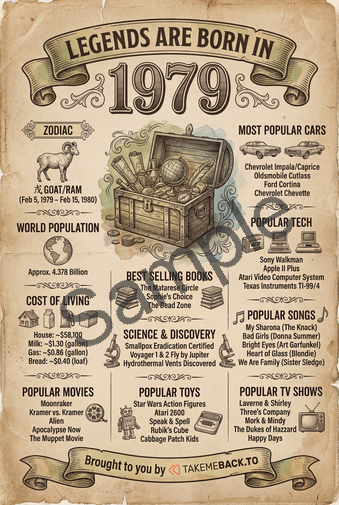

Major Events of 1979 - Historical Moments That Defined the Year | TakeMeBack.to
- 01 Jan US-China diplomatic relations established: On January 1, 1979, the United States and the People's Republic of China officially established diplomatic relations. This marked a significant shift in international relations, as the U.S. recognized the government in Beijing, leading to increased economic and cultural exchanges between the two nations. The normalization of relations was a pivotal moment in the Cold War context, influencing global geopolitics. source: history.state.gov
- 02 Jan Sid Vicious' trial for the alleged murder of his girlfriend Nancy Spungen begins: On January 2, 1979, Sid Vicious, bassist for the Sex Pistols, stood trial in New York City for the second-degree murder of his girlfriend, Nancy Spungen, who was found stabbed to death in their hotel room on October 12, 1978. Vicious was released on bail but died from a heroin overdose on February 2, 1979, before the trial concluded. source: crimeandinvestigation.co.uk
- 04 Jan Ohio settles Kent State shootings civil suits for $675,000: On January 4, 1979, the State of Ohio reached an out-of-court settlement with victims and relatives of victims of the 1970 Kent State University shootings. The settlement included $675,000 in damages and a statement expressing regret for the tragedy, though it did not assign liability. The funds were distributed among nine wounded students and the families of four students killed, with the largest amount awarded to Dean Kahler, who was paralyzed in the incident. source: washingtonpost.com
- 05 Jan Charles Mingus dies in Cuernavaca, Mexico: Charles Mingus, the renowned American jazz bassist and composer, passed away on January 5, 1979, in Cuernavaca, Mexico, at the age of 56. He had been battling amyotrophic lateral sclerosis (ALS) since 1977. His ashes were later scattered in the Ganges River in India. source: britannica.com
- 06 Jan Bee Gees' 'Too Much Heaven' reaches number one on US Billboard Hot 100: On January 6, 1979, the Bee Gees' song 'Too Much Heaven' topped the US Billboard Hot 100 chart, marking the group's fourth consecutive number one single in the United States. source: nypl.org
- 07 Jan Bipasha Basu's birth date confirmed: Bipasha Basu, an Indian actress and model known for her work in Hindi films, was born on January 7, 1979. She gained fame for her roles in various successful movies and has received several awards for her performances. Basu is also recognized for her contributions to the Indian fashion industry and her fitness advocacy. source: britannica.com
- 08 Jan Vietnamese troops capture Phnom Penh during Cambodian Civil War: On January 8, 1979, Vietnamese forces captured Phnom Penh, the capital of Cambodia, effectively ending the Khmer Rouge regime led by Pol Pot. This military action was part of a broader invasion aimed at stopping the atrocities committed by the Khmer Rouge, which had resulted in the deaths of millions. The fall of Phnom Penh marked a significant turning point in Cambodian history and led to the establishment of a new government supported by Vietnam. source: britannica.com
- 09 Jan Colautti v. Franklin: Supreme Court voids vagueness in Pennsylvania's abortion statute: On January 9, 1979, the U.S. Supreme Court ruled in Colautti v. Franklin that a section of Pennsylvania's 1974 Abortion Control Act was void for vagueness. The specific provision required abortion providers to determine fetal viability based on their experience and professional judgment, a standard the Court found too ambiguous. This decision emphasized the necessity for clear and precise legislative language in abortion regulations. source: en.wikipedia.org
- 10 Jan Billy Carter's remarks about Jews and Arabs: On January 10, 1979, Billy Carter, brother of President Jimmy Carter, made controversial remarks during a tour of Georgia with a Libyan delegation. He stated, "There's a hell of a lot more Arabians than there is Jews," and later commented, "The Jewish media tears up the Arab countries full time." These statements were widely criticized as anti-Semitic, leading the White House to publicly disassociate itself from his comments. source: washingtonpost.com
- 11 Jan Village People's 'Y.M.C.A.' reaches number one on UK charts: On January 6, 1979, 'Y.M.C.A.' by the Village People topped the UK Singles Chart, holding the number one position for three consecutive weeks. The song's popularity was significant, becoming one of the best-selling singles of the 1970s in the UK. source: en.wikipedia.org
- 12 Jan Khomeini forms Revolutionary Council: On January 12, 1979, Ayatollah Ruhollah Khomeini established the Revolutionary Council to oversee the Iranian Revolution. The council's members were initially kept secret, with Khomeini later revealing that he had chosen individuals such as Beheshti, Motahhari, Rafsanjani, Bahonar, and Mousavi Ardabili. The council played a pivotal role in managing revolutionary affairs and laying the groundwork for the establishment of the Islamic Republic. source: washingtonpost.com
- 13 Jan YMCA files libel suit against Village People's 'YMCA' song: On January 13, 1979, the Young Men's Christian Association (YMCA) filed a libel lawsuit against the Village People, alleging that their hit song 'YMCA' misrepresented the organization. The lawsuit was later dropped. source: brainyhistory.com
- 14 Jan Carter supports MLK holiday, Jan. 14, 1979: On January 14, 1979, President Jimmy Carter called for legislation to make Martin Luther King Jr.'s birthday a national holiday. Speaking at Atlanta's Ebenezer Baptist Church, Carter emphasized the need to honor King's legacy and strengthen civil rights laws. This pivotal endorsement revitalized efforts that had been stalled for over a decade, leading to the eventual establishment of the holiday in 1983. source: washingtonpost.com
- 16 Jan Shah of Iran flees into exile in Egypt: On January 16, 1979, Mohammad Reza Pahlavi, the Shah of Iran, departed Tehran with his wife, Empress Farah, and their three youngest children, seeking medical treatment in Egypt. This marked the end of his reign following months of escalating protests against his regime. The Shah's departure was officially described as a 'vacation,' but it was effectively an exile. He died in Egypt in 1980. source: news.bbc.co.uk
- 17 Jan Soviet Union conducts underground nuclear test on January 17, 1979: On January 17, 1979, the Soviet Union performed an underground nuclear test at the Atyrau site in Kazakhstan. This test was part of a series of 31 nuclear tests conducted by the USSR in 1979, which included various underground detonations for purposes such as weapons development and peaceful nuclear explosions. source: en.wikipedia.org
- 18 Jan Peter Jenkins completes 'A Walk Across America': Peter Jenkins completed his journey across the United States on January 18, 1979, culminating in Florence, Oregon. His experiences were later published in the bestselling book 'A Walk Across America' in 1979. source: en.wikipedia.org
- 19 Jan John N. Mitchell paroled from federal prison: John N. Mitchell, former U.S. Attorney General, was released on parole from federal prison on January 19, 1979, after serving 19 months of a one-to-four-year sentence for his involvement in the Watergate scandal. Mitchell, 65 at the time, had undergone major surgery during his incarceration and was granted parole due to health concerns. He was the last of the Watergate figures to be released from prison. source: washingtonpost.com
- 20 Jan Chic's 'Le Freak' reaches number one on Billboard Hot 100: On January 20, 1979, Chic's 'Le Freak' topped the Billboard Hot 100 chart, marking the band's first number-one single in the United States. The song, released in September 1978, became a defining track of the disco era and achieved significant commercial success. source: en.wikipedia.org
- 21 Jan Neptune becomes the outermost planet in the solar system: On January 21, 1979, Neptune was confirmed as the outermost planet in our solar system after the discovery of Pluto's small size and its reclassification as a dwarf planet. This marked a significant change in our understanding of the solar system's structure. Neptune, discovered in 1846, is the eighth planet from the Sun and is known for its striking blue color and strong winds. source: solarsystem.nasa.gov
- 22 Jan Pope John Paul II's first visit to Mexico: Pope John Paul II made his first visit to Mexico from January 22 to 26, 1979. This historic trip marked the first time a pope visited the country, and it was significant for strengthening the Catholic Church's presence in Latin America. The visit included large public masses and meetings with various groups, reflecting the pope's commitment to engaging with the faithful in the region. source: bbc.com
- 23 Jan Willie Mays elected to Baseball Hall of Fame in first year of eligibility: On January 23, 1979, Willie Mays was elected to the Baseball Hall of Fame in his first year of eligibility, receiving 94.7% of the vote. He was inducted on August 5, 1979, in Cooperstown, New York. source: en.wikipedia.org
- 25 Jan Pope John Paul II's first international papal visit: Pope John Paul II embarked on his inaugural official papal visit outside Italy on January 25, 1979, traveling to the Dominican Republic, Mexico, and the Bahamas. This journey marked a significant milestone in his papacy, demonstrating his commitment to global Catholicism and fostering connections with diverse cultures. During his visit to the Dominican Republic, he addressed the Cathedral of the Annunciation in Santo Domingo, emphasizing the importance of faith and unity among the faithful. source: vatican.va
- 26 Jan Nelson Rockefeller dies of heart attack at 70: Nelson Rockefeller, the 41st Vice President of the United States and former Governor of New York, died on January 26, 1979, at the age of 70. He suffered a fatal heart attack in his Manhattan townhouse, where he was accompanied by his aide, Megan Marshack. Initial reports incorrectly stated he died at his office in Rockefeller Center. His death led to widespread speculation about the circumstances, particularly regarding his relationship with Marshack. source: washingtonpost.com
- 27 Jan 36th Golden Globe Awards highlights: The 36th Golden Globe Awards, held on January 27, 1979, honored the best in film and television for 1978. 'Midnight Express' won Best Motion Picture – Drama, while 'Heaven Can Wait' took Best Motion Picture – Musical or Comedy. In television, '60 Minutes' was named Best Television Series – Drama, and 'Taxi' won Best Television Series – Musical or Comedy. Lucille Ball received the Cecil B. DeMille Award for lifetime achievement. source: en.wikipedia.org
- 28 Jan Deng Xiaoping's historic US visit: On January 28, 1979, Chinese Vice Premier Deng Xiaoping arrived at Andrews Air Force Base near Washington, D.C., marking the first official visit to the United States by a senior Chinese leader since 1949. This visit was a significant milestone in Sino-American relations, following the establishment of full diplomatic ties on January 1, 1979. During his nine-day stay, Deng engaged in multiple meetings with President Jimmy Carter and other U.S. officials, leading to agreements on cultural relations, science collaboration, and technology cooperation. The visit also included cultural exchanges, such as a performance of American arts at the Kennedy Center, and a memorable moment when Deng donned a cowboy hat at a Texas rodeo, symbolizing the deepening ties between the two nations. source: whitehousehistory.org
- 29 Jan Deng Xiaoping visits Washington, D.C.: Deng Xiaoping, the Chinese leader, made a historic visit to Washington, D.C. on January 29, 1979. This visit marked a significant step in U.S.-China relations, following the normalization of diplomatic ties between the two countries. During his stay, Deng met with President Jimmy Carter and discussed various issues, including trade and cooperation. source: state.gov
- 30 Jan Rhodesian whites approve new constitution leading to black majority rule: On January 30, 1979, Rhodesia's white voters overwhelmingly approved a new constitution that paved the way for black majority rule. The referendum, which saw an 85% approval rate, was part of the Internal Settlement between Prime Minister Ian Smith and moderate black leaders, including Bishop Abel Muzorewa. Despite the approval, the international community did not recognize the new government, and the Rhodesian Bush War continued until the Lancaster House Agreement in December 1979. source: washingtonpost.com
- 31 Jan US and China sign cultural agreement to enhance bilateral relations: On January 31, 1979, U.S. President Jimmy Carter and Chinese Vice Premier Deng Xiaoping signed a cultural agreement in Washington, D.C., aiming to strengthen cultural exchanges and mutual understanding between the two nations. This agreement was part of a series of accords signed during Deng's visit to the United States, following the normalization of diplomatic relations on January 1, 1979. source: fmprc.gov.cn
- 01 Feb Ayatollah Khomeini returns to Iran after 14 years in exile: On February 1, 1979, Ayatollah Ruhollah Khomeini returned to Tehran after 14 years in exile. His arrival marked a pivotal moment in the Iranian Revolution, leading to the establishment of the Islamic Republic and the overthrow of Shah Mohammad Reza Pahlavi. source: aljazeera.com
- 02 Feb Sid Vicious found dead in New York City apartment: Sid Vicious, the bassist of the punk rock band Sex Pistols, was found dead in his New York City apartment on February 2, 1979. His death was ruled as a heroin overdose, and it occurred shortly after he was released on bail for the murder of his girlfriend, Nancy Spungen. Vicious's life and death became emblematic of the chaotic punk rock lifestyle of the era. source: bbc.com
- 03 Feb Pluto moves inside Neptune's orbit for the first time: On February 3, 1979, Pluto entered a phase where it was inside Neptune's orbit, a rare occurrence due to its highly elliptical orbit. This alignment lasted until February 11, 1999, after which Pluto returned to its usual position beyond Neptune. This event highlights the unique orbital characteristics of Pluto compared to the other planets in our solar system. source: solarsystem.nasa.gov
- 04 Feb Heart of Glass by Blondie tops UK Singles Chart: On February 4, 1979, Blondie's 'Heart of Glass' was the number one song on the UK Singles Chart, marking the band's first chart-topping single in the UK. The track, known for its fusion of disco and punk elements, was part of their third studio album, Parallel Lines. source: officialcharts.com
- 05 Feb Sears Radio Theater premieres on CBS Radio: The Sears Radio Theater, a radio drama anthology series sponsored by the Sears chain, premiered on CBS Radio on February 5, 1979. The program offered a different genre of drama each weekday night, featuring hosts such as Lorne Greene, Andy Griffith, Vincent Price, Cicely Tyson, and Richard Widmark. The series ran until August 2, 1979, after which episodes were rebroadcast until February 11, 1980. source: en.wikipedia.org
- 06 Feb Supreme Court upholds Zulfikar Ali Bhutto's death sentence: On February 6, 1979, Pakistan's Supreme Court upheld the death sentence of former Prime Minister Zulfikar Ali Bhutto, who had been convicted of murder in 1978. The court's decision was a 4-3 split, affirming the Lahore High Court's verdict. Bhutto was executed on April 4, 1979, under the military regime of General Zia-ul-Haq. source: washingtonpost.com
- 07 Feb February 7, 1979: Key Events in the Iranian Revolution: On February 7, 1979, significant developments unfolded during the Iranian Revolution. Ayatollah Khomeini addressed the Kurdish community, emphasizing unity between Shia and Sunni Muslims. In Tehran, large demonstrations supported the Bazargan government, with staff from eleven federal ministries declaring allegiance to it. Additionally, the U.S. Secretary of State recognized the Bakhtiar administration, urging it to act in accordance with the people's will. These events marked a pivotal moment in the revolution, signaling the diminishing influence of the Shah's regime and the rise of Khomeini's leadership. source: en.wikipedia.org
- 08 Feb Denis Sassou-Nguesso becomes President of the Republic of the Congo: On February 8, 1979, Colonel Denis Sassou-Nguesso was appointed as interim president of the Republic of the Congo following the resignation of General Joachim Yhombi-Opango. He was confirmed as president by the People's National Assembly on March 31, 1979, and re-elected in 1984 and 1989. source: britannica.com
- 09 Feb Dennis Gabor, inventor of holography, dies in London: Dennis Gabor, the Hungarian-British physicist renowned for inventing holography and awarded the Nobel Prize in Physics in 1971, passed away in London on February 9, 1979. source: en.wikipedia.org
- 10 Feb Iranian Air Force mutiny in Tehran: On February 10, 1979, air force recruits at the Doshan Tappeh Air Base in Tehran staged a rebellion in support of Ayatollah Khomeini. The Imperial Guard responded with force, leading to clashes that resulted in at least 175 deaths. The unrest contributed to the disintegration of military unity and the eventual downfall of the Shah's regime. source: washingtonpost.com
- 11 Feb Elvis Presley biographical film "Elvis!" airs on ABC: On February 11, 1979, the biographical film "Elvis!" starring Kurt Russell as Elvis Presley premiered on ABC. The film, directed by John Carpenter, was the first Elvis biopic and garnered 43 million viewers in the U.S. It was also nominated for a Golden Globe and three Primetime Emmy Awards. source: en.wikipedia.org
- 12 Feb Battle of N'Djamena in Chad: On February 12, 1979, the Battle of N'Djamena commenced when Hissène Habré's Armed Forces of the North (FAN) launched an assault against President Félix Malloum's government forces in the capital, N'Djamena. The conflict resulted in several thousand civilian casualties and prompted international mediation, leading to a ceasefire agreement after three days of negotiations. source: en.wikipedia.org
- 13 Feb Hood Canal Bridge collapses during severe windstorm: On February 13, 1979, the western half of the Hood Canal Bridge in Washington State collapsed during a severe windstorm. The storm produced sustained winds of up to 85 mph and gusts estimated at 120 mph, causing the bridge's pontoons to flood and sink. Fortunately, the bridge was closed to traffic at the time, and no casualties were reported. The bridge was rebuilt and reopened on October 3, 1982. source: sos.wa.gov
- 14 Feb Kidnapping and death of U.S. Ambassador Adolph Dubs in Kabul: On February 14, 1979, U.S. Ambassador Adolph Dubs was kidnapped in Kabul, Afghanistan, by four men, some of whom were reportedly wearing Afghan police uniforms. The kidnappers held him in the Kabul Hotel and demanded the release of certain prisoners. Despite U.S. requests for negotiation, Afghan police, advised by Soviet officials, stormed the hotel, leading to a gunfight in which Dubs was killed. The exact circumstances remain unclear, with various accounts suggesting different motives and identities for the kidnappers. source: presidency.ucsb.edu
- 15 Feb Gas explosion at Warsaw's PKO Rotunda kills 49: On February 15, 1979, a gas explosion occurred at the PKO Bank Polski's Rotunda office in Warsaw, resulting in 49 deaths and 135 injuries. The explosion destroyed 70% of the building, leading to extensive rescue operations and widespread speculation about the cause. Officially, the disaster was attributed to a gas leak, but rumors suggested alternative causes, including a bomb. The Rotunda was rebuilt and reopened in October 1979, with a commemorative plaque honoring the victims. source: en.wikipedia.org
- 16 Feb Valentino Rossi born on February 16, 1979: Valentino Rossi, the renowned Italian motorcycle racer, was born on February 16, 1979, in Urbino, Italy. He is widely regarded as one of the greatest motorcycle racers of all time, having won multiple World Championships across different classes. Rossi's career has significantly influenced the sport and garnered a massive fan following worldwide. source: britannica.com
- 17 Feb Sino-Vietnamese War begins on February 17, 1979: The Sino-Vietnamese War commenced on February 17, 1979, when China launched a military invasion of Vietnam. This conflict arose from territorial disputes and Vietnam's invasion of Cambodia, which had overthrown the Khmer Rouge, a regime supported by China. The war lasted until March 16, 1979, resulting in significant casualties on both sides and lasting tensions in the region. source: britannica.com
- 18 Feb Rare snowfall in the Sahara Desert on February 18, 1979: On February 18, 1979, a rare snowfall occurred in the Sahara Desert, particularly in the town of Ain Sefra, Algeria. This unusual weather event marked one of the few times in recorded history that snow fell in the Sahara, surprising residents and meteorologists alike. The snowfall was light and melted quickly, but it remains a notable occurrence in the region's climate history. source: bbc.com
- 19 Feb President's Day Storm of 1979 caused significant snowfall and disruption: The President's Day Storm of 1979 was a major winter storm that struck the northeastern United States, bringing heavy snowfall and strong winds. It resulted in widespread disruptions, including road closures and power outages, affecting millions of residents. The storm is remembered for its intensity and the challenges it posed to emergency services and transportation. source: weather.gov
- 20 Feb Shankill Butchers sentenced to life imprisonment: On February 20, 1979, eleven members of the Shankill Butchers gang were sentenced to life imprisonment for 19 murders. The gang, active between 1975 and 1982 in Belfast, was notorious for abducting, torturing, and murdering civilians, primarily targeting Catholics. The trial resulted in 42 life sentences, the most ever in a single trial in British criminal history. source: irishnews.com
- 21 Feb Battle of Gayaza Hills during Uganda–Tanzania War: On February 21, 1979, Tanzanian forces engaged Ugandan troops in the Battle of Gayaza Hills near the town of Gayaza, Uganda. The Tanzanian 206th Brigade attacked Ugandan positions in the hills, resulting in heavy casualties, including 24 Tanzanian soldiers killed. Despite the ambush, Tanzanian forces successfully captured the area by the end of the day. source: en.wikipedia.org
- 22 Feb Saint Lucia gains independence from the United Kingdom: On February 22, 1979, Saint Lucia achieved full independence from the United Kingdom, becoming a sovereign state and a member of the Commonwealth of Nations. Prior to independence, the island had been an associated state since 1967, granting it full control over domestic affairs while the UK retained responsibility for foreign affairs and defense. source: britannica.com
- 23 Feb Frank E. Petersen Jr. becomes first African American Marine Corps general: On February 23, 1979, Frank E. Petersen Jr. was promoted to brigadier general, becoming the first African American to achieve this rank in the U.S. Marine Corps. A distinguished aviator, Petersen flew over 350 combat missions during the Korean and Vietnam Wars and held various command positions, including the first African American to command a fighter squadron and a major Marine Corps base. source: marines.mil
- 24 Feb Second Yemenite War erupts between North and South Yemen: On February 24, 1979, border clashes escalated into full-scale conflict between the Yemen Arab Republic (North Yemen) and the People's Democratic Republic of Yemen (South Yemen). The war, lasting until March 19, 1979, resulted in a South Yemeni victory and highlighted the deep-seated hostilities between the two nations. source: washingtonpost.com
- 25 Feb Soviet Union launches Soyuz 32 to Salyut 6 space station: On February 25, 1979, the Soviet Union launched Soyuz 32, carrying cosmonauts Vladimir Lyakhov and Valery Ryumin to the Salyut 6 space station. The mission aimed to conduct scientific experiments and perform maintenance on the station. The crew spent 175 days aboard, setting a new space endurance record at the time. source: washingtonpost.com
- 26 Feb Total solar eclipse of 1979: On February 26, 1979, a total solar eclipse occurred, visible across parts of the United States, Canada, and Mexico. This eclipse was notable for being the last total solar eclipse visible from the contiguous United States until 2017. The path of totality crossed several states, providing a unique opportunity for millions to experience the phenomenon. source: eclipse.gsfc.nasa.gov
- 27 Feb New Orleans Mardi Gras canceled due to police strike: In February 1979, New Orleans police officers initiated a strike that led to the cancellation of Mardi Gras parades. The strike began on February 16, 1979, and lasted for 15 days, during which major krewes canceled their parades, including Comus, Rex, and Zulu. Some krewes relocated their festivities to surrounding areas, such as Jefferson Parish. Despite the absence of official parades, celebrations continued in the French Quarter with National Guard troops maintaining order. source: washingtonpost.com
- 28 Feb 1979 Saint Elias earthquake in Alaska: On February 28, 1979, a magnitude 7.5 earthquake struck beneath the Chugach and Saint Elias Mountains in southeastern Alaska. Occurring at 12:27 AKST, the thrust-faulting earthquake was felt across southeastern Alaska and parts of Yukon, Canada. Despite its strength, the sparsely populated region experienced minimal damage and no casualties. source: usgs.gov
- 01 Mar Scottish devolution referendum held on March 1, 1979: On March 1, 1979, Scotland held a referendum to decide on the establishment of a Scottish Assembly under the Scotland Act 1978. While 51.6% of voters supported the proposal, the turnout was 63.7%, meaning only 32.9% of the total electorate voted in favor. Due to a stipulation in the Act requiring at least 40% of the electorate to approve, the proposal was not implemented, and the Act was subsequently repealed. source: bbc.com
- 04 Mar Voyager I discovers Jupiter's rings: On March 4, 1979, NASA's Voyager I spacecraft made a groundbreaking discovery by detecting rings around Jupiter. This finding was significant as it expanded our understanding of the gas giant and its complex system. The rings are composed mainly of dust particles and small rocks, providing insights into the planet's formation and its moons. source: solarsystem.nasa.gov
- 05 Mar Voyager 1 completes its flyby of Jupiter: On March 5, 1979, Voyager 1 made its closest approach to Jupiter, providing unprecedented images and data about the planet and its moons. This flyby revealed details about Jupiter's atmosphere, magnetic field, and its largest moon, Io, among others. The mission significantly advanced our understanding of the outer solar system. source: nasa.gov
- 06 Mar China announces end of invasion and troop withdrawal from Vietnam: On March 6, 1979, China declared the completion of its military objectives in Vietnam and began withdrawing troops after a 17-day invasion. The Chinese government stated that its forces had achieved their goals and would return to China, while warning Vietnam against future border provocations. The announcement was met with skepticism by Vietnamese officials, who questioned China's intentions and the sincerity of the withdrawal. The conflict had resulted in significant casualties and strained relations between the two nations. source: washingtonpost.com
- 07 Mar Largest magnetar event recorded on March 7, 1979: On March 7, 1979, the largest magnetar (soft gamma repeater) event was recorded, marking a significant milestone in high-energy astronomy. source: heasarc.gsfc.nasa.gov
- 08 Mar International Women's Day protests in Tehran: On March 8, 1979, thousands of Iranian women marched in Tehran to protest the newly imposed mandatory hijab decree by Ayatollah Khomeini. The protests, which lasted six days, were met with violence from pro-Khomeini forces but led to a temporary retraction of the decree. The movement highlighted women's resistance to the Islamic Republic's policies on women's rights. source: washingtonpost.com
- 09 Mar MLB mandates equal access for female reporters: On March 9, 1979, Major League Baseball Commissioner Bowie Kuhn ordered all 26 MLB teams to grant equal access to reporters, regardless of sex. This directive followed a successful lawsuit by Sports Illustrated reporter Melissa Ludtke, who had been denied access to team clubhouses during the 1977 World Series. The court ruled that the exclusion violated Ludtke's 14th Amendment rights, leading to the policy change. source: history.com
- 11 Mar Battle of Lukaya: Tanzanian forces defeat Ugandan and Libyan troops in Uganda: On March 10–11, 1979, during the Uganda–Tanzania War, Tanzanian forces, supported by Ugandan rebels, engaged Ugandan government troops backed by Libyan and Palestinian forces in Lukaya, Uganda. After an initial retreat, Tanzanian forces counterattacked, retaking Lukaya and inflicting heavy casualties on the opposing forces. The battle marked a significant turning point, leading to the eventual collapse of the Ugandan Army. source: en.wikipedia.org
- 12 Mar Iran withdraws from CENTO: On March 12, 1979, following the Iranian Revolution, Iran announced its withdrawal from the Central Treaty Organization (CENTO), a military alliance established in 1955. This decision led to the dissolution of CENTO, as the alliance was no longer functional without Iran's participation. source: washingtonpost.com
- 13 Mar European Monetary System established on March 13, 1979: The European Monetary System (EMS) was established on March 13, 1979, to promote monetary stability in Europe. It introduced the European Currency Unit (ECU) and aimed to reduce exchange rate variability and achieve monetary cooperation among member states. The EMS laid the groundwork for the eventual introduction of the euro. source: ecb.europa.eu
- 14 Mar Hawker Siddeley Trident crash in Beijing, China: On March 14, 1979, a CAAC Airlines Hawker Siddeley Trident 2E (registration B-274) crashed into a factory near Beijing-Xijiao Airport during its initial climb after takeoff. All 12 crew members on board were killed, along with at least 32 people on the ground. The crash was attributed to the pilot's limited experience and unfamiliarity with the aircraft type. source: baaa-acro.com
- 15 Mar Establishment of the European Monetary System: The European Monetary System (EMS) was established on March 15, 1979, to promote monetary stability in Europe. It introduced the European Currency Unit (ECU) and aimed to reduce exchange rate variability and achieve monetary cooperation among member states. The EMS was a precursor to the Euro and laid the groundwork for future economic integration in Europe. source: ecb.europa.eu
- 16 Mar Chinese forces withdraw from Vietnam, ending the Sino-Vietnamese War: On March 16, 1979, Chinese forces withdrew from Vietnam, marking the conclusion of the Sino-Vietnamese War. The conflict began on February 17, 1979, when China launched a military invasion into northern Vietnam, primarily in response to Vietnam's invasion of Cambodia. After capturing several border towns, including Lạng Sơn, Chinese forces declared that their objectives had been achieved and commenced withdrawal. The war lasted approximately one month, resulting in significant casualties on both sides, with estimates of around 30,000 deaths and 35,000 wounded for each country. Despite the heavy losses, the conflict did not lead to significant territorial changes, and the pre-war status quo remained largely intact. source: britannica.com
- 17 Mar Wales wins 1979 Five Nations Championship with 27-3 victory over England: On March 17, 1979, Wales secured their second consecutive Five Nations Championship title by defeating England 27-3 at Cardiff Arms Park. This victory also earned them the Triple Crown for the fourth successive season, marking a record 16th overall. The match featured tries from wingers JJ Williams and Elgan Rees, centre David Richards, and flanker Paul Ringer, while England's sole points came from a penalty by fly-half Neil Bennett. source: dailypost.co.uk
- 18 Mar Kurdish-Iranian conflict erupts in Sanandaj, Iran: On March 18, 1979, Kurdish rebels in Sanandaj, Iran, seized control of police headquarters, army bases, and parts of army barracks, leading to clashes with government forces. The fighting resulted in the deaths of at least 150 individuals. The unrest was part of a broader Kurdish rebellion seeking autonomy following the Iranian Revolution. source: washingtonpost.com
- 19 Mar C-SPAN begins live coverage of House of Representatives: On March 19, 1979, C-SPAN initiated live, gavel-to-gavel coverage of the U.S. House of Representatives, marking a significant step toward governmental transparency. The first speaker was Representative Al Gore of Tennessee, who emphasized the potential of television to revitalize representative democracy. This broadcast was made possible by the House's installation of a television system, funded by taxpayers, and operated by the House itself. source: wired.com
- 20 Mar Murder of Italian journalist Carmine Pecorelli in Rome: Carmine "Mino" Pecorelli, an Italian investigative journalist known for his controversial reporting, was assassinated in Rome on March 20, 1979. He was shot four times in the Prati district, near his magazine's office. Pecorelli had been investigating sensitive political matters, including the kidnapping and murder of former Prime Minister Aldo Moro. His death remains a significant event in Italian journalism and politics. source: ansa.it
- 21 Mar Egypt-Israel peace treaty approved: On March 21, 1979, the Egypt-Israel Peace Treaty was officially approved, marking a significant step towards peace in the Middle East. This treaty was the first of its kind between Israel and an Arab country, leading to the normalization of relations and the withdrawal of Israeli forces from the Sinai Peninsula. The agreement was facilitated by U.S. President Jimmy Carter and was a pivotal moment in the Arab-Israeli conflict. source: state.gov
- 22 Mar IRA assassinates British Ambassador Richard Sykes in The Hague: On March 22, 1979, Sir Richard Sykes, the British Ambassador to the Netherlands, was assassinated by the Provisional Irish Republican Army (IRA) outside his residence in The Hague. The attack also resulted in the death of his Dutch valet, Karel Straub. The IRA claimed responsibility for the assassination, stating that Sykes had been engaged in intelligence operations against their organization. source: theguardian.com
- 23 Mar Chad's President Félix Malloum resigns amid civil war: On March 23, 1979, Chadian President Félix Malloum resigned following intense civil conflict between his government and Prime Minister Hissène Habré's forces. Malloum's departure led to the formation of an eight-member governing council chaired by Goukouni Oueddei, marking a significant shift in Chad's political landscape. source: en.wikipedia.org
- 24 Mar Space Shuttle Columbia arrives at Kennedy Space Center: On March 24, 1979, the Space Shuttle Columbia, atop the Shuttle Carrier Aircraft, touched down at NASA's Kennedy Space Center in Florida. This marked the first time Columbia arrived at KSC, initiating preparations for its inaugural mission. The event was attended by NASA Administrator Robert A. Frosch and other dignitaries. source: nasa.gov
- 25 Mar Egypt-Israel peace treaty signed: On March 25, 1979, Egypt and Israel signed a peace treaty, marking the first such agreement between Israel and an Arab country. The treaty was a significant step towards peace in the Middle East, leading to the normalization of relations between the two nations and the withdrawal of Israeli forces from the Sinai Peninsula. This agreement was facilitated by U.S. President Jimmy Carter and took place at the Camp David Accords in 1978. source: state.gov
- 26 Mar Magic Johnson leads Michigan State to victory over Larry Bird's Indiana State in 1979 NCAA Championship: On March 26, 1979, Magic Johnson's Michigan State Spartans defeated Larry Bird's Indiana State Sycamores 75-64 in the NCAA Division I men's basketball championship game. Johnson scored 24 points, leading all scorers, while Bird contributed 19 points and 13 rebounds. This game marked the first of many matchups between the two future NBA stars, setting the stage for their legendary rivalry. source: si.com
- 27 Mar Delaware v. Prouse limits police vehicle stops without reasonable suspicion: In the 1979 Supreme Court case Delaware v. Prouse, the Court ruled that police cannot stop motorists at random to check driver's licenses and vehicle registrations without reasonable suspicion of a law violation. This decision emphasized the Fourth Amendment's protection against unreasonable searches and seizures. source: politico.com
- 28 Mar Three Mile Island nuclear accident occurs in Pennsylvania: On March 28, 1979, the Three Mile Island nuclear power plant in Pennsylvania experienced a partial meltdown, leading to the release of radioactive gases. This incident is considered the most serious accident in U.S. commercial nuclear power plant history, prompting widespread public concern and regulatory changes in the nuclear industry. The event highlighted the need for improved safety protocols and emergency response measures. source: nrc.gov
- 29 Mar Quebecair Flight 255 crashes after engine explosion: On March 29, 1979, Quebecair Flight 255, a Fairchild F-27 aircraft, crashed shortly after takeoff from Quebec City, Canada. The engine explosion led to the loss of 17 of the 24 people on board. source: washingtonpost.com
- 30 Mar Assassination of Airey Neave: On March 30, 1979, Airey Neave, the British Shadow Secretary of State for Northern Ireland, was assassinated by a car bomb planted by the Irish National Liberation Army (INLA) in the Palace of Westminster car park. The explosion occurred as Neave drove up the exit ramp, causing fatal injuries. He was 63 years old at the time of his death. source: news.bbc.co.uk
- 31 Mar Malta gains independence from British rule: On March 31, 1979, Malta officially gained independence from British colonial rule, marking a significant milestone in its history. This event followed a gradual process of self-governance that began in the early 20th century, culminating in full sovereignty. Malta's independence allowed it to establish its own government and pursue a path of national development. source: britannica.com
- 01 Apr Iran officially becomes an Islamic Republic: On April 1, 1979, Iran was declared an Islamic Republic following a referendum in which the majority of voters supported the establishment of a theocratic government. This marked a significant shift from the previous monarchy under Shah Mohammad Reza Pahlavi, leading to the establishment of a political system based on Islamic principles and governance. source: britannica.com
- 02 Apr Sverdlovsk anthrax leak: Soviet biowarfare accident: On April 2, 1979, anthrax spores were accidentally released from a Soviet military research facility in Sverdlovsk (now Yekaterinburg), leading to at least 66 human deaths and numerous animal fatalities. The Soviet government initially attributed the outbreak to tainted meat, but investigations later revealed that the incident was caused by a leak from a biological weapons plant. The event is sometimes referred to as the "biological Chernobyl." source: history.com
- 03 Apr Jane Byrne becomes first woman mayor of Chicago: On April 3, 1979, Jane Byrne was elected as Chicago's first female mayor, defeating Republican Wallace D. Johnson with 82.1% of the vote. She was sworn into office on April 16, 1979, and served until April 29, 1983. source: washingtonpost.com
- 04 Apr Execution of Zulfikar Ali Bhutto: On April 4, 1979, former Pakistani Prime Minister Zulfikar Ali Bhutto was executed by hanging in Rawalpindi, Pakistan. He had been convicted of ordering the assassination of Nawab Mohammad Ahmad Khan Kasuri in 1974. The trial was widely criticized for lacking fairness and due process. Despite international appeals for clemency, Bhutto was executed under the military regime of General Muhammad Zia-ul-Haq. source: news.bbc.co.uk
- 05 Apr Death of Eugene Gabritschevsky: Eugene Gabritschevsky, a notable figure in the field of neurology and psychiatry, passed away on April 5, 1979. He is known for his contributions to the understanding of neurological disorders and his work in the field of psychophysiology. His research has had a lasting impact on the study of brain function and mental health. source: ncbi.nlm.nih.gov
- 06 Apr Student protests in Nepal: On April 6, 1979, students in Kathmandu protested against the execution of former Pakistani Prime Minister Zulfikar Ali Bhutto. The demonstration escalated into violent clashes with police, leading to multiple arrests and injuries. This event marked the beginning of a series of student-led protests that eventually forced the monarchy to hold a referendum on the multiparty system. source: en.wikipedia.org
- 07 Apr Execution of Iranian Prime Minister Amir-Abbas Hoveyda: Amir-Abbas Hoveyda, who served as Iran's prime minister from 1965 to 1977, was executed on April 7, 1979, following a secret trial by the Islamic Revolutionary Court. Despite initial halts to executions, Hoveyda was convicted of corruption and other charges, leading to his death by firing squad. His execution marked a significant event during the early days of the Iranian Revolution. source: washingtonpost.com
- 08 Apr China joins the International Olympic Committee: On April 8, 1979, the People's Republic of China was officially admitted to the International Olympic Committee (IOC). This marked a significant moment in sports diplomacy, allowing China to participate in the Olympic Games and enhancing its international presence. The decision was part of a broader effort to reintegrate China into global institutions following years of isolation. source: britannica.com
- 09 Apr Jane Byrne becomes first female mayor of Chicago: On April 9, 1979, Jane Byrne was elected as the first female mayor of Chicago, marking a significant milestone in the city's political history. Her tenure was noted for various reforms and initiatives aimed at improving the city, particularly in areas like housing and public safety. Byrne's election represented a breakthrough for women in politics, inspiring future generations of female leaders. source: chicagotribune.com
- 10 Apr 1979 Red River Valley tornado outbreak: On April 10, 1979, a significant tornado outbreak occurred along the Red River Valley between Oklahoma and Texas. Thunderstorms developed over West and North Central Texas, producing large hail, strong winds, and multiple tornadoes. At least 22 tornadoes were documented on that day, including two rated F4 on the Fujita scale, resulting in 56 fatalities and 1,922 injuries. source: weather.gov
- 11 Apr Margaret Thatcher becomes UK's first female prime minister: On April 11, 1979, Margaret Thatcher was elected as the first female Prime Minister of the United Kingdom. Leading the Conservative Party, she served until 1990 and was known for her strong conservative policies and leadership style, which earned her the nickname 'The Iron Lady.' Her tenure marked significant changes in British politics and economics. source: bbc.com
- 12 Apr Soyuz 33 returns to Earth after mission abort: On April 12, 1979, the Soviet Soyuz 33 spacecraft, carrying cosmonauts Nikolai Rukavishnikov and Georgi Ivanov, returned to Earth after an aborted mission to the Salyut 6 space station. An engine failure prevented docking, leading to a ballistic re-entry and landing 320 km southeast of Dzhezkazgan. source: esa.int
- 13 Apr La Soufrière volcano eruption in Saint Vincent: On April 13, 1979, La Soufrière volcano in Saint Vincent erupted explosively after 10 months of mild premonitory activity. The eruption produced strong vertical explosions between April 13 and 26, generating ash falls, pyroclastic flows, and mudflows. From about May 3 onwards, basaltic–andesite lava began accumulating in the summit crater. source: nature.com
- 14 Apr Liberian rice price protest turns deadly: On April 14, 1979, a peaceful demonstration in Monrovia, Liberia, against a proposed rice price increase escalated into violent riots. The government deployed troops to suppress the unrest, resulting in at least 40 civilian deaths and over 500 injuries. The incident led to widespread looting and property damage estimated at over $40 million, significantly damaging President William Tolbert's credibility. source: en.wikipedia.org
- 15 Apr 1979 Montenegro earthquake: On April 15, 1979, a devastating earthquake struck the coastal region of Montenegro, then part of Yugoslavia, with a magnitude of 6.9. The tremor resulted in at least 136 fatalities and over 1,000 injuries, causing extensive damage to infrastructure and cultural monuments. The epicenter was located in the Adriatic Sea, approximately 15 kilometers from the coast, between the cities of Bar and Ulcinj. source: usgs.gov
- 16 Apr Jane Byrne becomes first female mayor of Chicago: On April 16, 1979, Jane Byrne was inaugurated as the 50th mayor of Chicago, becoming the first woman to hold the position. She won the 1979 Chicago mayoral election on April 3, 1979, defeating incumbent Michael Bilandic with 82.1% of the vote, marking the largest vote share in Chicago mayoral election history at that time. source: washingtonpost.com
- 17 Apr Pearl River Flood in Jackson, Mississippi: On April 17, 1979, the Pearl River in Jackson, Mississippi, reached a record crest of 43.28 feet, nearly 25 feet above the flood stage, causing extensive flooding in downtown Jackson and surrounding areas. Approximately 17,000 residents were evacuated, and the flood resulted in damages estimated between $500 million and $700 million at that time, equivalent to over $1 billion today. Tragically, four fatalities were reported due to the flooding. source: weather.gov
- 18 Apr Real People TV show premieres on NBC: 'Real People' is an American reality television series that premiered on NBC on April 18, 1979. The show featured a panel of hosts introducing pre-filmed segments about individuals with unique occupations or hobbies, engaging in comedic banter with the studio audience. It aired from 1979 to 1984, becoming one of NBC's most popular series during its early seasons. source: en.wikipedia.org
- 19 Apr Bangui children's massacre in Central African Empire: On April 19, 1979, approximately 100 students were killed in Ngaragba Prison, Bangui, following protests against mandatory school uniforms imposed by Emperor Jean-Bédel Bokassa. The students were arrested and beaten to death by prison guards, with reports suggesting Bokassa personally participated in the violence. This event, known as the Bangui children's massacre, led to international condemnation and contributed to the eventual overthrow of Bokassa's regime. source: washingtonpost.com
- 20 Apr President Carter's encounter with a swamp rabbit while fishing in Georgia: On April 20, 1979, President Jimmy Carter was fishing alone in a pond near his hometown of Plains, Georgia, when a swamp rabbit approached his boat, hissing and gnashing its teeth. Carter splashed water at the rabbit with his paddle, causing it to retreat. The incident was later reported by the press, leading to media coverage and political commentary. source: washingtonpost.com
- 21 Apr Carmelina musical closes on Broadway after 17 performances: The musical 'Carmelina' closed on April 21, 1979, at the St. James Theatre in New York City after 17 performances. Directed by José Ferrer and choreographed by Peter Gennaro, the production featured a cast including Georgia Brown, Cesare Siepi, Grace Keagy, John Michael King, and Josie de Guzman. The show received a Tony nomination for Best Original Score. source: broadwayworld.com
- 22 Apr Albert Einstein Memorial unveiled in Washington, D.C.: The Albert Einstein Memorial was unveiled on April 22, 1979, in Washington, D.C., to honor the renowned physicist. The memorial features a bronze statue of Einstein seated, surrounded by inscriptions of his famous equations and quotes. It serves as a tribute to his contributions to science and humanity. source: nps.gov
- 23 Apr Death of Blair Peach during Anti-Nazi League protest: Blair Peach, a New Zealand-born teacher and anti-racism activist, died on April 23, 1979, after being struck on the head during an Anti-Nazi League demonstration in Southall, London. He was among approximately 3,000 protesters opposing a National Front rally. Peach was hit on the head, probably by a member of the Special Patrol Group (SPG), a specialist unit within the Metropolitan Police Service. He died in hospital that night. source: bbc.co.uk
- 24 Apr Rhodesian Bishop Muzorewa wins general election: In April 1979, Bishop Abel Muzorewa's United African National Council (UANC) secured 51 of the 100 seats in Rhodesia's House of Assembly, leading to his appointment as the country's first black prime minister. The election was part of the Internal Settlement aimed at transitioning Rhodesia to majority rule, though it faced criticism for not being fully inclusive. source: washingtonpost.com
- 25 Apr Israel-Egypt peace treaty takes effect: The Israel-Egypt Peace Treaty, signed on March 26, 1979, officially took effect on April 25, 1979. This landmark agreement marked the first peace treaty between Israel and an Arab country, leading to the withdrawal of Israeli forces from the Sinai Peninsula and the normalization of relations between the two nations. The treaty was a significant step towards peace in the Middle East and was facilitated by U.S. mediation. source: state.gov
- 26 Apr Janne Wirman, Finnish musician, born on April 26, 1979: Janne Viljami "Warman" Wirman is a Finnish keyboardist born on April 26, 1979, in Espoo, Finland. He is best known for his work with the melodic death metal band Children of Bodom and the progressive metal band Warmen. source: en.wikipedia.org
- 27 Apr Soviet dissidents exchange and release: On April 27, 1979, a significant exchange of Soviet dissidents took place, where several political prisoners were released in a deal between the United States and the Soviet Union. This event highlighted the ongoing tensions of the Cold War and the human rights issues within the Soviet regime. The exchange was part of broader negotiations aimed at improving U.S.-Soviet relations during this period. source: washingtonpost.com
- 28 Apr President's Rule imposed in Goa on April 28, 1979: On April 28, 1979, following the resignation of Chief Minister Shashikala Kakodkar on April 27, President's Rule was imposed in Goa, Daman, and Diu for six months, with a provision for extension. The central government concluded that local leaders were unlikely to form a stable government after the fall of Kakodkar's administration, leading to the dissolution of the assembly and the imposition of President's Rule. source: indianexpress.com
- 29 Apr First manned flight of the Mauro Solar Riser: On April 29, 1979, the Mauro Solar Riser, piloted by Larry Mauro, achieved the first manned flight of a solar-powered aircraft at Flabob Airport in Riverside, California. The aircraft, a converted UFM Easy Riser hang glider, utilized photovoltaic cells to charge a battery that powered its electric motor. The flight lasted approximately five minutes, reaching a maximum altitude of about 40 feet and covering a distance of half a mile. source: guinnessworldrecords.com
- 30 Apr First Israeli ship traverses Suez Canal: On April 30, 1979, the Israeli freighter Ashdod became the first Israeli-flagged vessel to navigate the Suez Canal, marking the end of Egypt's ban on Israeli shipping that had been in place since Israel's founding. The ship's passage was part of a 32-ship international convoy traveling from the Red Sea to the Mediterranean. The Suez Canal Authority provided an escort of patrol boats through the canal as a security measure and honor guard. The Ashdod paid a $10,000 fee for passage through the canal. source: washingtonpost.com
- 01 May Greenland achieves limited autonomy from Denmark: On May 1, 1979, Greenland was granted home rule, allowing it to govern its internal affairs while Denmark retained control over foreign policy and defense. This marked a significant step towards self-determination for the Greenlandic people, enabling them to manage local resources and cultural matters more effectively. The home rule agreement was a pivotal moment in Greenland's political history, leading to further discussions about independence in subsequent years. source: britannica.com
- 02 May Quadrophenia film premieres in London: The British drama film 'Quadrophenia', directed by Franc Roddam and based on The Who's 1973 rock opera, premiered in London on May 2, 1979. The film, set in 1964, follows the life of a young mod named Jimmy Cooper, portrayed by Phil Daniels, and features a soundtrack by The Who. It was released to the public on August 16, 1979. source: brainyhistory.com
- 03 May Margaret Thatcher becomes first female British Prime Minister: On May 3, 1979, Margaret Thatcher was elected as the first female Prime Minister of the United Kingdom. Leading the Conservative Party, she won a decisive victory in the general election, marking a significant moment in British political history. Thatcher's leadership would last until 1990, during which she implemented numerous economic and social reforms. source: bbc.com
- 04 May Margaret Thatcher becomes UK Prime Minister: Margaret Thatcher was elected as the Prime Minister of the United Kingdom on May 4, 1979, after her Conservative Party won a decisive victory in the general election. She became the first woman to hold the office and served until 1990, implementing significant economic and social reforms during her tenure. Her leadership style and policies, often referred to as 'Thatcherism,' had a lasting impact on British politics. source: bbc.com
- 05 May Voyager 1 completes flyby of Jupiter: On May 5, 1979, Voyager 1 successfully completed its flyby of Jupiter, providing unprecedented images and data about the planet and its moons. This historic event marked a significant milestone in space exploration, revealing details about Jupiter's atmosphere, magnetic field, and its largest moon, Ganymede. The mission greatly enhanced our understanding of the outer solar system. source: nasa.gov
- 06 May Nancy Lopez wins Women's International Golf Tournament: On May 6, 1979, Nancy Lopez secured her 12th LPGA Tour victory at the Women's International Golf Tournament in South Carolina, finishing three strokes ahead of runner-up Donna White with a score of 282 (−6). source: en.wikipedia.org
- 07 May 5th UNCTAD Conference Opens in Manila: The Fifth United Nations Conference on Trade and Development (UNCTAD V) commenced on May 7, 1979, in Manila, Philippines. The conference, held at the Philippine International Convention Center, continued until June 3, 1979, focusing on global trade and development issues. source: unctad.org
- 08 May El Salvador Cathedral Massacre: Police Open Fire on Demonstrators: On May 8, 1979, Salvadoran police opened fire on anti-government protesters outside the Metropolitan Cathedral in San Salvador, resulting in at least 18 deaths and numerous injuries. The protest, organized by the left-wing Popular Revolutionary Bloc, was demanding the release of five leaders imprisoned by the military government. Eyewitnesses reported that the police fired automatic rifles into the crowd without warning, causing panic as demonstrators sought refuge inside the cathedral. The incident intensified the political unrest in El Salvador, leading to further violence and contributing to the escalation of the Salvadoran Civil War. source: news.bbc.co.uk
- 09 May SALT II Treaty signed by the US and USSR: The Strategic Arms Limitation Talks (SALT II) treaty was signed on May 9, 1979, by U.S. President Jimmy Carter and Soviet General Secretary Leonid Brezhnev. This treaty aimed to limit the number of strategic nuclear weapons and was a continuation of the SALT I negotiations. Although it was signed, the treaty was never ratified by the U.S. Senate due to rising tensions between the two superpowers. source: archives.gov
- 10 May Gasoline prices exceed $1 per gallon in Boston: On May 10, 1979, a Gulf station in Boston's Beacon Hill area became the first in the U.S. to raise its premium unleaded gasoline price above $1 per gallon, increasing it from 98.9 cents to $1.009. source: washingtonpost.com
- 12 May Tracy Austin ends Chris Evert's 125-match clay court winning streak: On May 12, 1979, 16-year-old Tracy Austin defeated Chris Evert 6-4, 2-6, 7-6 in the semifinals of the Italian Open, ending Evert's 125-match winning streak on clay courts that had begun in August 1973. source: tennismajors.com
- 13 May Cuban asylum seekers breach Venezuelan embassy in Havana: On May 13, 1979, twelve Cubans attempted to seek asylum by crashing a bus through the fence of the Venezuelan embassy in Havana. The Cuban Foreign Ministry confirmed the incident, stating that three of the individuals were wounded by gunfire from Cuban guards after the driver refused to halt, and three others were injured in the crash. The exact number of individuals who successfully entered the embassy was not specified. source: washingtonpost.com
- 14 May Jean Rhys dies at 88 in Exeter, England: Jean Rhys, the acclaimed British novelist known for works like "Wide Sargasso Sea," passed away on May 14, 1979, in Exeter, Devon, England, at the age of 88. source: britannica.com
- 15 May Margaret Thatcher becomes first female UK Prime Minister: On May 15, 1979, Margaret Thatcher was elected as the first female Prime Minister of the United Kingdom. Leading the Conservative Party, she served until 1990 and was known for her strong conservative policies and leadership style, which earned her the nickname 'The Iron Lady.' Her tenure marked significant changes in British politics and economics. source: bbc.com
- 16 May Kampatimar Shankariya executed in Jaipur, India: Kampatimar Shankariya, an Indian serial killer, was executed by hanging in Jaipur on May 16, 1979. He was convicted of murdering at least 70 people between 1977 and 1978, using a hammer to strike his victims on the neck below the ears. His last words were: "I have murdered in vain. Nobody should become like me." source: corriere.it
- 17 May 6th Daytime Emmy Awards held at Vivian Beaumont Theatre: The 6th Daytime Emmy Awards ceremony took place on May 17, 1979, at the Vivian Beaumont Theatre in New York City. Hosted by Bob Barker and televised on CBS, the event honored excellence in American daytime programming from 1978. Notably, this ceremony introduced the Outstanding Supporting Actor and Actress categories, marking a first in the awards show's history. source: en.wikipedia.org
- 18 May President Carter's unusual rabbit encounter during fishing trip: On May 18, 1979, President Jimmy Carter had a notable encounter with a rabbit while fishing in a canoe on a pond in Plains, Georgia. The rabbit reportedly swam toward the canoe, prompting Carter to splash water in an attempt to scare it away. This incident became a quirky moment in presidential history, often referenced in discussions about Carter's presidency. source: history.com
- 19 May Spectacular Bid wins 104th Preakness Stakes: On May 19, 1979, Spectacular Bid, ridden by 19-year-old jockey Ronnie Franklin, secured victory in the 104th Preakness Stakes at Pimlico Race Course in Baltimore, Maryland. The race was run on a track listed as good, and Spectacular Bid completed the 1 3/16-mile race in 1:54-1/5, winning by 5½ lengths over runner-up Golden Act. This performance solidified his reputation as a leading contender for the Triple Crown. source: washingtonpost.com
- 20 May Elton John's historic USSR tour: Elton John arrived in Moscow on May 20, 1979, to begin his eight-concert tour of the Soviet Union, marking a significant cultural exchange during the Cold War. The tour included performances in Leningrad and Moscow, with the final concert on May 28, 1979, broadcast live on BBC Radio 1. This event was pivotal in introducing Western pop music to the Soviet audience and led to the official release of John's album "A Single Man" in the USSR. source: eltonjohn.com
- 21 May White Night Riots in San Francisco: On May 21, 1979, following the conviction of Dan White for the voluntary manslaughter of Mayor George Moscone and Supervisor Harvey Milk, thousands of protesters, primarily from San Francisco's gay community, gathered at City Hall. The demonstration escalated into riots, resulting in property damage, injuries to both police officers and protesters, and a retaliatory police raid on a gay bar in the Castro District. source: en.wikipedia.org
- 22 May 1979 Canadian federal election results in Conservative victory: On May 22, 1979, the Progressive Conservative Party, led by Joe Clark, won 136 seats in the Canadian federal election, forming a minority government. Despite the Liberal Party securing 40.11% of the popular vote, the Conservatives achieved a plurality in seats. This election marked the end of 16 years of Liberal governance under Pierre Trudeau. source: en.wikipedia.org
- 23 May Karl Carstens elected President of West Germany: On May 23, 1979, Karl Carstens was elected as the fifth President of the Federal Republic of Germany, defeating Social Democratic candidate Annemarie Renger in the first ballot. Carstens, a member of the Christian Democratic Union (CDU), served as President from July 1, 1979, to June 30, 1984. source: washingtonpost.com
- 24 May Thorpe Park opens in Surrey: Thorpe Park, a theme park located in Chertsey and Staines, Surrey, England, opened to the public on 24 May 1979. The park was officially opened by Lord Louis Mountbatten, marking his final public appearance before his assassination in 1979. Initially, the park featured a replica Stone Age cave, Celtic farm, Norman castle, and Viking camp, along with ancient water vehicles and aircraft. source: en.wikipedia.org
- 25 May First post-moratorium execution in Florida: John Arthur Spenkelink was executed by electric chair on May 25, 1979, marking Florida's first execution after the death penalty was reinstated in 1976. He was convicted of the 1973 murder of Joseph J. Szymankiewicz in Tallahassee. Spenkelink's execution was the first in the United States since 1967, following Gary Gilmore's execution in Utah in 1977. source: washingtonpost.com
- 26 May USS Nautilus concludes historic nuclear submarine service: The USS Nautilus, the world's first nuclear-powered submarine, completed its final voyage on May 26, 1979, arriving at Mare Island Naval Shipyard in California. It was decommissioned on March 3, 1980, after 25 years of service and over half a million miles steamed. source: history.navy.mil
- 27 May Rick Mears wins the Indianapolis 500 for the first time: On May 27, 1979, Rick Mears won the Indianapolis 500, marking his first victory at this prestigious auto race. Mears drove a car for the Penske Racing team and completed the race in a time of 3 hours, 50 minutes, and 32 seconds. This win was significant in establishing Mears as one of the top drivers in IndyCar history, eventually leading to a total of four Indianapolis 500 victories. source: indycar.com
- 28 May Greece signs Treaty of Accession to European Economic Community: On May 28, 1979, Greek Prime Minister Konstantinos Karamanlis signed the Treaty of Accession at the Zappeion Megaron in Athens, marking Greece's formal entry into the European Economic Community. The treaty, effective January 1, 1981, made Greece the tenth member state of the EEC. source: cvce.eu
- 29 May Bishop Abel Muzorewa becomes Prime Minister of Zimbabwe Rhodesia: On May 29, 1979, Bishop Abel Muzorewa was sworn in as Prime Minister of Zimbabwe Rhodesia, following the April 1979 elections. Despite the election, the international community, including the United Nations and the Organization of African Unity, did not recognize the new government, considering it a continuation of white minority rule. This led to ongoing conflict until the Lancaster House Agreement in December 1979, which paved the way for internationally recognized independence in 1980. source: stepbystep.com
- 30 May Nottingham Forest wins European Cup final against Malmö FF: On May 30, 1979, Nottingham Forest secured their first European Cup title by defeating Malmö FF 1–0 in the final held at Munich's Olympiastadion. Trevor Francis scored the decisive goal, marking his European debut. This victory was notable as it was the first time an English club had won the European Cup since Liverpool's back-to-back wins in 1977 and 1978. source: theguardian.com
- 31 May Mohamed Khouna Ould Haidalla appointed Prime Minister of Mauritania: On May 31, 1979, Colonel Mohamed Khouna Ould Haidalla was appointed Prime Minister of Mauritania, succeeding Ahmed Salim Ould Sidi, who had served as acting Prime Minister for three days following the death of Ahmed Ould Bouceif in a plane crash on May 27, 1979. Haidalla's appointment marked a significant shift in Mauritania's political landscape during a period of military rule. source: en.wikipedia.org
- 01 Jun Intel introduces 8088 microprocessor: On June 1, 1979, Intel introduced the 8088 microprocessor, a variant of the 8086 with an 8-bit external data bus, facilitating compatibility with 8-bit systems. It featured 16-bit registers and a 20-bit address bus, allowing access to 1 MB of memory. The 8088 was utilized in the original IBM PC and its compatible clones. source: edn.com
- 02 Jun Pope John Paul II visits communist Poland: Pope John Paul II made a historic visit to Poland from June 2 to June 10, 1979. This visit was significant as it marked the first time a pope had visited a communist country, and it played a crucial role in inspiring the Solidarity movement and the eventual fall of communism in Eastern Europe. His message of hope and faith resonated deeply with the Polish people, strengthening their resolve against the oppressive regime. source: bbc.com
- 03 Jun Ixtoc I oil spill in Gulf of Mexico: On June 3, 1979, the Ixtoc I exploratory oil well suffered a blowout in the Bay of Campeche, Mexico, leading to a catastrophic oil spill. The well released an estimated 3.3 million barrels of crude oil over nearly ten months, making it the largest oil spill in history at that time. The spill caused extensive environmental damage, affecting marine ecosystems and coastal regions in Mexico and the United States. source: whoi.edu
- 04 Jun Ghana military coup: Jerry Rawlings seizes power: On June 4, 1979, Flight Lieutenant Jerry John Rawlings led a military coup in Ghana, overthrowing the Supreme Military Council (SMC II) government. Rawlings, previously arrested for an attempted coup on May 15, was freed by junior military officers and subsequently announced the formation of the Armed Forces Revolutionary Council (AFRC). The coup resulted in the execution of several senior military officers, including three former heads of state, and marked a significant shift in Ghana's political landscape. source: washingtonpost.com
- 05 Jun Seychelles adopts new constitution, establishing one-party state: On June 5, 1979, Seychelles adopted a new constitution following a coup d'état in 1977. The constitution established a one-party socialist republic, with the Seychelles People's Progressive Front (SPPF) as the sole legal party. This system remained in place until 1991, when multiparty democracy was reintroduced. source: uca.edu
- 06 Jun Kola Superdeep Borehole surpasses Bertha Rogers Borehole depth record: On June 6, 1979, the Kola Superdeep Borehole in the Soviet Union reached a depth of 9,584 meters, surpassing the previous world record held by the Bertha Rogers Borehole in Oklahoma, USA, which had a depth of 9,583 meters. source: en.wikipedia.org
- 07 Jun First direct elections to the European Parliament held: Between 7 and 10 June 1979, citizens from nine European Community member states participated in the inaugural direct elections to the European Parliament. This marked a significant step towards democratic representation within the European Community, allowing citizens to elect their representatives directly for the first time. source: europarl.europa.eu
- 08 Jun The Source: First Public Computer Information Service: The Source, founded in 1978 by William von Meister, was one of the first online services available to the general public. It was officially announced at a press conference in New York City on July 9, 1979, where science fiction writer Isaac Asimov declared it the start of the Information Age. The service offered features such as electronic mail, bulletin boards, and access to news and weather information. Despite its innovative offerings, The Source faced financial difficulties and was acquired by CompuServe in 1989. source: apple2history.org
- 09 Jun Chris Evert wins French Open Women's Singles: On June 9, 1979, Chris Evert defeated Wendy Turnbull 6–2, 6–0 in the French Open Women's Singles final, securing her third French Open title and ninth major singles title overall. Evert extended her win streak at the event to 18 matches, having previously won in 1974 and 1975. source: washingtonpost.com
- 11 Jun Death of actor John Wayne: John Wayne, the iconic American actor known for his roles in Westerns and war films, passed away on June 11, 1979. He died at the age of 72 after a long battle with cancer. Wayne's legacy includes numerous classic films and a lasting impact on American cinema. source: britannica.com
- 12 Jun First human-powered flight across the English Channel: On June 12, 1979, Bryan Allen piloted the Gossamer Albatross, a human-powered aircraft designed by Paul MacCready, across the English Channel from Folkestone, England, to Cap Gris-Nez, France. The 22.26-mile journey took 2 hours and 49 minutes, earning Allen the £100,000 Kremer Prize for this achievement. source: washingtonpost.com
- 13 Jun Sioux Nation awarded over $100 million compensation for Black Hills land seizure: On June 13, 1979, the U.S. Court of Claims ruled that the Sioux Nation was entitled to more than $100 million as compensation for the illegal seizure of the Black Hills in 1877. This decision marked the largest court settlement ever awarded to American Indians at that time. source: oregonnews.uoregon.edu
- 14 Jun Little Feat disbands in June 1979: In June 1979, Little Feat announced their disbandment during the recording of their album 'Down on the Farm.' The decision was influenced by creative differences among band members, particularly between founder Lowell George and other members. Shortly after the announcement, George passed away on June 29, 1979, leading to the band's final dissolution. source: en.wikipedia.org
- 15 Jun NASA conducts solid rocket booster qualification test for Space Shuttle: On June 15, 1979, NASA conducted a qualification test of the solid rocket boosters (SRBs) for the Space Shuttle program. This test was crucial for ensuring the reliability and performance of the SRBs, which were integral to the Shuttle's launch system. The successful completion of this test marked a significant milestone in the development of the Space Shuttle, paving the way for future missions. source: nasa.gov
- 16 Jun Sandinista guerrillas capture León, Nicaragua: On June 16, 1979, Sandinista guerrillas captured León, Nicaragua's second-largest city, marking a significant victory in their campaign against the Somoza regime. The operation was led by Commander Dora María Téllez, who coordinated the guerrilla units in intense street-by-street combat over six weeks. This success was pivotal in the broader Nicaraguan Revolution, contributing to the eventual overthrow of President Anastasio Somoza's government on July 19, 1979. source: elpais.com
- 17 Jun Hale Irwin wins 1979 U.S. Open Championship: Hale Irwin secured his second U.S. Open title at the Inverness Club in Toledo, Ohio, finishing with a score of 284 (even par). He led by three strokes after the third round and maintained his advantage despite a final-round 75. Jerry Pate and Gary Player tied for second place at 286. Notably, Fred Couples, at 19, played in his first major championship and was the low amateur. source: en.wikipedia.org
- 18 Jun SALT II treaty signed between the U.S. and the Soviet Union: The SALT II treaty, aimed at limiting the strategic arms race between the United States and the Soviet Union, was signed on June 18, 1979, by President Jimmy Carter and Soviet General Secretary Leonid Brezhnev. Although the treaty was never ratified by the U.S. Senate, it established a framework for arms control and was a significant step in Cold War diplomacy. source: archives.gov
- 20 Jun SALT II treaty signed between the U.S. and the Soviet Union: The SALT II treaty was signed on June 20, 1979, by U.S. President Jimmy Carter and Soviet General Secretary Leonid Brezhnev in Vienna, Austria. This treaty aimed to limit the number of strategic nuclear weapons and was a continuation of the Strategic Arms Limitation Talks (SALT) that began in the late 1960s. Although the treaty was never ratified by the U.S. Senate, it was observed by both nations until the end of the Cold War. source: archives.gov
- 21 Jun Sri Lanka wins inaugural ICC Trophy by defeating Canada: On June 21, 1979, Sri Lanka secured the first-ever ICC Trophy by defeating Canada by 60 runs in the final held at Worcestershire's New Road ground. Sri Lanka posted a total of 324/8 in their 60 overs, with Duleep Mendis contributing 66 runs. In response, Canada managed 264/5 in 60 overs, with John Vaughan remaining unbeaten on 80 runs. This victory marked Sri Lanka's first major international cricket title. source: espncricinfo.com
- 22 Jun Jeremy Thorpe acquitted in controversial murder conspiracy case: On June 22, 1979, former Liberal Party leader Jeremy Thorpe and three co-defendants were acquitted of charges alleging they conspired to murder Norman Scott, Thorpe's former lover. The trial, lasting six weeks at the Old Bailey, concluded with the jury's unanimous verdict after deliberations over three days. Despite the acquittal, the case significantly impacted Thorpe's political career. source: washingtonpost.com
- 23 Jun The Knack releases 'My Sharona': On June 23, 1979, The Knack released their hit single 'My Sharona.' The song quickly became a defining track of the late 1970s, reaching number one on the Billboard Hot 100 chart. Its catchy melody and distinctive guitar riff contributed to its lasting popularity in rock music history. source: billboard.com
- 24 Jun Founding of the Permanent Peoples' Tribunal in Bologna, Italy: The Permanent Peoples' Tribunal (PPT) was established in Bologna, Italy, on June 24, 1979, at the initiative of Senator Lelio Basso. It succeeded the Russell Tribunal and serves as an international opinion tribunal examining cases of human rights violations and rights of peoples. The PPT operates independently from state authorities and aims to provide a platform for victims to seek justice when national and international legal systems fail to do so. source: en.wikipedia.org
- 25 Jun Launch of the Sony Walkman: The Sony Walkman was launched on June 25, 1979, revolutionizing the way people listened to music. This portable cassette player allowed users to enjoy music on the go, leading to a significant cultural shift in personal audio consumption. The Walkman became an iconic product, influencing the design of future portable music devices. source: britannica.com
- 26 Jun John Paul Stevens confirmed to the Supreme Court: On June 26, 1979, John Paul Stevens was confirmed as an Associate Justice of the Supreme Court of the United States. Nominated by President Gerald Ford, Stevens served on the Court until his retirement in 2010, becoming known for his moderate and pragmatic approach to constitutional interpretation. source: supremecourt.gov
- 27 Jun Muhammad Ali announces retirement from boxing: On June 27, 1979, Muhammad Ali announced his retirement from boxing, stating he was too old to continue competing at the highest level. He sent a letter to the World Boxing Association resigning his title, effective immediately. Ali expressed concerns about the physical toll of training for 15-round fights and emphasized his desire to retire while still in good health. source: washingtonpost.com
- 28 Jun Three Mile Island nuclear accident occurred in Pennsylvania: The Three Mile Island accident was a partial meltdown of a reactor at the Three Mile Island Nuclear Generating Station in Pennsylvania on March 28, 1979. It was the most serious accident in U.S. commercial nuclear power plant history, leading to widespread public concern about nuclear safety. The incident resulted in significant regulatory changes in the nuclear industry. source: nrc.gov
- 29 Jun Moonraker premieres in the United States: The eleventh James Bond film, 'Moonraker,' premiered in the United States on June 29, 1979. Directed by Lewis Gilbert and starring Roger Moore as James Bond, the film was released in 788 theaters, marking United Artists' widest opening at the time. It grossed $14,744,718 in its first week from 900 bookings. source: en.wikipedia.org
- 30 Jun Sony Walkman launched, revolutionizing portable music: On June 30, 1979, Sony released the Walkman, a portable cassette player that changed how people listened to music. This innovative device allowed users to enjoy music on the go, leading to a significant shift in the music industry and consumer habits. The Walkman became a cultural icon and paved the way for future portable music devices. source: britannica.com
- 01 Jul Sweden becomes first country to ban corporal punishment of children: On July 1, 1979, Sweden became the first nation to explicitly prohibit all forms of corporal punishment of children, including by parents, through an amendment to the Parenthood and Guardianship Code. This law aimed to protect children's rights and promote non-violent child-rearing methods. source: blogs.loc.gov
- 02 Jul Release of the Susan B. Anthony dollar coin: The Susan B. Anthony dollar coin was officially released by the United States Mint on July 2, 1979. This coin was notable for being the first to feature a woman, Susan B. Anthony, who was a prominent suffragist. The coin was intended to promote the use of dollar coins but was eventually discontinued due to low public acceptance. source: usmint.gov
- 03 Jul Carter authorizes secret aid to Afghan opposition: On July 3, 1979, President Jimmy Carter authorized the CIA to provide up to $695,000 in non-military assistance to Afghan insurgents opposing the Soviet-backed government. This covert aid included cash, medical equipment, and radio transmitters, channeled through Pakistan's Inter-Services Intelligence (ISI). The initiative aimed to support Afghan resistance and establish links with the mujahideen, with the understanding that it might provoke Soviet military intervention. source: voanews.com
- 04 Jul Ahmed Ben Bella released from house arrest after 14 years: On July 4, 1979, former Algerian President Ahmed Ben Bella was released from house arrest after 14 years. He had been detained since his ousting in 1965 by Houari Boumédiène. Following Boumédiène's death in December 1978, President Chadli Benjedid assumed power and initiated reforms, leading to Ben Bella's release. He was formally pardoned on October 30, 1980. source: washingtonpost.com
- 05 Jul Shane Filan's birth in Sligo, Ireland: Shane Steven Filan, born on July 5, 1979, in Sligo, Ireland, is an Irish singer best known as a member of the pop vocal group Westlife. He is the youngest of seven siblings and began his music career in the late 1990s. source: en.wikipedia.org
- 06 Jul Van McCoy, composer of 'The Hustle,' dies at 39: Van McCoy, renowned for his 1975 hit "The Hustle," passed away on July 6, 1979, at the age of 39. He died at Englewood Hospital in Englewood, New Jersey, after suffering a heart attack at his home on June 29. McCoy was a prolific musician, producer, and songwriter, with approximately 700 song copyrights to his name. His contributions to the music industry included producing for artists like Gladys Knight & the Pips, Aretha Franklin, and The Stylistics. source: washingtonpost.com
- 07 Jul Björn Borg wins fourth consecutive Wimbledon title: On July 7, 1979, Swedish tennis player Björn Borg secured his fourth consecutive Wimbledon singles title by defeating American Roscoe Tanner in a five-set final. The match concluded with scores of 6–7^(4–7), 6–1, 3–6, 6–3, and 6–4, marking Borg's eighth Grand Slam title overall. source: washingtonpost.com
- 08 Jul Voyager 2 captures first image of Jupiter's moon Adrastea: On July 8, 1979, NASA's Voyager 2 spacecraft captured the first image of Jupiter's moon Adrastea, marking the discovery of this previously unknown satellite. Adrastea, the second closest of Jupiter's inner moons, was identified in the spacecraft's photographs and received the designation S/1979 J 1. It was officially named after the Greek nymph Adrasteia in 1983. source: nasa.gov
- 09 Jul Voyager 2's Jupiter flyby: On July 9, 1979, NASA's Voyager 2 spacecraft made its closest approach to Jupiter, passing within 350,000 miles of the planet's cloud tops. During this flyby, Voyager 2 captured over 17,000 images of Jupiter and its moons, confirming the existence of a thin ring system around the planet and providing detailed observations of the Great Red Spot and active volcanism on Io. source: nasa.gov
- 10 Jul Chuck Berry sentenced to four months for tax evasion: On July 10, 1979, rock legend Chuck Berry was sentenced to four months in federal prison for tax evasion related to his 1973 tax return. He was also ordered to perform 1,000 hours of community service and placed on four years of probation. Berry began serving his sentence at Lompoc Prison in California on August 10, 1979, and was released on November 19, 1979, after serving two months. source: cbsnews.com
- 11 Jul Skylab reenters Earth's atmosphere, debris falls over Australia and Indian Ocean: On July 11, 1979, Skylab, America's first space station, reentered Earth's atmosphere after six years in orbit. The 77.5-ton station disintegrated upon reentry, with debris falling over the Indian Ocean and sparsely populated areas of Western Australia. No injuries were reported, and the event marked the end of Skylab's mission. source: nasa.gov
- 12 Jul Kiribati gains independence from the United Kingdom: On July 12, 1979, Kiribati officially became an independent nation after gaining sovereignty from British colonial rule. This marked a significant milestone in the country's history, allowing it to establish its own government and pursue self-determination. Kiribati's independence is celebrated annually as a national holiday. source: britannica.com
- 15 Jul Morarji Desai resigns as Indian Prime Minister: On July 15, 1979, Morarji Desai, India's 83-year-old Prime Minister, resigned following mounting defections from his coalition government, which had left it with a parliamentary minority. Despite his resignation, President Neelam Sanjiva Reddy requested him to continue as a caretaker Prime Minister until a new government was formed. source: washingtonpost.com
- 16 Jul Saddam Hussein becomes president of Iraq: On July 16, 1979, Ahmed Hassan al-Bakr resigned as president of Iraq, and Saddam Hussein assumed the presidency. Shortly after taking office, Hussein initiated a purge of the Ba'ath Party leadership, removing and executing several senior members to consolidate his power. source: aljazeera.com
- 17 Jul Anastasio Somoza Debayle resigns and flees Nicaragua: On July 17, 1979, Nicaraguan President Anastasio Somoza Debayle resigned amid escalating civil unrest and fled the country, marking the end of the Somoza family's 43-year rule. He initially sought asylum in the United States but was denied by President Jimmy Carter. Subsequently, Somoza relocated to Paraguay, where he was assassinated in 1980. source: britannica.com
- 18 Jul First Space Shuttle Columbia test flight conducted: The first test flight of the Space Shuttle Columbia, designated STS-1, took place on July 18, 1979. This mission was crucial in demonstrating the shuttle's capabilities and paved the way for future space missions. The flight included various tests of the shuttle's systems and performance in orbit. source: nasa.gov
- 19 Jul Patricia Harris appointed Secretary of Health, Education, and Welfare: On July 19, 1979, President Jimmy Carter appointed Patricia Roberts Harris as Secretary of Health, Education, and Welfare, making her the first African American woman to serve in a U.S. presidential cabinet. Harris had previously served as Secretary of Housing and Urban Development from 1977 to 1979. source: washingtonpost.com
- 20 Jul Carter suspends U.S. troop withdrawals from South Korea: On July 20, 1979, President Jimmy Carter announced the suspension of planned U.S. troop withdrawals from South Korea. This decision was influenced by updated intelligence assessments indicating a significant increase in North Korean military strength, making the planned withdrawals too risky at that time. source: washingtonpost.com
- 21 Jul National Women's Hall of Fame relocates to Seneca Falls Savings Bank Building: On July 21, 1979, the National Women's Hall of Fame moved into the former Seneca Falls Savings Bank Building at 76 Fall Street in Seneca Falls, New York. This relocation provided the organization with a dedicated space to honor and celebrate the achievements of distinguished American women. source: womenofthehall.org
- 22 Jul Little Richard renounces rock and roll for religious pursuits: On July 22, 1979, Little Richard publicly renounced rock and roll during a revival meeting in North Richmond, California, declaring his commitment to religious pursuits. source: rockportraits.wordpress.com
- 23 Jul George Brett reaches 1,000th career hit milestone: On July 23, 1979, George Brett, third baseman for the Kansas City Royals, achieved his 1,000th career hit. This milestone marked a significant point in Brett's illustrious MLB career, which spanned 21 seasons with the Royals. source: brainyhistory.com
- 24 Jul Paul Volcker appointed as Federal Reserve Chairman: On July 24, 1979, Paul Volcker was appointed as the Chairman of the Federal Reserve. His tenure is noted for significant monetary policy changes aimed at combating inflation during a challenging economic period in the United States. Volcker's policies had a lasting impact on the Federal Reserve's approach to monetary policy. source: federalreserve.gov
- 25 Jul Sinai Peninsula handover to Egypt completed: On July 25, 1979, Israel officially handed over the Sinai Peninsula to Egypt, marking a significant step in the peace process following the Camp David Accords. This agreement, brokered by U.S. President Jimmy Carter, aimed to establish peace between the two nations after decades of conflict. The handover was a pivotal moment in Middle Eastern diplomacy and set a precedent for future negotiations in the region. source: britannica.com
- 26 Jul Auction '79: Major Coin Collecting Event: On July 26, 1979, a significant coin auction known as Auction '79 took place in Saint Louis, Missouri. Organized by prominent coin companies—Paramount, Rare Coin Company of America, Stack's, and Superior—the event featured rare and valuable coins. Notable highlights included the sale of a 1787 Brasher gold doubloon pattern for $430,000, an 1849-C $1 gold coin in EF condition for $90,000, and a 1838-O 50-cent coin in Proof 60 grade for $62,500. These sales underscored the event's significance in the numismatic community. source: kpolsson.com
- 27 Jul Broadway Opry '79 opens at St. James Theatre in New York City: 'Broadway Opry '79' was a special concert that premiered on July 27, 1979, at the St. James Theatre in New York City. The production featured performances by notable artists such as Floyd Cramer, Don Gibson, Mickey Newbury, and Tanya Tucker. Originally scheduled to run through September 16, 1979, the show was cut short after only two performances, closing on August 2, 1979. source: ibdb.com
- 28 Jul Lee Minwoo was born on July 28, 1979: Lee Minwoo, a South Korean singer, songwriter, and actor, was born on July 28, 1979. He is best known as a member of the popular boy band Shinhwa, which debuted in 1998 and has had a significant impact on the K-pop industry. Minwoo has also pursued a successful solo career in music and acting. source: kpopmap.com
- 29 Jul Herbert Marcuse dies after stroke in Germany: Herbert Marcuse, a German-born American philosopher and prominent member of the Frankfurt School, died on July 29, 1979, in Starnberg, West Germany, after suffering a stroke during a visit to Germany. He was 81 years old at the time of his death. source: britannica.com
- 30 Jul Fort Collins, Colorado, experiences devastating hailstorm: On July 30, 1979, Fort Collins, Colorado, was struck by a severe hailstorm lasting 40 minutes, with hailstones up to grapefruit size. The storm caused significant damage, injuring approximately 25 people and resulting in the death of a three-month-old infant. Over 2,000 homes and 2,500 vehicles were severely damaged, with property damage estimated at $20 million at the time. source: cbsnews.com
- 31 Jul Ted Bundy convicted in Florida State University murders: On July 31, 1979, Ted Bundy was convicted of the murders of two Florida State University sorority sisters, Cheryl Thomas and Lisa Levy, in Tallahassee, Florida. This trial was the first to be televised nationally, drawing significant public attention. source: local10.com
- 01 Aug First female prime minister of Portugal takes office: On August 1, 1979, Maria de Lourdes Pintasilgo became the first female Prime Minister of Portugal. Her appointment marked a significant milestone in Portuguese politics, as she led the country during a time of political transition following the Carnation Revolution. Pintasilgo's tenure focused on social reforms and modernization efforts. source: britannica.com
- 02 Aug Thurman Munson dies in plane crash: On August 2, 1979, New York Yankees catcher and team captain Thurman Munson died in a plane crash at Akron-Canton Regional Airport in Ohio. Munson, 32, was practicing takeoffs and landings in his Cessna Citation jet when the aircraft crashed short of the runway and burst into flames. Two passengers survived the crash, but Munson was trapped inside and perished in the fire. His death was a significant loss to the Yankees and the baseball community. source: washingtonpost.com
- 03 Aug Teodoro Obiang Nguema Mbasogo leads coup d'état in Equatorial Guinea: On August 3, 1979, Lieutenant Colonel Teodoro Obiang Nguema Mbasogo led a military coup d'état that overthrew President Francisco Macías Nguema. The coup was prompted by Macías Nguema's increasingly erratic behavior and violent purges, including the execution of several family members. Obiang, Macías Nguema's nephew, assumed power and established the Supreme Military Council, marking the beginning of his long tenure as president. source: washingtonpost.com
- 04 Aug Indian Airlines HAL 748 crashes near Panvel, India: On August 4, 1979, an Indian Airlines HAL 748 aircraft crashed in the Kiroli Hills near Panvel, approximately 11 kilometers east of Bombay (now Mumbai). The flight, operating from Pune to Bombay, was minutes away from landing at Santa Cruz Airport when it lost altitude and crashed, resulting in the deaths of all 45 people on board, including 41 passengers and 4 crew members. source: indianexpress.com
- 05 Aug Mauritania signs peace treaty with Polisario Front, ending territorial claims over Western Sahara: On August 5, 1979, Mauritania and the Polisario Front signed a peace treaty in Algiers, where Mauritania renounced all territorial claims over Western Sahara and withdrew its forces from the region. This agreement marked the end of Mauritania's involvement in the Western Sahara conflict and recognized the Sahrawi people's right to self-determination. Morocco subsequently annexed the area vacated by Mauritania, leading to further tensions in the region. source: washingtonpost.com
- 06 Aug Paul Volcker becomes Federal Reserve Chairman: Paul Volcker was appointed as the Chairman of the Federal Reserve on August 6, 1979. His tenure is noted for significant monetary policy changes aimed at combating high inflation in the United States during the late 1970s and early 1980s. Volcker's policies ultimately led to a period of economic stabilization, albeit with short-term pain in the form of recession. source: nytimes.com
- 07 Aug Kit Williams' Golden Hare Treasure Hunt Begins: On August 7, 1979, artist Kit Williams, accompanied by celebrity witness Bamber Gascoigne, secretly buried a golden hare pendant in Ampthill Park, Bedfordshire. This act initiated a treasure hunt detailed in Williams' book 'Masquerade', which contained clues leading to the hare's location. The hunt captivated the public, leading to widespread searches and media attention. source: bbc.com
- 08 Aug Saddam Hussein executes 21 officials for alleged coup plot: On August 8, 1979, Iraqi President Saddam Hussein oversaw the execution of 21 government officials, including five members of the Revolutionary Command Council, for allegedly conspiring against his government. The executions were carried out by firing squad, and the event was publicly broadcast to demonstrate Hussein's consolidation of power. source: washingtonpost.com
- 09 Aug FBI agents killed in two separate incidents on August 9, 1979: On August 9, 1979, three FBI agents were killed in two separate incidents. In Cleveland, Ohio, Special Agent Johnnie L. Oliver was fatally shot while pursuing a fugitive. In El Centro, California, Special Agents J. Robert Porter and Charles W. Elmore were killed when a gunman entered the FBI office and opened fire before taking his own life. source: fbi.gov
- 10 Aug Michael Jackson's 'Off the Wall' album released: Michael Jackson's fifth studio album, 'Off the Wall,' was released on August 10, 1979. This album marked a significant turning point in Jackson's career, showcasing his transition from child star to adult artist. It features hits like 'Don't Stop 'Til You Get Enough' and 'Rock with You,' and is credited with helping to establish Jackson as a major force in the music industry. source: rollingstone.com
- 11 Aug Machchu-2 Dam failure in Gujarat, India: On August 11, 1979, the Machchu-2 dam in Gujarat, India, failed after intense monsoon rains, releasing a massive flood that devastated the town of Morbi and surrounding areas. Estimates of fatalities range from 1,800 to 25,000. The disaster was caused by excessive rainfall leading to the dam's collapse, inundating low-lying areas with floodwaters up to 30 feet deep. source: en.wikipedia.org
- 12 Aug Death of Nobel Laureate Ernst Boris Chain: Ernst Boris Chain, a German-born British biochemist renowned for his pivotal role in the development of penicillin, passed away on August 12, 1979, in Castlebar, Ireland. He was awarded the Nobel Prize in Physiology or Medicine in 1945 for his contributions to the discovery and production of penicillin. source: munzinger.de
- 13 Aug Launch of the Solar Maximum Mission satellite: The Solar Maximum Mission (SMM) satellite was launched on August 13, 1979, by NASA to study solar activity and its effects on the Earth's atmosphere. The mission aimed to observe solar flares and other phenomena, contributing significantly to solar physics. SMM provided valuable data until its decommissioning in 1989. source: ntrs.nasa.gov
- 14 Aug Release of Apocalypse Now: Apocalypse Now, directed by Francis Ford Coppola, was released on August 14, 1979. The film, inspired by Joseph Conrad's novella Heart of Darkness, explores the horrors of the Vietnam War through a surreal narrative. It received critical acclaim and has since become a landmark in American cinema, known for its ambitious production and profound themes. source: britannica.com
- 15 Aug Andrew Young resigns as U.S. Ambassador to the United Nations: On August 15, 1979, Andrew Young resigned from his position as U.S. Ambassador to the United Nations following controversy over a secret meeting with a Palestine Liberation Organization (PLO) representative, which violated U.S. policy prohibiting official contact with the PLO. Despite initial reports suggesting external pressure, Young later stated that his resignation was his own decision, and he absolved Israel from any role in his departure. source: washingtonpost.com
- 17 Aug First Quds Day Observance in Tehran on August 17, 1979: On August 17, 1979, the first Quds Day was observed in Tehran, Iran, following a declaration by Ayatollah Khomeini on August 7, 1979, designating the last Friday of Ramadan as International Quds Day to express solidarity with Palestinians and oppose Israeli occupation. source: commons.wikimedia.org
- 18 Aug Khomeini orders military action against Kurdish rebels: On August 18, 1979, Ayatollah Ruhollah Khomeini declared himself military commander-in-chief and ordered the armed forces to crush a Kurdish rebellion within 24 hours. He issued an ultimatum to the Kurds, warning of severe consequences if they did not cease their revolt. This directive led to a series of military operations against Kurdish strongholds in western Iran. source: washingtonpost.com
- 19 Aug Soviet cosmonauts return after record 175-day mission aboard Salyut 6: On August 19, 1979, cosmonauts Vladimir Lyakhov and Valery Ryumin returned to Earth aboard Soyuz 34 after a 175-day mission on the Salyut 6 space station. Their mission set a new Soviet space endurance record, surpassing the previous 139-day record. The crew conducted scientific experiments and prepared the station for future missions. source: science20.com
- 20 Aug Iranian Army initiates siege of Mahabad during Kurdish rebellion: On August 20, 1979, the Iranian Army began a siege of Mahabad, a Kurdish stronghold, as part of a broader campaign to suppress Kurdish autonomy movements. The siege lasted until September 3, 1979, resulting in over 500 casualties and the eventual capture of the city by Iranian forces. source: washingtonpost.com
- 21 Aug New York Mets win protested game against Houston Astros: On August 21, 1979, the New York Mets were leading the Houston Astros 5-0 at Shea Stadium. In the top of the ninth inning, with two outs, Astros batter Jeffrey Leonard flied out to center field, seemingly ending the game. However, Mets shortstop Frank Taveras had called time before the pitch, leading to a resumption of the at-bat. Leonard then singled, but Mets first baseman Ed Kranepool was not on the field at that moment. The umpires nullified the hit, and Leonard was ordered to bat again, resulting in another fly out to end the game. Astros manager Bill Virdon protested the game, and National League president Chub Feeney upheld the protest, ruling that Leonard's single was valid. The game was resumed the following day, with Leonard on first base and two outs, and concluded with the Mets' 5-0 victory. source: baseball-reference.com
- 22 Aug 200 black leaders meet in New York to support Andrew Young: On August 22, 1979, approximately 200 black leaders convened in New York to express their support for former U.S. Ambassador Andrew Young. This gathering included representatives from major civil rights organizations, clergy, social groups, and professional associations, marking one of the most extensive assemblies of black organizations since the 1963 March on Washington. The meeting underscored a unified stance against Young's resignation and addressed concerns over black leadership representation. source: washingtonpost.com
- 23 Aug Alexander Godunov defects from Soviet Union: On August 23, 1979, Alexander Godunov, a principal dancer with the Bolshoi Ballet, defected to the United States during the company's tour in New York City. He sought political asylum, citing artistic restrictions in the Soviet Union. His wife, Ludmila Vlasova, a fellow Bolshoi soloist, chose to return to Moscow after the defection. Godunov's departure marked the first defection from the prestigious Bolshoi Ballet. source: washingtonpost.com
- 24 Aug Death of pioneering German aviator Hanna Reitsch: Hanna Reitsch, a renowned German aviator and test pilot, died of a heart attack in Frankfurt am Main, Germany, on August 24, 1979, at the age of 67. She was buried in the Reitsch family grave in the Salzburger Kommunalfriedhof in Austria. source: en.wikipedia.org
- 25 Aug Somalia adopts new constitution: On August 25, 1979, Somalia held a constitutional referendum in which 99.78% of voters approved a new constitution. This constitution replaced the 1961 version and established a one-party state under the Somali Revolutionary Socialist Party, with a presidential system of government. The new constitution was ratified by the Supreme Court and led to the election of a People's Assembly. source: en.wikipedia.org
- 26 Aug Deaths of Alvin Karpis and Mika Waltari on August 26, 1979: Alvin Karpis, a Canadian–American criminal known for leading the Barker-Karpis Gang in the 1930s, died on August 26, 1979, in Torremolinos, Spain. Initially ruled a suicide due to the presence of sleeping pills, the cause of death was later determined to be natural. Mika Waltari, a Finnish author renowned for his novel "The Egyptian," also passed away on the same date in Helsinki, Finland. source: en.wikipedia.org
- 27 Aug IRA attacks on Lord Mountbatten and British soldiers in Northern Ireland: On August 27, 1979, the Provisional Irish Republican Army (IRA) carried out two significant attacks in Ireland. In the morning, a bomb planted by IRA member Thomas McMahon on Lord Louis Mountbatten's fishing boat, Shadow V, off the coast of Mullaghmore, County Sligo, resulted in the deaths of Mountbatten, his grandson Nicholas Knatchbull, 14, and crew member Paul Maxwell, 15. Later that day, near Warrenpoint, County Down, the IRA detonated two roadside bombs targeting a British Army convoy, killing 18 soldiers, including Lieutenant-Colonel David Blair, the commanding officer of the Queen's Own Highlanders. These attacks marked one of the deadliest days during the Troubles in Northern Ireland. source: news.bbc.co.uk
- 28 Aug IRA bombing in Brussels injures 18: On August 28, 1979, the Provisional Irish Republican Army (IRA) detonated a bomb under an open-air stage in Brussels' Grand-Place, targeting a British Army band. The explosion injured seven bandsmen and eleven civilians, causing extensive damage. The IRA claimed responsibility for the attack, which occurred amid a series of assaults by the group in Europe during that period. source: washingtonpost.com
- 29 Aug Aeroflot Flight 5484 crashes over Tambov Oblast, Russia: On August 29, 1979, Aeroflot Flight 5484, a Tupolev Tu-124V, crashed in the Tambov Oblast of the Russian SFSR, resulting in the deaths of all 63 people on board. The flight, originating from Odesa International Airport with a stopover in Kyiv, experienced a loss of control and disintegrated mid-air. This remains the deadliest Tu-124 crash in aviation history. source: en.wikipedia.org
- 30 Aug Comet Howard–Koomen–Michels collides with the Sun: On August 30, 1979, Comet Howard–Koomen–Michels, also known as C/1979 Q1 (Solwind), collided with the Sun. Discovered by the U.S. Naval Research Laboratory's SOLWIND coronagraph aboard the P78-1 satellite, the comet was observed falling toward the Sun, with its coma and tail captured in images. The comet's perihelion distance was less than 1 solar radius, leading to its complete vaporization upon encountering the Sun's dense atmosphere. This event caused a significant brightening of the solar corona, a phenomenon not previously observed in sungrazing comets. source: science.org
- 31 Aug U.S. Consulate General in Guangzhou reopens after 30 years: On August 31, 1979, the United States reopened its Consulate General in Guangzhou, China, nearly 30 years after its closure in 1949. Vice President Walter Mondale unveiled the consulate's seal on the 11th floor of the Dongfang Hotel, marking a significant step in the normalization of U.S.-China diplomatic relations. Richard L. Williams was appointed as the first Consul General since 1949. source: en.wikipedia.org
- 01 Sep Pioneer 11 successfully reaches Saturn: On September 1, 1979, NASA's Pioneer 11 spacecraft became the first to fly by Saturn, providing unprecedented data about the planet, its rings, and its moons. The mission revealed details about Saturn's atmosphere and magnetic field, significantly enhancing our understanding of the gas giant. This historic encounter marked a major milestone in space exploration. source: nasa.gov
- 02 Sep Manny Mota sets Major League pinch-hit record: On September 2, 1979, Los Angeles Dodgers outfielder Manny Mota set a Major League Baseball record by achieving his 145th career pinch hit, surpassing the previous record held by Smoky Burgess. Mota's record-breaking hit was a single to right field off Chicago Cubs reliever Lynn McGlothen during a 6-2 victory at Dodger Stadium. This milestone highlighted Mota's exceptional skill and reliability as a pinch hitter, a role he excelled in throughout his career. source: mlblogsdodgers.wordpress.com
- 03 Sep Hurricane David devastates Caribbean islands in September 1979: Hurricane David struck the Caribbean on September 3, 1979, causing widespread destruction across several islands, including Dominica and the Bahamas. The storm resulted in significant loss of life and property, with winds reaching up to 150 mph. Recovery efforts were hampered by the extensive damage to infrastructure and homes. source: nhc.noaa.gov
- 04 Sep Jamaica recognizes Sahrawi Arab Democratic Republic: On September 4, 1979, Jamaica officially recognized the Sahrawi Arab Democratic Republic (SADR), a self-declared state claiming authority over the disputed territory of Western Sahara. This recognition was part of a broader international acknowledgment of the SADR during that period. However, Jamaica withdrew its recognition of the SADR in 2016, adopting a neutral position on the Western Sahara issue. source: pbs.org
- 05 Sep Iranian Army occupies Piranshahr during Kurdish rebellion: On September 5, 1979, during the Kurdish rebellion in Iran, Iranian Army units captured the border town of Piranshahr after heavy fighting with Kurdish forces. This strategic move was part of a broader military campaign to suppress Kurdish resistance in the region. source: washingtonpost.com
- 06 Sep President Carter grants clemency to Puerto Rican nationalists: On September 6, 1979, President Jimmy Carter commuted the sentences of four Puerto Rican nationalists—Oscar Collazo, Rafael Cancel Miranda, Irving Flores Rodriguez, and Lolita Lebrón—who had been imprisoned since the 1950s for attacks on U.S. government officials. Collazo had attempted to assassinate President Truman in 1950, while the others were involved in a 1954 attack on the U.S. House of Representatives. The clemency was granted on humanitarian grounds after they had served over 25 years in prison. source: washingtonpost.com
- 07 Sep ESPN network launches as the first 24-hour sports channel: ESPN, the Entertainment and Sports Programming Network, launched on September 7, 1979, as the first 24-hour sports television channel. It revolutionized sports broadcasting by providing continuous coverage of various sports events, highlights, and news, significantly impacting how sports are consumed in the United States and beyond. source: britannica.com
- 08 Sep Mexico recognizes Sahrawi Arab Democratic Republic: On September 8, 1979, during the VI Conference of nations of the Non-Aligned Movement, Mexican Foreign Minister Jorge Castañeda y Álvarez de la Rosa declared that Mexico recognized the Sahrawi Arab Democratic Republic (SADR) as a state within the international community. Diplomatic relations were established on October 24, 1979. source: en.wikipedia.org
- 09 Sep John McEnroe wins first Grand Slam singles title at 1979 U.S. Open: On September 9, 1979, John McEnroe defeated Vitas Gerulaitis 7–5, 6–3, 6–3 in the men's singles final at the U.S. Open, marking his first major singles title. McEnroe's victory ended Jimmy Connors' five-year streak of U.S. Open finals appearances. The match was notable for McEnroe's powerful serves and volleys, which overwhelmed Gerulaitis. source: washingtonpost.com
- 10 Sep Pioneer 11 completes historic Saturn flyby: On September 10, 1979, Pioneer 11 became the first spacecraft to fly by Saturn, providing unprecedented data about the planet, its rings, and its moons. The mission significantly advanced our understanding of the Saturnian system and marked a major milestone in space exploration. The data collected helped inform future missions to the outer planets. source: nssdc.gsfc.nasa.gov
- 11 Sep Frank Francisco, Dominican Major League Baseball pitcher, born in Santo Domingo, Dominican Republic: Frank Francisco, a Dominican professional baseball pitcher, was born on September 11, 1979, in Santo Domingo, Dominican Republic. He played in Major League Baseball (MLB) for several teams, including the Texas Rangers and New York Mets, known for his fastball and slider pitches. source: onthisday.com
- 12 Sep Hurricane Frederic devastates Alabama coast: On September 12, 1979, Hurricane Frederic made landfall in Alabama as a Category 4 hurricane, causing extensive damage along the Gulf Coast. The storm produced wind gusts up to 145 mph, leading to widespread destruction of homes and businesses. A storm surge of 12-15 feet inundated coastal areas, and rainfall of 8-11 inches resulted in significant flooding. The hurricane caused five fatalities and approximately $2.3 billion in damages. source: weather.gov
- 13 Sep South Africa grants 'independence' to Venda: On September 13, 1979, South Africa declared the 'independent' Republic of Venda, a homeland designated for the Venda people. This move was part of South Africa's policy of creating self-governing territories for black South Africans, known as Bantustans. However, the international community, including the United Nations, did not recognize these 'independent' states, viewing them as a means to legitimize apartheid. Venda remained politically and economically dependent on South Africa until its dissolution in 1994. source: britannica.com
- 14 Sep Assassination of Afghan President Nur Muhammad Taraki: On September 14, 1979, Afghan President Nur Muhammad Taraki was overthrown and reportedly killed during a coup led by his deputy, Hafizullah Amin. Amin's forces stormed the presidential palace, resulting in a gunfight that led to Taraki's death. Official reports later stated that Taraki died of a severe illness on October 9, 1979, but the circumstances surrounding his death remain a subject of historical debate. source: britannica.com
- 15 Sep Bob Watson hits for the cycle with the Boston Red Sox: On September 15, 1979, Bob Watson of the Boston Red Sox hit for the cycle in a 10–2 victory over the Baltimore Orioles, becoming the first player to achieve this feat in both the National and American Leagues. source: mlb.com
- 16 Sep Hafizullah Amin overthrows Nur Muhammad Taraki in Afghanistan: On September 16, 1979, Hafizullah Amin led a coup that ousted President Nur Muhammad Taraki, marking a significant shift in Afghanistan's political landscape. Amin assumed leadership of the Revolutionary Council, the Central Committee of the Khalq party, and the Council of Ministers. Taraki's death was officially announced on October 9, 1979, attributed to a 'severe and prolonged illness.' source: en.wikipedia.org
- 17 Sep Two Bolshoi Ballet dancers defect to the United States: On September 16, 1979, Bolshoi Ballet principal dancers Leonid and Valentina Kozlov defected to the United States during the company's tour in Los Angeles. They sought political asylum and were granted it on September 17, 1979. This followed the earlier defection of Alexander Godunov in August 1979, marking a significant period of Soviet ballet dancers seeking asylum in the West. source: washingtonpost.com
- 18 Sep The Who performs at Madison Square Garden on September 18, 1979: The Who held a concert at Madison Square Garden in New York City on September 18, 1979, as part of their 1979 U.S. tour. This performance was part of a series of five consecutive sold-out shows at the venue from September 13 to 18, 1979. The setlist for the September 18 concert included songs such as "Substitute," "I Can't Explain," "Baba O'Riley," "Punk and the Godfather," "My Wife," "Sister Disco," "Behind Blue Eyes," "Music Must Change," "Drowned," "Who Are You," "5:15," "Pinball Wizard," "See Me, Feel Me," "Long Live Rock," "My Generation," "Dreaming from the Waist," "Magic Bus," "I Am an Animal," "Won't Get Fooled Again," "The Real Me," "Shakin' All Over," and "Roadrunner." The concert was notable for its energetic performance and marked a significant moment in the band's post-Keith Moon era. source: thewho.com
- 19 Sep 5.8 magnitude earthquake near Norcia, Italy: On September 19, 1979, a 5.8 magnitude earthquake struck near Norcia, Italy, causing significant damage and resulting in five fatalities. The epicenter was located approximately 8 km south of Norcia, with tremors felt across central Italy, including Rome and Florence. The Valnerina region, encompassing Norcia, was particularly affected, with numerous buildings damaged or destroyed. source: washingtonpost.com
- 20 Sep France abolishes the death penalty: On September 20, 1979, France officially abolished the death penalty, marking a significant shift in its legal system. This decision was part of a broader movement towards human rights and the protection of individual dignity. The abolition was solidified by a law passed in 1981, making France one of the first countries to eliminate capital punishment in modern times. source: britannica.com
- 21 Sep Gould and Lewontin publish "The Spandrels of San Marco and the Panglossian Paradigm": On September 21, 1979, Stephen Jay Gould and Richard Lewontin published "The Spandrels of San Marco and the Panglossian Paradigm: A Critique of the Adaptationist Programme" in the Proceedings of the Royal Society B: Biological Sciences. This influential paper critiques the adaptationist approach in evolutionary biology, introducing the concept of 'spandrels' to describe byproducts of evolution that are not directly selected for. source: keep.lib.asu.edu
- 22 Sep Vela Incident: Mysterious double flash in Indian Ocean: On September 22, 1979, the U.S. Vela satellite detected a double flash of light near the Prince Edward Islands in the Indian Ocean, indicative of a nuclear explosion. While the event remains officially unconfirmed, evidence suggests it was a joint South African–Israeli nuclear test. source: tandfonline.com
- 23 Sep Basque separatists assassinate military governor in Spain: On September 23, 1979, gunmen assassinated Brigadier General Lorenzo Gonzalez-Valles y Sanchez, the military governor of Spain's Basque province of Guipuzcoa, in San Sebastian. The Basque separatist organization ETA claimed responsibility for the attack, marking the third murder of a senior military officer in the Basque region within a week. This escalation in violence was believed to be aimed at disrupting an upcoming Basque home-rule referendum scheduled for October 25, 1979. source: washingtonpost.com
- 24 Sep CompuServe launches first consumer information service: On September 24, 1979, CompuServe introduced MicroNET, the first consumer-oriented online information service, allowing users to access computer resources during off-peak hours. This service marked the beginning of consumer access to online information and communication tools. source: wired.com
- 25 Sep Evita Broadway premiere: The Broadway production of 'Evita' premiered on September 25, 1979, at the Broadway Theatre in New York City. The musical, featuring music by Andrew Lloyd Webber and lyrics by Tim Rice, tells the story of Eva Perón, the First Lady of Argentina. The original cast included Patti LuPone as Eva, Mandy Patinkin as Che, and Bob Gunton as Perón. The production ran for 1,567 performances before closing on June 26, 1983. source: ibdb.com
- 26 Sep ABC purchases 1984 Summer Olympics television rights for $225 million: On September 26, 1979, ABC secured the U.S. broadcast rights for the 1984 Summer Olympics in Los Angeles with a bid of $225 million, marking a significant investment in Olympic coverage. source: washingtonpost.com
- 27 Sep Creation of the US Department of Education: The US Department of Education was established on September 27, 1979, through the Department of Education Organization Act. This act aimed to consolidate federal education programs and improve the management of education at the national level. The department's primary mission is to promote student achievement and ensure equal access to education. source: ed.gov
- 28 Sep Fire at Am Augarten Hotel in Vienna kills 25 people: On September 28, 1979, a fire erupted at the Am Augarten Hotel in Vienna, Austria, resulting in the deaths of 25 individuals, including three Americans. The blaze is believed to have started when a cigarette ignited a wastepaper basket in the hotel's reception area, rapidly spreading through the building. Firefighters managed to control the fire after approximately one hour, but the hotel suffered severe damage. source: washingtonpost.com
- 29 Sep Pope John Paul II's historic visit to Ireland begins: On September 29, 1979, Pope John Paul II arrived in Dublin, marking the first papal visit to Ireland. He was welcomed by President Patrick Hillery and celebrated Mass in Phoenix Park, attended by over 1.25 million people. The visit aimed to strengthen the Catholic faith and promote peace in the region. source: vatican.va
- 30 Sep Hong Kong MTR launches its first line: The Mass Transit Railway (MTR) in Hong Kong officially opened its first line on September 30, 1979. This initial segment, running from Central to Kowloon, marked a significant development in the city's public transportation system, facilitating urban mobility and contributing to Hong Kong's rapid growth. The MTR has since expanded significantly, becoming a vital part of the city's infrastructure. source: britannica.com
- 01 Oct US returns Panama Canal sovereignty to Panama: On October 1, 1979, the United States officially transferred control of the Panama Canal to Panama, marking the end of U.S. sovereignty over the canal. This event was part of the Torrijos-Carter Treaties signed in 1977, which established a timeline for the handover and aimed to improve U.S.-Panama relations. The transfer was significant in the context of Latin American independence and self-determination. source: archives.gov
- 02 Oct Pope John Paul II addresses United Nations General Assembly, condemns human rights violations: On October 2, 1979, Pope John Paul II addressed the United Nations General Assembly, condemning human rights violations and advocating for global disarmament and peace. He highlighted the disparity between the excessively rich and the destitute, emphasizing the need for coordinated international cooperation to address these issues. The Pope also called for the effective enjoyment of human rights by all individuals, regardless of political regime or system. source: washingtonpost.com
- 03 Oct Windsor Locks tornado: On October 3, 1979, an F4 tornado struck Windsor Locks, Connecticut, causing three fatalities and injuring 500 people. The tornado traveled 11.3 miles, causing approximately $420 million in damages, making it one of the costliest in U.S. history. It destroyed over 20 vintage aircraft at the New England Air Museum and narrowly missed a United Airlines flight attempting to land at Bradley International Airport. source: weather.gov
- 04 Oct Pope John Paul II's pastoral visit to Iowa on October 4, 1979: On October 4, 1979, Pope John Paul II visited Iowa during his apostolic journey to the United States. He celebrated Mass at Living History Farms in Urbandale, attended by approximately 340,000 people, marking the largest gathering in Iowa's history. Prior to this, he visited St. Patrick's Church in Cumming, a rural parish, where he led a prayer service for 200 parishioners. source: vatican.va
- 05 Oct Curtis Sanford NHL player profile: Curtis Sanford is a Canadian former professional ice hockey goaltender born on October 5, 1979, in Owen Sound, Ontario. He played in the NHL for the St. Louis Blues, Vancouver Canucks, and Columbus Blue Jackets, and later in the KHL for Lokomotiv Yaroslavl. After retiring in 2015, he became a goaltending coach for the Toronto Maple Leafs in 2022. source: en.wikipedia.org
- 06 Oct Pope John Paul II's historic White House visit: On October 6, 1979, Pope John Paul II became the first pope to visit the White House, meeting with President Jimmy Carter. The visit included a private meeting in the Oval Office and a public address to approximately 6,000 people on the South Lawn. The Pope emphasized themes of peace, human rights, and international understanding during his visit. source: bbc.com
- 07 Oct Swissair Flight 316 crashes in Athens, killing 14: On October 7, 1979, Swissair Flight 316, a McDonnell Douglas DC-8-62, crashed while attempting to land at Athens-Ellinikon International Airport. The aircraft overran the runway, resulting in a fire that led to 14 fatalities among the 154 passengers and crew on board. source: en.wikipedia.org
- 08 Oct Sugar Babies Broadway premiere: Sugar Babies, a musical revue paying homage to the burlesque era, premiered on Broadway at the Mark Hellinger Theatre on October 8, 1979. The production ran for nearly three years, closing on August 28, 1982, after 1,208 performances. The show featured a cast including Mickey Rooney, Ann Miller, and Ann Jillian. source: en.wikipedia.org
- 09 Oct Formation of Khmer People's National Liberation Armed Forces: On October 9, 1979, the Khmer People's National Liberation Armed Forces (KPNLAF) was established at Sok Sann, a camp in the Cardamom Mountains. This military component of the Khmer People's National Liberation Front (KPNLF) was formed by merging 13 anti-communist groups, including remnants of the Khmer National Armed Forces. The KPNLAF aimed to oppose the Vietnamese-backed People's Republic of Kampuchea. source: en.wikipedia.org
- 10 Oct Typhoon Tip becomes world's most intense tropical cyclone: On October 10, 1979, Typhoon Tip reached its peak intensity, becoming the most powerful tropical cyclone ever recorded. It had a minimum central pressure of 870 hPa and sustained winds of 305 km/h (190 mph). The storm caused significant damage in Japan and remains a benchmark for measuring tropical cyclone intensity. source: ncdc.noaa.gov
- 11 Oct Senate denounces Senator Herman Talmadge for financial misconduct: On October 11, 1979, the U.S. Senate voted 81–15 to denounce Senator Herman E. Talmadge for 'reprehensible' conduct regarding his official finances. The Senate found that Talmadge had accepted $43,435.83 in improper reimbursements between 1973 and 1978 and failed to report over $10,000 in campaign contributions. This action marked the first time the Senate disciplined one of its members since 1967. source: senate.gov
- 12 Oct The Hitchhiker's Guide to the Galaxy published: The Hitchhiker's Guide to the Galaxy, a science fiction comedy novel by Douglas Adams, was first published on October 12, 1979. It quickly gained popularity for its unique blend of humor and philosophical insights, becoming a classic in the genre. The book is the first in a series that explores the absurdities of life and the universe through the adventures of its protagonist, Arthur Dent. source: britannica.com
- 13 Oct Death of Archibald Roosevelt: Archibald Bulloch Roosevelt, the fifth child of President Theodore Roosevelt, died on October 13, 1979, in Stuart, Florida, at the age of 85. He was a decorated U.S. Army officer who served in both World Wars and was the only American to be medically discharged twice for the same wound in two different wars. He is buried at Youngs Memorial Cemetery in Oyster Bay, New York. source: washingtonpost.com
- 14 Oct Sony Walkman debuts in the US: The Sony Walkman, a portable cassette player, was introduced to the US market on October 14, 1979. This innovative device revolutionized how people listened to music on the go, paving the way for future portable audio technologies. The Walkman became a cultural icon, influencing music consumption and personal audio devices for decades. source: britannica.com
- 15 Oct Imperial Valley earthquake occurred on October 15, 1979: The Imperial Valley earthquake struck Southern California on October 15, 1979, measuring 6.6 on the Richter scale. It caused significant damage in the Imperial Valley region, particularly in the city of El Centro, and resulted in injuries and some fatalities. The earthquake highlighted the seismic risks in California and led to increased awareness and preparedness for future seismic events. source: earthquake.usgs.gov
- 16 Oct Nobel Prize in Economics awarded to Theodore W. Schultz and Sir Arthur Lewis: The Nobel Prize in Economics for 1979 was awarded jointly to Theodore W. Schultz and Sir Arthur Lewis for their pioneering work in the field of economic development. Their contributions significantly advanced the understanding of how economic policies can affect the growth and development of nations, particularly in the context of developing countries. source: britannica.com
- 17 Oct U.S. Department of Education established: The U.S. Department of Education was established on October 17, 1979, through the Department of Education Organization Act. This act aimed to consolidate federal education programs and improve the management of education-related activities. The department's primary mission is to promote student achievement and preparation for global competitiveness by fostering educational excellence and ensuring equal access. source: ed.gov
- 18 Oct FCC allows home satellite earth stations without federal license: On October 18, 1979, the Federal Communications Commission (FCC) permitted individuals to establish home satellite earth stations without requiring a federal government license. This decision enabled private citizens to set up and operate their own satellite communication systems, previously restricted to government agencies and large corporations. The move marked a significant shift in the accessibility of satellite technology for personal and commercial use. source: en.wikipedia.org
- 19 Oct Fatal Marine Corps Fire at Camp Fuji: On October 19, 1979, a catastrophic fire erupted at Camp Fuji, Japan, during Typhoon Tip, the strongest storm to strike mainland Japan in over a decade. The typhoon's powerful winds ruptured a 5,000-gallon fuel bladder, releasing gasoline that ignited, engulfing 15 Quonset huts and the camp's laundry facility. The blaze resulted in 13 Marines' deaths and injured 54 individuals, including Japanese civilians. Annual memorial ceremonies honor the victims and the local firefighters who assisted. source: fuji.marines.mil
- 20 Oct John F. Kennedy Presidential Library and Museum dedicated in Boston: The John F. Kennedy Presidential Library and Museum was officially dedicated on October 20, 1979, in Boston, Massachusetts. The ceremony was attended by President Jimmy Carter, who accepted the privately built library on behalf of the American people. The library, designed by architect I. M. Pei, is located on Columbia Point in the Dorchester neighborhood of Boston and serves as a repository for President Kennedy's papers and artifacts. source: jfklibrary.org
- 21 Oct Moshe Dayan resigns from Israeli government over autonomy talks: On October 21, 1979, Israeli Foreign Minister Moshe Dayan resigned, citing disagreements with Prime Minister Menachem Begin's policies on Palestinian autonomy negotiations. Dayan felt sidelined in the talks and reduced to handling minor foreign policy matters. His resignation raised questions about the future of Middle East peace negotiations and Israel's foreign policy direction. source: washingtonpost.com
- 22 Oct Shah of Iran arrives in New York for medical treatment: On October 22, 1979, the deposed Shah of Iran, Mohammad Reza Pahlavi, arrived in New York City for medical treatment at the Cornell Medical Center. His admission was permitted by U.S. President Jimmy Carter after consultations with former Secretary of State Henry Kissinger and Council on Foreign Relations Chairman David Rockefeller. This decision led to strong protests from Iran, culminating in the seizure of the U.S. Embassy in Tehran on November 4, 1979. source: washingtonpost.com
- 23 Oct Billy Martin involved in barroom altercation with marshmallow salesman: On October 23, 1979, New York Yankees manager Billy Martin engaged in a physical altercation with Joseph Cooper, a Minnesota marshmallow salesman, at a hotel bar in Minneapolis. The dispute began when Cooper commented that Martin should not have won the American League Manager of the Year award, suggesting it should have gone to Dick Williams or Earl Weaver. Martin mocked Cooper's profession, leading to a challenge and a subsequent fight where Martin delivered a sucker punch, causing Cooper to require 15 stitches to close a gash in his lip. This incident resulted in Martin's dismissal as Yankees manager for the second time. source: si.com
- 24 Oct Paul McCartney awarded rhodium disc by Guinness World Records: On October 24, 1979, Paul McCartney was honored by Guinness World Records as the most successful composer and recording artist of all time. At a ceremony in London, he received a unique rhodium disc, a rare and precious metal, recognizing his achievements, including 43 songs that sold over a million copies each and 60 gold records. The award was presented by Norris McWhirter, editor of the Guinness Book of Records. source: the-paulmccartney-project.com
- 26 Oct Assassination of South Korean President Park Chung Hee: On October 26, 1979, South Korean President Park Chung Hee was assassinated by Kim Jae-kyu, the head of the Korean Central Intelligence Agency. This event marked a significant turning point in South Korea's political landscape, leading to a period of instability and eventual democratic reforms. Park's rule had been characterized by authoritarianism and economic development, but his assassination opened the door for political change. source: britannica.com
- 27 Oct Saint Vincent and the Grenadines gains independence from the United Kingdom: On October 27, 1979, Saint Vincent and the Grenadines achieved full independence from the United Kingdom, becoming the last of the Windward Islands to do so. The country opted to remain within the Commonwealth of Nations, retaining Queen Elizabeth II as Monarch, represented locally by a Governor-General. source: britannica.com
- 28 Oct Soviet Union conducts nuclear tests in Kazakhstan in 1979: In 1979, the Soviet Union conducted a series of 31 nuclear tests, including underground detonations at the Semipalatinsk Test Site in Kazakhstan. These tests were part of the Soviet Union's ongoing nuclear weapons development program during that period. source: en.wikipedia.org
- 29 Oct Billy Martin fired as Yankees manager for second time: On October 29, 1979, Billy Martin was dismissed as manager of the New York Yankees for the second time. The decision followed an incident in which Martin allegedly punched a man in a Bloomington, Minnesota hotel, leading to concerns about his conduct. Martin had returned to manage the Yankees in June 1979 after resigning in July 1978, but the team finished fourth in the American League East that season. source: washingtonpost.com
- 30 Oct Richard Arrington Jr. elected as Birmingham's first African American mayor: On October 30, 1979, Richard Arrington Jr. was elected as the first African American mayor of Birmingham, Alabama, marking a significant milestone in the city's history. He served as mayor from 1979 to 1999, implementing policies that promoted racial equality and economic development. source: washingtonpost.com
- 31 Oct Second ACP-EEC Convention of Lomé signed: On October 31, 1979, the second Lomé Convention was signed in Lomé, Togo, between the European Economic Community (EEC) and 57 African, Caribbean, and Pacific (ACP) countries. This agreement expanded the partnership to include more ACP nations and introduced new provisions for financial and technical cooperation, building upon the first Lomé Convention signed in 1975. source: consilium.europa.eu
- 01 Nov Burmah Agate oil spill: On November 1, 1979, the oil tanker Burmah Agate collided with the freighter Mimosa near Galveston, Texas, resulting in explosions and a significant oil spill. The collision caused a fire that burned for over two months, leading to the deaths of 31 crew members and environmental damage along the Texas coast. An estimated 2.6 million gallons of oil were released into the environment, with another 7.8 million gallons consumed by the fire. source: washingtonpost.com
- 02 Nov Death of notorious French criminal Jacques Mesrine: Jacques Mesrine, a notorious French criminal known for his bank robberies and violent escapades, was killed by police in Paris on November 2, 1979. His life and criminal activities made him a controversial figure in France, often referred to as 'Public Enemy No. 1.' Mesrine's death marked the end of a tumultuous career that had captivated and horrified the French public. source: britannica.com
- 03 Nov Greensboro Massacre: On November 3, 1979, in Greensboro, North Carolina, members of the Ku Klux Klan and the American Nazi Party opened fire on participants of a "Death to the Klan" march organized by the Communist Workers Party. Five marchers were killed, and several others were injured. The incident, captured on film, became known as the Greensboro Massacre. In subsequent trials, the defendants were acquitted on self-defense grounds, leading to civil suits and a 1985 jury finding some police officers and Klan members liable for wrongful death. source: history.com
- 04 Nov Iran Hostage Crisis begins with the seizure of the U.S. Embassy: On November 4, 1979, Iranian militants stormed the U.S. Embassy in Tehran, taking 52 American diplomats and citizens hostage. This event marked the beginning of a 444-day crisis that significantly impacted U.S.-Iran relations and led to widespread protests in the United States. The hostages were held until their release on January 20, 1981, coinciding with Ronald Reagan's inauguration. source: archives.gov
- 05 Nov Khomeini denounces United States as "Great Satan": On November 5, 1979, Ayatollah Ruhollah Khomeini labeled the United States as the "Great Satan," accusing it of imperialism and corruption. This declaration coincided with the Iran hostage crisis, during which Iranian students seized the U.S. Embassy in Tehran, taking 52 American diplomats and citizens hostage. Khomeini's rhetoric intensified anti-American sentiment and underscored the revolutionary government's opposition to U.S. influence in Iran. source: washingtonpost.com
- 06 Nov Mehdi Bazargan's government resigns in Iran: On November 6, 1979, Prime Minister Mehdi Bazargan and his entire cabinet resigned from the Interim Government of Iran. This decision followed the takeover of the U.S. Embassy in Tehran by Iranian militants on November 4, 1979, and was a response to the government's inability to resolve the hostage crisis. The resignation marked the end of the Interim Government and led to the establishment of the Council of the Islamic Revolution as the de facto governing body. source: washingtonpost.com
- 07 Nov Ted Kennedy announces challenge to President Carter for Democratic nomination: On November 7, 1979, Senator Ted Kennedy formally declared his candidacy for the 1980 Democratic presidential nomination, challenging incumbent President Jimmy Carter. Kennedy's campaign focused on addressing economic issues and criticized Carter's policies, marking a significant moment in Democratic Party politics. source: washingtonpost.com
- 08 Nov ABC News broadcasts 'The Iran Crisis: America Held Hostage': On November 8, 1979, ABC News aired a special report titled 'The Iran Crisis: America Held Hostage,' hosted by Frank Reynolds. This program provided in-depth coverage of the unfolding events following the storming of the U.S. Embassy in Tehran by Iranian students on November 4, 1979, who took 66 Americans hostage. The broadcast featured reports from various ABC correspondents and included interviews with key figures involved in the crisis. source: archive.org
- 09 Nov Four men convicted of Carl Bridgewater's murder in 1979: In November 1979, four men—James Robinson, cousins Vincent and Michael Hickey, and Patrick Molloy—were convicted for the murder of 13-year-old paperboy Carl Bridgewater, who was shot while delivering newspapers in Stourbridge, England. The convictions were overturned in 1997 after the Court of Appeal found the trial had been unfair due to fabricated evidence by police officers. source: news.bbc.co.uk
- 10 Nov Mississauga train derailment: On November 10, 1979, a Canadian Pacific Railway freight train carrying hazardous chemicals derailed in Mississauga, Ontario. The incident led to explosions and fires, resulting in the evacuation of over 200,000 residents, marking it as the largest peacetime evacuation in North America at that time. Remarkably, there were no fatalities or serious injuries. source: peelregion.ca
- 11 Nov Courtenay Semel's birth date: Courtenay Semel was born on November 11, 1979, in Beverly Hills, California. She is an American actress and television personality, best known for her appearance on "Filthy Rich: Cattle Drive." Semel is also recognized for her advocacy within the LGBTQ+ community.
- 12 Nov President Carter halts Iranian oil imports in response to embassy hostage crisis: On November 12, 1979, President Jimmy Carter announced the cessation of U.S. oil imports from Iran, following the seizure of 66 Americans at the U.S. Embassy in Tehran on November 4. This decision aimed to eliminate any suggestion that economic pressures could influence the U.S. stance on the hostages' release. The U.S. had been importing approximately 700,000 barrels of Iranian oil daily, nearly 10% of its total imports at the time. source: washingtonpost.com
- 13 Nov The Times newspaper resumes publication after year-long dispute: On November 13, 1979, The Times newspaper resumed publication after an 11-month suspension due to a dispute between management and unions over staffing levels and the introduction of new technology. The suspension had begun in November 1978, marking the first break in the newspaper's production since its founding in 1788. The resolution of the dispute allowed The Times and its sister publication, The Sunday Times, to return to print. source: news.bbc.co.uk
- 14 Nov Carter freezes Iranian assets in response to embassy hostage crisis: On November 14, 1979, President Jimmy Carter issued Executive Order 12170, freezing all Iranian government assets in the United States. This action aimed to prevent Iran from withdrawing approximately $12 billion from U.S. banks, following the seizure of the U.S. Embassy in Tehran and the taking of American hostages. The freeze affected deposits in U.S. banks and their foreign branches, totaling less than $6 billion in liquid assets. source: presidency.ucsb.edu
- 15 Nov Sir Anthony Blunt exposed as Soviet spy: On November 15, 1979, British Prime Minister Margaret Thatcher publicly revealed that Sir Anthony Blunt, a distinguished art historian and former Surveyor of the Queen's Pictures, had been a Soviet spy during World War II. Blunt had confessed to his espionage activities in 1964 but had been granted immunity from prosecution. Following the public disclosure, he was stripped of his knighthood and died in 1983. source: washingtonpost.com
- 16 Nov Joy Division releases 'Transmission' single: On November 16, 1979, Joy Division released 'Transmission' as their debut single on Factory Records. The track was recorded in July and August 1979 and was later re-released as a 12-inch single in December 1980. The song gained significant attention after the band's performance on the BBC's 'Something Else' program in September 1979. source: en.wikipedia.org
- 17 Nov Ayatollah Khomeini orders release of female and African-American hostages during Iran Hostage Crisis: On November 17, 1979, Ayatollah Khomeini ordered the release of five female and eight African-American hostages from the U.S. Embassy in Tehran. The hostages were released on November 19 and 20, 1979, bringing the total number of U.S. hostages to 53. The release was attributed to Khomeini's respect for women in Islam and his view that African-Americans had been oppressed in American society. source: archives.gov
- 19 Nov Iran Hostage Crisis: Partial Hostage Release: On November 19, 1979, during the Iran Hostage Crisis, three hostages—two African American U.S. Marines and a female secretary—were released from captivity in Tehran. This release was part of a broader decision by Ayatollah Khomeini to free 13 hostages, including all women and African Americans, citing their oppression in American society. The remaining hostages were held until January 20, 1981. source: archives.gov
- 20 Nov Grand Mosque Seizure in Mecca: On November 20, 1979, hundreds of militants led by Juhayman al-Otaybi seized the Grand Mosque in Mecca, Saudi Arabia, during dawn prayers. They declared al-Otaybi's brother-in-law, Muhammad al-Qahtani, as the Mahdi, a messianic figure in Islam. The Saudi government responded with a two-week siege, involving national forces and foreign assistance, resulting in the deaths of hundreds, including militants, hostages, and military personnel. The incident led to significant political and social changes in Saudi Arabia. source: britannica.com
- 21 Nov US Embassy in Islamabad attacked and burned by mob: On November 21, 1979, a large mob of Pakistani citizens stormed the US Embassy in Islamabad, setting it ablaze. The rioters, primarily students from Quaid-i-Azam University and members of the Jamaat-e-Islami party, were incited by false Iranian radio reports accusing the US of orchestrating the Grand Mosque seizure in Mecca. The attack resulted in the deaths of four embassy personnel and two protesters, with over 70 others injured. The Pakistani Army intervened to rescue the trapped embassy staff and restore order. source: news.bbc.co.uk
- 23 Nov Carter convenes crisis meeting on Iran hostage situation: On November 23, 1979, President Jimmy Carter convened a crisis meeting to address the ongoing Iran hostage situation, where 52 American diplomats and citizens were held captive at the U.S. Embassy in Tehran. The meeting aimed to formulate a response to the crisis, which had significant implications for U.S. foreign policy and domestic politics. This event marked a pivotal moment in the Iran-U.S. relations during the late 20th century. source: archives.gov
- 25 Nov Israel returns Alma oil field to Egypt as part of peace agreement: On November 25, 1979, Israel transferred control of the Alma oil field in the Sinai Peninsula to Egypt, fulfilling a commitment under the Egypt–Israel peace treaty signed earlier that year. This field had been producing over 20% of Israel's oil needs, and its return marked a significant step in the normalization of relations between the two nations. source: washingtonpost.com
- 26 Nov China readmitted to International Olympic Committee: On November 26, 1979, the International Olympic Committee (IOC) formally approved the People's Republic of China's (PRC) return to the Olympic Games, ending a 28-year absence since the 1952 Helsinki Olympics. This decision allowed Chinese athletes to compete under their national flag and anthem, marking a significant moment in Olympic history. source: washingtonpost.com
- 27 Nov Shin Hye-sung's birth date: Shin Hye-sung, born Jung Pil-kyo, is a South Korean singer-songwriter and member of the boy group Shinhwa. He was born on November 27, 1979, in Seoul, South Korea. source: en.wikipedia.org
- 28 Nov Air New Zealand Flight 901 crashes into Mount Erebus, killing all 257 on board: On November 28, 1979, Air New Zealand Flight 901, a sightseeing flight to Antarctica, crashed into Mount Erebus, resulting in the deaths of all 237 passengers and 20 crew members. The disaster remains New Zealand's worst civil accident. source: britannica.com
- 29 Nov British Embassy in Tehran reduces staff amid crisis: On November 29, 1979, the British Embassy in Tehran announced a reduction in staff due to escalating tensions following the Iranian Revolution. This decision was part of broader measures taken by foreign embassies in response to the volatile political climate and the hostage crisis involving American diplomats. The situation in Iran was increasingly precarious, prompting many nations to reassess their diplomatic presence. source: bbc.com
- 30 Nov Pink Floyd releases 'The Wall': On November 30, 1979, Pink Floyd released their eleventh studio album, 'The Wall', a rock opera exploring themes of isolation and alienation. The album topped the US Billboard 200 chart for 15 weeks and reached number three in the UK. It remains one of the best-selling albums of all time, with over 19 million copies sold in the US between 1979 and 1990. source: en.wikipedia.org
- 01 Dec World Series Cricket players return to Test cricket: In December 1979, following an agreement between Kerry Packer's World Series Cricket (WSC) and the Australian Cricket Board (ACB), WSC players were reinstated into the official Australian Test team. This marked the return of prominent players like Allan Border, Bruce Laird, and Rodney Hogg to international cricket. The first Test match featuring these players took place against the West Indies in Brisbane, starting on December 1, 1979. source: en.wikipedia.org
- 02 Dec Iran's 1979 Constitutional Referendum: On December 2 and 3, 1979, Iran held a referendum to approve a new Islamic constitution, which was ratified by 99.5% of voters. The referendum was organized by the Council of the Islamic Revolution after the resignation of the Interim Government. Ayatollah Ruhollah Khomeini urged citizens to vote, emphasizing the importance of the constitution for the Islamic Republic. The new constitution replaced the 1906 Persian Constitution, establishing Iran as an Islamic republic. source: washingtonpost.com
- 03 Dec Iran adopts new constitution, replacing 1906 version: On December 3, 1979, Iran's new constitution was ratified, replacing the 1906 constitution. The new constitution established Iran as an Islamic Republic, introducing direct elections for the presidency and creating a unicameral parliament. It also required any constitutional changes to go to a referendum. The constitution was adopted by a referendum held on December 2 and 3, 1979, with 99.5% approval from voters. source: wipo.int
- 04 Dec Hastie family fire in Hull leads to multiple fatalities: On December 4, 1979, a fire erupted at the Hastie family's residence in Hull, England, resulting in the deaths of three children: Charles (15), Paul (12), and Peter (8). Their mother, Edith, and their brother Thomas (9) survived. The fire was determined to be arson, with paraffin found at the scene. Bruce George Peter Lee confessed to starting the fire as an act of revenge against Charles Hastie, with whom he had been in a homosexual relationship. Lee also admitted to starting nine other fatal fires in Hull over the previous seven years, leading to a total of 23 deaths. He was arrested on December 4, 1979, and later pleaded guilty to 26 counts of manslaughter, receiving an indefinite hospital detention sentence in 1981. source: en.wikipedia.org
- 05 Dec Sonia Johnson excommunicated by Mormon Church: On December 5, 1979, Sonia Johnson, a fifth-generation Mormon and leader of Mormons for ERA, was excommunicated from the Church of Jesus Christ of Latter-day Saints. The charges included spreading false doctrine and working against the teachings of the Church and its leaders. Johnson had been actively campaigning for the Equal Rights Amendment, which the Church opposed, leading to her excommunication. source: washingtonpost.com
- 06 Dec Star Trek: The Motion Picture world premiere held in 1979: The world premiere of 'Star Trek: The Motion Picture' took place on December 6, 1979, at the Samuel Goldwyn Theater in Beverly Hills, California. This film marked the first feature-length installment of the Star Trek franchise, which had originally begun as a television series in the 1960s. The premiere was a significant event for fans and the film industry, showcasing the return of the beloved characters to the big screen. source: britannica.com
- 07 Dec Assassination of Shahriar Shafiq in Paris: On December 7, 1979, Shahriar Shafiq, a 34-year-old Iranian Imperial Navy captain and nephew of the deposed Shah, was assassinated in Paris. He was shot twice in the head by a masked gunman outside his mother's residence on Rue Pergolese. Ayatollah Sadegh Khalkhali, head of Iran's revolutionary tribunals, claimed responsibility, stating that a member of his Fedayan-e-Islam guerrilla group carried out the killing. An anonymous caller to Agence France-Presse attributed the assassination to the Muslim Liberation Front, a previously unknown group. Shafiq had fled Iran in March 1979 and was actively organizing resistance against the Islamic Republic at the time of his death. source: washingtonpost.com
- 09 Dec Global smallpox eradication certified by WHO: On December 9, 1979, the Global Commission for the Certification of Smallpox Eradication declared smallpox eradicated worldwide. This milestone was officially endorsed by the World Health Assembly on May 8, 1980. The eradication was achieved through a global vaccination campaign, marking the first time a human disease was completely eradicated. source: who.int
- 10 Dec Mother Teresa receives Nobel Peace Prize in 1979: Mother Teresa was awarded the Nobel Peace Prize on December 10, 1979, for her humanitarian work and dedication to helping the poor and sick in India and around the world. The Nobel Committee recognized her efforts to alleviate suffering and promote peace through her charitable organization, the Missionaries of Charity. source: britannica.com
- 11 Dec Rhodesia reverts to British rule: On December 11, 1979, the Parliament of Zimbabwe Rhodesia voted to dissolve itself, effectively ending the country's brief period as an unrecognized state. This action restored British colonial authority, with Lord Soames appointed as governor to oversee the transition until internationally recognized elections could be held. The country was renamed Southern Rhodesia, and the Union Jack was reinstated as the official flag. source: news.bbc.co.uk
- 12 Dec Rhodesia reverts to British colonial status as Southern Rhodesia: On December 12, 1979, Rhodesia reverted to British colonial status, becoming Southern Rhodesia. This transition followed the Lancaster House Agreement, which aimed to resolve the Rhodesian Bush War and led to the establishment of Zimbabwe as an independent nation in April 1980. source: news.bbc.co.uk
- 13 Dec Canadian government falls, leading to a federal election: On December 13, 1979, the Canadian government led by Prime Minister Pierre Trudeau was defeated in a vote of no confidence. This event marked the first time in Canadian history that a sitting government was brought down by a non-confidence motion, leading to a federal election in February 1980. The defeat was primarily due to the opposition parties uniting against the government's policies. source: thecanadianencyclopedia.ca
- 14 Dec The Clash releases iconic album 'London Calling': On December 14, 1979, The Clash released their third studio album, 'London Calling.' The album is widely regarded as one of the greatest in rock history, blending punk rock with reggae, ska, and rockabilly influences. Its themes of social unrest and political commentary resonated with listeners, solidifying The Clash's status as a leading band in the punk movement. source: britannica.com
- 15 Dec International Court of Justice orders Iran to release U.S. hostages: On December 15, 1979, the International Court of Justice (ICJ) issued an order demanding that Iran immediately release all U.S. nationals held hostage in Tehran and restore the U.S. Embassy premises to American control. This decision was made in response to the seizure of the U.S. Embassy by Iranian militants on November 4, 1979, and the subsequent detention of embassy personnel. The ICJ emphasized Iran's obligations under international law, including the Vienna Convention on Diplomatic Relations, and called for the protection and safe departure of the hostages. source: washingtonpost.com
- 16 Dec OPEC members raise oil prices in December 1979: On December 16, 1979, Libya and Indonesia announced plans to increase their oil prices by $4 and $2 per barrel, respectively, ahead of the Organization of Petroleum Exporting Countries' (OPEC) annual price-setting meeting in Caracas. These preemptive hikes aimed to influence the upcoming OPEC decisions, which ultimately led to a significant rise in global oil prices, contributing to the energy crisis of the late 1970s. source: washingtonpost.com
- 17 Dec Stuntman Stan Barrett breaks the sound barrier, unofficially: On December 17, 1979, Hollywood stuntman Stan Barrett drove the Budweiser Rocket, a rocket- and missile-powered car, across a dry lakebed at California’s Edwards Air Force Base, reportedly reaching a top speed of 739.666 miles per hour. However, due to equipment malfunctions and the lack of a second run, this achievement was not officially recognized as a land speed record. source: history.com
- 20 Dec Comin' Uptown musical premieres in New York City: 'Comin' Uptown,' a musical adaptation of Charles Dickens' 'A Christmas Carol,' premiered on December 20, 1979, at the Winter Garden Theatre in New York City. The production featured an all-Black cast, including Gregory Hines as Scrooge, and ran for 45 performances until January 27, 1980. source: ibdb.com
- 21 Dec Congress approves $1.5 billion loan guarantees for Chrysler Corporation: On December 21, 1979, the U.S. Congress approved $1.5 billion in loan guarantees for Chrysler Corporation to prevent its bankruptcy. This decision was made after Chrysler faced significant financial losses and sought federal assistance to continue operations. The loan guarantees were contingent upon Chrysler meeting certain conditions, including raising additional funds from private sources and implementing cost-cutting measures. source: nytimes.com
- 22 Dec Death of Darryl F. Zanuck, Prominent Film Producer: Darryl F. Zanuck, a renowned American film producer and studio executive, passed away on December 22, 1979, in Palm Springs, California, at the age of 77. He was a co-founder of 20th Century Fox and produced over 200 films during his career, including three that won the Academy Award for Best Picture. Zanuck died of pneumonia and is interred at the Westwood Village Memorial Park Cemetery in Los Angeles. source: washingtonpost.com
- 23 Dec First European Ariane rocket launch successfully conducted: The first launch of the Ariane rocket took place on December 23, 1979, from the Guiana Space Centre in French Guiana. This marked a significant milestone for the European Space Agency, establishing Europe as a key player in space launch capabilities. The Ariane program has since evolved, contributing to numerous satellite launches and advancements in space technology. source: esa.int
- 24 Dec First Ariane 1 rocket launch from Kourou, French Guiana: On December 24, 1979, the European Space Agency's Ariane 1 rocket successfully launched from the Guiana Space Centre in Kourou, French Guiana. This inaugural flight marked Europe's entry into independent space exploration, deploying the CAT-1 technological capsule into orbit. The mission was deemed a success, paving the way for future European space endeavors. source: esa.int
- 25 Dec Soviet Union invades Afghanistan, marking the start of a decade-long conflict: On December 25, 1979, the Soviet Union launched a military invasion of Afghanistan, aiming to support the communist government against insurgent groups. This invasion led to a protracted conflict that lasted until 1989, significantly impacting both Afghanistan and the Soviet Union, contributing to the latter's eventual dissolution. The invasion was met with international condemnation and led to a U.S.-led boycott of the 1980 Moscow Olympics. source: britannica.com
- 26 Dec First Usenet experiments initiated by Duke University graduate students: In late 1979, Duke University graduate students Tom Truscott and Jim Ellis began experimenting with a system to exchange messages and files between computers using the Unix-to-Unix Copy Protocol (UUCP). They established a link with the University of North Carolina (UNC) at Chapel Hill using Bourne shell scripts written by Steve Bellovin. This collaboration led to the creation of Usenet, a distributed discussion system that became a precursor to modern internet forums. source: britannica.com
- 27 Dec Soviet forces seize control of Afghanistan, overthrowing President Amin and installing Babrak Karmal: On December 27, 1979, Soviet forces stormed the Tajbeg Palace in Kabul, assassinating President Hafizullah Amin and installing Babrak Karmal as the new leader of Afghanistan. This marked the beginning of a decade-long Soviet military intervention in the country. source: britannica.com
- 29 Dec Concerts for the People of Kampuchea: On December 29, 1979, the final night of the 'Concerts for the People of Kampuchea' benefit series was held at London's Hammersmith Odeon. The lineup featured Elvis Costello & The Attractions, Rockpile (with guest Robert Plant on 'Little Sister'), Wings, and the all-star ensemble Rockestra. Organized by Paul McCartney and United Nations Secretary-General Kurt Waldheim, the event aimed to raise funds for the victims of war-torn Cambodia. source: en.wikipedia.org
- 30 Dec Togo holds constitutional referendum and general elections: On December 30, 1979, Togo conducted a constitutional referendum and general elections. The referendum approved a new constitution establishing the Third Togolese Republic, transitioning the country into a presidential republic and a one-party state. The constitution received 99.87% approval from voters, with a 99.4% turnout, and came into effect on January 12, 1980. source: en.wikipedia.org
What happened in 1979?
Discover what the world looked like in 1979: