

Major Events of 1974: Key Historical Moments You Need to Know
Every year brings its own set of pivotal moments that leave a lasting mark on history. From political shifts and technological advancements to cultural breakthroughs, these events shape the world and influence the future. In this comprehensive overview, we'll explore the most significant occurrences from 1974, highlighting key moments that continue to impact our lives today.
Explore by topic:
Born in 1974? Get Your Birth Year Poster!
A beautifully researched, newspaper-style poster of the year.
Step back into 1974. Get yours today!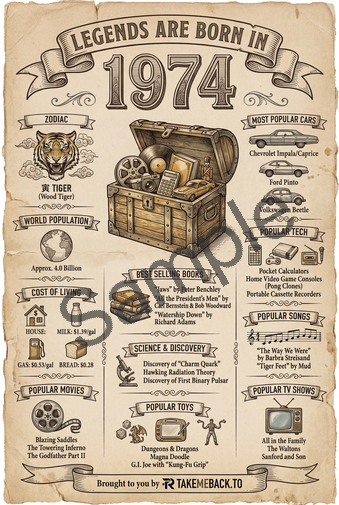

Major Events of 1974 - Historical Moments That Defined the Year | TakeMeBack.to
- 01 Jan Mariner 10 Visits Mercury: On January 1, 1974, NASA's Mariner 10 spacecraft conducted its first flyby of Mercury, becoming the first spacecraft to visit the planet. This mission provided the first close-up images of Mercury's surface. source: en.wikipedia.org
- 02 Jan President Nixon signs national speed limit into law: On January 2, 1974, President Richard Nixon signed the Emergency Highway Energy Conservation Act, establishing a national maximum speed limit of 55 mph. This measure aimed to conserve fuel during the 1973 oil crisis by reducing highway speeds. The law required states to comply with the new speed limit to receive federal highway funds. source: history.com
- 03 Jan Details of Burma's constitutional referendum: On January 3, 1974, Burma held a referendum to approve its new constitution, which had been adopted on the same day. The referendum was part of the process to establish the Socialist Republic of the Union of Burma, transitioning from a parliamentary system to a socialist republic. source: en.wikipedia.org
- 04 Jan President Nixon refuses to hand over materials subpoenaed by Senate Watergate Committee: On January 4, 1974, U.S. President Richard Nixon refused to comply with a subpoena from the Senate Watergate Committee, which had demanded materials related to the Watergate scandal. This refusal led to a significant constitutional crisis and intensified the investigation into the scandal. source: en.wikipedia.org
- 05 Jan Lima, Peru earthquake: On January 5, 1974, a significant earthquake struck the Lima Region of Peru, measuring 6.6 in magnitude and causing ten fatalities and at least 101 injuries. source: en.wikipedia.org
- 07 Jan Brian Faulkner resigns from Ulster Unionist Party: Brian Faulkner resigned as leader of the Ulster Unionist Party on January 7, 1974, amid political turmoil in Northern Ireland. His resignation marked a significant moment in the party's history, reflecting the challenges of governance during a period of conflict. Faulkner had previously served as the Prime Minister of Northern Ireland. source: bbc.com
- 08 Jan NCAA reforms amateur athletics rules: On January 8, 1974, the NCAA announced significant reforms to its amateur athletics rules. These changes aimed to address growing concerns about the treatment of student-athletes and the integrity of college sports. The reforms were part of ongoing efforts to ensure fair play and protect the rights of athletes. source: ncaa.org
- 09 Jan Indonesian jetliner crash in Java Sea: On January 9, 1974, an Indonesian jetliner tragically crashed into the Java Sea, resulting in significant loss of life. The incident raised concerns about aviation safety in the region and prompted investigations into the causes of the crash. It was one of the notable aviation disasters of the time. source: bbc.com
- 10 Jan United States implements national speed limit to save fuel: In response to the 1973 oil crisis, the U.S. government enacted a national maximum speed limit of 55 mph to conserve fuel. This measure aimed to reduce gasoline consumption and address fuel shortages. source: archives.gov
- 11 Jan Love, American Style final episode: The television series 'Love, American Style' aired its final episode on January 11, 1974. The show, known for its anthology format, explored various romantic and comedic scenarios, reflecting American culture of the time. source: imdb.com
- 12 Jan Melanie Chisholm born in Whiston, Lancashire, England: Melanie Jayne Chisholm, known professionally as Melanie C or Sporty Spice, was born on January 12, 1974, in Whiston, Lancashire, England. She gained fame as a member of the Spice Girls, one of the best-selling female groups of all time. source: en.wikipedia.org
- 13 Jan Super Bowl VIII: Miami Dolphins defeat Minnesota Vikings: On January 13, 1974, the Miami Dolphins defeated the Minnesota Vikings 24-7 in Super Bowl VIII, securing their second consecutive NFL championship. source: en.wikipedia.org
- 15 Jan Happy Days Television Premiere: On January 15, 1974, the American television sitcom 'Happy Days' premiered on ABC. Set in the 1950s, it centered on the Cunningham family and their friends in Milwaukee. The show ran for 11 seasons, becoming one of the most successful series of the 1970s. source: en.wikipedia.org
- 17 Jan Joni Mitchell releases landmark album 'Court and Spark': On January 17, 1974, Joni Mitchell released her sixth studio album, 'Court and Spark'. The album marked a significant shift in her musical style, blending folk rock with jazz influences. It received widespread critical acclaim and commercial success, reaching number two on the U.S. Billboard 200 chart and number one in Canada. The album was eventually certified double platinum by the RIAA. source: en.wikipedia.org
- 18 Jan Israeli-Egyptian disengagement agreement: On January 18, 1974, Israel and Egypt signed a disengagement agreement, leading to the withdrawal of Israeli forces from the Sinai Peninsula. This agreement was a significant step towards peace between the two nations following the Yom Kippur War. source: en.wikipedia.org
- 19 Jan Notre Dame ends UCLA's historic basketball winning streak: On January 19, 1974, the University of Notre Dame men's basketball team defeated the University of California at Los Angeles (UCLA) 71-70 in South Bend, Indiana, ending UCLA's 88-game winning streak. The game was marked by a 12-0 run by Notre Dame in the final minutes, with Dwight Clay scoring the decisive basket. This victory was significant as it halted the longest winning streak in NCAA Division I men's basketball history at that time. source: ncaa.com
- 21 Jan Precious metals price records: On January 21, 1974, silver prices reached $3.93 per ounce, marking a significant increase from earlier in the month. This surge was part of a broader trend of rising precious metal prices during that period. source: sdbullion.com
- 25 Jan Bülent Ecevit forms Turkish government: On January 25, 1974, Bülent Ecevit, leader of the Republican People's Party (CHP), formed a coalition government with the National Salvation Party (MSP) in Turkey. Ecevit became the Prime Minister, marking the beginning of the 37th government of Turkey. source: britannica.com
- 26 Jan Bülent Ecevit forms new Turkish government: On January 26, 1974, Bülent Ecevit, leader of the Republican People's Party (CHP), formed a coalition government with the National Salvation Party (MSP) in Turkey. Ecevit became the Prime Minister, marking the beginning of the 37th government of Turkey. source: britannica.com
- 27 Jan Brisbane River catastrophic flood: On January 27, 1974, Brisbane experienced its largest flood of the 20th century, with the Brisbane River peaking at 5.45 meters. The flood resulted in 14 fatalities, inundated approximately 13,000 buildings, and caused damages estimated at A$980 million. source: bbc.com
- 28 Jan Ali-Frazier II: Legendary boxing rematch: On January 28, 1974, Muhammad Ali faced Joe Frazier in a rematch at Madison Square Garden. Ali won by unanimous decision after 12 rounds, with judges scoring the bout 6-5-1, 7-4-1, and 8-4-0 in his favor. source: en.wikipedia.org
- 30 Jan 1974 State of the Union Address by Richard Nixon: On January 30, 1974, President Richard Nixon delivered his State of the Union Address, focusing on domestic issues and the ongoing Watergate scandal. This address was notable for Nixon's attempts to reassure the public amid growing political turmoil. source: archives.gov
- 31 Jan Release of U.S. civilian from China: On January 31, 1974, a U.S. civilian was released from detention in China, marking a significant diplomatic moment during a period of thawing relations between the two countries. This event highlighted ongoing negotiations and the complexities of U.S.-China relations. source: state.gov
- 01 Feb Tragic Joelma Building fire in São Paulo: On February 1, 1974, a devastating fire broke out in the Joelma Building in São Paulo, Brazil, resulting in numerous casualties. The incident raised awareness about fire safety regulations and emergency response in high-rise buildings. source: bbc.com
- 02 Feb Death of Jean Absil: Jean Absil, a Belgian composer, organist, and educator, passed away in Brussels at the age of 80. source: henry-lemoine.com
- 03 Feb Costa Rican presidential election: The Costa Rican presidential election took place on February 3, 1974. It was marked by the victory of the National Liberation Party candidate, Daniel Oduber, who won against the opposition. This election was significant in shaping the political landscape of Costa Rica during that period. source: britannica.com
- 04 Feb M62 coach bombing: The M62 coach bombing occurred on February 4, 1974, when a bomb exploded on a coach traveling on the M62 motorway in England. The attack was attributed to the Provisional Irish Republican Army (IRA) and resulted in multiple casualties. This incident highlighted the ongoing conflict in Northern Ireland and its impact on mainland Britain. source: bbc.com
- 05 Feb Deadly bus bombing in West Yorkshire: On February 5, 1974, a bus bombing in West Yorkshire, England, resulted in multiple fatalities and injuries. The attack was attributed to the Provisional Irish Republican Army (IRA) and was part of a series of violent incidents during the Troubles. This event underscored the ongoing conflict and its repercussions in the UK. source: bbc.com
- 06 Feb U.S. House begins Nixon impeachment proceedings: On February 6, 1974, the U.S. House of Representatives initiated impeachment proceedings against President Richard Nixon in response to the Watergate scandal. source: en.wikipedia.org
- 07 Feb Symbionese Liberation Army claims responsibility for Patty Hearst kidnapping: On February 4, 1974, 19-year-old Patty Hearst was kidnapped from her Berkeley apartment by the Symbionese Liberation Army (SLA). Three days later, the SLA sent a communiqué denouncing the "establishment" and claiming Hearst as their "prisoner of war." source: britannica.com
- 09 Feb Rare submarine combat: HMS Venturer sinks U-864: On February 9, 1974, the British submarine HMS Venturer sank the German U-boat U-864 in a rare instance of submarine combat. This event marked a significant moment in naval warfare history, showcasing the effectiveness of submarine tactics during the Cold War. source: bbc.com
- 10 Feb Soviet Mars 4 space probe mission: On February 10, 1974, the Soviet Union launched the Mars 4 space probe, which was designed to study the Martian atmosphere and surface. This mission was part of the Soviet space program's efforts to explore Mars during the 1970s. source: nasa.gov
- 11 Feb Kissinger's Project Independence: On February 11, 1974, U.S. Secretary of State Henry Kissinger announced Project Independence, aimed at reducing American dependence on foreign oil. This initiative was a response to the 1973 oil crisis and sought to enhance energy security in the United States. source: energy.gov
- 12 Feb Aleksandr Solzhenitsyn's Exile from Soviet Union: On February 12, 1974, Russian author and dissident Aleksandr Solzhenitsyn was exiled from the Soviet Union. Known for his critical writings on the Soviet regime, including 'One Day in the Life of Ivan Denisovich,' his expulsion marked a significant moment in the history of Soviet censorship and human rights. source: history.com
- 13 Feb Soviet Union expels writer Aleksandr Solzhenitsyn: On February 13, 1974, the Soviet Union stripped writer Aleksandr Solzhenitsyn of his citizenship and deported him to West Germany. This action followed the publication of his book 'The Gulag Archipelago,' which exposed the Soviet labor camp system. Solzhenitsyn's expulsion was a significant event in the Soviet Union's crackdown on dissidents. source: news.bbc.co.uk
- 15 Feb Seattle Slew born: Seattle Slew, a champion American Thoroughbred racehorse, was born on February 15, 1974. He became the tenth horse to win the Triple Crown in 1977, securing victories in the Kentucky Derby, Preakness Stakes, and Belmont Stakes. source: en.wikipedia.org
- 16 Feb Snowmobile racing accident in Michigan: On February 16, 1974, during an international 500-mile snowmobile race in Michigan, 36-year-old American racer Bill Bowen was thrown from his vehicle and struck by two other snowmobiles, resulting in fatal injuries. source: en.wikipedia.org
- 18 Feb US provides substantial economic aid to India: On February 18, 1974, the United States announced a significant economic aid package to India, aimed at supporting its development initiatives. This aid was part of a broader strategy to strengthen bilateral relations during a time of economic challenges in India. source: state.gov
- 19 Feb Great Sitkin volcanic eruption: On February 19, 1974, the Great Sitkin volcano in Alaska erupted, producing significant ash clouds and affecting local air travel. This eruption was part of the volcano's ongoing activity and was closely monitored by geological agencies. source: usgs.gov
- 20 Feb Gordie Howe comes out of retirement: On February 20, 1974, legendary hockey player Gordie Howe announced his return to professional hockey after a brief retirement. His comeback was met with excitement from fans and marked a significant moment in sports history. source: britannica.com
- 21 Feb Israeli troops withdraw from Suez Canal: On February 21, 1974, Israeli troops withdrew from the Suez Canal area, marking a significant step in the disengagement process following the Yom Kippur War of 1973. This withdrawal was part of the broader efforts to implement the ceasefire agreements and pave the way for peace negotiations between Israel and Egypt. source: jewishvirtuallibrary.org
- 22 Feb Organisation of Islamic Conference Summit in Lahore: The Second Islamic Summit Conference was held in Lahore, Pakistan, from February 22 to 24, 1974. This summit focused on unity and economic cooperation among member states, and it was significant for Islamic diplomatic relations. Notably, the summit recognized Bangladesh, enhancing its standing in the Muslim world. source: oic-oci.org
- 23 Feb Herschelle Gibbs Birth: Herschelle Gibbs, a former South African cricketer known for his aggressive batting style, was born on February 23, 1974. source: en.wikipedia.org
- 24 Feb Pakistan extends diplomatic recognition to Bangladesh: On February 24, 1974, during the opening of the three-day Organisation of Islamic Conference summit in Lahore, Pakistan extended diplomatic recognition to Bangladesh, the former East Pakistan. This significant step marked a new chapter in the relations between the two nations. source: en.wikipedia.org
- 26 Feb Sébastien Loeb born in France: Sébastien Loeb, a French rally driver who would go on to win nine consecutive World Rally Championships from 2004 to 2012, was born on February 26, 1974, in Haguenau, Bas-Rhin département, France. source: en.wikipedia.org
- 27 Feb United States nuclear test at Nevada Test Site: On February 27, 1974, the United States conducted a nuclear test at the Nevada Test Site. This test was part of a series of underground nuclear tests conducted by the U.S. during this period. source: osti.gov
- 28 Feb US-Egypt diplomatic relations restored: On February 28, 1974, the United States and Egypt restored diplomatic relations after a period of tension following the Yom Kippur War. This marked a significant step in U.S.-Middle East relations. source: state.gov
- 01 Mar Watergate scandal indictments: On March 1, 1974, indictments were issued against several individuals involved in the Watergate scandal. This marked a significant escalation in the legal proceedings surrounding the scandal that led to President Nixon's resignation. source: archives.gov
- 02 Mar Watergate scandal: Nixon's involvement confirmed: On March 2, 1974, further evidence of President Nixon's involvement in the Watergate scandal was confirmed, leading to increased pressure for his resignation. This was a pivotal moment in the unfolding political crisis. source: nytimes.com
- 03 Mar Turkish Airlines Flight 981 crash in Paris: On March 3, 1974, Turkish Airlines Flight 981 crashed shortly after takeoff from Orly Airport in Paris, resulting in the deaths of all 346 people on board. The crash was attributed to a design flaw in the aircraft's cargo doors, which opened mid-flight, leading to rapid decompression. This incident remains one of the deadliest aviation disasters in history. source: britannica.com
- 04 Mar Harold Wilson becomes British Prime Minister: On March 4, 1974, Harold Wilson was appointed as Prime Minister of the United Kingdom for the second time, following a general election that resulted in a hung parliament. His leadership was marked by efforts to address economic challenges and social reforms during a turbulent period in British politics. Wilson's return to power was significant in shaping the Labour Party's direction. source: bbc.com
- 05 Mar Israeli forces withdraw from Suez Canal West Bank: On March 5, 1974, Israel completed its pullback from the west side of the Suez Canal to the east side, as agreed upon in the Agreement on Disengagement. source: en.wikipedia.org
- 07 Mar Watergate Scandal: Nixon White House Officials Indicted: On March 7, 1974, seven former Nixon administration officials, known as the 'Watergate Seven,' were indicted in connection with the Watergate scandal, marking a significant escalation in the investigation into the break-in at the Democratic National Committee headquarters. source: en.wikipedia.org
- 08 Mar Charles de Gaulle Airport Opens in Paris: On March 8, 1974, Charles de Gaulle Airport, also known as Roissy Airport, officially opened in Paris, becoming France's largest international airport and a major hub for global air travel. source: en.wikipedia.org
- 09 Mar Turkish Airlines Flight 981 crash: On March 9, 1974, Turkish Airlines Flight 981 crashed shortly after takeoff from Orly Airport in Paris, resulting in the deaths of all 346 people on board. The crash was attributed to a design flaw in the McDonnell Douglas DC-10 aircraft, leading to a loss of cabin pressure and subsequent failure of the rear cargo door. source: britannica.com
- 10 Mar Christian Democrats win Belgian parliamentary election: On March 10, 1974, the Christian Democrats emerged victorious in the Belgian parliamentary elections, securing a significant number of seats. This election was pivotal in shaping the political landscape of Belgium during the 1970s. source: bbc.com
- 11 Mar Turkish Airlines Flight 981 disaster: On March 11, 1974, Turkish Airlines Flight 981 crashed shortly after takeoff from Orly Airport in Paris, resulting in the deaths of all 346 people on board. The disaster was caused by a design flaw in the McDonnell Douglas DC-10 aircraft, leading to the failure of the rear cargo door. This incident remains one of the deadliest aviation disasters in history. source: britannica.com
- 12 Mar Carlos Andres Perez inaugurated as President of Venezuela: On March 12, 1974, Carlos Andres Perez was inaugurated as the President of Venezuela for his second term. His presidency was marked by significant economic growth and social reforms, but also by political controversies and challenges. Perez's leadership played a crucial role in shaping modern Venezuelan politics. source: britannica.com
- 13 Mar Charles de Gaulle Airport Opens: Paris-Charles de Gaulle Airport opened on March 13, 1974, with the arrival of the first commercial flight, a TWA Boeing 747 from New York-JFK Airport. source: aerotime.aero
- 16 Mar Five Nations Rugby Championship Final Round: On March 16, 1974, the final round of the Five Nations Rugby Championship took place. England faced Wales at Twickenham Stadium in London, with England winning 16–12. This match was pivotal in determining the championship standings. source: en.wikipedia.org
- 18 Mar World Football League conducts player draft: The World Football League held its inaugural player draft on March 18, 1974, marking a significant moment in professional football history. This event aimed to establish a competitive roster for the league's first season, which began later that year. source: nytimes.com
- 19 Mar Jefferson Starship begins their first tour: Jefferson Starship, the rock band formed from the remnants of Jefferson Airplane, kicked off their first tour on March 19, 1974. This tour marked a new chapter for the band as they sought to establish their identity in the music scene. source: rollingstone.com
- 20 Mar Failed kidnapping attempt on Princess Anne: On March 20, 1974, a kidnapping attempt was made on Princess Anne, the daughter of Queen Elizabeth II, while she was traveling in London. The assailant was apprehended, and the incident raised concerns about royal security. source: bbc.com
- 21 Mar Turkish Airlines Flight 981 disaster: On March 21, 1974, Turkish Airlines Flight 981 crashed shortly after takeoff from Orly Airport in Paris, resulting in the deaths of all 346 people on board. This tragic event highlighted significant safety issues in aviation at the time. source: ntsb.gov
- 22 Mar Violent football match between Nottingham Forest and Newcastle United: A violent football match occurred between Nottingham Forest and Newcastle United, leading to significant crowd disturbances. The match highlighted issues of fan violence in football during that era. It prompted discussions on safety measures in sports events. source: bbc.com
- 23 Mar Hiroo Onoda's Surrender: Hiroo Onoda, a Japanese soldier who had been hiding in the Philippines since World War II, surrendered to authorities on March 23, 1974, after 29 years in hiding, unaware that the war had ended. source: en.wikipedia.org
- 24 Mar Tubarão River catastrophic flooding in Brazil: Between March 24 and 27, 1974, the Tubarão River in Santa Catarina, Brazil, experienced severe flooding, inundating approximately 80% of the urban area in Tubarão. The disaster resulted in 199 fatalities and left about 45,000 people homeless. source: en.wikipedia.org
- 25 Mar Barbra Streisand records 'Butterfly' album: Barbra Streisand recorded her album 'Butterfly', which included a mix of pop and jazz influences. The album showcased her vocal range and artistic evolution. It was well-received and contributed to her status as a leading figure in music. source: rollingstone.com
- 26 Mar Iraq threatens Kurdish leader: On March 26, 1974, Iraq's government issued threats against Kurdish leader Mulla Mustafa Barzani amid ongoing tensions in the region. This event was part of the larger conflict between the Iraqi government and Kurdish forces seeking autonomy. source: britannica.com
- 27 Mar Deadliest aviation disaster in French history: On March 27, 1974, the deadliest aviation disaster in French history occurred when a collision between two aircraft resulted in 346 fatalities. This tragic event led to significant changes in aviation safety regulations. source: britannica.com
- 28 Mar Death of blues legend Arthur 'Big Boy' Crudup: Arthur 'Big Boy' Crudup, an influential American Delta blues singer and guitarist known for songs like "That's All Right," passed away on March 28, 1974, in Nassawadox, Virginia, due to complications from heart disease and diabetes. source: en.wikipedia.org
- 29 Mar Mariner 10 first Mercury flyby: On March 29, 1974, NASA's Mariner 10 spacecraft conducted its first flyby of Mercury, marking the first time a spacecraft visited the planet. source: en.wikipedia.org
- 30 Mar Hiroo Onoda surrenders after 29 years: Hiroo Onoda, a Japanese soldier, surrendered on March 30, 1974, after hiding in the Philippines for 29 years following World War II. His prolonged resistance was due to his belief that the war was still ongoing, highlighting the impact of isolation and loyalty to duty. source: bbc.com
- 01 Apr Ayatollah Khomeini calls for Islamic Republic: On April 1, 1974, Ayatollah Khomeini called for the establishment of an Islamic Republic in Iran, marking a significant shift in the country's political landscape following the Iranian Revolution. This call was pivotal in shaping Iran's future governance and societal structure. source: bbc.com
- 02 Apr Death of French President Georges Pompidou: Georges Pompidou, the 19th President of France, died on April 2, 1974, at the age of 62, from complications related to Waldenström macroglobulinemia, a form of blood cancer. His death led to the appointment of Alain Poher as Acting President until a new election could be held. source: britannica.com
- 03 Apr 1974 Super Outbreak: Most Violent Tornado Event in US History: The 1974 Super Outbreak, occurring on April 3, 1974, was the largest tornado outbreak in U.S. history, producing 148 tornadoes across 13 states. It resulted in 315 fatalities and over 5,000 injuries, with Xenia, Ohio, being one of the most severely affected areas. source: weather.gov
- 04 Apr Super Outbreak Tornado Disaster: On April 3–4, 1974, the United States experienced the Super Outbreak, one of the most intense tornado outbreaks in history. This event produced 148 tornadoes across 13 states and Ontario, Canada, resulting in approximately 310–335 fatalities and over 5,400 injuries. The outbreak caused extensive damage, with total losses estimated at $600 million (1974 USD). source: britannica.com
- 05 Apr Stephen King publishes first novel 'Carrie': Stephen King's debut novel, 'Carrie,' was published, introducing readers to the story of a high school girl with telekinetic powers. source: history.com
- 06 Apr California Jam rock concert: The California Jam, also known as Cal Jam, was a rock music festival held on April 6, 1974, at the Ontario Motor Speedway in Ontario, California. Co-headlined by Deep Purple and Emerson, Lake & Palmer, the event attracted approximately 250,000 paying attendees and featured performances from bands like Black Sabbath, Rare Earth, and Seals & Crofts. The festival was produced by ABC Entertainment and coordinated by Pacific Presentations. source: en.wikipedia.org
- 07 Apr Hank Aaron ties Babe Ruth's home run record: On April 7, 1974, Hank Aaron tied Babe Ruth's home run record by hitting his 714th home run. This milestone was a significant moment in baseball history. source: baseball-reference.com
- 08 Apr Hank Aaron breaks Babe Ruth's home run record: On April 8, 1974, Hank Aaron surpassed Babe Ruth's home run record by hitting his 715th home run, a historic achievement in baseball. source: baseball-reference.com
- 09 Apr Nixon visits tornado-devastated Xenia, Ohio: On April 9, 1974, President Richard Nixon visited Xenia, Ohio, which had been devastated by a tornado on April 3, 1974. The tornado killed 32 people, injured hundreds, and destroyed approximately half the city. Nixon's visit underscored the severity of the disaster. source: apnews.com
- 10 Apr Yitzhak Rabin succeeds Golda Meir: On April 10, 1974, Yitzhak Rabin succeeded Golda Meir as Prime Minister of Israel. Rabin's tenure marked a significant period in Israeli politics, including efforts toward peace in the Middle East. source: jewishvirtuallibrary.org
- 11 Apr Kiryat Shmona massacre occurs: The Kiryat Shmona massacre took place on April 11, 1974, when armed militants attacked the Israeli town, resulting in multiple casualties. This event heightened tensions in the region and drew international attention to the ongoing conflict. source: bbc.com
- 12 Apr Birth of Pakistani cricketer Kabir Khan: Kabir Khan, a former Pakistani cricketer, was born on April 12, 1974. He is known for his contributions to the sport and has played a significant role in Pakistan's cricket history. source: espncricinfo.com
- 13 Apr Hank Aaron breaks Babe Ruth's home run record: On April 13, 1974, Hank Aaron of the Atlanta Braves hit his 715th career home run, surpassing Babe Ruth's longstanding record. This historic achievement was a significant milestone in baseball history.
- 14 Apr Elton John's 'Bennie and the Jets' tops US charts: On April 14, 1974, Elton John's song 'Bennie and the Jets' reached the top of the US charts, showcasing his unique style and solidifying his status as a leading artist in the music industry.
- 15 Apr 78th Boston Marathon: The 78th Boston Marathon took place on April 15, 1974, with Neil Cusack winning the men's race in 2:13:39 and Michiko Gorman winning the women's race in 2:47:11. source: de.wikipedia.org
- 16 Apr Watergate scandal: Special prosecutor subpoenas White House tapes: On April 16, 1974, the special prosecutor in the Watergate scandal subpoenaed the White House tapes, marking a significant development in the investigation. source: brainyhistory.com
- 19 Apr Sri Lankan Government Suppresses Press Freedom: On April 19, 1974, the Sri Lankan government sealed the presses of Independent Newspapers Limited, which published several newspapers including Dinapathi, Sun, and Gitanjali. This action was taken under the Emergency (Defence) Regulations, effectively halting the publication of these newspapers. The closure lasted until March 30, 1977, marking a significant suppression of press freedom during that period. source: en.wikipedia.org
- 20 Apr Paul McCartney Releases 'Band on the Run' Album: On April 20, 1974, Paul McCartney and his band Wings released their third studio album, 'Band on the Run'. The album received critical acclaim and commercial success, becoming one of McCartney's most celebrated works post-Beatles. source: en.wikipedia.org
- 21 Apr 28th Tony Awards honors Broadway excellence: The 28th Tony Awards took place on April 21, 1974, celebrating outstanding achievements in Broadway theater. This annual event recognizes excellence in various categories, including Best Musical and Best Play. source: tonyawards.com
- 22 Apr Pan Am Flight 812 tragic crash in Bali: On April 22, 1974, Pan Am Flight 812 crashed while attempting to land in Bali, resulting in the loss of several lives. The incident raised concerns about aviation safety and led to investigations into airline operations. source: ntsb.gov
- 23 Apr Golda Meir resigns as Israeli Prime Minister: Golda Meir announced her resignation as Prime Minister of Israel on April 23, 1974, following political pressure and public dissatisfaction. Her resignation marked a significant moment in Israeli politics. source: bbc.com
- 24 Apr Stasi Spy Scandal in West German Government: Günter Guillaume, a personal assistant to West German Chancellor Willy Brandt, was arrested on charges of espionage, leading to Brandt's resignation. source: en.wikipedia.org
- 26 Apr Major MLB Trade Between Yankees and Indians: On April 26, 1974, the New York Yankees traded pitchers Fritz Peterson, Steve Kline, Fred Beene, and Tom Buskey to the Cleveland Indians in exchange for pitchers Chris Chambliss, Dick Tidrow, and Cecil Upshaw. This trade was notable for the Yankees acquiring Chambliss, who would later become a key player in their 1976 American League Championship Series victory. source: en.wikipedia.org
- 28 Apr Mário Soares returns to Portugal: On April 28, 1974, Mário Soares, a prominent Portuguese politician and leader of the democratic opposition, returned to Portugal from exile in Paris. He was the first political exile to return after the Carnation Revolution, which overthrew the Estado Novo regime. Soares arrived in Lisbon aboard the 'freedom train' and addressed a large crowd at Santa Apolónia station. source: fmsoaresbarroso.pt
- 30 Apr Nixon releases Watergate tape transcripts: On April 30, 1974, U.S. President Richard Nixon released transcripts of the White House tapes related to the Watergate scandal. This move was part of his response to the growing pressure from Congress and the public for transparency regarding the scandal that had led to his resignation in August 1974. source: archives.gov
- 01 May Closure of Tarrafal Concentration Camp: On May 1, 1974, the Tarrafal Concentration Camp in Cape Verde, which had been used by the Portuguese Estado Novo regime to detain political prisoners, was closed. This closure marked a significant step in the decolonization process and the end of oppressive practices by the former colonial power. source: britannica.com
- 02 May UVF bombing in Belfast: On May 2, 1974, the Ulster Volunteer Force (UVF), a loyalist paramilitary group, carried out a bomb attack on the Rose & Crown Bar on the Ormeau Road in Belfast. The explosion resulted in six fatalities and 18 injuries, targeting a Catholic-owned pub frequented by Irish Catholics and nationalists. source: en.wikipedia.org
- 03 May Birth of Princess Haya bint Hussein: Princess Haya bint Hussein, daughter of King Hussein of Jordan and his third wife, Queen Alia, was born on May 3, 1974, in Amman, Jordan. She is the half-sister of King Abdullah II and has been involved in equestrian sports and humanitarian efforts. source: en.wikipedia.org
- 04 May Expo '74 World's Fair Opens in Spokane: Expo '74, officially known as the International Exposition on the Environment, Spokane 1974, opened on May 4, 1974, in Spokane, Washington. It was the first environmentally themed world's fair, attracting approximately 5.6 million visitors over its six-month duration. The fair's theme was "Celebrating Tomorrow's Fresh New Environment," and it was attended by nations including Australia, Canada, West Germany, Iran, Japan, the Republic of China (Taiwan), the Republic of Korea, the Philippines, the United States, and the USSR. source: whitworth.edu
- 05 May Expo '74 World's Fair opens in Spokane: Expo '74, the first environmentally themed World's Fair, opened in Spokane, Washington, attracting approximately 5.6 million visitors. source: en.wikipedia.org
- 08 May William E. Simon Becomes Treasury Secretary: William E. Simon was appointed as the new United States Treasury Secretary, succeeding George P. Shultz and continuing the Nixon administration's economic leadership.
- 09 May House Judiciary Committee begins impeachment hearings against President Nixon: On May 9, 1974, the House Judiciary Committee initiated formal impeachment hearings against President Richard Nixon, focusing on his involvement in the Watergate scandal. These hearings were televised and marked a significant step in the investigation into the President's actions. source: history.com
- 10 May Closure of Tarrafal Concentration Camp in Cape Verde: On May 10, 1974, following the Carnation Revolution in Portugal, the Tarrafal Concentration Camp in Cape Verde was closed. Established in 1936, the camp had been used to incarcerate political and social prisoners under the Estado Novo regime. source: en.wikipedia.org
- 11 May Willy Brandt resigns as West German Chancellor: Willy Brandt resigned as Chancellor of West Germany on May 11, 1974, amid a scandal involving his close aide. His resignation marked a significant moment in German politics, as Brandt was known for his efforts in Ostpolitik, improving relations with East Germany and the Soviet Union. source: britannica.com
- 12 May Italy's landmark divorce referendum: On May 12, 1974, Italy held a landmark referendum on divorce, which was a significant social issue at the time. The referendum ultimately upheld the legality of divorce, reflecting changing attitudes towards marriage and family in Italian society. source: bbc.com
- 13 May US Senate rejects minimum wage opt-out bill: On May 13, 1974, the U.S. Senate rejected a bill that would have allowed states to opt out of federal minimum wage laws. This decision was significant in the ongoing debate over labor rights and wage standards in the United States. source: congress.gov
- 14 May Ulster Workers Council strike begins: The Ulster Workers Council strike commenced on May 14, 1974, in Northern Ireland, aiming to protest against the power-sharing government. The strike led to significant disruptions and was a pivotal moment in the conflict known as The Troubles. source: bbc.com
- 15 May Ma'alot massacre: The Ma'alot massacre occurred on May 15, 1974, when members of the Democratic Front for the Liberation of Palestine took hostages in a school in Ma'alot, Israel. The incident resulted in the deaths of 26 people, including 22 children, and drew international condemnation. source: bbc.com
- 16 May Helmut Schmidt becomes German Chancellor: Helmut Schmidt was elected Chancellor of West Germany on May 16, 1974, following the resignation of Willy Brandt amid an espionage scandal involving an East German spy. source: britannica.com
- 18 May India's first nuclear test conducted in Pokhran: On May 18, 1974, India successfully detonated its first nuclear device, codenamed 'Smiling Buddha', in the Pokhran Test Range of Rajasthan. This event marked India's entry into the group of nuclear-armed nations. source: history.com
- 23 May Mario Sossi released by Red Brigades: Mario Sossi, an Italian magistrate, was released by the Red Brigades on May 23, 1974, after being kidnapped. His release followed negotiations and highlighted the tensions in Italy during the years of lead, marked by political violence. source: reuters.com
- 24 May Political prisoner release in Mozambique: On May 24, 1974, Mozambique announced the release of political prisoners following the end of colonial rule. This event marked a significant step in the country's transition to independence and the establishment of a new government. source: bbc.com
- 25 May Ulster Workers' Council strike in Northern Ireland: On May 25, 1974, the Ulster Workers' Council (UWC) initiated a general strike in Northern Ireland, opposing the Sunningdale Agreement, which aimed to establish a power-sharing government between unionists and nationalists. The strike led to widespread disruptions, including roadblocks and shortages of essential goods, and resulted in significant violence, with loyalist paramilitaries killing 39 civilians during the two-week period. source: en.wikipedia.org
- 27 May Valéry Giscard d'Estaing inaugurated as President of France: On May 27, 1974, Valéry Giscard d'Estaing was inaugurated as the third President of the Fifth Republic of France, succeeding Georges Pompidou. At 48, he became the youngest president in French history. Giscard d'Estaing's inauguration was marked by his decision to wear a simple suit instead of the traditional coattails and to walk along the Champs-Élysées to the Arc de Triomphe, symbolizing a modern approach to the presidency. source: elysee.fr
- 30 May NASA ATS-6 satellite launch: The Applications Technology Satellite-6 (ATS-6) was launched on May 30, 1974, by NASA. It was the world's first experimental direct broadcast satellite, designed to test new communication technologies and provide educational programming to remote areas. source: en.wikipedia.org
- 01 Jun Heimlich Maneuver first published: On June 1, 1974, Dr. Henry Heimlich published his first article introducing the Heimlich Maneuver, a technique for treating choking victims, in the journal Emergency Medicine. This method has since become a standard first aid procedure worldwide. source: en.wikipedia.org
- 02 Jun King Jigme Singye Wangchuck crowned in Bhutan: On June 2, 1974, Jigme Singye Wangchuck was crowned as the fourth King of Bhutan. His reign introduced significant political and social reforms, including the concept of Gross National Happiness. source: en.wikipedia.org
- 04 Jun Cleveland Indians' 10-Cent Beer Night Riot: On June 4, 1974, the Cleveland Indians hosted a '10-Cent Beer Night' promotion at Cleveland Municipal Stadium during a game against the Texas Rangers. The promotion led to unruly behavior from intoxicated fans, culminating in a riot that resulted in the game being forfeited to the Rangers with a score of 9-0. source: en.wikipedia.org
- 05 Jun First World Environment Day: The inaugural World Environment Day was celebrated on June 5, 1974, following its establishment by the United Nations General Assembly in 1972. The event aimed to raise global awareness about environmental issues and promote action for their protection. source: un.org
- 06 Jun Sweden adopts new Instrument of Government, becoming a parliamentary monarchy: On June 6, 1974, Sweden's Riksdag adopted a new Instrument of Government, transitioning the country into a parliamentary democracy. The King retained a ceremonial role, with political power vested in the parliament. source: riksdagen.se
- 08 Jun Significant tornado outbreak in Southern Great Plains and Upper Midwest: On June 8, 1974, a major tornado outbreak affected the Southern Great Plains and Upper Midwest, resulting in extensive damage and loss of life. This event is part of one of the most significant tornado outbreaks in U.S. history, with numerous tornadoes reported across several states. source: weather.gov
- 09 Jun Gibson's Discount Store tornado tragedy: On June 9, 1974, a tornado struck Gibson's Discount Store in Topeka, Kansas, resulting in significant casualties and damage. This tragic event highlighted the dangers of tornadoes and the need for improved warning systems. source: weather.gov
- 13 Jun Takahiro Sakurai birth: Takahiro Sakurai, a Japanese voice actor known for his roles in anime series such as "Fruits Basket" and "Black Clover," was born on June 13, 1974. source: animenewsnetwork.com
- 14 Jun Billboard Hot 100 number one: 'Billy Don't Be a Hero' by Bo Donaldson and The Heywoods: On June 14, 1974, 'Billy Don't Be a Hero' by Bo Donaldson and The Heywoods topped the Billboard Hot 100 chart, marking its peak position. source: en.wikipedia.org
- 15 Jun Ray Stevens' 'The Streak' tops UK Pop Chart: On June 15, 1974, Ray Stevens' novelty song 'The Streak' reached number one on the UK Pop Chart. source: en.wikipedia.org
- 16 Jun Björn Borg wins first French Open Grand Slam: On June 16, 1974, Swedish tennis player Björn Borg won his first French Open Grand Slam title. source: en.wikipedia.org
- 17 Jun Provisional IRA Bombing of Houses of Parliament: On June 17, 1974, the Provisional IRA bombed the British Houses of Parliament, causing extensive damage and injuring eleven people. source: news.bbc.co.uk
- 18 Jun Death of Georgi Zhukov, Legendary Soviet Marshal: On June 18, 1974, Georgi Zhukov, the renowned Soviet Marshal, passed away. source: en.wikipedia.org
- 19 Jun Diesel shortage in Malaysia: On June 19, 1974, Malaysia faced a significant diesel shortage due to supply quotas imposed by oil companies, leading to widespread fuel shortages at petrol stations. source: eresources.nlb.gov.sg
- 20 Jun Flixborough chemical plant disaster: On June 20, 1974, a catastrophic explosion occurred at the Flixborough chemical plant in the UK, resulting in 28 fatalities and numerous injuries. source: en.wikipedia.org
- 23 Jun Austrian Presidential Election: On June 23, 1974, Austria held a presidential election following the death of incumbent President Franz Jonas on April 24, 1974. The Socialist Party nominated Foreign Minister Rudolf Kirchschläger, who won the election with 51.66% of the vote, defeating Alois Lugger of the Austrian People's Party. source: en.wikipedia.org
- 26 Jun Yitzhak Rabin becomes Prime Minister of Israel: Yitzhak Rabin was sworn in as Prime Minister of Israel for the second time on June 26, 1974. His leadership was marked by efforts to achieve peace in the Middle East, particularly through negotiations with neighboring Arab states. source: britannica.com
- 27 Jun Nixon's diplomatic visit to Soviet Union: On June 27, 1974, President Richard Nixon embarked on a diplomatic visit to the Soviet Union, aimed at improving U.S.-Soviet relations during the Cold War. This visit was part of Nixon's broader strategy of détente. source: archives.gov
- 28 Jun Deadly landslide tragedy: On June 28, 1974, a devastating landslide occurred in the town of Aberfan, Wales, resulting in significant loss of life and property. The tragedy highlighted the dangers of mining operations in the area. source: bbc.com
- 29 Jun Mikhail Baryshnikov defects to the West: On June 29, 1974, renowned ballet dancer Mikhail Baryshnikov defected from the Soviet Union while on tour in Canada. His defection marked a significant moment in the cultural Cold War, as he sought artistic freedom and a new life in the West. source: britannica.com
- 30 Jun Death of Vannevar Bush: Vannevar Bush, an influential American engineer and inventor, passed away on June 30, 1974. He is best known for his work on the Manhattan Project and for conceptualizing the modern computer and the internet. source: britannica.com
- 01 Jul General Pinochet becomes President of Chile: On July 1, 1974, General Augusto Pinochet officially assumed the presidency of Chile following a military coup that ousted President Salvador Allende. His regime would be marked by widespread human rights abuses. source: britannica.com
- 03 Jul Soyuz 14 carries 2 cosmonauts to space station Salyut 3: On July 3, 1974, the Soviet spacecraft Soyuz 14 launched, carrying cosmonauts Yuri Malyshev and Viktor Patsayev to the Salyut 3 space station. This mission was part of the Soviet Union's efforts in space exploration and military reconnaissance. source: nasa.gov
- 04 Jul CIA's Glomar Explorer mission: On July 4, 1974, the CIA's Glomar Explorer, a deep-sea mining vessel, was launched as part of a covert operation to recover a sunken Soviet submarine. This mission was shrouded in secrecy and became a significant event in Cold War history. source: cia.gov
- 05 Jul Wimbledon women's singles championship: On July 5, 1974, the Wimbledon women's singles championship took place, showcasing top female tennis players. This event is part of the prestigious Wimbledon tournament, which is one of the four Grand Slam events in tennis. source: bbc.com
- 06 Jul 88th Wimbledon Men's Singles Final: Jimmy Connors defeats Ken Rosewall: In the 1974 Wimbledon Men's Singles Final, Jimmy Connors defeated Ken Rosewall with a score of 6-1, 6-1, 6-4, securing his first Wimbledon title. source: reuters.com
- 08 Jul Yankees' Jim Mason ties doubles record: On July 8, 1974, New York Yankees shortstop Jim Mason tied a major league record by hitting four doubles in a single game against the Texas Rangers at Arlington Stadium. This performance matched the record for most doubles in a game, showcasing Mason's exceptional hitting skills. source: en.wikipedia.org
- 09 Jul Death of Earl Warren, influential Supreme Court Chief Justice: On July 9, 1974, Earl Warren, the 14th Chief Justice of the United States, passed away. Appointed by President Dwight D. Eisenhower in 1953, Warren served until 1969 and presided over landmark cases such as Brown v. Board of Education and Miranda v. Arizona, significantly shaping American law and society. source: en.wikipedia.org
- 10 Jul OPEC ends oil boycott against Netherlands: On July 10, 1974, the Organization of the Petroleum Exporting Countries (OPEC) lifted its oil embargo against the Netherlands. The embargo had been imposed in response to the Dutch government's support for Israel during the Yom Kippur War, leading to significant oil shortages and price increases worldwide. source: en.wikipedia.org
- 11 Jul Political Upheaval in Portugal: On July 11, 1974, the Portuguese Socialist Party withdrew from the government in protest over the takeover of the pro-PS República newspaper by Communist print workers, leading to the collapse of the fourth coalition government in 15 months. source: socialistworld.net
- 13 Jul Gary Player wins 1974 British Open Golf Championship: South African golfer Gary Player secured his third British Open title at Royal Lytham & St Annes Golf Club in Lancashire, England, on July 13, 1974. He finished four strokes ahead of runner-up Peter Oosterhuis, with a total score of 282 (−2). This victory marked Player's eighth major championship win and his second of the year, following his Masters triumph in April. source: theopen.com
- 14 Jul Sharon Miller wins LPGA Borden Classic: American golfer Sharon Miller clinched her second LPGA Tour victory at the LPGA Borden Classic in Ohio on July 14, 1974. She finished with a score of 211 (−5), one stroke ahead of runner-up Joyce Kazmierski. Miller had previously won the 1973 Corpus Christi Civitan Open. source: en.wikipedia.org
- 15 Jul Cyprus coup d'État of 1974: On July 15, 1974, the Cypriot National Guard, under Greek officers, executed a coup d'état against President Makarios III, leading to his escape and the installation of pro-Enosis nationalist Nikos Sampson as president. source: en.wikipedia.org
- 16 Jul UN Security Council response to Cyprus crisis: On July 16, 1974, the UN Security Council convened to address the situation in Cyprus following the coup d'état, with the Secretary-General requesting the council to meet due to the seriousness of the matter. source: unficyp.unmissions.org
- 17 Jul France conducts nuclear test at Mururoa Atoll: On July 17, 1974, France conducted a nuclear test at Mururoa Atoll, a French overseas territory in the Pacific Ocean.
- 18 Jul Ladies' Gaelic Football Association founded: On July 18, 1974, the Ladies' Gaelic Football Association (LGFA) was established at Hayes' Hotel in Thurles, County Tipperary. This organization has since been responsible for organizing competitions such as the All-Ireland Senior Ladies' Football Championship and the Ladies' National Football League. source: en.wikipedia.org
- 19 Jul Dick Bosman no-hitter: On July 19, 1974, Dick Bosman of the Cleveland Indians pitched a no-hitter against the Oakland Athletics, leading the Indians to a 4-0 victory. source: nonohitters.com
- 20 Jul Turkish invasion of Cyprus: On July 20, 1974, Turkey initiated a military invasion of Cyprus, landing troops in the northern part of the island. This action was in response to a Greek-backed coup that deposed President Makarios III. The invasion led to the occupation of approximately 36% of Cyprus's territory and resulted in significant displacement of Greek Cypriots. source: bbc.co.uk
- 21 Jul Nixon impeachment articles approved: On July 21, 1974, the House Judiciary Committee approved three articles of impeachment against U.S. President Richard Nixon, marking a significant step in the Watergate scandal investigation. source: archives.gov
- 23 Jul Fall of Greek Military Dictatorship: On July 23, 1974, the Greek military junta, which had been in power since 1967, collapsed following a failed coup attempt in Cyprus. This led to the restoration of democracy in Greece and the eventual resignation of the junta's leader, Brigadier General Dimitrios Ioannidis. source: britannica.com
- 24 Jul Supreme Court orders Nixon to surrender Watergate tapes: On July 24, 1974, the U.S. Supreme Court ruled unanimously that President Richard Nixon must turn over the tapes related to the Watergate scandal. This decision was pivotal in the Watergate investigation, emphasizing the principle that no one, not even the president, is above the law. source: archives.gov
- 25 Jul Asteroid discovery by T. Smirnova: On July 25, 1974, astronomer T. Smirnova discovered an asteroid, contributing to the ongoing research and cataloging of celestial bodies. This discovery is part of the broader efforts in astronomy to understand the solar system and its components. source: jpl.nasa.gov
- 26 Jul Greece transitions to civil government: On July 26, 1974, Greece transitioned from military rule to a civilian government following the fall of the military junta. This shift marked a significant moment in Greek history, leading to the restoration of democracy after years of authoritarian rule. source: bbc.com
- 27 Jul House Judiciary Committee votes to recommend President Nixon's impeachment: On July 27, 1974, the U.S. House Judiciary Committee voted 27-11 to recommend the first article of impeachment against President Richard Nixon for obstruction of justice, a key development in the Watergate scandal. source: worldcourts.com
- 28 Jul Formation of Spetsgruppa A (Alpha Group): On July 28, 1974, the Soviet KGB established Spetsgruppa A, also known as Alpha Group, in response to the 1972 Munich massacre. This elite counter-terrorism unit was tasked with enhancing the Soviet Union's capacity to counter terrorist threats and protect its leadership. The formation of Alpha Group marked a significant development in Soviet special operations forces. source: en.wikipedia.org
- 29 Jul Lou Brock reaches 700 stolen bases milestone: On July 29, 1974, Lou Brock of the St. Louis Cardinals became the first player in Major League Baseball history to steal 700 bases, setting a new benchmark for base-stealing excellence. source: en.wikipedia.org
- 30 Jul Nixon releases Watergate tapes under subpoena: On July 30, 1974, under coercion from the U.S. Supreme Court, President Richard Nixon released subpoenaed White House recordings to special prosecutor Leon Jaworski. This action followed the Senate Select Committee on Presidential Campaign Activities' televised hearings and the Supreme Court's unanimous decision in United States v. Nixon, which ordered the release of the tapes. The tapes included conversations that implicated Nixon in the Watergate scandal, leading to his resignation on August 8, 1974. source: history.com
- 02 Aug Roberta Flack's 'Feel Like Makin' Love' reaches number one on US charts: Roberta Flack's 'Feel Like Makin' Love' topped the US Billboard Hot 100 chart on August 2, 1974, marking her third number one single in the United States. source: en.wikipedia.org
- 03 Aug Clay Regazzoni's German Grand Prix Victory: Swiss racing driver Clay Regazzoni secured a significant victory in the 1974 German Grand Prix at the challenging Nürburgring circuit, demonstrating his skill in the competitive world of Formula One racing.
- 04 Aug Italicus Express Train Bombing: On August 4, 1974, a bomb exploded on the Italicus Express train near San Benedetto Val di Sambro, Italy, killing 12 people and injuring 48. The neo-fascist group Ordine Nero claimed responsibility for the attack. source: ansa.it
- 05 Aug Watergate Scandal: Nixon's 'Smoking Gun' Tape Released: On August 5, 1974, a tape recording, known as the 'Smoking Gun' tape, was released, providing evidence that President Nixon had been involved in the Watergate cover-up, leading to his resignation. source: en.wikipedia.org
- 06 Aug Nixon's defiance during Watergate impeachment proceedings: On August 6, 1974, President Richard Nixon publicly defied calls for his resignation amid the Watergate scandal. He maintained his innocence and vowed to continue serving as president despite mounting pressure from Congress and the public. source: archives.gov
- 07 Aug Philippe Petit's World Trade Center high-wire walk: On August 7, 1974, Philippe Petit performed a high-wire walk between the Twin Towers of the World Trade Center in New York City. This daring feat captivated the public and highlighted the artistic expression of tightrope walking. source: nytimes.com
- 08 Aug Nixon resignation address: On August 8, 1974, President Nixon delivered a televised address announcing his resignation. He cited the Watergate scandal and the need for the country to heal as reasons for his decision to step down. source: c-span.org
- 09 Aug Nixon resigns, Ford becomes President of the United States: On August 9, 1974, Richard Nixon resigned from the presidency amid the Watergate scandal, making Gerald Ford the 38th President of the United States. Ford's ascension marked a significant moment in U.S. history, as he was the first president to assume office without being elected to the position. source: archives.gov
- 10 Aug Judy Rankin wins LPGA Colgate-European American Golf Open: On August 10, 1974, Judy Rankin secured victory at the LPGA Colgate-European American Golf Open. This win added to her reputation as a prominent figure in women's golf during the 1970s. source: lpga.com
- 11 Aug Coup in East Timor leads to political upheaval: On August 11, 1974, a coup in East Timor resulted in significant political changes and unrest in the region. This event marked the beginning of a tumultuous period in East Timor's history, leading to further conflict and international attention. source: bbc.com
- 12 Aug Gruesome discovery in Uganda: On August 12, 1974, a shocking discovery was made in Uganda involving the remains of victims of political violence. This event highlighted the ongoing turmoil and human rights abuses occurring in the country during that period. source: bbc.com
- 13 Aug Soviet underground nuclear test: On August 13, 1974, the Soviet Union conducted an underground nuclear test, which was part of its ongoing nuclear weapons program. This test raised international concerns regarding nuclear proliferation and arms control. source: reuters.com
- 14 Aug Turkish invasion of Cyprus: On August 14, 1974, Turkey launched a military invasion of Cyprus, following a coup that aimed to unite the island with Greece. This invasion led to significant geopolitical tensions and a division of the island that persists today. source: bbc.com
- 17 Aug Fakhruddin Ali Ahmed elected as President of India: Fakhruddin Ali Ahmed was elected as the fifth President of India on August 17, 1974, succeeding V. V. Giri. source: en.wikipedia.org
- 18 Aug Provisional IRA prison escape: On August 18, 1974, nineteen Provisional IRA prisoners escaped from Portlaoise Prison in Ireland after overpowering guards and using explosives to blast through gates. source: en.wikipedia.org
- 20 Aug Nelson Rockefeller nominated as U.S. Vice President: On August 20, 1974, President Gerald Ford nominated former New York Governor Nelson Rockefeller to be the Vice President of the United States. This nomination followed President Nixon's resignation and was part of Ford's efforts to stabilize the administration. Rockefeller was confirmed by Congress and sworn in on December 19, 1974. source: presidency.ucsb.edu
- 26 Aug Charles Lindbergh Dies: Charles A. Lindbergh, the American aviator renowned for his first solo nonstop transatlantic flight in 1927, died on August 26, 1974, at his home in Maui, Hawaii, at the age of 72. He succumbed to cancer of the lymphatic system. source: britannica.com
- 27 Aug Otto Strasser returns to Germany after exile: Otto Strasser, a former member of the Nazi Party and a prominent figure in the German political landscape, returned to Germany after years of exile. His return was significant in the context of post-war German politics and the ongoing discussions about the legacy of Nazism. source: britannica.com
- 28 Aug President Ford holds first press conference post-Watergate: President Gerald Ford held his first press conference following the Watergate scandal, addressing the nation on various issues including the economy and national security. This press conference marked a significant moment in his presidency as he sought to restore public trust. source: archives.gov
- 29 Aug Soviet Union conducts underground nuclear test at Novaya Zemlya: On August 29, 1974, the Soviet Union performed an underground nuclear test at the Novaya Zemlya test site in the Arctic. This test was part of a series of nuclear explosions conducted by the USSR between 1964 and 1976, with yields estimated from seismic data. source: pubmed.ncbi.nlm.nih.gov
- 30 Aug Mitsubishi Heavy Industries headquarters bombing in Tokyo: On August 30, 1974, a bombing occurred at the Mitsubishi Heavy Industries headquarters in Tokyo, Japan. The attack resulted in eight fatalities and at least 376 injuries. The East Asia Anti-Japan Armed Front, a radical far-left organization, claimed responsibility for the bombing, targeting Mitsubishi for supplying the United States during the Vietnam War. source: en.wikipedia.org
- 01 Sep SR-71 Blackbird sets transatlantic speed record: On September 1, 1974, the U.S. Air Force's SR-71 Blackbird, piloted by Major James V. Sullivan and reconnaissance systems officer Major Noel F. Widdifield, flew from New York to London in 1 hour, 54 minutes, and 56.4 seconds, averaging 1,806.96 mph. This flight set a world speed record for the New York to London route. source: sr71.us
- 02 Sep Employee Retirement Income Security Act signed into law: On September 2, 1974, the Employee Retirement Income Security Act (ERISA) was signed into law in the United States. ERISA established standards for pension and health plans in private industry to protect individuals in these plans. source: dol.gov
- 06 Sep Bicentennial Reconvening of First Continental Congress: On September 6, 1974, a dinner event titled "Reconvening the First Continental Congress" was held in Philadelphia to commemorate the bicentennial of the original 1774 meeting. President Gerald R. Ford delivered the main address, and Pennsylvania Governor Milton Shapp attended. A program from the event, signed by President Ford, was later sold by The Raab Collection. source: raabcollection.com
- 07 Sep Deadly Bus Crash in Zambia: A catastrophic bus accident in Zambia resulted in the tragic loss of 26 lives, highlighting the potential dangers of transportation in the region.
- 08 Sep Nixon Presidential Pardon: On September 8, 1974, President Gerald Ford granted a "full, free, and absolute pardon" to former President Richard Nixon for any crimes he may have committed during his presidency. Ford stated that he believed the pardon was in the best interests of the country, aiming to end the national divisions created by the Watergate scandal. source: history.com
- 09 Sep Mathias Färm, Swedish Guitarist of Millencolin: Mathias Färm, a notable Swedish guitarist, was born on this date. He is best known as a member of the popular Swedish punk rock band Millencolin, which gained international recognition in the 1990s and 2000s.
- 12 Sep Ethiopian Imperial Regime Overthrown: On September 12, 1974, Emperor Haile Selassie was deposed by the Derg, a military junta, ending the Ethiopian Empire. The Derg established a provisional military government, marking a significant political shift in Ethiopia. source: britannica.com
- 13 Sep First Broadcast of 'The Rockford Files': The American detective drama series 'The Rockford Files' premiered on NBC on September 13, 1974. The show starred James Garner as private investigator Jim Rockford and ran for six seasons until 1980. source: en.wikipedia.org
- 14 Sep Discovery of Leda, Jupiter's 13th Satellite: On September 14, 1974, astronomer Charles T. Kowal discovered Leda, Jupiter's 13th known satellite, at the Mount Palomar Observatory. Leda is a prograde irregular satellite belonging to the Himalia group, orbiting Jupiter at a distance of approximately 11 to 13 million kilometers with an inclination of about 27.5 degrees. source: solarsystem.nasa.gov
- 16 Sep Ford announces Vietnam War deserter amnesty: On September 16, 1974, President Gerald Ford announced a program to grant amnesty to Vietnam War deserters. This decision aimed to heal the divisions caused by the war and encourage reconciliation within the nation. source: archives.gov
- 17 Sep Three nations join United Nations: On September 17, 1974, the United Nations welcomed three new member states: Papua New Guinea, the Seychelles, and the Maldives. This expansion reflected the growing recognition of these nations in the international community. source: un.org
- 18 Sep Hurricane Fifi devastates Honduras: Hurricane Fifi struck Honduras on September 18, 1974, causing widespread destruction. The storm's torrential rains and strong winds led to severe flooding and mudslides, resulting in significant loss of life and property damage. source: en.wikipedia.org
- 20 Sep Congressional inspection of Fort Knox gold reserves: On September 23, 1974, a congressional delegation and members of the press were permitted to view the gold reserves at the Fort Knox Bullion Depository, marking a rare departure from the strict no-visitor policy. This inspection aimed to reassure the public about the integrity of the nation's gold holdings. source: coinworld.com
- 22 Sep Gresford Colliery disaster: The Gresford Colliery disaster occurred on September 22, 1974, in Wales, resulting in the deaths of 26 miners. It was one of the worst mining disasters in British history, leading to significant changes in mining safety regulations. source: bbc.com
- 23 Sep Congressional inspection of Fort Knox gold reserves: On September 23, 1974, a congressional inspection of the Fort Knox gold reserves took place, aimed at verifying the amount of gold held by the U.S. government. This event highlighted ongoing concerns about the transparency of the gold reserves. source: fortknox.gov
- 24 Sep Ford-Callaghan diplomatic meeting in New York: On September 24, 1974, U.S. Secretary of State Henry Kissinger met with British Foreign Secretary James Callaghan in New York to discuss European affairs, the United Nations, and other international issues. source: catalog.princeton.edu
- 25 Sep First Tommy John surgery performed: On September 25, 1974, Los Angeles Dodgers pitcher Tommy John underwent a groundbreaking surgery to repair his ulnar collateral ligament, a procedure now known as Tommy John surgery. source: en.wikipedia.org
- 26 Sep John Lennon's 'Walls and Bridges' album released in the US: John Lennon's fifth solo studio album, 'Walls and Bridges,' was released on September 26, 1974, in the United States, featuring the hit single 'Whatever Gets You thru the Night.' source: beatlesbible.com
- 27 Sep Fourth World Synod of Bishops opens in Rome: Pope Paul VI celebrated Mass in the Sistine Chapel before over 200 Catholic prelates at the start of the Fourth World Synod of Bishops. The theme discussed was 'Evangelization in the Contemporary World,' focusing on the Church's role in addressing societal changes. source: reuters.screenocean.com
- 28 Sep First Lady Betty Ford undergoes breast cancer surgery: First Lady Betty Ford underwent a mastectomy after being diagnosed with breast cancer. Her decision to publicly disclose her diagnosis and treatment raised awareness and encouraged open discussions about the disease. source: cancer.gov
- 29 Sep 5th New York City Marathon: The 5th New York City Marathon took place on September 29, 1974, featuring a record number of participants. This event marked a significant moment in the history of marathons, as it helped popularize long-distance running in the United States. The race was won by a notable athlete, further establishing the marathon's reputation. source: nytimes.com
- 30 Sep First Lady Betty Ford's breast cancer surgery: On September 30, 1974, First Lady Betty Ford underwent surgery for breast cancer, which she publicly announced shortly thereafter. Her openness about the diagnosis and treatment raised awareness about breast cancer and encouraged many women to seek medical advice. This event had a lasting impact on public health discussions. source: cancer.gov
- 01 Oct Watergate cover-up trial begins: The Watergate cover-up trial commenced on October 1, 1974, involving key figures in the scandal that led to President Nixon's resignation. This trial was pivotal in uncovering the extent of the conspiracy and the efforts to obstruct justice. It marked a significant moment in American political history. source: archives.gov
- 02 Oct Hank Aaron hits final home run in Atlanta Braves career: On October 2, 1974, Hank Aaron hit his final home run as a member of the Atlanta Braves, marking the end of an era in baseball. This home run was significant as it contributed to his legendary status in Major League Baseball history. source: nytimes.com
- 03 Oct Watergate trial commences: The Watergate trial began on October 3, 1974, involving key figures in the scandal that led to President Nixon's resignation. This trial was a pivotal moment in American political history, highlighting issues of corruption and accountability. source: archives.gov
- 04 Oct Death of poet Anne Sexton: On October 4, 1974, American poet Anne Sexton died by suicide at the age of 45. She was known for her confessional poetry, which delved into personal struggles with mental health and family dynamics. Her death occurred shortly after a working lunch with fellow poet Maxine Kumin, during which they reviewed Sexton's manuscript for "The Awful Rowing Toward God," scheduled for publication in March 1975. source: en.wikipedia.org
- 05 Oct Guildford pub bombings: On October 5, 1974, the Provisional Irish Republican Army (IRA) detonated two bombs in Guildford, England, targeting pubs frequented by British Army personnel. The explosions resulted in the deaths of five people—four soldiers and one civilian—and injured 65 others. The Horse & Groom pub was the first to be bombed at 8:30 pm, followed by the Seven Stars pub at 9:00 pm. The attacks were part of a series of IRA operations during the Troubles. source: bbc.com
- 06 Oct Helmut Koinigg's fatal crash at the United States Grand Prix: Austrian racing driver Helmut Koinigg died in a crash during the 1974 United States Grand Prix at Watkins Glen, New York. His car suffered a suspension failure, leading to a fatal collision with the Armco barrier. source: en.wikipedia.org
- 07 Oct German Democratic Republic amends constitution: On October 7, 1974, the German Democratic Republic (GDR) amended its constitution, redefining the state as a "socialist state of workers and farmers" and removing references to "Germany" and "German nation." source: germanhistorydocs.org
- 09 Oct Frank Robinson becomes first Black MLB manager: On October 9, 1974, Frank Robinson was appointed as the player-manager of the Cleveland Indians, becoming the first Black manager in Major League Baseball history. source: en.wikipedia.org
- 10 Oct UK holds second general election of 1974: On October 10, 1974, the United Kingdom held its second general election of the year, resulting in a narrow victory for the Labour Party, led by Harold Wilson, who secured a majority of three seats in the House of Commons. source: en.wikipedia.org
- 11 Oct UK Labour Party wins second general election of 1974: On October 11, 1974, the UK Labour Party, led by Harold Wilson, won the second general election of the year, securing a narrow majority in the House of Commons. source: en.wikipedia.org
- 12 Oct U.S. Air Force WC-130 disappearance: On October 12, 1974, a U.S. Air Force WC-130H aircraft, call sign Swan 38, disappeared over the South China Sea while investigating Typhoon Bess. The crew of six was presumed lost after radio contact was lost during the mission. The disappearance remains a significant incident in U.S. Air Force history. source: en.wikipedia.org
- 13 Oct First woman NFL TV commentator: On October 13, 1974, Jane Chastain became the first woman to provide commentary for a National Football League (NFL) game on CBS, marking a significant milestone in sports broadcasting. source: en.wikipedia.org
- 14 Oct UN recognition of Palestinian Liberation Organization: On October 14, 1974, the United Nations General Assembly invited the Palestine Liberation Organization (PLO) to participate as an observer in its sessions and international conferences, acknowledging its role in representing the Palestinian people. source: media.un.org
- 15 Oct Nobel Prize in Chemistry awarded to Paul J. Flory: On October 15, 1974, the Royal Swedish Academy of Sciences awarded the Nobel Prize in Chemistry to Professor Paul J. Flory of Stanford University for his fundamental achievements in the physical chemistry of macromolecules. Flory's work significantly advanced the understanding of polymers, including plastics and biological compounds like proteins and nucleic acids. source: nobelprize.org
- 16 Oct Riots at Long Kesh Maze Prison in Belfast: On October 16, 1974, rioting prisoners set fire to the Long Kesh Maze prison near Belfast. The violence resulted in injuries to over 130 prisoners, with nine requiring hospital treatment. One officer sustained a suspected fractured skull. Troops were deployed to quell the unrest, but much of the camp, housing 1,500 convicted prisoners and internees, was destroyed. source: news.bbc.co.uk
- 17 Oct Oakland Athletics win third consecutive World Series: On October 17, 1974, the Oakland Athletics secured their third consecutive World Series title by defeating the Los Angeles Dodgers in Game 5. The Athletics clinched the championship with a 3-2 victory, with Rollie Fingers earning the World Series Most Valuable Player Award for his contributions in relief pitching. source: mlb.com
- 19 Oct Mickey Redmond scores first hat trick against Washington Capitals: On October 19, 1974, Detroit Red Wings' forward Mickey Redmond achieved his first career hat trick in a game against the Washington Capitals. source: brainyhistory.com
- 20 Oct First broadcast of "Derrick" TV series on ZDF: The German crime television series "Derrick" premiered on October 20, 1974, on ZDF, featuring Horst Tappert as Detective Chief Inspector Stephan Derrick. source: brainyhistory.com
- 21 Oct New York Islanders' first shutout victory: On October 21, 1974, the New York Islanders achieved their first shutout victory, defeating the Washington Capitals 5-0. source: kpolsson.com
- 24 Oct Billy Martin named AL Manager of the Year: Billy Martin was named the Associated Press American League Manager of the Year after leading the Texas Rangers to a second-place finish in the AL West with an 84–76 record, a 27-game improvement from the previous season. source: si.com
- 27 Oct Chantal Langlacé sets female marathon world record: On October 27, 1974, French long-distance runner Chantal Langlacé set a world best in the marathon with a time of 2:46:24 in Neuf-Brisach, France. source: en.wikipedia.org
- 29 Oct Equal Credit Opportunity Act prohibits discrimination: On October 28, 1974, President Gerald Ford signed the Equal Credit Opportunity Act into law, making it unlawful for creditors to discriminate against applicants based on race, color, religion, national origin, sex, marital status, age, or receipt of public assistance. This legislation aimed to ensure equal access to credit for all individuals. source: congress.gov
- 30 Oct Muhammad Ali defeats George Foreman in "Rumble in the Jungle": On October 30, 1974, Muhammad Ali defeated George Foreman in the eighth round of their heavyweight boxing match, known as the "Rumble in the Jungle," held in Kinshasa, Zaire. Ali reclaimed his world heavyweight title with this victory. source: britannica.com
- 31 Oct Ronald Clark O'Bryan murders son: On October 31, 1974, Ronald Clark O'Bryan poisoned his son, Timothy, with cyanide-laced Halloween candy, leading to the child's death. This incident, known as the "Candy Man" case, resulted in O'Bryan's execution in 1984. source: texasmonthly.com
- 01 Nov World Tourism Organization established: The World Tourism Organization (UNWTO) was established on November 1, 1974, as a specialized agency of the United Nations. Its mission is to promote responsible, sustainable, and universally accessible tourism. source: en.wikipedia.org
- 03 Nov Premiere of iconic German detective series Derrick: The German crime television series "Derrick," starring Horst Tappert as Detective Chief Inspector Stephan Derrick, premiered on October 20, 1974. The second episode, "Johanna," aired on November 3, 1974. source: en.wikipedia.org
- 05 Nov Federal Elections Campaign Act signed into law: The Federal Elections Campaign Act was signed into law on November 5, 1974, aimed at regulating campaign finance in federal elections. This legislation established limits on campaign contributions and required disclosure of campaign expenditures. source: congress.gov
- 06 Nov Soviet Luna 23 lunar mission successfully launched: On November 6, 1974, the Soviet Union launched the Luna 23 mission, which successfully landed on the Moon. The mission aimed to collect soil samples and conduct scientific experiments on the lunar surface. source: nasa.gov
- 07 Nov 63rd Davis Cup: South Africa beats India: On November 7, 1974, South Africa defeated India in the 63rd Davis Cup, marking a significant victory in international tennis. The match showcased the competitive spirit of both teams. source: britannica.com
- 08 Nov Mysterious disappearance of Lord Lucan: On November 8, 1974, Lord Lucan was reported missing following the murder of his children's nanny, leading to a high-profile investigation. His disappearance sparked widespread media coverage and speculation. source: bbc.com
- 10 Nov Montreal Canadiens historic shutout: On November 10, 1974, the Montreal Canadiens achieved a historic shutout against the New York Islanders, winning the game 5-0. This victory marked a significant moment in the Canadiens' storied history, showcasing their dominance in the NHL during that era. The shutout was a testament to the team's strong defensive play and goaltending. source: nhl.com
- 11 Nov Maria Callas' legendary final public performance: On November 11, 1974, renowned opera singer Maria Callas gave her final public performance at the New York City Opera. This performance marked the end of an illustrious career that had a profound impact on the world of opera. Callas is remembered for her exceptional vocal talent and dramatic interpretations. source: nytimes.com
- 12 Nov South Africa suspended from UN General Assembly: On November 12, 1974, the United Nations General Assembly suspended South Africa due to its apartheid policies. This decision marked a significant moment in international efforts to address racial discrimination and promote human rights. source: un.org
- 13 Nov Amityville Horror murders: On November 13, 1974, Ronald DeFeo Jr. murdered six members of his family in their home in Amityville, New York. This gruesome crime later inspired the book and film 'The Amityville Horror,' which became a cultural phenomenon. source: britannica.com
- 15 Nov Ringo Starr releases 'Goodnight Vienna' album: On November 15, 1974, Ringo Starr released his album 'Goodnight Vienna.' The album featured contributions from notable musicians and was well-received, showcasing Starr's continued success as a solo artist post-Beatles. source: britannica.com
- 16 Nov Historic interstellar radio message sent from Arecibo: On November 16, 1974, the Arecibo Observatory transmitted the Arecibo Message, Earth's first intentional interstellar radio message, to the globular star cluster M13, approximately 25,000 light-years away. source: nationalgeographic.com
- 17 Nov Ford's anti-inflation campaign: On November 17, 1974, President Gerald Ford announced a comprehensive anti-inflation campaign, including a 90-day freeze on wages and prices, to combat rising inflation in the United States. source: history.com
- 21 Nov Birmingham pub bombings occur in England: On November 21, 1974, two pub bombings in Birmingham, England, resulted in 21 deaths and over 180 injuries. The attacks were attributed to the Provisional Irish Republican Army (IRA) and marked a significant escalation in the conflict in Northern Ireland. source: bbc.com
- 22 Nov UN General Assembly recognizes Palestinian sovereignty: On November 22, 1974, the United Nations General Assembly passed a resolution recognizing the Palestinian Liberation Organization as the representative of the Palestinian people and affirming their right to self-determination. source: un.org
- 23 Nov Mass execution of Ethiopian officials occurs: On November 23, 1974, a mass execution of former Ethiopian officials took place following a coup that led to the establishment of a Marxist regime. This event marked a significant moment in Ethiopian history and the rise of the Derg. source: bbc.com
- 24 Nov Discovery of Lucy - Groundbreaking Hominid Fossil: On November 24, 1974, paleoanthropologist Donald Johanson and his assistant Tom Gray discovered the fossilized remains of a female Australopithecus afarensis in Hadar, Ethiopia. Nicknamed "Lucy," the skeleton, comprising 40% of a single individual, provided significant insights into early human evolution, particularly evidence of bipedalism. source: iho.asu.edu
- 26 Nov Suspension bridge collapse in Nepal: On November 26, 1974, a suspension bridge in Nepal collapsed, resulting in numerous casualties. The incident highlighted the need for improved infrastructure and safety regulations in the region. source: reuters.com
- 27 Nov Argentine police official assassinated by Montoneros: On November 27, 1974, an Argentine police official was assassinated by the leftist guerrilla group Montoneros. This event underscored the violent political climate in Argentina during this period. source: theguardian.com
- 28 Nov John Lennon's final public concert performance: On November 28, 1974, John Lennon performed his last public concert at the Toronto Rock and Roll Revival. This performance was notable as it marked the end of his public appearances until his tragic death in 1980. source: rollingstone.com
- 30 Nov Discovery of Lucy - groundbreaking paleoanthropological find: On November 30, 1974, the discovery of 'Lucy,' a 3.2 million-year-old hominid skeleton, was announced. This find was pivotal in understanding human evolution and has been extensively studied since. source: nhm.ac.uk
- 01 Dec TWA Flight 514 tragic crash: TWA Flight 514, a scheduled flight from New York to Washington, D.C., crashed while attempting to land at Dulles International Airport. The crash resulted in the deaths of all 92 people on board, making it one of the deadliest aviation accidents in U.S. history at that time. source: ntsb.gov
- 02 Dec Pioneer 11's closest approach to Jupiter: Pioneer 11, launched on April 6, 1973, made its closest approach to Jupiter on December 2, 1974, passing within 26,618 miles (42,900 kilometers) of the planet's cloud tops. This encounter provided detailed images of Jupiter's Great Red Spot and mapped its polar regions. source: nasa.gov
- 04 Dec Sartre visits Andreas Baader in prison: On December 4, 1974, French philosopher Jean-Paul Sartre visited Andreas Baader, a member of the Red Army Faction, in prison. This meeting highlighted Sartre's interest in political activism and the struggles of leftist movements in Europe. source: theguardian.com
- 05 Dec Final episode of Monty Python's Flying Circus airs: The final episode of Monty Python's Flying Circus, Series 4, was broadcast on December 5, 1974. This marked the conclusion of the influential British sketch comedy series, which had been a significant part of British television since 1969. source: en.wikipedia.org
- 06 Dec Passing of Soviet Naval Legend Admiral Nikolai Kuznetsov: Admiral Nikolai Gerasimovich Kuznetsov, a prominent Soviet naval officer and People's Commissar of the Navy during World War II, passed away in Moscow at the age of 70. He was interred with full military honors at the Novodevichy Cemetery. source: en.wikipedia.org
- 07 Dec Randolph-Sheppard Act Implemented: The Randolph-Sheppard Act, which authorizes blind individuals to operate vending facilities on federal property, was implemented, expanding employment opportunities for blind Americans. source: en.wikipedia.org
- 08 Dec Greek Monarchy Referendum Details: A referendum was held in Greece on December 8, 1974, to decide the future of the monarchy. The referendum was part of the process to determine Greece's political system following the fall of the military junta. source: en.wikipedia.org
- 09 Dec Death of Walter Guyton Cady: Walter Guyton Cady, an American physicist and electrical engineer known for his pioneering work in piezoelectricity and the development of the first quartz crystal oscillator, passed away on December 9, 1974, in East Providence, Rhode Island. source: en.wikipedia.org
- 10 Dec Helios 1 Space Probe Launch: Helios 1, a joint German-American mission to study solar processes, was launched on December 10, 1974, from Cape Canaveral, Florida. The spacecraft was designed to investigate phenomena such as solar wind, magnetic and electric fields, cosmic rays, and cosmic dust in regions between Earth's orbit and approximately 0.3 AU from the Sun. source: science.nasa.gov
- 11 Dec FALN bombing injures police officer in East Harlem: On December 11, 1974, the Puerto Rican nationalist group FALN detonated a bomb in East Harlem, New York City, resulting in the permanent injury of police officer Angel Poggi, who lost an eye. The FALN claimed responsibility for the attack, describing it as a response to the 'brutal murder of Martin 'Tito' Perez' by police officers. source: govinfo.gov
- 13 Dec North Vietnamese forces attack Phước Long Province: On December 13, 1974, North Vietnamese forces initiated an assault on Phước Long Province, marking the beginning of the 1975 Spring Offensive. This attack led to the capture of the provincial capital on January 6, 1975, and was a significant escalation in the Vietnam War. source: rallypoint.com
- 15 Dec Catfish Hunter becomes free agent: On December 15, 1974, pitcher Catfish Hunter became a free agent, marking a significant moment in Major League Baseball history. This event was notable as it was one of the first instances of a player gaining free agency, which would later change the landscape of professional sports contracts. source: nytimes.com
- 16 Dec Soviet nuclear test in Kazakhstan: On December 16, 1974, the Soviet Union conducted a nuclear test at the Semipalatinsk Test Site in Kazakhstan. This test was part of the Soviet nuclear weapons program during the Cold War. source: ctbto.org
- 17 Dec WIPO becomes UN specialized agency: On December 17, 1974, the World Intellectual Property Organization (WIPO) became a specialized agency of the United Nations, formalizing its role in promoting and protecting intellectual property worldwide. source: wipolex-res.wipo.int
- 19 Dec The Man with the Golden Gun premieres in London: The ninth James Bond film, 'The Man with the Golden Gun,' premiered at the Odeon Leicester Square in London on December 19, 1974. The film, starring Roger Moore as James Bond and Christopher Lee as Francisco Scaramanga, was released in the United States and Canada on December 18, 1974. source: en.wikipedia.org
- 20 Dec Ethiopia becomes socialist one-party state: On December 20, 1974, Ethiopia transitioned into a socialist one-party state following a military coup that deposed Emperor Haile Selassie. source: en.wikipedia.org
- 22 Dec Nelson Rockefeller sworn in as Vice President: Nelson Rockefeller was sworn in as the 41st Vice President of the United States on December 22, 1974. He was appointed by President Gerald Ford following the resignation of Spiro Agnew. Rockefeller's tenure was marked by his focus on domestic issues and his previous experience as Governor of New York. source: archives.gov
- 23 Dec Good News musical opens on Broadway: The musical 'Good News' opened on Broadway on December 23, 1974. This production was a revival of the original 1927 musical, featuring a mix of comedy and catchy songs. It received positive reviews and contributed to the vibrant Broadway scene of the time. source: ibdb.com
- 24 Dec Cyclone Tracy devastates Darwin, Australia: Cyclone Tracy struck Darwin, Australia, on December 24, 1974, causing widespread destruction and loss of life. The cyclone resulted in significant damage to infrastructure and homes, leading to a major humanitarian crisis. Recovery efforts were extensive and reshaped the city. source: bom.gov.au
- 25 Dec White House security breach: On December 25, 1974, a security breach occurred at the White House, raising concerns about the safety of the presidential residence. The incident prompted discussions about security protocols and measures in place to protect the President and the First Family. It highlighted vulnerabilities in national security. source: washingtonpost.com
- 26 Dec Salyut 4 Space Station Launch: The Soviet Union launched the Salyut 4 space station on December 26, 1974, into a low Earth orbit. It was the fourth operational Salyut space station, designed for civilian use, and operated until February 1977. source: nasa.gov
- 28 Dec Devastating Pakistan Earthquake of 1974: On December 28, 1974, a severe magnitude 6.2 earthquake struck Pakistan's Pattan region, causing massive destruction. The disaster resulted in 5,300 fatalities, 17,000 injuries, and impacted approximately 97,000 people. The village of Pattan and surrounding hamlets were completely obliterated, marking one of the most significant natural disasters in Pakistan's history. source: takemeback.to
- 30 Dec The Beatles legal dissolution finalized: On December 30, 1974, the legal dissolution of The Beatles was finalized, marking the end of the iconic band's partnership. This followed years of legal disputes and personal conflicts among the members, particularly regarding financial matters. source: bbc.com
- 31 Dec Altair 8800 personal computer debuts: The Altair 8800, often considered the first commercially successful personal computer, was introduced on December 31, 1974. It sparked the personal computing revolution and inspired the creation of Microsoft by Bill Gates and Paul Allen. source: computerhistory.org
What happened in 1974?
Discover what the world looked like in 1974: