

Major Events of 1978: Key Historical Moments You Need to Know
Every year brings its own set of pivotal moments that leave a lasting mark on history. From political shifts and technological advancements to cultural breakthroughs, these events shape the world and influence the future. In this comprehensive overview, we'll explore the most significant occurrences from 1978, highlighting key moments that continue to impact our lives today.
Explore by topic:
Born in 1978? Get Your Birth Year Poster!
A beautifully researched, newspaper-style poster of the year.
Step back into 1978. Get yours today!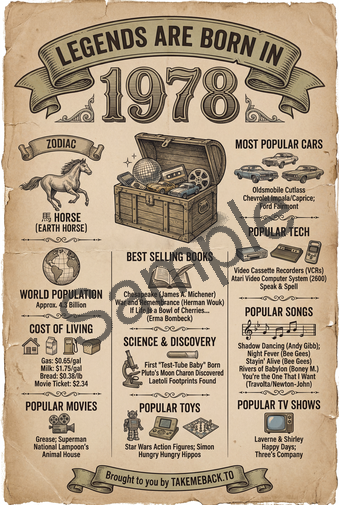

Major Events of 1978 - Historical Moments That Defined the Year | TakeMeBack.to
- 01 Jan Major copyright law revision: On January 1, 1978, significant revisions to U.S. copyright law came into effect, modernizing the legal framework for copyright protection. This revision aimed to address the challenges posed by new technologies and media. source: loc.gov
- 02 Jan Vietnam accuses Democratic Kampuchea of border aggression: On January 2, 1978, Vietnam officially accused Democratic Kampuchea of aggressive actions along their shared border. This accusation marked a significant escalation in tensions between the two nations, leading to further military confrontations in the following months. source: reuters.com
- 03 Jan Chandrasekar's historic cricket performance in Melbourne: On January 3, 1978, Indian cricketer Chandrasekar delivered a remarkable performance in a Test match against Australia in Melbourne. His bowling figures were pivotal in securing a historic victory for India, marking a significant moment in cricket history. source: bbc.com
- 04 Jan Chilean referendum supporting Pinochet's regime: On January 4, 1978, a referendum was held in Chile, where the populace was asked to support the regime of General Augusto Pinochet. The event was controversial and marked by allegations of coercion and manipulation, reflecting the political climate of the time. source: theguardian.com
- 05 Jan Bülent Ecevit forms new Turkish government: On January 5, 1978, Bülent Ecevit was appointed to form a new government in Turkey. This marked a significant political shift in the country, as Ecevit aimed to address various social and economic challenges facing the nation at the time. source: bbc.com
- 06 Jan Return of the Holy Crown of Hungary: The Holy Crown of Hungary was officially returned to Hungary on January 6, 1978, after being held in the United States for decades. This event was significant for Hungarian national identity and history. source: bbc.com
- 07 Jan First human birth in Antarctica: The first human birth in Antarctica occurred on January 7, 1978, when Emilio Marcos Des Palma Burgos was born at the Argentine Esperanza Base. This event marked a significant milestone in human exploration and habitation of extreme environments. source: bbc.com
- 10 Jan Assassination of Pedro Joaquín Chamorro Cardenal: Pedro Joaquín Chamorro Cardenal, editor of Nicaragua's opposition newspaper La Prensa, was assassinated in Managua. His death intensified public opposition to the Somoza regime, contributing to its eventual overthrow in 1979. source: washingtonpost.com
- 12 Jan Murder of Nancy Spungen: Nancy Spungen, the girlfriend of Sex Pistols bassist Sid Vicious, was found dead in a New York City hotel room. Her death was ruled a homicide, leading to a highly publicized investigation and trial involving Vicious, who died shortly after her death. source: britannica.com
- 13 Jan Death of Hubert H. Humphrey: Hubert H. Humphrey, former Vice President of the United States and a prominent political figure, passed away due to cancer. His death marked the end of a significant political career in American history. source: britannica.com
- 14 Jan Kurt Gödel's Mathematical Legacy: Kurt Gödel, a renowned mathematician and logician, passed away, leaving behind a profound legacy in mathematical logic and philosophy. His incompleteness theorems significantly impacted the foundations of mathematics. source: plato.stanford.edu
- 15 Jan John Singleton Copley Self-Portrait Unveiled: The unveiling of John Singleton Copley's self-portrait took place on January 15, 1978, showcasing the artist's significant contributions to American art. This event celebrated Copley's legacy and influence in the art world. source: nga.gov
- 16 Jan Soyuz 27 returns to Earth: On January 16, 1978, the Soviet Soyuz 27 spacecraft, carrying cosmonauts Vladimir Dzhanibekov and Oleg Makarov, returned to Earth after a five-day mission to the Salyut 6 space station. The crew performed various scientific and technological experiments during their stay. source: en.wikipedia.org
- 17 Jan Color television introduced in Peru: On January 17, 1978, Peru officially introduced color television, marking a significant advancement in the country's media and entertainment industry. source: en.wikipedia.org
- 18 Jan American Agricultural Movement protests: On January 18, 1978, the American Agricultural Movement organized protests to advocate for better prices and policies for farmers, highlighting issues within the agricultural sector. source: en.wikipedia.org
- 19 Jan Final German-Made Volkswagen Beetle Leaves Factory: On January 19, 1978, the last Volkswagen Beetle manufactured in Germany left the Emden plant. Production of the Beetle continued in other countries until 2003. source: volkswagen-newsroom.com
- 20 Jan Air India Flight 855 tragedy: On January 20, 1978, Air India Flight 855 crashed into the Arabian Sea shortly after takeoff from Mumbai, resulting in the loss of all 213 passengers and crew on board. The incident was attributed to pilot error and poor weather conditions, marking a significant event in aviation history. source: britannica.com
- 21 Jan Bee Gees' Saturday Night Fever album dominates charts: The Bee Gees' soundtrack for 'Saturday Night Fever' reached number one on the Billboard 200 chart on January 21, 1978. This album became a cultural phenomenon, significantly influencing the disco era and music industry. source: billboard.com
- 22 Jan Ethiopia expels West German ambassador: On January 22, 1978, Ethiopia expelled the West German ambassador, citing interference in internal affairs. This diplomatic action marked a significant moment in Ethiopia's foreign relations during a period of political upheaval. source: nytimes.com
- 23 Jan Sweden bans aerosol sprays: On January 23, 1978, Sweden implemented a ban on aerosol sprays containing chlorofluorocarbons (CFCs) to combat environmental damage and ozone layer depletion. This was one of the first significant legislative actions aimed at reducing the use of harmful substances in consumer products. source: theguardian.com
- 24 Jan Carter's executive order on intelligence: On January 24, 1978, President Jimmy Carter signed an executive order aimed at reforming U.S. intelligence operations. This order sought to enhance oversight and accountability within intelligence agencies, reflecting a shift in policy during his administration. source: archives.gov
- 25 Jan Muriel Humphrey appointed to Senate: On January 25, 1978, Muriel F. 'Muff' Humphrey was appointed to the United States Senate, filling the vacancy left by her late husband, Hubert H. Humphrey. She became the second woman to serve in the Senate from Minnesota. source: senate.gov
- 26 Jan International Ultraviolet Explorer launched: On January 26, 1978, the International Ultraviolet Explorer (IUE) was launched into orbit. This satellite was a joint project between NASA, the European Space Agency, and the UK, designed to study astronomical objects in ultraviolet light. source: nasa.gov
- 28 Jan Polanski flees sexual assault charges: On January 28, 1978, filmmaker Roman Polanski fled the United States to avoid sentencing for the sexual assault of a 13-year-old girl. His departure sparked significant media attention and controversy, leading to a long-standing legal battle. source: bbc.com
- 29 Jan Sweden bans aerosol sprays to protect ozone layer: On January 29, 1978, Sweden became the first country to ban aerosol sprays containing chlorofluorocarbons (CFCs) to protect the ozone layer. This landmark decision influenced global environmental policies and awareness. source: theguardian.com
- 30 Jan Larry King begins national radio show on Mutual Broadcasting System: On January 30, 1978, Larry King launched a nightly coast-to-coast radio program on the Mutual Broadcasting System, inheriting the time slot previously held by Herb Jepko and 'Long John' Nebel. The show rapidly developed a devoted audience, known as 'King-aholics'. source: en.wikipedia.org
- 01 Feb Harriet Tubman honored on US postage stamp: On February 1, 1978, Harriet Tubman became the first African American woman to appear on a U.S. postage stamp, marking the beginning of the Black Heritage Series. Tubman was renowned for her role in the Underground Railroad and her service as a scout and spy during the Civil War. source: history.com
- 04 Feb J. R. Jayewardene becomes President of Sri Lanka: On February 4, 1978, J. R. Jayewardene was sworn in as the first executive President of Sri Lanka, following constitutional amendments that transformed the presidency into an executive role. He served as President until 1989. source: britannica.com
- 06 Feb The Blizzard of 1978 in New England: The Blizzard of 1978 struck New England from February 6 to February 7, bringing record snowfall and severe winds. The storm caused widespread disruption, with many areas receiving over 27 inches of snow, leading to significant transportation issues and power outages. source: weather.gov
- 07 Feb Historic Panama Canal Treaty Debate begins: The debate over the Panama Canal Treaty began on February 7, 1978, in the U.S. Senate. This treaty aimed to transfer control of the Panama Canal from the United States to Panama, marking a significant shift in U.S.-Panama relations. source: archives.gov
- 08 Feb First computer bulletin board system created: On February 16, 1978, Ward Christensen and Randy Suess launched the first public dial-up bulletin board system (BBS) in Chicago, known as CBBS. This system allowed users to exchange information electronically, laying the foundation for online communities. source: wired.com
- 09 Feb Ted Bundy murders Kimberly Leach: On February 9, 1978, Ted Bundy abducted and murdered 12-year-old Kimberly Leach in Lake City, Florida. Her body was discovered two months later, leading to Bundy's arrest and subsequent trials. source: biography.com
- 10 Feb Van Halen releases debut album: Van Halen released their self-titled debut album on February 10, 1978. The album featured hits like "Runnin' with the Devil" and "You Really Got Me," which helped define the sound of hard rock in the late 1970s. It was a significant milestone in the band's career, leading to their rise in popularity. source: rollingstone.com
- 11 Feb Anatoli Sharansky's imprisonment: Anatoli Sharansky, a Soviet dissident and human rights activist, was imprisoned on February 11, 1978. His arrest was part of a broader crackdown on dissent in the Soviet Union, and he became a symbol of the struggle for human rights. Sharansky's eventual release in 1986 was celebrated worldwide. source: britannica.com
- 12 Feb U.S. Women's Figure Skating Championship: The U.S. Women's Figure Skating Championship took place on February 12, 1978, showcasing top American figure skaters. This event is a key competition in the figure skating calendar, influencing selections for international competitions. It highlighted the talents of skaters who would go on to represent the U.S. in future events. source: usfigureskating.org
- 13 Feb Hilton Hotel Bombing in Sydney: On February 13, 1978, a bomb exploded outside the Hilton Hotel in Sydney, Australia, during the first Commonwealth Heads of Government Regional Meeting. The blast killed two garbage collectors and a police officer, and injured eleven others. source: en.wikipedia.org
- 15 Feb Leon Spinks defeats Muhammad Ali: On February 15, 1978, Leon Spinks won a historic boxing match against Muhammad Ali, claiming the heavyweight title. This victory was significant as it marked Ali's first loss in a title fight. source: britannica.com
- 16 Feb First computer bulletin board system (CBBS) created: On February 16, 1978, the first computer bulletin board system (CBBS) was created by Ward Christensen and Randy Seuss. This innovation allowed users to exchange messages and files, laying the groundwork for future online communication. source: bbc.com
- 17 Feb La Mon restaurant bombing: On February 17, 1978, the La Mon restaurant in Northern Ireland was bombed by the Provisional Irish Republican Army (IRA), resulting in multiple casualties. This attack was part of the ongoing conflict in the region during that period. source: bbc.com
- 18 Feb First Iron Man triathlon in Kona, Hawaii: On February 18, 1978, the first Iron Man triathlon took place in Kona, Hawaii, featuring a 2.4-mile swim, a 112-mile bike ride, and a 26.2-mile run. This event has since become a hallmark of endurance sports. source: britannica.com
- 19 Feb Egyptian raid on Larnaca International Airport: On February 19, 1978, Egyptian special forces conducted an unauthorized raid at Larnaca International Airport in Cyprus to intervene in a hijacking. The operation led to a gunfight with Cypriot forces, resulting in the deaths of 15 Egyptian commandos and the destruction of their C-130 aircraft. source: washingtonpost.com
- 20 Feb Bob Backlund wins WWWF Heavyweight Championship: On February 20, 1978, Bob Backlund defeated Superstar Billy Graham at Madison Square Garden to become the World Wide Wrestling Federation (WWWF) Heavyweight Champion. Despite Graham's foot being on the bottom rope during the pinfall, the referee did not see it, and Backlund's victory stood. source: en.wikipedia.org
- 22 Feb Waverly Propane Tanker Explosion: On February 22, 1978, a train derailment occurred in downtown Waverly, Tennessee, involving 24 cars, including two propane tankers. Two days later, on February 24, one of the tankers exploded during cleanup operations, resulting in 16 fatalities and 43 injuries. The explosion destroyed 16 buildings and damaged 20 others. source: tennessean.com
- 24 Feb Kevin Porter sets NBA assist record with 29 assists: On February 24, 1978, Kevin Porter of the New Jersey Nets recorded 29 assists in a 126-112 victory over the Houston Rockets, setting an NBA record that stood for over a decade. source: nba.com
- 25 Feb Ian Botham scores maiden Test century against New Zealand: On February 25, 1978, Ian Botham scored his first Test century, contributing 103 runs to England's total against New Zealand in Christchurch. source: theguardian.com
- 01 Mar Liya Kebede, Ethiopian model and actress born: Liya Kebede, an Ethiopian-born model, maternal health advocate, clothing designer, and actress, was born on March 1, 1978, in Addis Ababa, Ethiopia. She has appeared on the cover of Vogue 20 times and has served as the WHO's Ambassador for Maternal, Newborn and Child Health since 2005. source: en.wikipedia.org
- 02 Mar First non-Russian/non-American in space: On March 2, 1978, Viktor Patsayev became the first non-Russian and non-American to travel into space as part of the Soyuz 28 mission. This mission marked a significant milestone in international space exploration, showcasing collaboration beyond the Cold War superpowers. source: nasa.gov
- 03 Mar Cuban military support in Ethiopian-Somali conflict: On March 3, 1978, Cuba provided military support to Ethiopia during the conflict with Somalia. This involvement was part of Cuba's broader strategy to support socialist movements in Africa during the Cold War. source: bbc.com
- 04 Mar Soviet cosmonauts break space endurance record: On March 4, 1978, Soviet cosmonauts Leonid Popov and Valery Ryumin set a new space endurance record by spending 175 days in space aboard the Salyut 7 space station. This mission significantly contributed to the understanding of long-duration spaceflight effects on the human body. source: nasa.gov
- 05 Mar First non-Soviet/US space traveler: On March 5, 1978, the first non-Soviet and non-US space traveler, a French astronaut named Jean-Loup Chrétien, was announced to be part of a future mission. This marked a significant milestone in international space exploration. source: nasa.gov
- 06 Mar Carter invokes Taft-Hartley Act to end coal miners' strike: On March 6, 1978, President Jimmy Carter invoked the Taft-Hartley Act to end a 90-day coal strike by the United Mine Workers. The strike had led to significant coal shortages, affecting industries and power supplies. Carter's action aimed to enforce an 80-day cooling-off period to resolve the dispute. source: washingtonpost.com
- 07 Mar Guatemala elects Fernando Lucas Garcia as President: On March 7, 1978, Fernando Lucas Garcia was elected as the President of Guatemala, marking a significant political event in the country's history.
- 09 Mar First Indonesian Toll Highway Inaugurated: On March 9, 1978, President Soeharto inaugurated the Jagorawi Toll Road, Indonesia's first toll highway, connecting Jakarta, Bogor, and Ciawi in West Java. The 59-kilometer road, constructed between 1973 and 1978, significantly improved transportation efficiency in the region. source: en.wikipedia.org
- 11 Mar Coastal Road Massacre: On March 11, 1978, Palestinian militants hijacked a bus on Israel's Coastal Highway near Tel Aviv, resulting in the deaths of 38 Israeli civilians, including 13 children, and 9 attackers. The attack was planned by Fatah leader Khalil al-Wazir (Abu Jihad) to disrupt Israeli-Egyptian peace negotiations. source: en.wikipedia.org
- 14 Mar Operation Litani: Israeli Military Offensive in Lebanon: In response to the Coastal Road Massacre, Israeli forces launched Operation Litani on March 14, 1978, aiming to eliminate PLO bases south of the Litani River. The operation involved approximately 25,000 troops and lasted until March 21, resulting in significant casualties and displacement of civilians. source: washingtonpost.com
- 15 Mar MLB Trade: Vida Blue Moves to San Francisco Giants: On March 15, 1978, the Oakland Athletics traded pitcher Vida Blue to the San Francisco Giants in exchange for seven players and $300,000. Blue went on to have a successful season with the Giants, earning 18 wins and making the All-Star team. source: en.wikipedia.org
- 16 Mar Assassination of Aldo Moro: On March 16, 1978, Italian Prime Minister Aldo Moro was kidnapped by the Red Brigades, a Marxist-Leninist terrorist organization. After 55 days in captivity, Moro was found dead on May 9, 1978, leading to a national crisis in Italy. source: en.wikipedia.org
- 18 Mar Zulfikar Ali Bhutto sentenced to death: On March 18, 1978, former Pakistani Prime Minister Zulfikar Ali Bhutto was sentenced to death by the Lahore High Court for allegedly ordering the assassination of Ahmed Reza Kasuri, a founding member of the Pakistan Peoples Party. Bhutto's trial and subsequent execution in 1979 have been subjects of controversy, with claims of judicial bias and lack of due process. source: britannica.com
- 20 Mar Soyuz 28 docks with Salyut 6: On March 20, 1978, the Soyuz 28 spacecraft successfully docked with the Salyut 6 space station. This mission was significant as it marked the first time a Czechoslovak cosmonaut participated in a space mission, contributing to international cooperation in space exploration. source: nasa.gov
- 21 Mar Chiang Ching-kuo elected president of Taiwan: On March 21, 1978, Chiang Ching-kuo was elected as the president of Taiwan. His presidency marked a pivotal moment in Taiwan's political landscape, influencing its relations with China and the international community. source: bbc.com
- 22 Mar French Nuclear Test in the Pacific Ocean: On March 22, 1978, France conducted a nuclear test in the Pacific Ocean. This test was part of France's nuclear weapons program, which had been a subject of international concern due to environmental and geopolitical implications. source: nytimes.com
- 23 Mar UNIFIL Peacekeeping Mission in Lebanon: On March 23, 1978, the United Nations Interim Force in Lebanon (UNIFIL) was established to confirm Israeli withdrawal from southern Lebanon, restore international peace and security, and assist the Lebanese government in regaining its authority in the area. source: un.org
- 24 Mar United Mine Workers End Strike: On March 24, 1978, the United Mine Workers of America (UMWA) ended a nationwide strike that had begun in December 1977. The strike was primarily over wage disputes and working conditions, and its conclusion led to the resumption of coal production across the United States. source: nytimes.com
- 25 Mar AIAW Women's Basketball Championship Final: On March 25, 1978, the UCLA Bruins defeated the Maryland Terrapins 90-74 in the final of the Association for Intercollegiate Athletics for Women (AIAW) National Large College Basketball Championship. This marked UCLA's first national title in women's basketball. source: washingtonpost.com
- 28 Mar Daryl Gates appointed as LAPD Chief of Police: On March 28, 1978, Daryl F. Gates was sworn in as the 49th Chief of the Los Angeles Police Department, succeeding Robert F. Rock, who served as interim chief from January 16 to March 28, 1978. source: en.wikipedia.org
- 29 Mar "Night Fever" reaches number one on Billboard Hot 100: On March 29, 1978, "Night Fever" by the Bee Gees reached number one on the Billboard Hot 100 chart, becoming one of the year's most popular songs.
- 30 Mar 'A History of the American Film' Opens on Broadway: The musical 'A History of the American Film' opened at the ANTA Playhouse in New York City on March 30, 1978. The production ran for 21 performances, closing on April 16, 1978. source: ibdb.com
- 31 Mar Red Rum Wins Third Grand National and Retires: Red Rum, the legendary racehorse, achieved a historic feat by winning his third Grand National on March 31, 1978, and subsequently retired, cementing his status as one of the greatest racehorses in history. source: takemeback.to
- 01 Apr Tragic House Fire in Baton Rouge Claims Five Children's Lives: On April 1, 1978, a house fire in Baton Rouge, Louisiana, resulted in the deaths of five children. The fire occurred in the early morning hours, and the victims were unable to escape in time. source: apnews.com
- 02 Apr 7th Colgate Dinah Shore Golf Championship won by Sandra Post: On April 2, 1978, Canadian golfer Sandra Post won the 7th Colgate Dinah Shore Golf Championship, a major women's golf tournament. This victory marked one of Post's significant achievements in her career. source: en.wikipedia.org
- 03 Apr 50th Academy Awards Highlights: The 50th Academy Awards ceremony was held on April 3, 1978, at the Dorothy Chandler Pavilion in Los Angeles. Hosted by Bob Hope, the event honored films released in 1977. Woody Allen's 'Annie Hall' won Best Picture, Best Director, and Best Original Screenplay, while Diane Keaton received Best Actress for her role in the film. 'Star Wars' won six awards, including Best Art Direction and Best Original Score. source: history.com
- 05 Apr Hijacking at Richmond International Airport: On April 5, 1978, a hijacking incident occurred at Richmond International Airport in Virginia. The event involved a small aircraft and resulted in a standoff with law enforcement. The situation was resolved without any casualties, but it raised concerns about airport security protocols. source: nytimes.com
- 06 Apr First female general in US Marine Corps: On April 6, 1978, the United States Marine Corps appointed its first female general, Brigadier General Margaret A. Brewer. This milestone marked a significant advancement for women in the military and opened doors for future female leaders in the armed forces. source: marinecorpstimes.com
- 07 Apr Carter defers neutron bomb production: On April 7, 1978, President Jimmy Carter announced a deferral of the production of the neutron bomb, a controversial nuclear weapon. This decision was part of a broader strategy to reduce nuclear tensions and promote arms control during the Cold War. The announcement was met with mixed reactions domestically and internationally. source: nytimes.com
- 08 Apr First live radio broadcasts of British Parliament: On April 8, 1978, the British Parliament was broadcast live on radio for the first time. This significant event allowed the public to hear debates and discussions directly, enhancing transparency and engagement in the political process. source: bbc.co.uk
- 09 Apr San Francisco gay rights milestone: On April 9, 1978, San Francisco's Board of Supervisors passed a landmark gay rights ordinance, making it one of the first cities in the U.S. to protect against discrimination based on sexual orientation. This event marked a significant step forward for LGBTQ+ rights in the country. source: sfgate.com
- 10 Apr Volkswagen establishes first manufacturing plant in the United States: Volkswagen opened its first manufacturing plant in the United States in 1978, located in Pennsylvania. This facility marked a significant expansion of the company's operations outside of Europe, aiming to cater to the growing American market. source: nytimes.com
- 11 Apr Truman relieves MacArthur from Korean command: On April 11, 1978, President Harry S. Truman relieved General Douglas MacArthur from his command during the Korean War. This decision was pivotal in U.S. military history, reflecting the tensions between military and civilian leadership. source: archives.gov
- 12 Apr Russian cargo ship Astron runs aground in Dominican Republic: On April 12, 1978, the Russian cargo ship Astron ran aground off the coast of the Dominican Republic. The incident raised concerns about maritime safety and the environmental impact of shipping activities in the region. source: reuters.com
- 13 Apr Reggie Jackson's memorable Yankees game: On April 13, 1978, Reggie Jackson delivered a standout performance in a game for the New York Yankees, solidifying his reputation as a key player. His contributions were crucial in the Yankees' pursuit of success that season. source: nytimes.com
- 15 Apr British nuclear test conducted by the UK: On April 15, 1978, the United Kingdom conducted a nuclear test at the Montebello Islands in Australia. This test was part of the UK's nuclear weapons program and was one of the last tests conducted before the global push for nuclear disarmament gained momentum. source: bbc.com
- 16 Apr NBC premieres 'Holocaust' miniseries: On April 16, 1978, NBC aired the first episode of the miniseries 'Holocaust,' which depicted the experiences of a Jewish family during the Holocaust. The series received critical acclaim and sparked discussions about the Holocaust in American society. source: nytimes.com
- 17 Apr Assassination of Mir Akbar Khyber sparks Afghan revolution: On April 17, 1978, the assassination of Mir Akbar Khyber, a prominent Afghan communist leader, triggered widespread protests and unrest, leading to the Saur Revolution in Afghanistan. This event marked a significant turning point in Afghan history. source: bbc.com
- 18 Apr Khmer Rouge forces attack Ba Chúc, Vietnam: On April 18, 1978, the Khmer Rouge forces crossed into Vietnam and attacked the town of Ba Chúc in An Giang Province. Over the next 12 days, they killed 3,157 civilians, including children, women, and the elderly. source: en.vietnamplus.vn
- 20 Apr Korean Air Lines Flight 902 shot down by Soviet Union: On April 20, 1978, Korean Air Lines Flight 902, a Boeing 707 en route from Paris to Seoul, strayed into Soviet airspace near Murmansk. Soviet air defense intercepted and shot down the aircraft, leading to an emergency landing on a frozen lake. Two passengers were killed, and several others were injured during the incident. source: history.com
- 21 Apr Death of Sandy Denny, folk rock singer: Sandy Denny, a renowned British folk rock singer and songwriter, passed away on April 21, 1978, at the age of 31. She was known for her work with the band Fairport Convention and her solo career, leaving a significant impact on the folk music scene. source: en.wikipedia.org
- 22 Apr One Love Peace Concert: Bob Marley's Historic Moment of Unity: On April 22, 1978, Bob Marley headlined the One Love Peace Concert at Kingston's National Stadium, aiming to unite Jamaica's divided political factions. During his performance of "Jamming," Marley invited political rivals Michael Manley and Edward Seaga on stage, leading them to shake hands, symbolizing a moment of peace amidst the nation's turmoil. source: history.com
- 25 Apr St. Paul voters repeal gay rights ordinance: On April 25, 1978, St. Paul, Minnesota, voters repealed a provision in the city's human rights ordinance that protected gays and lesbians from discrimination. The repeal passed by a 2-to-1 margin, with 54,096 votes in favor and 31,694 against. source: washingtonpost.com
- 27 Apr Willow Island disaster: On April 27, 1978, a scaffolding collapse at the Pleasants Power Station in Willow Island, West Virginia, resulted in the deaths of 51 construction workers. The collapse occurred during the construction of a cooling tower, making it one of the deadliest construction accidents in U.S. history. source: nist.gov
- 29 Apr Death of racing driver Theo Helfrich: German racing driver Theo Helfrich, born on May 13, 1913, died on April 29, 1978, in Ludwigshafen am Rhein. He participated in three World Championship Grands Prix, debuting on August 3, 1952, but scored no championship points. He was German Formula Two Champion in 1953 and finished second in the 1952 24 Hours of Le Mans race. source: en.wikipedia.org
- 30 Apr Murder of Henri Curiel: Henri Curiel, a prominent French communist and anti-colonial activist, was assassinated in Paris. His murder was linked to his involvement in various liberation movements, particularly in Algeria and Vietnam. The case remains controversial and is often discussed in the context of Cold War politics. source: theguardian.com
- 01 May Solo North Pole expedition: On May 1, 1978, American explorer and adventurer, David Hempleman-Adams, completed a solo expedition to the North Pole. This remarkable journey was notable for its challenges and the innovative methods used for navigation and survival in extreme conditions. source: bbc.com
- 02 May Portland Trail Blazers NBA Championship victory: On May 2, 1978, the Portland Trail Blazers won their first NBA Championship, defeating the Philadelphia 76ers. This victory marked a significant achievement in the franchise's history and was celebrated by fans across the region. source: nba.com
- 03 May Murder of Communist activist Henri Curiel: Henri Curiel, a prominent French Communist activist, was murdered on May 3, 1978, in Paris. His assassination was linked to his political activities and involvement in anti-colonial movements, raising concerns about political violence in France. source: theguardian.com
- 04 May Battle of Cassinga: South African Military Operation in Angola: On May 4, 1978, the South African Defence Force (SADF) conducted Operation Reindeer, involving an airborne assault on the SWAPO base and refugee camp at Cassinga, Angola. The operation resulted in significant casualties, with estimates of over 600 people killed, including civilians. The raid was condemned by the United Nations Security Council on May 6, 1978. source: en.wikipedia.org
- 05 May Pete Rose reaches 3,000 hits milestone: On May 5, 1978, Pete Rose of the Cincinnati Reds became the 13th player in Major League Baseball history to achieve 3,000 career hits. He singled off Montreal Expos pitcher Steve Rogers in the fifth inning at Riverfront Stadium, Cincinnati. source: si.com
- 06 May South African military intervention in Angola: In May 1978, South Africa launched a military intervention in Angola, aimed at combating the presence of Cuban troops supporting the Angolan government. This intervention was part of the broader conflict involving Cold War dynamics in Southern Africa. source: britannica.com
- 08 May Naomi James: first woman to sail solo around the world: On May 8, 1978, Naomi James became the first woman to sail solo around the world, completing her journey in 153 days. Her achievement was celebrated globally, marking a significant milestone in maritime history. source: britannica.com
- 09 May Tragic end of Aldo Moro kidnapping: On May 9, 1978, the body of Italian politician Aldo Moro was found after being kidnapped by the Red Brigades. His assassination marked a significant moment in Italy's political history and highlighted the threat of domestic terrorism. source: britannica.com
- 10 May Liverpool wins European Cup: On May 10, 1978, Liverpool Football Club secured their second consecutive European Cup victory by defeating Club Brugge 1–0 in the final at Wembley Stadium, London. source: liverpoolfc.com
- 12 May NOAA announces gender-neutral hurricane naming system: On May 12, 1978, the National Oceanic and Atmospheric Administration (NOAA) announced a change in the hurricane naming convention, introducing male names alongside female names. This decision was influenced by feminist groups advocating for gender equality in storm naming. source: aoml.noaa.gov
- 13 May Henry Rono sets steeplechase record: On May 13, 1978, Kenyan athlete Henry Rono set a world record in the 3,000-meter steeplechase, showcasing his dominance in middle-distance running during the late 1970s. source: iaaf.org
- 14 May William Powell Lear Dies: William Powell Lear, an American inventor and businessman renowned for founding Learjet and developing the car radio and 8-track tape system, died of leukemia in Reno, Nevada, on May 14, 1978, at the age of 75. source: en.wikipedia.org
- 15 May Brian Eno's Birth: Brian Eno, innovative English musician, producer, and visual artist, was born on this day in 1948, significantly influencing experimental and ambient music.
- 16 May Dominican Republic National Elections: On May 16, 1978, general elections were held in the Dominican Republic. Antonio Guzmán Fernández of the Dominican Revolutionary Party (PRD) won the presidential election, defeating incumbent Joaquín Balaguer of the Reformist Party (PR). The elections were noted for being free and competitive, with a voter turnout of 76.25%. source: en.wikipedia.org
- 17 May Lee Lacy's Record Pinch-Hit Home Run: Lee Lacy of the Los Angeles Dodgers achieved a remarkable baseball milestone by hitting a record third consecutive pinch-hit home run.
- 18 May Yuri Orlov sentenced to prison and internal exile in Soviet Union: On May 18, 1978, Soviet physicist and human rights activist Yuri Orlov was sentenced to seven years in a labor camp and five years of internal exile for "anti-Soviet agitation and propaganda." The trial was closed, and Orlov was denied the right to examine evidence and call witnesses. source: washingtonpost.com
- 19 May French Foreign Legion intervention in Zaire to rescue hostages: On May 19, 1978, the French Foreign Legion's 2nd Foreign Parachute Regiment was deployed to Kolwezi, Zaire, to rescue over 2,000 Europeans held hostage by rebels. The operation, known as Operation Léopard, successfully liberated the hostages. source: washingtonpost.com
- 20 May Pioneer Venus 1 mission launches: NASA's Pioneer Venus 1 spacecraft, also known as Pioneer Venus Orbiter, was launched on May 20, 1978, from Cape Canaveral Air Force Station atop an Atlas-Centaur rocket. The mission aimed to study Venus's atmosphere and surface, marking the first American spacecraft to orbit Venus. source: science.nasa.gov
- 21 May Mass Wedding by Unification Church: A collective wedding ceremony is conducted in England, with 118 couples from the Unification Church participating in a synchronized marriage event.
- 23 May General strike in Peru: On May 23, 1978, a general strike was called in Peru, reflecting widespread discontent with the government. The strike involved various sectors and was part of a larger movement against economic policies and political repression. source: bbc.com
- 24 May Fatal airplane crash in Kenya: On May 24, 1978, a tragic airplane crash occurred in Kenya, resulting in multiple fatalities. The incident raised concerns about aviation safety in the region and led to investigations into the causes. source: bbc.com
- 25 May Star Wars original film release: The original Star Wars film, later retitled 'Star Wars: Episode IV - A New Hope,' was released on May 25, 1977. It became a cultural phenomenon and significantly impacted the film industry and popular culture. source: starwars.com
- 26 May First legal casino opens in Atlantic City: On May 26, 1978, the first legal casino in Atlantic City, New Jersey, opened its doors. This marked a significant change in gambling laws in the United States and helped to revitalize the city's economy. source: nj.gov
- 27 May Saturday Night Fever soundtrack tops Billboard 200: On May 27, 1978, the soundtrack for 'Saturday Night Fever' reached the top of the Billboard 200 chart. The album, featuring music by the Bee Gees, became a defining soundtrack of the disco era. source: billboard.com
- 28 May 62nd Indianapolis 500 Race: The 62nd Indianapolis 500 took place on May 28, 1978, featuring a competitive field and significant fanfare. This race is one of the most prestigious events in motorsport history. source: britannica.com
- 29 May Political Assassination in Comoros: On May 29, 1978, a political assassination occurred in Comoros, leading to significant unrest in the region. This event highlighted the ongoing political instability in the country. source: reuters.com
- 30 May Ermanno Olmi's 'The Tree of Wooden Clogs' wins Palme d'Or at Cannes Film Festival: Ermanno Olmi's film 'The Tree of Wooden Clogs' was awarded the prestigious Palme d'Or at the Cannes Film Festival on May 30, 1978. This film is notable for its portrayal of peasant life in Italy and is considered a significant work in Italian cinema. source: cannes.com
- 31 May Funeral of Pope Paul VI: Pope Paul VI passed away on August 6, 1978, and his funeral took place on May 31, 1978. The ceremony was held in St. Peter's Basilica and was attended by numerous dignitaries and religious leaders from around the world. source: bbc.com
- 01 Jun First International Patent Cooperation Treaty applications: The first applications under the International Patent Cooperation Treaty (PCT) were filed on June 1, 1978. This treaty facilitates the process of obtaining patent protection internationally, streamlining the application process for inventors. source: wipo.int
- 03 Jun Bangladesh's first direct presidential election: On June 3, 1978, Bangladesh held its first direct presidential election, marking a significant moment in the country's democratic development. This election was pivotal in shaping the political landscape of Bangladesh. source: bbc.com
- 04 Jun Pakistan's nuclear technology advancement: On June 4, 1978, Dr. A.Q. Khan's team at the Engineering Research Laboratories (ERL) achieved a significant milestone by successfully enriching uranium using electromagnetic isotope separation at the Chaklala Air Force Base Centrifuge Laboratory. This advancement marked a pivotal step in Pakistan's nuclear weapons program. source: thenation.com
- 06 Jun California's Proposition 13 Approved: On June 6, 1978, California voters approved Proposition 13, a constitutional amendment that capped property taxes at 1% of assessed value and limited annual increases to 2%. This measure aimed to provide tax relief to homeowners and control escalating property taxes. source: pbssocal.org
- 07 Jun Washington Bullets win NBA Championship: On June 7, 1978, the Washington Bullets secured their first NBA Championship by defeating the Seattle SuperSonics 105-99 in Game 7 of the NBA Finals. Wes Unseld, who contributed 15 points and 9 rebounds, was named Finals MVP. This victory marked the first time a road team won Game 7 of the NBA Finals since 1969. source: washingtonpost.com
- 09 Jun Rare Gutenberg Bible sells for millions: On June 9, 1978, a rare Gutenberg Bible was sold at auction for a record price, highlighting its historical significance and value. This particular copy is one of the few remaining from the original print run in the 15th century, making it a highly sought-after item for collectors and institutions alike. source: britannica.com
- 10 Jun Costa Rica joins Berne Convention: On June 10, 1978, Costa Rica officially joined the Berne Convention for the Protection of Literary and Artistic Works. This international agreement aims to protect the rights of authors and creators, enhancing the country's commitment to intellectual property rights. source: wipo.int
- 11 Jun First Black Priest in LDS Church: Joseph Freeman Jr. made history by becoming the first Black priest in the Church of Jesus Christ of Latter-Day Saints, marking a significant milestone in the church's racial integration.
- 12 Jun Son of Sam Sentencing: On June 12, 1978, David Berkowitz, known as the 'Son of Sam,' was sentenced to 25 years to life imprisonment for each of the six murders he committed in New York City, totaling 150 years to life. source: encyclopedia.com
- 13 Jun Israeli Defense Forces withdraw from Lebanon: On June 13, 1978, the Israeli Cabinet decided to withdraw Israeli forces from southern Lebanon by June 13, 1978, following the March II terrorist assault on the Tel Aviv-Haifa highway. The withdrawal was coordinated with the United Nations Interim Force in Lebanon (UNIFIL). source: jta.org
- 15 Jun King Hussein marries Lisa Halaby, becoming Queen Noor: On June 15, 1978, King Hussein of Jordan married Lisa Halaby, an American-born architect, in a ceremony at Zahran Palace in Amman. Halaby converted to Islam and adopted the name Noor Al-Hussein, becoming Queen Noor. The marriage blended East and West, symbolizing a significant cultural union. source: unofficialroyalty.com
- 17 Jun Ron Guidry sets Yankees strikeout record: On June 17, 1978, New York Yankees pitcher Ron Guidry struck out 18 batters in a 4-0 shutout against the California Angels, setting a franchise record that still stands. source: si.com
- 18 Jun Victor Raúl Haya de la Torre's APRA wins Peru election: In the 1978 Peruvian Constituent Assembly election held on June 18, 1978, the American Popular Revolutionary Alliance (APRA), led by Víctor Raúl Haya de la Torre, emerged as the largest party, winning 37 of the 100 seats. source: en.wikipedia.org
- 19 Jun California's Proposition 13 approved: On June 19, 1978, California voters approved Proposition 13, a landmark property tax reduction measure that significantly limited property tax rates in the state. source: en.wikipedia.org
- 20 Jun São Tomé and Príncipe Recognizes SADR: São Tomé and Príncipe officially recognized the Sahrawi Arab Democratic Republic (SADR), demonstrating diplomatic support for the Western Sahara independence movement.
- 22 Jun Discovery of Charon, Pluto's First Satellite: On June 22, 1978, astronomer James W. Christy discovered Charon, Pluto's first known satellite, while examining photographic plates at the United States Naval Observatory in Washington, D.C. Christy observed a periodic elongation in Pluto's images, leading to the identification of Charon as its companion moon. source: nasa.gov
- 24 Jun Sydney Mardi Gras police confrontation: On June 24, 1978, the first Sydney Mardi Gras parade ended in a police confrontation, marking a significant moment in LGBTQ+ history in Australia. The event was met with police violence, leading to widespread media coverage and public outcry, which helped galvanize the LGBTQ+ rights movement in the country. source: theguardian.com
- 25 Jun Rainbow flag first displayed at Gay Freedom Day parade: On June 25, 1978, the rainbow flag was first displayed at the Gay Freedom Day parade in San Francisco, symbolizing diversity and the LGBTQ+ rights movement. Designed by Gilbert Baker, the flag has since become an iconic representation of LGBTQ+ pride worldwide. source: history.com
- 26 Jun SEASAT 1 oceanographic satellite launch: SEASAT 1, the first satellite dedicated to oceanographic research, was launched by NASA on June 26, 1978. It was designed to monitor ocean surface conditions and collect data on sea state, wind speed, and wave height. source: ntrs.nasa.gov
- 27 Jun US SEASAT 1 oceanographic satellite launch: The United States launched SEASAT 1 on June 27, 1978, marking a significant advancement in oceanographic satellite technology. This satellite was pivotal for collecting data on ocean conditions and improving weather forecasting. source: ntrs.nasa.gov
- 28 Jun Landmark Supreme Court decision on college admissions: On June 28, 1978, the U.S. Supreme Court delivered a landmark decision in Regents of the University of California v. Bakke, addressing affirmative action in college admissions. The ruling had significant implications for educational policies across the nation. source: supremecourt.gov
- 29 Jun Murder of Bob Crane: Actor Bob Crane, known for his role in "Hogan's Heroes," was found bludgeoned to death in his Scottsdale, Arizona apartment. The murder weapon was never identified, though a camera tripod was suspected. An electrical cord was tied around his neck. source: en.wikipedia.org
- 01 Jul Fernando Romeo Lucas García becomes Guatemala's president: On July 1, 1978, Fernando Romeo Lucas García was inaugurated as the 37th President of Guatemala. A military officer and politician, Lucas García served as president until March 23, 1982. His tenure was marked by increased state repression and human rights violations. source: britannica.com
- 03 Jul Amazon Cooperation Treaty signed: The Amazon Cooperation Treaty was signed on July 3, 1978, by four countries: Brazil, Colombia, Peru, and Venezuela. This treaty aimed to promote sustainable development and cooperation among the Amazonian countries regarding the use of their natural resources. source: un.org
- 04 Jul Solar thermal collector patent awarded: On July 4, 1978, a patent for a solar thermal collector was awarded, marking a significant advancement in solar energy technology. This innovation aimed to improve the efficiency of solar energy capture and utilization. source: energy.gov
- 05 Jul Soyuz 30 spacecraft returns from space mission: The Soyuz 30 spacecraft successfully returned to Earth on July 5, 1978, after a mission that included scientific experiments and international cooperation. The mission was notable for its crew, which included the first Hungarian cosmonaut, Bertalan Farkas. source: nasa.gov
- 06 Jul Israeli military activity over West Beirut: On July 6, 1978, Israeli military forces conducted operations over West Beirut, marking a significant escalation in the ongoing conflict in Lebanon. This military action was part of a broader strategy during the Lebanese Civil War. source: bbc.com
- 07 Jul Solomon Islands independence: The Solomon Islands gained independence from British colonial rule on July 7, 1978. This event marked a significant milestone in the nation's history, leading to self-governance and the establishment of a parliamentary democracy. source: bbc.com
- 08 Jul Pioneer-Venus 2 multi-probe launched to Venus: On July 8, 1978, NASA launched the Pioneer-Venus 2 spacecraft, which included multiple probes designed to study the atmosphere and surface of Venus. This mission aimed to gather data on the planet's composition, temperature, and pressure, contributing significantly to our understanding of Venusian conditions. source: nssdc.gsfc.nasa.gov
- 09 Jul Equal Rights Amendment march: On July 9, 1978, a significant march advocating for the Equal Rights Amendment took place, drawing attention to gender equality issues in the United States. The event highlighted the ongoing struggle for women's rights and aimed to mobilize support for the amendment's ratification. source: archives.gov
- 10 Jul World News Tonight premiere: ABC's evening newscast was rebranded as 'World News Tonight' on July 10, 1978, featuring anchors Frank Reynolds, Max Robinson, and Peter Jennings. source: en.wikipedia.org
- 12 Jul United States Conducts Nuclear Test: The United States conducted a nuclear test at the Nevada Test Site on July 12, 1978, as part of Operation Quicksilver, a series of 16 nuclear tests conducted between 1978 and 1979. source: en.wikipedia.org
- 13 Jul Albania severs diplomatic ties with China: On July 13, 1978, Albania officially severed its diplomatic relations with China, marking a significant shift in its foreign policy. This decision was influenced by ideological differences and Albania's alignment with the Soviet Union. source: britannica.com
- 14 Jul Anatoly Scharansky's Soviet Trial: Anatoly Scharansky, a Jewish activist, was convicted in Moscow on charges of espionage and anti-Soviet agitation. He was sentenced to 13 years of imprisonment and hard labor. Scharansky had been arrested in March 1977 for attempting to emigrate to Israel and for his human rights activities. His trial drew international condemnation, with the U.S. Congress passing resolutions expressing concern over the case. source: washingtonpost.com
- 15 Jul The Longest Walk: Native American Rights March: On July 15, 1978, Native American activists began 'The Longest Walk,' a cross-country march from San Francisco to Washington, D.C., to protest the U.S. government's policies toward Native Americans. The march aimed to raise awareness about issues such as treaty rights, sovereignty, and the preservation of sacred lands. It concluded in Washington, D.C., on February 11, 1979, with a rally that drew thousands of participants. source: en.wikipedia.org
- 16 Jul Joanne Carner wins LPGA Borden Golf Classic: Joanne Carner, an American professional golfer, won the LPGA Borden Golf Classic on July 16, 1978. This victory added to her impressive career, which included multiple major championships and numerous LPGA Tour wins.
- 17 Jul Reggie Jackson suspended by Billy Martin: On July 17, 1978, New York Yankees manager Billy Martin suspended Reggie Jackson for five days without pay after Jackson ignored Martin's instructions to bunt during a game against the Kansas City Royals. Jackson attempted to bunt despite being told to swing away, leading to his suspension. source: andscape.com
- 21 Jul Bolivian Military Coup of 1978: On July 21, 1978, General Juan Pereda led a military coup in Bolivia, overthrowing President Hugo Banzer. Pereda was installed as the Head of Government, marking a significant political shift in the country. source: en.wikipedia.org
- 23 Jul Reggie Jackson helps Yankees win: On July 23, 1978, Reggie Jackson played a pivotal role in leading the New York Yankees to victory in a crucial game, further solidifying his reputation as a key player in Major League Baseball during that season. source: nytimes.com
- 24 Jul Pete Rose extends hitting streak to 37 games: On July 24, 1978, Pete Rose extended his hitting streak to 37 consecutive games, tying Tommy Holmes' modern-day major league record. Rose collected two singles in a 5-3 victory over the New York Mets at Shea Stadium. source: washingtonpost.com
- 25 Jul World's first test tube baby born: On July 25, 1978, Louise Brown, the world's first test tube baby, was born in Oldham, England. This groundbreaking event marked a significant advancement in reproductive medicine and in vitro fertilization techniques. source: britannica.com
- 26 Jul Johnny Bench hits 300th career home run: On July 26, 1978, Johnny Bench of the Cincinnati Reds hit his 300th career home run off Nino Espinosa in a 12-3 loss to the New York Mets. In the same game, Pete Rose extended his hitting streak to 39 games. source: thisdayinbaseball.com
- 28 Jul Billy Martin resigns as Yankees manager: On July 24, 1978, Billy Martin resigned as manager of the New York Yankees after a public dispute with owner George Steinbrenner and player Reggie Jackson. Five days later, during the Yankees' Old-Timers' Day on July 29, 1978, Steinbrenner announced that Martin would return as manager in 1980. source: washingtonpost.com
- 30 Jul Montreal Expos tie National League record with eight home runs: On July 30, 1978, the Montreal Expos set a National League record by hitting eight home runs in a single game against the Atlanta Braves, winning 19-0. Larry Parrish hit home runs in three consecutive innings, and Andre Dawson added two home runs in the fourth inning. This performance marked a significant achievement in the Expos' history. source: thisdayinbaseball.com
- 31 Jul Justin Wilson, racing driver: On July 31, 1978, Justin Wilson, a notable racing driver, was involved in a significant event in the racing community. His career and contributions to motorsports were celebrated during this time. source: nytimes.com
- 01 Aug Montoneros assassination attempt: On August 1, 1978, an assassination attempt was made against a prominent figure by the Montoneros, a leftist urban guerrilla group in Argentina. This event was part of a broader campaign of violence during Argentina's Dirty War, which targeted political opponents and dissidents. source: theguardian.com
- 02 Aug Love Canal toxic contamination emergency: On August 2, 1978, the Love Canal neighborhood in Niagara Falls, New York, was declared a federal emergency site due to toxic waste contamination. This event highlighted the dangers of hazardous waste and led to significant changes in environmental policy in the United States. source: epa.gov
- 03 Aug Assassination of Ezzedine Kalak: Ezzedine Kalak, a prominent figure in the Lebanese political landscape, was assassinated on August 3, 1978. His death was part of the ongoing violence and political turmoil in Lebanon during this period. source: reuters.com
- 06 Aug Death of Pope Paul VI: Pope Paul VI, who led the Catholic Church from 1963 to 1978, died on August 6, 1978, at his summer residence in Castel Gandolfo, Italy. He was 80 years old. source: upi.com
- 08 Aug NASA launches Pioneer Venus Multiprobe: On August 8, 1978, NASA launched the Pioneer Venus Multiprobe, a spacecraft designed to study Venus's atmosphere. The mission included a main spacecraft and four probes that entered Venus's atmosphere on December 9, 1978, transmitting valuable data about the planet's composition and conditions. source: nasa.gov
- 10 Aug Transatlantic balloon flight attempt: On August 10, 1978, a group of adventurers attempted a transatlantic balloon flight, aiming to set a new record. The event captured public interest and highlighted the spirit of exploration during that era. source: nytimes.com
- 11 Aug Funeral of Pope Paul VI: Pope Paul VI, who served as the head of the Catholic Church from 1963 until his death in 1978, was laid to rest on August 11, 1978. His funeral was attended by numerous dignitaries and marked a significant moment in the history of the Vatican. The Pope was known for his efforts in ecumenism and social justice. source: bbc.com
- 12 Aug International Cometary Explorer (ICE) spacecraft launch: The International Cometary Explorer (ICE) was launched on August 12, 1978, to study comets and solar wind. This mission was significant for its contributions to our understanding of the solar system and the behavior of comets. ICE was the first spacecraft to fly through the tail of a comet, providing valuable data. source: ntrs.nasa.gov
- 13 Aug Judy Rankin wins LPGA WUI Classic: Judy Rankin secured victory at the WUI Classic in Jericho, New York, finishing with a score of 283 (−9), two strokes ahead of Pam Higgins and Debbie Massey. source: en.wikipedia.org
- 15 Aug Madhu Limaye's resignation from Janata Party: On August 15, 1978, Madhu Limaye, the general secretary of the Janata Party, submitted his resignation letter. Efforts were made to persuade him to reconsider, but his principled stance garnered support within the party and among independent Members of Parliament. source: indianexpress.com
- 19 Aug Cinema Rex fire in Abadan, Iran, kills hundreds: On August 19, 1978, the Cinema Rex in Abadan, Iran, was set ablaze, resulting in the deaths of at least 377 people. Four individuals, motivated by Islamic extremism, doused the building with airplane fuel and set it on fire, blocking the exits to prevent escape. This tragic event significantly contributed to the unrest leading up to the Iranian Revolution of 1979. source: en.wikipedia.org
- 20 Aug El Al airline bus attacked in London: On August 20, 1978, a bus carrying El Al airline staff was ambushed in London by members of the Popular Front for the Liberation of Palestine. The attackers opened fire with submachine guns and threw hand grenades, resulting in the death of flight attendant Irit Gidron and injuries to nine others. The terrorist responsible was later captured and sentenced to life imprisonment. source: news.bbc.co.uk
- 22 Aug Nicaraguan Revolution: Sandinista National Palace seizure: On August 22, 1978, the Sandinista National Liberation Front seized the National Palace in Managua, Nicaragua, taking hostages and demanding the release of political prisoners. This event was a pivotal moment in the Nicaraguan Revolution, escalating tensions in the country. source: britannica.com
- 23 Aug Iranian students occupy embassy in Netherlands: On August 23, 1978, Iranian students occupied the Dutch embassy in The Hague, protesting against the Shah's regime in Iran. This event was part of a larger wave of protests that characterized the Iranian Revolution. source: britannica.com
- 24 Aug USSR conducts underground nuclear test: On August 24, 1978, the Soviet Union conducted an underground nuclear test at the Semipalatinsk Test Site in Kazakhstan. This test was part of the USSR's ongoing nuclear weapons program during the Cold War. source: britannica.com
- 26 Aug First German cosmonaut in space: On August 26, 1978, Sigmund Jähn became the first German cosmonaut to travel to space. He flew aboard the Soviet spacecraft Soyuz 31, marking a significant achievement in the history of space exploration for Germany. source: nasa.gov
- 27 Aug Political leadership change in Iran: On August 27, 1978, Iran experienced a significant political leadership change as the Shah's regime faced increasing opposition. This period marked the escalation of tensions leading to the Iranian Revolution. source: bbc.com
- 28 Aug Political leadership change in Iran: On August 28, 1978, Iran continued to experience significant political upheaval as the leadership faced mounting challenges. This period was crucial in the lead-up to the Iranian Revolution. source: bbc.com
- 29 Aug USTA National Tennis Center opens in Flushing, New York: On August 29, 1978, the USTA National Tennis Center opened in Flushing Meadows, New York, marking the debut of the US Open at its new venue. The inaugural match featured Björn Borg defeating Bob Hewitt 6-0, 6-2. source: worldtennismagazine.com
- 01 Sep Premiere of 'Dawn of the Dead' in Italy: The horror film 'Dawn of the Dead' premiered in Turin, Italy, on September 1, 1978. source: cordcuttersnews.com
- 03 Sep Pope John Paul I installed as 264th Supreme Pontiff: On September 3, 1978, Pope John Paul I was installed as the 264th Supreme Pontiff of the Roman Catholic Church in a ceremony at St. Peter's Square, Vatican City. The event was attended by dignitaries from around the world, including U.S. Vice President Walter Mondale and Argentine President Jorge Videla. The ceremony was notable for its simplicity, as Pope John Paul I chose not to wear the traditional papal tiara, opting instead for a simple miter. source: washingtonpost.com
- 05 Sep Death of Metropolitan Nikodim Rotov: Metropolitan Nikodim Rotov, the Russian Orthodox Church's Metropolitan of Leningrad and Novgorod, died of a heart attack during a papal audience with Pope John Paul I. source: en.wikipedia.org
- 06 Sep Begin and Sadat meet at Camp David to discuss peace: Israeli Prime Minister Menachem Begin and Egyptian President Anwar Sadat, hosted by U.S. President Jimmy Carter, began a 13-day summit at Camp David to negotiate a framework for Middle East peace. source: whitehousehistory.org
- 09 Sep Ayatollah Khomeini calls for Iranian army uprising: On September 9, 1978, Ayatollah Ruhollah Khomeini, the exiled leader of the Iranian opposition, urged the Iranian armed forces to turn against Shah Mohammad Reza Pahlavi, calling him a "traitor." He expressed hope that the military would join the people in ending the crisis, emphasizing the need for an Islamic republic in Iran. source: washingtonpost.com
- 10 Sep Broadway Musical Closes: The musical 'Timbuktu!' closed on September 10, 1978, at the Mark Hellinger Theatre in New York City. source: ibdb.com
- 11 Sep Last known smallpox victim dies: On September 11, 1978, the last known natural case of smallpox occurred when a woman named Janet Parker died in Birmingham, England. This case was significant as it marked the end of the smallpox disease, which was declared eradicated in 1980. source: who.int
- 12 Sep Greek warships traverse Bosporus: On September 12, 1978, Greek warships passed through the Bosporus Strait, a significant event in the context of Greek-Turkish relations. This movement was part of military exercises and highlighted ongoing tensions in the region. source: reuters.com
- 13 Sep Arkansas Flood of 1978: On September 13, 1978, a significant rainstorm caused record rainfall in central Arkansas, leading to flash floods that resulted in 13 fatalities and extensive damage across at least 57 counties. source: encyclopediaofarkansas.net
- 15 Sep Yankees defeat Red Sox: On September 15, 1978, the New York Yankees defeated the Boston Red Sox 4-0 at Yankee Stadium. The Yankees' pitcher, Ron Guidry, delivered a two-hit shutout, while the Yankees' offense capitalized on a four-run fourth inning to secure the victory. source: baseball-reference.com
- 17 Sep Camp David Accords signed: The Camp David Accords were signed on September 17, 1978, by Egyptian President Anwar Sadat and Israeli Prime Minister Menachem Begin, facilitated by U.S. President Jimmy Carter. This agreement aimed to establish peace between Egypt and Israel, leading to the Egypt-Israel Peace Treaty in 1979. source: archives.gov
- 18 Sep Camp David Accords signed by Egypt and Israel: On September 18, 1978, Egyptian President Anwar Sadat and Israeli Prime Minister Menachem Begin signed the Camp David Accords, a historic peace agreement brokered by U.S. President Jimmy Carter. This agreement aimed to establish a framework for peace between Egypt and Israel, leading to the Egypt–Israel Peace Treaty in 1979. source: en.wikipedia.org
- 20 Sep Zen Master Visits German Abbey: Yamada Mumon Roshi, a prominent Zen Buddhist master, visits the Benedictine Abbey of Maria Laach in Germany, symbolizing a moment of cross-cultural and interfaith exchange.
- 24 Sep Switzerland creates Canton of Jura: On September 24, 1978, Swiss voters approved the creation of the Canton of Jura, which became the country's 26th canton, following a national referendum. source: swissinfo.ch
- 26 Sep Railroad clerks strike disrupts national transportation: On September 26, 1978, a strike by railroad clerks significantly disrupted transportation across the United States. The strike was part of a larger labor dispute involving wage negotiations and working conditions, affecting freight and passenger services nationwide. source: nytimes.com
- 27 Sep Pope John Paul I's final public appearance: Pope John Paul I made his last public appearance on September 27, 1978, just a day before his sudden death. His brief papacy lasted only 33 days, and he was known for his warm demeanor and efforts to modernize the Church. source: bbc.com
- 28 Sep Pope John Paul I's sudden death: Pope John Paul I died unexpectedly on September 28, 1978, just 33 days after his election. His sudden death shocked the world and raised questions about the circumstances surrounding it, leading to various conspiracy theories. source: nytimes.com
- 29 Sep Nationwide rail strike threat: A nationwide rail strike was threatened in the United States due to disputes over labor contracts and working conditions. This potential strike raised concerns about disruptions in transportation and commerce. source: nytimes.com
- 30 Sep Finnair Flight 405 hijacking: Finnair Flight 405 was hijacked by a group of armed individuals, leading to a tense standoff. The incident highlighted security concerns in air travel during the late 1970s. source: bbc.com
- 01 Oct Yankees lose to Indians, playoff implications: On October 1, 1978, the New York Yankees faced the Cleveland Indians, a game that had significant implications for the playoffs. The outcome affected the Yankees' standings in the American League. source: nytimes.com
- 02 Oct New Prime Minister in Djibouti: On October 2, 1978, a new Prime Minister was appointed in Djibouti, marking a significant political change in the country. This event was part of the ongoing political developments in the region. source: nytimes.com
- 03 Oct Tragic Finnish Air Force DC-3 crash: On October 3, 1978, a Finnish Air Force DC-3 crashed, resulting in the loss of several lives. The incident raised concerns about aviation safety and military operations in Finland. source: aviation-safety.net
- 04 Oct Funeral of Pope John Paul I: The funeral of Pope John Paul I took place on October 4, 1978, following his sudden death just 33 days into his papacy. The event drew significant attention from around the world. source: bbc.com
- 05 Oct Isaac Bashevis Singer wins Nobel Prize in Literature: On October 5, 1978, Isaac Bashevis Singer was awarded the Nobel Prize in Literature for his impassioned narrative art rooted in Polish-Jewish cultural tradition, bringing universal human conditions to life. He was the first Yiddish writer to receive this honor. source: nobelprize.org
- 06 Oct Singapore shipyard explosion: An explosion at a shipyard in Singapore on October 6, 1978, led to significant damage and casualties. The incident highlighted safety issues in industrial operations. source: nytimes.com
- 07 Oct Aeroflot Flight 1080 tragic crash: Aeroflot Flight 1080 crashed on October 7, 1978, near the city of Leningrad, resulting in the deaths of all 70 people on board. The crash was attributed to a combination of pilot error and adverse weather conditions. This incident remains one of the deadliest aviation disasters in Soviet history. source: britannica.com
- 08 Oct Daniel arap Moi becomes president of Kenya: Daniel arap Moi was sworn in as the second President of Kenya on October 8, 1978, following the death of Jomo Kenyatta. His presidency lasted until 2002 and was marked by significant political and economic changes, including the establishment of a one-party state. Moi's leadership was often criticized for human rights abuses and corruption. source: britannica.com
- 09 Oct P.W. Botha becomes South African Prime Minister: P.W. Botha was appointed as the Prime Minister of South Africa on October 9, 1978, succeeding John Vorster. His leadership was characterized by attempts to reform apartheid policies while maintaining the status quo. Botha's tenure saw increased internal resistance and international condemnation of apartheid. source: britannica.com
- 10 Oct Smash Hits magazine first published: The first issue of Smash Hits magazine was published on October 10, 1978. The magazine became known for its focus on pop music and youth culture. source: nytimes.com
- 11 Oct Aristides Royo elected President of Panama: On October 11, 1978, Arístides Royo was elected as the 23rd President of Panama by the National Assembly of Community Representatives. He succeeded Demetrio B. Lakas, who had served as president since 1969. Royo's election marked a significant political transition in Panama. source: en.wikipedia.org
- 12 Oct Israel-Egypt peace negotiations in Washington: On October 12, 1978, Israel and Egypt began peace negotiations in Washington, D.C., aiming to resolve longstanding conflicts between the two nations. These talks were pivotal in leading to the Camp David Accords, which established a framework for peace in the Middle East. source: en.wikipedia.org
- 13 Oct US launches third-generation weather satellite Tiros N: On October 13, 1978, the United States successfully launched the Tiros N satellite, enhancing weather forecasting capabilities. This satellite was part of a series designed to provide critical data for meteorological research and public safety. source: nasa.gov
- 14 Oct China's nuclear test: On October 14, 1978, China conducted its nuclear test, marking its continued development of nuclear capabilities. This test was part of China's broader strategy in international relations and defense. source: armscontrol.org
- 15 Oct LPGA Civitan Golf Open won by Silvia Bertolaccini: On October 15, 1978, Silvia Bertolaccini won the LPGA Civitan Golf Open, marking a significant achievement in her professional golf career. This victory contributed to her recognition in the sport during that era. source: lpga.com
- 16 Oct Herbert A. Simon awarded Nobel Prize in Economics: On October 16, 1978, Herbert A. Simon was awarded the Nobel Memorial Prize in Economic Sciences for his pioneering research into the decision-making process within economic organizations. His work has had a significant impact on the fields of economics, psychology, and information sciences. source: nobelprize.org
- 17 Oct Yankees win 1978 World Series: The New York Yankees clinched the 1978 World Series by defeating the Los Angeles Dodgers in Game 6 on October 17, 1978. This victory marked the Yankees' second consecutive championship and their 22nd overall. source: mlb.com
- 18 Oct World Chess Championship retained by Anatoly Karpov: Anatoly Karpov successfully defended his World Chess Championship title against Viktor Korchnoi on October 18, 1978, in Baguio City, Philippines. The match concluded with Karpov winning 6-5, solidifying his position as world champion. source: britannica.com
- 19 Oct Charlie Chaplin Body Theft Trial: A trial was scheduled for December 11 and 14 involving two East Europeans accused of stealing the body of legendary comedian Charlie Chaplin, creating an unusual and sensational legal case.
- 22 Oct Pope John Paul II installed as pontiff: On October 22, 1978, Cardinal Karol Wojtyła was installed as Pope John Paul II, becoming the first non-Italian pope in 455 years. His papacy lasted until his death in 2005, during which he became a significant global figure and advocate for peace and human rights. source: britannica.com
- 23 Oct China-Japan diplomatic normalization: On October 23, 1978, China and Japan signed a treaty to normalize diplomatic relations, marking a significant step in East Asian politics. This agreement helped to mend ties after years of conflict and set the stage for future cooperation. source: britannica.com
- 24 Oct Keith Richards sentenced in Toronto drug case: On October 24, 1978, Keith Richards, guitarist of The Rolling Stones, was sentenced to one year of probation and ordered to perform a benefit concert for the Canadian National Institute for the Blind after pleading guilty to heroin possession in Toronto. source: sothebys.com
- 26 Oct Begin and Sadat awarded Nobel Peace Prize: On October 26, 1978, Israeli Prime Minister Menachem Begin and Egyptian President Anwar Sadat were awarded the Nobel Peace Prize for their efforts in negotiating the Camp David Accords. source: nobelprize.org
- 27 Oct Hawkins-Humphrey Full Employment Bill signed: The Hawkins-Humphrey Full Employment Bill was signed into law on October 27, 1978, aiming to promote full employment in the United States. The legislation sought to establish a framework for job creation and economic stability, reflecting the government's commitment to addressing unemployment issues. source: congress.gov
- 28 Oct Soviet nuclear test in Kazakhstan: On October 28, 1978, the Soviet Union conducted a nuclear test at the Semipalatinsk Test Site in Kazakhstan. This test was part of the Soviet nuclear weapons program and raised international concerns regarding nuclear proliferation and environmental safety. source: bbc.com
- 30 Oct Death of Edgar Bergen: Edgar Bergen, a famous ventriloquist and actor, passed away on October 30, 1978. He was well-known for his characters, particularly Charlie McCarthy, and had a significant impact on American entertainment. His death marked the end of an era in ventriloquism and radio comedy. source: nytimes.com
- 31 Oct Iranian oil workers go on strike: On October 31, 1978, Iranian oil workers went on strike, joining the growing opposition against the Shah's regime. This strike was pivotal in disrupting oil production and was a key factor in the escalating protests that led to the Iranian Revolution. source: bbc.com
- 01 Nov Dominica gains independence: Dominica gained independence from the United Kingdom on November 1, 1978. This marked a significant milestone in the nation's history, allowing it to establish its own government and pursue self-determination. source: britannica.com
- 02 Nov Dominica's independence celebrated: On November 2, 1978, Dominica celebrated its independence, which had been officially granted the previous day. The celebrations included various cultural events and activities to mark the transition to self-governance. source: britannica.com
- 03 Nov Dominica gains independence from United Kingdom: On November 3, 1978, Dominica officially gained independence from British colonial rule. This marked a significant milestone in the nation's history, allowing it to establish its own government and constitution. The independence was celebrated with various ceremonies and events across the island. source: britannica.com
- 04 Nov 1978 United States presidential election: The United States presidential election took place on November 4, 1978, primarily for the midterm elections. This election was significant as it influenced the political landscape, with various congressional seats contested. The results had implications for the Carter administration's policies. source: archives.gov
- 05 Nov Iranian Revolution tensions escalate: On November 5, 1978, protests against the Shah of Iran intensified, leading to violent clashes. This marked a significant escalation in the Iranian Revolution, which ultimately resulted in the overthrow of the monarchy in 1979. source: bbc.com
- 06 Nov Uganda annexes Tanzanian territory: On November 6, 1978, Uganda, under the regime of Idi Amin, invaded Tanzania, claiming parts of its territory. This act of aggression led to the Uganda-Tanzania War, which would have significant regional implications. source: bbc.com
- 07 Nov Marion Barry elected first African American mayor of Washington, D.C.: On November 7, 1978, Marion Barry was elected as the first African American mayor of Washington, D.C. His election marked a significant milestone in the city's political history and was celebrated by many in the African American community. source: washingtonpost.com
- 09 Nov British Labour government survives no-confidence vote: On November 9, 1978, the British Labour government, led by Prime Minister James Callaghan, survived a no-confidence vote in Parliament. This event was crucial in maintaining the government's stability during a period of economic turmoil. source: theguardian.com
- 10 Nov Israel withdraws from peace negotiations: On November 10, 1978, Israel announced its withdrawal from peace negotiations with Egypt, citing disagreements over key issues. This decision had significant implications for Middle Eastern diplomacy and the peace process. source: jta.org
- 11 Nov Maumoon Abdul Gayoom becomes president of Maldives: On November 11, 1978, Maumoon Abdul Gayoom was elected as the President of the Maldives. His presidency marked a significant shift in the political landscape of the country, leading to a long tenure in office. source: bbc.com
- 12 Nov Operation Condor kidnapping of Lilián Celiberti: On November 12, 1978, Lilián Celiberti was kidnapped in Uruguay as part of Operation Condor, a campaign of political repression and state terrorism in South America. This operation involved several countries collaborating to eliminate leftist opposition. Celiberti's abduction highlighted the human rights abuses occurring during this period. source: theguardian.com
- 13 Nov NASA launches High Energy Astronomy Observatory (HEAO): On November 13, 1978, NASA launched the High Energy Astronomy Observatory (HEAO), marking a significant advancement in the study of cosmic X-rays and gamma rays. The observatory was designed to explore high-energy phenomena in the universe, contributing to our understanding of black holes and neutron stars. This mission was pivotal in the field of astrophysics. source: ntrs.nasa.gov
- 15 Nov Tragic plane crash in Sri Lanka: On November 15, 1978, a tragic plane crash occurred in Sri Lanka, resulting in significant loss of life. The incident involved a commercial aircraft that went down shortly after takeoff, raising concerns about aviation safety in the region. Investigations followed to determine the cause of the crash and improve future safety measures. source: bbc.com
- 18 Nov Jonestown mass suicide: On November 18, 1978, a mass suicide occurred at the Jonestown settlement in Guyana, led by cult leader Jim Jones. Over 900 individuals died in this tragic event, which remains one of the largest mass suicides in history. source: en.wikipedia.org
- 19 Nov Tragic Indian Air Force Antonov An-12 crash: On November 19, 1978, an Indian Air Force Antonov An-12 crashed near Leh Airport in the Himalayas, killing all 77 people on board and a woman in a nearby hut. The aircraft was on approach to the airport when it crashed. source: en.wikipedia.org
- 23 Nov Deadly Cyclone in Sri Lanka: On November 23, 1978, Cyclone 04B struck Sri Lanka's Eastern Province, causing significant devastation. The cyclone resulted in approximately 915 fatalities, affected over one million people, and caused extensive damage to infrastructure, including the destruction of nearly 250,000 houses and 240 school buildings. source: en.wikipedia.org
- 26 Nov Deadly Holiday Inn Fire in Rochester, New York: On November 26, 1978, a fire erupted at the Holiday Inn in Greece, New York, resulting in the deaths of ten people and injuries to thirty-four others. The blaze, suspected to be arson, led to the deaths of eight women and two men, including seven Canadian nationals. The fire's rapid spread was facilitated by open stairwells acting as chimneys, and the absence of a sprinkler system and malfunctioning alarms contributed to the high casualty count. source: apnews.com
- 27 Nov Assassination of George Moscone and Harvey Milk: On November 27, 1978, San Francisco Mayor George Moscone and Supervisor Harvey Milk were assassinated by former Supervisor Dan White. The killings shocked the nation and led to significant political and social repercussions, including the White Night riots in 1979. source: en.wikipedia.org
- 28 Nov First day-night cricket match played at Sydney Cricket Ground: On November 28, 1978, the first day-night cricket match was held at the Sydney Cricket Ground between WSC Australia and WSC West Indies. The match attracted a near-capacity crowd of 44,374, marking a significant milestone in the evolution of limited-overs cricket. source: en.wikipedia.org
- 01 Dec Carter expands national park system: On December 1, 1978, President Jimmy Carter signed a bill that expanded the National Park System, adding several new parks and monuments. This initiative aimed to preserve natural landscapes and promote conservation efforts across the United States. source: nps.gov
- 02 Dec Iranian Revolution: Anti-Shah protests in Tehran: On December 2, 1978, large-scale protests against the Shah of Iran took place in Tehran, marking a significant moment in the Iranian Revolution. These protests were part of a broader movement that ultimately led to the overthrow of the Shah in 1979. source: bbc.com
- 03 Dec Venezuelan Presidential and Legislative Elections: On December 3, 1978, Venezuela held presidential and legislative elections, marking a significant moment in its democratic process. This election was notable for the participation of multiple political parties and was seen as a step towards consolidating democracy in the country. source: bbc.com
- 04 Dec Pioneer Venus 1 enters Venus orbit: Pioneer Venus 1 successfully entered the orbit of Venus on December 4, 1978, marking a significant achievement in space exploration. This mission provided valuable data about the planet's atmosphere and surface, enhancing our understanding of Venus. source: nssdc.gsfc.nasa.gov
- 05 Dec European Monetary System established: The European Monetary System (EMS) was established on December 5, 1978, to create a zone of monetary stability in Europe. It aimed to reduce exchange rate variability and achieve monetary cooperation among European countries, paving the way for the Euro. source: ecb.europa.eu
- 06 Dec Spain ratifies 1978 Constitution: On December 6, 1978, Spain ratified its new constitution, which established a democratic framework following the Franco dictatorship. This constitution is considered a cornerstone of modern Spanish democracy, ensuring civil liberties and rights. source: britannica.com
- 07 Dec Devastating fire at U.S. National Archives: On December 7, 1978, a major fire erupted at the National Archives and Records Administration's film vault in Suitland, Maryland. The blaze destroyed 12.6 million feet of irreplaceable newsreel footage, including films of the bombing of Pearl Harbor and other World War II combat footage. source: smithsonianmag.com
- 09 Dec Women's Professional Basketball League Inaugural Game: The Women's Professional Basketball League (WBL) played its first game on December 9, 1978, between the Chicago Hustle and the Milwaukee Does at the Milwaukee Arena, marking the beginning of the first professional women's basketball league in the United States. source: en.wikipedia.org
- 10 Dec Nobel Peace Prize Awarded to Begin and Sadat: Anwar Sadat of Egypt and Menachem Begin of Israel were jointly awarded the Nobel Peace Prize in 1978 for their efforts in the Camp David Accords, which led to the Egypt–Israel Peace Treaty. source: nobelprize.org
- 11 Dec First Successful Test Flight of F/A-18 Hornet: The F/A-18 Hornet, a carrier-capable multirole combat jet, had its first successful test flight on December 11, 1978. source: history.navy.mil
- 14 Dec China's nuclear test at Lop Nor: On December 14, 1978, China conducted a nuclear test at its Lop Nor test site. This test was part of China's ongoing development of its nuclear arsenal, which began in the 1960s. The test was significant in demonstrating China's capabilities in nuclear technology. source: brookings.edu
- 15 Dec US diplomatic recognition of China: On December 15, 1978, the United States formally recognized the People's Republic of China, marking a significant shift in foreign policy. This recognition was part of a broader effort to establish diplomatic relations and improve ties between the two nations. It was a pivotal moment in international relations during the Cold War. source: history.state.gov
- 16 Dec Cleveland's financial crisis: On December 16, 1978, Cleveland's financial crisis deepened as the city struggled with its mounting debts. The crisis led to significant cuts in public services and raised concerns about urban governance. It was a critical moment for the city's future and economic stability. source: nytimes.com
- 17 Dec Belgian parliamentary elections held: On December 17, 1978, Belgium conducted general elections for the Chamber of Representatives and the Senate. The Christian People's Party emerged as the largest party, securing 57 of the 212 seats in the Chamber of Representatives and 29 of the 106 seats in the Senate. Voter turnout was notably high at 94.8%. These elections were called following the resignation of Prime Minister Leo Tindemans over the Egmont pact, which aimed to transform Belgium into a federal state. The new government formed after the elections was the Vanden Boeynants II cabinet. source: en.wikipedia.org
- 18 Dec Dominica joins the United Nations: On December 18, 1978, the United Nations General Assembly admitted the Commonwealth of Dominica as its 153rd member state, following a recommendation from the Security Council. source: digitallibrary.un.org
- 19 Dec Third Plenary Session of 11th National Congress of Communist Party of China: From December 18 to 22, 1978, the Third Plenary Session of the 11th Central Committee of the Communist Party of China was held in Beijing, marking the beginning of the 'Reform and Opening Up' policy. source: china.org.cn
- 20 Dec Formation of Kampuchean United Front for National Salvation: On December 20, 1978, the Kampuchean United Front for National Salvation was formed in Cambodia to oppose the Khmer Rouge regime. source: cambridge.org
- 21 Dec John Wayne Gacy Jr. arrested for multiple murders: On December 21, 1978, John Wayne Gacy Jr., a Chicago-area contractor and part-time clown, was arrested for the murders of at least 33 young men and boys. His arrest led to one of the most notorious serial killer cases in U.S. history. source: chicagotribune.com
- 22 Dec China's economic reform turning point: On December 22, 1978, China marked a significant turning point in its economic reform policies. The country began shifting from a centrally planned economy to a more market-oriented one, laying the foundation for rapid economic growth in the subsequent decades. source: britannica.com
- 26 Dec Paris-Dakar Rally inaugural race: The first Paris-Dakar Rally took place on December 26, 1978, starting in Paris, France, and ending in Dakar, Senegal. This rally became famous for its challenging routes and adventurous spirit, attracting participants from around the world. source: bbc.com
- 27 Dec Spain's democratic constitution ratification: On December 27, 1978, Spain ratified its new democratic constitution, marking a significant transition from dictatorship to democracy. This constitution established fundamental rights and the framework for a parliamentary system. source: britannica.com
- 28 Dec Spain adopts democratic constitution: On December 28, 1978, Spain adopted a new democratic constitution, marking a significant transition from dictatorship to democracy following the Franco regime. This constitution established fundamental rights and freedoms, and it laid the groundwork for Spain's modern political system. source: britannica.com
- 29 Dec Shah's last political maneuver in Iran: On December 29, 1978, the Shah of Iran, Mohammad Reza Pahlavi, made a final attempt to maintain power amid growing unrest. His efforts were ultimately unsuccessful, leading to the Iranian Revolution and the establishment of an Islamic Republic in 1979. source: britannica.com
- 30 Dec Woody Hayes fired from Ohio State football coaching position: Woody Hayes, the legendary head coach of the Ohio State Buckeyes football team, was fired after a controversial incident during the 1978 Gator Bowl. His dismissal marked the end of a highly successful coaching career, during which he won five national championships and became a significant figure in college football history. source: espn.com
- 31 Dec U.S.-Taiwan diplomatic shift: On December 31, 1978, the United States announced its decision to establish formal diplomatic relations with the People's Republic of China, leading to the severing of official ties with Taiwan. This shift was a significant moment in U.S.-China relations and had lasting implications for Taiwan's international status. source: state.gov
What happened in 1978?
Discover what the world looked like in 1978: