

Major Events of 1975: Key Historical Moments You Need to Know
Every year brings its own set of pivotal moments that leave a lasting mark on history. From political shifts and technological advancements to cultural breakthroughs, these events shape the world and influence the future. In this comprehensive overview, we'll explore the most significant occurrences from 1975, highlighting key moments that continue to impact our lives today.
Explore by topic:
Born in 1975? Get Your Birth Year Poster!
A beautifully researched, newspaper-style poster of the year.
Step back into 1975. Get yours today!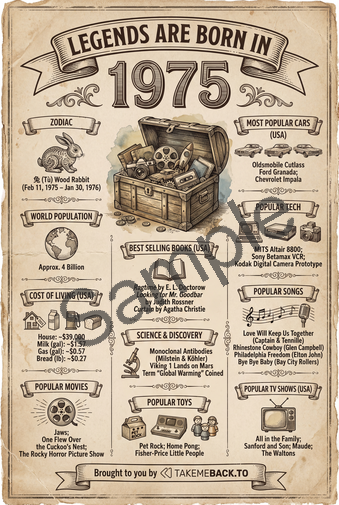

Major Events of 1975 - Historical Moments That Defined the Year | TakeMeBack.to
- 01 Jan Gold ownership legalized in the USA: In 1975, the United States government lifted restrictions on private ownership of gold, allowing citizens to buy, sell, and hold gold bullion. This marked a significant shift in U.S. monetary policy, as gold had been restricted since the Great Depression. The change was part of a broader move towards deregulation in the economy. source: federalreserve.gov
- 02 Jan US Federal Rules of Evidence approved: On January 2, 1975, the U.S. Congress approved the Federal Rules of Evidence, which established a comprehensive set of rules governing the admissibility of evidence in federal courts. This was a significant reform aimed at standardizing legal procedures and ensuring fair trials. The rules have since been adopted by many state courts as well. source: uscourts.gov
- 03 Jan Presidential strategy meeting held on January 3, 1975: On January 3, 1975, President Gerald Ford held a strategy meeting to discuss key issues facing his administration. This meeting was part of Ford's efforts to address economic challenges and political dynamics in the post-Watergate era. source: presidency.ucsb.edu
- 04 Jan Ford issues executive order on CIA activities: On January 4, 1975, President Gerald Ford issued an executive order aimed at regulating CIA activities, reflecting growing concerns about intelligence operations and oversight. This order was part of a broader effort to reform intelligence practices post-Watergate. source: archives.gov
- 05 Jan Salyut 4 space mission: The Salyut 4 space station was launched by the Soviet Union on January 5, 1975. It was the fourth in the Salyut series and was designed for military reconnaissance and scientific research. The mission lasted for 63 days, with two crews visiting the station during its operational period. source: nasa.gov
- 06 Jan North Vietnamese capture Phuoc Long Province: On January 6, 1975, North Vietnamese forces captured Phuoc Long Province in South Vietnam, marking a significant victory in the Vietnam War. This event was part of a larger offensive that ultimately led to the fall of Saigon later that year. The capture demonstrated the weakening position of South Vietnamese forces. source: britannica.com
- 07 Jan OPEC raises crude oil prices: On January 7, 1975, the Organization of the Petroleum Exporting Countries (OPEC) announced a significant increase in crude oil prices. This decision was part of OPEC's strategy to respond to global economic conditions and maintain its influence in the oil market. source: reuters.com
- 08 Jan Watergate figures released from prison: On January 8, 1975, several key figures involved in the Watergate scandal were released from prison after serving their sentences. This event marked a significant moment in the aftermath of the political scandal that shook the Nixon administration. source: nytimes.com
- 09 Jan 600 employees of Royal Canadian Mint go on strike: On January 9, 1975, approximately 600 employees of the Royal Canadian Mint initiated a strike, demanding higher wages and improved working conditions. This labor action highlighted the growing labor unrest in Canada during the mid-1970s. source: islandnet.com
- 11 Jan Soyuz 17 mission to Salyut 4: On January 11, 1975, the Soviet Union launched Soyuz 17, carrying cosmonauts to the Salyut 4 space station. This mission was part of the Soviet Union's efforts to establish a long-term human presence in space during the 1970s. source: islandnet.com
- 12 Jan Caryn Campbell disappearance: Caryn Campbell, a 23-year-old nurse, disappeared on January 12, 1975, while on vacation in Colorado. Her case garnered significant media attention and remains unsolved, highlighting issues of safety and crime in tourist areas. source: denverpost.com
- 14 Jan Portugal to grant Angola independence: On January 14, 1975, Portugal officially announced its intention to grant independence to Angola, ending a long colonial rule. This decision was part of a broader decolonization movement in Africa during the mid-20th century. source: britannica.com
- 15 Jan Alvor Agreement signed: The Alvor Agreement was signed on January 15, 1975, marking a significant step towards Angola's independence from Portugal. This agreement established a framework for the transition to self-governance and the end of colonial rule. source: britannica.com
- 17 Jan Deng Xiaoping's political comeback in China: On January 17, 1975, Deng Xiaoping, a prominent Chinese Communist Party leader, was reinstated to significant positions of power in the People's Republic of China. This marked his return to high office after being purged during the Cultural Revolution in 1966. source: wsws.org
- 18 Jan North Vietnam plans final offensive: In early 1975, North Vietnam planned a final offensive to reunify the country under communist rule. This offensive culminated in the Fall of Saigon on April 30, 1975, leading to the end of the Vietnam War. source: en.wikipedia.org
- 19 Jan Energy Reorganization Act signed in the U.S.: On January 19, 1975, the Energy Reorganization Act was signed into law, leading to the restructuring of the U.S. Atomic Energy Commission into the Nuclear Regulatory Commission (NRC) and the Energy Research and Development Administration (ERDA). source: nrc.gov
- 20 Jan R&B Number 1: 'Fire' by Ohio Players: On January 20, 1975, the song 'Fire' by the Ohio Players reached number one on the R&B charts. This track became one of the band's signature hits, showcasing their unique blend of funk and soul music. source: billboard.com
- 21 Jan 28th NHL All-Star Game: Wales beat Campbell 7-1 at Montreal: On January 21, 1975, the 28th NHL All-Star Game was held in Montreal, where the Wales Conference defeated the Campbell Conference 7-1. This game featured some of the best players in the league and was a showcase of talent and skill. source: hockey-reference.com
- 22 Jan Landsat 2 Earth observation satellite launch: On January 22, 1975, the Landsat 2 satellite was launched, continuing the series of Earth observation satellites. This satellite provided valuable data for land use and environmental monitoring, contributing significantly to remote sensing technology. source: landsat.gsfc.nasa.gov
- 23 Jan Barney Miller TV show premieres: The American sitcom 'Barney Miller' premiered on ABC on January 23, 1975. The series, set in a New York City police station, ran for eight seasons until 1982. source: en.wikipedia.org
- 25 Jan Bangladesh political leadership change: On January 25, 1975, Sheikh Mujibur Rahman declared a state of emergency, abolished the parliamentary system, and assumed the presidency, effectively establishing a one-party state. source: www14.wsws.org
- 28 Jan Death of Antonín Novotný: Antonín Novotný, former President of Czechoslovakia (1957–1968) and First Secretary of the Communist Party (1953–1968), died on January 28, 1975, in Prague. source: en.wikipedia.org
- 30 Jan First Faroese Postage Stamp Issued: On January 30, 1975, the Faroe Islands issued their first postage stamps, featuring maps and landscapes, marking the beginning of their independent postal service. source: en.stamps.fo
- 01 Feb US President Ford announces $52 billion fiscal deficit for 1976: On February 1, 1975, President Gerald Ford announced that the 1976 fiscal year budget would reflect a deficit of $52 billion, marking the largest peacetime deficit in U.S. history at that time. source: presidency.ucsb.edu
- 02 Feb Idi Amin declares himself President of Uganda: On February 2, 1975, Ugandan military leader Idi Amin declared himself President of Uganda, consolidating his power after a series of political maneuvers. source: en.wikipedia.org
- 03 Feb Baseball Hall of Fame Inductees: On February 3, 1975, former second baseman Billy Herman, outfielder Earl Averill, and manager Bucky Harris were selected for induction into the Baseball Hall of Fame by the Special Veterans Committee. source: en.wikipedia.org
- 04 Feb Haicheng Earthquake Prediction Success: The Haicheng earthquake of 1975 was notable for being the first major earthquake successfully predicted, leading to the evacuation of residents prior to the disaster. source: en.wikipedia.org
- 05 Feb Lima Riots (Limazo): On February 5, 1975, a police strike in Lima, Peru, known as the Limazo, led to widespread unrest and violent suppression by the military. source: en.wikipedia.org
- 07 Feb New Orleans Jazz Break Road Losing Streak: On February 7, 1975, the New Orleans Jazz ended a lengthy losing streak in the NBA. This victory marked a significant moment for the team, which had struggled in the league since its inception. source: nba.com
- 08 Feb Mass Wedding by Unification Church: On February 8, 1975, the Unification Church conducted a mass wedding ceremony in New York City, officiated by its founder, Sun Myung Moon. This event was part of the church's efforts to promote its teachings on family and marriage. source: washingtonpost.com
- 09 Feb Margaret Thatcher Becomes Conservative Party Leader: On February 9, 1975, Margaret Thatcher was elected leader of the Conservative Party in the UK, becoming the first woman to lead a major political party in Britain. Her leadership would significantly shape British politics in the following decades. source: bbc.com
- 10 Feb Isabel Perón authorizes military action in Tucumán, Argentina: On February 10, 1975, Argentine President Isabel Perón authorized the military to launch 'Operativo Independencia' in the province of Tucumán, aiming to neutralize or annihilate subversive elements operating there. source: en.wikipedia.org
- 11 Feb Margaret Thatcher wins Conservative Party leadership: On February 11, 1975, Margaret Thatcher was elected as the new leader of the United Kingdom's Conservative Party, becoming the first woman to lead a major British political party. source: en.wikipedia.org
- 12 Feb Led Zeppelin's legendary Madison Square Garden concert: On February 12, 1975, Led Zeppelin performed a legendary concert at Madison Square Garden in New York City, which is often cited as one of their most iconic performances. source: en.wikipedia.org
- 13 Feb Cyprus Political Development: On February 13, 1975, significant political developments occurred in Cyprus, particularly regarding the ongoing tensions between Greek and Turkish Cypriots. This period was marked by efforts to address the political division on the island, which had been exacerbated by previous conflicts. source: bbc.com
- 14 Feb Death of P.G. Wodehouse: P.G. Wodehouse, the beloved English author known for his humorous novels and characters like Jeeves and Wooster, died on February 14, 1975. His works have remained popular and influential in English literature, celebrated for their wit and charm. source: bbc.com
- 16 Feb Day of the Shining Star celebrated in North Korea: February 16, 1975, marked the Day of the Shining Star in North Korea, celebrating the birthday of Kim Jong Il. This day is a significant national holiday in North Korea, honoring the late leader. source: bbc.com
- 17 Feb John Lennon releases 'Rock 'n' Roll' album: On February 17, 1975, John Lennon released his album 'Rock 'n' Roll'. This album features covers of classic rock and roll songs and was well-received by fans and critics alike. source: rollingstone.com
- 18 Feb Italy abortion law reform enacted: On February 18, 1975, Italy enacted a significant reform of its abortion laws, allowing for legal abortions under certain conditions. This reform marked a pivotal moment in Italian social policy. source: loc.gov
- 19 Feb Death of Luigi Dallapiccola: Luigi Dallapiccola, an influential Italian composer known for his contributions to 20th-century music, passed away on February 19, 1975. His works often reflected his political beliefs and personal experiences, making him a significant figure in contemporary classical music. source: britannica.com
- 20 Feb Margaret Thatcher becomes Conservative Party leader: On February 20, 1975, Margaret Thatcher was elected as the leader of the Conservative Party in the United Kingdom. This event marked a turning point in British politics, as she would later become the first female Prime Minister. Her leadership style and policies significantly influenced the Conservative Party and the country. source: bbc.com
- 21 Feb Watergate scandal: Key Nixon aides sentenced: On February 21, 1975, several key aides of former President Richard Nixon were sentenced for their roles in the Watergate scandal. This event marked a significant moment in American political history, highlighting issues of corruption and accountability. source: archives.gov
- 22 Feb Drew Barrymore born: Drew Barrymore, an American actress, producer, and director, was born on February 22, 1975. She comes from a famous acting family and has had a successful career in film and television since childhood. source: britannica.com
- 23 Feb Early Daylight Saving Time Implementation: In response to the 1973 oil crisis, the United States implemented an earlier start to Daylight Saving Time (DST) on February 23, 1975, moving clocks forward by one hour. This change aimed to conserve energy by extending evening daylight hours. However, the extended DST period faced public opposition, particularly from those concerned about children walking to school in the dark winter mornings. As a result, the trial period was not continued, and the start date reverted to the last Sunday in April in 1976. source: scientificamerican.com
- 24 Feb Coronation of King Birendra of Nepal: King Birendra Bir Bikram Shah Dev was crowned as the tenth King of Nepal on February 24, 1975, at the age of 29. The ceremony took place at Hanuman Dhoka in Kathmandu, following traditional Hindu rituals. Representatives from 60 nations attended the event, marking a significant moment in Nepal's history.
- 25 Feb Death of Elijah Muhammad: Elijah Muhammad, leader of the Nation of Islam, died of congestive heart failure on February 25, 1975, in Chicago, Illinois, at the age of 77. source: archives.gov
- 26 Feb IRA member kills London police officer: On February 26, 1975, Liam Quinn, an American member of the Provisional Irish Republican Army, fatally shot Police Constable Stephen Tibble in London during a chase. source: en.wikipedia.org
- 27 Feb Lomé Convention negotiations commence in Togo: On February 27, 1975, negotiations began in Lomé, Togo, for the establishment of a cooperation agreement between the European Economic Community (EEC) and 46 African, Caribbean, and Pacific (ACP) countries. This agreement aimed to provide a system of cooperation combining development aid, industrial and technical trade cooperation, and financial assistance, ensuring stable export revenues for ACP countries despite potential challenges like poor harvests or falling prices. source: cvce.eu
- 01 Mar Algiers Accord signed for Iran-Iraq border settlement: The Algiers Accord was signed on March 1, 1975, between Iran and Iraq, aiming to settle border disputes and improve bilateral relations. source: en.wikipedia.org
- 03 Mar Iran-US trade agreement signed: On March 3, 1975, Iran and the United States signed a trade agreement aimed at enhancing economic cooperation between the two nations. This agreement was part of a broader strategy to strengthen ties during a period of significant geopolitical change. source: reuters.com
- 04 Mar Charlie Chaplin knighted by Queen Elizabeth II: On March 4, 1975, at the age of 85, Charlie Chaplin was knighted by Queen Elizabeth II at Buckingham Palace. The ceremony was attended by his wife, Oona, and their two youngest children. Chaplin, who had been living in Switzerland, received the honor in a wheelchair due to his health. He expressed being 'dumbfounded' by the occasion and mentioned that the Queen thanked him for his contributions to cinema. source: news.bbc.co.uk
- 05 Mar First meeting of the Homebrew Computer Club: The Homebrew Computer Club held its inaugural meeting in Menlo Park, California, bringing together early computer enthusiasts. This gathering is often credited with influencing the personal computer revolution, as members shared ideas and projects that would lead to the development of various computing technologies. source: computerhistory.org
- 06 Mar Zapruder film publicly screened: The Zapruder film, which captured the assassination of President John F. Kennedy, was publicly screened for the first time on March 6, 1975. This event sparked significant public interest and debate regarding the circumstances of the assassination. source: nytimes.com
- 07 Mar Lesley Whittle murder case discovery: On March 7, 1975, the body of Lesley Whittle was discovered in a remote area of England, leading to a high-profile murder investigation. The case garnered significant media attention and highlighted issues related to crime and safety in the region. source: bbc.com
- 08 Mar End of 'Whip Inflation Now' program: The 'Whip Inflation Now' (WIN) program, initiated by President Gerald Ford in 1974 to combat inflation, effectively ended on March 8, 1975. The program faced criticism for its lack of substantial impact on inflation rates. source: nytimes.com
- 09 Mar Ethiopian army massacre in Agordat: On March 9, 1975, a massacre occurred in Agordat, Eritrea, involving the Ethiopian army. This event was part of the broader conflict in the region during the Ethiopian Civil War. source: bbc.com
- 10 Mar The Rocky Horror Show opens in New York City: The musical 'The Rocky Horror Show' premiered on Broadway at the Belasco Theatre in New York City on March 10, 1975. The production ran for 45 performances, closing on April 5, 1975. source: broadwayworld.com
- 12 Mar Vietcong capture Ban Me Thuot, South Vietnam: On March 12, 1975, the People's Army of Vietnam (PAVN) captured Ban Me Thuot, a strategic city in South Vietnam's Central Highlands, marking a significant victory in the Vietnam War. source: en.wikipedia.org
- 13 Mar Vietnam War: Central Highlands Evacuation: Following the fall of Ban Me Thuot on March 12, 1975, South Vietnamese forces began evacuating the Central Highlands region to the coast, facing significant challenges. source: en.wikipedia.org
- 14 Mar Death of Susan Hayward: Susan Hayward, the American actress known for her roles in films such as "I Want to Live!" and "With a Song in My Heart," died on March 14, 1975. source: imdb.com
- 15 Mar Merger of Guanabara and Rio de Janeiro states: On March 15, 1975, the states of Guanabara and Rio de Janeiro were merged into a single state, both administratively and politically, forming the current State of Rio de Janeiro. source: en.wikipedia.org
- 16 Mar Mariner 10 completes final Mercury flyby: On March 16, 1975, NASA's Mariner 10 spacecraft completed its third and final flyby of Mercury, providing detailed images and data about the planet's surface and magnetic field. source: en.wikipedia.org
- 17 Mar South Vietnamese forces retreat in Vietnam War: On March 17, 1975, South Vietnamese forces began a significant retreat in the face of advancing North Vietnamese troops, marking a critical point in the Vietnam War. This retreat was part of a larger collapse of South Vietnamese defenses leading to the fall of Saigon later that year. source: britannica.com
- 18 Mar Assassination of Herbert Chitepo: Herbert Chitepo, a prominent Zimbabwean nationalist leader, was assassinated on March 18, 1975. His death marked a significant moment in the struggle for Zimbabwe's independence from colonial rule. source: britannica.com
- 19 Mar Pennsylvania breaks gender barrier in high school sports: On March 19, 1975, Pennsylvania made headlines by breaking gender barriers in high school sports, allowing girls to compete in previously male-dominated sports. This was a significant step towards gender equality in athletics. source: pennlive.com
- 21 Mar Ethiopia abolishes monarchy and establishes a socialist state: On March 21, 1975, Ethiopia officially ended its monarchy, leading to the establishment of a socialist state under the Derg, a military junta. This marked a significant shift in the country's political landscape, resulting in widespread land reforms and nationalization of industries. source: britannica.com
- 22 Mar Browns Ferry Nuclear Power Plant fire incident: On March 22, 1975, a fire broke out at the Browns Ferry Nuclear Power Plant in Alabama, leading to significant safety concerns and regulatory changes in the nuclear industry. The incident was caused by a candle igniting a plastic insulation material, which raised alarms about fire safety protocols in nuclear facilities. source: nrc.gov
- 26 Mar Biological Weapons Convention enters into force: The Biological Weapons Convention (BWC), formally known as the Convention on the Prohibition of the Development, Production and Stockpiling of Bacteriological (Biological) and Toxin Weapons and on their Destruction, entered into force on March 26, 1975. The BWC is a disarmament treaty that bans the development, production, and stockpiling of biological and toxin weapons. source: britannica.com
- 28 Mar March 1975 tornado outbreak in the United States: The March 1975 tornado outbreak occurred from March 28 to March 29, resulting in several tornadoes across the central United States. This outbreak caused significant damage and loss of life, prompting discussions on tornado preparedness and response. source: weather.gov
- 30 Mar Ruppert family mass murder: On March 30, 1975, James U. Ruppert killed 11 members of his family in Hamilton, Ohio, in what became known as the Easter Sunday Massacre. source: en.wikipedia.org
- 31 Mar UCLA's historic NCAA basketball championship: On March 31, 1975, UCLA won its 10th NCAA basketball championship under coach John Wooden, defeating the University of Kentucky. This victory solidified UCLA's dominance in college basketball during the 1970s. source: ncaa.com
- 01 Apr Fall of Lon Nol's regime in Cambodia: On April 1, 1975, Lon Nol's regime in Cambodia faced significant challenges, leading to its eventual collapse. The Khmer Rouge, led by Pol Pot, would take control shortly thereafter, marking a significant shift in Cambodian history. source: britannica.com
- 02 Apr Vietnam War refugee crisis in Quang Ngai: On April 2, 1975, the Vietnam War refugee crisis intensified in Quang Ngai as thousands fled the advancing North Vietnamese forces. This marked a critical moment in the humanitarian crisis resulting from the war. source: bbc.com
- 03 Apr Vietnam War: Operation Babylift: Operation Babylift was a humanitarian mission during the Vietnam War that aimed to evacuate orphaned children from South Vietnam to the United States. The operation began on April 3, 1975, and was marked by a tragic plane crash shortly after takeoff, resulting in numerous casualties. source: archives.gov
- 04 Apr Vietnam War: Operation Baby Lift Tragedy: On April 4, 1975, a tragic incident occurred during Operation Babylift when a plane carrying orphans crashed shortly after takeoff, resulting in the deaths of many children and crew members. This event highlighted the risks involved in the evacuation efforts during the Vietnam War. source: archives.gov
- 05 Apr Chiang Kai-shek dies: Chiang Kai-shek, the former leader of the Republic of China, passed away on April 5, 1975. His death marked the end of an era in Taiwanese politics and history. source: britannica.com
- 06 Apr Yen Chia-kan sworn in as President of Nationalist China: Yen Chia-kan was sworn in as the President of the Republic of China on April 6, 1975. His presidency followed the death of Chiang Kai-shek and was marked by significant political challenges. source: britannica.com
- 07 Apr Beverly Sills makes Metropolitan Opera debut in 'The Siege of Corinth': On April 7, 1975, American opera singer Beverly Sills made her long-awaited debut at the Metropolitan Opera House in New York City, performing the role of Pamira in Rossini's 'The Siege of Corinth'. This performance marked a significant milestone in her career, as she had previously been excluded from the Met by its former general manager, Rudolf Bing. Sills received an 18-minute ovation for her performance. source: jwa.org
- 08 Apr Frank Robinson becomes first African American MLB manager: On April 8, 1975, Frank Robinson was appointed as the player-manager of the Cleveland Indians, becoming the first African American to manage a Major League Baseball team. This historic appointment marked a significant milestone in the integration of baseball.
- 09 Apr People's Revolutionary Party execution in South Korea: On April 9, 1975, the South Korean government executed eight individuals associated with the People's Revolutionary Party, a group accused of attempting to overthrow the government. The executions were carried out 18 hours after the Supreme Court's death penalty announcement. source: en.wikipedia.org
- 10 Apr Lee Elder breaks racial barrier at Masters Tournament: On April 10, 1975, Lee Elder became the first African American golfer to compete in the Masters Tournament at Augusta National Golf Club. source: en.wikipedia.org
- 11 Apr Hank Aaron returns to Milwaukee: On April 11, 1975, baseball legend Hank Aaron returned to Milwaukee to play for the Milwaukee Brewers, marking his return to the city where he began his major league career. source: en.wikipedia.org
- 12 Apr Linda Ronstadt releases hit single: On April 12, 1975, Linda Ronstadt released her single 'You're No Good,' which became a major hit and solidified her status as a leading artist in the music industry. The song topped the Billboard Hot 100 chart, showcasing her vocal talent and appeal. source: britannica.com
- 13 Apr Start of Lebanese Civil War: The Lebanese Civil War began on April 13, 1975, marking the start of a devastating conflict that lasted until 1990. The war was characterized by sectarian violence and foreign interventions, leading to significant loss of life and displacement. source: britannica.com
- 14 Apr Federal Election Commission begins operations: The Federal Election Commission (FEC) officially began its operations on April 14, 1975. The FEC was established to regulate campaign finance and ensure transparency in federal elections in the United States. source: fec.gov
- 15 Apr Gabon constitutional amendment: On April 15, 1975, Gabon enacted a constitutional amendment that allowed for the extension of presidential terms. This amendment was part of a broader effort to consolidate power within the government. source: britannica.com
- 17 Apr Death of Sarvepalli Radhakrishnan: Sarvepalli Radhakrishnan, the second President of India and a prominent philosopher, passed away on April 17, 1975. He was known for his contributions to education and his role in promoting Indian philosophy globally. source: britannica.com
- 18 Apr John Lennon's final public performance: On April 18, 1975, John Lennon made his last public performance at a benefit concert for the One to One Foundation. This event marked a significant moment in music history as it was his final appearance before a live audience. source: rollingstone.com
- 19 Apr Final battle of Vietnam War: The final battle of the Vietnam War occurred on April 19, 1975, as North Vietnamese forces captured the city of Saigon. This event marked the end of the war and led to the reunification of Vietnam under communist control. source: britannica.com
- 20 Apr 29th Tony Awards honors Broadway excellence: The 29th Annual Tony Awards ceremony was held on April 20, 1975, at the Winter Garden Theatre in New York City. The event was broadcast by ABC television and featured hosts such as Larry Blyden, George S. Irving, Larry Kert, Carol Lawrence, Michele Lee, Bernadette Peters, and Bobby Van. The ceremony celebrated the best in Broadway theater for the 1974–1975 season. source: en.wikipedia.org
- 21 Apr 79th Boston Marathon won by Bill Rodgers: On April 21, 1975, Bill Rodgers won the 79th Boston Marathon, marking his second consecutive victory at this prestigious event. His performance was celebrated and contributed to his legacy as one of the greatest marathon runners. source: britannica.com
- 24 Apr Baader-Meinhof Gang Embassy Attack in Stockholm: On April 24, 1975, six members of the Red Army Faction (RAF), also known as the Baader-Meinhof Gang, seized the West German Embassy in Stockholm, taking 11 hostages. They demanded the release of 26 imprisoned RAF members. During the 12-hour siege, two hostages were killed, and the building was destroyed by a premature explosion of TNT placed by the terrorists. The surviving terrorists were captured and later extradited to West Germany. source: news.bbc.co.uk
- 25 Apr Australian Embassy Evacuation from Saigon: On April 25, 1975, as North Vietnamese forces advanced on Saigon, the Australian government initiated the evacuation of its embassy personnel and citizens. This operation was part of a broader effort to evacuate foreign nationals and at-risk individuals before the fall of Saigon. source: awm.gov.au
- 26 Apr Birth of Joey Jordison: Joey Jordison, the original drummer of the heavy metal band Slipknot, was born on April 26, 1975, in Des Moines, Iowa. source: en.wikipedia.org
- 27 Apr USSR nuclear test in Kazakhstan: On April 27, 1975, the Soviet Union conducted a nuclear test in Kazakhstan, marking one of the numerous tests carried out during that period. source: ctbto.org
- 28 Apr South Vietnamese military chief flees amid chaos: On April 28, 1975, General Nguyễn Văn Thiệu, the South Vietnamese military chief, fled the country as the fall of Saigon loomed. His departure marked a significant moment in the Vietnam War, signaling the collapse of the South Vietnamese government. source: britannica.com
- 29 Apr Final U.S. evacuation from Saigon: On April 29, 1975, the United States conducted its final evacuation from Saigon as North Vietnamese forces closed in. This marked the end of U.S. involvement in the Vietnam War and the beginning of the city's fall. source: britannica.com
- 30 Apr Fall of Saigon marks end of Vietnam War: On April 30, 1975, Saigon fell to North Vietnamese forces, marking the official end of the Vietnam War. This event led to the reunification of Vietnam under communist control. source: britannica.com
- 01 May NHL Playoffs: Islanders vs Flyers Game 2: On May 1, 1975, the New York Islanders faced the Philadelphia Flyers in Game 2 of the Stanley Cup Semifinals. The Flyers won 5-4 in overtime, taking a 2-0 series lead. The game was held at the Spectrum in Philadelphia. source: hockey-reference.com
- 04 May Baseball's one-millionth run milestone: On May 4, 1975, baseball celebrated its one-millionth run scored in Major League Baseball history. This milestone highlighted the sport's rich history and the evolution of its statistics over the years. source: nytimes.com
- 05 May Pulitzer Prize awarded to Michael Shaara for 'The Killer Angels': Michael Shaara was awarded the Pulitzer Prize for Fiction on May 5, 1975, for his novel 'The Killer Angels.' The book, which depicts the Battle of Gettysburg, is celebrated for its historical accuracy and narrative style. source: nytimes.com
- 06 May China establishes diplomatic relations with European Community: On May 6, 1975, China and the European Economic Community (EEC) agreed to establish diplomatic relations, marking a significant development in international relations at the time. source: fmprc.gov.cn
- 07 May End of the Vietnam Era: The Vietnam War concluded on April 30, 1975, with the fall of Saigon, marking the end of the Vietnam era. source: en.wikipedia.org
- 08 May Final foreign evacuees flee Cambodia after communist takeover: On May 8, 1975, the last known foreigners, about 550 occupants of the French Embassy in Phnom Penh, crossed the border into Thailand, three weeks after Cambodia's fall to Communist guerillas. source: en.wikipedia.org
- 10 May Sony introduces Betamax videocassette recorder: On May 10, 1975, Sony introduced the Betamax videocassette recorder, which became a significant development in home video technology. Despite its initial popularity, Betamax eventually lost the format war to VHS, but it set the stage for future advancements in video recording. source: britannica.com
- 11 May Khmer Rouge seizes US merchant ship Mayaguez: On May 11, 1975, the Khmer Rouge seized the US merchant ship SS Mayaguez in Cambodian waters. This incident led to a military confrontation between the United States and Cambodia, highlighting the tensions in the region following the Vietnam War. source: britannica.com
- 12 May Indochina Wars: Democratic Kampuchea naval forces capture the SS Mayaguez: On May 12, 1975, the Democratic Kampuchea naval forces captured the SS Mayaguez, a US merchant ship, leading to a significant military response from the United States. This event was part of the broader context of the Indochina Wars and heightened tensions in Southeast Asia. source: britannica.com
- 13 May US Merchant Ship Mayaguez Seized by Cambodian Forces: On May 13, 1975, the U.S. merchant ship SS Mayaguez was seized by Cambodian gunboats in international waters. The Khmer Rouge, which had recently taken control of Cambodia, captured the ship and its 39-man crew, leading to a significant international incident. President Gerald Ford condemned the act as piracy and ordered military action to secure the release of the crew and the vessel. source: defense.gov
- 14 May Cambodian deportation reports: In May 1975, reports emerged regarding the forced deportation of Cambodians by the Khmer Rouge regime. This marked a significant human rights violation during the Cambodian genocide, leading to widespread suffering and displacement. source: bbc.com
- 15 May Mayaguez incident: US military rescue operation: On May 15, 1975, the US launched a military operation to rescue the crew of the SS Mayaguez, which had been seized by the Khmer Rouge. This incident marked a significant moment in US foreign policy and military engagement in Southeast Asia. source: archives.gov
- 16 May First woman summits Mount Everest: On May 16, 1975, Junko Tabei from Japan became the first woman to reach the summit of Mount Everest. Her achievement was a significant milestone in mountaineering history and inspired many women in sports and adventure. source: bbc.com
- 17 May 101st Preakness Stakes: Darrel McHargue rode Master Derby to victory in the 101st Preakness Stakes, completing the race in an impressive time of 1:56.4.
- 21 May Baader-Meinhof Group Trial Begins: On May 21, 1975, the trial of the Baader-Meinhof group, also known as the Red Army Faction (RAF), commenced in Stuttgart, Germany. The defendants—Andreas Baader, Gudrun Ensslin, Ulrike Meinhof, and Jan-Carl Raspe—faced charges including murder, bombings, and bank robberies. The trial was held in a specially constructed courtroom within the Stammheim Prison, designed to ensure maximum security. The proceedings were marked by strict security measures and were closely monitored by the public and media. source: thelocal.de
- 22 May First Legal Numbers Game in New Jersey: On May 22, 1975, New Jersey introduced its first legal numbers game, known as Pick-3. This daily draw game allowed players to select their own three-digit numbers, marking a significant shift in the state's gambling regulations. The game offered various ways to win, including matching all three digits in exact order (Straight), any order (Box), or a combination of both (Straight/Box). source: en.wikipedia.org
- 23 May Death of Jackie "Moms" Mabley: Jackie "Moms" Mabley, a pioneering African American comedian known for her stand-up routines and performances, passed away on May 23, 1975. She was a significant figure in comedy, breaking racial barriers and influencing future generations of comedians. source: biography.com
- 24 May Last known naturally occurring smallpox case: The last known naturally occurring case of smallpox was reported on May 24, 1975, in Somalia. This marked a significant milestone in public health, leading to the eventual eradication of the disease through global vaccination efforts. source: who.int
- 25 May Total lunar eclipse of 1975: A total lunar eclipse occurred on May 25, 1975, visible in various parts of the world. This astronomical event captivated skywatchers and was part of a series of lunar eclipses that occurred during the decade. source: eclipse.gsfc.nasa.gov
- 26 May Lauryn Hill's birth: Lauryn Hill, the acclaimed singer, songwriter, and actress, was born on May 26, 1975, in East Orange, New Jersey. She gained fame as a member of the Fugees and for her solo album 'The Miseducation of Lauryn Hill.' source: biography.com
- 27 May Philadelphia Flyers win Stanley Cup: On May 27, 1975, the Philadelphia Flyers won the Stanley Cup, marking a significant achievement in the franchise's history. This victory solidified their status in the NHL and was celebrated by fans. source: nhl.com
- 28 May Economic Community of West African States (ECOWAS) established: ECOWAS was established on May 28, 1975, by the Treaty of Lagos, aiming to promote economic integration and cooperation among West African countries. The founding members were Benin, Burkina Faso, Cape Verde, Côte d'Ivoire, The Gambia, Ghana, Guinea, Guinea-Bissau, Liberia, Mali, Niger, Nigeria, Sierra Leone, Senegal, and Togo. source: britannica.com
- 30 May European Space Agency Established: The European Space Agency (ESA) was established on May 30, 1975, following the signing of the ESA Convention by 10 European countries. The agency began operations on May 31, 1975, after the Convention entered into force on October 30, 1980. source: esa.int
- 31 May The Isley Brothers Release 'Fight the Power': The Isley Brothers released their single 'Fight the Power (Part 1 & 2)' on May 31, 1975. The song became one of their most popular recordings, reaching number 1 on the R&B singles chart and number 4 on the Billboard Hot 100. source: en.wikipedia.org
- 01 Jun Founding of the Patriotic Union of Kurdistan: The Patriotic Union of Kurdistan (PUK) was established on June 1, 1975, in Berlin, Germany. The founding members included Adel Murad, Jalal Talabani, Nawshirwan Mustafa, Fuad Masum, Ali Askari, and Abdul Razaq Feyli. The PUK aimed to unify various Kurdish political factions and promote self-determination, human rights, democracy, and peace for the Kurdish people in Iraq. source: en.wikipedia.org
- 02 Jun First Black Roman Catholic Bishop Consecrated: On June 2, 1975, the first Black Roman Catholic bishop was consecrated, marking a significant milestone in the church's history. source: rsssf.org
- 03 Jun Idi Amin nationalizes all land in Uganda: On June 3, 1975, Ugandan President Idi Amin issued a decree nationalizing all land in the country, effectively making it publicly owned. This move aimed to eliminate the existing mailo land tenure system, which had been established by the 1900 Buganda Agreement and granted private land ownership to the Buganda Kingdom's aristocracy. The nationalization was part of Amin's broader land reform efforts during his regime. source: britannica.com
- 04 Jun Angelina Jolie Born: Angelina Jolie, the American actress and humanitarian, was born on June 4, 1975. source: rsssf.org
- 05 Jun Suez Canal reopens after eight-year closure: On June 5, 1975, Egypt reopened the Suez Canal to international shipping, ending an eight-year closure that began after the Six-Day War in 1967. Egyptian President Anwar Sadat led a ceremonial convoy through the canal, marking a significant step towards regional peace and economic recovery. source: wsws.org
- 06 Jun UK European Economic Community referendum: On June 6, 1975, the United Kingdom held a referendum on its membership in the European Economic Community (EEC). The majority voted to remain in the EEC, affirming the UK's commitment to European integration. source: en.wikipedia.org
- 07 Jun Sony launches Betamax videocassette recorder: On June 7, 1975, Sony introduced the Betamax videocassette recorder, marking a significant advancement in home video technology. This innovation allowed consumers to record television programs and watch them at their convenience, paving the way for the home entertainment industry. source: britannica.com
- 08 Jun Soviet Venus space exploration mission: On June 8, 1975, the Soviet Union launched the Venera 9 spacecraft, aimed at exploring Venus. This mission was significant for its successful transmission of the first images from the surface of another planet. source: nasa.gov
- 09 Jun First Order of Australia awards: On June 9, 1975, the first Order of Australia awards were presented, recognizing outstanding contributions to the nation. This honor established a new system of awards to acknowledge the achievements of Australians in various fields. source: gg.gov.au
- 10 Jun Rockefeller Commission Reports on CIA Intelligence Oversight: On June 10, 1975, the Rockefeller Commission, officially known as the President's Commission on CIA Activities within the United States, released its report detailing the CIA's domestic activities. The commission investigated allegations of improper CIA operations, including surveillance of domestic dissident groups and mail opening. The report recommended reforms to enhance oversight and prevent future abuses. source: fordlibrarymuseum.gov
- 11 Jun First North Sea oil production: On June 11, 1975, the United Kingdom began its first oil production from the North Sea, marking a significant milestone in the country's energy sector. The initial production came from the Argyll oil field, with the first oil pumped into the tanker Theogennitor. source: osti.gov
- 14 Jun Soviet Venus Space Mission: The Soviet Union launched the Venera 10 spacecraft on June 14, 1975, as part of its Venus exploration program. The mission included an orbiter and a lander, with the lander successfully transmitting data from Venus's surface in October 1975. source: en.wikipedia.org
- 16 Jun Great Barrier Reef Marine Park established: The Great Barrier Reef Marine Park was officially established on June 16, 1975, to protect the unique marine environment of the Great Barrier Reef in Australia. This landmark legislation aimed to conserve the biodiversity and ecological integrity of the reef, which is the largest coral reef system in the world. source: environment.gov.au
- 17 Jun Northern Mariana Islands approve commonwealth status: On June 17, 1975, the Northern Mariana Islands voted to approve a commonwealth status in political union with the United States. This decision marked a significant step in the islands' political development and relationship with the U.S., providing them with greater autonomy and self-governance. source: loc.gov
- 18 Jun Assassin of King Faisal executed in Saudi Arabia: Faisal bin Musaid, nephew of King Faisal, was executed by beheading in Riyadh for assassinating his uncle on March 25, 1975. The execution took place in front of the Al Hokm palace, following a trial that found him guilty of regicide. source: upi.com
- 20 Jun Jaws theatrical release: Steven Spielberg's thriller 'Jaws' premiered in theaters on June 20, 1975, becoming a landmark in cinema history and the first summer blockbuster. source: history.com
- 23 Jun Lou Graham wins US Open Golf Championship: Lou Graham won the US Open Golf Championship on June 23, 1975, at the Medinah Country Club in Illinois. This victory marked a significant achievement in his golfing career, showcasing his skills against a competitive field. source: usga.org
- 24 Jun Indira Gandhi electoral campaign legal controversy: On June 24, 1975, a legal controversy arose regarding Indira Gandhi's electoral campaign, leading to significant political implications. This controversy was part of the larger context of the Emergency declared in India. source: bbc.com
- 25 Jun Mozambique Independence Day: Mozambique gained independence from Portugal on June 25, 1975, after a protracted liberation struggle led by the Mozambique Liberation Front (FRELIMO). This day is celebrated annually as a national holiday in Mozambique, marking the end of colonial rule and the beginning of self-governance. source: britannica.com
- 26 Jun Pine Ridge Reservation shootout: On June 26, 1975, a shootout occurred at the Pine Ridge Indian Reservation in South Dakota, involving members of the American Indian Movement (AIM) and federal agents. This incident was part of a larger conflict over Native American rights and sovereignty during the 1970s. source: nps.gov
- 27 Jun Egypt and Israel sign second disengagement agreement: On June 27, 1975, Egypt and Israel signed a second disengagement agreement, aimed at reducing tensions following the Yom Kippur War. This agreement was part of ongoing peace negotiations between the two nations. source: britannica.com
- 28 Jun David Bowie releases 'Fame' single: On June 28, 1975, David Bowie released 'Fame,' co-written with John Lennon and Carlos Alomar. The song became Bowie's first U.S. number one single, topping the Billboard Hot 100 chart. source: hotpress.com
- 29 Jun Death of Richard Loving: Richard Loving, one of the plaintiffs in the landmark Supreme Court case Loving v. Virginia, passed away in a car accident. His case was pivotal in the fight against laws prohibiting interracial marriage in the United States. source: history.com
- 30 Jun Distant galaxy discovery: In 1975, astronomers announced the discovery of a distant galaxy, contributing to the understanding of the universe's structure. This finding was significant in the field of astronomy and helped shape future research. source: nasa.gov
- 01 Jul Muhammad Ali defeats Joe Bugner: Muhammad Ali faced Joe Bugner again on July 1, 1975, in a rematch, solidifying his victory from the previous fight. This match further established Ali's legacy in boxing history. source: bbc.com
- 02 Jul Australian political crisis: Jim Cairns dismissed: On July 2, 1975, Australian Prime Minister Gough Whitlam dismissed his Deputy Prime Minister Jim Cairns amid a political crisis. This event was part of a larger constitutional crisis that ultimately led to the dismissal of Whitlam himself later that year. source: theguardian.com
- 04 Jul American Bicentennial commemorative coins released: On July 4, 1975, the United States Mint released commemorative coins to celebrate the American Bicentennial. These coins were part of a larger celebration of the 200th anniversary of the Declaration of Independence. source: usmint.gov
- 05 Jul Cape Verde gains independence from Portugal: Cape Verde officially gained independence from Portugal on July 5, 1975, after a long struggle for liberation. The country became a sovereign nation, marking a significant milestone in its history. source: britannica.com
- 06 Jul Comoros independence declared from France: On July 6, 1975, the Comoros officially declared independence from France, following a series of political movements. This event marked a significant change in the region's political landscape. source: britannica.com
- 07 Jul US Billboard Number 1 Hit: On July 7, 1975, the US Billboard Hot 100 chart featured a new number one hit, showcasing the popular music trends of the era. This event is significant in the history of American music. source: billboard.com
- 08 Jul African Nations Ceasefire: On July 8, 1975, a ceasefire agreement was reached among several African nations, marking a significant step towards peace in the region. This event was crucial in the context of ongoing conflicts at the time. source: un.org
- 09 Jul Midwest United States earthquake: On July 9, 1975, a significant earthquake struck the Midwest United States, particularly affecting the areas around the New Madrid Seismic Zone. The quake registered a magnitude of 5.2 and was felt across several states, causing minor damage but no fatalities. This event highlighted the seismic risks in the region, which had previously experienced major earthquakes in the early 19th century. source: earthquake.usgs.gov
- 10 Jul Comoros Islands declare independence from France: On July 10, 1975, the Comoros Islands declared independence from France, following a referendum in which the majority of the population voted for independence. This event marked a significant moment in the decolonization of Africa, as the Comoros became one of the first nations to gain independence from French colonial rule. The declaration led to a series of political changes in the islands. source: britannica.com
- 11 Jul Terracotta Army archaeological discovery: On July 11, 1975, archaeologists completed the excavation of the necropolis of Qin Shi Huang, the first emperor of a unified China, uncovering approximately 8,000 life-size terracotta warriors and their horses guarding his tomb. This discovery provided invaluable insights into ancient Chinese art and military history. source: wired.com
- 13 Jul São Tomé and Príncipe gains independence: On July 13, 1975, São Tomé and Príncipe officially gained independence from Portugal after a prolonged struggle for liberation. This marked a significant milestone in the decolonization of Africa. The new nation faced challenges in establishing governance and economic stability. source: britannica.com
- 14 Jul Guinea restores diplomatic ties with France: On July 14, 1975, Guinea announced the restoration of diplomatic relations with France, which had been severed following Guinea's independence in 1958. This move was seen as a step towards improving international relations and economic cooperation. source: reuters.com
- 15 Jul Apollo-Soyuz Test Project: Historic Space Collaboration: On July 15, 1975, the Apollo-Soyuz Test Project commenced with the launch of the Soviet Soyuz 19 spacecraft at 8:20 a.m. EDT from the Baikonur Cosmodrome in Kazakhstan. The American Apollo spacecraft launched later that day at 3:50 p.m. EDT from the Kennedy Space Center in Florida. This mission marked the first international human spaceflight collaboration between the United States and the Soviet Union. source: nasa.gov
- 17 Jul Apollo-Soyuz Test Project: First US-Soviet Space Collaboration: On July 17, 1975, the Apollo-Soyuz Test Project achieved the first international rendezvous and docking of spacecraft from the United States and the Soviet Union. This mission marked a significant milestone in space exploration, demonstrating the feasibility of joint operations between the two nations. The Apollo spacecraft, carrying three U.S. astronauts, docked with the Soviet Soyuz spacecraft, carrying two cosmonauts, in orbit. The crews conducted joint experiments and exchanged gifts, symbolizing a new era of cooperation in space exploration. source: nasa.gov
- 19 Jul Apollo-Soyuz Space Mission: First International Space Docking: On July 19, 1975, the Apollo-Soyuz Test Project concluded its joint operations in space. The Apollo and Soyuz spacecraft, which had been docked since July 17, undocked and continued their respective missions. The crews conducted additional experiments and shared experiences, further solidifying the success of the first international space docking. This mission paved the way for future collaborations between the United States and the Soviet Union in space exploration. source: nasa.gov
- 21 Jul Apollo-Soyuz spacecraft undock: On July 21, 1975, the Apollo-Soyuz Test Project saw the two spacecraft undock after a successful joint mission. This marked a significant moment in U.S.-Soviet space cooperation during the Cold War. source: nasa.gov
- 22 Jul South Africa supports Angolan independence fighters: On July 22, 1975, South Africa announced its support for Angolan independence fighters during the Angolan Civil War. This involvement was part of a broader regional conflict influenced by Cold War dynamics. source: bbc.com
- 23 Jul Dodgers players hit consecutive pinch home runs: On July 23, 1975, Los Angeles Dodgers players Willie Crawford and Lee Lacy hit back-to-back pinch-hit home runs in the ninth inning off Bob Forsch, but the Dodgers lost 5–4 to the St. Louis Cardinals. This marked the second time in franchise history that two Dodgers pinch hitters connected for consecutive home runs. source: baseball-reference.com
- 26 Jul China launches satellite into orbit: On July 26, 1975, China successfully launched its first satellite, Dong Fang Hong 1, into orbit. This marked a significant milestone in China's space program and its technological advancements. source: nasa.gov
- 27 Jul Assassination of Alfred Duraiappah in Jaffna: On July 27, 1975, Alfred Duraiappah, the Mayor of Jaffna and a member of the Sri Lanka Freedom Party, was assassinated by masked gunmen at the Varadaraja Perumal Temple in Ponnalai, Jaffna. source: colombotelegraph.com
- 29 Jul Death of James Blish: James Blish, an influential American science fiction writer, passed away on July 29, 1975. His works contributed significantly to the genre, and he is remembered for his innovative storytelling. source: britannica.com
- 30 Jul Jimmy Hoffa disappearance: Jimmy Hoffa, a prominent labor union leader, disappeared under mysterious circumstances on July 30, 1975. His last known location was a restaurant in Detroit, Michigan, where he was reportedly meeting with two mobsters. Despite extensive investigations, Hoffa's fate remains unknown, and he was declared legally dead in 1982. source: fbi.gov
- 31 Jul The Miami Showband massacre: The Miami Showband massacre occurred on July 31, 1975, when members of the Miami Showband, a popular band in Northern Ireland, were attacked by loyalist paramilitaries. Three band members were killed, and the incident is considered one of the most notorious acts of violence during the Troubles. It highlighted the sectarian tensions and violence prevalent in Northern Ireland at the time. source: bbc.com
- 01 Aug Helsinki Accords signed: The Helsinki Accords were signed on August 1, 1975, during the Conference on Security and Cooperation in Europe (CSCE). This agreement aimed to improve relations between the Communist bloc and the West, addressing issues such as security, economic cooperation, and human rights. The accords are considered a significant step in the détente period of the Cold War. source: state.gov
- 02 Aug First street letter boxes in U.S. major cities: On August 2, 1975, the first street letter boxes were installed in major U.S. cities, improving mail collection and accessibility for the public. This innovation was part of postal service modernization efforts. source: usps.com
- 03 Aug X-ray Nova Detection: On August 3, 1975, the first X-ray nova was detected, marking a significant advancement in astrophysics. This event provided crucial insights into the behavior of high-energy astronomical phenomena and contributed to the understanding of black holes and neutron stars. source: nasa.gov
- 04 Aug Japanese Red Army Hostage Crisis in Kuala Lumpur: On August 4, 1975, members of the Japanese Red Army took hostages at the U.S. embassy in Kuala Lumpur, Malaysia. This incident highlighted the global reach of terrorist organizations during the 1970s and raised international security concerns. source: bbc.com
- 05 Aug Assassination of Sheikh Mujibur Rahman: On August 5, 1975, Sheikh Mujibur Rahman, the founding leader of Bangladesh, was assassinated in a military coup. This event marked a significant turning point in the political landscape of Bangladesh. source: bbc.com
- 08 Aug Banqiao Dam disaster in Henan Province, China: The Banqiao Dam disaster occurred when heavy rainfall led to the dam's failure, resulting in catastrophic flooding. It is estimated that over 200,000 people died as a result of the disaster, making it one of the deadliest in history. source: britannica.com
- 09 Aug Death of Dmitri Shostakovich: Dmitri Shostakovich, the renowned Russian composer, passed away on August 9, 1975. He was known for his significant contributions to classical music, particularly during the Soviet era, and his works remain influential today. source: britannica.com
- 10 Aug Helsinki Accords signed: The Helsinki Accords were signed on August 10, 1975, during a conference in Finland, involving 35 nations. This agreement aimed to improve relations between the Communist bloc and the West, addressing issues of security and cooperation. source: archives.gov
- 11 Aug East Timor civil war erupts: On August 11, 1975, civil war broke out in East Timor following the declaration of independence from Portugal. The conflict involved various factions and led to a significant humanitarian crisis in the region. source: bbc.com
- 12 Aug John Walker sets mile record: On August 12, 1975, American middle-distance runner John Walker set a new world record in the mile, clocking in at 3:49.4. This achievement marked a significant milestone in athletics and showcased Walker's exceptional talent. source: espn.com
- 13 Aug Birth of Shoaib Akhtar: Shoaib Akhtar, nicknamed the 'Rawalpindi Express,' was born on August 13, 1975, in Rawalpindi, Pakistan. He is renowned as one of the fastest bowlers in cricket history, making his Test debut in November 1997. source: en.wikipedia.org
- 15 Aug Khondaker Mostaq Ahmad assumes presidency after coup: After the assassination of President Sheikh Mujibur Rahman on August 15, 1975, Khondaker Mostaq Ahmad, a close associate of Mujib, took control of the government. He declared himself President of Bangladesh, marking the first direct military intervention in the country's civilian administration. source: en.wikipedia.org
- 16 Aug Khondaker Mostaq Ahmad issues Indemnity Ordinance granting legal protection to coup participants: On August 26, 1975, President Khondaker Mostaq Ahmad issued the Indemnity Ordinance, which granted legal protection to those involved in the August 15 coup and assassination of President Sheikh Mujibur Rahman. This ordinance effectively shielded the coup participants from prosecution. source: en.wikipedia.org
- 17 Aug Eight firefighters killed in Philadelphia refinery fire: On August 17, 1975, a fire erupted at the Gulf Oil Refinery in Philadelphia, Pennsylvania, leading to explosions that resulted in the deaths of eight firefighters. The incident began when hydrocarbon vapors ignited during the off-loading of crude oil, causing a fire that threatened 600 storage tanks at the refinery's tank farm. The fire was brought under control after 24 hours, but not before eight firefighters lost their lives. source: firehouse.com
- 20 Aug Viking 1 Mars Mission Launch: NASA's Viking 1 mission was launched on August 20, 1975, using a Titan IIIE-Centaur rocket from Cape Canaveral, Florida. The mission aimed to explore Mars by deploying an orbiter and a lander, marking the first successful landing on another planet. The orbiter entered Mars orbit on June 19, 1976, and the lander touched down on July 20, 1976, returning the first photographs from the Martian surface. source: science.nasa.gov
- 22 Aug Assassination Attempt on President Gerald Ford: On August 22, 1975, President Gerald Ford survived an assassination attempt in Sacramento, California. The assailant, Lynette 'Squeaky' Fromme, a member of the Manson Family, pointed a gun at Ford but did not fire. She was quickly subdued and later convicted of attempted assassination. source: archives.gov
- 23 Aug Soviet nuclear test conducted: On August 23, 1975, the Soviet Union conducted a nuclear test at the Semipalatinsk Test Site in Kazakhstan. This test was part of a series of nuclear detonations that the USSR carried out during the Cold War. source: armscontrol.org
- 24 Aug Greek coup leaders sentenced: On August 24, 1975, leaders of the military coup that had taken place in Greece were sentenced to prison. This marked a significant step in the country's transition back to democracy following years of military rule. source: bbc.com
- 25 Aug Bruce Springsteen releases 'Born to Run': On August 25, 1975, Bruce Springsteen released his third studio album, 'Born to Run.' The album marked a significant milestone in his career, featuring iconic tracks like the title song, 'Thunder Road,' and 'Tenth Avenue Freeze-Out.' source: digital.abcaudio.com
- 31 Aug K.C. and the Sunshine Band top US charts: On August 31, 1975, K.C. and the Sunshine Band achieved significant success by reaching the top of the US Billboard Hot 100 chart with their hit single 'Get Down Tonight.' This marked a pivotal moment in the disco era, showcasing the band's influence on popular music during the 1970s. source: billboard.com
- 01 Sep First African-American four-star general: On September 1, 1975, General Daniel James Jr. became the first African-American to achieve the rank of four-star general in the United States Air Force. This milestone represented a significant achievement in the integration of the military and the advancement of African Americans in leadership roles. source: af.mil
- 05 Sep London Hilton Hotel bombing: On September 5, 1975, the London Hilton Hotel was bombed by the Provisional Irish Republican Army (IRA). The attack resulted in two deaths and numerous injuries, marking a significant event in the conflict in Northern Ireland. source: bbc.com
- 06 Sep Devastating earthquake in eastern Turkey: On September 6, 1975, a powerful earthquake struck eastern Turkey, causing widespread destruction and loss of life. The disaster highlighted the region's vulnerability to seismic activity and prompted international aid efforts. source: usgs.gov
- 07 Sep Manuel Orantes wins US Open Tennis Championship: On September 7, 1975, Manuel Orantes won the US Open Tennis Championship, defeating the American player, Jimmy Connors. This victory marked a significant achievement in Orantes' tennis career. source: usopen.org
- 09 Sep Viking 2 Mars Mission Launch: NASA's Viking 2 mission, consisting of an orbiter and lander, was launched on September 9, 1975, from Cape Canaveral, Florida, aboard a Titan IIIE-Centaur rocket. The mission aimed to explore Mars by capturing high-resolution images and analyzing the Martian surface and atmosphere. The orbiter entered Mars orbit on August 7, 1976, and the lander touched down on September 3, 1976, at Utopia Planitia. source: science.nasa.gov
- 10 Sep Kiss Releases Groundbreaking Live Album 'Alive!': On September 10, 1975, the American rock band Kiss released their live album 'Alive!', which became a commercial success and is considered one of the greatest live albums in rock history. The album captured the band's energetic performances and significantly boosted their popularity. source: en.wikipedia.org
- 11 Sep London Hilton Hotel Bombing by IRA: On September 11, 1975, the Provisional Irish Republican Army (IRA) carried out a bombing at the London Hilton Hotel, targeting a Conservative Party conference. The attack resulted in several injuries and highlighted the ongoing conflict in Northern Ireland during that period. source: en.wikipedia.org
- 13 Sep Hurricane Eloise devastates Caribbean and United States: Hurricane Eloise struck the Caribbean and the southeastern United States on September 13, 1975, causing significant damage and loss of life. The storm affected areas from the Bahamas to Florida, leading to widespread flooding and destruction. source: nhc.noaa.gov
- 14 Sep Vandalism of Rembrandt's Nightwatch: On September 14, 1975, Rembrandt's famous painting 'The Nightwatch' was vandalized in Amsterdam. A man attacked the painting with a knife, causing damage that required extensive restoration efforts. source: nytimes.com
- 15 Sep Mike Vail's rookie hitting streak record: On September 15, 1975, Mike Vail set a Major League Baseball record for a rookie by hitting in 23 consecutive games. This achievement highlighted his impressive debut season with the New York Mets. source: nytimes.com
- 16 Sep Portugal approves democratic constitution: On September 16, 1975, Portugal approved a new democratic constitution following the Carnation Revolution. This constitution established the framework for a democratic government and civil rights in the country. source: britannica.com
- 17 Sep Constantine Maroulis birth: Constantine Maroulis, an American actor and rock singer, was born on September 17, 1975, in Brooklyn, New York. source: en.wikipedia.org
- 18 Sep Patricia Campbell Hearst captured by FBI in San Francisco: On September 18, 1975, FBI agents captured Patricia Campbell Hearst, the granddaughter of publishing magnate William Randolph Hearst, in San Francisco, California. She had been a fugitive since her kidnapping in 1974. source: history.com
- 19 Sep Indonesian invasion of East Timor begins: On September 19, 1975, Indonesia launched a military invasion of East Timor, leading to a prolonged conflict and significant loss of life. The invasion was part of Indonesia's efforts to annex the territory, which had declared independence from Portugal earlier that year. This event marked the beginning of a violent occupation that lasted for decades. source: bbc.com
- 20 Sep David Bowie's 'Fame' tops charts: On September 20, 1975, David Bowie's single 'Fame' reached the top of the Billboard Hot 100 chart. This song, co-written with John Lennon, marked a significant milestone in Bowie's career, showcasing his innovative style and influence in the music industry. 'Fame' became one of Bowie's most iconic tracks, reflecting the themes of celebrity and self-identity. source: billboard.com
- 21 Sep Sultan Yahya Petra becomes Yang di-Pertuan Agong of Malaysia: On September 21, 1975, Sultan Yahya Petra was officially installed as the Yang di-Pertuan Agong of Malaysia. His reign marked a significant period in Malaysian history, as the Yang di-Pertuan Agong serves as the ceremonial head of state in the country's constitutional monarchy. This event is part of Malaysia's unique royal rotation system among its nine Malay states. source: thestar.com.my
- 22 Sep Final executions in Francoist Spain: On September 22, 1975, the last executions under Francisco Franco's regime took place in Spain, marking a significant moment in the country's history. The executions of five political prisoners drew international condemnation and highlighted the oppressive nature of Franco's rule. source: theguardian.com
- 24 Sep Garuda Indonesia Flight 150 crash: On September 24, 1975, Garuda Indonesia Flight 150 crashed while attempting to land at the airport in Medan, Indonesia. The incident resulted in the loss of many lives and raised concerns about aviation safety in the region. source: bbc.com
- 25 Sep Jackie Wilson suffers debilitating heart attack: On September 25, 1975, American singer Jackie Wilson suffered a heart attack that left him incapacitated for the rest of his life. This event marked a tragic turn in the life of the influential performer, known for his contributions to soul and R&B music. source: britannica.com
- 26 Sep The Rocky Horror Picture Show theatrical release: The Rocky Horror Picture Show premiered in U.S. theaters on September 26, 1975. Initially, the film received negative reviews and poor box office performance but later gained a cult following through midnight screenings. source: history.com
- 28 Sep Spaghetti House Siege in London: On September 28, 1975, an attempted robbery at the Spaghetti House restaurant in Knightsbridge, London, escalated into a six-day hostage situation. The three robbers, involved in black liberation organizations, barricaded themselves with the staff in a storeroom. They released all hostages unharmed after six days. Two of the gunmen surrendered; the ringleader, Franklin Davies, shot himself in the stomach. All three were later imprisoned, as were two of their accomplices. source: en.wikipedia.org
- 29 Sep First Black-Owned Television Station in the U.S. Begins Broadcasting: On September 29, 1975, WGPR-TV in Detroit, Michigan, became the first television station in the United States owned and operated by African Americans. Founded by William Venoid Banks, the station aimed to provide African Americans with crucial training and experience in the television industry, allowing many local blacks the opportunity to work 'behind the camera' in producing, directing, and other roles. source: blackpast.org
- 30 Sep First Flight of AH-64 Apache Helicopter: On September 30, 1975, the AH-64 Apache helicopter, developed by Hughes Helicopters for the U.S. Army, made its first flight. The Apache became one of the most advanced and effective attack helicopters in the world. source: en.wikipedia.org
- 01 Oct Seychelles gains internal self-government: On October 1, 1975, Seychelles achieved internal self-government, marking a significant step towards independence from British colonial rule. This change allowed for greater local governance and set the stage for full independence, which was achieved in 1976. source: britannica.com
- 02 Oct Emperor Hirohito's historic White House visit: On October 2, 1975, Emperor Hirohito of Japan made a historic visit to the White House, marking a significant moment in U.S.-Japan relations. This visit underscored the strengthening ties between the two nations post-World War II. source: nytimes.com
- 03 Oct DINA attempts assassination of Bernardo Leighton: On October 3, 1975, agents of DINA, the Chilean secret police, attempted to assassinate Bernardo Leighton, a former Chilean senator, in Rome. The attack was part of a broader campaign against political opponents of the Pinochet regime. Leighton survived the assassination attempt, which highlighted the international reach of Chile's political repression during this period. source: theguardian.com
- 04 Oct Mid-Atlantic wrestling plane crash in Wilmington: On October 4, 1975, a plane carrying several professional wrestlers crashed in Wilmington, North Carolina, resulting in multiple fatalities. The incident shocked the wrestling community and raised concerns about air travel safety for athletes. The crash is remembered as a tragic event in the history of professional wrestling. source: wrestlinginc.com
- 05 Oct Niki Lauda wins first Formula 1 World Championship: On October 5, 1975, Niki Lauda secured his first Formula 1 World Championship at the Italian Grand Prix in Monza. Lauda's victory marked a significant milestone in his racing career and established him as one of the sport's greats. His performance throughout the season was characterized by consistency and skill, leading to this prestigious title. source: bbc.com
- 06 Oct Historic visit: Egyptian President in Israel: On October 6, 1975, Egyptian President Anwar Sadat made a historic visit to Israel, marking the first time an Arab leader visited the country. This visit laid the groundwork for the Camp David Accords and the subsequent peace treaty between Egypt and Israel. source: history.state.gov
- 07 Oct U.S. Congress overrides presidential veto on school lunch program: On October 7, 1975, the U.S. Congress overrode President Gerald Ford's veto, ensuring the continuation of the school lunch program. source: nytimes.com
- 09 Oct Emperor Hirohito's US visit: Emperor Hirohito of Japan made a historic visit to the United States in October 1975, marking the first time a reigning Japanese emperor visited the country. This visit aimed to strengthen diplomatic relations between Japan and the U.S. and included meetings with President Gerald Ford. source: archives.gov
- 10 Oct Israel-Egypt Sinai Accord signing: The Sinai Accord was signed on October 10, 1975, as part of the peace process between Israel and Egypt. This agreement aimed to establish a framework for peace and the withdrawal of Israeli forces from the Sinai Peninsula, following the Yom Kippur War. source: britannica.com
- 11 Oct Bill Clinton and Hillary Rodham wedding: Bill Clinton and Hillary Rodham were married on October 11, 1975, in a ceremony held in Fayetteville, Arkansas. Their marriage would later become a significant aspect of their public lives, especially during Clinton's presidency. source: britannica.com
- 12 Oct NASA space vehicle launch: On October 12, 1975, NASA launched the Viking 1 spacecraft, which was part of the Viking program to explore Mars. This mission marked a significant achievement in space exploration, providing valuable data about the Martian surface and atmosphere. Viking 1 was the first spacecraft to successfully land on Mars. source: nasa.gov
- 13 Oct Māori land rights march to New Zealand Parliament: On October 13, 1975, a significant march took place in New Zealand, advocating for Māori land rights. This event highlighted the ongoing struggles of the Māori people for recognition and justice regarding land ownership and sovereignty. It was a pivotal moment in New Zealand's history regarding indigenous rights. source: britannica.com
- 14 Oct President Ford Survives Limousine Incident: On October 14, 1975, U.S. President Gerald Ford's motorcade was in Hartford, Connecticut, when a 19-year-old named James Salamites accidentally collided with the president's armored limousine. Ford was uninjured but shaken by the incident. source: smithsonianmag.com
- 16 Oct Last Known Natural Smallpox Case: On October 16, 1975, the last known natural case of smallpox was reported in Somalia. This case marked the final instance of naturally occurring smallpox before the disease was declared eradicated in 1980. source: en.wikipedia.org
- 17 Oct UN Resolution on Zionism: On October 17, 1975, the UN General Assembly's Third Committee adopted a draft resolution equating Zionism with racism. The resolution passed with 70 votes in favor, 29 against, and 27 abstentions. source: media.un.org
- 19 Oct A Chorus Line Broadway premiere: The musical 'A Chorus Line' premiered on Broadway at the Shubert Theatre on October 19, 1975. Directed by Michael Bennett, the show received critical acclaim and won nine Tony Awards, including Best Musical, and the Pulitzer Prize for Drama. source: ibdb.com
- 20 Oct First spacecraft enters Venus orbit: On October 20, 1975, the Soviet spacecraft Venera 9 successfully entered orbit around Venus. It became the first spacecraft to transmit images from the surface of Venus, providing valuable data about the planet's atmosphere and geology. source: nasa.gov
- 21 Oct Carlton Fisk's legendary World Series home run: On October 21, 1975, Carlton Fisk hit a dramatic home run in Game 6 of the World Series, leading the Boston Red Sox to a victory over the Cincinnati Reds. The iconic moment is remembered for Fisk's famous wave to the ball as it sailed fair, solidifying his place in baseball history. source: nytimes.com
- 22 Oct Turkish diplomat assassinated in Vienna: On October 22, 1975, a Turkish diplomat was assassinated in Vienna, marking a significant event in the context of international relations and terrorism. This incident was part of a series of attacks against Turkish officials during that period. source: reuters.com
- 23 Oct Iceland women's strike: On October 23, 1975, women in Iceland organized a nationwide strike to protest gender inequality and demand equal rights. This event, known as the Women's Day Off, significantly impacted Icelandic society and led to increased awareness and legislative changes regarding women's rights. source: bbc.com
- 24 Oct Icelandic women's strike for gender equality: On October 24, 1975, approximately 90% of Icelandic women participated in a nationwide strike, known as Women's Day Off, to protest wage discrepancies and unfair employment practices, leading to significant social and legislative changes. source: en.wikipedia.org
- 26 Oct China's nuclear test at Lop Nor: On October 26, 1975, China conducted its fourth nuclear test at the Lop Nor test site. This test was part of China's efforts to develop its nuclear capabilities and assert its position in global geopolitics during the Cold War. source: bbc.com
- 27 Oct First murder by Yorkshire Ripper: On October 27, 1975, the Yorkshire Ripper, Peter Sutcliffe, committed his first murder, targeting 28-year-old Wilma Montesi. This event marked the beginning of a series of brutal killings that would terrorize the UK throughout the late 1970s. source: bbc.com
- 28 Oct Venezuela's oil nationalization agreement: On October 28, 1975, Venezuela signed an agreement to nationalize its oil industry, marking a significant shift in the country's economic policy. This move aimed to increase state control over oil resources and revenues. source: reuters.com
- 29 Oct New York Daily News headline "Ford to City: Drop Dead": On October 29, 1975, the New York Daily News published a front-page headline reading "FORD TO CITY: DROP DEAD," following President Gerald Ford's refusal to provide federal assistance to New York City during its fiscal crisis. This headline is considered one of the most controversial in the newspaper's history. source: en.wikipedia.org
- 31 Oct Bob Geldof's debut with The Boomtown Rats: On October 31, 1975, Bob Geldof performed his first concert with The Boomtown Rats at Dublin's Bolton Street College of Technology. During this Halloween night gig, the band changed their name from The Nightlife Thugs to The Boomtown Rats. source: theboomtownrats.blogspot.com
- 03 Nov Assassination of Four Bangladeshi National Leaders: On November 3, 1975, four prominent leaders—Syed Nazrul Islam, Tajuddin Ahmad, Muhammad Mansur Ali, and Abul Hasnat Muhammad Qamaruzzaman—were assassinated inside Dhaka Central Jail. These leaders had been key figures in the 1971 Liberation War and the subsequent formation of the Mujibnagar government. Their deaths, orchestrated by anti-liberation forces, are commemorated annually as Jail Killing Day. source: en.wikipedia.org
- 04 Nov Castro Sends Troops to Angola: On November 4, 1975, Cuban leader Fidel Castro announced the deployment of Cuban troops to Angola to support the People's Movement for the Liberation of Angola (MPLA) in its civil war against rival factions. This intervention marked a significant escalation in the Angolan Civil War and drew international attention to the Cold War dynamics in Africa. source: history.com
- 05 Nov Sex Pistols Launch Punk Rock in the UK: On November 5, 1975, the Sex Pistols, a British punk rock band, performed their first gig at St. Martin's School of Art in London. This event is often cited as the beginning of the punk rock movement in the UK, influencing a generation of musicians and shaping the future of rock music. source: rollingstone.com
- 06 Nov Sex Pistols' first concert: The Sex Pistols, a seminal punk rock band, played their first concert on November 6, 1975, at St. Martin's School of Art in London. This performance marked the beginning of the band's influential career in the punk music scene. source: en.wikipedia.org
- 07 Nov Bangladeshi Coup d'État of 1975: On November 7, 1975, a coup d'état in Bangladesh led to the assassination of President Sheikh Mujibur Rahman and several members of his family. This event marked a significant turning point in the country's political landscape, leading to military rule. source: bbc.com
- 08 Nov Nick Bockwinkle wins NWA Championship: On November 8, 1975, Nick Bockwinkle won the National Wrestling Alliance (NWA) World Heavyweight Championship. This victory solidified his status as a prominent figure in professional wrestling during the 1970s. source: wrestlinginc.com
- 09 Nov Severe Weather Warning for Lake Superior: On November 9, 1975, a severe weather warning was issued for Lake Superior, predicting dangerous conditions due to high winds and heavy snowfall. This warning was crucial for maritime safety in the region. source: weather.gov
- 10 Nov UN Resolution 3379 on Zionism: On November 10, 1975, the United Nations General Assembly adopted Resolution 3379, which equated Zionism with racism. This controversial resolution was met with significant opposition, particularly from Israel and its allies, and was later revoked in 1991. source: un.org
- 11 Nov Australian Constitutional Crisis of 1975: The Australian Constitutional Crisis of 1975 culminated on November 11, when Governor-General Sir John Kerr dismissed Prime Minister Gough Whitlam. This unprecedented event led to a significant political upheaval and a subsequent election that changed the course of Australian politics. source: britannica.com
- 12 Nov Comoros joins the United Nations: On November 12, 1975, Comoros was admitted as a member state of the United Nations. This marked a significant step in the country's international recognition following its independence from France earlier that year. source: un.org
- 18 Nov Eldridge Cleaver returns to United States: Eldridge Cleaver, a prominent figure in the Black Panther Party, returned to the United States after years of exile. His return marked a significant moment in the civil rights movement, as he had been a vocal advocate for social justice and equality. source: nytimes.com
- 19 Nov Release of 'One Flew Over the Cuckoo's Nest': The film 'One Flew Over the Cuckoo's Nest,' directed by Milos Forman and based on Ken Kesey's novel, was released in theaters. The film received critical acclaim and went on to win several Academy Awards, becoming a classic in American cinema. source: imdb.com
- 20 Nov Death of Francisco Franco: Francisco Franco, the former dictator of Spain, died on November 20, 1975. His death marked the end of an era in Spanish history and led to significant political changes in the country, including the transition to democracy. source: britannica.com
- 22 Nov Juan Carlos becomes King of Spain: On November 22, 1975, following the death of Francisco Franco, Juan Carlos was proclaimed King of Spain during a joint session of the Cortes Españolas. source: britannica.com
- 23 Nov Death of Francisco Franco: Francisco Franco, the Spanish dictator, died on November 23, 1975, after ruling Spain for nearly 40 years. His death marked the end of an era and initiated a transition to democracy in Spain. source: britannica.com
- 24 Nov Assassination of Antonio Echeverria: Antonio Echeverria, a prominent figure in the Spanish political landscape, was assassinated on November 24, 1975. His death was part of the political turmoil following Franco's regime. source: theguardian.com
- 25 Nov Portuguese Military Coup Suppression: The military coup attempt in Portugal on November 25, 1975, was suppressed by loyalist forces. This event solidified the democratic transition in Portugal after years of dictatorship. source: bbc.com
- 26 Nov French nuclear test at Fangataufa Island: On November 26, 1975, France conducted a nuclear test named Hector at Fangataufa Atoll in the Pacific Ocean. The test was part of a series of 29 nuclear tests conducted by France between 1975 and 1978. source: ipfs.io
- 27 Nov Ross McWhirter assassinated by Provisional IRA: On November 27, 1975, Ross McWhirter, co-founder of the Guinness Book of Records and television presenter, was assassinated outside his home in Enfield, London. He had recently offered a £50,000 reward for information leading to the arrest of IRA bombers. Two gunmen, Harry Duggan and Hugh Doherty, members of the Provisional IRA's Active Service Unit, shot McWhirter at close range. They were later apprehended during the Balcombe Street siege and sentenced to life imprisonment. source: news.bbc.co.uk
- 28 Nov Last live soap opera broadcasts occur: On November 28, 1975, the last live broadcasts of soap operas took place, marking the end of an era in television history. This transition to pre-recorded episodes allowed for better production quality and scheduling flexibility. The change reflected broader trends in the television industry during the 1970s. source: nytimes.com
- 29 Nov Birth of the name 'Microsoft': On November 29, 1975, Bill Gates used the name "Micro-soft" in a letter to Paul Allen to refer to their partnership. This is the earliest known written reference to the name. source: firstonline.info
- 30 Nov Ben Thatcher: Welsh footballer born: Benjamin David Thatcher, a Welsh former professional footballer, was born on November 30, 1975, in Swindon, England. He played as a left-back for several English clubs, including Millwall, Wimbledon, Tottenham Hotspur, Leicester City, Manchester City, Charlton Athletic, and Ipswich Town. Thatcher also earned seven caps for the Wales national team between 2004 and 2005. source: en.wikipedia.org
- 01 Dec Establishment of Lambda Theta Phi, first Latino fraternity: Lambda Theta Phi Latin Fraternity, Inc. was founded on December 1, 1975, at Kean College in Union, New Jersey. It was the first Latino fraternity in the United States, established to unite Latino students and promote cultural awareness and leadership. source: en.wikipedia.org
- 02 Dec Communist forces seize Laotian capital and monarchy ends: On December 2, 1975, the Pathet Lao, backed by North Vietnam, captured Vientiane, leading to the abdication of King Sisavang Vatthana and the establishment of the Lao People's Democratic Republic, ending the 600-year-old monarchy. source: en.wikipedia.org
- 03 Dec Discovery of HMHS Britannic Wreck: On December 3, 1975, the wreck of the HMHS Britannic, a sister ship to the Titanic, was discovered off the Greek island of Kea, nearly 60 years after it sank during World War I. source: en.wikipedia.org
- 04 Dec Suriname joins the United Nations: Suriname officially became a member of the United Nations on December 4, 1975, shortly after gaining independence from the Netherlands. This marked a significant step in its international recognition and participation in global affairs. source: un.org
- 05 Dec End of preventive detention in Northern Ireland: On December 5, 1975, the British government announced the end of preventive detention in Northern Ireland, a controversial measure that had been in place during the Troubles. This decision was part of broader efforts to address civil unrest and political tensions. source: bbc.com
- 06 Dec US-Indonesia meeting on East Timor: On December 6, 1975, a meeting took place between US and Indonesian officials regarding the situation in East Timor. This meeting was significant in the context of international relations and the geopolitical landscape of Southeast Asia during that period. source: state.gov
- 07 Dec Indonesian invasion of East Timor: On December 7, 1975, Indonesian forces launched a massive invasion of East Timor, initiating Operation Lotus. The assault began with a naval bombardment of Dili, followed by landings of paratroopers and marines. This marked the start of Indonesia's occupation of East Timor, which lasted until 1999. source: history.com
- 08 Dec Ford signs NYC financing act: On December 8, 1975, President Gerald Ford signed a financing act aimed at providing financial assistance to New York City, which was facing a severe fiscal crisis. This act was part of a broader effort to stabilize the city's economy during a time of significant financial distress. source: nytimes.com
- 09 Dec UN advances human rights declarations: On December 9, 1975, the United Nations made significant progress in advancing human rights declarations, focusing on various global issues. This meeting highlighted the UN's ongoing commitment to promoting and protecting human rights worldwide. source: un.org
- 10 Dec Andrei Sakharov's Nobel Peace Prize acceptance: On December 10, 1975, Andrei Sakharov accepted the Nobel Peace Prize, recognizing his efforts in advocating for human rights and nuclear disarmament. His acceptance speech highlighted the importance of freedom and justice in the world. source: britannica.com
- 13 Dec Australian Federal Election of 1975: On December 13, 1975, Australia held a double dissolution federal election, resulting in a decisive victory for the Liberal-National Country Party coalition led by Malcolm Fraser. The coalition secured 91 of the 127 House of Representatives seats, while the Australian Labor Party, led by Gough Whitlam, won 36 seats. This election followed the dismissal of Whitlam's government by Governor-General Sir John Kerr on November 11, 1975. source: en.wikipedia.org
- 16 Dec UN rescinds Zionism-racism resolution: On December 16, 1975, the United Nations General Assembly passed Resolution 3379, which equated Zionism with racism. However, this resolution was later rescinded in 1991 during the Madrid Conference, reflecting a significant shift in international relations regarding Israel and Palestine. source: un.org
- 17 Dec John Paul Stevens confirmed to Supreme Court: On December 17, 1975, the U.S. Senate unanimously confirmed John Paul Stevens as an Associate Justice of the Supreme Court, following his nomination by President Gerald Ford on November 28, 1975. Stevens was sworn into office on December 19, 1975. source: fjc.gov
- 18 Dec Algerian expulsion of Moroccans: On December 18, 1975, Algerian President Houari Boumediene ordered the expulsion of all Moroccan nationals from Algeria, leading to the forced departure of approximately 45,000 Moroccan families. This action was a response to the Madrid Accords and the Green March in Western Sahara. source: en.wikipedia.org
- 19 Dec U.S. Senate rejects military aid to Angola: On December 19, 1975, the U.S. Senate passed the Clark Amendment, which prohibited U.S. assistance to private groups engaged in military or paramilitary operations in Angola. The amendment passed with a vote of 54–22. source: en.wikipedia.org
- 20 Dec Pope Paul VI appoints Johannes Willebrands as Archbishop of Utrecht: On December 20, 1975, Pope Paul VI appointed Johannes Willebrands as Archbishop of Utrecht, Netherlands. Willebrands, previously President of the Secretariat for Promoting Christian Unity, succeeded Bernardus Johannes Alfrink, who resigned on December 6, 1975. Willebrands was also created Cardinal-Priest of San Sebastiano alle Catacombe on the same date. source: vatican.va
- 21 Dec Madagascar adopts new constitution: On December 21, 1975, Madagascar held a constitutional referendum in which 95.57% of voters approved a new constitution. This transformed the country into a presidential republic, with President Didier Ratsiraka serving a seven-year term without election. source: en.wikipedia.org
- 23 Dec Metric Conversion Act signed: The Metric Conversion Act was signed into law on December 23, 1975, by President Gerald Ford. This act aimed to promote the use of the metric system in the United States, encouraging a gradual transition from customary units to metric units in various sectors. source: congress.gov
- 24 Dec Bernard Herrmann, film composer, dies: Renowned film composer Bernard Herrmann passed away on December 24, 1975. He was known for his work on classic films such as 'Psycho' and 'Citizen Kane,' leaving a significant impact on the film music industry. source: britannica.com
- 25 Dec Formation of Iron Maiden: Iron Maiden, the iconic heavy metal band, was formed on December 25, 1975, by bassist Steve Harris in London. The band would go on to become one of the most influential acts in the heavy metal genre. source: britannica.com
- 26 Dec First supersonic transport service begins operations: The first commercial supersonic transport service, the Concorde, commenced operations on December 26, 1975. This marked a significant milestone in aviation history, allowing passengers to travel faster than the speed of sound. The service was initially operated by British Airways and Air France. source: britannica.com
- 27 Dec Chasnala colliery mining disaster occurs: The Chasnala colliery mining disaster took place on December 27, 1975, in India, resulting in the deaths of 372 miners. An explosion caused by a methane gas buildup led to this tragic event, highlighting the dangers of mining operations. It remains one of the deadliest mining disasters in Indian history. source: bbc.com
- 28 Dec Devastating Pakistan earthquake: On December 28, 1975, a powerful earthquake struck the region of Baluchistan in Pakistan, resulting in significant destruction and loss of life. The quake measured 6.5 on the Richter scale and caused widespread damage to infrastructure and homes. source: usgs.gov
- 29 Dec End of Spanish Sahara and territorial conflict: On December 29, 1975, Spain withdrew from Spanish Sahara, leading to a territorial conflict involving Morocco and the Sahrawi people. This event marked a significant shift in the geopolitical landscape of North Africa. source: bbc.com
- 30 Dec Oleg Blokhin wins Ballon d'Or: On December 30, 1975, Oleg Blokhin, a forward for Dynamo Kyiv and the Soviet Union national team, was awarded the Ballon d'Or, becoming the first Ukrainian to receive this honor. He secured 122 points, surpassing Franz Beckenbauer (42 points) and Johan Cruyff (27 points). source: en.wikipedia.org
What happened in 1975?
Discover what the world looked like in 1975: