

Major Events of 1976: Key Historical Moments You Need to Know
Every year brings its own set of pivotal moments that leave a lasting mark on history. From political shifts and technological advancements to cultural breakthroughs, these events shape the world and influence the future. In this comprehensive overview, we'll explore the most significant occurrences from 1976, highlighting key moments that continue to impact our lives today.
Explore by topic:
Born in 1976? Get Your Birth Year Poster!
A beautifully researched, newspaper-style poster of the year.
Step back into 1976. Get yours today!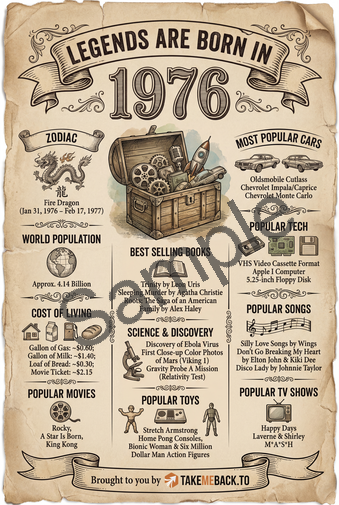

Major Events of 1976 - Historical Moments That Defined the Year | TakeMeBack.to
- 01 Jan Middle East Airlines Flight 438 bombing incident: On January 1, 1976, Middle East Airlines Flight 438 was bombed, resulting in the tragic loss of lives. The incident highlighted the ongoing tensions and conflicts in the region during that period. source: britannica.com
- 02 Jan Devastating North Sea Gale of 1976: The North Sea Gale of 1976 struck on January 2, causing severe weather conditions and significant damage across the region. The storm resulted in loss of life and extensive property damage, affecting many coastal areas. source: bbc.com
- 03 Jan US nuclear test at Nevada Test Site: On January 3, 1976, the United States conducted a nuclear test at the Nevada Test Site. This test was part of a series of underground nuclear tests aimed at assessing the effectiveness of nuclear weapons. The test was conducted under the auspices of the Department of Energy. source: energy.gov
- 04 Jan Ulster Volunteer Force sectarian killings: On January 4, 1976, the Ulster Volunteer Force (UVF) was involved in a series of sectarian killings in Northern Ireland. This violence was part of the ongoing conflict known as The Troubles, which saw numerous acts of violence between nationalist and unionist groups. The UVF was a loyalist paramilitary group that sought to maintain Northern Ireland's status as part of the United Kingdom. source: bbc.com
- 05 Jan Kingsmill Massacre: The Kingsmill Massacre occurred when a group of IRA members ambushed a bus carrying workers in Northern Ireland, resulting in the deaths of 10 people. This tragic event highlighted the ongoing conflict in the region during the Troubles. source: bbc.com
- 06 Jan China's Nuclear Test at Lop Nor: On January 6, 1976, China conducted its fifth nuclear test at Lop Nor, further advancing its nuclear capabilities. This test was part of China's ongoing efforts to establish itself as a major nuclear power. source: bbc.com
- 07 Jan Alfonso Soriano, Dominican baseball player: Alfonso Soriano, a prominent Dominican baseball player, was born on January 7, 1976. He is known for his successful MLB career, including stints with the New York Yankees and Chicago Cubs, and for being a two-time All-Star. source: baseball-reference.com
- 09 Jan Queen's 'Bohemian Rhapsody' tops UK charts: On January 9, 1976, Queen's 'Bohemian Rhapsody' reached number one on the UK Singles Chart, marking the band's first chart-topping single. The song, from their album 'A Night at the Opera,' held the top position for nine consecutive weeks. source: 98online.com
- 11 Jan Dorothy Hamill wins third consecutive U.S. Figure Skating Championship: On January 11, 1976, Dorothy Hamill secured her third consecutive U.S. Figure Skating Championship title, further solidifying her reputation as a leading figure in American figure skating. source: teamusa.com
- 12 Jan UN Security Council grants PLO observer status: On January 12, 1976, the United Nations Security Council voted 11–1 with 3 abstentions to grant the Palestine Liberation Organization (PLO) observer status, allowing its representatives to participate in Security Council debates without voting rights. source: en.wikipedia.org
- 14 Jan Kermadec Islands Earthquake Sequence: On January 14, 1976, a series of significant earthquakes struck the Kermadec Islands region, including a magnitude 7.8 mainshock at 04:47 UTC, followed by aftershocks of magnitudes 6.3, 6.2, and 6.3. These events were among the largest earthquakes recorded in the area during that period. source: en.wikipedia.org
- 15 Jan Helios B Solar Probe Launch: On January 15, 1976, the Helios B solar probe was launched. This mission, a collaboration between NASA and the German Aerospace Center, aimed to study the solar wind and the sun's corona. source: en.wikipedia.org
- 16 Jan Bangladesh and Pakistan diplomatic reconciliation: On January 16, 1976, Bangladesh and Pakistan engaged in diplomatic discussions aimed at reconciling their relations post-Bangladesh Liberation War. This marked a significant step towards normalizing ties between the two nations after years of conflict and political strife. source: bbc.com
- 17 Jan UK music chart highlights for January 17, 1976: On January 17, 1976, the UK music charts featured various artists, reflecting the popular music trends of the time. This period was notable for the rise of disco and pop music, influencing the charts significantly. source: bbc.co.uk
- 18 Jan Karantina massacre in Lebanon: The Karantina massacre occurred on January 18, 1976, during the Lebanese Civil War, resulting in significant civilian casualties. This event underscored the brutal nature of the conflict and the impact on the civilian population. source: bbc.com
- 19 Jan Energy Policy Conservation Act signed: The Energy Policy Conservation Act was signed into law on January 19, 1976, aimed at reducing energy consumption and promoting energy conservation in the United States. This legislation was part of a broader response to the energy crisis of the 1970s. It established various measures to improve energy efficiency. source: congress.gov
- 20 Jan Damour massacre in Lebanon: The Damour massacre occurred on January 20, 1976, during the Lebanese Civil War, resulting in the deaths of numerous civilians. This tragic event highlighted the escalating violence and sectarian conflict in Lebanon at the time. It remains a significant incident in the history of the civil war. source: bbc.com
- 21 Jan Concorde begins regular transatlantic service: On January 21, 1976, the Concorde commenced its regular transatlantic service, connecting London and New York. This marked the beginning of a new era in air travel, offering faster flights across the Atlantic. source: bbc.com
- 22 Jan Augustine Volcano eruption begins in Alaska: The Augustine Volcano in Alaska began erupting on January 22, 1976, leading to significant ashfall and disruption in the surrounding areas. This event marked one of the notable eruptions in the region's volcanic history. source: usgs.gov
- 24 Jan George Foreman defeats Ron Lyle in boxing match: On January 24, 1976, George Foreman faced Ron Lyle in a highly anticipated boxing match. Foreman won the bout by knockout in the fifth round, solidifying his status as a top heavyweight contender. source: boxingnews24.com
- 25 Jan President Ford delivers gloomy State of the Union address: On January 25, 1976, President Gerald Ford delivered a State of the Union address that reflected the economic challenges facing the nation. He discussed inflation, unemployment, and the need for economic recovery measures. source: presidency.ucsb.edu
- 26 Jan Israel opens 'Good Fence' to Lebanon: On January 26, 1976, Israel opened the 'Good Fence' policy, allowing Lebanese citizens to cross into Israel for work and trade. This policy aimed to improve relations and provide economic opportunities amid regional tensions. source: aljazeera.com
- 27 Jan Viv Richards scores his first Test century: On January 27, 1976, Viv Richards scored his maiden Test century against Australia, marking a significant milestone in his cricket career. source: brainyhistory.com
- 28 Jan Erapalli Prasanna's 8-wicket haul against New Zealand: On January 28, 1976, Indian cricketer Erapalli Prasanna achieved remarkable bowling figures of 8 wickets for 76 runs in the second innings of the Test match against New Zealand at Eden Park, Auckland. This performance led India to an eight-wicket victory, marking one of their few away Test wins. source: sportstar.thehindu.com
- 29 Jan IRA bombing in London's West End: On January 29, 1976, the Provisional Irish Republican Army (IRA) carried out a bombing in London's West End. The attack was part of the ongoing conflict during the Troubles, targeting civilian areas to instill fear and disrupt daily life. source: theguardian.com
- 30 Jan George H.W. Bush appointed as CIA Director: On January 30, 1976, U.S. President Gerald Ford appointed George H.W. Bush as the Director of the Central Intelligence Agency (CIA). Bush's tenure was marked by efforts to reform the agency and restore public trust following previous controversies. source: cia.gov
- 31 Jan 118 Picasso works stolen from Avignon exhibition: On January 31, 1976, 118 paintings, drawings, and other works by Pablo Picasso were stolen from an exhibition at the Palais des Papes in Avignon, France. source: en.wikipedia.org
- 02 Feb Groundhog Day Gale of 1976: On February 2, 1976, a severe winter storm, known as the Groundhog Day Gale, struck the Northeastern United States and southeastern Canada. The storm caused extensive damage, including coastal flooding and power outages, particularly in Maine and New Brunswick. source: theweathernetwork.com
- 04 Feb 7.5 earthquake kills 22,778 in Guatemala and Honduras: On February 4, 1976, a devastating 7.5 magnitude earthquake struck Guatemala and parts of Honduras, resulting in the deaths of approximately 22,778 people. The earthquake caused widespread destruction, displacing thousands and leading to significant humanitarian efforts. source: usgs.gov
- 05 Feb Swine Flu Outbreak Begins: The Swine Flu outbreak began in the United States on February 5, 1976, leading to widespread concern and a national vaccination campaign. The outbreak was linked to a strain of the H1N1 virus, prompting public health officials to take action to prevent a pandemic. source: cdc.gov
- 06 Feb Lockheed bribery scandal in Japan: On February 6, 1976, the Lockheed bribery scandal came to light in Japan, revealing extensive bribery by the Lockheed Corporation to secure contracts. This scandal had significant political repercussions in Japan, leading to investigations and the resignation of several high-profile officials. source: nytimes.com
- 07 Feb Hua Guofeng becomes Premier of Communist China: On February 7, 1976, Hua Guofeng was appointed as the Premier of the People's Republic of China. His leadership marked a transitional period in Chinese politics following the death of Mao Zedong, as he sought to consolidate power and navigate the complexities of the post-Mao era. source: britannica.com
- 08 Feb Leadership change in China: On February 8, 1976, Zhou Enlai, the Premier of China, passed away, leading to a significant leadership change in the country. His death marked the end of an era in Chinese politics, as he was a key figure in the Communist Party and had been instrumental in various reforms. This event set the stage for the subsequent political shifts in China. source: britannica.com
- 09 Feb Oscar Charleston Hall of Fame induction: Oscar Charleston, a legendary figure in baseball history, was inducted into the Baseball Hall of Fame on February 9, 1976. Known for his outstanding skills as a player and manager in the Negro Leagues, Charleston's legacy continues to influence the sport. His induction recognized his contributions and achievements in baseball. source: britannica.com
- 11 Feb Alexander Lippisch dies at 81: German aeronautical engineer Alexander Lippisch, known for pioneering delta-wing and rocket aircraft designs, died in Cedar Rapids, Iowa, at the age of 81. source: en.wikipedia.org
- 12 Feb Nuclear Testing at Nevada Site: On February 12, 1976, the United States conducted an underground nuclear test at the Nevada Test Site, code-named Alpaca, as part of Operation Whetstone. The test had a yield of less than 20,000 tons of TNT, and an accidental release of radioactivity was detected off-site. source: deseret.com
- 13 Feb Nigerian military coup attempt: On February 13, 1976, Lieutenant Colonel Bukar Suka Dimka led a failed coup against Nigeria's government, resulting in the assassination of General Murtala Muhammed and his aide-de-camp, Lieutenant Akintunde Akinsehinwa. source: en.wikipedia.org
- 17 Feb Rockefeller Commission Established to Investigate CIA Abuses: On February 17, 1976, President Gerald R. Ford established the Rockefeller Commission to investigate CIA abuses, following revelations from the Church Committee and Pike Committee about the CIA's activities in the 1970s. source: en.wikipedia.org
- 18 Feb Ford's Executive Order Banning Political Assassinations: On February 18, 1976, President Gerald R. Ford signed Executive Order 11905, which banned political assassinations and reformed the United States Intelligence Community. source: en.wikipedia.org
- 21 Feb Cardinal Willebrands installed as Archbishop of Utrecht: On February 21, 1976, Cardinal Johannes Willebrands was installed as the Archbishop of Utrecht, becoming the de facto Primate of the Netherlands. He had been appointed to this position on December 6, 1975, while continuing his role as President of the Secretariat for the Union of Christians. source: vatican.va
- 22 Feb Kathy Whitworth wins LPGA Bent Tree Golf Classic: On February 22, 1976, American professional golfer Kathy Whitworth won the Bent Tree Golf Classic, a tournament on the LPGA Tour. This victory added to her impressive career, which included 88 LPGA Tour wins, the most by any player on a single professional tour. source: brainyhistory.com
- 24 Feb 25th Congress of Communist Party of Soviet Union opens: The 25th Congress of the Communist Party of the Soviet Union convened in Moscow from February 24 to March 5, 1976, focusing on political and economic stability. source: en.wikipedia.org
- 25 Feb Birth of Rashida Jones: Rashida Jones, an American actress and writer, was born on February 25, 1976. source: en.wikipedia.org
- 26 Feb Portugal ends military rule: On February 26, 1976, Portugal officially transitioned from military rule to a democratic government following the Carnation Revolution of 1974. This marked a significant shift in Portuguese politics, leading to the establishment of a democratic constitution and the end of decades of authoritarian governance. source: bbc.com
- 27 Feb Western Sahara declares independence: On February 27, 1976, the Sahrawi Arab Democratic Republic declared independence from Spanish colonial rule in Western Sahara. This declaration marked the beginning of a protracted conflict over the territory, which remains disputed between Morocco and the Sahrawi people. source: un.org
- 28 Feb Madagascar recognizes Sahrawi Arab Democratic Republic: On February 28, 1976, Madagascar officially recognized the Sahrawi Arab Democratic Republic, supporting its claim for independence from Morocco. This recognition was part of a broader trend of African nations supporting the Sahrawi cause during the decolonization period. source: un.org
- 01 Mar Bradford Bishop family murder case: In March 1976, Bradford Bishop was implicated in the murder of his family in Maryland. He disappeared shortly after the crime and has been a fugitive ever since, with the case remaining unsolved for decades. source: fbi.gov
- 02 Mar Maguire Seven trial verdict announced: On March 2, 1976, the verdict in the Maguire Seven trial was delivered, resulting in the conviction of seven individuals accused of handling explosives. The case was controversial and raised questions about the justice system in the UK. source: theguardian.com
- 03 Mar Vitoria massacre occurs in Spain: On March 3, 1976, the Vitoria massacre took place in Spain, where police opened fire on a group of workers protesting for better labor conditions. This tragic event highlighted the tensions during Spain's transition to democracy. source: theguardian.com
- 04 Mar Northern Ireland Constitutional Convention dissolved: The Northern Ireland Constitutional Convention, established in 1975 to address constitutional issues, was formally dissolved on March 4, 1976, leading to direct rule from London. source: irishtimes.com
- 06 Mar Algeria recognizes Sahrawi Arab Democratic Republic: On March 6, 1976, Algeria became the third country to recognize the Sahrawi Arab Democratic Republic (SADR), following its proclamation by the Polisario Front on February 27, 1976. This recognition led to the establishment of formal diplomatic relations and the opening of a Sahrawi embassy in Algiers later that year. source: en.wikipedia.org
- 07 Mar Charan Singh released from house arrest in India: On March 7, 1976, Indian politician Charan Singh was released from house arrest. Singh, a prominent leader in Indian politics, had been placed under house arrest due to political tensions at the time. source: indiatoday.in
- 08 Mar Massive meteorite fall in Jilin, China: On March 8, 1976, a significant meteorite fall occurred in Jilin, China. The event was notable for the size and number of meteorites that landed, causing widespread interest and study in the scientific community. source: sciencedirect.com
- 09 Mar First female cadets admitted to West Point: On March 9, 1976, the United States Military Academy at West Point admitted its first female cadets. This historic decision marked a significant step toward gender integration in the U.S. military. source: washingtonpost.com
- 11 Mar Magnitude 3.5 earthquake near Newport, Rhode Island: On March 11, 1976, a magnitude 3.5 earthquake occurred near Newport, Rhode Island. The tremor was felt in the surrounding areas but did not cause significant damage or injuries.
- 12 Mar South African troops withdraw from Angola: On March 12, 1976, South African troops completed their withdrawal from Angola, ending Operation Savannah. This operation had been launched in October 1975 to support anti-communist factions during Angola's civil war. The withdrawal was finalized by March 27, 1976. source: reuters.screenocean.com
- 13 Mar Mozambique recognizes Sahrawi Arab Democratic Republic: On March 13, 1976, Mozambique officially recognized the Sahrawi Arab Democratic Republic (SADR), following the lead of other African nations. This recognition was part of a broader pattern of African nations acknowledging the SADR during the mid-1970s. source: sahrawi-emb-au.com
- 14 Mar Egypt ends Soviet friendship treaty: On March 14, 1976, Egypt officially terminated its friendship treaty with the Soviet Union, signaling a shift in its foreign policy towards the West. This decision was part of President Anwar Sadat's broader strategy to align Egypt more closely with the United States. source: brookings.edu
- 15 Mar Harold Wilson resigns as UK Prime Minister: On March 15, 1976, Harold Wilson announced his resignation as Prime Minister of the United Kingdom, a position he had held twice. His resignation marked the end of a significant political era and was influenced by various factors, including party divisions and economic challenges. source: bbc.com
- 17 Mar US conducts nuclear test at Nevada Test Site: On March 17, 1976, the United States conducted a nuclear test at the Nevada Test Site. This test was part of a series of underground nuclear tests conducted by the US government during this period. source: energy.gov
- 19 Mar Princess Margaret separates from Earl of Snowdon: On March 19, 1976, Princess Margaret announced her separation from her husband, Antony Armstrong-Jones, the Earl of Snowdon. This marked a significant moment in British royal history, reflecting the challenges within the royal family. source: bbc.com
- 20 Mar Patty Hearst convicted of armed robbery: On March 20, 1976, Patty Hearst was convicted of armed robbery for her involvement with the Symbionese Liberation Army. Her trial and conviction were highly publicized and sparked debates about brainwashing and free will. source: nytimes.com
- 24 Mar Argentine Military Coup Deposes President Isabel Perón: On March 24, 1976, a military junta led by General Jorge Rafael Videla overthrew President Isabel Perón, initiating a period of military dictatorship in Argentina. source: en.wikipedia.org
- 25 Mar Argentine military junta suppresses political opposition: On March 25, 1976, the Argentine military junta initiated a campaign to suppress political opposition, marking the beginning of a period known as the Dirty War. This regime targeted leftist activists, resulting in widespread human rights abuses and disappearances. source: britannica.com
- 26 Mar Argentine military dictatorship begins: The Argentine military dictatorship officially began on March 26, 1976, following a coup that overthrew Isabel Perón. This regime lasted until 1983 and was characterized by severe repression and human rights violations. source: britannica.com
- 27 Mar Washington Metro first section opens: On March 27, 1976, the Washington Metro's first section, a 4.6-mile segment of the Red Line, opened between Rhode Island Avenue and Farragut North stations in Washington, D.C. This inaugural segment featured five stations and marked the beginning of the city's rapid transit system. source: en.wikipedia.org
- 29 Mar Dirty War begins in Argentina: The Dirty War, initiated in 1976, was a period of state terrorism in Argentina where the government targeted suspected dissidents. Thousands were abducted, tortured, and killed during this time. source: britannica.com
- 30 Mar Palestinian Land Day protests: On March 30, 1976, Palestinians in Israel and the occupied territories held protests known as Land Day to oppose land confiscations. This event has since become an annual day of commemoration for Palestinian rights. source: aljazeera.com
- 31 Mar Karen Ann Quinlan right-to-die case: The Karen Ann Quinlan case became a landmark legal battle in the United States regarding the right to die. Quinlan, in a persistent vegetative state, was the subject of a court case that ultimately allowed her parents to remove her from life support. This case raised significant ethical and legal questions about end-of-life decisions. source: nytimes.com
- 01 Apr Death of Max Ernst: Max Ernst, a prominent German painter, sculptor, and graphic artist, died on April 1, 1976. He was a key figure in the Dada and Surrealist movements, known for his innovative techniques and unique style. His work has had a lasting impact on modern art. source: britannica.com
- 02 Apr Khmer Rouge Removes Prince Sihanouk from Power: On April 2, 1976, the Khmer Rouge, led by Pol Pot, deposed Prince Norodom Sihanouk, marking a significant shift in Cambodia's political landscape. This event led to the establishment of the Democratic Kampuchea regime, which was characterized by radical policies and widespread human rights abuses. source: en.wikipedia.org
- 03 Apr Drew Shirley Born: Drew Shirley, future guitarist of the alternative rock band Switchfoot, was born on this date.
- 04 Apr Karen Ann Quinlan Life Support Case: In 1976, the New Jersey Supreme Court ruled in the case of Karen Ann Quinlan, allowing her parents to remove her from life support after she had been in a persistent vegetative state for several months. This landmark decision addressed the right to die and the withdrawal of life-sustaining treatment. source: law.justia.com
- 06 Apr Karen Ann Quinlan life support removal confirmed: On April 6, 1976, Karen Ann Quinlan's life support was officially removed after a prolonged legal battle. This case became a landmark in the right-to-die debate in the United States, raising ethical questions about medical intervention and patient autonomy. source: nytimes.com
- 07 Apr Deng Xiaoping political purge: On April 7, 1976, Deng Xiaoping was purged from his position in the Chinese Communist Party during a political struggle. This event was part of the larger context of the Cultural Revolution and had significant implications for China's political future. source: britannica.com
- 09 Apr US-Soviet nuclear test agreement: On April 9, 1976, the United States and the Soviet Union reached an agreement on nuclear testing, aimed at reducing the risk of nuclear proliferation. This agreement was a significant step in Cold War diplomacy. source: state.gov
- 10 Apr Cleveland Cavaliers first NBA Central Division title: On April 10, 1976, the Cleveland Cavaliers secured their first NBA Central Division title. This achievement marked a significant milestone in the franchise's history, showcasing their growth and competitiveness in the league. The Cavaliers' success was celebrated by fans and marked a turning point for the team. source: nba.com
- 11 Apr Ballard Avenue Historical District established: The Ballard Avenue Historical District was established on April 11, 1976, in Seattle, Washington. This district is recognized for its well-preserved historic buildings and cultural significance. It serves as a reminder of the area's rich history and architectural heritage. source: seattle.gov
- 12 Apr Publication of 'Interview with the Vampire': Anne Rice's debut novel, 'Interview with the Vampire,' was published on April 12, 1976. The novel centers on Louis de Pointe du Lac, a vampire who recounts his life story to a reporter. It was Rice's first novel and the beginning of 'The Vampire Chronicles' series. source: britannica.com
- 15 Apr IBM announces 3800 laser printer: On April 15, 1975, IBM announced the IBM 3800 laser printer, the first commercially available laser printer. It was capable of printing more than 350 pages per minute on continuous, fan-folded paper, revolutionizing high-volume computer printing. source: computerhistory.org
- 17 Apr President Ford appears on Saturday Night Live: On April 17, 1976, President Gerald Ford made a guest appearance on the television show Saturday Night Live. This marked a significant moment in political and pop culture, showcasing the intersection of politics and entertainment during his presidency. source: nbcnews.com
- 18 Apr New York temperature record: On April 18, 1976, New York City recorded an unprecedented high temperature of 95 degrees Fahrenheit. This record-setting heat wave was part of a broader trend of unusual weather patterns during that spring. source: nytimes.com
- 19 Apr Executive Order 9066 rescinded: On April 19, 1976, President Gerald Ford formally rescinded Executive Order 9066, which had authorized the internment of Japanese Americans during World War II. This act was part of a broader effort to acknowledge and rectify past injustices against Japanese Americans. source: archives.gov
- 20 Apr Williams v. Saxbe: First sexual harassment damages award: On April 20, 1976, the case Williams v. Saxbe resulted in the first damages award for sexual harassment in the workplace. This landmark case set a precedent for future sexual harassment claims in the United States. source: eeoc.gov
- 21 Apr Swine flu vaccine testing begins: On April 21, 1976, testing for a swine flu vaccine began in response to concerns about a potential outbreak. The initiative was part of a public health effort to prevent the spread of the virus following a military base outbreak. source: cdc.gov
- 24 Apr Lebanon constitutional amendment allows presidential election: On April 24, 1976, Lebanon's parliament approved a constitutional amendment that permitted the election of a president, a significant step in the country's political landscape during a tumultuous period. This amendment aimed to stabilize governance amid ongoing civil unrest. source: bbc.com
- 25 Apr Portugal adopts new constitution: On April 25, 1976, Portugal adopted a new constitution following the Carnation Revolution, which ended decades of dictatorship. This constitution established a democratic framework and enshrined civil rights, marking a pivotal moment in Portuguese history. source: bbc.com
- 26 Apr Pan Am launches New York to Tokyo non-stop flight: On April 26, 1976, Pan American World Airways launched its first non-stop flight from New York to Tokyo, revolutionizing air travel between the two cities. This service marked a significant advancement in international aviation and connectivity. source: nytimes.com
- 29 Apr Annular solar eclipse of 1976: An annular solar eclipse occurred on April 29, 1976, visible across parts of the United States and Canada. During this event, the Moon covered the center of the Sun, leaving a ring-like appearance. This eclipse was part of the Saros cycle 145. source: eclipse.gsfc.nasa.gov
- 30 Apr Muhammad Ali defeats Jimmy Young in heavyweight boxing match: On April 30, 1976, Muhammad Ali faced Jimmy Young in a heavyweight boxing match in Washington, D.C. Ali won the bout by unanimous decision, showcasing his skills and stamina. This fight was significant in Ali's career as it came during a period of intense scrutiny and challenges. source: boxrec.com
- 01 May Minamata disease official discovery: On May 1, 1976, Minamata disease was officially recognized as a neurological disorder caused by mercury poisoning in Japan. This condition was linked to industrial pollution from the Chisso Corporation, leading to significant health crises in affected communities. The recognition marked a pivotal moment in environmental health awareness. source: ncbi.nlm.nih.gov
- 03 May Pan Am 747SP sets world record flight: On May 1, 1976, Pan American World Airways' Boeing 747SP-21, 'Clipper Liberty Bell,' departed New York's JFK Airport for a record-setting round-the-world flight. The journey covered 23,137 miles in 39 hours, 25 minutes, and 53 seconds, setting multiple speed records for commercial airline routes. source: airwaysmag.com
- 04 May El País newspaper launches in Spain: El País, a Spanish-language daily newspaper, was first published on May 4, 1976, in Madrid. Founded by José Ortega Spottorno, Jesús de Polanco, and Juan Luis Cebrián, it aimed to promote democratic ideals in post-Franco Spain. source: britannica.com
- 06 May Friuli Earthquake of 1976: On May 6, 1976, a devastating earthquake struck the Friuli region in northeastern Italy, causing widespread destruction and loss of life. The earthquake had a magnitude of 6.4 and resulted in significant damage to infrastructure and buildings.
- 07 May Devastating Friuli Earthquake in Italy: On May 7, 1976, a powerful earthquake struck the Friuli region in northeastern Italy, causing widespread destruction and loss of life. The earthquake had a magnitude of 6.4 and resulted in significant damage to infrastructure and buildings.
- 08 May Kazuo Hashimoto files patent for caller ID display device: On May 8, 1976, Japanese inventor Kazuo Hashimoto files U.S. patent 4,242,539 for a caller ID display device, marking a significant advancement in telecommunications. source: en.wikipedia.org
- 09 May Broadway Play Closes: The theatrical production "So Long 174th St" concluded its run at the Harkness Theater in New York City after a brief 16-performance stint.
- 10 May Jeremy Thorpe resigns as leader of the UK's Liberal Party: On May 10, 1976, Jeremy Thorpe resigned as leader of the UK's Liberal Party amid allegations of conspiracy to murder former male model Norman Scott. source: apnews.com
- 11 May 3rd Daytime Emmy Awards Ceremony: The 3rd Daytime Emmy Awards were held on May 11, 1976, at the Vivian Beaumont Theatre, honoring excellence in daytime television programming from 1975. Hosted by Bob Barker, the ceremony aired on CBS and featured categories such as Outstanding Daytime Drama Series and Outstanding Game Show. source: en.wikipedia.org
- 12 May Urquiola tanker disaster in La Coruña, Spain: On May 12, 1976, the Urquiola tanker struck a submerged object while approaching the Coruña Oil Terminal in La Coruña, Spain, leading to an oil leak. The vessel was ordered out of the harbor to prevent explosions, but it grounded again, rupturing its bow tanks. The crew abandoned ship, and two hours later, the vessel exploded, resulting in the captain's death. Approximately 513,000 barrels of oil burned in the subsequent 16-hour fire, causing significant environmental damage. source: incidentnews.noaa.gov
- 14 May Record-breaking Billy Graham Crusade: On May 14, 1976, evangelist Billy Graham held a crusade at Seattle's Kingdome, drawing a record crowd of 74,000 attendees. This event marked the largest single gathering in the stadium's history at that time. source: thenewstribune.com
- 17 May Devastating Gazli Earthquake in Uzbekistan: On May 17, 1976, a 7.0 magnitude earthquake struck near Gazli, Bukhara, Uzbekistan, causing significant damage and loss of life. source: earthquaketrack.com
- 19 May Soviet Nuclear Test in Kazakhstan: On May 19, 1976, the Soviet Union conducted a nuclear test in Kazakhstan, contributing to international concerns over nuclear proliferation. source: nti.org
- 20 May Soviet Nuclear Test: On May 20, 1976, the Soviet Union conducted another nuclear test, further escalating tensions during the Cold War. source: nti.org
- 21 May Yuba City Bus Disaster: On May 21, 1976, a tragic bus accident occurred in Yuba City, California, resulting in multiple fatalities. The incident involved a school bus and a pickup truck, leading to significant public outcry and changes in safety regulations. source: nytimes.com
- 22 May NASA Space Vehicle Launch: On May 22, 1976, NASA launched the Viking 1 spacecraft, which was designed to explore Mars. This mission marked a significant milestone in space exploration, providing valuable data about the Martian surface and atmosphere. source: nasa.gov
- 23 May Women defend building against Palestinian fighters in Beirut: On May 23, 1976, during the Lebanese Civil War, women in Beirut took a stand to defend their building against Palestinian fighters. This incident highlighted the complex dynamics of the conflict and the involvement of civilians. source: theguardian.com
- 24 May Concorde service to Washington, DC launched: On May 24, 1976, the Concorde supersonic passenger jet began its service to Washington, D.C. This marked a significant advancement in aviation technology and international travel, showcasing the capabilities of supersonic flight. source: bbc.com
- 25 May Ford wins Republican primaries in Kentucky, Tennessee, and Oregon: On May 25, 1976, President Gerald Ford secured victories in the Republican primaries held in Kentucky, Tennessee, and Oregon. Despite these wins, his opponent, Ronald Reagan, gained more delegates overall by winning primaries in Arkansas, Idaho, and Nevada on the same day. source: fordlibrarymuseum.gov
- 26 May US-Soviet Anti-Ballistic Missile Treaty signed: On May 26, 1976, the United States and the Soviet Union signed the Anti-Ballistic Missile Treaty, a significant arms control agreement aimed at limiting the use of missile defense systems to prevent an arms race in strategic ballistic missiles. source: archives.gov
- 29 May Johnny Cash single reaches chart position: On May 29, 1976, Johnny Cash's single 'One Piece at a Time' reached the top of the charts, showcasing his enduring popularity in country music. The song, which tells the story of a car factory worker who builds a car from parts, became one of Cash's signature hits. source: billboard.com
- 30 May Mariner 9 space mission: On May 30, 1976, NASA's Mariner 9 spacecraft successfully entered orbit around Mars, becoming the first spacecraft to do so. This mission provided unprecedented data about the Martian surface and atmosphere, significantly advancing our understanding of the planet. source: mars.nasa.gov
- 31 May Ronald Reagan wins Texas Republican primary: On May 31, 1976, Ronald Reagan secured a decisive victory in the Texas Republican primary, defeating incumbent President Gerald Ford. This win was pivotal in Reagan's campaign, as it demonstrated his strong support among conservative voters and bolstered his position in the race for the Republican nomination. source: washingtonpost.com
- 01 Jun Aeroflot Flight 418 crashes in Equatorial Guinea: On June 1, 1976, Aeroflot Flight 418, a Tupolev Tu-154A, crashed into Mount San Carlos on Bioko Island, Equatorial Guinea, during its en route from Luanda, Angola, to Moscow, Russia. All 46 occupants, including 36 passengers and 10 crew members, perished. The investigation suggested a possible radar failure as the cause of the crash. source: en.wikipedia.org
- 02 Jun Don Bolles, investigative journalist, assassinated: On June 2, 1976, Don Bolles, a journalist for the Arizona Republic, was killed by a car bomb in Phoenix, Arizona. Bolles was known for his investigative reporting on organized crime and corruption, and his death highlighted the dangers faced by journalists in the pursuit of truth. source: en.wikipedia.org
- 04 Jun Sex Pistols' Manchester Debut: The Sex Pistols performed at Manchester's Lesser Free Trade Hall, a concert that became a pivotal moment in the punk rock movement, inspiring future members of bands like Joy Division, New Order, and The Smiths. source: bbc.com
- 05 Jun Teton Dam disaster: On June 5, 1976, the Teton Dam in Idaho failed, leading to catastrophic flooding. The disaster resulted in significant loss of life and property, prompting changes in dam safety regulations. The event is remembered as one of the worst dam failures in U.S. history. source: usbr.gov
- 06 Jun Death of J. Paul Getty: J. Paul Getty, the American oil tycoon and founder of the Getty Oil Company, died on June 6, 1976. His death marked the end of an era for one of the wealthiest individuals in the world, known for his art collection and philanthropic efforts. source: britannica.com
- 07 Jun McDonald's opens first New Zealand restaurant in Porirua: On June 7, 1976, McDonald's opened its first New Zealand outlet in Porirua, near Wellington. The original menu featured items like the Big Mac for 75 cents and cheeseburgers for 40 cents. The restaurant faced challenges due to strict import laws but successfully established its presence in the New Zealand market. source: nzhistory.govt.nz
- 09 Jun Spain legalizes political parties: On June 9, 1976, Spain officially legalized political parties, marking a significant step towards democracy after decades of dictatorship under Francisco Franco. This move allowed for the formation of various political groups and set the stage for democratic elections. source: bbc.com
- 10 Jun Paul McCartney & Wings concert at Kingdome: On June 10, 1976, Paul McCartney and Wings performed at the Kingdome in Seattle, Washington. This concert was part of their successful Wings Over America tour, which showcased their popular hits and attracted a large audience. source: seattletimes.com
- 11 Jun Beatles Rock & Roll Music LP released: The Beatles' compilation album 'Rock & Roll Music' was released on June 11, 1976. This album features a collection of the band's rock and roll hits, showcasing their influence on the genre. It was well-received and contributed to the band's enduring legacy in music history. source: beatlesbible.com
- 12 Jun Military Coup in Uruguay: On June 12, 1976, the Uruguayan military overthrew President Juan María Bordaberry, establishing a de facto government. This led to widespread human rights abuses and the disappearance of thousands of individuals during the subsequent dictatorship. source: uca.edu
- 13 Jun Iowa tornado disaster causes significant damage: On June 13, 1976, a tornado struck Iowa, resulting in extensive damage and several injuries. The tornado was part of a larger weather system that affected multiple states, leading to emergency responses and recovery efforts. source: weather.gov
- 14 Jun Black Panther killer trial begins in California: The trial of a member of the Black Panther Party accused of murder began on June 14, 1976. This high-profile case drew significant media attention and highlighted issues of race and justice in America. source: nytimes.com
- 15 Jun Yankees-Orioles major player trade occurs: On June 15, 1976, a significant trade between the New York Yankees and Baltimore Orioles was announced, impacting both teams' rosters. This trade was part of the ongoing strategy to strengthen team performance during the season. source: nytimes.com
- 16 Jun Soweto Uprising begins in South Africa: On June 16, 1976, thousands of black students in Soweto, South Africa, protested against the government's policy of teaching in Afrikaans. The peaceful demonstration turned violent when police opened fire, leading to at least 12 deaths on the first day. The uprising continued for several months, spreading to other townships and resulting in hundreds of deaths. source: britannica.com
- 17 Jun Soweto Uprising continues with widespread protests: On June 17, 1976, the Soweto Uprising continued as protests spread to other townships in South Africa. The demonstrations, initially sparked by opposition to the use of Afrikaans in schools, escalated into broader anti-apartheid protests. The government's response included deploying more police forces, leading to further violence and casualties. source: britannica.com
- 20 Jun US evacuation from Lebanon: On June 20, 1976, the United States began evacuating its citizens from Lebanon due to the escalating civil conflict. The evacuation was prompted by increasing violence and instability in the region, particularly in Beirut, where American citizens were at risk. source: state.gov
- 21 Jun Italian Communist Party electoral victory: On June 21, 1976, the Italian Communist Party achieved significant electoral success in the national elections. This victory marked a notable moment in Italian politics, reflecting the party's growing influence during that period. source: britannica.com
- 22 Jun Canada abolishes capital punishment: On June 22, 1976, Canada officially abolished capital punishment, marking a significant shift in its legal system. This decision reflected changing societal views on the death penalty and human rights. source: canada.ca
- 23 Jun United States vetoes Angola's UN membership: On June 23, 1976, the United States vetoed Angola's application for United Nations membership, citing concerns over the continued presence of Cuban forces in Angola. This marked the fifteenth time the U.S. had exercised its veto power against Angola's UN membership. source: sahistory.org.za
- 25 Jun Unique baseball fielding record: On June 25, 1976, a unique baseball fielding record was set, highlighting an extraordinary play or achievement in the sport. This record contributed to the rich history of baseball and showcased the skills of the players involved. source: baseball-reference.com
- 26 Jun Entebbe Airport Hijacking: On June 26, 1976, an Air France plane was hijacked by two members of the Popular Front for the Liberation of Palestine – External Operations and two members of the Revolutionary Cells. The plane was diverted to Entebbe, Uganda, where Israeli commandos successfully rescued 102 hostages in Operation Entebbe. source: history.com
- 27 Jun Israeli Raid on Entebbe: On June 27, 1976, Air France Flight 139, en route from Tel Aviv to Paris, was hijacked by members of the Popular Front for the Liberation of Palestine - External Operations (PFLP-EO) and the German Revolutionary Cells. The hijackers diverted the plane to Entebbe, Uganda, where they were joined by additional accomplices. The hostages were held for the release of 53 militants imprisoned in Israel, Kenya, West Germany, and elsewhere. This led to the Israeli military's Operation Entebbe on July 3–4, 1976, which successfully rescued 102 hostages. source: britannica.com
- 02 Jul Reunification of Vietnam: On July 2, 1976, Vietnam was officially reunified, marking the end of the Vietnam War and the establishment of the Socialist Republic of Vietnam. This event symbolized the consolidation of North and South Vietnam after years of conflict. source: britannica.com
- 03 Jul United States Bicentennial Celebration: On July 3, 1976, the United States celebrated its Bicentennial, marking 200 years of independence. This event included various festivities, parades, and fireworks across the nation, highlighting American history and culture. source: archives.gov
- 04 Jul United States Bicentennial celebrations: The United States celebrated its Bicentennial on July 4, 1976, marking 200 years since the signing of the Declaration of Independence. Events included parades, fireworks, and various cultural activities across the nation, emphasizing American history and patriotism. source: archives.gov
- 05 Jul Political transition in Spain: Carlos Arias Navarro resigns: On July 5, 1976, Carlos Arias Navarro resigned as the Prime Minister of Spain, marking a significant moment in the country's transition to democracy following the Franco regime. His resignation paved the way for democratic reforms and the eventual establishment of a parliamentary system. source: britannica.com
- 06 Jul First women admitted to U.S. Naval Academy: On July 6, 1976, the United States Naval Academy in Annapolis, Maryland, admitted women for the first time in its history, inducting 81 female midshipmen. source: history.com
- 07 Jul Viking 2 spacecraft enters Mars orbit: On July 7, 1976, NASA's Viking 2 spacecraft entered orbit around Mars, preparing for its lander to touch down on the planet's surface. source: en.wikipedia.org
- 08 Jul Indonesia launches first domestically built satellite: On July 8, 1976, Indonesia successfully launched its first domestically built satellite, named Palapa A1. This marked a significant milestone in Indonesia's space program, showcasing its technological advancements and aspirations in satellite communications. source: britannica.com
- 09 Jul Pentagon opens war room to media: On July 9, 1976, the Pentagon opened its war room to media representatives, allowing for unprecedented access to military operations and strategies. This move aimed to increase transparency and public understanding of military affairs. source: defense.gov
- 10 Jul Seveso disaster occurs in Italy: On July 10, 1976, a chemical accident in Seveso, Italy, released a toxic cloud of dioxin, affecting the local population and environment. The incident led to the evacuation of thousands and raised awareness about industrial safety regulations. source: britannica.com
- 11 Jul French nuclear test conducted at Mururoa Atoll: On July 11, 1976, France conducted a nuclear test at Mururoa Atoll in the South Pacific. This test was part of France's nuclear program and drew international criticism for environmental and safety concerns. source: bbc.com
- 12 Jul Barbara Jordan delivers historic speech at convention: On July 12, 1976, Barbara Jordan made a groundbreaking speech at the Democratic National Convention, becoming the first African American woman from the South to speak at a major party convention. Her address focused on civil rights and social justice. source: c-span.org
- 13 Jul 47th All Star Baseball Game: NL wins 7-1 at Veterans Stadium, Philadelphia: On July 13, 1976, the National League defeated the American League 7-1 in the 47th All-Star Game held at Veterans Stadium in Philadelphia. This game showcased some of the best talent in Major League Baseball. source: baseball-reference.com
- 14 Jul Devastating Bali earthquake: On July 14, 1976, a powerful earthquake struck Bali, Indonesia, causing significant destruction and loss of life. The earthquake highlighted the region's vulnerability to seismic activity. source: usgs.gov
- 15 Jul Jimmy Carter Democratic Nomination: On July 15, 1976, Jimmy Carter secured the Democratic nomination for President of the United States at the Democratic National Convention in New York City. His nomination marked a significant moment in his political career, leading to his election as the 39th President.
- 16 Jul 1976 Summer Olympics Begin in Montreal: The 1976 Summer Olympics commenced on July 16, 1976, in Montreal, Canada. This event marked the first time the Olympics were held in Canada, featuring athletes from around the world competing in various sports.
- 17 Jul Indonesian annexation of East Timor: On July 17, 1976, Indonesia formally annexed East Timor, following a military invasion in 1975. This event marked a significant escalation in the conflict and led to years of violence and international controversy. source: bbc.com
- 18 Jul Nadia Comaneci scores historic perfect 10: On July 18, 1976, gymnast Nadia Comaneci achieved the first perfect 10 in Olympic history during the Montreal Games. This remarkable feat changed the landscape of gymnastics and made her an international icon. source: bbc.com
- 19 Jul Political Transition in Spain: On July 19, 1976, Spain underwent a significant political transition with the appointment of Adolfo Suárez as Prime Minister by King Juan Carlos I. This marked a pivotal moment in Spain's post-Franco era, initiating a series of democratic reforms. source: en.wikipedia.org
- 20 Jul Viking 1 Lands on Mars at Chryse Planitia: On July 20, 1976, NASA's Viking 1 lander successfully touched down in Chryse Planitia on Mars, marking the first U.S. spacecraft to land on another planet and begin transmitting data back to Earth. source: nasa.gov
- 21 Jul Viking I lands on Mars: On July 21, 1976, NASA's Viking I spacecraft successfully landed on Mars, marking a significant milestone in space exploration. It was the first spacecraft to land on the Martian surface and send back images and data, greatly enhancing our understanding of the planet. source: nasa.gov
- 22 Jul Japan completes war reparations to the Philippines: On July 22, 1976, Japan officially completed its war reparations to the Philippines, a process that began in the early 1950s. The reparations were part of Japan's efforts to reconcile with countries affected by its actions during World War II, providing financial compensation and aid to the Philippines. source: britannica.com
- 23 Jul Soviet Union conducts nuclear tests at Semipalatinsk: On July 23, 1976, the Soviet Union conducted multiple underground nuclear tests at the Semipalatinsk Test Site in Kazakhstan. These tests were part of a series of 21 nuclear tests conducted that year. source: en.wikipedia.org
- 24 Jul John Naber sets world record in swimming: On July 24, 1976, American swimmer John Naber set a world record, contributing to his successful performance at the 1976 Summer Olympics in Montreal. source: en.wikipedia.org
- 25 Jul Viking 1 Mars mission captures first images of Mars: On July 25, 1976, NASA's Viking 1 spacecraft transmitted the first detailed images of Mars' surface, marking a significant milestone in planetary exploration. source: en.wikipedia.org
- 27 Jul Devastating Tangshan earthquake in China: On July 27, 1976, a catastrophic earthquake struck Tangshan, China, resulting in an estimated 242,000 deaths and widespread destruction. source: en.wikipedia.org
- 28 Jul Tangshan Earthquake strikes China: On July 28, 1976, a devastating earthquake struck Tangshan, China, resulting in significant loss of life and destruction. It is estimated that the earthquake had a magnitude of 7.5 and caused the deaths of hundreds of thousands of people, making it one of the deadliest earthquakes in history. source: britannica.com
- 29 Jul Seychelles gains independence from Britain: On July 29, 1976, Seychelles officially gained independence from British colonial rule. This marked a significant step in the nation's history, allowing it to establish its own government and sovereignty. source: britannica.com
- 30 Jul Seattle Seahawks' First Game: The Seattle Seahawks played their inaugural football game, marking the beginning of the franchise's journey in the National Football League (NFL).
- 31 Jul Big Thompson Canyon Flash Flood Tragedy: On July 31, 1976, a stationary thunderstorm near Estes Park, Colorado, released up to 14 inches of rain over four hours, causing the Big Thompson River to flood. The flood resulted in 144 fatalities, over 250 injuries, and extensive property damage, including the destruction of 418 homes and 152 businesses. It is considered one of Colorado's deadliest natural disasters. source: usgs.gov
- 01 Aug Niki Lauda's Near-Fatal Formula 1 Accident: On August 1, 1976, during the German Grand Prix at the Nürburgring, Formula 1 driver Niki Lauda crashed his Ferrari, resulting in a fire that caused severe burns and inhalation injuries. Despite the severity of his injuries, Lauda made a remarkable recovery and returned to racing just six weeks later. source: en.wikipedia.org
- 03 Aug Viking 2 reaches Mars orbit: On August 3, 1976, NASA's Viking 2 spacecraft successfully entered orbit around Mars. This mission was crucial for the exploration of the Martian surface and provided valuable data about the planet's atmosphere and geology. source: nasa.gov
- 04 Aug Death of Roy Herbert Thomson, Lord Thomson of Fleet: Roy Herbert Thomson, a prominent Canadian newspaper publisher and media mogul, passed away on August 4, 1976. He was known for his significant contributions to the media industry and his influence in Canadian journalism. source: bbc.com
- 05 Aug Jesse Owens receives Presidential Medal of Freedom: On August 5, 1976, Jesse Owens, the legendary Olympic athlete, was awarded the Presidential Medal of Freedom. This honor recognized his remarkable achievements and contributions to sports and civil rights in the United States. source: obamawhitehouse.archives.gov
- 06 Aug Hiroshima atomic bombing remembrance: On August 6, 1976, ceremonies were held to commemorate the atomic bombing of Hiroshima, Japan, which occurred on the same date in 1945. The event serves as a reminder of the devastating effects of nuclear warfare and promotes peace and anti-nuclear sentiments worldwide. source: archives.gov
- 07 Aug Viking 2 enters Mars orbit: Viking 2 successfully entered orbit around Mars on August 7, 1976, following its launch earlier that year. This mission aimed to explore the Martian surface and conduct experiments to search for signs of life. It provided significant data about the planet's atmosphere and geology. source: nasa.gov
- 08 Aug Women's peace demonstration in Northern Ireland: On August 8, 1976, a significant women's peace demonstration took place in Northern Ireland, advocating for an end to violence and conflict in the region. This event highlighted the role of women in peace activism during a tumultuous period in Northern Irish history. It aimed to promote dialogue and reconciliation among communities. source: bbc.com
- 09 Aug USSR's final lunar mission: On August 9, 1976, the Soviet Union launched Luna 24, the last mission of its Luna program. The spacecraft successfully landed in the Mare Crisium region of the Moon, collected a 160 cm long lunar soil core sample weighing approximately 170 grams, and returned the sample to Earth on August 22, 1976. source: astronomy.com
- 10 Aug Hurricane Belle strikes Long Island and New England: On August 10, 1976, Hurricane Belle made landfall, impacting Long Island and New England. The hurricane caused significant damage and was notable for its rapid intensification and movement. source: weather.gov
- 11 Aug Trinidad and Tobago Becomes a Republic: Trinidad and Tobago transitioned from a constitutional monarchy to a republic, with Sir Ellis Clarke becoming the first President. This marked a significant milestone in the country's post-colonial political development, symbolizing national sovereignty and independence.
- 12 Aug Tel al-Zaatar Massacre during Lebanese Civil War: A devastating massacre occurred at the Tel al-Zaatar Palestinian refugee camp in Beirut, Lebanon, resulting in the deaths of between 1,000 and 3,500 Palestinians. This tragic event was one of the most brutal incidents during the Lebanese Civil War, highlighting the extreme violence and human suffering of the conflict. source: Wikipedia (day-month pages)
- 14 Aug Women's Peace Demonstration in Belfast: On August 14, 1976, approximately 10,000 women from Northern Ireland gathered in Belfast to demonstrate for peace, highlighting the grassroots efforts to end sectarian violence during the height of the Troubles. This significant public protest showcased women's collective power and their desire to stop the ongoing conflict through peaceful means.
- 16 Aug 58th PGA Championship: Dave Stockton wins the 58th PGA Championship at Congressional Country Club in Maryland, shooting an impressive total score of 281.
- 17 Aug 1976 Moro Gulf earthquake and tsunami: On August 17, 1976, a magnitude 8.0 earthquake struck near the islands of Mindanao and Sulu in the Philippines, followed by a destructive tsunami. The disaster resulted in at least 5,000 fatalities, with some reports estimating up to 8,000 deaths, and left approximately 90,000 people homeless. source: en.wikipedia.org
- 18 Aug Korean Axe Murder Incident: On August 18, 1976, two U.S. soldiers were killed by two North Korean soldiers in the Korean Demilitarized Zone (DMZ) near Panmunjom. The incident, known as the Korean Axe Murder Incident, occurred when the soldiers attempted to cut down a poplar tree obstructing the view between two checkpoints. The attack led to increased tensions between North and South Korea. source: en.wikipedia.org
- 19 Aug Gerald Ford wins Republican presidential nomination: At the 1976 Republican National Convention in Kansas City, Missouri, President Gerald Ford secured the party's nomination for a full term, defeating former California Governor Ronald Reagan. Ford's acceptance speech emphasized America's peace and economic recovery. source: presidency.ucsb.edu
- 20 Aug Hurricane Belle strikes Long Island and New England: Hurricane Belle, a Category 3 Atlantic hurricane, made landfall on August 9, 1976, causing moderate damage across the East Coast of the United States, including Long Island and New England. The storm resulted in 12 fatalities and approximately $100 million in damages. source: en.wikipedia.org
- 21 Aug Al Bumbry hits inside-the-park home run for Orioles: On August 21, 1976, Al Bumbry became the 17th player in Baltimore Orioles history to hit an inside-the-park home run. This achievement highlighted his exceptional speed and agility on the field. source: brainyhistory.com
- 22 Aug Soviet Luna 24 mission returns moon rocks to Earth: On August 22, 1976, the Soviet Union's Luna 24 mission successfully returned lunar soil samples to Earth, marking a significant achievement in lunar exploration. source: en.wikipedia.org
- 23 Aug 1976 Tangshan earthquake devastates China: On August 23, 1976, a catastrophic earthquake struck Tangshan, China, resulting in a death toll estimated between 242,000 and 700,000, making it one of the deadliest earthquakes in recorded history. source: en.wikipedia.org
- 24 Aug Marcelo Gelman abducted during Uruguayan dictatorship: On August 24, 1976, Marcelo Gelman, a prominent Uruguayan writer and journalist, was abducted by the military dictatorship, leading to his death and highlighting the regime's repression. source: en.wikipedia.org
- 25 Aug First Ebola outbreak discovered: The first known outbreak of the Ebola virus occurred in Zaire (now the Democratic Republic of the Congo) in 1976. This outbreak led to significant research into the virus and its transmission. source: cdc.gov
- 26 Aug Raymond Barre appointed Prime Minister of France: Raymond Barre was appointed as the new Prime Minister of France following Jacques Chirac's resignation. His government focused on economic reforms and addressing the challenges facing the country. source: nytimes.com
- 27 Aug Renee Richards barred from US Tennis Open: Renee Richards, a transgender woman, was barred from competing in the US Open due to her gender identity. This decision sparked significant controversy and discussions about gender and sports. source: nytimes.com
- 28 Aug USSR nuclear test at Semipalatinsk: The Soviet Union conducted a nuclear test at the Semipalatinsk test site in Kazakhstan. This event was part of the ongoing Cold War tensions and nuclear arms race during the 1970s. source: nytimes.com
- 29 Aug Death of Kazi Nazrul Islam, Bengali cultural icon: Kazi Nazrul Islam, a prominent Bengali poet and cultural figure, passed away. His works and contributions to Bengali literature and music have left a lasting legacy in the region. source: britannica.com
- 30 Aug Paul Felix Lazarsfeld dies at age 75: Austrian-American sociologist Paul Felix Lazarsfeld, known for his contributions to empirical social research, passed away in Newark, New Jersey. source: en.wikipedia.org
- 31 Aug Olympic Marathon Victory: Waldemar Cierpinski of East Germany won the Olympic Marathon with an impressive time of 2:09:55.0, representing a significant athletic achievement during the Cold War era.
- 01 Sep Wayne L. Hays resigns from Congress amid scandal: On September 1, 1976, U.S. Representative Wayne L. Hays resigned from Congress following a scandal involving his secretary, Elizabeth Ray, who claimed to have been his mistress and was paid a federal salary for her services. source: en.wikipedia.org
- 03 Sep Viking 2 Planned Mars Landing Site: NASA's Viking 2 lander was scheduled to land on Mars at Utopia Planitia on September 3, 1976. This site was chosen due to its potential for finding signs of life and its proximity to Viking 1's landing site. source: science.nasa.gov
- 05 Sep Jerome Kern musical concludes Broadway run: The musical 'Show Boat,' composed by Jerome Kern, concluded its Broadway run on September 5, 1976. This production is notable for its impact on American musical theater and its exploration of racial themes. source: nytimes.com
- 06 Sep Soviet MiG-25 pilot defects to Japan during Cold War: On September 6, 1976, a Soviet MiG-25 pilot defected to Japan, landing in Hakodate. This event was significant during the Cold War, as it provided the West with valuable intelligence about Soviet aircraft technology. source: bbc.com
- 07 Sep Death of Mao Zedong: Mao Zedong, the founding father of the People's Republic of China, died on September 7, 1976. His death marked the end of an era in Chinese politics and had significant implications for the country's future direction. source: britannica.com
- 08 Sep Establishment of the Autonomous Region of the Azores: On September 8, 1976, the Autonomous Region of the Azores was officially established in Portugal. This marked a significant step in granting self-governance to the Azorean islands, allowing for greater local autonomy and legislative power. The move was part of a broader effort to decentralize governance in Portugal following the Carnation Revolution. source: britannica.com
- 09 Sep Death of Mao Zedong: Mao Zedong, the founding father of the People's Republic of China, died on September 9, 1976. His death marked the end of an era in Chinese politics and led to significant changes in the country's direction. Mao's policies and leadership had a profound impact on China and the world. source: britannica.com
- 10 Sep Mid-air collision over Yugoslavia: On September 10, 1976, a tragic mid-air collision occurred over Yugoslavia involving two aircraft, resulting in numerous casualties. This incident raised concerns about air traffic control and safety regulations in the region. It remains a significant event in aviation history. source: bbc.com
- 11 Sep Chris Evert defeats Evonne Goolagong in US Open final: On September 11, 1976, Chris Evert defeated Evonne Goolagong 6–3, 6–0 in the women's singles final at the US Open. This victory marked Evert's second consecutive US Open title and her sixth major singles title overall. Goolagong was aiming to complete the career Grand Slam but was unable to secure the win. source: en.wikipedia.org
- 12 Sep Jane Blalock wins LPGA tournament: On September 12, 1976, Jane Blalock secured her victory at the LPGA tournament, marking a significant achievement in her golfing career. This win contributed to her reputation as one of the leading female golfers of her time. source: nytimes.com
- 13 Sep George Harrison copyright plagiarism case: On September 13, 1976, George Harrison faced a copyright infringement lawsuit regarding his song 'My Sweet Lord.' The case centered on allegations that the song plagiarized 'He's So Fine' by The Chiffons. source: nytimes.com
- 14 Sep National Emergencies Act signed into law: On September 14, 1976, President Gerald Ford signed the National Emergencies Act into law, establishing procedures for the declaration of national emergencies. This legislation aimed to clarify the powers of the executive branch during crises. source: congress.gov
- 15 Sep Northeastern Italy earthquake: On September 15, 1976, a devastating earthquake struck northeastern Italy, causing significant destruction and loss of life. The event prompted a national response to aid the affected regions. source: bbc.com
- 17 Sep NASA unveils Space Shuttle Enterprise: On September 17, 1976, NASA unveiled the Space Shuttle Enterprise at a ceremony in Palmdale, California. The shuttle, named after the fictional starship from the 'Star Trek' series, was constructed for atmospheric test flights and was not capable of space travel. The event was attended by 'Star Trek' cast members and NASA officials. source: nasa.gov
- 18 Sep Funeral of Mao Zedong: On September 18, 1976, the funeral of Chinese leader Mao Zedong was held in Tiananmen Square, Beijing. The ceremony was attended by approximately one million people, including party and state leaders. Mao's body was later permanently interred in a mausoleum in the square. source: history.com
- 19 Sep "Going Up" Broadway revival opens at John Golden Theatre: The 1976 revival of the musical "Going Up" premiered on September 19, 1976, at the John Golden Theatre in New York City. Directed by Bill Gile, the production ran for 49 performances, closing on October 31, 1976. source: ibdb.com
- 20 Sep Orlando Letelier assassinated in Washington, D.C.: On September 20, 1976, Orlando Letelier, a former Chilean ambassador and critic of the Pinochet regime, was assassinated in Washington, D.C., along with his American colleague Ronni Moffitt. The attack was attributed to agents of the Chilean government. source: en.wikipedia.org
- 21 Sep Assassination of Orlando Letelier: On September 21, 1976, Orlando Letelier, a former Chilean diplomat and critic of dictator Augusto Pinochet, was killed in Washington, D.C., by a car bomb planted by agents of the Chilean secret police (DINA). Letelier's assistant, Ronni Moffitt, was also killed in the attack. Declassified U.S. intelligence documents indicate that Pinochet personally ordered the assassination. source: bbc.com
- 23 Sep Soyuz 22 mission concludes: The Soviet Union's Soyuz 22 mission, launched on September 15, 1976, concluded on September 23, 1976. The mission involved two cosmonauts conducting Earth observation experiments, including photographing geographic areas and studying the effects of cosmic rays on human vision. source: en.wikipedia.org
- 24 Sep Oh! Calcutta! Broadway revival opens: The avant-garde revue 'Oh! Calcutta!' reopened on Broadway at the Edison Theatre on September 24, 1976. Directed by Jacques Levy and choreographed by Margo Sappington, the revival ran for 5,959 performances, making it the longest-running revue in Broadway history at the time. source: ibdb.com
- 25 Sep Porgy and Bess revival opens in NYC: A revival of George Gershwin's opera 'Porgy and Bess' opened on Broadway at the Uris Theatre on September 25, 1976. Directed by Jack O'Brien, the production ran for 122 performances and was recorded complete by RCA Records. source: ibdb.com
- 28 Sep Toxic Substances Control Act passed: The Toxic Substances Control Act (TSCA) was enacted on September 28, 1976, to regulate the introduction of new or already existing chemicals. It aims to ensure that chemical substances do not pose an unreasonable risk to health or the environment. source: epa.gov
- 29 Sep Syria expels Palestinian guerrillas from Lebanon: On September 29, 1976, Syria began expelling Palestinian guerrillas from Lebanon as part of its military intervention in the Lebanese Civil War. This action aimed to stabilize the region amid ongoing conflict. source: bbc.com
- 01 Oct Hurricane Liza devastates Baja California Peninsula: Hurricane Liza, a Category 4 storm, struck the Baja California Peninsula on October 1, 1976, causing extensive damage and resulting in at least 1,263 fatalities. source: en.wikipedia.org
- 03 Oct West German federal election held on October 3, 1976: On October 3, 1976, West Germany conducted its federal election, resulting in the Christian Democratic Union/Christian Social Union (CDU/CSU) alliance becoming the largest faction in the Bundestag. Despite this, Helmut Schmidt of the Social Democratic Party (SPD) remained Chancellor, continuing the SPD–FDP coalition government. source: en.wikipedia.org
- 04 Oct Thammasat University Massacre occurred on October 6, 1976: On October 6, 1976, Thai state forces and right-wing paramilitaries attacked student protesters at Thammasat University in Bangkok. The students had been protesting against the return of former dictator Thanom Kittikachorn. The assault resulted in the deaths of at least 46 individuals, with some estimates suggesting the actual number was over 100. source: en.wikipedia.org
- 05 Oct Birth of J.J. Yeley, NASCAR driver: Christopher Beltram Hernandez "J.J." Yeley was born on October 5, 1976, in Phoenix, Arizona. He is an American professional stock car racing driver, known for his achievements in the USAC Triple Crown and his participation in various NASCAR series. source: en.wikipedia.org
- 06 Oct End of Cultural Revolution in China: The Cultural Revolution in China, initiated by Mao Zedong in 1966, effectively ended in October 1976 with the arrest of the Gang of Four. This marked a significant shift in Chinese politics and society. source: en.wikipedia.org
- 07 Oct Birth of actress Rachel McAdams: Canadian actress Rachel McAdams was born on October 7, 1976, in London, Ontario. She gained fame for her roles in films such as "The Notebook" and "Mean Girls." source: en.wikipedia.org
- 08 Oct Sex Pistols sign with EMI Records: On October 8, 1976, the British punk rock band Sex Pistols signed a contract with EMI Records, marking a significant moment in the punk music scene. source: en.wikipedia.org
- 09 Oct New York Yankees win American League Championship: On October 9, 1976, the New York Yankees secured the American League Championship, marking their return to the World Series after a 12-year absence. The Yankees defeated the Kansas City Royals in the American League Championship Series to clinch the title. source: baseball-reference.com
- 10 Oct New Jersey Meadowlands Stadium opens: On October 10, 1976, the New Jersey Meadowlands Stadium, later known as Giants Stadium, opened in East Rutherford, New Jersey. The stadium became the home of the NFL's New York Giants and New York Jets. source: en.wikipedia.org
- 12 Oct Space Shuttle Enterprise approach and landing test: The Space Shuttle Enterprise conducted its first approach and landing test on October 12, 1976, at Edwards Air Force Base in California. This test was crucial for validating the shuttle's design and operational capabilities before its first flight. The Enterprise was a prototype and did not fly in space but played a significant role in the shuttle program's development. source: nasa.gov
- 13 Oct First electron micrograph of Ebola virus: On October 13, 1976, scientists captured the first electron micrograph of the Ebola virus during an outbreak in Zaire (now the Democratic Republic of the Congo). This groundbreaking image helped in understanding the virus's structure and pathology, contributing to future research and containment efforts. The outbreak marked the beginning of global awareness of the Ebola virus disease. source: cdc.gov
- 14 Oct Nobel Prize in Economic Sciences awarded to Milton Friedman: On October 14, 1976, Milton Friedman was awarded the Nobel Memorial Prize in Economic Sciences for his achievements in consumption analysis, monetary history and theory, and for demonstrating the complexity of stabilization policy. source: nobelprize.org
- 15 Oct First U.S. vice-presidential debate between Mondale and Dole: On October 15, 1976, the first-ever U.S. vice-presidential debate took place between Democratic nominee Walter Mondale and Republican nominee Bob Dole in Houston, Texas. source: presidency.ucsb.edu
- 18 Oct Nobel Prize in Chemistry awarded to William N. Lipscomb Jr.: On October 18, 1976, the Royal Swedish Academy of Sciences awarded the Nobel Prize in Chemistry to Professor William N. Lipscomb of Harvard University for his studies on the structure of boranes, which illuminated problems of chemical bonding. source: nobelprize.org
- 19 Oct Major Copyright Law Revision: On October 19, 1976, the Copyright Act of 1976 was enacted, marking a significant revision of U.S. copyright law. The Act extended federal copyright protection to all works, both published and unpublished, once they are fixed in a tangible form. It also altered the term of copyright protection for new works to the life of the author plus fifty years. source: copyright.gov
- 20 Oct Julius Erving NBA trade: On October 20, 1976, Julius Erving was traded from the New York Nets to the Philadelphia 76ers, marking a significant moment in NBA history. This trade helped elevate the profile of the league and Erving became a key figure in popularizing basketball in the 1980s. source: nba.com
- 21 Oct Saul Bellow wins Nobel Prize in Literature: On October 21, 1976, Saul Bellow was awarded the Nobel Prize in Literature for his contributions to literature, particularly for his exploration of the human condition. Bellow's works have had a lasting impact on American literature. source: britannica.com
- 22 Oct FDA bans Red Dye No. 4: On October 22, 1976, the FDA banned the use of Red Dye No. 4 due to concerns over its safety and potential health risks. This decision was part of a broader effort to regulate food additives and ensure consumer safety. source: fda.gov
- 23 Oct Birth of Ryan Reynolds: Ryan Reynolds, the Canadian actor known for his roles in films such as 'Deadpool' and 'The Proposal', was born on October 23, 1976. He has gained significant fame and recognition in Hollywood over the years. source: biography.com
- 24 Oct James Hunt wins Formula 1 World Championship: On October 24, 1976, British driver James Hunt won the Formula 1 World Championship at the Japanese Grand Prix. His victory was marked by a dramatic season and intense rivalry with Niki Lauda, making it a memorable moment in motorsport history. source: bbc.com
- 25 Oct Alabama Governor grants pardon to Scottsboro Boys survivor: On October 25, 1976, Alabama Governor George Wallace granted a pardon to Clarence Norris, the last surviving member of the Scottsboro Boys. Norris had been convicted in 1931 of raping two white women, a case that became a symbol of racial injustice in the United States. source: en.wikipedia.org
- 31 Oct Javed Miandad's Record-Breaking Test Century: On October 31, 1976, at 19 years and 140 days, Javed Miandad became the youngest player to score a double century in Test cricket, achieving 206 runs against New Zealand in Karachi. source: indianexpress.com
- 02 Nov Jimmy Carter elected U.S. President: On November 2, 1976, Jimmy Carter, the Democratic former governor of Georgia, was elected as the 39th President of the United States, narrowly defeating incumbent Republican Gerald R. Ford. Carter would later be awarded the Nobel Peace Prize in 2002, recognizing his significant diplomatic and humanitarian efforts. source: takemeback.to
- 05 Nov First reported Ebola epidemic: The first recognized outbreak of the Ebola virus occurred in Zaire (now the Democratic Republic of the Congo) in 1976. This outbreak resulted in a high mortality rate and raised global awareness about the virus and its potential for future outbreaks. source: cdc.gov
- 06 Nov Jimmy Carter wins 1976 presidential election: Jimmy Carter was elected as the 39th President of the United States on November 6, 1976. His victory marked a shift in American politics, emphasizing a return to honesty and integrity in government following the Watergate scandal. source: archives.gov
- 07 Nov Dassault Falcon 50 first flight: The Dassault Falcon 50, a French-built super-midsize, long-range business jet, made its first flight on November 7, 1976. This aircraft was notable for being the world's first tri-jet business jet and the first civil aircraft with a supercritical wing design. source: dassault-aviation.com
- 09 Nov Patrick Hillery elected President of Ireland: On November 9, 1976, Patrick Hillery was elected unopposed as the sixth President of Ireland, succeeding Cearbhall Ó Dálaigh. Hillery, a member of the Fianna Fáil party, was inaugurated on December 3, 1976. source: presidentialelection.ie
- 11 Nov Egypt-Israel cease-fire agreement signed: On November 11, 1976, Egypt and Israel signed a cease-fire agreement aimed at reducing hostilities in the region. This agreement was part of ongoing efforts to stabilize relations following the Yom Kippur War of 1973. source: britannica.com
- 12 Nov Renee MacRae disappearance case begins: The disappearance of Renee MacRae, a Scottish woman, began on November 12, 1976, when she was last seen leaving her home. The case remains one of Scotland's most enduring mysteries, with ongoing investigations. source: bbc.com
- 14 Nov War criminal Pieter Menten captured: Pieter Menten, a Dutch war criminal, was captured in 1976 after being sought for his involvement in war crimes during World War II. His capture marked a significant moment in the pursuit of justice for war crimes committed during the Holocaust. source: nytimes.com
- 15 Nov Syrian military intervention in Beirut: On November 15, 1976, Syrian forces intervened in Beirut, Lebanon, as part of a peacekeeping mission during the Lebanese Civil War. This intervention marked a significant escalation in the conflict and had lasting implications for regional stability. source: bbc.com
- 16 Nov Rick Barry's NBA free throw streak ends: On November 16, 1976, NBA player Rick Barry's remarkable free throw streak came to an end. Barry was known for his unique shooting style and exceptional accuracy, making this event notable in sports history. source: nba.com
- 18 Nov Man Ray dies in Paris: Man Ray, an American visual artist known for his contributions to Dada and Surrealist movements, died in Paris on November 18, 1976. He was 86 years old at the time of his death. source: moma.org
- 20 Nov George Harrison performs on Saturday Night Live: George Harrison made a notable appearance on Saturday Night Live, performing songs from his solo career. This marked a significant moment in his post-Beatles career, showcasing his musical evolution and connection with American audiences. source: nbc.com
- 21 Nov Birth of Romanian long-distance runner Mihaela Botezan: Mihaela Botezan, a prominent Romanian long-distance runner, was born on November 21, 1976. She would go on to represent Romania in various international competitions, contributing to the country's athletic legacy. source: athletics.org
- 22 Nov Algeria adopts new constitution: On November 22, 1976, Algeria adopted a new constitution, marking a significant political change in the country. This constitution aimed to address various governance issues and reflect the evolving political landscape of Algeria. source: bbc.com
- 23 Nov Death of André Malraux, renowned French intellectual: André Malraux, a prominent French intellectual and author, passed away on November 23, 1976. His contributions to literature and politics left a lasting impact on French culture and thought. source: britannica.com
- 24 Nov The Band's final public performance: On November 24, 1976, The Band, a renowned rock group, held their final public performance, which was later documented in the film "The Last Waltz." This event marked the end of an era for the group, who had been influential in the music industry. source: en.wikipedia.org
- 25 Nov José López Portillo becomes Mexican president: José López Portillo was inaugurated as the President of Mexico on November 25, 1976. He served until 1982, focusing on economic development and nationalization of the banking sector. His presidency was marked by significant political and economic changes in Mexico. source: britannica.com
- 26 Nov Wolf Biermann stripped of citizenship: East German dissident Wolf Biermann was stripped of his citizenship on November 26, 1976, after a concert in West Germany. This act was seen as a significant political move by the East German government, reflecting the tensions between dissidents and the state. Biermann's situation garnered international attention and support. source: britannica.com
- 27 Nov Amy Alcott wins LPGA Golf Championship: Amy Alcott won the LPGA Golf Championship on November 27, 1976, marking a significant achievement in her professional golf career. This victory contributed to her reputation as one of the leading female golfers of her time. Alcott's success in the tournament was celebrated in the sports community. source: britannica.com
- 28 Nov 64th CFL Grey Cup Championship: The 64th CFL Grey Cup was held on November 28, 1976, in Toronto, Ontario. The game featured the Ottawa Rough Riders against the Saskatchewan Roughriders, with Ottawa winning 23-20. This championship is a significant event in Canadian football history. source: cfl.ca
- 29 Nov Reggie Jackson signs with New York Yankees: On November 29, 1976, Reggie Jackson signed a five-year contract with the New York Yankees, making him one of the highest-paid players in baseball at the time. This move was pivotal for the Yankees, as Jackson would go on to play a crucial role in their success during the late 1970s. source: baseball-reference.com
- 30 Nov Tony Dorsett wins Heisman Trophy: On November 30, 1976, Tony Dorsett was awarded the Heisman Trophy, recognizing him as the best player in college football. Dorsett played for the University of Pittsburgh and went on to have a successful career in the NFL, further solidifying his legacy in football history. source: heisman.com
- 01 Dec Angola Joins the United Nations: On December 1, 1976, Angola was admitted as the 146th member of the United Nations. The General Assembly approved Angola's membership with 116 votes in favor, none against, and one abstention (the United States). source: media.un.org
- 02 Dec Fidel Castro becomes President of Cuba: On December 2, 1976, Fidel Castro was officially declared the President of Cuba, having previously served as Prime Minister since 1959. This marked a significant consolidation of power in his leadership. source: time.com
- 03 Dec Sex Pistols launch controversial UK tour: The Sex Pistols began their 'Anarchy in the UK' tour on December 3, 1976, facing widespread cancellations due to public outrage over their appearance on the 'Today' show. Only three of the original nineteen dates proceeded as planned. source: bbc.com
- 05 Dec Japanese parliamentary election shifts political landscape: On December 5, 1976, Japan held a parliamentary election that resulted in a significant shift in the political landscape, with the ruling Liberal Democratic Party losing its majority in the House of Councillors. source: en.wikipedia.org
- 06 Dec War Criminal Pieter Menten Arrested in Zurich: On December 6, 1976, Pieter Menten, a Dutch war criminal, was arrested in Zurich, Switzerland. He was apprehended by Swiss police after being discovered by journalist Martin A. Walser in Uster, near Zurich. Menten was later extradited to the Netherlands to stand trial for his crimes. source: de.wikipedia.org
- 07 Dec Angola Joins United Nations: On December 7, 1976, Angola was admitted as a member of the United Nations. This followed the adoption of Security Council Resolution 397 on November 22, 1976, which recommended Angola's admission. source: en.wikipedia.org
- 08 Dec Congressional Hispanic Caucus established: On December 8, 1976, five Hispanic members of the U.S. House of Representatives—Herman Badillo, Baltasar Corrada del Río, Eligio 'Kika' de la Garza, Henry B. González, and Edward Roybal—announced the formation of the Congressional Hispanic Caucus (CHC). The CHC serves as a forum for Hispanic members to address issues affecting the Hispanic community. source: chc.house.gov
- 09 Dec Birth of singer Imogen Heap: Imogen Heap, an English singer-songwriter and producer, was born on December 9, 1976. She is known for her solo work and as part of the duo Frou Frou. source: en.wikipedia.org
- 10 Dec UK Secures IMF Loan: On December 15, 1976, the United Kingdom secured a $3.9 billion loan from the International Monetary Fund (IMF) to stabilize the pound sterling amid a currency crisis. The loan was contingent upon implementing significant public expenditure cuts. source: chathamhouse.org
- 12 Dec Walter Stolle completes record-breaking bicycle tour: On December 12, 1976, Walter Stolle completed a bicycle journey covering over 646,960 kilometers (402,000 miles), visiting 159 countries since January 24, 1959. This achievement set a Guinness World Record for the longest journey by bicycle. source: guinnessworldrecords.tr
- 15 Dec Argo Merchant Environmental Disaster: On December 15, 1976, the Liberian-flagged tanker Argo Merchant ran aground on Fishing Rip Shoals, approximately 29 miles southeast of Nantucket Island, Massachusetts. The vessel was carrying about 183,000 barrels of No. 6 fuel oil and cutter stock. Despite efforts to refloat the ship, it broke apart on December 21, releasing approximately 36,000 barrels of oil into the ocean. source: incidentnews.noaa.gov
- 17 Dec WTBS becomes first superstation to broadcast nationally: On December 17, 1976, Atlanta's WTCG-TV, owned by Ted Turner, changed its call letters to WTBS and began satellite transmission, becoming the first commercial TV station to cover the entire U.S. as a 'superstation'. source: pugetsoundradio.com
- 19 Dec Plane crashes into Baltimore Memorial Stadium after NFL playoff game: On December 19, 1976, a Piper Cherokee aircraft crashed into the upper deck of Baltimore's Memorial Stadium shortly after the Pittsburgh Steelers defeated the Baltimore Colts 40-14 in an NFL playoff game. The pilot, Donald Kroner, had previously been arrested for reckless flying and making threats against former Colts player Bill Pellington. Fortunately, most of the 60,000 fans had already left the stadium, and only four people sustained minor injuries. Kroner was arrested for reckless flying and later sentenced to two years in prison. source: en.wikipedia.org
- 20 Dec Yitzhak Rabin resigns as Israeli Prime Minister: On December 20, 1976, Yitzhak Rabin resigned from his position as Prime Minister of Israel following a scandal involving his wife, Leah Rabin, who had been found to have violated currency regulations by transferring large sums of money abroad without declaring them. Rabin's resignation marked a significant moment in Israeli politics, leading to the appointment of Shimon Peres as his successor. source: en.wikipedia.org
- 21 Dec US conducts nuclear test at Nevada Test Site: On December 21, 1976, the United States conducted a nuclear test at the Nevada Test Site. This test was part of the U.S. nuclear weapons testing program, which continued until 1992, when the U.S. declared a moratorium on nuclear testing. source: en.wikipedia.org
- 22 Dec Nina Hagen granted exit from East Germany: In December 1976, singer Nina Hagen and her mother, Eva-Maria Hagen, left East Germany following the expulsion of her stepfather, Wolf Biermann. Nina Hagen had been a prominent artist in East Germany, known for her song "Du hast den Farbfilm vergessen." After emigrating, she formed the Nina Hagen Band in West Berlin in 1977. source: amp.dw.com
- 28 Dec Death of blues guitarist Freddie King: Freddie King, an influential American blues guitarist and singer, died on December 28, 1976, in Dallas, Texas, at the age of 42. He passed away due to complications from stomach ulcers and acute pancreatitis. source: en.wikipedia.org
- 30 Dec Soviet nuclear test in Kazakhstan: On December 30, 1976, the Soviet Union conducted a nuclear test at the Semipalatinsk Test Site in Kazakhstan. This test was part of a series of nuclear detonations that raised international concerns about nuclear proliferation and environmental impacts. The test was not publicly acknowledged by the Soviet government at the time. source: bbc.com
- 31 Dec Somerset television soap opera concludes: The long-running British soap opera 'Somerset' aired its final episode on December 31, 1976. The show, which had been popular since its debut, was known for its dramatic storylines and character development. Its conclusion marked the end of an era in British television. source: bbc.co.uk
What happened in 1976?
Discover what the world looked like in 1976: