

Major Events of 1949: Key Historical Moments You Need to Know
Every year brings its own set of pivotal moments that leave a lasting mark on history. From political shifts and technological advancements to cultural breakthroughs, these events shape the world and influence the future. In this comprehensive overview, we'll explore the most significant occurrences from 1949, highlighting key moments that continue to impact our lives today.
Explore by topic:
Born in 1949? Get Your Birth Year Poster!
A beautifully researched, newspaper-style poster of the year.
Step back into 1949. Get yours today!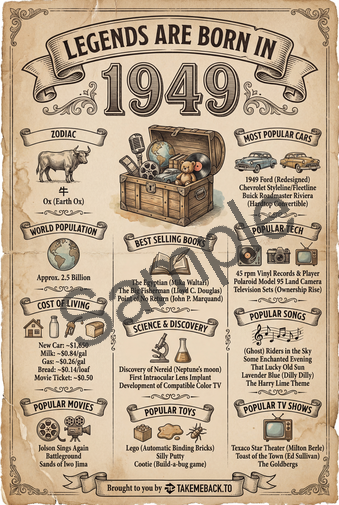

Major Events of 1949 - Historical Moments That Defined the Year | TakeMeBack.to
- 01 Jan KTTV TV Channel Launch: KTTV TV channel 11, a MET station, begins broadcasting in Los Angeles, California, further developing the television landscape in the region.
- 03 Jan Battle of Rafah begins: The final major combat operation of the Arab-Israeli War commenced with the Battle of Rafah, as Israel aimed to encircle Egyptian forces in Palestine and drive them back to Egypt. source: en.wikipedia.org
- 04 Jan Severe winter storms in Western United States: Severe winter storms impacted the Western United States, causing significant damage and loss of life, particularly in Arkansas and Louisiana. source: nytimes.com
- 05 Jan Truman's Fair Deal Program Unveiled: On January 5, 1949, President Harry S. Truman delivered his State of the Union address, proposing the "Fair Deal," an eight-point domestic reform program aimed at extending and updating the liberal thrust of President Franklin D. Roosevelt's New Deal. The program included national health insurance, public housing, civil rights legislation, and federal aid to education. source: history.com
- 08 Jan Lawrence Rowe born in Kingston, Jamaica: Lawrence George Rowe, a former West Indian cricketer, was born on January 8, 1949, in Kingston, Jamaica. He is renowned for his elegant batting style and significant contributions to West Indies cricket. source: en.wikipedia.org
- 10 Jan Communist victory in Huaihai Campaign: The Huaihai Campaign, a significant battle in the Chinese Civil War, concluded on January 10, 1949, with a decisive victory for the People's Liberation Army (PLA). The campaign lasted 66 days, resulting in the annihilation of approximately 555,000 Nationalist troops and the liberation of vast areas north of the Yangtze River. This victory significantly weakened the Nationalist forces and paved the way for the PLA's advance toward Nanjing and Shanghai. source: fmprc.gov.cn
- 12 Jan Dutch Court Sentences SS Chief Hanns Rauter: On January 12, 1949, a Dutch court confirmed the death sentence of Hanns Albin Rauter, the Higher SS and Police Leader in the Netherlands during World War II. Rauter was convicted of war crimes and executed by firing squad on March 24, 1949. source: en.wikipedia.org
- 13 Jan Durban riots in South Africa: On January 13, 1949, anti-Indian riots erupted in Durban, South Africa, following an altercation between an Indian storekeeper and an African youth. The violence led to the deaths of 142 people and the destruction of numerous properties. source: sahistory.org.za
- 15 Jan Communist forces capture Tianjin in China: On January 15, 1949, during the Chinese Civil War, Communist forces captured Tianjin after 29 hours of fighting, leading to the surrender of Nationalist troops and marking a significant victory for the Communists. source: en.wikipedia.org
- 16 Jan KNBH Television Channel launches in Los Angeles: On January 16, 1949, KNBH, later known as KNBC, began broadcasting on Channel 4 in Los Angeles. It was the last of NBC's five original owned-and-operated stations to sign on, marking the debut of NBC programs on the West Coast. The station initially broadcast from the NBC Radio City Studios on Sunset Boulevard and Vine Street in Hollywood. source: en.wikipedia.org
- 17 Jan Smith Act Trial of American Communists begins: On January 17, 1949, a trial commenced in New York City for eleven leaders of the Communist Party USA, charged under the Smith Act with conspiring to advocate the violent overthrow of the U.S. government. The trial was one of the lengthiest in U.S. history at that time, lasting ten months and drawing significant public attention. source: en.wikipedia.org
- 18 Jan They Stand Accused TV premiere: The television premiere of 'They Stand Accused' took place on January 18, 1949. This show was notable for its unique format, presenting real-life courtroom dramas to the audience. It contributed to the growing popularity of legal dramas on television. source: tvguide.com
- 19 Jan First appearance of the mysterious Poe Toaster: On January 19, 1949, the Poe Toaster made its first appearance at Edgar Allan Poe's grave in Baltimore, Maryland. This mysterious figure, known for leaving roses and a bottle of cognac, became a beloved tradition among Poe enthusiasts. The identity of the Poe Toaster remains unknown, adding to the intrigue surrounding the event. source: baltimoresun.com
- 20 Jan Truman's second term inauguration: Harry S. Truman was inaugurated for his second term as President of the United States on January 20, 1949. This event was notable as it was the first presidential inauguration to be televised, allowing millions of Americans to witness the ceremony. Truman's second term focused on post-war recovery and international relations. source: archives.gov
- 21 Jan US diplomatic recognition of Latin American governments: On January 21, 1949, the United States continued its policy of recognizing various Latin American governments, which was crucial for maintaining influence in the region during the early Cold War. This recognition was part of a broader strategy to counter Soviet influence. source: state.gov
- 22 Jan Beijing peacefully transitions to Communist control: On January 22, 1949, Beijing transitioned to Communist control without significant conflict, marking a pivotal moment in the Chinese Civil War. This event symbolized the consolidation of Communist power in China, leading to the establishment of the People's Republic later that year. source: britannica.com
- 23 Jan Japanese General Elections of 1949: On January 23, 1949, Japan held general elections under its new constitution. The Democratic Liberal Party secured a majority, winning 269 of the 466 seats in the House of Representatives. This election marked the first under the post-war constitution and led to the formation of Prime Minister Shigeru Yoshida's second cabinet. source: en.wikipedia.org
- 24 Jan France Recognizes Israel: On January 24, 1949, France officially recognized the State of Israel. This diplomatic move was significant in the post-World War II era, as Israel sought international legitimacy and support. France's recognition was part of a broader trend of European nations establishing relations with the new state. source: jewishvirtuallibrary.org
- 25 Jan First Israeli Election: On January 25, 1949, Israel held its first general elections. The elections were conducted to establish the first Knesset, Israel's legislative body, following the declaration of independence in 1948. The event marked a significant step in the consolidation of Israel's democratic institutions. source: jewishvirtuallibrary.org
- 26 Jan Hale Telescope First Light at Palomar Observatory: On January 26, 1949, the Hale Telescope at Palomar Observatory in California achieved its first light under the direction of astronomer Edwin Hubble. The telescope's inaugural observation targeted NGC 2261, also known as Hubble's Variable Nebula. This marked the beginning of the telescope's contributions to astronomy, including the discovery of quasars and advancements in understanding stellar evolution. source: astro.caltech.edu
- 28 Jan New York Giants break color barrier in baseball: On January 28, 1949, the New York Giants signed infielder Hank Thompson, making him one of the first African American players in Major League Baseball. This event was pivotal in breaking the color barrier in the sport. source: nytimes.com
- 29 Jan International recognition of Israel: On January 29, 1949, Israel was officially recognized by several countries, marking a significant step in its establishment as a sovereign state following its declaration of independence in 1948. source: britannica.com
- 30 Jan Paraguayan political coup: On January 30, 1949, a coup in Paraguay led to the overthrow of President Juan Natalicio González. This event marked a significant shift in the political landscape of Paraguay, leading to a series of military governments. source: britannica.com
- 31 Jan Pingjin campaign concludes: The Pingjin Campaign, a decisive military operation during the Chinese Civil War, concluded on January 31, 1949. This campaign resulted in the capture of Beijing by Communist forces, significantly impacting the war's outcome. source: britannica.com
- 01 Feb Hale telescope first used: The Hale Telescope, one of the largest optical telescopes in the world, was first used on February 1, 1949. Located at Palomar Observatory, it has played a crucial role in astronomical discoveries since its inception. source: britannica.com
- 02 Feb Ben Hogan survives severe auto accident: Professional golfer Ben Hogan was involved in a near-fatal car crash near Van Horn, Texas, while returning home with his wife after the Phoenix Open. The accident resulted in multiple injuries, including a broken left ankle, contusions to his left leg, a broken collarbone, a cracked rib, a double fracture of the pelvis, a head abrasion, and internal injuries. Despite initial doubts about his recovery, Hogan made a remarkable comeback to professional golf. source: skysports.com
- 04 Feb John Loves Mary film premiere: The comedy film 'John Loves Mary,' starring Ronald Reagan and Patricia Neal, premiered in New York City on February 4, 1949. Directed by David Butler, the film was released by Warner Bros. on February 19, 1949. source: en.wikipedia.org
- 05 Feb Huaso sets world record in horse high jump: On February 5, 1949, the Chilean horse Huaso, ridden by Captain Alberto Larraguibel, set a world record by jumping 2.47 meters (8 feet 1.25 inches) in Viña del Mar, Chile. This record remains unbroken. source: en.wikipedia.org
- 08 Feb Cardinal Mindszenty sentenced to life imprisonment in Hungary: On February 8, 1949, Cardinal József Mindszenty, the highest Catholic official in Hungary, was convicted of treason and sentenced to life imprisonment by the Communist People's Court. The trial and conviction were widely condemned in Western Europe and the United States as unjust. Mindszenty had been a vocal critic of the communist regime and had previously been arrested by Hungary's fascist government during World War II for denouncing the oppression of Jews. source: history.com
- 10 Feb 'Death of a Salesman' premieres on Broadway: Arthur Miller's play "Death of a Salesman" premiered on Broadway at the Morosco Theatre on February 10, 1949. Directed by Elia Kazan and starring Lee J. Cobb as Willy Loman, the production ran for 742 performances, winning six Tony Awards, including Best Play, and the Pulitzer Prize for Drama. source: ibdb.com
- 11 Feb Canadian Prime Minister Louis St. Laurent visits Washington, D.C.: Canadian Prime Minister Louis St. Laurent arrived in Washington, D.C., for a three-day informal visit to confer with President Harry S. Truman on various issues affecting the United States and Canada. source: history.state.gov
- 12 Feb Radio Broadcast Panic in Quito: A radio broadcast in Quito, Ecuador caused widespread panic among listeners, reminiscent of Orson Welles' famous 'War of the Worlds' broadcast, demonstrating the powerful psychological impact of mass media.
- 13 Feb António Óscar Carmona's Uncontested Presidential Re-election: On February 13, 1949, Portuguese President António Óscar Carmona was re-elected unopposed for a fourth term after his sole opponent, General José Norton de Matos, withdrew from the race due to government persecution. source: en.wikipedia.org
- 16 Feb UN Security Council rejects North Korea's membership application: On February 16, 1949, the United Nations Security Council held its 410th meeting to discuss the Democratic People's Republic of Korea's application for UN membership. The draft resolution (S/1259) proposing the admission was not adopted, effectively rejecting the application. The meeting's official records are available for reference. source: digitallibrary.un.org
- 17 Feb Chaim Weizmann becomes first President of Israel: On February 17, 1949, Chaim Weizmann was elected as the first President of Israel. His election marked a significant milestone in the establishment of the new state, following its declaration of independence in 1948. source: Wikipedia (day-month pages)
- 18 Feb Establishment of National Reactor Testing Station: On February 18, 1949, the United States Atomic Energy Commission assumed control of the Naval Proving Ground in Idaho's Lost River Desert, expanding it by 200,000 acres and renaming it the National Reactor Testing Station (NRTS). This facility became a central site for nuclear research and testing during the early years of the Cold War. source: defense.gov
- 19 Feb First Bollingen Prize for Poetry awarded to Ezra Pound: The inaugural Bollingen Prize for Poetry was awarded to Ezra Pound for his collection 'The Pisan Cantos'. This decision sparked controversy due to Pound's pro-Fascist activities during World War II. source: britannica.com
- 20 Feb Birth of Ivana Trump: Ivana Trump, born Ivana Marie Zelníčková, was born on February 20, 1949, in Zlín, Czechoslovakia (now Czechia). She was a Czech-American businesswoman, socialite, model, designer, and author. She was the first wife of Donald Trump, with whom she had three children: Donald Jr., Ivanka, and Eric. source: en.wikipedia.org
- 21 Feb Death of Tan Malaka, Indonesian Nationalist: Tan Malaka, a 51-year-old Indonesian nationalist activist and guerrilla fighter, was executed by the Indonesian army on February 21, 1949. source: en.wikipedia.org
- 24 Feb Arab-Israeli War Armistice Agreements signed: The Arab-Israeli War Armistice Agreements were signed on February 24, 1949, marking the end of hostilities between Israel and its neighboring Arab states. These agreements established the borders of the newly formed state of Israel and laid the groundwork for future peace negotiations. source: britannica.com
- 25 Feb First US ambassador to Israel appointed: On February 25, 1949, the United States appointed its first ambassador to Israel, marking a significant step in diplomatic relations between the two nations. This appointment underscored the U.S. commitment to supporting Israel post-independence. source: state.gov
- 26 Feb First nonstop around-the-world flight by US Air Force: On February 26, 1949, the US Air Force's Boeing B-50A Superfortress, Lucky Lady II, departed from Carswell Air Force Base in Texas for a nonstop circumnavigation. The mission lasted 94 hours and 1 minute, covering 23,452 miles with four in-flight refuelings, and concluded on March 2, 1949. source: defense.gov
- 27 Feb Chaim Weizmann becomes first President of Israel: On February 27, 1949, Chaim Weizmann was elected as the first President of Israel. He served as the head of state until his death in 1952. source: en.wikipedia.org
- 28 Feb Birth of actress Ilene Graff: Ilene Graff, an American actress and singer known for her roles in television and theater, was born on February 28, 1949. source: en.wikipedia.org
- 01 Mar Indonesia seizes Yogyakarta from the Dutch: On March 1, 1949, Indonesian forces captured Yogyakarta, the last major stronghold of the Dutch in Indonesia, marking a significant step towards the country's independence. source: en.wikipedia.org
- 02 Mar First non-stop round-the-world flight completed: On March 2, 1949, the U.S. Air Force's Boeing B-50A Superfortress, Lucky Lady II, completed the first non-stop, round-the-world flight. Piloted by Captain James G. Gallagher, the aircraft covered 23,452 miles in 94 hours and 1 minute, demonstrating the U.S. military's global reach. source: fai.org
- 05 Mar Israel Defense Forces launch Operation Uvda: On March 5, 1949, the Israel Defense Forces initiated Operation Uvda, aiming to establish Israeli sovereignty over the southern Negev desert, which was claimed by Jordan during the 1949 armistice talks. source: en.wikipedia.org
- 08 Mar Axis Sally convicted of treason: On March 8, 1949, Mildred Gillars, known as Axis Sally, was convicted of treason in the United States for her propaganda broadcasts during World War II. Her trial highlighted issues of loyalty and the impact of wartime propaganda on public perception. source: archives.gov
- 09 Mar Kim Il Sung meets Stalin in Kremlin: On March 9, 1949, North Korean leader Kim Il Sung met with Soviet Premier Joseph Stalin in the Kremlin. This meeting was crucial for North Korea's political alignment and military support from the Soviet Union during the early Cold War period. source: britannica.com
- 10 Mar Axis Sally convicted of treason: Mildred Gillars, known as Axis Sally, was convicted of treason for her propaganda broadcasts during World War II. She was sentenced to 10 to 30 years in prison for her role in aiding the enemy. Her case highlighted the complexities of wartime loyalty and free speech. source: archives.gov
- 11 Mar Kim Il Sung meets Stalin in the Kremlin: On March 11, 1949, North Korean leader Kim Il Sung met with Soviet leader Joseph Stalin in the Kremlin. This meeting was crucial for North Korea's political alignment and military support from the Soviet Union during the early Cold War. It solidified the relationship between the two leaders and their countries. source: britannica.com
- 12 Mar US Defense Secretary discusses biological warfare: On March 12, 1949, U.S. Defense Secretary Louis Johnson addressed concerns regarding biological warfare. This discussion highlighted the emerging threats and the need for preparedness during the early Cold War period. source: archives.gov
- 13 Mar Jeju Uprising military offensive: The Jeju Uprising, which began in 1948, saw a significant military offensive on March 13, 1949. This conflict was a response to the South Korean government's crackdown on dissent, leading to widespread violence and casualties. source: bbc.com
- 14 Mar End of clothes rationing in post-war Britain: On March 14, 1949, clothes rationing in post-war Britain officially ended. This marked a significant shift in consumer freedom and the economy as the country began to recover from wartime restrictions. source: bbc.com
- 15 Mar Death of Gheorghe Brăescu, Romanian Writer: Gheorghe Brăescu, a Romanian writer born on January 30, 1871, passed away on March 15, 1949. He was known for his works such as "Vine doamna şi domnul gheneral" (1919) and "Moş Belea" (1927). source: en.wikipedia.org
- 17 Mar Grand Opening of the Shamrock Hotel in Houston: The Shamrock Hotel, designed by architect Morris Aubry, opened its doors in Houston, Texas, on March 17, 1949. It was known for its luxurious accommodations and unique design, becoming a notable landmark in the city. source: houstonchronicle.com
- 18 Mar NATO Pact ratification: The North Atlantic Treaty Organization (NATO) was ratified on March 18, 1949, establishing a military alliance among North American and European countries. This pact was a significant step in collective defense during the Cold War era. source: nato.int
- 19 Mar Death of Sir James Somerville: Sir James Somerville, a British admiral and naval commander during World War II, passed away on March 19, 1949. He was known for his leadership in various naval operations and contributions to the Royal Navy. source: britannica.com
- 20 Mar Mosley Union Movement parade disrupted: On March 20, 1949, a parade organized by the Mosley Union Movement was disrupted, leading to significant public attention and controversy. The event highlighted tensions surrounding labor movements and civil rights during that era. source: theguardian.com
- 21 Mar Birth of Slavoj Žižek: Slavoj Žižek, a prominent Slovenian philosopher and cultural critic, was born on March 21, 1949. He is known for his work on psychoanalysis, Marxism, critical theory, and film criticism. source: theguardian.com
- 22 Mar Fanny Ardant birth: Fanny Ardant, a renowned French actress and director, was born on March 22, 1949. She is known for her roles in various films and has received numerous awards throughout her career. source: britannica.com
- 23 Mar Lebanon-Israel Armistice Agreement: The Lebanon-Israel Armistice Agreement was signed on March 23, 1949, marking the end of hostilities between Lebanon and Israel following the 1948 Arab-Israeli War. This agreement was part of a series of armistice agreements between Israel and its neighboring states. source: un.org
- 24 Mar Nazi war criminal executed for crimes against humanity: On March 24, 1949, a Nazi war criminal was executed for crimes against humanity, marking a significant moment in post-war justice. This execution was part of the broader efforts to hold individuals accountable for war crimes during World War II. source: britannica.com
- 25 Mar Soviet deportation of Baltic peoples: On March 25, 1949, the Soviet Union began Operation Priboi, a mass deportation of over 90,000 Estonians, Latvians, and Lithuanians to Siberia. This operation aimed to eliminate resistance to Soviet rule and facilitate collectivization. source: en.wikipedia.org
- 26 Mar Kentucky Wildcats win NCAA basketball championship: On March 26, 1949, the Kentucky Wildcats defeated the Oklahoma A&M Aggies 46-36 to win the NCAA men's basketball championship. Alex Groza was named the tournament's Most Outstanding Player. source: sports-reference.com
- 28 Mar Fred Hoyle coins 'Big Bang' term: On March 28, 1949, astronomer Fred Hoyle coined the term "Big Bang" during a BBC radio broadcast to describe the theory that the universe originated from a single, explosive event. Hoyle, who advocated for the steady-state model of the universe, used the term to contrast his theory with the Big Bang concept. He later clarified that the term was intended as a vivid image to highlight the differences between the two models, not as a derogatory remark. source: vaticanobservatory.org
- 30 Mar NATO riot in Reykjavík, Iceland: On March 30, 1949, a significant protest occurred in Reykjavík against Iceland's membership in NATO. The demonstration was fueled by concerns over military presence and national sovereignty. This event marked a pivotal moment in Iceland's post-war political landscape. source: nato.int
- 31 Mar Churchill's Cold War warning: On March 31, 1949, Winston Churchill delivered a speech warning about the dangers of the Cold War and the threat posed by the Soviet Union. He emphasized the need for unity among Western nations to counteract Soviet expansionism. This speech is often cited as a significant moment in Cold War rhetoric. source: bbc.com
- 01 Apr Chinese Civil War peace talks fail: On April 1, 1949, peace talks aimed at resolving the Chinese Civil War collapsed, leading to the continuation of hostilities between the Nationalists and Communists. This failure significantly impacted the future of China and set the stage for the establishment of the People's Republic of China later that year. source: britannica.com
- 03 Apr Costa Rican coup attempt suppressed: On April 3, 1949, a coup attempt in Costa Rica was suppressed, leading to significant political changes in the country. This event marked a pivotal moment in Costa Rican history, contributing to the establishment of a stable democracy. source: britannica.com
- 04 Apr Israel-Jordan armistice agreement: On April 4, 1949, Israel and Jordan signed an armistice agreement, marking a significant step towards peace following the 1948 Arab-Israeli War. This agreement established the borders between the two nations and laid the groundwork for future negotiations. It was part of a series of armistice agreements between Israel and its neighboring Arab states. source: britannica.com
- 05 Apr Saint Anthony's Hospital fire tragedy: The Saint Anthony's Hospital fire occurred on April 5, 1949, in Chicago, resulting in the deaths of 77 patients and staff. The tragedy was one of the deadliest hospital fires in U.S. history and led to significant changes in fire safety regulations in healthcare facilities. Investigations revealed numerous safety violations that contributed to the high casualty rate. source: nytimes.com
- 06 Apr Israel introduces first national currency: On April 6, 1949, Israel introduced its first national currency, the Israeli pound, which replaced the Palestine pound. This move was part of the country's efforts to establish a stable economic foundation following its independence in 1948. The new currency symbolized national sovereignty and economic independence. source: britannica.com
- 07 Apr South Pacific Broadway Premiere: The musical 'South Pacific' premiered on Broadway at the Majestic Theatre in New York City, becoming an immediate hit and running for almost five years. source: history.com
- 09 Apr First televised charity telethon in history: On April 9, 1949, comedian Milton Berle hosted the first-ever telethon on NBC, raising approximately $1.1 million for the Damon Runyon Cancer Fund. The 16-hour broadcast featured various entertainment segments, including quiz shows, musical performances, and comic acts, setting the precedent for future televised fundraising events. source: time.com
- 13 Apr Minneapolis Lakers win NBA Championship: The Minneapolis Lakers secured the first-ever NBA Championship by defeating the Washington Capitols in the finals. This victory marked a significant moment in basketball history, establishing the Lakers as a dominant force in the league. source: nba.com
- 14 Apr US response to Soviet charges at UN: The United States addressed accusations made by the Soviet Union during a United Nations meeting. This event highlighted the growing tensions of the Cold War and the diplomatic struggles between the two superpowers. source: un.org
- 15 Apr Pope Pius XII publishes encyclical Redemptoris Nostri: Pope Pius XII issued the encyclical 'Redemptoris Nostri,' addressing various theological and moral issues of the time. This document aimed to guide the Catholic Church's stance on contemporary challenges. source: vatican.va
- 16 Apr Record coal delivery during Berlin Airlift: During the Berlin Airlift, a record amount of coal was delivered to West Berlin, showcasing the efforts of the Allies to support the city amidst the Soviet blockade. This event was crucial for maintaining the city's energy supply. source: britannica.com
- 18 Apr Ireland becomes a republic: On April 18, 1949, Ireland officially became a republic, severing its last constitutional ties with the United Kingdom. The Republic of Ireland Act 1948, which came into force on this date, declared the state as the Republic of Ireland and transferred the executive authority in external relations from the British monarch to the President of Ireland. This marked the culmination of Ireland's journey towards full sovereignty. source: parliament.uk
- 19 Apr Marshall Plan extension approved by Congress: On April 19, 1949, the U.S. Congress approved the extension of the Marshall Plan, which provided economic aid to European countries recovering from World War II. This extension aimed to bolster European economies and prevent the spread of communism in the region. source: archives.gov
- 20 Apr HMS Amethyst incident in Yangtze River: On April 20, 1949, the British Royal Navy ship HMS Amethyst was involved in a significant incident on the Yangtze River, where it was fired upon by Chinese Communist forces. The ship's crew faced a perilous situation, leading to a dramatic escape that garnered international attention. source: bbc.com
- 21 Apr Communist forces capture Nanjing: On April 21, 1949, Communist forces captured Nanjing, the capital of the Republic of China, during the Chinese Civil War. This event marked a significant turning point in the conflict, leading to the eventual establishment of the People's Republic of China. source: bbc.com
- 22 Apr Commonwealth Prime Ministers' Conference convenes in London: On April 22, 1949, the Commonwealth Prime Ministers' Conference convened in London, bringing together leaders from various Commonwealth nations to discuss issues of mutual interest and cooperation. This conference was significant in shaping post-war relations within the Commonwealth. source: britannica.com
- 23 Apr Chinese Communist Troops Capture Nanjing: On April 23, 1949, Chinese Communist forces captured Nanjing, the capital of the Republic of China, marking a pivotal moment in the Chinese Civil War. source: chinadaily.com.cn
- 28 Apr Indian Larry: motorcycle builder and stuntman: Indian Larry, a prominent motorcycle builder and stuntman, was born on April 28, 1949. He became well-known for his custom motorcycle designs and his appearances in various motorcycle shows and films. source: britannica.com
- 01 May Discovery of Neptune's Moon Nereid: On May 1, 1949, astronomer Gerard P. Kuiper discovered Nereid, the third-largest known moon of Neptune, using a ground-based telescope. Nereid is unique due to its highly eccentric orbit, taking it between 1.4 million and 9.7 million kilometers from Neptune over its 360-day journey around the planet. source: science.nasa.gov
- 02 May Arthur Miller wins Pulitzer Prize for Death of a Salesman: Arthur Miller was awarded the Pulitzer Prize for Drama in 1949 for his play 'Death of a Salesman'. The play is considered a classic of American theater, exploring themes of identity and the American Dream. source: britannica.com
- 03 May First US Viking rocket launch: The first Viking rocket was launched on May 3, 1949, marking a significant milestone in American rocketry. This launch was part of a series of tests that contributed to the development of future space exploration technologies. source: nasa.gov
- 04 May Torino football team air disaster: On May 4, 1949, the Torino football team tragically crashed into the Basilica of Superga in Italy, resulting in the deaths of all 31 people on board. This disaster is one of the most significant tragedies in sports history. source: bbc.com
- 05 May Council of Europe established in London: The Council of Europe was established on May 5, 1949, in London, with the aim of promoting democracy and human rights in Europe. It was formed by ten founding member states and has since expanded to include 47 member countries. source: coe.int
- 06 May EDSAC first operation: a milestone in computing: The Electronic Delay Storage Automatic Calculator (EDSAC) performed its first operation on May 6, 1949. This event marked a significant milestone in the history of computing as it was one of the first stored-program computers. source: bbc.co.uk
- 07 May 75th Kentucky Derby won by Ponder: On May 7, 1949, Ponder won the 75th running of the Kentucky Derby, a prestigious horse race held annually in Louisville, Kentucky. This victory added to the rich history of the Derby. source: britannica.com
- 08 May West German Constitution established: On May 8, 1949, the Basic Law (Grundgesetz) was adopted, establishing the constitution of the Federal Republic of Germany (West Germany). This document laid the foundation for the country's democratic governance post-World War II. source: britannica.com
- 09 May Israel joins the United Nations: On May 9, 1949, Israel was admitted as the 59th member of the United Nations, following its declaration of independence in 1948. source: un.org
- 10 May West German Parliamentary Council selects Bonn as capital: On May 10, 1949, the Parliamentary Council of West Germany selected Bonn as the provisional capital of the Federal Republic of Germany. This decision was made during the drafting of the Basic Law, which served as the constitution for West Germany. source: dw.com
- 11 May Israel joins the United Nations: On May 11, 1949, Israel was admitted as the 59th member of the United Nations. This followed the country's declaration of independence in 1948 and its subsequent recognition by the international community. source: un.org
- 12 May Soviet Berlin Blockade ends: The Berlin Blockade, initiated by the Soviet Union in June 1948, ended on May 12, 1949. This blockade was a significant event during the early Cold War, leading to the Berlin Airlift and highlighting the tensions between the Soviet Union and the Western Allies. source: britannica.com
- 13 May Birth of actress Zoë Wanamaker: Zoë Wanamaker, a renowned British actress, was born on May 13, 1949. She is known for her work in theater, television, and film, earning acclaim for her performances in various productions. source: britannica.com
- 14 May Gerhart Eisler arrested aboard Polish liner: On May 14, 1949, Gerhart Eisler, a German communist and former member of the German parliament, was arrested aboard a Polish liner in New York. His arrest was part of the broader context of the Red Scare and anti-communist sentiment in the United States during this period. source: nytimes.com
- 17 May India's Commonwealth membership: On May 17, 1949, the British government recognized India's decision to remain a member of the Commonwealth of Nations, despite adopting a republican constitution. This decision was formalized during the Commonwealth Prime Ministers' Conference in London, where the London Declaration was issued, affirming India's continued membership and the acceptance of the British monarch as the symbol of the free association of its independent member nations. source: thecommonwealth.org
- 18 May Rick Wakeman born: Richard Christopher Wakeman, an English keyboardist and composer, was born in Perivale, Middlesex, England. He is best known for his work with the progressive rock band Yes and his prolific solo career. source: en.wikipedia.org
- 19 May Death of Paul Schultze-Naumburg: Paul Schultze-Naumburg, a German traditionalist architect, painter, publicist, and author, died on this date. He was known for his criticism of modern architecture and his advocacy for traditional styles. source: en.wikipedia.org
- 21 May Birth of Andrew Neil: Andrew Neil, a prominent British journalist and broadcaster, was born on May 21, 1949. He is known for his work in political journalism and has held various editorial positions throughout his career. source: bbc.com
- 22 May James Forrestal's controversial death: James Forrestal, the first U.S. Secretary of Defense, died on May 22, 1949, under controversial circumstances. His death was ruled a suicide, but many conspiracy theories have emerged regarding the events leading up to it. source: britannica.com
- 23 May Alan García Pérez birth: Alan García Pérez, a prominent Peruvian politician and former president of Peru, was born on May 23, 1949. He served two non-consecutive terms and was a significant figure in Peruvian politics during the late 20th century. source: bbc.com
- 24 May Soviet Union ends Berlin Blockade: On May 24, 1949, the Soviet Union lifted the Berlin Blockade, which had been in place since June 1948. The blockade had cut off all land and water routes to West Berlin, aiming to force the Western Allies to abandon the city. The end of the blockade marked a significant de-escalation in Cold War tensions. source: history.com
- 26 May Dan Pastorini born in San Francisco, California: Dan Pastorini, former NFL quarterback, was born on May 26, 1949, in San Francisco, California. He played 13 seasons in the NFL, primarily with the Houston Oilers, and was known for his toughness and leadership on the field. source: en.wikipedia.org
- 27 May Jo Ann Harris born in Los Angeles, California: Jo Ann Harris, an American actress known for her roles in films such as 'The Beguiled' (1971) and 'The Parallax View' (1974), was born on May 27, 1949, in Los Angeles, California. source: imdb.com
- 28 May Birth of Wendy O. Williams, punk rock pioneer: Wendy O. Williams, the lead singer of the punk rock band Plasmatics, was born on May 28, 1949. She was known for her provocative performances and was a significant figure in the punk rock movement. source: en.wikipedia.org
- 29 May Ford labor strike concludes: The Ford labor strike, which began earlier in 1949, concluded on May 29. This strike was significant in the context of labor relations in the automotive industry, impacting negotiations and worker rights. source: nytimes.com
- 30 May First general election in Suriname: Suriname held its first general election on May 30, 1949, marking a pivotal moment in its political history. This election was crucial for establishing democratic governance in the country. source: britannica.com
- 31 May Alger Hiss Perjury Trial Begins: The first perjury trial of Alger Hiss, a former U.S. State Department official accused of espionage, began on May 31, 1949, in New York before Judge Samuel Kaufman. The trial ended in a hung jury on July 7, 1949. source: fbi.gov
- 02 Jun Birth of astronomer Heather Couper: Heather Couper, a prominent British astronomer and science communicator, was born on June 2, 1949. She was known for her work in popularizing astronomy and her contributions to various educational programs. source: bbc.co.uk
- 03 Jun First African American graduate from US Naval Academy: On June 3, 1949, Charles Bolden became the first African American to graduate from the United States Naval Academy. His achievement paved the way for future generations of minority students in military academies. source: usna.edu
- 04 Jun Cavalcade of Stars television premiere: The television show 'Cavalcade of Stars' premiered on June 4, 1949. It was notable for showcasing various talents and became a significant part of early television history. source: britannica.com
- 05 Jun First female Thai parliamentarian elected: On June 5, 1949, Orapin Chaiyakan was elected as the first woman to the House of Representatives of Thailand, representing Ubon Ratchathani Province. She was a member of the Democrat Party. source: en.wikipedia.org
- 06 Jun Mahabodhi Temple Act restores partial Buddhist control: The Bodh Gaya Temple Act of 1949 established the Bodhgaya Temple Management Committee, granting partial control of the Mahabodhi Temple to Buddhists, though the committee included both Buddhist and Hindu members. source: en.wikipedia.org
- 07 Jun Whittaker Chambers testifies in Alger Hiss trial: On June 7, 1949, Whittaker Chambers testified in the perjury trial of Alger Hiss, a former State Department official accused of espionage. Chambers, a former Communist Party member, alleged that Hiss had been part of a Communist underground in the late 1930s and had provided him with classified documents. This testimony was pivotal in the case, leading to Hiss's conviction on perjury charges in 1950. source: msa.maryland.gov
- 10 Jun Death of Sigrid Undset: Sigrid Undset, a Norwegian author and Nobel Prize winner, passed away on June 10, 1949. She is renowned for her historical novels, particularly 'Kristin Lavransdatter,' which explores themes of love, faith, and the human condition. Her works reflect her deep understanding of medieval Norway. source: britannica.com
- 11 Jun George Orwell's '1984' published: George Orwell's dystopian novel '1984' was published on June 11, 1949. The book explores themes of totalitarianism, surveillance, and individuality, and has since become a classic of modern literature. Its impact on political thought and culture remains significant today. source: britannica.com
- 12 Jun UC Berkeley Faculty Loyalty Oath Controversy: In 1949, the University of California implemented a loyalty oath for faculty members, sparking significant controversy. Many faculty members opposed the oath, arguing it infringed on academic freedom and civil liberties. The situation escalated, leading to protests and legal challenges. source: berkeley.edu
- 14 Jun First Mammal in Space: Albert II's Historic Rocket Flight: On June 14, 1949, Albert II, a rhesus monkey, became the first mammal to travel into space aboard a V-2 rocket. This flight marked a significant milestone in space exploration, paving the way for future human spaceflight. Albert II's journey provided valuable data on the effects of space travel on living organisms. source: nasa.gov
- 15 Jun Taiwan currency reform: On June 15, 1949, Taiwan introduced the New Taiwan dollar to replace the Old Taiwan dollar, with an exchange rate of 1 new dollar to 40,000 old dollars, aiming to stabilize the economy amid hyperinflation. source: en.wikipedia.org
- 16 Jun Paulo Cézar Lima's birth: Paulo Cézar Lima, commonly known as Caju, a Brazilian former professional footballer who played as an attacking midfielder, was born in Rio de Janeiro, Brazil. source: en.wikipedia.org
- 18 Jun Birth of Jarosław Kaczyński: Jarosław Kaczyński, future Prime Minister of Poland, was born in Warsaw. source: britannica.com
- 20 Jun Central Intelligence Agency Act passes: The Central Intelligence Agency Act was enacted on June 20, 1949, providing for the administration of the CIA, established under the National Security Act of 1947. source: cia.gov
- 23 Jun Dutch Constellation Aircraft Crash in Bari, Italy: On June 23, 1949, a KLM Lockheed L-749 Constellation named 'Roermond' crashed into the Adriatic Sea near Bari, Italy, during a flight from Cairo to Amsterdam. All 33 occupants, including 11 crew members and 22 passengers, were killed. The aircraft was cruising at 5,000 meters when it lost control and entered a dive, with the tail section detaching before the crash. The exact cause remains undetermined, but a failure of the autopilot system was suspected. source: baaa-acro.com
- 24 Jun Cumbre Vieja volcano eruption begins: On June 24, 1949, the Cumbre Vieja volcano on La Palma in the Canary Islands erupted, marking the start of a 37-day eruption that lasted until July 30, 1949. The eruption began with phreatomagmatic explosions from the Duraznero vent, followed by lava flows from the Llano del Banco vent, and concluded with renewed activity at Duraznero and Hoyo Negro vents. source: en.wikipedia.org
- 25 Jun Syrian presidential powers referendum and Husni al-Za'im's candidacy approval: On June 25, 1949, Syria held a referendum on presidential powers and Husni al-Za'im's candidacy for president. Al-Za'im's candidacy was approved by 99.4% of voters. source: en.wikipedia.org
- 26 Jun Berlin Airlift begins: Operation Vittles launched: On June 26, 1949, the Berlin Airlift began with the launch of Operation Vittles, a massive airlift operation to supply West Berlin during the Soviet blockade.
- 28 Jun Alabama Anti-Mask Law Signed: On June 28, 1949, Alabama Governor Jim Folsom signed a law making it a misdemeanor to appear in public wearing a mask. The law was enacted to counteract the Ku Klux Klan's activities in the state. source: time.com
- 29 Jun Joan Clos i Matheu, Mayor of Barcelona: Joan Clos i Matheu was born on this date, who would later become a prominent political figure and mayor of Barcelona from 1997 to 2006.
- 01 Jul Establishment of the Institute of Chartered Accountants of India: The Institute of Chartered Accountants of India (ICAI) was established on July 1, 1949, under the Chartered Accountants Act, 1949. It serves as the national professional accounting body in India, responsible for regulating the profession of Chartered Accountancy. ICAI plays a crucial role in setting accounting and auditing standards, ensuring financial integrity, and contributing to the country's economic development. source: icai.org
- 02 Jul Vasil Kolarov becomes Bulgarian Prime Minister: Following the death of Prime Minister Georgi Dimitrov on July 2, 1949, Vasil Kolarov was appointed as the new Prime Minister of Bulgaria. Kolarov served as acting Prime Minister from July 2 to July 20, 1949, and then officially from July 20, 1949, until his death on January 23, 1950. source: en.wikipedia.org
- 07 Jul Birth of Shelley Duvall: Shelley Alexis Duvall was born on July 7, 1949, in Fort Worth, Texas. She became a renowned American actress and producer, known for her distinctive screen presence and portrayals of eccentric characters. source: en.wikipedia.org
- 08 Jul Monte Irvin and Hank Thompson Join New York Giants: On July 8, 1949, Monte Irvin and Hank Thompson became the first African American players to join the New York Giants, breaking baseball's color barrier and marking a significant moment in the sport's history. source: baseball-reference.com
- 09 Jul Bobby Locke Wins British Open Golf Championship: On July 9, 1949, South African golfer Bobby Locke won the British Open Golf Championship, marking his fourth victory in the tournament. source: theopen.com
- 10 Jul Khait Earthquake Disaster: On July 10, 1949, a magnitude 7.5 earthquake struck the Gharm Oblast of the Tajik SSR (now Tajikistan), triggering landslides that led to approximately 7,200 deaths. source: en.wikipedia.org
- 11 Jul Newfoundland and Labrador's First General Assembly in Canadian Federation: On July 11, 1949, Newfoundland and Labrador became the tenth province of Canada, holding its first general assembly within the Canadian Federation. source: en.wikipedia.org
- 12 Jul Death of Douglas Hyde, first President of Ireland: Douglas Hyde, the first President of Ireland, passed away on July 12, 1949. He was a prominent figure in the Irish cultural revival and served as president from 1938 until 1945, advocating for the Irish language and culture. source: bbc.com
- 13 Jul Vatican excommunicates Communist Catholics: On July 13, 1949, the Vatican issued a decree excommunicating Catholics who were members of the Communist Party. This decision was part of the Church's broader stance against communism during the Cold War, emphasizing the incompatibility of Catholicism and communist ideology. source: catholicnewsagency.com
- 14 Jul USSR detonates first atomic bomb: On July 14, 1949, the Soviet Union successfully detonated its first atomic bomb, marking a significant moment in the Cold War. This event escalated the arms race between the USSR and the United States, leading to heightened global tensions. source: britannica.com
- 15 Jul Czech Tennis Stars Defect to the West: Czech tennis players Jaroslav Drobný and Vladimír Černík defected to the West on July 15, 1949, during the Swiss Championships in Gstaad. They announced their decision to seek asylum in the United States, defying orders from the Czechoslovak national sports organization to return to Prague. source: en.wikipedia.org
- 17 Jul Birth of Geezer Butler, Black Sabbath musician: Terence Michael Joseph "Geezer" Butler, the English bassist and primary lyricist of the heavy metal band Black Sabbath, was born on July 17, 1949, in Birmingham, England. source: en.wikipedia.org
- 19 Jul French Union Agreement with Laos: On July 19, 1949, France signed an agreement with Laos, granting it autonomy within the French Union. This agreement marked a significant step towards Laos's eventual independence from colonial rule. source: britannica.com
- 20 Jul Israel's War of Independence concludes: The War of Independence for Israel officially concluded on July 20, 1949, with the signing of armistice agreements. This marked the establishment of Israel as a sovereign state following a period of conflict with neighboring Arab nations. source: britannica.com
- 21 Jul United States Senate ratifies NATO Treaty: On July 21, 1949, the U.S. Senate ratified the North Atlantic Treaty by a vote of 82 to 13, marking the United States' commitment to the North Atlantic Treaty Organization (NATO). source: visitthecapitol.gov
- 22 Jul Birth of Alan Menken, American composer: Alan Menken, an American composer and pianist known for his work on Disney films, was born on July 22, 1949, in New York City. source: en.wikipedia.org
- 24 Jul Stan Musial hits for the cycle: On July 24, 1949, Stan Musial of the St. Louis Cardinals achieved the rare feat of hitting for the cycle in a 14-1 victory over the Brooklyn Dodgers at Ebbets Field. Musial's performance included a single, double, triple, and home run, contributing to the Cardinals' rise to first place in the National League. source: stlredbirds.com
- 26 Jul Roger Taylor born: Roger Taylor, the English musician and drummer of the rock band Queen, was born on July 26, 1949. He is renowned for his contributions to the band's music and his solo career.
- 27 Jul De Havilland Comet's maiden flight: The De Havilland Comet, the world's first commercial jet airliner, made its maiden flight on July 27, 1949. This marked a significant milestone in aviation history, paving the way for future developments in commercial air travel. source: britannica.com
- 28 Jul Vida Blue: baseball legend: Vida Blue, an American professional baseball pitcher, was born on July 28, 1949. He became a prominent figure in Major League Baseball, known for his exceptional skills and contributions to the sport. source: britannica.com
- 29 Jul Berlin Airlift concludes: The Berlin Airlift, a major operation to supply West Berlin with food and fuel during the Soviet blockade, concluded on July 29, 1949. This event marked a significant moment in the early Cold War period. source: britannica.com
- 30 Jul HMS Amethyst escapes Yangtze River under cover of darkness: On July 30, 1949, the British frigate HMS Amethyst initiated a daring escape from the Yangtze River after being trapped for months due to Chinese Communist artillery fire. Under the command of Lieutenant Commander John Kerans, the ship slipped its anchor chain and navigated downstream, evading Communist shore batteries. By dawn on July 31, Amethyst rendezvoused with the destroyer HMS Concord, rejoining the British fleet off Woosung. source: iwm.org.uk
- 31 Jul HMS Amethyst escapes Chinese fire on Yangtze River: On July 31, 1949, the British frigate HMS Amethyst successfully escaped Chinese Communist artillery fire on the Yangtze River. After slipping its anchor chain on July 30, the ship navigated downstream under cover of darkness, evading Communist shore batteries. By dawn on July 31, Amethyst rendezvoused with the destroyer HMS Concord, rejoining the British fleet off Woosung. source: iwm.org.uk
- 02 Aug Western powers reject Soviet accusations on NATO and Italy: On August 2, 1949, Western powers, including the United States and its allies, dismissed Soviet accusations regarding NATO's intentions in Italy. This event highlighted the growing tensions of the Cold War era. source: britannica.com
- 03 Aug Dutch upper house ratifies NATO treaty: On August 3, 1949, the Dutch upper house ratified the NATO treaty, solidifying the Netherlands' commitment to the North Atlantic Treaty Organization. This was a key moment in the establishment of NATO as a military alliance. source: nato.int
- 04 Aug Formation of the National Basketball Association (NBA): The formal formation of the National Basketball Association (NBA) took place on August 4, 1949, following the merger of the Basketball Association of America and the National Basketball League. This event was pivotal in the history of professional basketball. source: britannica.com
- 05 Aug Ambato earthquake in Ecuador: On August 5, 1949, a 6.8 magnitude earthquake struck Ecuador's Tungurahua Province, southeast of its capital Ambato, resulting in the deaths of over 5,000 people. The earthquake destroyed several towns, including Guano, Patate, Pelileo, and Pillaro, and caused significant damage to Ambato, leaving approximately 100,000 people homeless. source: en.wikipedia.org
- 07 Aug British Gloster Meteor Sets Endurance Record: On August 7, 1949, a British Gloster Meteor III, piloted by Patrick Hornidge, set a new jet endurance record by remaining airborne for 12 hours and 3 minutes. The aircraft was refueled ten times by a Lancaster tanker, covering a distance of 3,600 miles. This achievement demonstrated the potential of jet aircraft for long-duration flights. source: en.wikipedia.org
- 08 Aug First Council of Europe Meeting: The Council of Europe held its inaugural meeting in Strasbourg, France, on August 8, 1949. This meeting marked the beginning of the organization's efforts to promote human rights, democracy, and the rule of law among European nations. source: coe.int
- 10 Aug First North American Jet Airliner Flight: On August 10, 1949, the Avro Canada C102 Jetliner made its first flight, becoming the first jet airliner designed and built in the Western Hemisphere and the second worldwide to fly. source: en.wikipedia.org
- 12 Aug Fourth Geneva Convention established: The Fourth Geneva Convention was adopted on August 12, 1949, focusing on the protection of civilians during times of war. This convention is a crucial part of international humanitarian law, aiming to safeguard those who are not participating in hostilities. source: un.org
- 13 Aug Third Geneva Convention adopted, establishing humanitarian war standards: The Third Geneva Convention was adopted on August 13, 1949, focusing on the treatment of prisoners of war. This convention set important standards for humanitarian treatment during armed conflicts, reinforcing the principles of international humanitarian law. source: britannica.com
- 14 Aug Syrian military coup by Colonel Sami Hinnawi: On August 14, 1949, Colonel Sami Hinnawi led a military coup in Syria, further destabilizing the political environment in the country. This coup was part of a broader trend of military interventions in Syrian governance during this period. source: britannica.com
- 15 Aug WOTV TV Channel 8 Launches in Grand Rapids: On August 15, 1949, WLAV-TV, the predecessor of WOOD TV8, began broadcasting on Channel 7 from the Grand Rapids National Bank Building, marking the first television station in West Michigan. source: woodtv.com
- 17 Aug Theodor Herzl reinterment: Theodor Herzl, the founder of modern political Zionism, was reinterred in Jerusalem on August 17, 1949. This event marked a significant moment in Jewish history, symbolizing the establishment of a Jewish homeland in Israel. source: britannica.com
- 18 Aug Hungary adopts new constitution: On August 18, 1949, Hungary adopted a new constitution that established a people's republic and solidified the communist regime's power. This constitution was a significant step in the establishment of a socialist state in Hungary. source: britannica.com
- 19 Aug Peru severs diplomatic ties with Cuba: On August 19, 1949, Peru officially severed diplomatic relations with Cuba, reflecting the growing tensions in Latin America during the Cold War. This decision was part of a broader shift in regional politics. source: reuters.com
- 20 Aug Hungary becomes a People's Republic: On August 20, 1949, Hungary officially became the Hungarian People's Republic, marking the establishment of a communist state under Soviet influence. This followed the adoption of a new constitution, Act XX of 1949, which was modeled after the Soviet Constitution and led to the renaming of the country. source: en.wikipedia.org
- 21 Aug Queen Charlotte Islands earthquake: On August 21, 1949, a magnitude 8.1 earthquake struck the Queen Charlotte Islands (now Haida Gwaii) off the coast of British Columbia, Canada. The quake ruptured the Queen Charlotte Fault, causing severe shaking felt throughout British Columbia and parts of the Pacific Northwest. Despite its intensity, no fatalities were reported. source: seismescanada.rncan.gc.ca
- 23 Aug Dutch-Indonesian Round Table Conference opens in The Hague: The Dutch-Indonesian Round Table Conference commenced in The Hague on August 23, 1949. This pivotal meeting between representatives of the Netherlands, the Republic of Indonesia, and the Federal Consultative Assembly aimed to resolve the Indonesian National Revolution and led to the transfer of sovereignty to the United States of Indonesia. source: en.wikipedia.org
- 24 Aug NATO Treaty takes effect: The North Atlantic Treaty, establishing the North Atlantic Treaty Organization (NATO), took effect on August 24, 1949. This treaty marked a significant step in the collective defense strategy among member nations, aiming to counter potential Soviet aggression during the early stages of the Cold War. source: britannica.com
- 26 Aug Indian Citizenship for Overseas Indians: On August 26, 1949, the Indian government enacted provisions for granting citizenship to overseas Indians. This was part of a broader effort to recognize the contributions of Indians living abroad and to strengthen ties with the diaspora. source: mea.gov.in
- 27 Aug Peekskill Riot disrupts Paul Robeson concert: The Peekskill Riot occurred on August 27, 1949, during a concert by Paul Robeson, a prominent African American singer and civil rights activist. The event was marked by violence and protests against Robeson's political views. source: nytimes.com
- 28 Aug First Meeting of the Council of Europe: The first meeting of the Council of Europe took place in London, marking a significant step in European cooperation post-World War II. This organization aimed to promote democracy, human rights, and the rule of law across Europe. source: coe.int
- 29 Aug Soviet Union detonates first atomic bomb: On August 29, 1949, the Soviet Union successfully detonated its first atomic bomb, codenamed 'First Lightning.' This event marked the beginning of the nuclear arms race during the Cold War. source: britannica.com
- 30 Aug Birth of Peter Maffay: Peter Maffay, a renowned German musician and singer, was born on August 30, 1949. He is known for his contributions to rock music and has a significant following in Germany and beyond. source: britannica.com
- 31 Aug End of the Greek Civil War: The Greek Civil War officially ended on August 31, 1949, with the defeat of the communist forces. This conflict had significant implications for Greece and the broader Cold War context in Europe. source: britannica.com
- 01 Sep First network detective series 'Private Eyes' premieres: On September 1, 1949, 'Private Eyes' premiered as the first network detective series, paving the way for future crime dramas on television. This series was significant in shaping the genre and attracting a dedicated audience. source: tvguide.com
- 02 Sep The Third Man film premieres: The film 'The Third Man' premiered on September 2, 1949, in London, quickly becoming a classic in cinema history. Directed by Carol Reed, the film is noted for its unique storytelling and atmospheric cinematography. source: bfi.org.uk
- 03 Sep Communist forces capture Xining: On September 3, 1949, during the Chinese Civil War, Communist forces captured Xining, the capital of Qinghai province. This victory was part of the broader Communist advance following the fall of Lanzhou on August 26, 1949. source: en.wikipedia.org
- 04 Sep Peekskill Riots erupt in New York: The Peekskill Riots occurred in Peekskill, New York, as a response to a concert by Paul Robeson, an African American singer and civil rights activist. The riots involved violent clashes between white residents and African American concertgoers, highlighting racial tensions in the post-World War II era. source: nytimes.com
- 05 Sep Camden mass shooting: Howard Unruh's deadly rampage: On September 5, 1949, Howard Unruh went on a shooting spree in Camden, New Jersey, killing 13 people in a matter of minutes. This incident is considered one of the first mass shootings in U.S. history and raised awareness about gun violence and mental health issues. source: nbcnews.com
- 06 Sep Camden mass murder by Howard Unruh: Following his shooting spree, Howard Unruh was apprehended by police on September 6, 1949. The incident shocked the nation and led to discussions about gun control and mental health, as Unruh was later diagnosed with a mental illness. source: nbcnews.com
- 07 Sep Founding of West Germany: On September 7, 1949, the Federal Republic of Germany (West Germany) was officially established, marking a significant moment in post-World War II Europe. This event was part of the broader division of Germany into East and West, influenced by the Cold War dynamics. The new government was formed under a democratic constitution, setting the stage for West Germany's future as a key player in European politics. source: britannica.com
- 08 Sep Truman enacts Defense Production Act: On September 8, 1949, President Harry S. Truman signed the Defense Production Act into law, aimed at ensuring the availability of materials and resources for national defense. This legislation was a response to the growing tensions of the Cold War and aimed to bolster the U.S. military's readiness. The act has been invoked in various contexts since its inception. source: archives.gov
- 09 Sep Birth of future Indonesian president: On September 9, 1949, Joko Widodo, who would later become the President of Indonesia, was born. His leadership has been marked by significant economic reforms and infrastructure development in Indonesia. source: britannica.com
- 10 Sep Bill O'Reilly born: Bill O'Reilly, the American television host and political commentator, was born on September 10, 1949. He is best known for his work on 'The O'Reilly Factor' and has been a prominent figure in American media. source: biography.com
- 11 Sep Greek war minister threatens communist neighbors: On September 11, 1949, Greece's War Minister threatened neighboring communist countries amid the ongoing Greek Civil War. This statement reflected the heightened tensions in the region during the Cold War era. source: bbc.com
- 12 Sep Foundation of West German democracy: On September 12, 1949, the Federal Republic of Germany (West Germany) was officially established, marking a significant step in the post-World War II reconstruction of Germany. This event laid the groundwork for the country's democratic governance. source: britannica.com
- 13 Sep First President of West Germany Elected: On September 12, 1949, Theodor Heuss was elected as the first President of West Germany by the Federal Convention, assuming office on the same day. source: britannica.com
- 15 Sep WJAC TV Channel 6 launches in Johnstown, Pennsylvania: WJAC-TV, Channel 6, began broadcasting in Johnstown, Pennsylvania, on September 15, 1949. It was originally owned by the Johnstown Automotive Company and was the third-smallest television station in the country market-wise to be granted a commercial license at that time. source: en.wikipedia.org
- 16 Sep KABC TV Channel 7 launches in Los Angeles: KABC-TV, Channel 7, began broadcasting in Los Angeles on September 16, 1949. The station has been a major broadcaster in the Los Angeles area, offering a variety of programming to its viewers.
- 17 Sep First North Atlantic Treaty Council meeting: The first meeting of the North Atlantic Treaty Council took place in Washington, D.C., where member nations discussed collective defense strategies. This meeting was pivotal in establishing NATO as a military alliance during the early Cold War period. source: nato.int
- 18 Sep Major League Baseball grand slam record: On September 18, 1949, a significant grand slam home run record was set in Major League Baseball, showcasing the power and skill of the players during the season. This event contributed to the evolving history of baseball records. source: baseball-almanac.com
- 19 Sep British pound sterling devaluation: On September 19, 1949, the British government announced a devaluation of the pound sterling, reducing its value by 30%. This decision was aimed at addressing economic challenges post-World War II and had significant implications for international trade. source: bbc.com
- 20 Sep Soviet Union detonates first atomic bomb: The Soviet Union successfully detonated its first atomic bomb on September 20, 1949, marking a significant moment in the Cold War. This event ended the United States' monopoly on nuclear weapons and escalated the arms race. source: britannica.com
- 21 Sep West Germany gains democratic sovereignty: On September 21, 1949, the Federal Republic of Germany (West Germany) was established, gaining democratic sovereignty. This marked a significant step in post-war recovery and the division of Germany during the Cold War. source: britannica.com
- 22 Sep Soviet Union detonates first atomic bomb: The Soviet Union successfully detonated its first atomic bomb on September 22, 1949, marking a significant moment in the Cold War and the arms race. This event was a response to the United States' nuclear capabilities. source: history.com
- 23 Sep USSR first nuclear device detonation revealed: The detonation of the Soviet Union's first nuclear device on September 23, 1949, was a pivotal moment in global military history. This revelation confirmed the USSR's capabilities and shifted the balance of power during the Cold War. source: atomicarchive.com
- 24 Sep North Atlantic Treaty Organization (NATO) established: NATO was established on September 24, 1949, as a military alliance among Western nations. This organization was created in response to the growing tensions of the Cold War and aimed to provide collective security against potential Soviet aggression. source: nato.int
- 25 Sep USSR confirms atomic weapon capability: On September 25, 1949, the Soviet Union officially confirmed its capability to produce atomic weapons, marking a significant escalation in the Cold War. This announcement followed the successful detonation of their first atomic bomb earlier that month, altering the global balance of power. source: britannica.com
- 26 Sep Samuel Putnam's Don Quixote translation published: On September 26, 1949, Samuel Putnam's English translation of Miguel de Cervantes' 'Don Quixote' was published. This translation is notable for its accessibility and has contributed to the novel's enduring popularity in the English-speaking world. source: britannica.com
- 27 Sep Design of the People's Republic of China flag: On September 27, 1949, the design of the People's Republic of China flag was officially finalized. The flag features a red field with five yellow stars, symbolizing the unity of the Chinese people under the leadership of the Communist Party. source: britannica.com
- 29 Sep Communist Party of China drafts common programme: On September 29, 1949, the Communist Party of China drafted its Common Programme, which served as a provisional constitution for the newly established People's Republic of China. This document outlined the party's policies and goals, marking a significant step in the establishment of communist governance in China. source: britannica.com
- 30 Sep Berlin Airlift concludes: The Berlin Airlift, a major operation to supply West Berlin with food and fuel during the Soviet blockade, concluded on September 30, 1949. This operation was a significant event in the early Cold War, demonstrating the West's commitment to defending Berlin against Soviet pressure. source: britannica.com
- 01 Oct Founding of the People's Republic of China: On October 1, 1949, the People's Republic of China was officially proclaimed by Mao Zedong in Tiananmen Square, marking the end of a long civil war and the establishment of communist rule in China. This event is celebrated annually as National Day in China. source: britannica.com
- 02 Oct New York Yankees clinch American League pennant: On October 2, 1949, the New York Yankees secured the American League pennant by defeating the Boston Red Sox 5–3 at Yankee Stadium. This victory marked the Yankees' 16th AL title. source: mlb.com
- 04 Oct Stephen Gyllenhaal birth: Stephen Gyllenhaal, an American director and writer, was born on October 4, 1949. He is known for his work in film and television, as well as being the father of actors Jake and Maggie Gyllenhaal. source: britannica.com
- 05 Oct UN Headquarters steel work completion: The steel work for the United Nations Headquarters in New York City was completed on October 5, 1949. This marked a significant milestone in the construction of the UN, which serves as a central hub for international diplomacy. source: un.org
- 06 Oct US Mutual Defense Assistance Act signed: The Mutual Defense Assistance Act was signed into law, providing military aid to allies in the context of the Cold War. This act aimed to strengthen the defense capabilities of nations aligned with the United States against potential threats. It marked a significant step in U.S. foreign policy during the post-war period. source: loc.gov
- 07 Oct Formation of the German Democratic Republic: The German Democratic Republic (GDR) was officially established on this date, marking the division of Germany into East and West during the Cold War. The GDR was created as a socialist state under Soviet influence, with its capital in East Berlin. This event solidified the geopolitical divide in Europe. source: britannica.com
- 08 Oct West Berlin City Assembly Seeks Integration with West Germany: On October 8, 1949, the West Berlin City Assembly voted to seek integration with West Germany, aiming to strengthen ties and promote economic recovery in the post-war period. source: history.com
- 09 Oct New York Yankees beat Brooklyn Dodgers four games to one in 46th World Series: The New York Yankees secured their 12th World Series championship on October 9, 1949, by defeating the Brooklyn Dodgers four games to one in the 46th World Series. source: baseball-reference.com
- 10 Oct Norwegian parliamentary election held: On October 10, 1949, Norway conducted parliamentary elections, resulting in the Labour Party securing 85 of the 150 seats in the Storting, led by Einar Gerhardsen. source: en.wikipedia.org
- 11 Oct East German leadership established: On October 11, 1949, Wilhelm Pieck was elected president and Otto Grotewohl was appointed premier, marking the establishment of East Germany's leadership. source: britannica.com
- 13 Oct Guatemala flooding: On October 13, 1949, Guatemala experienced severe flooding due to torrential rains that began on September 28 and continued until October 14. The floods resulted in significant loss of life and property damage, with estimates of fatalities ranging from 1,000 to 40,000. The U.S. Ambassador to Guatemala reported that the flood was considered the worst in the country's history. source: nytimes.com
- 14 Oct Communist Party leaders convicted in landmark sedition trial: On October 14, 1949, the Smith Act trial of Communist Party leaders concluded with all eleven defendants found guilty of criminal conspiracy. This landmark sedition trial was a significant event during the early years of the Cold War in the United States. source: nytimes.com
- 15 Oct President Truman nominates federal judges: On October 15, 1949, President Harry S. Truman nominated several individuals for federal judgeships, continuing his efforts to shape the federal judiciary during his administration. source: archives.gov
- 16 Oct Greek Communist Party announces temporary ceasefire, ending the Greek Civil War: On October 16, 1949, the Greek Communist Party, led by Nikolaos Zachariadis, announced a temporary ceasefire to prevent the complete annihilation of Greece, effectively ending the Greek Civil War. source: britannica.com
- 19 Oct Yankees-Indians player trade: On October 19, 1949, the New York Yankees traded pitcher Allie Reynolds to the Cleveland Indians in exchange for pitcher Gene Bearden. This trade was significant as it involved two prominent teams in Major League Baseball during that era. source: nytimes.com
- 20 Oct Establishment of China People's Insurance Corporation: The China People's Insurance Corporation was established on October 20, 1949, as part of the new government's efforts to create a state-controlled insurance system. This marked a significant step in the development of China's financial and insurance sectors. source: reuters.com
- 21 Oct Birth of Benjamin Netanyahu: Benjamin Netanyahu, the Israeli politician and former Prime Minister, was born on October 21, 1949. He has played a significant role in Israeli politics, serving multiple terms as Prime Minister and influencing the country's policies. source: britannica.com
- 22 Oct Nowy Dwór Mazowiecki train disaster: The Nowy Dwór Mazowiecki train disaster occurred on October 22, 1949, when a passenger train collided with a freight train in Poland, resulting in numerous casualties. This tragic event highlighted the need for improved railway safety measures. source: railwaygazette.com
- 23 Oct Death of Almanzo Wilder, husband of Laura Ingalls Wilder: Almanzo Wilder, known for his marriage to author Laura Ingalls Wilder, passed away on October 23, 1949. He was a significant figure in the Little House series, which chronicled their life on the American frontier. source: biography.com
- 24 Oct United Nations Headquarters cornerstone laying ceremony: The cornerstone for the United Nations Headquarters in New York City was laid on October 24, 1949. This event marked a significant milestone in the establishment of the UN as a global organization for peace and cooperation. source: un.org
- 25 Oct Battle of Guningtou in the Taiwan Strait: The Battle of Guningtou occurred on October 25, 1949, as part of the Chinese Civil War. This battle was significant in halting the advance of Communist forces in the Taiwan Strait. source: britannica.com
- 26 Oct Truman raises minimum wage significantly: On October 26, 1949, President Harry S. Truman signed legislation that raised the federal minimum wage. This was part of his broader efforts to improve labor conditions in the post-war economy. source: dol.gov
- 27 Oct Battle of Kuningtou: Communist advance halted: The Battle of Kuningtou, which took place on October 27, 1949, was a pivotal conflict in the Chinese Civil War. Nationalist forces successfully halted the advance of Communist troops during this engagement. source: britannica.com
- 28 Oct Air France Lockheed Constellation Crash in Azores: Air France Flight 009, a Lockheed L-749 Constellation, crashed into a mountain while attempting to land at Santa Maria Airport in the Azores, resulting in the deaths of all 48 people on board. source: en.wikipedia.org
- 31 Oct First broadcast of WOC television in Iowa: WOC Television, the first television station in Iowa, began broadcasting on October 31, 1949. This marked a significant milestone in the development of television in the Midwest, contributing to the growth of media in the region. source: iptv.org
- 01 Nov Eastern Air Lines Flight 537 mid-air collision tragedy: On November 1, 1949, Eastern Air Lines Flight 537 collided mid-air with a private plane, resulting in the tragic loss of all aboard. This incident raised significant concerns regarding air traffic safety and regulations. source: ntsb.gov
- 02 Nov Dutch-Indonesian round table conference concludes: The Dutch-Indonesian Round Table Conference concluded on November 2, 1949, leading to agreements on Indonesia's independence. This conference was pivotal in shaping the future of Indonesia and its relationship with the Netherlands. source: un.org
- 05 Nov Battle of Dengbu Island concludes with Nationalist triumph: The Battle of Dengbu Island, part of the Chinese Civil War, ended on November 5, 1949, with a decisive victory for the Nationalist forces. This battle was significant in the context of the Nationalists' efforts to maintain control over Taiwan and surrounding areas during the conflict with the Communist forces. source: britannica.com
- 06 Nov Greek Civil War concludes: The Greek Civil War officially ended on November 6, 1949, marking a significant turning point in Greek history. The conflict, which lasted from 1946 to 1949, involved a struggle between government forces and communist insurgents, leading to a decisive victory for the government. source: britannica.com
- 07 Nov Eleanor Roosevelt's memoir publication: Eleanor Roosevelt's memoir, 'This I Remember', was published on November 7, 1949. The book provides insights into her life, her role as First Lady, and her views on various social and political issues, contributing to her legacy as a prominent figure in American history. source: britannica.com
- 09 Nov George Eastman Museum opens in Rochester: The George Eastman Museum, dedicated to photography and film, opened its doors in Rochester, New York, on November 9, 1949. Located on the estate of George Eastman, founder of Eastman Kodak Company, it is the world's oldest museum dedicated to photography and one of the oldest film archives. source: en.wikipedia.org
- 12 Nov Volkswagen Type 2 Panel Van debut: The Volkswagen Type 2 Panel Van, also known as the Volkswagen Bus, was introduced in 1950 as Volkswagen's second mass-production light motor vehicle series. It was inspired by an idea from Netherlands-VW-importer Ben Pon. source: en.wikipedia.org
- 15 Nov KRON TV Channel 4 launches in San Francisco: KRON TV Channel 4, a television station in San Francisco, began broadcasting on November 15, 1949. It was one of the first television stations in the Bay Area, contributing to the growth of television as a medium in the region. source: kron4.com
- 16 Nov Greek Civil War concludes: The Greek Civil War officially ended on November 16, 1949, marking a significant turning point in Greek history. The conflict had lasting effects on the political landscape of Greece and the region. source: britannica.com
- 17 Nov Alger Hiss perjury trial continues: The perjury trial of Alger Hiss, a former U.S. State Department official, continued on November 17, 1949. Hiss was accused of lying about his alleged communist affiliations, a case that garnered significant media attention. source: archives.gov
- 18 Nov Jackie Robinson wins NL MVP: On November 18, 1949, Jackie Robinson was awarded the National League Most Valuable Player (MVP) award. He was the first African American to receive this honor, marking a significant achievement in sports history. source: britannica.com
- 20 Nov Israel reaches milestone population of 1 million: On November 20, 1949, Israel's population reached 1 million, marking a significant demographic milestone for the young nation. This growth was fueled by waves of Jewish immigration following World War II and the establishment of the state in 1948. source: bbc.com
- 21 Nov New Zealand announces national anthems: On November 21, 1949, New Zealand officially announced its national anthems, 'God Defend New Zealand' and 'God Save the King.' This decision reflected the country's evolving national identity post-World War II. source: govt.nz
- 22 Nov Israel rejects UN proposal for Jerusalem's internationalization: The Israeli delegation at the United Nations rejected an Australian proposal calling for the complete internationalization of Jerusalem under the terms of the 1947 partition decision. They argued that such a plan would disrupt the city's institutions and sever connections with the only government providing security in the face of Arab attacks. source: jta.org
- 23 Nov Soviet Support for Communist China in UN Dispute: On November 23, 1949, the Soviet Union expressed support for Communist China in its dispute with the Republic of China over representation in the United Nations. The Soviet Union advocated for the People's Republic of China to replace the Republic of China in the UN, aligning with the Communist government's position. source: un.org
- 24 Nov British Steel Industry Nationalization: On November 24, 1949, the British government announced the nationalization of the steel industry. This move aimed to bring the steel sector under public ownership, ensuring that it served the national interest and contributed to economic planning. source: britannica.com
- 25 Nov Ted Williams wins American League MVP: Boston Red Sox outfielder Ted Williams was awarded the American League Most Valuable Player (MVP) award for the 1949 baseball season. Williams led the league with a .343 batting average, 43 home runs, and 159 RBIs, marking his second MVP award. source: baseball-reference.com
- 26 Nov India adopts constitution as a republic: India adopted its constitution, officially becoming a republic. The constitution established India as a sovereign, secular, and democratic republic, with a parliamentary system of government. source: en.wikipedia.org
- 28 Nov Lady Astor: First woman in UK Parliament: Lady Nancy Astor became the first woman to take her seat in the UK Parliament on November 28, 1949. She was a member of the Conservative Party and served as the MP for Plymouth Sutton. Her election marked a significant milestone in women's political representation in the UK. source: bbc.com
- 29 Nov Nationalist China retreats to Taiwan: On November 29, 1949, the Nationalist government of China officially retreated to Taiwan following the Chinese Civil War. This marked a significant shift in power, as the Communist Party established control over mainland China. The retreat led to the establishment of Taiwan as a separate political entity. source: bbc.com
- 30 Nov Chinese communists capture Chungking: On November 30, 1949, Chinese Communist forces captured Chungking (Chongqing), a major city in southwestern China. This event was part of the larger campaign that led to the establishment of the People's Republic of China. The fall of Chungking marked a significant victory for the Communists. source: bbc.com
- 01 Dec Birth of Pablo Escobar: Pablo Escobar, the Colombian drug lord and leader of the Medellín Cartel, was born on December 1, 1949, in Rionegro, Colombia. source: britannica.com
- 02 Dec UN Convention Against Human Trafficking adopted: The United Nations adopted the Convention Against Human Trafficking on December 2, 1949, aiming to combat human trafficking and protect victims. This treaty established international legal standards for the prevention and punishment of trafficking in persons. source: unodc.org
- 03 Dec Congressional investigation into Harry Hopkins' Soviet connections: On December 3, 1949, a congressional investigation was initiated to examine the alleged Soviet connections of Harry Hopkins, a key advisor to President Franklin D. Roosevelt. The inquiry aimed to address concerns regarding espionage and influence within the U.S. government. source: archives.gov
- 04 Dec Governor of Sarawak assassinated: The Governor of Sarawak was assassinated on December 4, 1949, in a politically motivated attack. This event highlighted the tensions and conflicts in the region during the post-colonial period. source: britannica.com
- 07 Dec Leon Hart wins Heisman Trophy: On December 7, 1949, Leon Hart, a standout end for the University of Notre Dame, was awarded the Heisman Trophy, recognizing him as the nation's top college football player. Hart was the second lineman to receive this honor. source: heisman.com
- 08 Dec Gentlemen Prefer Blondes Broadway premiere: The musical 'Gentlemen Prefer Blondes' premiered on Broadway at the Ziegfeld Theatre. It featured music by Jule Styne and lyrics by Leo Robin, and starred Carol Channing in the lead role. The show became a significant success and is known for its iconic songs and themes. source: broadwayworld.com
- 09 Dec Dutch recognition of Indonesian sovereignty: On December 9, 1949, the Netherlands officially recognized Indonesia's sovereignty following a prolonged struggle for independence. This recognition marked the end of colonial rule and was a significant moment in post-war decolonization efforts. source: britannica.com
- 10 Dec Fall of Chengdu during Chinese Civil War: On December 10, 1949, Communist forces captured Chengdu, the last major city held by the Kuomintang (KMT) on mainland China. This marked a significant turning point in the Chinese Civil War, leading to the KMT's retreat to Taiwan. source: britannica.com
- 11 Dec Cleveland Browns win AAFC Championship: On December 11, 1949, the Cleveland Browns secured the All-America Football Conference (AAFC) Championship, marking their dominance in the league before its merger with the NFL. source: en.wikipedia.org
- 12 Dec Birth of Rajinikanth: On December 12, 1949, Indian film actor Rajinikanth was born in Bangalore, India. He became one of the most influential and highest-paid actors in the Indian film industry. source: en.wikipedia.org
- 13 Dec White House reconstruction begins: On December 13, 1949, President Harry Truman initiated a comprehensive renovation of the White House, addressing structural issues and modernizing the building. source: en.wikipedia.org
- 14 Dec Guangxi Campaign concludes with Communist victory: The Guangxi Campaign, a significant military operation during the Chinese Civil War, concluded on December 14, 1949, with the People's Liberation Army capturing Guangxi province from the Nationalist forces. source: en.wikipedia.org
- 15 Dec West Germany receives Marshall Plan aid: On December 15, 1949, West Germany signed a bilateral agreement with the United States, enabling it to receive economic assistance under the Marshall Plan to aid in post-war reconstruction. source: archives.gov
- 16 Dec Indonesia gains independence; Sukarno becomes first president: On December 16, 1949, Indonesia officially gained independence, and Sukarno was inaugurated as the first president of the newly independent nation. source: en.wikipedia.org
- 17 Dec Burma recognizes People's Republic of China: On December 17, 1949, Burma officially recognized the People's Republic of China, marking a significant diplomatic shift in the region. This recognition was part of a broader trend of countries acknowledging the new communist government in China following the Chinese Civil War. source: britannica.com
- 18 Dec Khrushchev's rise in Soviet leadership: On December 18, 1949, Nikita Khrushchev began to solidify his position within the Soviet leadership, setting the stage for his eventual rise to power. His political maneuvers during this period were crucial in shaping Soviet policies in the following decades. source: britannica.com
- 19 Dec Erich von Manstein war crimes trial concludes: The war crimes trial of German General Erich von Manstein concluded on December 19, 1949. He was charged with war crimes committed during World War II, particularly in the Eastern Front, but was ultimately acquitted of most charges. source: britannica.com
- 20 Dec Clark Gable marries Sylvia Ashley: Hollywood actor Clark Gable married actress Sylvia Ashley on December 20, 1949. This was Gable's third marriage, and the couple remained together until Gable's death in 1960. source: hollywoodreporter.com
- 21 Dec Dutch Parliament recognizes Indonesian sovereignty: On December 21, 1949, the Dutch Parliament officially recognized Indonesian sovereignty, marking the end of colonial rule and the establishment of Indonesia as an independent nation. This was a significant moment in post-war decolonization. source: britannica.com
- 26 Dec Death of Leon Schlesinger: Leon Schlesinger, an influential figure in the animation industry and founder of Warner Bros. Cartoons, passed away on December 26, 1949. His contributions to animation and film production were significant during the early 20th century. source: britannica.com
- 27 Dec United States of Indonesia Gains Independence: On December 27, 1949, the United States of Indonesia officially gained independence from Dutch colonial rule. This marked a significant moment in the post-World War II decolonization movement in Southeast Asia. source: britannica.com
- 29 Dec First UHF Television Station Goes Live: On December 29, 1949, KC2XAK in Bridgeport, Connecticut, became the world's first UHF television station to operate a daily schedule. It served as a rebroadcaster of WNBT from New York City. source: en.wikipedia.org
- 30 Dec India recognizes People's Republic of China: On December 30, 1949, India officially recognized the People's Republic of China, establishing diplomatic relations. This move was significant in the context of post-World War II geopolitics and marked a shift in India's foreign policy towards China. source: bbc.com
- 31 Dec International recognition of Indonesian independence: On December 31, 1949, Indonesia's independence was recognized internationally following the Dutch-Indonesian Round Table Conference. This recognition was a pivotal moment in Indonesia's struggle for sovereignty after years of colonial rule. source: britannica.com
What happened in 1949?
Discover what the world looked like in 1949: