

Major Events of 1946: Key Historical Moments You Need to Know
Every year brings its own set of pivotal moments that leave a lasting mark on history. From political shifts and technological advancements to cultural breakthroughs, these events shape the world and influence the future. In this comprehensive overview, we'll explore the most significant occurrences from 1946, highlighting key moments that continue to impact our lives today.
Explore by topic:
Born in 1946? Get Your Birth Year Poster!
A beautifully researched, newspaper-style poster of the year.
Step back into 1946. Get yours today!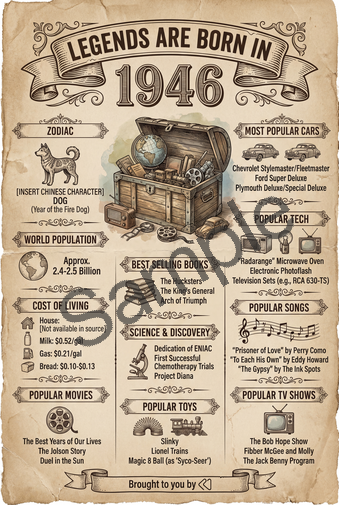

Major Events of 1946 - Historical Moments That Defined the Year | TakeMeBack.to
- 01 Jan First UN General Assembly Convenes: The first session of the United Nations General Assembly convened on January 1, 1946, in London. This marked the beginning of the UN's legislative body, where representatives from member states gathered to discuss and address global issues. The assembly plays a crucial role in international diplomacy and cooperation. source: un.org
- 02 Jan King Zog of Albania Abdicates: On January 2, 1946, King Zog I of Albania formally abdicated the throne after the communist government declared the monarchy illegal. Zog and his heirs were stripped of all rights and property and were permanently forbidden from returning to Albania. source: britannica.com
- 03 Jan Cissy King Joins The Lawrence Welk Show: Cissy King, an American dancer and singer, became part of the iconic Lawrence Welk Show, contributing to the entertainment landscape of mid-20th century America.
- 04 Jan Devastating tornado outbreak in South-Central United States: On January 4, 1946, a significant tornado outbreak struck the South-Central United States, causing widespread destruction and loss of life. The outbreak was one of the deadliest in U.S. history, with numerous tornadoes reported across several states. source: weather.gov
- 05 Jan United States restores diplomatic relations with Siam (Thailand): On January 5, 1946, the United States officially restored diplomatic relations with Siam, now known as Thailand, following World War II. This move was part of the broader effort to re-establish international relations and promote stability in the region. source: state.gov
- 06 Jan First general election in Vietnam: Vietnam held its first general election on January 6, 1946, electing 333 deputies to the National Assembly, with a voter turnout of approximately 89%. source: vietnamlawmagazine.vn
- 07 Jan First United Nations meeting: The first meeting of the United Nations was held on January 10, 1946, at Methodist Central Hall Westminster in London, marking the beginning of the UN's operations. source: en.wikipedia.org
- 08 Jan Nazi Hereditary Health Court System Abolished: On January 8, 1946, the Allied powers formally abolished Germany's Hereditary Health Court (Erbgesundheitsgericht) system. Between 1934 and 1945, these courts had ordered the sterilization of approximately 400,000 individuals deemed to have hereditary defects, such as mental retardation, schizophrenia, and epilepsy. The system had an appellate court (Erbgesundheitobergericht), but its orders were upheld 97% of the time. source: en.wikipedia.org
- 09 Jan Execution of László Bárdossy: László Bárdossy, the former Prime Minister of Hungary during World War II, was executed on January 9, 1946. He was convicted of war crimes for his role in Hungary's alliance with Nazi Germany and the deportation of Jews to concentration camps. source: en.wikipedia.org
- 10 Jan United Nations General Assembly first convenes: The first session of the United Nations General Assembly convened on January 10, 1946, in London, England. This marked the beginning of a new era in international diplomacy and cooperation following World War II. source: un.org
- 11 Jan People's Republic of Albania established: On January 11, 1946, the People's Republic of Albania was officially established, marking a significant shift in the country's political landscape. This event followed the end of World War II and the rise of communist influence in Eastern Europe. source: britannica.com
- 12 Jan Cleveland Rams relocate to Los Angeles: On January 12, 1946, the NFL approved the relocation of the Cleveland Rams to Los Angeles, making them the first professional sports team to move westward. source: espn.com
- 14 Jan Paris Agreement on German Reparations: On January 14, 1946, the Paris Agreement on Reparations was signed by 18 Allied nations, including the United States, the United Kingdom, and France. This agreement established the Inter-Allied Reparations Agency to oversee the distribution of German assets as reparations for World War II damages. The agency was tasked with ensuring an equitable distribution among the signatory nations. source: archives.gov
- 16 Jan First UN Security Council session held in London: The first session of the United Nations Security Council took place in London, marking a significant step in international diplomacy post-World War II. The session focused on establishing the UN's role in maintaining peace and security worldwide. source: un.org
- 17 Jan United Nations Security Council holds its first meeting: The United Nations Security Council convened for its first official meeting, focusing on issues of international peace and security. This meeting set the stage for future UN operations and interventions. source: un.org
- 18 Jan Eastern Air Lines Flight 16-B crashes in Connecticut: Eastern Air Lines Flight 16-B crashed in Connecticut, resulting in significant loss of life. This incident raised concerns about aviation safety and regulations in the post-war era. source: britannica.com
- 19 Jan UN Security Council's first order of business: On January 19, 1946, the United Nations Security Council held its first meeting, addressing issues related to the maintenance of international peace and security. This marked a significant step in the establishment of the UN's role in global governance. source: un.org
- 20 Jan F Gouin follows Charles de Gaulle as temporary leader of French government: Following Charles de Gaulle's resignation on January 20, 1946, Félix Gouin was appointed as the temporary leader of the French government. This transition was part of the political reshuffling in France during the establishment of the Fourth Republic. source: britannica.com
- 21 Jan Federal Reserve increases margin requirements to 100%: On January 21, 1946, the Federal Reserve raised the initial margin requirement for purchasing securities on margin to 100%, aiming to curb excessive stock market speculation. source: federalreserve.gov
- 24 Jan UN establishes Atomic Energy Commission: On January 24, 1946, the United Nations General Assembly established the Atomic Energy Commission to address issues related to atomic energy, including its peaceful use and the elimination of atomic weapons. source: un.org
- 25 Jan Soviet Atomic Bomb Program initiated: On January 25, 1946, the Soviet Union officially initiated its atomic bomb program, marking a significant step in the early stages of the Cold War nuclear arms race. source: atomicheritage.org
- 26 Jan Bikini Atoll selected for nuclear weapons testing: On January 26, 1946, Bikini Atoll was chosen as the site for nuclear weapons testing by the United States. This decision marked the beginning of a series of tests known as Operation Crossroads, which aimed to assess the effects of nuclear explosions on naval vessels. source: archives.gov
- 27 Jan Death of Harold Cole, World War II traitor: Harold Cole, a British traitor during World War II, died on January 27, 1946. He was known for his collaboration with the enemy, which led to significant consequences during the war. source: theguardian.com
- 28 Jan Vaillant-Couturier testimony at Nuremberg Trials: On January 28, 1946, French resistance member Léon Vaillant-Couturier testified at the Nuremberg Trials, detailing the atrocities committed by the Nazi regime. His testimony contributed to the prosecution of war criminals and highlighted the experiences of those who resisted Nazi oppression. source: ushmm.org
- 29 Jan Central Intelligence Group established: The Central Intelligence Group (CIG) was established on January 29, 1946, as a precursor to the Central Intelligence Agency (CIA). Its formation marked the beginning of organized intelligence operations in the United States during the early Cold War period. source: cia.gov
- 30 Jan Roosevelt dime enters circulation: The Roosevelt dime was officially released into circulation on January 30, 1946, honoring President Franklin D. Roosevelt. The coin features a profile of Roosevelt and is significant for its role in commemorating his contributions to the nation. source: usmint.gov
- 31 Jan Permanent Court of International Justice concludes final session: On January 31, 1946, the Permanent Court of International Justice held its final session, marking the end of its operations. This court was established to resolve disputes between states and was a precursor to the International Court of Justice. source: britannica.com
- 01 Feb Trygve Lie becomes first UN Secretary-General: On February 1, 1946, Trygve Lie of Norway was elected as the first Secretary-General of the United Nations. His term began on February 2, 1946, following his formal installation by the General Assembly. source: un.org
- 02 Feb Hiroshima blast casualties reported: On February 2, 1946, reports emerged detailing the casualties from the atomic bombing of Hiroshima. This event marked a significant moment in understanding the impact of nuclear warfare. source: archives.gov
- 03 Feb Record-breaking non-stop transcontinental flight: On February 3, 1946, a record-breaking non-stop transcontinental flight was completed, showcasing advancements in aviation technology and marking a significant achievement in air travel. source: britannica.com
- 06 Feb Sarawak becomes British Crown Colony: On February 6, 1946, Sarawak was officially established as a British Crown Colony, following the dissolution of the British Military Administration. source: en.wikipedia.org
- 07 Feb French military assault in Bến Tre Province, Vietnam: On February 7, 1946, French military forces launched an assault in Bến Tre Province, Vietnam, as part of their efforts to reassert control over the region. source: en.wikipedia.org
- 08 Feb Soviet report on World War II damages: On February 8, 1946, the Soviet Union released a report detailing the damages it sustained during World War II, highlighting the extensive human and material losses. source: archives.gov
- 09 Feb Stalin's Bolshoi Theatre election speech: On February 9, 1946, Joseph Stalin delivered a speech at the Bolshoi Theatre, emphasizing the importance of the upcoming elections in the Soviet Union. This speech was part of a campaign to consolidate power and promote the Communist Party's agenda. source: britannica.com
- 10 Feb First UN Secretary-General appointed: On February 10, 1946, Trygve Lie of Norway was appointed as the first Secretary-General of the United Nations. His appointment marked a significant step in the establishment of the UN as a key player in international diplomacy and peacekeeping. source: un.org
- 11 Feb Bombing of Dresden begins: The bombing of Dresden, a significant event during World War II, began on February 11, 1946. This operation resulted in extensive destruction and loss of life, marking a controversial moment in military history. source: britannica.com
- 12 Feb Isaac Woodard brutally assaulted, sparking civil rights movement: Isaac Woodard was brutally assaulted by police on February 12, 1946, after returning from military service. This incident became a catalyst for the civil rights movement in the United States, highlighting racial injustices. source: britannica.com
- 13 Feb ENIAC: First general-purpose electronic computer announced: On February 13, 1946, the Electronic Numerical Integrator and Computer (ENIAC), the first general-purpose electronic computer, was announced. Designed by John Mauchly and J. Presper Eckert, ENIAC was capable of performing 5,000 additions per second and weighed 30 tons. source: britannica.com
- 14 Feb ENIAC: First general-purpose electronic computer unveiled: The Electronic Numerical Integrator and Computer (ENIAC) was unveiled on February 14, 1946. It is recognized as the first general-purpose electronic computer, capable of being programmed to solve a wide range of problems. ENIAC marked a significant milestone in the history of computing and technology. source: britannica.com
- 15 Feb The Gouzenko Affair: The Gouzenko Affair began on February 15, 1946, when Igor Gouzenko, a Soviet cipher clerk, defected to Canada and revealed a Soviet espionage network. This event marked the start of the Cold War in Canada and led to significant political and social repercussions, including heightened fears of communism. source: thecanadianencyclopedia.ca
- 16 Feb First UN Security Council veto by Soviet Union: On February 16, 1946, the Soviet Union cast its first veto in the United Nations Security Council, blocking a resolution concerning the withdrawal of British and French forces from Syria and Lebanon. This marked the beginning of the Soviet Union's use of the veto power in the Security Council. source: aljazeera.com
- 17 Feb Ismail Sidky becomes Prime Minister of Egypt: On February 17, 1946, Ismail Sidky was appointed as the Prime Minister of Egypt. This marked his second term in office, having previously served from 1930 to 1933. source: en.wikipedia.org
- 19 Feb Cabinet Mission to India announced: On February 19, 1946, British Prime Minister Clement Attlee announced the dispatch of a special mission to India, comprising three Cabinet Ministers: Lord Pethick-Lawrence, Secretary of State for India; Sir Stafford Cripps, President of the Board of Trade; and A.V. Alexander, First Lord of the Admiralty. The mission aimed to discuss constitutional issues with Indian leaders and the Viceroy, with the objective of preparing India for independence. source: api.parliament.uk
- 21 Feb Finnish War Crimes Trial of President Ryti: On February 21, 1946, former Finnish President Risto Ryti was tried for war crimes related to Finland's actions during World War II. The trial was part of a broader effort to hold leaders accountable for wartime actions. source: archives.gov
- 22 Feb The Long Telegram: A pivotal Cold War document: On February 22, 1946, George Kennan sent the Long Telegram from Moscow, outlining his views on the Soviet Union and U.S. policy. This document significantly influenced American Cold War strategy and containment policy. source: archives.gov
- 23 Feb Japanese security official interrogated post-World War II: On February 23, 1946, a Japanese security official was interrogated as part of the Allied occupation's efforts to investigate war crimes and ensure compliance with new governance structures in Japan after World War II. source: archives.gov
- 24 Feb Colonel Juan Perón elected to first term as President of Argentina: On February 24, 1946, Colonel Juan Perón was elected to his first term as President of Argentina, establishing a political legacy that would shape the nation for decades. His election was pivotal in the development of Peronism. source: britannica.com
- 25 Feb Columbia, Tennessee racial confrontation: On February 25, 1946, a racial confrontation occurred in Columbia, Tennessee, when James Stephenson, an African-American Navy veteran, was involved in a dispute with a white store clerk over a radio repair. The incident escalated tensions, leading to a white mob gathering and subsequent violence. The event highlighted the growing resistance among African-American veterans and others to prevailing racial norms in the post-World War II era. source: en.wikipedia.org
- 27 Feb Road to Utopia film premiere in New York City: The 1946 American musical comedy film 'Road to Utopia,' starring Bing Crosby, Bob Hope, and Dorothy Lamour, premiered in New York City on February 27, 1946. Directed by Hal Walker, the film is the fourth installment in the 'Road to ...' series, following the adventures of two vaudeville performers in Alaska. It received an Academy Award nomination for Best Original Screenplay in 1947. source: en.wikipedia.org
- 28 Feb Graham Vivian born in Auckland, New Zealand: Graham Ellery Vivian, a former New Zealand cricketer, was born in Auckland on February 28, 1946. He played in five Test matches and one One Day International between 1965 and 1972. source: en.wikipedia.org
- 02 Mar 1946 U.S. Figure Skating Championships: The 1946 U.S. Figure Skating Championships were held from February 28 to March 2 at the Chicago Stadium in Chicago, Illinois. This event marked the return of the Senior Men's singles after a two-year hiatus due to World War II. Richard Button won the Senior Men's title, while John Lettengarver claimed the Junior Men's title. source: en.wikipedia.org
- 04 Mar Frank Sinatra's First Album Release: Frank Sinatra's debut album, "The Voice of Frank Sinatra," was released on March 4, 1946, by Columbia Records. The album, a set of four 78 rpm records, featured songs like "Night and Day" and "The Girl Next Door," marking the beginning of Sinatra's illustrious recording career. source: secondhandsongs.com
- 05 Mar Churchill's Iron Curtain Speech: On March 5, 1946, Winston Churchill delivered his famous "Iron Curtain" speech at Westminster College in Fulton, Missouri. In this address, he highlighted the division between Western democracies and Eastern communist countries, coining the term "Iron Curtain" to describe the boundary separating them. source: en.wikipedia.org
- 07 Mar Bikini Atoll residents relocated for atomic testing: On March 7, 1946, the 167 inhabitants of Bikini Atoll in the Marshall Islands were relocated to Rongerik Atoll to allow the United States to conduct atomic bomb tests. The relocation was intended to be temporary, but the residents faced challenges due to inadequate resources and environmental conditions at the new location. source: en.wikipedia.org
- 09 Mar Dutch colonial forces return to Indonesia: On March 9, 1946, Dutch colonial forces returned to Indonesia, marking a significant event in the post-World War II period as Indonesia sought independence from Dutch colonial rule. source: en.wikipedia.org
- 10 Mar British troops begin withdrawal from Lebanon: On March 10, 1946, British and French representatives agreed on a plan for British troops to withdraw from Lebanon by June 30, 1946, and French troops by March 31, 1947. source: paperspast.natlib.govt.nz
- 11 Mar Capture of Rudolf Höss, Auschwitz Commandant: Rudolf Höss, the former commandant of Auschwitz concentration camp, was arrested by British military police on March 11, 1946, in Gottrupel, Germany. He had been living under the alias Franz Lang and was captured after his wife provided information about his whereabouts. Höss was later handed over to Polish authorities and tried for war crimes. source: auschwitz.org
- 13 Mar Death of Werner von Blomberg, German Field Marshal: Werner von Blomberg, a German field marshal and former Reich Minister of War, died on March 13, 1946, in Nuremberg, Bavaria, Germany. He had been imprisoned since 1945 and was diagnosed with colorectal cancer in February 1946. Blomberg died in detention without ceremony. source: en.wikipedia.org
- 14 Mar Formation of Belgian government under Paul-Henri Spaak: On March 14, 1946, Paul-Henri Spaak, a prominent Belgian politician, formed a new government. Spaak, a member of the Belgian Socialist Party, played a significant role in post-war Belgian politics and was known for his contributions to European integration. source: en.wikipedia.org
- 16 Mar Rudolf Höss confesses to Holocaust atrocities: On March 16, 1946, Rudolf Höss, the former commandant of Auschwitz concentration camp, confessed to his role in the Holocaust. Höss detailed the systematic extermination of Jews and other groups, providing crucial evidence for post-war trials and the historical record of Nazi atrocities. source: en.wikipedia.org
- 17 Mar Soviet troops withdraw from Danish Bornholm Island: On March 17, 1946, Soviet forces completed their withdrawal from Bornholm Island, Denmark, marking the end of Soviet military presence in Denmark after World War II. The withdrawal was part of a broader Soviet retreat from occupied territories in Eastern Europe. source: en.wikipedia.org
- 18 Mar United Auto Workers strike against General Motors concludes: On March 18, 1946, the United Auto Workers (UAW) concluded a significant strike against General Motors, which had begun in February. The strike was one of the largest in U.S. history at the time and resulted in improved wages and working conditions for auto workers. source: en.wikipedia.org
- 19 Mar Execution of Hungarian Fascist Government Officials: On March 19, 1946, several officials from the Hungarian fascist government were executed following the end of World War II. This action was part of a broader effort to address war crimes and restore justice in Hungary after the fall of the fascist regime. source: britannica.com
- 20 Mar Capture of Axis Sally: On March 20, 1946, Mildred Gillars, known as Axis Sally, was captured by American forces. She was notorious for her propaganda broadcasts during World War II aimed at demoralizing Allied troops. source: britannica.com
- 21 Mar United Nations Establishes Temporary Headquarters: On March 21, 1946, the United Nations established its temporary headquarters in New York City. This decision was pivotal for the UN's operations as it sought to promote international cooperation in the aftermath of World War II. source: un.org
- 24 Mar British Cabinet Mission Arrives in India: On March 24, 1946, a British Cabinet Mission comprising Lord Pethick-Lawrence, Sir Stafford Cripps, and A.V. Alexander arrived in New Delhi to discuss the transfer of power from British rule to Indian leadership, aiming to preserve India's unity and grant independence. source: en.wikipedia.org
- 26 Mar Truman's Executive Order 9708: On March 26, 1946, President Harry S. Truman signed Executive Order 9708, which established the President's Committee on Civil Rights. This order aimed to address civil rights issues in the United States and laid the groundwork for future civil rights advancements. source: archives.gov
- 28 Mar Acheson-Lilienthal Report on Nuclear Control: The Acheson-Lilienthal Report, released on March 28, 1946, proposed a framework for international control of atomic energy. It recommended the establishment of an Atomic Development Authority to oversee nuclear materials and prevent the proliferation of nuclear weapons. source: osti.gov
- 29 Mar African Majority in Gold Coast Parliament: On March 29, 1946, constitutional amendments in the Gold Coast (now Ghana) established a Legislative Council with 32 members, including 21 black members, marking the first African majority in a colonial legislature. source: en.wikipedia.org
- 30 Mar Australia defeats New Zealand in Cricket Test Match: On March 29-30, 1946, Australia defeated New Zealand by an innings and 103 runs in a Test match at Wellington's Basin Reserve, marking the first official Test between the two nations. source: teara.govt.nz
- 01 Apr International financial institutions established: In 1946, several key international financial institutions were established to promote global economic stability and development. These institutions play a crucial role in international finance and economic policy. source: imf.org
- 02 Apr Birth of Pearl Musical Instrument Company: Pearl Musical Instrument Company was founded on April 2, 1946, and has since become a prominent manufacturer of drums and percussion instruments. The company is known for its quality craftsmanship and innovation. source: pearldrum.com
- 05 Apr Soviet Union and Iran sign historic oil agreement: On April 4, 1946, Iran and the Soviet Union signed an agreement establishing a joint oil company, granting the Soviets a 51% stake for the first 25 years. source: cia.gov
- 07 Apr Soviet Union annexes East Prussia as Kaliningrad Oblast: In April 1946, the Soviet Union annexed northern East Prussia, renaming it Kaliningrad Oblast. This move solidified Soviet control over the region, providing a strategic outlet to the Baltic Sea. The city of Königsberg was renamed Kaliningrad in honor of Mikhail Kalinin, marking a significant shift in the post-World War II European landscape. source: en.wikipedia.org
- 09 Apr Indonesian Air Force established: On April 9, 1946, the Indonesian Air Force (Tentara Nasional Indonesia-Angkatan Udara) was officially formed, marking a significant milestone in Indonesia's pursuit of independence. Initially equipped with a limited number of small aircraft left behind by Japanese forces, the Air Force began its operations during the Indonesian National Revolution. source: en.wikipedia.org
- 12 Apr Syria gains independence from France: On April 12, 1946, Syria officially gained independence from French colonial rule after a prolonged struggle for sovereignty. This marked a significant moment in the country's history, leading to the establishment of a sovereign state. source: britannica.com
- 13 Apr Japanese war crimes accountability: On April 13, 1946, the International Military Tribunal for the Far East began proceedings to hold Japanese leaders accountable for war crimes committed during World War II. This tribunal was a significant step in post-war justice. source: britannica.com
- 14 Apr Jewish Avengers attempt to poison SS prisoners: Members of the Jewish organization Nakam infiltrated a bakery supplying bread to Stalag 13 near Nuremberg, coating 3,000 loaves with arsenic intended for German POWs. Over 2,200 prisoners fell ill, but no deaths were reported. source: timesofisrael.com
- 15 Apr First television network established in the United States: The National Broadcasting Company (NBC) was established as the first television network in the United States, marking a significant milestone in American broadcasting history. source: history.com
- 16 Apr First US V-2 rocket launch: The United States conducted its first V-2 rocket launch, utilizing German scientists and technology obtained after World War II to advance its missile program. source: history.com
- 17 Apr League of Nations disbands: The League of Nations officially disbanded on April 17, 1946, after failing to prevent World War II. Its responsibilities and functions were transferred to the newly established United Nations. source: un.org
- 18 Apr Jackie Robinson breaks baseball color barrier in Montreal: On April 18, 1946, Jackie Robinson made his debut with the Montreal Royals, breaking the color barrier in professional baseball. This event was a significant milestone in the fight against racial segregation in sports. source: britannica.com
- 19 Apr French Fourth Republic Constitution approved: On April 19, 1946, the French Constituent Assembly approved a draft constitution for the Fourth Republic, which was later submitted to a national referendum. source: cambridge.org
- 23 Apr Manuel Roxas elected as last Commonwealth president: On April 23, 1946, Manuel Roxas was elected as the last president of the Commonwealth of the Philippines. His presidency marked the transition from Commonwealth to full independence, which was achieved later that year. source: britannica.com
- 24 Apr Baseball Hall of Fame induction ceremony: The Baseball Hall of Fame held its first induction ceremony on April 24, 1946, honoring the inaugural class of players. This event marked a significant moment in baseball history, celebrating the sport's legends. source: britannica.com
- 25 Apr Birth of Vladimir Zhirinovsky: Vladimir Zhirinovsky, a prominent Russian politician and leader of the Liberal Democratic Party, was born on April 25, 1946. He became known for his controversial views and significant influence in Russian politics. source: britannica.com
- 26 Apr Communist forces capture Harbin: On April 26, 1946, Communist forces captured Harbin, a significant city in Manchuria, China. This event marked a pivotal moment in the Chinese Civil War, as Harbin's capture by Communist troops was a significant development in the conflict. source: trove.nla.gov.au
- 28 Apr Pestalozzi Children's Village established in Switzerland: On April 28, 1946, the foundation stone for the Pestalozzi Children's Village was laid in Trogen, Switzerland. This initiative aimed to provide a home and education for children affected by World War II. The village was designed by architect Hans Fischli, incorporating rustic yet cozy spaces for children, each equipped with their own chest, table, chair, and bed. source: pestalozzi.ch
- 29 Apr International Military Tribunal for the Far East convenes in Tokyo: On April 29, 1946, the International Military Tribunal for the Far East convened in Tokyo to prosecute Japanese leaders for war crimes committed during World War II. This tribunal was established to hold individuals accountable for atrocities committed during the war. source: britannica.com
- 01 May Pilbara Indigenous Workers' Strike Begins: On May 1, 1946, approximately 800 Aboriginal pastoral workers initiated a strike across the Pilbara region in Western Australia, demanding fair wages, improved working conditions, and social recognition. This action marked the first industrial strike by Aboriginal people since colonization and became the longest industrial strike in Australian history, lasting until 1949. source: en.wikipedia.org
- 04 May Battle of Alcatraz: On May 2–4, 1946, six inmates at Alcatraz Federal Penitentiary attempted a violent escape, leading to a two-day standoff known as the Battle of Alcatraz. The conflict resulted in the deaths of two guards and three inmates, with several others wounded. The U.S. Marines intervened to restore order, marking one of the most violent episodes in the prison's history. source: sfchronicle.com
- 05 May Tokyo War Crimes Tribunal Begins: The International Military Tribunal for the Far East, commonly known as the Tokyo War Crimes Tribunal, began on May 5, 1946. This tribunal was established to prosecute Japanese leaders for war crimes committed during World War II.
- 06 May Native American veterans denied voting rights in New Mexico: On May 6, 1946, two Navajo Code Talkers, Jimmie King and Howard Nez, were denied the right to register to vote in Shiprock, New Mexico, highlighting the ongoing struggle for Native American voting rights. source: text-message.blogs.archives.gov
- 07 May Sony Corporation founded: Sony Corporation, originally known as Tokyo Tsushin Kogyo, was founded on May 7, 1946, in Tokyo, Japan, by Masaru Ibuka and Akio Morita, marking the beginning of one of the world's leading electronics companies. source: en.wikipedia.org
- 08 May Estonian schoolgirls blow up Soviet war memorial: On the night of May 8, 1946, Estonian schoolgirls Aili Jõgi and Ageeda Paavel destroyed a Soviet war memorial in Tallinn, symbolizing their resistance to Soviet occupation. source: en.wikipedia.org
- 09 May First V-2 rocket launch in United States: On May 9, 1946, the United States conducted its first launch of a German V-2 rocket, marking a significant step in its post-war rocket program. source: history.com
- 10 May Nehru becomes de facto leader of Congress Party: On May 10, 1946, Jawaharlal Nehru assumed the role of de facto leader of the Indian National Congress, leading the party in its quest for independence. source: britannica.com
- 11 May SS members convicted for Mauthausen atrocities: On May 11, 1946, several members of the SS were convicted for atrocities committed at the Mauthausen concentration camp during World War II. The trials were part of the broader effort to hold Nazi officials accountable for war crimes and crimes against humanity. source: en.wikipedia.org
- 12 May Soviet blockade of Berlin ends: The Soviet blockade of Berlin, which began in June 1948, ended on May 12, 1949. This blockade was a significant event during the early stages of the Cold War, leading to the Berlin Airlift, where Western Allies supplied West Berlin by air. source: en.wikipedia.org
- 13 May Federal Airport Act of 1946: The Federal Airport Act was enacted on May 13, 1946, to provide federal funding for the development of airports across the United States. This legislation aimed to improve the nation's air transportation infrastructure in the post-World War II era. source: faa.gov
- 14 May Robert Jarvik birth: Robert Jarvik, an American cardiologist and medical researcher, was born on May 14, 1946. He is best known for developing the Jarvik-7, the first permanent artificial heart implanted in a human patient in 1982. source: britannica.com
- 15 May USCGC Eagle commissioned into U.S. Coast Guard service: On May 15, 1946, the U.S. Coast Guard Cutter Eagle was commissioned in New London, Connecticut. Originally built in 1936 by the Blohm & Voss Shipyard in Hamburg, Germany, as the Horst Wessel, the ship was taken as a war prize after World War II and recommissioned as the Eagle. It serves as a training vessel for future officers of the United States Coast Guard. source: uscga.edu
- 19 May Tokyo Food Shortage Protest: On May 19, 1946, approximately 250,000 people gathered in front of the Imperial Palace in Tokyo to protest severe food shortages and the government's handling of the crisis. The demonstration, known as the "People's Rally for Obtaining Food," was a significant public outcry against the post-war food scarcity. source: jijiphoto.photoshelter.com
- 20 May Birth of Cher, Iconic Performer: Cher, born Cherilyn Sarkisian on May 20, 1946, in El Centro, California, is an American singer, actress, and television personality. She gained fame in the 1960s as part of the duo Sonny & Cher and later achieved a successful solo career. source: en.wikipedia.org
- 21 May Fatal Criticality Incident: Louis Slotin and the Demon Core: On May 21, 1946, physicist Louis Slotin was involved in a criticality accident while conducting an experiment with the Demon Core, a subcritical mass of plutonium. The incident resulted in a fatal dose of radiation for Slotin, highlighting the dangers of handling nuclear materials. This event is a significant moment in the history of nuclear safety. source: nrc.gov
- 22 May US Government seizes bituminous coal mines: On May 22, 1946, the U.S. government seized control of bituminous coal mines to avert a strike that threatened to disrupt coal production. This action was part of a broader effort to stabilize the economy and ensure the availability of essential resources post-World War II. The seizure was met with both support and opposition from various stakeholders. source: archives.gov
- 23 May Central United States tornado outbreak: On May 23, 1946, a significant tornado outbreak occurred in the central United States, affecting several states and causing widespread destruction. This event resulted in numerous fatalities and injuries, highlighting the severe weather risks in the region. The outbreak is remembered for its intensity and the impact it had on affected communities. source: weather.gov
- 24 May Major U.S. Railroad Strike of 1946: In 1946, a significant railroad strike occurred in the United States, leading to widespread disruptions in transportation and commerce. The strike was part of a series of labor actions during that period. source: archives.gov
- 26 May US hydrogen bomb patent filed: On May 26, 1946, the United States filed a patent for the hydrogen bomb, a significant development in nuclear weapons technology. This marked a pivotal moment in the arms race during the Cold War era. source: archives.gov
- 28 May United States extends massive loan to France: On May 28, 1946, the United States extended a significant loan to France as part of its post-war recovery efforts. This financial assistance was crucial for rebuilding the French economy after World War II. source: britannica.com
- 29 May KVP wins provincial national election in the Netherlands: On May 29, 1946, the KVP (Catholic People's Party) won the provincial national election in the Netherlands, marking a significant shift in the Dutch political landscape post-World War II. This victory solidified the party's influence in Dutch politics. source: britannica.com
- 30 May George Robson wins Indianapolis 500 after World War II hiatus: George Robson won the 1946 Indianapolis 500 on May 30, 1946, marking the first race after World War II. He led 138 of the 200 laps and finished 44.04 seconds ahead of rookie Jimmy Jackson. source: si.com
- 01 Jun Penicillin becomes publicly available in UK: On June 1, 1946, penicillin was made available to the public in the United Kingdom. This marked a significant advancement in medical treatment, allowing for the effective treatment of bacterial infections and saving countless lives. source: ncbi.nlm.nih.gov
- 02 Jun Italian Republic referendum: The Italian Republic referendum on June 2, 1946, allowed Italians to decide whether to abolish the monarchy. The outcome led to the establishment of the Italian Republic, marking a significant shift in the country's governance. source: britannica.com
- 03 Jun Italian referendum transforms government: The Italian referendum on June 3, 1946, resulted in the abolition of the monarchy and the establishment of a republic. This transformation marked a new era in Italian governance and democracy. source: britannica.com
- 04 Jun Record-breaking solar prominence observed: A solar prominence, a large eruptive feature of relatively cool plasma, was observed, measuring approximately 500,000–700,000 km in length, marking one of the largest recorded at that time. source: guinnessworldrecords.com
- 06 Jun Formation of the Basketball Association of America (BAA): On June 6, 1946, the Basketball Association of America (BAA) was established in New York City by a group of arena owners and sports promoters. The league aimed to fill large venues by hosting professional basketball games, marking a significant development in the sport's commercialization. source: espn.com
- 07 Jun BBC Television Service Resumes After World War II: On June 7, 1946, the BBC Television Service resumed broadcasting after World War II. This marked a significant milestone in the UK's post-war recovery and the revival of cultural life. source: Wikipedia (day-month pages)
- 08 Jun United Kingdom Victory Celebration: On June 8, 1946, the United Kingdom held a grand Victory Celebration in London to commemorate the Allied victory in World War II. The event featured a nine-mile-long parade with tens of thousands of uniformed marchers representing Allied nations, and a Royal Air Force flyover. The celebrations were witnessed by nearly one-fourth of England's population. source: en.wikipedia.org
- 09 Jun King Bhumibol Adulyadej Ascends to Thai Throne: On June 9, 1946, following the death of his brother, King Ananda Mahidol, Bhumibol Adulyadej ascended to the Thai throne as King Rama IX, beginning a reign that would last until his death in 2016. source: en.wikipedia.org
- 10 Jun Establishment of the Italian Republic: On June 10, 1946, the Italian Supreme Court of Cassation declared the establishment of the Italian Republic following a referendum where 54.3% of voters chose a republic over the monarchy. source: cvce.eu
- 13 Jun End of Italian Monarchy: On June 13, 1946, following a referendum on June 2, 1946, which resulted in a majority favoring a republic, King Umberto II of Italy left the country, marking the end of the monarchy and the establishment of the Italian Republic. source: vaia.com
- 14 Jun Baruch Plan Proposed to UN: On June 14, 1946, the Baruch Plan, proposed by Bernard Baruch, was presented to the United Nations Atomic Energy Commission, aiming to establish international control over atomic energy and prevent nuclear weapons proliferation. source: history.state.gov
- 15 Jun Dramatic U.S. Open Golf Tournament Tie: The 1946 U.S. Open Golf Championship ended in a dramatic tie, leading to a playoff. This event showcased the competitive spirit of the tournament and highlighted the skills of the participating golfers. source: usga.org
- 16 Jun Night of the Bridges: Haganah Resistance Operation: The Night of the Bridges was a Haganah operation on June 16, 1946, targeting British infrastructure in Palestine. This operation was part of the broader struggle for independence and highlighted the tensions of the period. source: britannica.com
- 17 Jun First mobile telephone commercial service in USA: On June 17, 1946, the first commercial mobile telephone service was launched in the United States by AT&T. This service allowed users to make calls from their cars, marking a significant advancement in telecommunications technology. source: britannica.com
- 18 Jun Dr. Ram Manohar Lohia's Direct Action Day in Goa: On June 18, 1946, Dr. Ram Manohar Lohia called for a Direct Action Day in Goa, advocating for the liberation of the region from Portuguese colonial rule. This event was part of the broader Indian independence movement. source: britannica.com
- 19 Jun Soviet nuclear disarmament proposal: On June 19, 1946, the Soviet Union proposed a plan for nuclear disarmament at the United Nations. This proposal was part of the early Cold War efforts to address the growing threat of nuclear weapons. source: un.org
- 20 Jun Allied Powers agree to withdraw occupation forces from Italy: On June 20, 1946, the Allied Powers reached an agreement to withdraw their occupation forces from Italy, marking a significant step in the post-World War II reconstruction of the country. This decision was part of broader efforts to restore sovereignty to Italy. source: britannica.com
- 21 Jun Albert Speer's testimony at Nuremberg Trials: On June 21, 1946, Albert Speer, former Minister of Armaments and War Production for Nazi Germany, testified at the Nuremberg Trials. His testimony provided insights into the workings of the Nazi regime and its war efforts. source: archives.gov
- 22 Jun Bill Veeck acquires Cleveland Indians: On June 22, 1946, Bill Veeck officially took control of the Cleveland Indians, marking a pivotal moment in the franchise's history. His leadership would influence the team's direction and fan engagement. source: britannica.com
- 23 Jun Monnet Plan Proposed by France: On June 23, 1946, France proposed the Monnet Plan, a proposal for European economic integration, aiming to create a common market for coal and steel among European countries to prevent future conflicts. source: en.wikipedia.org
- 24 Jun Fred M. Vinson Becomes Chief Justice: On June 24, 1946, Fred M. Vinson was appointed as the Chief Justice of the United States Supreme Court, serving until his death in 1953. source: en.wikipedia.org
- 25 Jun World Bank established: The World Bank was established on June 25, 1946, to provide financial and technical assistance to developing countries. Its primary goal is to reduce poverty and support development by providing loans and grants for various projects. source: britannica.com
- 26 Jun Dutch Nazi collaborator sentenced: On June 26, 1946, a Dutch Nazi collaborator was sentenced for war crimes committed during World War II. This event marked a significant moment in post-war justice as countries began to hold individuals accountable for their actions during the war. source: nytimes.com
- 27 Jun Canadian Citizenship Act of 1946: The Canadian Citizenship Act was enacted on June 27, 1946, establishing Canadian citizenship as a distinct legal status separate from British subject status. This act was a significant step in defining national identity in Canada. source: britannica.com
- 28 Jun First President of Italy Elected: Enrico De Nicola was elected as the provisional head of state of Italy on June 28, 1946, by the Constituent Assembly, following the abolition of the monarchy. source: en.wikipedia.org
- 29 Jun British arrest Yishuv leaders: On June 29, 1946, British authorities conducted Operation Agatha, a large-scale military and police operation in Mandatory Palestine. The operation aimed to arrest Jewish Agency leaders and members of the Haganah, including future Israeli Prime Minister Moshe Sharett, in an effort to curb insurgent activities. source: en.wikipedia.org
- 01 Jul Operation Crossroads: Atomic Bomb Test: Operation Crossroads was a series of nuclear weapon tests conducted by the United States at Bikini Atoll in the Pacific Ocean in 1946. The tests aimed to investigate the effects of nuclear explosions on naval ships and equipment. source: en.wikipedia.org
- 02 Jul Nazi pardons in American zone of Germany: On July 2, 1946, the American military government in Germany announced pardons for several former Nazi officials. This decision was met with controversy and criticism, as many believed it undermined efforts for justice in post-war Germany. source: archives.gov
- 03 Jul National Mental Health Act signed: The National Mental Health Act was signed into law on July 3, 1946, marking a significant step in the U.S. government's commitment to mental health care. This act established the National Institute of Mental Health and aimed to improve mental health services across the country. source: nimh.nih.gov
- 04 Jul Philippines independence from the United States: On July 4, 1946, the Philippines officially gained independence from the United States, ending nearly 50 years of American colonial rule. This day is celebrated annually as Philippine Independence Day. source: britannica.com
- 05 Jul Sam Snead wins British Open: American golfer Sam Snead won the British Open on July 5, 1946. This victory added to his illustrious career, marking him as one of the sport's greats. source: en.wikipedia.org
- 07 Jul Howard Hughes' Dramatic Aircraft Crash: On July 7, 1946, Howard Hughes crashed the XF-11 reconnaissance aircraft in Beverly Hills, California, sustaining serious injuries. source: pbs.org
- 09 Jul 1946 Major League Baseball All-Star Game: The 13th Major League Baseball All-Star Game was held on July 9, 1946, at Fenway Park in Boston, Massachusetts. The American League defeated the National League 12–0, with Ted Williams setting records for hits (4), home runs (2), runs (4), RBIs (5), and total bases (10). source: en.wikipedia.org
- 12 Jul Vance Dinges' unique inside-the-park home run: On July 12, 1946, Vance Dinges hit a remarkable inside-the-park home run during a minor league game. This event is notable for its rarity and the excitement it generated among fans. Dinges' performance is remembered as a highlight of the season. source: baseball-almanac.com
- 13 Jul US Marines captured in China: On July 13, 1946, a group of US Marines was captured in China amidst rising tensions in the region. This incident highlighted the complexities of post-war relations and the challenges faced by American forces. The event drew significant media attention and concern from the US government. source: archives.gov
- 14 Jul Kielce pogrom: Antisemitic violence in post-World War II Poland: On July 14, 1946, the Kielce pogrom occurred in Poland, resulting in the deaths of several Jewish individuals. This violent outbreak was fueled by antisemitic sentiments in the aftermath of World War II. The event is a significant moment in Jewish history and post-war Poland. source: yadvashem.org
- 15 Jul SS War criminals sentenced to death: On July 15, 1946, several high-ranking SS officers were sentenced to death for war crimes committed during World War II. This marked a significant moment in post-war justice and accountability for Nazi atrocities. source: ushmm.org
- 16 Jul Social Security Administration established: The Social Security Administration (SSA) was officially established on July 16, 1946, to oversee the Social Security program in the United States. This agency plays a crucial role in providing financial assistance to retirees and disabled individuals. source: ssa.gov
- 17 Jul Execution of Draža Mihailović: Draža Mihailović, a Serbian general and leader of the Chetnik movement during World War II, was executed on July 17, 1946, after being convicted of treason and war crimes. His execution marked a significant moment in post-war Yugoslavia. source: britannica.com
- 18 Jul Allie Caulfield's death in The Catcher in the Rye: In J.D. Salinger's novel "The Catcher in the Rye," the character Allie Caulfield dies of leukemia on July 18, 1946. This event profoundly affects his brother, Holden Caulfield, who is deeply impacted by the loss. source: sparknotes.com
- 19 Jul Birth of Ilie Năstase: Ilie Năstase, a renowned Romanian tennis player, was born on July 19, 1946. He is considered one of the greatest tennis players of his era. source: en.wikipedia.org
- 20 Jul Michigan National Bank officials and former state legislators indicted for bribery conspiracy: On July 20, 1946, the Ingham County grand jury charged 28 individuals, including top officials of the Michigan National Bank System and former state legislators, with a bribery conspiracy aimed at defeating the 1941 Anti-Branch Banking Bill. The indictment alleged that these individuals unlawfully engaged in a scheme to influence the legislative process through bribery. source: digital.bentley.umich.edu
- 21 Jul Paris Peace Conference of 1946: The Paris Peace Conference of 1946 was a diplomatic meeting held in Paris to address the post-World War II order and the restructuring of Europe. The conference aimed to establish peace treaties with the Axis powers and set the stage for the reconstruction of war-torn nations. source: en.wikipedia.org
- 22 Jul King David Hotel bombing in Jerusalem: On July 22, 1946, the Jewish paramilitary organization Irgun carried out a bombing in Jerusalem. The attack targeted the King David Hotel, which housed the British administrative headquarters for Palestine. The bombing resulted in numerous casualties and was part of a series of operations by Jewish underground groups against British authorities. source: en.wikipedia.org
- 25 Jul Operation Crossroads: Underwater nuclear weapon test: Operation Crossroads, conducted by the United States, included underwater nuclear tests at Bikini Atoll starting on July 25, 1946. The tests aimed to assess the effects of nuclear weapons on naval vessels. source: atomicheritage.org
- 26 Jul US military desegregation order: On July 26, 1946, President Harry S. Truman issued an executive order to desegregate the U.S. military, marking a significant step towards civil rights in America. This order aimed to eliminate racial discrimination in the armed forces. source: archives.gov
- 27 Jul Muslim League rejects Cabinet Mission Plan: On July 27, 1946, the All-India Muslim League rejected the Cabinet Mission Plan proposed by the British government, which aimed to address the political future of India. This rejection was a pivotal moment in the lead-up to the partition of India. source: britannica.com
- 31 Jul Gary Lewis born: Gary Lewis, American musician and leader of the 1960s pop band Gary Lewis & the Playboys, was born on July 31, 1945, in Newark, New Jersey. source: en.wikipedia.org
- 01 Aug Scandinavian Airlines System founded: On August 1, 1946, the national airlines of Denmark, Norway, and Sweden formed the Scandinavian Airlines System (SAS) to handle intercontinental air traffic. Operations commenced on September 17, 1946, with the first flight between Stockholm and New York. source: britannica.com
- 02 Aug Martin Luther King Jr.'s early civil rights activism: In 1946, Martin Luther King Jr. began his activism in civil rights, advocating for racial equality and justice. His efforts laid the groundwork for the larger civil rights movement that would gain momentum in the 1950s and 1960s. source: history.com
- 03 Aug Belgian government formation: On August 3, 1946, Belgium formed a new government following the end of World War II. This government aimed to address the political and economic challenges facing the nation during the post-war recovery period. source: britannica.com
- 04 Aug Devastating Dominican Republic Earthquake: On August 4, 1946, a magnitude 7.8 earthquake struck near Samaná, Dominican Republic, at 13:51 AST. The earthquake generated a tsunami that caused widespread devastation across Hispaniola, resulting in 1,790 deaths. source: en.wikipedia.org
- 06 Aug First successful radio-controlled long-distance aircraft flight: On August 6, 1946, the first successful flight of a radio-controlled long-distance aircraft took place, marking a significant advancement in aviation technology. This event demonstrated the potential for remote-controlled flight, paving the way for future developments in both military and civilian aviation. source: britannica.com
- 07 Aug Soviet demand for Dardanelles control: On August 7, 1946, the Soviet Union made a demand for control over the Dardanelles Strait, a strategic waterway. This demand heightened tensions in post-World War II Europe and was part of broader geopolitical maneuvers during the early Cold War period. source: britannica.com
- 08 Aug First flight of the Convair B-36 Peacemaker: On August 8, 1946, the Convair B-36 Peacemaker, a strategic bomber, made its first flight. This aircraft was notable for its size and range, representing a significant advancement in military aviation during the post-World War II era. source: britannica.com
- 09 Aug John Cecil Jones lynching and civil rights catalyst: On August 8, 1946, John Cecil Jones, a World War II veteran, was lynched near Minden, Louisiana. His 17-year-old cousin, Albert Harris Jr., was also tortured and left for dead. This incident became a catalyst for civil rights activism. source: en.wikipedia.org
- 12 Aug African Mineworkers Union Strike of 1946: The African Mineworkers Union initiated a significant strike on August 12, 1946, demanding better wages and working conditions. This strike marked a pivotal moment in labor relations in South Africa, highlighting the struggles of black workers against oppressive labor practices. source: britannica.com
- 13 Aug British Deportation of Jewish Refugees from Palestine: On August 13, 1946, the British authorities began deporting Jewish refugees from Palestine, a controversial action that sparked international outrage. This event was part of the broader conflict surrounding Jewish immigration to Palestine post-World War II. source: britannica.com
- 14 Aug Soviet Cultural Suppression: Zhdanov's Campaign Against Intellectuals: On August 14, 1946, Andrei Zhdanov launched a campaign against perceived cultural and intellectual dissent in the Soviet Union. This campaign aimed to enforce strict ideological conformity among artists and intellectuals, leading to widespread censorship. source: britannica.com
- 15 Aug Truman Doctrine Announcement: On August 15, 1946, President Harry S. Truman announced the Truman Doctrine, a policy aimed at containing communism. This doctrine marked a significant shift in U.S. foreign policy, committing the nation to support countries resisting Soviet influence. source: archives.gov
- 16 Aug Establishment of Japan Business Federation (Keidanren): The Japan Federation of Economic Organizations, known as Keidanren, was established on August 16, 1946, to mediate differences between member industries and advise the government on economic policy. It is considered one of the most powerful organizations in Japan. source: britannica.com
- 18 Aug United Nations first meeting: The first meeting of the United Nations General Assembly took place on August 18, 1946, in London, marking a significant step in international diplomacy and cooperation. This meeting set the stage for future discussions on global issues and the establishment of international norms. source: un.org
- 19 Aug Bill Clinton's birth: Bill Clinton, the 42nd President of the United States, was born on August 19, 1946, in Hope, Arkansas. His presidency from 1993 to 2001 was marked by significant economic growth and various domestic and foreign policy initiatives. source: whitehouse.gov
- 20 Aug Bob Feller's radar-measured pitch speed: On August 20, 1946, baseball pitcher Bob Feller had his pitch speed measured at 98.6 mph, making it one of the fastest recorded pitches of the time. This event highlighted advancements in sports technology and the growing interest in measuring athletic performance. source: baseballhall.org
- 21 Aug Reburial of Frederick the Great and his father: On August 21, 1946, Frederick the Great and his father, Frederick William I, were reburied in a ceremony that symbolized the restoration of the Prussian monarchy after World War II. This event marked a significant moment in German history, reflecting on the legacy of the Prussian state. source: britannica.com
- 22 Aug Execution of Döme Sztójay: On August 22, 1946, Döme Sztójay, a former Hungarian Prime Minister, was executed for war crimes committed during World War II. His trial and execution were part of the broader efforts to hold leaders accountable for their actions during the war. source: britannica.com
- 23 Aug Creation of North Rhine-Westphalia: North Rhine-Westphalia was officially created on August 23, 1946, as part of the restructuring of Germany's federal states in the British occupation zone. This new state combined the provinces of North Rhine and Westphalia, aiming to promote regional governance and stability. source: britannica.com
- 24 Aug Marilyn Monroe's first Hollywood contract: On August 24, 1946, Marilyn Monroe signed her first major contract with 20th Century Fox, marking a significant step in her career. This contract helped establish her as a leading actress in Hollywood, paving the way for her future success. source: biography.com
- 25 Aug Ben Hogan wins 28th PGA Championship: On August 25, 1946, Ben Hogan won the 28th PGA Championship, solidifying his status as one of golf's greatest players. This victory was part of his remarkable comeback after a near-fatal car accident, showcasing his resilience and skill. source: britannica.com
- 26 Aug George Orwell publishes influential allegorical novel 'Animal Farm': On August 26, 1946, George Orwell's 'Animal Farm' was published, presenting a satirical allegory of the Russian Revolution and the rise of Stalinism. The novel uses farm animals to critique totalitarian regimes and has since become a classic in political literature. source: britannica.com
- 27 Aug Pioneering vascular surgery technique by João Cid dos Santos: On August 27, 1946, João Cid dos Santos introduced a groundbreaking technique in vascular surgery, which significantly advanced the field. His contributions have had a lasting impact on surgical practices and patient outcomes. source: ncbi.nlm.nih.gov
- 28 Aug Founding of the Workers' Party of North Korea: On August 28, 1946, the Workers' Party of North Korea was founded, marking a significant moment in the establishment of the Democratic People's Republic of Korea. This party played a crucial role in shaping North Korea's political landscape. source: britannica.com
- 30 Aug Creation of Rhineland-Palatinate State: On August 30, 1946, the French military government established the state of Rhineland-Palatinate in Germany, formed from parts of the former states of Prussia, Hesse, and Bavaria. source: en.wikipedia.org
- 01 Sep Greek monarchy referendum held: On September 1, 1946, a referendum was held in Greece to decide the future of the monarchy. The vote resulted in the restoration of King George II, marking a significant moment in Greek political history after World War II. source: britannica.com
- 02 Sep Nehru forms interim government of India: On September 2, 1946, Jawaharlal Nehru announced the formation of an interim government in India. This marked a crucial step towards India's independence from British rule, which was achieved in 1947. source: britannica.com
- 03 Sep Project Paperclip: U.S. recruits German scientists: On September 3, 1946, the United States initiated Project Paperclip, a program to recruit German scientists, engineers, and technicians after World War II. This effort aimed to leverage their expertise for American military and technological advancements. source: archives.gov
- 04 Sep Broadway premiere of 'A Flag Is Born': The play 'A Flag Is Born,' advocating for the creation of a Jewish homeland in Palestine, premiered on Broadway. The production featured Paul Muni, Celia Adler, and Marlon Brando, and was directed by Luther Adler with music by Kurt Weill. source: en.wikipedia.org
- 05 Sep Trans-Luxury Airlines Flight 850 Crash: On September 5, 1946, Trans-Luxury Airlines Flight 850, en route from New York to San Francisco, crashed into a hillside while attempting to land in Elko, Nevada, resulting in 21 fatalities. A 2-year-old boy survived the accident with only minor injuries. source: en.wikipedia.org
- 06 Sep US Postwar Economic Reconstruction Policy for Germany: On September 6, 1946, U.S. Secretary of State James F. Byrnes delivered the "Speech of Hope" in Stuttgart, Germany. He announced a shift in U.S. policy, moving from punitive measures to economic reconstruction, aiming to help Germany rebuild and rejoin the community of free nations. source: en.wikipedia.org
- 07 Sep Birth of Francisco Varela, Chilean Biologist and Philosopher: Francisco Varela, a renowned Chilean biologist and philosopher, was born on September 7, 1946. He made significant contributions to the study of consciousness and cognitive science, co-authoring the influential book "The Embodied Mind." source: britannica.com
- 08 Sep 66th US Men's Tennis Championship: Jack Kramer defeats Tom Brown Jr.: In the men's singles final of the 66th U.S. National Championships, Jack Kramer defeated Tom Brown Jr. with a score of 9–7, 6–3, 6–0. This victory marked Kramer's first U.S. men's singles title. source: en.wikipedia.org
- 09 Sep Birth of musician Billy Preston: Billy Preston, an American musician known for his work as a keyboardist and singer, was born. He gained prominence for his contributions to The Beatles and later had a successful solo career.
- 10 Sep Soviet Allegations of British War Preparations: The Soviet Army newspaper Red Star published allegations of 'intensive war preparations' by Britain in Transjordan and Palestine, reflecting the growing tensions of the early Cold War period and geopolitical suspicions.
- 11 Sep Longest scoreless tie in MLB history: On September 11, 1946, the Cincinnati Reds and Brooklyn Dodgers played a 19-inning scoreless tie at Ebbets Field, the longest scoreless game in Major League Baseball history. source: sabr.org
- 13 Sep Boston Red Sox win American League pennant: On September 13, 1946, the Boston Red Sox clinched the American League pennant, marking their first AL pennant since 1918. source: en.wikipedia.org
- 14 Sep Military Casualties Report: A military division reported significant casualties on September 14, 1946, as documented in the Camp Bowie Blade. The total casualties numbered 27,343, which included 3,974 killed, 19,052 wounded, and 4,317 missing in action. This report likely reflects ongoing military operations or the aftermath of World War II. source: takemeback.to
- 15 Sep Establishment of People's Republic of Bulgaria: On September 15, 1946, the People's Republic of Bulgaria was officially established, marking a significant political shift in the country's history. source: en.wikipedia.org
- 17 Sep Post-war production surge: On September 17, 1946, the United States experienced a significant surge in production as industries transitioned from wartime to peacetime manufacturing. This shift was crucial for economic recovery and marked the beginning of a robust post-war economy. source: bls.gov
- 18 Sep Joe Louis wins heavyweight boxing title: On September 18, 1946, Joe Louis reclaimed the heavyweight boxing title by defeating Jersey Joe Walcott in a match that showcased his legendary boxing skills. This victory solidified Louis's status as one of the greatest heavyweight champions in boxing history. source: boxinghistory.org
- 19 Sep First Cannes Film Festival: The inaugural Cannes Film Festival took place from September 19 to October 5, 1946. It aimed to promote international cinema and has since become one of the most prestigious film festivals in the world. source: cannes.com
- 20 Sep Churchill's United Europe Vision: On 19 September 1946, Winston Churchill delivered a speech at the University of Zurich, advocating for a "United States of Europe" and proposing the formation of a Council of Europe. source: winstonchurchill.org
- 21 Sep Cleveland Indians' League Park Era Concludes: The Cleveland Indians played their final game at League Park on 21 September 1946, marking the end of an era for the team. source: mlb.com
- 22 Sep Yogi Berra's Major League Debut: On September 22, 1946, Yogi Berra made his Major League Baseball debut with the New York Yankees against the Philadelphia Athletics. In his second at-bat, he hit a home run. source: en.wikipedia.org
- 27 Sep General Pulaski Memorial Day Proclamation: On September 25, 1946, President Harry S. Truman issued Proclamation 2704, designating October 11, 1946, as General Pulaski's Memorial Day to honor the Polish patriot's contribution to American liberty. source: trumanlibrary.gov
- 28 Sep Australian Federal Election of 1946: On September 28, 1946, Australia held a federal election, resulting in the Australian Labor Party, led by Prime Minister Ben Chifley, defeating the Liberal-Country coalition. source: en.wikipedia.org
- 30 Sep Héctor Lavoe born: Héctor Lavoe, a prominent Puerto Rican salsa singer, was born on September 30, 1946. He became known for his unique voice and contributions to the salsa music genre, influencing many artists in the Latin music scene. source: biography.com
- 01 Oct Nuremberg Tribunal verdicts announced: The verdicts of the Nuremberg Tribunal were announced on October 1, 1946, concluding the trials of major war criminals after World War II. This event marked a significant moment in international law and justice. source: ushmm.org
- 02 Oct Communist takeover in Bulgaria: On October 2, 1946, the Communist Party in Bulgaria solidified its power, leading to a one-party state. This event was part of the broader trend of communist takeovers in Eastern Europe post-World War II. source: britannica.com
- 03 Oct Truman's statement on Jewish immigration to Palestine: On October 3, 1946, President Harry S. Truman made a statement regarding Jewish immigration to Palestine, emphasizing the need for a solution to the refugee crisis following World War II. This statement was part of the broader context of U.S. foreign policy in the Middle East. source: trumanlibrary.gov
- 04 Oct Birth of Rutherford B. Hayes: Rutherford B. Hayes, the 19th President of the United States, was born on October 4, 1822. His presidency is noted for the end of Reconstruction and the withdrawal of federal troops from the South. source: britannica.com
- 10 Oct Historic V-2 rocket launch: On October 10, 1946, the first V-2 rocket was launched from the Peenemünde Army Research Center in Germany. This event marked a significant milestone in rocket technology and paved the way for future space exploration efforts. source: nasa.gov
- 11 Oct Einstein's warning about nuclear weapons to President Roosevelt: On October 11, 1946, Albert Einstein expressed concerns about the dangers of nuclear weapons in a letter to President Franklin D. Roosevelt. This communication highlighted the potential threats posed by atomic energy and the need for international control. source: archives.gov
- 13 Oct France adopts Fourth Republic constitution: On October 13, 1946, France adopted a new constitution, establishing the Fourth Republic. This marked a significant political change following World War II, aiming to stabilize the government and promote democratic governance. source: britannica.com
- 14 Oct Netherlands-Indonesia ceasefire agreement: On October 14, 1946, a ceasefire agreement was reached between the Netherlands and Indonesia, aimed at ending hostilities during the Indonesian National Revolution. This agreement was a crucial step towards Indonesia's eventual independence. source: britannica.com
- 15 Oct Hermann Göring's suicide: Hermann Göring, a leading Nazi official, committed suicide by cyanide on October 15, 1946, the night before his scheduled execution. He was convicted of war crimes at the Nuremberg Trials, which sought to bring Nazi leaders to justice for their actions during World War II. source: britannica.com
- 16 Oct Nuremberg Trials: mass execution of Nazi war criminals: On October 16, 1946, several high-ranking Nazi officials were executed following the Nuremberg Trials, which sought to hold leaders accountable for war crimes. This event symbolized a pivotal moment in international law and justice. source: britannica.com
- 17 Oct Coffee Price Controls Removed: On October 17, 1946, the Office of Price Administration (OPA) removed price controls on coffee, allowing market prices to be determined by supply and demand. This decision was based on data indicating that supply and demand were approximately in balance. source: oregonnews.uoregon.edu
- 20 Oct Birth of Elfriede Jelinek: Elfriede Jelinek, an Austrian playwright and novelist, was born on October 20, 1946, in Mürzzuschlag, Austria. She is renowned for her works that explore themes of gender relations, female sexuality, and popular culture, and was awarded the Nobel Prize in Literature in 2004. source: britannica.com
- 23 Oct First United Nations General Assembly convenes in New York: The first United Nations General Assembly convened in New York City on October 23, 1946, at Flushing Meadows–Corona Park. U.S. President Harry Truman opened the Assembly, marking a significant step in the UN's establishment. This session continued the inaugural meeting that began in London in January 1946. source: presidency.ucsb.edu
- 25 Oct First Earth photograph from space: On October 25, 1946, the first photograph of Earth taken from space was captured by a V-2 rocket launched by the United States. This historic image marked a significant milestone in space exploration and provided a new perspective of our planet. The photograph was taken at an altitude of 105 kilometers (65 miles). source: nasa.gov
- 26 Oct Quiet day in post-World War II era: On October 26, 1946, many nations were experiencing a period of recovery and adjustment following the end of World War II. This day was marked by a general sense of calm as countries began to rebuild and address the aftermath of the war. The focus was on establishing peace and stability in a war-torn world. source: britannica.com
- 27 Oct Bulgaria holds elections for Grand National Assembly: On October 27, 1946, Bulgaria conducted elections for the Grand National Assembly, which was tasked with adopting a new constitution. The Fatherland Front, an anti-fascist coalition dominated by the Bulgarian Communist Party, secured a majority with 53.88% of the vote and 278 out of 465 seats. This marked the consolidation of communist power in Bulgaria. source: en.wikipedia.org
- 31 Oct Birth of Stephen Rea: Irish actor Stephen Rea was born on October 31, 1946, in Belfast, Northern Ireland. source: en.wikipedia.org
- 03 Nov Japan adopts new constitution: On November 3, 1946, Japan's new constitution was promulgated, replacing the Meiji Constitution of 1889. The new constitution emphasized popular sovereignty, fundamental human rights, and pacifism, with Article 9 renouncing war as a sovereign right of the nation. source: ndl.go.jp
- 04 Nov UNESCO founded: The United Nations Educational, Scientific and Cultural Organization (UNESCO) was founded on November 4, 1946, with the aim of promoting international collaboration in education, science, and culture. source: en.wikipedia.org
- 05 Nov Nixon and Kennedy Elected to Congress: In the 1946 United States midterm elections, Richard Nixon was elected to the House of Representatives for California's 12th congressional district, and John F. Kennedy was elected to represent Massachusetts's 11th congressional district. source: en.wikipedia.org
- 06 Nov 1946 United States Congressional Midterm Elections: The 1946 midterm elections resulted in significant gains for the Republican Party, which took control of both the House of Representatives and the Senate. source: en.wikipedia.org
- 08 Nov Viola Desmond challenges racial segregation in Nova Scotia: On November 8, 1946, Viola Desmond, a Black Canadian businesswoman, was arrested for sitting in the 'whites-only' section of the Roseland Theatre in New Glasgow, Nova Scotia, challenging the province's racial segregation practices. source: historymuseum.ca
- 12 Nov Indonesian-Dutch truce: On November 12, 1946, a truce was established between Indonesia and the Netherlands, aiming to end the Indonesian National Revolution and restore Dutch sovereignty over Indonesia. source: en.wikipedia.org
- 14 Nov US-India air transport services pact signed: On November 14, 1946, the United States and India signed a pact to establish air transport services between the two nations. This agreement aimed to enhance connectivity and promote trade. source: state.gov
- 15 Nov Netherlands recognizes Indonesian Republic: On November 15, 1946, the Netherlands officially recognized the Indonesian Republic, marking a significant step in Indonesia's struggle for independence. This recognition was part of the broader decolonization movement post-World War II. source: britannica.com
- 16 Nov Formation of the Evangelical United Brethren Church: On November 16, 1946, the Evangelical United Brethren Church was formed through the merger of two denominations. This event marked a significant development in American Protestantism during the post-war era. source: britannica.com
- 17 Nov Romanian Communist Party electoral manipulation: On November 19, 1946, the Romanian Communist Party, under Soviet influence, conducted elections marked by widespread fraud and intimidation. The Bloc of Democratic Parties (BPD), led by the Communists, claimed over 80% of the vote, a result widely disputed and considered falsified. The actual opposition, notably the National Peasants' Party (PNȚ), was believed to have secured a majority, but the Communists' manipulation ensured their dominance. source: en.wikipedia.org
- 18 Nov College Football's 'Game of the Century': On November 18, 1946, the University of Notre Dame and the University of Oklahoma faced off in a highly anticipated college football game, often referred to as the "Game of the Century." The game ended in a 0-0 tie, maintaining Notre Dame's undefeated season. source: en.wikipedia.org
- 19 Nov Zhou Enlai leaves Nanjing negotiations: On November 19, 1946, Chinese Communist leader Zhou Enlai departed from Nanjing, ending negotiations with the Nationalist government. This marked a significant point in the Chinese Civil War, as the failure of these talks led to the resumption of full-scale conflict between the Communists and Nationalists. source: en.wikipedia.org
- 22 Nov French ultimatum to Vietnamese in Haiphong: On November 22, 1946, French forces issued an ultimatum to the Vietnamese in Haiphong, demanding their withdrawal from the French and Chinese sections of the city, including the port. This ultimatum set the stage for the subsequent bombardment on November 23. source: en.wikipedia.org
- 23 Nov French naval bombardment of Haiphong: On November 23, 1946, French naval forces initiated a bombardment of the Vietnamese sections of Haiphong, resulting in significant civilian casualties. Estimates of the number of Vietnamese killed vary, with some sources reporting up to 6,000 deaths. source: en.wikipedia.org
- 24 Nov Ted Bundy born: Ted Bundy, an American serial killer, was born on November 24, 1946. He became infamous for his crimes in the 1970s, which included the abduction, assault, and murder of numerous young women. His life and crimes have been the subject of extensive media coverage and analysis. source: biography.com
- 25 Nov Uneventful day in post-World War II era: November 25, 1946, is noted as an uneventful day in the context of the post-World War II period. This time was characterized by significant political and social changes as nations began to rebuild and redefine their futures after the war. Specific events on this day are not widely documented. source: archives.gov
- 26 Nov Uneventful day in post-World War II era: November 26, 1946, is also recognized as an uneventful day in the post-World War II context. The aftermath of the war saw many nations grappling with reconstruction and the establishment of new political orders. Specific notable events from this day are not recorded. source: archives.gov
- 27 Nov Nehru's nuclear disarmament appeal: On November 27, 1946, Indian Prime Minister Jawaharlal Nehru made a significant appeal for nuclear disarmament at the United Nations. This marked India's commitment to promoting peace and security in the post-war world, emphasizing the need for global cooperation to prevent nuclear proliferation. source: un.org
- 28 Nov Anton Mussert sentenced to death for treason: On November 28, 1946, Anton Mussert, the leader of the Dutch National Socialist Movement, was sentenced to death for treason. His actions during World War II, including collaboration with Nazi Germany, led to his conviction and subsequent execution. source: britannica.com
- 29 Nov Founding of SOBSI labor organization: On November 29, 1946, the SOBSI (Syndicat Ouvrier de la Bâtiment et des Services Internationaux) labor organization was founded. This organization aimed to represent workers in the construction and international services sectors, advocating for their rights and interests. source: britannica.com
- 30 Nov Dramatic Army-Navy football game: On November 30, 1946, the Army-Navy football game took place, marking a significant rivalry in American college football. The game is known for its intense competition and has a storied history, symbolizing the spirit of the military academies. source: britannica.com
- 01 Dec Miguel Alemán Valdés becomes president of Mexico: Miguel Alemán Valdés was inaugurated as the President of Mexico on December 1, 1946. His presidency marked a period of modernization and economic development in Mexico, focusing on industrialization and infrastructure improvements. source: britannica.com
- 02 Dec International Whaling Commission established: The International Whaling Commission (IWC) was established on December 2, 1946, to provide for the proper conservation of whale stocks and to regulate the whaling industry. The IWC aims to ensure that whale populations are maintained at sustainable levels and to promote the conservation of marine ecosystems. source: iwc.int
- 03 Dec US challenges Franco's rule at UN: On December 3, 1946, the United States presented a challenge to Francisco Franco's regime in Spain at the United Nations. This marked a significant moment in international relations, as the US sought to address concerns over Franco's authoritarian rule and its implications for democracy in Europe. source: un.org
- 04 Dec Coal miners strike contempt ruling: On December 4, 1946, a ruling was made regarding the contempt of court in relation to a coal miners' strike. This ruling was significant in the context of labor relations and the legal framework governing strikes and labor disputes in the United States. source: britannica.com
- 05 Dec Truman establishes Presidential Committee on Civil Rights: On December 5, 1946, President Harry S. Truman established the Presidential Committee on Civil Rights. This committee was tasked with addressing civil rights issues in the United States and aimed to promote equality and justice for all citizens. source: archives.gov
- 06 Dec Failed negotiations for United British India: On December 6, 1946, negotiations aimed at uniting British India faced significant challenges, ultimately failing to reach an agreement. This event was pivotal in the lead-up to the partition of India, which occurred in 1947. The discussions involved key political figures and highlighted the complexities of colonial governance. source: bbc.com
- 07 Dec Winecoff Hotel fire in Atlanta: The Winecoff Hotel fire occurred on December 7, 1946, in Atlanta, Georgia, resulting in the deaths of 119 people. It was one of the deadliest hotel fires in U.S. history, leading to significant changes in fire safety regulations. The tragedy highlighted the need for improved safety measures in public buildings. source: history.com
- 08 Dec Isma'il Sidqi resigns as Egyptian Prime Minister: Isma'il Sidqi resigned from his position as Prime Minister of Egypt on December 8, 1946. His resignation came amid political turmoil and opposition from various factions within the Egyptian government. Sidqi's tenure was marked by efforts to stabilize the country post-World War II. source: britannica.com
- 09 Dec First meeting of India's Constituent Assembly: India's Constituent Assembly held its first meeting on December 9, 1946, marking a pivotal moment in the country's journey towards independence and self-governance. The assembly was tasked with drafting the Constitution of India, which would lay the foundation for the nation's democratic framework. source: britannica.com
- 10 Dec Alger Hiss resigns from State Department: Alger Hiss resigned from his position in the U.S. State Department on December 10, 1946, amid allegations of espionage and communist ties. His resignation marked a significant moment in the early Cold War period, leading to a high-profile investigation and trial that captured national attention. source: britannica.com
- 11 Dec Spain Suspended from United Nations: On December 11, 1946, Spain was suspended from the United Nations due to its failure to comply with the organization's principles and its authoritarian regime under Francisco Franco. This marked a significant moment in international relations post-World War II. source: un.org
- 12 Dec UN Security Council Resolution 13: On December 12, 1946, the United Nations Security Council unanimously adopted Resolution 13, recommending the General Assembly admit Siam (now Thailand) as a member state. source: en.wikipedia.org
- 14 Dec First Cannes Film Festival: The first Cannes Film Festival took place from September 20 to October 5, 1946, but the official opening was celebrated on December 14, 1946. This festival has since become one of the most prestigious film festivals in the world. source: britannica.com
- 15 Dec First election in French India: On December 15, 1946, the first election to the Representative Assembly of French India was held, with the National Democratic Front winning 30 out of 44 seats. source: en.wikipedia.org
- 16 Dec Léon Blum returns as French Prime Minister: Léon Blum, leader of the French Section of the Workers' International (SFIO), returned to the position of Prime Minister of France on December 16, 1946. source: en.wikipedia.org
- 17 Dec Albert Padmore born in Barbados: Albert Leroy Padmore, a former West Indies cricketer, was born on December 17, 1946, in Halls Village, St James, Barbados. He played two Test matches for the West Indies in 1976, primarily as an off-spin bowler. Padmore also represented Barbados in first-class and List A cricket. source: en.wikipedia.org
- 19 Dec Battle of Hanoi begins: The Battle of Hanoi marked the start of the First Indochina War between French colonial forces and the Viet Minh. This conflict was pivotal in the struggle for Vietnamese independence from French rule. source: britannica.com
- 20 Dec Nankaidō earthquake and tsunami: The Nankaidō earthquake struck off the coast of Japan, triggering a tsunami that caused significant destruction. This natural disaster resulted in thousands of casualties and extensive damage to coastal areas. source: britannica.com
- 21 Dec It's a Wonderful Life premieres in USA: The classic film 'It's a Wonderful Life,' directed by Frank Capra, premiered in New York City on December 21, 1946. The movie, starring James Stewart and Donna Reed, has since become a beloved holiday tradition. source: loc.gov
- 22 Dec The Havana Conference of Organized Crime Bosses: The Havana Conference took place on December 22, 1946, where major organized crime figures from the United States met in Havana, Cuba. This meeting was significant in the history of organized crime, as it solidified alliances among various crime families. source: britannica.com
- 23 Dec NYC subway ridership peak: On December 23, 1946, New York City's subway system reached its highest ridership levels, reflecting the post-war population boom and increased urban commuting. This peak highlighted the importance of public transportation in the city. source: nytimes.com
- 24 Dec Establishment of France's Fourth Republic: On December 24, 1946, the French Fourth Republic was officially established, following the approval of the new constitution by referendum on October 13, 1946. source: elysee.fr
- 25 Dec 'Great Expectations' released in the United States: The film adaptation of Charles Dickens' novel 'Great Expectations' was released in the United States on December 25, 1946. source: en.wikipedia.org
- 26 Dec Flamingo Hotel opens in Las Vegas: On December 26, 1946, mobster Benjamin "Bugsy" Siegel opened the Flamingo Hotel and Casino in Las Vegas, Nevada. The resort, initially a 105-room property, was the first luxury hotel on the Strip and marked a significant development in the city's entertainment industry. source: britannica.com
- 27 Dec United States triumphs in post-World War II Davis Cup: On December 27, 1946, the United States secured victory in the Davis Cup, the premier international team event in men's tennis, by defeating Australia in the final. source: daviscup.com
- 28 Dec Death of Elie Nadelman: Elie Nadelman, a Polish-American sculptor and artist, passed away on December 28, 1946. He was known for his modernist sculptures and contributions to American art. His works are recognized for their unique style and cultural significance. source: artnews.com
- 29 Dec Birth of Marianne Faithfull, British singer and cultural icon: Marianne Faithfull, a British singer and cultural icon, was born on December 29, 1946. She gained fame in the 1960s and is known for her distinctive voice and artistic contributions. Her career spans several decades, influencing music and culture. source: britannica.com
- 31 Dec Liberia grants women the right to vote: On December 31, 1946, Liberia's constitutional amendment granting women the right to vote came into effect, following a referendum held on May 7, 1946. source: en.wikipedia.org
What happened in 1946?
Discover what the world looked like in 1946: