

Major Events of 1945: Key Historical Moments You Need to Know
Every year brings its own set of pivotal moments that leave a lasting mark on history. From political shifts and technological advancements to cultural breakthroughs, these events shape the world and influence the future. In this comprehensive overview, we'll explore the most significant occurrences from 1945, highlighting key moments that continue to impact our lives today.
Explore by topic:
Born in 1945? Get Your Birth Year Poster!
A beautifully researched, newspaper-style poster of the year.
Step back into 1945. Get yours today!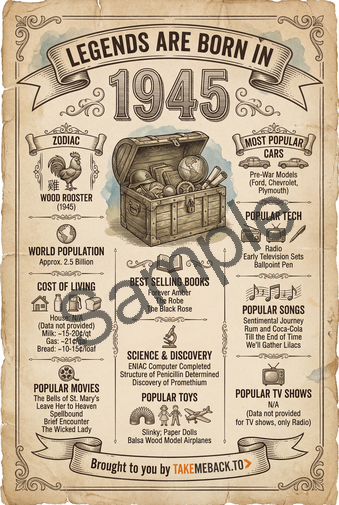

Major Events of 1945 - Historical Moments That Defined the Year | TakeMeBack.to
- 01 Jan Operation Bodenplatte: German Luftwaffe's desperate air offensive: On January 1, 1945, the German Luftwaffe launched Operation Bodenplatte, a last-ditch air offensive aimed at crippling Allied air power in the West. The operation involved coordinated attacks on Allied airfields but ultimately failed, resulting in significant German losses. source: britannica.com
- 02 Jan Allied air raid on Nuremberg: On January 2, 1945, Allied forces conducted a significant air raid on Nuremberg, targeting key military installations and infrastructure. This attack was part of the broader strategy to weaken German defenses as the Allies advanced into Germany. source: britannica.com
- 03 Jan US aircraft carriers attack Okinawa: On January 3, 1945, US aircraft carriers launched air strikes against Japanese positions in Okinawa as part of the Pacific campaign. This operation aimed to weaken Japanese defenses ahead of the planned invasion of the island. source: britannica.com
- 04 Jan Nazi executions in Amsterdam: On January 4, 1945, Nazi forces executed several individuals in Amsterdam, Netherlands. The executions were part of the German occupation's repressive measures against resistance members and civilians. Specific details about the victims and circumstances are limited. source: en.wikipedia.org
- 05 Jan Pepe Le Pew cartoon debut: On January 5, 1945, the animated character Pepe Le Pew made his debut in the Warner Bros. cartoon "Odor-able Kitty." Pepe Le Pew is a French skunk known for his romantic pursuits and distinctive accent. source: en.wikipedia.org
- 06 Jan Turkey cuts diplomatic ties with Japan: On January 6, 1945, Turkey severed diplomatic relations with Japan during World War II. This decision aligned Turkey with the Allied powers and was part of its broader efforts to distance itself from Axis nations. source: en.wikipedia.org
- 08 Jan Philippine Commonwealth Army attacks Japanese forces in Ilocos Sur: On January 8, 1945, the Philippine Commonwealth Army initiated an assault on Japanese positions in Ilocos Sur, marking the beginning of the Battle of Bessang Pass. This operation was part of a broader campaign to liberate Northern Luzon from Japanese occupation during World War II. source: philhistoricsites.nhcp.gov.ph
- 09 Jan US invasion of Lingayen Gulf: On January 9, 1945, U.S. forces launched an amphibious assault on Lingayen Gulf, marking a significant step in the liberation of the Philippines from Japanese occupation during World War II. source: army.mil
- 10 Jan Japanese balloon bomb intercepted during World War II: On January 10, 1945, a Japanese balloon bomb was intercepted over the Pacific Ocean. These balloon bombs were part of Japan's strategy to cause destruction in the United States by using high-altitude balloons to carry incendiary devices. This incident marked one of the few successful interceptions of such devices during the war. source: archives.gov
- 12 Jan Soviet offensive in Eastern Europe: On January 12, 1945, the Soviet Union launched a major offensive in Eastern Europe, aimed at pushing back German forces. This offensive was part of the larger strategy to liberate occupied territories and weaken the German military. The operation contributed to the rapid advance of Soviet troops towards Berlin. source: britannica.com
- 13 Jan Auschwitz concentration camp evacuation begins: On January 13, 1945, the evacuation of Auschwitz concentration camp began as Soviet forces approached. The Nazis forced remaining prisoners on death marches to other camps, leading to significant loss of life. This event marked a tragic chapter in the Holocaust as the camp was liberated shortly thereafter. source: britannica.com
- 14 Jan Battle of Ramree Island: British-Japanese Confrontation in Burma: On January 14, 1945, during World War II, the Battle of Ramree Island took place in Burma. British forces launched an amphibious assault on Ramree Island, aiming to capture it from Japanese control. The battle was notable for its intense combat and the subsequent mass retreat of Japanese forces into the island's mangrove swamps. source: en.wikipedia.org
- 17 Jan Soviet forces capture Warsaw from German occupation: On January 17, 1945, Soviet troops liberated Warsaw, ending German control over the city. This marked a significant turning point in the European theater of World War II. source: history.com
- 18 Jan Evacuation of Auschwitz concentration camp begins: On January 18, 1945, the SS initiated the evacuation of Auschwitz concentration camp, forcing approximately 56,000 prisoners to march westward toward the interior of the German Reich. This operation, known as the 'death marches,' resulted in the deaths of thousands of prisoners. source: auschwitz.org
- 19 Jan German evacuation of East Prussia: In January 1945, as Soviet forces advanced, the German population began evacuating East Prussia. This mass movement was marked by chaos and significant loss of life, as civilians fled westward to escape the approaching Red Army. source: britannica.com
- 20 Jan German forces surrender in Hungary: On January 20, 1945, German forces in Hungary surrendered to the advancing Soviet Red Army. This marked a significant step in the liberation of Hungary from Axis control during World War II. source: britannica.com
- 21 Jan Soviet advances on Eastern Front: On January 21, 1945, Soviet forces continued their advances on the Eastern Front, pushing deeper into German-occupied territories. This offensive was part of a larger strategy to defeat Nazi Germany in World War II. source: britannica.com
- 24 Jan Liberation of Auschwitz Concentration Camp: On January 24, 1945, Soviet forces liberated the Auschwitz concentration camp in Poland, freeing approximately 7,000 prisoners who had been left behind by the retreating German forces. The camp had been evacuated earlier, with most prisoners sent on death marches or to other camps. source: auschwitz.org
- 25 Jan Allied Forces Advance in Burma: On January 25, 1945, Allied forces advanced in Burma, with British 3rd Commando Brigade engaging in the Battle of Hill 170, securing a bridgehead in the Arakan region. source: en.wikipedia.org
- 26 Jan Hitler's final military reorganization: On January 26, 1945, Adolf Hitler ordered a significant reorganization of the German military in response to the deteriorating situation on the Eastern Front. This reorganization aimed to bolster defenses against the advancing Soviet forces, but ultimately proved ineffective as the war neared its end. source: britannica.com
- 27 Jan Liberation of Auschwitz concentration camp: On January 27, 1945, Soviet forces liberated Auschwitz, one of the most notorious Nazi concentration and extermination camps. This liberation revealed the full extent of the Holocaust and the suffering endured by millions. The date is now commemorated as International Holocaust Remembrance Day. source: britannica.com
- 28 Jan Wilhelm Gustloff Sinking - Worst Maritime Disaster in War History: On January 28, 1945, the German ship Wilhelm Gustloff was sunk by a Soviet submarine, resulting in the deaths of an estimated 9,000 people. This tragedy remains the deadliest maritime disaster in history, overshadowed by the events of World War II. source: bbc.com
- 29 Jan Soviet Offensive in Königsberg during World War II: On January 29, 1945, the Soviet Red Army launched a major offensive against the German city of Königsberg. This assault was part of the larger East Prussian offensive, leading to the city's capture and contributing to the collapse of German defenses in the region. source: britannica.com
- 30 Jan Wilhelm Gustloff Maritime Disaster: On January 30, 1945, the German ocean liner Wilhelm Gustloff was torpedoed and sunk by the Soviet submarine S-13 in the Baltic Sea. The ship was carrying an estimated 10,000 passengers, including civilians and military personnel, fleeing the advancing Soviet forces. Approximately 9,000 people perished, making it the deadliest maritime disaster in history. source: britannica.com
- 31 Jan Stutthof Concentration Camp Massacre: On January 31, 1945, as Soviet forces advanced, the Nazis executed approximately 1,000 prisoners at the Stutthof concentration camp in Poland. The victims were mostly Jewish and Polish prisoners, killed in an attempt to cover up the atrocities committed at the camp. source: en.wikipedia.org
- 01 Feb U.S. Victory in Second Battle of Kesternich: On February 1, 1945, during World War II, American forces achieved victory in the Second Battle of Kesternich, a part of the larger Battle of Hürtgen Forest. The battle resulted in the capture of the German-held village of Kesternich, contributing to the Allied advance into Germany. source: en.wikipedia.org
- 02 Feb Roosevelt and Churchill depart for Yalta Conference: On February 2, 1945, President Franklin D. Roosevelt and Prime Minister Winston Churchill departed for the Yalta Conference to discuss post-war Europe's future. source: en.wikipedia.org
- 03 Feb Battle of Manila begins: The Battle of Manila commenced on February 3, 1945, as American forces launched an assault to liberate the city from Japanese occupation. This battle was marked by intense urban combat and significant destruction, ultimately leading to the city's liberation. source: britannica.com
- 04 Feb Yalta Conference begins: The Yalta Conference began on February 4, 1945, where leaders of the Allied powers, including Franklin D. Roosevelt, Winston Churchill, and Joseph Stalin, met to discuss the post-war reorganization of Europe. This conference was crucial in shaping the geopolitical landscape after World War II. source: britannica.com
- 05 Feb Churchill arrives in Yalta for conference: Winston Churchill arrived in Yalta on February 5, 1945, to meet with Franklin D. Roosevelt and Joseph Stalin. This conference was crucial for discussing the post-war reorganization of Europe and the strategy against Nazi Germany. source: britannica.com
- 06 Feb Red Army crosses the Oder River: On February 6, 1945, the Red Army successfully crossed the Oder River, marking a significant advance towards Berlin. This operation was part of the Soviet offensive to defeat Nazi Germany in the final stages of World War II. source: britannica.com
- 07 Feb US infantry divisions cross the Sauer River: On February 7, 1945, US infantry divisions crossed the Sauer River as part of their advance into Germany. This maneuver was crucial in the Allied efforts to penetrate deeper into German territory during World War II. source: britannica.com
- 08 Feb Operation Veritable: Allied offensive in Western Germany: Operation Veritable commenced on February 8, 1945, as an Allied offensive aimed at clearing the German forces from the Rhineland. This operation was crucial in the push towards the Rhine River and the eventual defeat of Nazi Germany. source: britannica.com
- 09 Feb Rare submarine-to-submarine combat in World War II: On February 9, 1945, a rare instance of submarine-to-submarine combat took place during World War II. This engagement underscored the evolving tactics and technologies used in naval warfare during the conflict. source: britannica.com
- 10 Feb Allied powers strategize war's conclusion: On February 10, 1945, Allied leaders convened to strategize the conclusion of World War II in Europe. This meeting focused on coordinating military efforts and planning for the post-war landscape. source: britannica.com
- 11 Feb Yalta Conference: Major Allied Powers Meet to Discuss Post-War World Order: The Yalta Conference, held from February 4 to 11, 1945, in Yalta, Crimea, was attended by U.S. President Franklin D. Roosevelt, British Prime Minister Winston Churchill, and Soviet Premier Joseph Stalin. They discussed the post-war reorganization of Europe, including the establishment of occupation zones in Germany, reparations, and the creation of the United Nations. source: prlib.ru
- 12 Feb San Francisco Chosen for United Nations Conference: The Yalta Conference agreed to hold a United Nations Conference in San Francisco in April 1945 to establish a new international organization aimed at maintaining peace. source: prlib.ru
- 13 Feb Dresden bombing by British forces during World War II: On February 13, 1945, British Bomber Command initiated a series of air raids on Dresden, Germany, marking the beginning of a three-day bombing campaign that resulted in significant destruction and civilian casualties. source: britannica.com
- 14 Feb Dresden bombing - second day: On February 14, 1945, the U.S. Eighth Air Force conducted a second bombing raid on Dresden, Germany, continuing the Allied offensive against the city. source: britannica.com
- 15 Feb Dresden bombing campaign during World War II: Between February 13 and 15, 1945, British and American forces conducted a series of bombing raids on Dresden, Germany, resulting in widespread destruction and significant civilian casualties. source: britannica.com
- 16 Feb US Navy carrier raid on Tokyo: On February 16, 1945, the US Navy conducted a significant carrier raid on Tokyo, targeting military installations and infrastructure. This operation was part of the broader strategy to weaken Japanese defenses as the war in the Pacific intensified. source: britannica.com
- 17 Feb British SAS Operation Cold Comfort in Italy: On February 17, 1945, British Special Air Service (SAS) launched Operation Cold Comfort in Italy, targeting German supply lines. This operation aimed to disrupt enemy logistics as Allied forces advanced through Europe. source: britannica.com
- 18 Feb Death of General Ivan Chernyakhovsky in World War II: General Ivan Chernyakhovsky, a prominent Soviet commander, was killed in action on February 18, 1945, during World War II. His leadership was crucial in several key battles on the Eastern Front. source: britannica.com
- 19 Feb US Marines land on Iwo Jima: On February 19, 1945, US Marines landed on Iwo Jima, marking the beginning of a fierce battle during World War II. This strategic location was vital for the US military's operations in the Pacific. source: britannica.com
- 20 Feb Naval engagement in the Atlantic: U-1276 and HMS Vervain: On February 20, 1945, the British destroyer HMS Vervain engaged the German U-boat U-1276 in the Atlantic. This encounter was part of the ongoing Battle of the Atlantic, where Allied forces sought to secure shipping lanes against German U-boat threats. source: naval-history.net
- 21 Feb Allied forces break through Siegfried Line: On February 21, 1945, Allied forces successfully breached the Siegfried Line, a German defensive fortification. This breakthrough was a significant step in the Allied advance into Germany during World War II, leading to the eventual defeat of Nazi forces. source: britannica.com
- 22 Feb Operation Clarion launched: Operation Clarion was launched on February 22, 1945, as a strategic air offensive by Allied forces targeting German transportation and communication networks. This operation aimed to disrupt German logistics in the final stages of World War II. source: britannica.com
- 23 Feb Liberation of Manila: The liberation of Manila was a significant event during World War II, marking the end of Japanese occupation in the Philippines. American and Filipino forces fought to reclaim the city, which had suffered extensive destruction during the battle. This event is commemorated annually in the Philippines as a pivotal moment in their history. source: britannica.com
- 24 Feb Liberation of Manila: The liberation of Manila continued on February 24, 1945, as American and Filipino troops pushed further into the city. The battle was marked by fierce fighting and significant civilian casualties, highlighting the devastation of urban warfare. This day is also recognized for the efforts to restore order and begin rebuilding the city. source: britannica.com
- 25 Feb US aircraft carriers attack Tokyo: On February 25, 1945, U.S. aircraft carriers launched a significant air raid on Tokyo, targeting military installations and infrastructure. This attack was part of a broader strategy to weaken Japanese defenses as the Allies moved closer to Japan. The raid demonstrated the reach and capability of U.S. naval aviation during the war. source: britannica.com
- 26 Feb US troops reclaim Corregidor Island: On February 26, 1945, U.S. troops successfully reclaimed Corregidor Island in the Philippines from Japanese forces. This marked a significant victory in the Pacific Theater, as Corregidor had been a strategic stronghold for the Japanese since 1942. The recapture was part of the broader campaign to liberate the Philippines. source: britannica.com
- 27 Feb Philippines civil administration transfer: On February 27, 1945, the United States transferred civil administration in the Philippines from military to civilian control, marking a significant step in the post-war recovery and governance of the islands. This transition aimed to restore normalcy and rebuild the war-torn nation. source: archives.gov
- 28 Feb Violent demonstration in Bucharest and political intervention: On February 28, 1945, a violent demonstration occurred in Bucharest, Romania, leading to significant political intervention. The unrest was fueled by dissatisfaction with the post-war government and foreign influence, reflecting the turbulent political climate in Eastern Europe at the time. source: britannica.com
- 01 Mar Roosevelt's last congressional address: On March 1, 1945, President Franklin D. Roosevelt delivered his last address to Congress, outlining his vision for post-war America and the world. This address came shortly before his death and highlighted his commitment to international cooperation and peace. source: archives.gov
- 02 Mar Henry A. Wallace becomes U.S. Secretary of Commerce: On March 2, 1945, Henry A. Wallace was appointed as the U.S. Secretary of Commerce, a position he held until 1946. Wallace was a significant figure in the Roosevelt administration, known for his progressive policies and advocacy for civil rights. source: archives.gov
- 03 Mar Liberation of Manila: On March 3, 1945, Allied forces completed the liberation of Manila from Japanese occupation. This marked a significant victory in the Pacific Theater of World War II, leading to the eventual defeat of Japan. source: britannica.com
- 04 Mar Battle of Manila concludes: The Battle of Manila, a major conflict in the Pacific Theater of World War II, concluded on March 4, 1945. The battle resulted in the liberation of Manila from Japanese forces but caused extensive destruction and civilian casualties. source: en.wikipedia.org
- 05 Mar Allied generals strategic meeting in Lunéville: On March 5, 1945, Allied generals held a strategic meeting in Lunéville, France, to discuss military operations and coordination in the European theater during World War II. source: en.wikipedia.org
- 06 Mar Communist government established in Romania: On March 6, 1945, under Soviet pressure, Petru Groza formed Romania's first Communist-led government. This marked the beginning of Romania's transition to a Communist state. source: britannica.com
- 07 Mar Ludendorff Bridge seized at Remagen: On March 7, 1945, U.S. forces captured the Ludendorff Bridge at Remagen, Germany, providing a crucial crossing point over the Rhine River. This strategic victory facilitated the Allied advance into Germany. source: americanrifleman.org
- 08 Mar Kiss Me Kate Debuts in Britain: The musical 'Kiss Me Kate', a popular Broadway adaptation of Shakespeare's 'The Taming of the Shrew', opens in Britain, showcasing post-war cultural exchange and entertainment.
- 09 Mar Soviet suppression of Polish resistance: On March 9, 1945, the Soviet Union intensified its efforts to suppress Polish resistance movements, particularly the Home Army. This suppression was part of a broader strategy to establish control over Poland following World War II. source: britannica.com
- 10 Mar Tokyo firebombing - World War II atrocity: On March 10, 1945, the United States conducted a massive firebombing raid on Tokyo, resulting in extensive destruction and loss of life. This event is considered one of the most devastating air raids of World War II, targeting civilian areas. source: britannica.com
- 11 Mar Allied bombing of Essen: On March 11, 1945, the Royal Air Force conducted a massive bombing raid on Essen, Germany, dropping 4,738 tons of bombs. This attack was part of the Battle of the Ruhr, aiming to cripple German industrial capabilities. The raid resulted in significant destruction of the city, with numerous civilian casualties. source: en.wikipedia.org
- 12 Mar New York Pioneers Anti-Discrimination Employment Law: On March 12, 1945, New York Governor Thomas E. Dewey signed the Ives–Quinn Act into law, marking a significant step in civil rights legislation. The act prohibited employment discrimination based on race, religion, or national origin, establishing the State Commission against Discrimination to enforce these provisions. source: en.wikipedia.org
- 13 Mar Queen Wilhelmina returns to the Netherlands: Queen Wilhelmina of the Netherlands returned to her country after years of exile during World War II. Her return marked a significant moment in Dutch history, symbolizing the restoration of the monarchy and national unity following the German occupation. source: britannica.com
- 14 Mar RAF first operational use of Grand Slam bomb: The Royal Air Force (RAF) conducted its first operational use of the Grand Slam bomb, a massive weapon designed to penetrate hardened targets. This event marked a significant advancement in aerial bombing capabilities during World War II. source: raf.mod.uk
- 15 Mar Soviet offensive in Upper Silesia: The Soviet offensive in Upper Silesia began, marking a significant advance into German territory during World War II. This offensive was part of the larger Soviet push towards Berlin, contributing to the eventual defeat of Nazi Germany. source: en.wikipedia.org
- 16 Mar Allies secure Iwo Jima: On March 16, 1945, Allied forces secured the island of Iwo Jima after a fierce battle. This strategic victory was crucial for the Allies in the Pacific Theater during World War II, providing a base for air operations against Japan. source: britannica.com
- 17 Mar Battle of Iwo Jima concludes: The Battle of Iwo Jima concluded on March 17, 1945, after a month of intense fighting. This battle was one of the bloodiest in the Pacific, with significant casualties on both sides, and it played a pivotal role in the Allied campaign against Japan. source: britannica.com
- 18 Mar Massive Bombing of Berlin: On March 18, 1945, an air battle occurred over Berlin when 1,329 Allied bombers and 700 long-range fighters were met by the Luftwaffe using the new Me 262s and air-to-air rockets. source: en.wikipedia.org
- 19 Mar US Navy attacks Kure and Kobe harbors: On March 19, 1945, the U.S. Navy's Task Force 58 launched a large-scale air raid targeting Japanese warships in Kure and Kobe harbors. The attack involved 240 carrier aircraft from multiple carriers, aiming to neutralize the remnants of the Japanese Combined Fleet. Despite the extensive assault, no Japanese warships were sunk, though several were damaged. The American forces faced significant resistance from Japanese anti-aircraft defenses and fighter aircraft, resulting in the loss of 14 American planes and the downing of 25 Japanese aircraft. source: pacificwrecks.com
- 20 Mar Hitler's final public appearance: On March 20, 1945, Adolf Hitler made his last public appearance, addressing the German people and military leaders. This event marked the final time he appeared in public before retreating to his underground bunker in Berlin, where he would remain until his death in April 1945. source: history.com
- 21 Mar Allied bombing campaign over Germany: On March 21, 1945, Allied forces intensified their bombing campaign over Germany, targeting industrial centers, transportation hubs, and military installations. This strategic bombing aimed to cripple Germany's war production capabilities and disrupt supply lines, contributing to the eventual Allied victory in Europe. source: history.com
- 22 Mar Arab League founding: The Arab League was founded on March 22, 1945, in Cairo, Egypt, with six member states: Egypt, Iraq, Jordan, Lebanon, Saudi Arabia, and Syria. The organization aimed to promote political, economic, cultural, and social cooperation among Arab countries. source: britannica.com
- 23 Mar Operation Plunder: Allied Rhine River crossing: Operation Plunder commenced on March 23, 1945, as Allied forces launched a major offensive to cross the Rhine River. This operation was pivotal in the final stages of World War II, facilitating the advance into Germany and contributing to the eventual defeat of Nazi forces. source: britannica.com
- 24 Mar Operation Varsity: Allied Airborne Landings East of Rhine: Operation Varsity, launched on March 24, 1945, saw Allied airborne forces land east of the Rhine River to secure key positions ahead of the ground assault. source: en.wikipedia.org
- 25 Mar US Seventh Army Crosses Rhine at Worms: On March 25, 1945, the U.S. Seventh Army crossed the Rhine River at Worms, advancing into Germany as part of the Allied offensive. source: en.wikipedia.org
- 26 Mar Battle of Iwo Jima concludes: The Battle of Iwo Jima, a pivotal World War II engagement, concluded on March 26, 1945, with the United States declaring the island secure. The battle, which began on February 19, 1945, resulted in nearly 7,000 U.S. Marines killed and approximately 20,000 Japanese soldiers killed. source: history.com
- 27 Mar Operation Starvation begins: Operation Starvation, a campaign aimed at disrupting Japanese supply lines, commenced on March 27, 1945. This operation involved extensive aerial bombardment targeting Japanese shipping and infrastructure in the Pacific theater. source: britannica.com
- 28 Mar Soviet forces capture Castle Balga and destroy German 4th Army: On March 28, 1945, Soviet forces captured Castle Balga, leading to the destruction of the German 4th Army. This event was part of the larger offensive in East Prussia during the final stages of World War II. source: britannica.com
- 29 Mar End of V-1 flying bomb attacks on England: The end of V-1 flying bomb attacks on England was officially marked on March 29, 1945. This cessation came as Allied forces advanced and diminished the threat posed by German rocket attacks. source: bbc.com
- 30 Mar Soviet invasion of Austria: The Soviet invasion of Austria began on March 30, 1945, as part of the final offensive against Nazi Germany. This operation aimed to liberate Austria from German occupation during World War II. source: britannica.com
- 31 Mar Death of Hans Fischer: Hans Fischer, a German organic chemist and Nobel laureate, died on March 31, 1945, in Munich, Germany. He was awarded the Nobel Prize in Chemistry in 1930 for his research into the constitution of hemin and chlorophyll. source: britannica.com
- 01 Apr US forces land on Okinawa during World War II: On April 1, 1945, American forces initiated the amphibious invasion of Okinawa, marking the beginning of one of the bloodiest battles in the Pacific Theater. The operation, codenamed "Operation Iceberg," aimed to secure a strategic base for operations near Japan. By the evening of April 1, approximately 60,000 U.S. troops had landed on the island, facing minimal initial resistance. source: history.com
- 02 Apr Multiple military operations in Europe during World War II: On April 2, 1945, various military operations were underway in Europe as Allied forces advanced into German territory. These operations aimed to weaken German defenses and facilitate the final stages of the war in Europe. source: armytimes.com
- 03 Apr Canadian 1st Army crosses Rhine River: On April 3, 1945, the Canadian 1st Army successfully crossed the Rhine River, marking a significant advance into Germany during World War II. This maneuver was part of the larger Allied strategy to penetrate German defenses and hasten the end of the war in Europe. source: britannica.com
- 04 Apr Hungary liberated from German occupation: On April 4, 1945, Hungary was liberated from German occupation as Soviet forces advanced into the country. This liberation was part of the broader Soviet offensive against Axis powers in Eastern Europe during World War II. source: bbc.com
- 05 Apr Leadership change in Imperial Japan during World War II: On April 5, 1945, significant leadership changes occurred in Imperial Japan as the country faced increasing pressure from Allied forces. This shift was part of the broader context of Japan's declining position in the war. source: britannica.com
- 06 Apr Yamato's Final Voyage: On April 6, 1945, the Japanese battleship Yamato embarked on its final mission, Operation Ten-Go, aiming to engage U.S. forces near Okinawa. The mission was intercepted by American aircraft, leading to the sinking of the Yamato on April 7, 1945, with most of its crew perishing. source: pbs.org
- 07 Apr Sinking of the Japanese battleship Yamato: On April 7, 1945, the Japanese battleship Yamato was sunk by U.S. aircraft during Operation Ten-Go. This marked a significant moment in naval warfare, as the Yamato was one of the largest battleships ever built. The loss symbolized the decline of Japanese naval power in World War II. source: britannica.com
- 08 Apr Nazi train massacre: On April 8, 1945, a tragic event known as the Nazi train massacre occurred, where numerous prisoners were executed by Nazi forces. This event highlighted the brutalities of the Holocaust and the desperate measures taken by the Nazis as Allied forces closed in. It remains a somber reminder of the atrocities committed during this period. source: britannica.com
- 09 Apr United States Atomic Energy Commission formed: The United States Atomic Energy Commission (AEC) was established on April 9, 1945, to oversee the development and regulation of atomic energy. This formation came in the wake of the Manhattan Project and marked a significant step in the U.S. government's approach to nuclear energy and weapons. The AEC played a crucial role in the post-war nuclear landscape. source: osti.gov
- 10 Apr Canadian troops capture Deventer: On April 10, 1945, Canadian forces launched Operation Cannonshot, a significant offensive across the IJssel River near Deventer in the Netherlands. The operation aimed to secure a bridgehead for further advances into Germany, marking a crucial step in the liberation of the region. source: codenames.info
- 11 Apr Liberation of Buchenwald concentration camp: On April 11, 1945, American forces liberated the Buchenwald concentration camp in Germany. The camp was one of the largest and most notorious Nazi concentration camps, where thousands of prisoners were held and many perished. source: en.wikipedia.org
- 12 Apr Death and Succession of President Franklin D. Roosevelt: President Franklin D. Roosevelt died on April 12, 1945, from a cerebral hemorrhage, leading to Harry S. Truman's succession as the 33rd President of the United States. Roosevelt's death occurred during the final stages of World War II, significantly impacting U.S. leadership during this critical period. source: archives.gov
- 13 Apr Gardelegen Massacre: The Gardelegen Massacre, which occurred on April 13, 1945, involved the killing of prisoners by German soldiers as Allied forces approached. This event is part of the broader context of Nazi war crimes during the Holocaust, highlighting the brutalities faced by concentration camp inmates. source: britannica.com
- 14 Apr American bombing of Tokyo: On April 14, 1945, American forces conducted bombing raids on Tokyo, targeting military and industrial sites. This was part of a broader strategy to weaken Japan's war capabilities as World War II neared its conclusion. source: archives.gov
- 15 Apr Liberation of Bergen-Belsen concentration camp: On April 15, 1945, British forces liberated the Bergen-Belsen concentration camp, uncovering the horrific conditions and the extent of Nazi atrocities. This event highlighted the brutal realities of the Holocaust. source: bbc.com
- 16 Apr Soviet forces launch major offensive on Berlin: On April 16, 1945, the Soviet Union initiated a significant offensive against Berlin, marking a crucial phase in World War II. This operation aimed to capture the German capital and effectively end Nazi control in Europe. source: britannica.com
- 17 Apr Uranium seizure to prevent Soviet atomic ambitions: On April 17, 1945, Allied forces seized uranium supplies in an effort to prevent the Soviet Union from developing atomic weapons. This action was part of the broader geopolitical tensions emerging at the end of World War II. source: britannica.com
- 18 Apr Walter Model's mass surrender: On April 18, 1945, Field Marshal Walter Model, commander of German Army Group B, ordered the mass surrender of German forces in the Ruhr area. This decision followed the dissolution of Army Group B on April 15, 1945, and led to the capture of approximately 317,000 German soldiers by Allied forces. source: en.wikipedia.org
- 19 Apr Hitler's final defeat in Berlin bunker: On April 19, 1945, Adolf Hitler, the leader of Nazi Germany, faced his final defeat in the Berlin bunker as Soviet forces advanced into Berlin. This marked the beginning of the end for Nazi Germany, leading to its unconditional surrender on May 8, 1945.
- 20 Apr Soviet artillery begins shelling Berlin's city center: On April 20, 1945, Soviet artillery of the 1st Belorussian Front began shelling Berlin's city center, marking the start of the Battle of Berlin. This heavy bombardment continued until the city's surrender. source: britannica.com
- 21 Apr Soviet forces advance into Berlin's suburbs: On April 21, 1945, Soviet forces advanced into Berlin's suburbs, marking a significant step in the Battle of Berlin. The 1st Belorussian Front's artillery had begun shelling the city center on April 20. source: britannica.com
- 22 Apr Hitler's final breakdown in the Führerbunker: On April 22, 1945, Adolf Hitler suffered a nervous breakdown in the Führerbunker, admitting that Germany was defeated and deciding to remain in Berlin until his death. source: histclo.com
- 23 Apr Soviet assault on Berlin: On April 23, 1945, Soviet forces intensified their assault on Berlin, advancing through the city as part of the final push to capture the German capital. source: britannica.com
- 24 Apr Elbe Day: US and Soviet troops meet: On April 24, 1945, American and Soviet forces met at the Elbe River in Germany, marking a significant moment in World War II. This meeting symbolized the cooperation between the two nations against Nazi Germany and was a pivotal point in the Allied advance into Germany. source: britannica.com
- 25 Apr Elbe Day: US and Soviet troops meet: On April 25, 1945, the meeting of US and Soviet troops at the Elbe River was celebrated as Elbe Day. This event symbolized the unity of the Allies in their fight against Nazi Germany and marked a significant moment in the closing days of World War II. source: britannica.com
- 26 Apr Dachau Concentration Camp Death March: On April 26, 1945, as Allied forces advanced, thousands of prisoners were forced to march from Dachau concentration camp. Many died from exhaustion, exposure, and execution during this brutal march. This event highlights the atrocities committed during the Holocaust as the Nazi regime collapsed. source: ushmm.org
- 27 Apr Capture of Benito Mussolini: On April 27, 1945, Italian partisans captured Benito Mussolini while he attempted to flee to Switzerland. His capture marked the end of his regime and was a significant moment in the Italian resistance against fascism during World War II. source: britannica.com
- 28 Apr Execution of Mussolini and Petacci: On April 28, 1945, Benito Mussolini and his mistress Clara Petacci were executed by Italian partisans. Their bodies were later displayed in Milan, marking a significant moment in the end of Fascist rule in Italy and the broader context of World War II. source: britannica.com
- 29 Apr Hitler's final marriage and succession: On April 29, 1945, following his marriage to Eva Braun, Adolf Hitler designated his successor, Grand Admiral Karl Dönitz, as the new leader of Germany. This decision was made in the context of the imminent fall of Berlin and the collapse of the Nazi regime. source: britannica.com
- 30 Apr Adolf Hitler's suicide in Berlin bunker: On April 30, 1945, Adolf Hitler committed suicide in his bunker in Berlin as Soviet forces closed in on the city. He took his life by gunshot, and his long-time companion, Eva Braun, also died by suicide shortly thereafter. source: britannica.com
- 01 May German total surrender begins: On May 1, 1945, the German military began the process of total surrender, following the fall of Berlin and the death of Adolf Hitler. This marked the beginning of the end of World War II in Europe. source: britannica.com
- 02 May Fall of Berlin: Berlin fell to Soviet forces on May 2, 1945, marking a significant turning point in World War II and leading to Germany's surrender. source: britannica.com
- 03 May Wernher von Braun surrenders: On May 3, 1945, German rocket scientist Wernher von Braun and his team surrendered to American forces, leading to their relocation to the United States. source: en.wikipedia.org
- 04 May Major German Surrender Near Hamburg: On May 4, 1945, a significant German surrender occurred near Hamburg as Allied forces continued their advance. This surrender was part of the larger context of the collapse of Nazi Germany, leading to the end of the war in Europe. The event underscored the rapid disintegration of German military power at the time. source: britannica.com
- 05 May German Surrender in Netherlands: On May 5, 1945, German forces in the Netherlands surrendered to the Allies, marking the liberation of the country. This event was part of the final stages of World War II in Europe, contributing to the overall defeat of Nazi Germany. The surrender was celebrated by the Dutch population as a significant moment of freedom. source: britannica.com
- 06 May Iconic Reichstag flag photograph taken: On May 2, 1945, Soviet soldiers raised the Soviet flag over the Reichstag building in Berlin, symbolizing the defeat of Nazi Germany. This moment was captured in a famous photograph, representing a significant turning point in World War II. source: britannica.com
- 07 May Nazi Germany's unconditional surrender: Nazi Germany officially surrendered unconditionally on May 7, 1945, marking the end of World War II in Europe. This surrender was signed in Reims, France, and was celebrated as Victory in Europe (VE) Day on May 8. source: britannica.com
- 08 May Victory in Europe Day (VE Day): Victory in Europe Day, celebrated on May 8, 1945, marks the formal acceptance of Nazi Germany's unconditional surrender by the Allies. This day is commemorated in many countries across Europe and is a significant historical milestone in the conclusion of World War II. source: britannica.com
- 09 May End of World War II in Europe: The end of World War II in Europe was officially marked on May 9, 1945, following the ratification of Germany's unconditional surrender. This day is commemorated as a significant turning point in global history, leading to the eventual establishment of peace in Europe. source: britannica.com
- 10 May Australian forces secure Wewak in New Guinea: On May 10, 1945, Australian troops, supported by the Royal Australian Air Force and Royal Australian Navy, launched an amphibious assault on Wewak, a major Japanese air base in New Guinea. Despite determined resistance, Australian forces declared Wewak cleared on May 11, marking a significant victory in the Aitape-Wewak campaign. source: dva.gov.au
- 12 May UN Security Council Formation: The United Nations Security Council was established on May 12, 1945, as part of the UN Charter, which aimed to promote international cooperation and prevent future conflicts. This body plays a crucial role in maintaining international peace and security. source: un.org
- 13 May Iconic World War II Photo Published: On May 13, 1945, one of the most iconic photographs from World War II was published, capturing the essence of the conflict and its impact on soldiers and civilians alike. This image has since become a symbol of the war's legacy. source: britannica.com
- 14 May US offensive captures Sugar Loaf Hill on Okinawa: On May 14, 1945, American forces captured Sugar Loaf Hill during the Battle of Okinawa. This strategic victory was part of a larger campaign to secure the island from Japanese forces, which was crucial for the Allied advance in the Pacific. source: britannica.com
- 15 May Last European battle of World War II: The last major battle in Europe during World War II occurred on May 15, 1945, marking the end of significant hostilities on the continent. This battle involved German forces and was part of the broader collapse of Nazi Germany. source: britannica.com
- 16 May Fierce battle of Sugar Loaf/Half Moon in Okinawa: The Battle of Sugar Loaf and Half Moon occurred on May 16, 1945, as American forces engaged in intense combat against Japanese troops in Okinawa. This battle was part of the larger campaign to secure the island. source: britannica.com
- 17 May Denmark severs diplomatic ties with Japan: On May 17, 1945, Denmark officially severed diplomatic relations with Japan, reflecting the changing geopolitical landscape following World War II. This decision was part of Denmark's alignment with the Allied powers. source: britannica.com
- 19 May Capture of Nazi Ideologue Alfred Rosenberg: Alfred Rosenberg, a leading Nazi ideologue, was captured by Allied forces on May 19, 1945, in Flensburg-Mürwik, Germany. He was later tried at the Nuremberg Trials, found guilty on all counts, and executed on October 16, 1946. source: en.wikipedia.org
- 22 May US 6th Marine Division advances in Okinawa: On May 22, 1945, the US 6th Marine Division made significant advances in Okinawa, capturing key positions against Japanese forces. This operation was part of the larger Battle of Okinawa, which was one of the bloodiest battles in the Pacific during World War II. source: britannica.com
- 23 May UN Conference approves Security Council structure: On May 23, 1945, the United Nations Conference on International Organization approved the structure of the UN Security Council. This decision was crucial in establishing a framework for international peace and security post-World War II. source: un.org
- 25 May U.S. Troops Begin Homeward Journey After World War II: Following the end of World War II in Europe on May 8, 1945, the United States initiated Operation Magic Carpet to repatriate over eight million American military personnel from the European Theater. This operation commenced in June 1945, with hundreds of Liberty ships, Victory ships, and troop transports beginning the journey from Europe to the United States. source: en.wikipedia.org
- 26 May Allied Headquarters Relocated to Frankfurt: On May 26, 1945, the Supreme Headquarters Allied Expeditionary Force (SHAEF) moved from Versailles, France, to the I.G. Farbenindustrie Building in Frankfurt, Germany. This relocation marked a significant step in the post-war occupation and administration of Germany. source: en.wikipedia.org
- 28 May USS Drexler sunk by kamikaze attack: On May 28, 1945, during Operation Kikusui VIII, the USS Drexler (DD-741) was struck by two Japanese kamikaze aircraft off the coast of Okinawa. The ship sank rapidly, resulting in the loss of 158 crew members and wounding 52 others. source: history.navy.mil
- 29 May US Marines capture Shuri Castle in Okinawa: On May 29, 1945, during the Battle of Okinawa, U.S. Marines captured Shuri Castle, a strategic stronghold of the Japanese forces. This victory was a significant step toward securing the island and contributed to the eventual Allied success in the Pacific Theater.
- 31 May U.S. Air Raid on Taipei during World War II: On May 31, 1945, the U.S. Fifth Air Force conducted the largest air raid on Taihoku (now Taipei), Taiwan, during World War II. A total of 117 B-24 bombers dropped approximately 3,800 bombs on military and governmental facilities, resulting in over 3,000 civilian deaths and tens of thousands wounded or displaced. source: en.wikipedia.org
- 01 Jun P-51 Mustangs Lost in Thunderstorm During Osaka Mission: On June 1, 1945, during a mission to escort B-29 bombers over Osaka, 148 P-51 Mustang fighters encountered severe weather conditions, including a solid front from sea level to 23,000 feet. This led to 27 Mustangs being lost, with 24 pilots killed, marking one of the largest single-day losses of P-51s in World War II. source: airandspaceforces.com
- 02 Jun Soviet Delegation Seeks UN Security Council Veto Power: On June 2, 1945, during the negotiations at the San Francisco Conference, the Soviet Union sought veto power in the United Nations Security Council, a key demand that influenced the structure of the post-war international order. source: en.wikipedia.org
- 03 Jun Birth of Hale Irwin, Professional Golfer: Hale S. Irwin, an American professional golfer, was born on June 3, 1945, in Joplin, Missouri. He is renowned for winning three U.S. Open titles and is considered one of the greatest players in Champions Tour history. source: en.wikipedia.org
- 04 Jun US Marines land on the North Oroku Peninsula, Okinawa: On June 4, 1945, U.S. Marines launched an amphibious assault on the North Oroku Peninsula in Okinawa, Japan. This operation aimed to secure the peninsula and eliminate Japanese defenses, contributing to the overall success of the Battle of Okinawa. source: nps.gov
- 05 Jun Allied Control Council takes power in Germany: On June 5, 1945, the Allied Control Council was established, marking the assumption of supreme authority over Germany by the United States, the Soviet Union, the United Kingdom, and France. This council was responsible for governing Germany following its unconditional surrender in World War II. source: deutschlandmuseum.de
- 06 Jun Hitler's body identified by Soviet forces: On June 6, 1945, Soviet Marshal Georgy Zhukov's staff announced that Adolf Hitler's body had been found and identified in the Chancellery gardens in Berlin. This followed earlier reports of charred remains discovered in the Führerbunker, which were later confirmed through dental records. source: en.wikipedia.org
- 08 Jun US and Australian Naval Task Group Bombards Brunei Bay: On June 8, 1945, a US and Australian naval task group, under Rear Admiral R.S. Berkey, conducted a bombardment of enemy positions in Brunei Bay, Borneo. This operation was part of the pre-invasion preparations for the Australian landings scheduled for June 10, 1945. The bombardment aimed to weaken Japanese defenses and support the upcoming amphibious assault. source: ibiblio.org
- 09 Jun 'A Gruesome Twosome' Animated Short Premieres: On June 9, 1945, Warner Bros. released the animated short 'A Gruesome Twosome,' directed by Bob Clampett. This Merrie Melodies cartoon features Tweety Bird and is notable for being the last Tweety film directed by Clampett before he left the studio. The short was produced by Warner Bros. Cartoons and distributed by Warner Bros. Pictures. source: en.wikipedia.org
- 10 Jun Australian troops capture Labuan airfield in Borneo: On June 10, 1945, Australian forces successfully captured Labuan Airfield in Borneo during World War II. This strategic victory was part of the broader campaign to liberate Borneo from Japanese occupation. source: britannica.com
- 11 Jun Ethical considerations in nuclear warfare: On June 11, 1945, discussions surrounding the ethical implications of nuclear warfare gained prominence as the world faced the potential use of atomic bombs. This marked a pivotal moment in military ethics and international relations. source: brookings.edu
- 12 Jun US Marines capture Kunishi Ridge in Okinawa: On June 12, 1945, US Marines captured Kunishi Ridge during the Battle of Okinawa, a crucial engagement in the Pacific Theater of World War II. This victory contributed to the eventual Allied success in the campaign. source: britannica.com
- 13 Jun Heerjansdam Soccer Team Established: VV Heerjansdam, a Dutch football club, was founded on June 13, 1945, in Heerjansdam, Netherlands. The club has since participated in various amateur leagues and achieved notable successes. source: en.wikipedia.org
- 15 Jun Battle of Bessang Pass: The Battle of Bessang Pass was a significant engagement during the Philippines Campaign of World War II, fought from January 9 to June 15, 1945. Filipino soldiers serving with the U.S. Army Forces in the Philippines – Northern Luzon (USAFIP-NL) successfully captured Bessang Pass from the Imperial Japanese Army, leading to the eventual surrender of Japanese forces in the Philippines. source: en.wikipedia.org
- 18 Jun Truman discusses Japan invasion strategy: On June 18, 1945, President Harry S. Truman met with his top military advisors to discuss the planned invasion of Japan's Kyushu island, codenamed Operation Olympic. General George C. Marshall estimated that the first 30 days of the invasion could result in approximately 31,000 American casualties. The meeting also considered the potential impact of Soviet entry into the war against Japan, which Marshall suggested might be the decisive action needed to compel Japan's surrender. source: washingtonpost.com
- 19 Jun General Eisenhower receives triumphant ticker-tape parade in New York City: On June 19, 1945, General Dwight D. Eisenhower, Supreme Commander of the Allied Expeditionary Force in Europe, was honored with a ticker-tape parade in New York City. The parade celebrated the Allied victory in Europe and Eisenhower's leadership during the campaign. source: en.wikipedia.org
- 20 Jun Operation Paperclip: Nazi scientists transferred to U.S.: Operation Paperclip was a secret program initiated by the U.S. government to recruit German scientists, engineers, and technicians after World War II. The operation aimed to leverage their expertise for American military and technological advancements during the Cold War. source: archives.gov
- 21 Jun Polish Home Army officers tried in Moscow: On June 21, 1945, several officers of the Polish Home Army were tried in Moscow, reflecting the Soviet Union's efforts to consolidate control over Poland after World War II. This trial was part of a broader campaign against Polish resistance leaders. source: britannica.com
- 22 Jun End of the Battle of Okinawa: The Battle of Okinawa concluded on June 22, 1945, with the surrender of Japanese forces. This battle was crucial in the Pacific campaign, paving the way for the eventual Allied invasion of Japan. source: britannica.com
- 23 Jun Emperor Hirohito's peace overture: On June 23, 1945, Emperor Hirohito of Japan issued a peace overture, signaling a desire to end World War II. This marked a significant moment in the conflict, as Japan faced imminent defeat. The overture was part of the broader context of Japan's surrender negotiations. source: archives.gov
- 24 Jun 1945 Moscow Victory Parade: The Moscow Victory Parade on June 24, 1945, celebrated the defeat of Nazi Germany in World War II. This grand event featured military displays and was attended by Soviet leaders, symbolizing the USSR's significant role in the war. It was a pivotal moment in Soviet history. source: britannica.com
- 25 Jun Seán T. O'Kelly elected President of Ireland: Seán T. O'Kelly was inaugurated as the second President of Ireland on June 25, 1945, succeeding Douglas Hyde. He served two terms from 1945 to 1959. source: britannica.com
- 26 Jun United Nations Charter Signed in San Francisco: The United Nations Charter was signed in San Francisco on June 26, 1945, establishing the United Nations as an international organization aimed at promoting peace and cooperation among nations.
- 28 Jun Formation of Poland's Provisional Government of National Unity: On June 28, 1945, the Provisional Government of National Unity (TRJN) was established in Poland, marking a coalition between the Polish Workers' Party and the Polish People's Party, as agreed upon during the Yalta Conference. source: trumanlibrary.gov
- 02 Jul End of the Battle of Okinawa: The Battle of Okinawa, one of the bloodiest battles in the Pacific during World War II, officially ended on July 2, 1945. This battle was crucial for the Allied forces as they aimed to secure a base for the invasion of Japan. The high casualties and destruction marked a significant moment in the war's final stages. source: britannica.com
- 03 Jul UK General Election: Labour Party's Landmark Victory: On July 3, 1945, the Labour Party won a decisive victory in the UK General Election, marking a significant shift in British politics post-World War II. This election resulted in the formation of a Labour government under Clement Attlee, which implemented extensive social reforms. The victory was seen as a mandate for change in the aftermath of the war. source: bbc.com
- 04 Jul Canadian Troops Riot in Aldershot, England: On July 4, 1945, Canadian troops stationed in Aldershot, England, rioted due to dissatisfaction with their living conditions and treatment. This incident highlighted the challenges faced by military personnel during the post-war period. The unrest was a reflection of broader issues within the military at the time. source: bbc.com
- 05 Jul United Kingdom General Election of 1945: The United Kingdom General Election of 1945 took place on July 5, 1945, resulting in a significant victory for the Labour Party. This election was pivotal in shaping post-war Britain, leading to major social reforms and the establishment of the welfare state. The election reflected the public's desire for change after the hardships of World War II. source: bbc.com
- 06 Jul Medal of Freedom established: The Medal of Freedom was established on July 6, 1945, by President Harry S. Truman. It was created to honor individuals for their contributions to the United States, particularly during World War II. source: archives.gov
- 07 Jul Kalagong Massacre in Burma: The Kalagong Massacre occurred on July 7, 1945, during World War II, when Japanese forces killed numerous civilians in Burma. This event highlighted the brutalities of the war in the region. source: britannica.com
- 11 Jul Fadil Hoxha becomes Kosovo Assembly President: Fadil Hoxha was elected as the President of the Kosovo Assembly on July 11, 1945. His leadership marked a significant moment in the political landscape of Kosovo during the post-war period. source: britannica.com
- 12 Jul Labour Party wins landmark UK general election: On July 12, 1945, the Labour Party won a historic general election in the United Kingdom, leading to significant social and economic reforms. This victory marked a shift in British politics and the beginning of the post-war welfare state. source: bbc.com
- 13 Jul First atomic bomb detonation in New Mexico: On July 13, 1945, the first atomic bomb was detonated in New Mexico as part of the Manhattan Project. This event marked a pivotal moment in military history and the development of nuclear weapons. source: britannica.com
- 14 Jul USS South Dakota bombards Japan: The USS South Dakota participated in a bombardment of Japanese targets, contributing to the Allied offensive in the Pacific Theater. source: en.wikipedia.org
- 15 Jul Truman departs for Potsdam Conference: President Harry S. Truman departed for the Potsdam Conference, a pivotal meeting with Allied leaders to discuss post-war Europe and the Pacific. source: en.wikipedia.org
- 16 Jul Victor Sloan birth: Victor Sloan, an influential figure in the field of sports, was born on July 16, 1945. His contributions to athletics have been recognized in various capacities throughout his career. source: britannica.com
- 18 Jul Bedford Magazine explosion in Nova Scotia: On July 18, 1945, a fire aboard an ammunition barge at the Bedford Magazine near Halifax, Nova Scotia, led to a series of explosions lasting over 24 hours. The blasts shattered windows and damaged structures in Halifax, but only one fatality was reported. The incident prompted the evacuation of the northern half of the city. source: halifax.ca
- 20 Jul Birth of Larry Craig: Larry Craig, an American politician and former U.S. Senator from Idaho, was born on July 20, 1945. He served in the Senate from 1991 to 2009 and was a prominent figure in Republican politics. source: britannica.com
- 21 Jul Truman Approves Atomic Bomb Use Against Japan: On July 21, 1945, U.S. President Harry S. Truman approved the use of atomic bombs against Japan. This decision led to the bombings of Hiroshima and Nagasaki in August 1945, contributing to the end of World War II.
- 22 Jul Berlin Occupation Zones Military Police Agreement: On July 22, 1945, the Allied powers agreed on the establishment of military police zones in Berlin. This agreement was crucial for maintaining order in the divided city post-World War II. The arrangement laid the groundwork for the governance of Berlin during the early Cold War period. source: archives.gov
- 23 Jul Philippe Pétain Treason Trial: Philippe Pétain, the former leader of Vichy France, began his treason trial on July 23, 1945. He was charged with collaborating with Nazi Germany during World War II. The trial was significant in addressing wartime collaboration and accountability in post-war France. source: britannica.com
- 24 Jul Truman discloses atomic bomb to Stalin at Potsdam Conference: On July 24, 1945, President Harry S. Truman informed Soviet Premier Joseph Stalin about the successful test of the atomic bomb during the Potsdam Conference. This disclosure marked a significant moment in U.S.-Soviet relations and the onset of the nuclear age. source: archives.gov
- 25 Jul U.S. declares end of Japanese resistance in Mindanao: On July 25, 1945, U.S. forces announced the end of organized Japanese resistance in Mindanao, Philippines, marking a significant step in the liberation of the Philippines during World War II. This event followed intense fighting and was part of the broader campaign to defeat Japanese forces in the region. source: archives.gov
- 26 Jul USS Indianapolis delivers atomic bomb components: On July 26, 1945, the USS Indianapolis delivered crucial components for the atomic bomb to the U.S. military base at Tinian Island. This mission was critical in the development of the atomic bomb used later in the war against Japan. source: britannica.com
- 27 Jul Manhattan Project: Little Boy atomic bomb preparation: On July 27, 1945, the assembly of the Little Boy atomic bomb began on Tinian Island, with components arriving from the USS Indianapolis. source: britannica.com
- 28 Jul Japan rejects surrender ultimatum: On July 28, 1945, Japanese Prime Minister Kantarō Suzuki's response to the Potsdam Declaration was interpreted as a rejection, leading to continued conflict. source: en.wikipedia.org
- 29 Jul USS Indianapolis sunk after atomic bomb mission: The USS Indianapolis was sunk by a Japanese submarine on July 29, 1945, shortly after delivering components for the atomic bomb to Tinian. The sinking resulted in one of the worst maritime disasters in U.S. naval history. source: britannica.com
- 30 Jul USS Indianapolis sinking - World War II maritime tragedy: The sinking of the USS Indianapolis on July 30, 1945, resulted in the loss of nearly 900 crew members. This tragedy highlighted the dangers faced by naval forces during World War II and remains a significant event in naval history. source: britannica.com
- 31 Jul Little Boy atomic bomb assembly completed: On July 31, 1945, the assembly of the Little Boy atomic bomb was completed. This bomb was later dropped on Hiroshima, Japan, marking a pivotal moment in World War II and the history of warfare. source: britannica.com
- 01 Aug Destruction of Toyama by US bombers: On August 1, 1945, the city of Toyama, Japan, was heavily bombed by US forces, resulting in widespread destruction. This bombing was part of the larger strategy to weaken Japan's war capabilities during World War II. The attack caused significant civilian casualties and damage to infrastructure. source: archives.gov
- 02 Aug Potsdam Conference concludes: The Potsdam Conference, held from July 17 to August 2, 1945, concluded on this date. Leaders from the United States, the United Kingdom, and the Soviet Union met to discuss the post-war order in Europe and the administration of Germany. The conference was crucial in shaping the geopolitical landscape of the post-war world. source: archives.gov
- 04 Aug Byron Nelson's record-breaking golf season: Byron Nelson won his 11th consecutive tournament in 1945, a streak that began on March 8 and continued through August 4. source: pgachampionship.com
- 06 Aug Atomic bombing of Hiroshima: On August 6, 1945, during World War II, the United States dropped an atomic bomb on Hiroshima, Japan, resulting in an estimated 140,000 deaths. This event marked the first use of nuclear weapons in warfare and played a significant role in Japan's surrender, leading to the end of World War II. source: archives.gov
- 07 Aug United States ratifies UN Charter: On August 7, 1945, the United States ratified the United Nations Charter, marking its commitment to the newly formed international organization aimed at promoting peace and cooperation among nations. This ratification was a significant step in establishing a framework for global governance post-World War II. source: un.org
- 08 Aug Soviet Union declares war on Japan and launches Manchurian offensive: On August 8, 1945, the Soviet Union declared war on Japan and initiated a military offensive in Manchuria. This action was part of the agreements made at the Yalta Conference and significantly contributed to the end of World War II in the Pacific. source: britannica.com
- 09 Aug Comprehensive Nagasaki atomic bombing description: On August 9, 1945, the United States dropped an atomic bomb on Nagasaki, Japan, resulting in massive destruction and loss of life. This event played a crucial role in Japan's subsequent surrender and the end of World War II. source: britannica.com
- 10 Aug Emperor Hirohito's surrender decision: Emperor Hirohito intervened in the Japanese Supreme Council meeting on August 10, 1945, to break the deadlock and approve the proposal to accept the Potsdam Declaration, leading to Japan's conditional surrender. source: wagingpeace.org
- 11 Aug Allies reject Japanese conditional surrender: On August 11, 1945, U.S. Secretary of State James F. Byrnes replied to Japan's offer with a refusal to compromise on the demand that the surrender be unconditional. source: en.wikipedia.org
- 14 Aug International Civil Aviation Organization established: The International Civil Aviation Organization (ICAO) was established on August 14, 1945, to promote safe and orderly development of international civil aviation. It plays a crucial role in setting global aviation standards. source: icao.int
- 15 Aug Japan surrenders, ending World War II: Japan's formal surrender on August 15, 1945, effectively ended World War II. This surrender followed the atomic bombings of Hiroshima and Nagasaki and was a pivotal moment in global history, leading to the establishment of peace treaties and the post-war order. source: britannica.com
- 16 Aug Emperor Hirohito orders ceasefire: On August 16, 1945, Emperor Hirohito ordered a ceasefire following Japan's surrender announcement. This order was crucial in halting military operations and facilitating the transition to peace in the region. source: britannica.com
- 17 Aug Publication of Animal Farm: George Orwell's novella 'Animal Farm' was published on August 17, 1945. The book is an allegorical tale that critiques totalitarianism and reflects on the events leading up to the Russian Revolution of 1917. source: britannica.com
- 18 Aug Last Air Combat of World War II: On August 18, 1945, the last air combat of World War II occurred as American and Japanese forces engaged in skirmishes over the Pacific. This marked the end of aerial hostilities in the war. source: britannica.com
- 19 Aug Philadelphia Phillies defeat Cincinnati Reds 4-2: On August 19, 1945, the Philadelphia Phillies secured a 4-2 victory over the Cincinnati Reds at Shibe Park. The game was notable for Jimmie Foxx, a Hall of Fame slugger, who made a rare pitching appearance, pitching six innings and allowing only four hits. This marked one of his nine pitching appearances during the 1945 season. source: baseball-reference.com
- 21 Aug Fatal criticality accident at Los Alamos: On August 21, 1945, physicist Harry Daghlian was performing a criticality experiment at the Los Alamos Laboratory in New Mexico. During the experiment, he accidentally dropped a tungsten carbide brick onto a plutonium core, causing a supercritical reaction. He received a fatal dose of radiation and died 25 days later from acute radiation poisoning. source: en.wikipedia.org
- 24 Aug Vincent K. McMahon's birth: Vincent K. McMahon, an American businessman and former professional wrestling promoter, was born on August 24, 1945, in Pinehurst, North Carolina. source: en.wikipedia.org
- 25 Aug John Birch killed by Communist forces: John Birch, an American missionary and intelligence officer, was killed by Communist forces in China on August 25, 1945. source: en.wikipedia.org
- 26 Aug Post-World War II period - Aftermath and Reconstruction: The period following World War II, starting August 26, 1945, was marked by global efforts in reconstruction and addressing the aftermath of the war. source: en.wikipedia.org
- 27 Aug US troops land in Japan following World War II surrender: On August 27, 1945, U.S. troops landed in Japan following the country's surrender in World War II. source: en.wikipedia.org
- 30 Aug Allied Control Council established in Germany: The Allied Control Council was established to oversee the administration of Germany after World War II. This council was composed of representatives from the United States, the United Kingdom, the Soviet Union, and France, and it aimed to ensure the implementation of policies regarding the occupation and reconstruction of Germany. source: britannica.com
- 31 Aug Japanese general surrenders in Philippines: On August 31, 1945, Japanese General Tomoyuki Yamashita surrendered to Allied forces in the Philippines, marking a significant step in the conclusion of World War II in the Pacific. This surrender followed Japan's overall capitulation earlier that month. source: britannica.com
- 01 Sep Xinghua Campaign concludes with Communist victory: The Xinghua Campaign, part of the Chinese Civil War, concluded on September 1, 1945, with a victory for the Communist forces. This campaign was significant in consolidating Communist control in the region following Japan's defeat in World War II. source: britannica.com
- 02 Sep World War II surrender ceremony on USS Missouri: The surrender ceremony of Japan took place on September 2, 1945, on the USS Missouri in Tokyo Bay. This event symbolized the official end of World War II, with representatives from Japan signing the instrument of surrender. source: archives.gov
- 03 Sep Japanese forces surrender in the Philippines: On September 3, 1945, Japanese forces in the Philippines surrendered, following the formal surrender of Japan on September 2. This marked the end of hostilities in the region and the conclusion of the war in the Pacific. source: archives.gov
- 04 Sep Division of Korea begins: On September 4, 1945, the division of Korea into North and South began, following Japan's surrender in World War II. The Korean Peninsula was divided along the 38th parallel, with Soviet forces occupying the north and American forces occupying the south, setting the stage for the Korean War. source: en.wikipedia.org
- 05 Sep Gouzenko defection marks Cold War beginning: On September 5, 1945, Soviet cipher clerk Igor Gouzenko defected to Canada, bringing with him 109 documents detailing Soviet espionage activities in North America. This event is widely considered the beginning of the Cold War. source: rcinet.ca
- 08 Sep Division of Korea begins: The division of Korea into North and South began on September 8, 1945, following Japan's surrender in World War II. The 38th parallel was established as the dividing line, leading to the eventual formation of two separate governments. source: britannica.com
- 09 Sep Japanese surrender in Asia: On September 9, 1945, Japan formally surrendered in Asia, marking the end of World War II in the region. This event was crucial in reshaping the political landscape of East Asia. source: archives.gov
- 10 Sep Vidkun Quisling sentenced to death: Vidkun Quisling, the Norwegian army officer who collaborated with Nazi Germany during World War II, was sentenced to death on September 10, 1945, after being found guilty of treason and other crimes. His collaboration led to the deportation of nearly 1,000 Jews to concentration camps. Quisling was executed by firing squad at Akershus Fortress in Oslo on October 24, 1945. source: britannica.com
- 12 Sep Japanese Army surrenders in Singapore: On September 12, 1945, the Japanese forces in Singapore formally surrendered to the Allied forces, marking a significant event in the conclusion of World War II in Asia. This surrender followed Japan's overall capitulation after the atomic bombings and the Soviet declaration of war. source: britannica.com
- 13 Sep Victory over Japan Day (V-J Day): Victory over Japan Day, or V-J Day, is celebrated on September 13, 1945, marking the official surrender of Japan and the end of World War II. This day is significant as it represents the conclusion of hostilities in the Pacific Theater. source: archives.gov
- 14 Sep Post-World War II period - quiet day: September 14, 1945, is noted as a quiet day in the aftermath of World War II, as nations began to process the end of hostilities and the implications for peace. This period was marked by reflection and the beginning of reconstruction efforts. source: britannica.com
- 15 Sep US Fifteenth Air Force inactivated: On September 15, 1945, the US Fifteenth Air Force was officially inactivated following the end of World War II. This marked a significant transition in the US military structure as forces were reduced in the post-war period. source: afhistory.af.mil
- 18 Sep Typhoon Makurazaki devastates Japan: On September 17, 1945, Typhoon Makurazaki struck Japan, causing over 2,000 deaths, with the majority in Hiroshima Prefecture. The typhoon also resulted in significant property damage, including the destruction of 89,839 homes and flooding of 273,888 homes. source: nippon.com
- 19 Sep Kim Il Sung returns to Korea from Soviet Union: On September 19, 1945, Kim Il Sung, along with 66 other Korean officers, arrived in Wonsan, Korea, after being demobilized by the Soviet Red Army. This marked his return to Korea after 26 years in exile. He made his first public appearance less than a month later, on October 14, 1945, at a rally in Pyongyang. source: wilson-center-digital-archive.dvincitest.com
- 20 Sep Gandhi and Nehru demand British troop withdrawal from India: In September 1945, Indian leaders Mahatma Gandhi and Jawaharlal Nehru publicly demanded the withdrawal of British troops from India. This was part of the broader movement for Indian independence, which eventually led to the end of British colonial rule in 1947. source: en.wikipedia.org
- 21 Sep Brazil ratifies UN Charter: On September 21, 1945, Brazil became one of the founding members of the United Nations by ratifying the UN Charter. This marked Brazil's commitment to international cooperation and peacekeeping in the post-World War II era. source: en.wikipedia.org
- 24 Sep Emperor Hirohito's post-war address of surrender and blame: On August 15, 1945, Emperor Hirohito delivered a radio address announcing Japan's acceptance of the Potsdam Declaration, effectively surrendering and ending World War II. The speech was broadcast at noon Japan Standard Time and was the first time many Japanese citizens heard their emperor's voice. The message was delivered in formal Classical Japanese, which many listeners found difficult to understand. The speech made no direct reference to Japan's surrender but stated that the government had been instructed to accept the 'joint declaration' of the United States, the United Kingdom, China, and the Soviet Union. This led to confusion among listeners about whether Japan had actually surrendered. The poor audio quality of the radio broadcast and the formal courtly language further exacerbated the confusion. source: politico.com
- 26 Sep Béla Bartók passes away: Hungarian composer Béla Bartók died in New York City on September 26, 1945, at the age of 64. He had been suffering from leukemia and had moved to the United States during World War II. His remains were initially interred in Ferncliff Cemetery in Hartsdale, New York. In 1988, his remains were reburied in Budapest, Hungary, following a state funeral. source: en.wikipedia.org
- 27 Sep Emperor Hirohito meets General MacArthur in Tokyo: On September 27, 1945, Emperor Hirohito of Japan met with General Douglas MacArthur in Tokyo. This meeting marked a significant moment in post-war Japan as it symbolized the beginning of the American occupation and reconstruction efforts. source: archives.gov
- 28 Sep China and Turkey ratify UN Charter: On September 28, 1945, China and Turkey officially ratified the United Nations Charter, becoming founding members of the UN. This event was crucial in establishing the framework for international cooperation post-World War II. source: un.org
- 29 Sep Chicago Cubs win National League pennant: On September 29, 1945, the Chicago Cubs clinched the National League pennant, marking a significant achievement in their baseball history. This victory was celebrated by fans and marked a return to prominence for the team. source: britannica.com
- 30 Sep Bourne End rail crash: The Bourne End rail crash occurred on September 30, 1945, in Buckinghamshire, England, when a passenger train collided with a freight train. The incident resulted in several fatalities and injuries, highlighting safety issues in post-war rail transport. source: bbc.com
- 01 Oct US Office of Strategic Services disbands: The U.S. Office of Strategic Services (OSS), a precursor to the CIA, was officially disbanded on October 1, 1945. This marked the end of its operations during World War II and the transition to peacetime intelligence activities. source: cia.gov
- 02 Oct Birth of Don McLean, iconic singer-songwriter: Don McLean, renowned for his 1971 hit "American Pie," was born on October 2, 1945, in New Rochelle, New York. source: en.wikipedia.org
- 05 Oct Nazi Health Official's Suicide at Nuremberg: Leonardo Conti, the Reich Health Leader and SS-Obergruppenführer in Nazi Germany, committed suicide by hanging in his Nuremberg prison cell on October 6, 1945, after being arrested by the British in May 1945. source: en.wikipedia.org
- 07 Oct Pierre Laval sentenced to death for collaboration with Nazi regime: Pierre Laval, the former Prime Minister of France, was sentenced to death for his collaboration with the Nazi regime during World War II. His trial highlighted the contentious issues of collaboration and resistance in post-war France. source: britannica.com
- 08 Oct US shares atomic bomb technology with allies: On October 8, 1945, the United States began sharing atomic bomb technology with its allies, marking a significant step in post-war international relations. This decision was part of the broader context of the emerging Cold War dynamics. source: britannica.com
- 09 Oct New York City honors naval heroes: On October 9, 1945, New York City held a ceremony to honor naval heroes who served during World War II. This event was part of the city's efforts to recognize the sacrifices made by military personnel during the war. source: nytimes.com
- 10 Oct Abolition of the Nazi Party: On October 10, 1945, the Allied Control Council enacted Control Council Law No. 2, formally abolishing the National Socialist German Labour Party (Nazi Party) and all its affiliated organizations. This law declared the Nazi Party and its associated institutions illegal, marking a significant step in the denazification process in post-war Germany. source: bhroberts.org
- 11 Oct Chinese Civil War Resumes: On October 11, 1945, the Chinese Civil War resumed between the Communist Party of China and the Kuomintang. Despite the Double Tenth Agreement signed the previous day, hostilities broke out again, leading to a prolonged period of conflict in China. source: en.wikipedia.org
- 12 Oct Conscientious objector receives Medal of Honor: On October 12, 1945, Corporal Desmond Doss, a Seventh-day Adventist and conscientious objector, was awarded the Medal of Honor by President Harry S. Truman. Doss served as an unarmed medic during World War II and was recognized for saving 75 men during the Battle of Okinawa. source: history.com
- 13 Oct Nuremberg Trials preparation: Preparations for the Nuremberg Trials, which aimed to prosecute prominent leaders of Nazi Germany for war crimes, were underway on October 13, 1945. These trials became a landmark in international law and justice. source: history.com
- 14 Oct Nazi Party officially dissolved by Allied powers: On October 14, 1945, the Allied powers officially dissolved the Nazi Party in Germany as part of the denazification process following World War II. This action aimed to eliminate Nazi influence from German society and politics. source: britannica.com
- 15 Oct UN Charter ratification: On October 15, 1945, the United Nations Charter was ratified, officially establishing the United Nations as an international organization aimed at promoting peace and cooperation among nations. This marked a pivotal moment in global governance. source: un.org
- 16 Oct Battle of Surabaya begins: The Battle of Surabaya commenced on October 16, 1945, as Indonesian nationalists clashed with British forces in the city of Surabaya. This battle was a significant event in Indonesia's struggle for independence from colonial rule. source: britannica.com
- 17 Oct Day of Loyalty - Peronist Movement Emerges: On October 17, 1945, a large labor demonstration at Plaza de Mayo in Buenos Aires demanded the release of Juan Domingo Perón from prison. This event is considered the foundational moment of the Peronist movement in Argentina. source: en.wikipedia.org
- 18 Oct Nuremberg War Crimes Trial begins: The Nuremberg War Crimes Trial commenced on October 18, 1945, marking a significant moment in international law. This trial aimed to hold Nazi leaders accountable for war crimes committed during World War II. source: archives.gov
- 19 Oct Deutsch Schutzen massacre: The Deutsch Schutzen massacre occurred on October 19, 1945, involving the killing of German civilians by Soviet troops. This event highlighted the brutal realities of post-war retribution in Eastern Europe. source: bbc.com
- 20 Oct Nuremberg Trials begin: The Nuremberg Trials officially began on October 20, 1945, following the initial war crimes trial. These trials were pivotal in establishing legal precedents for prosecuting war crimes and crimes against humanity. source: archives.gov
- 21 Oct Women's Suffrage in France: On October 21, 1945, French women voted for the first time in a national election, marking a significant milestone in the women's suffrage movement in France. This event followed the end of World War II and was part of broader social changes in the country. source: britannica.com
- 22 Oct United Nations Charter Officially Enacted: The United Nations Charter was officially enacted on October 22, 1945, after being ratified by the five permanent members of the Security Council and a majority of other signatories. This marked the formal establishment of the United Nations as an international organization aimed at promoting peace and cooperation. source: un.org
- 23 Oct United Nations Founded: The United Nations was founded on October 23, 1945, following the ratification of its charter. This organization was created to foster international cooperation and prevent future conflicts after the devastation of World War II. source: un.org
- 24 Oct United Nations Charter comes into effect: The United Nations Charter officially came into effect on October 24, 1945, marking the establishment of the United Nations as an international organization aimed at promoting peace and cooperation among nations. This date is now celebrated as United Nations Day. source: un.org
- 25 Oct End of Japanese administration in Taiwan: On October 25, 1945, Japan formally surrendered control of Taiwan, ending 50 years of Japanese rule. This event marked the beginning of the Republic of China's administration over the island following World War II. source: britannica.com
- 26 Oct Einstein advocates for global nuclear control: On October 26, 1945, Albert Einstein publicly advocated for international control of nuclear weapons, emphasizing the need for global cooperation to prevent nuclear war. His stance was part of a broader movement for nuclear disarmament in the post-war era. source: britannica.com
- 27 Oct Navy Day Celebrations in New York City: On October 27, 1945, New York City hosted Navy Day celebrations, featuring a naval review and President Truman's address, honoring the U.S. Navy's contributions during World War II. source: trumanlibrary.gov
- 30 Oct 442nd Infantry Regiment rescues Lost Battalion: On October 30, 1945, the 442nd Infantry Regiment, composed mainly of Japanese American soldiers, successfully rescued the Lost Battalion in the Vosges Mountains of France during World War II. This operation was significant in showcasing the bravery and contributions of Japanese Americans in the war despite facing discrimination at home. source: nps.gov
- 01 Nov British intelligence confirms Hitler's marriage and death: On November 1, 1945, British intelligence confirmed the marriage of Adolf Hitler to Eva Braun and reported on his death. This information was part of the broader context of post-World War II investigations into the Nazi regime and its leaders. source: bbc.com
- 03 Nov Indonesia's Political Party Declaration: On November 3, 1945, Indonesian Vice President Mohammad Hatta issued a declaration encouraging the formation of political parties to prepare for democratic elections. This initiative aimed to establish a democratic system in Indonesia. source: en.wikipedia.org
- 05 Nov Colombia Joins United Nations: Colombia became a member of the United Nations on November 5, 1945, contributing to the organization's efforts in promoting international cooperation and peace.
- 06 Nov William O'Dwyer elected NYC Mayor: William O'Dwyer was elected as the Mayor of New York City on November 6, 1945. His tenure was marked by significant post-war urban challenges and developments in the city. source: nyc.gov
- 07 Nov Mexico and South Africa ratify UN Charter: On November 7, 1945, both Mexico and South Africa ratified the United Nations Charter, solidifying their commitment to international cooperation and peace following World War II. This was a significant step in the establishment of the UN's global governance framework. source: un.org
- 08 Nov British Major General E.C. Mansergh issues ultimatum in Java: On November 8, 1945, British Major General E.C. Mansergh delivered an ultimatum to the Indonesian Nationalist Governor of East Java, demanding the surrender of arms by 6 a.m. on November 10, 1945, or face military action. source: wjcash.org
- 10 Nov Liberation of Buchenwald Concentration Camp: On November 10, 1945, the Dachau camp trial, the first mass trial of war criminals, began at the Dachau concentration camp, involving 40 individuals charged with war crimes. source: en.wikipedia.org
- 11 Nov Daniel Ortega becomes political leader in Nicaragua: On November 11, 1945, Daniel Ortega emerged as a significant political figure in Nicaragua, later becoming a key leader of the Sandinista movement. His political career has been marked by various roles, including serving as President of Nicaragua multiple times. source: britannica.com
- 12 Nov Nobel Peace Prize awarded to Cordell Hull: Cordell Hull was awarded the Nobel Peace Prize on November 12, 1945, for his role in establishing the United Nations and promoting international cooperation. His efforts in diplomacy and peacebuilding were recognized globally. source: britannica.com
- 13 Nov Charles De Gaulle elected head of French provisional government: On November 13, 1945, Charles De Gaulle was elected as the head of the French provisional government, marking a significant moment in post-World War II France. His leadership was pivotal in shaping the country's political landscape during the transition to a republic. source: britannica.com
- 14 Nov Sutan Sjahrir appointed as first Prime Minister of Indonesia: On November 14, 1945, Sutan Sjahrir was appointed as the first Prime Minister of Indonesia. He played a significant role in Indonesia's struggle for independence and was a key figure in the country's early post-colonial government.
- 15 Nov UN Atomic Energy Commission Proposal: On November 15, 1945, the United States, United Kingdom, and Canada issued a joint statement recognizing the potential for atomic energy to be used for destruction and the need for international cooperation to ensure its peaceful use. This led to the establishment of the United Nations Atomic Energy Commission to promote peaceful applications of atomic energy and prevent its military use. source: api.parliament.uk
- 16 Nov UNESCO Founded: On November 16, 1945, the Constitution of the United Nations Educational, Scientific and Cultural Organization (UNESCO) was signed in London by representatives of 44 countries. The organization aims to promote international collaboration in education, science, and culture to build peace and security in the world. source: unesco.org
- 17 Nov Alan Hull: English Rock Musician Born: Alan Hull, the English rock musician and songwriter best known as the lead vocalist of the band Lindisfarne, was born on November 17, 1945. He was renowned for his distinctive voice and songwriting skills. source: en.wikipedia.org
- 18 Nov Wilhelm Gustloff maritime tragedy occurs: On November 18, 1945, the Wilhelm Gustloff tragedy took place, resulting in the sinking of the ship and the loss of thousands of lives. This event is one of the deadliest maritime disasters in history, occurring during the aftermath of World War II. source: britannica.com
- 19 Nov MacArthur initiates trials of Japanese war leaders: On November 19, 1945, General Douglas MacArthur initiated the trials of Japanese war leaders, marking a significant moment in post-war justice. These trials aimed to hold accountable those responsible for war crimes during World War II. source: archives.gov
- 20 Nov Nuremberg Trials begin: The Nuremberg Trials commenced on November 20, 1945, aiming to prosecute prominent leaders of Nazi Germany for war crimes. This landmark event set precedents for international law and accountability. source: archives.gov
- 21 Nov United Auto Workers strike 92 General Motors plants in 50 cities: On November 21, 1945, the United Auto Workers (UAW) initiated a strike involving 92 General Motors plants across 50 cities. The workers were demanding a 30% wage increase, leading to a nationwide work stoppage that lasted 113 days. source: en.wikipedia.org
- 22 Nov End of World War II Food Rationing in US: On November 22, 1945, the United States ended food rationing that had been in place during World War II. This marked a significant shift as the nation transitioned from wartime to peacetime economy. source: en.wikipedia.org
- 23 Nov Calcutta anti-British riots: On November 23, 1945, British police fired on anti-British rioters in Calcutta, killing 37. source: en.wikipedia.org
- 25 Nov MacArthur's Economic Reforms in Japan: On November 25, 1945, General Douglas MacArthur, as Supreme Commander for the Allied Powers, initiated significant economic reforms in Japan. These included land reforms that redistributed land from absentee landlords to tenant farmers, aiming to democratize the economy and reduce the power of the zaibatsu conglomerates. Additionally, MacArthur's staff drafted a new constitution that renounced war and stripped the Emperor of his military authority, instituting a parliamentary system of government. source: army.mil
- 26 Nov Dynamo Moscow's UK Football Tour Finale: Dynamo Moscow concluded its UK goodwill football tour with a dramatic 2-2 draw against Rangers, symbolizing post-war cultural exchange.
- 27 Nov Nuremberg Trials continue: The Nuremberg Trials, a series of military tribunals held after World War II, continued on this date. These trials were significant for prosecuting prominent leaders of Nazi Germany for war crimes, crimes against humanity, and genocide. source: archives.gov
- 28 Nov ENIAC computer assembly completed: The assembly of the ENIAC, one of the first electronic general-purpose computers, was completed on this date. This marked a significant milestone in the field of computing and technology. source: britannica.com
- 29 Nov Yugoslavia abolishes monarchy and establishes republic: On November 29, 1945, the Constituent Assembly of Yugoslavia proclaimed the Federal People's Republic of Yugoslavia, abolishing the monarchy and establishing a federal republic under communist rule. source: en.wikipedia.org
- 30 Nov Nuremberg Trials: Hess Confession: On November 30, 1945, during the Nuremberg Trials, Rudolf Hess, a leading Nazi official, claimed to have faked his memory loss as a tactical move. source: avalon.law.yale.edu
- 02 Dec Alan Thomson born in Reservoir, Victoria, Australia: Alan Lloyd Thomson, known as 'Froggy,' was born on December 2, 1945, in Reservoir, Victoria, Australia. He later became a notable Australian cricketer and Australian rules football umpire. source: en.wikipedia.org
- 11 Dec First "Captain Rob" comic strip published in Dutch newspaper: On December 11, 1945, the first episode of 'Kapitein Rob' ('Captain Rob'), a Dutch adventure comic strip, was published in the newspaper Het Parool. Created by Pieter Kuhn and written by Evert Werkman, the series ran until January 21, 1966. source: en.wikipedia.org
- 14 Dec Maurice Baring, renowned English writer, dies: Maurice Baring, an English author known for his works as a dramatist, poet, novelist, translator, and essayist, died on December 14, 1945, at Beaufort Castle, Scotland. He was 71 years old. source: en.wikipedia.org
- 17 Dec Women's suffrage in Japan: On December 17, 1945, Japan granted women the right to vote, following the revision of the electoral law for the House of Representatives. source: japanesewiki.com
- 18 Dec Uruguay joins the United Nations: Uruguay became a member of the United Nations on December 18, 1945, following the signing of the UN Charter on June 26, 1945. source: research.un.org
- 19 Dec British Fascist John Amery executed for treason: John Amery, a British fascist and collaborator with Nazi Germany, was executed for treason on December 19, 1945. His actions during World War II, including broadcasting propaganda for the Nazis, led to his conviction and subsequent execution. source: bbc.com
- 20 Dec United Nations Participation Act signed: The United Nations Participation Act was signed into law on December 20, 1945, allowing the United States to participate in the newly formed United Nations. This act was crucial for establishing international cooperation in the post-war era. source: un.org
- 21 Dec World Bank establishment: The World Bank was established on December 21, 1945, to provide financial and technical assistance to developing countries. Its primary goal is to reduce poverty and support development by providing loans and grants for various projects. source: britannica.com
- 22 Dec Truman's executive order on World War II refugees: On December 22, 1945, President Harry S. Truman signed an executive order to facilitate the resettlement of World War II refugees. This order aimed to address the humanitarian crisis resulting from the war and assist displaced persons in finding new homes. source: archives.gov
- 23 Dec Tomoyuki Yamashita convicted of war crimes: On December 23, 1945, Japanese General Tomoyuki Yamashita was convicted of war crimes by an Allied military tribunal. He was held responsible for atrocities committed by Japanese troops in the Philippines during World War II. source: britannica.com
- 24 Dec Birth of Lemmy Kilmister: Ian Fraser Kilmister, known as Lemmy, was born on December 24, 1945, in Burslem, Stoke-on-Trent, Staffordshire, England. He was the founder, lead vocalist, bassist, and primary songwriter of the metal band Motörhead. source: en.wikipedia.org
- 25 Dec Birth of Noel Redding, bassist of The Jimi Hendrix Experience: David Noel Redding, known as Noel Redding, was born on December 25, 1945, in Folkestone, Kent, England. He was the bass player for The Jimi Hendrix Experience and guitarist/singer for Fat Mattress. source: en.wikipedia.org
- 27 Dec International Monetary Fund (IMF) Established: The International Monetary Fund (IMF) was established on December 27, 1945, to promote international monetary cooperation and exchange rate stability. source: imf.org
- 28 Dec War Brides Act enacted: The War Brides Act, enacted on December 28, 1945, allowed foreign-born spouses and children of U.S. military personnel to immigrate to the United States without being subject to immigration quotas. This legislation facilitated the reunification of families separated during World War II. source: en.wikipedia.org
- 30 Dec Birth of Davy Jones, Monkees singer: Davy Jones, the lead singer of The Monkees, was born on December 30, 1945, in Manchester, England. He gained fame in the 1960s as a member of the pop group The Monkees, known for hits like "Daydream Believer." source: biography.com
- 31 Dec United Nations Charter Ratification Completed: On December 31, 1945, the United Nations officially completed the ratification of its charter, which had been signed on June 26, 1945. This marked the establishment of the UN as an international organization aimed at promoting peace and cooperation among nations. The ratification was a crucial step in the post-war reconstruction of international relations. source: un.org
What happened in 1945?
Discover what the world looked like in 1945: