

Major Events of 1940: Key Historical Moments You Need to Know
Every year brings its own set of pivotal moments that leave a lasting mark on history. From political shifts and technological advancements to cultural breakthroughs, these events shape the world and influence the future. In this comprehensive overview, we'll explore the most significant occurrences from 1940, highlighting key moments that continue to impact our lives today.
Explore by topic:
Born in 1940? Get Your Birth Year Poster!
A beautifully researched, newspaper-style poster of the year.
Step back into 1940. Get yours today!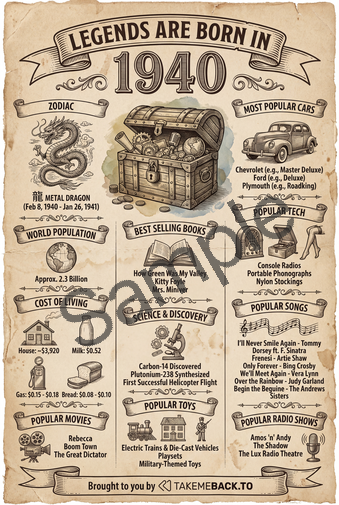

Major Events of 1940 - Historical Moments That Defined the Year | TakeMeBack.to
- 01 Jan World War II: Early War Period: The early phase of World War II, known as the 'Phoney War,' was marked by limited military activity on the Western Front, with major operations commencing in 1940. source: en.wikipedia.org
- 02 Jan Finnish resistance against Soviet invasion: In early January 1940, Finland mounted a determined defense against the Soviet invasion, marking a significant phase in the Winter War. source: britannica.com
- 03 Jan Finnish victory in Winter War Battle of Suomussalmi: On January 3, 1940, Finnish forces achieved a decisive victory over the Soviet Union in the Battle of Suomussalmi during the Winter War. source: britannica.com
- 04 Jan Brian Josephson born in Cardiff, Wales: Brian Josephson, a Welsh physicist renowned for his work in superconductivity, was born in Cardiff, Wales, on January 4, 1940. source: en.wikipedia.org
- 05 Jan Battle of Raate Road during Winter War: Between January 1 and 7, 1940, Finnish forces engaged Soviet troops along the Raate Road, leading to a significant Finnish victory. source: en.wikipedia.org
- 06 Jan Great Britain introduces food rationing: On January 6, 1940, Great Britain implemented food rationing due to shortages caused by World War II. This measure aimed to ensure equitable distribution of food supplies among the population during wartime. Rationing would continue throughout the war, affecting various food items. source: bbc.co.uk
- 07 Jan Winter War: Battle of Raate Road: The Battle of Raate Road occurred on January 7, 1940, during the Winter War between Finland and the Soviet Union. Finnish forces achieved a significant victory, effectively encircling and defeating a Soviet division. This battle showcased Finland's tactical prowess despite being outnumbered. source: britannica.com
- 08 Jan Britain's first comprehensive war rationing: On January 8, 1940, Britain introduced its first comprehensive war rationing system, expanding on previous measures. This system aimed to manage food supplies and ensure that all citizens received their fair share during the ongoing war. Rationing would become a significant aspect of life in Britain throughout World War II. source: bbc.co.uk
- 09 Jan German military aircraft emergency landing in Belgium: On January 9, 1940, a German military aircraft made an emergency landing in Belgium, marking a significant event during the early stages of World War II. This incident highlighted the tensions and military activities occurring in Europe at the time. source: bbc.com
- 10 Jan Mechelen incident: German invasion plans exposed: The Mechelen incident occurred on January 10, 1940, when a German aircraft crashed in Belgium, revealing plans for the invasion of France and the Low Countries. This event had significant implications for the Allied forces' strategic planning during World War II. source: bbc.com
- 11 Jan Battle of Kunlun Pass: The Battle of Kunlun Pass took place on January 11, 1940, during the Second Sino-Japanese War. This battle was part of the larger conflict between China and Japan, showcasing the intense military engagements of the era. source: bbc.com
- 12 Jan NBC launches first network television programming: On January 12, 1940, NBC broadcast its first network television program, a play titled "Meet The Wife," originating from W2XBS in New York City and rebroadcast by W2XB in Schenectady, New York. source: en.wikipedia.org
- 14 Jan Mechelen Incident: German invasion plans exposed: On January 14, 1940, the Mechelen Incident occurred when a German aircraft crashed in Belgium, revealing plans for the invasion of France and the Low Countries. This incident significantly impacted Allied military strategies and responses to the impending German offensive. source: britannica.com
- 15 Jan British government nationalizes meat industry during World War II: On January 15, 1940, the British government took control of the meat industry to ensure adequate supplies during World War II. This move was part of broader efforts to manage resources and maintain food security amid wartime challenges. source: bbc.co.uk
- 16 Jan Hitler's strategic military planning revealed: On January 16, 1940, details of Adolf Hitler's military strategies were disclosed, particularly concerning the planned invasion of France and the Low Countries. This information was crucial for Allied forces in preparing for the German offensive. source: britannica.com
- 17 Jan Soviet-Finnish Winter War: air attacks and military engagement: On January 17, 1940, the Soviet Union intensified its military operations against Finland during the Winter War, including air attacks and ground engagements. This conflict highlighted the Soviet military's strategies and Finland's resistance efforts. source: bbc.co.uk
- 18 Jan German submarine U-63 commissioned: On January 18, 1940, the German submarine U-63 was commissioned into the Kriegsmarine. This submarine played a role in the Battle of the Atlantic, contributing to Germany's naval warfare efforts during World War II. source: britannica.com
- 19 Jan Birth of Paolo Borsellino, Anti-Mafia Magistrate: Paolo Borsellino, an Italian magistrate renowned for his efforts against the Sicilian Mafia, was born on January 19, 1940, in Palermo, Italy. He became a prominent figure in the fight against organized crime, working alongside his close friend Giovanni Falcone. Tragically, Borsellino was assassinated by the Mafia on July 19, 1992. source: en.wikipedia.org
- 21 Jan Palmiry massacre during World War II: Between December 1939 and July 1941, Nazi German forces conducted mass executions near the village of Palmiry in the Kampinos Forest, northwest of Warsaw. Over 1,700 Poles and Jews, including members of the Polish political, cultural, and social elite, were executed in this area. source: en.wikipedia.org
- 28 Jan Stalin replaces Winter War commander: On January 28, 1940, Soviet leader Joseph Stalin replaced Kliment Voroshilov with Semyon Timoshenko as the commander of Soviet forces in the Winter War against Finland. source: en.wikipedia.org
- 31 Jan First Social Security Monthly Benefit Check Issued: On January 31, 1940, Ida May Fuller of Ludlow, Vermont, received the first monthly Social Security benefit check, amounting to $22.54. She had paid a total of $24.75 into the system over three years. source: ssa.gov
- 02 Feb Frank Sinatra debuts with Tommy Dorsey Orchestra: Frank Sinatra made his professional debut with the Tommy Dorsey Orchestra on February 2, 1940. This performance marked the beginning of Sinatra's illustrious career in music and entertainment, leading to his status as one of the most iconic figures in American music history. source: biography.com
- 03 Feb Jim Hartz: Early television newscaster: Jim Hartz, an early television newscaster, was born on February 3, 1940. He became known for his work in broadcasting, particularly as a co-anchor on NBC's 'Today' show, contributing to the evolution of television journalism in the United States. source: nytimes.com
- 04 Feb Soviet offensive in the Winter War: Battle of Summa: The Battle of Summa occurred on February 4, 1940, during the Winter War between the Soviet Union and Finland. This battle was part of a larger Soviet offensive aimed at breaking Finnish defenses and securing territory. source: britannica.com
- 05 Feb German submarine U-41 sunk: On February 5, 1940, the German submarine U-41 was sunk by depth charges from the British destroyer HMS Antelope off the south coast of Ireland. All 49 crew members perished with the vessel. source: en.wikipedia.org
- 07 Feb Pinocchio world premiere: Disney's second animated feature film, 'Pinocchio,' premiered at the Center Theatre in New York City on February 7, 1940. The film received critical acclaim and won two Academy Awards, including Best Original Song for "When You Wish Upon a Star." source: d23.com
- 08 Feb Establishment of Łódź Ghetto: On February 8, 1940, the German authorities established the Łódź Ghetto in Poland, marking it as the first large ghetto in the country. This action was part of the Nazis' broader strategy to segregate and oppress Jewish populations during World War II. source: ushmm.org
- 09 Feb Roosevelt's diplomatic fact-finding mission: On February 9, 1940, President Franklin D. Roosevelt initiated a diplomatic fact-finding mission to assess the situation in Europe. This mission aimed to gather information on the political and military landscape as World War II progressed. source: archives.gov
- 10 Feb Soviet mass deportation of Polish citizens: On February 10, 1940, the Soviet Union began a mass deportation of Polish citizens, targeting those deemed a threat to Soviet authority. This event was part of a broader campaign of repression against Polish nationals during World War II. source: britannica.com
- 11 Feb Soviet breakthrough in Winter War: On February 11, 1940, the Soviet Union achieved a significant breakthrough in the Winter War against Finland. This marked a turning point in the conflict, as Soviet forces began to gain ground after initial setbacks. source: britannica.com
- 12 Feb German submarine U-33 sunk in Firth of Clyde: On February 12, 1940, the German submarine U-33 was sunk in the Firth of Clyde by British forces. This event was part of the larger naval engagements during World War II, highlighting the ongoing conflict at sea. source: naval-history.net
- 13 Feb Finland seeks Swedish military support: On February 13, 1940, Finland's diplomatic representative in London, Georg Gripenberg, and Lieutenant-General Enckell appealed to British Foreign Secretary Lord Halifax for military aid. Halifax promised to raise the matter in the War Cabinet. In Sweden, Finnish Foreign Minister Tanner requested Swedish troops, but Sweden declined, citing concerns over potential German intervention. source: historydiaries.blog
- 14 Feb British merchant fleet armed during World War II: On February 14, 1940, the British merchant fleet was armed to defend against German U-boat attacks. This measure aimed to protect vital supply lines during the Battle of the Atlantic. source: en.wikipedia.org
- 16 Feb Altmark Incident: British Rescue of Prisoners: On February 16, 1940, the British destroyer HMS Cossack intercepted the German tanker Altmark in Norwegian waters, liberating 299 British prisoners of war held captive since the sinking of their ships by the German cruiser Admiral Graf Spee. The boarding led to hand-to-hand combat, resulting in the deaths of eight German sailors and injuries to ten others. A British sailor was also wounded during the operation. source: chroniclingamerica.loc.gov
- 17 Feb Manstein Plan Presentation to Hitler: On February 17, 1940, General Erich von Manstein presented his plan for the German invasion of France and the Low Countries to Adolf Hitler. The plan, later known as the Manstein Plan, was a key component of the German strategy during World War II. source: en.wikipedia.org
- 18 Feb HMS Daring Sunk During World War II Naval Engagement: On February 18, 1940, the British destroyer HMS Daring was sunk by the German submarine U-23 in the North Sea off Duncansby Head, Scotland. The attack resulted in the loss of 157 crew members. source: historydiaries.blog
- 19 Feb Finnish Military Victory Against Soviet Forces in Winter War: On February 19, 1940, Finnish forces achieved a significant victory against Soviet troops during the Winter War. The battle resulted in the withdrawal of Soviet forces from Finnish territory. source: en.wikipedia.org
- 21 Feb Hitler authorizes invasion of Norway: On February 21, 1940, Adolf Hitler authorized the invasion of Norway, marking a significant strategic move in World War II. This decision was part of a broader plan to secure German access to Swedish iron ore and to establish naval bases in Norway. source: britannica.com
- 22 Feb Discovery of the 14th Dalai Lama: On February 22, 1940, the 14th Dalai Lama was officially recognized as the spiritual leader of Tibet. His discovery was a significant event in Tibetan Buddhism, marking the continuation of the lineage of Dalai Lamas. source: britannica.com
- 23 Feb Soviet conquest of Lasi Island during World War II: On February 23, 1940, Soviet forces successfully captured Lasi Island as part of their military operations during World War II. This event was part of the broader Soviet strategy to expand their influence in the region. source: britannica.com
- 24 Feb Assassination of Ahmed Maher Pasha: Ahmed Maher Pasha, the Egyptian Prime Minister, was assassinated on February 24, 1940. His assassination had significant political repercussions in Egypt and the broader Middle East during a tumultuous period. source: britannica.com
- 25 Feb First televised hockey game in the United States: The first televised hockey game in the United States took place on February 25, 1940. This event marked a significant milestone in sports broadcasting, paving the way for the future of televised sports. source: britannica.com
- 26 Feb German submarine U-33 sunk in Firth of Clyde: The German submarine U-33 was sunk by British forces in the Firth of Clyde. This event contributed to the ongoing naval battles of World War II, highlighting the intense conflict in the Atlantic waters. source: uboat.net
- 27 Feb Discovery of carbon-14 radioactive isotope: The discovery of carbon-14, a radioactive isotope of carbon, was made by Martin Kamen and Sam Ruben. This discovery has had significant implications for fields such as archaeology and geology, particularly in radiocarbon dating. source: britannica.com
- 28 Feb 1940 US population census data: The 1940 US Census was conducted, providing critical demographic data for the United States. This census was the first to include questions about income and education, reflecting the changing social landscape of the country. source: census.gov
- 01 Mar Nazi Germany plans invasion of Denmark and Norway: On March 1, 1940, Nazi Germany finalized plans for the invasion of Denmark and Norway, known as Operation Weserübung. This strategic move aimed to secure shipments of Swedish iron ore and control the North Sea. source: britannica.com
- 02 Mar Soviet conquest of Tuppura Island during Winter War: On March 2, 1940, the Soviet Union successfully captured Tuppura Island as part of the Winter War against Finland. This conflict highlighted the intense military engagements during the harsh winter conditions. source: britannica.com
- 03 Mar Soviet offensive on Viipuri during Winter War: On March 3, 1940, the Soviet forces launched an offensive on Viipuri, a key city in Finland, during the Winter War. This offensive was part of the larger conflict between the Soviet Union and Finland. source: britannica.com
- 04 Mar Death of Hamlin Garland, notable American author: Hamlin Garland, an American novelist, poet, and essayist, died on March 4, 1940, at his home in Hollywood, California. He was 79 years old at the time of his death. source: en.wikipedia.org
- 05 Mar Katyn Massacre order signed: On March 5, 1940, the Soviet Politburo signed an order for the execution of approximately 22,000 Polish military officers and intelligentsia, known as the Katyn Massacre. This event marked a significant atrocity during World War II, reflecting the brutal tactics employed by the Soviet regime against perceived enemies. source: britannica.com
- 06 Mar Winter War armistice: The armistice that ended the Winter War between Finland and the Soviet Union was signed on March 6, 1940. This conflict lasted from November 1939 to March 1940, resulting in significant territorial losses for Finland but showcasing its resilience against a larger Soviet force. source: britannica.com
- 07 Mar Diplomatic mission: Sumner Welles in Paris: On March 7, 1940, U.S. Under Secretary of State Sumner Welles arrived in Paris on a diplomatic mission. His visit aimed to strengthen relations with European nations amid the growing tensions leading up to World War II. source: archives.gov
- 08 Mar Nazi reprisal killings in the Netherlands: On March 8, 1940, Nazi forces carried out reprisal killings in the Netherlands as part of their occupation strategy. These actions were aimed at suppressing resistance and instilling fear among the local population during World War II. source: britannica.com
- 09 Mar Raúl Juliá birth: Raúl Juliá, the acclaimed Puerto Rican actor, was born on March 9, 1940. He became known for his roles in film, television, and theater, earning recognition for his performances in various productions throughout his career. source: britannica.com
- 10 Mar Ribbentrop's diplomatic mission to Rome: On March 10, 1940, German Foreign Minister Joachim von Ribbentrop embarked on a diplomatic mission to Rome. This visit aimed to strengthen the Axis alliance between Germany and Italy during World War II. source: britannica.com
- 11 Mar Finland cedes territory to Soviet Union in Moscow Treaty: On March 11, 1940, Finland and the Soviet Union signed the Moscow Treaty, which concluded the Winter War. Finland ceded significant territories to the Soviet Union, marking a pivotal moment in Finnish history. source: britannica.com
- 12 Mar Finland and Soviet Union sign Moscow Peace Treaty: On March 12, 1940, Finland and the Soviet Union officially signed the Moscow Peace Treaty, concluding the Winter War. This treaty formalized the territorial changes and established a fragile peace between the two nations. source: britannica.com
- 13 Mar Winter War ends with Moscow Peace Treaty: On March 13, 1940, the Moscow Peace Treaty was signed, officially ending the Winter War between Finland and the Soviet Union. The treaty stipulated that Finland cede the Karelian Isthmus, including the city of Viipuri, and other territories to the Soviet Union. The ceasefire took effect at noon Moscow time on March 13, 1940. source: britannica.com
- 14 Mar Mass displacement of Finnish Karelia: Following the Moscow Peace Treaty, approximately 430,000 Finns were evacuated from the ceded territories, including the Karelian Isthmus and Ladoga Karelia. This mass displacement was one of the largest in Finnish history, as residents were relocated to other parts of Finland. source: valtioneuvosto.fi
- 18 Mar First Bombe machine installed at Bletchley Park: On March 18, 1940, the first Bombe machine, code-named 'Victory', was installed at Bletchley Park. Designed by Alan Turing and his team, the Bombe was an electromechanical device used to decrypt German Enigma messages, playing a crucial role in Allied codebreaking efforts during World War II. source: britannica.com
- 21 Mar Paul Reynaud becomes Prime Minister of France: On March 21, 1940, Paul Reynaud was appointed Prime Minister of France, succeeding Édouard Daladier. Reynaud, a lawyer and politician, was known for his opposition to Nazi Germany and his advocacy for a strong alliance with Britain during World War II. source: britannica.com
- 22 Mar Soviet military deployment in Hanko, Finland: On March 22, 1940, Soviet military personnel began arriving in the Finnish port of Hanko, which had been leased to the Soviets for 30 years as part of the Moscow Peace Treaty. source: en.wikipedia.org
- 23 Mar Lahore Resolution proposed: On March 23, 1940, the Lahore Resolution was proposed by the All-India Muslim League. This resolution called for separate states for Muslims in the north-western and eastern zones of India, leading to the creation of Pakistan. source: en.wikipedia.org
- 24 Mar French destroyer La Railleuse sunk by accidental torpedo explosion: On March 24, 1940, the French destroyer La Railleuse was sunk due to an accidental torpedo explosion during a naval exercise. This incident highlighted the dangers of naval operations during World War II and the challenges faced by the French Navy. source: britannica.com
- 25 Mar US allows military aircraft sales to allies: On March 25, 1940, the United States government approved the sale of military aircraft to allied nations. This decision was part of a broader strategy to support allies during World War II, marking a significant shift in U.S. foreign policy. source: archives.gov
- 26 Mar Notable births on March 26, 1940: March 26, 1940, saw the birth of several notable individuals who would go on to make significant contributions in various fields, including entertainment and politics. This day is remembered for its impact on cultural history. source: britannica.com
- 27 Mar Peter Fraser becomes New Zealand Prime Minister: Following the death of Prime Minister Michael Joseph Savage on March 27, 1940, Peter Fraser was elected leader of the New Zealand Labour Party. Fraser assumed the role of Prime Minister, leading the country through the majority of World War II. source: britannica.com
- 29 Mar Joe Louis defeats Johnny Paychek in heavyweight boxing match: On March 29, 1940, at Madison Square Garden in New York City, Joe Louis successfully defended his World Heavyweight Championship by defeating Johnny Paychek via technical knockout in the second round. The bout lasted just 41 seconds into the second round, with Paychek being knocked down three times in the first round and ultimately unable to continue. The fight drew a crowd of 11,620 spectators, with gate receipts totaling $62,481.41. source: digital.bentley.umich.edu
- 31 Mar Fascist sympathizers interned in the UK: On March 31, 1940, 33 individuals with fascist sympathies were interned in the United Kingdom. This action was part of the government's efforts to secure national security during World War II. source: en.wikipedia.org
- 01 Apr British Overseas Airways Corporation begins operations: On April 1, 1940, the British Overseas Airways Corporation (BOAC) commenced operations as a single company. This consolidation aimed to streamline British air services during World War II. source: en.wikipedia.org
- 02 Apr Walt Disney Productions goes public: On April 2, 1940, Walt Disney Productions held its initial public offering, offering 155,000 shares of preferred stock at $25 per share and 600,000 shares of common stock at $5 per share, raising $3.5 million. source: islandnet.com
- 03 Apr German invasion of Norway begins: On April 3, 1940, Germany launched Operation Weserübung, initiating the invasion of Norway. This military campaign aimed to secure strategic ports and resources, marking a significant escalation in World War II. source: britannica.com
- 04 Apr Bijan Pakzad: Fashion designer emerges: On April 4, 1940, Bijan Pakzad, an influential fashion designer, began to gain recognition for his luxurious menswear. His designs would later become synonymous with high fashion and exclusivity. source: nytimes.com
- 05 Apr Katyn massacre commences: The Katyn massacre began on April 5, 1940, when thousands of Polish officers were executed by the Soviet secret police. This event became a significant point of contention in post-war relations between Poland and Russia. source: britannica.com
- 06 Apr German submarine U-1 lost in North Sea: The German submarine U-1 was lost in the North Sea during World War II. It was one of the early U-boats commissioned by Germany, and its loss marked a significant event in naval warfare at the time. source: history.com
- 07 Apr Booker T. Washington first African American on US postage stamp: On April 7, 1940, Booker T. Washington became the first African American to be featured on a United States postage stamp. This honor recognized his contributions to education and civil rights in America. source: postalmuseum.si.edu
- 08 Apr HMS Glowworm's heroic last stand: On April 8, 1940, HMS Glowworm engaged in a heroic last stand against German naval forces. The destroyer fought valiantly before being sunk, becoming a symbol of bravery in the Royal Navy during World War II. source: bbc.co.uk
- 09 Apr Germany invades Denmark and Norway in World War II: On April 9, 1940, Germany launched Operation Weserübung, invading Denmark and Norway. The Norwegian government, led by Prime Minister Johan Nygaardsvold, evacuated Oslo in response to the invasion. source: en.wikipedia.org
- 10 Apr Quisling forms Norwegian puppet government: On April 10, 1940, Vidkun Quisling established a puppet government in Norway under German occupation, serving as Prime Minister. source: en.wikipedia.org
- 13 Apr RAF Bomber Command conducts first minelaying operation: On April 13, 1940, RAF Bomber Command launched its first minelaying operation of World War II. Fifteen Handley Page Hampden bombers were dispatched to lay sea mines off the Danish coast, marking a significant escalation in the conflict. source: rafmuseum.org.uk
- 14 Apr Allied forces land in Norway during World War II: On April 14, 1940, British and Allied troops landed in Norway as part of Operation Weserübung, aiming to secure vital ports and prevent German expansion in Scandinavia during World War II. source: historydiaries.blog
- 15 Apr Allied forces attack Narvik during World War II: On April 15, 1940, Allied forces launched an attack on Narvik, Norway, aiming to recapture the port from German occupation during World War II. source: historydiaries.blog
- 16 Apr Bob Feller's opening day no-hitter: On April 16, 1940, Bob Feller pitched a no-hitter on opening day for the Cleveland Indians against the Chicago White Sox. This remarkable achievement made Feller the youngest pitcher to throw a no-hitter in Major League Baseball history at that time. His performance is still celebrated in baseball history. source: britannica.com
- 17 Apr HMS Suffolk attacks German airfield in Norway: On April 17, 1940, the British cruiser HMS Suffolk attacked a German airfield in Norway during World War II. This operation was part of the Allied efforts to disrupt German supply lines and support Norwegian forces. The attack highlighted the naval engagements occurring in the region at the time. source: britannica.com
- 18 Apr German Submarine U-99 Commissioned: The German submarine U-99, a Type VIIB U-boat, was commissioned on April 18, 1940, under the command of Korvettenkapitän Otto Kretschmer. U-99 became one of the most successful German U-boats during World War II, sinking 38 ships totaling 244,658 gross register tons in eight patrols before being sunk on March 17, 1941. source: en.wikipedia.org
- 19 Apr Little Falls Gulf Curve Crash of 1940: On April 19, 1940, the westbound Lake Shore Limited train derailed near Little Falls, New York, resulting in 31 fatalities and 51 injuries. The accident was attributed to excessive speed on the sharp Gulf Curve, the sharpest on the New York Central Railroad lines. source: en.wikipedia.org
- 20 Apr First electron microscope demonstrated by RCA: On April 20, 1940, RCA demonstrated the first electron microscope, a groundbreaking advancement in imaging technology. This device allowed scientists to view objects at a much smaller scale than previously possible, revolutionizing fields such as biology and materials science. source: britannica.com
- 21 Apr First US military casualty in World War II: On April 21, 1940, the first U.S. military casualty of World War II occurred when a soldier was killed in action during the defense of Norway. This marked a significant moment in the U.S. involvement in the conflict. source: britannica.com
- 22 Apr US naval admiral predicts conflict with Japan: On April 22, 1940, a U.S. naval admiral publicly predicted that conflict with Japan was imminent. This statement reflected growing tensions in the Pacific and foreshadowed the events leading to the attack on Pearl Harbor. source: britannica.com
- 23 Apr Rhythm Night Club Fire Tragedy: On April 23, 1940, a devastating fire erupted at the Rhythm Night Club in Natchez, Mississippi, during a performance by Walter Barnes and His Royal Creolians. The blaze, believed to have been ignited by a discarded cigarette near a hamburger stand, rapidly engulfed the club, which was decorated with highly flammable Spanish moss. Tragically, 209 people perished, including nine members of the band, and many others were injured. The incident highlighted severe deficiencies in fire safety protocols, leading to significant reforms in building codes and emergency response procedures. source: en.wikipedia.org
- 29 Apr Norwegian royal escape during World War II: On April 29, 1940, King Haakon VII and Crown Prince Olav of Norway were evacuated from Molde to Tromsø aboard the British cruiser HMS Glasgow, accompanied by the Norwegian government and national gold reserves, as German forces advanced. source: royalcentral.co.uk
- 30 Apr Nazi establishment of Lódz Jewish ghetto: On April 30, 1940, Nazi Germany established the Lódz Ghetto in Poland, one of the largest Jewish ghettos during World War II, where Jews were forcibly relocated and subjected to harsh conditions. source: en.wikipedia.org
- 01 May Łódź Ghetto sealed off from the rest of the city: On May 1, 1940, the German authorities formally sealed the Łódź Ghetto, isolating its Jewish population from the rest of the city. This action was part of the broader Nazi policy of segregation and persecution of Jews during World War II. source: en.wikipedia.org
- 02 May Allied Evacuation from Norwegian Ports During World War II: On May 2, 1940, German forces reached Åndalsnes, prompting the Allies to evacuate Namsos. Before dawn, 5,400 British and French troops were evacuated. Small British and French forces were also landed at Mosjøen to help block the road north to Narvik. source: onwar.com
- 03 May Allied Withdrawal from Norway during World War II: By May 3, 1940, the Allies had withdrawn from southern Norway, leaving only forces in northern Norway to prevent the supply of iron ore to Germany. The German advance continued north to Trondheim. source: onwar.com
- 05 May Norwegian Government establishes exile administration in London: On May 5, 1940, the Norwegian Government-in-Exile was established in London, following the German invasion of Norway. This government represented Norway's interests abroad during World War II. source: en.wikipedia.org
- 06 May 1940 Summer Olympics canceled: The International Olympic Committee (IOC) officially canceled the 1940 Summer Olympics scheduled for Tokyo, Japan, due to the outbreak of World War II. The Games were initially rescheduled to Helsinki, Finland, but were ultimately canceled as the war escalated. source: washingtonpost.com
- 07 May Winston Churchill becomes Prime Minister of Britain: On May 7, 1940, Winston Churchill was appointed Prime Minister of the United Kingdom, succeeding Neville Chamberlain. Churchill's leadership was pivotal during World War II, guiding Britain through its most challenging times. source: en.wikipedia.org
- 09 May Belgium declares state of emergency: On May 9, 1940, Belgium declared a state of emergency and placed its military on alert in response to the impending German invasion. This decision was made after reports indicated that Germany intended to attack Belgium, leading to the mobilization of Belgian forces. source: digital.bentley.umich.edu
- 10 May Germany launches invasion of Western Europe: On May 10, 1940, Germany launched its invasion of Western Europe, attacking France, Belgium, Luxembourg, and the Netherlands. This marked a significant escalation in World War II, leading to the rapid fall of these countries. source: en.wikipedia.org
- 11 May Allied forces mobilize on River Dyle: On May 11, 1940, Allied forces mobilized along the River Dyle in Belgium. This was part of the Dyle Plan, which aimed to counter the German invasion by positioning Allied troops in Belgium. source: en.wikipedia.org
- 12 May German invasion of France through Ardennes Forest: On May 12, 1940, German forces initiated their invasion of France through the Ardennes Forest. This unexpected route allowed them to bypass the heavily fortified Maginot Line, leading to significant territorial gains. source: britannica.com
- 13 May Churchill's iconic war speech: On May 13, 1940, British Prime Minister Winston Churchill delivered a powerful speech to the House of Commons, rallying the nation during the early days of World War II. His famous declaration, 'We shall fight on the beaches,' became a symbol of British resolve against Nazi Germany. source: bbc.com
- 14 May Luftwaffe bombs Rotterdam despite ceasefire: On May 14, 1940, the German Luftwaffe bombed the city of Rotterdam, causing extensive destruction and civilian casualties, despite a ceasefire being in effect. This attack was part of Germany's strategy to force the Netherlands to surrender. source: britannica.com
- 15 May Battle of Sedan ends in German victory: On May 15, 1940, the Battle of Sedan concluded with a decisive victory for German forces. This battle was crucial in the German invasion of France and marked a significant turning point in World War II. source: britannica.com
- 16 May US Congress approves massive aircraft production funding: On May 16, 1940, the United States Congress approved significant funding for aircraft production as part of its efforts to bolster national defense. This decision was influenced by the escalating conflict in Europe and the need for military preparedness. source: archives.gov
- 17 May German forces capture Brussels: On May 17, 1940, German forces captured Brussels, the capital of Belgium, following the withdrawal of Belgian and British forces. The Belgian Army had been ordered to retreat to the Scheldt River to avoid encirclement, allowing German General Reichenau to occupy Brussels. This marked a significant step in the German invasion of Belgium, leading to the eventual surrender of Belgian forces on May 28, 1940. source: ww2db.com
- 18 May German 18th Army breaks through Belgian defenses: On May 18, 1940, the German 18th Army successfully breached the Belgian defenses, advancing towards the city of Antwerp. This breakthrough was part of the larger German offensive in Belgium, which led to the eventual surrender of Belgian forces on May 28, 1940. source: en.wikipedia.org
- 19 May Opening of Auschwitz Concentration Camp: Auschwitz Concentration Camp was officially opened on May 19, 1940, by the Nazis. It became one of the most notorious extermination camps during the Holocaust, where millions of Jews and others were murdered. source: britannica.com
- 20 May First Prisoners Arrive at Auschwitz: The first prisoners arrived at Auschwitz on May 20, 1940, marking the beginning of its operation as a concentration camp. Initially, it housed Polish political prisoners before becoming a site for mass extermination. source: britannica.com
- 21 May Battle of Arras: The Battle of Arras occurred on May 21, 1940, during World War II, as part of the Battle of France. British and French forces launched a counter-attack against German troops advancing through the Ardennes. Despite initial progress, the Allies faced strong German resistance and were eventually forced to withdraw. source: en.wikipedia.org
- 22 May British Parliament Expands War Powers: On May 22, 1940, the British Parliament passed legislation granting the government expanded powers to manage the war effort. This included increased control over the economy, resources, and civil liberties to support the ongoing conflict. source: bbc.com
- 24 May Dunkirk evacuation begins: The evacuation of Allied troops from Dunkirk commenced on May 24, 1940, as German forces advanced. This operation, known as Operation Dynamo, aimed to rescue soldiers trapped on the beaches of Dunkirk. source: britannica.com
- 25 May Battle of Dunkirk begins: The Battle of Dunkirk officially began on May 25, 1940, as German forces intensified their attacks on the encircled Allied troops. This battle was crucial for the survival of the British Expeditionary Force. source: britannica.com
- 26 May Siege of Calais ends in surrender: The Siege of Calais concluded on May 26, 1940, when British and French forces surrendered to German troops. This event marked a significant moment in the Battle of France during World War II, as it allowed German forces to secure a vital port. source: britannica.com
- 27 May Operation Dynamo: Dunkirk evacuation begins: Operation Dynamo commenced on May 27, 1940, marking the beginning of the Dunkirk evacuation. This operation aimed to rescue Allied soldiers trapped on the beaches of Dunkirk as German forces advanced. source: britannica.com
- 28 May Belgium's surrender to Nazi Germany: On May 28, 1940, Belgium officially surrendered to Nazi Germany after a rapid invasion during World War II. The surrender marked a significant moment in the German campaign in Western Europe, leading to the occupation of Belgium. source: britannica.com
- 29 May Churchill's defiant speech: On May 29, 1940, British Prime Minister Winston Churchill delivered a defiant speech to the House of Commons, rallying support during World War II. His speeches were pivotal in maintaining British morale during the conflict. source: britannica.com
- 30 May Dunkirk evacuation and German strategic adjustments: On May 30, 1940, the Dunkirk evacuation was underway, prompting German forces to adjust their strategies. The Allies were retreating to Dunkirk, leading to significant military maneuvers by the Germans to capitalize on the situation. source: britannica.com
- 31 May Operation Dynamo peak evacuation: On May 31, 1940, Operation Dynamo reached its peak as Allied forces evacuated from Dunkirk. This operation was crucial in saving hundreds of thousands of soldiers from capture by German forces. source: britannica.com
- 01 Jun British withdrawal from Dunkirk: On June 1, 1940, British forces completed their withdrawal from Dunkirk as Operation Dynamo concluded. This marked a pivotal moment in World War II, allowing many troops to escape to safety despite the ongoing threat from German forces. source: britannica.com
- 02 Jun German bombing of Dunkirk beach during World War II: On June 2, 1940, German aircraft conducted bombing raids on the beaches of Dunkirk, France, targeting Allied forces during their evacuation. source: historyofwar.org
- 03 Jun Battle of Dunkirk concludes with German victory: The Battle of Dunkirk ended on June 3, 1940, with German forces achieving victory as Allied troops completed their evacuation from Dunkirk. source: historyofwar.org
- 04 Jun Dunkirk evacuation concludes: The evacuation of Allied forces from Dunkirk, known as Operation Dynamo, concluded on June 4, 1940. Over nine days, from May 26 to June 4, approximately 338,000 British and French soldiers were evacuated from the beaches and harbor of Dunkirk to England, despite continuous German attacks. This operation allowed the core of the British Expeditionary Force to escape, preserving a significant portion of the Allied military strength. source: britannica.com
- 05 Jun German offensive in Battle of France - Operation Fall Rot: On June 5, 1940, Germany launched Operation Fall Rot, the second phase of its offensive in the Battle of France. This operation aimed to capture the remaining French territory and force France to surrender. The German forces advanced rapidly, leading to the eventual fall of France and the signing of an armistice on June 22, 1940. source: en.wikipedia.org
- 06 Jun Italian maritime mobilization: On June 6, 1940, Italy began mobilizing its naval forces in preparation for potential conflict during World War II. This move was part of Italy's broader strategy to assert its influence in the Mediterranean region as tensions escalated in Europe. source: britannica.com
- 07 Jun Norwegian royal family and government go into exile: On June 7, 1940, the Norwegian royal family and government fled to London to establish a government-in-exile following the German occupation. This move was crucial for maintaining Norwegian sovereignty and resistance against Nazi rule. source: britannica.com
- 08 Jun Allied evacuation from Narvik completed: On June 8, 1940, the Allied evacuation from Narvik, Norway, was completed, marking the end of the Norwegian campaign. The operation, known as Operation Alphabet, involved the withdrawal of British, French, and Polish troops from the harbor of Narvik. The evacuation was prompted by the German invasion of France, which reduced the strategic importance of Scandinavia. The last Allied troops left the Narvik area on June 8, 1940. source: en.wikipedia.org
- 09 Jun German offensive in Aisne sector: On June 9, 1940, during the Battle of France, German forces launched an offensive in the Aisne sector. The 5th and 7th Panzer Divisions crossed the Seine River, with the 5th Panzer Division capturing the city of Rouen. The 14th Panzer Corps broke through at Amiens, while the 16th Panzer Corps continued to be held down in Péronne by French defenses. source: ww2db.com
- 10 Jun Italy enters World War II: On June 10, 1940, Italy declared war on France and the United Kingdom, entering World War II on the side of the Axis powers. The Italian government, led by Benito Mussolini, aimed to expand its influence in Europe and Africa by joining the conflict. source: en.wikipedia.org
- 11 Jun Italy enters World War II: On June 11, 1940, Italy declared war on France and the United Kingdom, entering World War II on the side of the Axis powers. This action expanded the conflict in Europe, leading to further military engagements. source: en.wikipedia.org
- 12 Jun British and French troops surrender to Rommel at Saint-Valery-en-Caux: On June 12, 1940, British and French forces surrendered to German General Erwin Rommel at Saint-Valery-en-Caux during World War II. This event marked a significant defeat for the Allies in the Battle of France, leading to the evacuation of remaining troops from the continent. source: bbc.com
- 13 Jun Soviet Union annexes Baltic States: On June 13, 1940, the Soviet Union formally annexed the Baltic States of Estonia, Latvia, and Lithuania. This action was part of the Soviet strategy to expand its influence in Eastern Europe during World War II, following the Molotov-Ribbentrop Pact with Nazi Germany. source: bbc.com
- 14 Jun First inmates arrive at Auschwitz: On June 14, 1940, the first inmates arrived at Auschwitz concentration camp, marking the beginning of one of the most notorious sites of the Holocaust. Initially established as a detention center for political prisoners, it later became a major extermination camp. source: ushmm.org
- 15 Jun France surrenders to Nazi Germany: On June 15, 1940, following the rapid advance of German forces, the French government signed an armistice with Nazi Germany, leading to the occupation of northern and western France. source: britannica.com
- 16 Jun France changes leadership during World War II: On June 16, 1940, following the fall of France to Nazi Germany, a new government was formed under Marshal Philippe Pétain. This marked a significant shift in French leadership during the war, as Pétain sought an armistice with Germany. source: britannica.com
- 17 Jun France seeks surrender terms from Germany: On June 17, 1940, the French government officially sought terms of surrender from Nazi Germany after the rapid advance of German forces. This marked a pivotal moment in World War II, leading to the establishment of the Vichy regime. source: britannica.com
- 18 Jun Churchill delivers defiant speech in House of Commons: On June 18, 1940, British Prime Minister Winston Churchill delivered a defiant speech in the House of Commons, rallying the nation during World War II. His speech emphasized resilience and determination in the face of adversity. source: britannica.com
- 19 Jun Rommel's 7th Armour Division captures Cherbourg: On June 19, 1940, General Erwin Rommel's 7th Armoured Division successfully captured the strategic port city of Cherbourg during World War II. This victory was crucial for the German forces in their campaign in France. source: britannica.com
- 20 Jun FDR prepares United States for World War II: On June 20, 1940, President Franklin D. Roosevelt began preparations for the United States' involvement in World War II. This included military buildup and strategic planning in response to the escalating global conflict. source: archives.gov
- 21 Jun France surrenders to Nazi Germany: On June 21, 1940, France officially surrendered to Nazi Germany after a swift military campaign. This capitulation led to the establishment of the Vichy regime and marked a significant turning point in World War II. source: britannica.com
- 22 Jun France surrenders to Nazi Germany in symbolic Compiègne Forest: On June 22, 1940, the French government signed an armistice with Nazi Germany in the Compiègne Forest, symbolizing France's defeat. This event was marked by the same location where Germany had surrendered in World War I. source: britannica.com
- 23 Jun Vichy France-Italy Armistice: On June 23, 1940, the Vichy France-Italy Armistice was signed, ending hostilities between France and Italy during World War II. This followed the German-French armistice signed on June 22, 1940, which divided France into occupied and unoccupied zones. The Franco-Italian armistice was signed on June 24, 1940, and both armistices took effect on June 25, 1940. source: britannica.com
- 24 Jun Franco-Italian Armistice of World War II: The Franco-Italian Armistice was signed on June 24, 1940, ending hostilities between France and Italy during World War II. This followed the German-French armistice signed on June 22, 1940, which divided France into occupied and unoccupied zones. Both armistices took effect on June 25, 1940. source: britannica.com
- 25 Jun French armistice with Nazi Germany takes effect: On June 22, 1940, France signed an armistice with Nazi Germany, which became effective on June 25, 1940, ending hostilities between the two nations. source: britannica.com
- 27 Jun German occupation of France completed: On June 27, 1940, Germany completed its occupation of France following the armistice signed earlier that month. This marked a significant point in World War II, leading to the establishment of the Vichy regime. source: britannica.com
- 28 Jun Soviet territorial expansion in Romania: On June 28, 1940, the Soviet Union expanded its territory into Romania, following the invasion earlier that week. This expansion was part of the USSR's strategy to gain influence in Eastern Europe. source: britannica.com
- 29 Jun US Alien Registration Act passed: The US Congress passed the Alien Registration Act, requiring non-citizens to register with the government. This act aimed to monitor foreign nationals during World War II and included provisions for deportation of those deemed dangerous. source: archives.gov
- 30 Jun Germany invades Channel Islands: Germany launched an invasion of the Channel Islands, marking the first British territory to be occupied during World War II. This event led to a prolonged occupation that lasted until 1945. source: bbc.com
- 01 Jul Establishment of Vichy France: On July 1, 1940, the French government relocated to Vichy, establishing the Vichy regime under Marshal Philippe Pétain. This collaborationist government governed the unoccupied southern part of France during World War II. source: britannica.com
- 02 Jul Kenneth Harry Clarke Birth: Kenneth Harry Clarke, a prominent British politician, was born on this date. He would later become a notable Conservative Party member and serve in multiple cabinet positions.
- 03 Jul British bombardment of French fleet at Mers-el-Kébir: On July 3, 1940, the British Royal Navy initiated a bombardment of the French fleet anchored at Mers-el-Kébir, Algeria. This action was part of Operation Catapult, aimed at preventing the French Navy from falling into German hands after France's armistice with Germany. The attack led to the sinking of the battleship Bretagne, damage to other French ships, and the death of 1,297 French sailors. The British forces suffered minimal losses, with five aircraft downed and two crew members killed. source: en.wikipedia.org
- 04 Jul Kanalkampf: Air battles over the English Channel begin: On July 4, 1940, during World War II, the German Luftwaffe initiated the Kanalkampf, a series of air battles over the English Channel. This marked the beginning of the Battle of Britain, as German forces aimed to gain air superiority over the Channel to facilitate an invasion of Britain. The air battles involved intense engagements between German and British aircraft, with both sides suffering significant losses. source: en.wikipedia.org
- 05 Jul Death of Carl Einstein: Carl Einstein, a notable German-Jewish writer and art historian, passed away on July 5, 1940. His works contributed significantly to modern art criticism and literature, particularly in the context of the avant-garde movements of the early 20th century. source: britannica.com
- 06 Jul German Battleships Sink HMS Glorious and Destroyers: On July 6, 1940, German battleships sank the British aircraft carrier HMS Glorious along with two destroyers. This event marked a significant naval engagement in the early stages of World War II. source: bbc.com
- 07 Jul Luftwaffe aerial bombardment of British territories: On July 7, 1940, the Luftwaffe intensified its aerial bombardment of British territories, marking a significant escalation in the Battle of Britain. This campaign aimed to weaken British morale and military capabilities as part of Germany's broader strategy during World War II. source: britannica.com
- 08 Jul U.S. Export Control Act of 1940: The U.S. Export Control Act was enacted on July 8, 1940, to regulate the export of military and strategic materials. This legislation aimed to support allies during World War II by controlling the supply of critical resources to nations engaged in conflict. source: archives.gov
- 09 Jul RAF bombing of Germany: On July 9, 1940, the Royal Air Force (RAF) conducted bombing raids over Germany as part of its strategic campaign during World War II. These operations aimed to disrupt German military operations and infrastructure. source: britannica.com
- 10 Jul Battle of Britain begins: The Battle of Britain commenced on July 10, 1940, as the German Luftwaffe launched a sustained aerial campaign against the United Kingdom. This battle was crucial in preventing a German invasion and marked a significant turning point in World War II. source: britannica.com
- 11 Jul Pétain abrogates constitutional separation of powers: On July 11, 1940, Marshal Pétain abrogated the constitutional separation of powers in France, consolidating his authority under the Vichy regime. This move marked a significant shift towards authoritarian governance in France during World War II. source: britannica.com
- 12 Jul Luftwaffe air raids on British territories: On July 12, 1940, the German Luftwaffe conducted multiple bombing raids over Britain. Targets included Aberdeen and the Scottish coast, where Heinkel He 111 bombers attacked shipyard facilities, resulting in civilian casualties. Additionally, the Solent, Portland, and Hampshire areas were bombed, causing damage to infrastructure and civilian areas. source: battleofbritain1940.com
- 14 Jul Andrew McNaughton takes command of 7th Army Corps: On July 14, 1940, Canadian General Andrew McNaughton assumed command of the 7th Army Corps. McNaughton was a prominent figure in the Canadian military during World War II, known for his leadership and contributions to the Allied war effort. source: en.wikipedia.org
- 15 Jul Nazi library seizure in Amsterdam: On July 15, 1940, German forces seized a library in Amsterdam, reflecting the broader pattern of cultural and intellectual suppression during the Nazi occupation of the Netherlands. source: en.wikipedia.org
- 17 Jul Birth of Tim Brooke-Taylor: Timothy Julian Brooke-Taylor, an English actor and comedian, was born on July 17, 1940, in Buxton, Derbyshire, England. He was best known as a member of the comedy trio The Goodies and for his work on the radio show 'I'm Sorry I Haven't a Clue.' source: en.wikipedia.org
- 19 Jul Hitler's Field Marshal Ceremony in World War II: On July 19, 1940, Adolf Hitler held a ceremony at the Kroll Opera House in Berlin, promoting twelve generals to the rank of Generalfeldmarschall (Field Marshal) in recognition of their roles in the swift victory in the Battle of France. Hermann Göring was also promoted to the newly created rank of Reichsmarschall during this event. source: en.wikipedia.org
- 20 Jul French Indochina Leadership Change: Admiral Jean Decoux is appointed governor of French Indochina by Marshal Philippe Pétain during the early years of World War II, signaling a significant administrative shift in the French colonial administration.
- 21 Jul Baltic States incorporated into Soviet Union: On July 21, 1940, the puppet parliaments of Estonia, Latvia, and Lithuania declared their countries as Soviet Socialist Republics and requested incorporation into the Soviet Union. This followed rigged elections and was part of the Soviet occupation of the Baltic states. source: britannica.com
- 23 Jul Welles declaration on Baltic states: On July 23, 1940, U.S. Undersecretary of State Sumner Welles issued a declaration regarding the Baltic states, asserting that the United States would not recognize the Soviet annexation of Estonia, Latvia, and Lithuania. This declaration was significant in U.S. foreign policy during World War II. source: history.state.gov
- 24 Jul First illegal newsletter in occupied Netherlands: On July 24, 1940, the first illegal newsletter was published in the occupied Netherlands, marking a significant act of resistance against Nazi occupation. This newsletter aimed to inform the public about the realities of the occupation and encourage resistance efforts. source: dutchnews.nl
- 25 Jul Swiss Army's National Redoubt Strategy: On July 25, 1940, General Henri Guisan addressed the Swiss Officer Corps at the Rütli Meadow, emphasizing Switzerland's commitment to resist any Nazi invasion. He outlined the National Redoubt strategy, which involved retreating into the Alps and destroying key infrastructure to impede enemy progress. This plan effectively ceded the lowlands to the Axis powers but aimed to preserve Swiss independence through guerrilla warfare in the mountainous regions. source: en.wikipedia.org
- 26 Jul US Export Restrictions on Japan Escalate Tensions: On July 26, 1940, the United States imposed export restrictions on Japan, including the embargo of aviation gasoline and high-grade scrap iron. This move significantly heightened tensions between the two nations, contributing to the deterioration of diplomatic relations that would eventually lead to Japan's attack on Pearl Harbor in December 1941. source: en.wikipedia.org
- 28 Jul Radio Oranje begins broadcasting in London: On July 28, 1940, Radio Oranje, a Dutch radio program, began broadcasting from London to the German-occupied Netherlands during World War II. The inaugural broadcast featured a rendition of the nationalist song 'Merck toch hoe sterck' followed by a speech by Queen Wilhelmina. The program aimed to provide news and commentary to the Dutch population under occupation. source: en.wikipedia.org
- 29 Jul Birth of civil rights leader Bernard Lafayette: Bernard Lafayette, an American civil rights activist and Baptist minister, was born on July 29, 1940, in Tampa, Florida. He played a significant role in the Civil Rights Movement, notably in the Selma Voting Rights Movement and the Nashville Student Movement. Lafayette was also a member of the Student Nonviolent Coordinating Committee (SNCC) and the Southern Christian Leadership Conference (SCLC). source: en.wikipedia.org
- 31 Jul Hitler plans Operation Barbarossa: On July 31, 1940, Adolf Hitler finalized plans for Operation Barbarossa, the code name for the invasion of the Soviet Union. This operation was intended to be a decisive campaign to eliminate the Soviet threat and secure German dominance in Eastern Europe. source: britannica.com
- 01 Aug Hitler's directive for intensified warfare against Britain: On August 1, 1940, Adolf Hitler issued a directive to intensify military operations against Britain, signaling a shift in strategy during the Battle of Britain. This directive aimed to escalate air and naval attacks to force Britain into submission. source: britannica.com
- 02 Aug Hitler plans Operation Sea Lion: On August 2, 1940, Adolf Hitler approved plans for Operation Sea Lion, the proposed invasion of Great Britain. This operation was contingent on achieving air superiority over the Royal Air Force, which was a significant challenge for the German Luftwaffe. source: britannica.com
- 03 Aug Soviet incorporation of Lithuania: On August 3, 1940, Lithuania was officially incorporated into the Soviet Union following a brief occupation. This event marked a significant shift in the geopolitical landscape of Eastern Europe during World War II. source: britannica.com
- 04 Aug Pershing's call for U.S. aid to Britain: On August 4, 1940, General John J. Pershing delivered a nationwide radio broadcast urging the United States to send aid to Britain. He stated that democracy and liberty were threatened in Europe and that by assisting Britain, the U.S. could hope to keep the war on the other side of the Atlantic. source: en.wikipedia.org
- 05 Aug Soviet annexation of Latvia: On August 5, 1940, the Soviet Union formally annexed Latvia, incorporating it as the Latvian SSR. This action was part of the Soviet Union's broader strategy to expand its influence in Eastern Europe during the early stages of World War II. source: en.wikipedia.org
- 06 Aug Soviet annexation of Estonia: On August 6, 1940, the Soviet Union formally annexed Estonia, following a period of occupation that began in June 1940. This event marked a significant moment in the Baltic states' history, leading to decades of Soviet control. source: britannica.com
- 07 Aug Churchill recognizes Free French government: On August 7, 1940, British Prime Minister Winston Churchill officially recognized the Free French government led by Charles de Gaulle. This recognition was a crucial step in supporting the French resistance against Nazi occupation. source: britannica.com
- 08 Aug Battle of Britain begins: On August 8, 1940, the Luftwaffe intensified its attacks against British ports and airfields, marking the start of the Battle of Britain. This phase involved large-scale bombing raids aimed at weakening the Royal Air Force (RAF) and preparing for a potential invasion. source: britannica.com
- 10 Aug 1940 Louisiana hurricane causes severe flooding and damage: The 1940 Louisiana hurricane, a Category 2 storm, made landfall near Sabine Pass, Texas, on August 7, 1940. It caused extensive flooding and damage across the Southern United States, with rainfall peaking at 37.5 inches in Miller Island, Louisiana. The storm resulted in seven fatalities and approximately $10.75 million in damages. source: en.wikipedia.org
- 11 Aug Battle of Britain: Convoys attacked in Thames Estuary and off Harwich: On August 11, 1940, during the Battle of Britain, German Bf 110 fighter-bombers and Do 17 bombers attacked a convoy codenamed 'Booty' off Harwich, damaging two freighters. British Hurricanes and Spitfires intercepted, shooting down four German aircraft and damaging several others. Three British fighters were lost, and another was damaged. source: battleofbritain1940.com
- 12 Aug Luftwaffe targets British radar and airfield infrastructure: On August 12, 1940, the Luftwaffe launched coordinated attacks on British radar stations and airfields in southern England. The primary targets included radar installations at Rye, Pevensey, Dover, and Dunkirk, as well as airfields such as Manston, Lympne, and Hawkinge. These assaults aimed to disrupt the Royal Air Force's early warning system and degrade its operational capabilities ahead of the planned 'Adlertag' offensive on August 13. source: manstonhistory.org.uk
- 13 Aug Operation Eagle Day: Luftwaffe's massive air assault on Britain: On August 13, 1940, the Luftwaffe launched 'Adlertag' (Eagle Day), a large-scale air assault against the Royal Air Force (RAF) and its airfields. The operation aimed to achieve air superiority over southern England by targeting RAF Fighter Command's infrastructure. Despite the scale of the attack, the RAF's resilience and effective defense strategies resulted in significant German losses and limited success in crippling British air defenses. source: bbc.com
- 15 Aug Luftwaffe's massive assault on RAF airfields: On August 15, 1940, during the Battle of Britain, the Luftwaffe launched a significant air attack on RAF Fighter Command's air defence ground network and fighter stations. The assault involved 1,500 sorties, resulting in the loss of 75 Luftwaffe aircraft and 34 RAF aircraft. This marked a continued effort by Germany to weaken British air defences. source: rafmuseum.org.uk
- 17 Aug US-Canada Joint Defense Commission established: On August 17, 1940, the US-Canada Joint Defense Commission was established to enhance military cooperation between the two nations during World War II. This initiative aimed to coordinate defense strategies and resources in response to the growing threat from Axis powers. source: archives.gov
- 18 Aug The Hardest Day - Battle of Britain air battle: On August 18, 1940, known as 'The Hardest Day,' the Battle of Britain saw intense aerial combat between the Royal Air Force and the German Luftwaffe. This day marked one of the largest air battles of the campaign, with significant losses on both sides. source: bbc.co.uk
- 19 Aug Luftwaffe tactical shift during Battle of Britain: On August 19, 1940, the Luftwaffe shifted its tactics in the Battle of Britain, focusing on bombing British airfields and radar stations. This change aimed to weaken the Royal Air Force's capabilities and gain air superiority. The shift marked a critical point in the aerial conflict over Britain. source: britannica.com
- 20 Aug Churchill's famous 'Battle of Britain' speech: On August 20, 1940, Winston Churchill delivered a pivotal speech emphasizing the importance of the Battle of Britain. He rallied the British public and underscored the resolve to fight against Nazi Germany. This speech became iconic for its defiance and determination during a critical time in World War II. source: britannica.com
- 21 Aug Peak of the Battle of Britain: The Battle of Britain reached its peak on August 21, 1940, with intense aerial combat between the Royal Air Force and the Luftwaffe. This day marked significant losses for both sides, but the RAF's resilience was crucial in preventing a German invasion. The battle was a turning point in World War II. source: britannica.com
- 22 Aug Death of Sir Oliver Joseph Lodge: Sir Oliver Joseph Lodge, an English physicist known for his contributions to early radio communication, died on August 22, 1940, at the age of 89. source: en.wikipedia.org
- 24 Aug Breakthrough in penicillin research: On August 24, 1940, a team of pathologists at Oxford University, including Howard Florey, Ernst Chain, and Norman Heatley, published laboratory results in The Lancet describing methods for the production of penicillin and its effects on lab mice. This work laid the foundation for the mass production of penicillin, revolutionizing the treatment of bacterial infections. source: en.wikipedia.org
- 25 Aug Soviet annexation of Baltic States: On August 25, 1940, the Soviet Union formally annexed the Baltic States—Estonia, Latvia, and Lithuania—after staging elections that resulted in pro-Soviet governments. This action led to the incorporation of these countries into the Soviet Union, a move that was not recognized by many Western nations. source: britannica.com
- 26 Aug Chad joins the Allies in World War II: On August 26, 1940, the French colony of Chad declared its allegiance to the Free French Forces, becoming the first French colony to join the Allies during World War II. This decision was led by Governor Félix Éboué, who defied the Vichy regime and pledged support to General Charles de Gaulle's Free French Forces. source: en.wikipedia.org
- 27 Aug Reciprocal bombing of London and Berlin: On August 27, 1940, during World War II, German bombers conducted air raids over London, while the Royal Air Force (RAF) bombed Berlin in return. This marked a significant escalation in the Battle of Britain. source: en.wikipedia.org
- 28 Aug RAF bombing raid on Berlin: On August 28, 1940, the Royal Air Force (RAF) conducted a bombing raid on Berlin, marking the first time the British had bombed the German capital during World War II. source: en.wikipedia.org
- 30 Aug Intense Day in the Battle of Britain: On August 30, 1940, the Battle of Britain intensified, with heavy Luftwaffe attacks on British airfields and cities, marking a significant escalation in the conflict. source: history.com
- 31 Aug Soap Rationing in Occupied Netherlands: German occupiers implemented soap rationing in the Netherlands, a typical wartime measure to control resources and manage civilian supplies during the German occupation.
- 01 Sep George Marshall becomes US Army Chief of Staff: On September 1, 1940, George C. Marshall was appointed as the Chief of Staff of the United States Army. His leadership would play a crucial role in the Army's expansion and modernization during World War II. source: army.mil
- 02 Sep US-British naval base lease agreement: On September 2, 1940, the United States and the United Kingdom signed a lease agreement for naval bases in the Western Hemisphere. This agreement was part of the Lend-Lease policy to support Britain during World War II. source: archives.gov
- 03 Sep The Blitz begins: German aerial assault on London: On September 3, 1940, the German Luftwaffe commenced its bombing campaign against London, marking the start of the Blitz. This sustained aerial assault aimed to demoralize the British population and disrupt military operations. source: britannica.com
- 04 Sep Japan's strategic alliance and territorial ambitions: On September 4, 1940, Japan solidified its alliance with Germany and Italy through the Tripartite Pact, aiming to expand its territorial ambitions in Asia and the Pacific. This alliance significantly impacted the dynamics of World War II. source: britannica.com
- 05 Sep The Blitz begins: Nazi Germany bombs London: On September 5, 1940, the German Luftwaffe intensified its bombing raids on London, continuing the Blitz campaign. This marked a critical phase in the aerial warfare that aimed to cripple British morale and infrastructure. source: britannica.com
- 06 Sep King Carol II of Romania abdicates in favor of son Michael I: On September 6, 1940, King Carol II of Romania abdicated the throne, and his 19-year-old son, Michael I, ascended to power. source: en.wikipedia.org
- 07 Sep The Blitz begins: Black Saturday: On September 7, 1940, the German Luftwaffe initiated the Blitz by bombing London, marking the start of 57 consecutive nights of air raids. The first attack targeted the city's docks, resulting in 430 civilian deaths and 1,600 injuries. This event is referred to as 'Black Saturday' in British history. source: britannica.com
- 08 Sep Luftwaffe bombing of London during the Blitz: On September 8, 1940, the Luftwaffe continued its bombing campaign against London, resulting in 412 civilian deaths and 747 injuries. Fires ignited by the bombs illuminated the skies over East London, causing widespread destruction. source: bbc.com
- 10 Sep German bomb explodes at Buckingham Palace for the first time: On September 10, 1940, during the Blitz, a German bomb exploded at Buckingham Palace, marking the first direct hit on the royal residence. The palace sustained damage, but King George VI and Queen Elizabeth were unharmed. source: history.com
- 11 Sep German bomb damages Buckingham Palace and St. Paul's Cathedral: On September 11, 1940, during the Blitz, German bombers targeted London, causing damage to both Buckingham Palace and St. Paul's Cathedral. The attacks resulted in significant destruction in the city. source: historyofwar.org
- 12 Sep Explosion at Hercules Powder Company plant in Kenvil, New Jersey: On September 12, 1940, an explosion occurred at the Hercules Powder Company plant in Kenvil, New Jersey, resulting in at least 51 fatalities and over 100 injuries. The blast was so powerful that it was felt in areas up to 50 miles away, including parts of New York State. The cause of the explosion remains uncertain, with theories ranging from industrial accident to sabotage by pro-IRA or pro-Nazi factions. source: en.wikipedia.org
- 13 Sep Italian forces invade Egypt during World War II: On September 13, 1940, Italian forces launched an invasion of Egypt, marking a significant escalation in the North African Campaign of World War II. The operation aimed to seize control of the Suez Canal and the Middle East oil fields, but it faced stiff resistance from British and Commonwealth forces. source: en.wikipedia.org
- 14 Sep Battle of Britain Day: Battle of Britain Day commemorates the significant aerial battle fought between the Royal Air Force and the German Luftwaffe during World War II. This day marks the turning point in the Battle of Britain, where the RAF successfully defended the UK against sustained attacks. It is observed annually on September 15. source: britannica.com
- 15 Sep Battle of Britain Day: Decisive air battle: September 15, 1940, is recognized as Battle of Britain Day, marking a decisive air battle where the Royal Air Force successfully repelled the Luftwaffe's attacks. This day is celebrated for the bravery of the RAF pilots and is seen as a turning point in the war, contributing to the eventual defeat of Nazi Germany. source: britannica.com
- 16 Sep First peacetime draft in US history: On September 16, 1940, the United States implemented its first peacetime draft, known as the Selective Training and Service Act. This legislation required men aged 21 to 35 to register for military service, reflecting the growing concerns about global conflicts and the need for a prepared military. It marked a significant shift in U.S. military policy. source: archives.gov
- 17 Sep Hitler postpones invasion of Britain: On September 17, 1940, Adolf Hitler indefinitely postponed Operation Sea Lion, the planned German invasion of the United Kingdom, due to mounting Luftwaffe losses in the Battle of Britain. source: rafbf.org
- 19 Sep Witold Pilecki's mission in Auschwitz: On September 19, 1940, Polish resistance member Witold Pilecki intentionally allowed himself to be arrested during a German roundup in Warsaw. He was transported to Auschwitz, where he was assigned prisoner number 4859. Pilecki's mission was to gather intelligence on the camp and establish a resistance movement within. source: holocaustrescue.org
- 21 Sep London Underground officially approved as air-raid shelter: On September 21, 1940, the British government officially approved the use of the London Underground as an air-raid shelter during World War II. This decision provided civilians with protection against German bombing raids, as the Underground's deep tunnels offered a safe haven. The shelters were equipped with basic amenities to accommodate large numbers of people seeking refuge during air raids. source: nationalarchives.gov.uk
- 22 Sep RAF bombing of Berlin: On September 22, 1940, the Royal Air Force (RAF) conducted a bombing raid on Berlin, marking a significant escalation in the Battle of Britain. This attack was part of the RAF's strategy to retaliate against German bombings and to demonstrate the capability to strike at the heart of Nazi Germany. The raid aimed to disrupt German military operations and boost British morale. source: en.wikipedia.org
- 23 Sep Intense German air raids on London: On September 23, 1940, the German Luftwaffe intensified its bombing campaign against London, targeting key infrastructure and civilian areas. This marked a significant escalation in the Battle of Britain, as the air raids aimed to demoralize the British population and disrupt military operations. source: britannica.com
- 24 Sep Luftwaffe's major bombing of London: On September 24, 1940, the Luftwaffe launched a major bombing campaign against London, targeting civilian and military sites. This attack was part of the broader strategy to weaken British morale and military capabilities during World War II. source: britannica.com
- 25 Sep Quisling becomes Prime Minister of Norway: On September 25, 1940, Vidkun Quisling was appointed Prime Minister of Norway by the German occupying forces. His collaboration with the Nazis made him a controversial figure and synonymous with betrayal in Norway. source: britannica.com
- 26 Sep US imposes total embargo on scrap metal to Japan: On September 26, 1940, the United States imposed a total embargo on the export of scrap metal to Japan. This action was part of a series of economic sanctions aimed at curbing Japan's military expansion in Asia. source: upi.com
- 27 Sep Tripartite Pact signed in Berlin: On September 27, 1940, Germany, Italy, and Japan signed the Tripartite Pact in Berlin, forming a military alliance aimed at deterring the United States from entering World War II. The pact stipulated mutual assistance if any signatory was attacked by a nation not already involved in the war. source: britannica.com
- 28 Sep Tom Harmon's remarkable football performance against California: On his 21st birthday, Michigan's halfback Tom Harmon led his team to a 41-0 victory over California, scoring four touchdowns, including a 94-yard kickoff return, a 72-yard punt return, an 85-yard run, and an 8-yard run, along with a 5-yard touchdown pass. source: si.com
- 29 Sep Double or Nothing radio quiz show debuts: The radio quiz program "Double or Nothing" premiered on September 29, 1940, on the Mutual Broadcasting System. Contestants answered questions, with each correct answer doubling the potential prize, but an incorrect answer eliminated them. The show was sponsored by Chooz breath candy, Feen-A-Mint, and Campbell's soup, and continued for 12 years on radio. source: oldradio.org
- 30 Sep Battle of Britain: Significant Luftwaffe losses: On September 30, 1940, during the Battle of Britain, the German Luftwaffe experienced significant losses. The exact number and details of these losses are not specified in the available sources. source: en.wikipedia.org
- 01 Oct RAF conducts heaviest Berlin raid: On October 1, 1940, during World War II, the Royal Air Force (RAF) conducted its heaviest raid on Berlin up to that point. The exact details and outcomes of this raid are not specified in the available sources. source: en.wikipedia.org
- 02 Oct RAF shoots down German aircraft during Battle of Britain: On October 2, 1940, during the Battle of Britain, the Royal Air Force (RAF) successfully shot down 18 German aircraft, while losing two of their own. This engagement resulted in the loss of 24 German aircrew members, with no RAF pilots killed. source: battleofbritain1940.com
- 04 Oct Intense German air raids on London: On October 4, 1940, London experienced severe air raids as part of the Blitz, with German bombers targeting key infrastructure and civilian areas. This marked a significant escalation in the aerial bombardment of the city during World War II. source: bbc.co.uk
- 05 Oct Hitler and Mussolini strategic meeting at Brenner Pass: On October 5, 1940, Hitler and Mussolini continued their discussions at the Brenner Pass, focusing on military strategies and the coordination of their efforts in World War II. This meeting was crucial for the Axis powers' plans in Europe. source: britannica.com
- 06 Oct San Francisco Zoological Gardens establishment: On October 6, 1940, the San Francisco Zoological Gardens were officially established, providing a home for various animal species and serving as an educational resource for the public. The zoo has since become a significant cultural institution in the city. source: britannica.com
- 07 Oct McCollum Memo: Strategic Proposal for US Entry into World War II: On October 7, 1940, Lieutenant Commander Arthur H. McCollum of the Office of Naval Intelligence submitted a memorandum outlining eight actions intended to provoke Japan into attacking the United States, thereby facilitating American entry into World War II. source: en.wikisource.org
- 08 Oct German troops enter Romania: On October 8, 1940, German forces entered Romania, marking a significant expansion of Nazi influence in Eastern Europe during World War II. source: britannica.com
- 10 Oct Bombing of St. Paul's Cathedral during the Blitz: On October 10, 1940, during the Battle of Britain, the German Luftwaffe launched a heavy nighttime air raid on London. A bomb struck St. Paul's Cathedral, damaging the high altar and causing significant structural damage. Despite the destruction around it, the cathedral survived, becoming a symbol of British resilience during World War II. source: history.com
- 11 Oct Execution of Lluís Companys, Catalan President: On October 11, 1940, Lluís Companys, the President of Catalonia's Generalitat government, was executed by firing squad at Montjuïc Castle in Barcelona. Companys had been arrested by the Gestapo in France and extradited to Spain, where he was tried by a military court and sentenced to death. His execution was a significant event during the Francoist regime's repression. source: catalannews.com
- 14 Oct Balham Underground Station Disaster: On October 14, 1940, during World War II, a bomb fell on the road above Balham Underground Station in London, creating a large crater. The explosion caused the northbound platform tunnel to collapse, filling it with earth and water from fractured water mains and sewers. Approximately 66 people were killed, and more than 70 were injured. The station and the tracks between Clapham South and Tooting Bec were closed until January 1941. source: theundergroundmap.com
- 16 Oct Establishment of Warsaw Ghetto: On October 16, 1940, German authorities announced the establishment of the Warsaw Ghetto, ordering all Jewish residents of Warsaw to relocate into a designated area. This ghetto was sealed off from the rest of the city in November 1940, confining over 400,000 Jews in a space of 1.3 square miles. source: encyclopedia.ushmm.org
- 19 Oct German U-boats attack Allied convoy HX 79: On October 19, 1940, German U-boats launched a coordinated attack on Allied convoy HX 79 in the North Atlantic. The assault resulted in the sinking of 12 ships, with no U-boats lost. This operation demonstrated the effectiveness of the 'wolfpack' tactic employed by the German Navy during World War II. source: en.wikipedia.org
- 20 Oct Cheese rationing implemented in the Netherlands: On October 20, 1940, the German occupying forces in the Netherlands imposed cheese rationing as part of broader food control measures during World War II. This action was part of a series of rationing policies affecting various food items in the occupied territories. source: brainyhistory.com
- 21 Oct Hitler-Pétain meeting in Montoire: On October 21, 1940, German Chancellor Adolf Hitler met with French Prime Minister Philippe Pétain in Montoire, France. This meeting marked the beginning of the collaboration between Nazi Germany and the Vichy government during World War II. source: en.wikipedia.org
- 23 Oct Italian Ultimatum to Greece: Italy presents an ultimatum to Greece during the night, effectively serving as a declaration of war. This diplomatic move precedes the imminent Italian invasion from Albania, marking a critical moment in the expansion of World War II.
- 24 Oct Hitler-Pétain collaboration meeting: On October 24, 1940, Adolf Hitler and French leader Philippe Pétain met to discuss collaboration between Nazi Germany and Vichy France. This meeting solidified the Axis powers' influence in occupied France during World War II. source: britannica.com
- 25 Oct Bombing of Berlin and Hamburg: On October 25, 1940, the British Royal Air Force conducted bombing raids on Berlin and Hamburg, targeting military and industrial sites. This marked a significant escalation in the aerial conflict during World War II, as the Allies sought to weaken German capabilities. source: britannica.com
- 26 Oct P-51 Mustang maiden flight: The P-51 Mustang, a long-range fighter aircraft, had its maiden flight on October 26, 1940. This aircraft would go on to play a crucial role in World War II, providing air superiority for Allied forces and becoming one of the most iconic planes of the war. source: britannica.com
- 28 Oct Invasion of Greece Begins: On October 28, 1940, Italian forces initiated an invasion of Greece, advancing from Albania into Greek territory. This marked the start of the Greco-Italian War, with Italian troops facing strong resistance from the Greek army. source: history.com
- 29 Oct Mussolini Invades Greece: On October 29, 1940, Italian forces under Benito Mussolini launched an invasion of Greece, marking the beginning of the Greco-Italian War. This military action aimed to expand Italian territory in the Balkans and was a significant escalation in World War II. source: britannica.com
- 30 Oct German Submarine U-32 Sunk: On October 30, 1940, the German submarine U-32 was sunk northwest of Ireland by depth charges from the British destroyers HMS Harvester and HMS Highlander. Nine crew members were killed, and 33 survived and became prisoners of war. source: uboat.net
- 31 Oct Battle of Britain concludes: UK prevents German invasion: The Battle of Britain, a pivotal air campaign during World War II, officially ended on October 31, 1940. The Royal Air Force successfully defended the United Kingdom against the German Luftwaffe, preventing a planned invasion and marking Germany's first significant defeat in the war. source: britannica.com
- 03 Nov Greek Counteroffensive Against Italian Invasion: On November 3, 1940, Greek forces launched a counteroffensive against the Italian invasion, recapturing several villages, including Vovousa, and effectively encircling the Italian 'Julia' division. source: hellenicaworld.com
- 05 Nov Walter Johnson loses Maryland congressional race: Walter Johnson, renowned for his 416 wins with the Washington Senators, lost his bid for a congressional seat in Maryland on November 5, 1940. source: brainyhistory.com
- 06 Nov Franklin D. Roosevelt wins third presidential term: Franklin D. Roosevelt secured his third term as U.S. President in the election held on November 6, 1940.
- 07 Nov Tacoma Narrows Bridge Collapse: On November 7, 1940, the Tacoma Narrows Bridge, known as "Galloping Gertie," collapsed into Puget Sound due to high winds. The bridge had been in operation for just four months, and its failure became a significant event in engineering history. source: wsdot.wa.gov
- 08 Nov Release of The Mark of Zorro: "The Mark of Zorro," a 1940 American black-and-white swashbuckling film directed by Rouben Mamoulian and starring Tyrone Power, Linda Darnell, and Basil Rathbone, was released on November 8, 1940. source: en.wikipedia.org
- 09 Nov Death of Neville Chamberlain: Neville Chamberlain, former Prime Minister of the United Kingdom, died on November 9, 1940, at the age of 71. He had resigned as Prime Minister in May 1940 and passed away from cancer in Heckfield, Hampshire. source: britannica.com
- 10 Nov Devastating Vrancea Earthquake in Romania: On November 10, 1940, a powerful earthquake struck the Vrancea region of Romania, registering 7.7 on the Richter scale and resulting in approximately 1,000 fatalities. source: en.wikipedia.org
- 11 Nov Battle of Taranto: First Aircraft Carrier Naval Strike: On November 11, 1940, British aircraft launched from the aircraft carrier HMS Illustrious conducted a successful attack on the Italian naval base at Taranto, marking the first all-aircraft ship-to-ship naval attack in history. source: nationalww2museum.org
- 12 Nov Deadly Midwestern US Blizzard Claims 154 Lives: The Armistice Day Blizzard struck the Midwest on November 11-12, 1940, causing 154 fatalities. The storm brought heavy snow, high winds, and a rapid temperature drop, leading to significant loss of life and property damage. source: iowadnr.gov
- 13 Nov Disney's Fantasia Premieres with Revolutionary Sound Technology: Disney's 'Fantasia' premiered on November 13, 1940, introducing innovative sound technology that synchronized music with animation, marking a significant advancement in film production. source: en.wikipedia.org
- 14 Nov Coventry Blitz: German bombing of Coventry: On November 14, 1940, during the Coventry Blitz, German bombers conducted a devastating air raid on Coventry, England, causing significant destruction and loss of life. source: en.wikipedia.org
- 15 Nov Coventry Blitz: Devastating German air raid: The German air raid on Coventry on November 15, 1940, was part of the ongoing Blitz campaign, resulting in widespread damage and civilian casualties in the city. source: en.wikipedia.org
- 16 Nov Sealing of the Warsaw Ghetto: On November 16, 1940, German authorities sealed off the Warsaw Ghetto, a walled-off area in Warsaw, Poland, confining approximately 400,000 Jews to a small part of the city. This action led to severe overcrowding, starvation, and disease among the residents. source: 1943.pl
- 17 Nov Birth of Luke Kelly: Luke Kelly, an Irish singer, folk musician, and actor, was born in Dublin, Ireland. He was a founding member of the band The Dubliners in 1962. source: en.wikipedia.org
- 18 Nov New York City's Mad Bomber First Strike: George Metesky, known as the 'Mad Bomber,' planted his first bomb on November 16, 1940, at the Consolidated Edison building in New York City. The bomb was discovered before it could detonate. source: britannica.com
- 20 Nov Hungary joins the Tripartite Pact: On November 20, 1940, Hungary formally joined the Axis Tripartite Pact, aligning itself with Germany, Italy, and Japan during World War II. The signing ceremony took place in Vienna, Austria, with Hungarian Foreign Minister István Csáky representing Hungary. source: en.wikipedia.org
- 22 Nov Greek counterattack in Albania during World War II: On November 22, 1940, Greek forces captured the city of Korçë in southern Albania, marking a significant victory in the Greco-Italian War. source: greekcitytimes.com
- 23 Nov Student protest against Nazi occupation in Delft: On November 23, 1940, hundreds of students at the Technical University of Delft went on strike to protest the suspension of Jewish professors by the Nazis. This was the first large-scale protest in the Netherlands against the German occupation. source: delta.tudelft.nl
- 24 Nov Slovakia joins Axis powers: On November 24, 1940, Slovakia officially joined the Axis powers, aligning itself with Nazi Germany and its allies during World War II. This move was part of Slovakia's efforts to gain territorial and political support from Germany. source: britannica.com
- 25 Nov Patria disaster in Haifa: The Patria disaster occurred on November 25, 1940, when a ship carrying Jewish refugees was sunk in Haifa harbor. The incident resulted in significant loss of life and highlighted the perilous conditions faced by refugees during World War II. source: britannica.com
- 26 Nov Warsaw Jewish ghetto establishment: On November 26, 1940, the establishment of the Warsaw Jewish Ghetto was officially announced by the Nazi authorities. This marked a significant step in the persecution of Jews in Poland during the Holocaust. source: britannica.com
- 27 Nov Battle of Cape Spartivento in Mediterranean: On November 27, 1940, the Battle of Cape Spartivento occurred between the British Royal Navy and the Italian Regia Marina. The engagement was inconclusive, with both sides sustaining minimal damage, but it disrupted Italian efforts to intercept a British convoy to Malta. source: en.wikipedia.org
- 30 Nov Romania joins Tripartite Pact: On November 30, 1940, Romania officially joined the Tripartite Pact, aligning itself with Germany, Italy, and Japan during World War II. This move was part of a broader strategy to secure territorial integrity and military support from the Axis powers. source: britannica.com
- 01 Dec Richard Pryor's birth: Richard Pryor, an influential American stand-up comedian and actor, was born on December 1, 1940. He is known for his groundbreaking comedy that addressed race, social issues, and personal experiences, making a significant impact on the entertainment industry. source: britannica.com
- 02 Dec German U-Boat attack on Allied Convoy HX 90 during World War II: On December 2, 1940, Convoy HX 90 was attacked by multiple German U-boats, resulting in the sinking of several merchant ships and the British armed merchant cruiser HMS Forfar, with significant loss of life. source: en.wikipedia.org
- 06 Dec Pietro Badoglio resigns as army chief of staff: On December 6, 1940, Pietro Badoglio resigned from his position as the Chief of Staff of the Italian Army. His resignation came amid the ongoing military setbacks faced by Italy in the Greco-Italian War. Badoglio's leadership had been criticized for the failures in the campaign against Greece. source: britannica.com
- 07 Dec Hitler's diplomatic meeting with Ambassador Alfieri: On December 7, 1940, Adolf Hitler held a diplomatic meeting with Italian Ambassador Alfieri. This meeting focused on the coordination of military strategies between Germany and Italy during World War II. The discussions were crucial for the Axis powers' plans in the Mediterranean region. source: britannica.com
- 08 Dec Mussolini seeks German aid: On December 8, 1940, Italian dictator Benito Mussolini requested military assistance from Germany as Italy faced setbacks in the North African campaign. This request highlighted the growing reliance of Italy on Nazi Germany during World War II. source: britannica.com
- 09 Dec Operation Compass: British offensive in Egypt: On December 9, 1940, British forces launched Operation Compass, a major offensive against Italian troops in Egypt. This operation marked a significant early victory for the Allies in the North African campaign during World War II. source: britannica.com
- 10 Dec British anti-offensive in Libya (Sidi Barrani): On December 10, 1940, British forces conducted operations against Italian positions in Sidi Barrani, Libya, as part of their ongoing campaign in North Africa. This was a response to Italian counter-offensives following initial British successes. source: britannica.com
- 11 Dec British victory in North African campaign: On December 11, 1940, British forces achieved a significant victory in the North African campaign against Italian troops. This victory was part of the larger Operation Compass, which aimed to secure British control in the region. source: britannica.com
- 12 Dec Plutonium first synthesized: On December 12, 1940, plutonium was first synthesized by a team of scientists at the University of California, Berkeley. This marked a significant milestone in nuclear chemistry and contributed to the development of nuclear weapons during World War II. source: osti.gov
- 13 Dec Battle of Himara begins: The Battle of Himara commenced on December 13, 1940, during the Greco-Italian War. This battle was part of the larger conflict between Greece and Italy, with significant military engagements in the region. source: britannica.com
- 14 Dec First isolation of plutonium at Berkeley: On December 14, 1940, scientists at the University of California, Berkeley, successfully isolated plutonium for the first time. This achievement was crucial for advancements in nuclear science and technology. source: osti.gov
- 15 Dec Battle of Himara commences: The Battle of Himara began on December 15, 1940, during the Greco-Italian War. It was a significant engagement between Greek and Italian forces in the Himara region of Albania. source: en.wikipedia.org
- 16 Dec Joe Louis retains heavyweight title by defeating Al McCoy: On December 16, 1940, Joe Louis successfully defended his heavyweight boxing title by defeating Al McCoy via technical knockout in the sixth round at Boston Garden in Boston, Massachusetts. source: cyberboxingzone.com
- 17 Dec Roosevelt introduces Lend-Lease Aid Plan to support Allies: On December 17, 1940, U.S. President Franklin D. Roosevelt introduced the Lend-Lease Aid Plan, aiming to provide military and economic assistance to Allied nations during World War II. source: en.wikipedia.org
- 18 Dec Hitler's Operation Barbarossa Directive: On December 18, 1940, Adolf Hitler issued Directive No. 21, known as Operation Barbarossa, ordering the German Wehrmacht to prepare for an invasion of the Soviet Union. The directive outlined plans for a swift offensive aimed at destroying the Soviet Army and establishing a defensive line from the Volga River to the Arctic Ocean. source: germanhistorydocs.org
- 19 Dec US Military Aid to China: On December 19, 1940, U.S. President Franklin D. Roosevelt approved $25 million in aid to the Republic of China, allowing the Nationalist government to purchase one hundred P-40 pursuit aircraft. source: en.wikipedia.org
- 21 Dec Death of F. Scott Fitzgerald: F. Scott Fitzgerald, the renowned American novelist, died of a heart attack on December 21, 1940, in Hollywood, California, at the age of 44. He had been struggling with alcoholism, which likely contributed to his early death. At the time of his passing, Fitzgerald was working on his fifth novel, 'The Last Tycoon,' which remained unfinished. source: britannica.com
- 24 Dec Gandhi's second letter to Hitler: On December 24, 1940, Mahatma Gandhi sent a second letter to Adolf Hitler, urging him to cease the war and highlighting the destructive consequences of his actions. Gandhi addressed Hitler as 'Dear Friend' and criticized his invasions of Czechoslovakia, Poland, and Denmark, appealing for peace and non-violence. source: gandhiashramsevagram.org
- 26 Dec Edward C. Prescott birth: Edward C. Prescott, an influential American economist and Nobel laureate, was born on December 26, 1940. He is known for his contributions to macroeconomic theory and business cycle analysis. source: britannica.com
- 27 Dec Greek troops capture Pogradec during Greco-Italian War: On December 27, 1940, Greek troops captured the town of Pogradec during the Greco-Italian War. This event marked a significant advance for Greek forces against Italian troops. source: britannica.com
- 28 Dec Arthur Morris cricket performance: On December 28, 1940, Arthur Morris delivered a notable performance in cricket, further establishing his reputation as a skilled batsman. His contributions were significant in the match context. source: britannica.com
- 29 Dec First jet-powered aircraft flight: On December 29, 1940, the Heinkel He 178, the world's first jet-powered aircraft, made its inaugural flight in Germany. This marked a significant milestone in aviation history, paving the way for future developments in jet technology. source: britannica.com
- 30 Dec Olympic Games suspended due to World War II: On December 30, 1940, the International Olympic Committee officially suspended the Olympic Games due to the ongoing World War II. This decision affected the 1940 Tokyo Games, which were originally scheduled to take place. source: britannica.com
- 31 Dec RAF bombing raids across multiple locations: On December 31, 1940, the Royal Air Force conducted bombing raids targeting various locations in Germany. These raids were part of the broader strategic bombing campaign during World War II aimed at disrupting German military operations and infrastructure. source: bbc.co.uk
What happened in 1940?
Discover what the world looked like in 1940: