

Major Events of 1953: Key Historical Moments You Need to Know
Every year brings its own set of pivotal moments that leave a lasting mark on history. From political shifts and technological advancements to cultural breakthroughs, these events shape the world and influence the future. In this comprehensive overview, we'll explore the most significant occurrences from 1953, highlighting key moments that continue to impact our lives today.
Explore by topic:
Born in 1953? Get Your Birth Year Poster!
A beautifully researched, newspaper-style poster of the year.
Step back into 1953. Get yours today!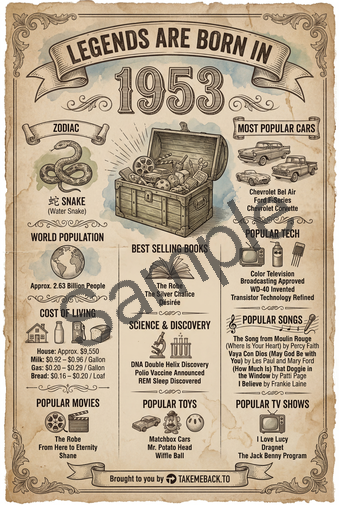

Major Events of 1953 - Historical Moments That Defined the Year | TakeMeBack.to
- 01 Jan Ernest Bloch's Suite Hebraique Premiere: Ernest Bloch's 'Suite Hebraique' premiered on January 1, 1953, showcasing his compositions inspired by Jewish themes and melodies. source: ernestbloch.org
- 03 Jan First mother-son congressional duo: On January 3, 1953, Frances P. Bolton and her son, Oliver P. Bolton, became the first mother and son to serve simultaneously in the U.S. Congress. Frances P. Bolton represented Ohio's 22nd congressional district in the House of Representatives, while her son, Oliver P. Bolton, served Ohio's 11th congressional district. source: en.wikipedia.org
- 04 Jan KTSM TV Channel 9 launches in El Paso: KTSM-TV, Channel 9, began broadcasting in El Paso, Texas, on January 4, 1953. It was the second television station in the El Paso market, following KROD-TV (now KDBC-TV), which debuted in December 1952. KTSM-TV was owned by Tri-State Broadcasting and affiliated with NBC. source: en.wikipedia.org
- 06 Jan First Asian Socialist Conference in Rangoon: The inaugural Asian Socialist Conference convened in Rangoon (now Yangon), Burma, from January 6 to 15, 1953. This conference aimed to establish a Pan-Asian socialist organization independent from European colonial influences and the superpowers of the Cold War. source: cia.gov
- 08 Jan René Mayer becomes French Prime Minister: René Mayer was appointed as the Prime Minister of France on January 8, 1953. His tenure was marked by efforts to stabilize the government during a period of political turmoil in post-war France. source: britannica.com
- 09 Jan Korean ferry disaster near Pusan: On January 9, 1953, a ferry disaster occurred near Pusan, South Korea, resulting in significant loss of life. The incident highlighted the need for improved maritime safety regulations in the region. source: britannica.com
- 10 Jan Pat Benatar born: Pat Benatar, the iconic rock singer, was born on January 10, 1953. She gained fame in the late 1970s and 1980s with hits like 'Hit Me with Your Best Shot.' source: biography.com
- 11 Jan WKBN TV Channel 27 begins broadcasting in Youngstown, Ohio: WKBN TV Channel 27, the first UHF station in Ohio, began broadcasting in Youngstown, Ohio, on January 11, 1953. The station was owned by the Williamson family and affiliated with CBS, with secondary affiliations to ABC and DuMont. source: en.wikipedia.org
- 13 Jan Soviet Doctors' Plot Accusation: On January 13, 1953, Soviet newspapers Pravda and Izvestiya reported the arrest of nine doctors, six of whom were Jewish, accused of conspiring to assassinate Soviet leaders. This event, known as the 'Doctors' Plot,' was later revealed to be a fabricated anti-Semitic campaign. source: britannica.com
- 15 Jan President Truman's Farewell Address: On January 15, 1953, President Harry S. Truman delivered his farewell address to the American people from the Oval Office. In this speech, he reflected on his presidency and the nation's achievements, expressing confidence in the future and support for his successor, Dwight D. Eisenhower. source: trumanlibrary.gov
- 16 Jan KXLY TV Channel 4 begins broadcasting in Spokane, Washington: KXLY TV Channel 4, the first television station in Spokane, Washington, began broadcasting on January 16, 1953. The station was affiliated with CBS. source: en.wikipedia.org
- 17 Jan General Motors Motorama debuts Chevrolet Corvette: On January 17, 1953, the Chevrolet Corvette was unveiled as a prototype at General Motors' Motorama show at the Waldorf-Astoria Hotel in New York City. The car featured an all-fiberglass body and a white exterior with red interior. source: history.com
- 19 Jan 'Lucy Goes to the Hospital' episode airs: The episode 'Lucy Goes to the Hospital' from the television series 'I Love Lucy' aired on January 19, 1953. This episode is notable for its comedic portrayal of Lucy's hospital experience as she prepares to give birth. It remains one of the most memorable episodes in television history. source: tvguide.com
- 20 Jan Dwight D. Eisenhower inaugurated as 34th President of the United States: Dwight D. Eisenhower was inaugurated as the 34th President of the United States on January 20, 1953. His presidency marked a significant shift in American politics, focusing on foreign policy and the Cold War. source: archives.gov
- 21 Jan John Foster Dulles appointed as US Secretary of State: John Foster Dulles was appointed as Secretary of State by President Dwight D. Eisenhower on January 21, 1953. Dulles played a crucial role in shaping U.S. foreign policy during the Cold War. source: history.state.gov
- 22 Jan Arthur Miller's 'The Crucible' opens on Broadway: Arthur Miller's play 'The Crucible' premiered on Broadway on January 22, 1953. The play, set during the Salem witch trials, serves as an allegory for McCarthyism and the Red Scare in the United States. source: broadway.com
- 23 Jan NFL Team Relocation: On January 23, 1953, the NFL granted a franchise to a Baltimore group led by Carroll Rosenbloom, awarding them the assets of the defunct Dallas Texans. The team, named the Colts, made a significant trade with the Cleveland Browns, acquiring 10 players in exchange for five. source: profootballhof.com
- 25 Jan Yuri Sergeev Sets Speed Skating World Record: On January 25, 1953, Soviet speed skater Yuri Sergeev set a world record in the men's 500 meters with a time of 40.9 seconds at Medeo. source: en.wikipedia.org
- 28 Jan Derek Bentley execution: Derek Bentley, a British man with a mental age of 11, was executed for the murder of a police officer during a botched burglary. His execution sparked widespread controversy and debates over the fairness of his trial and the appropriateness of capital punishment. source: en.wikipedia.org
- 31 Jan North Sea flood of 1953 causes widespread devastation: The North Sea flood of January 31, 1953, resulted in catastrophic flooding across the Netherlands, Belgium, and the UK. Over 1,800 lives were lost, and thousands of homes were destroyed, prompting significant changes in flood defense policies. source: bbc.com
- 01 Feb First female assistant secretary of state appointed in Netherlands: On February 1, 1953, the Netherlands appointed its first female assistant secretary of state, marking a significant milestone in gender equality in government roles. This appointment was celebrated as a progressive step for women's representation. source: nytimes.com
- 02 Feb Skyways Limited Avro York disappearance: On February 2, 1953, an Avro York aircraft registered G-AHFA, operated by Skyways Limited, vanished over the North Atlantic during a flight from the United Kingdom to Jamaica. The aircraft had 39 occupants, including 13 children, and was en route from Stansted Airport to Gander Airport. Despite extensive search efforts, no wreckage or survivors were found. source: en.wikipedia.org
- 04 Feb President Eisenhower registers as Republican voter: On February 4, 1953, President Dwight D. Eisenhower officially registered as a Republican voter in Washington, D.C. This marked a significant moment in his political career, aligning him with the party after his presidency as a Republican. source: archives.gov
- 05 Feb Rosenberg clemency denied: On February 5, 1953, the U.S. Supreme Court denied clemency for Julius and Ethel Rosenberg, who were convicted of espionage. Their case was highly controversial and drew significant public attention. source: archives.gov
- 06 Feb US economic controls lifted: On February 6, 1953, the United States lifted several economic controls that had been in place since World War II. This decision was part of a broader move towards economic normalization in the post-war era. source: reuters.com
- 07 Feb Dan Quisenberry born in Santa Monica, California: Dan Quisenberry, an American right-handed relief pitcher known for his submarine-style pitching delivery, was born in Santa Monica, California. He played primarily for the Kansas City Royals and led the American League in saves five times between 1980 and 1985. source: en.wikipedia.org
- 08 Feb Mary Steenburgen born in Newport, Arkansas: Mary Steenburgen, an American actress known for her roles in films such as 'Melvin and Howard' and 'The Help,' was born in Newport, Arkansas. source: en.wikipedia.org
- 09 Feb 'Adventures of Superman' TV series debut in Los Angeles: The 'Adventures of Superman' TV series premiered in Los Angeles on KECA (now KABC-TV Channel 7) on February 9, 1953, marking its first broadcast in the United States. source: supermansupersite.com
- 11 Feb Soviet-Israeli diplomatic rupture: On February 11, 1953, the Soviet Union announced a rupture in diplomatic relations with Israel. This decision was influenced by various geopolitical factors, including the growing tensions in the Middle East and the alignment of Israel with Western powers during the Cold War. source: britannica.com
- 12 Feb Sudan agreement with Britain: On February 12, 1953, Sudan and Britain reached an agreement regarding the future governance of Sudan. This agreement was a significant step towards Sudan's eventual independence, which was achieved in 1956. source: britannica.com
- 13 Feb Christine Jorgensen returns from groundbreaking gender reassignment surgery: Christine Jorgensen, the first American to undergo gender reassignment surgery, returned to the United States on February 13, 1953, after her operation in Denmark. Her arrival garnered significant media attention, marking a pivotal moment in transgender history. source: britannica.com
- 14 Feb 1953 NASCAR Grand National Series inaugural race: The 1953 NASCAR Grand National Series began on February 1, 1953, with the first race held at Palm Beach Speedway in West Palm Beach, Florida. The second race took place on February 15 at the Daytona Beach Road Course in Daytona Beach, Florida. source: en.wikipedia.org
- 15 Feb Comodoro Rivadavia rail disaster: On February 15, 1953, a railbus derailed on an embankment in Comodoro Rivadavia, Argentina, resulting in 23 fatalities and 42 injuries. source: en.wikipedia.org
- 16 Feb Establishment of Pakistan Academy of Sciences: The Pakistan Academy of Sciences was inaugurated on February 16, 1953, in Lahore, serving as a consultative forum and scientific advisor to the government. source: en.wikipedia.org
- 18 Feb 'Bwana Devil' premieres as first 3D film: On February 18, 1953, 'Bwana Devil' premiered as the first full-length 3D film, marking a significant milestone in cinematic history. The film's release sparked a 3D film craze in the early 1950s. source: en.wikipedia.org
- 20 Feb Birth of Riccardo Chailly: Riccardo Chailly, an acclaimed Italian conductor, was born on February 20, 1953. He is known for his work with major orchestras and opera companies around the world, contributing significantly to classical music. source: britannica.com
- 21 Feb Industrial explosion in Newark: On February 21, 1953, an industrial explosion occurred in Newark, resulting in significant damage and casualties. The incident raised concerns about industrial safety regulations at the time. source: nytimes.com
- 23 Feb British police officers honored for heroic sea wall rescue: On February 23, 1953, British police officers were recognized for their bravery in rescuing individuals from a sea wall during a severe storm. Their actions were commended for saving lives and demonstrating exceptional courage. source: bbc.com
- 24 Feb Death of Gerd von Rundstedt, German field marshal: Gerd von Rundstedt, a prominent German field marshal during World War II, passed away on February 24, 1953. He was known for his strategic military leadership and played significant roles in various campaigns during the war. source: britannica.com
- 25 Feb DNA structure discovery: On February 25, 1953, James Watson and Francis Crick published their groundbreaking paper on the double helix structure of DNA. This discovery revolutionized the field of genetics and molecular biology. source: britannica.com
- 26 Feb Allen W. Dulles becomes CIA director: Allen W. Dulles was appointed as the Director of the Central Intelligence Agency on February 26, 1953. His tenure marked significant developments in U.S. intelligence operations during the Cold War. source: cia.gov
- 27 Feb London Agreement on German external debts: The London Agreement on German External Debts was signed on February 27, 1953, addressing Germany's post-World War II reparations and debts. This agreement was crucial for Germany's economic recovery. source: britannica.com
- 28 Feb Discovery of DNA's double helix structure: On February 28, 1953, James Watson and Francis Crick announced the discovery of the double helix structure of DNA. This groundbreaking finding revolutionized the field of genetics and molecular biology. source: nobelprize.org
- 01 Mar Joseph Stalin suffers a stroke: On March 1, 1953, Joseph Stalin, leader of the Soviet Union, suffered a stroke at his dacha in Kuntsevo, Moscow. He was found unconscious and remained in critical condition until his death on March 5. source: historytoday.com
- 04 Mar Kay Lenz birth: Kay Lenz, an American actress known for her roles in 'Breezy' (1973) and 'House' (1985), was born on March 4, 1953, in Los Angeles, California. source: en.wikipedia.org
- 05 Mar Death of Joseph Stalin: Joseph Stalin, the leader of the Soviet Union, died on March 5, 1953. source: Wikipedia (day-month pages)
- 06 Mar Malenkov becomes Soviet leader: Georgy Malenkov succeeded Joseph Stalin as the leader of the Soviet Union on March 6, 1953.
- 07 Mar 1953 State Elections in Queensland and South Australia: On March 7, 1953, state elections were held in Queensland and South Australia. In Queensland, the Australian Labor Party (ALP), led by Premier Vince Gair, secured 50 seats, achieving an 8-seat gain. In South Australia, the Liberal and Country League (LCL), led by Premier Thomas Playford IV, retained government with 21 seats, while the Australian Labor Party (ALP), led by Mick O'Halloran, won 14 seats. source: en.wikipedia.org
- 09 Mar Death and state funeral of Joseph Stalin: Joseph Stalin, the second leader of the Soviet Union, died on 5 March 1953 at his Kuntsevo Dacha after suffering a stroke. His death was announced on 6 March, and his body was embalmed and displayed in the House of Unions for three days. On 9 March, a state funeral was held in Moscow's Red Square, attended by hundreds of thousands. During the funeral, a crowd crush resulted in at least 109 deaths. Stalin was interred in Lenin's Mausoleum, where his body remained until 1961. source: en.wikipedia.org
- 13 Mar Dag Hammarskjöld nominated as UN Secretary-General: On March 13, 1953, the United Nations Security Council nominated Dag Hammarskjöld of Sweden as Secretary-General. This followed a period of deadlock after previous candidates were vetoed, and Hammarskjöld's selection was seen as a compromise acceptable to both superpowers. source: un.org
- 14 Mar Tim McKee born, future Olympic swimmer: Tim McKee, an American swimmer who would later become a three-time Olympic silver medalist, was born on March 14, 1953, in Ardmore, Pennsylvania. source: en.wikipedia.org
- 15 Mar Patty Berg wins LPGA Titleholders Golf Championship: Patty Berg secured her sixth Titleholders Championship victory at Augusta Country Club, finishing with a score of 294 (+6). She led the tournament from start to finish, with Betsy Rawls finishing second at 303 (+15). source: en.wikipedia.org
- 16 Mar Birth of Richard Stallman: Richard Stallman, an influential figure in the free software movement, was born on March 16, 1953.
- 17 Mar US nuclear test at Nevada Test Site: The United States conducted a nuclear test at the Nevada Test Site on March 17, 1953.
- 18 Mar Indiana Hoosiers win 1953 NCAA Men's Basketball Championship: On March 18, 1953, the Indiana Hoosiers secured their second NCAA national championship with a 69–68 victory over the Kansas Jayhawks at the Municipal Auditorium in Kansas City, Missouri. source: si.com
- 19 Mar 25th Academy Awards First Television Broadcast: On March 19, 1953, the 25th Academy Awards ceremony was broadcast live on television for the first time, marking a significant milestone in the history of the Oscars. source: history.com
- 23 Mar Birth of Chaka Khan: Chaka Khan, born Yvette Marie Stevens, is an American singer and songwriter known as the "Queen of Funk." She was born on March 23, 1953, in Chicago, Illinois. source: britannica.com
- 24 Mar Death of Paul Couturier: Paul Couturier, a French Catholic priest known for his ecumenical work, died at the age of 72.
- 25 Mar Lari Massacre in Kenya: The Lari Massacre occurred on March 25, 1953, during the Mau Mau Uprising in Kenya. British colonial forces attacked the village of Lari, resulting in the deaths of many Kikuyu people, including women and children. This event highlighted the brutal tactics used during the colonial conflict. source: bbc.com
- 26 Mar Salk polio vaccine breakthrough: On March 26, 1953, Dr. Jonas Salk announced the successful development of the polio vaccine. This breakthrough was a significant milestone in medical science, leading to widespread vaccination efforts that drastically reduced polio cases worldwide. The vaccine's introduction marked a turning point in public health. source: cdc.gov
- 27 Mar Birth of Annemarie Moser-Pröll: Annemarie Moser-Pröll, an Austrian alpine ski racer, was born on March 27, 1953. She is celebrated for her achievements in skiing, including multiple World Cup titles and Olympic medals. Moser-Pröll is regarded as one of the greatest female ski racers in history. source: olympic.org
- 28 Mar Birth of Melchior Ndadaye, first president of Burundi: Melchior Ndadaye was born on March 28, 1953, and later became the first democratically elected president of Burundi. His presidency marked a significant moment in the country's history, although it was cut short by his assassination in 1993. source: britannica.com
- 29 Mar Tragic Littlefield Nursing Home fire in Florida: On March 29, 1953, a devastating fire broke out at the Littlefield Nursing Home in Florida, resulting in significant loss of life. The incident raised concerns about fire safety regulations in nursing homes across the state. source: nytimes.com
- 30 Mar Dag Hammarskjöld nominated as UN Secretary-General: On March 30, 1953, during a closed meeting of the UN Security Council, French Ambassador Henri Hoppenot proposed Dag Hammarskjöld of Sweden as a candidate for Secretary-General. This nomination was accepted by the Soviet Union, leading to a 10–0–1 vote in favor, with Nationalist China abstaining. Hammarskjöld was subsequently appointed by the General Assembly on April 7, 1953. source: un.org
- 01 Apr 252nd Communications Group establishment: The 252nd Communications Group was established on April 1, 1953, as part of the United States Air Force. It played a significant role in military communications during the Cold War. source: afhra.af.mil
- 02 Apr Jim Allister born: Jim Allister, a prominent Northern Irish politician and member of the European Parliament, was born on April 2, 1953. He is known for his unionist views and has been active in politics for several decades. source: bbc.com
- 03 Apr Launch of TV Guide magazine: TV Guide magazine was launched on April 3, 1953, becoming a significant publication in American television history. It provided viewers with program listings and became a staple in households across the country. source: britannica.com
- 04 Apr North Atlantic Treaty Organization (NATO) formally established: NATO was officially established on April 4, 1953, with the signing of the North Atlantic Treaty in Washington, D.C. This military alliance was formed to provide collective defense against aggression, particularly from the Soviet Union during the Cold War. It remains a key element of international security. source: nato.int
- 05 Apr Eisenhower's 'Chance for Peace' speech: On April 5, 1953, President Dwight D. Eisenhower delivered his 'Chance for Peace' speech, advocating for peace and disarmament during the Cold War. He emphasized the need for nations to work together to prevent war and promote global stability. The speech was significant in shaping U.S. foreign policy. source: archives.gov
- 07 Apr Dag Hammarskjöld elected UN Secretary-General: Dag Hammarskjöld was elected as the second Secretary-General of the United Nations on April 7, 1953. His tenure lasted until his death in 1961, during which he played a significant role in various international crises and peacekeeping efforts. source: un.org
- 08 Apr DNA double helix structure announced: On April 8, 1953, James Watson and Francis Crick announced the discovery of the double helix structure of DNA. This groundbreaking finding laid the foundation for modern genetics and molecular biology. source: britannica.com
- 09 Apr Discovery of the Hook Echo in Meteorology: On April 9, 1953, Illinois State Water Survey engineer Donald Staggs observed an unusual radar echo resembling the number six, associated with a thunderstorm near Champaign-Urbana, Illinois. This 'hook echo' was later linked to a destructive tornado in the same area, marking the first documented association between a hook echo and a confirmed tornado. source: en.wikipedia.org
- 10 Apr Minneapolis Lakers win 1953 NBA Championship: On April 10, 1953, the Minneapolis Lakers secured their fifth NBA title by defeating the New York Knicks 91-84 in Game 5 of the NBA Finals, clinching the series 4-1. source: basketball-reference.com
- 11 Apr Birth of renowned mathematician Andrew Wiles: Andrew Wiles, a British mathematician renowned for proving Fermat's Last Theorem, was born on April 11, 1953. source: en.wikipedia.org
- 12 Apr Ben Hogan wins 17th Masters Golf Championship: Ben Hogan secured his second Masters title with a record-breaking score of 274 (−14) at the 1953 Masters Tournament, held April 9–12 at Augusta National Golf Club in Augusta, Georgia. source: en.wikipedia.org
- 13 Apr CIA launches Project MKUltra: On April 13, 1953, the CIA officially launched Project MKUltra, a covert program aimed at researching mind control and chemical interrogation techniques. This project involved various unethical experiments on unwitting subjects, raising significant ethical concerns over human rights violations. source: cia.gov
- 14 Apr Australian Flags Act implementation: The Australian Flags Act was implemented on April 14, 1953, officially designating the Australian National Flag and the Aboriginal Flag. This act aimed to standardize the flags used in Australia and promote national identity. source: legislation.gov.au
- 15 Apr South African National Party election victory: On April 15, 1953, the South African National Party won a significant election victory, solidifying its power and paving the way for the implementation of apartheid policies. This victory marked a critical moment in South Africa's political history. source: britannica.com
- 16 Apr Haber Corporation factory explosion in Chicago: On April 16, 1953, an explosion occurred at the Haber Corporation factory in Chicago, Illinois. The blast resulted in at least 14 fatalities, with some reports estimating the number of dead to be between 20 and 26. The explosion caused a fire that rapidly engulfed the building, leading to significant casualties. source: usdeadlyevents.com
- 19 Apr Louise Suggs wins LPGA San Diego Golf Open: Louise Suggs secured victory at the 1953 San Diego Open, a golf tournament on the LPGA Tour held at the Mission Course in San Diego, California. source: en.wikipedia.org
- 20 Apr CIA launches Project MKULTRA: The Central Intelligence Agency initiated Project MKULTRA, a covert program aimed at researching mind control techniques, including the use of drugs and other methods. source: en.wikipedia.org
- 23 Apr Charles P. Cabell appointed deputy CIA director: Charles P. Cabell was appointed as the Deputy Director of the Central Intelligence Agency (CIA) on April 23, 1953. His tenure was marked by significant events during the Cold War, influencing U.S. intelligence operations. source: cia.gov
- 24 Apr Winston Churchill knighted by Queen Elizabeth II: Winston Churchill was knighted by Queen Elizabeth II on April 24, 1953, in recognition of his leadership during World War II and his contributions to British history. This event was a significant moment in British royal history. source: bbc.com
- 25 Apr Discovery of DNA double helix structure: On April 25, 1953, James Watson and Francis Crick published their groundbreaking paper on the double helix structure of DNA. This discovery revolutionized the field of genetics and biology. source: nature.com
- 26 Apr Birth of Ruby Wax and Brian Binnie: Ruby Wax, a British-American actress and comedian, was born on April 26, 1953. Brian Binnie, a notable figure in the aviation industry, was also born on the same day. Both have made significant contributions in their respective fields. source: britannica.com
- 27 Apr Operation Moolah: MiG-15 Defection Incentive: On April 27, 1953, the United States initiated Operation Moolah, offering rewards for the defection of MiG-15 pilots during the Korean War. This operation aimed to undermine enemy morale and gain intelligence on Soviet aircraft technology. source: history.com
- 28 Apr Significant Tornado Outbreak in Kansas and Southeastern United States: A significant tornado outbreak occurred on April 28, 1953, affecting Kansas and the southeastern United States. This event resulted in considerable damage and loss of life, highlighting the severe weather risks in the region. source: weather.gov
- 29 Apr First U.S. experimental 3D television broadcast airs: On April 29, 1953, ABC affiliate KECA-TV in Los Angeles aired an experimental 3D television broadcast of the science fiction series 'Space Patrol.' This marked the first such broadcast in the United States, though it was limited to a live audience due to the lack of home 3D viewing equipment. source: history.co.uk
- 30 Apr Little-Bigger League renamed to Babe Ruth League: On April 30, 1953, the Little-Bigger League, a baseball program for boys aged 13 to 15, changed its name to the Babe Ruth League, honoring the legendary baseball player. source: thisdayinbaseball.com
- 02 May The Matthews FA Cup Final: The 1953 FA Cup Final, known as the 'Matthews Final,' featured Blackpool's 4-3 victory over Bolton Wanderers at Wembley Stadium. Stanley Matthews, at 38, delivered a pivotal performance, leading Blackpool from a 3-1 deficit to triumph. The match also saw Stan Mortensen score a hat-trick, the only one in an FA Cup Final at the original Wembley. source: en.wikipedia.org
- 03 May Freedom to Read Declaration: On May 3, 1953, the American Library Association (ALA) and the American Book Publishers Council convened the Westchester Conference in Rye, New York, to discuss the fundamental freedom to read. This conference led to the creation of the Freedom to Read Statement, emphasizing the importance of intellectual freedom and the dangers of censorship. The statement was adopted on June 25, 1953, and has been reaffirmed and amended over the years. source: ala.org
- 04 May Ernest Hemingway Wins Pulitzer Prize for 'The Old Man and the Sea': In 1953, Ernest Hemingway's novella "The Old Man and the Sea" was awarded the Pulitzer Prize for Fiction. The novella, published in 1952, tells the story of an aging Cuban fisherman's struggle with a giant marlin. This work is considered one of Hemingway's most significant contributions to literature.
- 05 May Chemnitz Renamed Karl-Marx-Stadt: On May 5, 1953, the East German city of Chemnitz was officially renamed Karl-Marx-Stadt in honor of the philosopher Karl Marx. This change was part of the East German government's efforts to emphasize its socialist ideology. The city reverted to its original name, Chemnitz, in 1990 after German reunification.
- 06 May Birth of Aleksandr Akimov: Aleksandr Fyodorovich Akimov, a Soviet engineer and shift supervisor at the Chernobyl Nuclear Power Plant during the 1986 disaster, was born in Novosibirsk, Russian SFSR. source: en.wikipedia.org
- 08 May Australian Senate election maintains Coalition majority: On May 8, 1953, a half-Senate election was held in Australia. The Liberal-Country Coalition retained its majority in the Senate, securing 31 seats to the Australian Labor Party's 29. Despite Labor winning a majority of the contested seats, the Coalition maintained overall control of the upper house. source: en.wikipedia.org
- 09 May 1953 Australian Senate election: On May 9, 1953, a half-Senate election was held in Australia. The Liberal-Country Coalition retained its majority in the Senate, securing 31 seats to the Australian Labor Party's 29. Despite Labor winning a majority of the contested seats, the Coalition maintained overall control of the upper house. source: en.wikipedia.org
- 10 May Tito Santana born: Tito Santana, a professional wrestler and sports entertainer, was born on May 10, 1953, in Mission, Texas. He is known for his time in the World Wrestling Federation (WWF) during the 1980s and 1990s, where he became a two-time Intercontinental Champion. source: britannica.com
- 11 May Devastating Waco tornado outbreak: On May 11, 1953, a series of tornadoes struck Waco, Texas, resulting in significant destruction and loss of life. The outbreak produced multiple tornadoes, with the most severe causing extensive damage to homes and infrastructure. source: weather.gov
- 12 May Fatal Bell X-2 research aircraft explosion: On May 12, 1953, a Bell X-2 research aircraft exploded during a test flight, resulting in the loss of the aircraft and the life of the pilot. This incident highlighted the risks associated with experimental aviation technology. source: nasa.gov
- 14 May Milwaukee Brewery Workers Strike: On May 14, 1953, over 7,000 workers from six Milwaukee breweries initiated a strike demanding increased wages, reduced working hours, and improved health and pension plans. The strike lasted 76 days, ending on July 29, 1953, with new labor contracts favorable to the union. source: en.wikipedia.org
- 15 May Miller-Urey experiment published: On May 15, 1953, Stanley Miller published his groundbreaking experiment in the journal Science, demonstrating that amino acids could form under conditions simulating early Earth's atmosphere. This work provided significant support for the theory of abiogenesis, suggesting that life could originate from simple organic compounds. source: britannica.com
- 17 May Patty Berg wins LPGA Reno Golf Open: Patty Berg, a prominent American professional golfer, won the LPGA Reno Golf Open on May 17, 1953. source: en.wikipedia.org
- 18 May Jackie Cochran breaks sound barrier: On May 18, 1953, aviator Jackie Cochran became the first woman to break the sound barrier. This historic flight marked a significant achievement in aviation history and showcased her skills as a pilot. source: nasa.gov
- 19 May Concepción earthquake in Chile: A significant earthquake struck Concepción, Chile, on May 19, 1953. The quake caused considerable damage and loss of life, highlighting the region's vulnerability to seismic activity. source: usgs.gov
- 20 May Birth of Robert Doyle, Australian politician: Robert Doyle, an Australian politician, was born on May 20, 1953. He later became known for his contributions to local and state politics in Australia. source: parliament.vic.gov.au
- 21 May French government resignation: On May 21, 1953, the French government resigned amid political turmoil. This event was part of a series of changes in leadership during a turbulent period in French politics. source: britannica.com
- 22 May Submerged Lands Act enacted: On May 22, 1953, President Dwight D. Eisenhower signed the Submerged Lands Act into law, recognizing the rights of U.S. states to submerged lands beneath navigable waters within their boundaries. This legislation confirmed state ownership of these lands and their natural resources, while affirming federal jurisdiction over submerged lands beyond state boundaries. source: presidency.ucsb.edu
- 23 May Native Dancer wins 79th Preakness Stakes: On May 23, 1953, Native Dancer won the 79th Preakness Stakes, securing his place as one of the most celebrated racehorses in American history. His victory in this race was part of a remarkable career that included an undefeated streak until his first loss in the Kentucky Derby later that year. source: en.wikipedia.org
- 24 May Pope Pius XII publishes encyclical on Saint Bernard of Clairvaux: On May 24, 1953, Pope Pius XII issued the encyclical 'Doctor Mellifluus' on Saint Bernard of Clairvaux, commemorating the eighth centenary of his death. source: en.wikipedia.org
- 25 May Birth of Daniel Passarella: Daniel Passarella, the Argentine footballer and coach, was born on May 25, 1953. source: en.wikipedia.org
- 26 May Birth of Michael Portillo: Michael Portillo, a British journalist, broadcaster, and former Conservative Party politician, was born on May 26, 1953, in Bushey, Hertfordshire, England. source: en.wikipedia.org
- 28 May Third Battle of the Hook in Korean War: The Third Battle of the Hook occurred from May 28 to 29, 1953, near Panmunjom, North Korea. United Nations forces, primarily British troops supported by American, Canadian, and Turkish units, successfully defended the Hook position against a Chinese assault. source: en.wikipedia.org
- 29 May First Summit of Mount Everest: On May 29, 1953, Sir Edmund Hillary of New Zealand and Tenzing Norgay of Nepal became the first climbers to reach the summit of Mount Everest, the highest point on Earth. source: en.wikipedia.org
- 30 May Ken Rosewall wins French Men's Tennis Championship: On May 30, 1953, Australian tennis player Ken Rosewall won the men's singles title at the French Championships, defeating American Vic Seixas 6–3, 6–4, 1–6, 6–2 in the final. source: en.wikipedia.org
- 01 Jun WDAY TV Channel 6 begins broadcasting: WDAY TV Channel 6, based in Fargo, North Dakota, began its broadcasting operations on June 1, 1953. It was one of the first television stations in the region, contributing to the growth of television in the Midwest. source: wday.com
- 02 Jun Coronation of Queen Elizabeth II: Queen Elizabeth II was crowned in Westminster Abbey on June 2, 1953, marking the beginning of her reign. The event was notable for being the first coronation to be televised, allowing millions to witness the ceremony. source: bbc.com
- 03 Jun Death of Florence Price: Florence Price, an influential African American composer and the first woman to have a symphony performed by a major orchestra, passed away on June 3, 1953. Her work has gained recognition in the classical music world. source: gramophone.co.uk
- 04 Jun First Cinerama film premiere on June 4, 1953: The first Cinerama film, 'This Is Cinerama,' premiered on June 4, 1953, showcasing a new film format that used three cameras and projectors to create a panoramic viewing experience. This innovation marked a significant moment in film history. source: britannica.com
- 05 Jun US Senate rejects China's UN membership bid on June 5, 1953: On June 5, 1953, the United States Senate voted against a proposal to admit the People's Republic of China to the United Nations. This decision reflected the geopolitical tensions of the Cold War era and the U.S. stance on communist nations. source: congress.gov
- 06 Jun Popular music of the week on June 6, 1953: On June 6, 1953, various popular music charts highlighted the trending songs of the week, reflecting the musical tastes of the era. This week featured a mix of genres that resonated with the public. source: billboard.com
- 07 Jun Italian General Election: On June 7, 1953, Italy held a general election in which the Christian Democracy party won a plurality in both legislative houses, leading to Alcide De Gasperi continuing as prime minister. source: en.wikipedia.org
- 08 Jun Supreme Court desegregation ruling in Washington, D.C.: On June 8, 1953, the U.S. Supreme Court ruled in favor of desegregation in Washington, D.C. schools, marking a significant step towards civil rights and equality in education. This ruling was part of the broader movement against racial segregation in the United States. source: archives.gov
- 09 Jun Worcester tornado disaster: The Worcester tornado struck on June 9, 1953, causing significant destruction in Worcester, Massachusetts. It resulted in 94 fatalities and over 1,000 injuries, making it one of the deadliest tornadoes in U.S. history. source: weather.gov
- 10 Jun CIA approves controversial LSD experiments: On June 10, 1953, the CIA approved a series of experiments involving LSD as part of its MKUltra program. These experiments aimed to explore mind control and interrogation techniques, raising ethical concerns that continue to resonate today. source: cia.gov
- 11 Jun South Korean President accepts Korean War armistice terms: On June 11, 1953, South Korean President Syngman Rhee accepted the terms of the Korean War armistice. This decision was pivotal in concluding hostilities on the Korean Peninsula, although it was met with some domestic opposition. source: bbc.com
- 12 Jun Tim Allen born in Denver, Colorado: Actor and comedian Tim Allen was born on June 12, 1953, in Denver, Colorado. He later gained fame for his roles in television and film, becoming a prominent figure in American entertainment. source: biography.com
- 13 Jun Change in Hungarian political leadership: On June 13, 1953, there was a significant change in the political leadership of Hungary. This shift was part of the broader political changes occurring in Eastern Europe during the Cold War. source: bbc.com
- 14 Jun Czechoslovak presidential election: The Czechoslovak presidential election held on June 14, 1953, resulted in the election of Antonín Zápotocký as president. This election was significant as it occurred during a period of political consolidation under the Communist Party. Zápotocký's presidency was marked by efforts to strengthen the socialist state in Czechoslovakia. source: britannica.com
- 15 Jun Xi Jinping's birth: Xi Jinping, the current General Secretary of the Communist Party of China, was born on June 15, 1953. His birth marked the beginning of a significant political career that would lead him to become one of the most powerful leaders in modern Chinese history. Xi's leadership has been characterized by a focus on economic reform and increased centralization of power. source: britannica.com
- 16 Jun Berlin Workers' Mass Protest: On June 16, 1953, thousands of construction workers in East Berlin protested against increased work quotas, leading to a broader uprising across East Germany. The protests expanded to over a million people in about 700 localities, demanding better living conditions and political reforms. The uprising was violently suppressed by Soviet forces and East German police, resulting in numerous casualties and arrests. source: en.wikipedia.org
- 17 Jun East German Uprising of 1953: On June 17, 1953, the East German uprising escalated as protests spread across the country, with over a million people participating in demonstrations. The Soviet Union deployed tanks and troops to suppress the uprising, resulting in numerous casualties and arrests. The event highlighted widespread dissatisfaction with the East German government and Soviet policies. source: en.wikipedia.org
- 18 Jun Egyptian Revolution concludes - Republic Established: On June 18, 1953, Egypt abolished its monarchy and declared itself a republic, ending the 148-year rule of the Muhammad Ali Dynasty. General Mohamed Naguib became the first President of Egypt. source: en.wikipedia.org
- 20 Jun American expedition to K2: On June 20, 1953, an American expedition led by Charles Houston attempted to summit K2, the second-highest mountain in the world. Although they did not reach the summit, the expedition contributed valuable knowledge about high-altitude climbing. source: britannica.com
- 21 Jun Birth of Benazir Bhutto: Benazir Bhutto, the first woman to head a democratic government in a majority Muslim nation, was born on June 21, 1953. She served as Prime Minister of Pakistan and was a prominent political figure until her assassination in 2007. source: britannica.com
- 22 Jun Mount Everest expedition honored by Nepalese government: On June 22, 1953, the Nepalese government honored the successful expedition that first summited Mount Everest. This recognition highlighted the significance of the achievement in mountaineering history. source: britannica.com
- 26 Jun Arrest of Lavrentiy Beria: On June 26, 1953, Lavrentiy Beria, head of the Soviet Ministry of Internal Affairs, was arrested during a meeting of the Presidium of the Central Committee. He was later tried and executed on December 23, 1953. source: britannica.com
- 27 Jun Joseph Laniel Becomes Prime Minister of France: On June 27, 1953, Joseph Laniel was appointed Prime Minister of France, succeeding René Mayer.
- 29 Jun Birth of Rock Musician Don Dokken: Don Dokken, American heavy metal singer and founder of the band Dokken, was born on June 29, 1953, in Los Angeles, California. source: en.wikipedia.org
- 30 Jun First roll-on/roll-off ferry channel crossing: On June 30, 1953, the first roll-on/roll-off ferry service began operations, revolutionizing maritime transport by allowing vehicles to drive directly onto and off the ferry. This innovation significantly improved efficiency in shipping and logistics across the English Channel. source: bbc.com
- 01 Jul KLAS TV Channel 8 launches in Las Vegas: KLAS TV Channel 8 began broadcasting on July 1, 1953, becoming the first television station in Las Vegas. It has since played a crucial role in the development of local media and has been a primary source of news and entertainment for the Las Vegas community. source: 8newsnow.com
- 02 Jul U.S. State Department diplomatic communication on foreign policy: On July 2, 1953, the U.S. State Department issued a significant diplomatic communication outlining its foreign policy strategies during the Cold War. This document reflected the United States' approach to international relations and its stance on various global issues at the time. source: history.state.gov
- 03 Jul First successful ascent of Nanga Parbat: On July 3, 1953, Hermann Buhl achieved the first successful ascent of Nanga Parbat, one of the most challenging peaks in the Himalayas. This historic climb marked a significant milestone in mountaineering and showcased Buhl's exceptional skills and determination. source: bbc.com
- 04 Jul Maureen Connolly wins Wimbledon Women's Singles: On July 4, 1953, American tennis player Maureen Connolly, known as "Little Mo," successfully defended her Wimbledon Women's Singles title by defeating Doris Hart 8–6, 7–5 in the final. source: en.wikipedia.org
- 06 Jul Record-breaking London-Paris flight: On July 6, 1953, Lieutenant Mike Lithgow flew a Supermarine Swift F 4 from Heathrow to Le Bourget in 19 minutes and 18 seconds, setting a new record for the London-Paris route. source: en.wikipedia.org
- 07 Jul Walter Burkemo wins PGA Championship: On July 7, 1953, Walter Burkemo won the PGA Championship at Birmingham Country Club in Michigan, defeating Felice Torza 2 and 1 in the final. source: en.wikipedia.org
- 08 Jul Korean War armistice negotiations: On July 8, 1953, negotiations for an armistice to end the Korean War were ongoing, with both sides discussing terms to cease hostilities. The talks were crucial in establishing a ceasefire that would eventually lead to the division of Korea along the 38th parallel. source: britannica.com
- 09 Jul IRS officially named: On July 9, 1953, the Internal Revenue Service (IRS) was officially named, solidifying its role in tax administration in the United States. This marked a significant moment in the history of federal tax collection and regulation. source: irs.gov
- 10 Jul Lavrenti Beria deposed in Soviet power struggle: On July 10, 1953, Lavrenti Beria, the head of the Soviet secret police, was deposed during a power struggle following Stalin's death. His removal marked a significant shift in Soviet politics and the eventual rise of Nikita Khrushchev. source: britannica.com
- 11 Jul US Treasury renames Bureau of Internal Revenue: On July 11, 1953, the United States Treasury officially renamed the Bureau of Internal Revenue to the Internal Revenue Service (IRS). This change aimed to modernize the agency's image and improve its public perception. source: irs.gov
- 12 Jul Lebanese general election commences: The Lebanese general election began on July 12, 1953, marking a significant event in the country's political history. This election was crucial for shaping Lebanon's political landscape during a time of regional instability. source: bbc.com
- 13 Jul Educational reform in Madras State, India: On July 13, 1953, the Indian National Congress Government of Madras State, led by C. Rajagopalachari, introduced the Modified Scheme of Elementary Education. This plan aimed to reduce formal schooling hours and have students learn family occupations at home, but it faced strong public opposition and was eventually deferred. source: en.wikipedia.org
- 15 Jul Founding of China First Automobile Works: On July 15, 1953, the foundation stone for the First Automobile Works (FAW) was laid in Changchun, Jilin Province, China. This marked the beginning of China's automotive industry, with the factory producing the first domestically made truck, the Jiefang CA-10, in 1956. source: gojilin.gov.cn
- 17 Jul US Naval Aviation Training Tragedy: On July 17, 1953, a U.S. Navy Fairchild R4Q-2 Packet aircraft crashed shortly after takeoff from Naval Air Station Whiting Field in Florida. The plane was carrying 46 people, including 23 midshipmen from the University of Oklahoma, 10 from Rice University, and others. Tragically, 44 individuals lost their lives, making it the greatest recorded loss of U.S. midshipmen in a single event. source: en.wikipedia.org
- 18 Jul Gentlemen Prefer Blondes Film Release: 'Gentlemen Prefer Blondes,' a musical comedy starring Marilyn Monroe and Jane Russell, was released on July 18, 1953. The film was a commercial success and is renowned for Monroe's performance of 'Diamonds Are a Girl's Best Friend.' source: rottentomatoes.com
- 19 Jul Birth of Howard Schultz: Howard Schultz, the American businessman and former CEO of Starbucks, was born on July 19, 1953, in Brooklyn, New York. source: britannica.com
- 21 Jul Birth of Brian Talbot: Brian Talbot, the English footballer and manager, was born on July 21, 1953, in Ipswich, England. source: en.wikipedia.org
- 25 Jul NYC Transit fare increase and token introduction: On July 25, 1953, the New York City Transit Authority raised subway and bus fares from 10 to 15 cents. To accommodate the new fare, the authority introduced a 15-cent token, as existing turnstiles could not accept multiple coins. This marked the beginning of the iconic subway token system. source: nytimes.com
- 26 Jul Castro's Moncada Barracks attack launches Cuban Revolution: On July 26, 1953, Fidel Castro and his followers attacked the Moncada Barracks in Santiago de Cuba, marking the beginning of the Cuban Revolution. Although the attack failed, it galvanized support for Castro's movement. source: history.com
- 27 Jul Korean War armistice signed: The Korean War armistice was signed on July 27, 1953, effectively ending hostilities between North and South Korea. This agreement established the Korean Demilitarized Zone (DMZ) and has shaped the geopolitical landscape of the Korean Peninsula ever since. source: archives.gov
- 29 Jul Ken Burns born: Ken Burns was born on July 29, 1953, in Brooklyn, New York. He is a prominent documentary filmmaker known for his unique style and storytelling, which has brought American history to life through film. source: britannica.com
- 01 Aug Fidel Castro arrested in Cuba: On August 1, 1953, Fidel Castro was arrested following an attack on the Moncada Barracks in Santiago de Cuba. This event marked a significant moment in the Cuban Revolution, leading to Castro's eventual rise to power. His arrest garnered international attention and support for his cause. source: britannica.com
- 03 Aug Birth of Ian Bairnson, Scottish Musician: Ian Bairnson, a Scottish musician known for his work with the Alan Parsons Project and his contributions to various artists' recordings, was born on August 3, 1953. source: en.wikipedia.org
- 04 Aug Black families move into Trumbull Park Housing Project: On August 4, 1953, the Chicago Housing Authority moved additional Black families into the Trumbull Park Homes, a predominantly white public housing project, leading to racial tensions and violence in the South Deering neighborhood. source: encyclopedia.chicagohistory.org
- 05 Aug Operation Big Switch: Korean War Prisoner Exchange: Operation Big Switch commenced on August 5, 1953, facilitating the repatriation of prisoners of war between the United Nations Command and communist forces. Over a month, 75,823 communist soldiers were returned to North Korea and China, while 12,773 UN soldiers, including 3,597 Americans, were sent back to South Korea. The operation concluded on September 6, 1953. source: history.com
- 06 Aug Ted Williams Returns to Major League Baseball After Military Service: On August 6, 1953, Ted Williams returned to Major League Baseball after serving in the Korean War. He had been recalled to active duty in 1952 and flew 39 combat missions before being discharged in July 1953. Williams resumed his baseball career with the Boston Red Sox, playing 37 games and achieving a .407 batting average. source: mlb.com
- 08 Aug Soviet Union announces hydrogen bomb capability: On August 8, 1953, the Soviet Union publicly announced its capability to produce hydrogen bombs. This development marked a significant escalation in the nuclear arms race during the Cold War. source: britannica.com
- 09 Aug Dismissal of Sheikh Abdullah from Kashmir leadership: On August 9, 1953, Sheikh Abdullah was dismissed from his position as the Prime Minister of Jammu and Kashmir. This political move was significant in the context of Kashmir's political landscape and its relationship with India. source: bbc.com
- 10 Aug Heroic rescue on K2 expedition: On August 10, 1953, a dramatic rescue took place on K2, where climbers faced perilous conditions. The event highlighted the dangers of high-altitude climbing and the bravery of those involved in the rescue efforts. source: nytimes.com
- 11 Aug Hurricane Barbara forms in southern Bahamas: Hurricane Barbara formed on August 11, 1953, in the southern Bahamas, leading to significant weather warnings and preparations in the region. The storm was notable for its intensity and impact on the surrounding areas. source: nhc.noaa.gov
- 12 Aug Devastating Ionian earthquake: On August 12, 1953, a powerful earthquake struck the Ionian Islands, causing widespread destruction and loss of life. The event prompted significant humanitarian responses and rebuilding efforts in the affected areas. source: britannica.com
- 13 Aug Major French labor strike against austerity measures: On August 13, 1953, a significant labor strike occurred in France, protesting against austerity measures implemented by the government. The strike involved various sectors and highlighted the growing discontent among workers regarding economic policies and living conditions. source: bbc.com
- 14 Aug Devastating Ionian earthquake in Greece: On August 14, 1953, a powerful earthquake struck the Ionian Islands in Greece, causing widespread destruction and loss of life. The earthquake registered a magnitude of 7.2 and led to significant damage to infrastructure and homes, prompting a humanitarian response. source: usgs.gov
- 15 Aug Irk Valley Junction rail crash near Manchester: The Irk Valley Junction rail crash occurred on August 15, 1953, near Manchester, England, resulting in multiple casualties. The accident was attributed to a signal failure, leading to a collision between two trains and highlighting safety concerns in railway operations. source: bbc.com
- 16 Aug KTAL TV Channel 6 launches in Shreveport-Texarkana area: On August 16, 1953, KCMC-TV began broadcasting as the first television station in the Shreveport-Texarkana market, later known as KTAL-TV. source: ktalnews.com
- 18 Aug Kinsey Report on female sexual behavior published: The Kinsey Report, officially titled 'Sexual Behavior in the Human Female,' was published by Alfred Kinsey and his team. This groundbreaking work provided extensive data on female sexual behavior, challenging societal norms and sparking significant discussions about sexuality in America. source: britannica.com
- 19 Aug French exile of Moroccan king: King Mohammed V of Morocco was exiled by the French colonial authorities on August 19, 1953. His exile sparked widespread protests and resistance against French rule, ultimately leading to Morocco's independence in 1956. source: britannica.com
- 20 Aug Redstone missile first test: The first test of the Redstone missile took place on August 20, 1953. This event marked a significant advancement in U.S. missile technology during the Cold War, contributing to the development of future ballistic missiles. source: britannica.com
- 21 Aug U.S. pilot sets unofficial altitude record in Douglas D-558-2 Skyrocket: On August 21, 1953, Major Marion E. Carl of the U.S. Marine Corps piloted the Douglas D-558-2 Skyrocket to an altitude of 83,235 feet (25,370 meters), setting an unofficial world record. The aircraft, launched from a Boeing P2B-1S Superfortress at 30,000 feet (9,144 meters), also achieved a speed of Mach 1.728 during the flight. source: thisdayinaviation.com
- 23 Aug KBAK TV Begins Broadcasting: KBAK TV channel 29, an ABC affiliate, commenced broadcasting in Bakersfield, California, expanding television coverage in the region.
- 27 Aug Death of composer Nicolai Berezowsky: Nicolai Tikhonovich Berezowsky, a Russian-American violinist and composer, died in New York City on August 27, 1953. Born in St. Petersburg in 1900, he was known for his symphonies, concertos, and chamber music. Berezowsky was a protégé of Serge Koussevitzky, who premiered his symphonies to great acclaim. source: en.wikipedia.org
- 28 Aug Al-Bureij Refugee Camp Massacre: On August 28, 1953, Israeli military Unit 101, led by Ariel Sharon, attacked the Al-Bureij Refugee Camp in the Gaza Strip. The assault involved throwing bombs into sleeping refugees' huts and shooting those attempting to flee, resulting in at least 20 civilian deaths and numerous injuries. The United Nations described the incident as an "appalling case of deliberate mass murder." source: aljazeera.com
- 29 Aug USSR detonates first hydrogen bomb: On August 29, 1953, the Soviet Union detonated its first hydrogen bomb, becoming the second nation after the United States to possess this advanced nuclear weapon. The test marked a significant escalation in the nuclear arms race during the Cold War. source: history.com
- 30 Aug 1000 km Nürburgring Motor Race: The inaugural 1000 km Nürburgring race took place on 30 August 1953, marking the fifth round of the FIA World Sports Car Championship. The race was won by Ferrari drivers Alberto Ascari and Giuseppe Farina, who completed 44 laps in 8 hours, 20 minutes, and 44 seconds, averaging a speed of 120.208 km/h. source: en.wikipedia.org
- 01 Sep First jet-to-jet aerial refueling: On September 1, 1953, a Boeing B-47 Stratojet was refueled by a Boeing KB-47 Stratojet tanker, marking the first jet-to-jet aerial refueling. This event demonstrated the feasibility of refueling jet aircraft in flight, significantly extending their operational range. source: skytamer.com
- 02 Sep Ahmad Shah Massoud's birth date: Ahmad Shah Massoud, the Afghan military leader and politician, was born on September 2, 1953, in Bazarak, Afghanistan. source: en.wikipedia.org
- 03 Sep François Mitterrand resigns from French government: François Mitterrand, a prominent French politician, resigned from his position in the government on September 3, 1953. His resignation marked a significant moment in French politics, as he would later become President of France. Mitterrand's political career spanned several decades, influencing French policy and governance. source: britannica.com
- 04 Sep First coast-to-coast live television broadcast: On September 4, 1953, the first coast-to-coast live television broadcast took place in the United States. This landmark event marked a significant advancement in broadcasting technology, allowing viewers across the country to watch events in real-time. The broadcast set the stage for the future of television programming and live events. source: history.com
- 05 Sep First privately operated atomic reactor in USA: On September 5, 1953, the first privately operated atomic reactor in the United States was opened. This event marked a significant step in the development of nuclear energy for commercial use. The reactor represented a shift towards the privatization of nuclear technology, paving the way for future advancements in energy production. source: nrc.gov
- 07 Sep Hurricane Carol drives cargo ship ashore: Hurricane Carol struck the East Coast of the United States on September 7, 1953, causing significant damage and driving a cargo ship ashore. The storm highlighted the need for improved hurricane preparedness and response. source: nhc.noaa.gov
- 08 Sep Carnival in Flanders Theater Performance in New York: The musical 'Carnival in Flanders' opened on September 8, 1953, at the New Century Theatre in New York City. Despite a score by Jimmy Van Heusen and Johnny Burke, a book by Preston Sturges, and a leading performance by John Raitt, the show had a brief run of only six performances. Dolores Gray won the Tony Award for Best Actress in a Musical for her role, marking the shortest-lived Tony-honored performance. source: ibdb.com
- 12 Sep Khrushchev Becomes Communist Party Leader: On September 12, 1953, Nikita Khrushchev was announced as the new leader of the Soviet Union, succeeding Joseph Stalin as First Secretary of the Communist Party. This marked the beginning of his leadership, which included significant political and social reforms. source: history.com
- 13 Sep Innovative urban infrastructure: four level interchange: On September 13, 1953, a groundbreaking four-level interchange was completed, showcasing innovative urban infrastructure design. This project set a precedent for future urban planning and transportation systems. source: britannica.com
- 16 Sep 'The Robe' premieres as first CinemaScope film: On September 16, 1953, the film 'The Robe' premiered at the Roxy Theatre in New York City, marking the debut of the CinemaScope format. This religious epic, starring Richard Burton and Jean Simmons, was the first film to be released in the new widescreen process, which was advertised as 'the modern miracle you see without glasses.' source: en.wikipedia.org
- 19 Sep WVEC TV Channel 13 begins broadcasting: WVEC TV Channel 13, licensed to Hampton, Virginia, began operations on September 19, 1953, on UHF channel 15 as an NBC affiliate. It was co-owned by Peninsula Broadcasting Corporation, which also owned WVEC radio. The station switched affiliations to ABC in 1959 and moved to VHF channel 13 on November 13, 1959. source: en.wikipedia.org
- 21 Sep KRDO TV Channel First Broadcast: KRDO-TV, channel 13 in Colorado Springs, Colorado, began its first broadcast on September 21, 1953, as an NBC affiliate. The station was locally owned by Pikes Peak Broadcasting Company and later became a full-time ABC affiliate in 1960. source: en.wikipedia.org
- 23 Sep KHQA TV Channel 7 Begins Broadcasting: KHQA-TV, channel 7 in Hannibal, Missouri, began broadcasting on September 23, 1953, as a CBS affiliate. The station was originally owned by Lee Enterprises of Davenport, Iowa, along with the Hannibal Courier-Post and WTAD radio. source: en.wikipedia.org
- 24 Sep Rocky Marciano retains heavyweight title by defeating Roland La Starza: On September 24, 1953, at the Polo Grounds in New York City, Rocky Marciano successfully defended his undisputed heavyweight championship by defeating Roland La Starza via technical knockout in the 11th round. This victory marked Marciano's 45th consecutive win and was the first time La Starza was stopped in his boxing career. source: en.wikipedia.org
- 26 Sep Earl Warren appointed Chief Justice: Earl Warren was appointed as the Chief Justice of the United States on September 26, 1953. His tenure is noted for landmark decisions in civil rights and the expansion of personal liberties. source: archives.gov
- 27 Sep RecordTV launches in Brazil: RecordTV, one of Brazil's oldest television networks, officially launched on September 27, 1953. It has played a crucial role in the development of Brazilian television and media. source: bbc.com
- 28 Sep Death of Edwin Hubble: Edwin Hubble, an American astronomer renowned for establishing the field of extragalactic astronomy and providing evidence for the expansion of the universe, died on September 28, 1953, in San Marino, California. source: esa.int
- 30 Sep Earl Warren appointed Supreme Court Chief Justice: On September 30, 1953, President Dwight D. Eisenhower announced his intention to nominate Earl Warren as Chief Justice of the Supreme Court. Warren was sworn in on October 5, 1953. source: georgewbush-whitehouse.archives.gov
- 01 Oct KYTV Channel 3 begins broadcasting in Springfield, Missouri: KYTV Channel 3, now known as KY3, began its first broadcast in Springfield, Missouri, on October 1, 1953, becoming the second television station in the area. source: ky3.com
- 02 Oct Victor Borge's 'Comedy in Music' opens on Broadway: Victor Borge's one-man show, 'Comedy in Music,' premiered at the John Golden Theatre in New York City on October 2, 1953, and ran for 849 performances until January 21, 1956. source: ibdb.com
- 04 Oct Mickey Mantle's grand slam in World Series: On October 4, 1953, Mickey Mantle hit a grand slam during the World Series, contributing to the New York Yankees' victory. This moment is celebrated as one of the highlights of Mantle's illustrious baseball career. source: nytimes.com
- 05 Oct US-Korea Mutual Defense Treaty signed: The United States and South Korea signed the Mutual Defense Treaty on October 5, 1953, solidifying their military alliance following the Korean War. This treaty remains a cornerstone of US-South Korea relations. source: history.state.gov
- 06 Oct Konrad Adenauer re-elected as German Chancellor: Konrad Adenauer was re-elected as Chancellor of West Germany on October 6, 1953. His leadership was pivotal in the post-war recovery and integration of West Germany into the Western bloc. source: britannica.com
- 07 Oct UNICEF becomes permanent UN agency: On October 7, 1953, the United Nations Children's Fund (UNICEF) was officially recognized as a permanent specialized agency of the United Nations. This change reflected the organization's expanded mandate to address the long-term needs of children and women worldwide. source: un.org
- 08 Oct Soviet Union successfully tests hydrogen bomb: On October 8, 1953, the Soviet Union conducted a successful test of a hydrogen bomb, marking a significant advancement in nuclear weapons technology during the Cold War era.
- 09 Oct Konrad Adenauer becomes West German Chancellor: Konrad Adenauer was elected as the first Chancellor of West Germany on this date, serving from 1949 to 1963. His leadership was pivotal in the post-war recovery and integration of West Germany into Western Europe. source: britannica.com
- 10 Oct US-Korea Mutual Defense Treaty signed: The United States and South Korea signed a Mutual Defense Treaty on this date, establishing a military alliance between the two nations. This treaty has been a cornerstone of U.S. foreign policy in East Asia. source: state.gov
- 11 Oct Death of Pauline Robinson Bush: Pauline Robinson Bush, the mother of George H.W. Bush, passed away on October 11, 1953. She was known for her strong family values and support of her son's political career. Her death marked a significant moment for the Bush family. source: nytimes.com
- 12 Oct The Caine Mutiny Court-Martial Opens: The court-martial for the officers involved in the Caine Mutiny began on October 12, 1953. This high-profile trial examined the actions of Captain Queeg and the crew's mutiny during World War II, raising questions about military authority and leadership. source: britannica.com
- 13 Oct Samuel Bagno Invents Ultrasonic Burglar Alarm: On October 13, 1953, Samuel Bagno patented the ultrasonic burglar alarm, a significant advancement in security technology. This invention utilized sound waves to detect unauthorized entry, marking a shift in how security systems were designed. source: britannica.com
- 14 Oct Eisenhower's anti-communist federal employment policy: On October 14, 1953, President Dwight D. Eisenhower announced a new federal employment policy aimed at rooting out suspected communists from government positions. This policy was part of the broader Red Scare and reflected the intense anti-communist sentiment of the era. It led to significant political and social ramifications in the United States. source: archives.gov
- 15 Oct Creation of US Department of Health, Education, and Welfare: On October 15, 1953, the United States established the Department of Health, Education, and Welfare (HEW) to consolidate federal health, education, and social welfare programs. This department played a crucial role in shaping public policy in these areas until it was split into separate departments in 1979. The creation of HEW marked a significant development in the federal government's approach to social services. source: hhs.gov
- 16 Oct Fidel Castro's pivotal legal defense speech: On October 16, 1953, Fidel Castro delivered a significant speech during his trial for the attack on the Moncada Barracks, where he famously declared, "History will absolve me." This speech outlined his political beliefs and the injustices faced by the Cuban people, solidifying his role as a revolutionary leader. It became a rallying point for his supporters and marked a turning point in Cuban history. source: britannica.com
- 17 Oct Peter Brook's live television production of King Lear: Peter Brook directed a groundbreaking live television adaptation of Shakespeare's 'King Lear' on October 17, 1953. This production is notable for its innovative approach and is considered a significant moment in the history of television drama. source: bbc.co.uk
- 18 Oct Willie Thrower breaks NFL color barrier as quarterback: On October 18, 1953, Willie Thrower became the first African American quarterback to play in the NFL, making history during a game with the Chicago Bears. His participation marked a significant milestone in the integration of professional football. source: nfl.com
- 19 Oct Publication of Fahrenheit 451: Ray Bradbury's dystopian novel 'Fahrenheit 451' was published on October 19, 1953. The book explores themes of censorship and the power of literature, becoming a classic in American literature. source: britannica.com
- 20 Oct Johnny Bright incident in Stillwater: On October 20, 1953, during a college football game, Johnny Bright, an African American player, was severely injured by a white opponent in a racially charged incident. This event drew national attention and highlighted issues of racism in sports during that era. source: nytimes.com
- 22 Oct Laos gains independence from France: On October 22, 1953, Laos gained independence from France, ending a period of French colonial rule. This event marked a significant step in the decolonization process in Southeast Asia during the mid-20th century. source: en.wikipedia.org
- 24 Oct Steven Hatfill: Anthrax Investigation Person of Interest: Steven Hatfill, born on October 24, 1953, was later identified as a "person of interest" in the 2001 anthrax attacks investigation. source: en.wikipedia.org
- 26 Oct End of Pacific Electric Santa Monica Air Line Passenger Service: On October 26, 1953, the Pacific Electric Santa Monica Air Line ceased passenger operations, marking the end of nearly 60 years of service between Los Angeles and Santa Monica. The line had been reduced to a single daily round trip before its closure. source: pacificelectric.org
- 29 Oct BCPA Flight 304 crashes near San Francisco: On October 29, 1953, British Commonwealth Pacific Airlines Flight 304, a Douglas DC-6 named 'Resolution,' crashed near Woodside, California, during its approach to San Francisco International Airport. All 19 people on board, including renowned pianist William Kapell, were killed. The Civil Aeronautics Board concluded that the probable cause was the crew's failure to follow prescribed procedures for an instrument approach. source: en.wikipedia.org
- 30 Oct NSC 162/2 adopted, emphasizing nuclear deterrence: On October 30, 1953, the United States National Security Council adopted document NSC 162/2, which emphasized the capability of inflicting massive retaliatory damage by offensive striking power, marking the beginning of the 'New Look' defense policy under President Dwight D. Eisenhower. source: en.wikipedia.org
- 31 Oct First successful kidney transplant in medical history: On October 31, 1953, Dr. Joseph Murray performed the first successful kidney transplant at Peter Bent Brigham Hospital in Boston. The recipient was a 23-year-old man who received a kidney from his identical twin brother, marking a significant milestone in transplant surgery. source: ncbi.nlm.nih.gov
- 01 Nov United States detonates first hydrogen bomb: On November 1, 1953, the United States successfully detonated its first hydrogen bomb, codenamed 'Ivy Mike,' at Enewetak Atoll in the Pacific. This test marked a significant advancement in nuclear weapons technology during the Cold War. source: archives.gov
- 02 Nov Pakistan becomes Islamic Republic: On November 2, 1953, Pakistan was declared an Islamic Republic, marking a significant change in its political structure. This transition emphasized the role of Islam in the governance of the country. source: bbc.com
- 04 Nov Eddie Joost becomes Philadelphia Athletics manager: On November 4, 1953, Eddie Joost, the longtime shortstop for the Philadelphia Athletics, was appointed as the team's manager, succeeding Jimmie Dykes. Joost, 37 at the time, had been a key player for the Athletics and was expected to bring a fresh perspective to the team's leadership. However, under his management, the Athletics finished last in the American League with a record of 51-103, leading to the team's relocation to Kansas City after the season. source: sabr.org
- 05 Nov Nobel Prize in Physics awarded to Frederik Zernicke: On November 5, 1953, the Nobel Prize in Physics was awarded to Frederik Zernicke for his work in the field of physics. Zernicke's contributions were recognized by the Nobel Committee for their significance and impact on the scientific community. source: en.wikipedia.org
- 07 Nov WIS TV Channel 10 launches in Columbia, South Carolina: WIS TV Channel 10 began broadcasting in Columbia, South Carolina, on November 7, 1953. The inaugural broadcast featured a live telecast of a University of South Carolina football game. The station was assigned Channel 10, the only VHF channel in central South Carolina at the time, providing clear reception to many viewers in the area. source: scencyclopedia.org
- 08 Nov Heroic Rescue in Singapore: Malay policeman Yahya bin Mat Akim demonstrated exceptional bravery by rescuing a Malay fisherman from drowning at the 54 milestone Pasir Panjang in Singapore.
- 09 Nov Cambodia declares independence from France: On November 9, 1953, King Norodom Sihanouk declared Cambodia's independence from France, ending 90 years of French colonial rule. This event marked the establishment of the Kingdom of Cambodia. source: en.wikipedia.org
- 10 Nov New York Giants conclude Japan tour: On November 10, 1953, the New York Giants completed their exhibition tour of Japan, playing a series of games against Japanese teams. The tour was a goodwill mission to promote baseball and strengthen cultural ties between the United States and Japan. source: sabr.org
- 11 Nov Jimmy Dykes appointed Baltimore Orioles manager: On November 11, 1953, Jimmy Dykes was named the first manager of the newly re-established Baltimore Orioles, marking a significant moment in the team's history. source: en.wikipedia.org
- 12 Nov David Ben-Gurion resigns as Premier of Israel: On November 12, 1953, David Ben-Gurion resigned as Prime Minister of Israel, a position he had held since the country's founding in 1948. His resignation marked a significant shift in Israeli politics. source: en.wikipedia.org
- 14 Nov WCIA TV Channel 3 begins broadcasting: WCIA TV Channel 3, based in Champaign, Illinois, began broadcasting on November 14, 1953. It has since become a significant source of news and entertainment in the region. source: wcia.com
- 15 Nov WIBW TV Channel 13 launch in Topeka, Kansas: WIBW TV Channel 13, located in Topeka, Kansas, officially launched on November 15, 1953. It has played a vital role in local broadcasting and news coverage. source: wibw.com
- 16 Nov Birth of Griff Rhys Jones: Griff Rhys Jones, a Welsh comedian, actor, and writer, was born on November 16, 1953. He is best known for his work on the BBC sketch show 'Not the Nine O'Clock News' and for co-presenting the travel documentary series 'Great British Railway Journeys.' source: en.wikipedia.org
- 17 Nov Blasket Islands Evacuation: On November 17, 1953, the Irish government evacuated the inhabitants of the Blasket Islands, located off the coast of County Kerry. The decision was made due to the declining population and the challenges of maintaining the community, leading to the abandonment of the islands. source: en.wikipedia.org
- 19 Nov Piltdown Man hoax revealed: On November 21, 1953, scientists announced that the Piltdown Man fossils, discovered in 1912, were a deliberate hoax, consisting of modern human and orangutan bones. source: theguardian.com
- 21 Nov Piltdown Man hoax exposed: On November 21, 1953, scientists announced that the Piltdown Man fossils, discovered in 1912, were a deliberate hoax, consisting of modern human and orangutan bones. source: theguardian.com
- 22 Nov French paratroopers initiate Operation Castor in Điện Biên Phủ: On November 22, 1953, French paratroopers launched Operation Castor in Điện Biên Phủ, Vietnam. This military operation aimed to establish a base in the region to counter the Viet Minh forces. The operation marked a significant escalation in the First Indochina War. source: bbc.com
- 23 Nov Evacuation of the Blasket Islands begins: The evacuation of the Blasket Islands, off the coast of Ireland, began on November 23, 1953. This marked the end of permanent habitation on the islands, which had been home to a small community for centuries. The decision was made due to economic difficulties and declining population. source: bbc.com
- 24 Nov Brooklyn Dodgers hire Walter Alston as manager: On November 24, 1953, the Brooklyn Dodgers appointed Walter Alston, then manager of the Montreal Royals, as their new manager. Alston succeeded Chuck Dressen, who had resigned after the Dodgers declined to offer him a multi-year contract. Alston's tenure marked the beginning of a successful era for the Dodgers, leading them to multiple National League pennants and World Series titles. source: truebluela.com
- 25 Nov Guys & Dolls Broadway Run Concludes: The Broadway production of 'Guys & Dolls' concluded its run on November 28, 1953, after 1,200 performances. The musical, which opened on November 24, 1950, was a significant success during its time on Broadway. source: ovrtur.com
- 26 Nov KBOI Television Channel Launch in Boise: KBOI-TV, Boise's second television station, began broadcasting on November 26, 1953. It aired an analog signal on VHF channel 2, primarily affiliated with CBS, and was owned by Boise Valley Broadcasters alongside KBOI radio. source: en.wikipedia.org
- 29 Nov WSIX TV Channel 8 begins broadcasting in Nashville: WSIX TV Channel 8 began broadcasting in Nashville on November 29, 1953, becoming one of the city's first television stations. This development marked a significant milestone in Nashville's media landscape, providing residents with access to television programming and news. source: wkrn.com
- 01 Dec Victor Ambros born in Hanover, New Hampshire: Victor Ambros, an American developmental biologist renowned for discovering the first known microRNA, was born in Hanover, New Hampshire, on December 1, 1953. source: en.wikipedia.org
- 05 Dec F5 tornado strikes Vicksburg, Mississippi: An F5 tornado devastated Vicksburg, Mississippi, causing significant damage and loss of life. The tornado was part of a larger outbreak that affected the region, leading to widespread destruction and prompting emergency response efforts. source: weather.gov
- 08 Dec Eisenhower's Atoms for Peace Address: On December 8, 1953, U.S. President Dwight D. Eisenhower delivered his "Atoms for Peace" speech to the United Nations General Assembly in New York City. In this address, he advocated for the peaceful use of nuclear energy and proposed the establishment of an international atomic energy agency to promote its benefits for all mankind. source: britannica.com
- 09 Dec NHL sets penalty record in Canadiens vs Maple Leafs game: On December 9, 1953, the Montreal Canadiens and Toronto Maple Leafs set a record for the most penalties in a game. The incident began when Montreal's Eddie Mazur fought Toronto's George Armstrong in the first period, leading to game misconduct penalties for both players. Later, in the third period, Bud MacPherson and Ron Stewart engaged in a fight, further contributing to the record-breaking penalty minutes. source: en.wikipedia.org
- 10 Dec Albert Schweitzer awarded Nobel Peace Prize: On December 10, 1953, Albert Schweitzer was awarded the Nobel Peace Prize for his philosophy of "reverence for life" and his humanitarian work in Africa. Schweitzer, a theologian, physician, and musician, dedicated his life to providing medical care in Gabon, where he founded a hospital in Lambaréné. source: nobelprize.org
- 11 Dec Nobel Prize Awards Ceremony 1953 held: On December 11, 1953, the Nobel Prize Awards Ceremony took place in Stockholm, Sweden. The ceremony honored laureates in various categories, including Peace, Literature, and Medicine, recognizing their significant contributions to humanity. source: nobelprize.org
- 12 Dec Chuck Yeager breaks speed record in Bell X-1A: On December 12, 1953, Major Chuck Yeager piloted the Bell X-1A to a speed of Mach 2.44 (1,650 mph) at an altitude of approximately 76,000 feet. After shutting off the rocket engine, the aircraft tumbled out of control, descending nearly 50,000 feet in 70 seconds before Yeager regained control and landed safely at Edwards Air Force Base. source: chuckyeager.org
- 13 Dec Ben Bernanke born: Ben Bernanke, an American economist and former chairman of the Federal Reserve, was born on December 13, 1953. He is known for his role in managing the U.S. economy during the financial crisis of 2007-2008. source: federalreserve.gov
- 14 Dec Sandy Koufax signs with Brooklyn Dodgers: Sandy Koufax, a legendary baseball pitcher, signed with the Brooklyn Dodgers on December 14, 1953. He would go on to become one of the most celebrated pitchers in Major League Baseball history. source: britannica.com
- 17 Dec WEAU TV Channel 13 begins broadcasting: WEAU TV Channel 13, located in Eau Claire, Wisconsin, began broadcasting on December 17, 1953. The station has been serving the La Crosse–Eau Claire market as an affiliate of NBC and The CW Plus. source: en.wikipedia.org
- 18 Dec Piltdown Man hoax definitively exposed: The Piltdown Man hoax, which misled scientists for decades about human evolution, was definitively exposed on December 18, 1953. A team of scientists revealed that the skull fragments and jawbone, claimed to be the missing link, were actually a combination of human and orangutan remains. This discovery had significant implications for the field of paleoanthropology. source: britannica.com
- 19 Dec Death of Robert Millikan, renowned physicist: Robert Millikan, an American experimental physicist and Nobel laureate, passed away on December 19, 1953. He is best known for his work on the photoelectric effect and for measuring the charge of the electron, which significantly advanced the field of physics. source: britannica.com
- 20 Dec KWTV Channel 9 launches in Oklahoma City: KWTV Channel 9, affiliated with CBS, began broadcasting in Oklahoma City on December 20, 1953. The station's call sign, KWTV, stands for "World's Tallest Video," referencing its transmission tower, which was once the tallest in the world at 1,572 feet. source: en.wikipedia.org
- 23 Dec René Coty elected President of France: René Coty was elected as the second President of France under the Fourth Republic on December 23, 1953, after a prolonged election process. He succeeded Vincent Auriol and served from 1954 to 1959. source: britannica.com
- 24 Dec Tangiwai Railway Disaster: On December 24, 1953, the Tangiwai Railway Disaster occurred in New Zealand when an express passenger train plunged into the Whangaehu River after the bridge collapsed due to a volcanic lahar from Mount Ruapehu. The disaster resulted in 151 fatalities. source: nzhistory.govt.nz
- 27 Dec Birth of Gina Lopez, Filipino environmentalist and philanthropist: Gina Lopez, a prominent Filipino environmentalist and philanthropist, was born on December 27, 1953, in Manila, Philippines. She served as the Secretary of the Department of Environment and Natural Resources and was known for her advocacy in environmental conservation and corporate social responsibility. source: en.wikipedia.org
- 31 Dec Death of Albert Plesman, KLM founder: Albert Plesman, Dutch aviation pioneer and founder of KLM, died on December 31, 1953, at the age of 64. source: en.wikipedia.org
What happened in 1953?
Discover what the world looked like in 1953: