

Major Events of 1957: Key Historical Moments You Need to Know
Every year brings its own set of pivotal moments that leave a lasting mark on history. From political shifts and technological advancements to cultural breakthroughs, these events shape the world and influence the future. In this comprehensive overview, we'll explore the most significant occurrences from 1957, highlighting key moments that continue to impact our lives today.
Explore by topic:
Born in 1957? Get Your Birth Year Poster!
A beautifully researched, newspaper-style poster of the year.
Step back into 1957. Get yours today!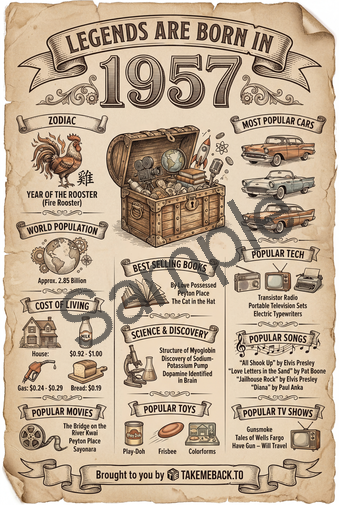

Major Events of 1957 - Historical Moments That Defined the Year | TakeMeBack.to
- 01 Jan Treaty of Rome establishes European Economic Community: The Treaty of Rome was signed on March 25, 1957, and came into effect on January 1, 1958, establishing the European Economic Community (EEC). This treaty marked a significant step towards European integration, promoting economic cooperation among member states. It laid the groundwork for the European Union as we know it today. source: europa.eu
- 02 Jan Pacific Coast Stock Exchange formation: The Pacific Coast Stock Exchange (PCSE) was established on January 2, 1957, in San Francisco, California. It aimed to provide a platform for trading securities on the West Coast, contributing to the growth of regional financial markets. The exchange played a significant role in the development of the financial landscape in the United States. source: sec.gov
- 03 Jan First electric watch introduced: The first electric watch, the Bulova Accutron, was introduced on January 3, 1957. This innovative timepiece utilized a tuning fork mechanism, marking a significant advancement in watch technology. The Accutron was known for its accuracy and paved the way for future developments in electronic timekeeping. source: britannica.com
- 04 Jan Final issue of Collier's Weekly Magazine published: The last issue of Collier's Weekly Magazine was published, marking the end of its 68-year run. The cover featured Princess Grace of Monaco. source: en.wikipedia.org
- 05 Jan Jackie Robinson retires from baseball: On January 5, 1957, Jackie Robinson announced his retirement from Major League Baseball at age 37. After a decade with the Brooklyn Dodgers, he had been traded to the New York Giants in December 1956 but chose to retire instead, citing health concerns and a desire to pursue business opportunities. Robinson later joined Chock Full o'Nuts as Vice President of Personnel. source: baseballhall.org
- 09 Jan Karachayevo-Cherkess Autonomous Region reestablished: On January 9, 1957, the Karachay-Cherkess Autonomous Oblast was reestablished in the Russian Soviet Federative Socialist Republic (RSFSR). This followed the rehabilitation of the Karachay people, who had been deported during World War II. The reestablishment aimed to restore the administrative unity of the Karachay and Cherkess peoples in the region. source: britannica.com
- 10 Jan Southern Christian Leadership Conference founded: The Southern Christian Leadership Conference (SCLC), a key organization in the American civil rights movement, was founded on January 10, 1957, in Atlanta, Georgia. source: nps.gov
- 11 Jan Bryan Robson born: Bryan Robson, an English footballer and manager, was born on January 11, 1957, in Chester-le-Street, England. He is known for his time with West Bromwich Albion and Manchester United, as well as his role as the England national team captain. source: en.wikipedia.org
- 12 Jan John Lasseter's birth: John Lasseter, an American animator and filmmaker known for his work with Pixar and Disney, was born on January 12, 1957. source: biography.com
- 13 Jan NFL Pro Bowl West Triumphs: On January 13, 1957, the NFL's seventh annual Pro Bowl was held at the Los Angeles Memorial Coliseum. The Western Conference team defeated the Eastern Conference 19-10. The game was attended by 44,177 fans and was not televised. Bert Rechichar of the Baltimore Colts was named the outstanding back, and Ernie Stautner of the Pittsburgh Steelers was named the outstanding lineman. source: en.wikipedia.org
- 15 Jan Kurosawa's 'Throne of Blood' released in Japan: Akira Kurosawa's film 'Throne of Blood' premiered in Japan on January 15, 1957. The film is an adaptation of Shakespeare's 'Macbeth' and is noted for its innovative cinematography and powerful performances, solidifying Kurosawa's reputation as a master filmmaker. source: criterion.com
- 16 Jan Historic first non-stop round world flight by B-52s: On January 16, 1957, a fleet of B-52 bombers completed the first non-stop round-the-world flight. This significant military achievement demonstrated the capabilities of the U.S. Air Force and marked a milestone in aviation history. source: af.mil
- 17 Jan Bay Area Rapid Transit (BART) System Recommendation: In 1957, the San Francisco Bay Area Rapid Transit Commission recommended the formation of a five-county rapid transit district to build and operate a high-speed rapid rail network, leading to the creation of BART. source: bart.gov
- 20 Jan Eisenhower's second presidential inauguration: Dwight D. Eisenhower was privately sworn in for his second term as the 34th President of the United States on January 20, 1957, at the White House. The public ceremony took place the following day, January 21, 1957, at the East Portico of the U.S. Capitol. source: eisenhowerlibrary.gov
- 21 Jan Eisenhower's Second Inaugural Address: On January 21, 1957, Dwight D. Eisenhower delivered his second inaugural address, marking the commencement of his second term as the 34th President of the United States. The ceremony took place at the East Portico of the United States Capitol in Washington, D.C., with Chief Justice Earl Warren administering the oath of office. Eisenhower's address focused on themes of peace, justice, and the nation's role in global affairs. source: presidency.ucsb.edu
- 22 Jan Israeli Withdrawal from Sinai Peninsula: On January 22, 1957, Israeli forces withdrew from the Sinai Peninsula, a move that was part of the aftermath of the Suez Crisis. The withdrawal was in response to international pressure and aimed at restoring peace and stability in the region. This action was significant in the context of Middle East geopolitics during the 1950s. source: presidency.ucsb.edu
- 23 Jan First Frisbees Produced by Wham-O: On January 23, 1957, Wham-O began producing the first Frisbees, a plastic disc that would become a popular recreational item. The Frisbee was inspired by the pie tins used by the Frisbie Pie Company, which students at Yale University would toss around, leading to the development of the modern toy. source: history.com
- 24 Jan Death of South African cricketer Dan Taylor: Dan Taylor, a South African cricketer who played in two Test matches in 1914, passed away in Durban, Natal, South Africa. source: en.wikipedia.org
- 25 Jan FBI arrests Jack and Myra Soble for Soviet espionage: Jack and Myra Soble were arrested in New York on charges of spying for the Soviet Union. They were later convicted and sentenced to prison. source: cia.gov
- 26 Jan Ashok Malhotra: Indian Test Cricketer: Ashok Malhotra was an Indian batsman who represented the national cricket team in 7 Test matches between 1982 and 1984.
- 29 Jan Graham Greene's 'The Potting Shed' Broadway premiere: Graham Greene's play 'The Potting Shed' premiered on Broadway at the Bijou Theatre on January 29, 1957. The production, directed by Carmen Capalbo, featured Robert Flemyng as James Callifer and Sybil Thorndike in supporting roles. The play explores family secrets and psychological drama, receiving critical acclaim for its emotional depth. source: en.wikipedia.org
- 30 Jan Eisenhower Doctrine approved by Congress: On January 30, 1957, the U.S. Congress approved the Eisenhower Doctrine, authorizing the President to use U.S. armed forces to assist Middle Eastern countries resisting communist aggression. This policy aimed to contain Soviet influence in the region during the Cold War.
- 01 Feb First Black pilot on US scheduled passenger airline: On February 1, 1957, the first Black pilot, Captain Alva Temple, was hired by a U.S. scheduled passenger airline, marking a significant milestone in aviation history. This event represented a breakthrough in the integration of the airline industry, which had been predominantly white. Temple's achievement paved the way for future generations of minority pilots. source: nytimes.com
- 02 Feb France's UN involvement prohibition in Algeria: On February 2, 1957, France faced a prohibition from the United Nations regarding its involvement in Algeria. This was part of the broader context of the Algerian War of Independence, where international scrutiny was increasing over France's colonial policies. The UN aimed to address human rights concerns amid the conflict. source: britannica.com
- 06 Feb US President Dwight D. Eisenhower delivers State of the Union address: On February 6, 1957, President Dwight D. Eisenhower delivered his annual State of the Union address to Congress, outlining his administration's legislative agenda and national priorities for the year. source: archives.gov
- 07 Feb 'The Incredible Shrinking Man' captivates audiences: On February 7, 1957, the science fiction film 'The Incredible Shrinking Man' was released, captivating audiences with its imaginative storyline and special effects. source: britannica.com
- 08 Feb Hungarian pre-uprising tensions in 1957: In early 1957, tensions were rising in Hungary as citizens expressed dissatisfaction with the Soviet-backed government. The political climate was marked by protests and calls for reform, setting the stage for the later uprising in October 1956. These events highlighted the struggle for independence and national identity in Hungary during the Cold War. source: britannica.com
- 09 Feb US presidential leadership in 1957: In 1957, President Dwight D. Eisenhower was in office, focusing on Cold War policies and domestic issues. His leadership was characterized by efforts to contain communism and promote economic growth. The year also saw significant events such as the Little Rock Nine crisis, which tested his commitment to civil rights. source: archives.gov
- 10 Feb Southern Christian Leadership Conference founded: The Southern Christian Leadership Conference (SCLC) was founded on February 10, 1957, in Atlanta, Georgia. This organization played a crucial role in the American civil rights movement, advocating for nonviolent protest against racial segregation. source: britannica.com
- 11 Feb US diplomatic communication with Israel: On February 11, 1957, the United States engaged in diplomatic communications with Israel regarding regional security and cooperation. This marked a significant moment in US-Israel relations during the Cold War era. source: state.gov
- 12 Feb Discovery of borazan material: On February 12, 1957, scientists announced the discovery of borazan, a compound of boron and nitrogen. This material has unique properties and potential applications in various fields, including materials science and electronics. source: britannica.com
- 13 Feb Southern Christian Leadership Conference organizes: The Southern Christian Leadership Conference (SCLC) was established on February 13, 1957, to coordinate civil rights activities across the southern United States. This organization played a crucial role in the American civil rights movement. source: history.com
- 14 Feb Racial segregation in Georgia baseball: On February 14, 1957, significant events regarding racial segregation in baseball occurred in Georgia, highlighting the ongoing struggle for civil rights in sports. This was part of a broader movement against segregation in the United States. source: nytimes.com
- 15 Feb Bergman's cinematic masterpiece debuts: Ingmar Bergman's film, widely regarded as a cinematic masterpiece, debuted on February 15, 1957. This film has since been celebrated for its artistic depth and influence on the film industry. source: britannica.com
- 16 Feb Shostakovich completes Second Piano Concerto: Dmitri Shostakovich completed his Piano Concerto No. 2 in F major, Op. 102, in February 1957. The concerto was composed as a 19th birthday present for his son, Maxim, who premiered the piece on May 10, 1957, during his graduation concert at the Moscow Conservatory. source: bso.org
- 17 Feb Warrenton Nursing Home fire: On February 17, 1957, a devastating fire erupted at the Katie Jane Memorial Home for the Aged in Warrenton, Missouri, resulting in the deaths of 72 residents. The blaze began around 2:40 p.m. in a first-floor annex linen closet during a Sunday afternoon religious service. Despite efforts from local residents and staff to rescue patients, many were trapped, leading to the building's roof collapsing and flames visible from 30 miles away. source: en.wikipedia.org
- 18 Feb Execution of Kenyan rebel leader Dedan Kimathi: On February 18, 1957, Dedan Kimathi, a prominent leader of the Mau Mau Uprising against British colonial rule in Kenya, was executed by hanging. His execution marked a significant point in the suppression of the Mau Mau movement, which had been fighting for independence and land reforms. Kimathi's death remains a symbol of resistance in Kenyan history. source: en.wikipedia.org
- 21 Feb Ben-Gurion addresses Knesset on Gaza withdrawal and US relations: On February 21, 1957, Israeli Prime Minister David Ben-Gurion addressed the Knesset, discussing Israel's position on the Gaza Strip and relations with the United States. He emphasized Israel's readiness to withdraw military forces from Gaza, provided that Egypt ceases acts of hostility and that Israel's security and rights are safeguarded. Ben-Gurion also criticized the United Nations and the U.S. for applying double standards in their treatment of Israel and Egypt. source: israeled.org
- 23 Feb Arturo Lezama leads Uruguay's National Council: Arturo Lezama Bagez, a member of Uruguay's Colorado Party, began his term as President of the National Council of Government on March 1, 1957, succeeding Alberto Fermín Zubiría Urtiague. His presidency lasted until March 1, 1958. source: en.wikipedia.org
- 28 Feb Jockey Johnny Longden achieves 5,000th career victory: On February 28, 1957, jockey Johnny Longden secured his 5,000th career victory, marking a significant milestone in his racing career. source: brainyhistory.com
- 01 Mar Ziegfeld Follies of 1957 opens on Broadway: The 'Ziegfeld Follies of 1957' revue opened at the Winter Garden Theatre in New York City on March 1, 1957, featuring performances by Beatrice Lillie, Billy DeWolfe, and Jane Morgan. source: ibdb.com
- 02 Mar Morocco gains independence from France: On March 2, 1957, Morocco gained independence from France, ending years of colonial rule. source: brainyhistory.com
- 03 Mar Cypriot liberation fighter killed by British troops: On March 3, 1957, a Cypriot liberation fighter was killed during a confrontation with British troops. This incident was part of the ongoing conflict in Cyprus as the island sought independence from British colonial rule. The event highlighted the tensions between the British authorities and the local population. source: bbc.com
- 04 Mar Execution of Algerian revolutionary leader: On March 4, 1957, an Algerian revolutionary leader was executed, marking a pivotal moment in the Algerian War of Independence. This event underscored the brutal nature of the conflict between Algerian nationalists and French colonial forces. It galvanized support for the independence movement. source: bbc.com
- 05 Mar Ben-Gurion addresses Knesset on Sinai campaign: On March 5, 1957, Israeli Prime Minister David Ben-Gurion addressed the Knesset regarding the Sinai Campaign. His speech focused on the military and political implications of the campaign, which had significant consequences for Israel's relations with its neighbors. The address was a key moment in Israeli history. source: jpost.com
- 07 Mar Eisenhower Doctrine approved by US Congress: On March 7, 1957, the U.S. Congress approved the Eisenhower Doctrine, authorizing the President to provide economic and military assistance to Middle Eastern countries resisting communist aggression. This policy aimed to counter Soviet influence in the region. source: britannica.com
- 08 Mar Ghana joins the United Nations: On March 8, 1957, Ghana was admitted to the United Nations as its 81st member, two days after gaining independence from Britain. This marked Ghana's emergence as the first African nation to join the UN. source: media.un.org
- 09 Mar Andreanof Islands earthquake and tsunami: On March 9, 1957, a magnitude 8.6 earthquake struck the Andreanof Islands in Alaska, generating a tsunami that affected the Pacific region. This event was part of the Aleutian Islands earthquake sequence. source: usgs.gov
- 10 Mar Jimmy Hoffa arrested on charges of jury tampering: On March 10, 1957, labor leader Jimmy Hoffa was arrested in connection with jury tampering charges. This event marked a significant moment in Hoffa's controversial career and the ongoing scrutiny of organized labor in the United States. source: nytimes.com
- 11 Mar Charles Van Doren game show scandal exposed by congressional hearings: On March 11, 1957, the game show scandal involving Charles Van Doren was brought to light during congressional hearings. The hearings revealed that many quiz shows were rigged, leading to significant changes in television regulations and public trust in media. source: nytimes.com
- 12 Mar German Democratic Republic signs military agreement with Soviet Union: On March 12, 1957, the German Democratic Republic (East Germany) signed a military agreement with the Soviet Union, solidifying their alliance during the Cold War. This agreement was part of the broader context of military cooperation between Eastern Bloc countries. source: britannica.com
- 13 Mar Failed assassination attempt on President Batista: A failed assassination attempt on Cuban President Fulgencio Batista occurred on March 13, 1957. This event was part of the larger context of unrest and opposition against Batista's regime during the Cuban Revolution. source: britannica.com
- 14 Mar Martial Law declared in Indonesia: On March 14, 1957, President Sukarno declared martial law in Indonesia due to rising political instability and regional rebellions. This move aimed to consolidate power and restore order amid growing tensions between various political factions. source: britannica.com
- 15 Mar Great Britain becomes third nuclear power: On March 15, 1957, Great Britain officially became the third country to possess nuclear weapons, following the United States and the Soviet Union. This development marked a significant moment in the Cold War and global military dynamics. source: britannica.com
- 16 Mar England wins Five Nations Rugby Championship: On March 16, 1957, England secured the Five Nations Rugby Championship title, showcasing their dominance in the sport during that season. This victory added to England's rich rugby history. source: bbc.com
- 17 Mar Death of Ramon Magsaysay in plane crash: On March 17, 1957, Philippine President Ramon Magsaysay died in a plane crash on Mount Manunggal in Cebu, Philippines. The crash killed 25 of the 26 occupants, including Magsaysay, and was a significant event in Philippine history. source: en.wikipedia.org
- 20 Mar Birth of filmmaker Spike Lee: Spike Lee, an influential American filmmaker known for his work on films like "Do the Right Thing" and "Malcolm X," was born on March 20, 1957. source: biography.com
- 25 Mar Treaty of Rome establishes European Economic Community: The Treaty of Rome was signed on March 25, 1957, establishing the European Economic Community (EEC). This treaty aimed to create a common market and promote economic integration among its member states. It marked a significant step in European cooperation and integration post-World War II. source: europa.eu
- 26 Mar Elvis Presley purchases Graceland: On March 26, 1957, Elvis Presley purchased Graceland, a mansion in Memphis, Tennessee, which would become his iconic home. The purchase marked a significant moment in Presley's life, as Graceland became a symbol of his success and a place of personal refuge. Today, it is a popular tourist destination and museum dedicated to his legacy. source: graceland.com
- 27 Mar 29th Academy Awards highlights: The 29th Academy Awards took place on March 27, 1957, celebrating the best films of 1956. Highlights included awards for Best Picture and Best Director, showcasing significant cinematic achievements. source: oscars.org
- 28 Mar US presidential leadership context: On March 28, 1957, the context of US presidential leadership was shaped by domestic and international events, influencing policies and public perception of the Eisenhower administration. source: archives.gov
- 01 Apr Birth of cricketer David Gower: David Gower, an English cricketer renowned for his elegant batting style, was born on April 1, 1957, in Tunbridge Wells, Kent, England. source: en.wikipedia.org
- 04 Apr Birth of Paul Downton, English Cricket Player: Paul Rupert Downton, a former English cricketer and cricket administrator, was born on April 4, 1957, in Farnborough, Kent. He played in 30 Test matches and 28 One Day Internationals for the England cricket team between 1977 and 1989. source: en.wikipedia.org
- 06 Apr New York City ends trolley car service: On April 6, 1957, New York City officially ended its trolley car service, marking the end of an era in urban transportation. The decision was part of a broader shift towards bus and subway systems, reflecting changing transportation needs and urban planning strategies. source: nytimes.com
- 07 Apr End of electric trolleys in New York City: On April 7, 1957, the last electric trolleys in New York City were officially retired, concluding a significant chapter in the city's public transportation history. This transition was part of a larger movement towards more modern transit options, including buses and subways. source: nytimes.com
- 08 Apr Devastating tornado outbreak in southeastern United States: On April 8, 1957, a significant tornado outbreak affected the southeastern United States, causing widespread destruction and loss of life. This event highlighted the need for improved weather forecasting and emergency response systems in the region. source: weather.gov
- 09 Apr Birth of golfer Severiano Ballesteros: Severiano Ballesteros, a Spanish professional golfer who won five major championships, was born on April 9, 1957. source: en.wikipedia.org
- 10 Apr USSR conducts nuclear test at Semipalatinsk: On April 10, 1957, the Soviet Union conducted a nuclear test at the Semipalatinsk Test Site in Kazakhstan. This test was part of a series of nuclear detonations during the Cold War, contributing to the arms race between the USSR and the United States. source: britannica.com
- 11 Apr Britain grants Singapore self-rule: On April 11, 1957, the British government granted self-rule to Singapore, allowing for greater local governance. This was a significant step towards Singapore's eventual independence. source: britannica.com
- 12 Apr Soviet Union conducts atmospheric nuclear test: On April 12, 1957, the Soviet Union conducted an atmospheric nuclear test, part of its ongoing nuclear weapons program. This test was part of a series that raised international concerns about nuclear proliferation. source: britannica.com
- 13 Apr Attempted Coup in Jordan: On April 13, 1957, an alleged coup attempt occurred in Jordan. Rioting broke out at the army barracks in Zarqa between royalist units loyal to King Hussein and Arab nationalist units. The incident led to the imposition of martial law and the disbanding of Palestinian-dominated military units. source: en.wikipedia.org
- 15 Apr Distant Early Warning Line transferred to military: On April 15, 1957, the Distant Early Warning (DEW) Line, a system of radar stations designed to detect incoming Soviet bombers, was completed and turned over to the U.S. Air Force. The DEW Line extended from Alaska to Baffin Island, providing early warning of potential Soviet attacks during the Cold War. source: britannica.com
- 16 Apr Soviet nuclear test at Semipalatinsk: On April 16, 1957, the Soviet Union conducted a nuclear test at the Semipalatinsk Test Site in Kazakhstan. This test was part of the Soviet Union's ongoing nuclear weapons program during the Cold War.
- 20 Apr Birth of English cricketer Graeme Fowler: Graeme Fowler, an English former professional cricketer and cricket coach, was born on April 20, 1957, in Accrington, Lancashire, England. He played for Lancashire County Cricket Club and later for Durham, appearing in 21 Test matches and 26 One Day Internationals for England. source: en.wikipedia.org
- 22 Apr MLB National League fully integrates with John Irvin Kennedy's debut: On April 22, 1957, John Irvin Kennedy became the first African American player for the Philadelphia Phillies, fully integrating the National League. He entered the game as a pinch-runner in the eighth inning against the Brooklyn Dodgers. source: history.com
- 24 Apr Chicago Cubs set National League pitching record: On April 24, 1957, the Chicago Cubs set a National League record by walking nine batters in a single inning during a 9-5 loss to the Cincinnati Redlegs. Moe Drabowsky walked four batters, Jackie Collum issued three, and Jim Brosnan added two in the fifth inning. source: sabr.org
- 25 Apr Experimental sodium nuclear reactor milestone: On April 25, 1957, the first experimental sodium-cooled nuclear reactor, known as the EBR-I, achieved a significant milestone by generating electricity. This event marked a pivotal moment in nuclear technology, showcasing the potential for sodium-cooled reactors in future energy production. source: energy.gov
- 26 Apr Founding of Shotokan karate style: On April 26, 1957, the Shotokan style of karate was officially founded by Gichin Funakoshi in Japan. This martial art emphasizes a strong stance and powerful techniques, becoming one of the most popular karate styles worldwide. source: britannica.com
- 28 Apr Patty Berg wins Women's Western Open: Patty Berg secured victory at the Women's Western Open, held from April 25–28, 1957, at Montgomery Country Club. She finished with a score of 291, one stroke ahead of runner-up Wiffi Smith. source: en.wikipedia.org
- 29 Apr SM-1 nuclear reactor dedicated at Fort Belvoir: The SM-1, the first U.S. military nuclear power plant, was dedicated at Fort Belvoir, Virginia, on April 29, 1957. This facility was designed to provide electricity and heat for remote military installations. source: army.mil
- 01 May Larry King's First Radio Broadcast: On May 1, 1957, Larry King began his radio career at WAHR (now WMBM) in Miami Beach, Florida. Initially hired for miscellaneous tasks, he was unexpectedly put on air as a disc jockey from 9 a.m. to noon. He also performed two afternoon newscasts and a sportscast, earning $50 a week. The station's manager suggested he adopt the name 'Larry King' for its simplicity and memorability. source: en.wikipedia.org
- 04 May Anne Frank Foundation Established: On May 3, 1957, the Anne Frank Foundation was established in Amsterdam to preserve the building where Anne Frank hid during World War II. The foundation aimed to prevent its demolition and make it accessible to the public. The Anne Frank House opened as a museum on May 3, 1960. source: en.wikipedia.org
- 05 May General Treaty recognizes West German sovereignty: The General Treaty, also known as the Bonn-Paris Agreements, was signed on May 5, 1957, officially recognizing West Germany's sovereignty. This treaty marked a significant step in the post-World War II recovery and integration of West Germany into the Western political and military framework. source: britannica.com
- 06 May Segni government resigns in Italy: On May 6, 1957, the Italian Prime Minister Antonio Segni announced his resignation, leading to a political crisis in Italy. His government faced challenges, including economic issues and political instability, which ultimately prompted his decision to step down. source: reuters.com
- 07 May Tragic baseball injury: Herb Score hit by line drive: On May 7, 1957, baseball player Herb Score suffered a severe injury when he was hit in the face by a line drive during a game. This incident had a lasting impact on his career and raised concerns about player safety in the sport. source: britannica.com
- 08 May Ngô Đình Diệm's state visit to the United States: Ngô Đình Diệm, President of South Vietnam, arrived in Washington, D.C., on May 8, 1957, for a state visit. He was personally greeted by President Dwight D. Eisenhower, Secretary of State John Foster Dulles, and Chairman of the Joint Chiefs of Staff Nathan Twining. This marked only the second time Eisenhower personally welcomed a visiting head of state. The visit was largely ceremonial, focusing on mutual support between the U.S. and South Vietnam. source: presidency.ucsb.edu
- 10 May Shostakovich's 2nd Piano Concerto premiere: Dmitri Shostakovich's Piano Concerto No. 2 in F major, Op. 102, was premiered on May 10, 1957, at the Moscow Conservatory. The piece was composed for his son, Maxim, who performed the solo part during his graduation concert. The concerto is noted for its accessibility to developing young pianists and its uncharacteristically cheerful tone. source: en.wikipedia.org
- 12 May Death of Erich von Stroheim: Erich von Stroheim, an influential filmmaker and actor, passed away on May 12, 1957. Known for his work in silent films and his directorial style, Stroheim left a lasting impact on the film industry. source: britannica.com
- 13 May Claudie André-Deshays: French cosmonaut: Claudie André-Deshays, a French cosmonaut, was born on May 13, 1957. She became notable for her contributions to space exploration and was part of the early wave of female astronauts. source: nasa.gov
- 14 May New Girl in Town musical opens in NYC: The musical 'New Girl in Town,' based on Eugene O'Neill's play 'Anna Christie,' opened on May 14, 1957, at the 46th Street Theatre in New York City. The production ran for 431 performances and was well-received by both critics and audiences. source: ibdb.com
- 15 May Britain's first hydrogen bomb test: On May 15, 1957, the United Kingdom conducted its first hydrogen bomb test, codenamed 'Short Granite,' over Malden Island in the Pacific Ocean as part of Operation Grapple. The bomb's yield was estimated at 300 kilotons, about a quarter of its designed capability. source: edn.com
- 17 May Prayer Pilgrimage for Freedom: On May 17, 1957, approximately 25,000 demonstrators gathered at the Lincoln Memorial in Washington, D.C., for the Prayer Pilgrimage for Freedom. This event marked the third anniversary of the Supreme Court's Brown v. Board of Education decision and featured Martin Luther King Jr.'s "Give Us the Ballot" speech, emphasizing the need for African American voting rights to achieve full civil rights. source: kinginstitute.stanford.edu
- 19 May Devastating US Central Plains tornado outbreak: On May 19, 1957, a significant tornado outbreak struck the Central Plains of the United States, causing extensive damage and loss of life. This event is remembered for its intensity and the destruction it wrought across several states. source: weather.gov
- 21 May French government of Mollet resigns: On May 21, 1957, the French government led by Prime Minister Guy Mollet resigned amid political turmoil and challenges in Algeria. This marked a significant shift in French politics during the decolonization period. source: britannica.com
- 22 May Accidental hydrogen bomb drop at Kirtland AFB: On May 22, 1957, a B-36 bomber accidentally dropped a hydrogen bomb near Kirtland Air Force Base in New Mexico. Fortunately, the bomb did not detonate, and no injuries were reported. This incident raised significant concerns about nuclear safety protocols. source: nytimes.com
- 24 May Colombia earthquake: On May 24, 1957, a significant earthquake struck Colombia, causing considerable damage and loss of life. The quake highlighted the region's vulnerability to seismic activity and prompted discussions on disaster preparedness. source: usgs.gov
- 25 May Shinbone Alley Broadway theater production closes: The Broadway production of 'Shinbone Alley' closed on May 25, 1957, after a run of 79 performances. The musical, based on the characters of the cartoonist Johnny Hart, received mixed reviews during its time on stage. source: ibdb.com
- 28 May Operation Plumbbob nuclear test: Operation Plumbbob, which included a series of nuclear tests, was conducted by the United States starting in May 1957. The tests were aimed at assessing the effects of nuclear explosions and were part of the Cold War nuclear arms race. source: energy.gov
- 29 May Algerian rebel violence: On May 29, 1957, violence escalated in Algeria as rebels intensified their fight against French colonial rule. This period marked a significant phase in the Algerian War of Independence, which lasted from 1954 to 1962. source: britannica.com
- 30 May Rohan Kanhai's Test Cricket Debut: Rohan Kanhai made his Test cricket debut for the West Indies against England at Edgbaston, Birmingham, on May 30, 1957. source: wisden.com
- 02 Jun Khrushchev television interview in the United States: On June 2, 1957, Soviet Premier Nikita Khrushchev participated in a televised interview in the United States, discussing various political issues. This event marked a significant moment in U.S.-Soviet relations during the Cold War. source: nytimes.com
- 03 Jun Howard Cosell debuts on television: Howard Cosell made his television debut on June 3, 1957, becoming a prominent sports commentator. His unique style and outspoken personality would later make him a well-known figure in American sports broadcasting. source: nytimes.com
- 04 Jun Dr. King's power of nonviolence speech: On June 4, 1957, Dr. Martin Luther King Jr. delivered a significant speech on the power of nonviolence. This address emphasized the importance of peaceful protest in the civil rights movement and has been influential in American history. source: thekingcenter.org
- 06 Jun John Diefenbaker Becomes Canadian Prime Minister: On June 6, 1957, John Diefenbaker was sworn in as the 13th Prime Minister of Canada, leading the Progressive Conservative Party.
- 08 Jun Birth of Scott Adams, creator of Dilbert comic strip: Scott Adams, the creator of the 'Dilbert' comic strip, was born on June 8, 1957. 'Dilbert' is a satirical comic strip that humorously critiques corporate culture and office life. source: britannica.com
- 09 Jun Anthony Eden resigns as British Prime Minister: On January 9, 1957, British Prime Minister Anthony Eden resigned due to ill health, following the Suez Crisis. He had served as Prime Minister from 1955 to 1957. source: britannica.com
- 10 Jun Louise Suggs wins 1957 LPGA Championship: On June 10, 1957, Louise Suggs secured her only LPGA Championship title at Churchill Valley Country Club in Blackridge, Pennsylvania, with a final score of 285 (+5). She finished three strokes ahead of runner-up Wiffi Smith. The tournament was originally scheduled for June 6–9 but was extended to June 10 due to rain delays. source: en.wikipedia.org
- 13 Jun Mayflower II arrives in Plymouth, Massachusetts: The Mayflower II, a replica of the original Mayflower, arrived in Plymouth, Massachusetts, on June 13, 1957, after a transatlantic voyage from England. source: visitplymouth.co.uk
- 15 Jun Oklahoma Statehood Celebration: Oklahoma celebrated its statehood on June 15, 1957, marking the 50th anniversary of its admission to the Union. Various events were held to commemorate this milestone in Oklahoma's history. source: archives.gov
- 16 Jun French Offensive in Algeria: On June 16, 1957, the French military launched an offensive in Algeria during the Algerian War of Independence. This conflict was marked by significant military actions and political implications. source: britannica.com
- 19 Jun Pat Boone's 'Love Letters in the Sand' tops US charts: On June 19, 1957, Pat Boone's hit single 'Love Letters in the Sand' reached the top of the US charts, becoming one of his signature songs. The song's romantic lyrics and Boone's smooth vocal style contributed to its popularity during the era. source: billboard.com
- 20 Jun US-Japan Security Treaty diplomatic meeting: On June 20, 1957, a significant diplomatic meeting took place regarding the US-Japan Security Treaty. This treaty was crucial in establishing the military alliance between the United States and Japan during the Cold War era. source: state.gov
- 21 Jun Ellen Louks Fairclough becomes first woman cabinet minister in Canada: On June 21, 1957, Ellen Louks Fairclough made history by becoming the first woman to serve as a cabinet minister in Canada. Her appointment was a significant milestone for women's representation in Canadian politics. source: thecanadianencyclopedia.ca
- 22 Jun Soviet R-12 missile first launch: The Soviet Union conducted the first launch of the R-12 missile on June 22, 1957. This intermediate-range ballistic missile was a significant development in Soviet military technology during the Cold War. source: britannica.com
- 23 Jun Devastating 1957 tornado outbreak: On June 23, 1957, a significant tornado outbreak occurred, affecting several states in the U.S. This event resulted in numerous fatalities and extensive damage, marking it as one of the notable tornado outbreaks of the decade. source: weather.gov
- 24 Jun Trajan inaugurates Aqua Traiana aqueduct: On June 24, 1957, the Aqua Traiana aqueduct was inaugurated, showcasing advanced engineering of the Roman Empire. This aqueduct was crucial for supplying water to Rome and its surrounding areas. source: ancient.eu
- 01 Jul Paul McCartney meets John Lennon: On July 1, 1957, Paul McCartney met John Lennon at a church fete in Woolton, Liverpool. This meeting marked the beginning of a partnership that would lead to the formation of The Beatles, one of the most influential bands in music history. source: bbc.com
- 02 Jul US Navy launches first submarine with guided missile capability: On July 2, 1957, the US Navy launched the USS George Washington, the first submarine equipped with guided missile capabilities. This advancement marked a significant milestone in naval warfare and submarine technology. source: history.navy.mil
- 06 Jul Harry S. Truman Library established: The Harry S. Truman Presidential Library and Museum was dedicated on July 6, 1957, in Independence, Missouri. It was the first presidential library to be created under the 1955 Presidential Libraries Act. source: trumanlibrary.gov
- 08 Jul Baseball Commissioner Re-election: On July 8, 1957, Major League Baseball owners re-elected Ford Frick to another seven-year term as Commissioner, extending his tenure until 1965. source: thisdayinbaseball.com
- 10 Jul Birth of Cindy Sheehan, Anti-War Activist: Cindy Sheehan, an American anti-war activist, was born on July 10, 1957, in Inglewood, California. She gained national attention in 2005 for her protest against the Iraq War following the death of her son, U.S. Army Specialist Casey Sheehan, in 2004. Sheehan has been a vocal critic of U.S. foreign policy and has run for political office, including a 2008 congressional bid and a 2012 vice-presidential candidacy. source: en.wikipedia.org
- 13 Jul Birth of Cameron Crowe: Cameron Crowe, an American filmmaker and writer known for movies like "Almost Famous" and "Jerry Maguire," was born on July 13, 1957. source: en.wikipedia.org
- 14 Jul First female Arab parliamentarians elected in Egypt: In Egypt's 1957 parliamentary elections, Rawya Ateya and Amina Shukri were elected, becoming the first female parliamentarians in the Arab world. source: en.wikipedia.org
- 16 Jul John Glenn's transcontinental speed record: On July 16, 1957, John Glenn set a transcontinental speed record by flying from Los Angeles to New York in a Vought F8U Crusader jet. This flight showcased Glenn's exceptional piloting skills and contributed to his later fame as an astronaut. The record was part of a series of achievements that highlighted advancements in aviation during the Cold War era. source: nasa.gov
- 17 Jul RB-47 UFO encounter over the United States: On July 17, 1957, an RB-47 reconnaissance aircraft reported an encounter with an unidentified flying object while flying over the United States. The incident was part of a series of UFO sightings during the 1950s, which sparked public interest and government investigations into unidentified aerial phenomena. The event remains a notable case in UFO lore. source: nasa.gov
- 18 Jul Execution of Kenyan anti-colonial leader Dedan Kimathi: Dedan Kimathi, a prominent leader in the Mau Mau uprising against British colonial rule in Kenya, was executed on July 18, 1957. His execution marked a significant moment in Kenya's struggle for independence and has since made him a symbol of resistance against colonialism. Kimathi's legacy continues to influence discussions on colonial history in Kenya. source: bbc.com
- 19 Jul Evelyn Waugh publishes autobiographical novel: On July 19, 1957, British author Evelyn Waugh published his autobiographical novel, 'A Little Learning.' The book reflects on his early life and experiences, providing insights into his literary career and personal philosophy. Waugh's work remains influential in English literature, known for its wit and social commentary. source: britannica.com
- 20 Jul Soviet Union restricts naval access to Vladivostok: On July 20, 1957, the Soviet Union announced restrictions on naval access to the port of Vladivostok, impacting international maritime operations. This move was part of broader Cold War tensions and military strategy in the Pacific region. source: reuters.com
- 21 Jul Arthur Ashe breaks racial barrier in US tennis: On July 21, 1957, Arthur Ashe became the first African American to win the U.S. National Championships, breaking significant racial barriers in tennis. His victory paved the way for future generations of black athletes in the sport. source: tennis.com
- 22 Jul Cold War leadership snapshot: On July 22, 1957, a snapshot of Cold War leadership revealed the ongoing tensions between the United States and the Soviet Union. Key figures were actively engaged in diplomatic and military strategies that defined the era. source: bbc.com
- 23 Jul Asghar Khan becomes first native Commander-in-Chief of Pakistan Air Force: On July 23, 1957, Air Vice Marshal Asghar Khan was promoted to Air Marshal, becoming the first native Commander-in-Chief of the Pakistan Air Force at the age of 36. source: defencejournal.com
- 25 Jul Nuclear test "Owens" conducted in Nevada: On July 25, 1957, the United States conducted the "Owens" nuclear test as part of Operation Plumbbob at the Nevada Test Site. This atmospheric test involved detonating a 9.7 kiloton nuclear device from a balloon at an altitude of 500 feet. The explosion produced a significant mushroom cloud, characteristic of atmospheric nuclear tests of that era. source: criticalpast.com
- 26 Jul Mickey Mantle's 200th Home Run: On July 26, 1957, New York Yankees' Mickey Mantle hit his 200th career home run against the Detroit Tigers at Yankee Stadium. source: themick.com
- 28 Jul Jerry Lee Lewis' first TV appearance: On July 28, 1957, Jerry Lee Lewis made his television debut on "The Steve Allen Show," performing "Whole Lotta Shakin' Goin' On." Known for his energetic performances, Lewis showcased his signature piano-playing antics, including kicking the piano bench aside and standing on top of the instrument. source: famousdaily.com
- 29 Jul International Atomic Energy Agency established: The International Atomic Energy Agency (IAEA) was established on July 29, 1957, to promote peaceful use of nuclear energy and prevent its use for military purposes. source: iaea.org
- 30 Jul Death of Sem Dresden, Dutch Composer and Conductor: Sem Dresden, a Dutch composer and conductor, passed away on July 30, 1957, in The Hague. He was born on April 20, 1881, in Amsterdam and was known for his contributions to Dutch music, including his role as director of the Royal Conservatory of Music in The Hague. source: en.wikipedia.org
- 31 Jul Birth of Daniel Ash, Gothic Rock Pioneer: Daniel Ash, an English musician and singer-songwriter, was born on July 31, 1957, in Northampton, England. He gained prominence as the guitarist for the gothic rock band Bauhaus and later formed Tones on Tail and Love and Rockets. source: en.wikipedia.org
- 03 Aug Death of Devdas Gandhi: Devdas Gandhi, the fourth and youngest son of Mahatma Gandhi, passed away on August 3, 1957. Born on May 22, 1900, he was a prominent journalist and served as the editor of the Hindustan Times. He was also the first pracharak of the Dakshina Bharat Hindi Prachar Sabha, established by his father in 1918. source: en.wikipedia.org
- 05 Aug American Bandstand television debut: 'American Bandstand,' a music and dance television program hosted by Dick Clark, made its national debut on ABC on August 5, 1957. The show featured teenagers dancing to popular songs and became a significant platform for rock and roll music. source: foxnews.com
- 08 Aug USSR extends economic and military support to Syria: In August 1957, the Soviet Union began providing Syria with economic and military assistance, including large-scale projects like the Euphrates hydroelectric complex and the Tartus-Hims railway. Approximately 1,000 Soviet economic technicians were working in Syria, and Moscow had extended about $2 billion in economic credits since 1957. source: cia.gov
- 09 Aug Birth of Melanie Griffith: Melanie Griffith, an American actress, was born on August 9, 1957, in New York City. She is the daughter of actress Tippi Hedren and advertising executive Peter Griffith. Griffith began her acting career in the 1970s and gained prominence in the 1980s with films like "Body Double" and "Working Girl." source: britannica.com
- 10 Aug U.S. Nuclear Test at Nevada Test Site: On August 10, 1957, the United States conducted a nuclear test at the Nevada Test Site. This was part of a series of atmospheric nuclear tests conducted by the U.S. during the 1950s. source: archives.gov
- 11 Aug Patty Berg wins LPGA All-American Golf Open: On August 11, 1957, Patty Berg secured victory at the LPGA All-American Open, held at the Tam O'Shanter Country Club in Niles, Illinois. This win marked her fourth All-American Open title. source: en.wikipedia.org
- 16 Aug Cyprus Gains Independence from United Kingdom: Cyprus gained independence from the United Kingdom on August 16, 1957, ending British colonial rule and establishing the Republic of Cyprus. source: britannica.com
- 17 Aug Elvis Presley tops US charts: On the same day, August 17, 1957, Elvis Presley also topped the US music charts with his hit 'All Shook Up'. This marked a significant moment in his career, solidifying his status as a leading figure in the music industry. source: billboard.com
- 18 Aug US nuclear test at Nevada site: On August 18, 1957, the United States conducted a nuclear test at the Nevada Test Site. This test was part of a series of atmospheric nuclear tests conducted during the Cold War, aimed at advancing military capabilities. source: archives.gov
- 19 Aug US Air Force Man-High II Balloon Mission Sets Altitude Record: On August 19, 1957, Major David G. Simons of the U.S. Air Force embarked on the Man-High II mission, ascending to a record altitude of 101,516 feet (30,942 meters) in a helium-filled balloon. The flight lasted 32 hours and 10 minutes, providing valuable data on human performance at high altitudes. source: thisdayinaviation.com
- 20 Aug Dale Long becomes first left-handed catcher in 56 years: On August 20, 1957, Dale Long of the Chicago Cubs became Major League Baseball's first left-handed-throwing catcher in 56 years. He moved from first base to catcher in the ninth inning of a game against the Pittsburgh Pirates, using his first baseman's mitt to handle the pitches. source: en.wikipedia.org
- 22 Aug Floyd Patterson defeats Pete Rademacher in heavyweight title fight: On August 22, 1957, at Sicks' Stadium in Seattle, Floyd Patterson successfully defended his heavyweight title against Pete Rademacher, the 1956 Olympic gold medalist. Rademacher, making his professional debut, knocked Patterson down in the second round, but Patterson recovered and won by knockout in the sixth round. source: historylink.org
- 26 Aug USSR tests first intercontinental ballistic missile (ICBM): On August 26, 1957, the Soviet Union successfully tested its first intercontinental ballistic missile (ICBM), marking a significant advancement in missile technology during the Cold War. source: history.com
- 27 Aug Malaya gains independence and enacts constitution: On August 27, 1957, Malaya achieved constitutional independence from British colonial rule and enacted its constitution, marking a significant milestone in its path to full sovereignty. source: history.com
- 28 Aug Strom Thurmond's filibuster against Civil Rights Act: On August 28, 1957, Senator Strom Thurmond conducted a historic filibuster against the Civil Rights Act of 1957, speaking for over 24 hours in opposition to the legislation. source: history.com
- 29 Aug US Congress passes Civil Rights Act of 1957: On August 29, 1957, the US Congress passed the Civil Rights Act of 1957, the first federal civil rights legislation since 1875. The Act aimed to protect African American voting rights by establishing the Commission on Civil Rights and the office of Assistant Attorney General for Civil Rights. President Dwight D. Eisenhower signed the bill into law on September 9, 1957. source: en.wikipedia.org
- 30 Aug Strom Thurmond's historic civil rights filibuster: On August 28, 1957, Senator Strom Thurmond began a filibuster against the Civil Rights Act of 1957, lasting 24 hours and 18 minutes. He concluded the filibuster on August 29, 1957, at 9:12 p.m. Despite his efforts, the Act passed the Senate with a 60–15 vote. source: en.wikipedia.org
- 01 Sep Jamaica's devastating train disaster: On September 1, 1957, a tragic train disaster occurred in Jamaica, resulting in significant loss of life and injuries. The incident highlighted the need for improved safety measures in the country's rail system. source: bbc.com
- 02 Sep First South Vietnamese presidential state visit to Australia: On September 2, 1957, South Vietnamese President Ngo Dinh Diem made his first state visit to Australia. This visit aimed to strengthen diplomatic relations between the two nations during a critical period in the Cold War. source: theguardian.com
- 03 Sep Little Rock Crisis begins: The Little Rock Crisis began on September 3, 1957, when nine African American students attempted to integrate Central High School in Little Rock, Arkansas. The event highlighted the intense resistance to desegregation in the South and led to federal intervention. source: archives.gov
- 04 Sep Little Rock Crisis: Racial segregation resistance: On September 4, 1957, the Little Rock Crisis escalated as the nine African American students faced violent opposition while trying to enter Central High School. This resistance underscored the deep-seated racial tensions in the United States during the Civil Rights Movement. source: archives.gov
- 05 Sep Batista suppresses Cienfuegos uprising: On September 5, 1957, Cuban dictator Fulgencio Batista suppressed an uprising led by revolutionary leader Camilo Cienfuegos. This event was part of the larger Cuban Revolution, which sought to overthrow Batista's regime. source: britannica.com
- 06 Sep Michaëlle Jean born in Port-au-Prince, Haiti: Michaëlle Jean, a Canadian journalist and politician, was born on September 6, 1957, in Port-au-Prince, Haiti. She later became the 27th Governor General of Canada, serving from 2005 to 2010. source: britannica.com
- 08 Sep Mal Anderson and Althea Gibson win US Open tennis: On September 8, 1957, Mal Anderson and Althea Gibson won the US Open tennis championships. Gibson became the first African American woman to win a Grand Slam title, marking a significant milestone in sports history. Anderson's victory added to the excitement of the tournament, showcasing the talent of both players. source: britannica.com
- 09 Sep Civil Rights Act of 1957 signed: On September 9, 1957, President Dwight D. Eisenhower signed the Civil Rights Act of 1957 into law. This legislation aimed to protect the voting rights of African Americans and established the Civil Rights Commission. It marked a significant step in the civil rights movement, addressing racial discrimination in voting. source: archives.gov
- 10 Sep Bombing of Hattie Cotton Elementary School in Nashville: On September 10, 1957, a bomb exploded at Hattie Cotton Elementary School in Nashville, Tennessee, shortly after it admitted its first African American student, causing significant damage to the building. source: en.wikipedia.org
- 11 Sep Rocky Flats Nuclear Weapons Laboratory Fire: On September 11, 1957, a plutonium fire occurred at the Rocky Flats Nuclear Weapons Laboratory in Colorado, releasing radioactive materials into the atmosphere. source: en.wikipedia.org
- 12 Sep NORAD established: The North American Aerospace Defense Command (NORAD) was established on September 12, 1957, as a joint military organization of the United States and Canada. Its primary mission is to monitor and defend North American airspace. source: britannica.com
- 13 Sep IBM 305 RAMAC: First commercial disk storage computer: On September 13, 1957, IBM introduced the 305 RAMAC, the first computer to use a hard disk drive for data storage. This innovation marked a significant advancement in data management and computing technology. source: britannica.com
- 14 Sep British nuclear test in Australia: On September 14, 1957, the United Kingdom conducted a nuclear test at Maralinga, Australia. This test was part of the British nuclear weapons program and raised significant concerns regarding environmental and health impacts. source: britannica.com
- 15 Sep West German Parliamentary Election of 1957: On September 15, 1957, West Germany held its third federal election, resulting in a significant victory for the Christian Democratic Union (CDU) and its Bavarian ally, the Christian Social Union (CSU). The CDU/CSU secured 270 seats in the Bundestag, achieving the first absolute majority for a single party in German parliamentary history. source: en.wikipedia.org
- 17 Sep Louis Armstrong criticizes Eisenhower's civil rights stance: On September 17, 1957, jazz musician Louis Armstrong publicly criticized President Eisenhower's handling of civil rights issues, particularly in relation to the Little Rock Nine. Armstrong expressed disappointment over the lack of federal intervention to protect African American students attempting to integrate Central High School in Little Rock, Arkansas. source: npr.org
- 18 Sep Wagon Train TV series premiere: The television series 'Wagon Train' premiered on September 18, 1957. Set in the American West, the show followed a group of pioneers traveling by wagon train, highlighting the challenges and adventures they faced during their journey. source: imdb.com
- 19 Sep Louis Armstrong speaks out on Little Rock school crisis: On September 19, 1957, Louis Armstrong addressed the Little Rock school crisis, emphasizing the need for equality and justice in education. His comments came in the wake of the federal government's intervention to protect African American students at Central High School. source: npr.org
- 20 Sep Death of Jean Sibelius, renowned Finnish composer: Finnish composer Jean Sibelius died on September 20, 1957, at the age of 91. He passed away at his home in Järvenpää, Finland, after a period of declining health. source: britannica.com
- 21 Sep Pamir shipwreck in Hurricane Carrie: The Pamir, a four-masted barquentine, sank during Hurricane Carrie off the coast of Bermuda. The ship was caught in the storm while returning from a grain voyage, leading to the loss of 80 crew members. This incident highlighted the dangers of maritime travel during severe weather conditions. source: britannica.com
- 22 Sep François Duvalier elected president of Haiti: François Duvalier, also known as 'Papa Doc', was elected president of Haiti on September 22, 1957. His presidency marked the beginning of a long and controversial rule characterized by authoritarianism and human rights abuses. Duvalier's regime had a lasting impact on Haiti's political landscape. source: britannica.com
- 23 Sep Eisenhower supports school integration: On September 23, 1957, President Dwight D. Eisenhower publicly supported the integration of schools in Little Rock, Arkansas. This was a pivotal moment in the Civil Rights Movement, as it demonstrated federal support for desegregation efforts. Eisenhower's actions included sending federal troops to enforce the integration of Central High School. source: archives.gov
- 24 Sep Eisenhower enforces school desegregation in Little Rock: On September 24, 1957, President Dwight D. Eisenhower sent federal troops to Little Rock, Arkansas, to enforce the desegregation of Central High School, allowing nine African American students, known as the Little Rock Nine, to attend the previously all-white institution. source: archives.gov
- 25 Sep Little Rock Nine integrate Central High School: On September 25, 1957, the Little Rock Nine, nine African American students, successfully integrated Central High School in Little Rock, Arkansas, following federal intervention to enforce desegregation. source: archives.gov
- 26 Sep West Side Story Broadway premiere: The musical 'West Side Story' premiered on Broadway on September 26, 1957. It was a groundbreaking production that combined a modern retelling of Romeo and Juliet with a vibrant score and choreography, becoming a significant part of American theater history. source: britannica.com
- 27 Sep San Francisco Giants secure temporary home at Seals Stadium: On September 27, 1957, the San Francisco Giants announced they would play their home games at Seals Stadium for the 1958 season. This decision came after the team's relocation from New York to San Francisco, marking a significant moment in baseball history. source: britannica.com
- 28 Sep Dutch Queen Juliana opens Velser Tunnels: On September 28, 1957, Queen Juliana of the Netherlands officially opened the Velser Tunnels. This infrastructure project was significant for improving transportation and connectivity in the region. source: britannica.com
- 29 Sep Train collision in West Pakistan: On September 29, 1957, a Karachi-bound express passenger train collided at full speed with a stationary oil-tanker train at Gambar Railway Station, resulting in 300 deaths and 150 injuries. source: en.wikipedia.org
- 30 Sep Fran Drescher's birth: Fran Drescher, an American actress and former trade union leader, was born on September 30, 1957, in Queens, New York City. source: en.wikipedia.org
- 01 Oct Thalidomide drug launch and tragic consequences: Thalidomide was introduced in 1957 as a tranquilizer and later marketed for morning sickness. It led to severe birth defects in thousands of children, resulting in its withdrawal from the market in 1961. source: en.wikipedia.org
- 02 Oct "The Bridge on the River Kwai" UK release: The film "The Bridge on the River Kwai," directed by David Lean, was released in the United Kingdom on October 2, 1957. source: en.wikipedia.org
- 03 Oct Landmark Literary Freedom Case: Howl and Other Poems: On October 3, 1957, a landmark obscenity trial began regarding Allen Ginsberg's poem 'Howl.' The case was pivotal in the fight for literary freedom and the rights of artists to express controversial ideas without censorship. source: nytimes.com
- 04 Oct Soviet Union launches Sputnik 1, marking the beginning of the Space Age: On October 4, 1957, the Soviet Union launched Sputnik 1, the world's first artificial satellite, into orbit. This event marked the beginning of the Space Age and intensified the space race between the United States and the Soviet Union. source: nasa.gov
- 05 Oct Yugoslav dissident Milovan Djilas sentenced: On October 5, 1957, Milovan Djilas, a prominent Yugoslav dissident and former communist leader, was sentenced to prison for his criticisms of the government. His works and political stance made him a significant figure in the fight for freedom of expression in Eastern Europe. source: britannica.com
- 06 Oct Milwaukee Braves defeat Yankees in World Series Game 4: On October 6, 1957, the Milwaukee Braves defeated the New York Yankees in Game 4 of the World Series. This victory was part of a historic series that ultimately led the Braves to win their first championship in Milwaukee. source: nytimes.com
- 07 Oct American Bandstand debuts on television: American Bandstand, a music-performance and dance television program, premiered on October 7, 1957. Hosted by Dick Clark, it became a significant platform for popular music and youth culture in America. source: history.com
- 08 Oct Launch of Sputnik 1: beginning of the Space Age: Sputnik 1, the first artificial satellite, was launched by the Soviet Union on October 4, 1957, but its impact was felt globally on October 8, 1957, when it became widely known. This event marked the start of the Space Age and the space race between the U.S. and the USSR. source: nasa.gov
- 09 Oct First satellite orbit calculation: The first calculations for satellite orbits were made following the launch of Sputnik 1, marking a significant milestone in space exploration. These calculations laid the groundwork for future satellite missions and the understanding of orbital mechanics. source: nasa.gov
- 10 Oct Launch of Sputnik 1: Sputnik 1, the first artificial satellite, was launched by the Soviet Union on October 10, 1957. This event marked the beginning of the space age and initiated the space race between the United States and the Soviet Union. source: nasa.gov
- 11 Oct Sputnik I orbit calculation milestone: Following the launch of Sputnik 1, scientists achieved a significant milestone in calculating its orbit, which was crucial for understanding satellite dynamics. This achievement was pivotal for future satellite missions and space exploration. source: nasa.gov
- 12 Oct In God We Trust on Currency: The phrase 'In God We Trust' first appeared on U.S. paper currency, reflecting the religious and patriotic sentiments of the 1950s Cold War era.
- 14 Oct Queen Elizabeth II Opens Canadian Parliament: On October 14, 1957, Queen Elizabeth II became the first reigning British monarch to open the Canadian Parliament, delivering the Speech from the Throne herself. source: ctvnews.ca
- 17 Oct Albert Camus Receives Nobel Prize in Literature: In 1957, Albert Camus was awarded the Nobel Prize in Literature for his contributions to literature and philosophy. source: nobelprize.org
- 18 Oct Karachi A defeats Sind A in Quaid-e-Azam Trophy: In a Quaid-e-Azam Trophy match held on October 18, 1957, Karachi A defeated Sind A by an innings and 77 runs. Karachi A's Hanif Mohammad and Alimuddin both scored centuries, contributing significantly to their team's victory. source: pcb.com.pk
- 19 Oct Maurice Richard scores 500th NHL goal: On October 19, 1957, Maurice "Rocket" Richard of the Montreal Canadiens became the first player in NHL history to score 500 career goals. He achieved this milestone during a 3–1 victory over the Chicago Blackhawks at the Montreal Forum, with his 500th goal coming in the first period. source: nhl.com
- 21 Oct LPGA Golf Tournament: The 1957 LPGA Tour concluded on October 21, 1957, with the Lawton Open in Oklahoma, marking the end of the season. source: en.wikipedia.org
- 22 Oct Konrad Adenauer re-elected as West German Chancellor: Konrad Adenauer was re-elected as Chancellor of West Germany on October 22, 1957, following the federal elections. source: en.wikipedia.org
- 23 Oct First Vanguard Satellite Launch Vehicle Test: On October 23, 1957, the United States conducted the Vanguard TV-2 test flight, a suborbital launch of the Vanguard rocket. This successful test reached an altitude of 109 miles and demonstrated the performance of the first stage of the Vanguard launch vehicle. source: en.wikipedia.org
- 25 Oct Nancy Cartwright born in Dayton, Ohio: Nancy Cartwright, the American actress best known for voicing Bart Simpson on 'The Simpsons,' was born on October 25, 1957, in Dayton, Ohio. She has also voiced other characters on the show, including Maggie Simpson and Ralph Wiggum. source: en.wikipedia.org
- 29 Oct Death of Hollywood mogul Louis B. Mayer: Louis B. Mayer, co-founder of Metro-Goldwyn-Mayer studios, died of leukemia on October 29, 1957, at the age of 72. source: britannica.com
- 31 Oct Toyota establishes U.S. headquarters in Hollywood, California: On October 31, 1957, Toyota established its U.S. headquarters in a former Rambler dealership in Hollywood, California. This marked the company's entry into the American market, where it began selling the Toyopet Crown sedan in 1958. However, the vehicle faced challenges due to its underpowered performance and was discontinued in 1961. source: pressroom.toyota.com
- 01 Nov Mackinac Bridge opens, connecting Michigan's peninsulas: The Mackinac Bridge, spanning the Straits of Mackinac, opened on November 1, 1957. This 5-mile suspension bridge connects Michigan's Upper and Lower Peninsulas, significantly improving transportation between the two regions. source: en.wikipedia.org
- 02 Nov Soviet leadership shake-up: Zhukov removed from power: On November 2, 1957, Marshal Georgy Zhukov was dismissed from his position as Minister of Defence in the Soviet Union. This followed a period of tension between Zhukov and other Soviet leaders, culminating in his forced retirement at age 62. source: en.wikipedia.org
- 03 Nov Sputnik 2 Launch: First Animal in Orbit: On November 3, 1957, the Soviet Union launched Sputnik 2, the second artificial satellite, carrying the dog Laika into orbit. Laika became the first living being to orbit Earth, though she did not survive the mission. source: nasa.gov
- 04 Nov Soviet Earth Satellite Launch: The Soviet Union launched Sputnik 1, the first artificial Earth satellite, marking a significant milestone in the space race and initiating the era of space exploration. source: en.wikipedia.org
- 06 Nov Fairey Rotodyne compound gyroplane's maiden flight: The Fairey Rotodyne, a British compound gyroplane, made its first flight on November 6, 1957, at White Waltham Airfield. Piloted by Squadron Leader W. Ron Gellatly and Lieutenant Commander John G.P. Morton, the aircraft demonstrated vertical takeoff and transition to horizontal flight. source: en.wikipedia.org
- 07 Nov Total lunar eclipse visible in North America: On November 7, 1957, a total lunar eclipse was visible across North America, offering a rare astronomical event for observers.
- 08 Nov United Kingdom's first hydrogen bomb test: On November 8, 1957, the United Kingdom successfully detonated its first hydrogen bomb, codenamed Grapple X, over Christmas Island in the Pacific Ocean. This test marked a significant milestone in Britain's nuclear weapons program, establishing it as the third nation to possess thermonuclear capabilities. source: atomicarchive.com
- 11 Nov US Billboard Number 1 hit on November 11, 1957: On November 11, 1957, the US Billboard Number 1 hit was 'You Send Me' by Sam Cooke. This song was pivotal in the rise of soul music and solidified Cooke's status as a leading artist of the era. source: billboard.com
- 13 Nov Devastating Po Valley floods in Italy on November 13, 1957: On November 13, 1957, severe flooding occurred in the Po Valley, Italy, causing significant damage and loss of life. The floods were attributed to heavy rainfall and resulted in widespread destruction of infrastructure. source: bbc.com
- 14 Nov Apalachin Meeting: Major Mafia Summit Raid: On November 14, 1957, a significant gathering of American Mafia leaders occurred at Joseph "Joe the Barber" Barbara's estate in Apalachin, New York. The meeting aimed to discuss various illicit activities, including loansharking, narcotics trafficking, and gambling. Local and state law enforcement, noticing numerous out-of-state vehicles, raided the event, leading to the arrest of over 60 individuals. This incident was pivotal in confirming the existence of a nationwide criminal conspiracy, a fact previously denied by some authorities. source: en.wikipedia.org
- 15 Nov Yugoslavia ends economic boycott of Spain: On November 15, 1957, Yugoslavia announced the end of its economic boycott of Francoist Spain, signaling a potential resumption of trade relations. However, diplomatic ties were not immediately reinstated. source: en.wikipedia.org
- 16 Nov Edward Gein murders Bernice Worden: On November 16, 1957, Bernice Worden was murdered by Edward Gein in Plainfield, Wisconsin. Gein was later arrested and became infamous for his gruesome crimes, which included exhuming corpses and fashioning items from their remains. source: biography.com
- 17 Nov British European Airways Vickers Viscount aircraft incident: On November 17, 1957, a British European Airways Vickers Viscount aircraft experienced a serious incident, leading to investigations into aviation safety. This event highlighted the challenges faced by the aviation industry during that era. source: aviation-safety.net
- 18 Nov Tunisia rejects Soviet arms offer: On November 18, 1957, Tunisia officially rejected an arms offer from the Soviet Union, opting instead for Western military support. This decision was significant in the context of Cold War politics in North Africa. source: brookings.edu
- 24 Nov Birth of Caroline Kennedy: Caroline Bouvier Kennedy, daughter of President John F. Kennedy and Jacqueline Kennedy, was born on November 27, 1957, in New York City. source: britannica.com
- 26 Nov WCVB TV Channel 5 Launches in Boston: WCVB-TV, originally known as WHDH-TV, began broadcasting on November 26, 1957, in Boston, Massachusetts. source: wcvb.com
- 28 Nov British Naval Dockyard Closure in Hong Kong: On November 28, 1957, the UK government announced the closure of the naval dockyard in Hong Kong, with operations expected to cease by November 30, 1959. This decision was part of a broader reorganization of naval forces and their shore support worldwide. source: api.parliament.uk
- 30 Nov Assassination attempt on President Sukarno: On November 30, 1957, an assassination attempt was made on Indonesian President Sukarno during a school function in Cikini, Central Jakarta. Six children were killed, but Sukarno escaped unharmed. The perpetrators were members of the Darul Islam group, under the order of its leader Sekarmadji Maridjan Kartosuwirjo. source: en.wikipedia.org
- 01 Dec NYC passes Fair Housing Practices Law: On December 1, 1957, New York City passed the Fair Housing Practices Law, aiming to eliminate discrimination in housing based on race, religion, or national origin. This was a significant step toward civil rights in the United States. source: nytimes.com
- 02 Dec Shippingport Atomic Power Station reaches criticality: On December 2, 1957, the Shippingport Atomic Power Station in Pennsylvania achieved criticality, becoming the first full-scale commercial nuclear power plant in the United States to do so. This event marked a significant milestone in the development of nuclear energy for peaceful purposes. source: energy.gov
- 03 Dec Elvis Presley's 'Jailhouse Rock' tops US charts: On December 3, 1957, Elvis Presley's hit single 'Jailhouse Rock' reached number one on the US Billboard charts. This song became one of his signature tracks and solidified his status as a leading figure in rock and roll music. source: billboard.com
- 04 Dec Lewisham Train Disaster: The Lewisham train disaster occurred on December 4, 1957, in London, resulting in the deaths of 90 people and injuring over 170. It was one of the worst rail disasters in British history, leading to significant changes in railway safety regulations. source: bbc.com
- 05 Dec New York City Fair Housing Practices Law: On December 5, 1957, New York City enacted a Fair Housing Practices Law aimed at preventing discrimination in housing. This legislation was a significant step towards civil rights and equality in housing opportunities. source: nyc.gov
- 06 Dec Project Vanguard TV-3 launch failure: On December 6, 1957, the United States' first attempt to launch a satellite into orbit, Vanguard Test Vehicle 3 (TV-3), ended in failure. The rocket rose about four feet before losing thrust and exploding on the launch pad at Cape Canaveral, Florida. The satellite payload was thrown clear but was too damaged for further use. This event was widely covered in the media, with headlines such as "Flopnik" and "Kaputnik". source: nasa.gov
- 08 Dec Phil Collen: English rock guitarist born: Phil Collen, the co-lead guitarist for the rock band Def Leppard, was born on December 8, 1957, in Hackney, London, England. He joined Def Leppard in 1982 during the recording of their album 'Pyromania' and has been a member since. source: en.wikipedia.org
- 10 Dec US Air Force establishes Astronautics Directorate: On December 10, 1957, the US Air Force established the Astronautics Directorate to oversee its space and missile programs. This move was part of the broader response to the Soviet Union's advancements in space technology, particularly following the launch of Sputnik. The Directorate aimed to coordinate research and development in astronautics and related fields. source: nasa.gov
- 11 Dec Jerry Lee Lewis controversial marriage: On December 11, 1957, rock and roll star Jerry Lee Lewis married his cousin, Myra Gale Brown, who was only 13 years old at the time. This marriage sparked significant controversy and backlash, affecting his career and public image. The incident highlighted issues of morality and legality in the entertainment industry during that era. source: rollingstone.com
- 12 Dec First artificial heart experiment: On December 12, 1957, the first successful experiment with an artificial heart was conducted. This groundbreaking procedure marked a significant step in medical technology and cardiac surgery, paving the way for future developments in artificial organs. The experiment demonstrated the potential for mechanical devices to assist or replace biological functions. source: ncbi.nlm.nih.gov
- 13 Dec 6.5 magnitude Farsinaj earthquake strikes Iran, causing over 1,100 fatalities: On December 13, 1957, a 6.5 magnitude earthquake hit Hamadan province in Iran, resulting in at least 1,130 deaths and leaving 15,000 people homeless. The epicenter was near the village of Farsinaj, where over 700 people perished. The earthquake also caused significant damage to 211 villages in the region. source: en.wikipedia.org
- 14 Dec Broadway musical 'Most Happy Fella' concludes its run: The Broadway musical 'Most Happy Fella' concluded its run on December 14, 1957. The show had been a significant production during its time on Broadway. source: ibdb.com
- 18 Dec Significant Midwestern tornado outbreak: On December 18, 1957, a significant tornado outbreak affected the Midwest, resulting in numerous tornadoes across several states. This event caused considerable damage and loss of life, marking it as one of the notable weather events of the year. source: weather.gov
- 19 Dec The Music Man Broadway premiere: The Music Man, a musical by Meredith Willson, premiered on Broadway on December 19, 1957. The show became a significant success and is known for its memorable songs and engaging story. source: ibdb.com
- 20 Dec Boeing 707 first flight: The Boeing 707, a significant aircraft in commercial aviation, had its first flight on December 20, 1957. This aircraft played a crucial role in the development of jet travel and the airline industry. source: faa.gov
- 22 Dec Asian flu pandemic emerges in China: The Asian flu pandemic, caused by the H2N2 influenza virus, was first identified in China on December 22, 1957. This outbreak would go on to affect millions worldwide, leading to significant public health responses. source: cdc.gov
- 25 Dec First Televised Royal Christmas Message: On December 25, 1957, Queen Elizabeth II delivered her first televised Christmas message from Sandringham House, marking a significant moment in royal communications. The broadcast allowed millions to see the Queen in their homes, enhancing the personal connection with the monarchy. source: royal.uk
- 28 Dec Pat Boone's 'April Love' tops charts: Pat Boone's song 'April Love' reached number one on the Billboard pop chart on December 28, 1957, marking his second number-one hit. The song, featured in the film of the same name, was nominated for an Academy Award for Best Original Song. source: rallypoint.com
- 30 Dec Israeli government resignation: On December 30, 1957, Israeli Prime Minister Moshe Sharett resigned from his position, leading to a significant political shift in the country. This resignation was influenced by internal party conflicts and pressures from the political landscape of the time. source: jta.org
- 31 Dec Disneyland reaches milestone of 10 million guests: On December 31, 1957, Disneyland celebrated a significant milestone by welcoming its 10 millionth guest. This achievement highlighted the park's growing popularity and success since its opening in 1955. source: disneylandnews.com
What happened in 1957?
Discover what the world looked like in 1957: