

Major Events of 1955: Key Historical Moments You Need to Know
Every year brings its own set of pivotal moments that leave a lasting mark on history. From political shifts and technological advancements to cultural breakthroughs, these events shape the world and influence the future. In this comprehensive overview, we'll explore the most significant occurrences from 1955, highlighting key moments that continue to impact our lives today.
Explore by topic:
Born in 1955? Get Your Birth Year Poster!
A beautifully researched, newspaper-style poster of the year.
Step back into 1955. Get yours today!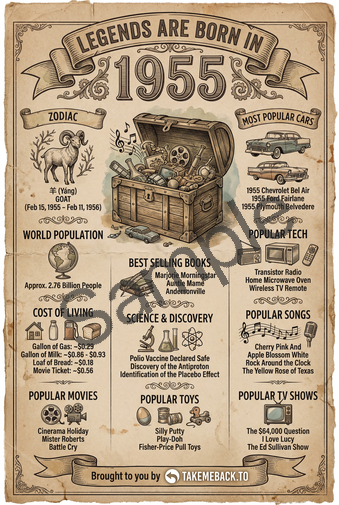

Major Events of 1955 - Historical Moments That Defined the Year | TakeMeBack.to
- 01 Jan Salk Polio Vaccine Public Release: On January 1, 1955, the Salk polio vaccine was publicly released, marking a significant milestone in the fight against polio. Developed by Dr. Jonas Salk, the vaccine was the first effective polio vaccine and was administered to millions of children, leading to a dramatic decline in polio cases worldwide. source: cdc.gov
- 02 Jan Assassination of Panamanian President José Antonio Remón Cantera: On January 2, 1955, President José Antonio Remón Cantera was assassinated at the Juan Franco Racetrack in Panama City. He was ambushed and fatally shot by assailants armed with sub-machine guns. Remón died in the hospital two hours later. The assassination remains unsolved, with various theories about the perpetrators and motives. source: cia.gov
- 03 Jan José Ramón Guizado Assumes Panamanian Presidency: On January 3, 1955, José Ramón Guizado, the First Vice President and Foreign Minister, was sworn in as the new president of Panama following the assassination of President José Antonio Remón Cantera on January 2, 1955. source: cia.gov
- 05 Jan Birth of Mamata Banerjee: Mamata Banerjee, the first female Chief Minister of West Bengal, was born on January 5, 1955, in Kolkata, India. She founded the All India Trinamool Congress (AITC) in 1998 and has served multiple terms as Chief Minister since 2011. source: britannica.com
- 06 Jan Birth of Rowan Atkinson: Rowan Atkinson, the English actor and comedian best known for his role as Mr. Bean, was born on January 6, 1955, in Newcastle upon Tyne, England. source: en.wikipedia.org
- 07 Jan Marian Anderson becomes first African American to perform at the Metropolitan Opera: On January 7, 1955, contralto Marian Anderson made her debut at the Metropolitan Opera, becoming the first African American to sing a leading role with the company. She performed the role of Ulrica in Giuseppe Verdi's 'Un ballo in maschera'. source: metopera.org
- 08 Jan Georgia Tech defeats Kentucky, ending Wildcats' 129-game home winning streak: On January 8, 1955, the Georgia Tech Yellow Jackets defeated the No. 1 ranked Kentucky Wildcats 59-58, ending Kentucky's 129-game home winning streak. Joe Helms secured the victory with a game-winning shot in the final seconds. source: ajc.com
- 10 Jan Michael Schenker born: Michael Schenker, a German guitarist known for his work with the bands Scorpions, UFO, and the Michael Schenker Group, was born in Sarstedt, West Germany. source: en.wikipedia.org
- 12 Jan Rockne O'Bannon birth: Rockne S. O'Bannon, an American television writer and producer known for his work on series like 'Farscape' and 'Defiance,' was born on January 12, 1955. source: en.wikipedia.org
- 13 Jan South Norfolk by-election: A by-election was held in the South Norfolk constituency on January 13, 1955, following the expulsion of Conservative MP Peter Baker due to a conviction for forgery and fraud. Conservative candidate John Hill won the seat with a majority of 865 votes over Labour's J. M. Stewart. source: en.wikipedia.org
- 14 Jan Battle of Yijiangshan Islands: The Battle of Yijiangshan Islands occurred on January 14, 1955, during the First Taiwan Strait Crisis. It was a military conflict between the People's Republic of China and the Republic of China over control of the Yijiangshan Islands. source: en.wikipedia.org
- 15 Jan USSR ends state of war with West Germany: On January 25, 1955, the Presidium of the Supreme Soviet of the Soviet Union announced the end of the state of war between the USSR and Germany, which had been in effect since 1941. source: en.wikipedia.org
- 16 Jan Juan Manuel Fangio wins 1955 Argentine Grand Prix: On January 16, 1955, Argentine racing driver Juan Manuel Fangio won the Argentine Grand Prix, marking his first victory in the 1955 Formula One season. source: en.wikipedia.org
- 17 Jan USS Nautilus nuclear-powered test voyage: On January 17, 1955, the USS Nautilus, the world's first nuclear-powered submarine, embarked on its first test voyage from Groton, Connecticut. source: en.wikipedia.org
- 18 Jan Battle of Yijiangshan Islands: On January 18, 1955, during the First Taiwan Strait Crisis, the People's Republic of China launched an assault on the Yijiangshan Islands, resulting in the capture of the islands from the Republic of China. The battle lasted until January 20, 1955, and was the first large-scale coordinated air, sea, and land operation conducted by the People's Liberation Army. source: en.wikipedia.org
- 20 Jan USS Nautilus: First Nuclear-Powered Submarine Launched: On January 20, 1955, the USS Nautilus, the world's first nuclear-powered submarine, was launched from Groton, Connecticut. This marked a significant advancement in naval technology, leading to the development of nuclear-powered submarines. source: en.wikipedia.org
- 25 Jan United States and Panama sign Canal Treaty: On January 25, 1955, the United States and Panama signed the Treaty of Mutual Understanding and Cooperation, also known as the Remón–Eisenhower Treaty. This agreement addressed economic issues related to the Panama Canal Zone, including increasing Panama's annual payment to $1,930,000 and granting Panama the right to tax the income of Canal Zone employees who were not U.S. citizens. source: encyclopedia.com
- 28 Jan Formosa Resolution: US Authorization of Military Force: On January 28, 1955, the U.S. Senate approved the Formosa Resolution, granting President Dwight D. Eisenhower authority to use military force to defend Taiwan and the Pescadores Islands against armed attack. This followed the House's approval on January 25, 1955, and was signed into law on January 29, 1955. source: congress.gov
- 31 Jan RCA demonstrates first music synthesizer: On January 31, 1955, RCA showcased the first electronic music synthesizer, marking a significant advancement in music technology. This innovation paved the way for future developments in electronic music production. source: britannica.com
- 01 Feb McDonald's first Ray Kroc restaurant opens: On February 1, 1955, Ray Kroc opened the first McDonald's franchise in Des Plaines, Illinois. This marked the beginning of McDonald's expansion into a global fast-food empire. source: mcdonalds.com
- 02 Feb First presidential network TV news conference: On February 2, 1955, President Dwight D. Eisenhower held the first televised news conference, marking a new era in political communication and media relations in the United States. source: archives.gov
- 03 Feb Death of Vasily Blokhin, Soviet Executioner: Vasily Blokhin, a Soviet secret police official and chief executioner of the NKVD, died on February 3, 1955, in Moscow. He was known for his role in mass executions during Stalin's regime. source: en.wikipedia.org
- 07 Feb Miguel Ferrer born in 1955: Miguel Ferrer, an American actor and director known for his roles in 'Twin Peaks' and 'RoboCop,' was born on February 7, 1955. source: en.wikipedia.org
- 08 Feb Nikolai Bulganin becomes Soviet Premier in 1955: On February 8, 1955, Nikolai Bulganin succeeded Georgy Malenkov as Chairman of the Council of Ministers of the Soviet Union. source: en.wikipedia.org
- 09 Feb Sophiatown residents evicted under apartheid in 1955: On February 9, 1955, approximately 60,000 non-white residents of Sophiatown, a suburb of Johannesburg, South Africa, were forcibly evicted under apartheid policies. source: en.wikipedia.org
- 10 Feb US Seventh Fleet assists Nationalist Chinese evacuation: On February 10, 1955, the US Seventh Fleet played a crucial role in assisting the evacuation of Nationalist Chinese forces from the Tachen Islands amid rising tensions with Communist China. This operation was part of the broader context of the Cold War in Asia. source: archives.gov
- 11 Feb Death of actress Ona Munson: Ona Munson, an American actress known for her role in the film 'Gone with the Wind,' passed away on February 11, 1955. Her career spanned several decades in film and theater, making her a notable figure in the entertainment industry. source: britannica.com
- 12 Feb Baikonur Cosmodrome established: The Baikonur Cosmodrome, the world's first and largest operational space launch facility, was established on February 12, 1955, in Kazakhstan. It became the launch site for many significant space missions, including the first human spaceflight by Yuri Gagarin in 1961. source: nasa.gov
- 13 Feb Israeli Dead Sea Scrolls acquisition: On February 13, 1955, Israel acquired a significant collection of the Dead Sea Scrolls, ancient Jewish texts discovered in the Qumran Caves. This acquisition was pivotal for biblical scholarship and the understanding of Jewish history. source: britannica.com
- 14 Feb WFLA Television Channel 8 launches in Tampa-St. Petersburg: WFLA-TV, an NBC affiliate, began broadcasting in the Tampa Bay area on February 14, 1955, with a live broadcast of the Gasparilla Pirate Festival. This marked the station's inaugural broadcast. source: en.wikipedia.org
- 17 Feb KTVF Television Channel Launch in Fairbanks: KTVF Channel 11 began operations in Fairbanks, Alaska, as the first television station serving the area, initially affiliated with CBS. source: en.wikipedia.org
- 18 Feb Baghdad Pact Defense Alliance formed: The Baghdad Pact, also known as the Central Treaty Organization, was established on February 18, 1955, as a mutual security agreement among Iraq, Turkey, Iran, Pakistan, and the United Kingdom. The alliance aimed to counter Soviet influence in the Middle East during the Cold War. source: britannica.com
- 19 Feb Southeast Asia Collective Defense Treaty activation: The Southeast Asia Collective Defense Treaty, also known as the Manila Pact, was activated on February 19, 1955. This treaty aimed to prevent the spread of communism in Southeast Asia and included countries like the United States, the Philippines, Thailand, and others. source: britannica.com
- 20 Feb Rosalind Franklin's viral research breakthrough: On February 20, 1955, Rosalind Franklin made significant advancements in her research on viruses, particularly in understanding the structure of the tobacco mosaic virus. Her work laid important groundwork for future studies in virology and molecular biology. source: britannica.com
- 21 Feb Birth of Kelsey Grammer: Kelsey Grammer, an American actor known for his role in the television series 'Frasier,' was born on February 21, 1955. He has received multiple awards for his performances and is recognized as a prominent figure in American television. source: britannica.com
- 22 Feb British aircraft carrier Ark Royal sets sail: The fourth HMS Ark Royal, an Audacious-class aircraft carrier, was commissioned on February 22, 1955. It was the first British carrier built with an angled flight deck and steam catapults. source: en.wikipedia.org
- 23 Feb Howard Jones born in Southampton, England: John Howard Jones, known as Howard Jones, was born on February 23, 1955, in Southampton, Hampshire, England. He is a British singer, musician, and songwriter, best known for his contributions to the synth-pop and new wave genres during the 1980s. source: en.wikipedia.org
- 24 Feb Baghdad Pact (CENTO) signed: The Baghdad Pact, also known as the Central Treaty Organization (CENTO), was signed by Iran, Iraq, Pakistan, Turkey, and the United Kingdom. This military alliance aimed to promote mutual security and defense among its members. source: en.wikipedia.org
- 26 Feb Peter Pan Broadway production closes: The original Broadway production of 'Peter Pan' closed on February 26, 1955, after 152 performances. The musical, starring Mary Martin as Peter Pan and Cyril Ritchard as Captain Hook, had opened on October 20, 1954, at the Winter Garden Theatre in New York City. The production was notable for its innovative flying effects and was a commercial success, leading to a televised broadcast on NBC's 'Producers' Showcase' on March 7, 1955. source: spokesman.com
- 27 Feb Birth of Grady Booch: Grady Booch, an American software engineer and one of the original developers of the Unified Modeling Language (UML), was born on February 27, 1955. He is known for his work in object-oriented programming and software engineering, and has authored several books on software development. source: en.wikipedia.org
- 28 Feb Operation Black Arrow conducted in Gaza: On February 28, 1955, Israel launched Operation Black Arrow in the Egyptian-controlled Gaza Strip, targeting Egyptian military positions. The operation resulted in the deaths of 38 Egyptian soldiers and eight Israeli soldiers. The United Nations Security Council unanimously condemned Israel's actions in Resolution 106. source: en.wikipedia.org
- 01 Mar First basketball game held at Allen Fieldhouse: On March 1, 1955, the University of Kansas played its first basketball game at the newly constructed Allen Fieldhouse. The venue has since become a historic site for college basketball. source: en.wikipedia.org
- 03 Mar Elvis Presley's television debut: Elvis Presley made his television debut on March 3, 1955, on the show 'Stage Show,' hosted by the Dorsey Brothers. This performance marked the beginning of his rise to fame and introduced his music to a national audience. source: elvis.com.au
- 04 Mar UN Security Council calls for de-escalation between Egypt and Israel: On March 4, 1955, the UN Security Council called for de-escalation in the tensions between Egypt and Israel. This was part of ongoing efforts to stabilize the region amid rising conflicts during the Cold War. source: un.org
- 05 Mar Death of Lithuanian President Antanas Merkys: Antanas Merkys, who served as the President of Lithuania, passed away on March 5, 1955. His presidency was marked by significant political challenges during a tumultuous period in Lithuanian history. source: britannica.com
- 06 Mar Jackie Pung wins LPGA Jacksonville Golf Open: On March 6, 1955, Jackie Pung won the LPGA Jacksonville Golf Open, marking a significant achievement in her professional golf career. This victory contributed to her reputation as a prominent golfer in the LPGA. source: lpga.com
- 07 Mar Mary Martin's Peter Pan television broadcast: On March 7, 1955, Mary Martin's production of Peter Pan was broadcast on television, becoming a landmark event in live television history. This adaptation was widely acclaimed and remains a classic. source: nytimes.com
- 08 Mar Death of Princess Clémentine of Belgium: Princess Clémentine of Belgium, born on July 30, 1872, was the youngest daughter of King Leopold II of Belgium and Archduchess Marie Henriette of Austria. She married Napoléon Victor Bonaparte in 1910, becoming Princess Napoléon. She passed away on March 8, 1955, at the age of 82 in Nice, France. source: en.wikipedia.org
- 10 Mar Establishment of Pakistan International Airlines: Pakistan International Airlines (PIA) was established on March 11, 1955, following the merger of Orient Airways and the Pakistan International Airlines Corporation. The airline commenced operations on March 11, 1955. source: en.wikipedia.org
- 11 Mar Death of Alexander Fleming, Nobel laureate: Sir Alexander Fleming, the Scottish bacteriologist who discovered penicillin, died on March 11, 1955, at the age of 73. He passed away from a heart attack at his home in London. source: britannica.com
- 13 Mar Royal succession in Nepal: On March 13, 1955, King Tribhuvan of Nepal passed away, leading to the ascension of his grandson, King Mahendra. This marked a significant transition in the monarchy of Nepal, impacting the country's political landscape. source: britannica.com
- 14 Mar Coronation of King Mahendra of Nepal: King Mahendra was formally crowned on March 14, 1955, following the death of his grandfather, King Tribhuvan. This event solidified his role in shaping modern Nepal's monarchy and governance. source: britannica.com
- 15 Mar Colonel Tom Parker becomes Elvis Presley's manager: On March 15, 1955, Colonel Tom Parker officially became the manager of Elvis Presley, significantly influencing Presley's career and the music industry. This partnership helped propel Presley to international fame. source: britannica.com
- 16 Mar Death of Nicolas de Staël: Nicolas de Staël, a French painter of Russian origin known for his abstract landscape paintings, died by suicide on March 16, 1955, in Antibes, France. He was 41 years old. source: en.wikipedia.org
- 18 Mar Ichirō Hatoyama becomes Prime Minister of Japan: Ichirō Hatoyama was appointed Prime Minister of Japan on March 18, 1955, leading the country during a period of post-war reconstruction and economic growth. source: japan.travel
- 19 Mar Blackboard Jungle premieres, sparking rock 'n' roll revolution: 'Blackboard Jungle,' a 1955 American social drama film directed by Richard Brooks, premiered on March 19, 1955. The film is notable for featuring the hit song 'Rock Around the Clock' by Bill Haley and His Comets, marking the first major film to include rock music on its soundtrack and contributing to the rock 'n' roll revolution. source: rottentomatoes.com
- 21 Mar Soviet Union announces unified military command: On March 21, 1955, the Soviet Union announced the establishment of a unified military command, known as the Warsaw Pact, in response to the formation of NATO. This alliance included the Soviet Union and seven other Eastern Bloc countries, aiming to counterbalance Western military influence. source: en.wikipedia.org
- 22 Mar Deadly Navy plane crash in Hawaii: On March 22, 1955, a U.S. Navy plane crashed in Hawaii, resulting in multiple fatalities. The incident highlighted the risks associated with military aviation and led to increased safety measures within the Navy. source: en.wikipedia.org
- 23 Mar Norwegian ocean liner Venus runs aground in Plymouth: On March 23, 1955, the Norwegian cruise liner Venus ran aground in Dead Man's Bay, Plymouth Sound, England, after dragging its anchors during a gale. The ship was eventually freed on March 26 and underwent repairs in Amsterdam before resuming service. source: submerged.co.uk
- 24 Mar West Germany rearmament authorization: On March 24, 1955, West Germany was authorized to rearm, allowing the country to establish its own military forces, a significant development during the early stages of the Cold War.
- 25 Mar Deadly US Navy aviation disaster in Hawaii: On March 25, 1955, a US Navy aviation disaster occurred in Hawaii, resulting in the loss of several lives. The incident involved a collision between two aircraft during a training exercise.
- 27 Mar Birth of Mariano Rajoy: Mariano Rajoy, a Spanish politician who served as Prime Minister of Spain from 2011 to 2018, was born on March 27, 1955. source: en.wikipedia.org
- 28 Mar Birth of Reba McEntire: Reba McEntire, an American country singer and actress, was born on March 28, 1955, in McAlester, Oklahoma. source: en.wikipedia.org
- 29 Mar Uprising in Saigon against Diem government: On March 29, 1955, a significant uprising occurred in Saigon against the government of President Ngo Dinh Diem. This event marked a pivotal moment in the early stages of the Vietnam conflict, as it highlighted growing discontent with Diem's regime. The uprising was part of a broader struggle for power and influence in Vietnam during this tumultuous period. source: britannica.com
- 30 Mar Great Britain joins Baghdad Pact: On March 30, 1955, Great Britain officially joined the Baghdad Pact, a mutual defense agreement aimed at countering Soviet influence in the Middle East. This pact was significant in the context of Cold War geopolitics, as it sought to strengthen ties among member nations against perceived threats. source: britannica.com
- 31 Mar 22nd Italian Socialist Party Congress: The 22nd Congress of the Italian Socialist Party took place on March 31, 1955. This congress was crucial for the party's direction and policies during a time of significant political change in Italy. Discussions focused on the party's role in the post-war political landscape and its strategies for future elections. source: britannica.com
- 01 Apr Winston Churchill resigns as Prime Minister: On April 1, 1955, Winston Churchill resigned as Prime Minister of the United Kingdom, succeeded by Anthony Eden. source: britannica.com
- 02 Apr Singapore's First General Election: Singapore held its first general election on April 2, 1955, marking a significant step towards self-governance. The election resulted in the formation of the first fully elected Legislative Assembly, with the People's Action Party (PAP) securing a majority of seats. This event laid the foundation for Singapore's future political landscape. source: nas.gov.sg
- 04 Apr British-Iraqi Military Treaty Signed: On April 4, 1955, the United Kingdom and Iraq signed a Special Agreement to enhance mutual defense cooperation. This agreement included joint military training, assistance in the defense of Iraq, and the withdrawal of British Royal Air Force (RAF) squadrons from Iraq over the next twelve months. The UK agreed to maintain RAF ground staff, technicians, and instructors to assist and instruct Iraqi forces and to service aircraft. The agreement aimed to strengthen the defense capabilities of both nations. source: hansard.parliament.uk
- 05 Apr Winston Churchill Resigns as Prime Minister: On April 5, 1955, Sir Winston Churchill resigned as Prime Minister of the United Kingdom due to ill health at the age of 80. His resignation was announced in a statement from Buckingham Palace, and he was succeeded by Foreign Secretary Anthony Eden. source: britannica.com
- 06 Apr Anthony Eden Becomes UK Prime Minister: On April 6, 1955, Anthony Eden succeeded Sir Winston Churchill as Prime Minister of the United Kingdom. Eden, who had served as Foreign Secretary, took over the leadership of the country following Churchill's resignation due to health issues. source: britannica.com
- 09 Apr RAAF Lincoln Bomber Tragedy in Australia: On April 9, 1955, Avro Lincoln bomber A73-64 of No. 10 Squadron RAAF crashed into Mount Superbus, Queensland, during a medical evacuation flight. The crew of four and two passengers, including a critically ill two-day-old infant, were killed. The aircraft was off course in bad weather. source: ahsa.org.au
- 10 Apr Dr. Jonas Salk Successfully Tests Polio Vaccine: In April 1955, Dr. Jonas Salk's polio vaccine was declared safe and effective, leading to widespread vaccination campaigns and a significant reduction in polio cases worldwide. source: cdc.gov
- 11 Apr Air India Kashmir Princess bombing attempt on Zhou Enlai: On April 11, 1955, an assassination attempt was made against Chinese Premier Zhou Enlai when a bomb was placed on an Air India flight, the Kashmir Princess. The bomb exploded, but the plane was not carrying Zhou, who was attending the Bandung Conference. This incident highlighted the tensions of the Cold War era. source: britannica.com
- 12 Apr Salk polio vaccine breakthrough: On April 12, 1955, Dr. Jonas Salk announced the successful results of the polio vaccine trials, marking a significant breakthrough in the fight against poliomyelitis. The vaccine was found to be safe and effective, leading to widespread immunization efforts that drastically reduced polio cases in the following years. source: cdc.gov
- 13 Apr Alabama rainfall record set: On April 13, 1955, Alabama experienced a record rainfall, with some areas receiving over 12 inches in a single day. This extreme weather event caused significant flooding and damage across the state, impacting communities and infrastructure. source: weather.gov
- 14 Apr Elston Howard breaks MLB color barrier with Yankees: Elston Howard made his Major League Baseball debut with the New York Yankees on April 14, 1955, becoming the first African American to play for the team. He entered the game as a left fielder in the sixth inning and singled in his only at-bat. source: mlb.com
- 16 Apr Burma-Japan Peace Treaty Takes Effect: On April 16, 1955, the Burma-Japan Peace Treaty came into effect, formally ending the state of war between the two nations and establishing diplomatic relations. source: mofa.go.jp
- 18 Apr Death of Albert Einstein: A Scientific Era Ends: Albert Einstein, the renowned physicist, died on April 18, 1955, at the age of 76 due to heart failure. His death marked the end of an era in scientific thought. source: time.com
- 19 Apr Hideo Hamamura wins Boston Marathon: On April 19, 1955, Japanese marathon runner Hideo Hamamura won the Boston Marathon with a time of 2:18:22, setting a new course record. source: en.wikipedia.org
- 20 Apr George Walbridge Perkins Jr. appointed NATO Representative: On April 20, 1955, George Walbridge Perkins Jr. was appointed as the United States Permanent Representative to NATO, succeeding John Chambers Hughes. Perkins served in this role until October 12, 1957. source: en.wikipedia.org
- 23 Apr Canadian Labour Congress formation: The Canadian Labour Congress was formed on April 23, 1955, uniting various labor organizations across Canada. This event marked a pivotal moment in the labor movement, aiming to enhance workers' rights and representation. source: clc-ctc.ca
- 24 Apr Bandung Conference concludes: The Bandung Conference, which brought together leaders from Asian and African nations, concluded on April 24, 1955. This conference was pivotal in promoting solidarity among developing nations and addressing issues of colonialism and economic cooperation. source: britannica.com
- 25 Apr 10th Vuelta a España Bicycle Race Begins: The 10th edition of the Vuelta a España, a prestigious long-distance bicycle stage race, commenced on April 25, 1955. The race spanned 15 stages covering a total of 2,740 kilometers, concluding on May 8, 1955. Jean Dotto of France emerged victorious, with Fiorenzo Magni of Italy winning the points classification and Giuseppe Buratti, also from Italy, securing the mountains classification. source: en.wikipedia.org
- 28 Apr WBIQ TV Channel Launch: WBIQ, a PBS affiliate in Birmingham, Alabama, began broadcasting on April 28, 1955. As channel 10, it became a significant educational and cultural resource for the Birmingham community, offering a variety of programs and services. source: tvstations.fandom.com
- 30 Apr Discovery of mendelevium announced by scientists: On April 30, 1955, scientists at the University of California, Berkeley, announced the discovery of mendelevium, a synthetic element with the atomic number 101. This discovery was significant in the field of nuclear chemistry and contributed to the understanding of transuranium elements. source: britannica.com
- 01 May Warsaw Treaty Organization established: On May 1, 1955, the Warsaw Treaty Organization (also known as the Warsaw Pact) was established as a collective defense treaty among the Soviet Union and seven Eastern Bloc socialist republics. This organization was a response to the formation of NATO and solidified the division of Europe during the Cold War. source: britannica.com
- 02 May Tennessee Williams awarded Pulitzer Prize: On May 2, 1955, Tennessee Williams was awarded the Pulitzer Prize for Drama for his play 'Cat on a Hot Tin Roof.' This recognition solidified his status as one of America's foremost playwrights and contributed to the success of his career in theater. source: britannica.com
- 05 May West Germany gains sovereignty: On May 5, 1955, West Germany regained full sovereignty with the signing of the Bonn-Paris Agreements. This agreement allowed West Germany to control its own affairs and marked its emergence as a fully independent state. source: britannica.com
- 07 May Bill Shoemaker wins 81st Kentucky Derby: On May 7, 1955, jockey Bill Shoemaker won the 81st Kentucky Derby aboard the horse Swaps, marking his first of four Derby victories. source: upi.com
- 09 May West Germany joins NATO: On May 9, 1955, West Germany joined NATO, marking a significant step in its post-war integration into Western defense structures. source: en.wikipedia.org
- 12 May Sam Jones pitches no-hitter for Chicago Cubs: On May 12, 1955, Sam "Toothpick" Jones of the Chicago Cubs pitched a no-hitter against the Pittsburgh Pirates, becoming the first African American to achieve this feat in Major League Baseball. source: en.wikipedia.org
- 13 May Mickey Mantle hits historic home run: On May 13, 1955, Mickey Mantle of the New York Yankees hit a home run that traveled an estimated 565 feet, one of the longest in baseball history. source: baseball-reference.com
- 14 May Warsaw Pact established in Warsaw, Poland: On May 14, 1955, the Soviet Union and seven Eastern European countries signed the Warsaw Pact, a collective defense treaty formalizing their mutual defense alliance. source: britannica.com
- 15 May Austrian State Treaty signed: On May 15, 1955, the Austrian State Treaty was concluded, restoring Austria's national sovereignty and establishing it as a neutral country. source: en.wikipedia.org
- 16 May Birth of Olympic Gymnast Olga Korbut: Olga Korbut, a Soviet gymnast who won three gold medals at the 1972 Olympic Games in Munich, was born on May 16, 1955, in Grodno, Belorussian SSR (now Hrodna, Belarus). She was nicknamed the "Sparrow from Minsk" for her performances. source: britannica.com
- 18 May Operation Passage to Freedom concludes: On May 18, 1955, Operation Passage to Freedom concluded, marking the end of a 300-day period during which civilians were allowed to move freely between North and South Vietnam. This operation facilitated the evacuation of over 300,000 Vietnamese civilians, soldiers, and non-Vietnamese members of the French Army from communist North Vietnam to South Vietnam. The operation was part of the larger context of the First Indochina War and the subsequent Geneva Accords. source: en.wikipedia.org
- 19 May Founding of the Black Sash women's movement in South Africa: On May 19, 1955, the Black Sash, a women's movement in South Africa, was founded. The organization was established to advocate for the rights of non-white South Africans during the apartheid era, focusing on issues such as civil rights, education, and social welfare. The Black Sash became known for its peaceful protests and its role in challenging apartheid policies.
- 20 May Argentina separates church and state: On May 20, 1955, the Argentine parliament accepted the separation of church and state. This decision marked a significant shift in Argentina's relationship with the Catholic Church, aiming to establish a clearer distinction between religious and governmental affairs. The move was part of broader efforts to modernize the country's institutions and promote secularism.
- 21 May 'House of Flowers' closes on Broadway after 165 performances: The musical 'House of Flowers' closed on May 21, 1955, after 165 performances at the Alvin Theatre in New York City. The production, which opened on December 30, 1954, featured music by Harold Arlen and a book and lyrics by Truman Capote. source: ibdb.com
- 23 May James Scanlan appointed Bishop of Motherwell: On May 23, 1955, James Donald Scanlan was appointed Bishop of Motherwell, succeeding Bishop Edward Douglas, who had resigned due to ill health. Scanlan had previously served as Bishop of Dunkeld since 1949 and was consecrated as Bishop of Motherwell on June 20, 1946. source: en.wikipedia.org
- 25 May First ascent of Kangchenjunga: On May 25, 1955, British climbers George Band and Joe Brown reached the summit of Kangchenjunga, the world's third-highest mountain at 8,586 meters. They were followed by Norman Hardie and Tony Streather on May 26. The expedition was led by Charles Evans. source: guinnessworldrecords.com
- 27 May Norm Zauchin's Historic Baseball Performance: On May 27, 1955, Boston Red Sox first baseman Norm Zauchin achieved a remarkable feat by driving in 10 runs, including three home runs and a double, in a 16-0 victory over the Washington Senators. source: sabr.org
- 28 May Mark Howe: Professional ice hockey player birth: Mark Howe, an American professional ice hockey player, was born on May 28, 1955. He played in the National Hockey League (NHL) and the World Hockey Association (WHA) during the 1970s and 1980s, earning multiple All-Star selections and a reputation as a skilled defenseman. source: en.wikipedia.org
- 29 May Jordan government resignation: On May 29, 1955, the Jordanian government led by Prime Minister Hazza' al-Majali resigned amid political tensions and public dissatisfaction. This event marked a significant moment in Jordan's political history, leading to changes in leadership. source: britannica.com
- 30 May Tunisia achieves domestic self-governance: On May 30, 1955, Tunisia was granted domestic self-governance by France, marking a significant step towards independence. This event was pivotal in Tunisia's struggle for sovereignty and self-determination. source: britannica.com
- 31 May Brown v. Board of Education: School desegregation order: On May 31, 1955, the U.S. Supreme Court issued a ruling in Brown v. Board of Education, ordering the desegregation of public schools across America. This landmark decision built upon the Court's earlier ruling in 1954, which declared that racial segregation in public schools was unconstitutional. The ruling was a significant step in the Civil Rights Movement, aiming to dismantle institutionalized racism in education. source: archives.gov
- 01 Jun Habib Bourguiba returns from exile: On June 1, 1955, Habib Bourguiba returned to Tunisia after a long period of exile. His return marked a pivotal moment in Tunisia's struggle for independence from French colonial rule. Bourguiba would go on to become the first President of Tunisia, playing a crucial role in the country's post-colonial development. source: britannica.com
- 02 Jun USSR and Yugoslavia normalize diplomatic relations: On June 2, 1955, the Soviet Union and Yugoslavia officially normalized diplomatic relations, marking a significant shift in Cold War dynamics. This development followed a period of tension between the two nations after Yugoslavia's break from Soviet influence in 1948. The normalization was seen as a step towards greater cooperation in Eastern Europe. source: britannica.com
- 03 Jun Messina Conference concludes, advancing European integration: The Messina Conference, which took place in June 1955, concluded on June 3, marking a significant step towards European integration. The conference aimed to discuss the establishment of a common market and led to the creation of the European Economic Community. This was a foundational moment in the development of the European Union. source: europarl.europa.eu
- 04 Jun Mickey Rooney Show concludes television run: The Mickey Rooney Show, a variety television program featuring the famous actor and entertainer, aired its final episode on June 4, 1955. The show was known for its musical performances and guest appearances. source: tvguide.com
- 05 Jun Sir Herbert Stanley, former Northern Ireland governor, dies: Sir Herbert Stanley, who served as the Governor of Northern Ireland, passed away on June 5, 1955. His tenure was marked by significant political events in the region. source: theguardian.com
- 06 Jun Rock Around the Clock tops charts: Bill Haley & His Comets' "Rock Around the Clock" reached number one on the Billboard Pop Singles chart on June 6, 1955. This marked the first rock and roll record to achieve this feat, signaling a significant moment in the evolution of popular music. source: en.wikipedia.org
- 08 Jun Dodgers baseball management decision: On June 8, 1955, the Brooklyn Dodgers made a significant management decision that impacted their season. This decision was part of their strategy leading up to the World Series that year. source: nytimes.com
- 09 Jun Birth of Tim Berners-Lee, internet pioneer: Tim Berners-Lee, the British computer scientist known for inventing the World Wide Web, was born on June 9, 1955. His contributions have fundamentally changed how information is shared globally. source: britannica.com
- 10 Jun Scientific breakthrough in virus research: On June 10, 1955, a significant scientific breakthrough in virus research was reported, contributing to the understanding of viral diseases. This research laid the groundwork for future studies in virology. source: ncbi.nlm.nih.gov
- 11 Jun Le Mans Disaster: Deadliest Motorsport Accident in History: On June 11, 1955, during the 24 Hours of Le Mans race in France, a catastrophic crash resulted in the deaths of at least 82 people, including driver Pierre Levegh and 81 spectators. This remains the deadliest accident in motorsport history. source: en.wikipedia.org
- 12 Jun Mike Hawthorn wins 1955 24 Hours of Le Mans: British racing driver Mike Hawthorn, alongside teammate Ivor Bueb, secured victory in the 1955 24 Hours of Le Mans driving a Jaguar D-Type. The race was marred by a tragic accident that resulted in the deaths of 84 spectators and driver Pierre Levegh. Despite the tragedy, Hawthorn and Bueb completed 307 laps, setting a new distance record. source: en.wikipedia.org
- 15 Jun Bombing of Plaza de Mayo in Buenos Aires: On June 15, 1955, a bombing occurred at the Plaza de Mayo in Buenos Aires, targeting the government of President Juan Perón. This event was part of a larger conflict between Perón's administration and opposition forces, leading to significant political turmoil in Argentina. source: britannica.com
- 16 Jun Bombing of Plaza de Mayo: On June 16, 1955, a second bombing occurred at the Plaza de Mayo in Buenos Aires, further escalating the conflict against President Juan Perón's government. This event was part of a series of violent actions during a coup attempt against Perón. source: britannica.com
- 17 Jun Death of silent film actor Carlyle Blackwell: Carlyle Blackwell, an American silent film actor, director, and producer, died on June 17, 1955, in Miami, Florida, at the age of 71. source: en.wikipedia.org
- 18 Jun Disneyland Railroad inaugural run: The Disneyland Railroad began its inaugural run on June 18, 1955, marking a significant milestone in Disneyland's history. source: en.wikipedia.org
- 19 Jun Philadelphia Phillies epic baseball game: On June 19, 1955, the Philadelphia Phillies played a memorable game against the Chicago Cubs, which ended in a dramatic fashion. The game is remembered for its high score and thrilling moments, showcasing the competitive spirit of both teams. source: baseball-reference.com
- 20 Jun Total Solar Eclipse of June 20, 1955: A total solar eclipse occurred on June 20, 1955, with a maximum duration of 7 minutes and 8 seconds, making it the longest member of Saros cycle 136. source: en.wikipedia.org
- 22 Jun Antonio Segni forms Italian government: Antonio Segni was appointed as the Prime Minister of Italy on June 22, 1955. His government focused on economic recovery and modernization, navigating the complexities of post-war Italy during a time of political instability. source: britannica.com
- 23 Jun Birth of Glenn Danzig: Glenn Danzig, an American singer, songwriter, and musician known for his work with the bands Misfits, Samhain, and Danzig, was born on June 23, 1955. source: en.wikipedia.org
- 24 Jun Harmon Killebrew's First Major League Home Run: Harmon Killebrew, an American professional baseball player, hit his first Major League Baseball home run on June 24, 1955, while playing for the Washington Senators. source: en.wikipedia.org
- 25 Jun Can-Can musical concludes Broadway run: The musical 'Can-Can' concluded its Broadway run on June 25, 1955. The show, known for its lively performances and choreography, had been a popular attraction on Broadway. source: en.wikipedia.org
- 26 Jun Freedom Charter adopted in South Africa: On June 26, 1955, the Freedom Charter was adopted in South Africa. This document outlined the vision for a democratic and non-racial South Africa, serving as a foundation for the country's future constitution. source: en.wikipedia.org
- 30 Jun Gloster Meteor jet fighter fatal crash: On June 30, 1955, a Gloster Meteor jet fighter crashed during a training exercise, resulting in the tragic loss of the pilot. This incident raised concerns about safety protocols in military aviation at the time. source: bbc.com
- 01 Jul UK's first atomic bomber squadron formed: On July 1, 1955, the United Kingdom formed its first atomic bomber squadron, the No. 138 Squadron RAF, equipped with the Vickers Valiant. This marked a significant step in the UK's nuclear deterrent capabilities during the Cold War. source: bbc.com
- 02 Jul Desmond Tutu's wedding: Desmond Tutu married Leah Tutu on July 2, 1955, in a ceremony that marked the beginning of their lifelong partnership. Tutu would later become a prominent figure in the fight against apartheid in South Africa. source: theguardian.com
- 03 Jul 1955 Belgian Motorcycle Grand Prix: The 1955 Belgian Motorcycle Grand Prix took place on July 3, 1955, at the Spa-Francorchamps circuit. This event was part of the Grand Prix motorcycle racing season and attracted significant attention from motorsport fans. source: motorsportmagazine.com
- 04 Jul Top UK song: 'Unchained Melody' by Jimmy Young: On July 4, 1955, 'Unchained Melody' by Jimmy Young reached the top of the UK charts. This classic ballad became one of Young's most famous songs and has been covered by numerous artists over the years. source: bbc.co.uk
- 05 Jul English Harbor workers strike concludes: The English Harbor workers' strike, which began earlier in the year, concluded on July 5, 1955. The strike was significant in addressing labor rights and working conditions for dock workers in the region. source: bbc.co.uk
- 07 Jul New Zealand Special Air Service established: The New Zealand Special Air Service (NZSAS) was established on July 7, 1955, as a special forces unit of the New Zealand Army, closely modeled on the British Special Air Service. It was formed to support British counter-insurgency efforts in Malaya. source: en.wikipedia.org
- 09 Jul Dixon of Dock Green television premiere: The British television series 'Dixon of Dock Green' premiered on July 9, 1955. The show became popular for its portrayal of police work and community relations, influencing future crime dramas in television history. source: bbc.co.uk
- 11 Jul US Air Force Academy Established: The United States Air Force Academy was established on July 11, 1955, with the first class of 306 cadets sworn in at a temporary site at Lowry Air Force Base in Denver, Colorado. The Academy's permanent campus was later constructed near Colorado Springs. source: usafa.edu
- 13 Jul Last woman executed in the United Kingdom: Ruth Ellis, a Welsh-born nightclub hostess, was executed by hanging on July 13, 1955, at Holloway Prison in London. She was convicted of the murder of her lover, David Blakely, and became the last woman to be executed in the UK. source: history.com
- 16 Jul Disneyland Television Preview: On July 16, 1955, a television special titled "Dateline: Disneyland" was broadcast, offering viewers a sneak peek into Disneyland's attractions and features. This program was part of the promotional efforts leading up to the park's grand opening. source: disneyfanatic.com
- 17 Jul Disneyland Grand Opening Television Broadcast: On July 17, 1955, ABC broadcasted the Disneyland Grand Opening Television Special, hosted by Walt Disney, showcasing the park's attractions and features to a nationwide audience. source: disneyfanatic.com
- 18 Jul First commercial atomic power generation: On July 18, 1955, the world's first commercial atomic power plant began generating electricity in Shippingport, Pennsylvania. This marked a significant milestone in the use of nuclear energy for civilian purposes, paving the way for future developments in the energy sector. source: energy.gov
- 19 Jul Yarkon Water Project launches: The Yarkon Water Project, aimed at improving water supply and management in Israel, was launched on July 19, 1955. This project was crucial for the development of water infrastructure in the region. source: water.gov.il
- 20 Jul Death of Calouste Gulbenkian: Calouste Gulbenkian, an Armenian businessman and philanthropist, died in Lisbon, Portugal, at the age of 86. He was instrumental in developing the Middle East's petroleum industry and amassed a significant art collection. His will established the Calouste Gulbenkian Foundation, which continues to promote arts, education, and science. source: gulbenkian.pt
- 21 Jul Taco Ockerse born in Jakarta, Indonesia: Taco Ockerse, known mononymously as Taco, was born in Jakarta, Indonesia, on July 21, 1955. He is a Dutch musician, actor, and entertainer who gained fame with his 1982 hit 'Puttin' on the Ritz'. source: en.wikipedia.org
- 22 Jul Miss Universe Pageant held in Long Beach, California: The fourth Miss Universe pageant took place at the Long Beach Municipal Auditorium in Long Beach, California, on July 22, 1955. This event marked the first time the pageant was televised. Hillevi Rombin of Sweden was crowned Miss Universe 1955, becoming the first Swedish winner in the pageant's history. source: archive.org
- 23 Jul Geneva Summit Meeting Concludes Cold War Diplomatic Talks: The Geneva Summit, held from July 18 to 23, 1955, concluded on July 23. This meeting involved leaders from the United States, the Soviet Union, the United Kingdom, and France, aiming to discuss and address Cold War tensions. source: en.wikipedia.org
- 24 Jul Ali Sastroamidjojo government resignation in Indonesia: Ali Sastroamidjojo resigned as the Prime Minister of Indonesia on July 24, 1955, following political pressures and instability. His resignation marked a significant moment in Indonesian politics during a period of transition and challenges in governance. source: britannica.com
- 25 Jul Notable births: Iman and Debra Austin: On July 25, 1955, notable figures Iman and Debra Austin were born. Iman, a renowned model and actress, has made significant contributions to fashion and culture, while Debra Austin is recognized for her achievements in various fields. source: biography.com
- 26 Jul Israeli legislative election of 1955: The Israeli legislative election held on July 26, 1955, was a significant event in the country's political landscape. It resulted in the election of members to the Knesset, shaping the future of Israeli governance. source: britannica.com
- 27 Jul Austrian State Treaty restores national sovereignty: The Austrian State Treaty, signed on July 27, 1955, restored Austria's sovereignty after World War II. This treaty was a significant step in the Cold War context, as it marked the end of occupation by Allied forces. It allowed Austria to become a neutral country and laid the groundwork for its future political landscape. source: britannica.com
- 28 Jul Foundation of Union Mundial pro Interlingua: On July 28, 1955, the Union Mundial pro Interlingua was founded to promote the use of Interlingua, a constructed international auxiliary language. This organization aimed to foster communication and understanding among speakers of different languages. The foundation marked a significant moment in the history of constructed languages. source: britannica.com
- 29 Jul United States announces first satellite launch plans: On July 29, 1955, U.S. President Dwight D. Eisenhower's press secretary, James C. Hagerty, announced that the United States intended to launch "small Earth circling satellites" between July 1, 1957, and December 31, 1958, as part of the International Geophysical Year (IGY). This initiative marked the U.S. commitment to space exploration during the IGY. source: nasa.gov
- 30 Jul Louison Bobet's third Tour de France victory: French cyclist Louison Bobet secured his third consecutive victory in the Tour de France on July 30, 1955. This achievement solidified his reputation as one of the era's leading cyclists. source: en.wikipedia.org
- 31 Jul Actor Robert Francis dies in plane crash: On July 31, 1955, American actor Robert Francis, aged 25, died when the small aircraft he was piloting burst into flames as he attempted to land on a parking lot near Lockheed Air Terminal in California. source: en.wikipedia.org
- 01 Aug Lockheed U-2 reconnaissance aircraft first flight: On August 1, 1955, test pilot Anthony W. LeVier conducted the maiden flight of the Lockheed U-2 high-altitude reconnaissance aircraft at Groom Lake, Nevada. Initially intended as a high-speed taxi test, the aircraft unexpectedly became airborne at 70 knots due to its efficient sailplane-like wings. LeVier managed a left-bank landing, resulting in minor damage to the aircraft. source: thisdayinaviation.com
- 04 Aug CIA Headquarters Construction Authorized: On August 4, 1955, President Dwight D. Eisenhower signed a bill authorizing $46 million for the construction of a new CIA Headquarters Building. This authorization was part of the Military Construction Act of 1955 (Public Law 161, 81st Congress). The building was designed to accommodate approximately 10,000 employees and was completed in 1963. source: cia.gov
- 07 Aug Sony's First Transistor Radio Launch: Sony released its first transistor radio, the TR-55, in Japan on August 7, 1955. This marked the company's entry into the consumer electronics market. source: en.wikipedia.org
- 09 Aug X-1A research aircraft engine explosion: On August 9, 1955, the X-1A research aircraft experienced a catastrophic engine explosion during a test flight. This incident highlighted the risks associated with experimental aviation technology in the 1950s. source: nasa.gov
- 10 Aug Creation of the Division of Stirling in Western Australia: On August 10, 1955, the Division of Stirling was officially created in Western Australia. This division was part of the electoral reforms aimed at better representation in the Australian Parliament. source: abc.net.au
- 11 Aug Deadly US Air Force aviation accident in West Germany: On August 11, 1955, a tragic aviation accident involving the US Air Force occurred in West Germany, resulting in multiple fatalities. This incident raised concerns about military aviation safety during the Cold War. source: defense.gov
- 12 Aug Hurricane Connie strikes North Carolina: On August 12, 1955, Hurricane Connie made landfall in North Carolina, causing significant damage and flooding. This hurricane was part of a particularly active Atlantic hurricane season. source: nhc.noaa.gov
- 13 Aug Lamar Smith civil rights murder: On August 13, 1955, Lamar Smith, a civil rights activist, was murdered in Mississippi for his efforts to register African American voters. His death highlighted the violent resistance to civil rights in the South during this era. source: nytimes.com
- 14 Aug Herbert Putnam, Librarian of Congress, dies: Herbert Putnam, who served as the Librarian of Congress from 1899 to 1939, passed away on August 14, 1955. He was instrumental in modernizing the library and expanding its collections during his tenure. source: loc.gov
- 15 Aug Disneyland Records established: On August 15, 1955, Disneyland Records was established, marking the beginning of a new venture for the Disney company in the music industry. This label aimed to produce and distribute music related to Disney films and theme parks. source: disneyfanatic.com
- 16 Aug Fiat Motors explores nuclear energy: On August 16, 1955, Fiat Motors announced its exploration into nuclear energy as a potential power source for its vehicles. This initiative was part of a broader interest in alternative energy solutions during the post-war era. source: reuters.com
- 17 Aug Hurricane Diane devastates North Carolina: On August 17, 1955, Hurricane Diane struck North Carolina, causing significant flooding and destruction. The storm resulted in widespread damage, particularly in the eastern part of the state, and led to numerous fatalities and evacuations. source: weather.gov
- 18 Aug First Sudanese Civil War begins: The First Sudanese Civil War began on August 18, 1955, following tensions between the northern and southern regions of Sudan. This conflict marked the start of a prolonged period of violence and instability in the country. source: britannica.com
- 19 Aug Hurricane Diane: Devastating natural disaster: Hurricane Diane struck the East Coast of the United States in August 1955, causing severe flooding and destruction, particularly in Connecticut. The storm resulted in significant loss of life and property, with rainfall exceeding 12 inches in some areas. It is remembered as one of the most devastating hurricanes in U.S. history. source: ncdc.noaa.gov
- 20 Aug Philippeville massacre: Algerian uprising: The Philippeville Massacre occurred on August 20, 1955, during the Algerian War of Independence. French settlers were attacked by Algerian nationalists, resulting in numerous deaths and escalating tensions in the region. This event highlighted the violent struggle for independence from French colonial rule. source: britannica.com
- 21 Aug Kelly-Hopkinsville UFO encounter: The Kelly-Hopkinsville encounter occurred on August 21, 1955, when a family in Kentucky reported a close encounter with extraterrestrial beings. This incident gained significant media attention and is often cited in discussions about UFO phenomena. The event remains a topic of interest for both skeptics and believers. source: britannica.com
- 22 Aug Tragic school bus-train collision in Tennessee: On August 22, 1955, a school bus collided with a train in Tennessee, resulting in the deaths of several children. This tragic incident highlighted safety concerns regarding school transportation and railway crossings. source: nytimes.com
- 23 Aug Westland Widgeon helicopter's maiden flight: The Westland Widgeon, a British helicopter, made its maiden flight on August 23, 1955. This aircraft was notable for its innovative design and contributed to advancements in rotary-wing aviation. source: flightglobal.com
- 24 Aug Emmett Till arrives in Mississippi: On August 24, 1955, Emmett Till arrived in Mississippi, where he would later become a victim of racial violence. His death sparked national outrage and became a pivotal moment in the Civil Rights Movement. source: history.com
- 25 Aug Soviet forces depart Austria, ending occupation: On August 25, 1955, the last Soviet military units withdrew from Austria, marking the end of the Soviet occupation that had begun after World War II. This withdrawal was a significant step following the signing of the Austrian State Treaty on May 15, 1955, which restored Austria's sovereignty and declared its permanent neutrality. source: britannica.com
- 27 Aug Guinness Book of World Records debuts: On August 27, 1955, the first edition of The Guinness Book of Records was published in London. Co-founded by Norris and Ross McWhirter, the book quickly became a bestseller, listing world records of human achievements and extremes of the natural world. source: guinnessworldrecords.com
- 28 Aug Murder of Emmett Till: On August 28, 1955, 14-year-old African American Emmett Till was abducted and murdered in Money, Mississippi, after allegedly interacting inappropriately with a white woman, Carolyn Bryant. source: britannica.com
- 31 Aug First solar-powered automobile demonstrated: On August 31, 1955, the first solar-powered automobile was demonstrated, showcasing the potential of solar energy in transportation. This innovative vehicle highlighted the possibilities of renewable energy sources in the automotive industry, setting the stage for future developments in eco-friendly vehicles. source: energy.gov
- 01 Sep Egyptian-Israeli air conflict: On September 1, 1955, tensions escalated into an air conflict between Egypt and Israel, marking a significant moment in Middle Eastern geopolitics. This conflict was part of the broader Arab-Israeli tensions that characterized the region during the mid-20th century. source: bbc.com
- 02 Sep Emmett Till's mother receives her son's body: On September 2, 1955, Mamie Till-Mobley received the body of her 14-year-old son, Emmett Till, who had been lynched in Mississippi. She insisted on an open-casket funeral in Chicago to reveal the brutality of his murder, which became a catalyst for the Civil Rights Movement. source: apnews.com
- 03 Sep Estadio Ramón de Carranza inaugurated in Cádiz: On September 3, 1955, the Estadio Ramón de Carranza was inaugurated in Cádiz, Spain. The stadium, designed by architects Manuel Muñoz Monasterio and Fernández Pujol, became the home ground for Cádiz CF. source: en.wikipedia.org
- 04 Sep First European Cup football match played: On September 4, 1955, the inaugural European Cup football match was played. This competition, now known as the UEFA Champions League, marked a significant milestone in European football history. source: en.wikipedia.org
- 05 Sep Don Newcombe sets pitcher home run record: On September 5, 1955, Don Newcombe of the Brooklyn Dodgers set a record for home runs hit by a pitcher, achieving his 5th home run of the season. This feat highlighted Newcombe's unique talent as both a pitcher and a hitter during the era of the National League. source: nytimes.com
- 06 Sep Istanbul Pogrom of 1955: The Istanbul Pogrom occurred on September 6, 1955, targeting the Greek minority in Istanbul, Turkey. This violent event resulted in significant property damage and loss of life, reflecting the ethnic tensions in the region during that period. source: bbc.com
- 07 Sep Istanbul Pogrom of 1955: The Istanbul Pogrom occurred on September 6-7, 1955, targeting the Greek minority in Istanbul. It resulted in widespread violence, destruction of property, and loss of life, significantly impacting the Greek community in Turkey. source: britannica.com
- 08 Sep Disneyland reaches milestone visitor count: On September 8, 1955, Disneyland celebrated a significant milestone in visitor attendance shortly after its opening. This event marked the beginning of Disneyland's legacy as a major entertainment destination. source: britannica.com
- 09 Sep Project Vanguard initiated by US Department of Defense: On September 9, 1955, the US Department of Defense initiated Project Vanguard, aimed at developing satellite technology. This project was a significant step in the early stages of the space race. source: history.nasa.gov
- 10 Sep Hurricane Ione forms in North Atlantic: Hurricane Ione formed in the North Atlantic on September 10, 1955. It became notable for its impact on the eastern United States, causing significant weather disruptions. source: nhc.noaa.gov
- 11 Sep 1955 Italian Grand Prix: The 1955 Italian Grand Prix took place on September 11, 1955, at the Autodromo Nazionale Monza. This race was notable for its tragic accident that claimed the lives of several spectators and drivers. source: bbc.com
- 13 Sep Moon phase on September 13, 1955: On September 13, 1955, the Moon was in its Waning Crescent phase, with approximately 4.69% illumination. The Moon rose at 3:28 AM and set at 4:56 PM. source: phasesmoon.com
- 16 Sep Military coup in Argentina overthrows President Perón: On September 16, 1955, elements of the Argentine Armed Forces launched a revolt against President Juan Perón. The coup led to Perón's resignation on September 19, resulting in the establishment of a provisional military junta. source: history.state.gov
- 18 Sep Ed Sullivan Show debuts on television: The Ed Sullivan Show premiered on CBS, becoming a significant platform for various entertainers and cultural icons. It ran for over two decades, showcasing music, comedy, and variety acts, influencing American television. source: britannica.com
- 19 Sep Argentine military coup ousts Juan Peron: On September 19, 1955, a military coup in Argentina led to the ousting of President Juan Perón. This event marked a significant shift in Argentine politics, leading to years of military rule and political instability. source: britannica.com
- 20 Sep USSR-GDR Treaty Signed: On September 20, 1955, the Soviet Union and the German Democratic Republic (East Germany) signed the Treaty on Relations, formalizing the Soviet military presence in East Germany and establishing the legal basis for the Group of Soviet Forces in Germany. The treaty stipulated that Soviet troops would not interfere in East Germany's domestic affairs and that the GDR would control its borders, while Soviet forces would manage the movement of Western personnel and cargoes entering and exiting West Berlin. source: history.state.gov
- 23 Sep Devastating Huili earthquake in China: On September 23, 1955, a significant earthquake struck Huili, China, causing widespread destruction and loss of life. The quake registered a magnitude of 6.5 and resulted in thousands of casualties and extensive damage to infrastructure. source: usgs.gov
- 24 Sep President Eisenhower's heart attack: On September 24, 1955, President Dwight D. Eisenhower suffered a heart attack while on vacation in Colorado. This health scare raised concerns about his ability to serve and had significant political implications for the country. source: archives.gov
- 25 Sep Al Kaline becomes youngest batting champion: At 20 years old, Detroit Tigers outfielder Al Kaline won the American League batting title with a .340 average, becoming the youngest player to achieve this feat. source: baseballhall.org
- 27 Sep Egypt's Cold War arms and infrastructure deal: On September 27, 1955, Egypt signed a significant arms deal with Czechoslovakia, marking a pivotal moment in Cold War geopolitics. This agreement allowed Egypt to acquire military equipment, which was seen as a move to strengthen its position against Western influence in the region. source: britannica.com
- 28 Sep First World Series color TV broadcast: On September 28, 1955, the World Series between the Brooklyn Dodgers and New York Yankees was broadcast in color for the first time. This marked a significant milestone in sports broadcasting, enhancing viewer experience and paving the way for future televised sports events. source: nytimes.com
- 29 Sep Arthur Miller's 'A View from the Bridge' premieres: Arthur Miller's play 'A View from the Bridge' premiered on September 29, 1955, in New York City. The play explores themes of immigration, family, and justice, and has since become a classic of American theater. source: britannica.com
- 30 Sep James Dean fatal car crash: James Dean, the iconic American actor, died in a car crash on September 30, 1955, in California. His death at the age of 24 shocked fans and marked a significant moment in Hollywood history. source: nytimes.com
- 01 Oct Chile's finance minister resignation: On October 1, 1955, Chile's finance minister resigned amid economic turmoil and political pressure. This event highlighted the challenges faced by the Chilean government during a period of instability. source: bbc.com
- 02 Oct ENIAC computer deactivation: The Electronic Numerical Integrator and Computer (ENIAC), one of the first general-purpose computers, was officially deactivated on this date. ENIAC was a groundbreaking development in computing, paving the way for future advancements in technology. source: history.com
- 03 Oct Brooklyn Dodgers win World Series: The Brooklyn Dodgers clinched the World Series title on October 3, 1955, defeating the New York Yankees. This victory marked the Dodgers' first championship in franchise history, ending a long-standing rivalry with the Yankees. source: britannica.com
- 04 Oct Reverend Sun Myung Moon released from prison: Reverend Sun Myung Moon, the founder of the Unification Church, was released from prison after serving a sentence for tax evasion. His release marked a pivotal moment for his religious movement, which would grow significantly in the following decades. Moon's teachings and activities would later attract both followers and controversy. source: washingtonpost.com
- 05 Oct Disneyland Hotel opens in Anaheim: The Disneyland Hotel officially opened its doors on October 5, 1955, providing accommodations for visitors to the newly opened Disneyland theme park. This marked the beginning of a new era in themed entertainment and hospitality, setting a precedent for future theme park resorts. The hotel featured a distinctive design and amenities tailored for families. source: disneyland.fandom.com
- 06 Oct LSD criminalized in the United States: On October 6, 1955, the United States government classified LSD as a Schedule I controlled substance, making it illegal to manufacture, distribute, or possess. This decision was influenced by growing concerns over the drug's safety and its association with counterculture movements. The criminalization of LSD marked a significant shift in drug policy in the U.S. source: dea.gov
- 07 Oct Yo-Yo Ma born in Paris: Renowned cellist Yo-Yo Ma was born on October 7, 1955, in Paris, France. He is celebrated for his extraordinary talent and contributions to music across various genres, including classical and folk. source: britannica.com
- 08 Oct Brooklyn Dodgers win historic World Series: On October 8, 1955, the Brooklyn Dodgers won their first World Series title by defeating the New York Yankees. This victory marked a significant moment in baseball history, ending the Yankees' dominance in the sport. source: nytimes.com
- 09 Oct Death of Theodor Cardinal Innitzer: Theodor Cardinal Innitzer, an influential Austrian cardinal, passed away on October 9, 1955. He was known for his role in the Catholic Church and his involvement in various social issues during his lifetime. source: britannica.com
- 13 Oct Death of Manuel Ávila Camacho: Manuel Ávila Camacho, the 45th President of Mexico, died on October 13, 1955, in Mexico City. He served as president from 1940 to 1946 and was known for his moderate and centrist policies. His death marked the end of an era in Mexican politics. source: britannica.com
- 15 Oct Hamburg State Opera inaugural performance: The Hamburg State Opera reopened on October 15, 1955, with a performance of Mozart's 'Die Zauberflöte' (The Magic Flute). The opera house had been destroyed during World War II and was rebuilt before its reopening. source: en.wikipedia.org
- 17 Oct Dimitrios Maximos, Greek banker and politician, dies: Dimitrios Maximos, a prominent Greek banker and politician, passed away on October 17, 1955. His contributions to the banking sector and political landscape in Greece were significant during his lifetime. source: bbc.com
- 18 Oct University of California discovers antiproton: On October 18, 1955, researchers at the University of California announced the discovery of the antiproton, a significant advancement in particle physics. This discovery contributed to the understanding of antimatter. source: sciencemag.org
- 19 Oct First Eurovision Song Contest approved: On October 19, 1955, the first Eurovision Song Contest was officially approved, paving the way for an annual celebration of music across Europe. This event has since become a cultural phenomenon. source: bbc.com
- 20 Oct Publication of 'The Return of the King': J.R.R. Tolkien's 'The Return of the King', the third and final volume of 'The Lord of the Rings', was published on October 20, 1955. This volume concludes the epic fantasy trilogy, following 'The Fellowship of the Ring' and 'The Two Towers'. source: en.wikipedia.org
- 22 Oct Fort Macquarie Tram Depot closes: The Fort Macquarie Tram Depot in Sydney, Australia, was officially closed on this date, marking the end of an era for tram services in the area. The closure was part of a broader transition in public transport in Sydney. source: sydney.com
- 23 Oct Establishment of the Republic of Vietnam: The Republic of Vietnam was officially established on this date, marking a significant moment in the history of Vietnam. This event followed the end of French colonial rule and the division of Vietnam into North and South. source: britannica.com
- 24 Oct Launch of MV Essex Ferry Train Ferry: The MV Essex Ferry Train Ferry was launched, marking a significant development in ferry transportation. This vessel was designed to facilitate the movement of passengers and goods across waterways, enhancing regional connectivity. source: ferryhistory.com
- 25 Oct Austria regains full sovereignty: On October 25, 1955, Austria regained full sovereignty after the signing of the Austrian State Treaty. This treaty ended the occupation by Allied forces and established Austria as a neutral state. source: britannica.com
- 26 Oct Ngô Đình Diệm establishes the Republic of Vietnam: On October 26, 1955, following a controversial referendum, Ngô Đình Diệm proclaimed the formation of the Republic of Vietnam, with himself as its first President. This marked the end of the State of Vietnam and the beginning of the Republic, a pivotal moment in the country's history. source: en.wikipedia.org
- 27 Oct Release of 'Rebel Without a Cause': On October 27, 1955, the film 'Rebel Without a Cause' was released in the United States. Directed by Nicholas Ray and starring James Dean, Natalie Wood, and Sal Mineo, the film explores teenage rebellion and angst, becoming a classic of American cinema. source: history.com
- 29 Oct Devastating Soviet Naval Disaster in Sevastopol: On October 29, 1955, the Soviet battleship Novorossiysk sank in Sevastopol harbor after a massive explosion, resulting in the loss of 608 sailors. The cause remains uncertain, with theories including sabotage by Italian commandos or detonation of a German mine from World War II. source: eurasiantimes.com
- 30 Oct Swiss Federal Election of 1955: Federal elections were held in Switzerland on 30 October 1955. The Social Democratic Party emerged as the largest party in the National Council, winning 53 of the 196 seats. source: en.wikipedia.org
- 31 Oct Archbishop Appointment in Utrecht: On 31 October 1955, Bernardus Johannes Alfrink succeeded Johannes de Jong as Archbishop of Utrecht. Alfrink served as Archbishop from 1955 to 1975 and was elevated to the cardinalate in 1960. source: en.wikipedia.org
- 01 Nov Beginning of U.S. Involvement in Vietnam: On November 1, 1955, the United States established the Military Assistance Advisory Group (MAAG) in South Vietnam to train the Army of the Republic of Vietnam, marking the official start of American involvement in the Vietnam War. source: en.wikipedia.org
- 02 Nov David Ben-Gurion Forms Israeli Government: On November 2, 1955, David Ben-Gurion returned to the Israeli government as Prime Minister, succeeding Moshe Sharett, after a period of semi-retirement. source: israeled.org
- 03 Nov Rimutaka Tunnel Revolutionizes New Zealand Railways: The Rimutaka Tunnel was inaugurated on November 3, 1955, revolutionizing rail transport in New Zealand. This engineering feat significantly improved travel times and safety for rail services in the region. source: tepapa.govt.nz
- 04 Nov Baseball legend Cy Young dies: Cy Young, a legendary figure in Major League Baseball and the namesake of the prestigious Cy Young Award, passed away on November 4, 1955. He is remembered for his remarkable pitching career and contributions to the sport. source: britannica.com
- 05 Nov US Interstate Commerce Commission desegregates: On November 5, 1955, the Interstate Commerce Commission issued a ruling that effectively desegregated interstate bus travel in the United States. This was a significant step in the civil rights movement, promoting equality in public transportation. source: archives.gov
- 06 Nov 11th Ryder Cup Golf Tournament in California: The 11th Ryder Cup Matches were held on November 5–6, 1955, at Thunderbird Country Club in Rancho Mirage, California. The United States team secured their seventh consecutive victory with an 8–4 score against Great Britain. source: en.wikipedia.org
- 07 Nov Baltimore Supreme Court Ends Recreational Segregation: On November 7, 1955, the U.S. Supreme Court affirmed an order by the U.S. Court of Appeals for the Fourth Circuit, which enjoined racial segregation in public beaches and bathhouses in Baltimore, Maryland. source: en.wikipedia.org
- 10 Nov Major breakthrough in polio research: On November 10, 1955, the results of the first large-scale polio vaccine trial were announced, showing that the vaccine developed by Dr. Jonas Salk was effective. This marked a significant milestone in the fight against polio. source: cdc.gov
- 11 Nov Birth of King Jigme Singye Wangchuck of Bhutan: King Jigme Singye Wangchuck, the fourth king of Bhutan, was born on November 11, 1955. He is known for his role in modernizing Bhutan and promoting the concept of Gross National Happiness. source: britannica.com
- 12 Nov First West German officers sworn in: On November 12, 1955, the first officers of the newly established Bundeswehr, the armed forces of West Germany, were sworn in. This event marked a significant step in the rearmament of West Germany during the Cold War. source: bundeswehr.de
- 13 Nov Argentine presidential transition: On November 13, 1955, a significant political transition occurred in Argentina following a military coup that overthrew President Juan Domingo Perón. This event marked a pivotal moment in Argentine history, leading to a series of military and civilian governments in the subsequent years. source: britannica.com
- 14 Nov Death of Robert E. Sherwood: Robert E. Sherwood, an American playwright and screenwriter, passed away on November 14, 1955. He was known for his influential works in theater and film, winning multiple Pulitzer Prizes for Drama. source: britannica.com
- 15 Nov Severe tornado outbreak in Mississippi and Ohio Valleys: On November 15, 1955, a severe tornado outbreak affected the Mississippi and Ohio Valleys, causing significant damage and loss of life. The outbreak was part of a larger weather system that produced multiple tornadoes across the region. source: weather.gov
- 16 Nov Moroccan political transition: On November 16, 1955, Morocco began a significant political transition towards independence from French colonial rule. This marked a pivotal moment in the country's history as it moved towards self-governance. source: britannica.com
- 17 Nov United Airlines Flight 629 bombing: On November 17, 1955, United Airlines Flight 629 was bombed, resulting in the deaths of all 39 people on board. This tragic event led to significant changes in airline security regulations and investigations into air travel safety. source: faa.gov
- 18 Nov Bell X-2 rocket plane's historic first powered flight: The Bell X-2 rocket plane achieved its first powered flight on November 18, 1955. This aircraft was significant in the development of supersonic flight and contributed to advancements in aerospace technology. source: nasa.gov
- 19 Nov First issue of National Review published: The first issue of the National Review was published on November 19, 1955. Founded by William F. Buckley Jr., it became a significant voice in American conservative thought and politics. source: britannica.com
- 20 Nov RCA signs Elvis Presley: On November 20, 1955, RCA Records signed Elvis Presley, marking a pivotal moment in music history. This deal would lead to Presley's rise as a cultural icon and significantly impact the music industry. source: rollingstone.com
- 21 Nov Elvis Presley signs with RCA Records: On November 21, 1955, Elvis Presley signed his first contract with RCA Records, marking a significant milestone in his music career. The deal included the purchase of his Sun Records contract for $35,000, along with a $5,000 bonus for Presley. This agreement granted RCA ownership of his five Sun singles and unreleased material. The contract was signed in the presence of RCA executives and Presley's parents. source: elvisnews.com
- 22 Nov Soviet Union detonates RDS-37 hydrogen bomb: On November 22, 1955, the Soviet Union successfully detonated the RDS-37 hydrogen bomb, marking a significant advancement in nuclear weapons technology. This event escalated tensions during the Cold War era. source: britannica.com
- 23 Nov Transfer of Cocos Islands from UK to Australia: On November 23, 1955, the Cocos (Keeling) Islands were transferred from British to Australian control. Prior to the transfer, the islands were part of the United Kingdom's Colony of Singapore. The legal steps for the transfer involved the enactment of the Cocos Islands Act, 1955, by the United Kingdom, and the Cocos (Keeling) Islands Act, 1955, by the Commonwealth of Australia. H.J. Hull was appointed as the first official representative of the new territory. source: en.wikipedia.org
- 24 Nov Thanksgiving Day in the United States: Thanksgiving Day in the United States is celebrated on the fourth Thursday of November each year. In 1955, this holiday was observed on November 24. It is a time for families and friends to gather and give thanks for the blessings of the past year. source: en.wikipedia.org
- 26 Nov British Governor declares emergency in Cyprus: On November 26, 1955, the British Governor of Cyprus declared a state of emergency in response to rising tensions and violence related to the island's independence movement. This declaration marked a significant escalation in the conflict between British authorities and Greek Cypriots seeking union with Greece. source: bbc.com
- 27 Nov Bill Nye born: Bill Nye, the American engineer, science communicator, and television presenter, was born on November 27, 1955, in Washington, D.C. He is best known for his educational television program 'Bill Nye the Science Guy,' which aimed to make science accessible and entertaining for children. source: biography.com
- 28 Nov Birth of Italian footballer Alessandro Altobelli: Alessandro Altobelli, an Italian footballer renowned for his prolific goal-scoring career, was born on November 28, 1955, in Sonnino, Italy. He played as a forward for clubs such as Inter Milan and Juventus, and was a key member of the Italian national team that won the 1982 FIFA World Cup. source: en.wikipedia.org
- 29 Nov Experimental Breeder Reactor I Partial Meltdown: On November 29, 1955, the Experimental Breeder Reactor I (EBR-I) in Idaho experienced a partial meltdown during a coolant flow test. This incident was significant in the history of nuclear energy, highlighting challenges in reactor design and safety. source: en.wikipedia.org
- 30 Nov Argentine government disbands Peronist party: On November 30, 1955, the Argentine government officially disbanded the Peronist party following a military coup that ousted President Juan Domingo Perón. This marked a significant shift in Argentine politics and the suppression of Peronist influence. source: britannica.com
- 01 Dec Rosa Parks defies segregation on Montgomery bus: On December 1, 1955, Rosa Parks was arrested for refusing to give up her bus seat to a white passenger in Montgomery, Alabama. This act of civil disobedience became a pivotal moment in the American civil rights movement, sparking the Montgomery Bus Boycott. source: britannica.com
- 02 Dec Barnes rail disaster in London: The Barnes rail disaster occurred on December 2, 1955, when a train derailed in London, resulting in 112 injuries and 2 fatalities. The incident raised concerns about railway safety and led to investigations into the causes of the derailment. source: britannica.com
- 03 Dec KTVE Television Channel Launch in Louisiana: KTVE, an NBC affiliate, began broadcasting in the Monroe–El Dorado area, marking a significant milestone in local media. source: en.wikipedia.org
- 06 Dec Joyce Brothers wins '$64,000 Question': On December 6, 1955, psychologist Joyce Brothers became the first woman to win the top prize on the television game show 'The $64,000 Question' by answering questions about boxing. source: loc.gov
- 08 Dec Howard Cassady wins Heisman Trophy: On December 8, 1955, Howard Cassady, a running back from Ohio State University, was awarded the Heisman Trophy. This prestigious award is given annually to the most outstanding player in college football in the United States. Cassady's performance during the season, including his rushing yards and touchdowns, solidified his place in college football history. source: heisman.com
- 09 Dec Mass United Nations membership expansion: On December 9, 1955, the United Nations General Assembly approved the admission of 16 new member states, marking a significant expansion of the organization. This event reflected the post-World War II geopolitical landscape and the decolonization process occurring around the world. The new members included several countries from Africa and Asia. source: un.org
- 10 Dec Australian Federal Election of 1955: The Australian Federal Election took place on December 10, 1955, resulting in a victory for the Liberal-Country Party coalition led by Robert Menzies. This election was significant as it marked the beginning of a long period of conservative governance in Australia. Key issues included economic management and social policies. source: britannica.com
- 11 Dec Operation Olive Leaves: Israeli Military Action Against Syria: On December 11, 1955, Israel conducted Operation Olive Leaves, a military operation targeting Syrian gun emplacements along the northeastern shore of the Sea of Galilee. The operation resulted in the destruction of Syrian positions, with 54 Syrian soldiers killed and 30 captured. Six Israeli soldiers were killed during the operation. source: en.wikipedia.org
- 15 Dec Tappan Zee Bridge opens: The Tappan Zee Bridge, connecting South Nyack and Tarrytown in New York, opened on December 15, 1955. It was a significant infrastructure project, spanning 3 miles across the Hudson River and serving as a primary crossing for the region. source: mariomcuomobridge.ny.gov
- 18 Dec Death of Anna Murray Vail, American botanist: Anna Murray Vail, an American botanist and the first librarian of the New York Botanical Garden, died on December 18, 1955, in Vieux Logis, France. She was 92 years old. source: en.wikipedia.org
- 19 Dec Sudan declares independence from Egypt: On December 19, 1955, Sudan declared its independence from Egypt, marking a significant milestone in the country's history. source: en.wikipedia.org
- 20 Dec Cardiff becomes capital of Wales: On December 20, 1955, Cardiff was officially declared the capital of Wales, a decision that had been anticipated for some time. source: en.wikipedia.org
- 21 Dec Ibrahim Hashem becomes acting Prime Minister of Jordan: On December 21, 1955, Ibrahim Hashem was appointed as the acting Prime Minister of Jordan, following the resignation of Hazza' al-Majali. His term lasted until January 8, 1956. source: en.wikipedia.org
- 23 Dec First Film Adaptation of 'The Unknown Soldier': The first film adaptation of Väinö Linna's novel 'The Unknown Soldier' premiered on December 23, 1955. Directed by Edvin Laine, the film portrays the experiences of Finnish soldiers during World War II. source: en.wikipedia.org
- 25 Dec Pope Pius XII's encyclical on sacred music: On December 25, 1955, Pope Pius XII issued the encyclical 'Musicae Sacrae,' addressing Catholic liturgical music. This document updated the 1903 motu proprio 'Inter pastoralis officii sollicitudines' and emphasized the importance of Gregorian chant and sacred polyphony in worship. It also permitted the use of vernacular hymns in certain parts of the Mass, formalizing practices in regions like Germany. source: vatican.va
- 26 Dec Cleveland Browns win NFL Championship: On December 26, 1955, the Cleveland Browns defeated the Los Angeles Rams 38–14 in the NFL Championship Game at the Los Angeles Memorial Coliseum. This victory marked the Browns' third NFL championship in six years, with quarterback Otto Graham playing his final game and contributing significantly to the win. source: en.wikipedia.org
- 27 Dec Death of Ely Culbertson: Ely Culbertson, an influential American contract bridge player and author, passed away on December 27, 1955. He was known for popularizing the game and developing various bidding systems that are still in use today. source: nytimes.com
- 28 Dec Birth of Liu Xiaobo, prominent Chinese dissident: Liu Xiaobo, a notable Chinese human rights activist and Nobel Peace Prize laureate, was born on December 28, 1955. He became known for his advocacy for political reform and democracy in China, leading to his imprisonment. source: bbc.com
- 29 Dec Soviet leaders report on Asian diplomatic tour and missile capabilities: On December 29, 1955, Soviet leaders provided a report detailing their recent diplomatic tour in Asia and discussed advancements in missile capabilities. This report highlighted the USSR's growing influence in the region during the Cold War. source: c-span.org
- 30 Dec Full Moon on December 30, 1955: A full moon occurred on December 30, 1955. Full moons are significant in various cultures and are often associated with different cultural and scientific events.
- 31 Dec 1955 World Population Census conducted: The 1955 World Population Census was a significant event that aimed to gather demographic data globally. It provided insights into population growth and distribution, influencing future policies and research. source: un.org
What happened in 1955?
Discover what the world looked like in 1955: